Fewer Unknowns, Not Fewer Risks
"Trump's stated objectives have kept shifting. And Iran's leaders remain standing." — The Financial Times, narrated by John Reed. The Islamic Republic has form on duration. In May 1982, Iran pushed the last Iraqi soldier off its territory. The war should have ended. Instead, Khomeini invaded Iraq. Saddam proposed multiple ceasefires. Iran rejected all of them and fought six more years until Khomeini called the eventual settlement "drinking a poisoned chalice." Mojtaba Khamenei's first public statement called for continued closure of the Strait, new fronts, and avenging martyrs. The FT outlined five ways this war could end. None of them includes a ceasefire initiated by Tehran.
"Doubt is not a pleasant condition, but certainty is absurd." — Voltaire. The best trades happen before the picture is complete. Waiting for clarity means paying for it.
"Bear Stearns is fine." — Jim Cramer, March 11, 2008. Six days later, it was sold for $2 a share. This week, JPMorgan marked down private credit portfolios in software loans. Morgan Stanley capped redemptions after investors tried to pull 10.9% of a fund's capital. The IEA released 400 million barrels of reserves, the largest coordinated release in history, and the market shrugged. When the marks start moving and the exits start closing, the problem is not the asset. It is the structure.
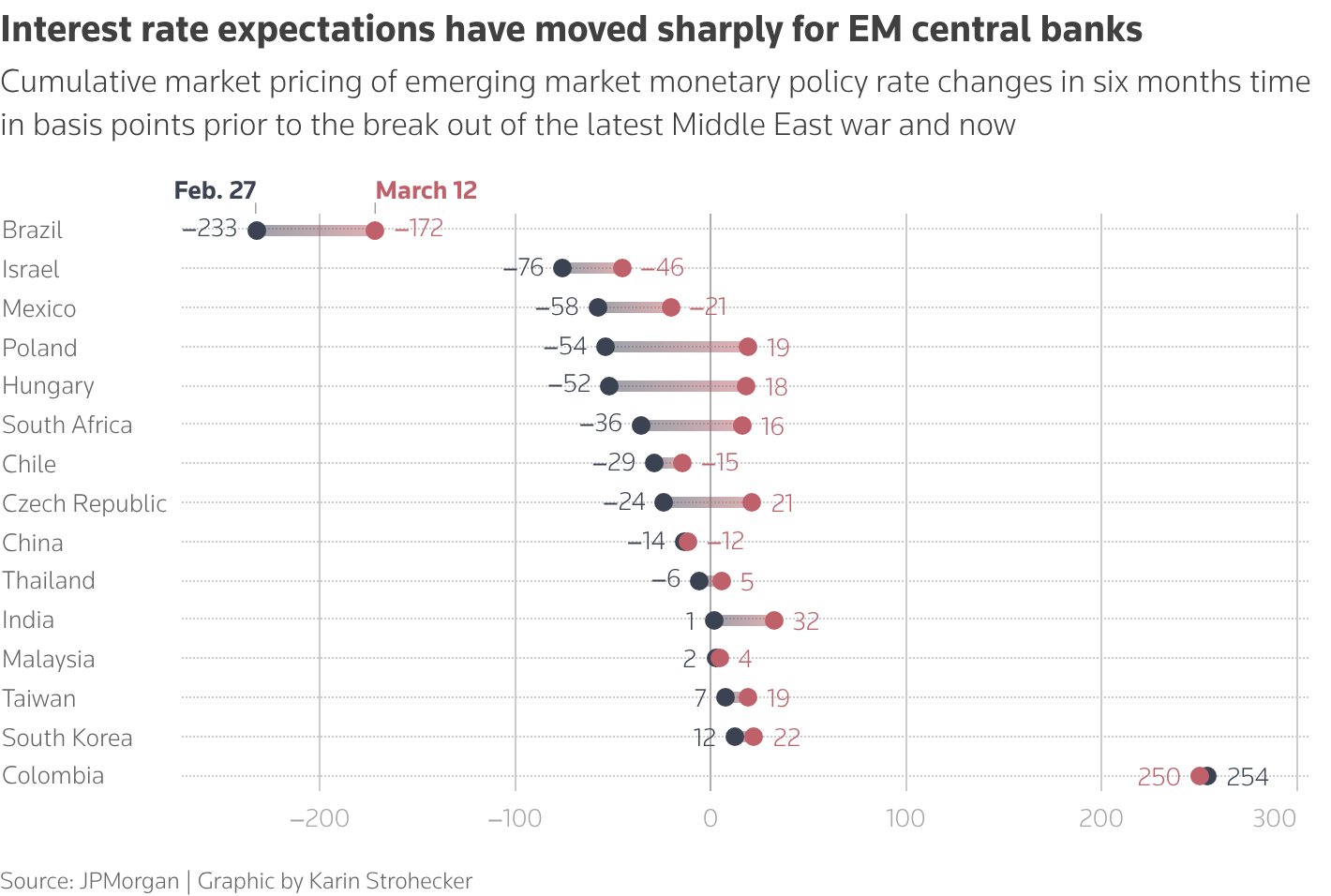
The war repriced every emerging market curve in two weeks. Brazil went from -233bp of cuts priced to -172bp. But the real story is the rightward drift across the board. India moved from flat to +32bp of hikes. South Korea from +12bp to +22bp. Thailand barely budged. Malaysia added 2bp. The market is not panicking uniformly. It is sorting.
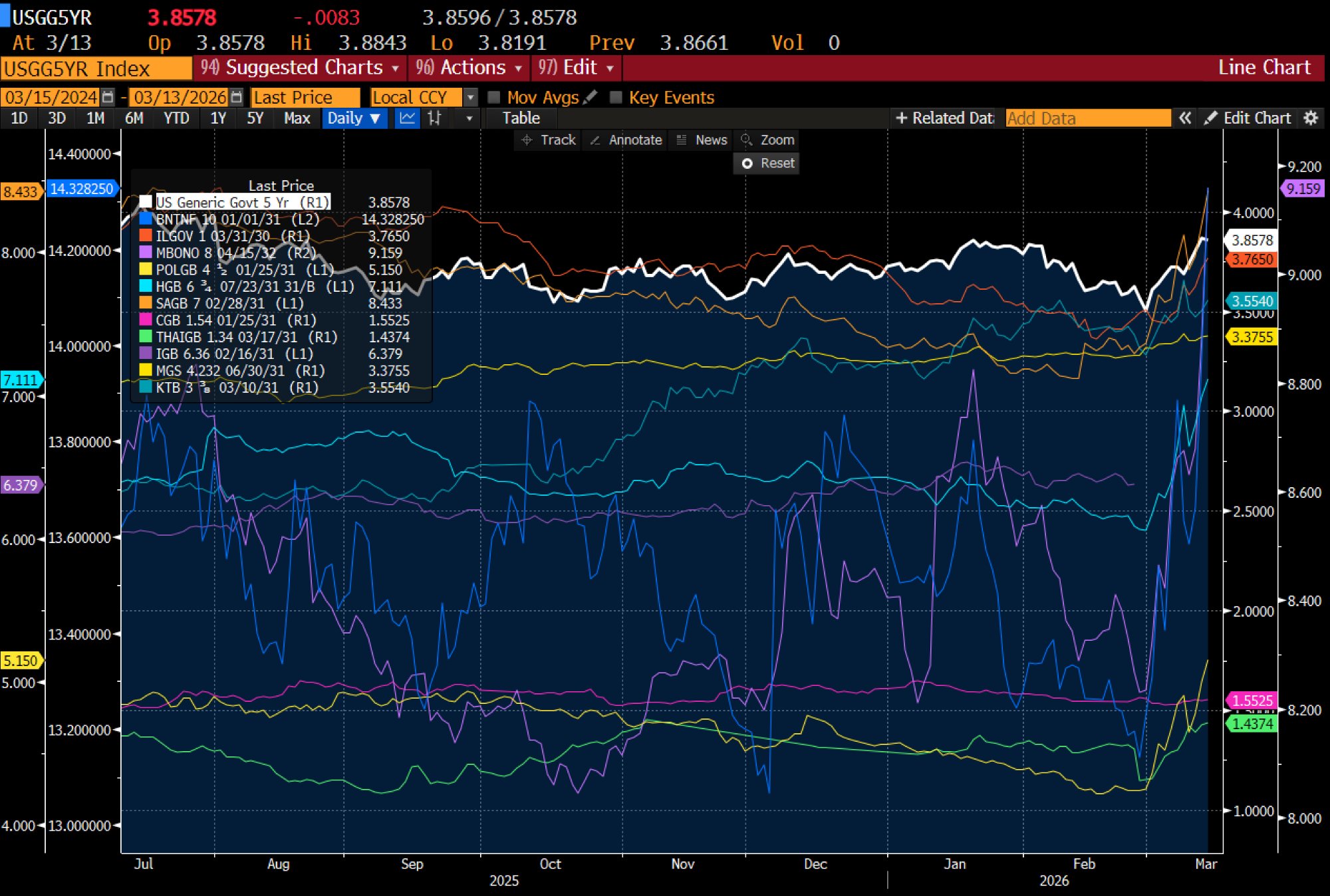
A noisy chart, but the noise is the point. White line is the US 5Y at 3.86%. Brazil (blue) trades at 14.33% in its own universe. The spike on the right side of the chart is the war. Israel (red) jumped to 9.16%, the sharpest single move on the screen. Mexico and South Africa repriced hard. But look at Asia. Malaysia (yellow) at 3.38%, Korea (light blue) at 3.55%, Thailand (green) at 1.44%, and China (pink) at 1.55%. These curves were already pricing out rate cuts before Hormuz closed. The incremental move is smaller because the adjustment started earlier.
What is the plan this week?
The war enters its third week. Every Sunday, I sit down feeling bearish. Every Monday and Tuesday, I am surprised by the resilience of financial markets, especially in FX. And by Thursday or Friday, the reality catches up. This week will be the same.
There are uncertainties, and there are things we can rule out. By deduction, we play with fewer unknowns.
Iran will not initiate a ceasefire. Mojtaba Khamenei's psychology and his position as Supreme Leader rule out anything close to surrender. His first public statement called for continued closure of the Strait, new fronts, and avenging martyrs. His father fought Iraq for six years after the last Iraqi soldier left Iranian soil. The son is not going to fold in week three.
Trump's sunk cost is now substantial. A TACO (Trump Arranges Ceasefire Option - new) is very tough but not impossible. He meets Xi in Beijing from March 31 to April 2. He called Putin last week. Both conversations will be about more than Iran, but Iran will be in every room.
China kicks off the week with February retail sales and industrial production. Back to work after the Two Sessions, which set a GDP target of 4.5-5.0%. The real economy read arrives in the middle of an energy crisis that could undermine the target before Q2 starts.
Then the central banks. Eight G10 central banks meet this week. The RBA on Tuesday, with futures pricing in about a 50% chance of a hike. The Fed on Wednesday is the main event, where Powell has to navigate stagflation risk without validating either side. Governor Miran is expected to dissent in favour of a cut. The dot plot will indicate whether the committee views the oil shock as transitory or structural. The ECB, BOJ, and BOE are all on Thursday. Lagarde faces the sharpest policy dilemma in the G10. The BOJ holds, but USDJPY at 160 approaches intervention territory. Switzerland, Sweden, the Czech Republic, and Taiwan round out the week. The risk is that only one bank moves (Australia) and the rest deliver hawkish holds. But hawkish holds are not neutral. They confirm that the easing cycle is dead.
In FX, the dollar is still attracting flight-to-safety flows, but treasury and mortgage yields are edging higher. USDJPY at 160 is a sore point. In July 2024, these levels triggered intervention checks. But with the world upside down and Japan getting hit among the hardest in this crisis, the Nikkei and local financial stability might take priority. An intervention call looks unlikely when the bigger fire is elsewhere.
Five thousand Marines are heading to the Persian Gulf. It is the closest this conflict has come to boots on the ground. Trump called on the world to send troops and ships to escort tankers through Hormuz. No allied escorts have materialised. The IRGC navy commander warned that any passage would be met with missiles and suicide drones. Trump is raising the stakes with the stability of global markets as collateral. While approvals are dropping and less talked about possible implication for Trump with the new release of Epstein files.
US banks are already breaking their uptrend line and underperforming the S&P 500. JPMorgan and Morgan Stanley reports unwinding. When the marks start moving and the exits start closing, the problem is not the asset. It is the structure.
The plan this week. The RBA on Tuesday is a forced move for the market. If they hike, AUD reprices and every other central bank's hold looks more fragile. USDJPY at 160 is a good short on my risk-off view. Intervention risk is rising and the BOJ meets Thursday. Oil volatility is the key variable. It could change the entire picture whichever way it swings. And keep one eye on Bab el-Mandab. If the Houthis activate, the Red Sea closes too and Saudi Arabia's pipeline workaround to Yanbu becomes worthless.
What Did I Learn Last Week?
Mar 9: China Feb CPI +1.3% vs +0.8% expected, strongest since Jan 2023. F1 opened in Melbourne. Baden-Württemberg voted. Trump said war will be over "very soon." South Korea Q4 GDP revised to -0.2% q/q but beat. Aramco reportedly cutting production at two fields.
Mar 10: China Jan-Feb exports +21.8% vs +7.1% expected. Surplus $213.6B, a record. Semiconductor exports +66.5%. US exports -11% but ASEAN +29.4%, EU +27.8%. The export machine is not slowing, it is redirecting. Oracle beat Q3, raised FY27 guidance, RPO above half a trillion. TSM Feb revenue +22% y/y. Volkswagen cutting 50K jobs by 2030. Existing home sales beat at 4.09M. BofA card spending K-shaped and widening.
Mar 11: CPI in line at 2.4%. Iran official: "Get ready for $200 oil." IEA confirmed 400M barrel reserve release, the largest in history. Market shrugged. JPMorgan marking down private credit portfolios in software loans. SLB cut Q1 guidance on Middle East disruption. 10-year auction drew 4.217%, weakest demand in months.
Mar 12: Mojtaba Khamenei's first public statement: continued Hormuz closure, new fronts, avenge martyrs. IRGC threatened to burn regional energy infrastructure. Two Sessions concluded. India CPI 2.9%, within band but oil changes everything. Housing starts beat at 1.487M. 30-year auction tailed at 4.871% vs 4.750% prior. Morgan Stanley capped private credit redemptions. Adobe CEO stepping down. Meta delayed new AI model.
Mar 13: Core PCE 3.1% as expected, but Q4 GDP revised down to 0.7% annualised. UMich sentiment 55.5, half surveyed before war. Inflation expectations fell to 3.4% one-year. JOLTS beat at 6.95M. Atlanta Fed raised Q1 GDP to 2.7% on trade data. Canada lost 83.9K jobs. France and Italy opened talks with Iran for Hormuz passage. India got two tankers through the Strait. Sovereign ratings reviewed for Saudi and Qatar the same week their governments reviewed force majeure. Trump invoked Defense Production Act.
What To Look Out For Next Week
Mon Mar 16: China February retail sales and industrial production. The real economy read after the Two Sessions growth target of 4.5-5%. Lunar New Year distortions in both directions. Canada CPI. US Empire State manufacturing, industrial production.
Tue Mar 17: RBA rate decision. Futures pricing about 50% chance of a hike. If they hike, AUD is the standout central bank story of the week. Indonesia rate decision. Germany ZEW survey, the first sentiment read since Hormuz shut down. St Patrick's Day at the White House with Irish Taoiseach. March Madness begins.
Wed Mar 18: Fed holds at 3.50-3.75%. The statement and dot plot are the main event. Before the war, swaps priced 60bp of cuts this year. Now less than 22bp. Powell has to navigate stagflation risk without validating either side. Governor Miran expected to dissent in favour of a cut. Bank of Canada decision. Brazil rate decision, Selic expected to be cut from 15.0%. Eurozone CPI. US PPI, factory orders, durable goods, TIC flows. Quadruple data day.
Thu Mar 19: ECB holds. Lagarde faces the sharpest policy dilemma in the G10. BOJ holds. USDJPY near 160. BOE holds at 3.75%. UK labour market data same morning. Switzerland, Sweden, Czech Republic, Taiwan, Ukraine rate decisions. Eight G10 central banks in one week. EU leaders summit in Brussels. PM Takaichi meets Trump in Washington. Eid al-Fitr. Malaysia trade and CPI.
Fri Mar 20: China loan prime rates. Russia rate decision. Quadruple witching in US markets. Spring equinox. Sovereign rating reviews: EU, Poland, Ireland.
All week: Earnings: Tencent and Alibaba (China consumer and cloud, OpenClaw AI agent adoption), Micron (memory pricing and AI demand read), FedEx (logistics under oil stress), Prudential and AIA (Asian insurance), Hon Hai/Foxconn (AI hardware, record full-year sales), CK Hutchison (Panama ports dispute), Cosco Shipping (navigating Iran war fallout), Lululemon (US consumer discretionary).
Regimes
Stagflation confirmed as dominant regime. Core PCE at 3.1%. Q4 GDP revised down to 0.7% annualised. February payrolls dropped 92,000. Oil near $100. Two-year yields spiking across US, UK, Germany. Eight central banks meet and the question is not whether to cut but whether to hike. The flight-to-safety bid in bonds is losing to inflation fear. Central banks are stuck between mandates.
Dollar structurally weak but mechanically bid. DXY rallied on position unwinds and safe-haven flows before reversing on Trump's ceasefire rhetoric. The administration still prefers a weaker dollar. When the war panic ebbs, the structural view reasserts. But the panic is not ebbing.
Credit stress accelerating. JPMorgan marking down private credit in software loans. Morgan Stanley capping redemptions at 10.9% of fund capital. BlackRock, Blackstone, Blue Owl all gating. Leveraged loans falling across sectors. AI disruption hitting software credit. Oil hitting everything else. The IEA released 400 million barrels of reserves and the market shrugged.
Shifts (if → then)
War extends through March → Oil through $120. Gulf states invoke force majeure on broader set of contracts. Central banks pause all remaining easing plans. Carried forward, probability rising.
RBA hikes Tuesday → AUD is the standout central bank story. First G10 rate hike outside Japan since the war started. Confirms oil shock is forcing policy action. New this week.
Fed dots shift hawkish Wednesday → Stagflation regime hardens into consensus. Dollar extends bid. Rate cut expectations for 2026 collapse entirely.
War finds off-ramp within two weeks → Oil retreats, rate cut hopes snap back, dip buyers vindicated. But credit damage and labour weakness do not reverse as fast. Carried forward, probability declining.
Gulf sovereigns pull back US investments → Financial pressure on Washington to negotiate. Sovereign rating reviews for Saudi and Qatar this week. Carried forward.
Xi-Trump summit produces Iran framework → Beijing uses leverage as Iran's primary oil customer to broker a ceasefire path. Oil drops $20 in a day.
Tails
Hormuz closed through April. $150 oil. Everything correlates. Equities, credit, and rates all reprice simultaneously. Gulf desalination plants become targets. Water scarcity compounds energy scarcity. Closer to reality each week.
Private credit contagion. Gating spreads beyond the big three. CLO machine stalls. Regional banks break uptrend lines (already happening). Upgraded to active watch.
Russia provides Iran targeting intelligence on US warships. Direct US-Russia confrontation. War scope expands beyond the Gulf.
Houthis enter the war. Bab al-Mandab closes alongside Hormuz. Two chokepoints shut simultaneously. Saudi oil rerouted via Red Sea is suddenly at risk too. New this week.
Beyond Next Week
Xi-Trump summit Mar 31 to Apr 2 in Beijing. First face-to-face since tariffs were reset. Trade, Taiwan, and Iran on the table.
Brazil rate decision Mar 26. Colombia end of month. Mexico Mar 26. Latin America rates week.
US data deluge last week of March: consumer confidence, personal income, PCE deflator. First post-war consumer reads.
Q2 begins Apr 1. Corporate guidance season and every company has to address the oil shock.
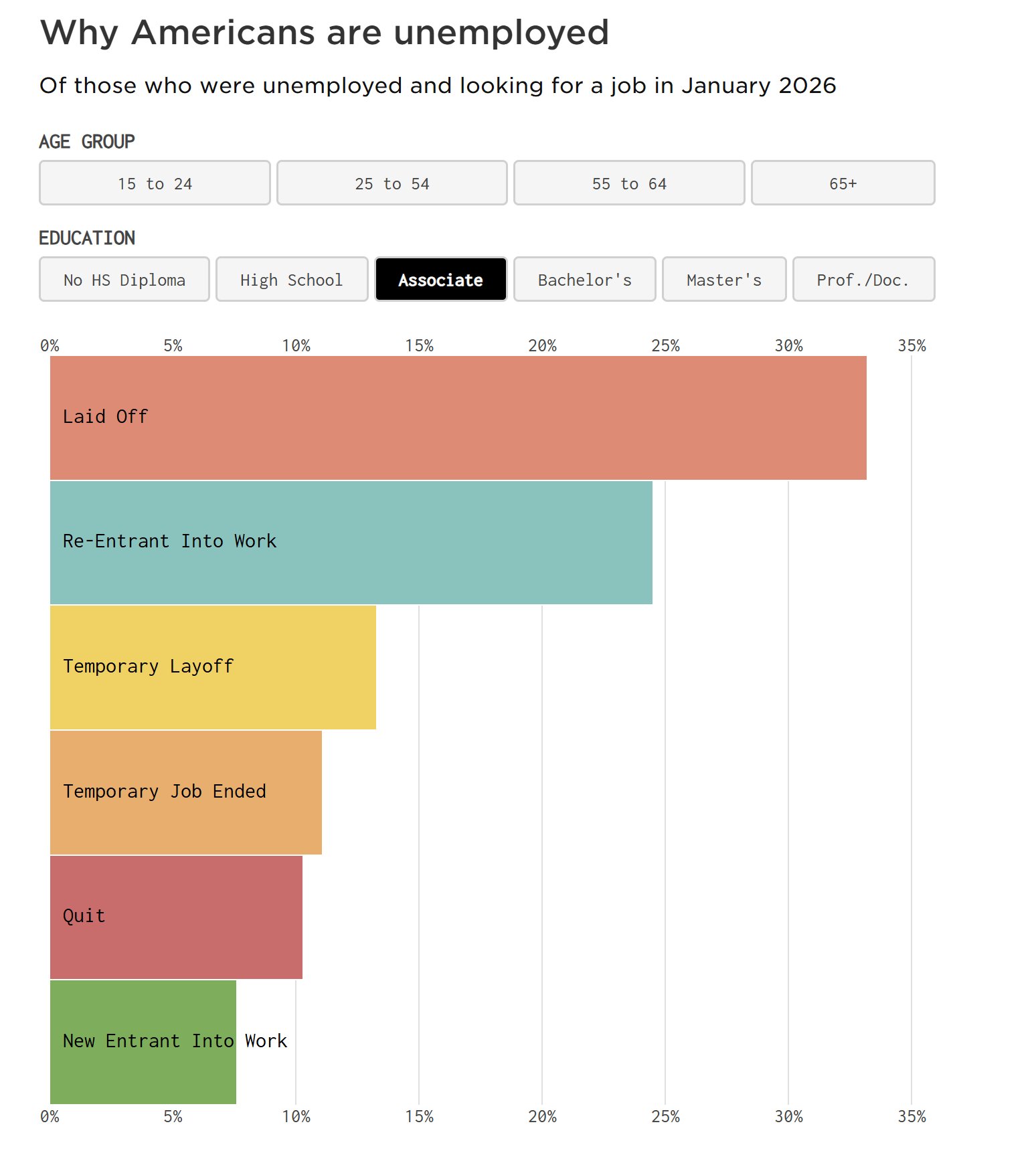
Eight million Americans reported being unemployed in January 2026. Among associate degree holders, 33% were laid off. Another 25% were re-entering the workforce. Layoffs dominate. The labour market is no longer the shock absorber it was. February payrolls dropped 92,000. Strip out the 784,000 health care and social assistance jobs created since 2024 and the rest of the economy has shed 634,000 positions. Manufacturing alone has lost 120,000 since end-2024. The K-shape is widening. Income growth in the top third exceeds 4% y/y. The bottom third is growing 0.6%. The households most exposed to gasoline prices are in service sector jobs that cannot be done from home. The word for that is stagflation. FlowingData interactive chart.
The full edition includes 35+ curated charts and infographics with commentary.
For the complete visual edition, email hoelon at lengleng dot com
Best,
Hoelon