Structural Damage Confirmed
“I will not be bullied into concealing the ongoing corruption and abuse of power at the Department of Justice.” — Liz Oyer, fired US Pardon Attorney, testifying before the Senate Judiciary Committee. On Day One of his second term, Trump issued blanket clemency to nearly 1,600 January 6 defendants. Since then, at least 33 pardoned insurrectionists have been rearrested or charged with new crimes, including six for child sex offences, five for illegal weapons possession, and two for rape. One pardoned rioter was sentenced to life in prison for sexually abusing a child just seven months after receiving his presidential pardon. Todd Blanche, the man who fired Oyer for refusing to restore gun rights to Mel Gibson, is now Acting Attorney General. The pardon power has become a patronage tool. The Justice Department is unrecognisable. Follow Oyer on Instagram (@lawyer_oyer) and her Substack (lawyeroyer.com), where the former pardon attorney is tracking every pardon, every cost, and every crime that follows.
“Coming on top of the ongoing Ukraine and tariff wars, the Iran War is shaping up as the biggest stagflationary shock the world has seen in five decades.” — Kenneth Rogoff, Harvard economist, in the Financial Times. The evidence is piling up. ISM prices paid hit 78.3 last week, the highest since June 2022. Germany CPI jumped from 1.9% to 2.7% in a single month. Brent’s March gain was 55%, the largest monthly move since the contract’s 1988 inception. Bloomberg Economics expects March US CPI at 0.9% month-on-month, the hottest print since June 2022.
“It’s not an A.I. company, but I did it with A.I.” — Matthew Gallagher, founder of Medvi, speaking to the New York Times. Gallagher launched a telehealth company in September 2024 with $20,000, no employees, and a house in Los Angeles. ChatGPT, Claude and Grok wrote the code, website copy and customer service agents. Midjourney and Runway generated the ads. In its first full year, Medvi did $401 million in revenue and served more than 250,000 customers. It is now tracking for $1.8 billion in 2026 with two employees: Matthew and his younger brother Elliot. Sam Altman once predicted that a one-person billion-dollar company would become possible with AI. Gallagher just proved him right. The punchline: he is now considering hiring people, mostly because he is lonely. When the biggest operational bottleneck in a $1.8 billion business is the founder’s social life, something fundamental has shifted about what a company is.
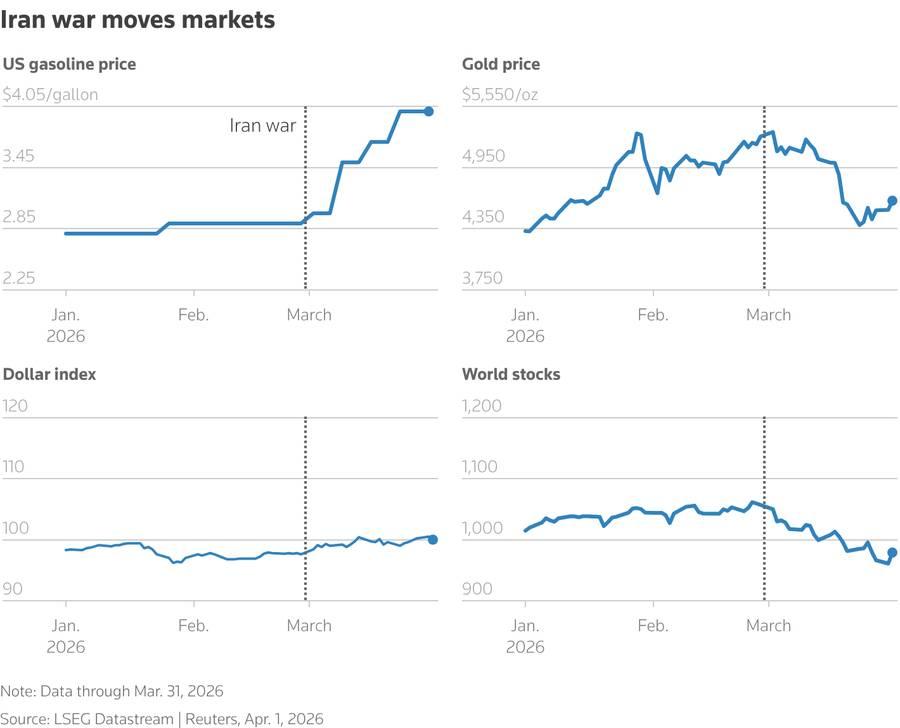
Traders who kicked off April betting the war’s end was in sight were wrong-footed as Trump vowed more aggressive strikes. Gasoline broke above $4/gallon for the first time in three years. The dollar surged above 100. World stocks collapsed. Gold, the traditional haven, was no haven at all — it sold off as margin calls hit everything. Even if hopes revive for a resolution, the damage to Middle East energy infrastructure and high energy prices will still hurt. After a brutal March, the narrative in bond markets is shifting from inflation angst to growth fears. Oil remains the key barometer.
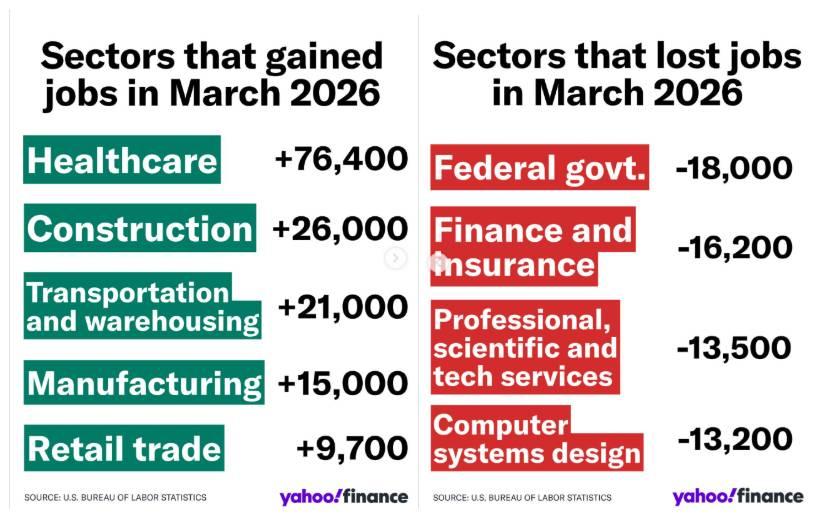
The headline number doubled the consensus, but the composition tells a different story. The sectors hiring, healthcare, construction, transport, are physical world, war-adjacent industries running on ageing demographics and supply chain rerouting. The sectors shedding, federal government, finance, tech services, are the knowledge economy, where DOGE cuts, AI displacement, and cautious corporate spending are all biting at once. The labour market is not weak. It is rotating. The question is whether the old economy can absorb what the new economy is discarding.
What is the plan this week?
How much longer does the world need to wait for a face-saving off-ramp from the current situation? Some parts of the market trade as if they have jumped straight to the later episodes of the war drama, but is that too optimistic? The aftermath effects on markets are in debate — stagflation versus transitory. But the majority of people in the world have been suffering, from anxiety to real hunger, in the worst oil crisis we have seen. Dated Brent hit $141.37 last week, surpassing the 2022 Ukraine highs and entering the neighbourhood of the 2008 global financial crisis.
The week starts with Easter Monday, when half the world’s markets are closed — the UK, Germany, France, all of Euronext, Australia, New Zealand, Hong Kong, and China for Ching Ming, and Thailand for Chakri Day. The US is open but thin. The April 6 Hormuz deadline expires at 8 PM Eastern on Sunday night. Whatever happens hits the thinnest liquidity of the year. Then the US gets FOMC minutes on Wednesday, GDP and PCE on Thursday, and the most important CPI on Friday. Strong payrolls last week were a relief for growth, but also complicated the Fed’s ability to ease. The additions came largely from healthcare, up 76K on war-adjacent demand and ageing demographics. The knowledge economy is shedding while physical-world sectors are hiring.
In Europe, EUR/USD continues to trade range-bound between 1.14 and 1.16, with ECB pricing at around a 50/50 chance of a hike, down from 85% a few weeks ago. The market is pricing uncertainty, not conviction. Germany’s industrial production remains stuck below the 2015 baseline, and the war is making it worse.
In Asia, RBNZ is expected to hold at 2.25%. A series of CPI numbers across the region will give a measure on the oil damage. Philippines already above target, Thailand turning from deflation after abandoning the diesel price cap, Taiwan nudging 2%. The Strait of Hormuz affects most Asian countries directly. Currencies have been hit very hard but last week saw a pause. Along with DXY, most USD-Asia pairs are at inflection points.
USD/JPY tried to go lower last week on increasing soundbites of intervention but rebounded into the end of the week after strong US data. India’s RBI imposed capital controls last week, limiting banks’ FX positions and barring NDF activity to defend the rupee. This may complicate hedging of Indian bonds by international asset managers. The RBI holds on Wednesday but the tone matters more than the decision. Singapore’s MAS decision is likely the following week; the street is mixed with all possible answers in play. China’s PPI is about to cross zero for the first time since September 2022, but this is upstream energy reflation, not downstream demand. The reflation story is misleading.
Delta earnings on Wednesday is the first corporate read on war damage to travel. BlackRock on Friday gives the asset management view. Banks loom the following week.
The plan this week. Gut feel is the off-ramp can happen. Approval ratings are crucially low and boots on the ground is really too much for Trump to actually take. But the trade is not about a relief rally. It is about selling USD in a more stable environment.
What Did I Learn Last Week?
Mar 30: Germany CPI 2.7% from 1.9%, energy +7.2% y/y first time since Dec 2023. Powell at Harvard: rates “good place”, debt path “not sustainable, will not end well.” BOJ Summary hawkish, one member warned “falling behind the curve.” Israel held 4.0%.
Mar 31: China manufacturing PMI 50.4, strongest since Mar 2025. Eurozone flash CPI 2.5% vs 2.7% expected but monthly surged 1.2%. Energy leading at 4.9% y/y, sharp reversal from -3.1% in Feb. Nike net income down 35%, guidance cut to -2% to -4% vs street +1.9%. Xi-Trump postponed to May 14-15. Macron arrived in Tokyo.
Apr 1: ISM manufacturing 52.3 but prices paid 78.3, highest since June 2022. 40% cited war, 20% tariffs. ISM called it a “bad cocktail.” Korea exports record $86.1B, chips $32.8B up 151%. BOJ Tankan non-manufacturing +36, record. Retail sales +0.6%. Supreme Court “very skeptical” of government birthright citizenship position.
Apr 2: Korea CPI 2.2% vs 2.0%, seventh month above target. Swiss CPI 0.3% vs 0.5%, lowflation intact. Trade deficit better at $57.3B, exports record $302.1B. Trump addressed the nation on Iran, threatened to hit every power plant “simultaneously.” Iran countered with five conditions. Houthis resumed ballistic missile attacks on Israel, threatened naval blockade. Macron and Takaichi agreed Hormuz maritime cooperation.
Apr 3: NFP +178K vs +59K, biggest beat since Sep 2024. Unemployment 4.3% but labour force shrank. Feb revised to -133K. Good Friday. Brent $112.42. Gold $4,679. Turkey CPI 30.87%. Macron in Seoul, France-Korea “global strategic partnership”, nuclear fuel, offshore wind, critical minerals agreements.
All week: S&P fifth consecutive losing week, not seen since 2022. Brent March gain 55%, largest monthly move since 1988 inception. April 6 Hormuz deadline expires Easter Sunday 8 PM Eastern. Iran rejected the 15-point proposal. Pakistan and China proposed five-point framework. The gap between rhetoric and action remains the primary uncertainty.
What To Look Out For Next Week
Mon Apr 7: Easter Monday. Europe, Hong Kong, Australia, New Zealand closed. US open but thin. The Hormuz deadline expired Sunday night, whatever happened hits the thinnest liquidity of the year. ISM services PMI (consensus 54.9, prior 56.1), likely picking up war disruption.
Tue Apr 8: China foreign reserves. Eurozone services PMI final. US durable goods (consensus -1.0%, ex-transport +0.4%). Fed’s Goolsbee speaks. ECB annual retreat. Sweden CPIF (BE 2.1%, above Riksbank’s 2% target, falls back in April on halved food VAT). Philippines CPI (BE 3.2%), Thailand CPI (BE 0.35%, turnaround from -0.88%). Treasury $58B 3-year notes.
Wed Apr 9: India RBI (consensus hold 5.25%, capital controls complicate the picture). RBNZ (hold 2.25%, look through first-round oil effects, no new projections until May). FOMC minutes from March 17-18. Japan wages (BE 2.5%, shunto strong, BOJ 25bp hike expected April 28). Taiwan CPI (BE 1.60%). Delta earnings (EPS $0.63, revenue $14B, watch jet fuel guidance, $70 resistance/$63 support on the chart). Treasury $39B 10-year notes.
Thu Apr 10: US PCE (Feb, headline +0.4% m/m, core +0.4% m/m, core y/y to 3.0%). The historically large gap between core PCE and core CPI since September makes this print important. GDP final (BE 0.7%). Claims (BE 212K). Swaps now pricing about 30% chance of a cut this year, down from 58% chance of a hike at the March 26 extreme. IMF’s Georgieva curtain raiser. MAS likely the following week; street is mixed: hold, 50bp slope, 100bp slope all in play. China aggregate financing (Apr 10-15, BE 15.4T yuan YTD). Treasury $22B 30-year bonds. The Masters begins.
Fri Apr 11: US CPI (March). THE print of the week. BE +0.9% m/m headline (hottest since June 2022), +3.3% y/y (from 2.4%). Core +0.2% m/m, +2.6% y/y. Base effect brutal: last March headline flat, core +0.1%. Gasoline above $4/gallon the driver. BLS has increased use of “imputation” which may soften the read. Risk is a one day VIX spike, but if no upside surprise a vol unwind could trigger equity relief rally. UMich sentiment (April prelim), first full war/oil/No Kings reading. China CPI (BE 1.1%, PPI +0.6%, first positive since Sep 2022). BOK (hold 2.5%). Canada jobs. Sovereign ratings: UK (Moody’s), France (S&P). BlackRock Q1 earnings.
All week: Earnings season begins. Delta Wednesday, BlackRock Friday. Banks loom: Goldman Apr 14, JPMorgan Apr 15. Asia closures: Hong Kong/China Fri-Mon (Ching Ming/Easter), Thailand Mon (Chakri Day). May WTI $111.55 but June at $98 and September below $78, near-term escalation priced, resolution expected. S&P rose for first time in six weeks.
Beyond Next Week
April 14-17: Bank earnings week. JPMorgan, Goldman, Citi, Wells Fargo, Bank of America in four days. First corporate read on war damage to credit, trading revenues, and loan provisions.
April 27-30: Central bank mega week. FOMC, BOJ, ECB, BOE in four days. If BOJ and ECB both hike, most coordinated tightening since 2022.
April 27 – May 22: UN NPT Review Conference in New York. Proliferation cascade debate (South Korea, Japan, Saudi Arabia all exploring).
May 14-15: Xi-Trump summit in Beijing. Rescheduled from March. Trade, Taiwan, Iran, rare earths. The most consequential bilateral meeting of the year.
Regimes
Structural damage confirmed, ceasefire optionality fading. Last week the regime was structural damage with two-way vol from deal hopes. This week the April 6 deadline expired on Easter with no deal. Iran rejected the 15-point proposal. Trump threatened to hit every power plant simultaneously. The ceasefire optionality that briefly appeared is narrowing. Oil back above $112. The market tested the deal narrative for two weeks and it did not deliver. Positioning reverts to one way: long energy, short duration. changed
Rate repricing has a new catalyst: data confirmation. Last week both sides were crowded. This week the data broke in favour of the hawks. ISM prices paid at 78.3, highest since June 2022. Germany CPI jumping from 1.9% to 2.7%. NFP +178K blowing past +59K expectations. The soft data is catching up to the hard data. ECB April hike now closer to a certainty. BOJ hawks emboldened. Fed patience is the outlier. Powell said rates are in a “good place” but Thursday’s CPI will test that position. changed
Dollar bid strengthening, at the high of the range. Powell holding, NFP strong, rate differentials widening. DXY above 100, testing 100.65, the high since the war began. The structural weakness thesis is being overwhelmed by cyclical strength. Yuan stability still the outlier as Beijing positions for the May summit. changed
Credit stress still waiting for a trigger. Fifth consecutive losing week for the S&P. Nike’s 35% profit collapse and guidance cut shows consumer discretionary is cracking. But no new gating, no new credit event. Bank earnings next week will tell us more. The trigger may be in those numbers. held
Shifts (if → then)
April 6 deadline expired without deal, strikes resume → Oil through $130. Power infrastructure targets. Everything correlates. The question is whether Trump acts or extends again. History says he extends. But the rhetoric was the most aggressive yet. new
US CPI breaches 3.0% on Friday → Fed hike pricing jumps. ISM prices paid at 78.3 says it is coming. The transmission from oil to CPI has a 4-6 week lag. March CPI captures the first full month of $100+ oil. new
Bank earnings reveal credit damage Apr 14-17 → Loan loss provisions spike. Private credit writedowns surface. Trading revenues may be strong (vol is good for desks) but the loan book is the risk. new
Xi-Trump summit cancelled or delayed again → Decoupling accelerates. Rare earth restrictions. The May 14-15 date is already a postponement from March. Another delay signals breakdown. new
War finds off-ramp → Oil retreats, rate cuts snap back. But South Pars, Qatar force majeure, and supply chain damage do not reverse. Pakistan’s five-point plan and Iran’s five conditions are the only frameworks on the table. Neither is close to agreement. carried, probability declining
Tails
Hormuz closed through Q2. $150+ oil. Demand destruction. Water scarcity. Gulf desalination targets. The deadline has passed and no resolution. Macquarie says Brent could reach $200 if blockade continues through June. carried, probability rising
Houthis escalate to full naval blockade. Senior leader threatened blockade of “aggressor countries.” Resumed ballistic missile attacks on Israel this week. If Bab al-Mandab closes alongside Hormuz, two chokepoints shut. changed, upgraded
Power plant strikes trigger Iranian retaliation on Gulf infrastructure. Iran explicitly threatened to “completely close” Hormuz and hit energy and desalination facilities if power plants are struck. This is no longer hypothetical. Trump said he would hit them “simultaneously.” new, upgraded from shift to tail
Sudden ceasefire. Oil crashes 20-30%. Pakistan five-point plan or Iran five conditions produce a framework. Every extension of the deadline has produced a brief oil collapse. The pattern could repeat. carried, probability uncertain
Private credit contagion. Gating spreads. CLOs stall. Bank earnings week will be the first real test. carried
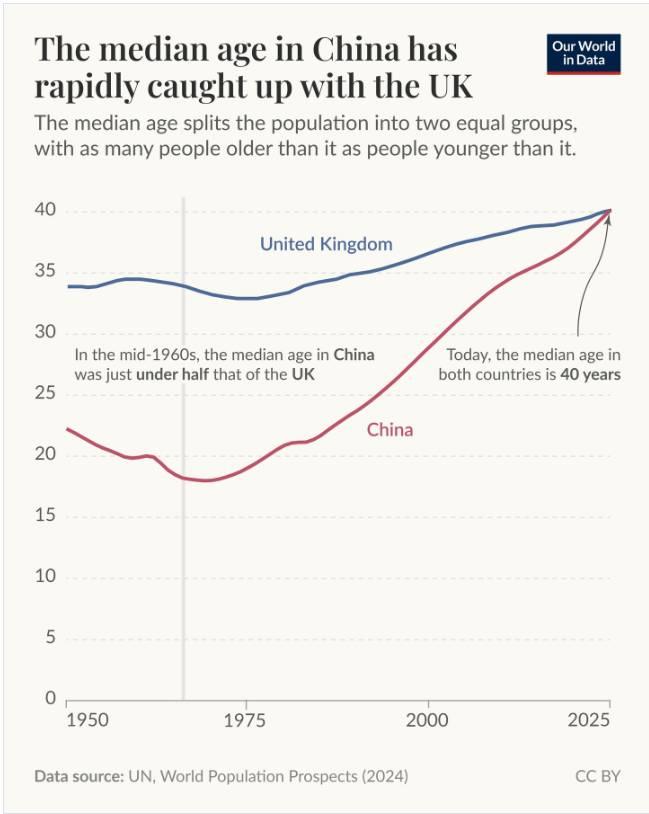
In 1965, China’s median age was 18. The UK’s was 34. Today both are 40. By 2050, China’s will be 10 years older than the UK’s. The speed of China’s demographic shift is unlike anything in history. This is the structural headwind behind every optimistic China growth forecast.
The full edition includes 40+ curated charts and infographics with commentary.
For the complete visual edition, email hoelon at lengleng dot com
Best,
Hoelon