Dollar Sells On
“For the first time, computers understand us,” — Jensen Huang said at Stanford recently. He meant that if you are worried about jobs, you are looking at this the wrong way. This is one of those rare moments where the world resets. Skills are rewritten. Barriers come down. Old advantages fade. You do not need a decade of experience to start building. You need curiosity, speed, and the courage to try. Even those of us with years behind us are learning again, which means you are not behind, you are early. I am a macro trader by training, yet I can now ship code alongside a team of seasoned developers. At the same time, people a third my age scan charts faster than I do after staring at them for almost three decades. The playing field has been flattened in both directions. That is what a real reset looks like.
“In times of change, learners inherit the Earth, while the learned find themselves beautifully equipped to deal with a world that no longer exists.” — Eric Hoffer.
“It is barriers to entry, not differentiation by itself, that creates strategic opportunities.” — Bruce Greenwald, Columbia Business School, in Competition Demystified. The most important question for every company, every sector, and every investor right now is which of their moats are being dissolved by AI. Differentiation without barriers is just a temporary lead. Software distribution, legal research, customer service scripts, call centres, equity research, coding interviews, and even chart reading are all fields where the barrier was time plus repetition, and AI compresses both to near zero. The winners over the next five years will not be the companies with the best differentiation; they will be the ones whose barriers remain standing after the flood.
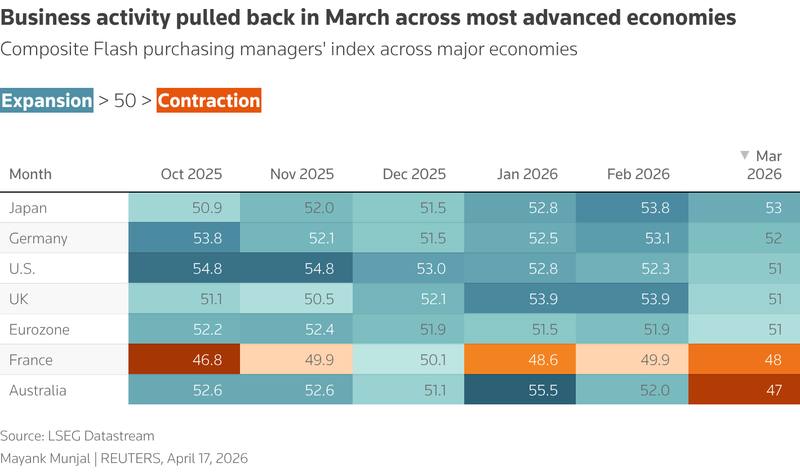
March flash PMIs showed a steep rise in input costs and a slowdown in overall business activity, and Thursday’s April read is the first chance to see whether that softening extended or stabilised as oil came off its peaks. Europe carries the most downside, imported energy dependence translates fastest into margin compression in airlines, retailers, and manufacturers. The United States is cushioned as a net exporter but not immune, the prices and employment sub-components are what matter for the rate path. Inflation prints from Japan, Britain, New Zealand and Canada later in the week are all expected to reflect the fuel pass-through. The question is whether central banks look through, or whether second-round effects force a hawkish pivot just as growth is rolling over.
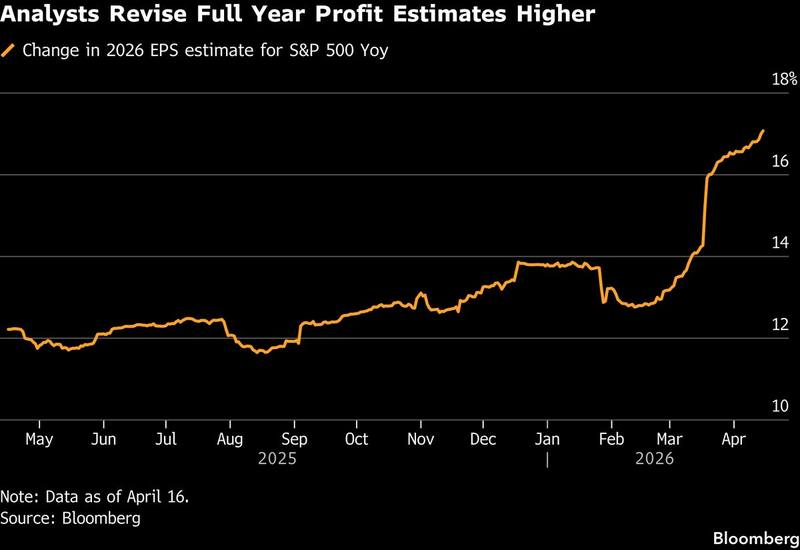
The earnings tape is anchored on three defence contractors, Northrop, Lockheed and GE Aerospace, all set to benefit from the proposed $1.5 trillion military budget. Tesla, P&G and United Airlines will outline how they are mitigating energy and supply shocks from the war. The question across the scorecard is whether analyst estimates that have been rising on oil and semiconductor strength are about to look late as the war trade fades.
What is the plan this week?
Is it over? Not quite. Iran has reimposed restrictions on vessel traffic through Hormuz and the IRGC is broadcasting the waterway closed again. The Lebanon ceasefire is already fraying with IDF strikes on what it called saboteurs. The US is preparing to board Iran-linked tankers and seize commercial ships in international waters to force the Strait back open. Yet markets are looking through, on the belief that escalation will not retrace to pre-March levels. PPI came in cool at 0.5% month-on-month versus 1.1% expected, a genuine downside surprise that took the stagflation air out of the room, which is very much what markets wanted to see. Risk rallied as Brent fell, but the debate has now shifted to whether strong equities can hold with a weak dollar, especially after the DXY fell for eight consecutive sessions through April 15, matching its longest losing streak in fifteen years.
The US calendar is thin but binary. Two events share Tuesday, the Senate Banking confirmation hearing for Kevin Warsh and the expiration of the two-week US-Iran ceasefire at day’s end. Warsh was picked by a President who has openly said he wants lower rates, so every syllable of the testimony will be parsed for whether the nominee sounds like a credible 2% steward or a ratification of the rate demand. The hearing itself may not happen. Democrats are signalling a block, and as long as Fed investigations continue there appears to be a blocking majority on Senate Banking. If no successor is confirmed by May 15, Powell is likely to be picked by the board to continue in the chair role until confirmation clears, his term as governor runs to 2028 either way. Same day, the truce runs out. If it rolls, the V-shape extends. If it does not, the physical crude market still at record delivery prices retakes the tape. March retail sales will print a strong headline driven by gas station spending, but the control group should be softer as BofA card data has already decelerated. Waller speaks at Brookings Tuesday, the last official Fed voice before blackout opens Saturday. Fed funds futures are now pricing roughly 65% chance of a cut by year-end, the highest reading in a month.
Europe is where the war shows up in the CPI print first. UK March inflation Wednesday should accelerate to 3.3% year-on-year from 3%, driven by a near-9% fuel price rise. German Ifo Friday is the cleanest read on whether the fiscal boost has been eaten by energy. Flash PMIs Thursday tell us whether the services soft patch has deepened or stabilised. Turkey is likely to hold Wednesday, but two US banks are expecting a technical hike. The EURUSD rose in nine of the past ten sessions, took out the pre-war high just below $1.1830, then sold off to $1.1760 into the Friday close, a potential key reversal if it holds. ECB April hike odds dropped from 85% to roughly 10%. Two hikes are still discounted for the year, which still feels ambitious.
China holds LPRs Monday at 3.00% and 3.50% for the eleventh straight month, with the Q1 GDP print at 5.0% removing urgency. The PBOC has quietly been appreciating the yuan since last May, with the fixing now at a three-year dollar low and portfolio flows following the guidance. Japan CPI Friday accelerates to 1.8% core, but BoJ hike odds have collapsed from 67% two weeks ago to under 17% for the next meeting. South Korea Q1 GDP Thursday should rebound to 0.7% quarter-on-quarter driven by chip exports up 139% year-on-year, the cleanest expression of the AI trade through the semis supply chain. The have-nots: Indonesia holds Wednesday with a rupiah under pressure, the Philippines holds Thursday with inflation already above target, both defending currencies rather than supporting growth. Bank of Korea Governor Rhee Chang Yong’s four-year term ends Monday, Shin Hyun Song takes over.
One larger thought sits underneath the week. Two years ago the debate was whether AI was real. One year ago it was about who wins. This week the debate shifted again, it is now about which of the old economy’s moats are coming down, and who will still be standing when the water recedes. The plan this week. Warsh hearing and Tuesday’s truce deadline are the twin catalysts, assuming the hearing actually happens. If Warsh sounds independent and the ceasefire rolls, stay long quality AI exposure, add long duration into Friday’s Ifo, fade further oil bounces. If either breaks the other way, cover duration quickly and pull equity beta. Short vol, long carry, modestly trim dollar shorts given the 8-day extension, neutral stocks. Size down for Tuesday.
What Did I Learn Last Week?
Mon Apr 13: India CPI in line at 3.4%, existing home sales 3.98M missed. Goldman Sachs kicked off bank earnings with $17.55 vs $16.34e, soft FICC. Fastenal March sales +16.8% y/y. Chinese tanker Rich Starry became the first to transit Hormuz since the blockade.
Tue Apr 14: The big one. March PPI +0.5% m/m vs +1.1%e, y/y 4.0% vs 4.6%e, a genuine downside surprise. MAS tightened for the first time since 2022, slope only not the double-barrel consensus expected, inflation forecast lifted to 1.5-2.5%. JPMorgan beat big at $5.94 vs $5.46e, Citi, Wells Fargo, JNJ, BlackRock all beat. Amazon confirmed $11.6B Globalstar acquisition and added $125B in market cap. Nvidia open-sourced quantum AI models.
Wed Apr 15: China Q1 GDP 5.0% vs 4.8%e, IP +5.7%. Empire Manufacturing 11.0 vs zero expected, prices-paid jumped to 51. ASML raised FY26 and warned supply cannot meet demand. BofA, Morgan Stanley, PNC beat. Trump threatened to fire Powell from his board seat and said Warsh gets confirmed next week.
Thu Apr 16: Israel-Lebanon 10-day ceasefire. Philly Fed 26.7 vs 10e. Netflix missed on Q2 guidance and Reed Hastings stepped down as Chairman. TSMC raised FY26 revenue above +30% USD, three-year capex much higher. IP -0.5% vs +0.1%e. IEA’s Birol warned Europe has six weeks of jet fuel.
Fri Apr 17: Iran FM declared Strait of Hormuz completely open for the ceasefire period. Trump said Iran agreed to never close it again. US reportedly considering a $20B cash-for-uranium deal. Brent fell 10% Friday to $82. Chinese researchers revealed a diamond-copper material cooling AI data centres 80% more efficiently.
All week: S&P +4.5%, Nasdaq +6.8%, DJIA +3.2%, Brent -15%. Bank earnings beat ex-Netflix. V-shape confirmed, max short software unwound, AI trade re-leading. PPI cooling despite the war was the most surprising datapoint; the lag is longer than the bears thought.
What To Look Out For Next Week
Mon Apr 20: China 1Y/5Y LPR, likely held at 3.00%/3.50% for the 11th month. Canada March CPI expected above 2.5% y/y from 1.8% on the energy shock. Japan Feb tertiary industry. Malaysia, NZ March trade. BoK Governor Rhee Chang Yong’s term ends, Shin Hyun Song succeeds. Balikatan 2026 Philippines-US exercise begins through May 8. Earnings: Steel Dynamics, Wanhua Chemical, Cleveland-Cliffs.
Tue Apr 21: The day. The US-Iran two-week ceasefire is set to expire at day’s end. Senate Banking holds the Kevin Warsh confirmation hearing, assuming Democrats do not block. March retail sales expected +1.2% headline, control-group much weaker as gas crowds out discretionary. Pending home sales, business inventories, $26B 5Y TIPS. Germany ZEW. NZ Q1 CPI expected 3.3% y/y from 3.1%. UK jobless claims. Fed Waller at Brookings, the last official Fed voice before blackout. Earnings: Northrop, RTX, UnitedHealth, GE Aerospace, Danaher, Halliburton, UAL, Capital One, Verizon.
Wed Apr 22: Turkey CBRT, consensus hold at 37% with a technical hike to 40% not ruled out on reserve burn and lira pressure. Bank Indonesia expected to hold at 4.75%. UK March CPI expected to accelerate to 3.3% y/y from 3% on a near-9% fuel rise. Eurozone consumer confidence. Japan March trade. ECB Lagarde at LSE, BOE Breeden in FT fireside chat on private credit. Earth Day, 10th anniversary of the Paris Agreement. Earnings: Tesla, IBM, Boeing, GE Vernova, Philip Morris, Texas Instruments, AT&T.
Thu Apr 23: Eurozone, UK, Germany, France flash composite PMIs, the first post-war read on whether March’s shock deepened. UK PMI expected 49.5 from 50.3. Euro PMI focus on price components. SK Q1 GDP expected +0.7% q/q driven by chip exports up 139% y/y. Philippines BSP expected hold at 4.25%. Singapore March CPI expected 1.8% from 1.2%. Japan, Australia, India flash PMIs. HK CPI. US claims, S&P Global PMIs. EU leaders Cyprus summit through Apr 24, energy top of agenda. ECB quiet period begins. Earnings: Intel, American Express, SAP, Thermo Fisher, SK Hynix, China Telecom, Infosys.
Fri Apr 24: Japan March CPI core ex-fresh food expected +1.8% y/y from +1.6%. German Ifo, the cleanest read on whether fiscal boost has been eaten by energy. US Michigan sentiment final April. Canada retail sales. Singapore Q1 URA private home prices. Russia rate decision. Sovereign ratings: Greece, Belgium, Croatia. Beijing Auto Show kicks off through May 3. Earnings: P&G, China Shenhua, Keyence, CMOC, Citic, Eni, SLB, Charter.
All week: 3M, ABB, AmEx, Baker Hughes, Blackstone, Boeing, Capital One, CME, Comcast, Dow, Fanuc, Freeport, HDFC, HCA, Heineken, Honeywell, ICICI, Infosys, Intel, IBM, Lam Research, Lockheed, Moody’s, MSCI, Nasdaq, Newmont, NextEra, Nokia, Nomura, Norfolk Southern, Northrop, Philip Morris, P&G, Renesas, RTX, Sanofi, SAP, ServiceNow, SK Hynix, SLB, Tesla, Texas Instruments, Thermo Fisher, UAL, UnitedHealth, Volvo, Zijin.
Beyond Next Week
Apr 21: Warsh confirmation hearing at risk of Democrat block given ongoing Fed investigations. If it slips, the May 15 Powell-retained scenario moves from tail to base case.
Apr 27-30: Central bank mega week. FOMC, BOJ, ECB, BOE in four days. BOJ April hike odds collapsed to under 17% so a hold is now the base case. ECB April odds compressed to roughly 10% from 85% three weeks ago. The FOMC is the first post-war policy read and Warsh’s tone (if the hearing happened) sets the bar.
May 5: RBA decision. Futures pricing roughly 80% chance of a third consecutive hike as war-driven energy inflation feeds Australian CPI.
May 14-15: Xi-Trump summit in Beijing. Trade, Taiwan, Iran, rare earths. The China-Iran intelligence question hangs over the agenda.
May 15: Powell’s term as Fed Chair ends. If no successor is confirmed, Powell is likely to be retained by board vote until clearance. Term as governor runs to 2028 regardless.
Late May: OPEC+ ministerial. Physical crude at records, Hormuz flow metered, any quota increase validates supply as the binding constraint, any hold invites accusations of price collusion with the US.
Q3/Q4: The financing squeeze nobody is pricing. $10 trillion US Treasury refinancing, $2 trillion deficit, $2 trillion corporate debt rolling, Gulf states pulling capital home for reconstruction. The crunch arrives in autumn.
Regimes
War de-escalating, truce extension is the swing factor. Last week was fragile truce growth cracking. Hormuz has reopened then partially re-restricted, Israel-Lebanon truce is fraying, the $20B cash-for-uranium framework is on the table. Markets are pricing resolution not damage, which makes Tuesday’s expiry the asymmetric risk. changed, week 1
Rate repricing: still confused. PPI at 0.5% gave the doves room, cut odds rebuilt into year-end. But Empire prices-paid jumped to 51 and Philly Fed ran hot. Warsh (if the hearing happens) resolves the ambiguity in one direction or the other. Stagflation is still the lens. held, week 4
Dollar bid fading, trap risk remains. Eight-session losing streak through April 15 is the longest in fifteen years. EM FX had its best week since 2018. Structural thesis intact but dollar bears have been trapped every ceasefire reversal. Directionally lower, not yet a regime change. held, week 3
Credit stress waited, banks delivered. Goldman, JPMorgan, Citi, Wells, BofA, Morgan Stanley all beat with resilient-consumer messaging. Loan provisions did not spike. Q1 numbers do not show the war yet, Blackstone Thursday is the next read and Q2 will be the real test. held, week 3
Shifts (if → then)
UK CPI prints above 3.3% → BOE hike odds rebuild, cable bounces, gilts sell off. carried
China-Iran intelligence confirmed ahead of Xi-Trump → Summit agenda poisons, decoupling accelerates, rare earth restrictions return to the table. carried
Warsh hearing postponed as Democrats block → Powell retained by board vote past May 15, dollar catches a continuity bid, duration fades. new
Warsh signals dovish and telegraphs cuts → Duration rallies, USD sells off further, gold extends. new
Warsh defends independence and refuses to telegraph → Short end sells off, dollar bounces, disappointment trade runs 24-48 hours. new
Ceasefire rolls past Tuesday without drama → V-shape extends, oil grinds into the $70s, EM FX continues. new
Ceasefire expires without extension → Oil snaps back above $100, positioning unwinds, duration rallies on growth fear. new
Tails
Cash-for-uranium $20B deal closes quickly, Hormuz fully reopens. Oil crashes to the $60s, rate cut path reopens, dollar weakens sharply, multi-asset risk-on extends. carried, upgraded
Hormuz closed through Q2, $150+ oil. Energy shock cascades. Probability declining but blockade mechanism keeps the option alive. carried, declining
Ceasefire collapses Tuesday, full military escalation resumes. Oil $120+, one-day VIX spike, defensive rotation, pre-war trades return overnight. carried
Mythos-class AI exploits financial infrastructure. Anthropic’s model demonstrated capability earlier this month. Wall Street emergency meetings already happened. carried
Private credit contagion in Blackstone earnings. Retail fund gates, BDC selling pressure, credit spreads widen. Blackstone reports Thursday. carried
Kessler cascade or major space debris collision. 30,000 tracked objects in orbit plus Amazon Leo in flight. A single bad day takes Starlink exposure and defence insurance overnight. new
AI DAT-style bubble signal triggers sector wipe-out. AllBirds pivoted to AI, Avis squeezed, quantum names parabolic. Concentrated long positioning unwinds violently. new
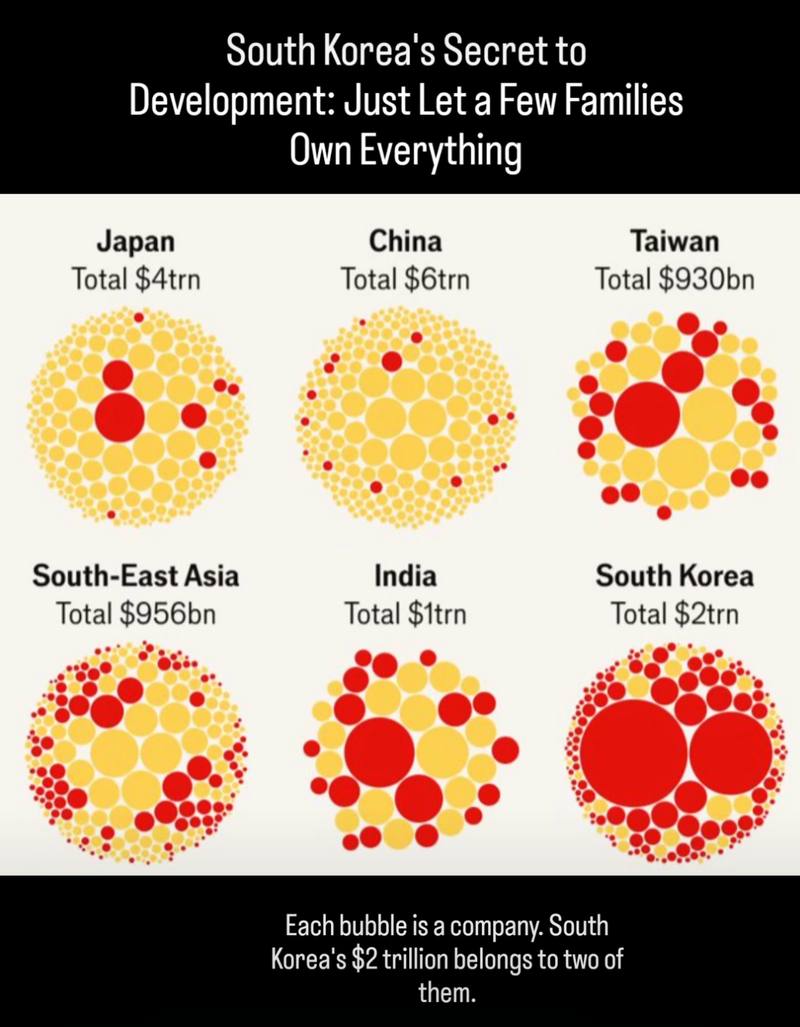
South Korea’s total market capitalisation is about $2 trillion. Two companies, Samsung and Hyundai, account for most of it. Every other Asian economy on the chart is spread across many smaller circles. Japan is $4 trillion across hundreds of firms. China is $6 trillion with a similar distribution. Korea bet the farm on chaebol concentration in the 1960s and the bet paid off in GDP terms. But the concentration never reversed, and the founding families still hold governance optionality over the broader economy. Feudal capitalism with export numbers, terrible governance theory, remarkable GDP chart.
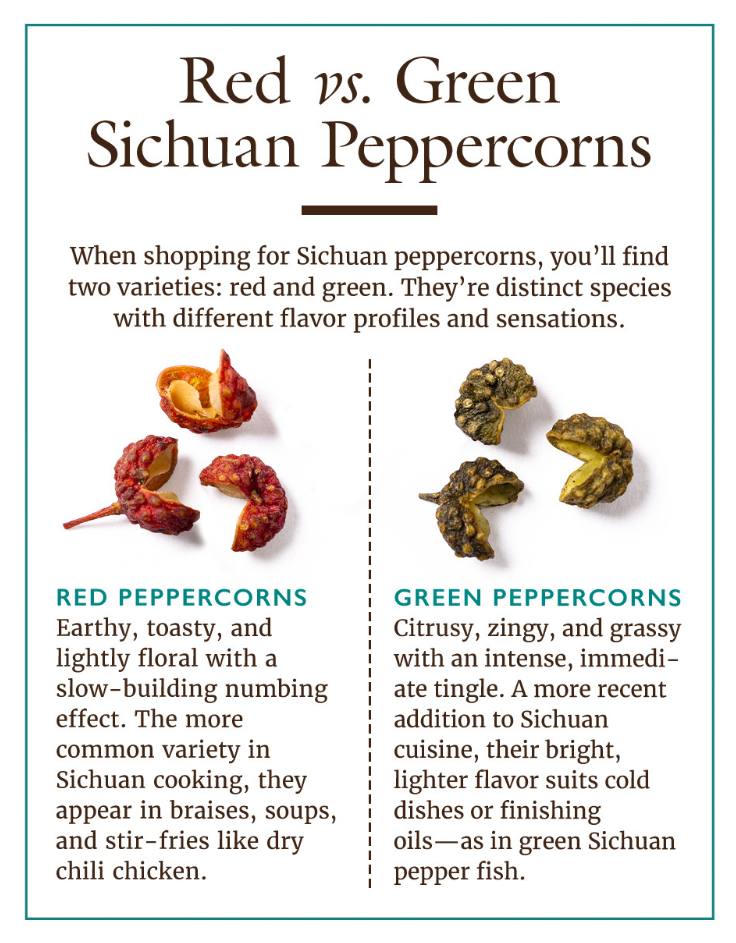
Two varieties, two sensations. Red Sichuan peppercorns are earthy and toasty with a slow-building numbing effect, the workhorse of the mapo tofu and dry chili chicken tradition. Green peppercorns arrived more recently, bright and citrusy with an immediate tingle, better suited to cold dishes and finishing oils. One ingredient, two different kitchens. A small reminder that the best answer is sometimes both, deployed properly, and that this applies to portfolios as much as it does to pepper.
The full edition includes 30+ curated charts and infographics with commentary.
For the complete visual edition, email hoelon at lengleng dot com
Best,
Hoelon