Sell in May
“America’s words carry weight. The actions of this great nation matter even more.” — King Charles III, addressing Congress during last week’s state visit. Polite but deliberate. A foreign ally using diplomacy to signal that US credibility rests on follow through, not statements. The uneven reception only sharpened it. Charles is not a partisan figure. The substance landed precisely because the source was above politics.
“The dollar is our currency, but it is your problem.” — John Connally, US Treasury Secretary, addressing European finance ministers in 1971. Connally said it after Nixon ended dollar convertibility into gold. The line became the textbook example of how a Treasury Secretary signals official tolerance for dollar weakness without saying it directly. Last week the US Treasury, unlike earlier this year, made no public statement when Japan intervened in FX markets to support the yen. Silence is its own communication. The opportunity to short the dollar finally feels in front of the trade.
“How many thousand of my poorest subjects are at this hour asleep! O sleep, O gentle sleep, nature’s soft nurse, how have I frighted thee, that thou no more wilt weigh my eyelids down and steep my senses in forgetfulness? Then, happy low, lie down! Uneasy lies the head that wears a crown.” — William Shakespeare, Henry IV, Part 2, Act III, Scene 1. Trump joked about two kings together during the Charles state visit. The joke landed as a joke and as a tell. The crown is heavy this week.
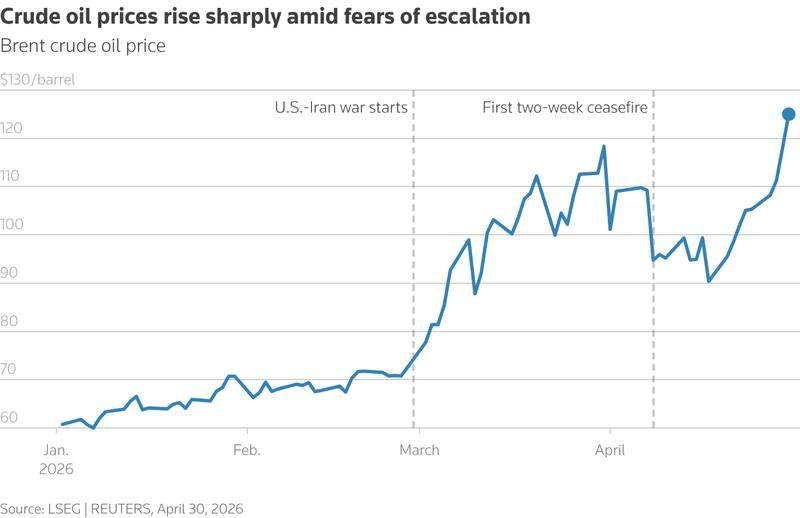
Brent crude between January and April 2026, with annotations marking the start of the war and the first ceasefire. Oil briefly vaulted above $120 this week, the highest since 2022. Global stocks holding up, bolstered by strong earnings and AI, but a third month of war puts pressure on the assumption that this lasts.
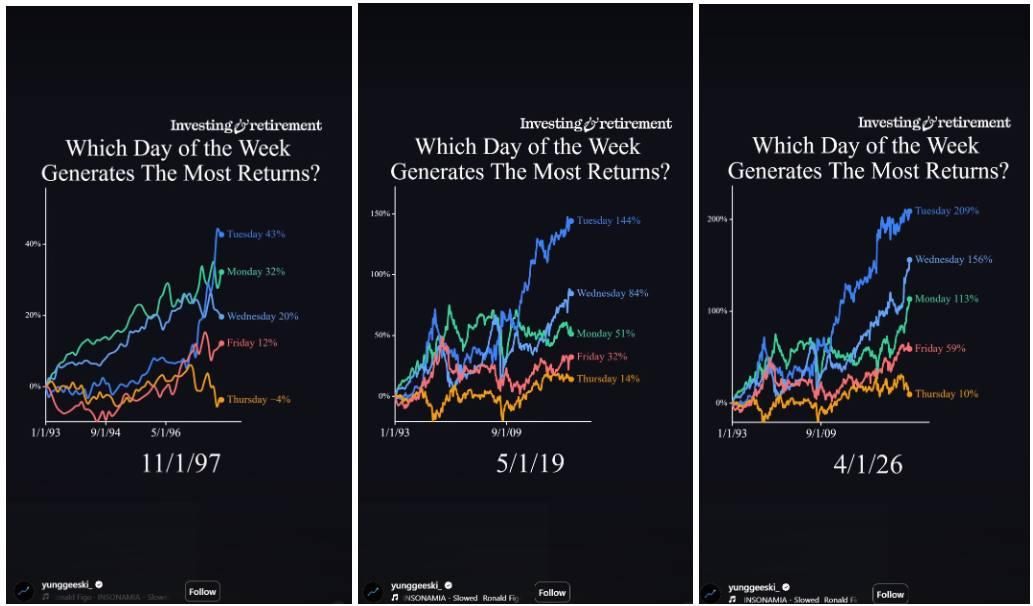
Which Day of the Week Generates the Most Returns? Three SPY backtests ending 11/1/97, 5/1/19 and 4/1/26, each line a strategy that only owns the market on a specific weekday and sits flat the rest of the time. Tuesday dominates by a wide margin, 209% in the 2026 vintage versus Wednesday 156%, Monday 113%, Friday 59%, Thursday 10%. Tuesday wins in every era. A large portion of long-term equity returns are concentrated in just a few trading windows, not spread evenly across time. This is not a strategy, it is a distribution insight.
What is the plan this week?
The war is in its tenth week and has slipped from the front pages. The stalemate has become the operating reality. Markets have given up waiting for resolution and are pricing the standoff as the new normal. The S&P printed fresh all-time highs last week even as Brent briefly tagged $120 and the dollar made its longest losing streak in fifteen years. Records and warning signals occupying the same week. The April rally was a textbook case of complacency. The market is in do-not-worry-be-happy mode while the data underneath says the opposite.
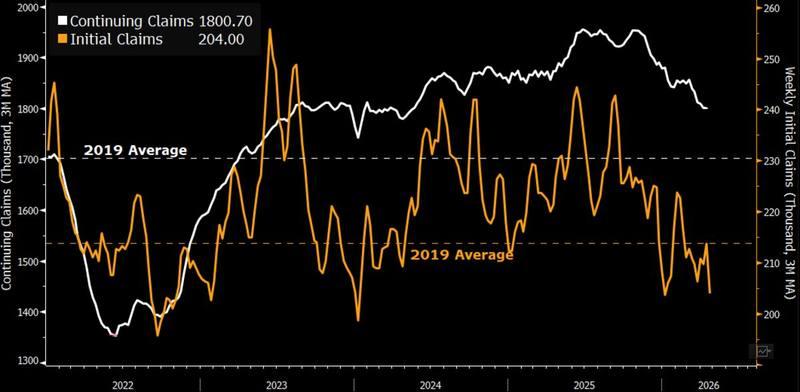
The US calendar is busy. ISM Services Tuesday should ease slightly to 53.5 from 54.0 but stay in expansion. JOLTS Tuesday holds around 6.85 million openings. Productivity Thursday and unit labour costs Q1 are the inflation read the Fed wants to see, with productivity at 0.4% and ULC easing to 2.5% from 4.4%. Initial jobless claims expected to bounce to 220K from 189K, the lowest since February 2023. The headline event is Friday’s nonfarm payrolls. Bloomberg Economics has 57K, the Reuters consensus 73K, both well below March’s 178K. Friday also brings the Hoover Monetary Policy Conference at Stanford with Bowman, Waller, Daly and Goolsbee, the most signal-dense Fed-speak day in months and a useful read on what the easing-bias dissent really meant.
Europe carries the heavy data. Turkey CPI Monday at 31.1%, Switzerland Tuesday at 0.5%, Sweden CPIF Wednesday at 1.3%, Riksbank holds Thursday at 1.75%. UniCredit, Lufthansa, Novo Nordisk, AB Inbev, Diageo, Equinor, Maersk, Rheinmetall and Shell all report. The earnings tape will be the cleanest read on whether the war is hitting European margins yet. UK local elections Thursday are the political event. Opinion polls point to a heavy defeat for Labour, and the 10-year gilt is already the worst-performing G7 sovereign since the war began. A heavy defeat could spark widespread demands for Starmer’s replacement and stoke expectations of looser fiscal under a successor, more bad news for British bonds. Trump raised EU auto tariffs to 25% from 15% Friday. The trade fight resumes just as ECB June hike pricing builds. Lagarde signalled the shift Thursday, the swaps now price 76 basis points of ECB tightening this year, up from 57 the prior week.
Asia’s setup is the cleanest split. The RBA Tuesday is a tight call, futures price 80% chance of a third consecutive hike to 4.35%. Indonesia GDP Tuesday softens to 5.2%, Philippines GDP Thursday slows to 2.5%, Philippines CPI breaches 4.9%, Thailand CPI bounces to 1.3%, South Korea inflation rises sharply to 2.6% on oil pass-through. BNM holds Thursday at 2.75%, the ringgit holding tempers imported inflation. Japan labour cash earnings Friday accelerate to 3.6% year-on-year, the BOJ’s preferred measure pushing 3.3%. The yen sits in an uneasy range with a thin air pocket of options strikes between 155 and 156, an accelerated decline if intervention fades. Singaporean lenders OCBC and UOB report Thursday with the wealth-management flow benefiting from the regional risk premium.
One bigger thought sits underneath the week. The April rally was easy because the supply shock did not arrive on schedule. May is when the credit warning, the political pressure on Starmer, the OPEC fracture and the Fed transition all show up in the same window. The 30-year US Treasury yield is at 5%, mortgage rates are not helping the consumer, and the Trump administration’s lieutenants Hegseth and Blanche are looking clownier each week as the Hormuz cost mounts in oil, gas, food and rate path. The bond market is telling the consumer what the consumer already knows. The plan this week. Stay short USD with stops, watch USDJPY 155 to 156 for the next leg lower, fade SPX rallies into Friday’s nonfarm payrolls, hold credit hedges via CDS payer spreads. Sell in May, not as an adage, but as the trade.
What did I learn last week?
Mon Apr 27: BOJ held at 0.75% (vote 6-3, high dissent). Iran offered new Hormuz proposal. Tankers exfiltrating US blockade, 4.6M barrels loaded at Iran terminals, 4M leaked through. Dallas Fed Manufacturing -2.3 vs +0.8 expected. Verizon beat, raised FY guidance. Gasoline futures broke above $3.50 for first time since June 2022.
Tue Apr 28: The bombshell. UAE quit OPEC and OPEC+ effective May 1, citing national interests. Eurozone 1-year CPI expectations spiked to 4.0% from 2.5% prior. US Consumer Confidence 92.8 vs 89.0e (beat). Trump approval rating fell to 34%, lowest of his second term. GM crushed it $3.70 vs $2.61 expected. Visa beat with $20B buyback. T-Mobile beat. UPS in-line. Pernod Ricard ended Brown-Forman talks.
Wed Apr 29: Brazil cut 25bp to 14.50% (5th consecutive). BoC held at 2.25% but said may hike if oil stays high. Fed held 3.50-3.75% with three dissents, highest dissent count since 1992. Powell announced he will not step down from board governor seat, citing Trump administration’s ongoing legal efforts to erode Fed independence. Housing starts 1.502M, highest since Dec 2024. Microsoft beat but cautious, $190B CY26 capex guide. Meta beat ($10.44 vs $6.71e), raised FY26 capex outlook, drew $96B bond interest. Amazon Q1 $2.78 vs $1.60e, AWS at $150B run rate, growing 28%. Eli Lilly beat, raised. Caterpillar dealer stats +14%. Carvana beat. Samsung Q1 final, said significant pickup in memory equipment spending.
Thu Apr 30: ECB held but Lagarde signalled June hike likely, swaps moved to 76bp tightening from 57bp. Iran Khamenei defiant statement: “new chapter for Hormuz”. Japan intervened in FX market overnight, USDJPY 160.70 to 155.50. BOE held at 3.75%. BofA card spending +7.2% w/y. Chicago PMI 49.2 vs 54.9e (BIG MISS). Initial claims 189K, lowest since Feb 2023. Q1 GDP advance +2.0% in line. ECI Q1 +0.9% vs +0.8%e (HOT). Apple Q2 beat $2.01, $100B buyback, dropped net-cash-neutral target. Sandisk Q3 $23.41 adj vs $14.11e (massive memory beat). Cigna, Merck, Mastercard beat.
Fri May 1: Trump raised EU auto tariffs to 25% from 15%. EU Trade Committee chair called it “unacceptable”. US warned shippers paying Hormuz tolls = sanctions risk. Trump: not satisfied with new Iran proposal. Final S&P Manufacturing PMI 54.5, ISM Manufacturing 52.7 vs 53.2e (slight miss). BCA upgraded US equities to Neutral. Anthropic asking $50B fundraise allocations, closing in two weeks. Chevron Q1 $1.41 vs $0.92e (beat). Spirit Airlines preparing to shut down. Exxon beat.
All week: S&P +0.9%, Nasdaq +1.1%, DJIA +0.5%. WTI peaked, closed under $102, gold -2%. Five G10 central banks delivered hawkish holds, year-end rate paths up across the board (BoC +22bp, ECB +19bp, BoE +15bp, Fed +10bp). Mag 7 mixed. Memory shortage drove Samsung, SK Hynix, Sandisk and Western Digital to records.
What to look out for next week?
Mon May 4: Turkey CPI expected +31.1% from 30.9%. Indonesia CPI expected +3.26% from 3.48%. Eurozone, France, Germany manufacturing PMI finals. India HSBC manufacturing PMI. NY Fed Williams speaks. Eurozone finance ministers meet in Brussels. ECB de Guindos presents annual report. India state assembly election results. Pulitzer Prizes. Met Gala. Japan and UK markets closed for holiday. Earnings: Palantir, Tyson, Cadence, Welltower, Berkshire (extended).
Tue May 5: RBA decision (BE base case hold at 4.10%, futures price 80% hike to 4.35%). Switzerland CPI expected +0.5%. Indonesia Q1 GDP expected +5.2%. Hong Kong Q1 GDP. Philippines CPI expected +4.9% from 4.1%. US Trade Balance expected -$60.9B. ISM Services expected 53.5. JOLTS expected 6,850k. New home sales. Fed Barr at Oxford. Norges Bank Bache testifies before Norway parliament. Earnings: HSBC, AMD, Shopify, PayPal, Live Nation, GM, Coca-Cola, Visa, Booking, Pfizer, BP, Ferrari, BYD, Foxconn, Maruti Suzuki, Advantest, NAB.
Wed May 6: China RatingDog services and composite PMI. NZ unemployment Q1. South Korea CPI expected +2.6%. Thailand CPI expected +1.3%. Sweden CPIF expected +1.3%. Poland rate decision. Eurozone PPI. Treasury quarterly refunding announcement. ADP employment. St Louis Fed Musalem. Chicago Fed Goolsbee at Milken. ECB Lane on central bank independence in Berlin. Earnings: Uber, Disney, Lufthansa, Novo Nordisk, AB Inbev, Diageo, BMW, Equinor, Restaurant Brands, Cloudflare, Cambricon, Geely, Bank of China, ICBC, ABB, Lloyds.
Thu May 7: Riksbank expected hold at 1.75%. Norges Bank, Mexico Banxico (all 10 economists expect 25bp cut to 6.50%), Bank Negara Malaysia all decide. Philippines Q1 GDP expected +2.5%. Taiwan CPI expected +1.6%. China foreign reserves. Australia trade. Germany factory orders. US Productivity Q1 expected +0.4%, Unit Labor Costs +2.5%. Initial jobless claims expected 220k. Construction spending. UK local and mayoral elections. ASEAN foreign ministers meet. ECB Schnabel at LSE. ECB Lane at BOE BEAR research. Earnings: Maersk, Rheinmetall, Shell, Equinor, Block, Airbnb, Expedia, McDonald’s, UOB, Toyota, Standard Chartered, Larsen & Toubro, Hindustan Unilever, Saudi Aramco.
Fri May 8: US nonfarm payrolls April expected +57k (Bloomberg) / +73k (Reuters) from +178k. Unemployment rate expected 4.2% from 4.3%. UMich preliminary May 49.8. Wholesale inventories. Hoover Institution Monetary Policy Conference at Stanford with Bowman, Waller, Daly, Goolsbee. BOE Governor Bailey at BEAR research. Canada employment expected +15k. Chile CPI. Germany IP and trade. Taiwan trade. Turkey IP. ASEAN Summit opens in Cebu, Philippines (through May 9). Sovereign ratings: Poland, Israel, Greece, Cyprus. Japan labor cash earnings expected +3.6%. Earnings: Apple (Thu), Toyota, Sony, Nintendo, AB Inbev (Wed), BNP Paribas, Société Générale, T-Mobile, Reddit, Coinbase.
All week: Heavy earnings tape. AMD, Airbnb, Amgen, Anheuser-Busch InBev, AppLovin, Apollo, Astera Labs, Berkshire, Block, BMW, BNP Paribas, Cameco, Cheniere, Coca-Cola, Coinbase, Coupang, Daimler Truck, Datadog, Disney, Electronic Arts, Equinor, Ferrari, Fiserv, Fortinet, Gilead, Globalfoundries, GSK, HSBC, Infineon, Iqvia, Larsen, Lloyd, Live Nation, Maersk, Marriott, McDonald’s, MercadoLibre, Microchip, Motorola, Novo Nordisk, NTT, Occidental, Palantir, PayPal, Pfizer, Royalty Pharma, Saudi Aramco, Shell, Shopify, Sony, Stellantis, Symbotic, Tapestry, Toyota, Tyson, Uber, UniCredit, UOB, Vertex, Visa, Westpac, Zoetis.
Beyond next week
May 12: Australian 2026/27 budget unveil, the first under the third-hike RBA cycle. US April CPI lag effect data point.
May 14-15: Xi Trump summit in Beijing. Trade, Taiwan, Iran, rare earths. Trump’s EU auto tariff escalation makes the agenda heavier.
May 15: Powell’s term as Fed Chair officially ends. Warsh takes the chair seat with Powell remaining as a board governor.
Mid June: Warsh’s first FOMC with the Summary of Economic Projections re-thought. Watch for a possible Bessent Warsh accord and any shift in the inflation targeting framework.
Late May: OPEC+ ministerial without UAE. Saudi retaliation through unilateral output cuts is the live tail. Cartel cohesion structurally broken.
Q3/Q4: The financing squeeze nobody is pricing. $10 trillion US Treasury refinancing, $2 trillion deficit, $2 trillion corporate debt rolling. The crunch lands in autumn.
Regimes
Hawkish G10 holds, Fed the only outlier still pricing a cut. Five major central banks delivered hawkish holds last week. The Fed is the only G10 central bank where market still prices a possible cut. Lagarde signalled June hike, BoC said will hike if oil stays high, Riksbank pause holds. The June FOMC is the first window for the Fed to align. changed, week 1
Credit stress sharpening, complacency the warning. HY OAS at 285bp matches June 2007 cycle low. Aegon and Barclays both telling investors to rebuild hedges via CDS payer spreads. 5-year CDX IG at 54bp Friday from 68bp late March, hedging is cheap. Q1 numbers do not show the war yet, Q2 is the real test. held, week 2
Dollar bid fading, intervention confirms the level. US Treasury silent when Japan defended the yen, unlike earlier this year. Dollar made its longest losing streak in 15 years in April. Below USDJPY 155 there are very few option strikes. Fed independence under attack adds structural pressure. The dollar short setup is finally in front of the trade rather than behind it. changed, week 1
Fed independence under siege. Three Fed dissents at the April FOMC, highest count since 1992. Powell announced he stays on as governor through January 2028. Warsh inherits the chair under political pressure to cut. Three dissents read as procedural rather than substantive, the natural place for the shift is the June SEP, but the optics are visible. new, week 1
Shifts (if → then)
NFP prints +57k or weaker as Bloomberg expects → Cut odds rebuild, dollar weak, stocks bid, gold extends. new
NFP prints above 100k → Fed hike pricing returns, dollar bounces, duration sells off. new
UK Labour rout in local elections Thursday → Starmer succession talk, gilt sell-off, GBP weak. Fiscal looser successor priced in. new
RBA delivers third hike Tuesday → AUD spikes then fades on buy rumour sell fact, regional EM rates higher. new
USDJPY breaks 155 sustainably → Air pocket below, no major strikes. Accelerated yen rally, BOJ June hike pulled forward. new
Saudi cuts output unilaterally in retaliation against UAE → Oil $130, OPEC structural collapse, energy equity rotation accelerates. new
China-Iran intelligence confirmed before Xi Trump → Summit agenda poisons, decoupling accelerates, rare earth restrictions return. carried
Tails
Hormuz blockade extends through Q2, $150+ oil → Energy shock cascades into rates, margins, profits. Probability rising. carried, upgraded
Bessent Warsh formal accord reshapes Fed independence → Markets reprice institutional risk premium. Bonds sell off, gold rallies, dollar weakens structurally. carried
Saudi unilateral output cuts after UAE OPEC exit → OPEC structural collapse. Saudi captures price, Russia returns as residual swing. new
Private credit contagion in the BDC complex → Vista capping withdrawals at 10%, Ares prepping tough conversations on $1B medium-risk software. The BDC complex is the channel. carried, upgraded
Trump escalates EU auto tariff to broader trade war → Already raised to 25% Friday. European recession imminent if expanded. new
Spirit Airlines bankruptcy contagion → High-beta consumer cyclicals reprice. Bondholders rejected Trump bailout. new
30-year Treasury yield breaks 5% sustainably → Mortgage market freezes, equity multiple compression. new
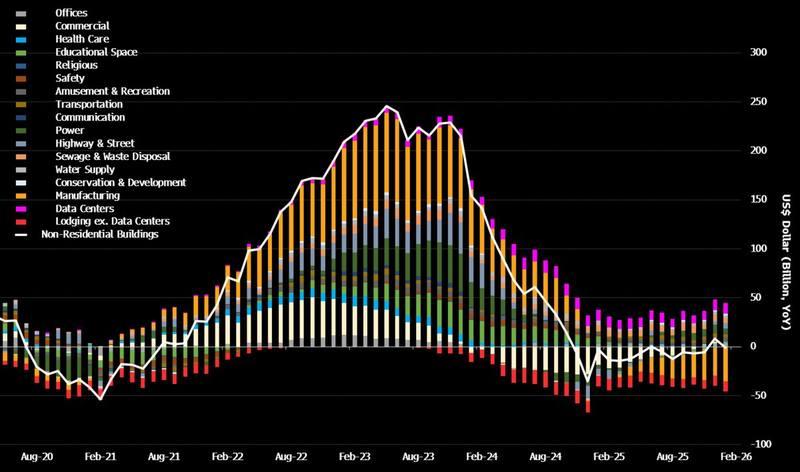
Construction spending likely improved in February and March. Within residential, spending on home improvements likely continued to increase. Single-family homes remained under the greatest pressure. Robust investment in data centers, driven by AI-related demand, has been a notable area of strength in the nonresidential sector. But it has not been enough to offset weakness in office and certain industrial segments.
Bloomberg Economics expects nonfarm payrolls for April to show net hiring growing 57k, down from 178k in March and lower than the consensus of 60k. That is likely above the pace consistent with a stable unemployment rate, which we estimate will drift down to 4.24% from 4.26%. Faster pace of hiring in professional and business services. Demand for data centers and a nascent recovery in the industrial sector should also keep hiring solid in construction and logistics. Improvements more than offset by a fall in leisure and hospitality hiring.
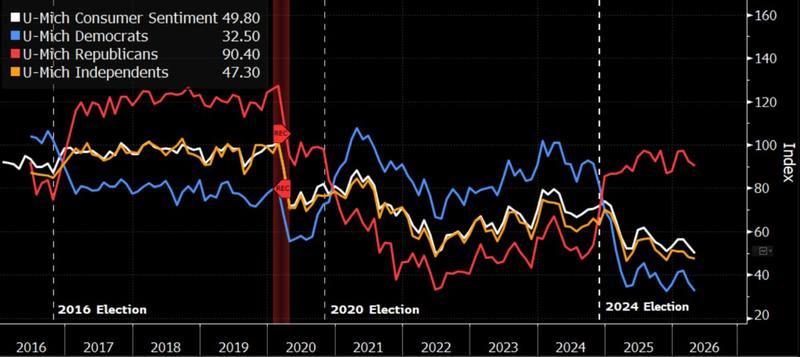
University of Michigan consumer sentiment at 49.80 preliminary May, the same record-low as April final. The political split is the story. Republicans 90.4, Democrats 32.5, Independents 47.3. The 60-point gap between Republicans and Democrats is the widest in the series since 2016. Sentiment readings now say more about the respondent’s politics than about the economy.
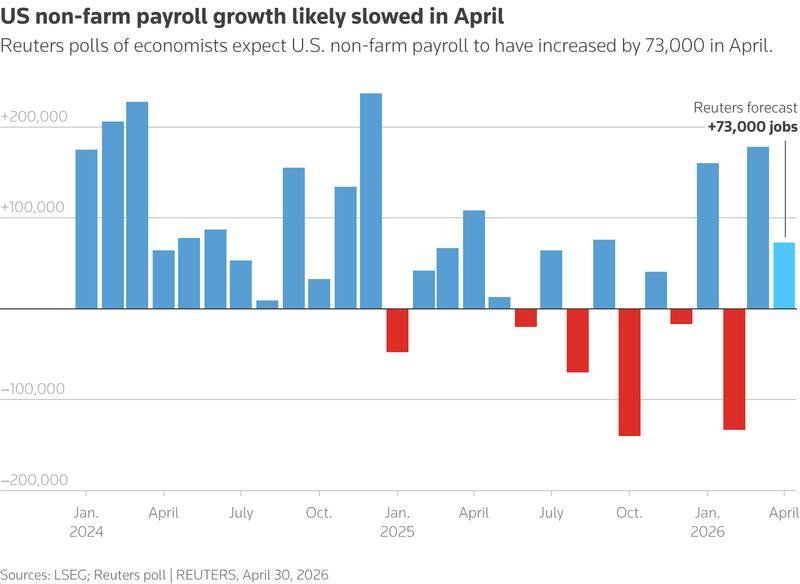
US monthly nonfarm payrolls from January 2024 to April 2026. US payroll growth likely slowed in April. Reuters consensus +73k, Bloomberg Economics +57k, both well below March’s +178k. Payrolls report comes amid signs of hawkishness at the Fed, with three policymakers dissenting at last week’s hold over the easing-bias language.
VC+ Special Dispatch — The Anatomy of America’s Debt
Seven charts mapping the structural pressure that the autumn refinancing wave will land into. From debt established in the 1790s to a 2025 federal debt at 100% of GDP and rising. $10 trillion in Treasury refinancing, $2 trillion deficit, $2 trillion corporate debt all queueing up against a 5% 30-year and a Fed in transition.
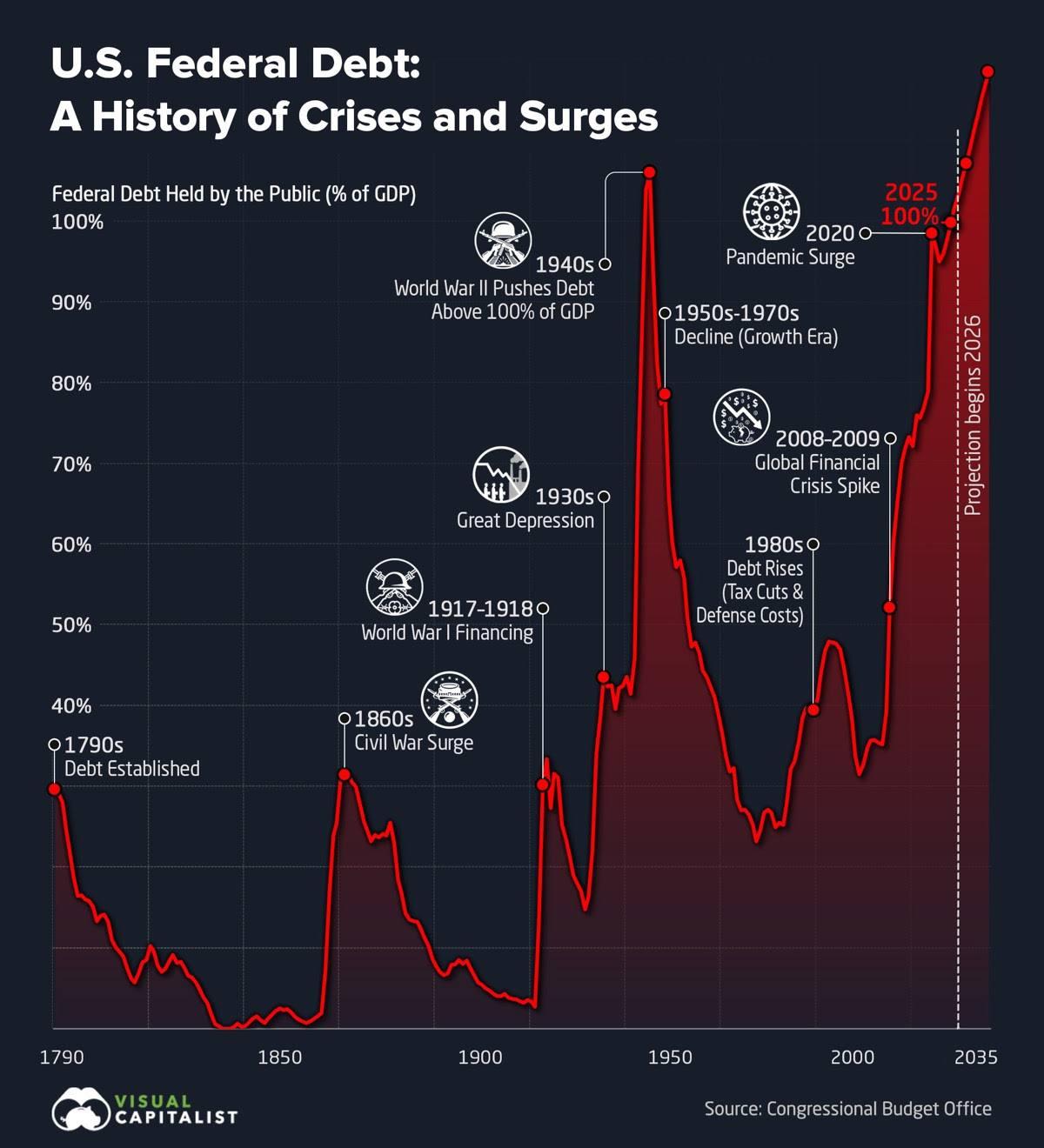
U.S. Federal Debt: A History of Crises and Surges. Federal Debt Held by the Public as a percent of GDP. From debt established in the 1790s through Civil War, World Wars, the 1980s tax cuts and defence costs, the 2008-09 GFC spike, the 2020 pandemic surge, and the climb to 100% of GDP in 2025 with projection beginning 2026. The chart visualises the structural pressure that May’s $10 trillion refinancing wave will land into.
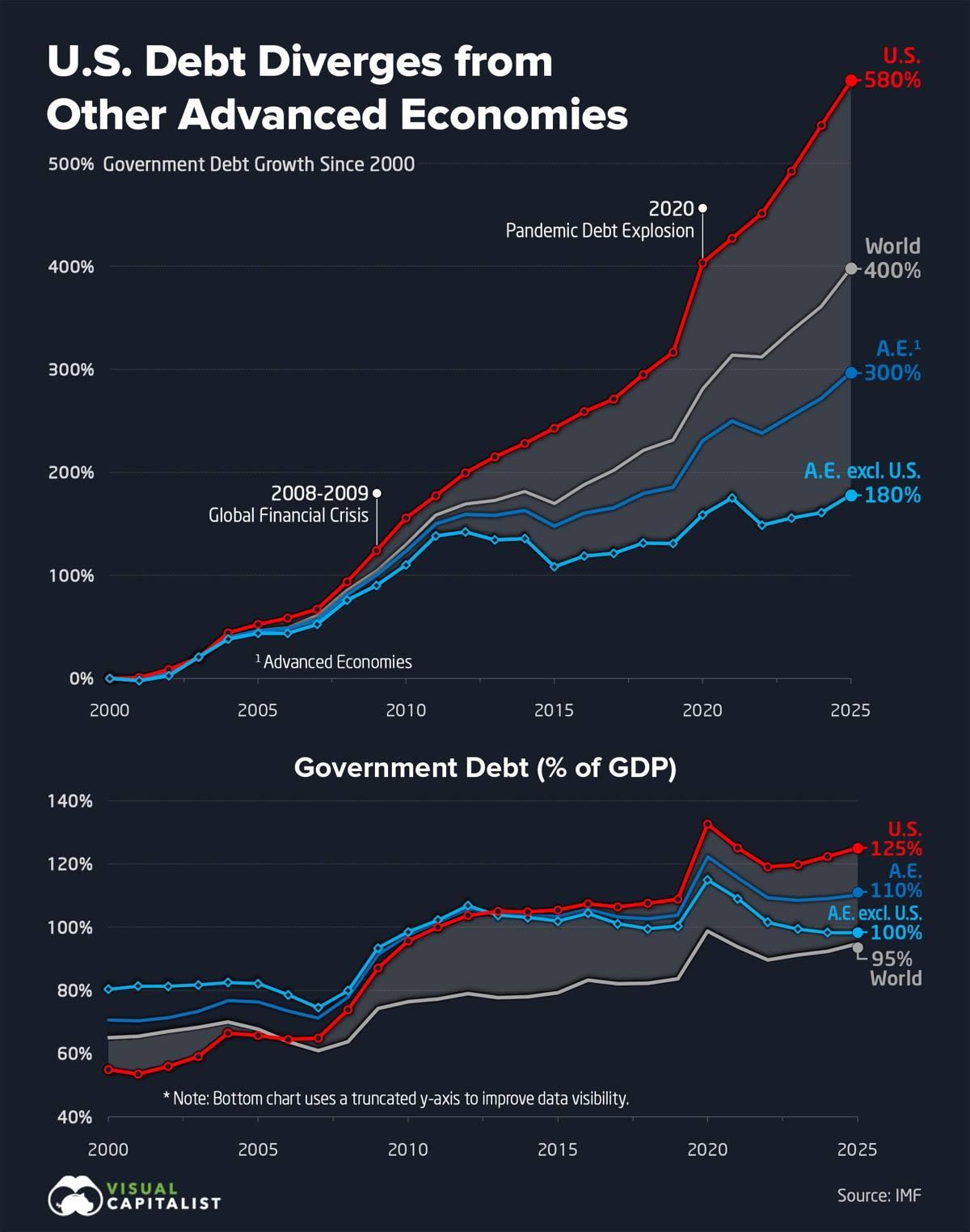
U.S. Debt Diverges from Other Advanced Economies. Government debt growth since 2000. The US line at +580%, the world at 400%, advanced economies at 300%, AE excluding US at 180%. The bottom panel, government debt as percent of GDP, US at 125% versus AE excluding US at 100% and world at 95%. Twenty-five years of relative US fiscal expansion compounding into the autumn financing window.
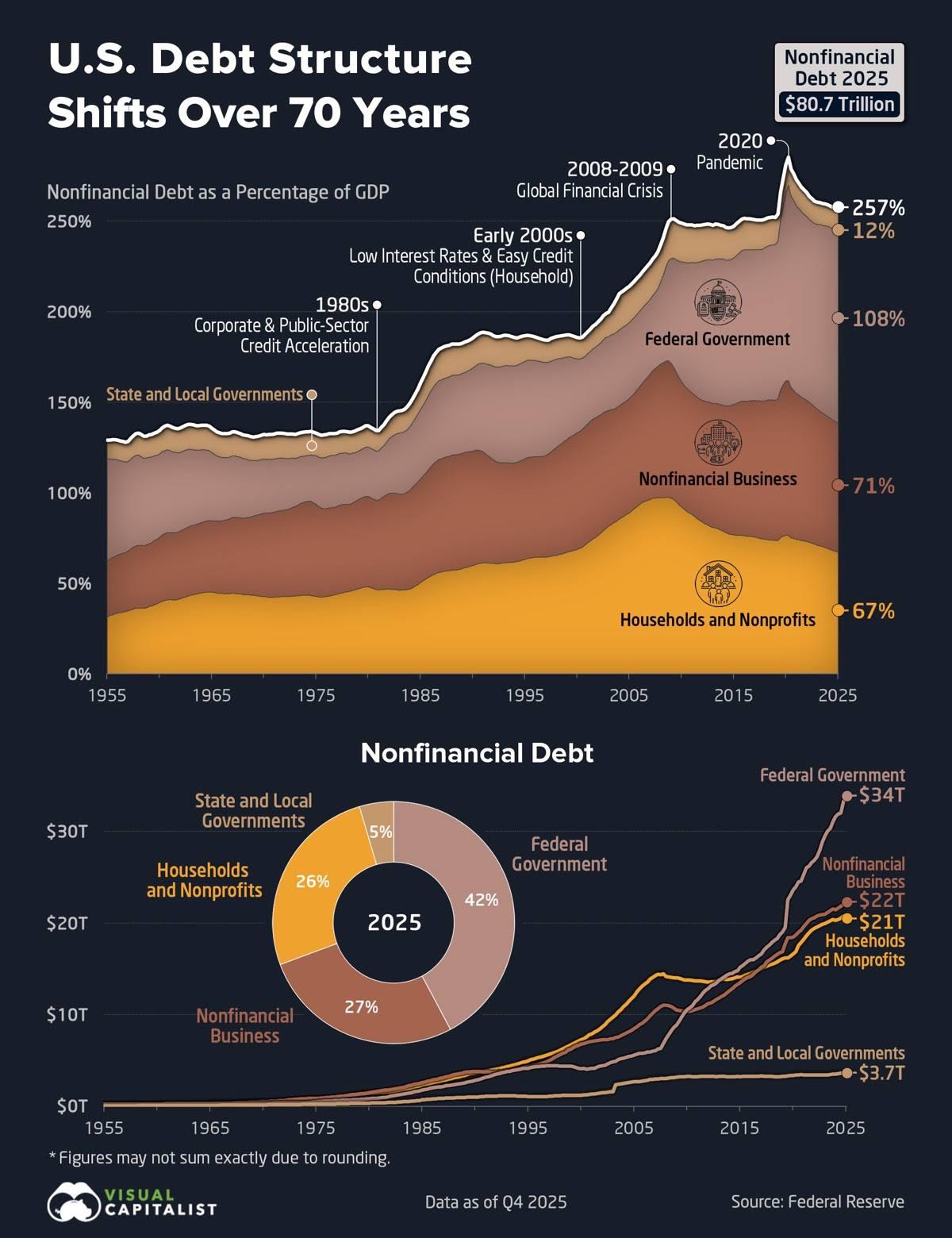
U.S. Debt Structure Shifts Over 70 Years. Nonfinancial debt as percent of GDP. Total nonfinancial debt 2025 $80.7 trillion. Federal Government 108% ($34T), Nonfinancial Business 71% ($22T), Households and Nonprofits 67% ($21T), State and Local 12% ($3.7T). The pie shows Federal Government at 42% of nonfinancial debt, Households 26%, Business 27%, State and Local 5%. Each segment carries its own refi schedule.
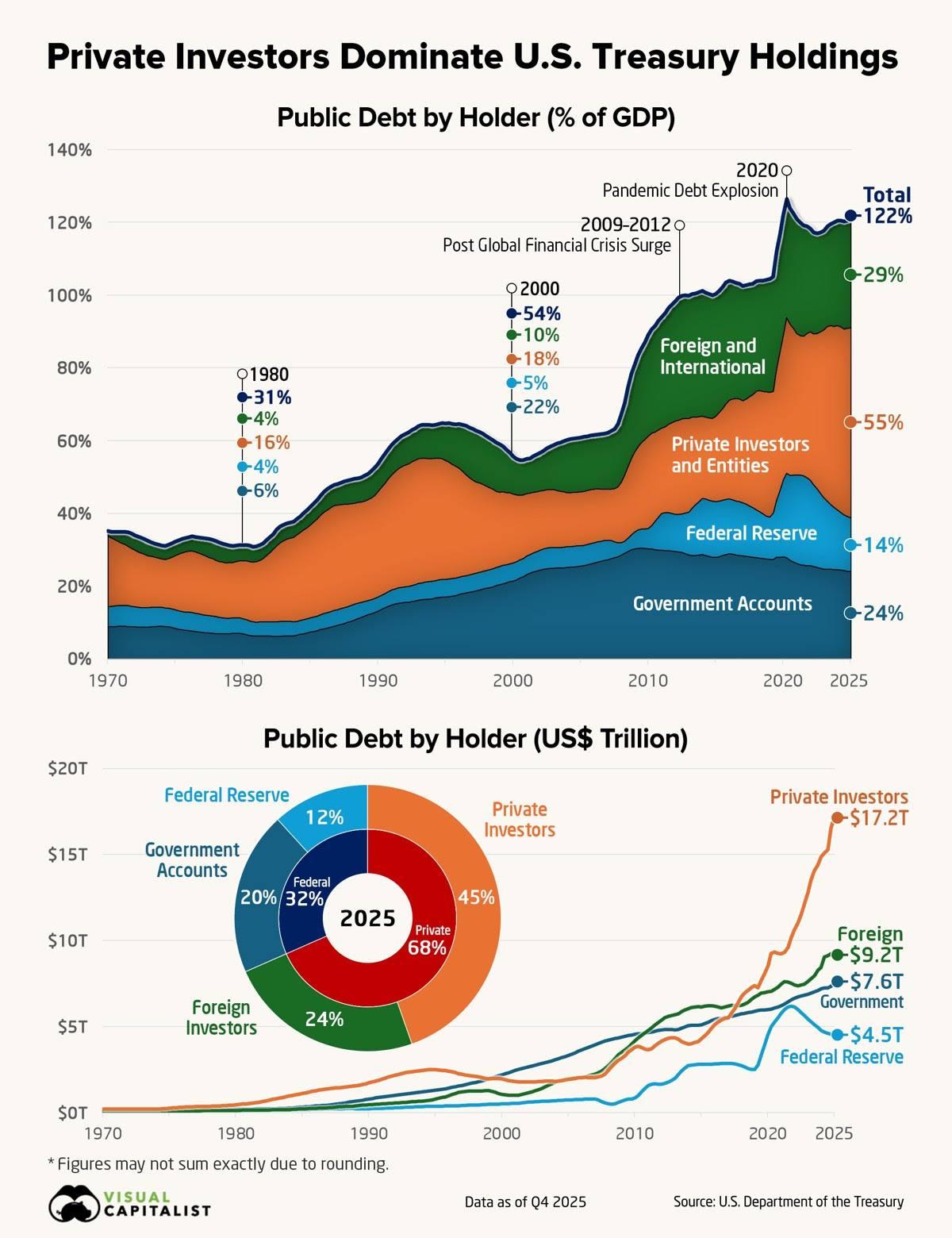
Private Investors Dominate U.S. Treasury Holdings. Public debt by holder, percent of GDP. Private Investors and Entities 55%, Foreign and International 29%, Government Accounts 24%, Federal Reserve 14%, Total 122%. The bottom panel in dollars, Private Investors $17.2T, Foreign $9.2T, Government $7.6T, Federal Reserve $4.5T. Private investors at 45% of public debt is the largest single category and the one most rate-sensitive.
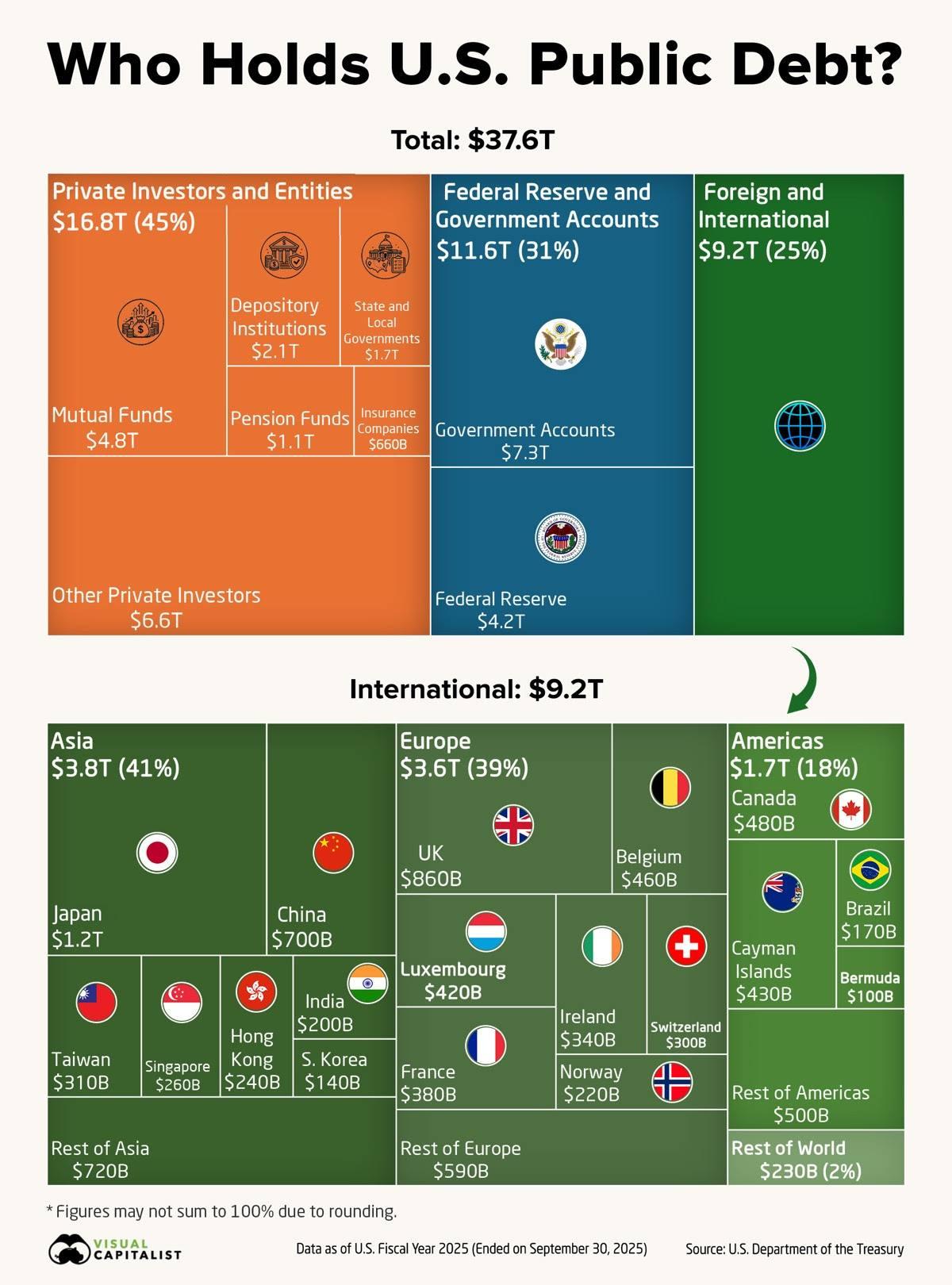
Who Holds U.S. Public Debt? Treasury holdings treemap, total $37.6T. Private Investors and Entities $16.8T (45%), Federal Reserve and Government Accounts $11.6T (31%), Foreign and International $9.2T (25%). Within international, Asia $3.8T (41%) with Japan $1.2T and China $700B. Europe $3.6T (39%) with UK $860B, Belgium $460B. Americas $1.7T (18%) with Canada $480B and Cayman Islands $430B. The geography matters when refinancing meets a weakening dollar.
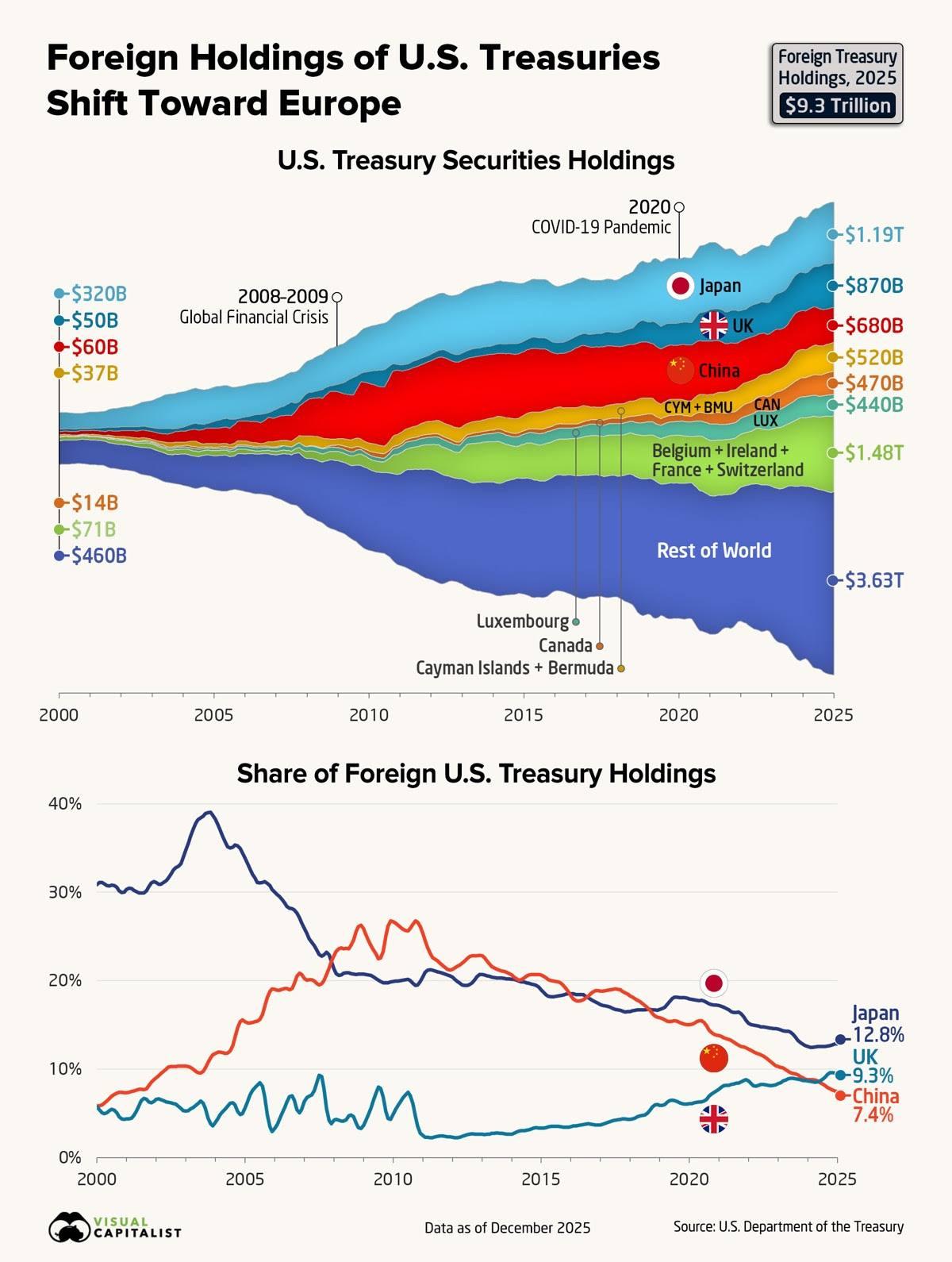
Foreign Holdings of U.S. Treasuries Shift Toward Europe. Treasury securities holdings by region. The 2025 totals, Japan $1.19T, UK $870B, China $680B, Belgium-Ireland-France-Switzerland combined $1.48T, Cayman Islands and Bermuda $470B, Luxembourg $440B, Rest of World $3.63T. The share of foreign US Treasury holdings, Japan 12.8%, UK 9.3%, China 7.4%. China’s share has more than halved from its 2010 peak. Europe is structurally the bigger holder now.
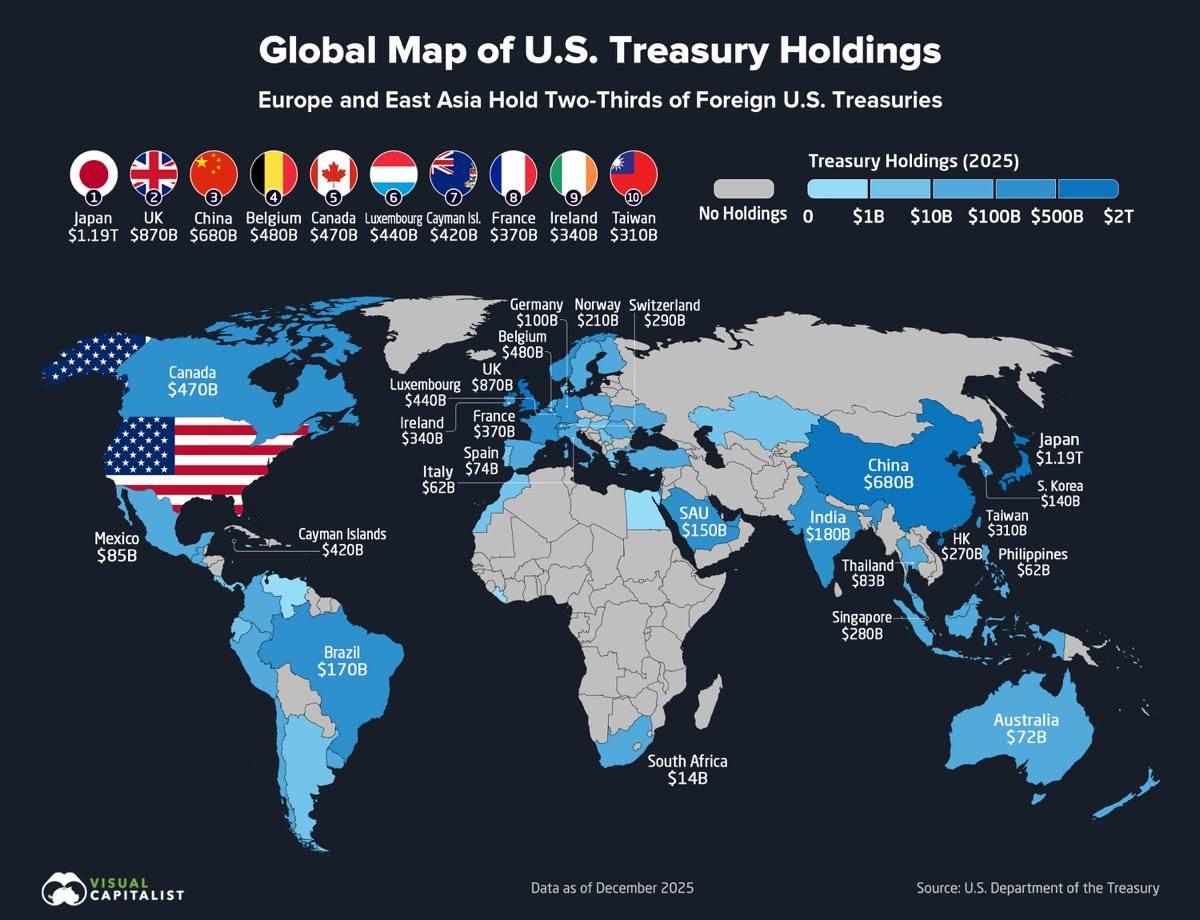
Global Map of U.S. Treasury Holdings. Europe and East Asia hold two-thirds of foreign US Treasuries. Top holders 2025, Japan $1.19T, UK $870B, China $680B, Belgium $480B, Canada $470B, Luxembourg $440B, Cayman Islands $420B, France $370B, Ireland $340B, Taiwan $310B, Saudi Arabia $150B. The map is the geopolitical risk surface for US debt, every relationship that matters for funding sits on this distribution.
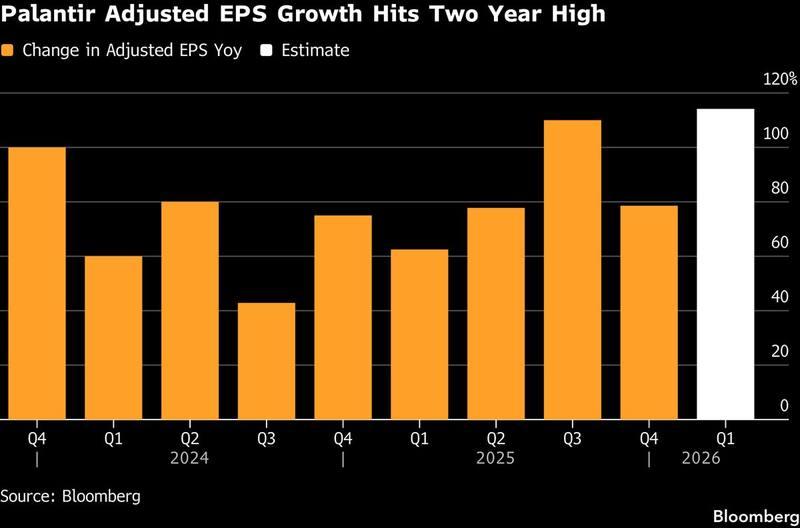
Block Thursday faces questions about near-term restructuring costs and longer term margin benefit after slashing roughly half of its workforce in February. Disney Wednesday faces FCC scrutiny over Kimmel jokes about Trump. Uber Wednesday gross bookings could grow at quickest since 2022 but near-term headwinds building from gas prices and weaker consumer confidence. Airbnb revenue forecast to rise the most in two years.
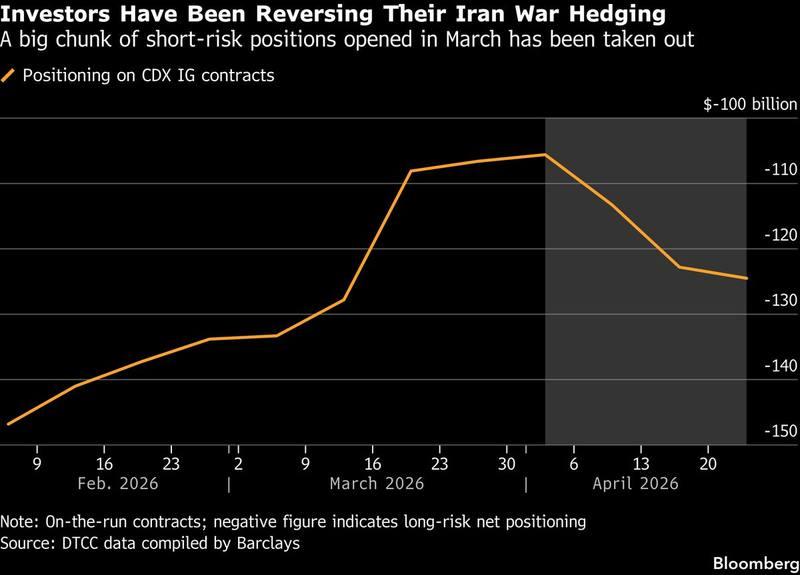
Aegon Asset Management and Barclays are getting ready for April’s credit rally to vanish as quickly as it appeared. Global investment-grade credit logged its best month since August, high-yield best since 2023. Investors broadly betting the war is over, but few of the risks have fully disappeared. Strait of Hormuz remains effectively shut. Hedging is relatively cheap. 5-year CDX North American Investment Grade at 54bp Friday, was 68bp late March.
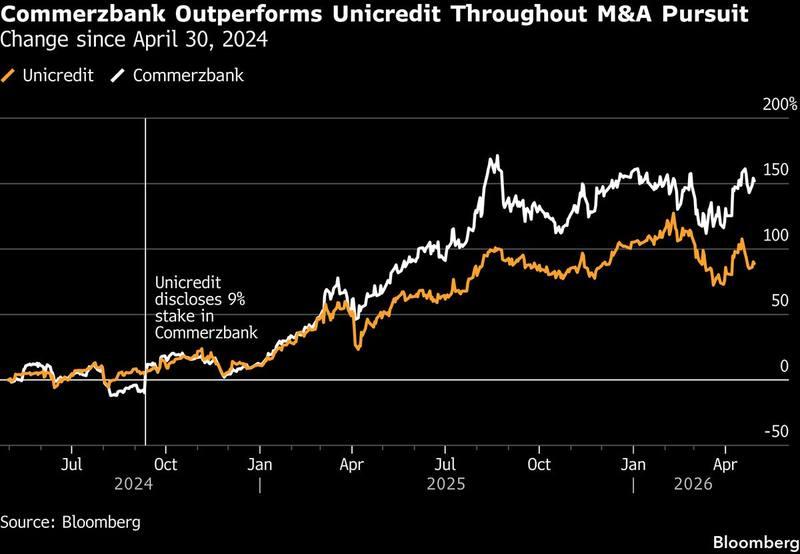
Commerzbank Outperforms Unicredit Throughout M&A Pursuit. Share price change since April 30, 2024, the day Unicredit disclosed its 9% stake in Commerzbank. Commerzbank up roughly +150%, Unicredit up roughly +75%, gap of 75 percentage points. The market has consistently rewarded the target over the acquirer, telling Andrea Orcel that the standalone case is the stronger case. UniCredit Tuesday earnings carry the question of whether to walk away or pay up. Lufthansa, Maersk, Rheinmetall and Shell round out the heavy European reporting tape this week.
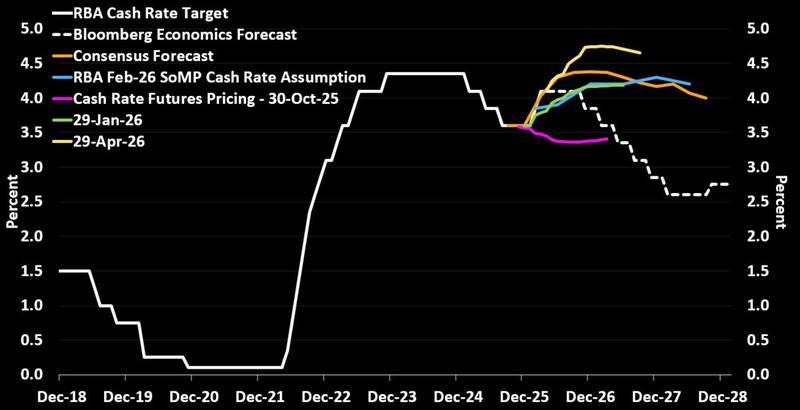
RBA Tuesday is the rate event of the week. Strong chance of a 25bp hike to 4.35%, futures pricing roughly 80%. Bloomberg Economics base case is hold after back-to-back hikes in February and March. The RBA must balance the early impact of an inflation shock against a hit to growth that is yet to arrive. Expect any further rate increases to be reversed, potentially as soon as 4Q26.
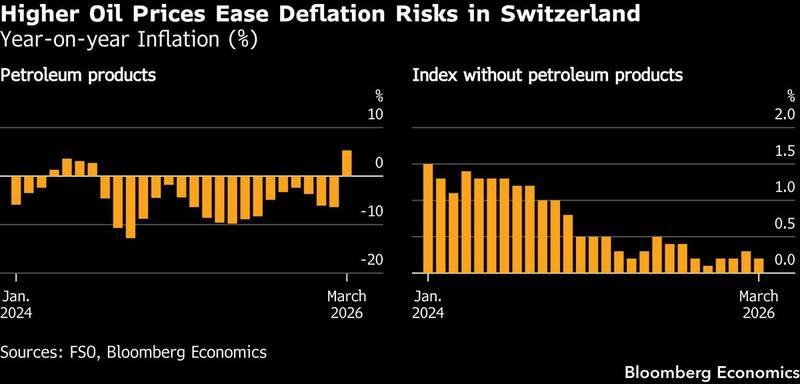
Swiss inflation expected to increase to 0.5% year-on-year from 0.3% in March, reflecting higher oil prices and a slightly weaker franc. Fuel will likely drive the increase. Setup gives the SNB enough confidence to slowly shift toward a more hawkish stance and rebuild policy space, culminating in a rate hike in December 2026.
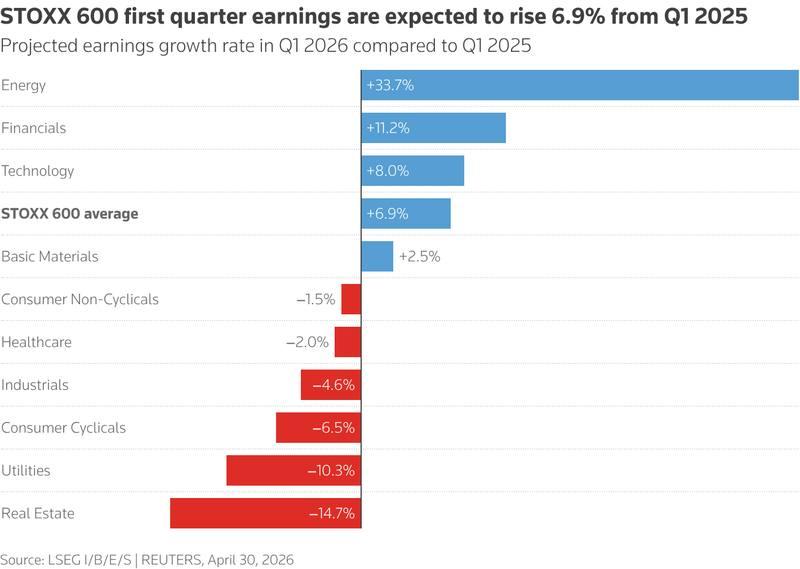
STOXX 600 Q1 sector earnings growth projected versus Q1 2025. Earnings projected to rise +6.9% from a year earlier, driven by just three sectors, financials, tech, and energy. Energy is the biggest beneficiary of the war due to higher oil and gas prices. If the war and energy surge persist, the overall outlook for European earnings could turn. This reporting season too early to reflect that in company guidance.
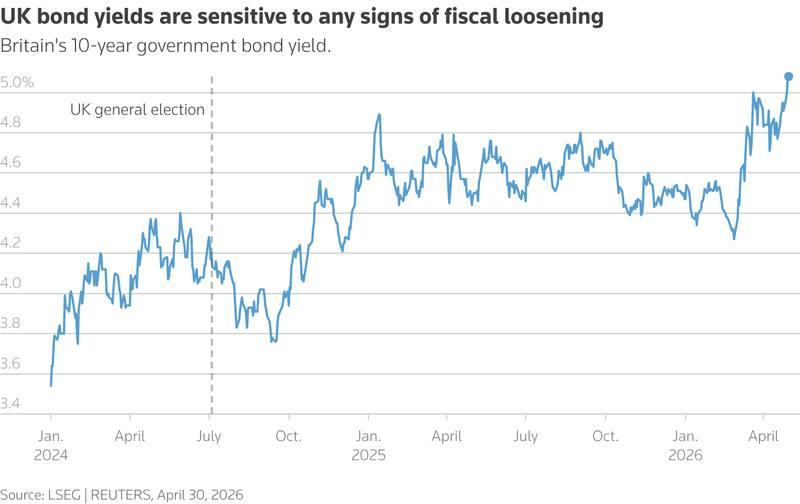
UK 10-year gilt yield since January 2024 with the 2024 election annotated. The gilt is the worst performer among G7 peers since the war started on February 28, by a wide margin. Thursday’s local elections are usually a non-event for investors but opinion polls point to a heavy defeat for Starmer’s Labour. A heavy defeat could spark widespread demands for his dismissal, stoking expectations of a successor more willing to run looser budgets. More bad news for British bonds.
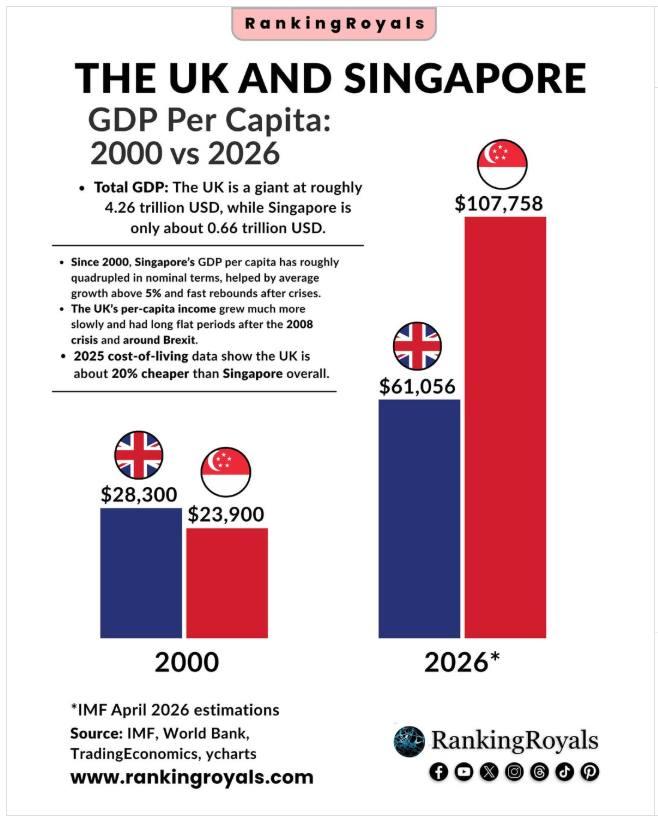
The UK and Singapore, GDP per capita 2000 vs 2026. In 2000 the UK was $28,300, Singapore $23,900. By 2026 the UK is $61,056 while Singapore is $107,758. Singapore’s GDP per capita roughly quadrupled in nominal terms, helped by average growth above 5% and fast rebounds after crises. The UK’s per-capita income grew much more slowly with long flat periods after the 2008 crisis and around Brexit. 2025 cost-of-living data show the UK is about 20% cheaper than Singapore overall. Compound growth on top of policy stability beats inherited size.
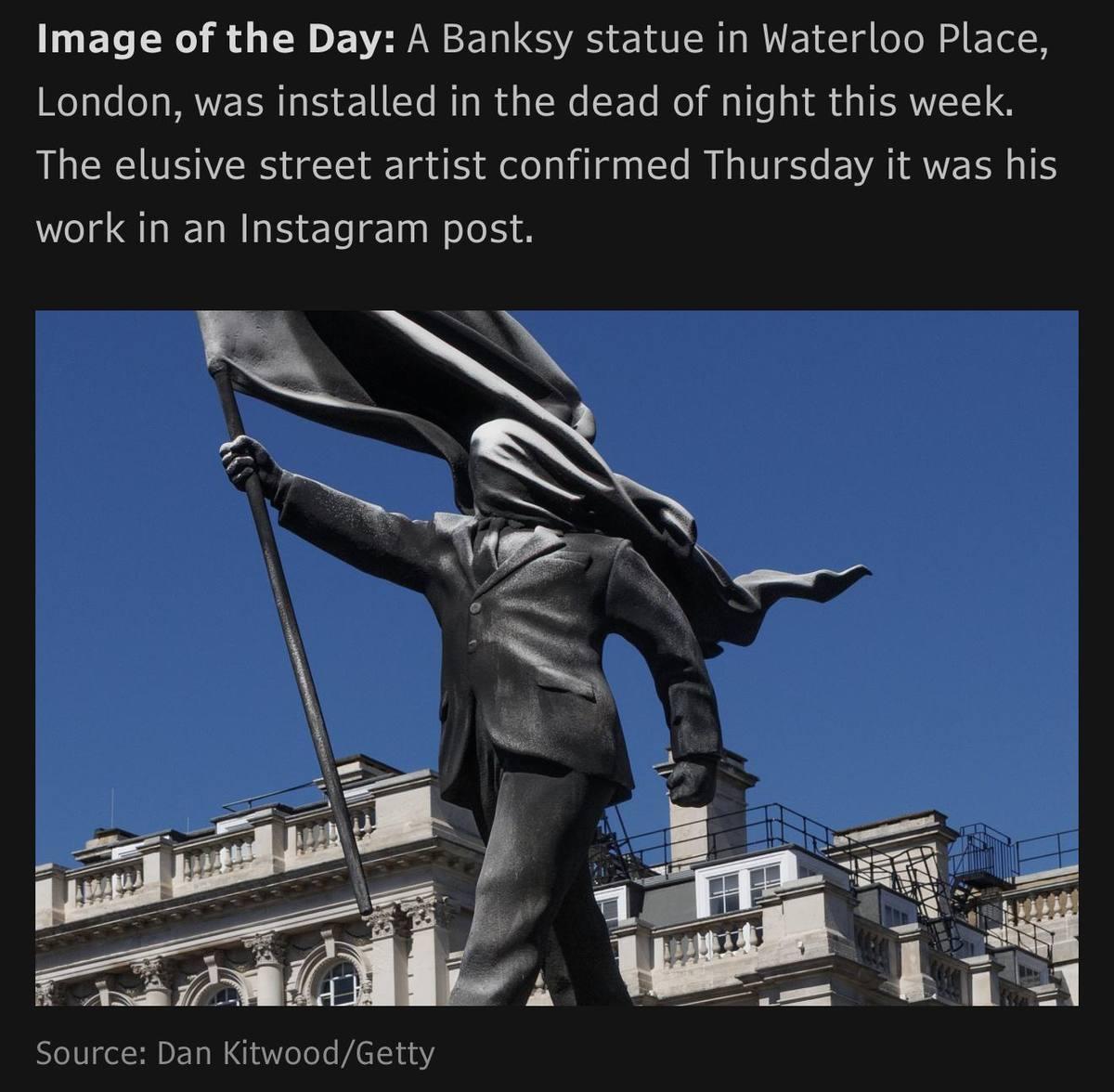
A Banksy statue in Waterloo Place, London, installed in the dead of night this week. The elusive street artist confirmed Thursday it was his work in an Instagram post. The headless figure carrying a flag is a fitting image for the UK economic story, the country marching forward but the head is missing, a metaphor for a Labour government heading into Thursday’s local election rout. The UK 10-year gilt is the worst performer among G7 peers since the war started.
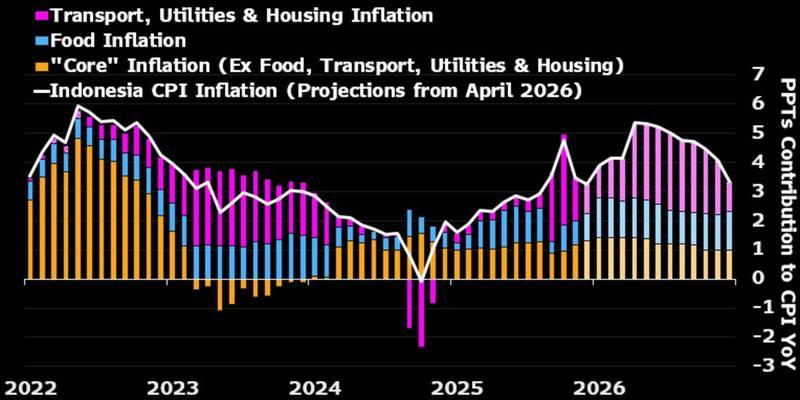
Indonesia CPI Monday expected to ease to 3.26% year-on-year from 3.48% in March, dropping further within the central bank’s 2.5-3.5% target range. The deceleration is driven by base effect. Looking ahead, inflation likely climbs above target in May and continues rising through 3Q, reflecting price pressures from the oil shock. Risk aversion has weakened the rupiah, increasing import costs.
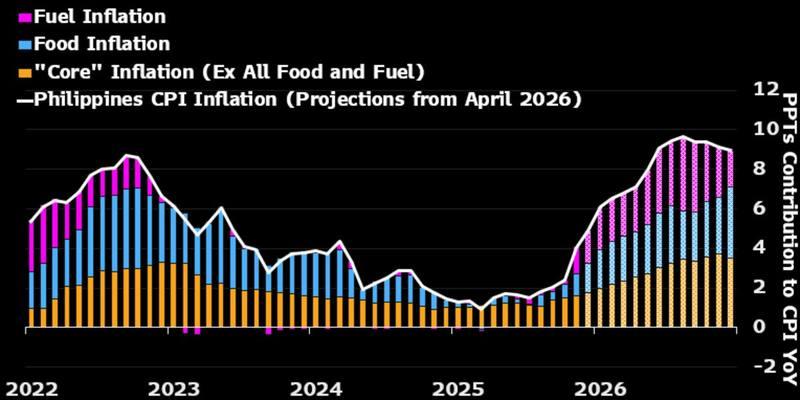
Philippines CPI Tuesday expected to pick up to 4.9% year-on-year from 4.1%, moving further above the central bank’s 2-4% target. The increase driven by the oil shock, which has also weighed on the peso, further inflating the cost of imports. Bangko Sentral expected to continue hiking until inflation peaks.
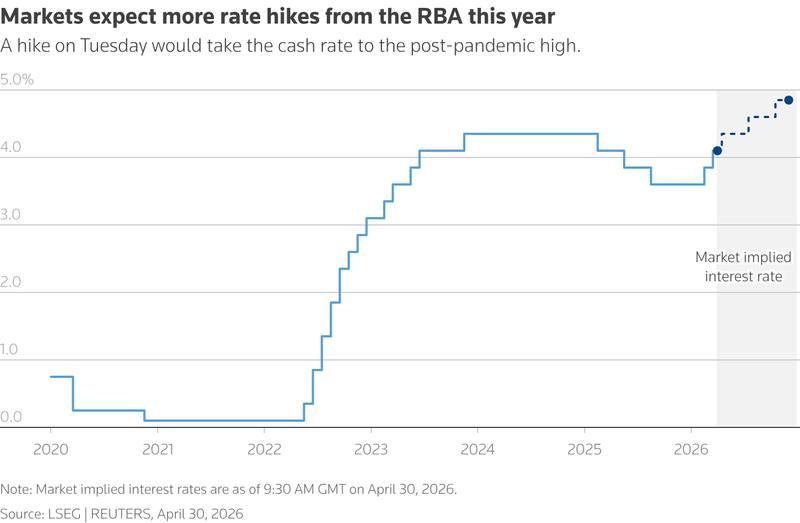
RBA cash rate since 2020 plus market-implied path to December 2026. Markets expect the RBA to hike a few times this year. The decision Tuesday could come down to the wire. March’s hike was a 5-4 vote, the tightest margin since the RBA started releasing breakdowns. Governor Bullock stressed the split reflected timing rather than direction.
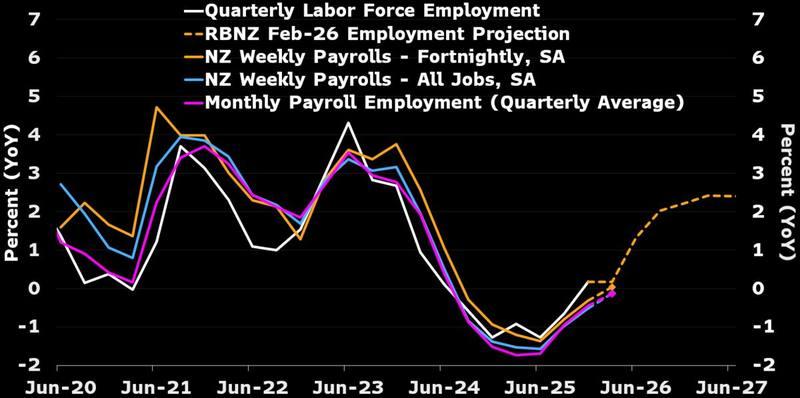
New Zealand jobs report Wednesday. Unemployment rate likely rose in Q1 as the labor-market recovery sputtered. Employment expected to rise just 0.1% q/q after a stronger 0.5% gain in 4Q25. Monthly jobs and weekly payrolls data suggest the recovery is losing steam, employment growth weaker than the RBNZ projected in February forecasts. Labor supply picking up after a sharp decline through 2024 and 2025.
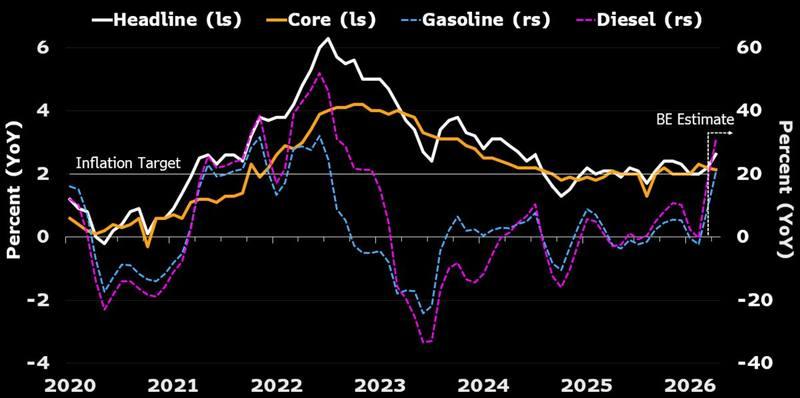
South Korea CPI Wednesday expected to rise sharply to 2.6% year-on-year from 2.2%, pushed well above the BOK’s 2% target by higher oil prices. Fuel-price cap has limited the immediate impact on retail costs, but only partly. Core inflation remained steady at 2.2%. Inflation likely rises further. Soaring memory chip prices feeding into consumer electronics.
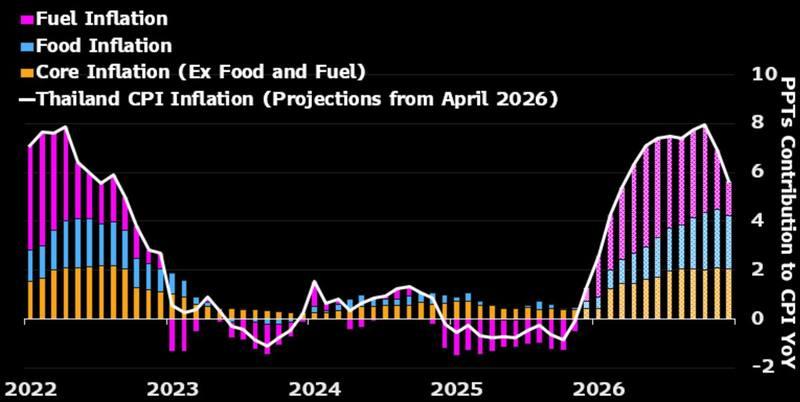
Thailand CPI Wednesday expected to rise to 1.3% year-on-year, a turnaround from the 0.08% decrease in March. Higher fuel prices and dependent goods drove the pickup. Inflation continues to climb into 4Q with limited fiscal space. Bank of Thailand likely looks through the oil shock.
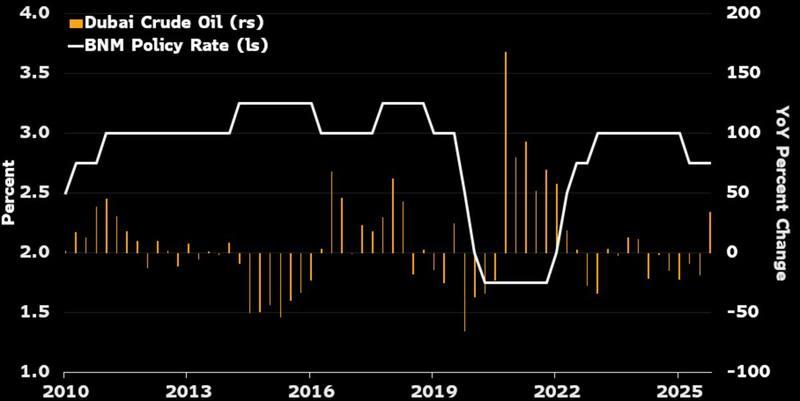
Bank Negara Malaysia Thursday expected to leave its overnight policy rate unchanged at 2.75%. The global oil shock has yet to materially lift inflation, which remained benign at 1.7% in March. Government oil-related revenues buoyed by the energy spike, providing scope to lean against higher domestic fuel prices with subsidies. The ringgit relatively strong versus peers, tempering imported inflation.
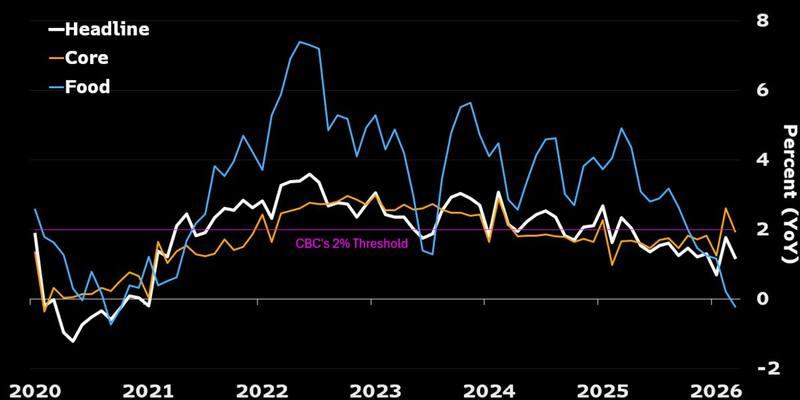
Taiwan CPI Thursday expected to accelerate to 1.6% from 1.2% in March, reflecting higher oil prices. Despite government measures including fuel price stabilization and tax adjustments, higher crude prices partially spilled over. Higher airline fuel surcharges added. Inflation set to edge higher. Central Bank of the Republic of China expected to keep policy rate at 2% through 2026.
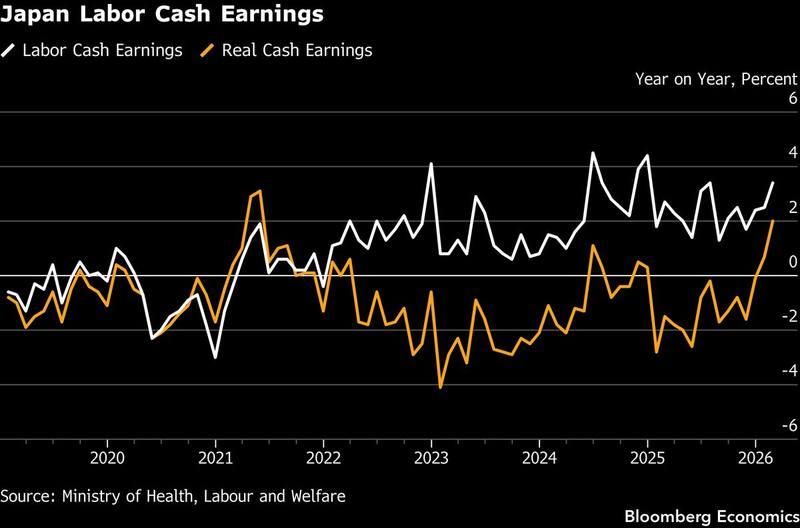
Japan labor cash earnings Friday expected to accelerate to +3.6% year-on-year from a revised +3.4% in February. Adjusted for inflation, labor cash earnings likely rose 2.0%, unchanged from the previous month. The BOJ’s preferred measure, which strips out sample changes for smoother continuity, will probably show pay growth of 3.3%, edging up from 3.2%.
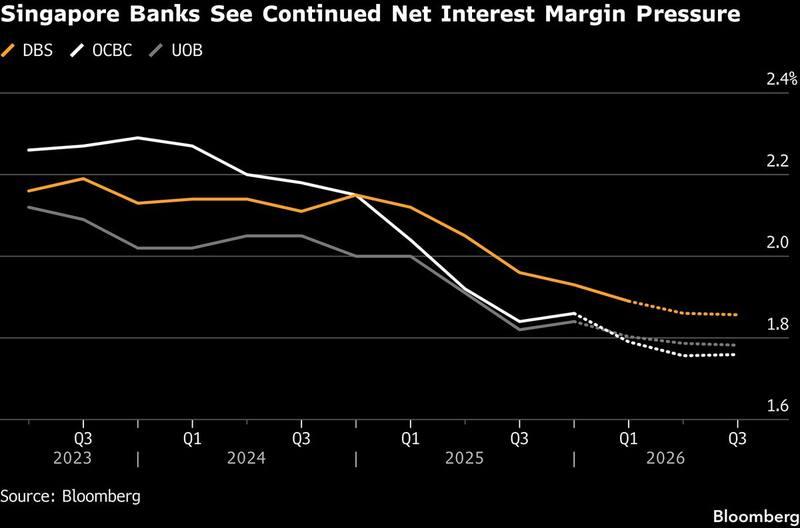
HSBC Tuesday likely sees cost-of-risk guidance tick higher, though only a prolonged war would threaten the year’s 40bp target. Hibor rates declining further. Westpac and NAB brace for uncertainty. Singaporean lenders OCBC and UOB could benefit from geopolitical turmoil, leveraging Singapore’s reputation, strong currency and AAA credit rating to draw wealth-management business.
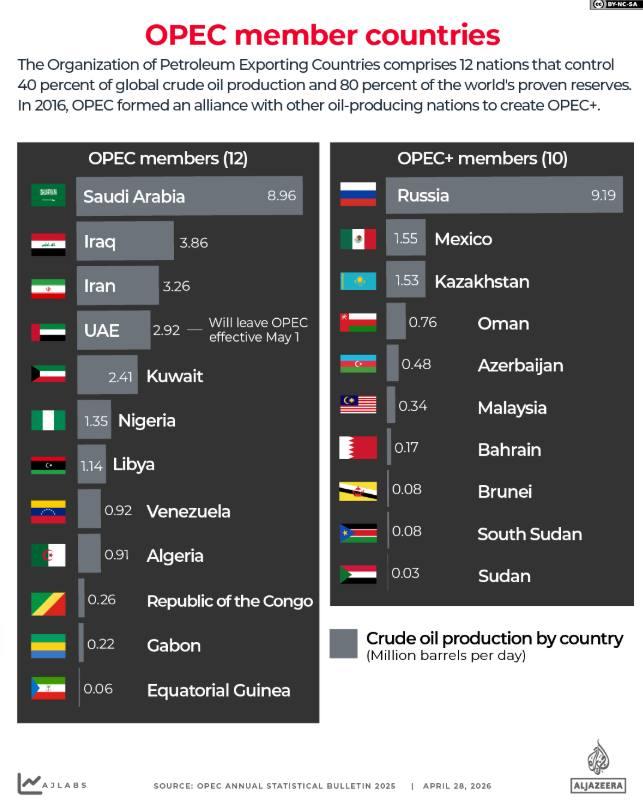
OPEC member countries, crude oil production by country in million barrels per day, April 28, 2026. Saudi Arabia 8.96, Iraq 3.86, Iran 3.26, UAE 2.92 will leave OPEC effective May 1, Kuwait 2.41, Nigeria 1.35, Libya 1.14, Venezuela 0.92, Algeria 0.91. OPEC+ adds Russia 9.19, Mexico 1.55, Kazakhstan 1.53, Oman 0.76, Azerbaijan 0.48, Malaysia 0.34. The UAE exit deals a heavy blow to the cartel at a time when the war on Iran has caused a historic energy shock. Saudi retaliation through unilateral output cuts is the live tail.
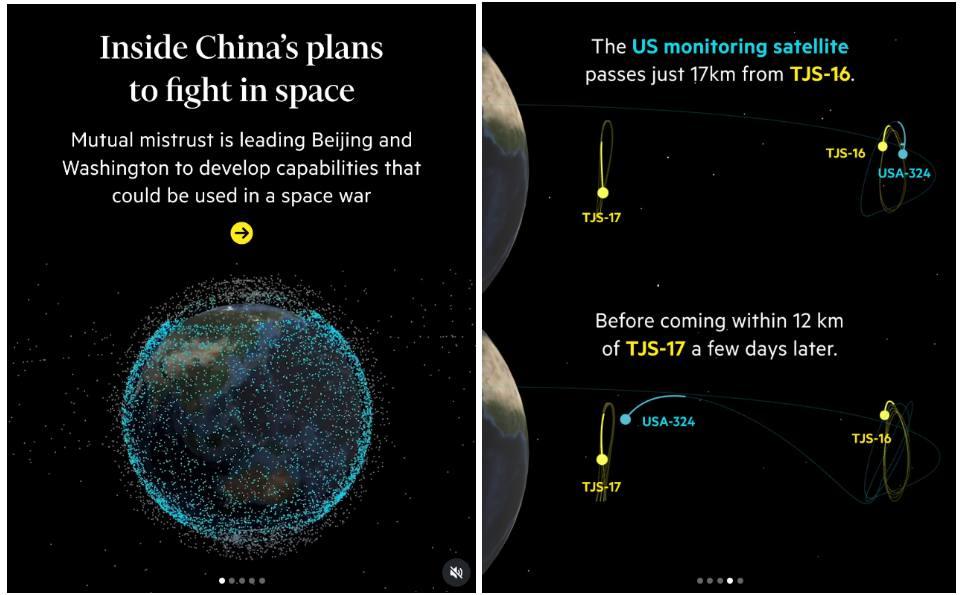
Inside China’s plans to fight in space. Mutual mistrust is leading Beijing and Washington to develop capabilities that could be used in a space war. The chart shows a US monitoring satellite USA-324 passing within 17 km of China’s TJS-16, then within 12 km of TJS-17 a few days later. Combat in Earth’s orbit is no longer the stuff of fiction. The US has classed a number of Chinese manoeuvres as “dogfighting in space”. The same proximity capability that lets one satellite inspect another can damage or disable it.
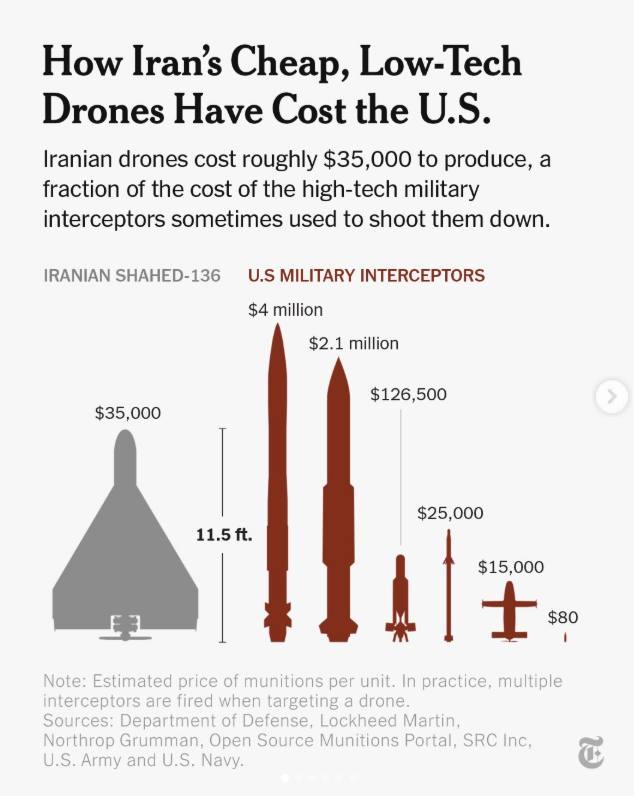
How Iran’s Cheap, Low-Tech Drones Have Cost the U.S. Iranian Shahed-136 drones cost roughly $35,000 to produce, a fraction of the $4 million Patriot interceptors and $2.1 million SM-2s sometimes used to shoot them down. The cost asymmetry is the lesson, a $35,000 drone neutralised by a $2 million missile is the kind of math that breaks military budgets, not just engagements. Iran has forced the US and its regional allies to confront the rise of cheap drones on the battlefield.
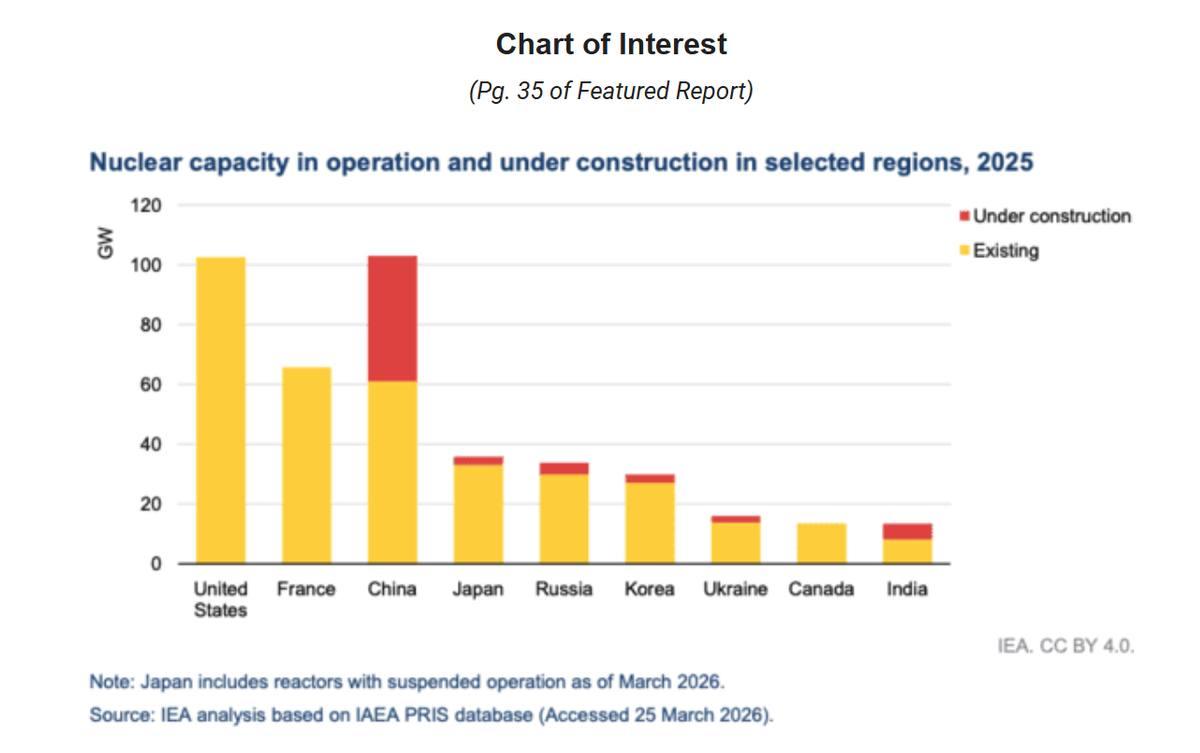
IEA Global Energy Review 2026, nuclear capacity in operation and under construction, selected regions, gigawatts. United States 102 GW, France 65, China 105 GW total with 45 GW under construction, Japan 36, Russia 35, Korea 30, Ukraine 16, Canada 14, India 14. China leads the pipeline, accounting for roughly half of global capacity under construction. Over the past decade China and Russia have driven 94% of new nuclear construction worldwide. Small modular reactors can be built in roughly three years with lower upfront capital. The AI capex boom needs power.
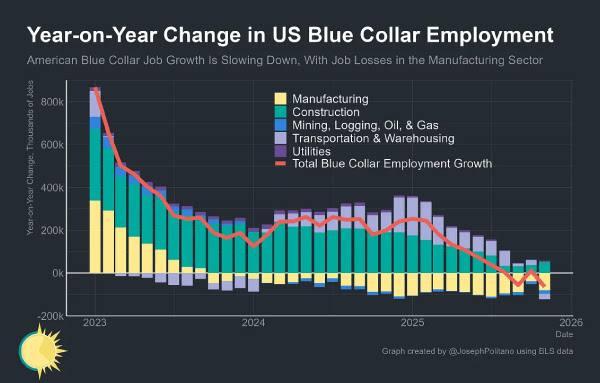
Year-on-Year Change in U.S. Blue Collar Employment from Apricitas Economics. Manufacturing, Construction, Mining/Logging/Oil & Gas, Transportation & Warehousing, Utilities. Total Blue Collar Employment Growth has slowed to negative territory in 2026 from +800k in early 2023. Manufacturing employment has declined for two consecutive years, falling to a record low of under 8% of total US employment, with manufacturing jobs down more than 200,000 since early 2023. Tariffs raised input costs, immigration crackdowns strained construction. The combination is a structural cost-push tailwind to inflation that will not unwind cleanly.
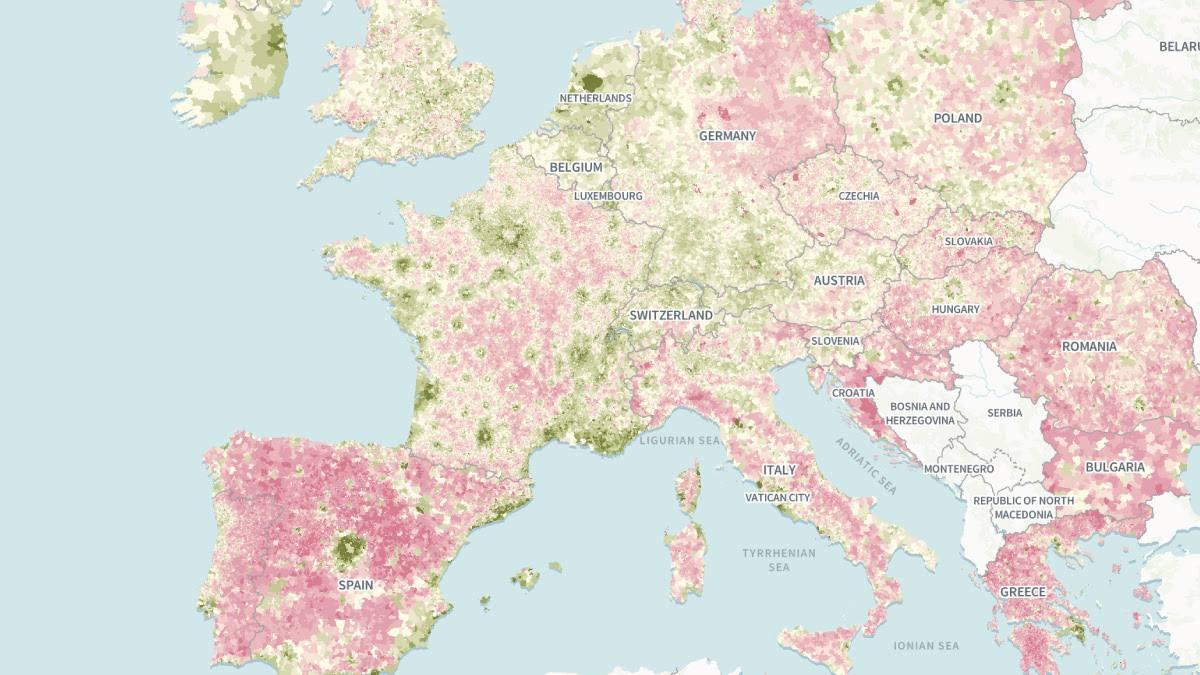
Half of Europe’s towns and villages have fewer residents than 60 years ago. Correctiv interactive map of 100,000 European cities and municipalities showing population change between 1961 and 2024. Pink for shrinking, green for growing. Two main trends visible, Europe-wide rural depopulation with people moving to urban centers, and major emigration from former Eastern Bloc countries. Lithuania is the extreme example, 73% of all municipalities shrank while capital Vilnius grew nearly threefold. Europe’s population reached 450 million in 2025 and is expected to peak in 2029.
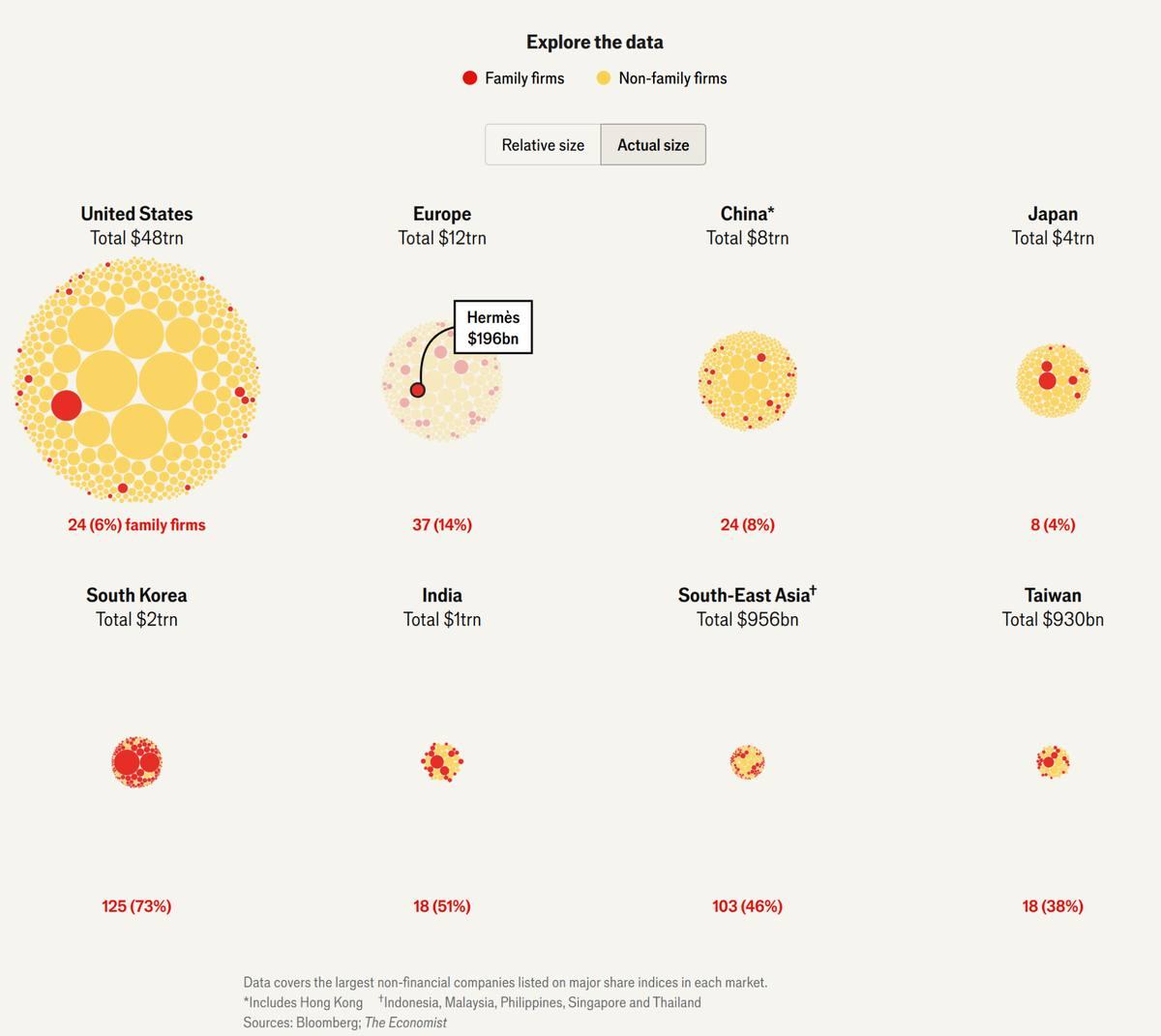
Family firms by country, actual size. Bubble size is the total market capitalization of the largest non-financial companies on each major share index. United States $48 trillion with 24 family firms (6%), Europe $12 trillion with 37 (14%), China $8 trillion with 24 (8%), Japan $4 trillion with 8 (4%), South Korea $2T (73%), India $1T (51%), South-East Asia $956B (46%), Taiwan $930B (38%). Hermès the standout European family firm at $196bn.
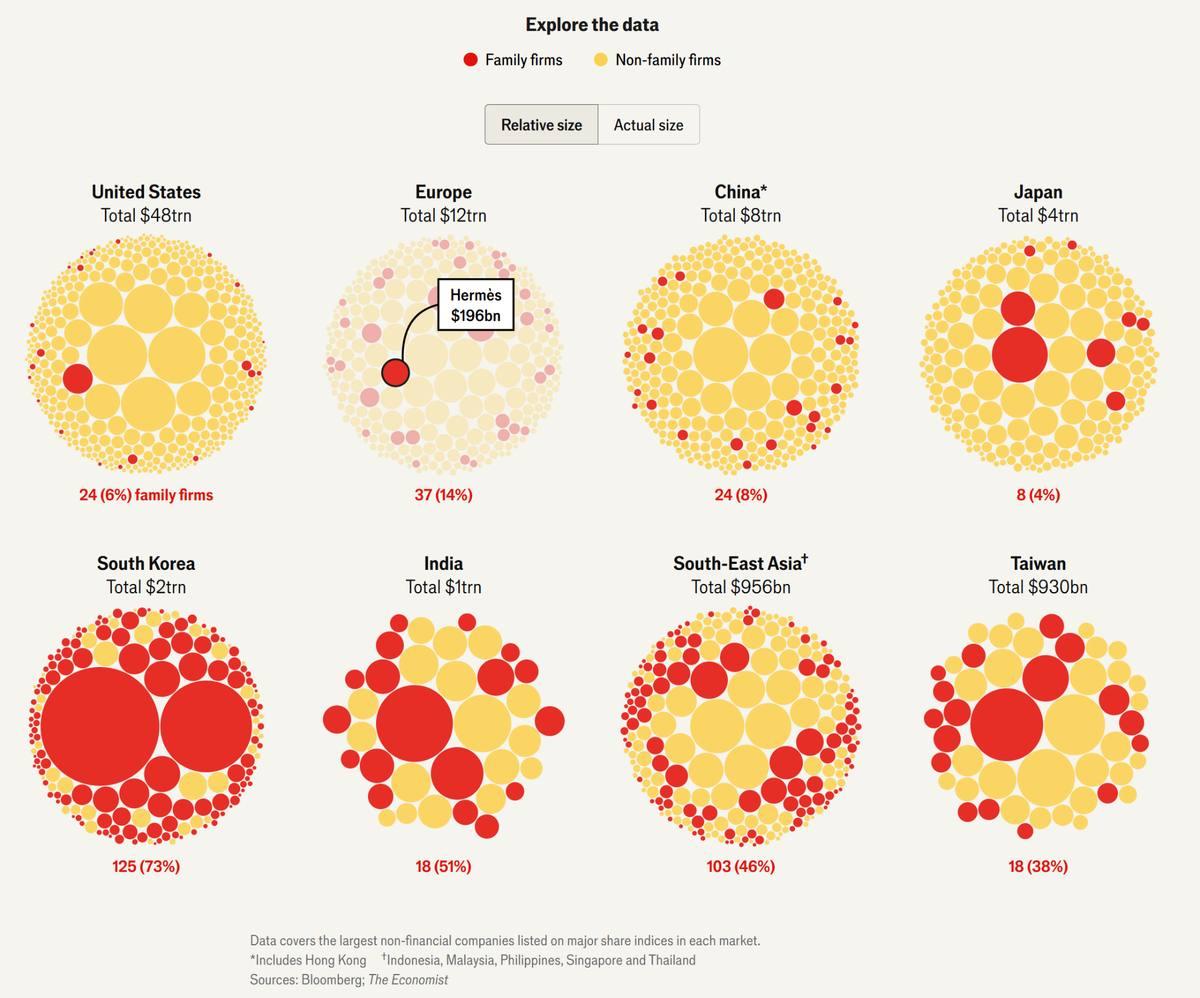
Family firms by country, relative size. Same data as the actual-size view, but each market scaled to fill its bubble so the share of family-controlled capitalisation is visible directly. South Korea 73% family firms, India 51%, South-East Asia 46%, Taiwan 38%, Europe 14%, China 8%, US 6%, Japan 4%. The relative view shows where family business is structurally dominant and where the succession wave will hit hardest. Asia ex-Japan and ex-China is the centre of gravity.
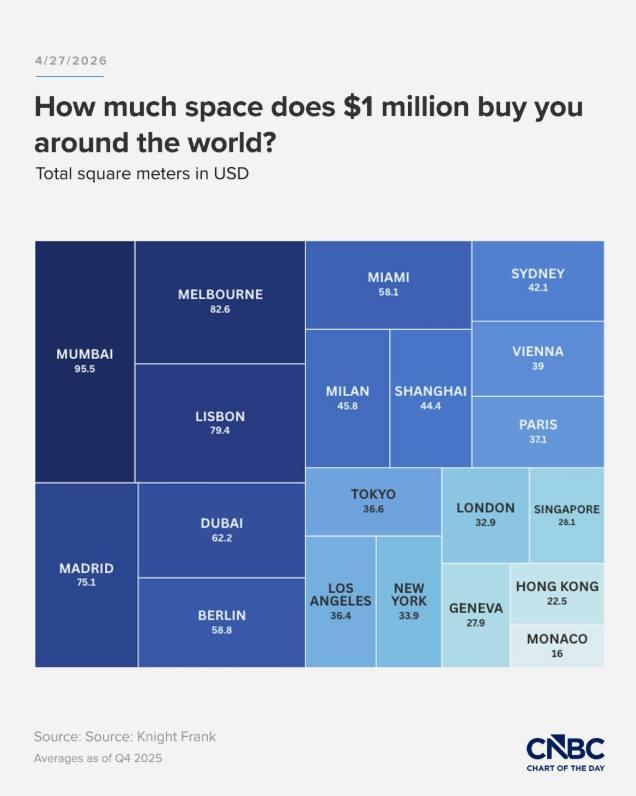
How much space does $1 million buy you around the world? Knight Frank, total square meters in USD. Mumbai 95.5, Melbourne 82.6, Lisbon 79.4, Madrid 75.1, Dubai 62.2, Berlin 58.8, Miami 58.1, Milan 45.8, Shanghai 44.4, Sydney 42.1, Vienna 39, Paris 37.1, Tokyo 36.6, Los Angeles 36.4, New York 33.9, London 32.9, Singapore 28.1, Geneva 27.9, Hong Kong 22.5, Monaco 16. A million dollars is not what it used to be, especially in luxury real estate. Monaco the world’s most expensive market measured per square meter.
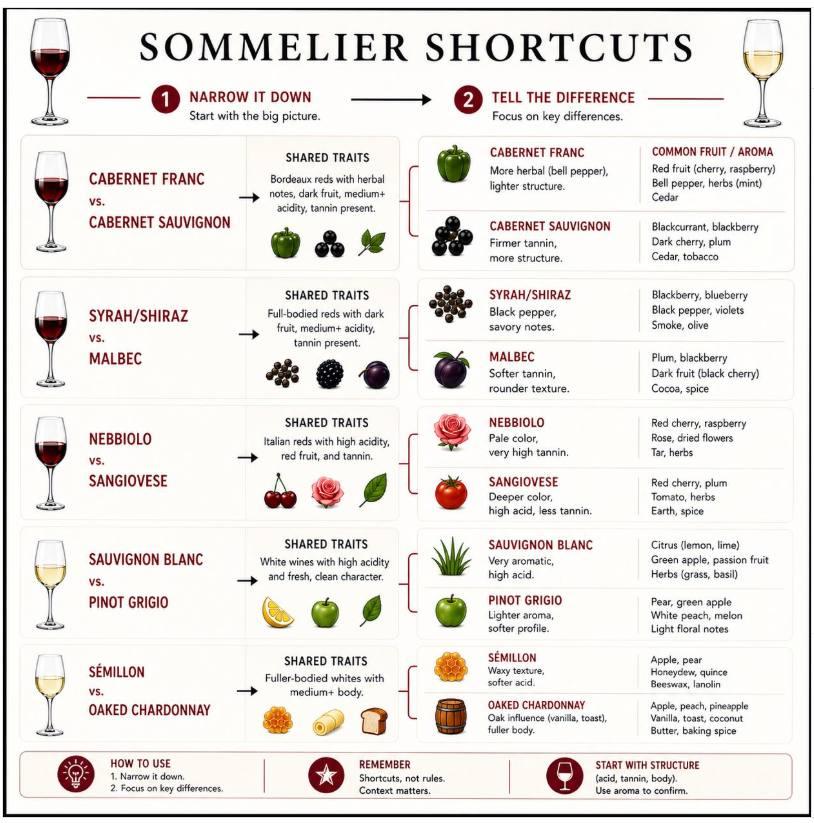
Sommelier Shortcuts, common blind wine tasting mixups and how to avoid them. Cabernet Franc vs Cabernet Sauvignon, Bordeaux reds with herbal notes and dark fruit. Syrah/Shiraz vs Malbec, full-bodied reds with dark fruit and tannin. Nebbiolo vs Sangiovese, Italian reds with high acidity. Sauvignon Blanc vs Pinot Grigio, whites with high acidity. Sémillon vs Oaked Chardonnay, fuller-bodied whites with medium-plus body. The best blind tasters hold three competing hypotheses at once and let the next sip eliminate two. The same applies to markets this week. Hold the bull case, hold the bear case, hold the stalemate case, let the data eliminate two.

Champagne Prestige Cuvée (Tête de Cuvées), the pinnacle of a Champagne house’s craftsmanship made from the finest grapes and best vintages. Dom Pérignon (Moët & Chandon, since 1936), Louis Roederer Cristal (1876, made for the Tsar of Russia), Pol Roger Sir Winston Churchill (1975), Taittinger Comtes de Champagne, Salon Le Mesnil, Veuve Clicquot La Grande Dame, Bollinger R.D., Laurent-Perrier Grand Siècle, Ruinart Dom Ruinart, Piper-Heidsieck Rare, Jacques Selosse Substance, Egly-Ouriet Les Crayères. Twelve houses, twelve different ways to express great Champagne. Hold the celebrations close, the week ahead has plenty of crown-heavy work.
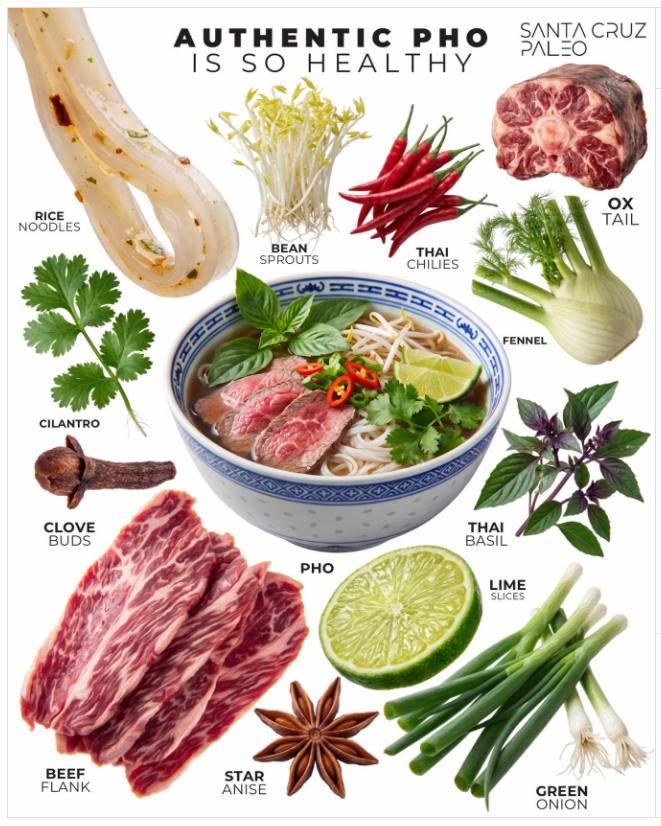
Authentic Pho is so healthy. The bowl, rice noodles, beef flank, ox tail, fennel, star anise, clove buds, cilantro, Thai basil, Thai chilies, bean sprouts, lime slices, green onion. Built right, pho is a complete meal in a bowl, slow-simmered bone broth for collagen and minerals, lean protein, herbs and aromatics for digestion, complex carbohydrates from rice noodles. The Vietnamese answer to the question of what to eat when the world is on fire and you still need to think clearly Monday morning.
Best,
Hoelon