The Handover
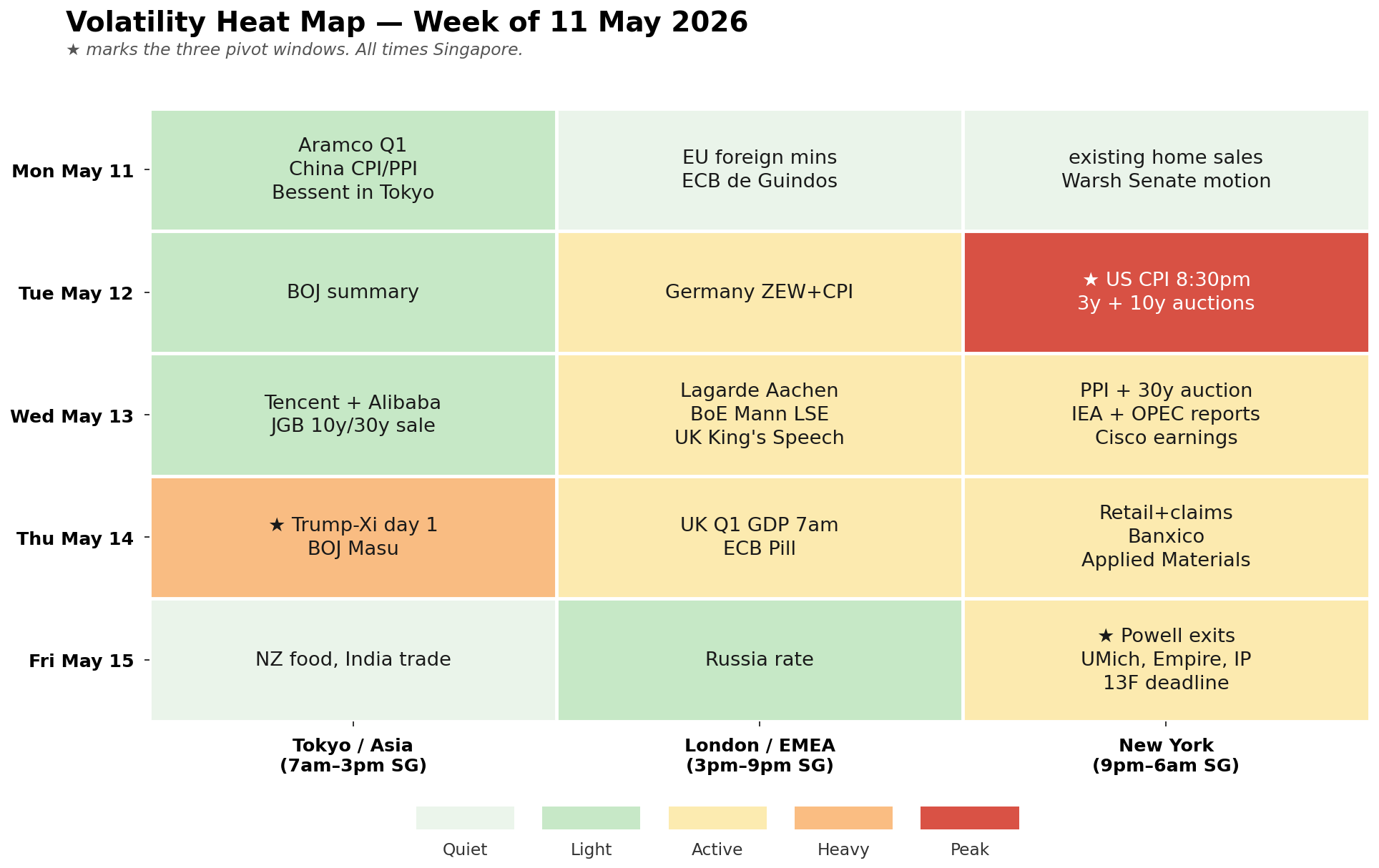
Volatility heat map for the week ahead, all times Singapore. The peak window is Tuesday evening as US April CPI prints. The second pivot is Thursday Asia open as Trump arrives in Beijing. The third is Friday late as Powell hands the chair to Warsh. Monday opens light with China data and Bessent in Tokyo. Wednesday cross-currents PPI and the Treasury 30-year auction with ECB Lagarde and BoE Mann, plus Tencent and Alibaba into Asia close and Cisco into US close. Friday is by design lighter as liquidity sizzles into the weekend. Size up Tuesday evening, hold powder for Thursday Asia gap, clear the desk by Friday lunch.
“He wants the Democrats to succeed him, with 100% certainty.” — Anthony Scaramucci, on the Mishal Husain interview last weekend. This is the most fascinating Trump observation of the week. Most people assume Trump would naturally want Rubio, Vance, or another Republican to inherit the movement. The opposite is closer to true. Trump’s instinct is personal dominance, not party continuity. A successful Republican successor risks shrinking Trump’s myth and historical importance. A Democratic victory after Trump could actually reinforce the idea that only Trump himself could hold the coalition together. He wouldn’t want those guys taking credit for anything that happened in the administration. That single observation reframes everything from the Trump-Xi summit Thursday to the Powell-Warsh handover Friday to the gerrymandering noise into the midterms. Trump operates more like a founder who never wants the company to survive without him.
“The principle of spending money to be paid by posterity, under the name of funding, is but swindling futurity on a large scale.” — Thomas Jefferson, Letter to John Taylor, May 28, 1816. The 30-year held above 5% Friday. Two centuries on, the math is the same.
“The AI boom today looks like a tiny little gnat on the arse of an elephant compared to the railway boom.” — Robin Wigglesworth, FT Unhedged Podcast, “Are AI stocks the new railroad bonds?” The point is not that AI is not a bubble. History suggests truly transformational infrastructure booms often become far larger and last far longer than people think possible. Railroads bankrupted investors and still changed civilization. Anthropic just printed 80x annualised growth in Q1, beating its own 10x plan by eight times. Cisco reports Wednesday. AMD jumped +25% on AI datacenter momentum. Intel has a preliminary deal to make Apple chips. Amazon’s Jassy says the chips Amazon produces would put it among the largest chipmakers in the world if it sold them externally. SK Hynix Q1 revenue +198%, operating profit +405%. DRAM ASPs +60% q/q, NAND +50%. The melt-up risk is very real.
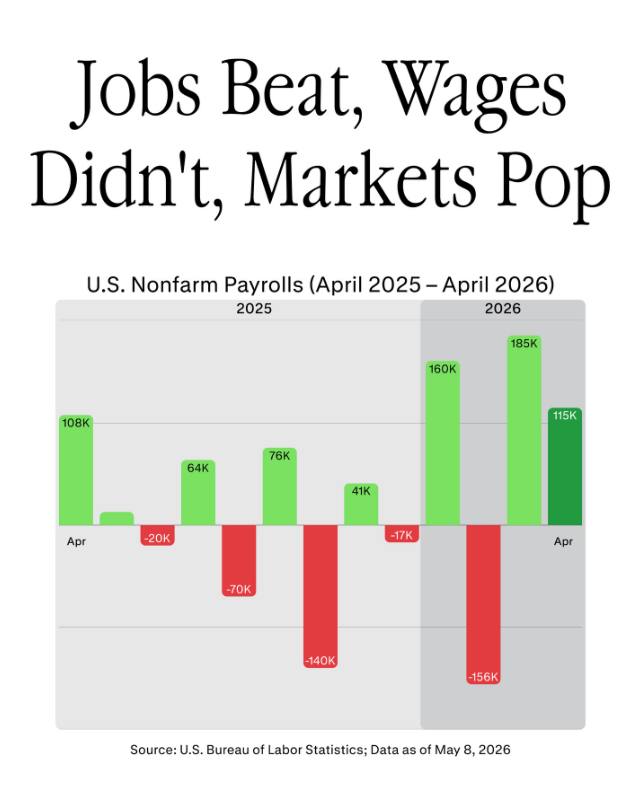
April nonfarm payrolls came in at 115,000 versus consensus 55,000, the second straight upside beat. Average hourly earnings grew just 0.2% month-on-month against a 0.3% estimate, 3.6% year-on-year versus 3.8% expected. That kills the stagflation print Wall Street had been bracing for. But the rest of the report was less cheerful. Labor force participation dropped to 61.8%, lowest since October 2021. The U-6 rate jumped to 8.2%. Tech shed another 13,000 jobs, extending a collapse that has now erased 342,000 positions since November 2022. The labor market is not breaking. It is quietly hollowing out from the inside.
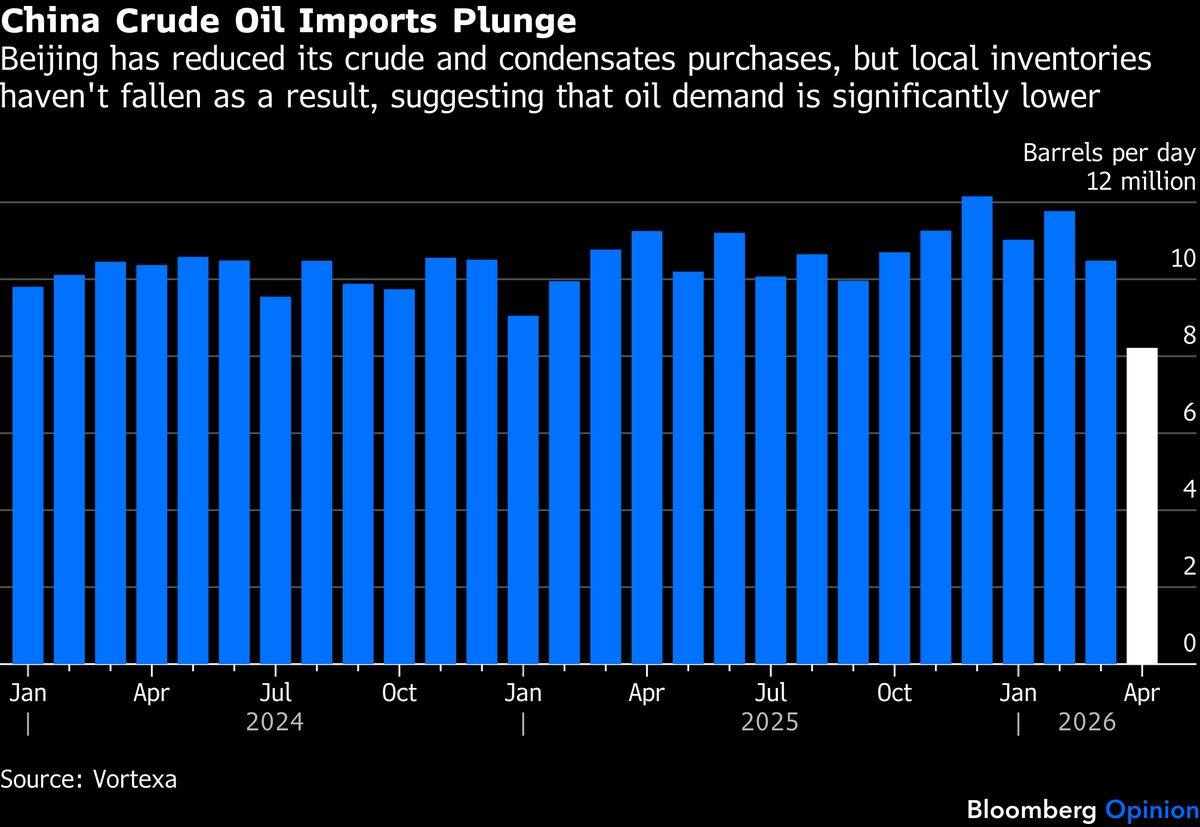
China crude oil imports plunge. Beijing has reduced its crude and condensates purchases, but local inventories have not fallen, suggesting that oil demand is significantly lower. Imports fell from a prewar level around 11.7 million barrels a day to about 8.2 million in April, a swing of 3.5 million barrels a day that almost matches Japan’s total consumption and is double the UAE Hormuz-bypass pipeline. Quietly the second- or third-largest factor rebalancing the oil market today, behind only Saudi Arabia’s pipeline and the US and Japan strategic reserves. State-owned Chinese companies are reselling cargoes. Premia that ran $30 above benchmark in early April are now changing hands at $1, with discounts emerging.
What is the plan this week?
Last week the S&P printed fresh all-time highs and the Nasdaq cleared 26,000 for the first time. Oil tumbled. The goldilocks payrolls killed the stagflation print. UMich at a fresh record low says the consumer hears something different. Records and warning signals occupying the same week, again. The April rally was complacency. May so far is conviction.
Three pivots define the week. Tuesday US April CPI is the inflation print of the cycle, consensus 0.58% headline and 0.36% core, shelter the wild card after October’s shutdown understatement gets rectified. Thursday Trump arrives in Beijing for the summit with Xi, his first China visit in eight years. Friday Powell hands the chair to Warsh. Bessent in Tokyo Monday with yen weakness on the agenda. PPI Wednesday alongside the 30-year auction and quarterly refunding. Cisco reports Wednesday into the AI tape, Tencent and Alibaba into Asia close. UK Q1 GDP Thursday.
Three Fed dissents at the April FOMC was the highest count since 1992. Warsh inherits a Fed under political pressure to cut, the long end above 5%, and an autumn refinancing wall against a $2 trillion deficit and $2 trillion of corporate debt rolling. The bond market is telling the consumer what the consumer already knows. UMich at 48.2 says the consumer hears it. The Court of International Trade ruled 2-1 Thursday that Trump’s Section 122 tariff workaround is illegal. The legal scaffolding is wobbling.
Europe is the political theatre. Starmer survived the Labour rout, the gilt rallied Friday in confirmation. UK Q1 GDP at 0.6% should be the strongest quarter since Q1 25, the strong-1Q-then-fade pattern visible. Lagarde and Lane both speak Wednesday on central bank independence. Norges’ surprise hike to 4.25% Thursday week ago was the under-priced event of last week.
Asia is the cleanest split. China is invisibly rebalancing the oil market while exports keep beating. Beijing has cut crude imports by about a quarter from prewar through stopping SPR builds, coal-to-chemicals substitution and quieter demand. The customs print over the working Saturday in Beijing showed the AI super-cycle showing up with a one-month lag, imports +25.3% on memory chip prices, exports +14.1% on integrated-circuit pricing power. SK Hynix’s Q1 numbers tell you why. The PBOC has guided the dollar reference rate to fresh three-year lows. The Trump-Xi summit is unlikely to move markets short-term, but some Beijing officials reportedly think Trump’s Greenland threats tell more about the new world order than the war on Iran does.
The plan this week. Stay short USD with stops, the inverse correlation to S&P 500 has reached -0.75, strongest since October 2022. Long KRW, MYR and TWD as AI-beneficial currencies, the SK Hynix-led memory cycle is just printing through customs data. Long THB on the contrarian dividend repatriation flow when everyone is short, and Thailand’s central bank holds the highest gold-to-reserves ratio in ASEAN, so a THB long is also an indirect gold position. Watch USDJPY 155 to 156 for the next leg lower, the air pocket below has no major option strikes. Accumulate gold on this base, the risk-off bid for Trump-Xi week is asymmetric and China has not stopped buying. Sell in May has not arrived. Stay cautious into US CPI Tuesday and Trump-Xi Thursday.
What did I learn last week?
Mon May 4: BOJ held at 0.75% (6-3 high dissent). Eurozone Sentix May -16.4 vs -22.0e beat. Iran-US Hormuz tensions traded with state-press claims and Axios denials. Treasury Q2 borrowing upgraded to $189B vs $150B. Factory orders +1.5% beat. Apple-Intel-Samsung A-series chip exploration. Amazon Jassy: $50B chip run rate. Anthropic’s Jack Clark: 60% recursive self-improvement by 2028. Palantir, Tyson beat.
Tue May 5: RBA hiked +25bp to 4.35%, third consecutive. Swiss CPI 0.6% 16-month high. New home sales 682K beat. Project Freedom paused per Trump. AMD Q1 $1.37 beat, datacenter accelerating, +25%. Anthropic CEO: SaaS firms may go bust from AI disruption. Pfizer beat. Google, xAI and Microsoft agreed to US national security AI reviews.
Wed May 6: PBOC reportedly guiding from extremely loose to neutral with mild easing bias. Axios: US close to one-page memo to end Iran war. ADP +109K. Trump tweet: Epic Fury at end, Hormuz open, else bombing higher. Suspected BOJ intervention drove USDJPY to 155.40, the 61.8% retracement of the late-Jan rally. Anthropic 80x Q1 growth (planned 10x). ARM, CDW, Costco, CVS, Disney, Marriott beat. OBDC cut div 16%. Whirlpool slashed outlook.
Thu May 7: WSJ: US plans to restart Project Freedom. Norges Bank surprise +25bp to 4.25%, first European hiker since the war. DOJ probing $2.6B oil trades — front-running scandal opens. Q1 productivity 0.8% beat, ULC 2.3% cooler. Court of International Trade ruled Trump’s Section 122 tariffs illegal 2-1. Maersk: ships staying in Gulf, +$0.5B/month war cost. McDonald’s: US consumer not improving, may be getting worse. First Squawk: IRGC hardliners delaying talks.
Fri May 8: Trump announced 3-day Russia-Ukraine ceasefire May 9-11. Goolsbee: jobs stable, inflation wrong way. April AHE +0.2% / Y/Y +3.6% both cooler. UMich preliminary May 48.2 fresh record low. Canada employment -17.7K terrible. TSMC April +17.5% lowest pace since October. Apple-Intel preliminary chip deal. SoftBank cut OpenAI margin loan 40% to $6B.
All week: S&P +2.3%, Nasdaq +4.5%, AI tape leading. WTI -7% to $95, Brent -6.6% to $101. 30-year above 5% first time since last summer. AUD reached $0.7280 best since June 2022.
What to look out for next week?
Mon May 11: China April CPI/PPI, consensus CPI 0.9%, PPI 1.8%. India April CPI 3.5%. US existing home sales. Bessent in Tokyo through May 13 to discuss yen weakness. Senate returns with Warsh Fed Chair nomination motion. JPMorgan Global Markets Conference in Paris. ECB de Guindos annual report. Earnings: Constellation Energy, Barrick, Hims, Tyson, Cadence, Berkshire (extended).
Tue May 12: US April CPI (consensus +0.58% headline, +0.36% core). Australian budget, first under third-hike RBA cycle. Germany CPI, ZEW. India CPI. NFIB small biz optimism. Treasury sells $58B 3-year notes and $42B 10-year notes. Goolsbee at Greater Rockford. RBNZ Breman at SNB/IMF. BOJ summary of opinions (3 dissents to digest). Cannes opens. Earnings: Rohm, SMFG, Nissan.
Wed May 13: US April PPI (+0.6% / +0.4%). South Korea unemployment. NZ Q2 inflation expectations. Sweden CPIF. Riksbank minutes. UK State Opening of Parliament, King’s Speech. Lagarde at Charlemagne, Lane in London. BoE Mann at LSE. BoC Alexopoulos on AI. Treasury sells $25B 30-year bonds + quarterly refunding announcement. ADP. Kashkari, Collins. NATO Bucharest Nine. IEA and OPEC monthly oil reports. Earnings: Cisco, SoftBank, SMFG, Alibaba, Tencent, AB Inbev, BMW, Bank of China, ICBC, Lloyds.
Thu May 14: Trump arrives in Beijing for summit with Xi, first China visit in eight years (through May 15). BRICS foreign ministers in New Delhi. UK Q1 GDP (+0.6% q/q). Mexico Banxico (-25bp to 6.50%). Peru BCRP (hold 4.25%). US April retail sales (+0.4%). Import prices, jobless claims, business inventories. Hammack, Barr at Money Marketeers. BOE Pill. BOJ Masu. PGA tees off. Earnings: Honda Motor (largest net loss since 1977), Singapore Airlines, Hon Hai, Klarna, Applied Materials, Figma.
Fri May 15: Powell’s term as Fed Chair officially ends. Warsh takes the chair seat. UMich preliminary May. NY Empire (~7). Industrial production (+0.2%). 13F filings deadline. India April trade. NZ food prices. Italy CPI. Russia rate. Czech and Poland CPI. Peru and Colombia Q1 GDP. CBRT inflation report. Earnings: Mitsubishi UFJ, Mizuho Financial.
All week: AI tape heavy. Cisco, AMD continuing momentum, AMAT, Klarna, the three Japanese megabanks. The AI infrastructure stack from TSMC and ASML at the foundation through compute, networking, photonics, memory and the data-center build-out.
Beyond next week
May 18-22: G20 finance ministers in Washington. IMF/World Bank Spring Meetings continue. Argentina PASO primaries.
May 19: RBA minutes for the May 5 hike.
May 22: Japan core CPI April. Eurozone PMI flash.
Late May: OPEC+ ministerial without UAE. Saudi retaliation through unilateral output cuts is the live tail. Cartel cohesion structurally broken.
Mid June: Warsh’s first FOMC with the Summary of Economic Projections re-thought. Watch for a possible Bessent-Warsh accord and any shift in the inflation-targeting framework.
Q3/Q4: The financing squeeze nobody is pricing. $10 trillion US Treasury refinancing, $2 trillion deficit, $2 trillion corporate debt rolling. The crunch lands in autumn.
Regimes
Hawkish G10 holds turning to action. Norges delivered the first European hike since the war, krone added 1% the next day. RBA delivered a third consecutive hike. The Fed remains the only G10 central bank still pricing a possible cut. held, week 2
Credit stress sharpening, complacency the warning. HY OAS at 285bp matches June 2007 cycle low. OBDC cut its dividend 16% Wednesday on the BDC stress channel. Hedging is cheap. Q2 earnings are the real test. held, week 3
Dollar bid fading, China engineering yuan appreciation. US Treasury silent when Japan defended the yen. DXY-S&P inverse correlation -0.75 strongest since October 2022. PBOC fixing fresh three-year lows. held, week 2
Fed independence under siege, Powell hands chair Friday. Three Fed dissents at the April FOMC, highest since 1992. Powell stays as governor through January 2028. The natural place for the shift is the June SEP. held, week 2
China rebalancing the oil market without anyone watching. Imports cut about a quarter from prewar, 3.5M bbl/day swing. Premia collapsed from $30 above benchmark to $1. The bigger question is what this says about future Chinese oil consumption. new, week 1
Shifts (if → then)
US CPI prints +0.7% headline or hotter Tuesday → Cut odds collapse, dollar bounces, duration sells off, gold pauses. new
US CPI prints below +0.5% headline → Dovish reset, dollar weak, stocks bid, Asian AI currencies extend. new
Trump-Xi summit produces communiqué hinting at G2 facility on AI or trade → CNH rallies, KRW/TWD/MYR extend, NDX prints fresh ATH. new
Trump-Xi summit produces nothing or breakdown → CNH retraces from 6.80, AI tape reprices on supply-chain risk, USD bid back. new
USDJPY breaks 155 sustainably → Air pocket below to 152, accelerated yen rally, BOJ June hike pulled forward. carried
Cisco beats and breaks $94.66 resistance → AI networking trade extends, NDX holds 26K, infra tape leads. new
PBOC continues guiding USD/CNH lower through 6.70 → Asian FX bloc rallies broadly. Yuan strength is policy not market. new
Tails
Hormuz blockade past Q2 / IRGC hardliners block any Pezeshkian-Araghchi framework → Oil $130, Trump escalates back to higher-intensity bombing. The IRGC growing power is the structural reason Axios headlines keep getting walked back. carried, week 4 + IRGC nuance
Powell-Warsh transition not orderly / Bessent-Warsh accord → Markets reprice institutional risk premium, gold rallies, dollar weakens structurally, bonds sell off. carried, week 3
Saudi unilateral output cuts after UAE OPEC exit → Cartel structural collapse. Saudi captures price, Russia returns as residual swing. carried, week 2
Private credit contagion via the BDC complex → OBDC cut Wednesday, Vista cap, Ares medium-risk software conversations. The dividend cuts are starting. carried, upgraded
CIT Section 122 ruling holds, Trump tariff regime unwinds → Trade tape reverses, growth revision modestly positive, dollar weak on lower-tariff regime. evolved from EU auto tariff, week 2
DOJ probe of $2.6B oil trades expands → Front-running of Iran-war headlines becomes an open scandal, possibly reaching Hegseth or Blanche orbit. new
Trump 5,000 Germany troop withdrawal + Tomahawk cancellation → European deterrence credibility undermined, EUR sells off, German 10y rallies on safe-haven bid. new
Manic Monday
China dominates the tape before the US wakes up. Customs data Saturday, CPI and PPI Monday, Bessent in Tokyo, Senate returns. The invisible hand on oil and the visible hand on trade, both moving while everyone else is at brunch.
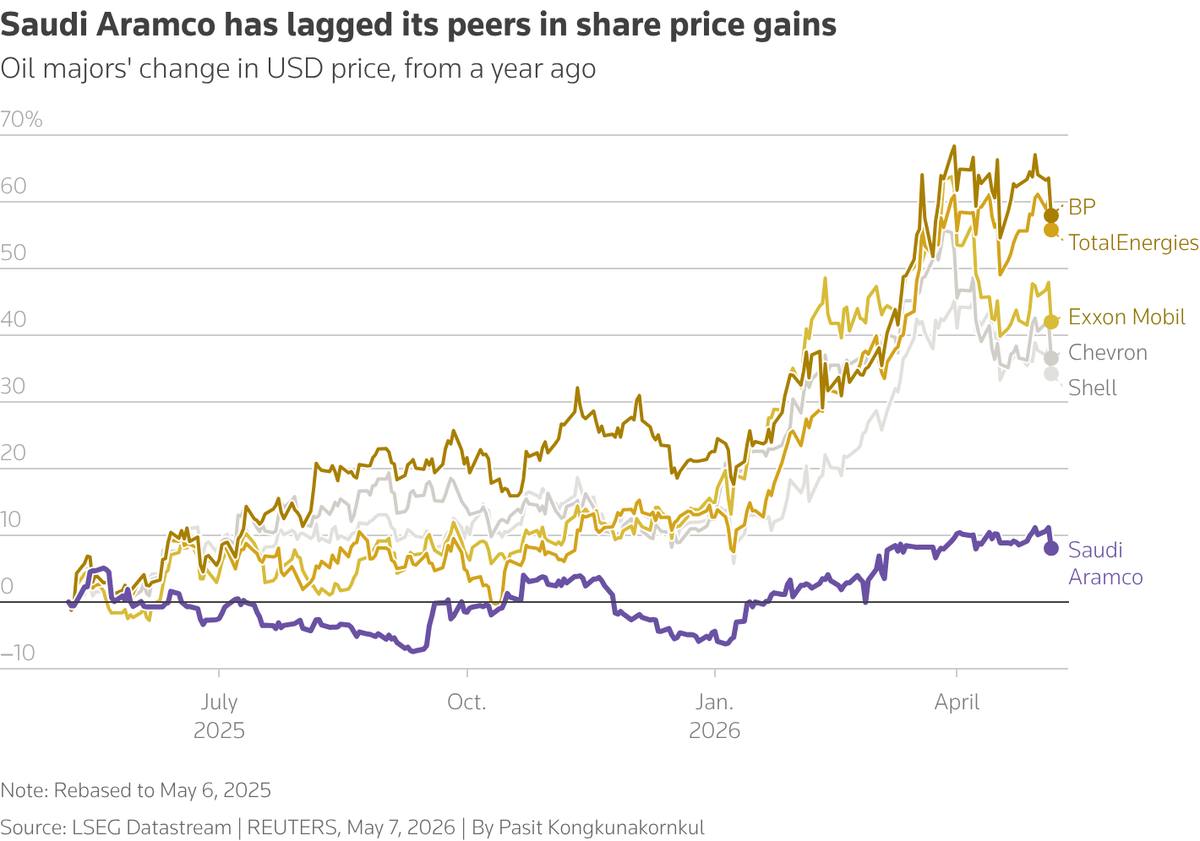
Saudi Aramco share price versus peers. The world’s biggest exporter of crude oil reports first-quarter results Sunday. The numbers are expected to show the pain from the more than two-month-old conflict that has all but closed the Strait of Hormuz and caused some 20 oil refineries in the region to be damaged or shut down. Progress to end the war has been slow, with clashes between forces in the Gulf in recent days endangering a month-old ceasefire and shaking hopes for a diplomatic solution.
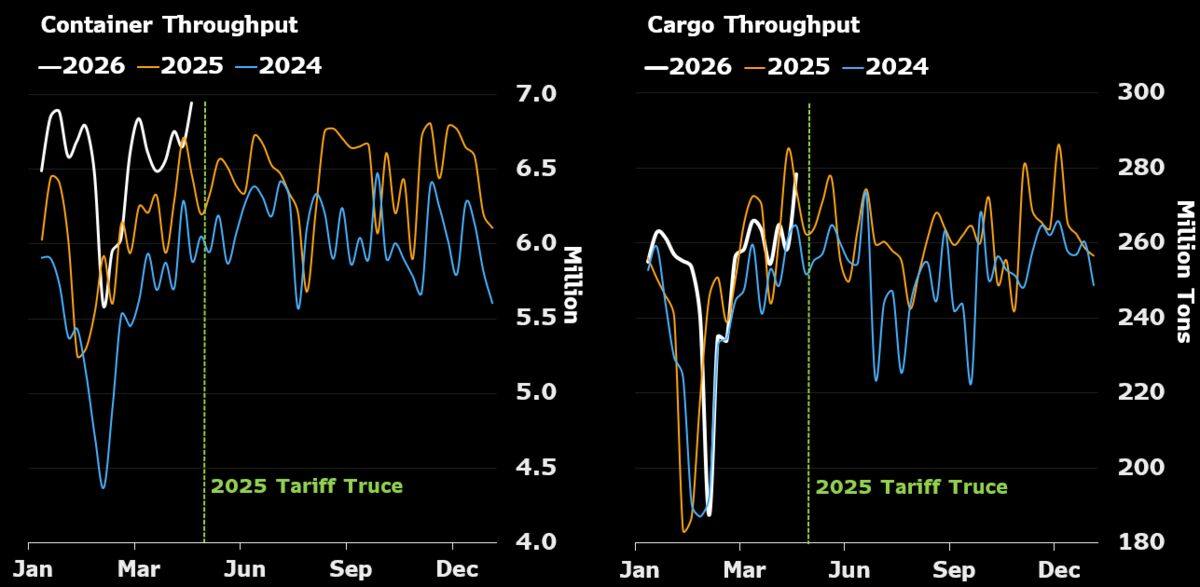
China April trade. Port and shipping data tracked by Bloomberg Economics suggested outbound shipments continued to run above year-earlier levels, as exporters redirected more goods toward non-US markets. The customs print landed strong over the working Saturday in Beijing — imports printed +25.3% year-on-year on memory chip prices and AI hardware demand, exports +14.1% on integrated-circuit pricing power and renewable-product demand. The 2026 China export forecast trajectory has been lifted to above 8% with imports above 13%, both substantially above prior consensus. SK Hynix Q1 revenue at +198% year-on-year with operating profit +405% tells you why.
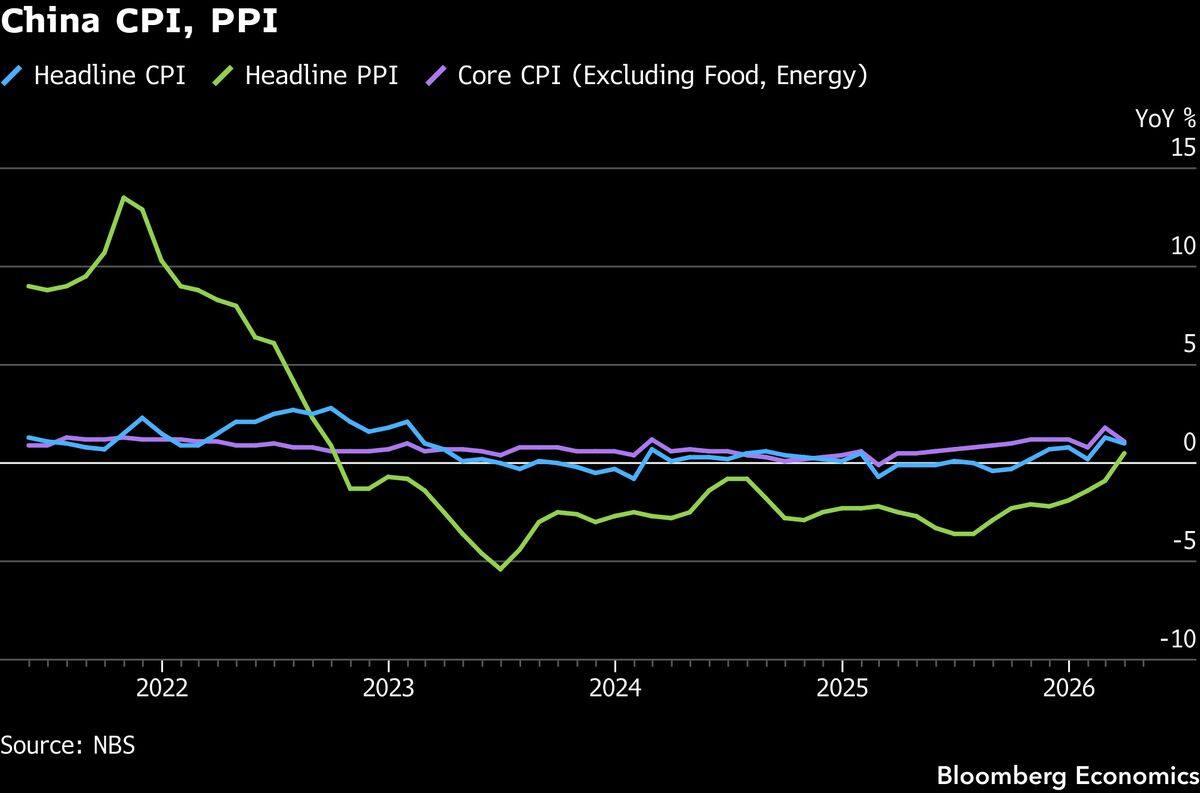
China April CPI and PPI Monday. Shockwaves from the Iran war likely pushed factory-gate prices higher, after PPI emerged from deflation in March for the first time in more than three years. Consumer price inflation by contrast may have eased slightly. Headline PPI expected +1.8% year-on-year from +0.5% in March, CPI +0.9% from 1.0% prior. The price trends suggest the GDP deflator is poised to end a 12-quarter streak of declines in Q2.
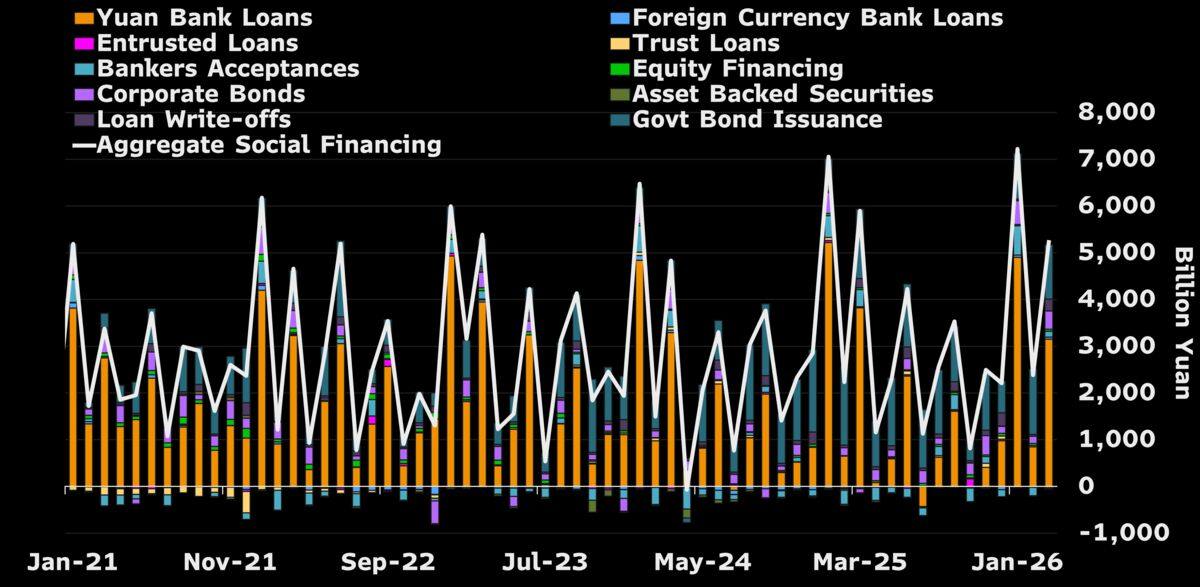
China aggregate social financing likely fell in April as banks typically slow lending after strong early-year expansion. Aggregate social financing expected at 950 billion yuan, down from 5.2 trillion yuan in March. New yuan loans likely came in at 360 billion yuan, down steeply but still above the 2022-2025 average for the month. Government funding accounts for the lion’s share, with central and local governments raising about 830 billion yuan in the bond market.
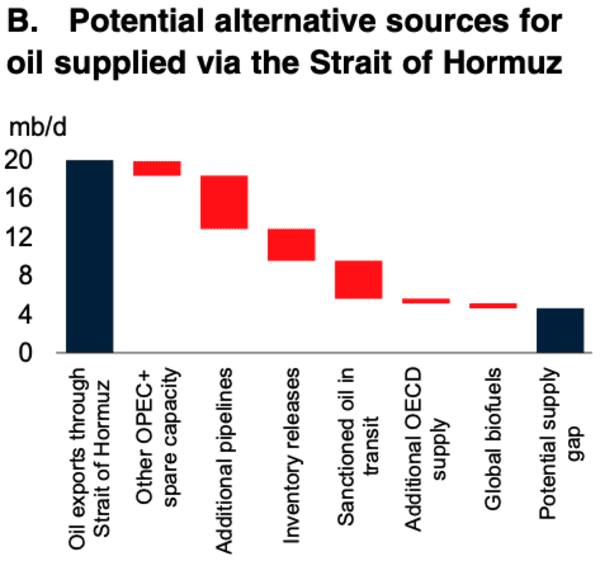
The oil supply gap since the war erupted. An estimated 500 million barrels of oil and condensate have been kept off the market, equivalent to roughly $50 billion in lost supply. Even after tapping every available lever — pipeline rerouting, strategic inventory releases, sanctioned oil in transit, additional OECD supply, biofuels and OPEC+ spare capacity — the global market still faces a significant shortfall. Pipelines bypassing the Strait have ramped from 5.5 million bpd capacity to 3 million bpd already flowing. US production is forecast to rise about 500,000 bpd in 2026, while OPEC+ production is set to shrink by nearly 5%. Read the full World Bank Commodity Markets Outlook.
Turnaround Tuesday
US April CPI is the inflation print of the cycle. Pump prices loom large. Shelter rectification is the wild card. Australian budget. German ZEW. Treasury 3-year and 10-year auctions. The day the inflation question gets answered for the rest of the week.
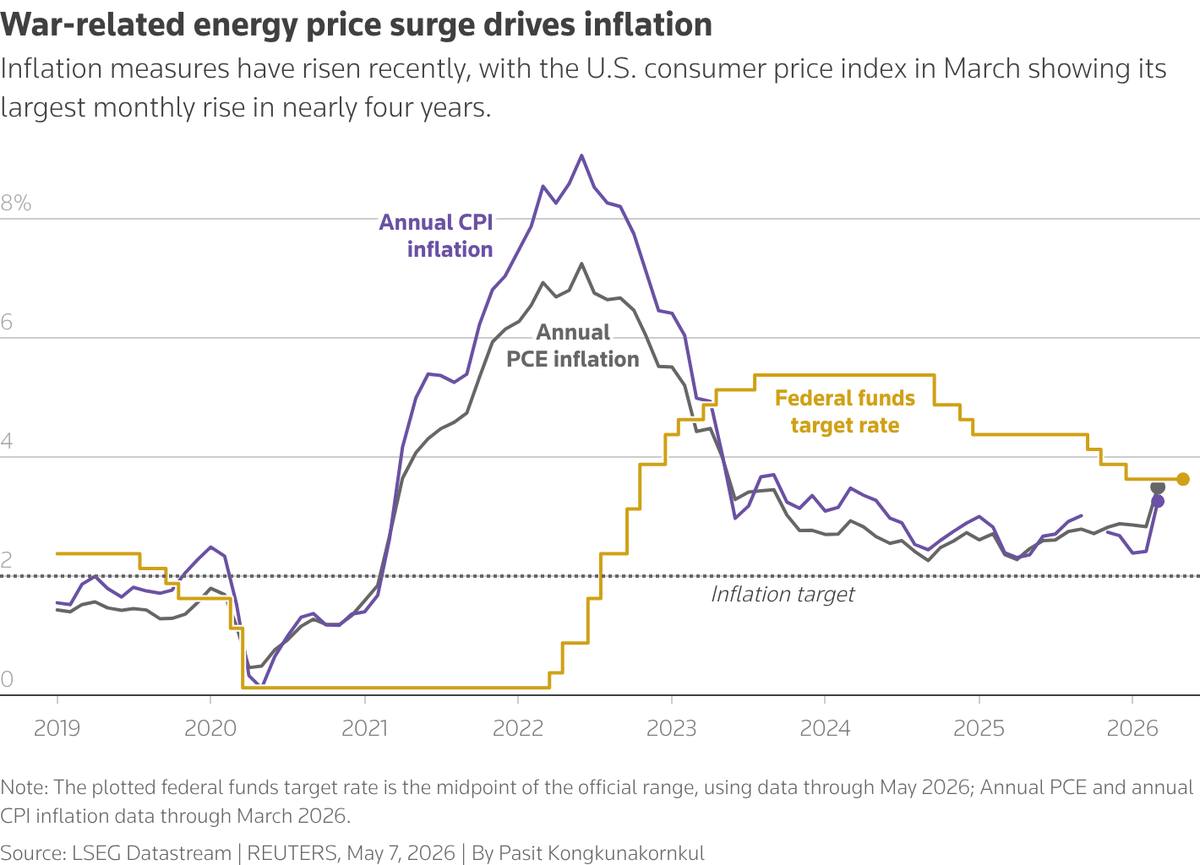
US Fed funds target rate vs CPI and PCE since 2019. Tuesday’s data should give a clearer sense of how much the war-driven spike in energy prices is stoking inflation, and whether consumers are losing their appetite to spend. Producer price data Wednesday is another inflation checkpoint after the FOMC exposed a more hawkish tilt among policymakers increasingly uneasy about price pressures. The Fed’s June meeting is the first window where the easing-bias dissents could become a vote.
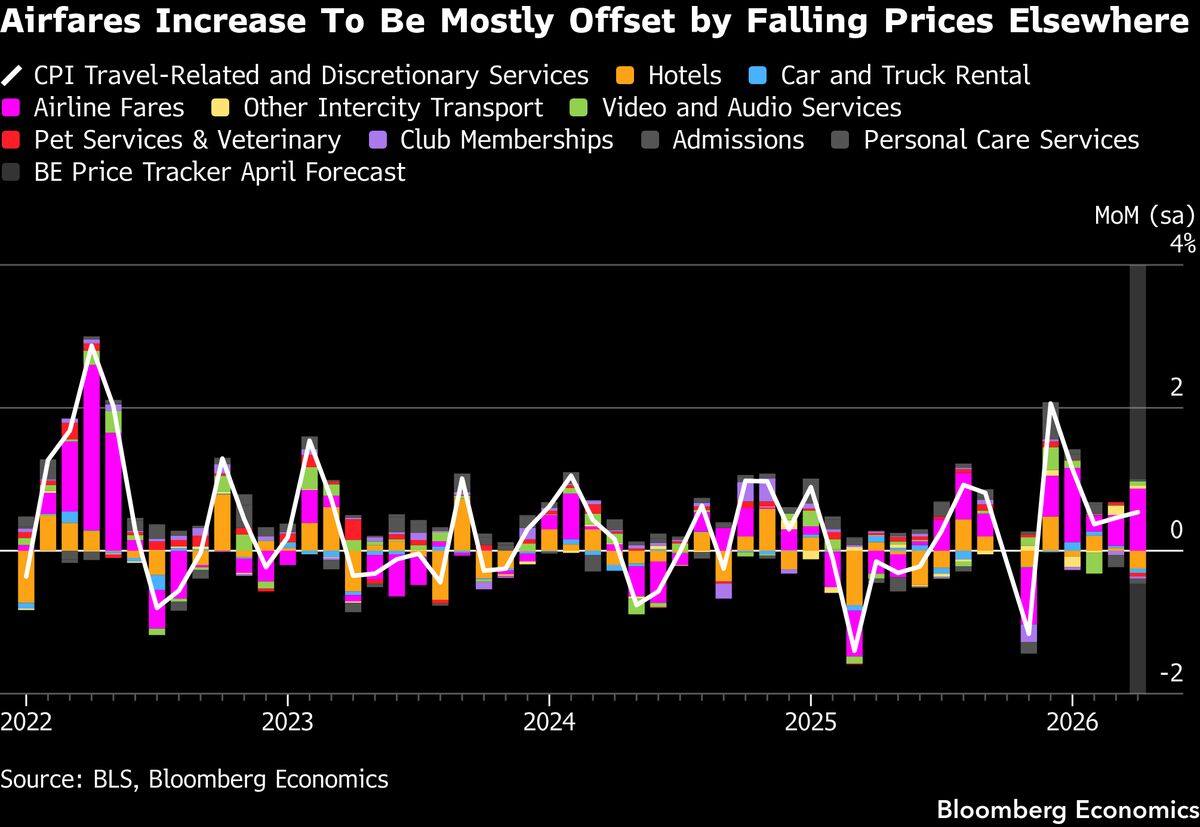
US April CPI Tuesday. Headline expected to increase 0.58%, a second straight very hot reading, lifting year-on-year to 3.7%. Gasoline prices notched another month of strong gains (+7%) after March’s 21% increase. Core CPI likely rose 0.36%, lifting the year-on-year increase to 2.7%. That pace was boosted by a rectification of the understatement in shelter prices amid the government shutdown last October. Without that adjustment, core CPI likely would have risen just 0.24%. The impact of the war shows up as a sharp rise in airfares, more than offset by declines in other travel and discretionary categories.
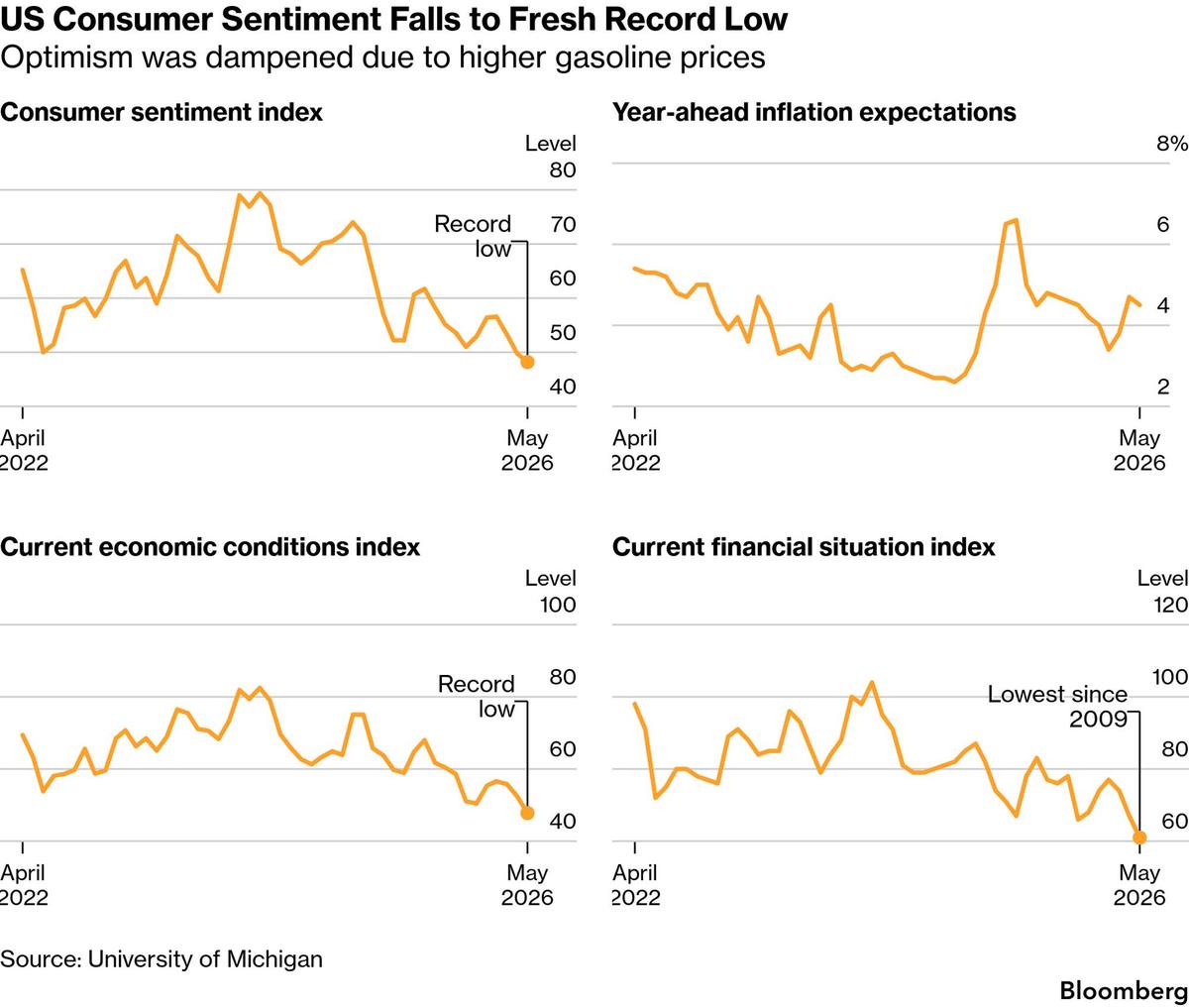
US consumer sentiment falls to fresh record low. Optimism dampened on higher gasoline prices. The headline index hit a fresh record low. Year-ahead inflation expectations stay well above target. Current financial situation index dropped to lowest since 2009. The signal underneath the headline is the divergence between household balance sheets and the equity tape, which keeps printing fresh all-time highs. The bond market has been telling the consumer what the consumer already knows, and the consumer hears it.
Whipsaw Wednesday
PPI plus the Treasury 30-year auction plus quarterly refunding announcement. Lagarde and Mann speak on independence. UK State Opening of Parliament. IEA and OPEC monthly reports. Tencent and Alibaba report into Asia close, Cisco into US close. The AI bell rings the same day the inflation tape gets rectified.
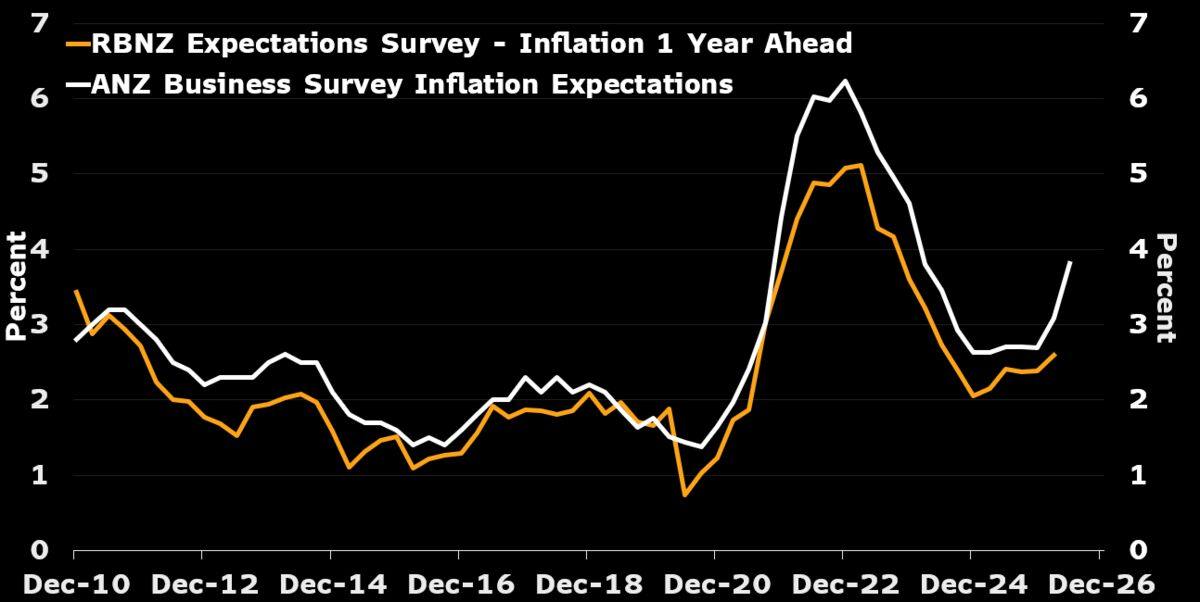
New Zealand inflation expectations likely jump in 2Q26, in line with business survey measures of price gains. Two-year and five-year inflation expectations sit slightly above the 2% midpoint of the RBNZ’s 1%-3% target band. Fuel prices have surged in recent weeks and are likely to be the main driver. A wide output gap, weak wage growth and elevated unemployment mean domestically driven inflation should stay contained. The central bank will watch for signs of sustained de-anchoring in long-run expectations.
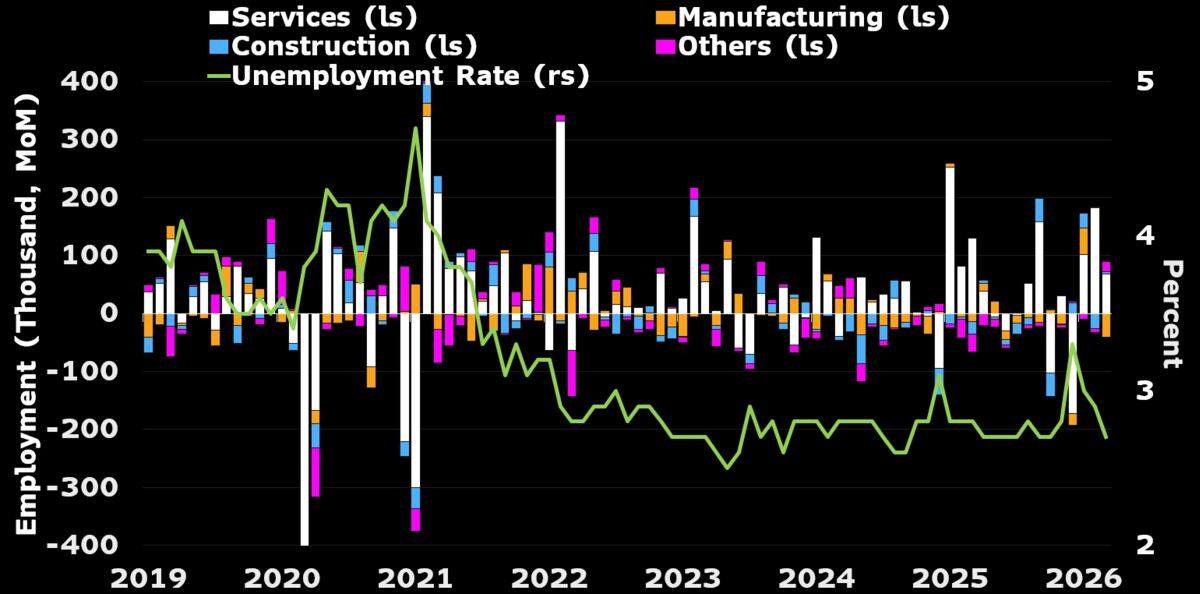
South Korea unemployment likely rose in April, reflecting supply-chain disruptions triggered by the Iran war. Unemployment rate to increase to 2.9% from 2.7%, with a net loss of 25,000 jobs. Manufacturing employment likely weakened further as disruptions to raw-material imports forced petrochemical producers to scale back or suspend operations. Construction hiring also probably declined. Hiring in health and social welfare provided a partial buffer, masking broader weakness in private-sector job creation.
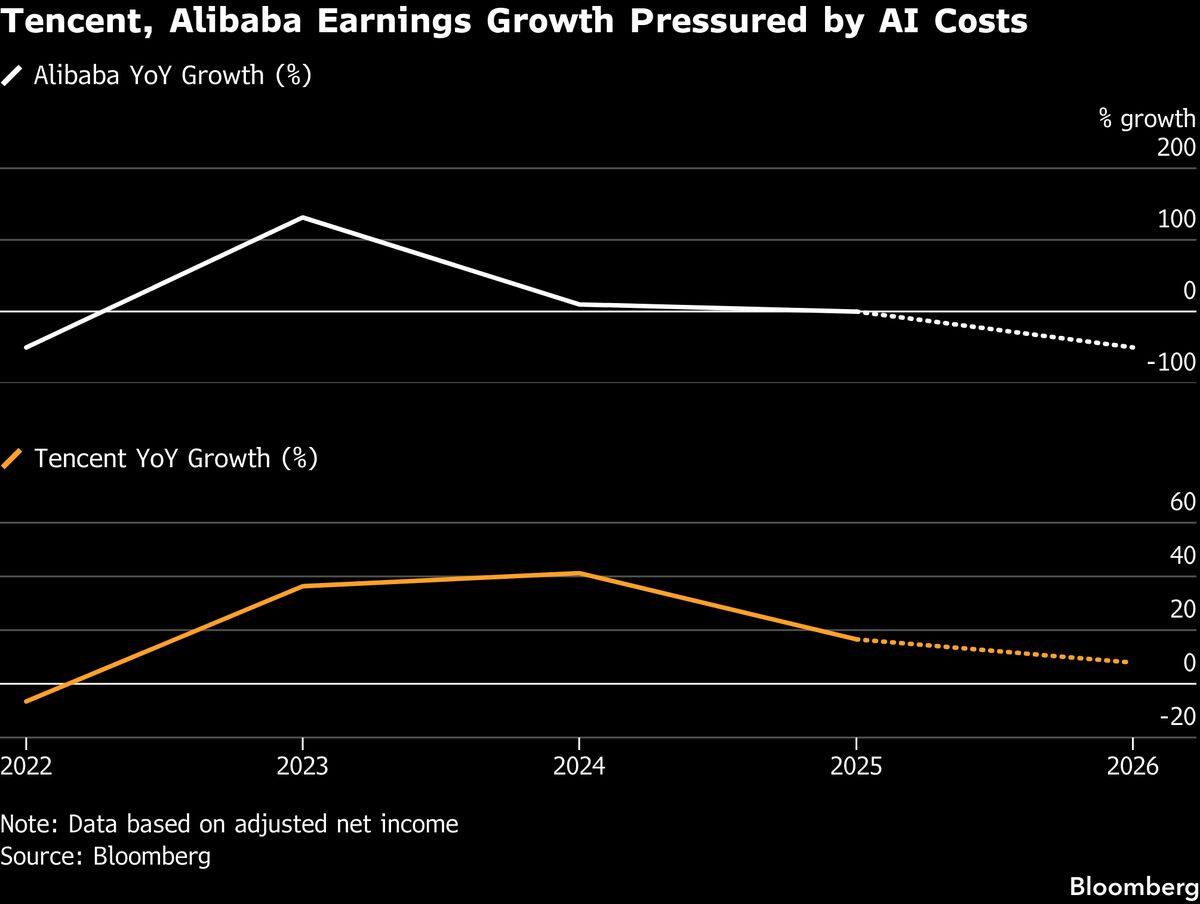
Tencent and Alibaba report Wednesday. Earnings shaped by rising AI investment costs and growing competition in China’s AI sector following DeepSeek’s high-profile release. Tencent full-year earnings growth expected to slow to low-teen percentage range as AI investments double. Alibaba faces pressure from China’s soft consumption outlook. Rising cloud-computing demand unlikely to deliver material upside to either’s cloud earnings in 2026 given intense competition. The companies are also rumored to join a maiden funding round for DeepSeek.
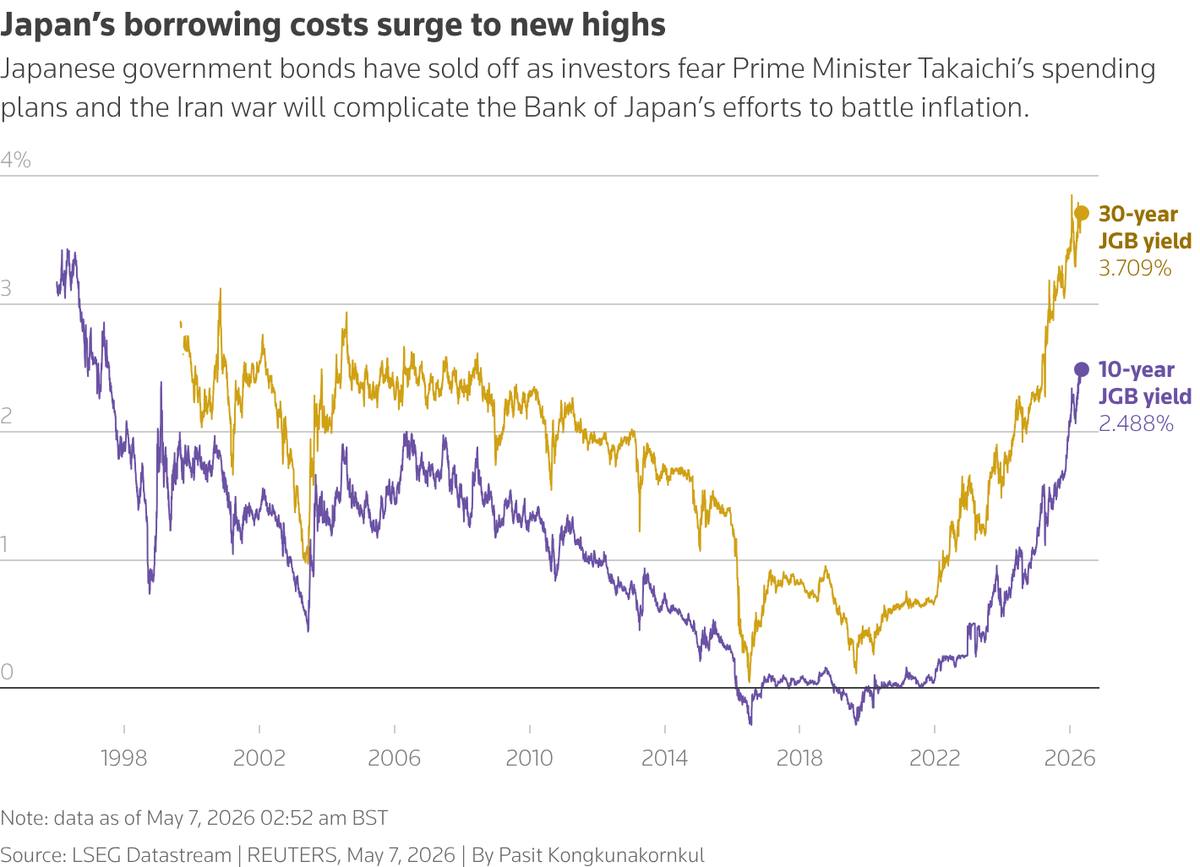
JGB 10-year and 30-year yields, 1996 to present. The Bank of Japan summary of opinions Tuesday is released after not one but three dissenting voices, giving investors a closer look at how fractured the policy debate has become. Bond investors will also digest sales of 10-year and 30-year Japanese government bonds Wednesday, a test of appetite for long-dated debt after suspected interventions in Tokyo to boost the yen over the last fortnight. Bessent meets Japan’s prime minister, central bank governor and finance minister Monday before heading to China.
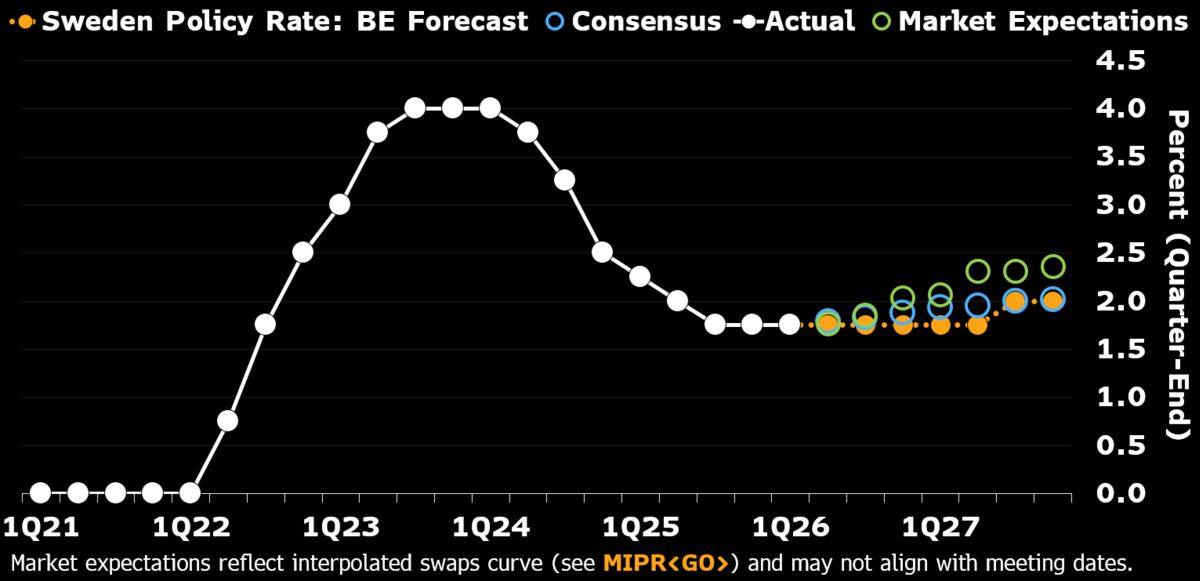
Riksbank on hold a while. The Riksbank held at 1.75% on May 7 and signaled readiness to act. The board’s risk assessment matched consensus, weaker-than-expected growth and potential escalation in the Middle East conflict pulling inflation in opposite directions. On balance upside risks dominate. Beyond reaffirming vigilance, rate guidance was vague. The minutes of the May meeting due Wednesday should offer clearer signals on the policy path. The market is already pricing a hike later this year.
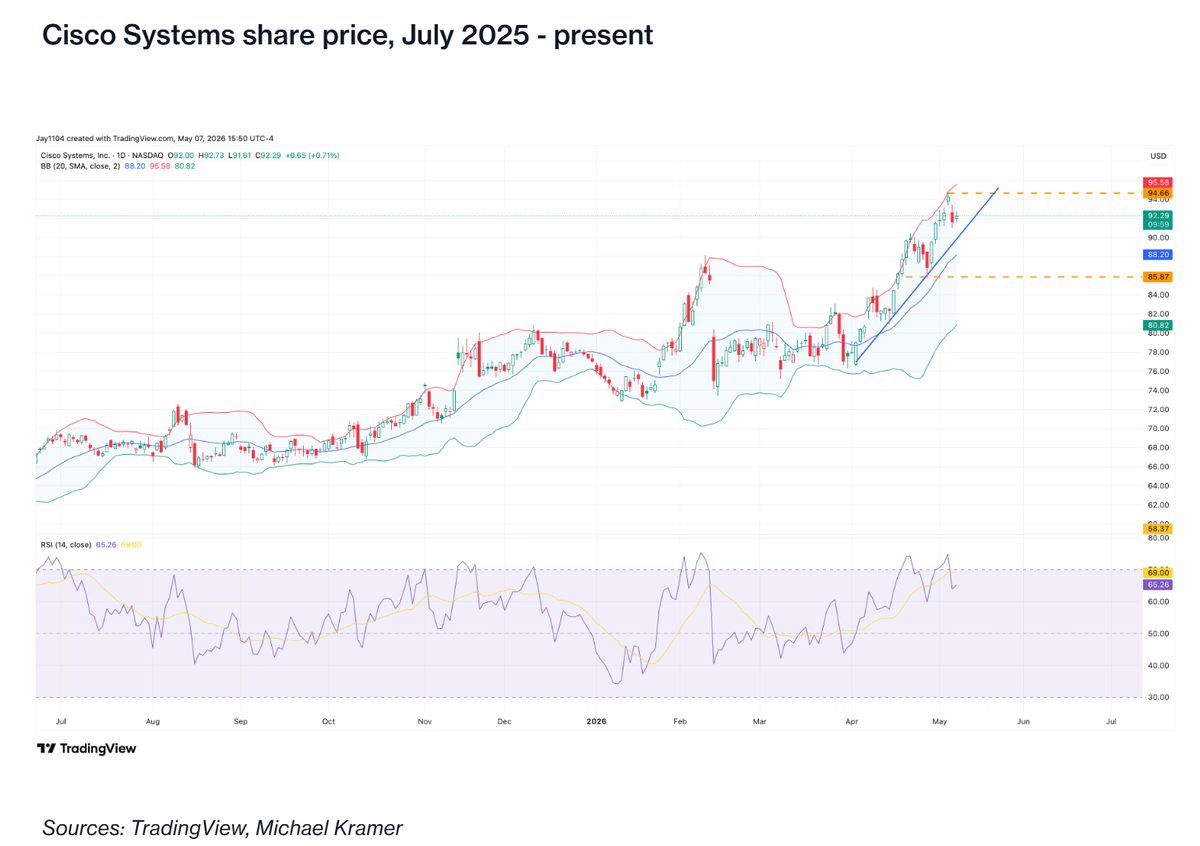
Cisco Systems share price July 2025 to present, with Bollinger Bands and RSI. The chart sits at $92.29 with $94.66 just above as resistance and $85.87 below as the first support. RSI at 65 is approaching the upper bound of the regime. Cisco reports Wednesday and is the AI-tape proxy for the broader networking trade — value flows from compute through networking before reaching applications, and Cisco sits on the chokepoint. The chart says the trade still has room to run if the AI capex tape continues. Hold the line, watch the break. See the CMC Markets weekly note for the broader setup.
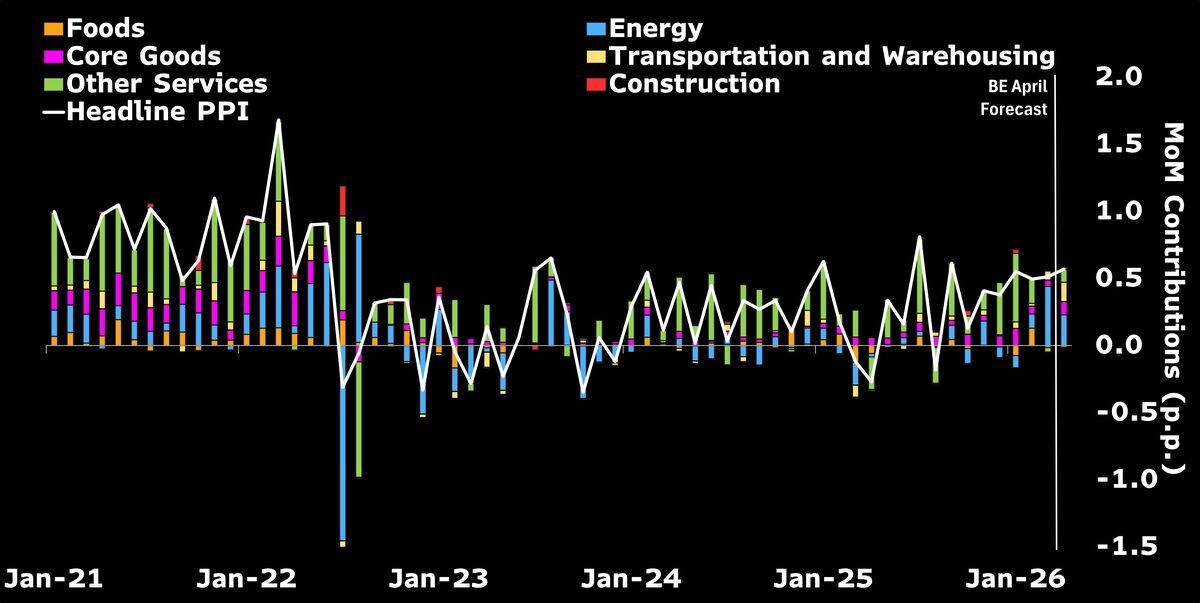
US PPI April Wednesday. Headline likely gained 0.6%, year-on-year jumping to 4.9%. Core to rise 0.4%, annual pace to 4.4%. Transportation and warehousing will likely be the biggest contributor, reflecting higher costs of diesel and jet fuel from the war and the recent pickup in freight activity. Core goods should also contribute more as costs that already were rising before the war feed through. PPI components that feed into core PCE will contribute little to its growth for April.
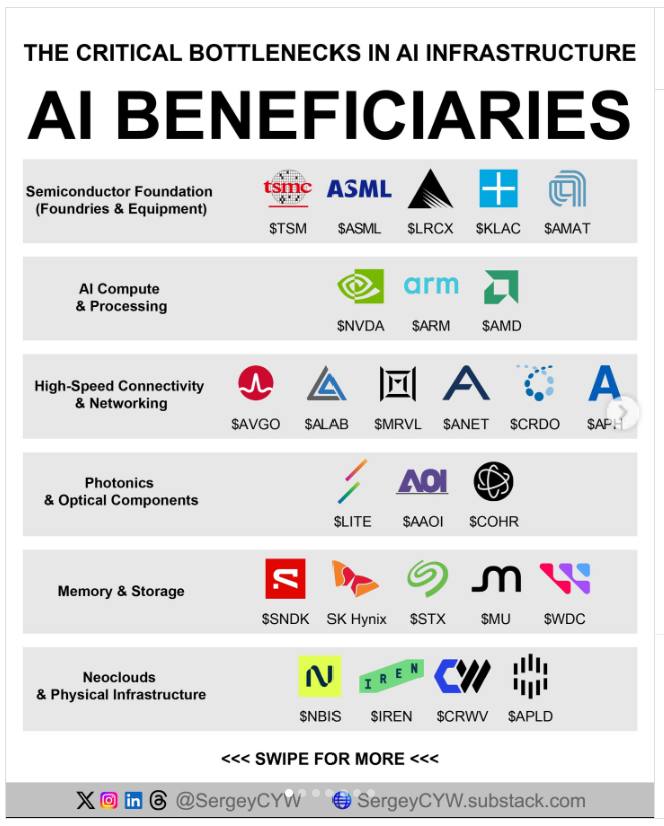
The AI infrastructure stack and who’s actually capturing value. At the foundation sits advanced semiconductor manufacturing — TSM, ASML control parts of the supply chain that cannot be easily replicated. On top sits compute — NVDA continues to define architecture, AMD, ARM benefit as hyperscalers diversify. Networking — AVGO, ANET, MRVL are enabling thousands of GPUs into single systems. Photonics — AAOI, LITE, COHR as copper hits physical limits. Memory — MU, STX. Infrastructure — CRWV, NBIS, IREN, APLD building specialized environments. Value is concentrating in the bottlenecks.
TP Thursday
Trump arrives in Beijing for the summit with Xi, his first China visit in eight years. The China rebalance, the silicon-wafer push and microchip geopolitics are the agenda items markets will be reading. UK Q1 GDP, US retail sales, jobless claims, import prices. Mexico Banxico, Peru BCRP. Take profit on the binaries that have run, hold position into the geopolitical event.
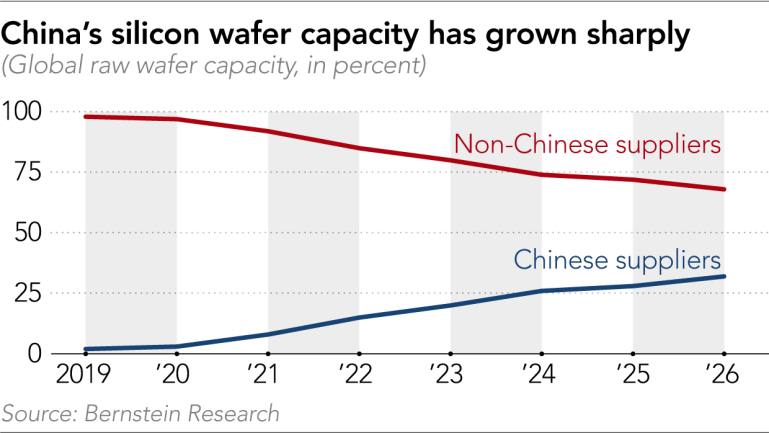
China targets 70% advanced domestic silicon wafer use by 2026. Local leaders led by Eswin drive major expansion for the self-sufficiency milestone. The Chinese government’s target has become an unspoken mandate among chipmakers to use locally-made 12-inch wafers. Eswin’s combined production capacity will reach 1.2 million wafers per month this year, meeting 40% of China’s domestic demand, with global market share expected above 10%. Chinese players’ global market share by capacity has jumped from only 3% in 2020 to about 28% in 2025, expected to grow to 32% by 2026. The traditional Shinetsu-Sumco-GlobalWafers oligopoly is breaking.
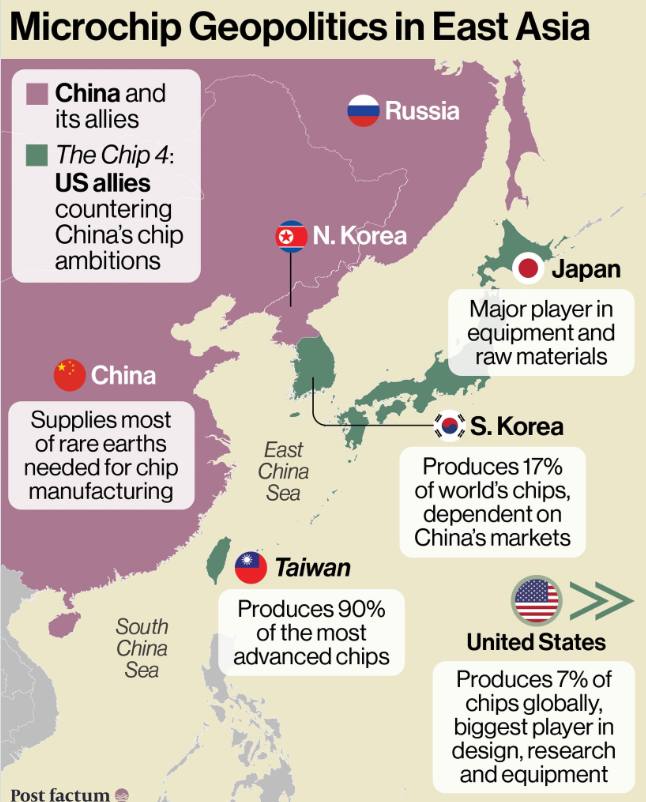
Geopolitics of microchips. Advanced microchips are needed to train and run AI systems. TSMC produces over 60% of the world’s microchips, including 92% of the most advanced ones. TSMC’s chip-making machines have a remote shutdown feature, so they can potentially be disabled from afar if taken over by China. TSMC’s equipment in turn relies on unique electrical circuit printing machines, produced only by ASML in the Netherlands. Under US pressure, ASML banned the sales of these advanced machines to China. Since 2022 the US has restricted sales of chips, equipment and intellectual property to China to slow their advance.
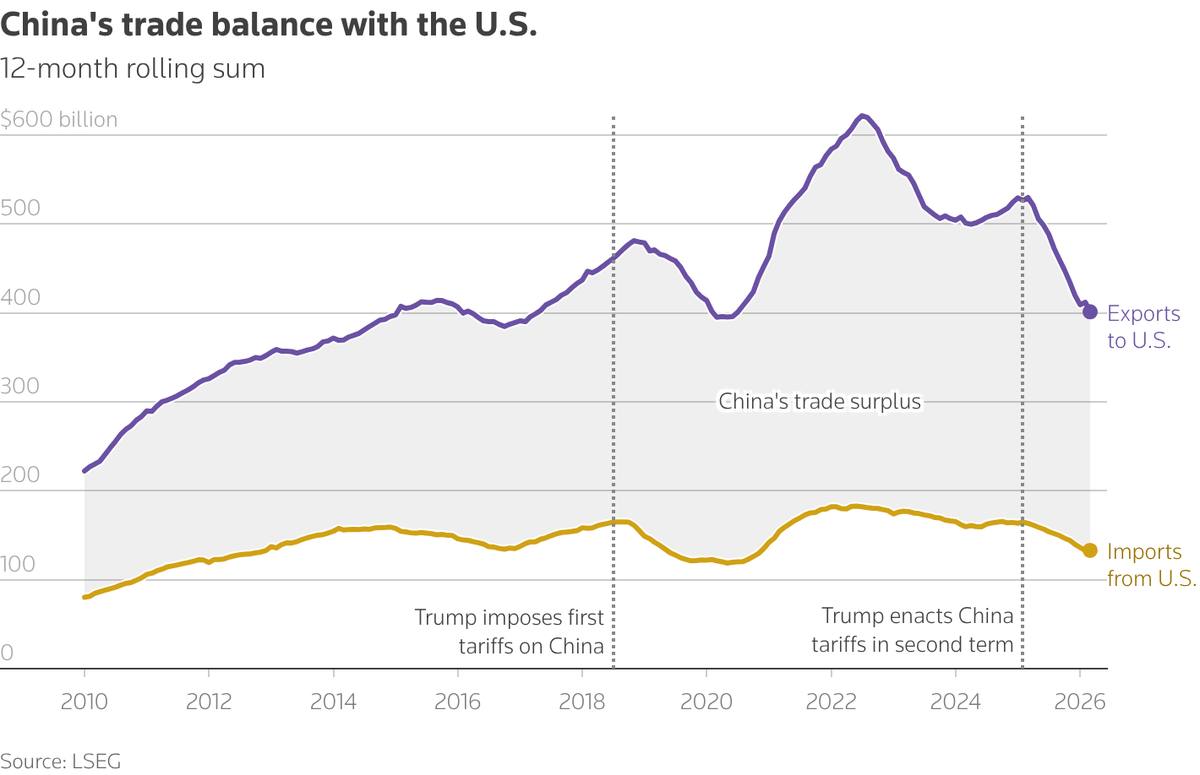
12-month rolling sum of China’s exports to and imports from the US, with trade surplus shaded. Trump visits Beijing on May 14-15, his first China visit in eight years. He will try to lock in the trade truce agreed in October in South Korea, and avoid a rerun of the tit-for-tat tariff battle that he set off in April 2025. Taiwan could also be on the agenda when he meets Xi. The context is far from calm. The Chinese trade surplus at the end of 2025 was roughly the size of the Dutch economy, while factory activity has expanded since the start of the war at the end of February.
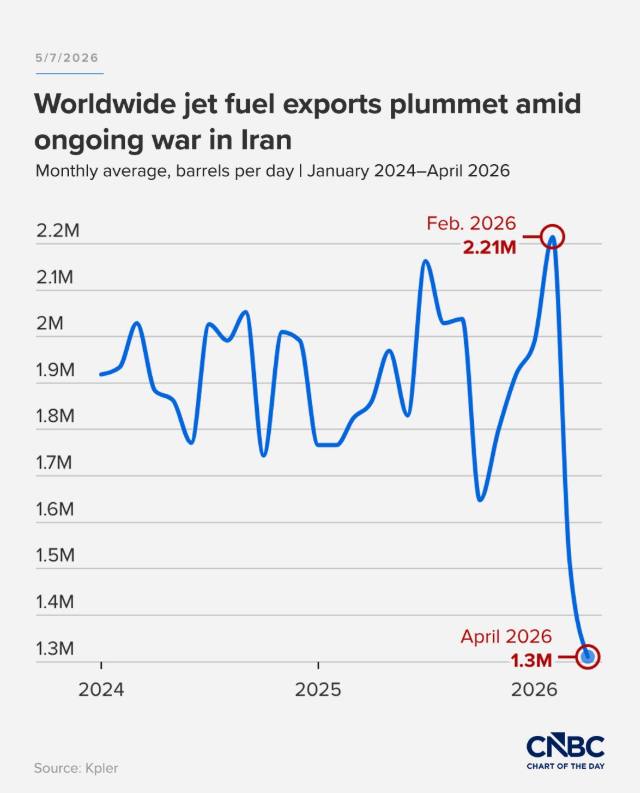
Global jet fuel exports plunged 30% to 1.3 million barrels per day in April, down from 1.9 million bpd in the same month last year. Jet fuel loaded on tankers last week plunged 50% to 18.6 million barrels down from 37.8 million barrels in the same week in 2025. Shortages threaten to disrupt summer travel as the loss of supplies from the Middle East ripples across Asia and Europe.
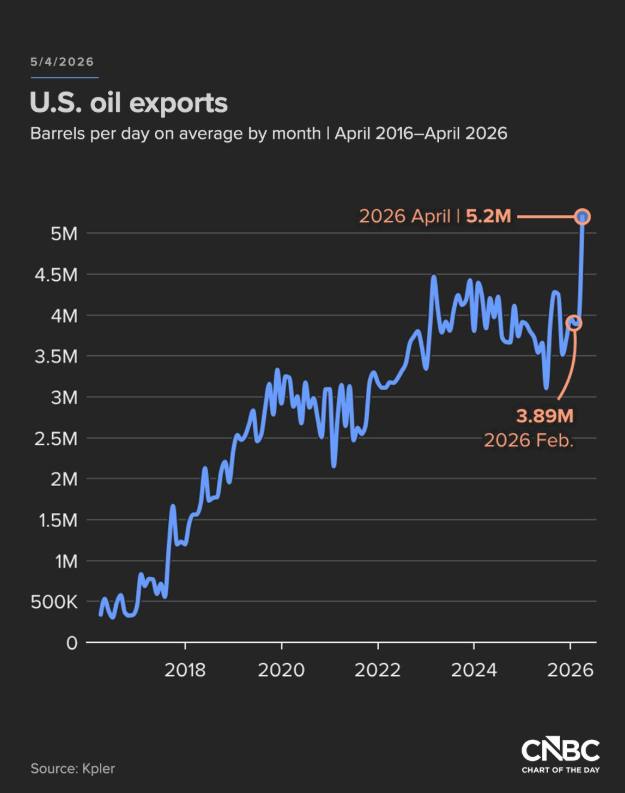
US oil exports jumped to 5.2 million barrels per day in April, a more than 30% increase over the 3.9 million bpd exported in February before the war. The Permian basin is the first place customers are looking for incremental supply. The Hormuz risk is becoming, in the words of one US producer, a substantial catalyst for more US production and infrastructure investment. The longer-term Middle East risk is being repriced as a structural opportunity for the American shale complex.
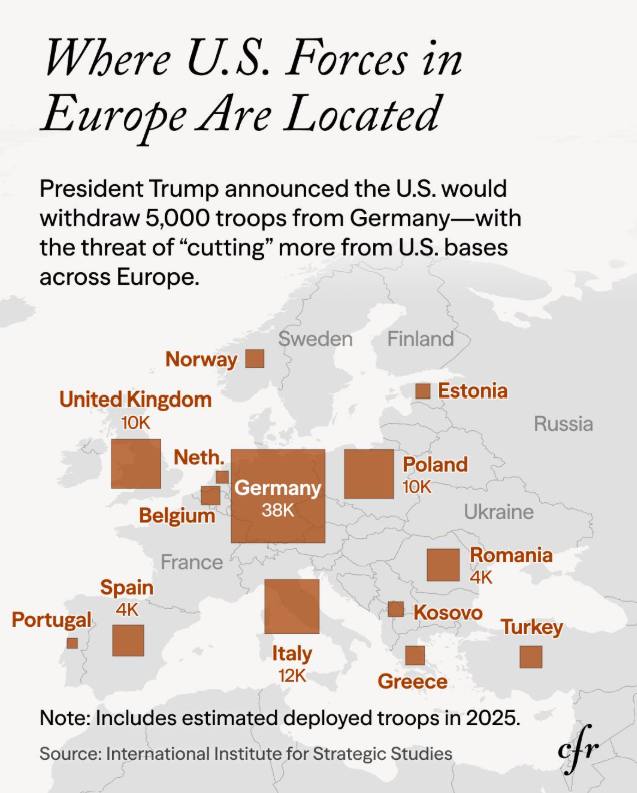
Trump’s recent announcement that the US would withdraw 5,000 troops from Germany, with the threat of cutting more from US bases across Europe, has taken US allies by surprise. The decision seems to be driven less by strategic calculations about burden-shifting within NATO and more by a desire to punish Europeans for their criticism of and limited support for the Iran war. More concerning is the possible cancellation of long-range Tomahawk cruise missiles to Germany, intended to counter Russian missiles stationed in Kaliningrad. The move could leave Europe lacking a critical capability that it cannot immediately replace on its own. As of April 2025, the US had roughly 80,000 service members stationed in Europe.
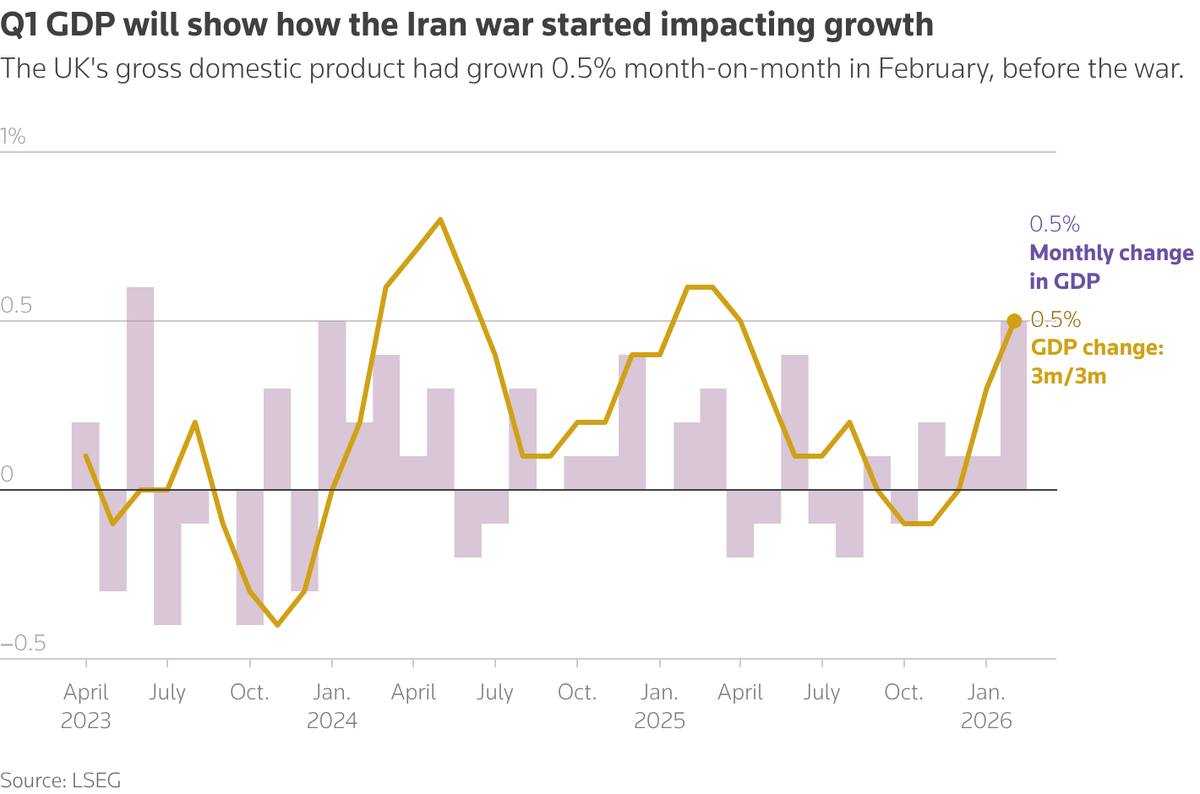
UK GDP 3m/3m and monthly changes from April 2023 to February 2026. Investors will parse Britain’s March growth data Thursday for the first official signs of the extent of the economic damage from the Iran war. The release coincides with the first-quarter figures, though those may flatter to deceive after a punchy 1Q. Britain looks vulnerable. Borrowing costs have jumped more than anywhere else among the G7 advanced economies as higher energy prices feed through. Local elections have dealt a blow to PM Keir Starmer’s Labour Party, raising doubts about his leadership.
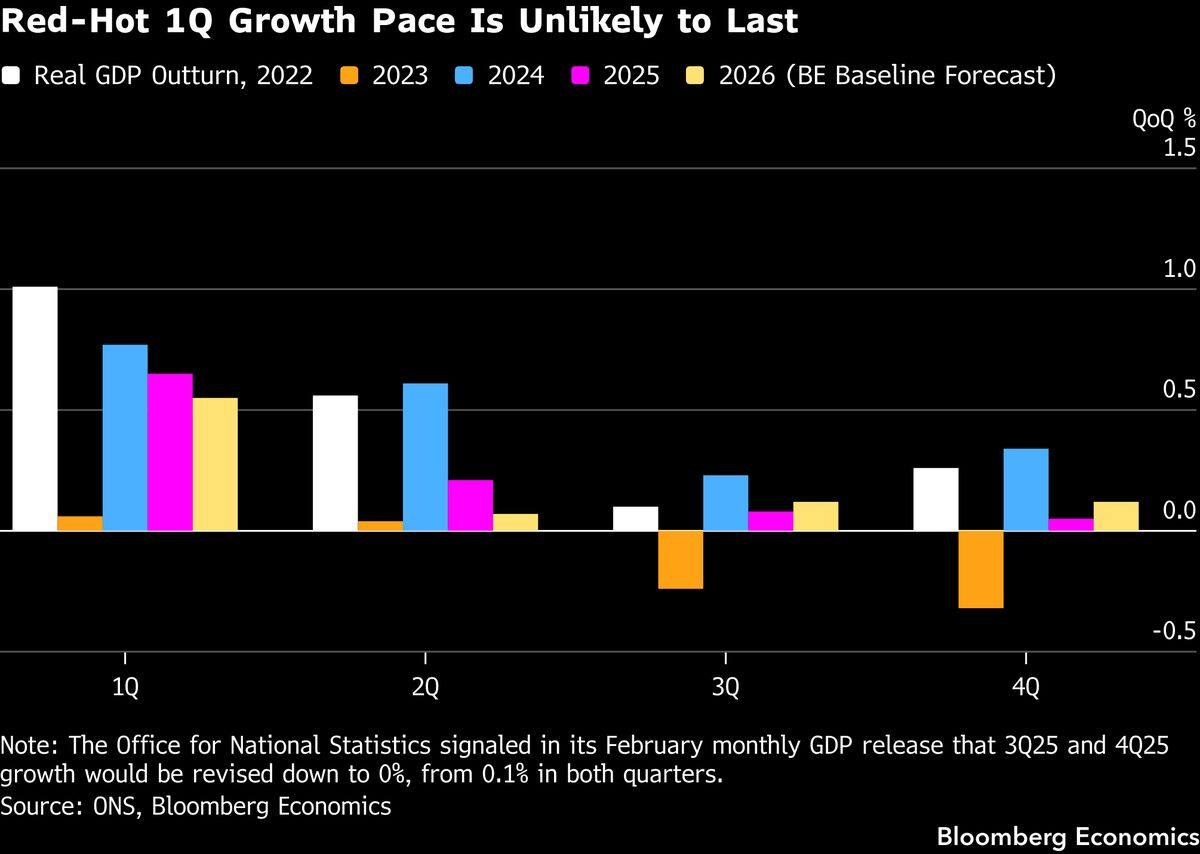
UK Q1 GDP Thursday. Expected to show +0.6% growth in 1Q26 after rising 0.1% in 4Q25. Monthly data so far shows output expanded by 0.1% in January and 0.5% in February. The data this year is likely to repeat what’s become a familiar pattern since the pandemic, where growth has been concentrated in 1Q followed by a slowdown over the rest of the year. The current pace is unlikely to be sustained, with the rise in energy costs set to bring growth to a near halt in the quarters ahead.
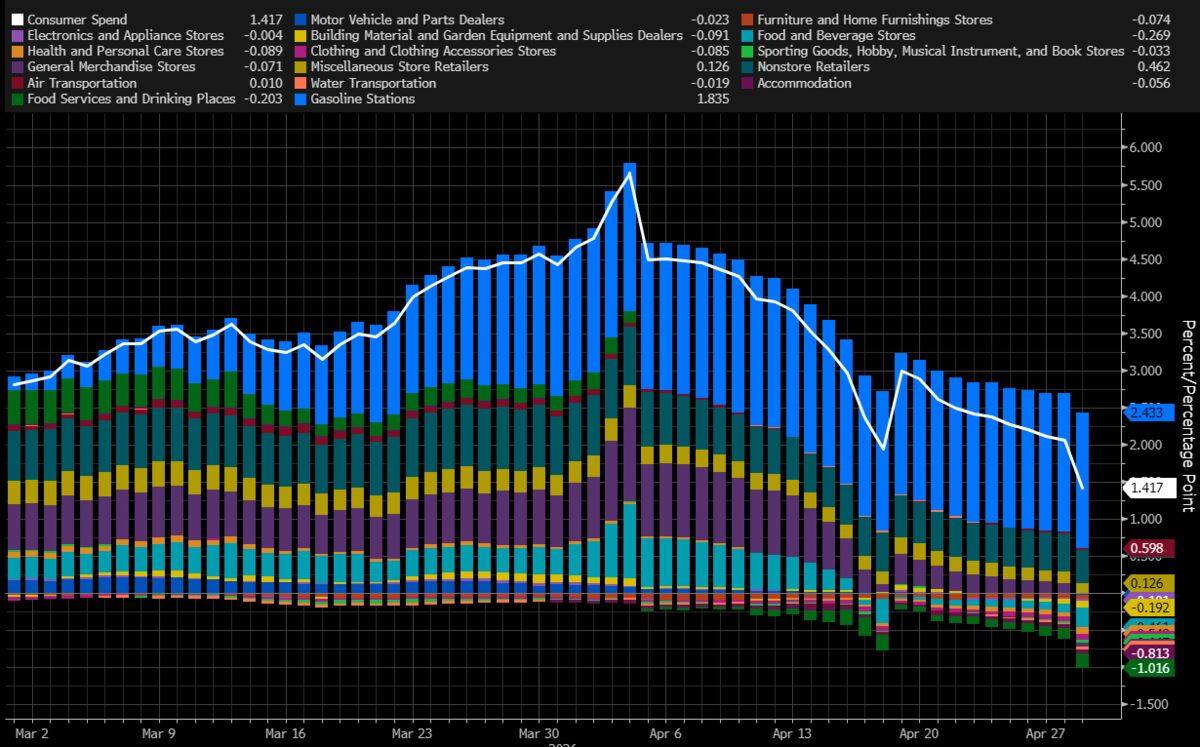
US April retail sales Thursday. Headline retail sales likely cooled to +0.4%. Spending at gas stations likely boosted the headline less than in March. Auto sales moderated 2.6%. Sales in the control group, which exclude cars, gas, food services and building materials, were likely softer. Bloomberg Second Measure data show a broad-based pullback in consumer spending after March retail sales were much stronger than anticipated.
Friday Farewell
Powell’s term as Fed Chair officially ends. Warsh takes the chair seat. Empire and IP. UMich preliminary. India trade. NZ food prices. The 13F deadline is the snapshot of where closely-watched hedge funds were positioned. By design lighter, because liquidity sizzles into the weekend and the chair handover is the emotional weight.
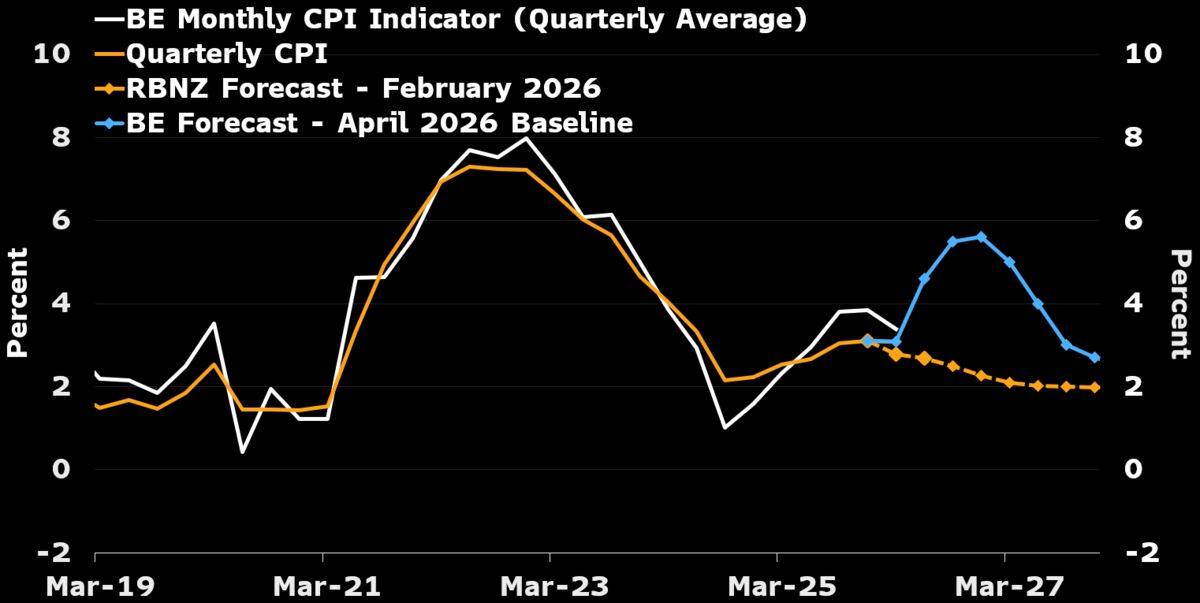
Fuel price spike to push up Kiwi inflation. New Zealand’s April price data will likely show a spike in inflation as higher energy prices feed through. The Iran war has reset the inflation landscape. Higher fuel costs will lift headline inflation first, with second-round effects pushing up food and other goods prices. Energy supply disruptions are likely to drive airfares and household utility costs higher over coming months. The RBNZ will closely monitor the data, but the inflation spike is unlikely to prompt a policy response yet.
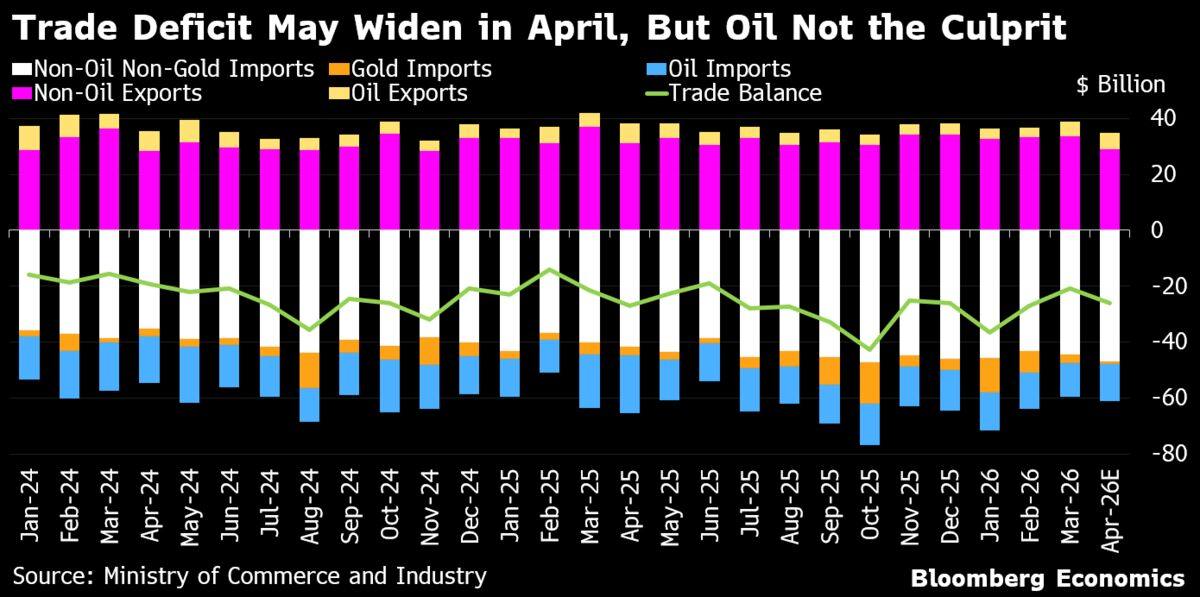
India April trade deficit likely widened to $26.2 billion from $20.7 billion, driven by stronger non-oil and non-gold imports that point to firm domestic demand. Imports excluding oil and gold probably surged, defying typical seasonal softness. Goods and services tax collections on imported goods jumped to 22.7% year-on-year in April from 14.8% in March. The net oil bill may have risen only marginally to $7.5 billion, helped by discounted Russian and Venezuelan crude. India’s resilience to the energy shock will hinge on continued access to Russian crude.
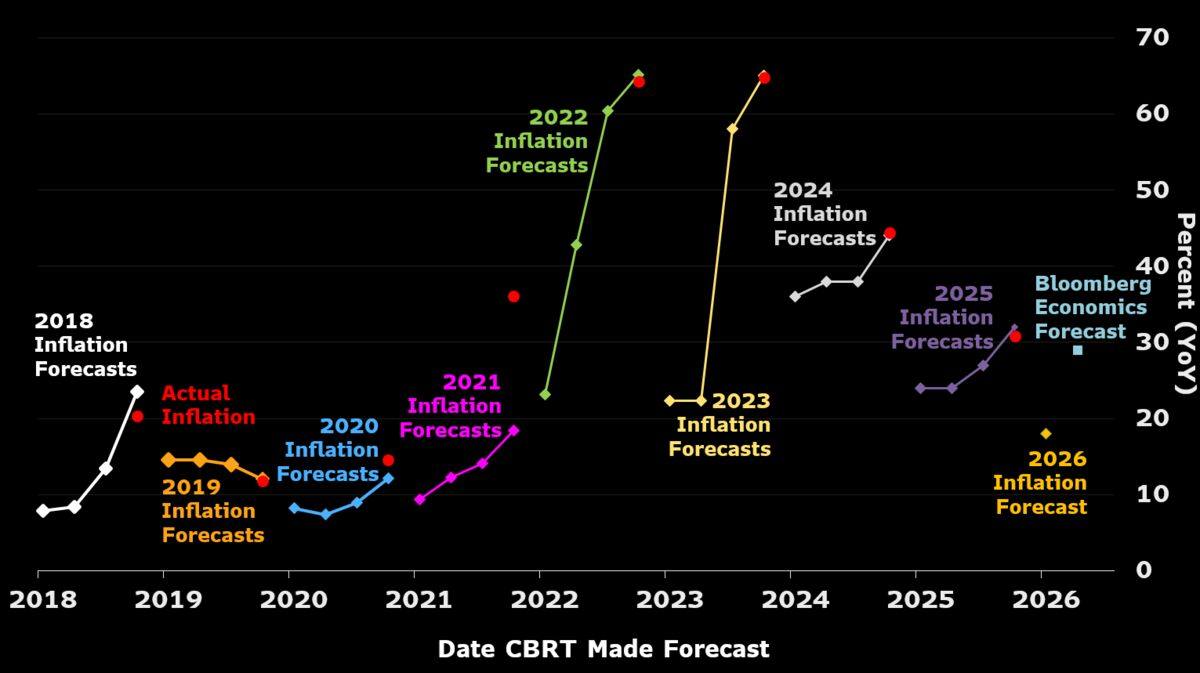
CBRT inflation forecasts. The Central Bank of the Republic of Turkey expected to raise its inflation outlook in the second Inflation Report of the year. February’s forecast put year-end inflation in a 15%-21% range, with an interim target at 16%. The Iran war means the forecasts are no longer tenable. The year-end inflation forecast stands at 29%, about 5.5 percentage points above the pre-war view. A similar upward shift in the central bank’s midpoint forecast, currently at 18%, is expected.
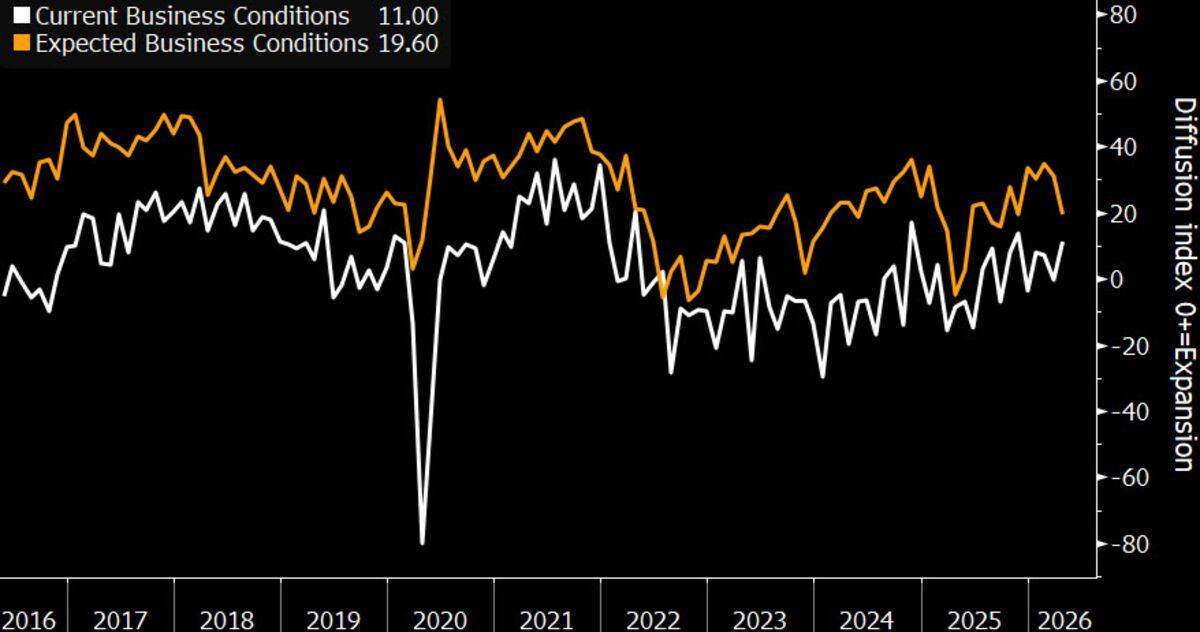
NY Empire State manufacturing Friday. The general business conditions index will likely pull back to around 7 in May after April’s 11.0 reading was the highest in five months. Current activity to remain in positive territory but moderate after April’s strong readings on new orders and shipments. Price pressures will likely remain elevated, given persistently high energy costs. Forward-looking indicators softened broadly in April and bear watching for signs of further weakening in sentiment.
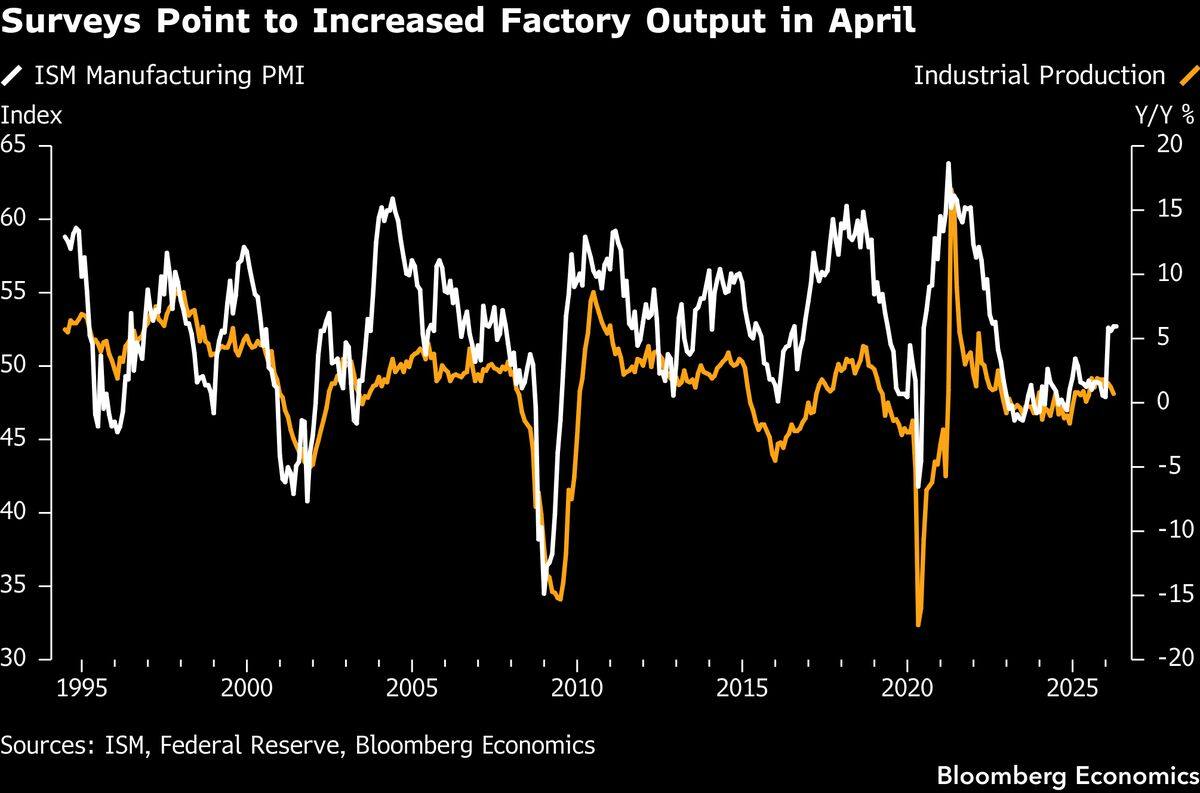
US industrial production Friday. IP likely increased 0.2% in April after it fell 0.5% in March. The prior declines were mostly concentrated in vehicle and electricity output, and a rebound in vehicle production would account for most of the expected headline growth. Manufacturers also reported increased production in April to meet accelerating orders. Energy-extraction activity appeared to fall in April despite elevated global oil prices, perhaps due to more substantive attempts to negotiate an enduring ceasefire.
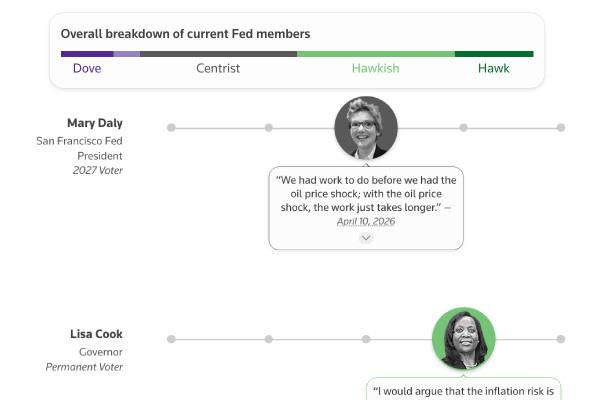
Doves and hawks at the Fed. Reuters interactive of policymaker leanings ahead of the May 15 chair handover. Three Fed dissents at the April FOMC was the highest count since 1992. Powell stays as governor through January 2028. Warsh inherits the chair Friday. The June FOMC is the first window for the dissents to become a vote. See the full Reuters interactive on Fed dove-hawk leanings.
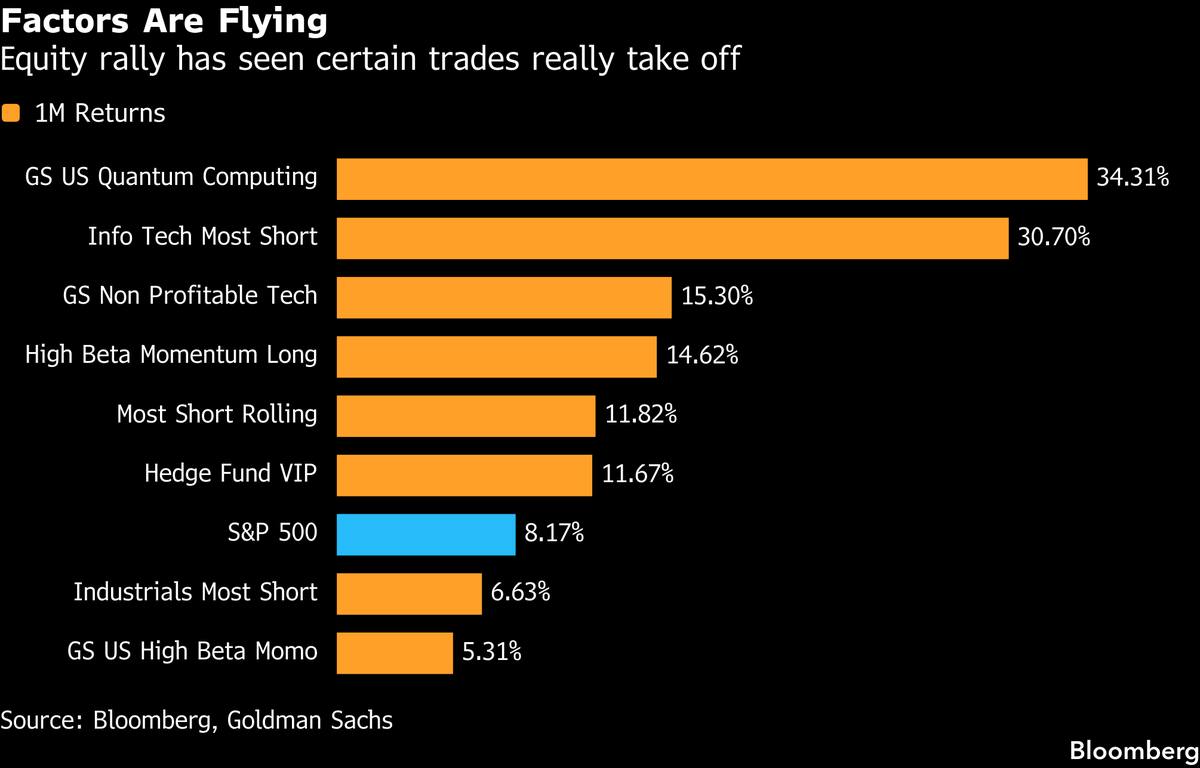
S&P 500 and Nasdaq 100 futures pointing to fresh all-time highs as tech-driven earnings and AI spending buoy sentiment despite geopolitical tensions. The Nasdaq cleared 26,000 for the first time last week. The melt-up risk that the railway-boom analogy suggests means this trade can run further than seems plausible, but the entry points are getting harder to find. Position size, not direction, is the question on the AI tape this week.
VC+ Special Dispatch — The Anatomy of America’s Debt: Part Two
How the U.S. Spends and Borrows in Eight Visuals. Part one of this Dispatch traced how US federal debt grew from $75 million in 1790 to $38 trillion today, and mapped the buyers behind that mountain of Treasuries. Part two zooms in on what drives the underlying flow — rising deficits, a federal budget that has shifted from defense to entitlements, sharp imbalances between contributing and recipient states, and an American household sector that has only partially deleveraged since 2008.
Two Shocks Reshaped the U.S. Debt Trajectory
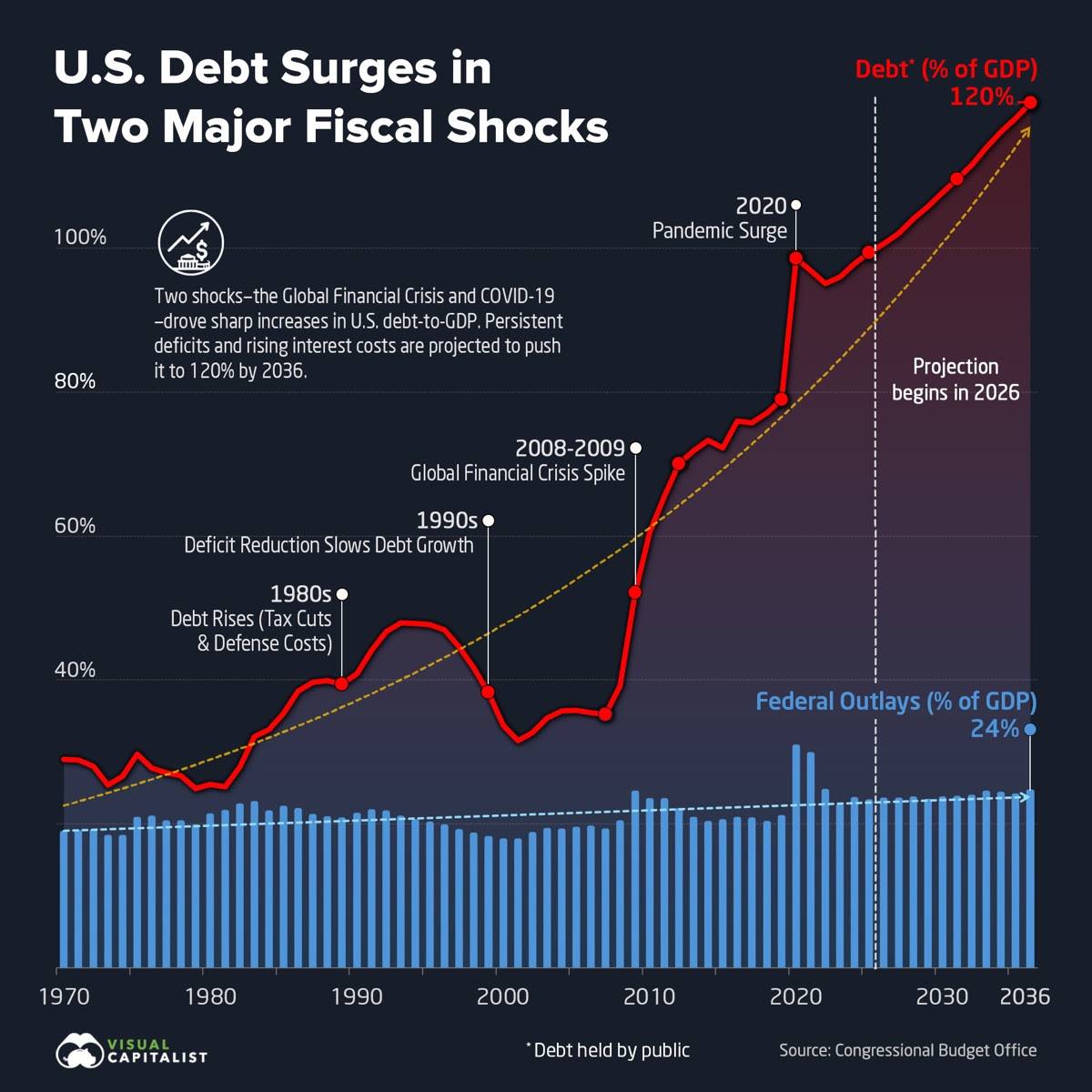
Two events have driven US federal debt to its highest sustained levels since World War II — the 2008 Global Financial Crisis and the COVID-19 pandemic. Together, they pushed debt held by the public from 35% of GDP in 2007 to 99% by 2020. The CBO now projects debt will rise from roughly 100% of GDP in 2025 to 120% by 2036, surpassing the WWII-era peak of 106% set in 1946. The driver is the persistent gap between federal outlays and revenues. Spending hit 30.7% of GDP during the 2020 pandemic peak. By 2025, higher interest costs are keeping outlays elevated at 23.1% of GDP.
U.S. Federal Deficits Are Set to Widen Through 2036
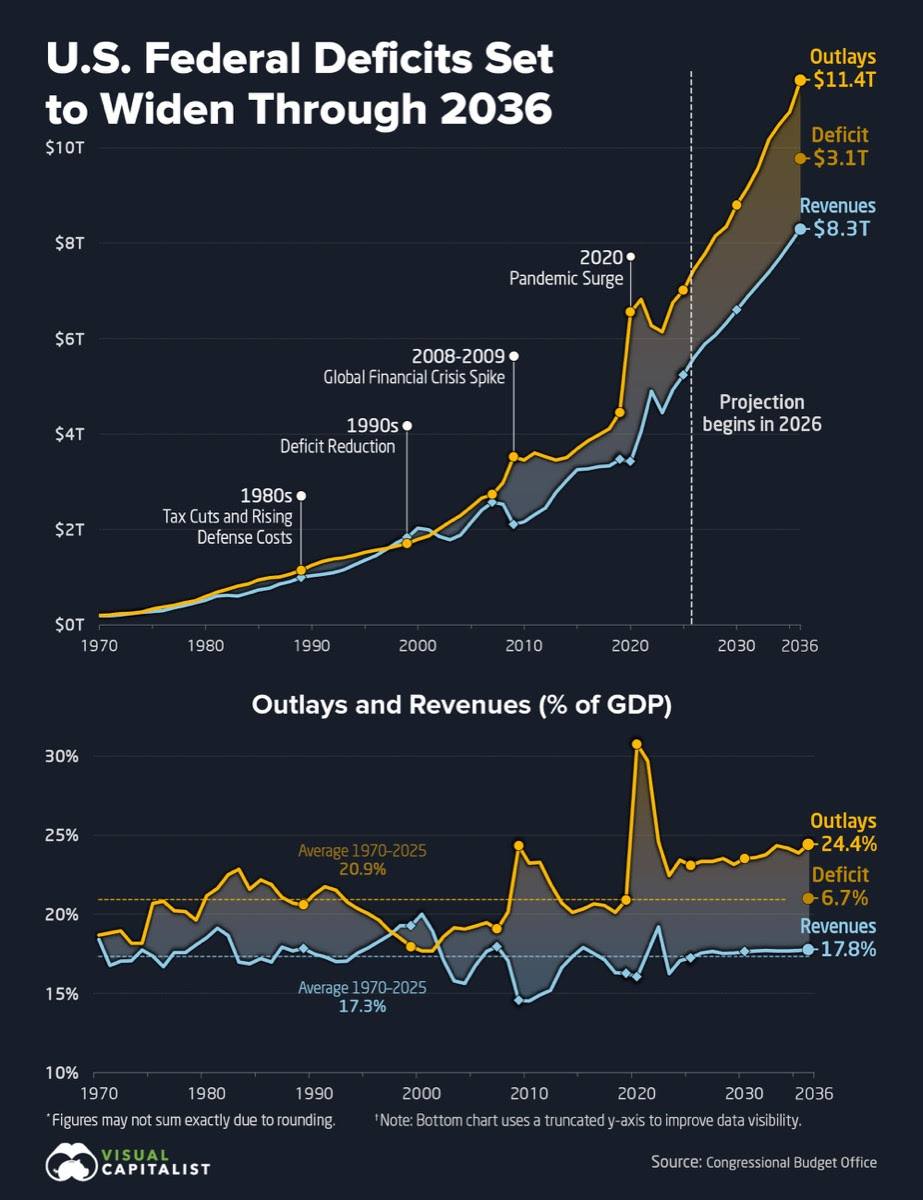
The fiscal gap is projected to widen sharply over the next decade. Federal outlays are forecast to climb from $7.0 trillion in 2025 to $11.4 trillion by 2036, while revenues rise only modestly. The annual deficit is forecast to rise from $1.8 trillion in 2025 to $3.1 trillion by 2036, or 6.7% of GDP, well above the 50-year average of 3.8%. Net interest costs, not new programs, are the single largest driver of the widening fiscal gap. Mandatory spending on Social Security and Medicare runs a close second.
How Defense Lost Its Spot Atop the U.S. Budget
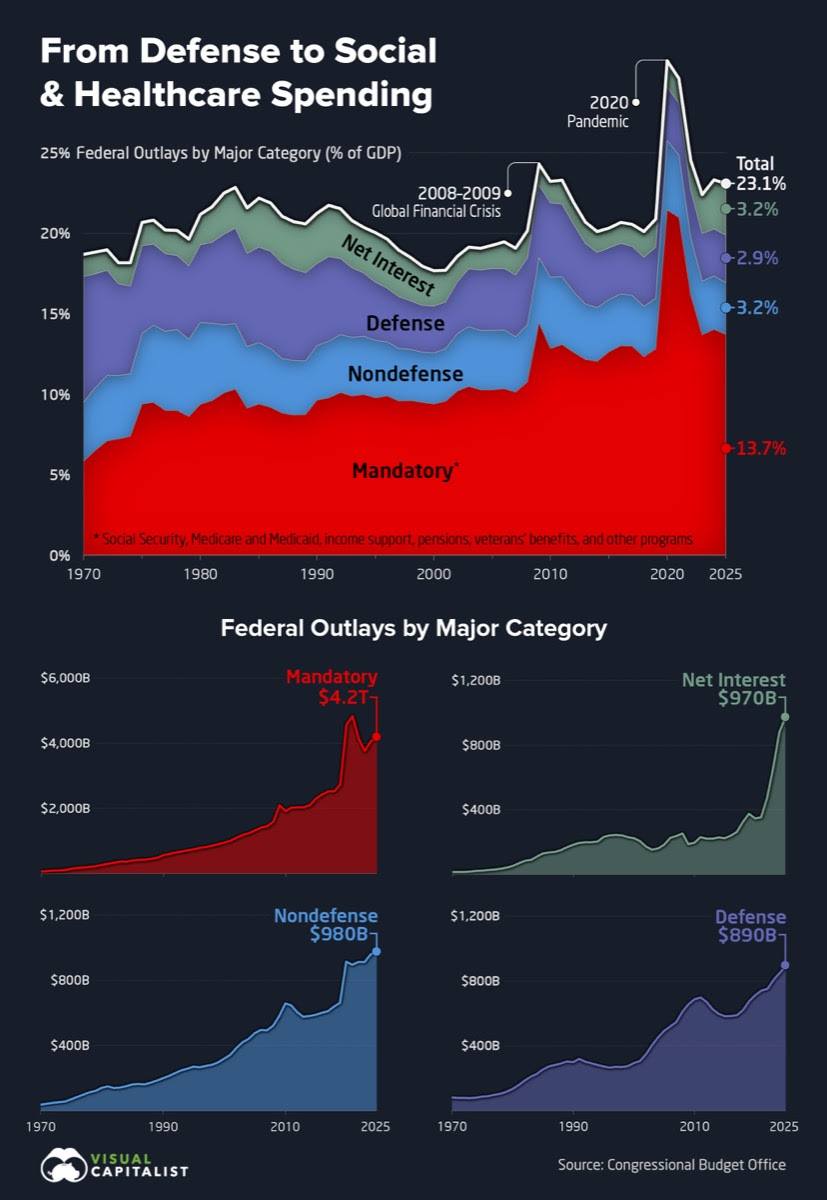
In 1970, defense made up 42% of all federal outlays. Today, it accounts for less than 13%. The biggest budget item is now mandatory spending — Social Security, Medicare, Medicaid, and other entitlements. It has grown from $61 billion in 1970 to $4.2 trillion in 2025, or 59% of all federal outlays. Annual net interest payments have surged to $970 billion in 2025, more than the entire defense budget at $890 billion. Discretionary spending is now a smaller slice of a larger pie.
Which States Pay More Than They Get Back from Washington
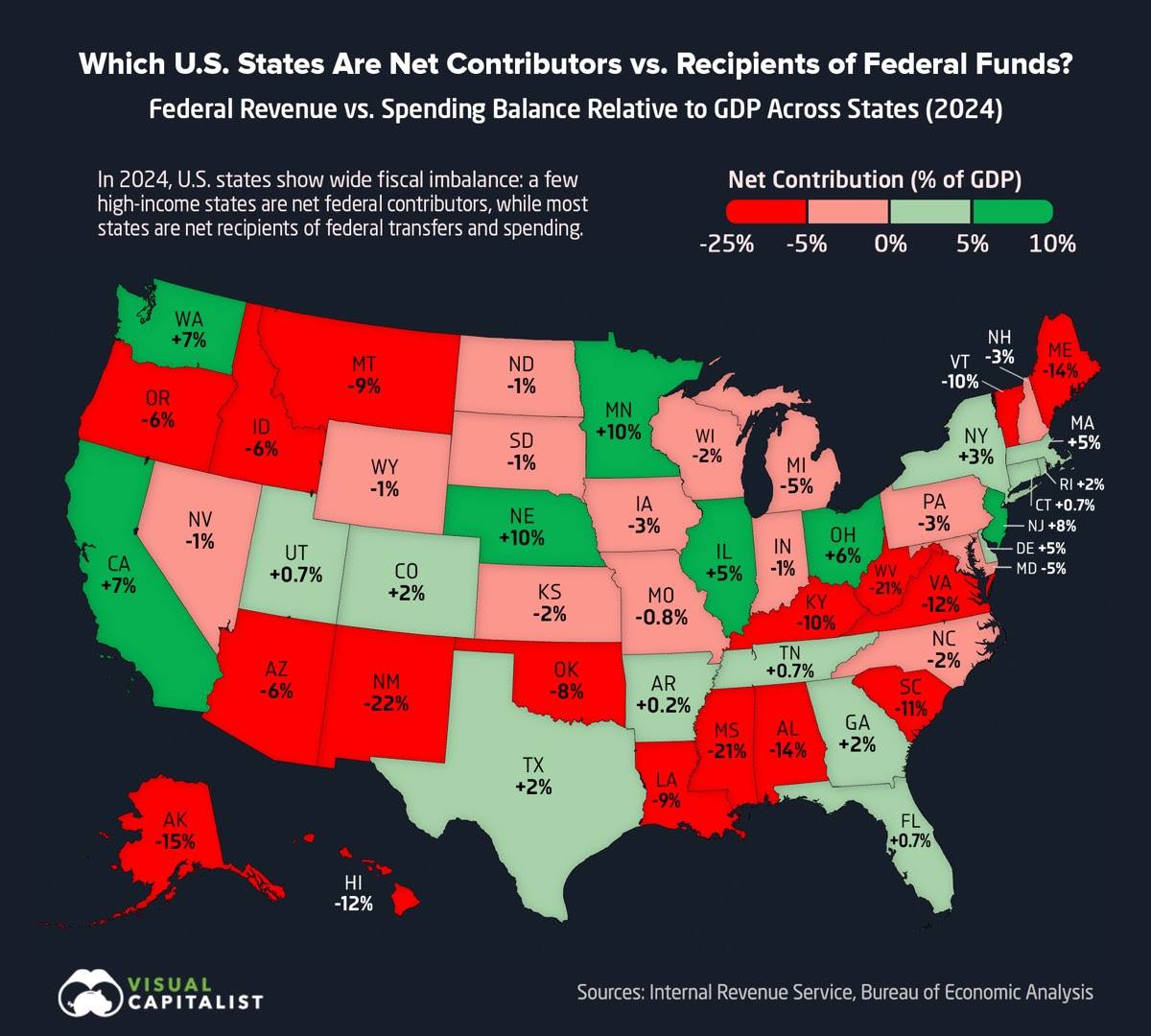
In 2024, the federal government collected about $5.1 trillion in revenue and paid out roughly $4.9 trillion to states. The flows are highly asymmetric. Just four states account for almost 40% of all federal revenue, California, Texas, New York and Florida. Measured against state GDP, the largest net contributors are Nebraska (+10.1%), Minnesota (+9.9%) and New Jersey (+8.0%). The biggest net recipients sit on the other extreme — New Mexico (-22.4%), West Virginia (-21.0%) and Mississippi (-20.7%) all receive more than a fifth of their economy in net federal transfers.
After 2008, U.S. Households Quietly Deleveraged
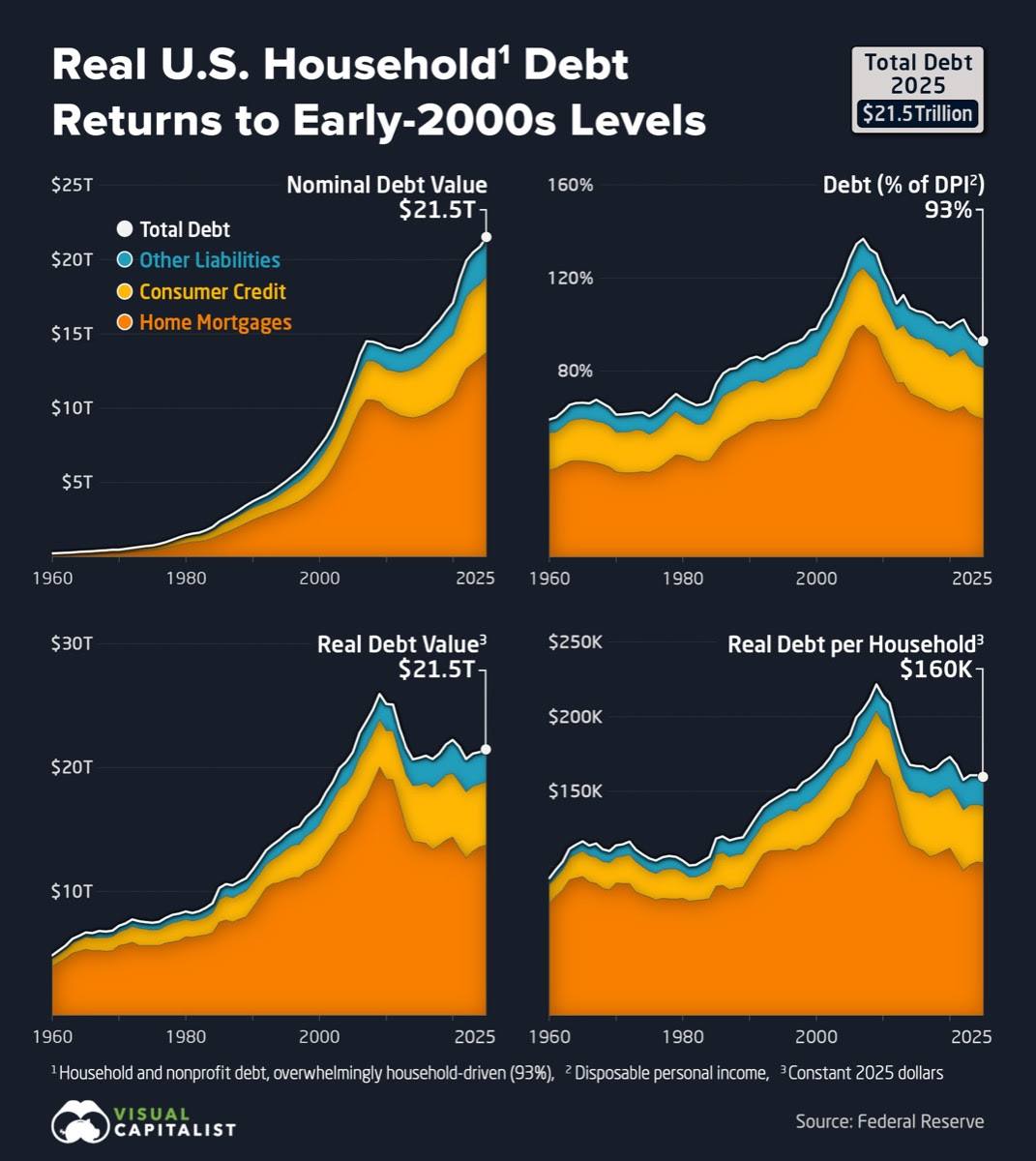
Federal debt is only half the story. American households also borrow heavily, but in real terms they owe less today than they did before the 2008 crisis. Total household and nonprofit debt reached $21.5 trillion in 2025, with mortgages accounting for $13.8 trillion (64%) and consumer credit $5.1 trillion (24%). After adjusting for inflation, real debt is still 17% below its 2009 peak, real debt per household is down 28%. As a share of disposable income, household debt has fallen from 137% in 2007 to 93% today.
Who Owes America’s $20 Trillion in Household Debt
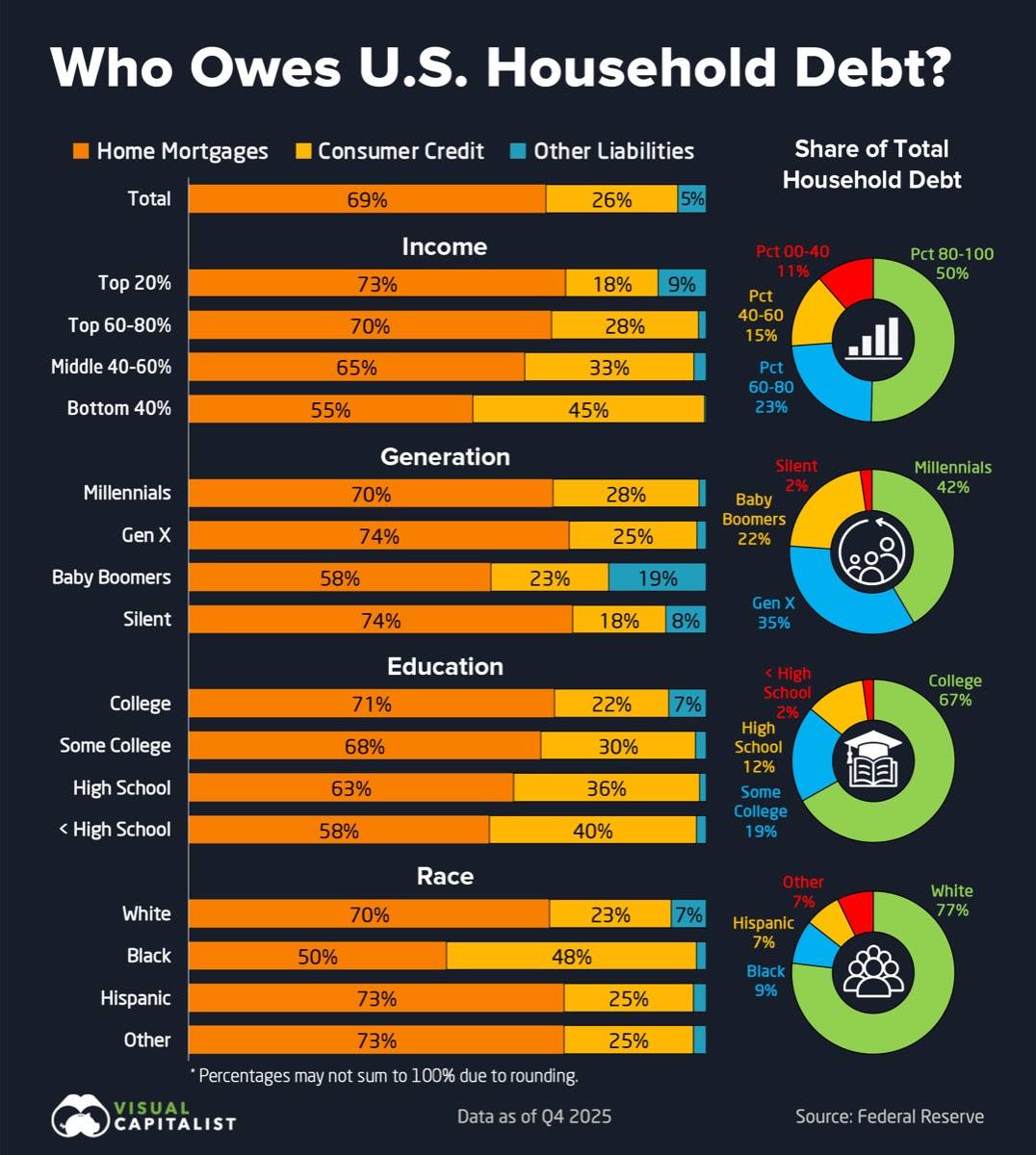
Household debt is not evenly distributed. The top 20% of earners hold half of all household debt, while the bottom 40% account for just 11%. Mortgages dominate among higher-income, college-educated households, lower-income households rely heavily on consumer credit. By generation, Millennials and Gen X together hold 77% of all household debt. Baby Boomers (22%) and the Silent Generation (2%) account for less than a quarter combined.
Why Gen X Carries America’s Heaviest Debt Burden
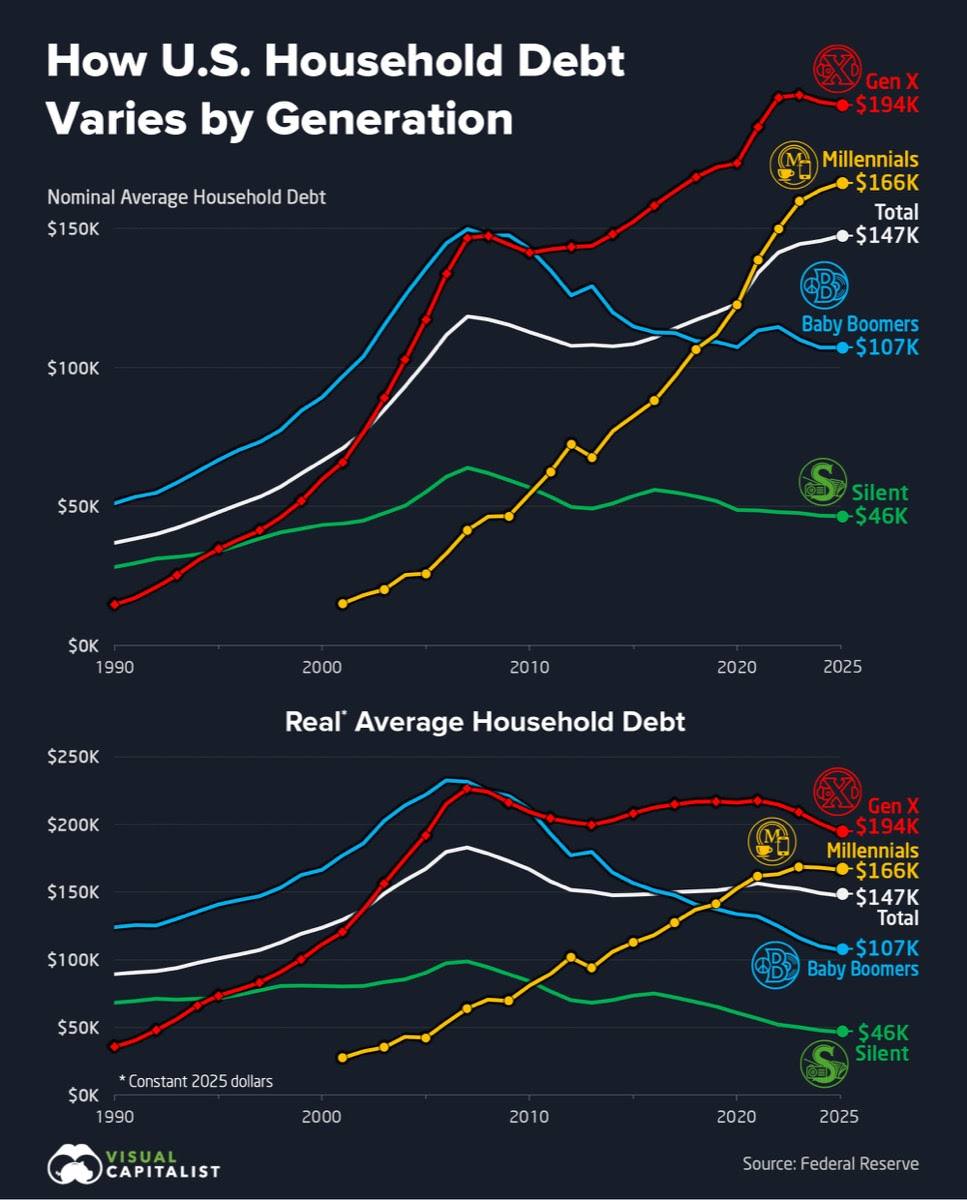
Average debt per household reached $147,000 in 2025, but that average hides a wide gap between generations. Generation X carries the heaviest load at $194,000 per household, followed by Millennials at $166,000. Baby Boomers ($107,000) and the Silent Generation ($46,000) hold far less. Since the 2007 peak, Millennials have seen real debt per household surge 160%, while Boomers and the Silent Generation have cut their real debt by more than half as they enter retirement.
The Top 20% Hold Over Half of America’s Mortgage Debt
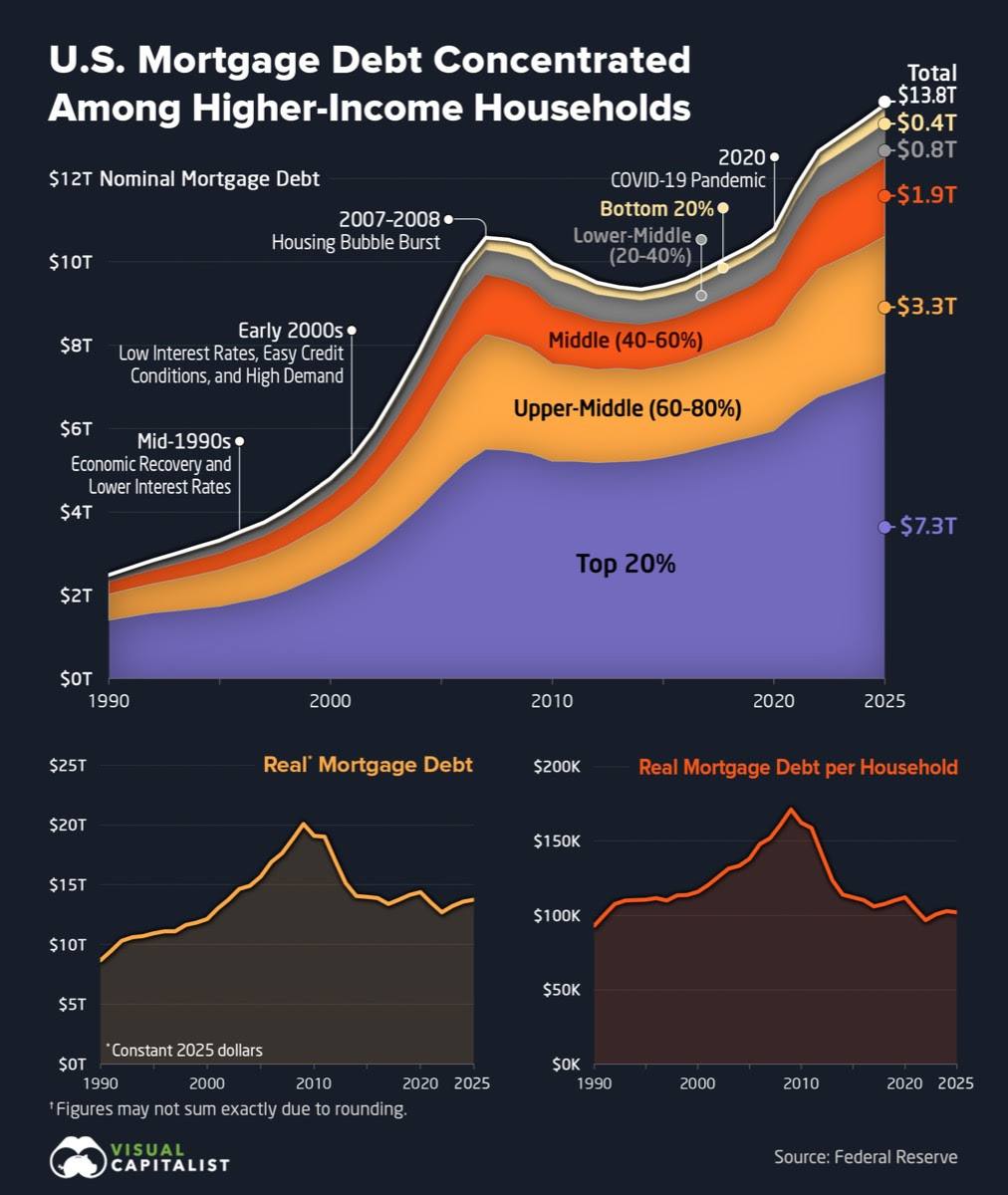
Mortgages, the largest single category of household debt, are highly concentrated at the top of the income distribution. The top 20% of earners alone hold $7.3 trillion in mortgages, or 53% of the US total. Add the next 20% and that share rises to 77%. The bottom 40% of households account for just 9% of mortgage debt, reflecting much lower homeownership rates and tighter credit access. After adjusting for inflation, real mortgage debt per household is now 33% below its 2009 peak, even as nominal balances hit new highs.
The Good Wrap
Bangkok’s heat curve, the world’s largest iceberg melting, AI agents trading on each other’s behalf, prediction markets paying the few, the merch economy of the Bureau, California overtaking Japan, steakhouse martinis as the second-last note. Closing on soil and wine, because everything in markets has a soil type, and most of the alpha is figuring out which one you are standing on.
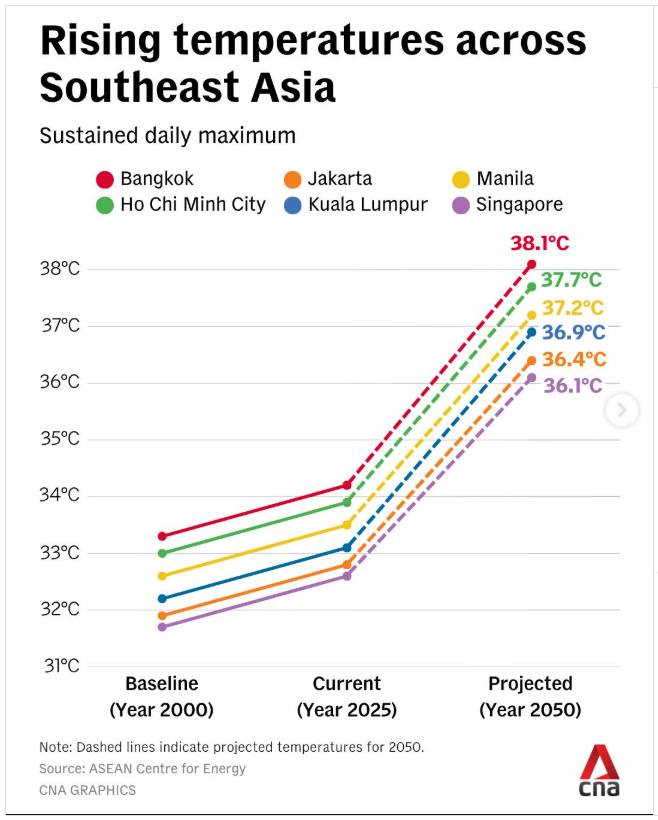
Bangkok could face up to 120 days above 35 degrees Celsius each year by 2050. Southeast Asian cities are getting hotter, and the Thai capital is projected to be among the hardest hit. The structural cost is air-conditioning load, water stress, productivity loss in outdoor work, and the slow capital-allocation question of which Asian capital remains habitable for global functions over a 30-year horizon. The energy infrastructure ramp implied by tropical heat is one of the silent macro tailwinds for Asia regional power and grid investment.
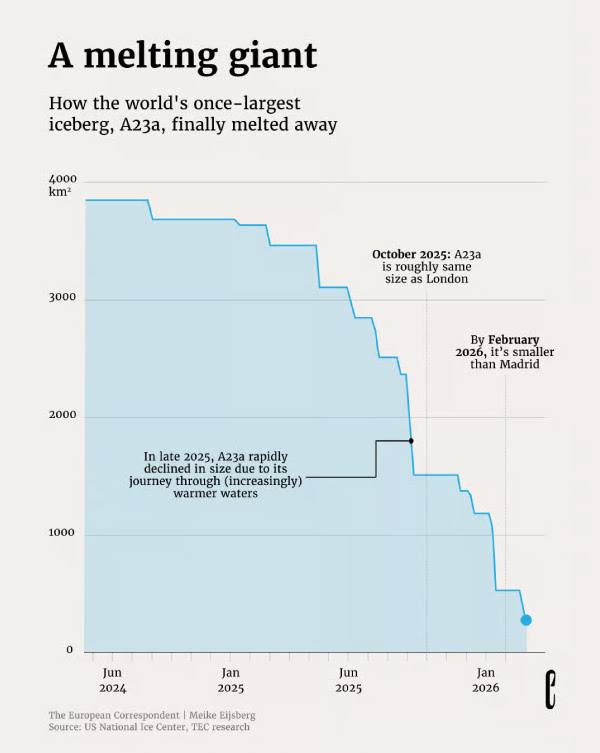
A23a, the world’s largest iceberg, is melting fast. Roughly twice the size of Greater London until last September, it could disappear entirely in a matter of weeks. Antarctica’s interior has historically been insulated from rising global temperatures by the Antarctic Circumpolar Current and stable polar wind patterns. That buffer is weakening. Between 2014 and 2016 Antarctica shed sea ice at a rate roughly equivalent to four decades of Arctic ice loss. If this acceleration continues, Antarctic ice loss could raise sea levels by up to two meters by 2100 under high-end scenarios.
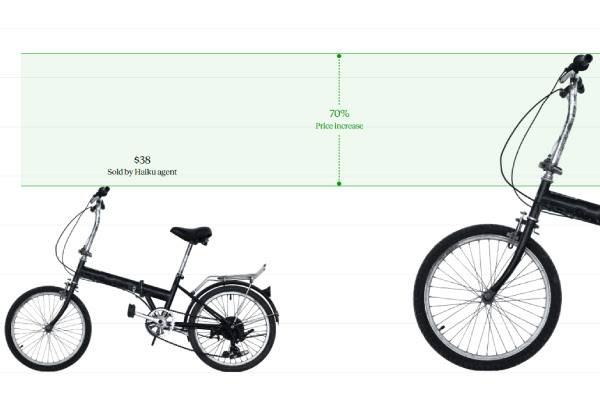
Project Deal by Anthropic. In a one-week in-house experiment, 69 employees were each given a $100 budget, with AI representatives acting on their behalf in a Slack-based classified marketplace. Claude first interviewed participants about what they wanted to buy and sell. The agents then handled listings, offers, counteroffers and final deals — closing 186 transactions across more than 500 items, totaling just over $4,000. Agents powered by Claude Opus 4.5 secured measurably better outcomes than those running on Claude Haiku 4.5, even though participants did not notice the gap. Read the full Anthropic write-up.
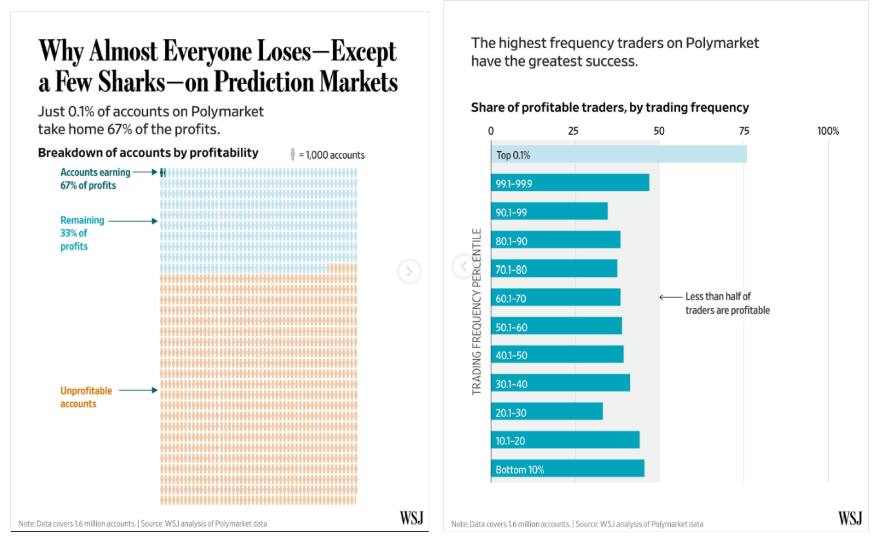
Prediction markets pay the few. On Polymarket, 67% of profits go to just 0.1% of accounts. That means fewer than 2,000 accounts netted nearly half a billion dollars out of 1.6 million accounts that have traded since November 2022. The distribution is similar on Kalshi. Total trading volume on both platforms rocketed to $24.2 billion in April, up from $1.8 billion a year earlier. The advertising features regular people winning life-changing sums. The data describes professional firms and trading shops eating retail’s lunch.

Kash Patel’s personally-branded Woodford Reserve bourbon, distributed to FBI staff and civilians on official business. Bottles bear the imprint of the Kentucky distillery and are engraved with “Kash Patel FBI Director” along with an FBI shield, Patel’s signature, and the number 9 — a reference to his place in the history of FBI directors. The cult-of-personality apparatus around the bureau is now part of the swag economy. Read the full Atlantic investigation for FBI staff testimony, the Woodford Reserve denial, the Quantico training-seminar bottle that went missing, and the wrongful-termination lawsuit.
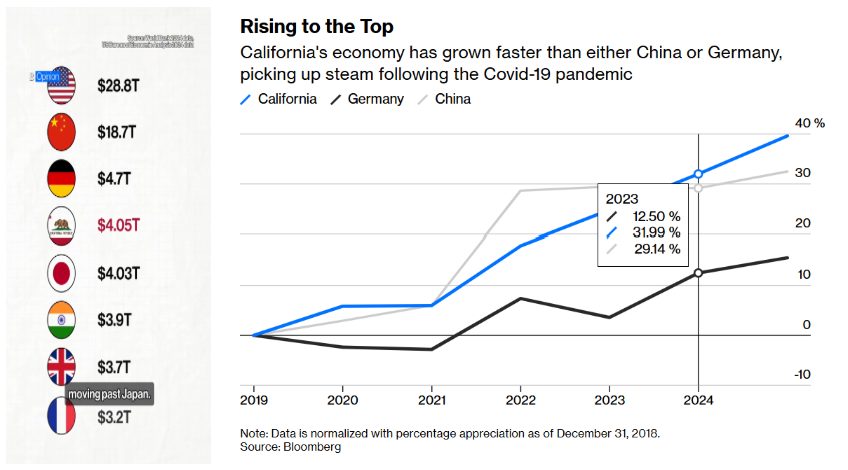
California is now bigger than Japan. The state’s economy has overtaken the world’s fourth-largest, sitting at $4.05 trillion versus Japan’s $4.03T, behind only the US, China and Germany. Since 2019 California has grown faster than China or Germany — +31.99% by 2024 versus China +29.14% and Germany +12.5%. Tech-sector dominance, demographic stability and policy bets that paid off post-pandemic. The world’s most-watched subnational economy is now also one of its fastest growing.
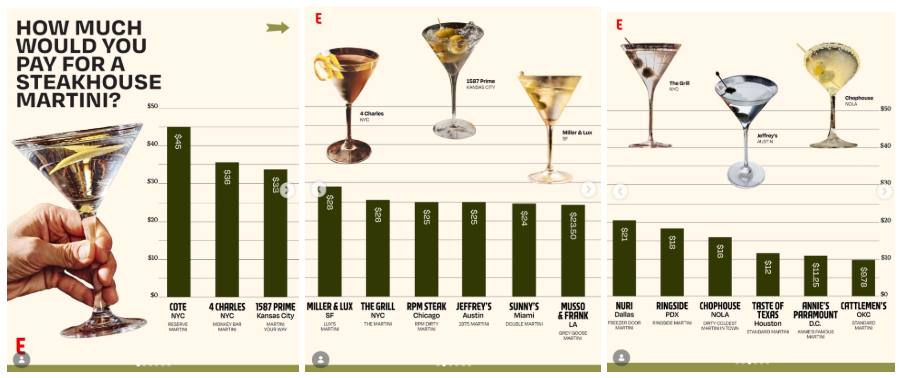
Steakhouse martinis, surveyed across the country. The classic cocktail ranges from the $9 martini at Cattlemen’s in Oklahoma City to the $45 Reserve Martini at Cote in NYC. The middle of the distribution is around $20-25, the high end is concentrated in NYC and Las Vegas. Liquidity sizzles into Friday afternoon. So does ice in a stainless shaker.
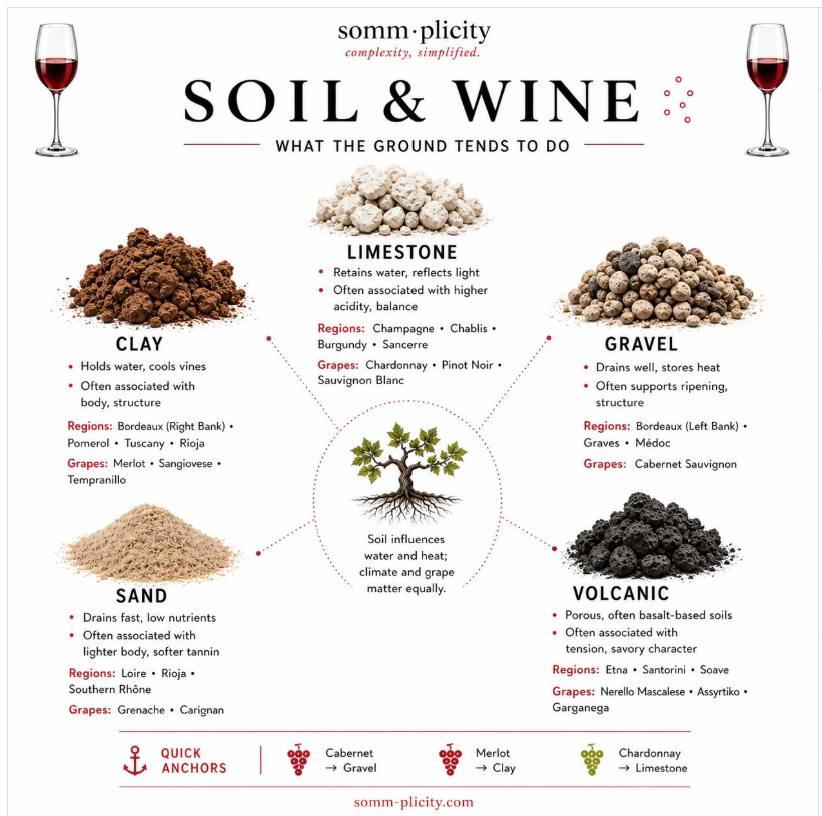
Soil and wine, what the ground tends to do. Clay holds water and cools vines, often associated with body and structure (Bordeaux Right Bank, Pomerol). Limestone retains water and reflects light, often higher acidity and balance (Champagne, Chablis, Burgundy). Gravel drains well and stores heat, often supporting ripening and structure (Bordeaux Left Bank, Médoc). Sand drains fast and is low-nutrient, lighter body and softer tannin (Loire, Rioja). Volcanic porous, often basalt-based, tension and savory character (Etna, Santorini, Soave). The metaphor for the week — soil influences water and heat, climate and grape matter equally. Markets work the same way. Find your soil.
Best,
Hoelon