Things Fall Apart
Personal views and market commentary. Not investment advice. Not associated with any employer or firm.
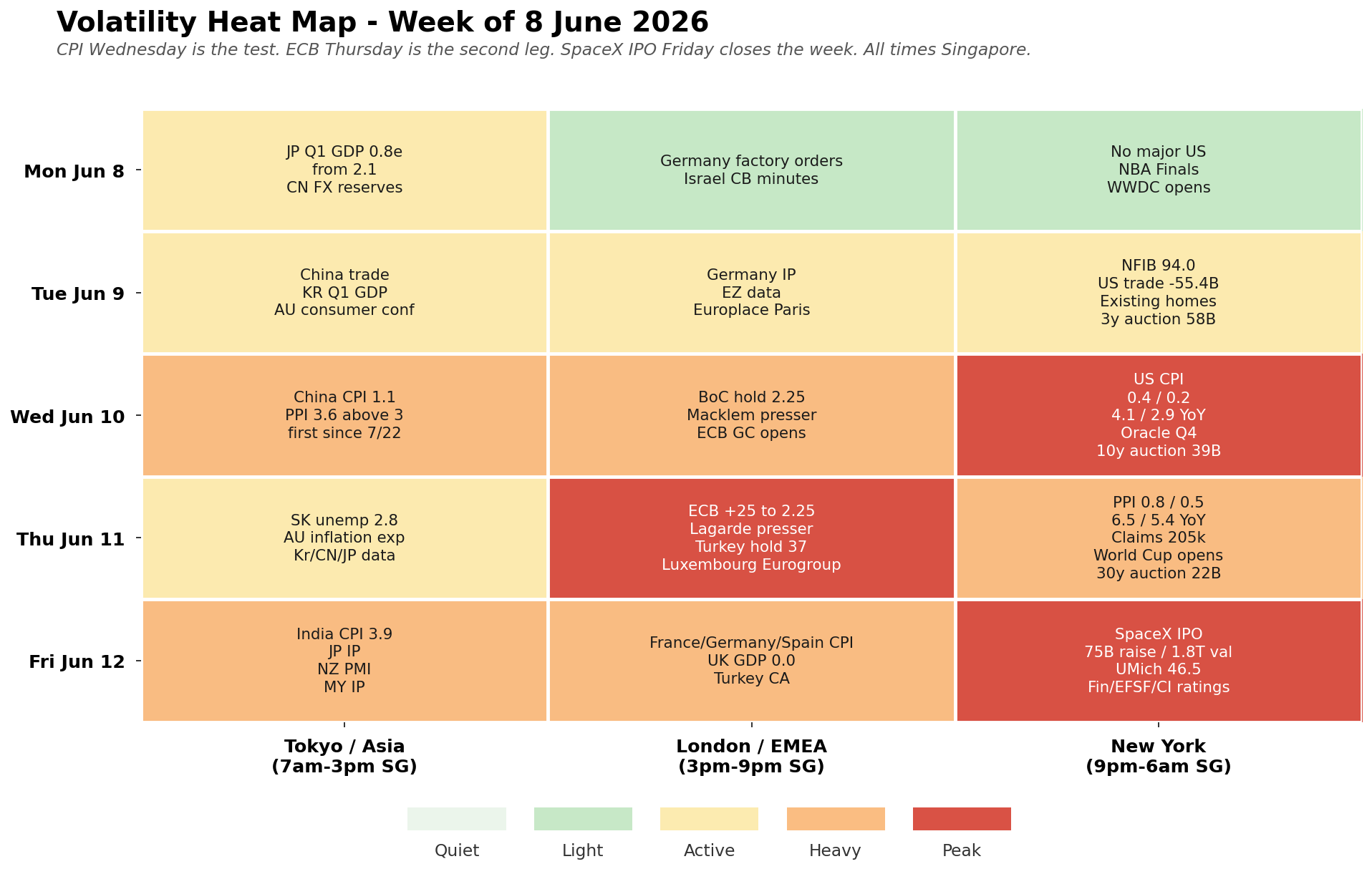
Volatility heat map for the week ahead, all times Singapore. Wednesday is the pivot, with US May CPI in New York, BoC hold and the ECB Governing Council opens, China CPI/PPI in Asia, Oracle Q4. Thursday's marquee is the ECB hike and Lagarde presser plus US PPI, with the FIFA World Cup opening that night. Friday closes the week with the SpaceX $75B IPO and UMich consumer sentiment in New York, eurozone CPI cluster and UK GDP in EMEA, India CPI in Asia. Fed in external comms blackout already.
"The Chinese first came in USA trying to build the Sierra, trans-continental railroad in the winter. Our people were dying and it was just impossible, so they brought in 50,000 Chinese coolies, who were in those days practically s****s. They took the coolies in the mountains and said, you build the railroads, and they did it. The Americans couldn’t do it by themselves. Fade in fade out 150 years later, due to immigration, these Asians have rapidly become Doctors, Lawyers, Businessmen and succeeded mightily. Every instrument that’s hard to play in symphony orchestra is played by a Chinese face." — Charlie Munger, 2019. Munger framed the macro arc in centuries while we trade five-day windows. Chinese coolies built the railroads that underpinned American dominance. The AI infrastructure arc is being built today and the labour is partly Asian. China’s May imports +32.7% on AI hardware. Korea’s exports +55.5% on chip shipments. Who builds and who profits often takes a century to settle. The week’s bear flattener is short arc. The longer arc of who profits is still being written.
"Heads I win, tails I do not lose much." — Mohnish Pabrai, The Dhandho Investor. Asymmetric is the only edge worth chasing. When DoubleLine puts a 100% probability on the AI bubble and SpaceX raises 75 billion at a 1.8 trillion valuation on Friday, the asymmetry of the long is gone. The asymmetry is now on the other side. Leopold opened 8.45 billion of puts last week against SMH, Nvidia, Oracle, Broadcom, AMD, Micron, TSM, ASML and Intel while keeping the infrastructure exposure long. Stay long the buildout. Pay for downside on the names the crowd cannot let go.
"It was the best of times, it was the worst of times, it was the age of wisdom, it was the age of foolishness, it was the epoch of belief, it was the epoch of incredulity, it was the season of light, it was the season of darkness, it was the spring of hope, it was the winter of despair." — Charles Dickens, A Tale of Two Cities, 1859. Dickens captured the duality in 1859. Markets in 2026 sit in the same paradox. S&P at records, AI IPOs piling on, Nasdaq still up 16% year-to-date even after Friday. And yet General Mills told an investor conference Thursday that the US consumer is stressed, Lululemon cut guidance, Boston Beer flagged consumers pre-gaming at home to skip on-premise pricing. Headline CPI peaks at 4.1% this week, PPI runs at 6.5%. The top 10% of US earners now account for half of all consumer spending. The two epochs live in the same tape until one breaks. The switch between inflation and demand destruction is the next chapter, and the calendar starts on Wednesday.
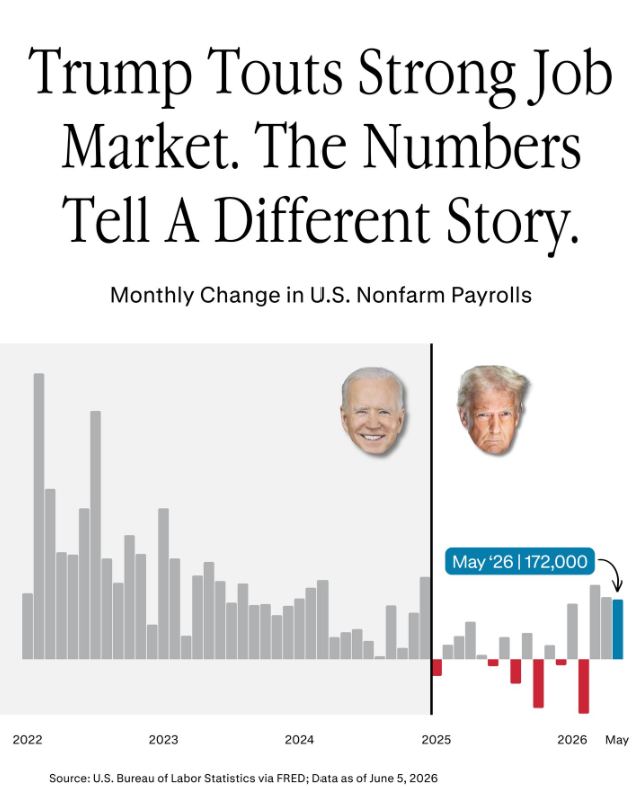
The NFP shock. May payrolls +172k versus +88k expected, roughly doubling the consensus. March and April revised up a combined 93,000. Leisure and hospitality led the gain at +70k, local government +55k, healthcare +35k, manufacturing +7k. Unemployment 4.3% held. The print was the moment the May calm broke — Nasdaq -4% on the day, -4.7% on the week, chipmakers -10%. The Fed-cut crowd offside and the bear flattener begins. Source: Bloomberg / BLS.
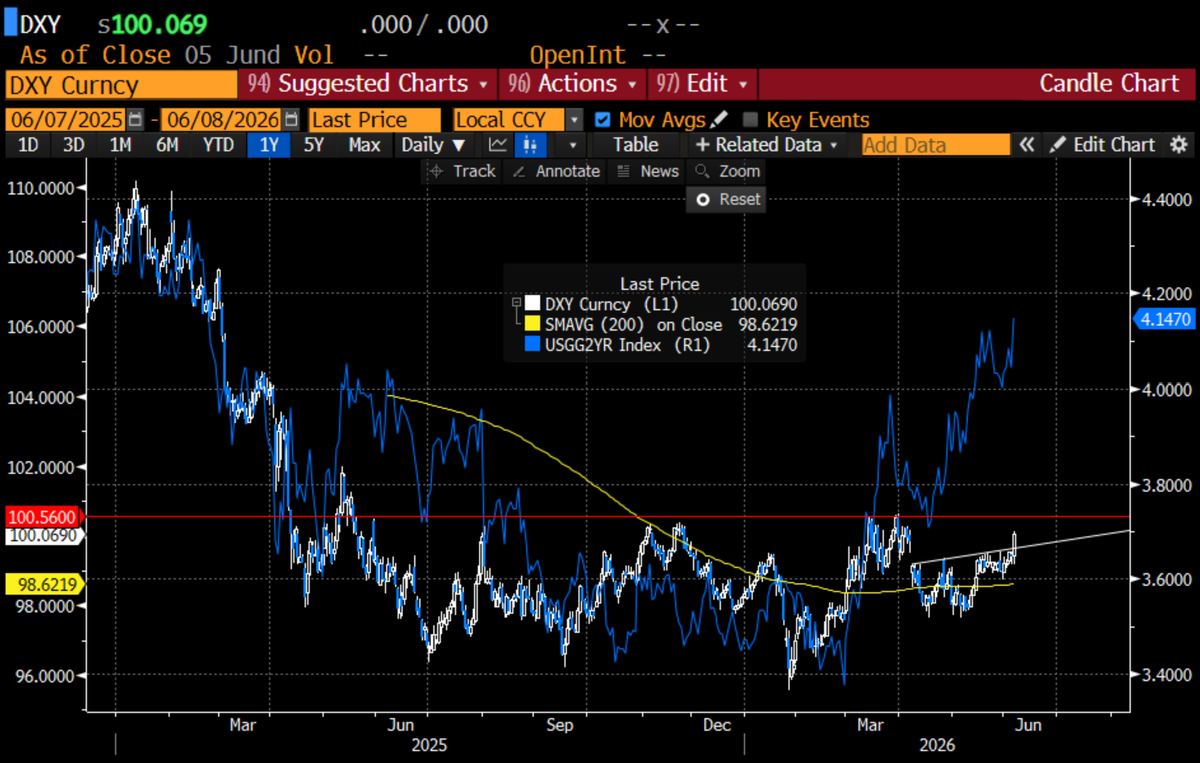
DXY broke 100, the 2-year yield at a new high. Friday's bullish outside up day on a strong NFP and back-up in rates lifted the dollar index to a two-month high near 100.10. The next technical target is the year's high at 100.65, set end-March. The break opens the question on whether Warsh's first FOMC delivers a July hike or signals one for September. The dollar carry and the rates carry now realign for the first time in a quarter. Source: Bloomberg.
What is the plan this week?
The calm of the last six weeks is finally broken. Markets spent May ignoring the inflation problem, ignoring the unresolved war, riding the AI tape parabolic. Friday’s 172k payrolls print, roughly double the 88k consensus, was the moment the calm cracked. Nasdaq fell 4% on the day and 4.7% on the week, chipmakers down 10%. DXY broke 100 to a two-month high. EUR sliced through 1.16 to 1.15. USDJPY tested 160.35, the highest since the April intervention. The 10-year yield closed above 4.50%. Rate pricing has reset, fully discounting a Fed hike by year end. Iran is no closer to a deal. Israel has expanded into Lebanon. The strong labour data that was supposed to neutralise the monetary policy debate has instead pulled the debate the other way.
Wednesday’s May CPI is the test. Bloomberg Economics calls 4.1% headline year-on-year, the peak of the Iran-war inflation wave. Core at 2.9% is the read for Warsh, subdued by consumer caution showing up in recreation services even as input costs surge. PPI Thursday is the upstream pressure at 0.8% headline, 6.5% year-on-year. Warsh’s first FOMC is nine days away. The external comms blackout has begun. The question is whether he is pragmatic on a CPI that just printed peak, or hawkish on a labour market that just printed double consensus.
The IPO fever and the wealth-effect channel is the second story underneath. SpaceX prints Friday, $75 billion raise at $1.8 trillion valuation, the largest IPO ever. Alphabet just announced an $85 billion equity raise. Anthropic finalised a $36 billion bond sale. BI estimates $5 trillion of AI capex over five years, much debt-financed. The top 10% of US earners now account for nearly half of all consumer spending and roughly a third of US GDP. If the equity drawdown continues into the summer, the wealth-effect channel that has anchored the consumer is the one that breaks. General Mills said it bluntly Thursday, the US consumer is stressed. Lululemon cut guidance. The supporting class is already feeling it. Hotter on the print, colder on the consumer.
Asia is the cleanest squeeze on the calendar. Korea Q1 GDP Tuesday, China trade Tuesday with imports surging 32.7% on AI hardware demand, China CPI/PPI Wednesday with PPI back above 3% for the first time since July 2022. The higher USD plus the Fed hike pricing is a tax on Asian economies that import oil and run import-financing risk. The RBI is now expected to deliver a 50bp tightening cycle in Q4. The CNH consolidation continues but the rally pace fades on the USD bid. AUDNZD has stalled at the air pocket, the next catalyst the RBA on June 16. Technical context for the week: DXY 100.65 the next test, EUR 1.14 the measured target, AUD head-and-shoulders target 0.6900, USDJPY 160.70 the April intervention high then 161.60.
The plan this week. The long USD trade has CTAs and the Fed-cut crowd wrong-sided. Powder dry into Wednesday’s CPI. The 3 to 6 month USD upside structures pay quickly on a hot print. Pay US short end on the bear flattener that is now happening, the most painful repricing for a market that was positioned for a cut and is getting a hike. Asia is squeezed on both FX and rates although a lot has already priced in. AUDNZD short held, long CNH held with the rally pace fading. The long EUR sleeve and the late-Friday long EURJPY are stopped on the EUR breakdown through 1.15. The bear flattener is the most painful trade when the market is wrong on direction. We are in that moment. Or we all just throw the towel to watch the World Cup, opens Thursday in Mexico.
What did I learn last week?
Mon Jun 1: ISM Manufacturing 54.0 vs 53.0e, the upside surprise that flagged the labour print to come. China RatingDog Mfg PMI 51.3. Korea exports +55.5% YoY on AI chips. Choose France summit at Versailles. Atlantic hurricane season opened.
Tue Jun 2: Eurozone CPI 3.2% headline, core 2.5% a 1-year high, cementing the ECB June hike. US JOLTS 7.618M vs 6.866Me, an 11-month high — the first crack in the soft-data narrative. South Korea CPI 2.9%. Indonesia CPI 3.1%. Yellen at Brookings on Powell tenure. Adnoc planning first multi-fuel UAE pipeline to bypass Hormuz.
Wed Jun 3: Australia Q1 GDP 0.4% QoQ as expected, the housing top-end already declining. ISM Services 53.7. BOJ said to mull June hike with another possible in FY2026, swaps lifted to 95%. St Petersburg Forum opened, Saudi Energy Minister attending. Bloomberg Tech Summit opens San Francisco. Bessent Senate Finance budget testimony.
Thu Jun 4: Initial claims 225k vs 215ke, highest since February. BoJ Ueda hawkish on rate path. Lululemon cut outlook on "moderating sales trend". General Mills said the US consumer is stressed. Blackstone Private Credit Fund capped redemptions at 5%, Q2 requests 10%. Anthropic urged global coordination to slow AI development.
Fri Jun 5: The NFP shock. +172k vs +88ke, roughly doubling expectations. Unemployment 4.3% held. Earnings growth cooled to 3.4%. Nasdaq -4% on the day, S&P -2.6% on the week, chipmakers -10%. DXY broke 100 to 100.10, EUR through 1.1520, USDJPY 160.35, AUD broke 0.7040. 10-year yield through 4.50%. Fed hike for 2026 fully priced.
All week: S&P -2.6%, Nasdaq -4.7%, the 10-straight-week-up streak broken. DXY +1.5% to 100, a two-month high. EUR through 1.16 to 1.15, AUD broke the neckline, USDJPY tested 160.35. Bitcoin near $60k, gold sold, 10y above 4.50%. Iran 4-stage proposal floated, Iran stops US message exchange, Israel expanding Lebanon. Maersk Hormuz avoidance costs $500M+/month.
What to look out for next week?
Sun Jun 7: OPEC+ JMMC meets to decide July quotas. Peru runoff (winner takes office Jul 28). Kosovo and Armenia elections. China May FX reserves. Monaco GP, Tony Awards.
Mon Jun 8: Japan Q1 GDP revised to 0.8% from 2.1% on weaker capex. China FX reserves. Apple WWDC opens Cupertino. London Tech Week begins. SuperReturn International in Berlin. Light data globally.
Tue Jun 9: NFIB small biz 94.0e from 95.9, hiring plans at 6-year low. US trade -55.4B, existing home sales 4.06M. China May trade — exports +15.2%, imports +32.7% on AI hardware. South Korea Q1 GDP. Bloomberg Intelligence Generative AI forum NY. US congressional primaries in ME, NV, ND, SC. Treasury sells $58B 3y.
Wed Jun 10: US May CPI — 0.4 headline / 0.2 core, 4.1% YoY (year peak per BE) / 2.9% YoY core. BoC holds at 2.25%, Macklem presser. China CPI 1.1% / PPI 3.6% (first above 3% since Jul 2022). ECB Governing Council meeting opens. Oracle Q4 earnings. Bloomberg Invest HK. Treasury sells $39B 10y.
Thu Jun 11: ECB +25 to 2.25%, Lagarde presser. US PPI 0.8% headline / 6.5% YoY, core 0.5% / 5.4% YoY. Initial claims 205k. FIFA World Cup opens — Mexico vs South Africa. Turkey CBRT hold at 37%. South Korea unemployment 2.8%. Eurogroup Luxembourg. Adobe Q2 earnings. Treasury sells $22B 30y.
Fri Jun 12: SpaceX IPO on Nasdaq — $75B raise, $1.8T valuation, largest IPO ever. UMich preliminary June 46.5 from May 44.8 record low. India CPI 3.9% from 3.5%. UK monthly GDP 0.0 from 0.3%. France/Germany/Spain CPI. Bloomberg Energy Security Houston with Sec Wright. Sovereign rating reviews: Finland, EFSF, Ivory Coast.
All week: CPI Wednesday is the test. ECB Thursday is the hike. SpaceX Friday is the absorption test. The Asian inflation/credit cluster Tuesday-Wednesday completes the global inflation read. Fed in blackout the entire week. World Cup opens Thursday.
Beyond next week
Jun 14: Switzerland Population-Cap Referendum — vote on 10M cap.
Jun 15-16: BOJ rate decision — swaps 95% priced for a 25bp hike to 1.00%.
Jun 16: RBA decision — futures pricing 70% probability of another hike.
Jun 16-17: Warsh’s first FOMC with the SEP redone. Whether the first move under the new chair is, improbably, up.
Jun 18: SNB decision — likely hold at 0%.
Jun 21: Colombia runoff if Sunday’s first round inconclusive.
Late Jun: Anthropic confidential IPO filing. OpenAI confidential filing reportedly imminent for September pricing.
Jul 19: FIFA World Cup final.
Aug: UN funding cliff. Guterres flags mid-August financial collapse on current trajectory.
Regimes
US growth signal stays clean, the NFP shock confirms the hike-priced 2026. 172k vs 88ke doubled expectations, 10-year through 4.50%. Front-end repricing leads. Carry into 3 to 6 month USD upside through CPI into Warsh FOMC. The bond market and the Fed-cut crowd are wrong-footed at the same time. evolved, week 4
G7 long-end stress evolves into the bear flattener, 2-year leading 10-year. The belly catch-up that was flagged last week is now happening at the 2-year. The most painful curve move when the market is positioned for cuts and gets a hike. Pay US short end. The same trade across UK, JGB, EU rates. evolved, week 5
European structural rebalance pauses on the dollar bid. EUR through 1.16 to 1.15 last week. ECB hike Thursday already priced. The long-EUR sleeve trimmed; the structural overhang frame still intact but the cyclical USD bid dominates for now. Re-add the long EUR position on a CPI miss or Warsh dovish. evolved, week 3
AI capex regime moves from political-risk discount into valuation reset. Last week was Hawley and Pope Leo. This week is Nasdaq -4.7%, chipmakers -10%, Broadcom blow-out met with a thud, Ciena -20% after beat-and-raise. Leopold opened $8.45B of puts. DoubleLine and Oaktree positioning for a credit event. SpaceX IPO Friday the absorption test. evolved, week 7
Top 10% wealth-spending channel under threat, the Main Street vs Wall Street divide finds its operational risk. Top 10% earners account for 50% of US consumer spending, the highest in 30 years. Moody's estimates the top 10% generates a third of US GDP. The wealth-effect channel breaks if the equity drawdown holds. General Mills already calling US consumer stressed. evolved, week 2
Shifts (if → then)
If May CPI prints 4.2 or hotter Wed → Fed hike confirmed for September, USD extends to DXY 100.65, AUDNZD finally breaks lower, the bear flattener accelerates through the 2-year. new
If May CPI prints below 4.0 Wed → bear flattener pauses, dollar fades temporarily, the long EUR sleeve gets re-added, the AUDNZD short can be added on better levels. new
If USDJPY breaks 160.70 Wed-Thu → April intervention high taken, MOF in play, BOJ-MoF-PMO alignment forced, the cross retests 161.60 next or intervention reverses it. new
If ECB Lagarde signals second hike Thursday → bunds sell off, EUR recovers from the front-end repricing, the cyclical-vs-structural debate reopens, the September move gets fully priced. new
If SpaceX IPO breaks issue price Friday → AI capex regime cracks, Mag 7 underperforms broader market, the fallen-unicorns picture extends, Leopold’s puts pay. new
If Iran 4-stage proposal lands → temporary risk-on, oil eases, USD softer for a session, but the data this week dominates the bigger picture. carried, evolved
If MOVE keeps rising while FX vol stays pinned → the gap closes the wrong way, FX vol catches up, the VAR shock arrives. carried
Tails
Bear flattener accelerates into forced deleveraging → positioning wrong-footed across G7 rates books, the curve shifts violently, the front-end repricing forces cross-asset de-risking. The most painful repricing scenario. new, week 1
AI capex bubble pops → DoubleLine's 100% probability comes due. The hyperscaler credit complex absorbs the air pocket. $5T of capex over five years gets revisited. new, week 1
Wealth destruction at the top 10% kills the consumer engine → the spending channel that has anchored US GDP cracks. Recession risk reprices via the income-concentration lens. new, week 1
Hormuz physical reopening lags the headline → Adnoc says four months minimum to 80% of pre-conflict flows, full flows not before Q1 2027. Oil to $130 if the war drags. week 10
BOJ hikes June but JPY weaker on policy mismatch → Ueda hikes, MoF threatens intervention, but the structural undervaluation and US-Japan rate differential dominate. USDJPY through 161.60 toward 163. new, week 1
Warsh forced into pragmatism → first FOMC delivers a pragmatic surprise vs hike-pricing. The bear flattener reverses, USD gives back, gold rallies. week 7, evolved
UN funding cliff in August → the 1945 architecture fragments visibly. The law-of-the-jungle frame the Xi-Putin statement called out becomes operational reality. week 3, carried
Are You Worried About the Equities Now?
Friday Nasdaq -4%, the week -4.7%, chipmakers down 10%. The strong swimmers got caught. Six charts under the headline tape. The Bloomberg picture of the rout itself, the FT chart on how $5.4 trillion of equity value was added since the Iran-war shock began (and who carried it), the PitchBook fallen-unicorn picture echoing the dotcom-era wreckage ahead of SpaceX, Leopold opening $8.45 billion of puts against the consensus AI longs, and the income-concentration that anchors the consumer spending engine to the equity tape. The question for the week ahead is whether the rotation is just a CPI-week tactical pause or the start of a regime change in the AI-tape.
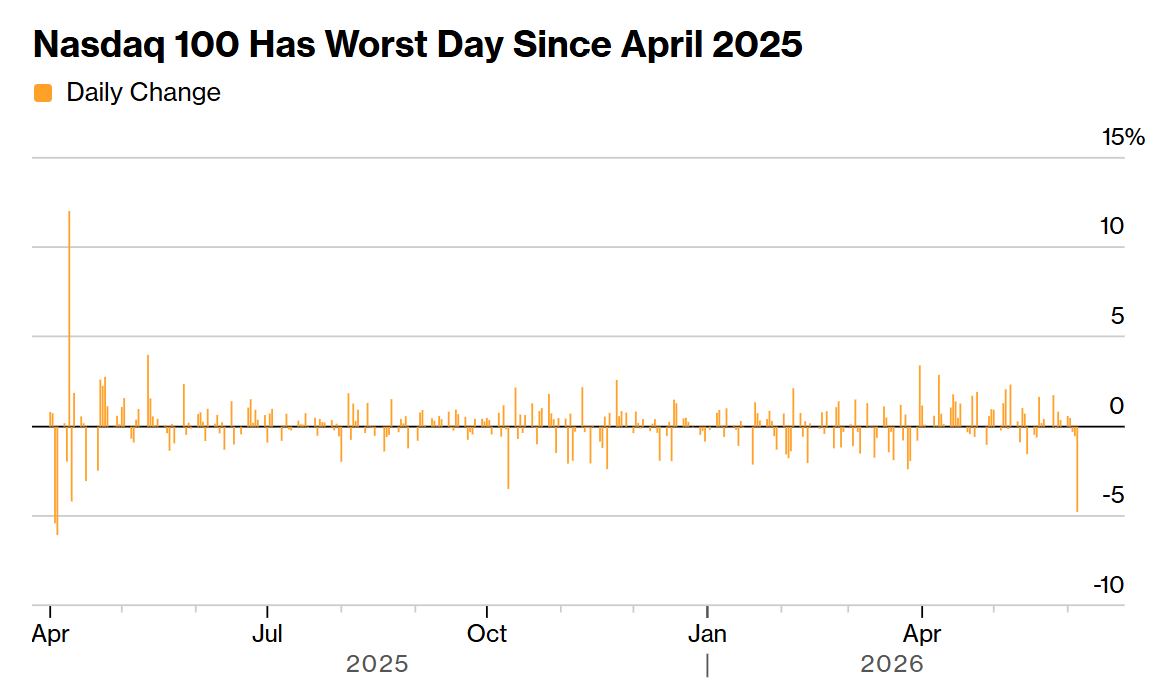
Nasdaq 100 sank 5% Friday in the AI-led rout as yields climbed and the Fed-hike pricing reset. S&P -2.6%, failing to complete a 10th straight week of gains. A gauge of chipmakers tumbled 10%. The Nasdaq's worst day since April 2025. The blowout NFP repriced rates and triggered a rotation out of the most stretched valuations. Where do we go from here is the question of the week. Source: Bloomberg.
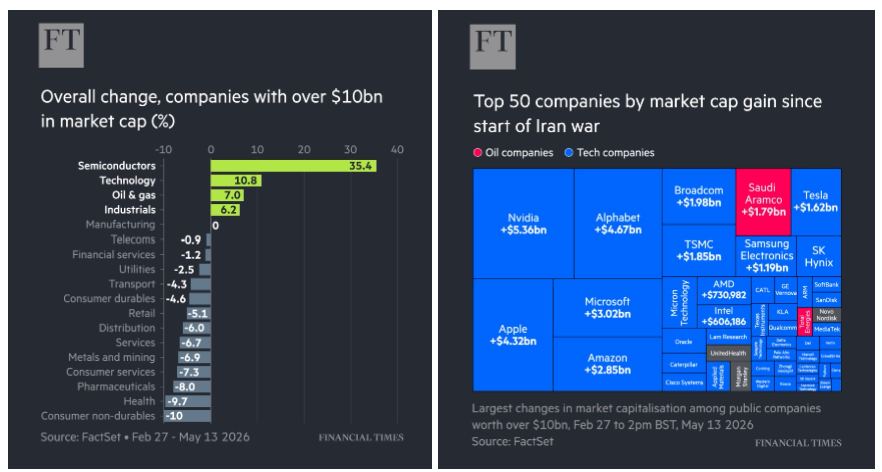
$5.4 trillion added in global equity-market value since the US-Israeli attacks on Iran, a 4.2% increase. Tech and chipmakers carried the rally — Intel, TSMC, the AI capex names. The defensive sectors lagged. The FT's Clara Murray on how investors hunted for the sectors least exposed to the Middle East while letting the energy-cost transmission run through the bottom-line elsewhere. The week's NFP shock starts to unwind the trade. Source: FT / Clara Murray.
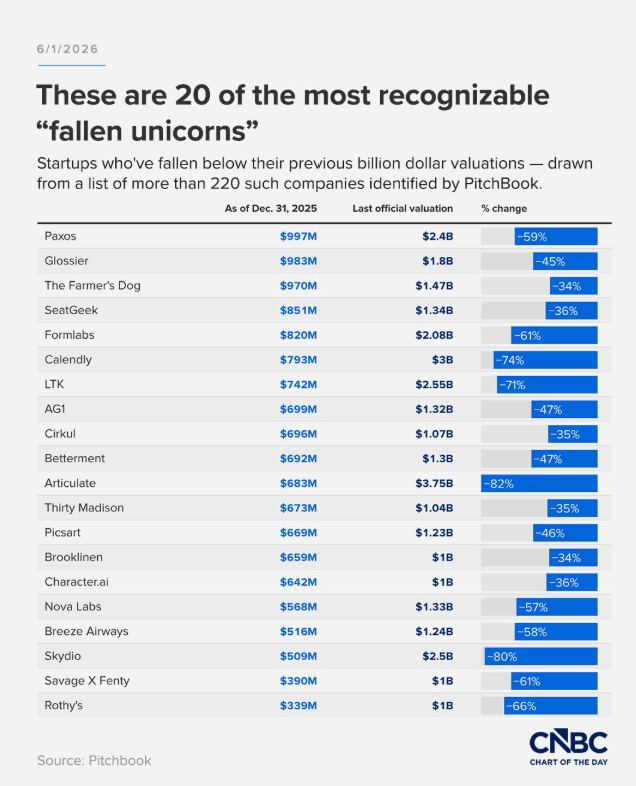
More than 220 companies that reached unicorn valuations during the pre-ChatGPT boom are now "fallen unicorns", per PitchBook. The $250B funneled into OpenAI and Anthropic ahead of their mega-IPOs has left the older crop stranded — inflated valuations, outdated technology, cut off from venture funding, not profitable enough for the public markets. The unicorn graveyard the SpaceX IPO Friday papers over. Source: PitchBook via CNBC.
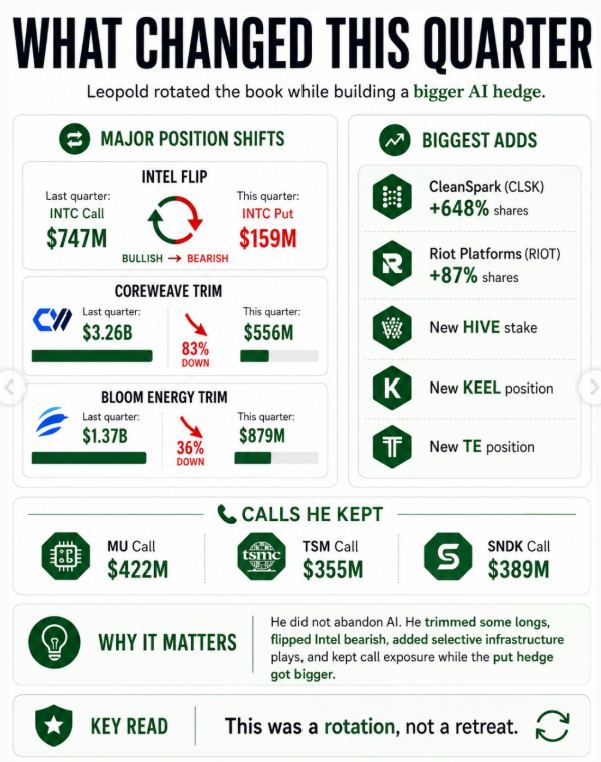
Leopold opens $8.45B in puts against the crowded chip trade — SMH, Nvidia, Oracle, Broadcom, AMD, Micron, TSM, ASML, Intel. One of the loudest AI bulls kept the infrastructure exposure, added miners and data centre names, and now hedges the names everyone treats as un-loseable. The convex hedge against the parabolic move. The asymmetry has flipped. Source: Leopold Aschenbrenner.
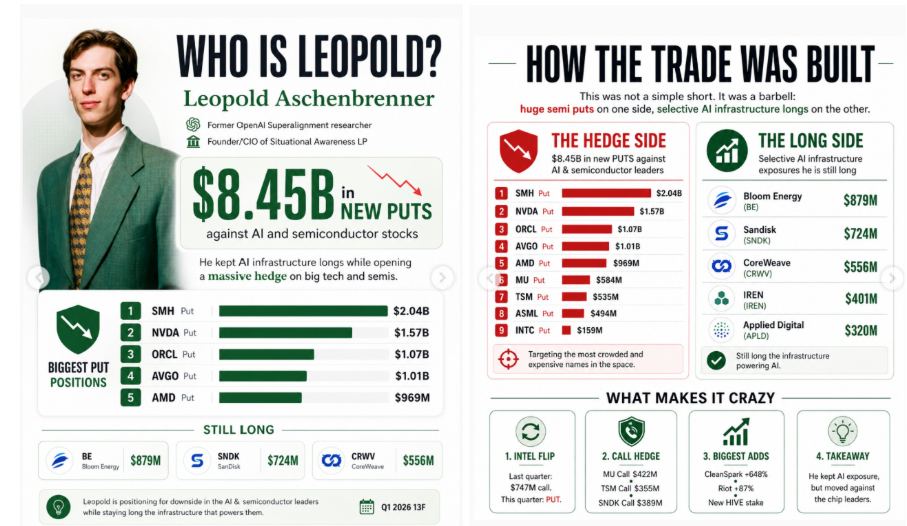
The Leopold put list. SMH, Nvidia, Oracle, Broadcom, AMD, Micron, TSM, ASML, Intel — the consensus AI longs hedged short. The framing: stay long the infrastructure thesis (data-centre buildout, miners, energy), but pay for downside on the names the crowd cannot let go. Heads I win small, tails I lose less. The asymmetric trade now. Source: Leopold Aschenbrenner.
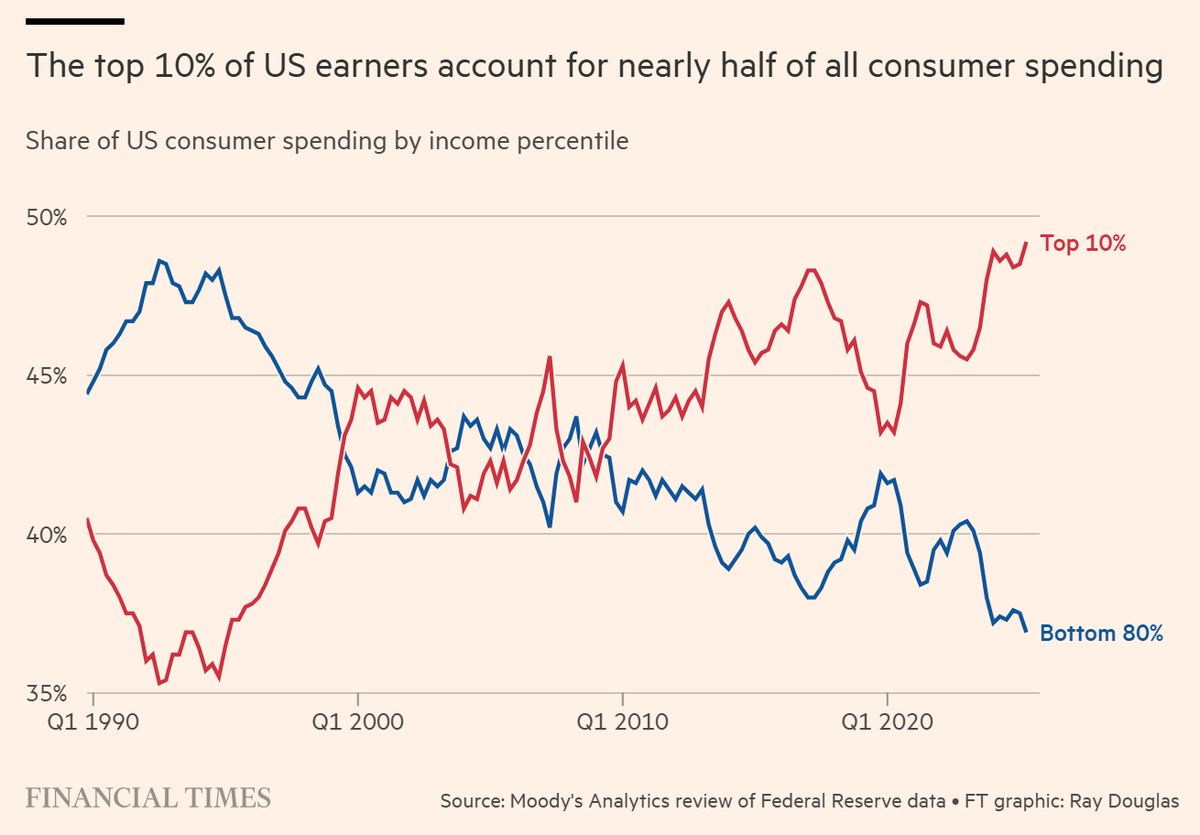
The top 10% of US earners account for nearly half of all consumer spending, the highest share in over 30 years. In the 1990s, the bottom 80% collectively accounted for more spending than the top 10%. The shift accelerated post-2000. Moody's Analytics estimates the top 10% now generate roughly a third of US GDP. The wealth-effect channel is the consumer story — if the equity drawdown holds into summer, the spending engine cracks. Source: Financial Times / Deborah Elms.
Manic Monday
Japan Q1 GDP revision, China FX reserves, light global data. WWDC opens. SuperReturn International in Berlin. London Tech Week begins. The data slate light but the positioning into Wednesday is the read.
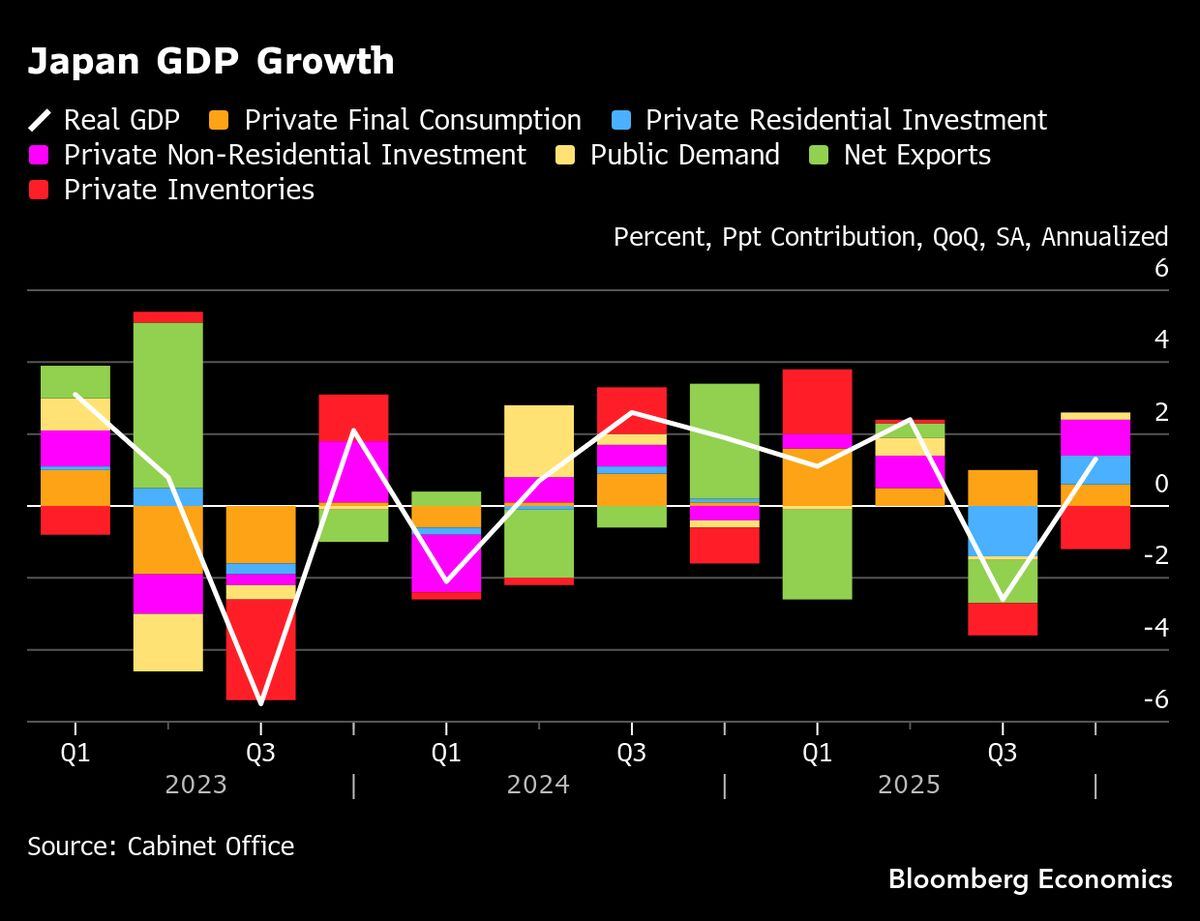
Japan Q1 GDP likely revised down to 0.8% annualized from the preliminary 2.1%, reflecting weaker capex. Still broadly in line with BOJ's 0.7% potential. The print is the read into the BOJ June 15-16 meeting, swaps now 95% priced for a 25bp hike to 1.00%. The structurally undervalued yen continues to weaken even as inflation runs hot and the BOJ tilts hawkish — the policy-mix tension under PM Takaichi the unresolved story. Source: Bloomberg Economics.
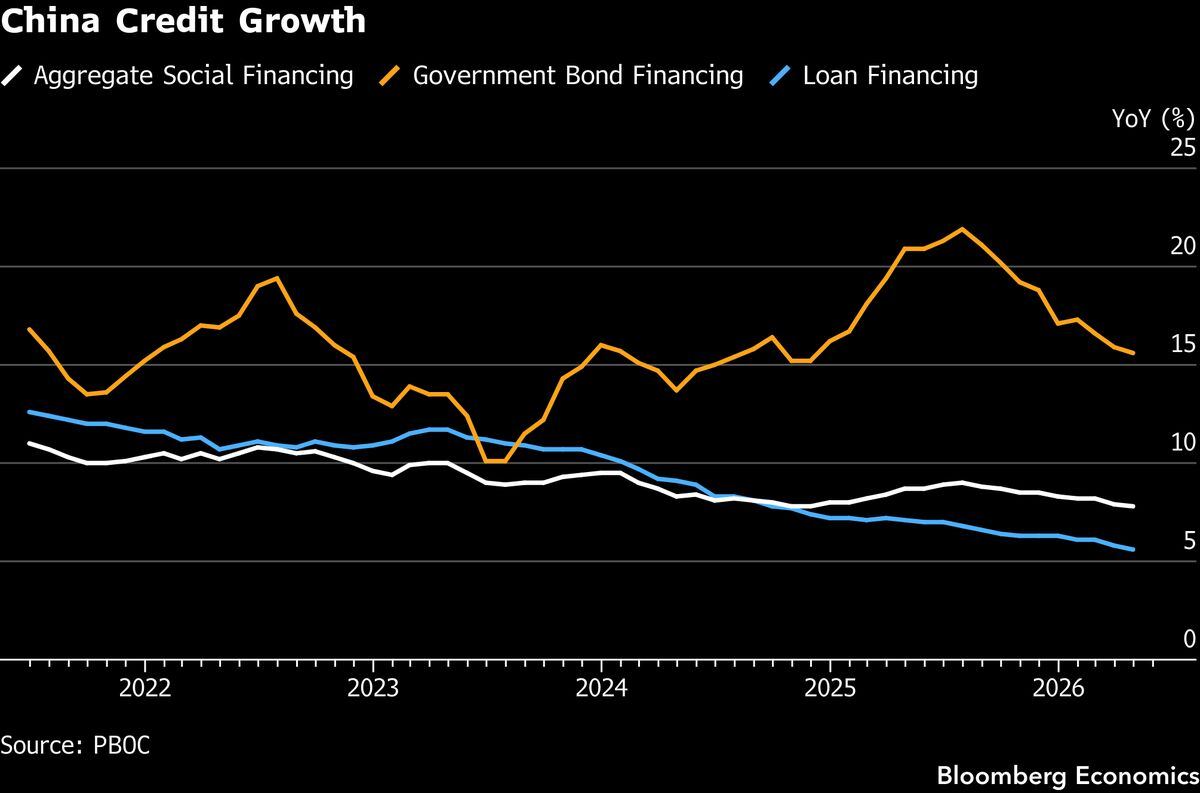
China new credit likely rebounded in May after the April dip but still falling short of last year. BE expects 2.2 trillion yuan in new aggregate social financing, year-to-date 17.7 trillion versus 2.3 trillion added a year earlier. Growth in outstanding social financing edged down for a third month to 7.7% YoY. The credit pulse remains the binding constraint on the Chinese consumer story. Source: Bloomberg Economics.
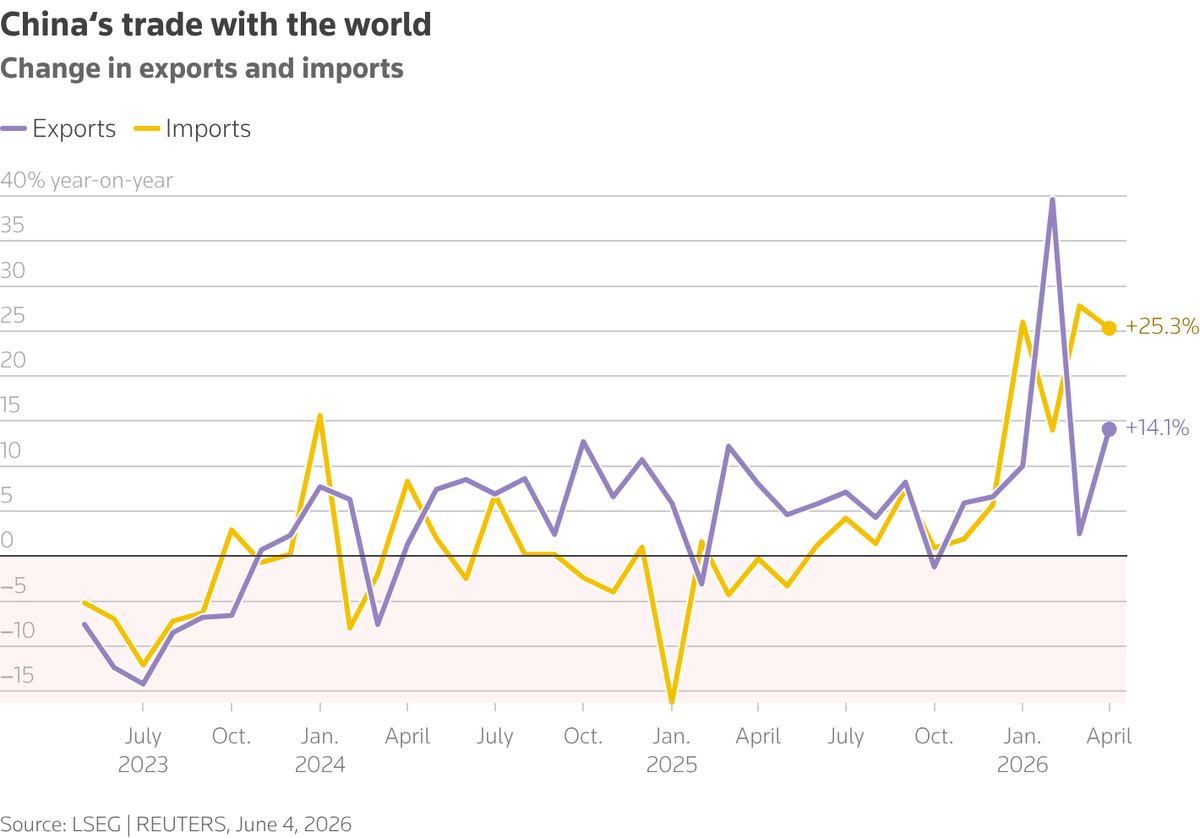
China's trade with the world. Tuesday's May trade print is expected to show exports +15.2% YoY and imports +32.7% YoY, the import surge driven by AI hardware demand and lower base effects. Port and shipping data suggest shipments to the US rose for a second straight month. The trade strength is the cushion against the credit pulse weakness underneath. Source: Reuters.
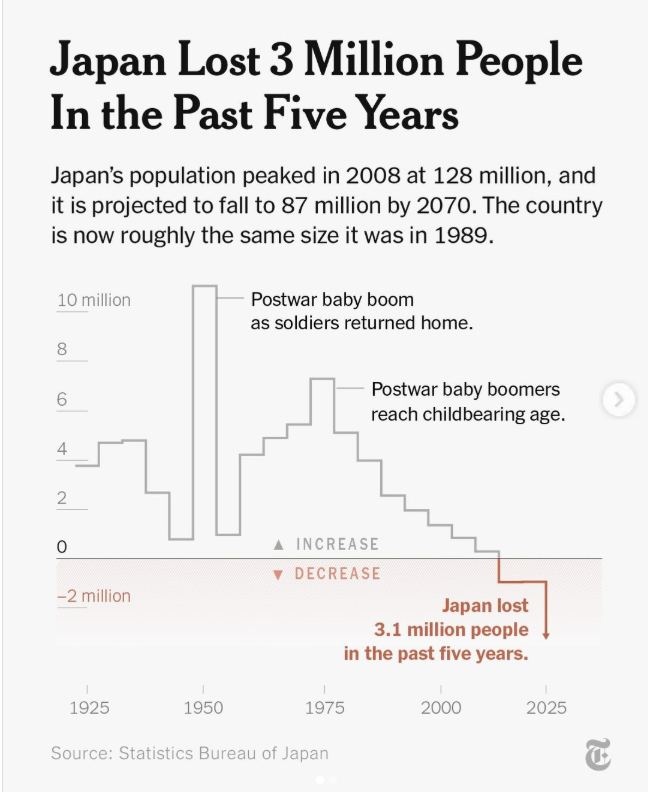
Japan's population fell by more than 3 million over the past five years, the biggest drop since the census began in 1920. Labour shortages worsening. Anecdotal evidence is growing of Nepalese workers being trained in Japanese language and labour market integration, the demographic-driven solution that emerging markets are quietly providing. Source: New York Times.
Turnaround Tuesday
China trade Tuesday morning, US trade and NFIB and existing home sales in the afternoon. Korea Q1 GDP. Bloomberg AI forum in New York. US primaries in ME, NV, ND, SC. The day pivots between the China trade strength and the US small-biz softness.
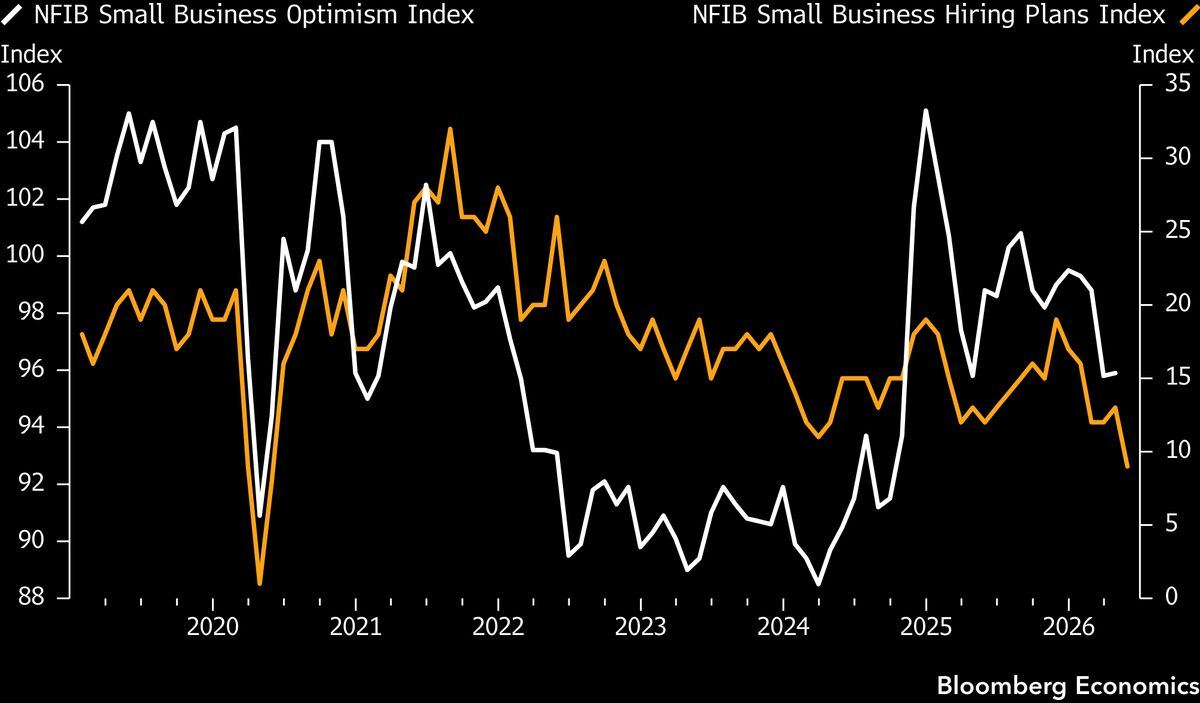
NFIB small business optimism likely fell to 94.0 in May from 95.9. Hiring plans dropped to the weakest in six years, with the net 9% of owners planning to create new jobs over the next three months down from 13%. Mentions of labour costs at a record high. The small-business soft data sits against the blowout NFP headline — the divergence is the read into how concentrated the labour-market strength actually is. Source: Bloomberg Economics.
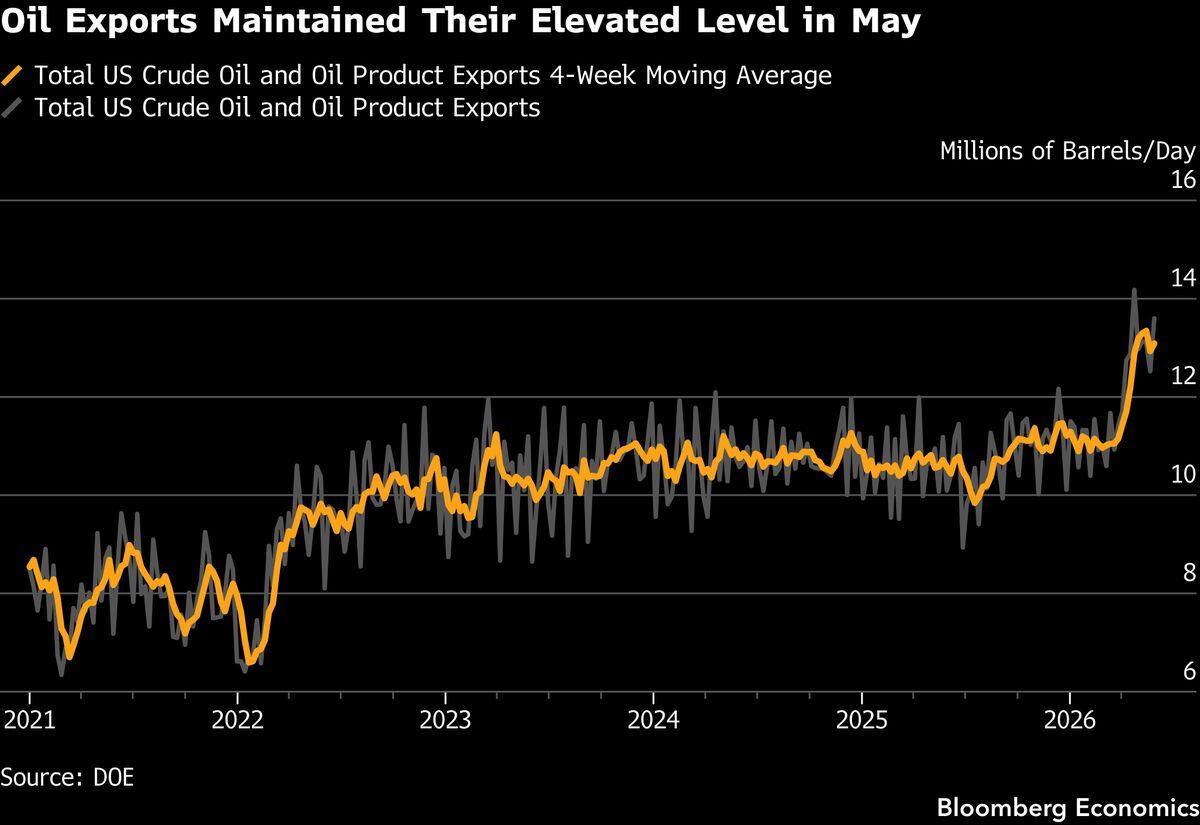
US trade balance likely narrowed to -$55.4B in April. Goods exports rose across most product categories. Capital-goods imports likely rose 5.6% from 1.8% prior, led by computer and semiconductor imports. Crude oil and oil-product exports moved to 13.2 million barrels per day on the four-week average. The trade-data confirmation of strong external demand and the AI-capex import surge that fuels the credit-weekly story. Source: Bloomberg Economics.
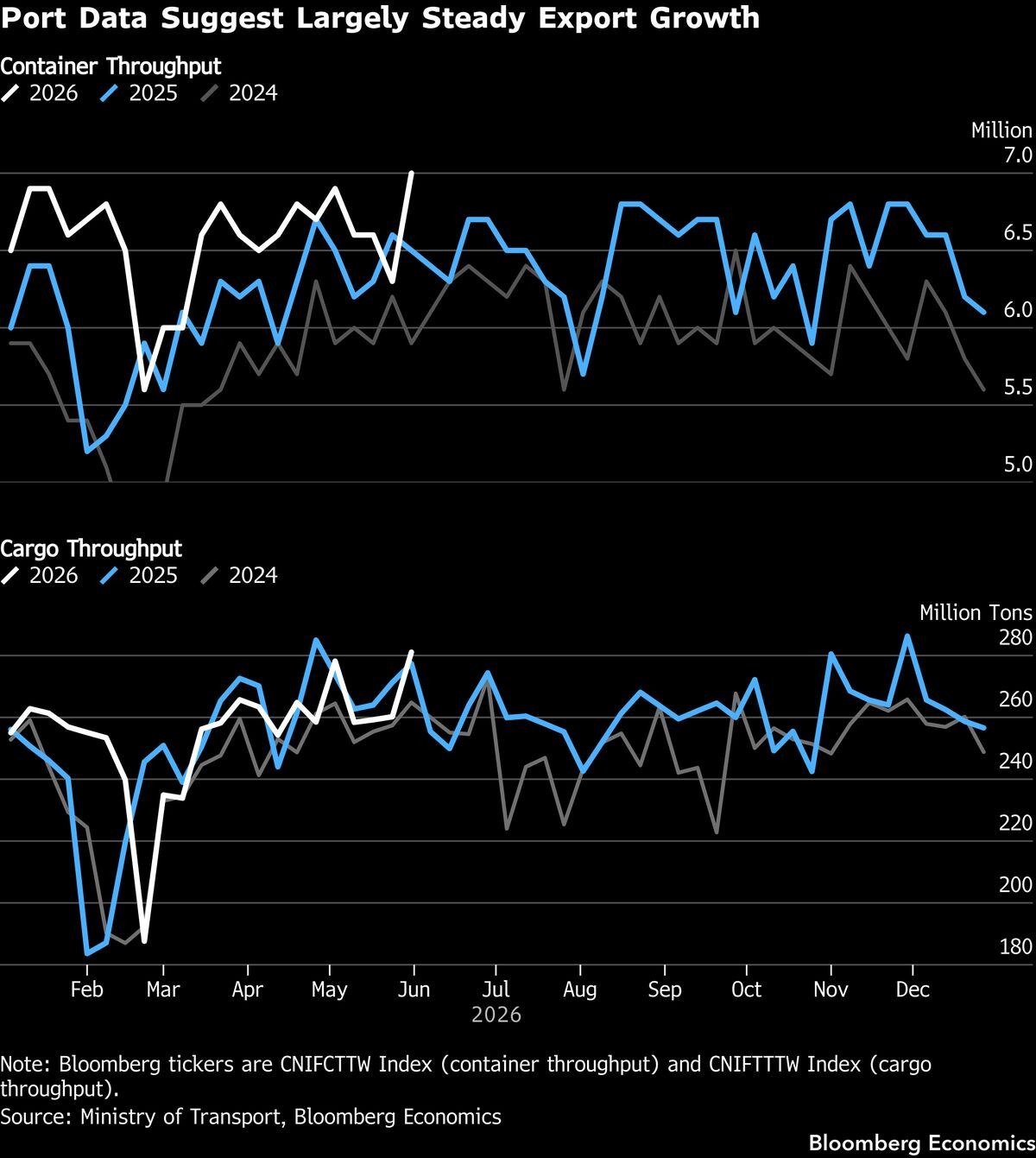
China imports likely surged 32.7% in May, lifted by AI hardware demand, war-driven commodity prices and favorable base effects. Exports +15.2%. The trade surplus narrowed to $81.1B from $84.8B. China is the marginal AI buyer even as the credit pulse tightens — the bifurcation between the export-tech complex and the domestic credit story is the deeper read. Source: Bloomberg Economics.
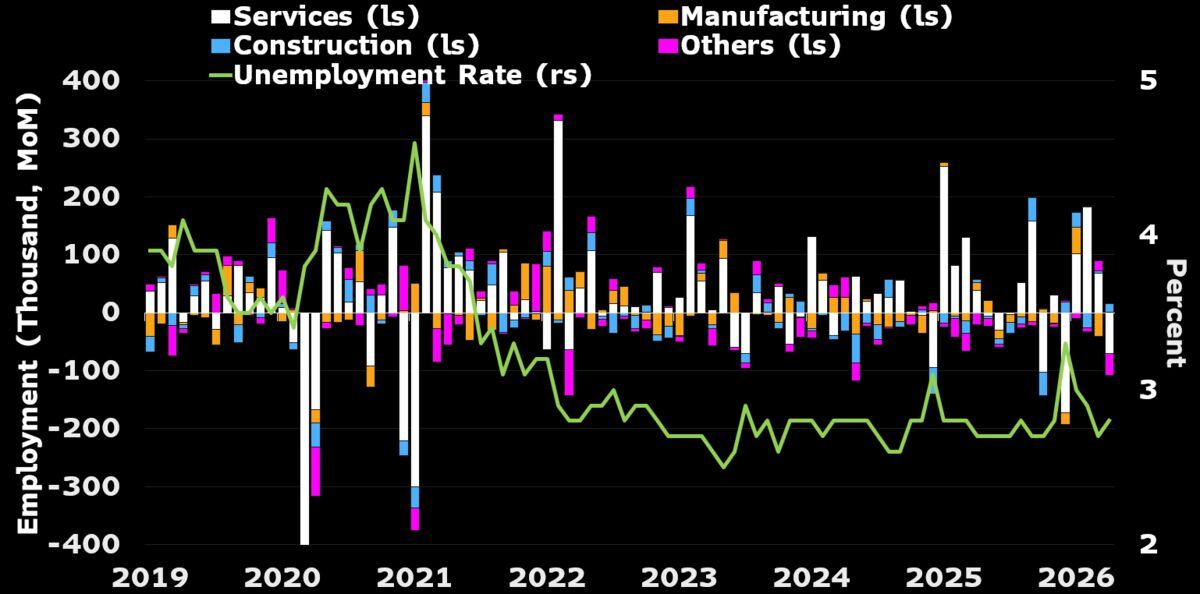
South Korea unemployment held steady at 2.8% in May. Employment rose by 20,000 after a 171,000 drop the prior month. Hiring in health and social welfare firm. Construction under pressure. The Korean labour market remains resilient despite the Iran-war uncertainty — the supply-chain bottleneck winner if AI hardware demand stays. Source: Bloomberg Economics.
Watershed Wednesday
The CPI day. US May CPI at 8:30 New York, BoC hold at 9:45 Toronto, China CPI/PPI in the morning Asia. Oracle Q4 after the New York close. ECB Governing Council opens Frankfurt. Bloomberg Invest Hong Kong. The Beige Book equivalent for the inflation tape and the AI tape on the same day.
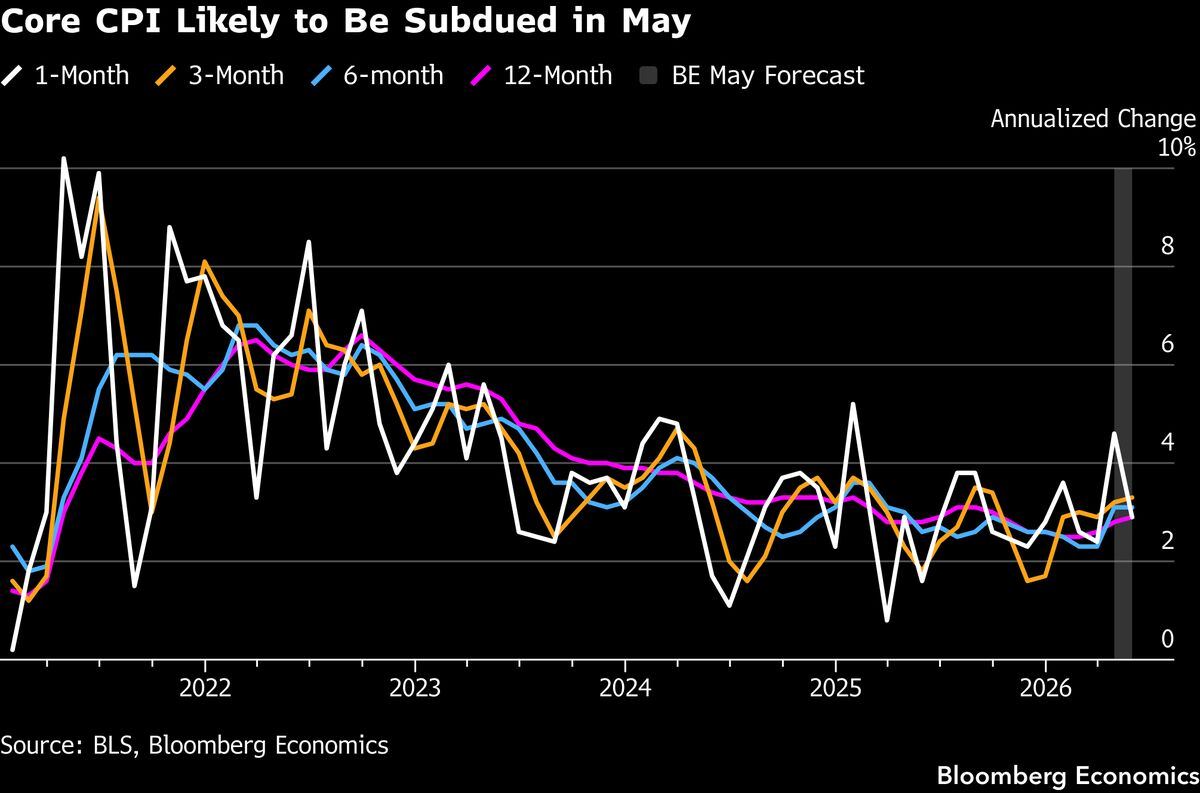
The marquee. US May CPI expected at 0.4% headline, 0.2% core, year-on-year 4.1% headline (the peak of the Iran-war inflation wave per BE) and 2.9% core. Annualized, the monthly core pace is mostly in line with the Fed's 2% target. Recreation-service prices in deflation as consumers turn cautious. The split between cost-push input inflation and pricing-power-deficient consumer inflation is the test of whether the inflation wave is transitory. Source: Bloomberg Economics.
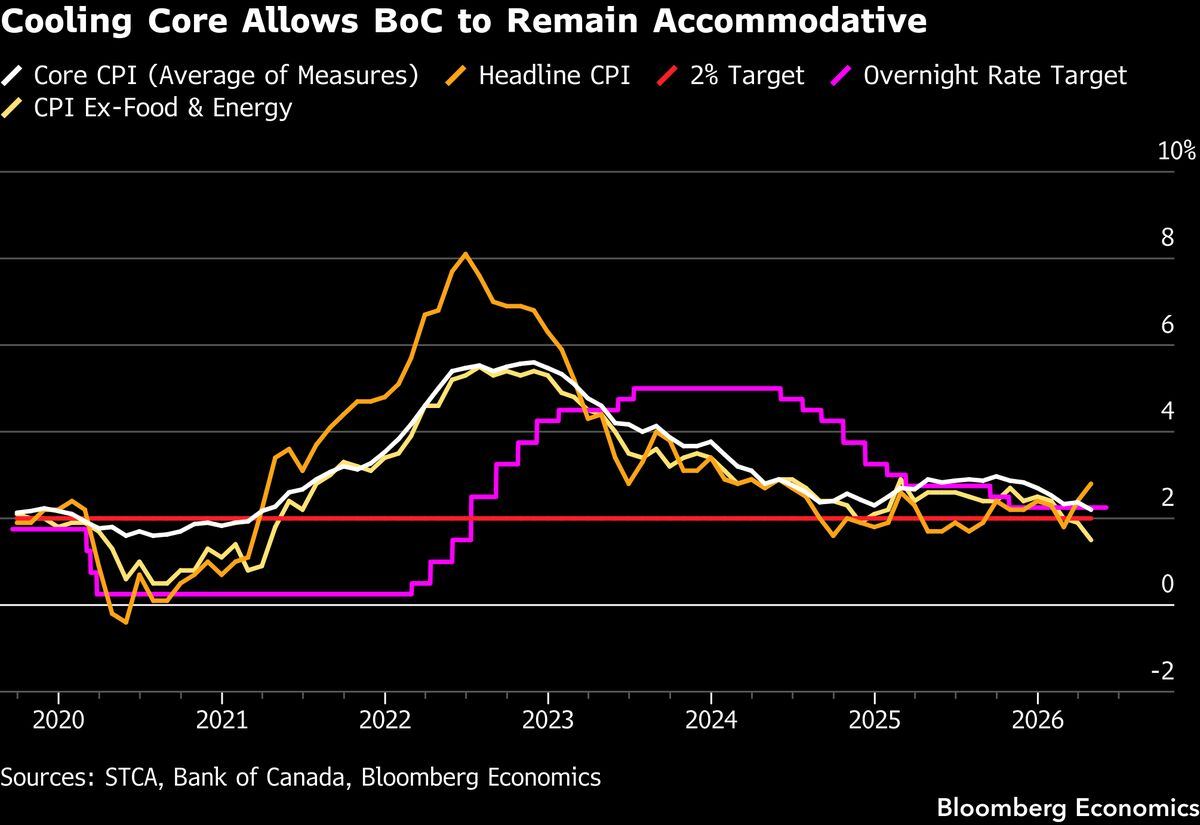
Bank of Canada to hold at 2.25% Wednesday. Inflation diffusion has narrowed, core has cooled, the economy is in technical recession (Q1 -0.1% annualized, second consecutive contraction). Macklem will dedicate to the 2% target but say pressures are contained. BE sees a hike close to year-end as Iran war and US trade-war outlooks become clearer. Friday's 154k Canadian jobs print, the most since Feb 2022, complicates the dovish framing. Source: Bloomberg Economics.
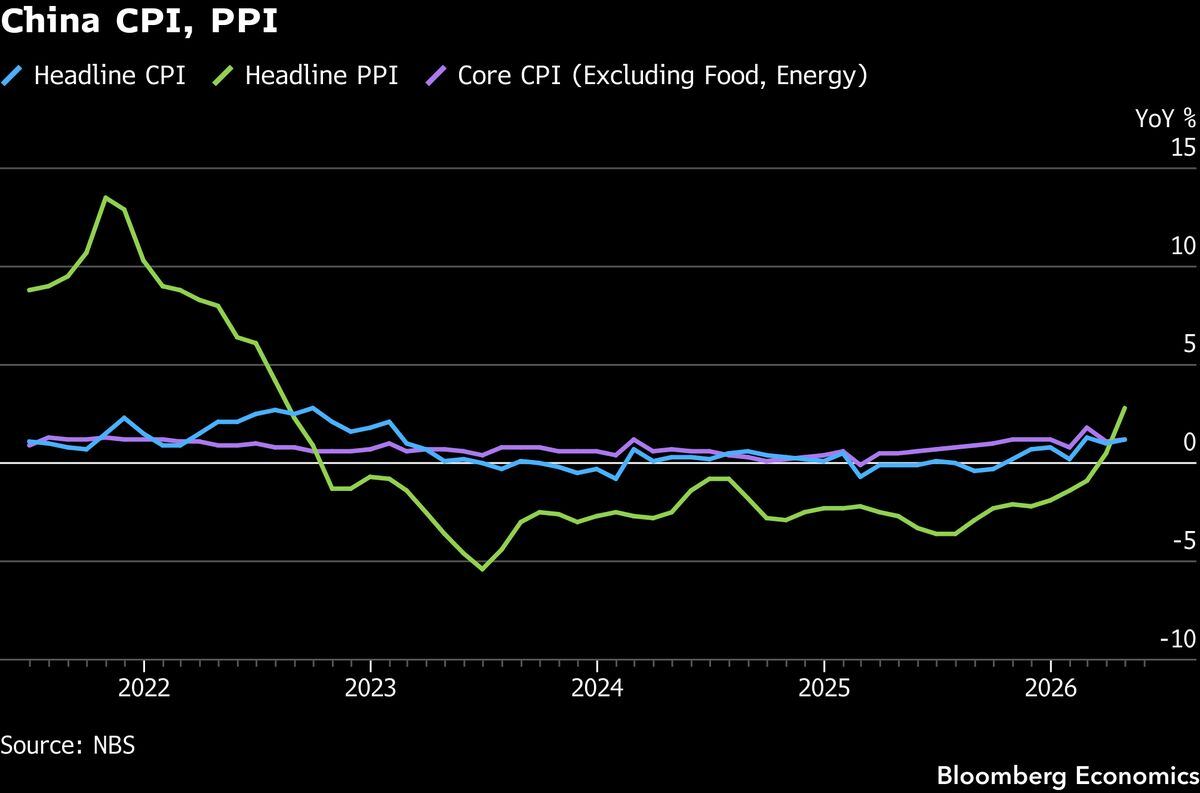
China CPI eased to 1.1% YoY in May from 1.2%, PPI accelerated to 3.6% from 2.8%, the highest since July 2022. The energy shock plus AI-hardware demand pushed factory-gate prices above 3% for the first time in nearly three years. The GDP deflator continues to climb out of deflation. The split between subdued CPI and reaccelerating PPI is the read on margin pressure for Chinese manufacturers. Source: Bloomberg Economics.
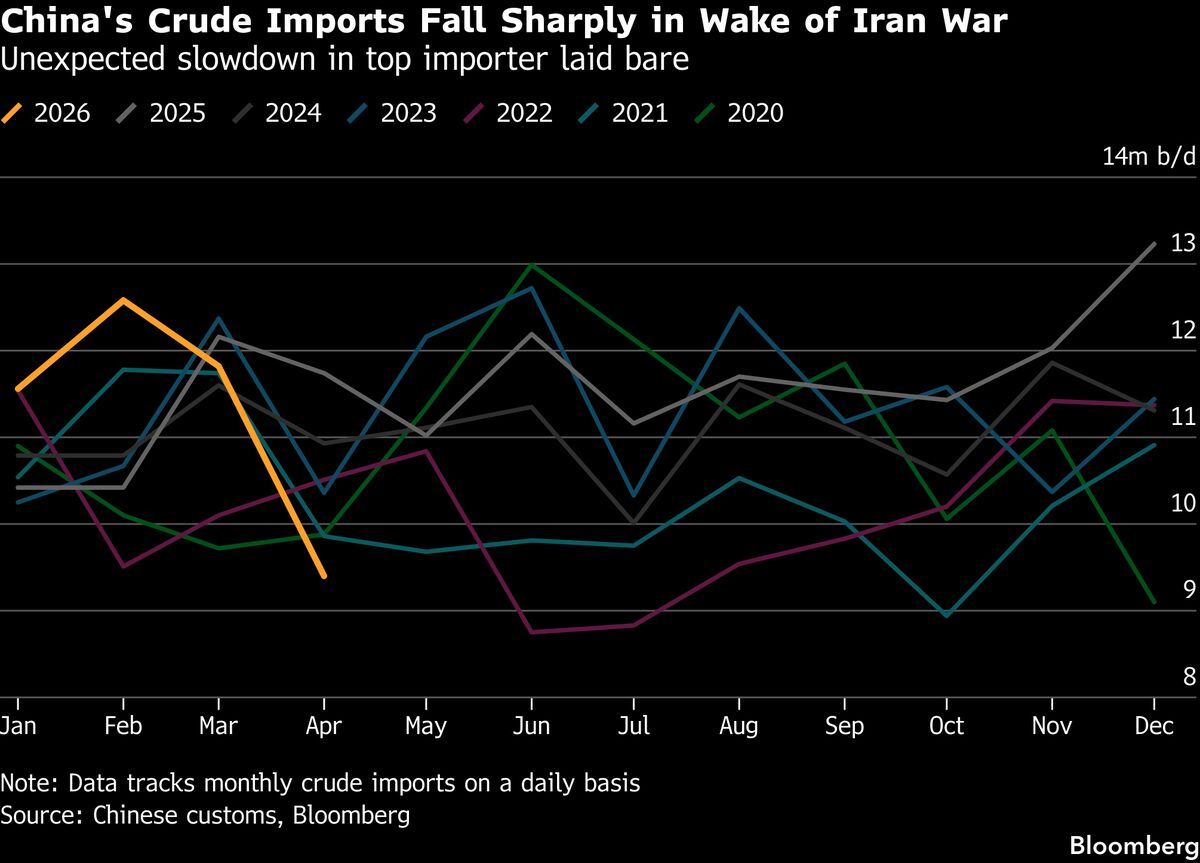
China refinery throughput collapsed to around 13 million barrels per day, the lowest since the early-pandemic 2020 run rate, down from 14.8M last year. China's pivot toward producing chemicals from coal instead of oil, and EV-driven domestic gasoline curbing, is helping to cap global oil prices. "China's backing off from the crude market has played a crucial role in attempting to rebalance the global market," per ING. Source: Kpler / Energy Aspects.
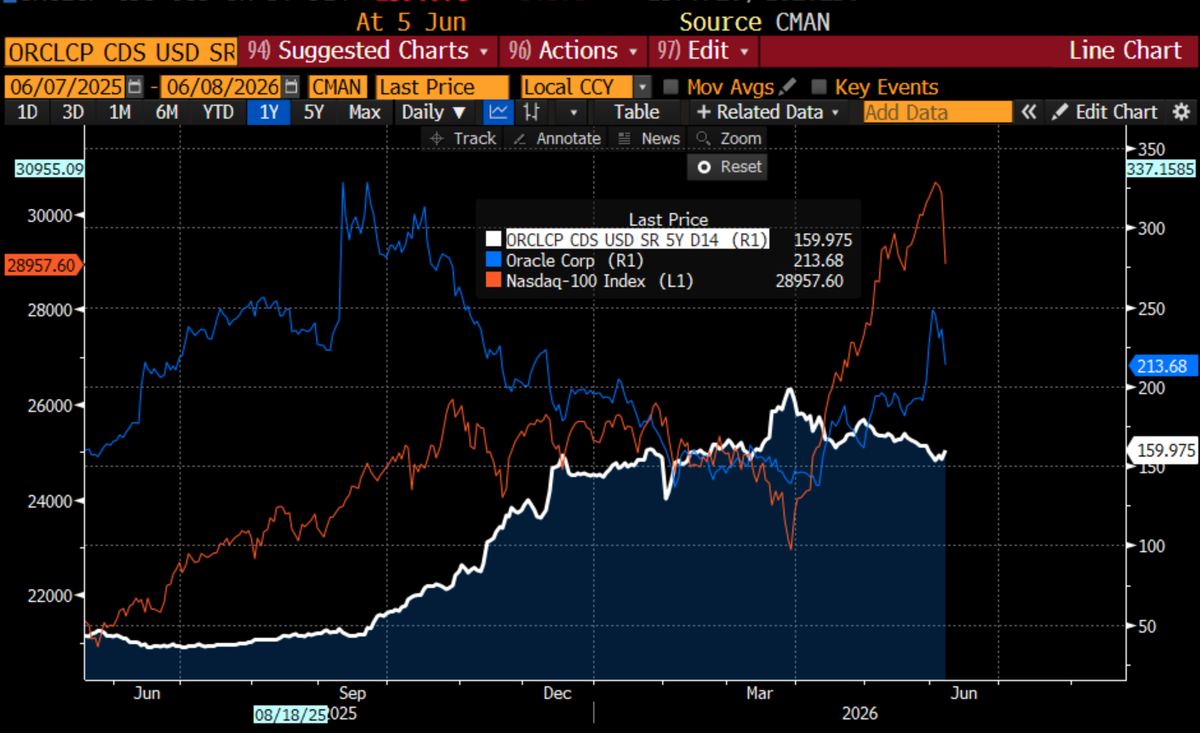
Oracle Q4 earnings Wednesday — the AI tape test. Expected EPS $1.96 (+15.4% YoY) on revenue $19.1B (+20.1%), capex +32.5% to $12B. Guidance the bigger read — Q1 expected $1.68 EPS / $19B / capex +60.8% to $13.7B. Options imply 11.3% move with downside bias. Stock at $236, +40% YTD. Above $250 opens $270. RSI near 70 flags overbought ahead of the test. Source: CMC Markets / Michael Kramer.
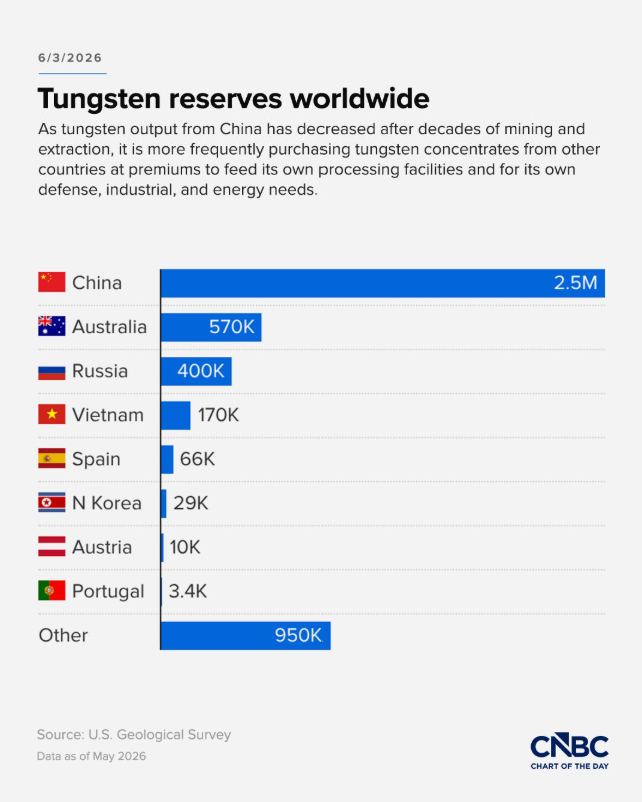
The Iran war's strategic-metals dimension. China controls 80% of the world's tungsten supply with exports tightly controlled since February 2025. US munitions depleted from Iran war + Ukraine shipments. The tungsten supply chain is the cleanest example of the rare-earth weaponization risk that sits underneath the headline oil story. The export-control loop is the trade no headline has fully priced. Source: USGS.
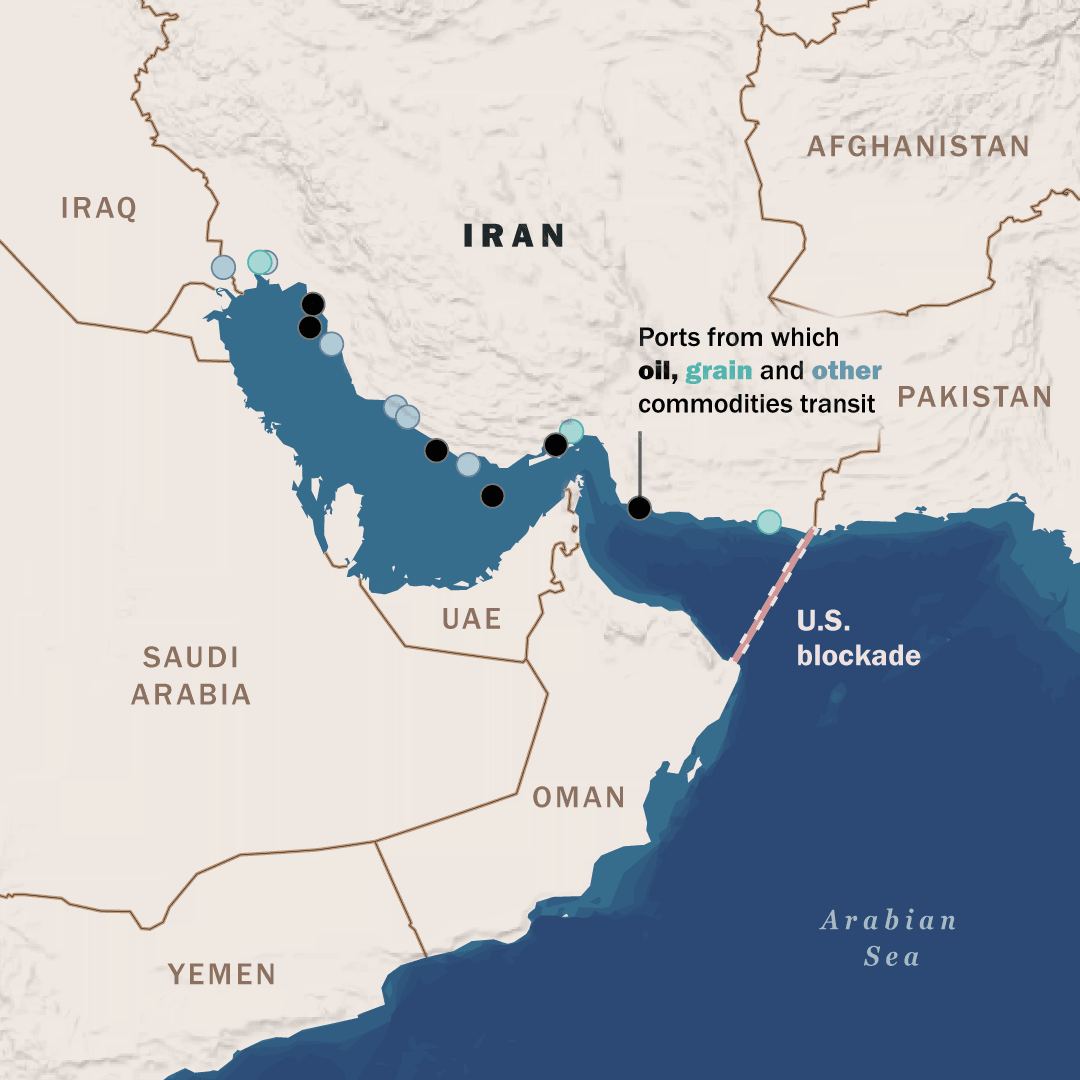
Beyond oil — Hormuz carries 1/3 of fertilizer trade, 1/5 of global natural gas, 1/3 of helium supplies, half of sulfur trade. International Crisis Group's interactive maps the cross-corridor dependencies and substitute paths. With the war past three months and Congress moving on the war powers vote, the supply-chain risk that lives downstream of the oil headline is still under-priced. Explore the full ICG interactive. Source: International Crisis Group.
TP Thursday
The ECB day. 25bp hike to 2.25 deposit rate, Lagarde presser. US PPI in parallel. World Cup opens Mexico vs South Africa. Take profit on Wednesday's structures, hold position into Friday. The CMC technicals on DAX and Oracle the read on whether the European hawkish dilemma plays through the equity tape.
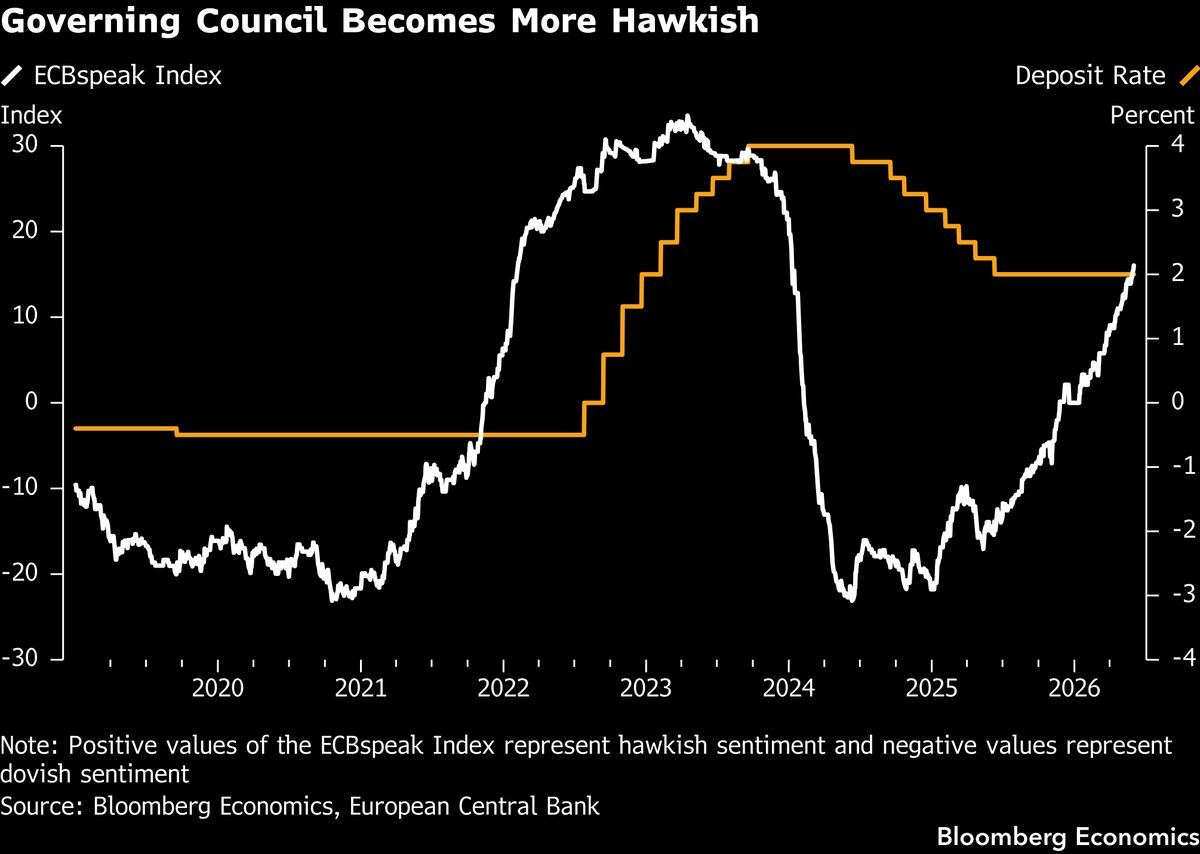
ECB to hike 25bp to 2.25% deposit rate Thursday. Lagarde expected to be clearer than in March that a second hike is in the pipeline. ECBspeak Index at a 2.5-year high. May core inflation accelerated to 2.5% (1-year high). Fresh staff projections likely show higher inflation and lower growth — the central bank's hawkish dilemma. BE baseline: hike in June, risks skewed to September follow-up. Action in July not ruled out. Source: Bloomberg Economics.
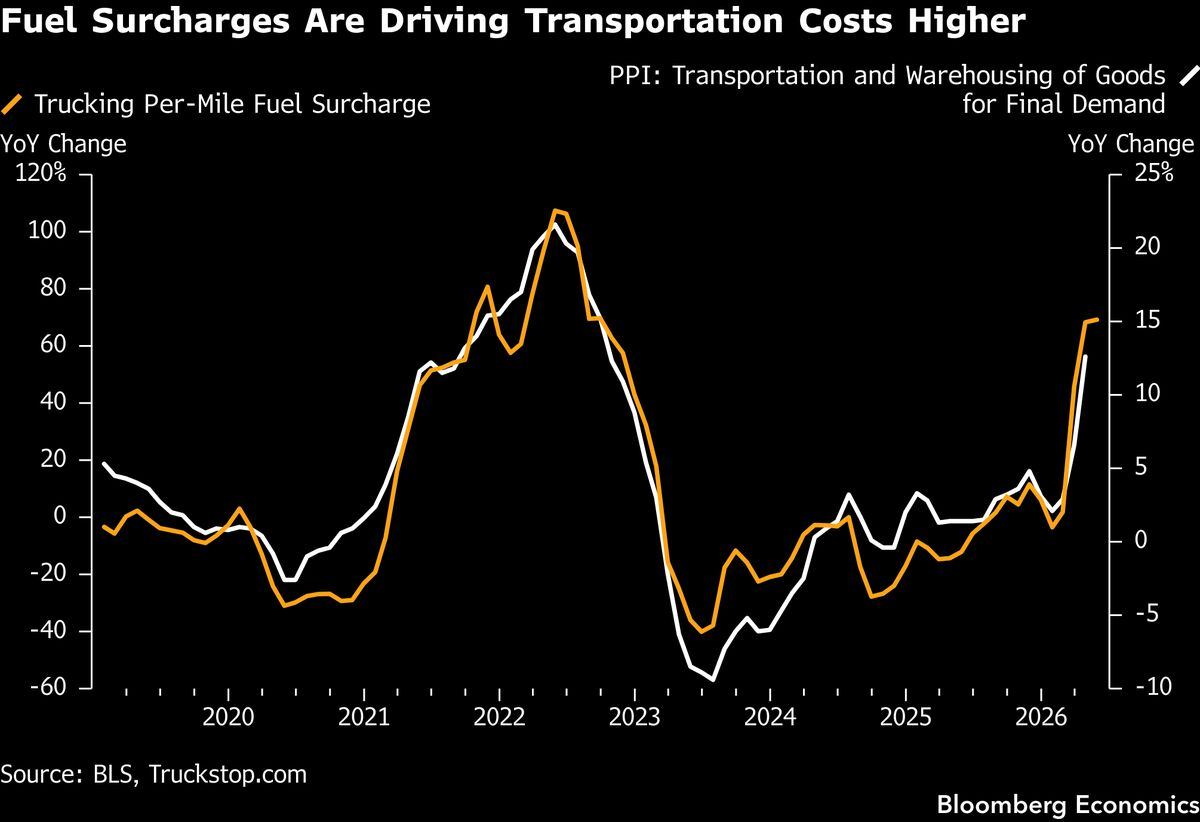
US May PPI likely +0.8% headline, +0.5% core, year-on-year 6.5% and 5.4%. Inflationary pressure building upstream from material and transportation costs. Fuel surcharges and trucking rates surging from higher diesel costs. Restraints on trucking capacity. PPI components that feed PCE contribute 8 basis points to May PCE inflation. Airfares brisker on jet fuel. Portfolio management fees rebound 3.1%. Source: Bloomberg Economics.
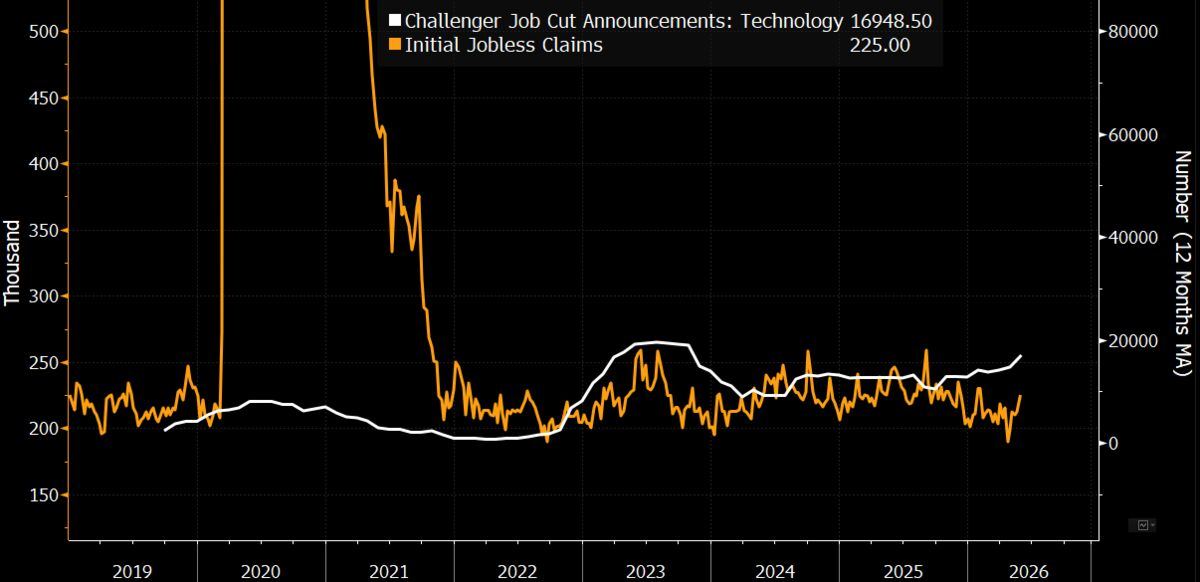
Initial jobless claims likely declined to 205k, tracking below year-ago for the 17th consecutive week. AI is increasingly driving targeted workforce reductions per Challenger data, but the headline claims figure remains contained. The rotation underneath — laid off coders moving to AI-adjacent roles, the bottom not showing in the aggregate yet. Source: Department of Labor / Challenger.
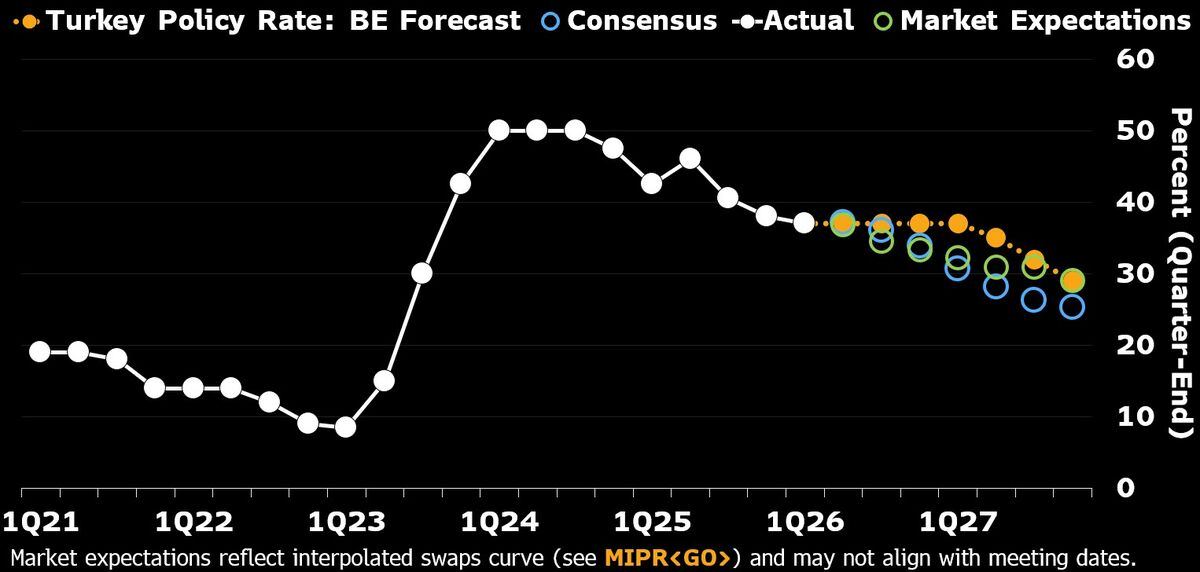
Turkey CBRT to hold the one-week repo rate at 37%, with the overnight lending rate at 40% the effective policy rate. Recent tightening of credit-growth caps delivers some of the tightening BE had previously priced. Baseline: unchanged through year end. Risks tilted toward stealth hike via wider gap between policy and lending if lira pressure intensifies. Source: Bloomberg Economics.
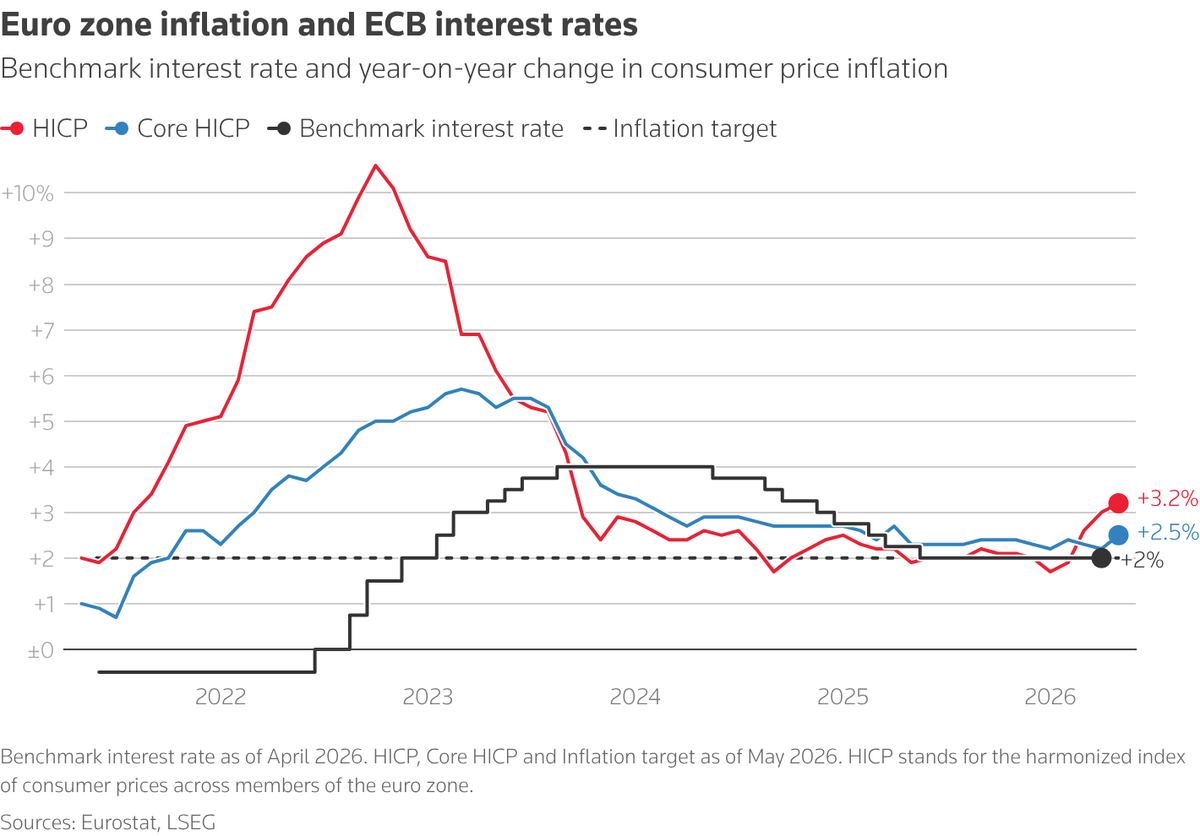
Eurozone inflation and ECB rates — the first major hike since the Iran war shock. Frankfurt's "insurance hike" framing per markets, signalling inflation won't get entrenched, not the start of a big cycle. Markets price two-to-three hikes this year, with September the most likely follow-up. The ECB walks the tightrope between hiking and exacerbating the growth hit already underway. Source: Reuters.
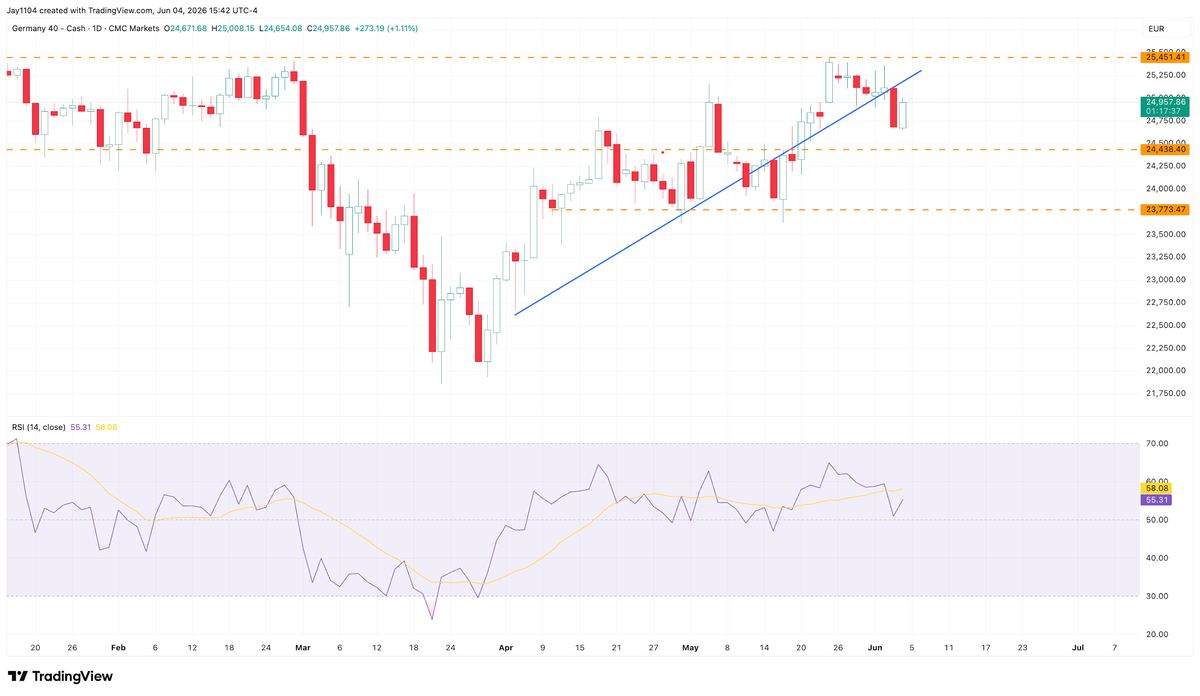
DAX under pressure into the ECB. Support 24,430, resistance 25,450. Below the short-term uptrend, RSI weakening. If 24,430 breaks, the next target is 23,750. The German index has underperformed peers, struggling to retake the Jan 13 record high of 25,508. The ECB hawkish dilemma plays out in the equity tape — hike or growth hit, but inflation forces the hand. Source: CMC Markets / Michael Kramer.
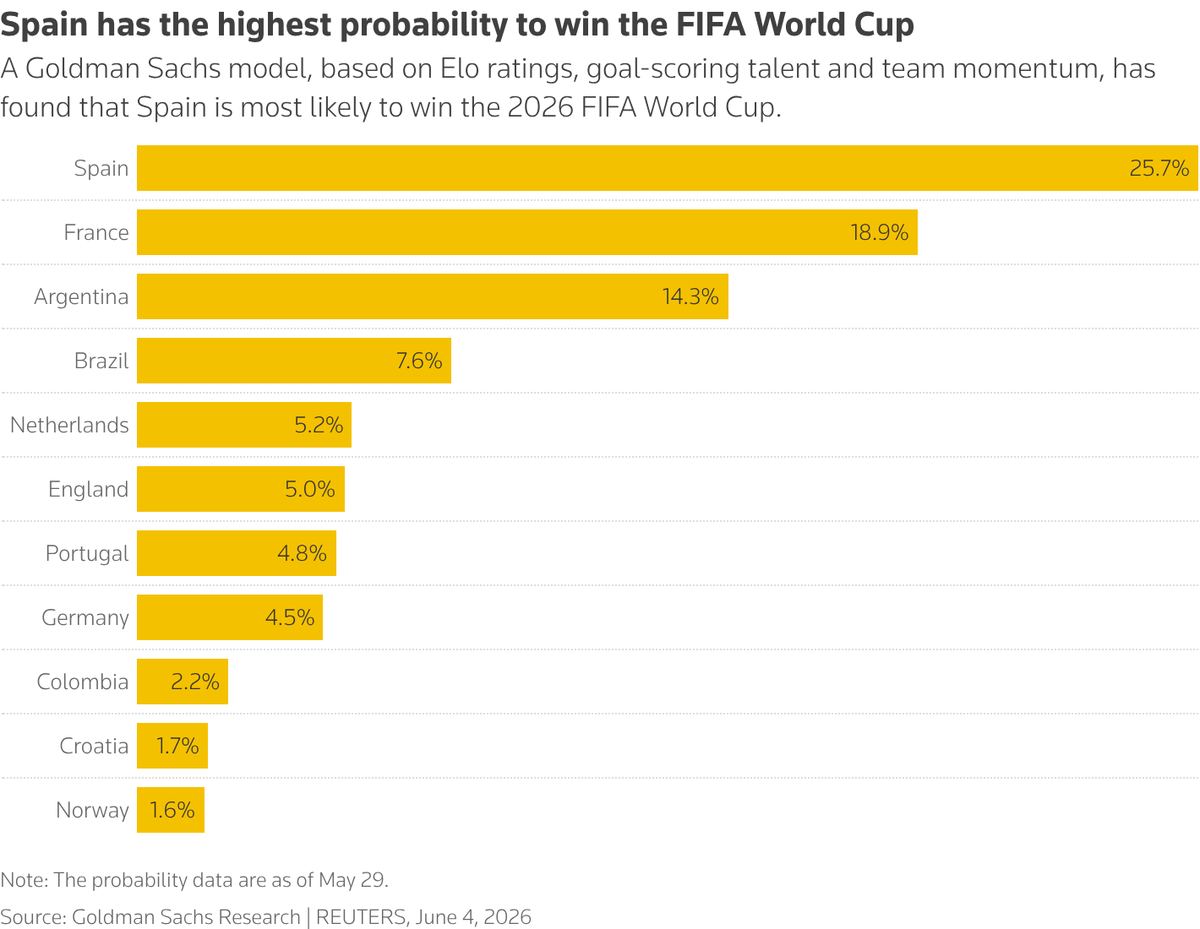
The 11 countries Goldman gives a probability of winning the World Cup. Spain leads at 26%, then France, Argentina and Brazil. Goldman's prediction model uses Elo ratings adapted from chess. The biggest sporting event of the year opens Thursday in Mexico, runs through July 19. Macro boost is short-lived per Reuters Take Five — growth tends to reshuffle rather than create new spending. Source: Reuters / Goldman Sachs.
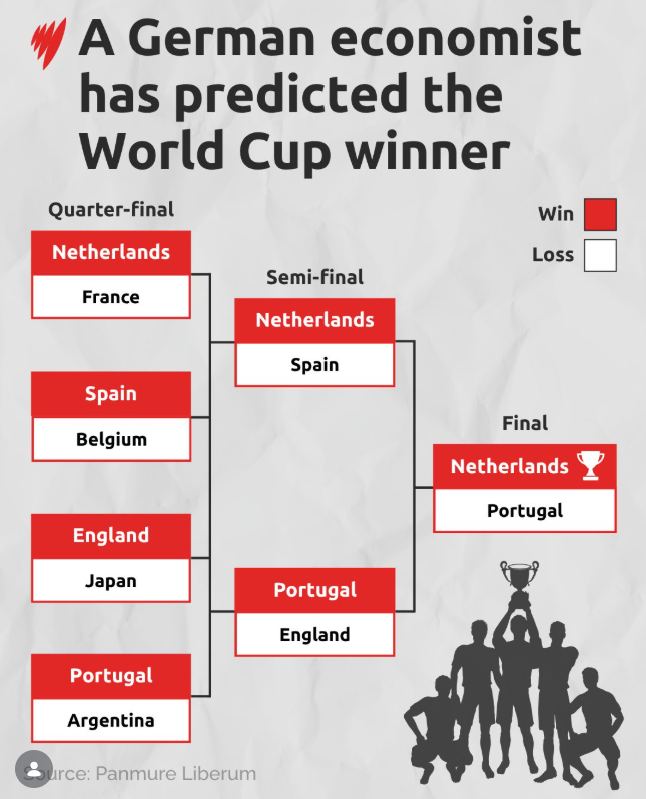
A formula that has predicted every World Cup winner since 2014. German economist Joachim Klement's model called Germany 2014, France 2018, Argentina 2022 — three for three. The 2026 pick: a relative underdog. The dispersion in the prediction set is the read on how the Iran-war geopolitical map could redraw — the model factors export-orientation and macro conditions. Read the SBS story for the underdog. Source: SBS News.
Friday Fade
SpaceX prints Friday. 75 billion raise at 1.8 trillion valuation. The largest IPO ever. UMich preliminary June bounce expected to 46.5 from the record-low 44.8. India CPI rising. UK monthly GDP stagnates. Eurozone CPI cluster. Carney-Macron in Paris ahead of G7. Powder dry for the absorption test.
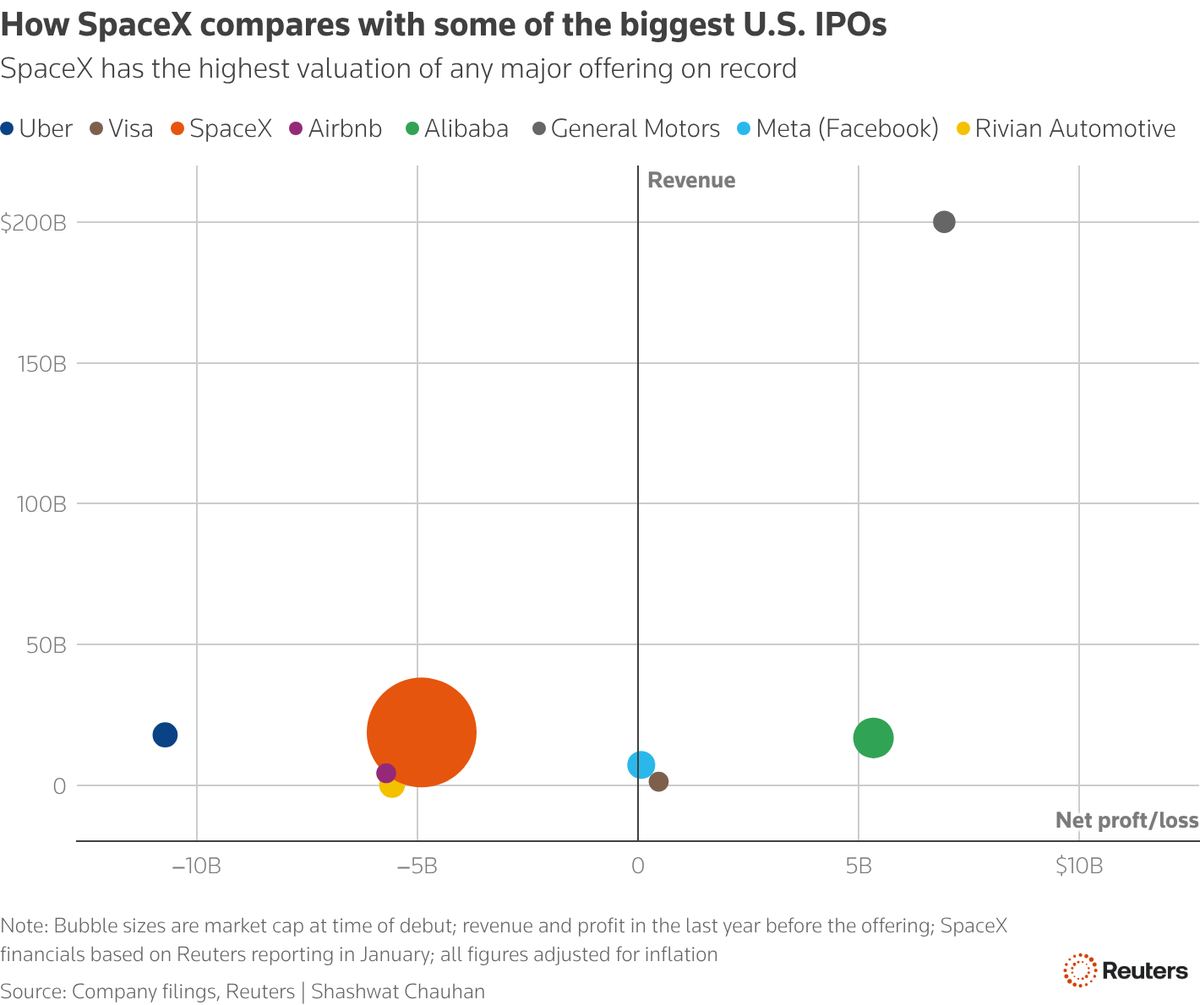
The biggest IPOs in US history — SpaceX joins the top of the list. The Nasdaq debut Friday is looking to raise a record-setting $75 billion at a $1.75 trillion valuation. The listing is expected to be followed by debuts from OpenAI and Anthropic (which confidentially filed June 1). The mega-IPO calendar coincides with the AI-tape correction that started Friday. The asymmetry of the long is gone; the question now is the absorption. Source: Reuters.
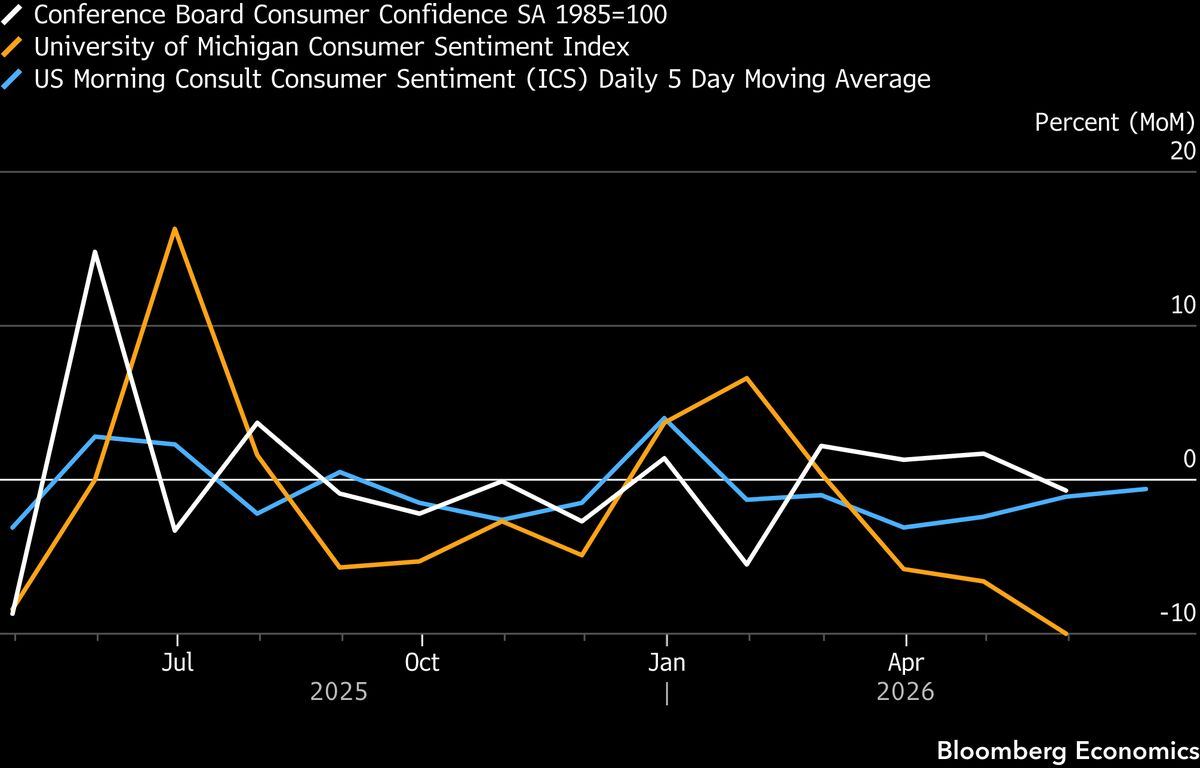
UMich consumer sentiment likely bounced to 46.5 in June from May's record-low 44.8 (-10% MoM). The divergence with Conference Board (-0.7%) and Morning Consult (-1.0%) suggests UMich overstated the deterioration. Beige Book points to consumers still spending, with activity diverging by income group. The top-end remains the consumer story even as middle-income sentiment cracks. Source: Bloomberg Economics.
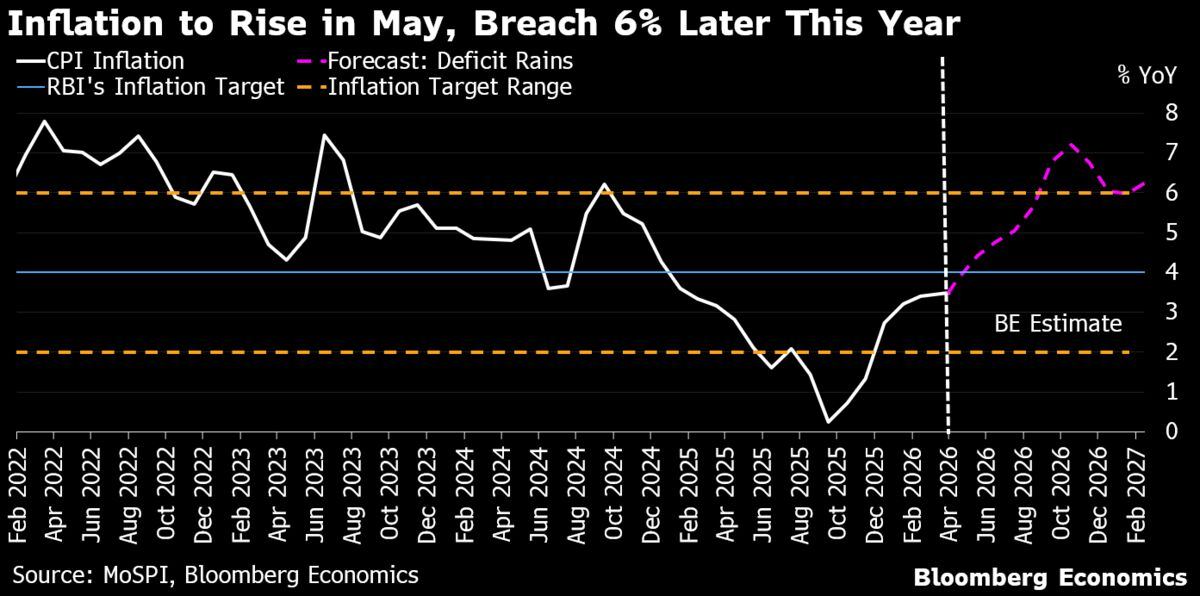
India CPI likely climbed to 3.9% YoY in May from 3.5%, still below the RBI's 4% target. Food inflation +4.4% from 4.0%. Energy inflation higher on auto fuel. Core +3.9% from 3.7% on second-round effects. RBI's hold won't last long — BE sees a 50bp hiking cycle in Q4 as high crude lifts pump prices and a potential El Niño hits farm output. RBI joins the central bank shift the rest of Asia has already made. Source: Bloomberg Economics.
VC+ Special Dispatch — Global Prosperity Beyond GDP
A seven-chart dispatch from the VC+ team. The global economy is on track for a record $126 trillion in 2026, but the size of the headline says surprisingly little about how it feels to live, work and earn inside any given country. The throughline: the biggest economy is rarely the one where people are best off. Credit to the VC+ team.
The $126 Trillion World Economy
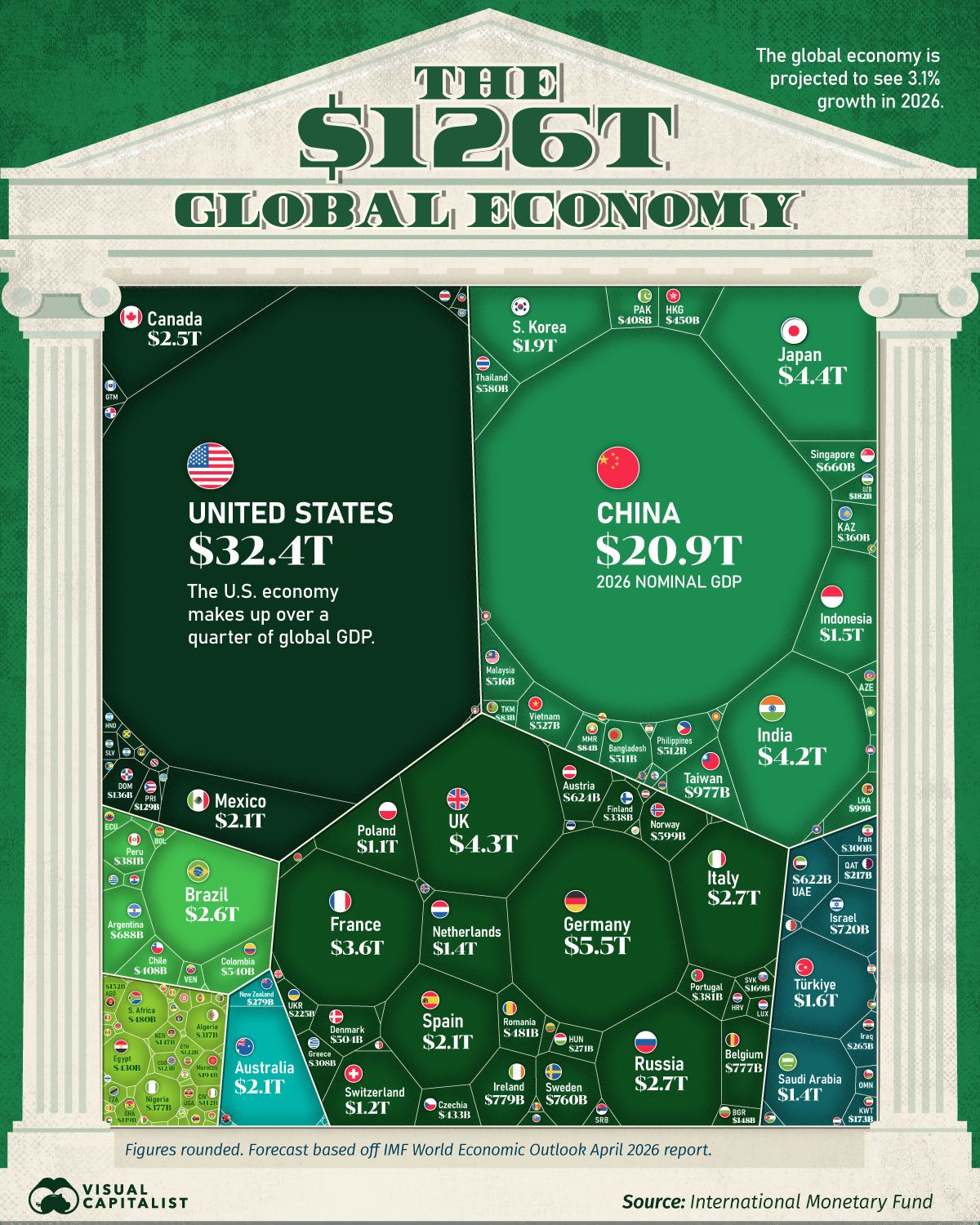
Global economy on track for $126 trillion in 2026, expanding 3.1%. The US ($32.4T) and China ($20.9T) make up over 40% of total output. India ($4.2T) on track to overtake to third place by end-decade. By purchasing power, China is already the world's largest economy. Headline GDP is only the starting line on what the rest of this dispatch goes through. Source: Visual Capitalist.
Where Workers Produce the Most
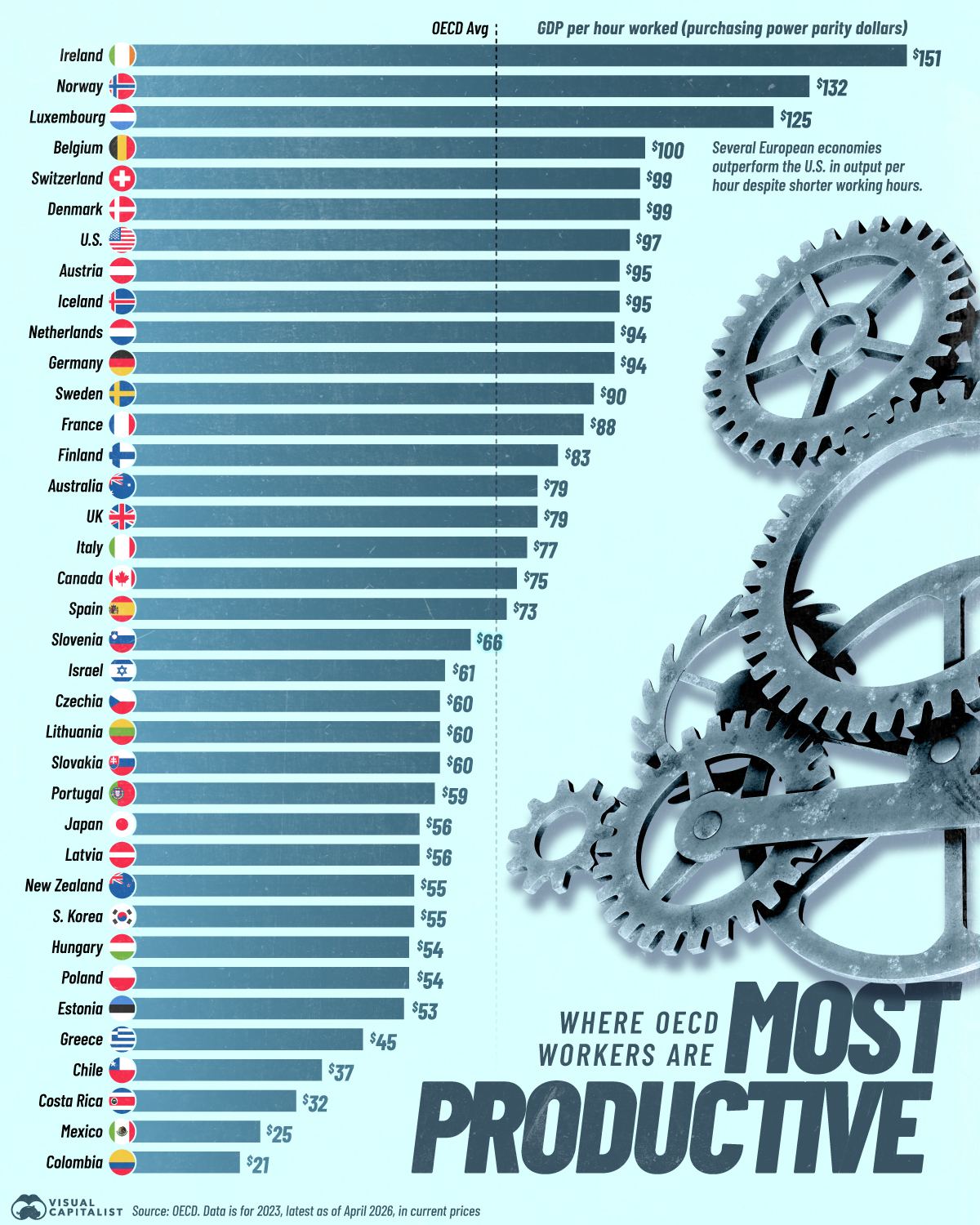
Where workers produce the most, GDP per hour worked. Ireland's $151 top spot is "leprechaun economics" — multinationals booking profits there for tax reasons. The real leaders are Norway, Luxembourg, Belgium. The US sits at $97. Several European economies top the US on output per hour while working far fewer hours each year. The productivity gap is the deeper story than the headline GDP. Source: Visual Capitalist.
Where Paychecks Stretch the Furthest
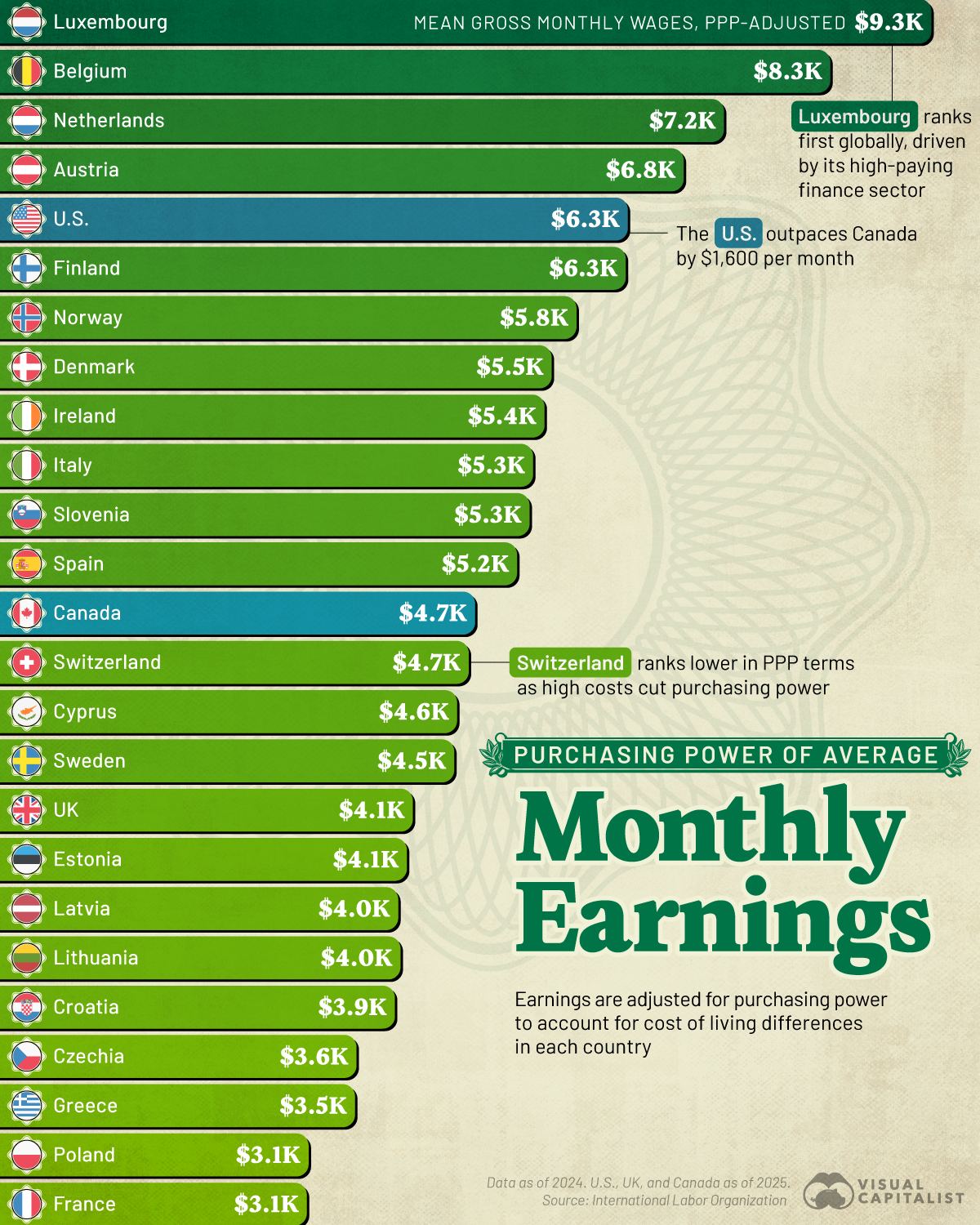
Where paychecks stretch the furthest. Average monthly earnings adjusted for purchasing power. Luxembourg leads at $9,300. The US ($6,300) sits comfortably in the top five, outpacing Canada by $1,600. Switzerland slips well down the list once living costs are factored in. Europe's heavier income taxes narrow the gross-to-net gap. Source: Visual Capitalist.
The Real Price of Everyday Life
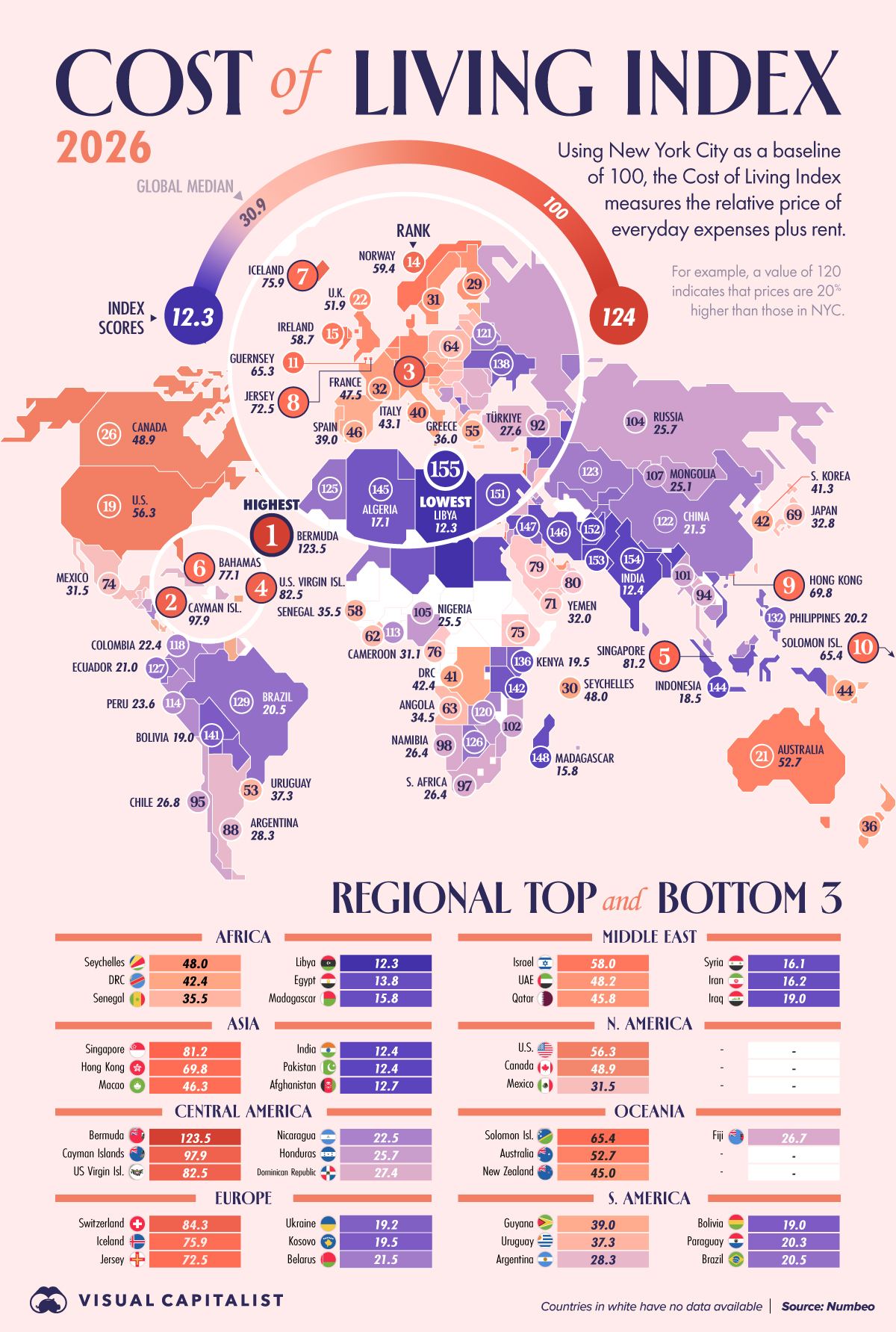
The cost of living index benchmarked to New York City at 100. Numbeo's measure puts most of the world dramatically cheaper than US and Western Europe, global median at 30.9. Switzerland and Bermuda edge out NYC at the extreme. For globally mobile workers, the gap between where you earn and where you spend is where real prosperity is won or lost. Source: Visual Capitalist.
When Wealth Doesn’t Buy Happiness
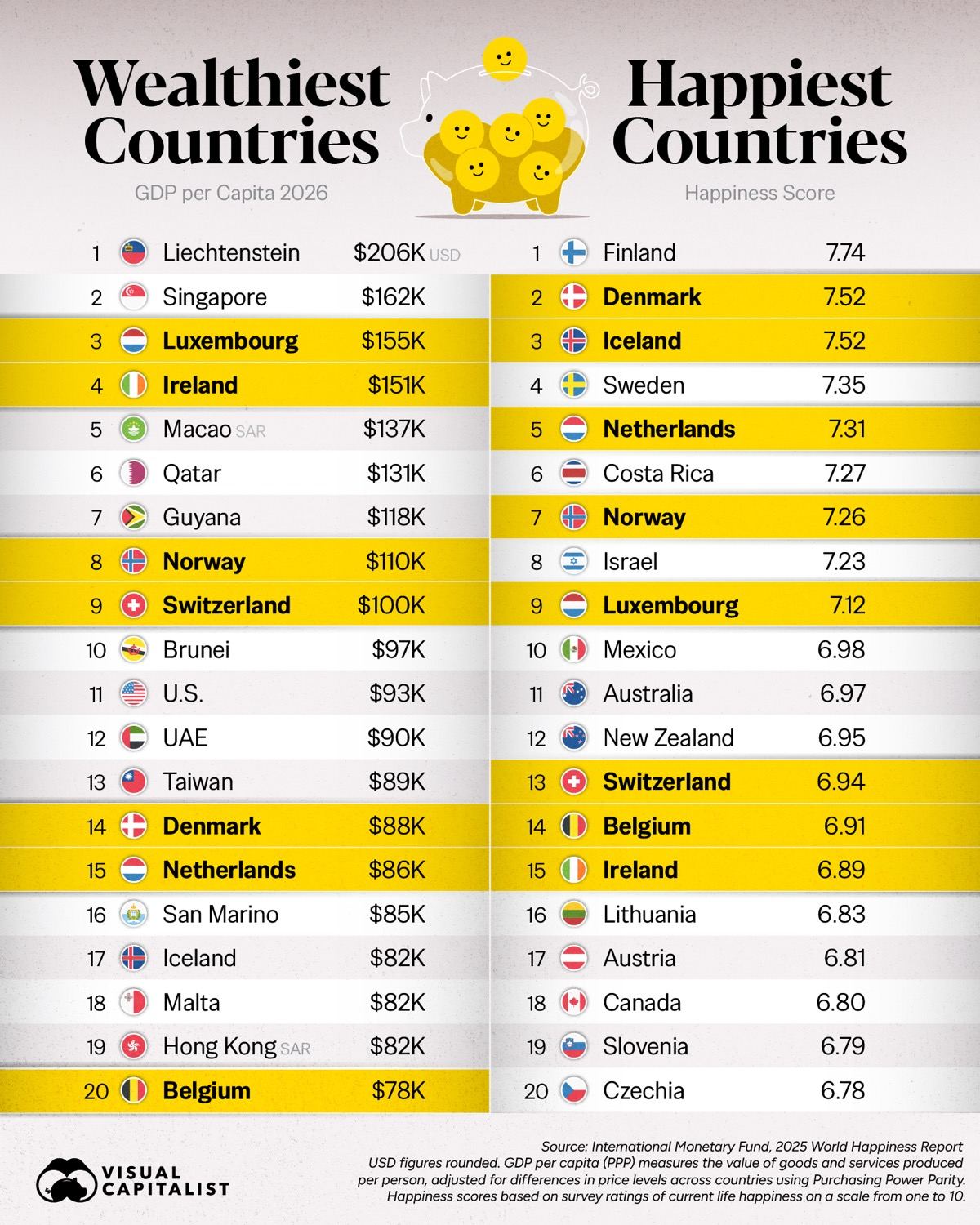
When wealth doesn't buy happiness. Singapore and Qatar don't crack the top 20 for happiness despite the income. Finland tops the World Happiness Report for the eighth straight year. Costa Rica lands sixth-happiest with far lower incomes than the Nordics. Once a country clears a basic income threshold, additional wealth does surprisingly little to lift overall happiness. Source: Visual Capitalist.
Which Countries Have More or Less Freedom
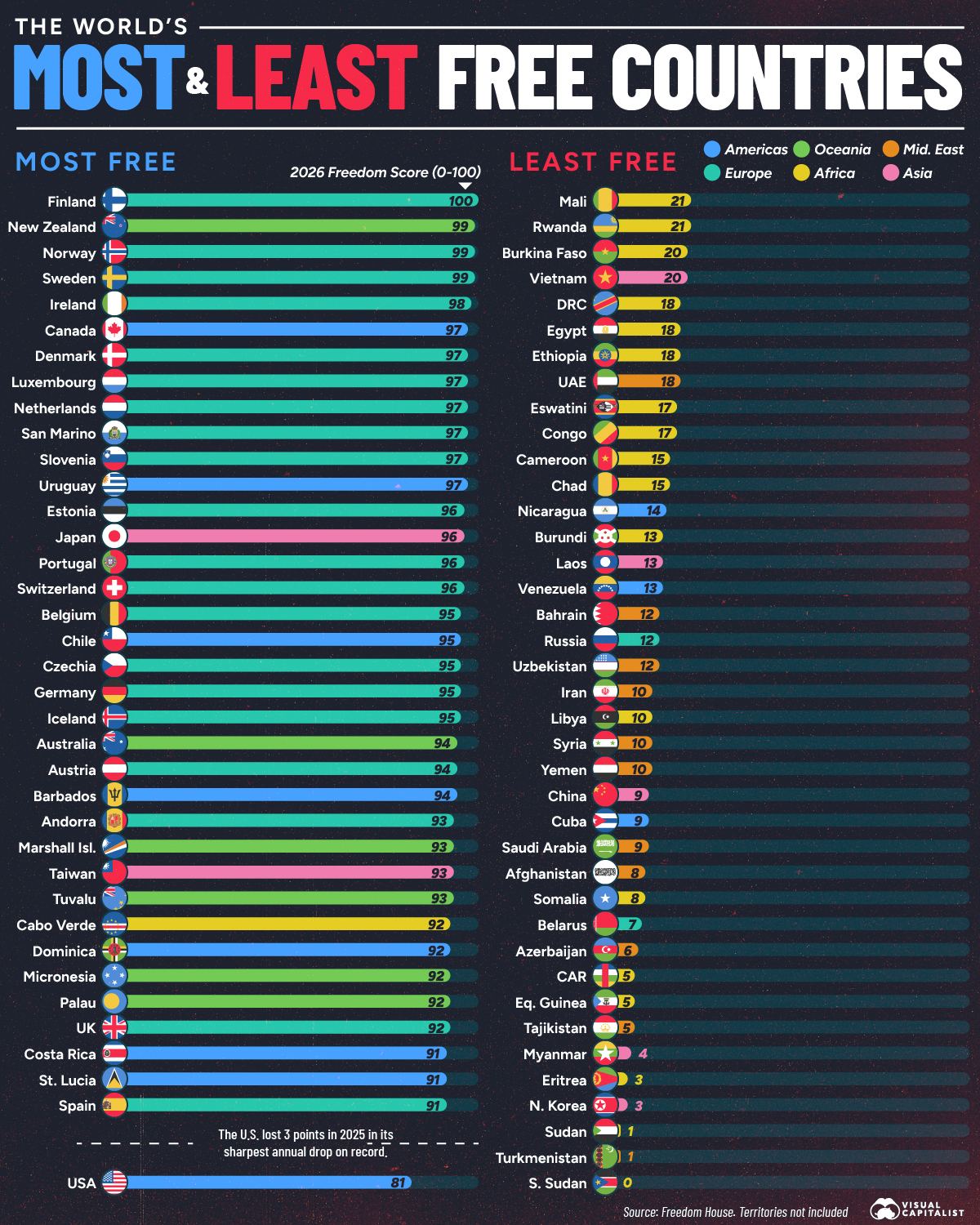
Freedom House annual index, the political-rights and civil-liberties scores. The US lost 3 points in 2026, its sharpest single-year decline on record. Now well behind Finland, New Zealand, Norway. Freedom House has logged nearly two decades of consecutive global decline. The free world clusters in Europe, Americas, Oceania; the least free in parts of Africa, Middle East, Asia. Source: Visual Capitalist.
Prosperity Is More Than GDP
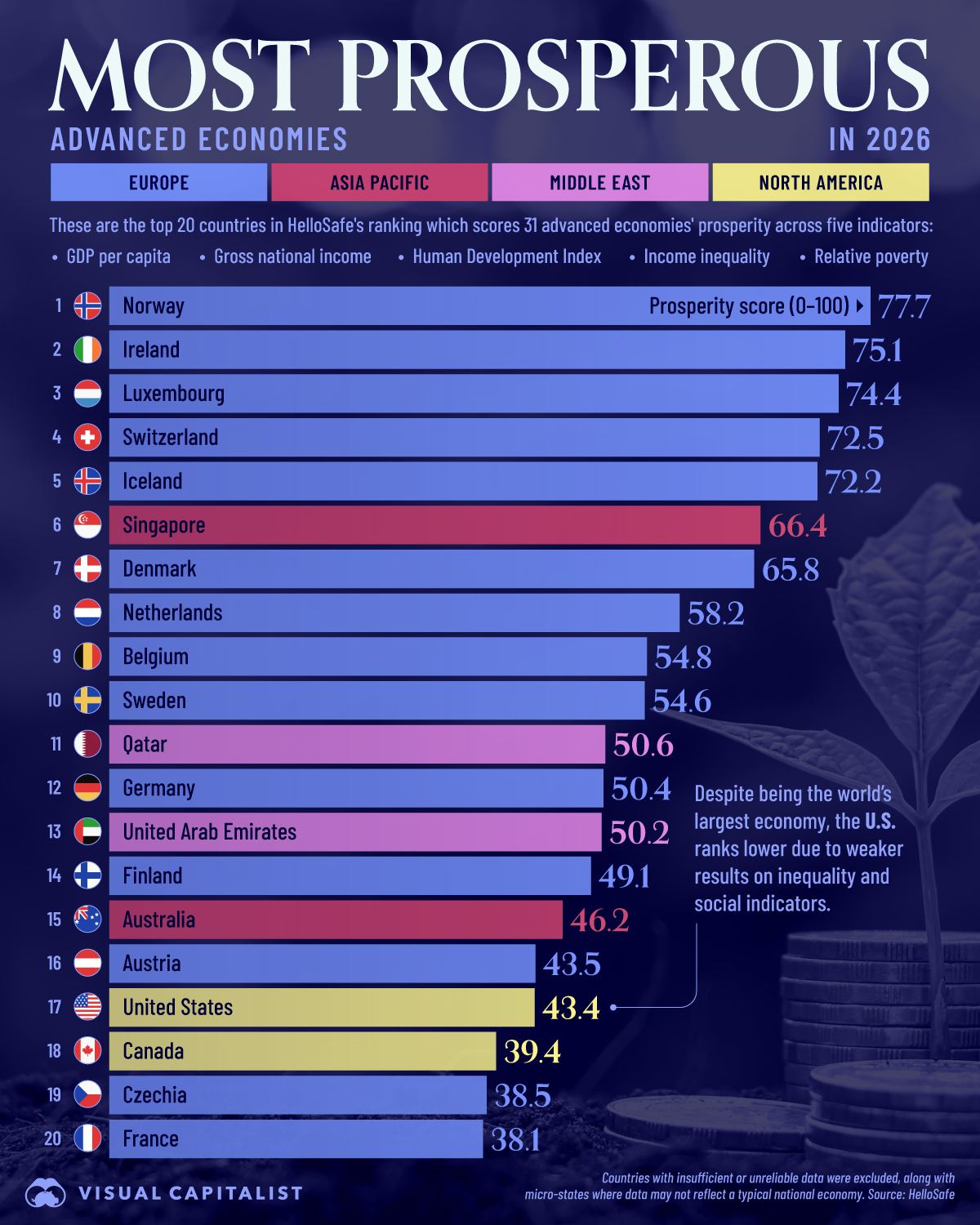
Prosperity is more than GDP — Norway tops the list at 77.7. HelloSafe ranks 31 advanced economies on five measures: GDP per capita, gross national income, HDI, income inequality, relative poverty. The US ranks 17th — the world's largest economy by a wide margin dragged down by inequality and social indicators. Norway, Ireland, Luxembourg the top three. Source: Visual Capitalist.
The Good Wrap
What is left at the close. Martin Wolf on AI as boon, bane or bubble. Anthropic on recursive self-improvement and the 8x code-per-engineer chart. Leopold opens $8.45B of puts against the AI consensus. The PitchBook fallen-unicorn picture ahead of SpaceX. Nasdaq -5% Friday. The top-10% spending share that now anchors US GDP. The MAGA-tax framing the Economist is putting on the household-level cost transmission. Closing on Korean BBQ ritual, wine oak, and the Al Jazeera virtual stadium guide for the World Cup that opens Thursday.
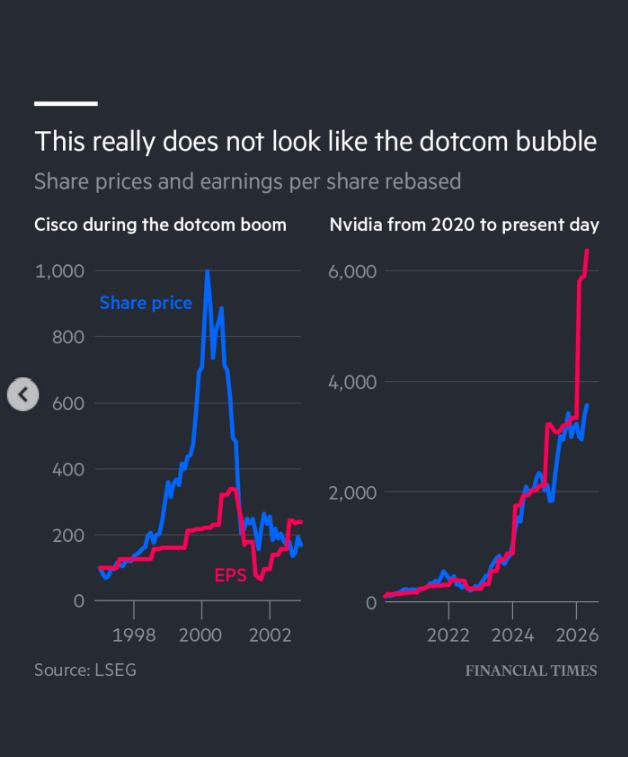
The AI bubble question. Martin Wolf's three charts on AI investment, productivity gains, and labour displacement. The IT investment cycle now exceeds the dotcom peak as a share of GDP. The productivity boost remains concentrated in tech and white-collar process-automation. The labour displacement story is starting to register in the entry-level cohort but not yet in aggregate claims. Wolf's framing: boon, bane, or bubble — the question that defines this decade. Source: Financial Times / Martin Wolf.
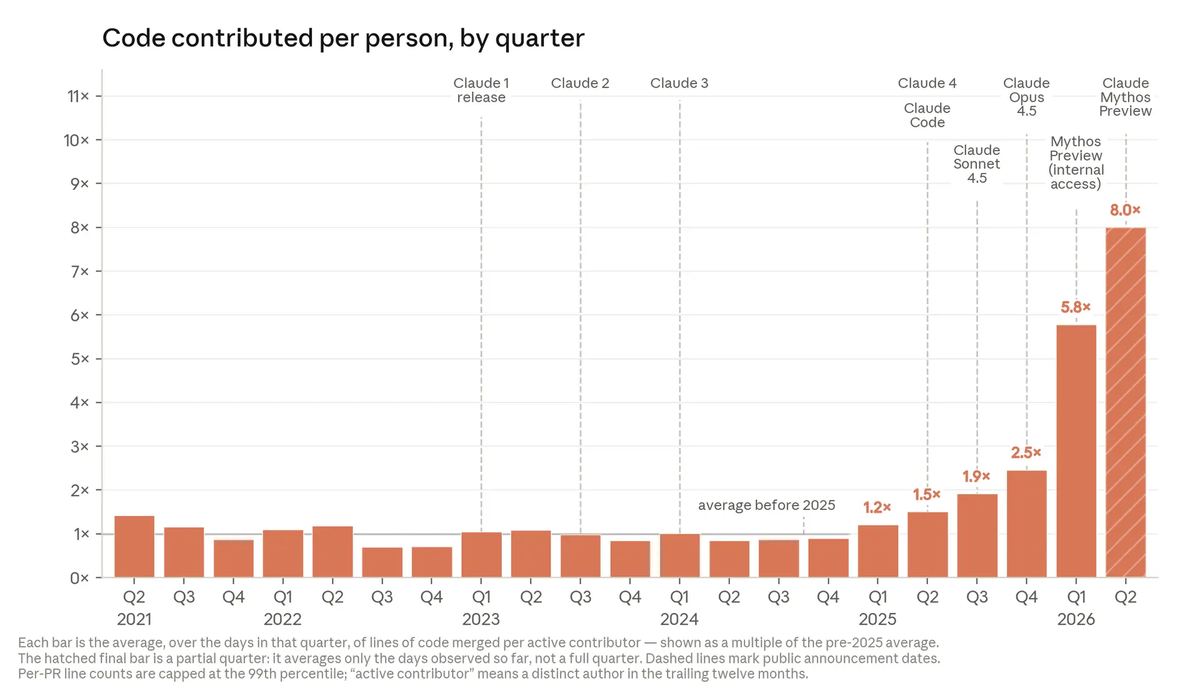
Anthropic on recursive self-improvement. A growing share of AI development is being delegated to AI systems themselves. Today, Anthropic engineers ship 8x as much code per quarter as in 2021-2025. Coding tasks that took 4 minutes in March 2024 took 12 hours by May 2026 — task duration doubling every four months. The full piece: Anthropic Institute on recursive self-improvement. Possible futures include the trend stalling, compounding efficiency gains, or full RSI. Source: Anthropic Institute.
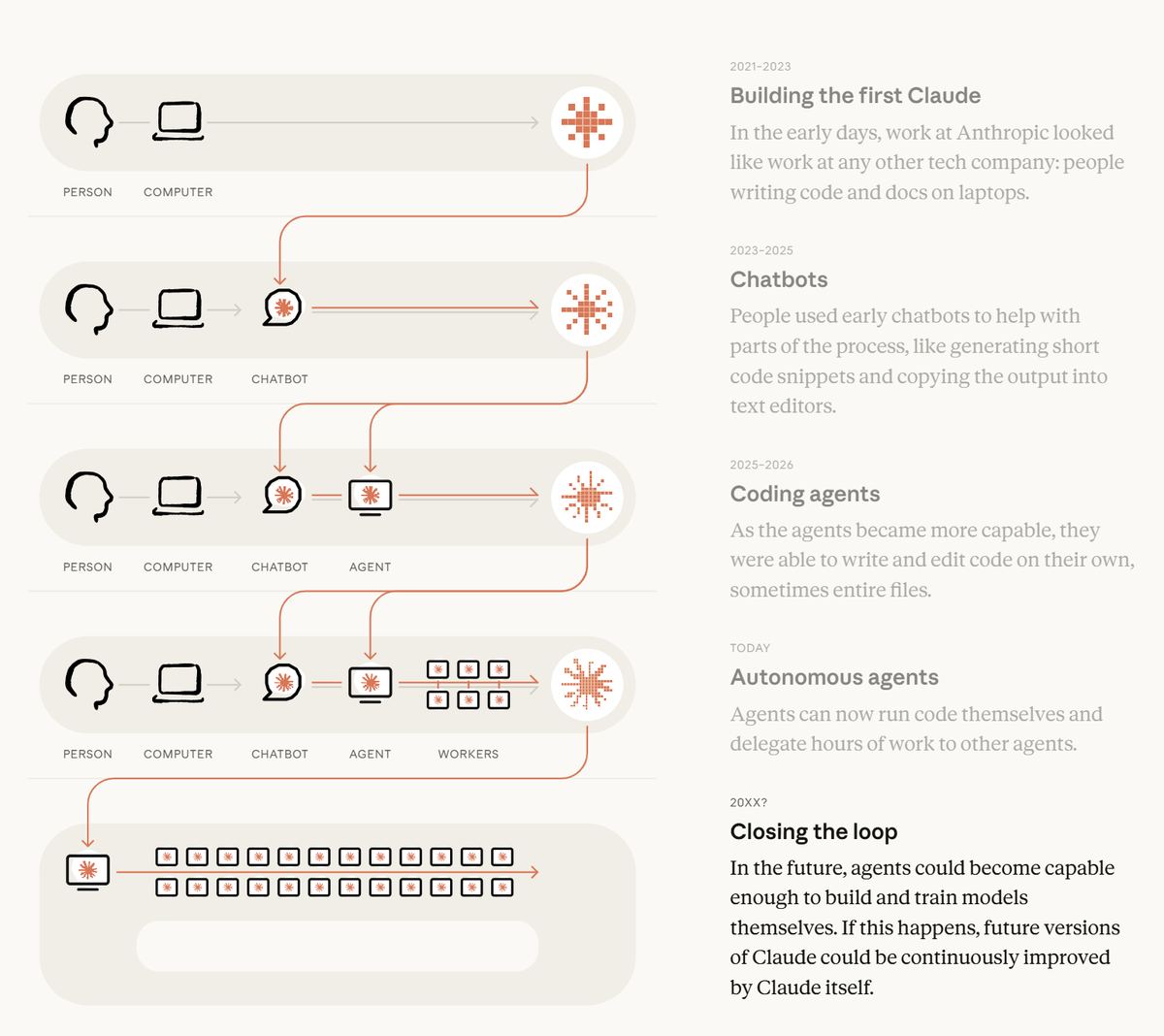
Code contributed per Anthropic engineer per quarter, Q2 2021 to Q2 2026. Two inflection points: Claude Code in research preview Feb 2025, and models working autonomously in 2026 with Mythos Preview. The typical engineer merges 8x more code per day than in 2024. 80% of code merged at Anthropic now authored by Claude. Lines of code is imperfect — but the productivity multiplier signal is real. Source: Anthropic Institute.
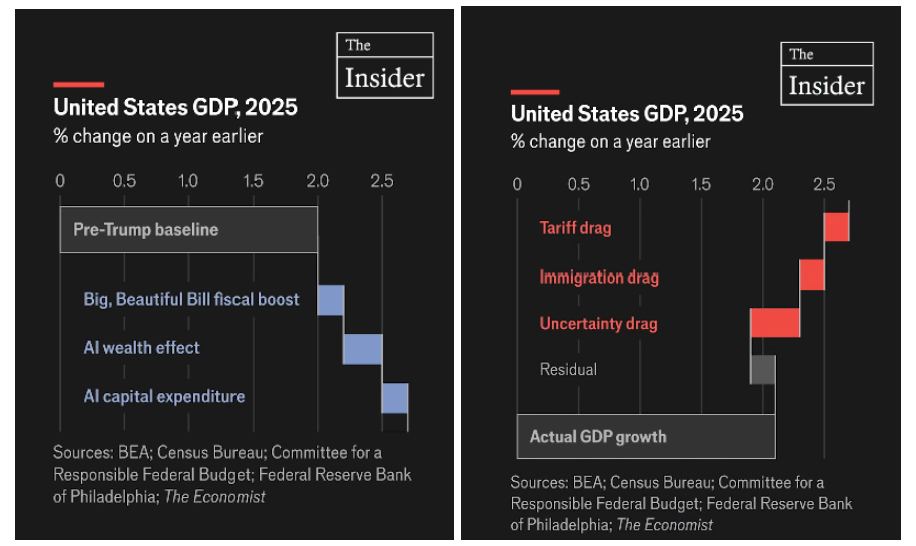
The MAGA tax framing. The Economist's Archie Hall on how Trump's economic policies are doing more harm than good. The tariff stack, the immigration crackdown, the dollar-weakness pressure, the fiscal drag-and-pull — the package is increasingly being framed as a household-level tax that doesn't show on the headline budget but does on the consumer-paid input prices. The story that the wealth-effect at the top hides until it doesn't. Source: The Economist / Archie Hall.
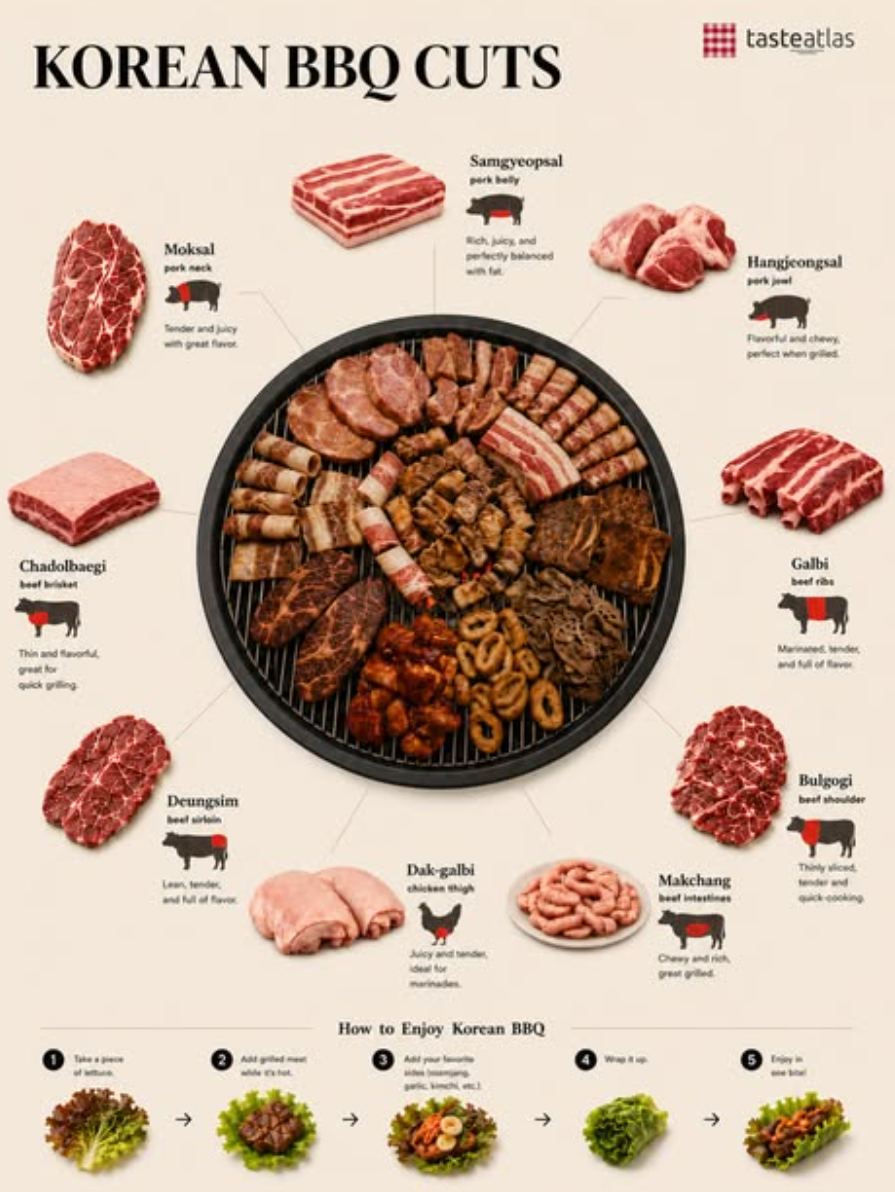
Korean BBQ — the order of operations matters as much as the meat. Samgyeopsal first to render fat, Galbi for the caramelized sweet glaze, Chadolbaegi the brisket starter. The ritual closes with the Ssam — lettuce wrap, charred meat, ssamjang, raw garlic, eaten in one bite. The flavors explode together. A reminder that markets too are about timing and combinations, not just the ingredients. Explore the TasteAtlas Korea guide. Source: TasteAtlas Korea.
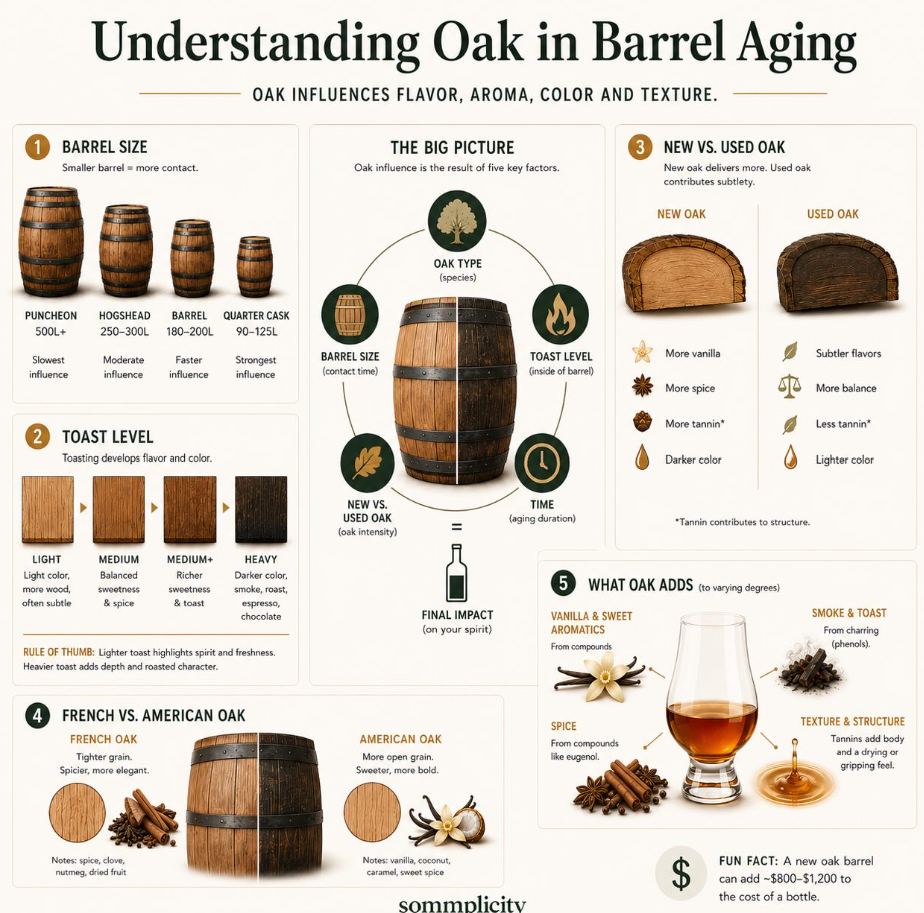
Know your oak. Different oak species, char levels, toast levels, and seasoning influence wine. The wine writer's reminder that the input matters as much as the grape — Quercus alba, Q. petraea, Q. robur each carry different vanillin, coconut, and spice profiles. Light, medium, heavy toast each shape the bouquet differently. Same grape, same vintage, different barrels — the entire experience changes. Source: Wine guide.
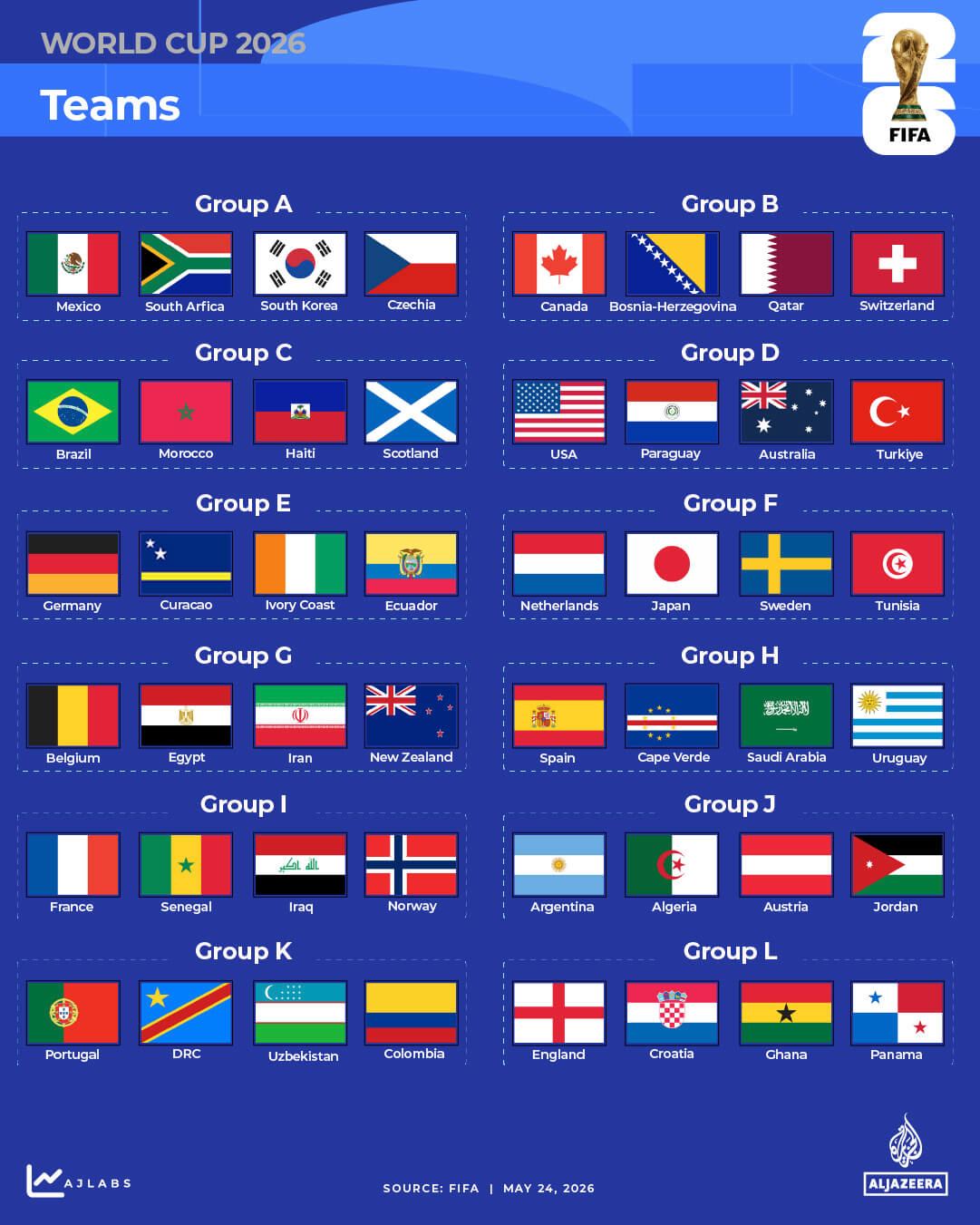
The World Cup 2026 stadium guide — 16 stadiums across 3 countries. 11 in the US, 3 in Mexico, 2 in Canada. First three-country World Cup, expanded from 32 to 48 teams, 104 matches across 16 cities. The furthest two venues, BC Place Vancouver and Estadio Azteca Mexico City, sit 4,400km apart. Save the link as your tournament guide: Al Jazeera virtual stadium tour. Source: Al Jazeera interactive.
Best,
Hoelon
WITPTW is a personal publication. Everything here is personal opinion and market commentary, written in a personal capacity. It is not investment advice and not a recommendation to buy or sell any security. It is not associated with, endorsed by, or representative of any employer, fund or company. Charts and images are reproduced from their original publishers, credited to their sources for commentary and discussion; all rights remain with the respective copyright holders.