The Next Narrative
Personal views and market commentary. Not investment advice. Not associated with any employer or firm.
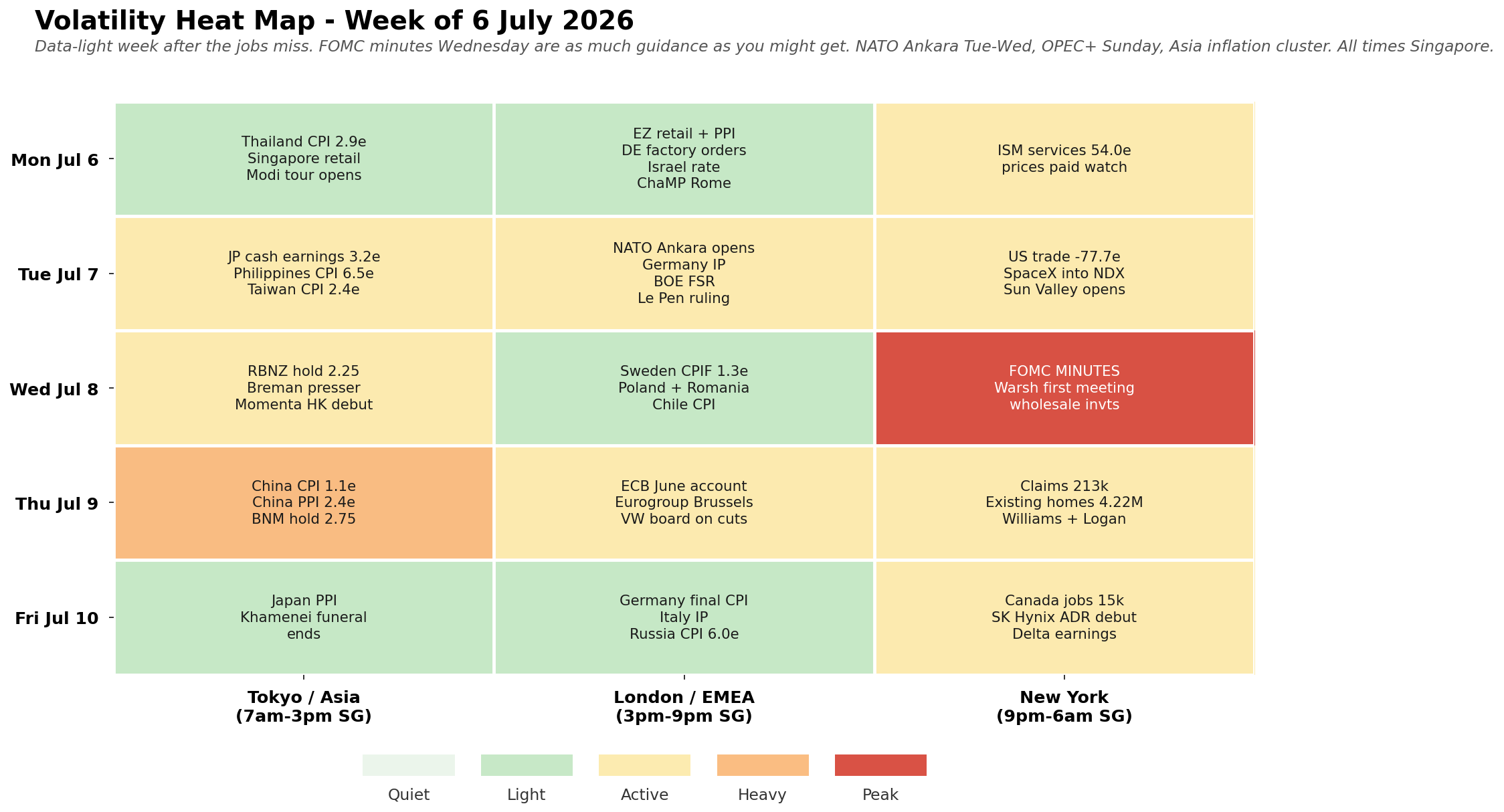
Volatility heat map for the week ahead, all times Singapore. A data-light week after the jobs miss. FOMC minutes Wednesday night Singapore are the gate, as much guidance as you might get from the new chair. NATO summit in Ankara Tuesday and Wednesday, OPEC+ virtual meeting Sunday. The Asia inflation cluster runs all week, Thailand Monday, Philippines and Taiwan Tuesday, China Thursday. RBNZ and BNM both expected to hold. Friday closes with Canada jobs, the SK Hynix ADR debut on Nasdaq and Delta opening the earnings season.
"A national debt, if it is not excessive, will be to us a national blessing." — Alexander Hamilton, first US Treasury Secretary, in a 1781 letter, as the republic turned 250 on Saturday. The 250th birthday arrived with the debt around 100% of GDP and the qualifier doing all the work. And still the dollar printed its high of the year ten days before the anniversary, foreign investors kept favouring US equities over bonds, and the currency rose in June against everything but a handful of EM currencies. The warning sits in the front end. Two-year inflation breakevens have fallen since the Iran war began, which means real rates have risen, and rising real rates for a Treasury that refinances itself mainly through the front end is the fiscal-sustainability worry expressed in market pricing rather than in op-eds. The exorbitant privilege is intact at 250. The price of keeping it is now visible on the curve.
"Something has gone completely wrong. The basic view among enterprises in this country is: I'm going to chillax and waste my time with tokens, I'm going to get no value, and they're going to get my IP... If it was so valuable, wouldn't I say I'll make you a billion dollars and I want 30%? Why are they charging for tokens if it's so valuable?... These models have been completely, irresponsibly oversold." — Alex Karp, Palantir co-founder and CEO, on CNBC Wednesday. He was announcing a partnership with Nvidia and torching the token business model in the same breath. The two places that make actual money, he says, are the application layer and compute. Enterprises want to control the weights, the data and the alpha, and everything in between is being repriced, from above by the labs' own falling prices and from below by Chinese open weights.
"Capital goes where it's welcome and stays where it's well treated." — Walter Wriston, former Citicorp CEO. At 250, the question has quietly flipped, not whether capital is welcome in America but whether America still treats it best, and the dispatch below follows the money.
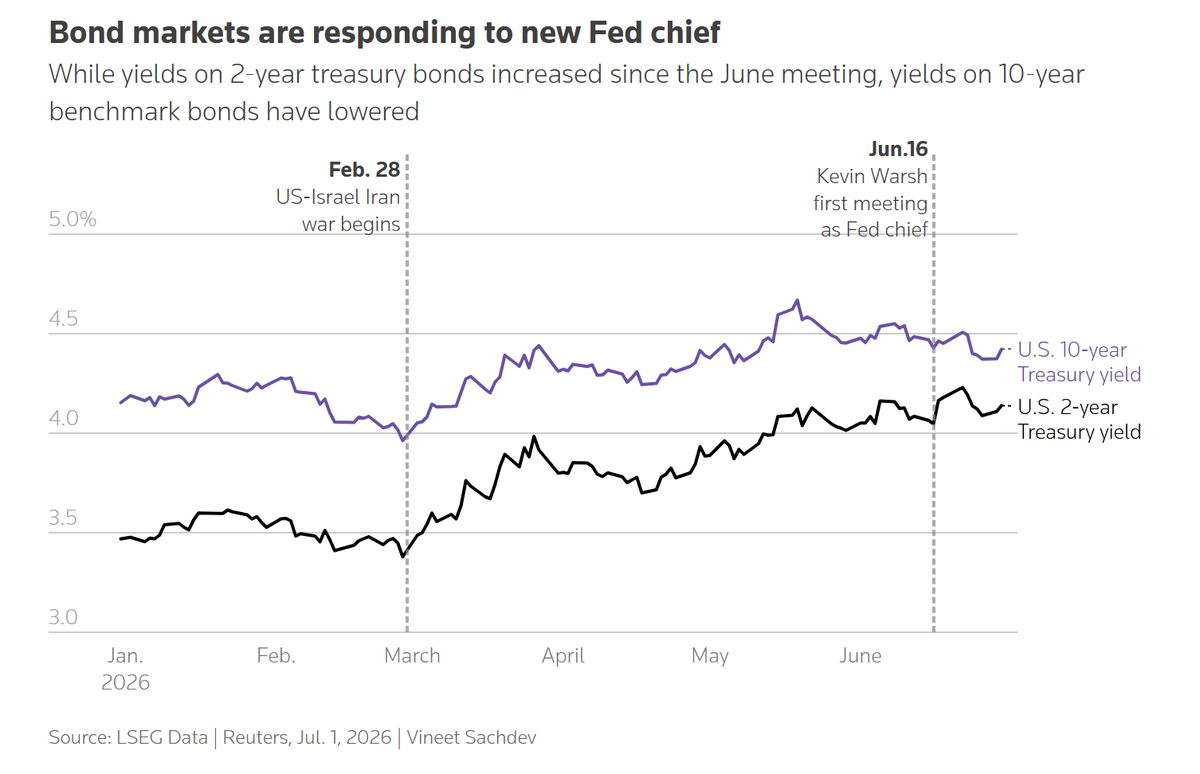
Bond markets are responding to the new Fed chief, in two directions at once. The two-year rose after the June meeting while the ten-year fell, the curve flattening from both ends. Then the jobs miss took the front end back down, the two-year finishing the week below 4.14% from a post-FOMC peak above 4.20%. In this environment, as goes the US two-year, so goes the dollar. The minutes Wednesday are the next input into the front end, and they reflect a dot plot that half the committee filled with hikes. Source: Reuters / LSEG.
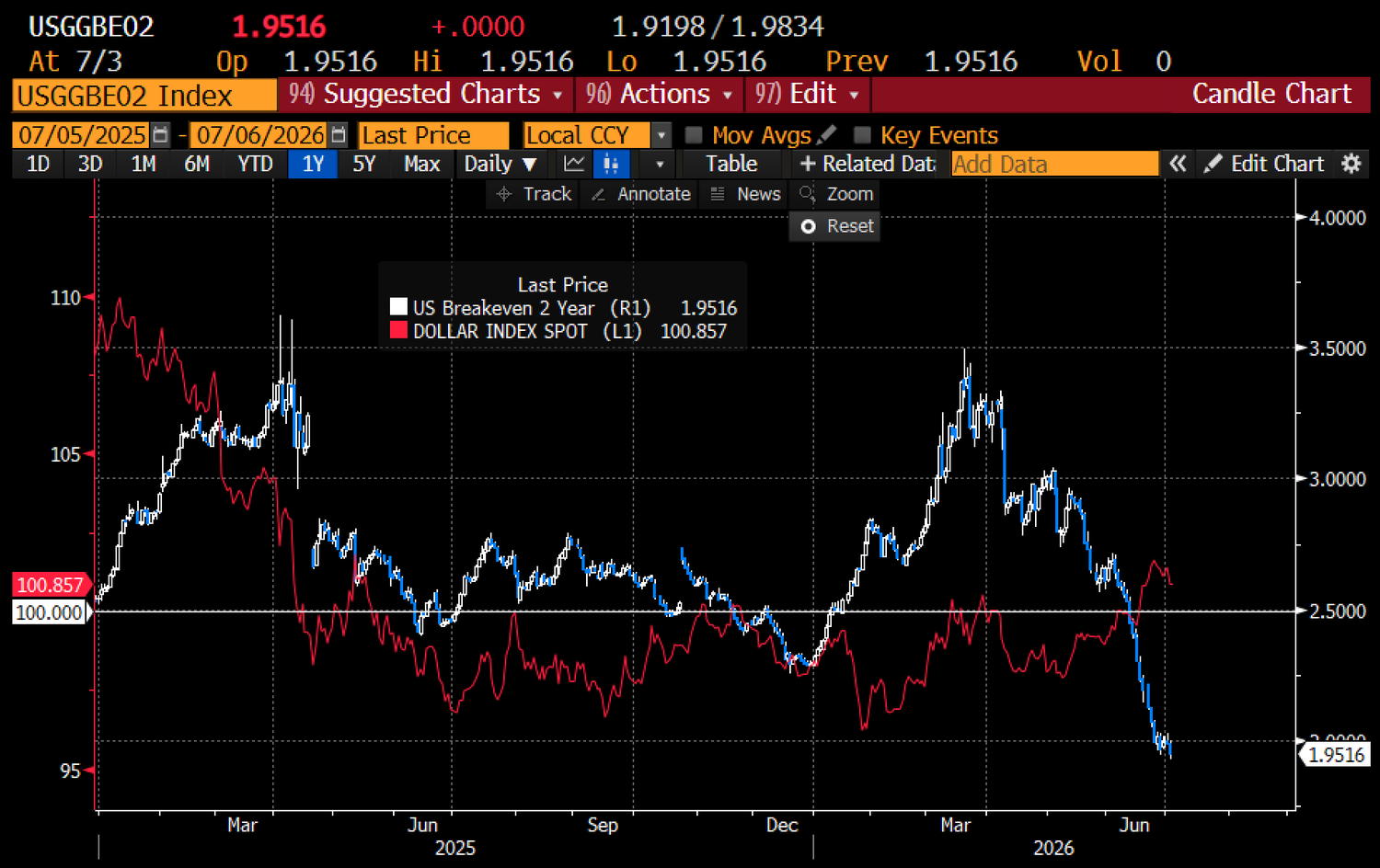
The Peak America chart. Two-year breakevens at 1.95, below target, while the Dollar Index holds near 100.86. Breakevens have collapsed from roughly 3.5 in March, through a war, the disinflation the Fed wants delivered by oil's round trip. The dollar has not followed yet. Either the currency is right about exceptionalism or the breakevens are right about the cycle, and the gap between the two lines is the question the republic's 250th birthday poses: real rates are doing the tightening while the Treasury refinances itself at the front end. One of these lines gives. Source: Bloomberg USGGBE02 Index, reproduction.
What is the plan this week?
As we understood and possibly misunderstood Warsh over the last two weeks, global markets are back to facing the summer doldrums without a theme. What is the next narrative? There are a few underlying trends that are hard to stop. A very, very strong first half in equities, the S&P closing its best quarter since 2020, the SOX up triple digits, the Kospi up 90%. We might get corrections in the next few weeks but it is hard to derail the momentum. Oil prices are back to pre-war. I was thinking there was no easy way out for the US from the conflict they started. I was wrong, as Trump seems to have shamelessly moved on. AI maxxing is inflationary short term and extraordinarily deflationary medium term, especially for service inflation. The timing is unknown, and the timing is the determinant of whether the FOMC has to hike rates first.
The jobs report reset the pricing. June payrolls came in at half of what was expected, the prior two months were revised net negative, and the household survey was worse, a 507k drop in the number of employed. The unemployment rate fell to 4.2% only because participation fell. The market pushed the first hike from October toward December, the two-year finished the week below 4.14%, and as goes the two-year, so goes the dollar.
The data week is light but each release lands on a nerve. Monday opens with the June ISM services PMI, 54.0 expected, the prices-paid index the one to watch after 71.3 in May. Wednesday brings the FOMC minutes from the first meeting under the new chair, as much guidance as you might get, written before the jobs miss and reflecting a dot plot where half the committee pencilled a hike. Thursday is China inflation, CPI barely at 1.1% and PPI decelerating to 2.4% as the oil surge unwinds, the print that feeds the PBOC easing talk. The monetary policy meetings, RBNZ Wednesday and BNM Thursday, are both expected holds with lower oil easing the near-term inflation risk, and the ECB June account lands Thursday already outdated by the CPI undershoot. NATO summit and OPEC+ probably not much spark for markets with the conflict off the spotlight and oil stabilising here. The week ends with Canada jobs giving back May's blowout and the SK Hynix ADR debut on Nasdaq, the AI-hardware listing of the summer.
The Asia inflation prints are interesting, maybe still pointy, but most of the forecasts were built on higher oil. With the Fed hike pricing backing off, the hurdle to hike the amount expected earlier is higher everywhere. The Asian currencies mostly sit at their weakest points, except CNY, waiting for the next steps in global markets, the won at a 17-year low near 1,545 even with the Kospi doubling. USDJPY printed 162.85, a 40-year high, before the jobs miss pulled it back through 161, and the new development is the tape talk that Tokyo and Seoul are considering intervening jointly, Japan having already shifted to a no-telegraph doctrine aimed at hitting the speculators. A coordinated move would be far more powerful than either acting alone. The Kospi surged 5.8% Friday as EM rallied into the softer dollar.
The plan is to stay short USDJPY and USDKRW as the markets continue to correct. Stop out if we break the lower-highs, lower-lows trend. The upside is much less than the last two weeks, with the Fed less likely to hike in July on the subdued job numbers. The last few years of July jobs prints have been seasonally very weak, it is the print that prompted the Powell cut two years ago, the weak July 2024 report that turned into the jumbo September cut. This year we have World Cup hiring, but expectations of the bump are already built in. Stay nimble.
What did I learn last week?
Mon Jun 29: SCOTUS declined to let Trump remove Fed Governor Lisa Cook without due process, but expanded presidential firing powers and backed the FTC removals 5-4. Iran launched missiles toward Bahrain and Kuwait, strikes then halted, talks resumed in Doha. Alphabet replaced Verizon in the Dow at the open. Dallas Fed 0.0 vs 1.0e.
Tue Jun 30: Tankan large manufacturers 22 vs 16e, the highest since March 2018. Germany CPI 2.3% vs 2.6%e, France 1.8% back at target. JOLTS jumped to 7.594M vs 7.3Me. Conference Board 91.2 vs 94.4e miss. Hammack: Fed may need to consider hikes. Nike beat ex-tariff-refund, China revenue -12%.
Wed Jul 1: EZ flash CPI 2.8% vs 3.0%e, core 2.4%, sapping the ECB September-hike case. ISM Mfg 53.3 vs 53.9e. Warsh at Sintra: no forward guidance, prices too high, inflation risks have come down. USDJPY printed 162.85, a 40-year high. Japan shifted away from telegraphing intervention, focusing on hitting speculators. USTR: USMCA shifts to rolling talks, no renewal. Atlanta Fed GDPNow cut Q2 to 1.2% from 2.5%. Meta reportedly selling excess AI compute, chips sold off hard.
Thu Jul 2: NFP came in at half of expectations with net-negative revisions. The household survey lost 507k employed. Unemployment fell to 4.2% only on lower participation. Hike pricing pushed from October toward December. Claims 215k. Tesla Q2 deliveries 480.1k vs 405ke, the energy shock drove consumers back to EVs, Ford -10.3%. OpenAI reportedly proposed handing the administration a 5% stake.
Fri Jul 3: US closed early into the 250th July 4. Kospi surged 5.8%, EM rallied into the softer dollar. Gold and Bitcoin caught a bid to open Q3. Colombian peso the best-performing currency in the world on the week, a six-year high.
All week: S&P +1.8%, DJIA +2%, Nasdaq +2.1%. The S&P closed its best quarter since 2020. Two-year finished below 4.14%, DXY off the 101.80 year high. Khamenei state funeral began, the military consolidating. Greenspan died at 100, a week after we quoted him here.
What to look out for next week?
Sun Jul 5: OPEC+ virtual meeting reviews production policy with Brent back below pre-war. Quota discipline versus share defence is the question. F1 British GP at Silverstone.
Mon Jul 6: US ISM services 54.0e from 54.5, the prices-paid index the watch item after 71.3. Thailand CPI 2.9e. Eurozone retail sales and PPI. Germany factory orders. Israel rate decision. Modi opens an Indo-Pacific tour through Jul 11. Waller, Schnabel and Lane at the ChaMP conference in Rome. Philippine Senate opens the Duterte impeachment trial.
Tue Jul 7: NATO summit opens in Ankara through Wednesday, the 5%-of-GDP pledge under delivery pressure, a new NATO-bank idea in the corridors. Japan labour cash earnings 3.2e. Philippines CPI 6.5e, Taiwan CPI 2.4e. US trade balance -77.7e from -55.9. Germany IP. SpaceX joins the Nasdaq-100. Sun Valley opens. BOE financial stability report. Le Pen appeal ruling.
Wed Jul 8: FOMC minutes from Warsh's first meeting, the gate of the week. The account reflects the hawkish June dot plot and may read more hawkish than the post-jobs market. There is also a chance the minutes are shorter and less detailed under the new communications style. RBNZ likely holds 2.25%, consensus split with some calling a hike. Sweden CPIF 1.3e. Poland and Romania rates. Chile CPI. Momenta debuts in Hong Kong. UniCredit-Commerzbank tender results.
Thu Jul 9: China CPI 1.1e and PPI 2.4e from 3.9, the disinflation print that feeds PBOC easing speculation. ECB publishes the June meeting account, likely outdated after the CPI undershoot. Malaysia BNM holds 2.75%. Mexico CPI and Banxico minutes. Peru rate. US claims 213k, existing home sales 4.22M. Williams and Logan at the NY liquidity workshop. Eurogroup Brussels. VW supervisory board meets on the four-plant closure and 100k-job cut plan. Reciprocal tariffs revert higher unless extended. World Cup quarterfinals begin. Khamenei funeral ceremonies conclude.
Fri Jul 10: Canada jobs 15k expected after May's 87.8k blowout, unemployment 6.8e. Brazil CPI. Germany final CPI. Japan PPI. SK Hynix ADRs debut on Nasdaq, the $29.4 billion raise. Delta opens the US earnings season, options pricing a 6% move. Saudi Arabia rating review.
All week: A data-light week that decides whether the dollar correction extends. Earnings open: PepsiCo, Delta, Fast Retailing, Seven & i, TCS, Yaskawa. China aggregate financing lands in the Jul 9-15 window. World Cup quarterfinals build toward the Jul 19 final, Tour de France rolls out of Barcelona, Wimbledon finals weekend ahead.
Beyond next week
Jul 14: JPMorgan opens Q2 earnings season. The tech-heavy final week of July is the one that matters.
Jul 15: Bank of Canada — extended pause the base case.
Jul 19: FIFA World Cup final.
Jul 23: ECB decision — likely hold. The September-hike case weakened with the June CPI undershoot.
Jul 24: Section 122 10% tariffs expire unless renewed.
Jul 28-29: FOMC — hike pricing now pushed toward December.
Aug 11: RBA meeting. Futures price ~15bp of tightening rest of year.
Aug 18: Iran talks deadline — Trump reportedly okay letting it slip.
Regimes
The Warsh era is a family fight. Trade the sequence, not the man. Inflation imminently high, deflation later, and a chair who hates QE and will find new ways to measure inflation, the trimmed-mean taskforce is already seated. The committee is split in public and the minutes will show the family fight. The trade is a sequence: short USD into the July FOMC while the jobs miss deflates the pricing, flip long USD only if September-hike conviction rebuilds after it, and no USD trade at all if the Fed never gets to hike. evolved, week 3 under Warsh
G7 curve: flattener against steepener is the crucial call of H2. Nine weeks tracked and still no decisive signal. The chart camp argues for steepeners, the macro camp for flatteners on a hike-fast-now, deflation-hits-harder-later sequence. The two-year 4.05-4.20 range is the tell, a break either side settles the argument. No curve position until it does. evolved, week 9
AI capex: is the correction imminent? H2 inflation rides on the answer. Nasdaq, SOX and Kospi can break their uptrend lines any week, against a momentum mindset that is still strong. On the other side sits the leverage, the compute glut and cheapening Chinese compute. The uptrend lines are the trigger, respect them both ways. The macro kicker: if the maxxing stops, the H2 inflation scare never arrives and the hike pricing dies with it. evolved, week 11
Asia FX pinned at the weak point, and the inflows need a USD-weakness run to return. Won at a 17-year low near 1,545, yen at 40-year lows, rupiah at a record low, roughly $81 billion pulled from Korean equities this year even with the Kospi up 90%. The inflows look hard to come back unless the dollar gives a proper weakness run, which makes short USDJPY and USDKRW the highest-beta expression of the correction. CNY the exception, the PBOC fix at three-year lows. evolved, week 6
UK political-fiscal vacuum. Tracking only, not traded. The Labour contest formally opens with construction at 38.2, the lowest since the pandemic, and borrowing at post-pandemic highs. Watchlist item, not a position. Gilts and sterling stay off the book until the leadership resolves. evolved, week 2
Shifts (if → then)
If the FOMC minutes re-inject the hawkish dot-plot spirit → front end backs up, the USD correction pauses, the two-year back through 4.20 kills the JPY and KRW shorts. new
If the minutes are short and less detailed, the new style → the market reads it dovish, S&P toward 7590-7600, USD softer, EM extends the rally. new
If Japan or Korea intervene into the correction → USDJPY gaps through 160.50, add to the shorts, the no-telegraph doctrine means it comes without warning. new
If China CPI and PPI confirm disinflation Thursday → PBOC easing speculation builds on the new overnight reverse-repo signal, China rates lower, CNH strength caps. new
If OPEC+ leans into quota discipline Sunday → the oil floor firms, the too-calm complacency unwinds, breakevens catch a bid and the long end sells. new
If the RBNZ surprises with a hike Wednesday → NZD squeeze, the Asia-Pacific hawkish repricing returns, AUDNZD lower. new
If MOVE keeps rising while FX vol stays pinned → the gap closes the wrong way, FX vol catches up, the VAR shock arrives. carried
Tails
US 10-year breaks above 4.50% → the fiscal roll-over worry expressed through real rates. Two-year breakevens fell through a war, meaning real rates rose, a problem for a Treasury refinancing at the front end. new
Intervention cascade, Japan and Korea coordinated → spec shorts squeezed without warning under the no-telegraph doctrine. Dollar puts already being bought as insurance. week 5, evolved
AI capex monetisation stress becomes funding stress → Microsoft's worst month since the dot-com era, falling AI prices meeting $725bn of guided capex, the copyright settlements now a real cost line. week 5, evolved
Oil takes a second leg higher that nobody is pricing → inventories need replenishing after record drawdowns, Hormuz recovering in fits and starts, damaged facilities below 100%. In 2022 prices were still 13% above pre-war at this point after the invasion. week 14, evolved
Khamenei succession turns violent → state funeral through Jul 9, the military consolidating. The MOU counterparty is changing in the middle of the negotiation. new
UK political instability bleeds into gilts → the leadership contest opens with construction at pandemic lows and borrowing at post-pandemic highs. week 2
Super El Niño into 2027 → SST anomalies 2.0°C or more, on the heels of the 11 hottest years on record, with heat already killing half a million a year and $2 trillion of annual productivity cost by 2030. week 3, carried
Mundane Monday
The doldrums open the week and the calendar obliges. Asia digests the OPEC+ decision from Sunday with the glut talk louder than the meeting itself. Thailand CPI 11:30am Singapore, likely 2.9% and still inside target. Eurozone retail sales and German factory orders through the London afternoon, Israel rate decision the same window. ISM services 10pm Singapore is the only US event worth an alarm, 54.0 expected with the prices-paid index the tell on whether the energy disinflation is reaching services. Mundane is the point: the market wants a narrative and Monday will not provide one.
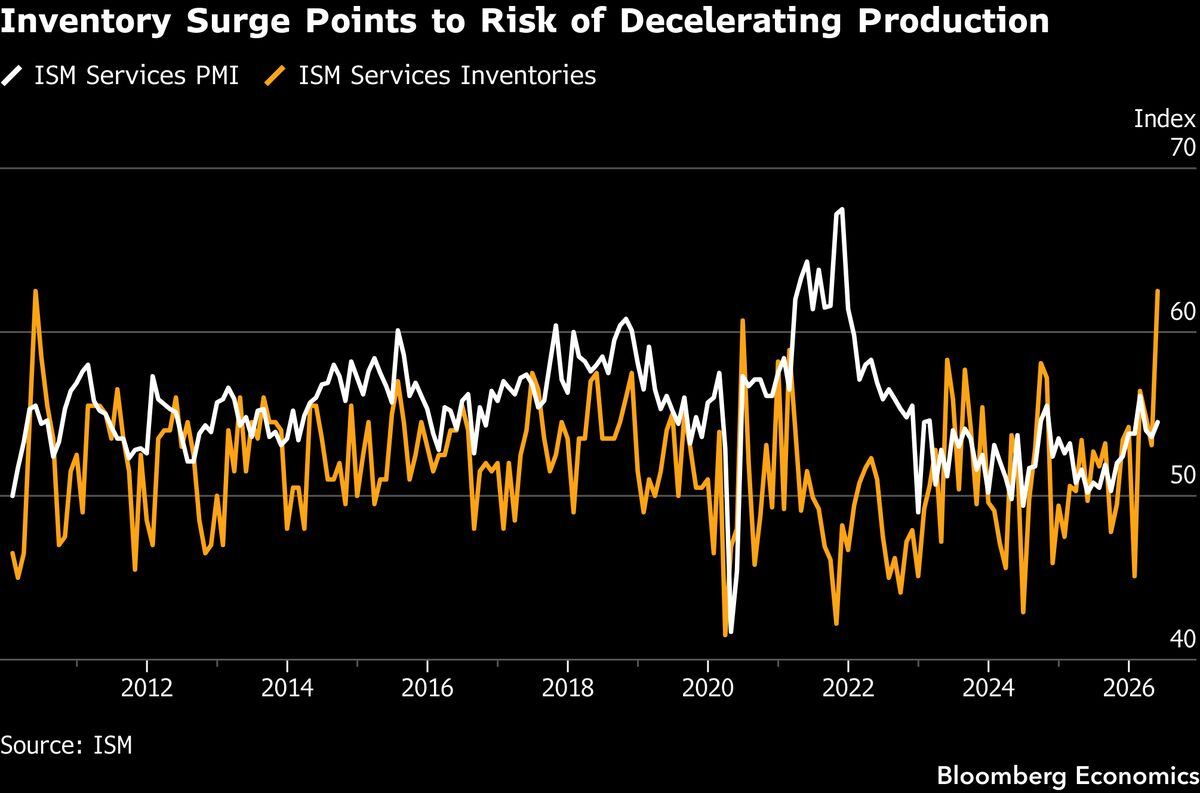
ISM services Monday — likely eased to 54.0 from 54.5. Still expansion, but regional surveys point to softening business conditions and demand in June. The prices-paid index is the one to watch after 71.3 in May, with the manufacturing equivalent falling sharply in June. Another read on whether the AI-and-energy inflation impulse is fading with oil. Source: Bloomberg Economics.
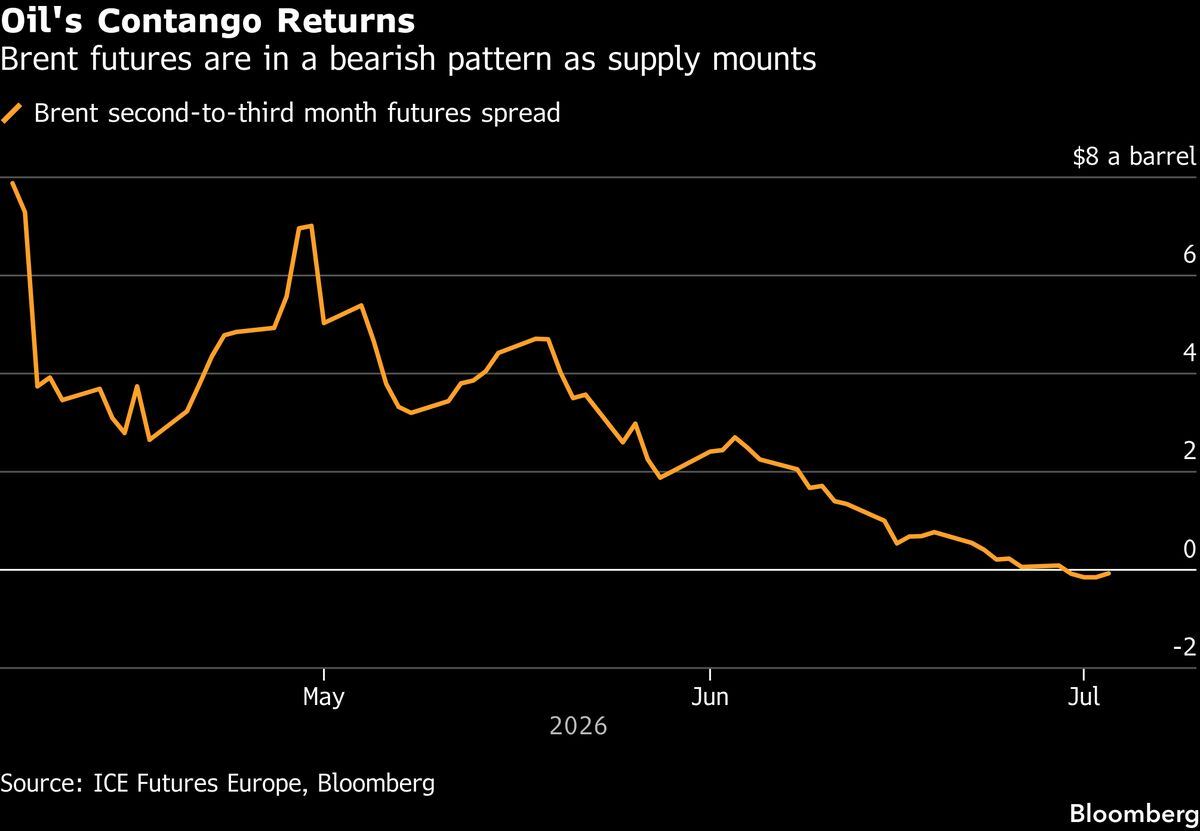
Oil's contango returns, the glut trade in one line. Brent's second-to-third month spread has flipped negative for the first time since the war, the structure that pays traders to put barrels into storage. More than 60 million trapped barrels are flooding out of the Gulf, OPEC production is still 28% below February, and the buyers are not there: China cut imports by 5 million barrels a day during the war and has not come back. Oman crude at a $4 discount to Dubai, the widest since 2020, a Congolese cargo unsold at a record $14 under Brent. The question moves from how fast OPEC+ can restore production to who is willing to cut. Source: ICE Futures Europe / Bloomberg.
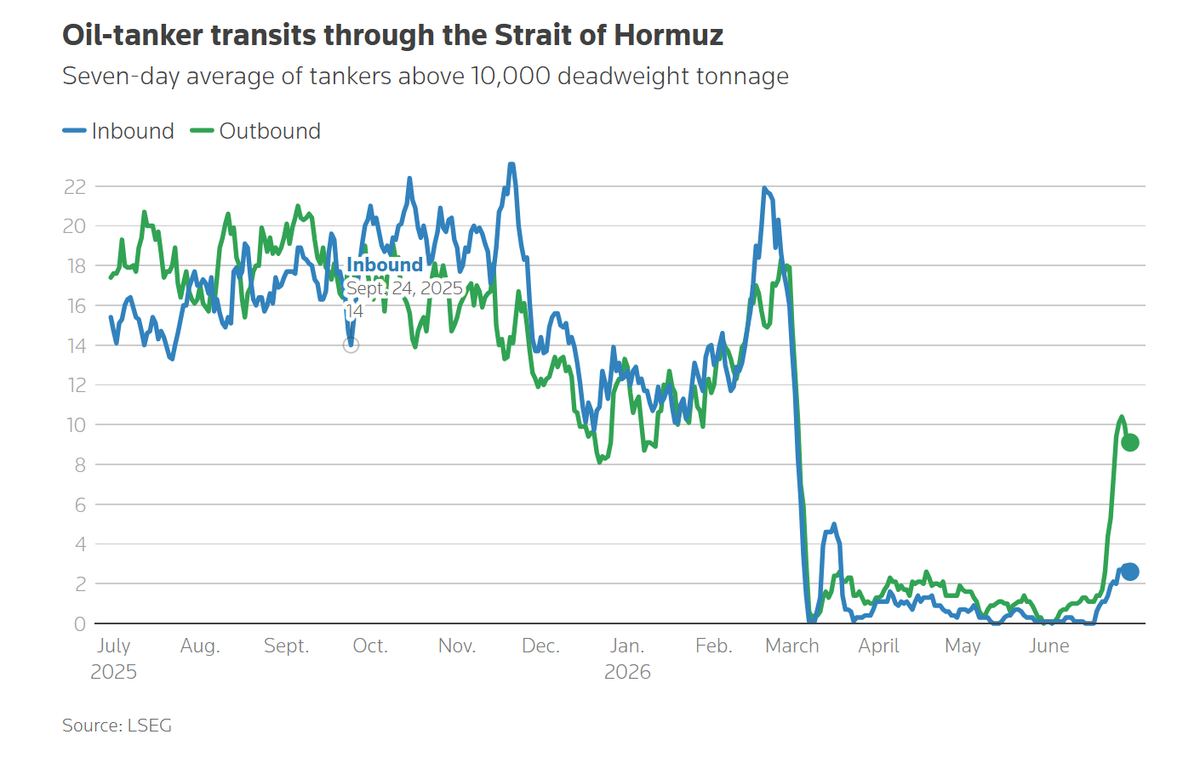
Hormuz transits are recovering in fits and starts, and oil is back below pre-war levels. From a four-year high of $126 in May, Brent now sits just above $70. The speed of the round trip surprised everyone. In 2022, this many weeks after Russia invaded Ukraine, Brent was still 13% above its pre-war level. Global inventories still need replenishing after record drawdowns, damaged production facilities are not back to 100%, and outbound transits are recovering faster than inbound. The risks are building for another leg higher in crude that few right now are factoring in. OPEC+ meets Sunday. Source: Reuters / LSEG.
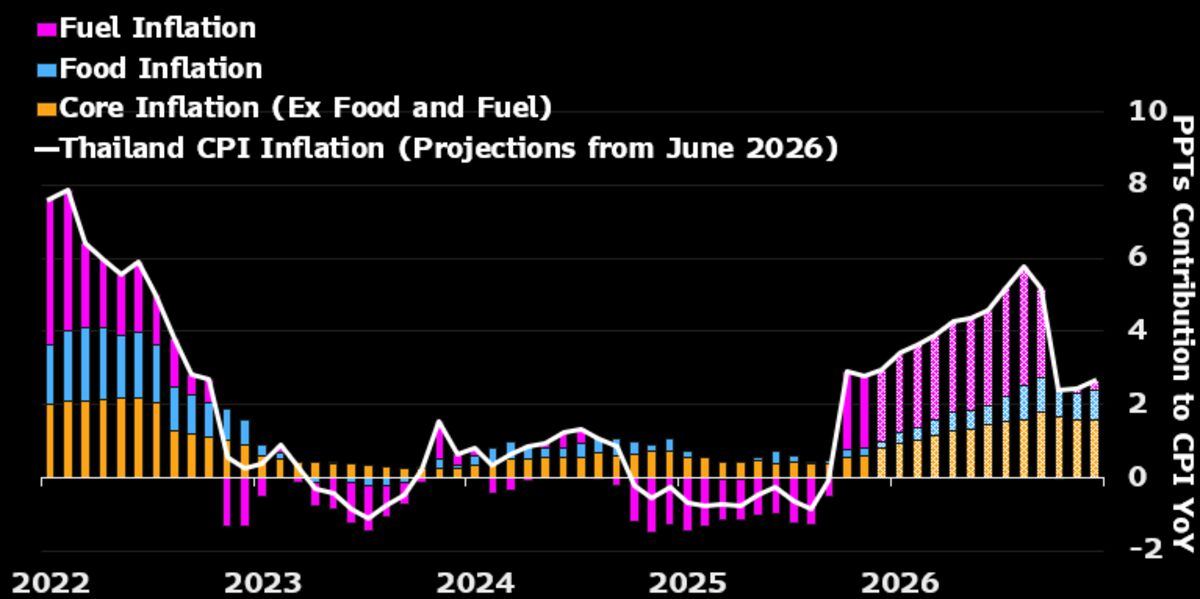
Thailand CPI Monday — likely rose to 2.9%, still inside the 1-3% target. Energy eased with global crude but core goods and services picked up the baton, the earlier fuel surge still working through the supply chain. El Niño is likely to lift food prices toward year-end. Weak domestic demand gives the BOT room to look through a small breach. Source: Bloomberg Economics.
Treaty Tuesday
The treaties get the headlines, the data gets the flows. NATO opens in Ankara with the 5%-of-GDP pledge under delivery pressure and a NATO-bank idea circulating in the corridors. Japan labour cash earnings 7:30am Singapore slow to 3.2% on calendar effects. Philippines CPI 9am, Taiwan CPI 4pm, the oil-pass-through reads. US trade balance 8:30pm Singapore prints the Q2 net-export damage, a $78 billion deficit expected. SpaceX joins the Nasdaq-100 at the New York open and the passive bid lands. Sun Valley opens in Idaho, the deal-room read on AI sentiment.
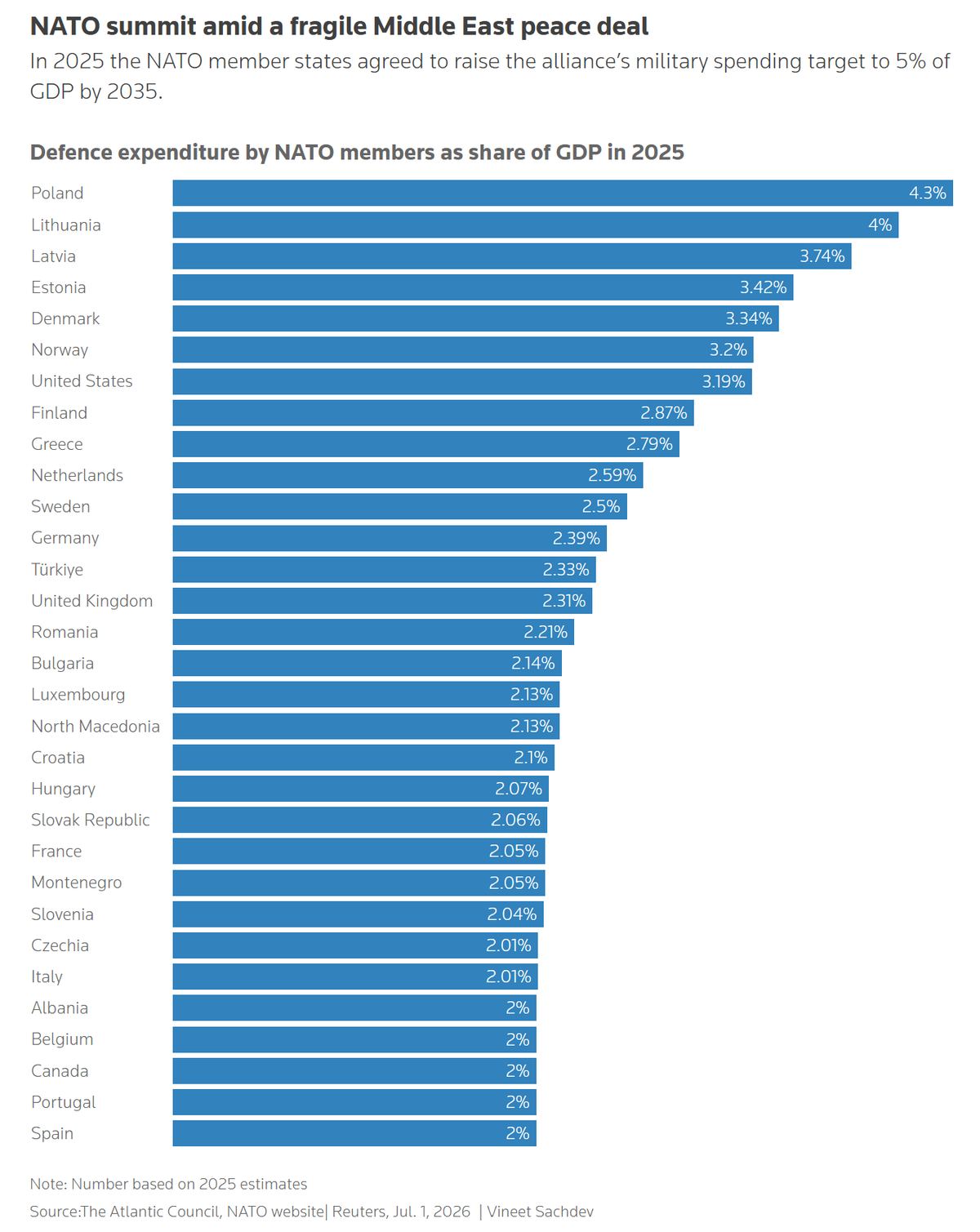
NATO's Trump card in Ankara. Turkey hosts the leaders of all 32 members Tuesday and Wednesday, plus Gulf guests. The last summit produced the 5%-of-GDP-by-2035 pledge, Spain excepted, and leaders arrive under pressure to deliver while averting fresh US withdrawal threats. Watch the new NATO-bank idea championed by Canada. The deeper question is whether an alliance built for consensus can move at the speed the current world requires. Source: Reuters.
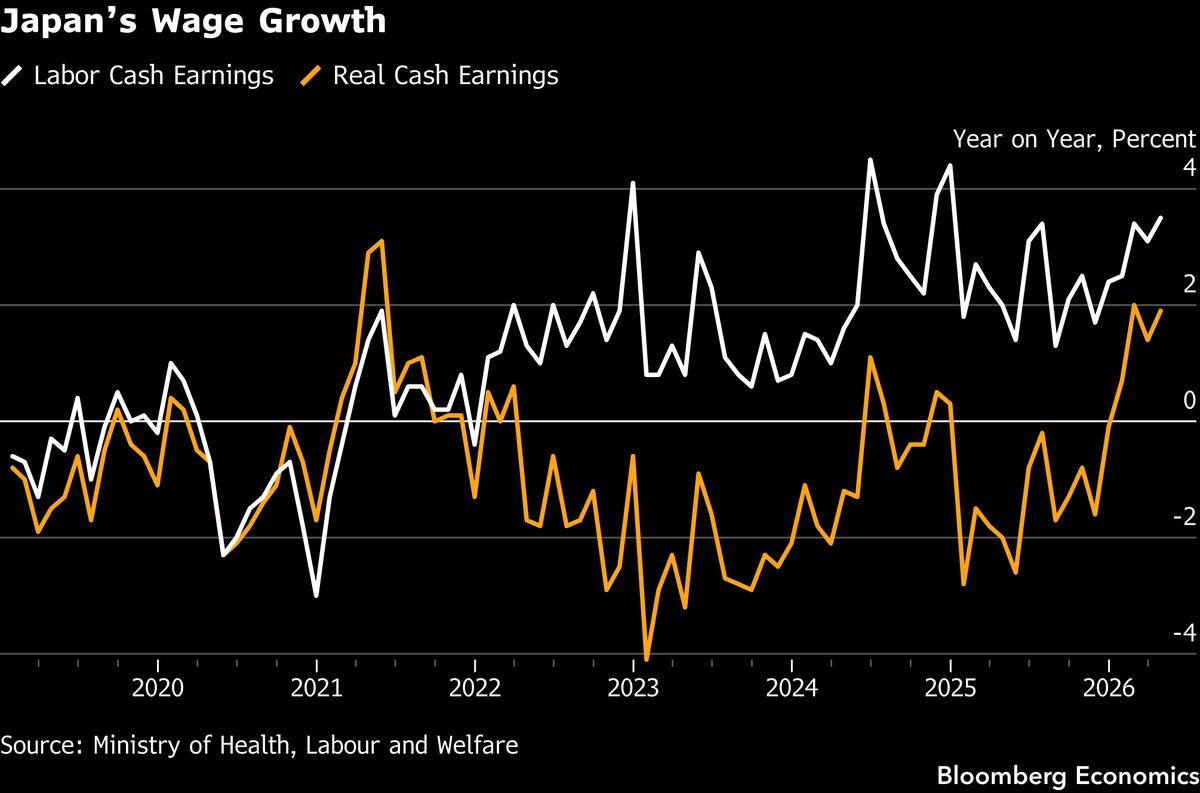
Japan labour cash earnings Tuesday — likely slowed to 3.2% from 3.6% on calendar effects. Real earnings likely +1.5% from +2.0%. The BOJ's preferred measure eases to 2.6% from 2.9%. The underlying trend stays solid as employers raise pay to compete in a tight labour market, and wage growth should reaccelerate in June as the calendar effect fades. Nothing here derails the normalisation path. Source: Bloomberg Economics.
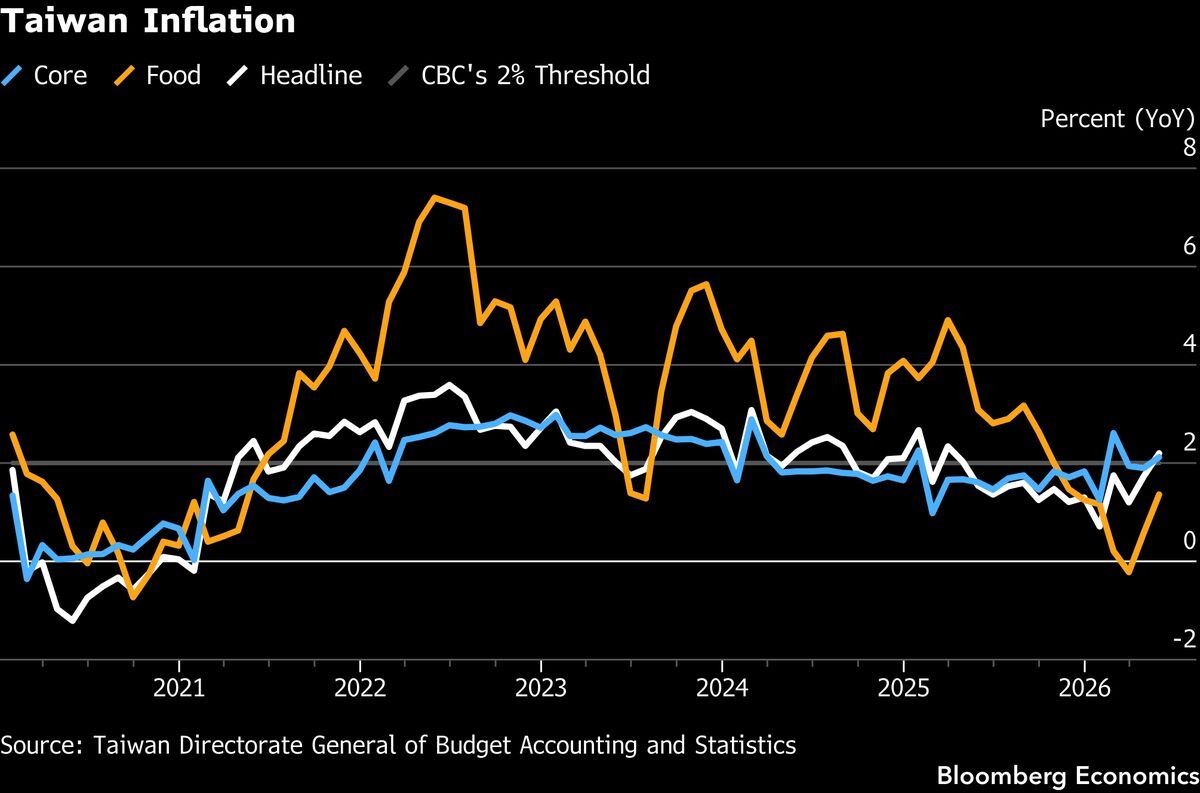
Taiwan CPI Tuesday — likely picked up to 2.4%, further above the 2% alert line. Fuel-price smoothing and tax cuts cushioned the energy pass-through only partly. Sticky dining-out and housing costs plus a weaker currency keep underlying inflation firm. The AI boom is strengthening the central bank's confidence in growth, first hike expected September to 2.125%. Source: Bloomberg Economics.
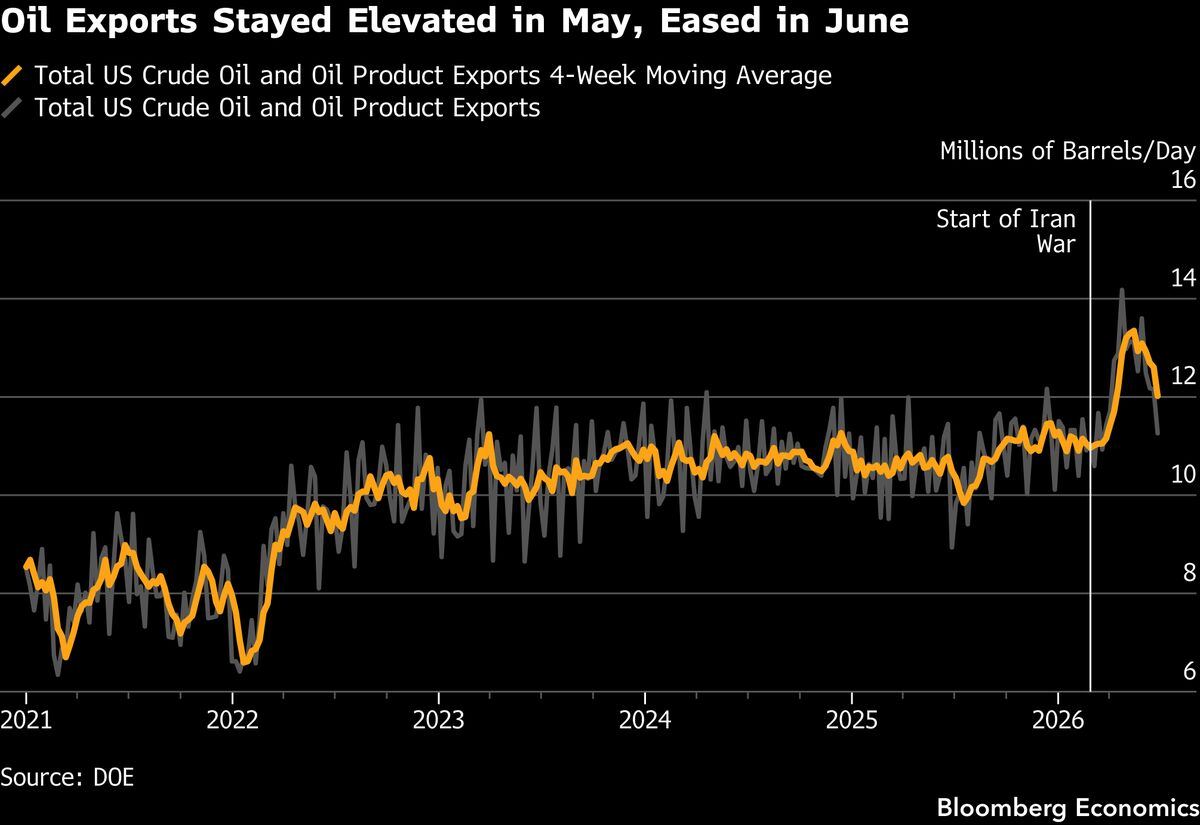
US trade balance Tuesday — the deficit likely blew out to $77.7B from $55.9B. Exports declined across most categories while imports rose broadly. Crude and product exports stayed elevated in May but fall in June with Hormuz reopening. Gold exports drop sharply, so the ex-gold measure, the better GDP read, widens less than the headline. Net exports deteriorate into the Q2 GDP arithmetic. Source: Bloomberg Economics.
Asia at the Half
Two words dominated the first half in Asia, Iran and AI, and the scoreboard is worth a pause before the second half opens. The memory makers became national champions, the currencies hit multi-decade lows anyway, and the bond markets repriced a generation. The four charts below are the half-time summary of the most consequential divergence in global markets: Asian equity strength and Asian currency weakness are the same AI trade seen from two sides, and only a proper dollar-weakness run reconciles them.
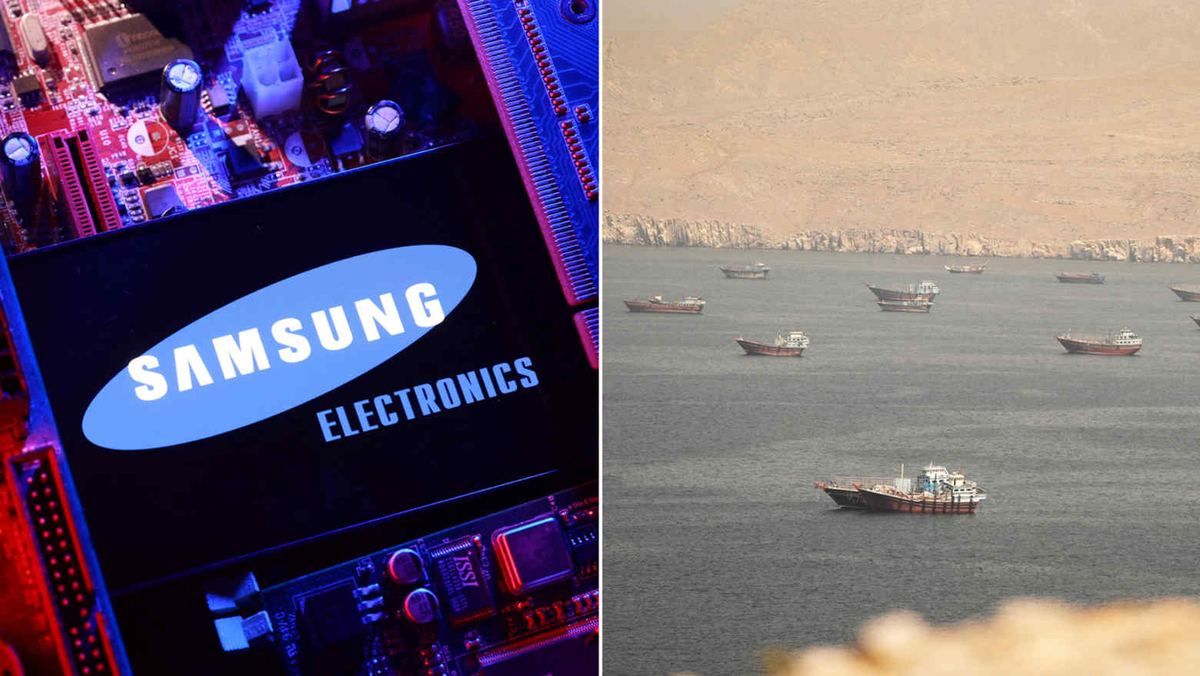
Two words dominated the first half in Asia: Iran and AI. The blockade shook every asset class while the AI boom split the markets down the middle. The snapshots below show how it ended. Source: Nikkei Asia.
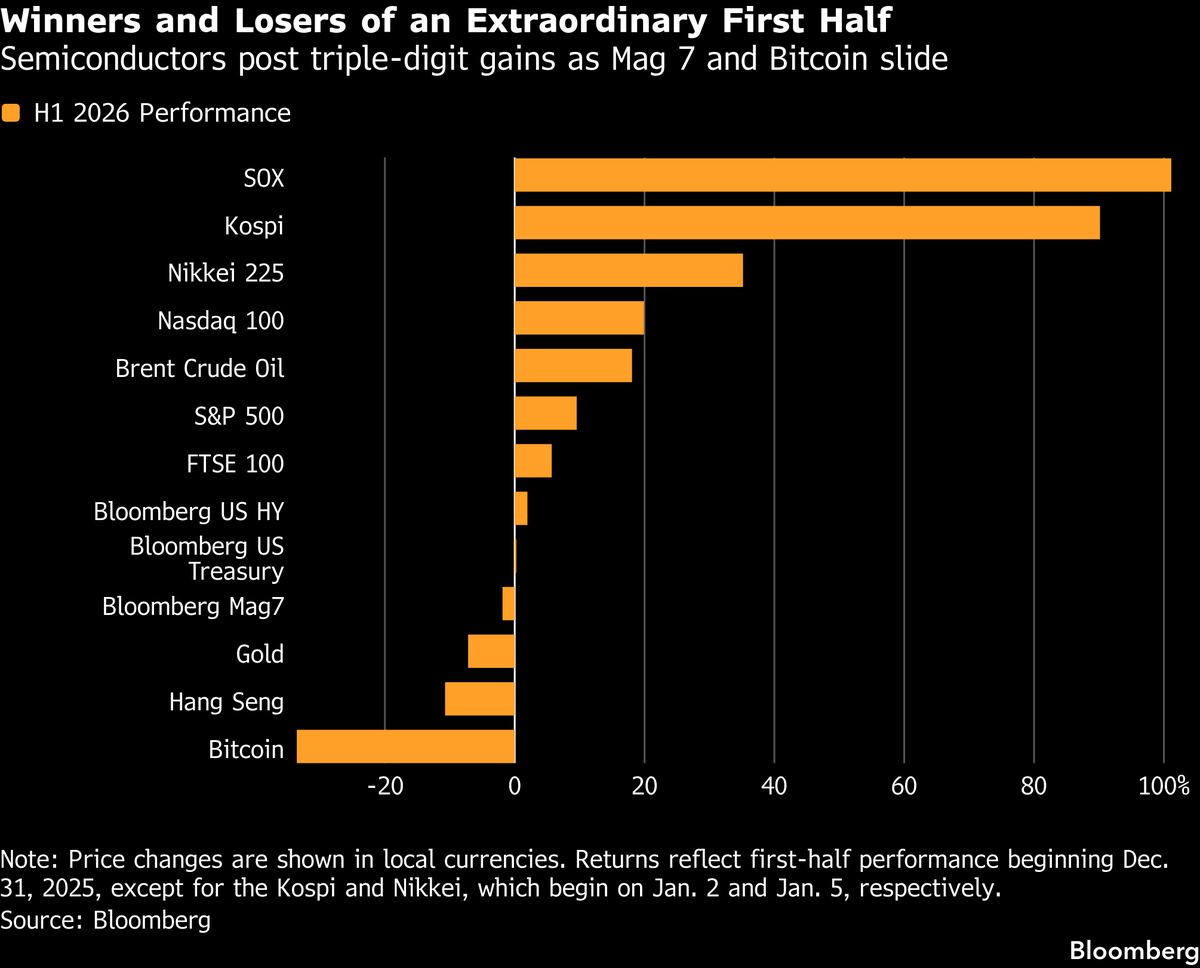
Winners and losers of an extraordinary first half. Semiconductors posted triple-digit gains while the Mag 7 went sideways and Bitcoin slid. The SOX topped 100%, the Kospi 90%, the Nikkei 35%. Gold negative, Treasuries flat, the Hang Seng down. The dispersion tells the real story of H1: the market paid for AI hardware and Asian leverage to it, not for the US mega-caps that spent the half proving how much the buildout costs. The question for H2 is whether the pick-and-shovel trade needs the mega-cap capex to keep being rewarded. Source: Bloomberg.
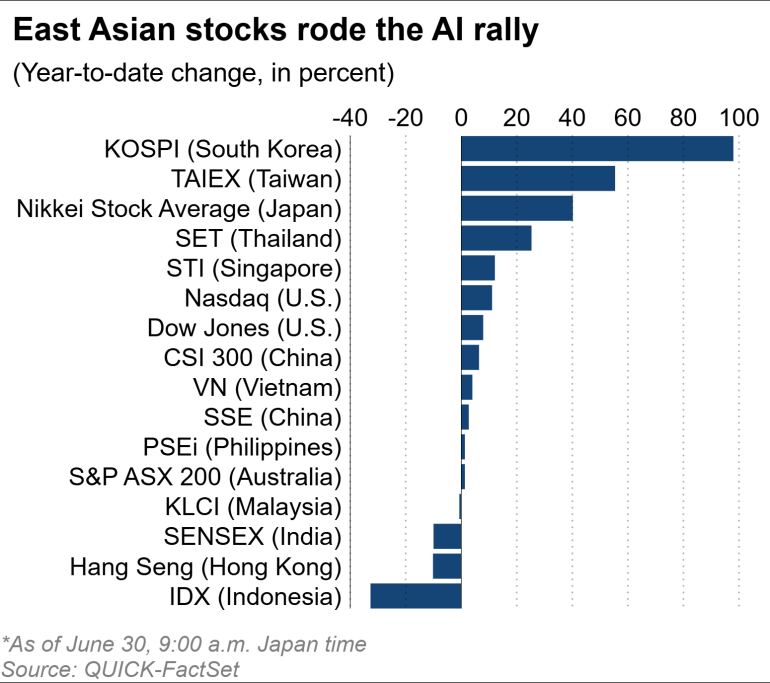
East Asian stocks rode the AI rally, and the dispersion is brutal. The Kospi near +100% YTD, the Taiex +55%, the Nikkei +40%, all repeated record highs, while Indonesia fell more than 30% under MSCI's frontier-downgrade threat. SK Hynix joined the trillion-dollar club and passed Samsung as Korea's most valuable company. Kioxia topped Toyota on the Tokyo bourse. The memory makers are the new national champions, and the leverage building under the retail flows is the new fragility. Source: QUICK-FactSet / Nikkei Asia.
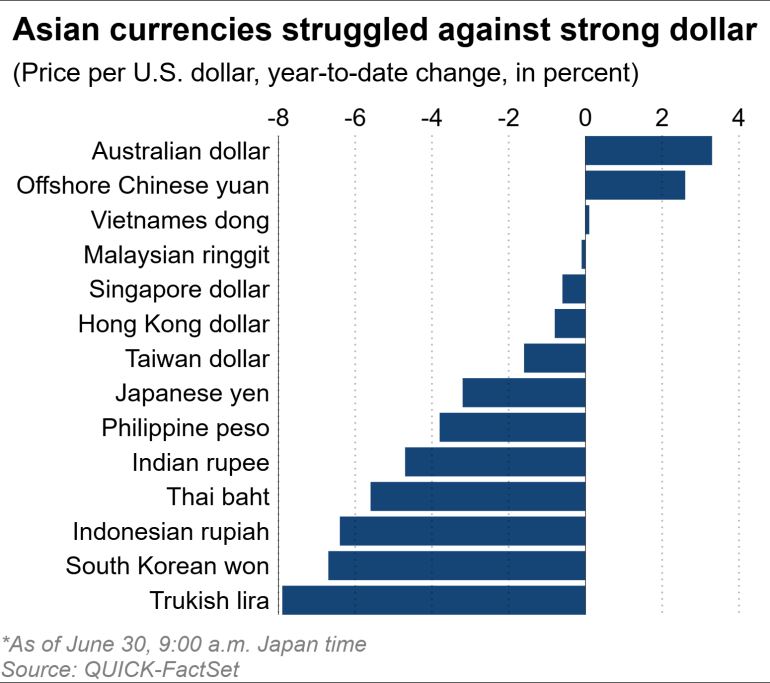
Asian currencies did not get the memo. The won at a 17-year low near 1,545 despite the Kospi doubling, the yen at its weakest since 1986, the rupiah at a record low, the baht at a one-year low. Foreign investors pulled roughly $81 billion from Korean equities this year even as the index doubled, hedging the currency all the way. The AI exports boom and the FX weakness are the same trade seen from two sides, and the inflows do not come back without a USD-weakness run. Source: Nikkei Asia.
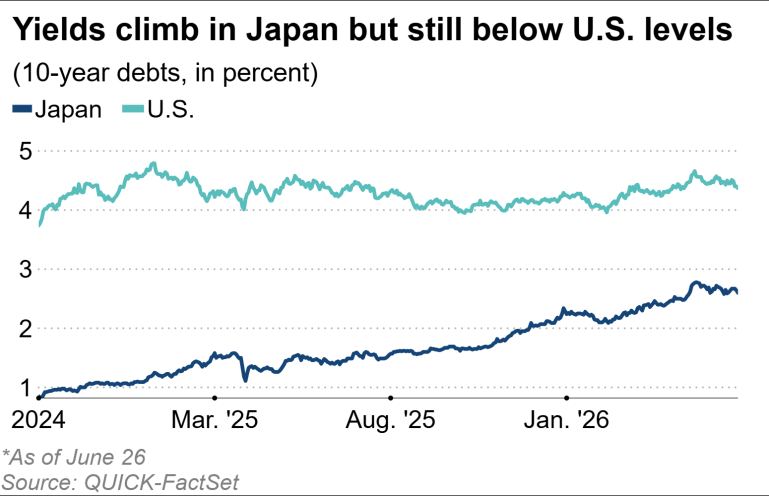
Asia bonds repriced a generation. JGB 10-year yields at 2.8%, the highest in 29 years, Korea above 4% for the first time since 2023. The BOJ at 1%, its highest in three decades, still called behind the curve. The range talk now centres 2.5-3% for the JGB 10-year. The era of free Japanese money that anchored every carry trade in Asia is closing one meeting at a time. Source: Nikkei Asia.
Minutes Wednesday
The gate of the week has a byline. RBNZ 10am Singapore first, a hold at 2.25% expected but the consensus is genuinely split and a hawkish surprise is the risk. Sweden CPIF, Poland and Romania through the London day. Then the FOMC minutes at 2am Thursday Singapore time, the first written record of the Warsh committee. The account reflects the hawkish June dot plot drafted before the jobs miss, and the new chair may already have made the minutes shorter and less detailed. A market that just pushed hike pricing to December can be disappointed in both directions, which is what makes Wednesday the only day this week to be properly awake for.
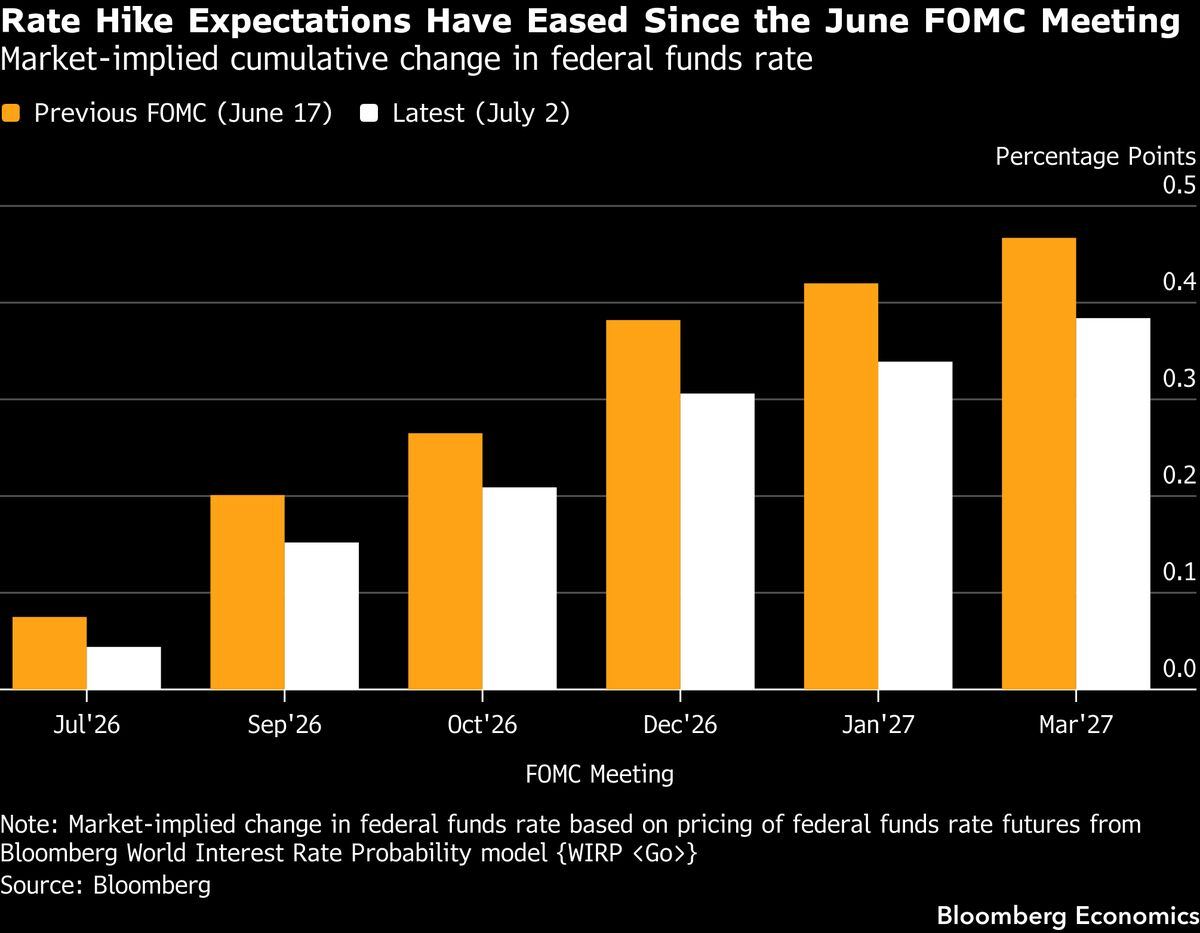
FOMC minutes Wednesday — the first meeting under the new chair, and the risk runs hawkish. In April a majority judged tightening likely appropriate if inflation stayed persistently above 2%. With half the June dots showing at least one hike this year, that view firmed. Watch whether anyone put a hike in their baseline. Given the communications overhaul and the dramatically shorter statement, there is also a real chance the minutes themselves are shorter and less detailed. The account will read more hawkish than the market that has just pushed hike pricing toward December. Source: Bloomberg Economics.
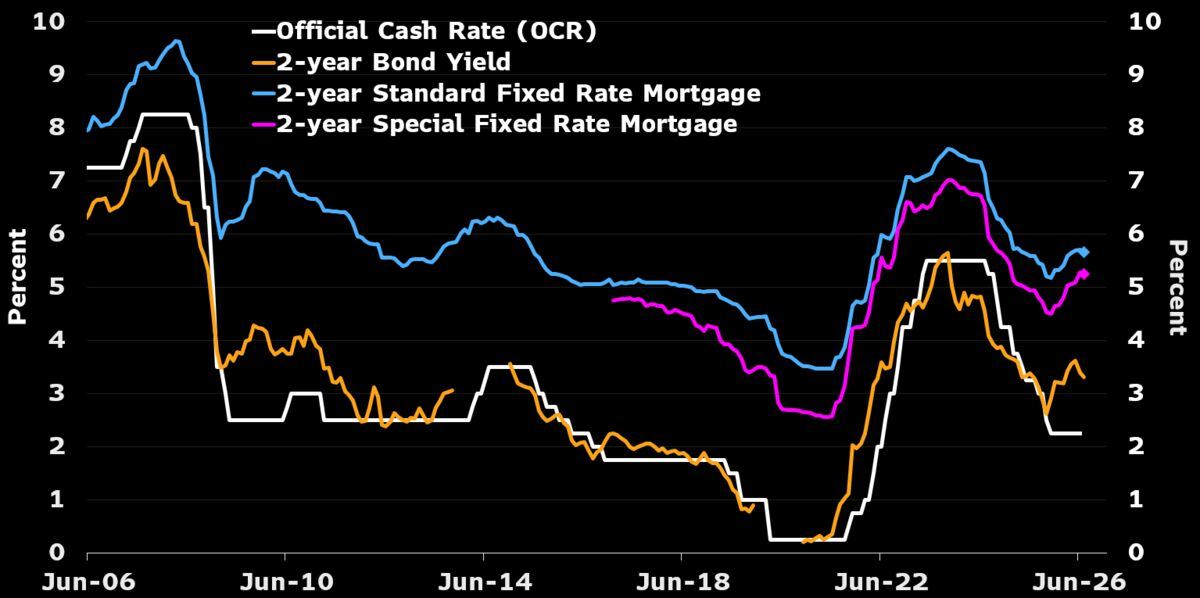
RBNZ Wednesday — likely holds at 2.25%, but the consensus is split with some calling a hike. Lower oil eases the near-term inflation risk that made May's hold finely balanced. Higher yields are already lifting mortgage costs and weighing on demand. The July decision lands before Q2 CPI, supporting wait-and-see into the August meeting with fresh forecasts. Source: Bloomberg Economics.
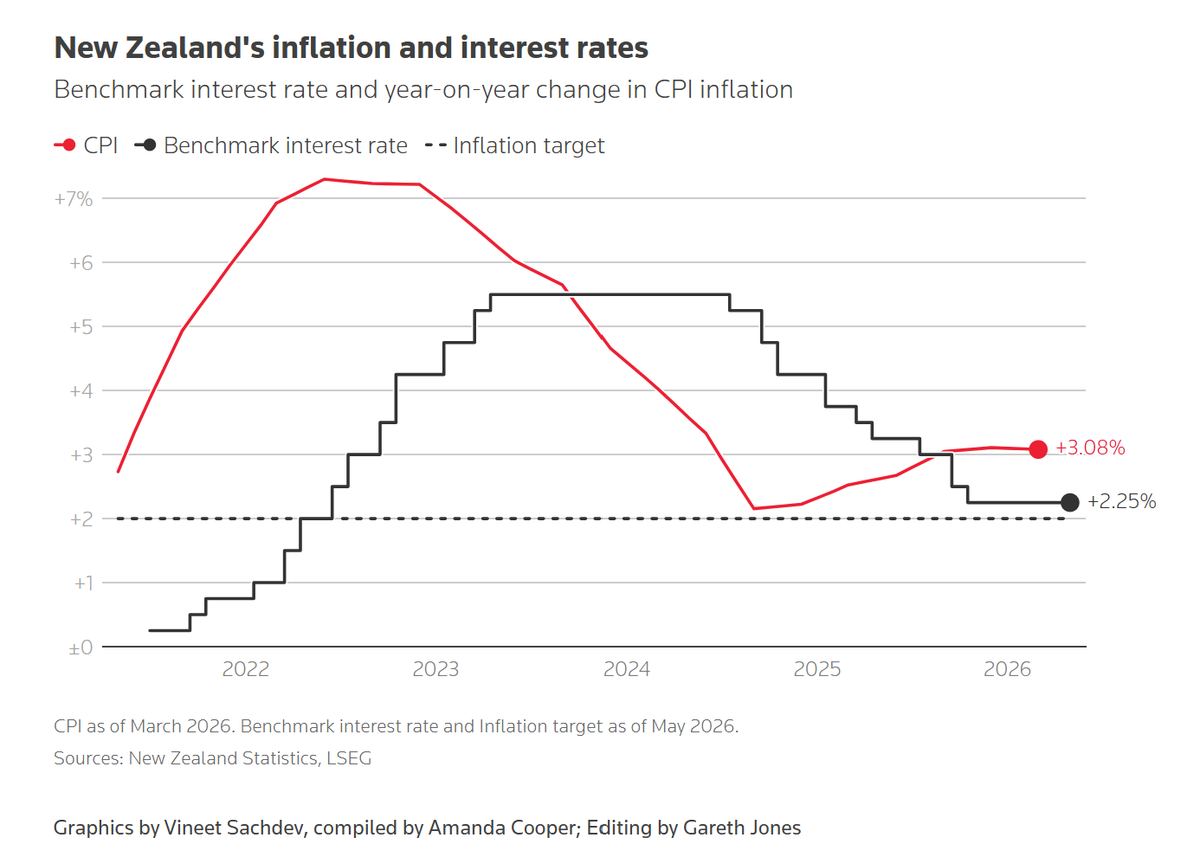
Asia inflation and the RBNZ. Investors are betting the RBNZ could join the RBA in raising rates, though brokerages pared hike forecasts once oil returned to pre-war levels. Inflation stays above target for some time either way, and the IMF says the recovery has been delayed by the oil shock. China, Thailand, Philippines and Taiwan prints this week reveal how much of the energy surge passed through and how much washes back out. Source: Reuters.
AI Winter in Summer
The theme carries into a third week and the industry's own winners are now supplying the material. Microsoft closed its worst month in more than 25 years, down 22% this year, the heaviest AI spender no longer rewarded for spending. AI usage prices are falling into the largest capex program in corporate history. The agent-economics debate has moved to the enterprise bill, $13 a day for a coding agent against $300 for the engineer, with usage compounding fast enough that one company blew its annual AI budget in four months. The copyright war has a price precedent. And the hour-by-hour telemetry of what people actually do with AI is now published data. The quote at the top of this letter is the theme.
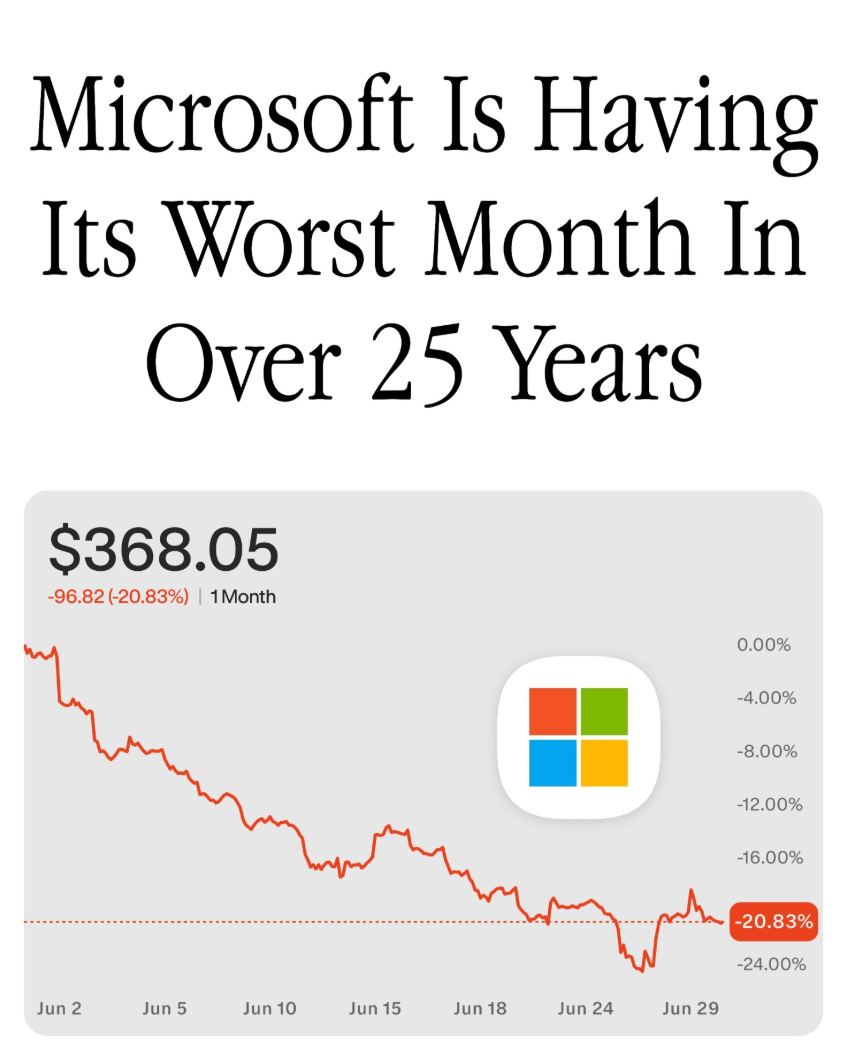
Microsoft just closed its worst month in more than 25 years, down 22% in 2026. The heaviest AI spender has yet to convince investors the $190 billion of data-centre capex converts to profit, and Azure guidance of "modest" growth did not help. The last time the stock had a month like this was December 2000. The second worst was February 2008. The company is fine. The precedents are not. Source: Instagram.
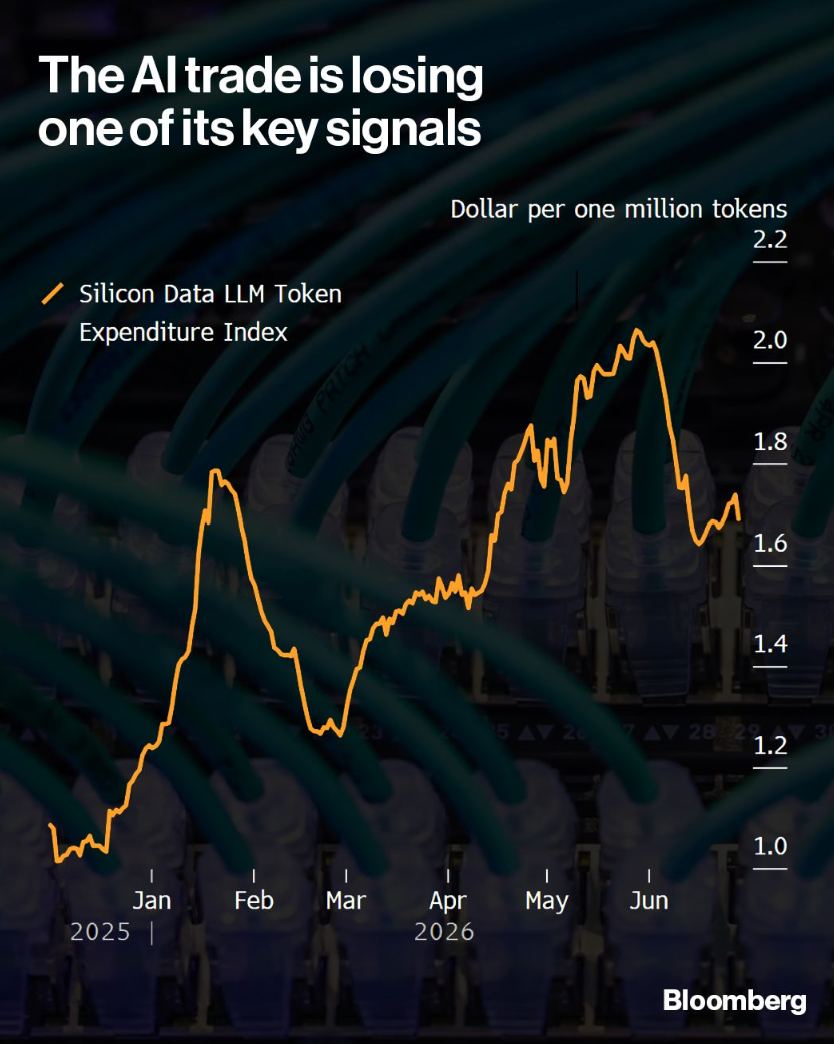
Prices for AI usage are falling. For the equity story that is a warning, because the revenue line underwriting the capex boom assumes pricing holds. Falling usage prices are great for adoption and terrible for the payback math on $725 billion of guided 2026 hyperscaler spend. The deflation the technology promises eventually shows up first in the sellers' own income statements. Source: Bloomberg via Instagram.
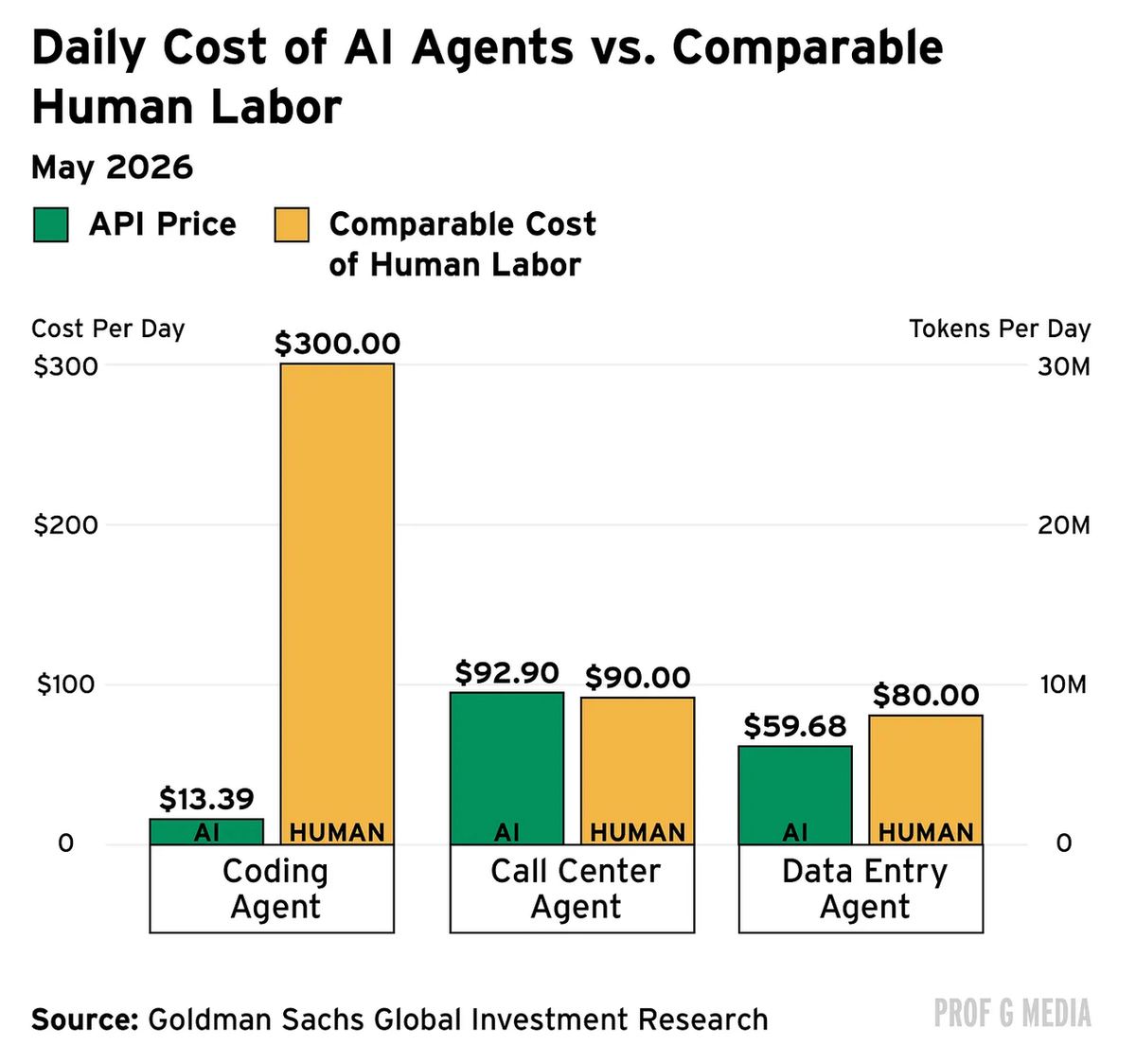
A coding agent costs $13 a day against $300 a day for a software engineer. The economics invert in lower-wage roles, where a call-centre agent can cost slightly more than the human. Costs escalate quickly at scale, one Anthropic employee reportedly generated $150,000 of Claude Code usage in a single month and Uber exhausted its 2026 annual AI budget in four months. The enterprise question has moved from whether AI can do the work to whether the productivity gain justifies the compute bill. Source: Goldman Sachs via Prof G Media.
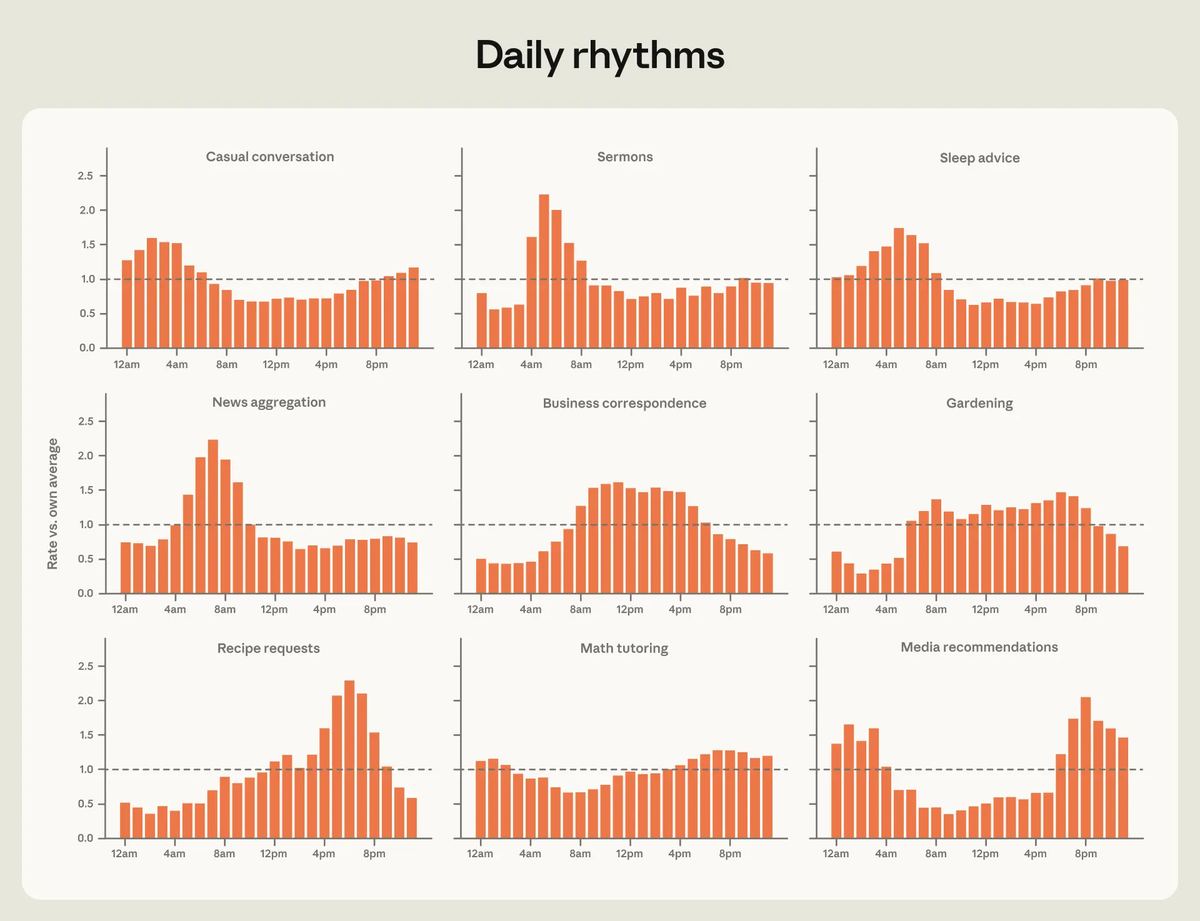
What people actually do with AI, hour by hour. The request-cluster data shows coding dominating working hours and creative and personal requests filling the evenings, the first real telemetry on how AI labour substitution is distributed across the day. This is the demand side of the token economy the sellers keep repricing. The pattern to watch is whether the work-hours share keeps growing, because that is where the enterprise spend lives. Source: Anthropic Economic Index, June 2026.
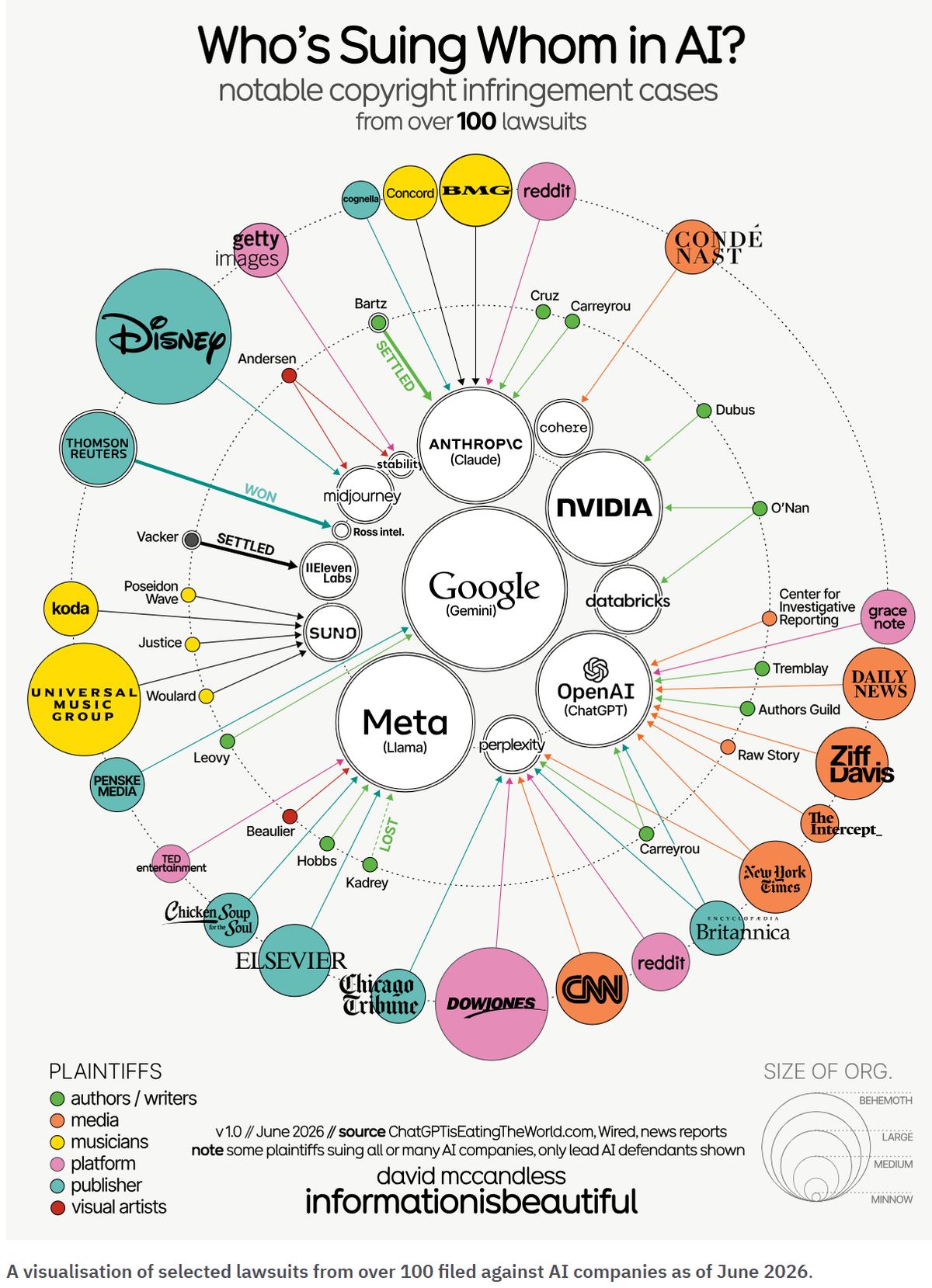
The AI copyright war, tallied. OpenAI faces 24 lawsuits, Meta 14, Microsoft 10, Anthropic 9. The Bartz settlement, $1.5 billion, was the largest copyright settlement in US history and set the precedent the pile-on cases are riding. Disney calls Midjourney a bottomless pit of plagiarism, the labels say Suno is the largest music theft in history. This is the structural fight over who owns the raw material of the internet, and the settlements are becoming a real line item in the AI cost stack. Source: ChatGPT is Eating the World / Wired.
Disinflation Thursday
The day the falling-prices story reports for duty. China CPI and PPI 9:30am Singapore, the read that feeds the PBOC easing speculation with the new overnight reverse-repo tool already set low. Malaysia BNM 3pm Singapore holds with inflation benign. The ECB June account lands mid-London, already outdated by the CPI undershoot, the September-hike case weakening in public. Eurogroup in Brussels. US claims and existing home sales through the New York morning, Williams and Logan on market liquidity after. The VW supervisory board decides on the four-plant closure plan, the hard edge of Europe's industrial story. Reciprocal tariffs revert unless extended. World Cup quarterfinals begin.
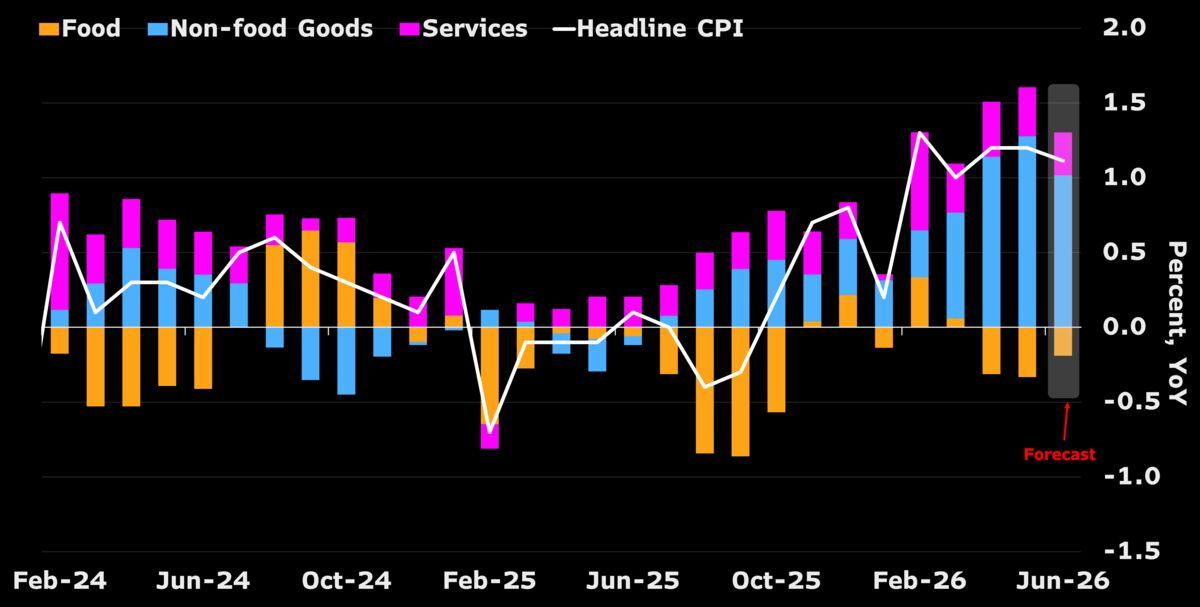
China CPI and PPI Thursday — the disinflation read. PPI likely eased to 2.4% from 3.9% as oil and steel retreated, CPI edging down to 1.1% from 1.2% with pork leading food lower. The PBOC has introduced a new overnight reverse-repo tool and set the rate lower than expected, a signal of potential easing. A soft print builds the rate-cut speculation the fix has been hinting at. Source: Bloomberg Economics.
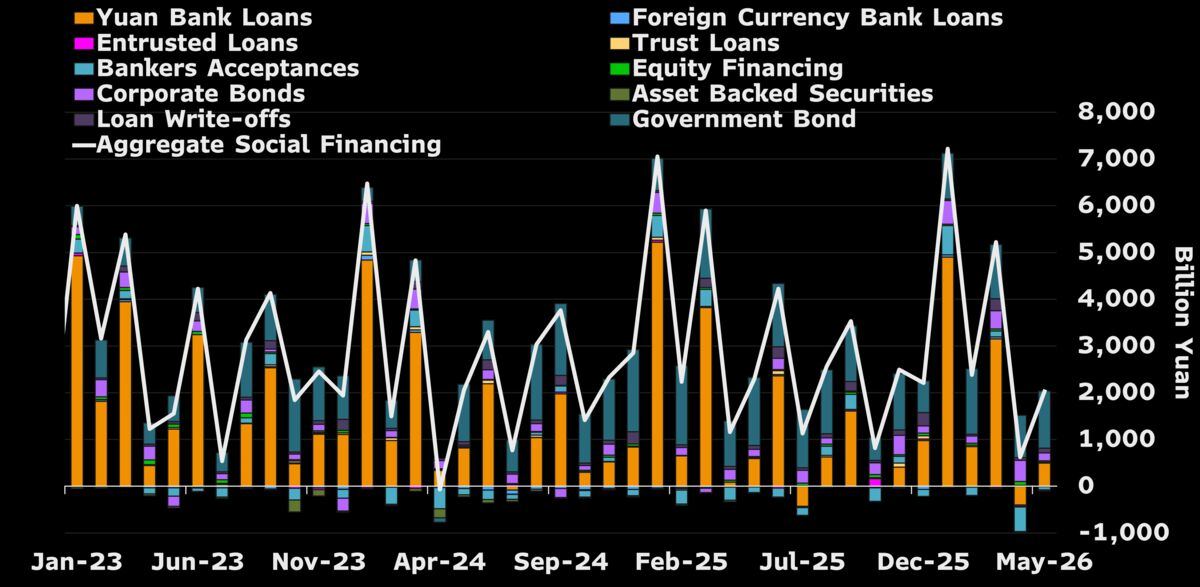
China aggregate financing due in the Jul 9-15 window — credit expansion stays soft. First-half total likely 21.4 trillion yuan, below last year's 21.5 trillion equivalent pace, as government financing fell to 820 billion yuan in June from 1.4 trillion a year earlier. Private-sector financing picking up modestly is the silver lining. The credit impulse is not the stimulus story the AI-export boom is. Source: Bloomberg Economics.
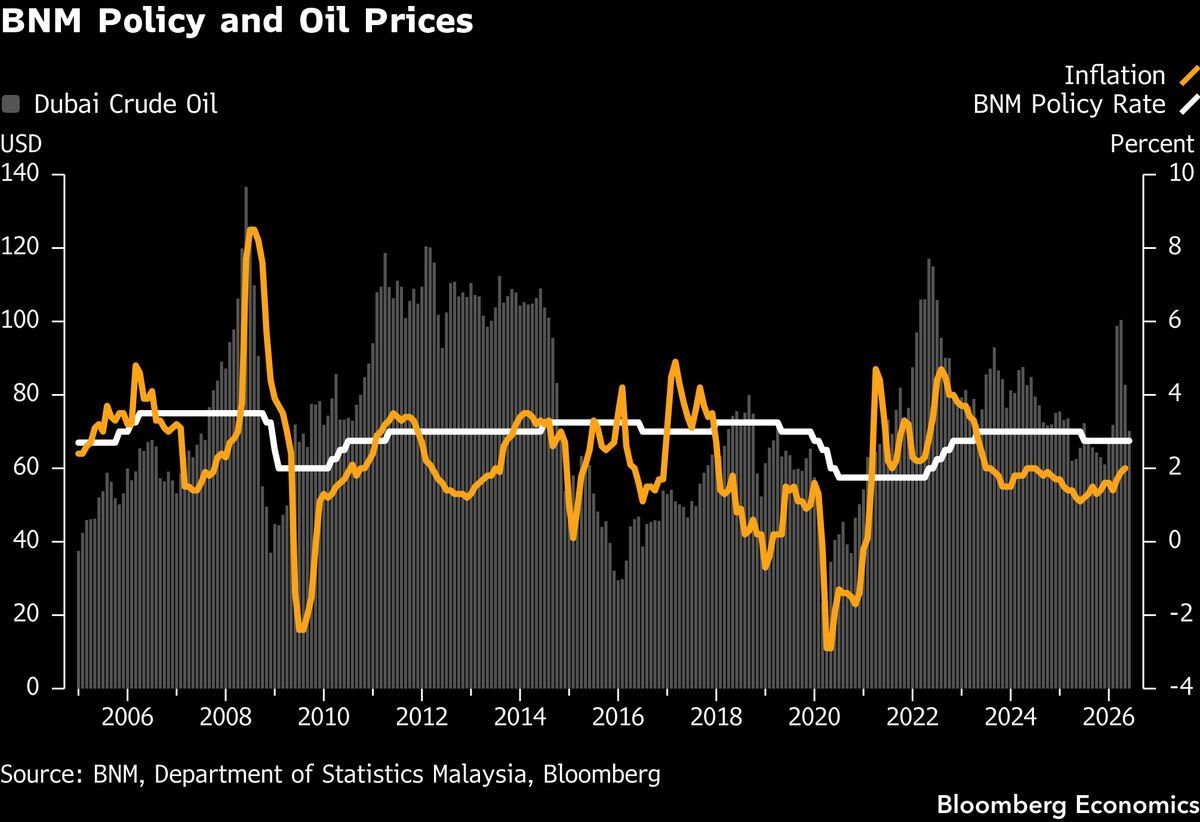
Bank Negara Malaysia Thursday — holds at 2.75%. Inflation benign at 2.0% in May, the oil shock never materially lifted it. Oil-related government revenues funded subsidies that leaned against pump prices, and crude's retreat to pre-war curbs expectations. The AI-boom electronics exports keep domestic demand buoyant, the second-round risk only builds if the subsidy scope narrows. Source: Bloomberg Economics.
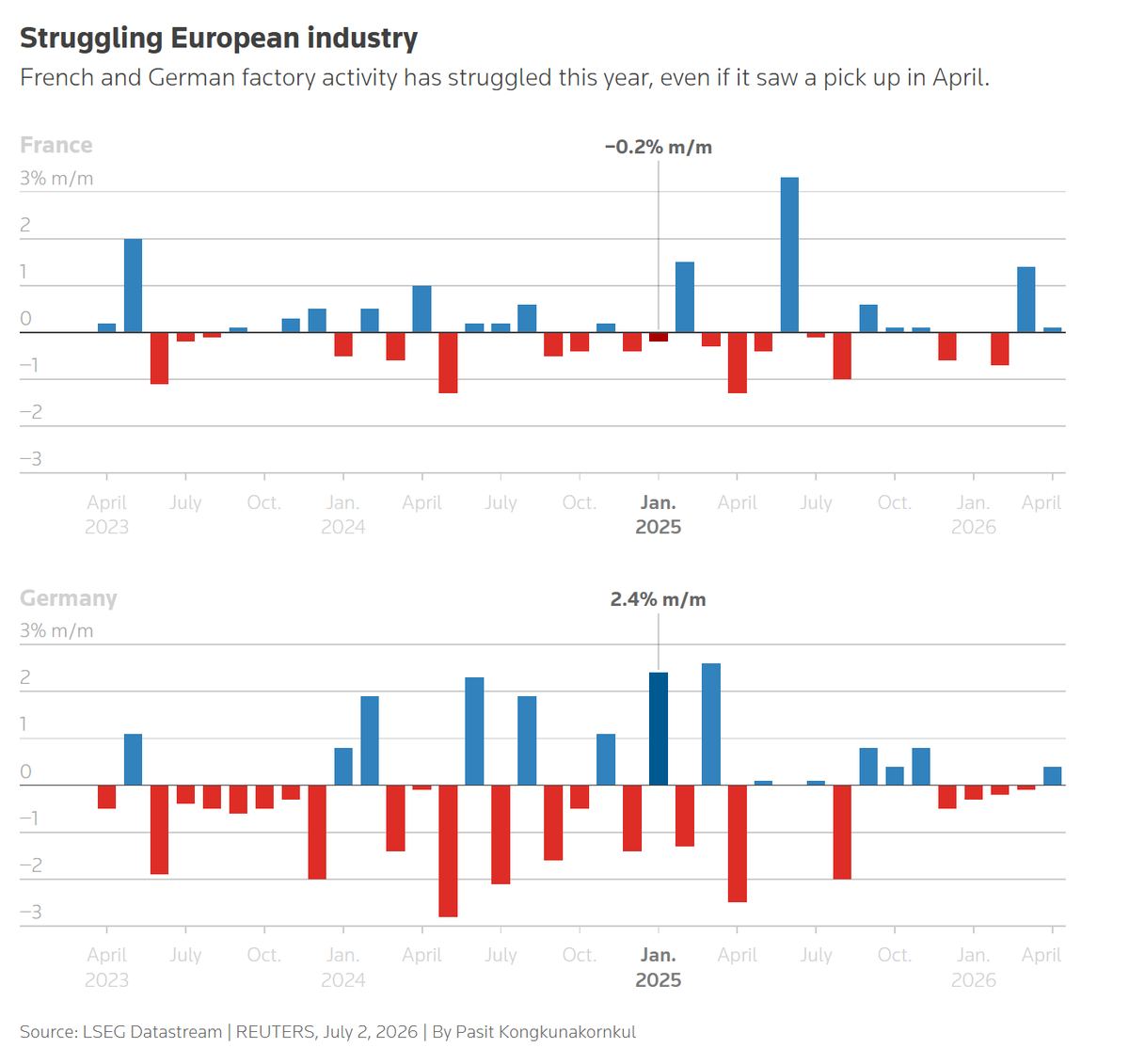
Europe's factories sputter while the China trade gap widens. German and French trade and industrial production land this week with Brussels angst over the widening EU-China gap fresh from the commerce-minister visit. Production in the three months to April was already flagging. Volkswagen is considering shutting four German factories and cutting up to 100,000 jobs, plans due at the July 9 supervisory board. The industrial heart of Europe is the case study in what the energy shock and the China competition do together. Source: Reuters.
Debut Friday
Two debuts close the week. SK Hynix ADRs list on Nasdaq, the AI-hardware listing of the summer from the company that just passed Samsung as Korea's most valuable. And Delta opens the US earnings season with options pricing a 6% move, the first read on whether the earnings that carried the market all year can keep doing it. Canada jobs 8:30pm Singapore gives back May's blowout, 15k expected after 87.8k. Japan PPI early Singapore, Germany final CPI through London, Saudi rating review after the close. The week fades into the World Cup quarterfinal weekend.
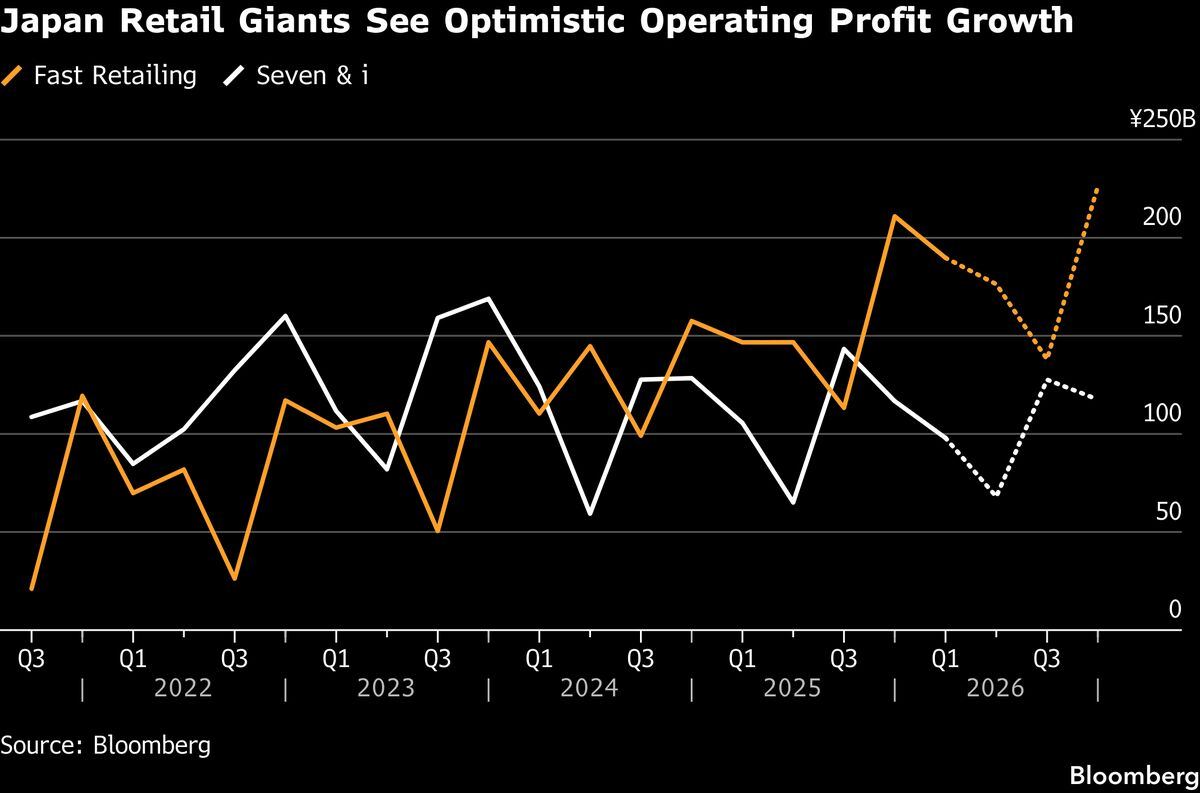
Asia earnings open the season. Fast Retailing heads for a 14th straight quarter of operating profit growth on Uniqlo's overseas strength, inflation making affordable clothing attractive. Seven & i sees tailwinds from gasoline margins with a ¥2 trillion buyback in play. TCS faces a fourth consecutive year of subdued revenue growth, the macro-plus-AI double-whammy on Indian IT. Yaskawa is the AI-robotics read, its fastest operating profit growth in 12 quarters on motion-control orders. Source: Bloomberg.
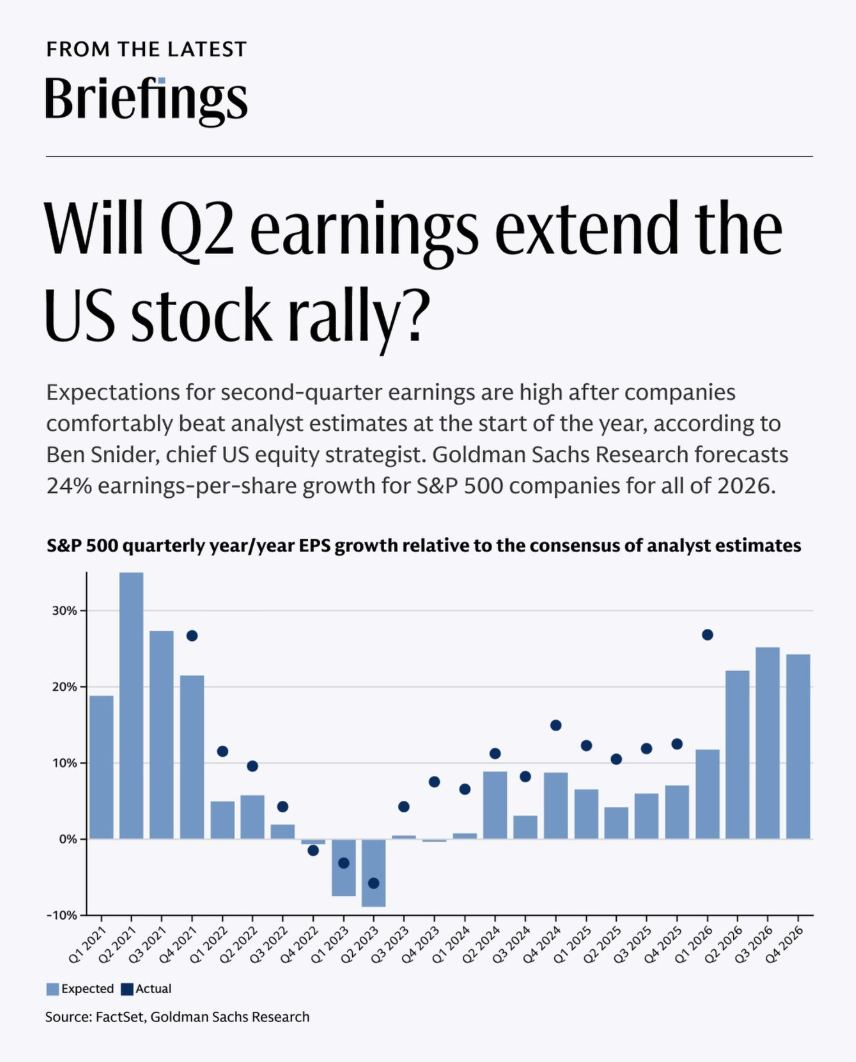
Earnings have carried US stocks this year, which makes Q2 season the next gate. With multiples already elevated and the AI capex bill compounding, the margin between beat and miss narrows. The season opens with Delta and PepsiCo this week, JPMorgan on the 14th, and the tech-heavy final week of July the one that matters. Source: Goldman Sachs Research.
VC+ Special Dispatch — The Great Capital Rotation
An eight-chart dispatch on how AI, energy and geopolitics are redirecting trillions. Capital that once chased apps and ad clicks is pouring into chips, data centres, power grids, batteries, minerals and missiles. Five tech companies spent over $140 billion on AI infrastructure in a single quarter. Nearly every NATO member has pledged 5% of GDP for defence. China took 71% of global battery investment and produces 99% of primary gallium. The through-line: electricity has quietly become the binding constraint on the entire AI trade, and every server rack is a bundle of geopolitical dependencies. Credit to the VC+ team.
The $141 Billion Quarter
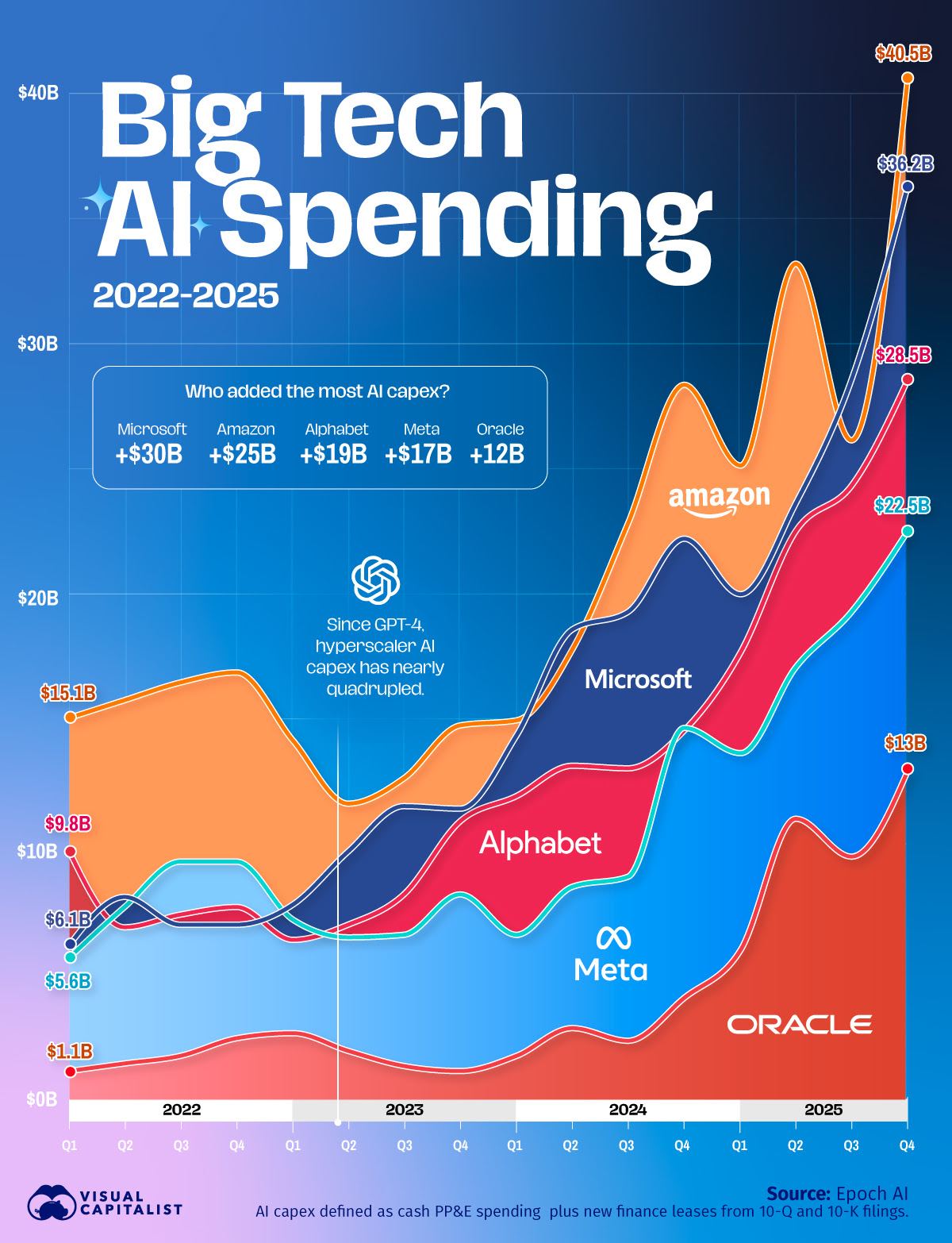
The $141 billion quarter. Since GPT-4 launched, quarterly AI capital spending by the five hyperscalers has nearly quadrupled, and their 2026 guidance adds to roughly $725 billion, up 77% from 2025. Spending at that scale is straining even Big Tech's famously deep cash reserves. The buildout is now as much a balance-sheet story as a technology one. Source: Visual Capitalist.
Where the World Keeps Its Compute
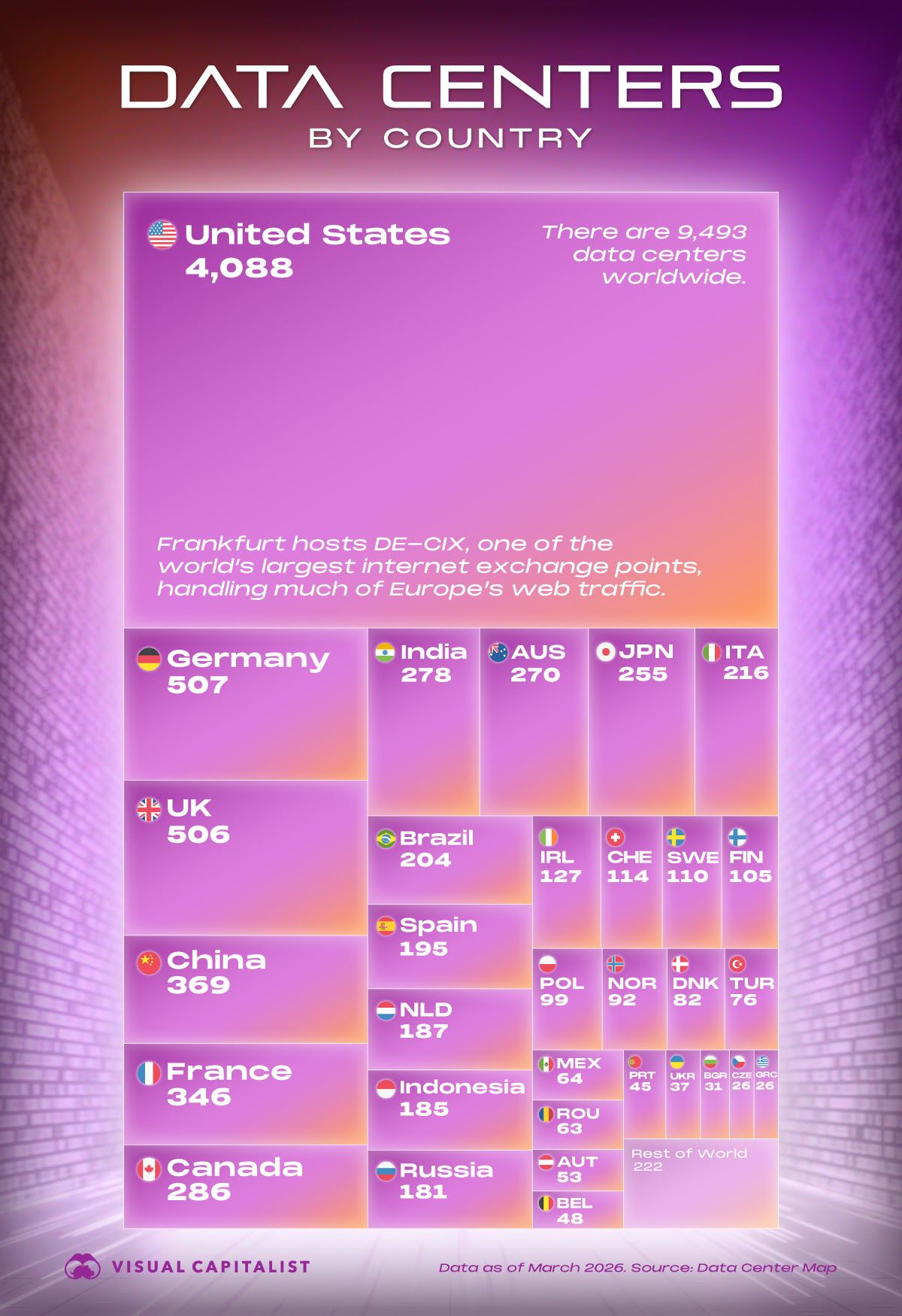
Where the world keeps its compute. The US hosts 4,088 of the world's 9,493 data centres, more than the next 14 countries combined. China lists just 369 despite its ambitions. The next wave may be sovereign rather than corporate, Stargate UAE's $30 billion campus in Abu Dhabi is designed to put national compute on national soil, first 200MW phase online this year. Source: Visual Capitalist.
The Power Bill Comes Due
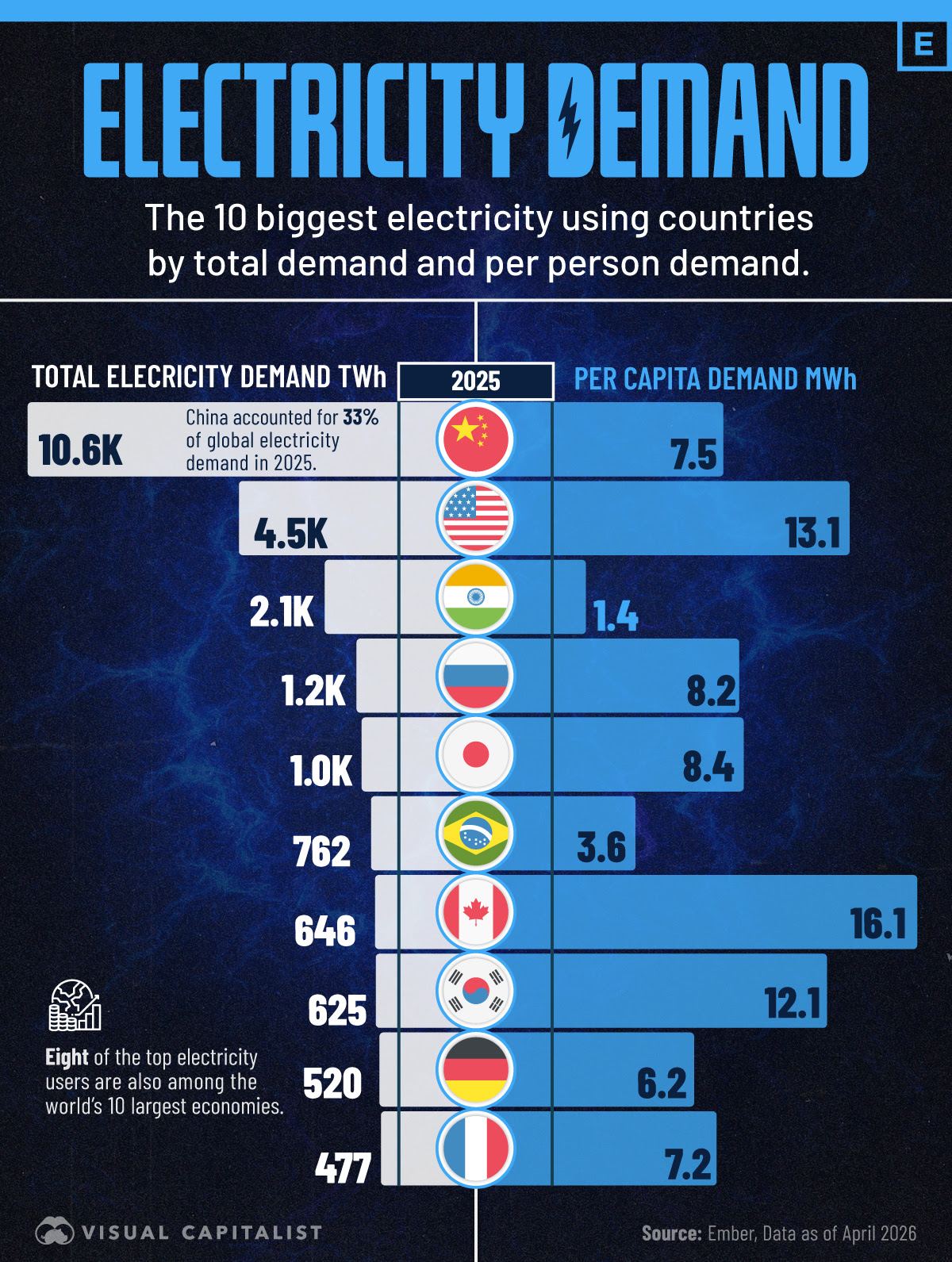
The power bill comes due. China consumed roughly 10,600 TWh of electricity in 2025, a third of the global total and more than double the US. Global demand grows 3.6% a year through 2030, about 50% faster than the past decade, and data centres nearly double to 950 TWh. Electricity has quietly become the binding constraint on the entire AI trade. Source: IEA / Visual Capitalist.
The Widening Generation Gap
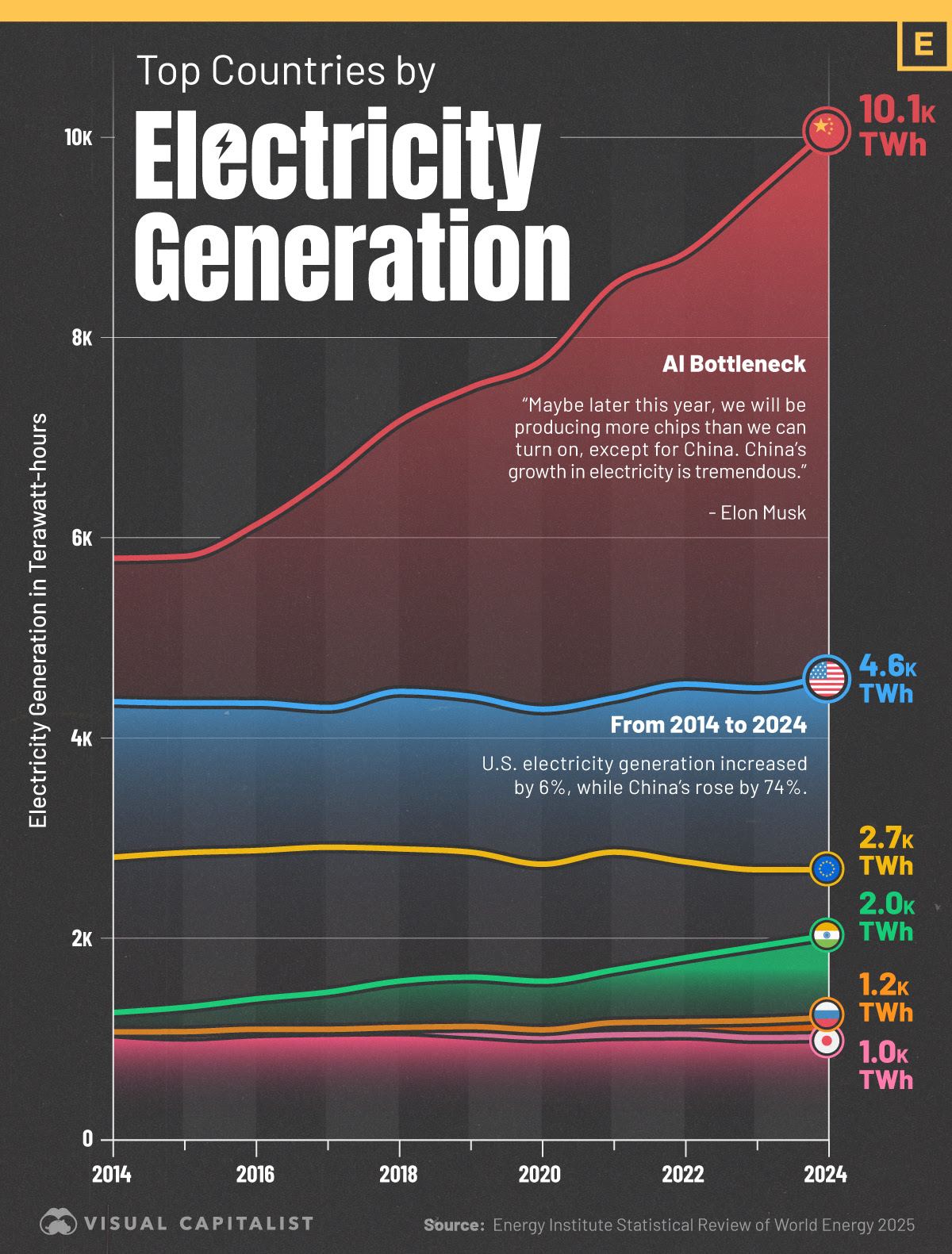
The widening generation gap. From 2014 to 2024, China's electricity output rose 74% while US generation grew 6%. China added more solar in 2025 than the rest of the world combined. America may soon produce more AI chips than it can power, which is the sentence that explains most of the US grid-investment story below. Source: Visual Capitalist.
Rewiring the World
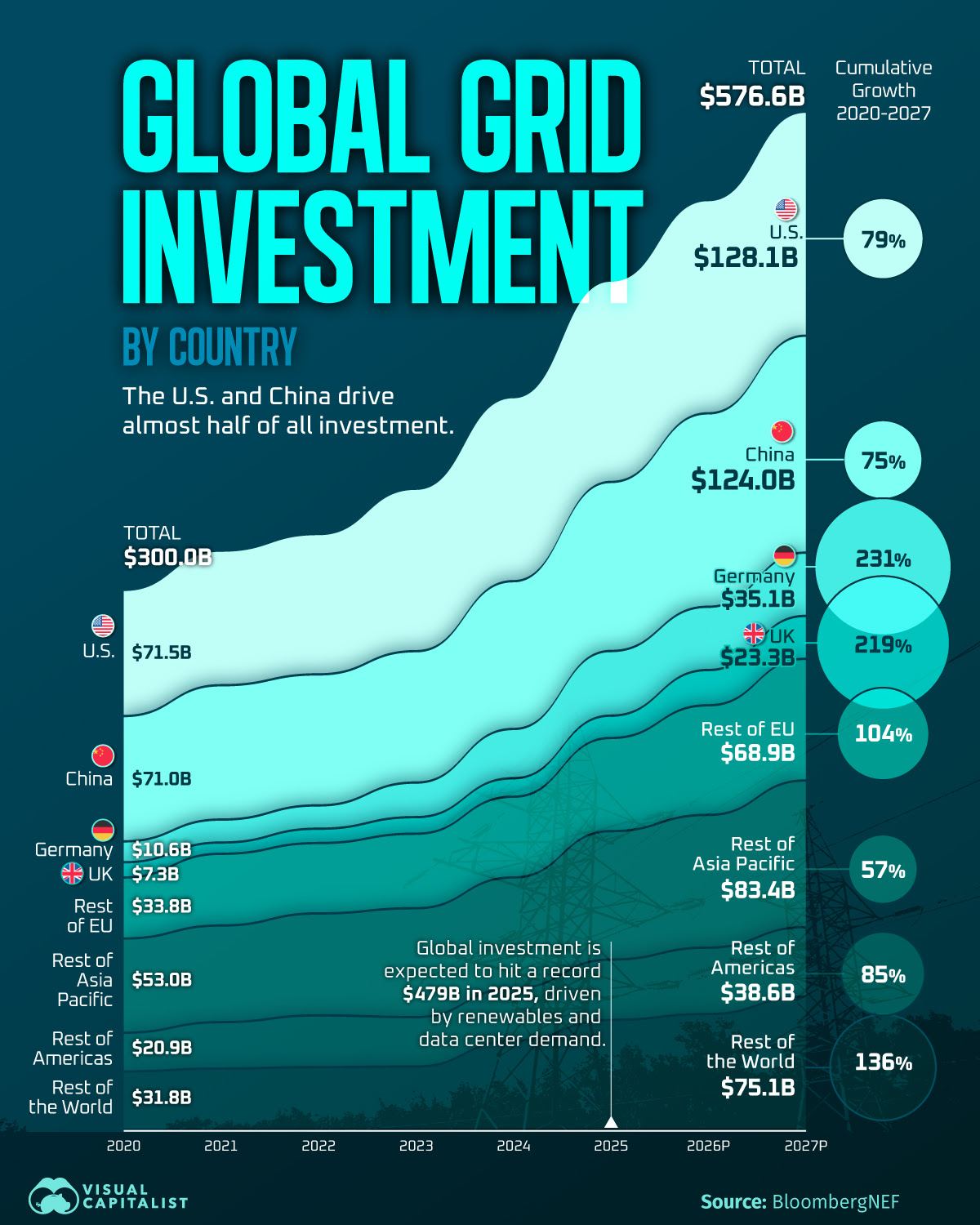
Rewiring the world. Global grid investment nearly doubles from $300 billion in 2020 to a projected $577 billion by 2027, a record $479 billion in 2025 alone. Money is now outrunning the supply chain, US lead times for large power transformers stretch to four years. Germany's 231% cumulative growth is the fastest of any major economy. Source: BloombergNEF / Visual Capitalist.
The Battery Money Went East
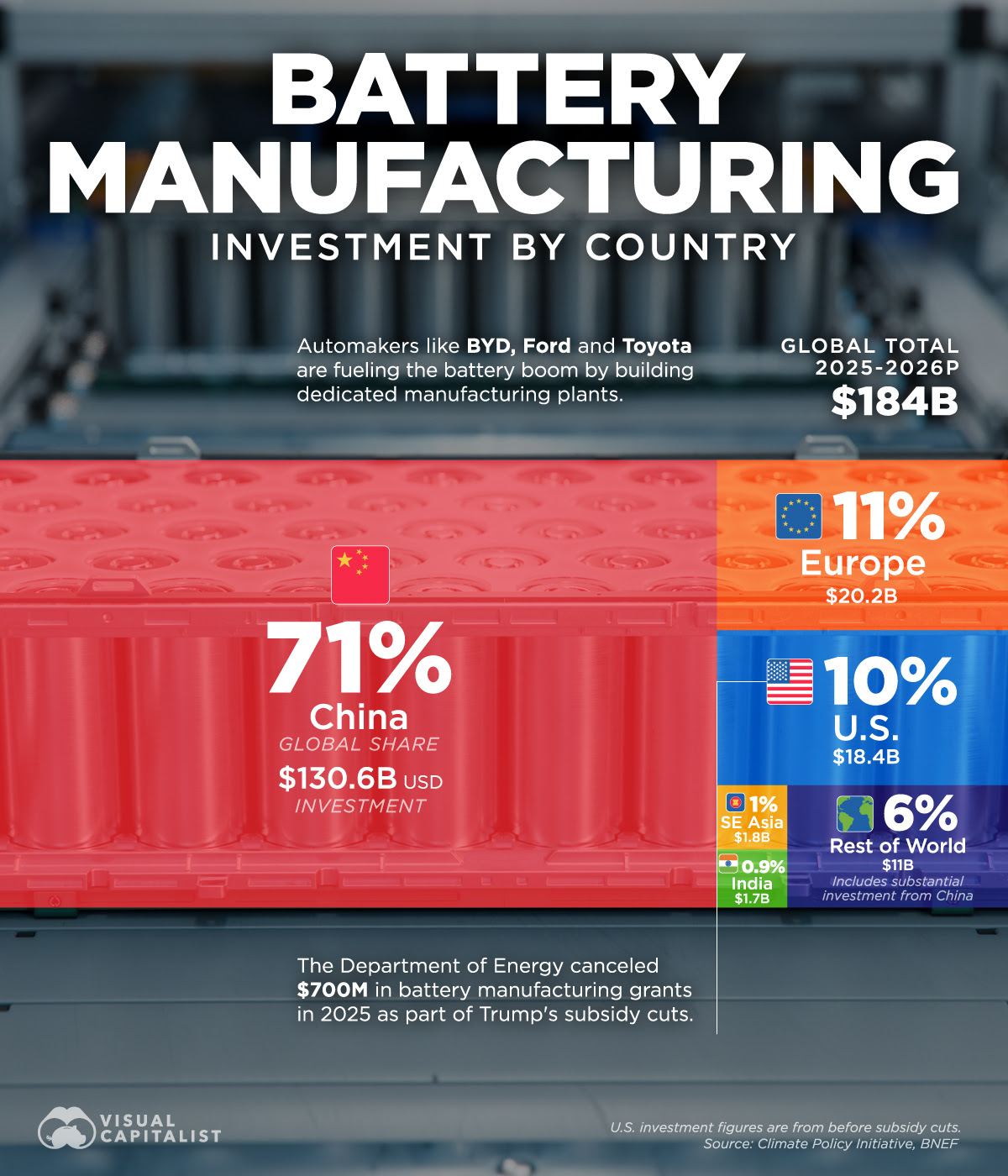
The battery money went east. Of the $184 billion flowing into battery manufacturing across 2025 and 2026, 71% is invested in China. Europe takes 11%, the US 10%, and the Western numbers flatter reality, they predate the DOE's cancellation of $700 million in grants and Northvolt's collapse. Even the rest-of-world slice carries Chinese capital. Source: Visual Capitalist.
The Chokepoints Beneath the Boom
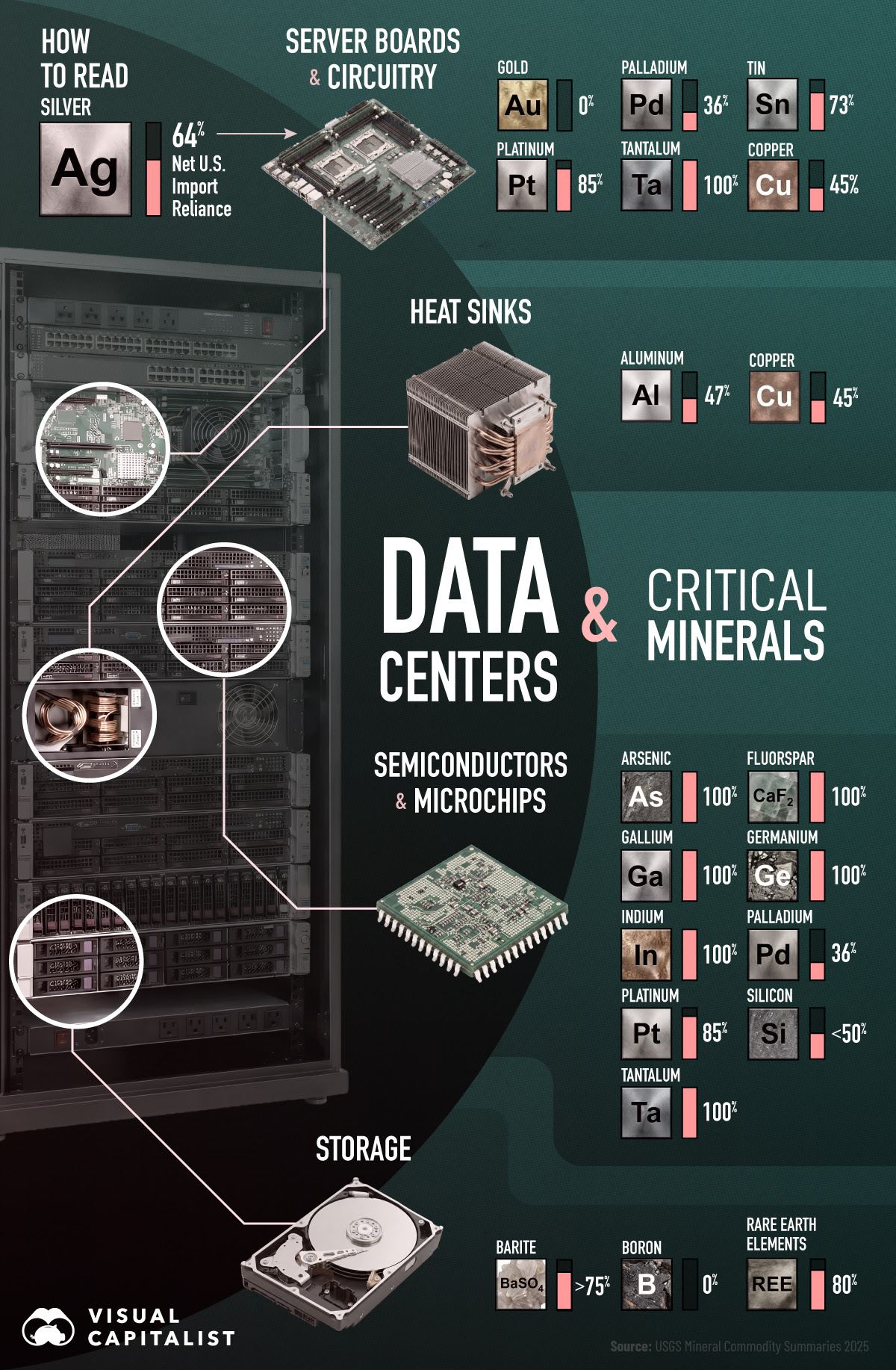
The chokepoints beneath the boom. The US is 100% import-reliant for gallium, germanium, arsenic, indium and tantalum, all essential to chips. China produces roughly 99% of primary gallium and has banned exports before. The Busan suspension notwithstanding, gallium exports remain down 94% from 2024 levels. Every server rack is a bundle of geopolitical dependencies. Source: USGS / CSIS / Visual Capitalist.
Rearmament Joins the Rotation
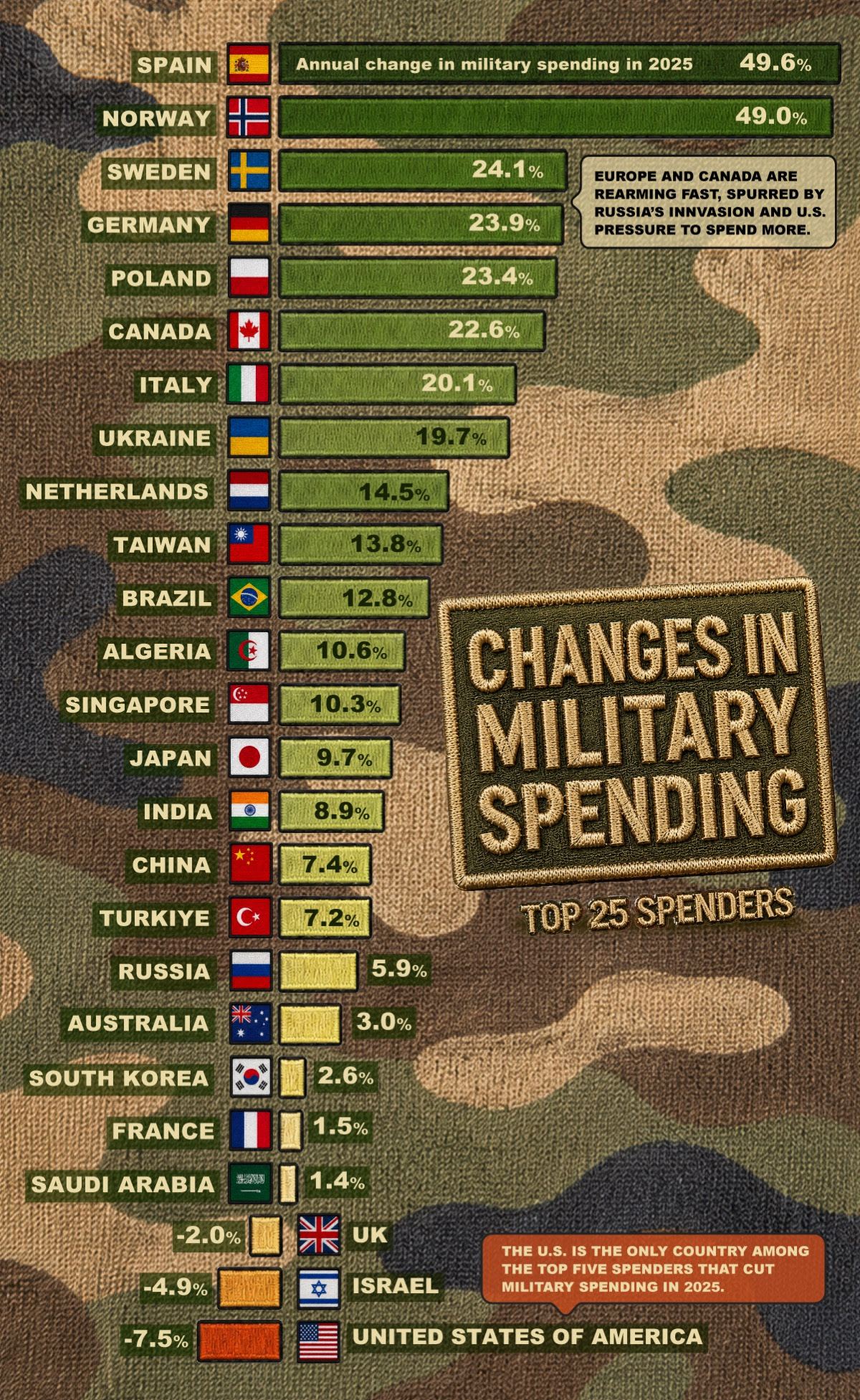
Rearmament joins the rotation. Spain and Norway led 2025 defence-spending growth at nearly +50%, Germany, Poland, Sweden and Canada all up more than 20%. The US cut 7.5%, the only top-five spender to do so. NATO's 5%-of-GDP-by-2035 pledge gives the surge staying power, and the twist is that Spain, the growth leader, negotiated the alliance's only exemption from the target it is outrunning anyway. Source: SIPRI / Visual Capitalist.
The Good Wrap
What is left at the close. The Super El Niño forming on the heels of the 11 hottest years on record, extreme heat already the deadliest climate hazard and few governments with a framework for it. The FT read on obesity and income in America, a 14-point gap between the poorest and richest thirds of women and almost none for men, a labour-market story hiding in a health chart. Closing on bâtonnage, the art of stirring the lees. Small decisions during maturation shape the final style, of a wine and of a book in a summer-doldrums market. The work that matters this month is the stirring.
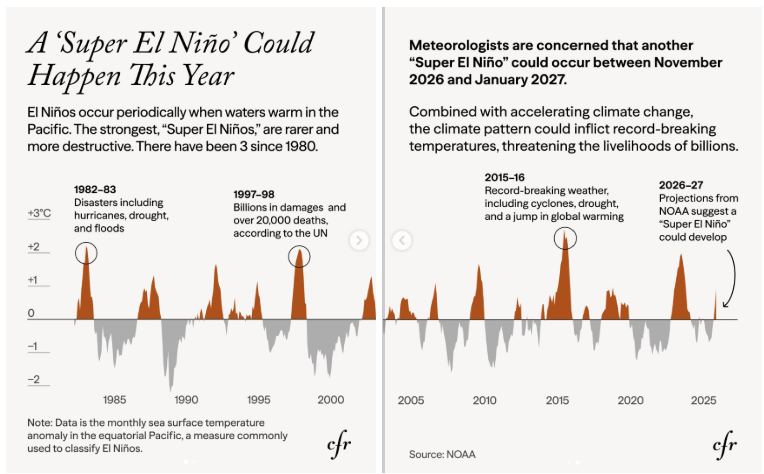
A Super El Niño is forming, and the framing has escalated. Sea-surface temperatures 2.0°C or more above average, on the heels of the 11 hottest years on record, with food and energy systems already strained by the war's fuel and fertiliser shortages. Extreme heat already kills more than half a million people a year, more than floods, fires and hurricanes combined, and is expected to cost the global economy $2 trillion annually by 2030 through lost productivity. Few governments have frameworks for it. The preparation window is closing. Source: NOAA / CFR.
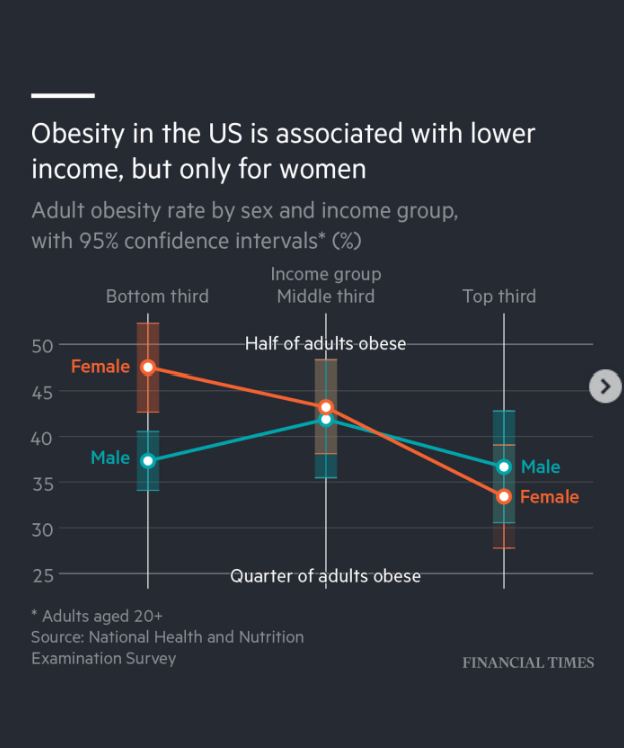
Obesity in the US is associated with lower income, but only for women. The poorest third of American women have an obesity rate 14 percentage points higher than the richest third. For men the gap is under a point. Europe shows the same pattern, less extreme. The uncomfortable possibility is that weight is not merely an outcome of poverty but a driver of it, through confidence and discrimination channels that hit women specifically. A labour-market story hiding in a health chart. Source: FT / NHANES.
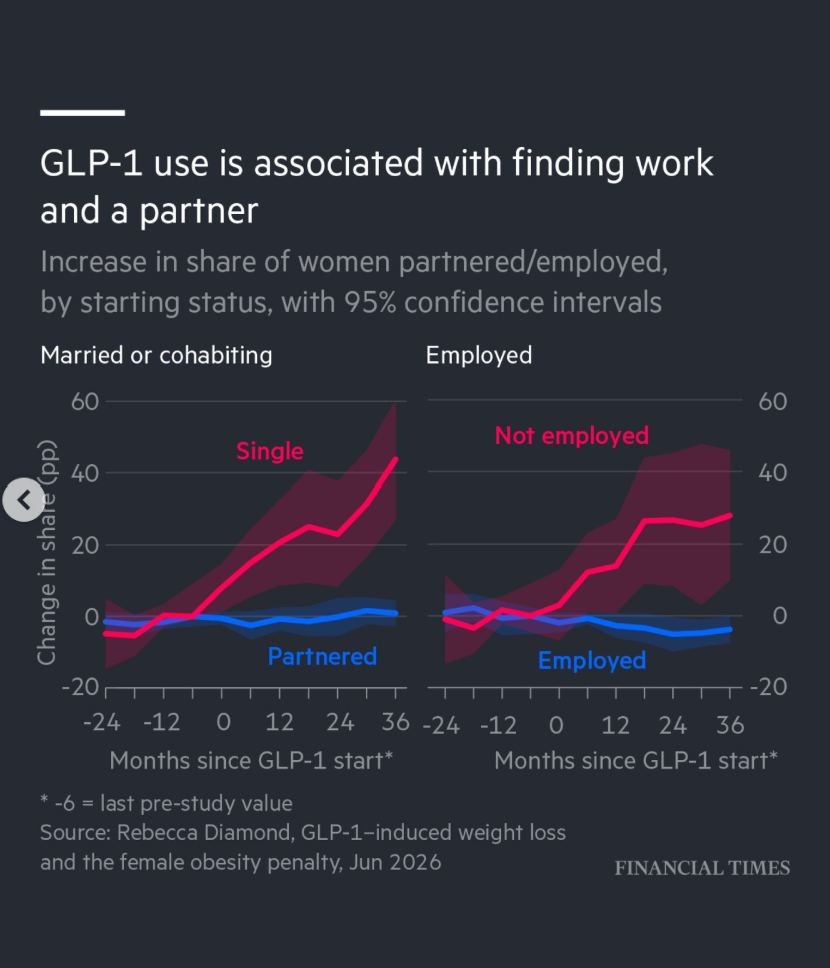
The same divide, drawn across countries. The income-obesity gradient is a rich-world regularity with a gender asymmetry embedded in it. Whatever the mechanism, the economic cost compounds through wages, participation and health spending. The chart pairs with the one above it. Source: FT / NHANES.
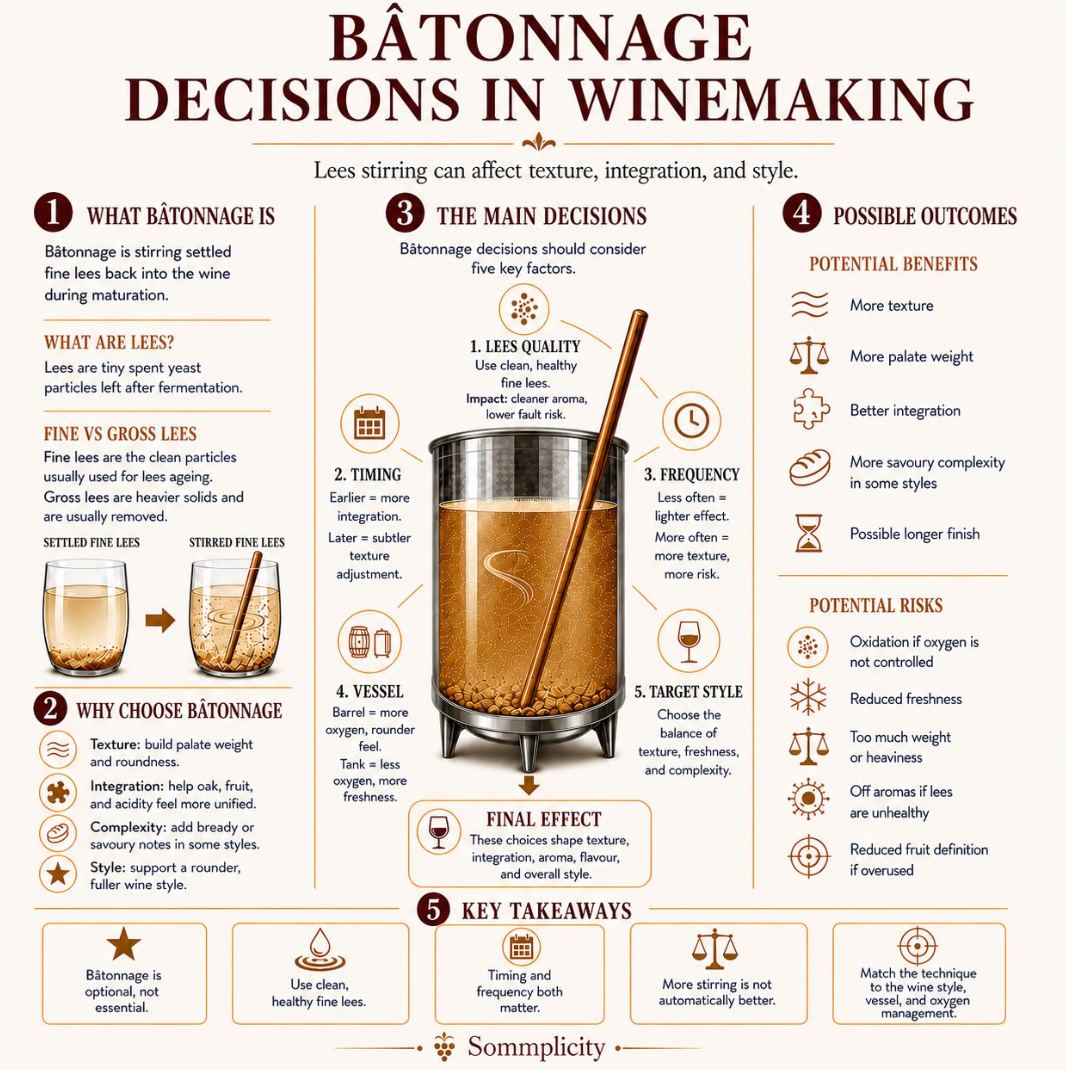
Bâtonnage, the art of stirring the lees. Small decisions during maturation have lasting impact, texture, integration, final style. The same is true of a portfolio in a summer-doldrums market. The work that matters this month is not the trade, it is the stirring. A Sunday closer. Source: Instagram.
Best,
Hoelon
WITPTW is a personal publication. Everything here is personal opinion and market commentary, written in a personal capacity. It is not investment advice and not a recommendation to buy or sell any security. It is not associated with, endorsed by, or representative of any employer, fund or company. Charts and images are reproduced from their original publishers, credited to their sources for commentary and discussion; all rights remain with the respective copyright holders.