The Full Day's Test
Personal views and market commentary. Not investment advice. Not associated with any employer or firm.
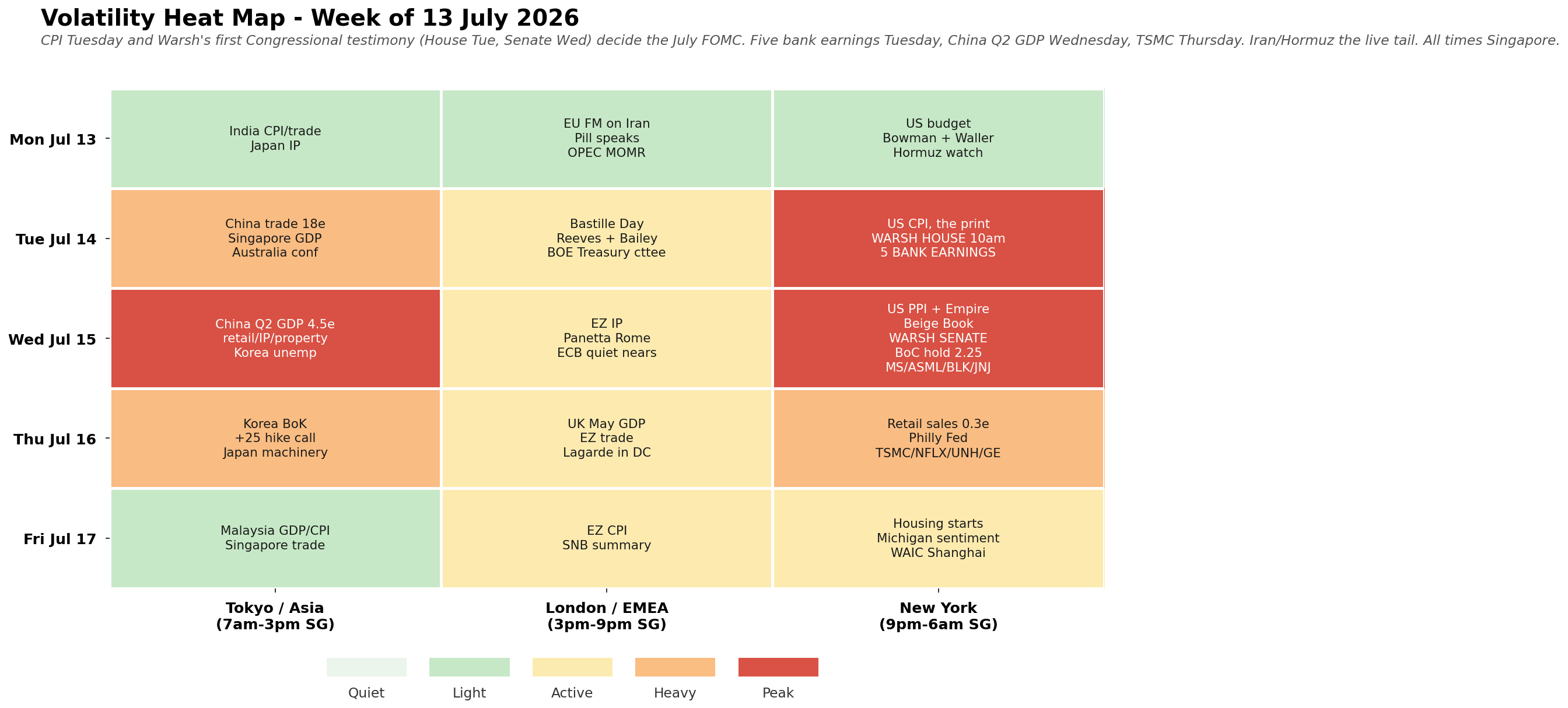
Volatility heat map for the week ahead, all times Singapore. The busiest scheduled week of the summer. Tuesday alone stacks June CPI, the new chair's first Congressional testimony and five of the six largest US banks reporting before the New York open. Wednesday adds China Q2 GDP, the Bank of Canada, PPI, the Beige Book and the chair's second appearance, this time before the Senate. Thursday brings the Bank of Korea and TSMC, Friday the euro-area CPI and Michigan sentiment. And behind all of it, a weekend of fresh strikes around the Strait of Hormuz that could steal the whole tape.
"The Stone Age did not end for lack of stone, and the Oil Age will end long before the world runs out of oil." — Sheikh Ahmed Zaki Yamani, former Saudi oil minister. I confess I find it hard to follow the view that this Middle East conflict drags on for much longer, when the oil price action keeps telling me the opposite. Strikes resumed around Hormuz over the weekend, Iran declared the strait closed, and crude still trades offered, back near pre-war levels within weeks. The shale charts later in this letter explain most of it, a marginal barrel that no longer waits on the Gulf. Yamani was talking about demand and technology, not tankers, but the instinct travels. The thing that ends the Oil Age is not a war in the strait. It is everything being built on the other side of the energy charts below.
"Warsh in his speeches and publications has been very clear that he expects things to change at the Federal Reserve. The people he has appointed to these task forces simply double down on that expectation." — John Mauldin's Frontline Thoughts. Kevin Warsh's appointments may reveal more about the future of Fed policy than the next CPI release. His Inflation Task Force comprises Greg Mankiw, Thomas Sargent and William White, three economists known for their emphasis on policy credibility, inflation discipline and the risks of loose monetary policy. Meanwhile, his Productivity and Jobs Task Force brings together Marc Andreessen, Microsoft's Asha Sharma and Stanford economist Charles Jones, who is currently at Anthropic, reflecting the view that AI driven productivity could become the key offset to inflationary pressures. Together, the appointments suggest Warsh is building an intellectual framework around two core beliefs: inflation must be defeated through credible policy, while stronger productivity, rather than lower interest rates, offers the most sustainable path to higher long term growth.
Joe Wiesenthal: "Balance sheet capacity is scarce."
Alex Altmann: "Balance sheet capacity is scarce and it will remain scarce so long as the S&P is trading at these levels... You have north of US$200 billion of AUM that has materialised in a relatively short period and, with more than 2x leverage, you're creating an additional US$400 billion plus of exposure sitting on bank balance sheets in swap format. This is one contributor, but don't overlook that multi manager platforms have grown to roughly US$1 trillion of AUM, essentially tripling since COVID, and they too are consuming balance sheet."
— Odd Lots: The Korean Levered ETFs Shaking Markets All Around the World. Levered ETFs are no longer simply a volatility story. The more important issue is balance sheet consumption. Korean levered ETF AUM has exploded from roughly US$12-13 billion at the start of the year to US$50-55 billion, while US levered ETF assets have grown from around US$120 billion in early April to over US$200 billion, largely driven by market appreciation. Every dollar of 2x or 3x leverage is largely synthetically financed through dealer swap books, consuming an increasingly scarce prime brokerage balance sheet. Overlay this with approximately US$1 trillion of assets managed by multi-manager hedge funds, record Treasury issuance and blockbuster investment grade bond supply, and the system is becoming progressively more balance sheet constrained. The question is no longer whether leverage amplifies volatility. It is whether dealers will have sufficient capacity to intermediate when multiple sources of forced rebalancing arrive simultaneously.
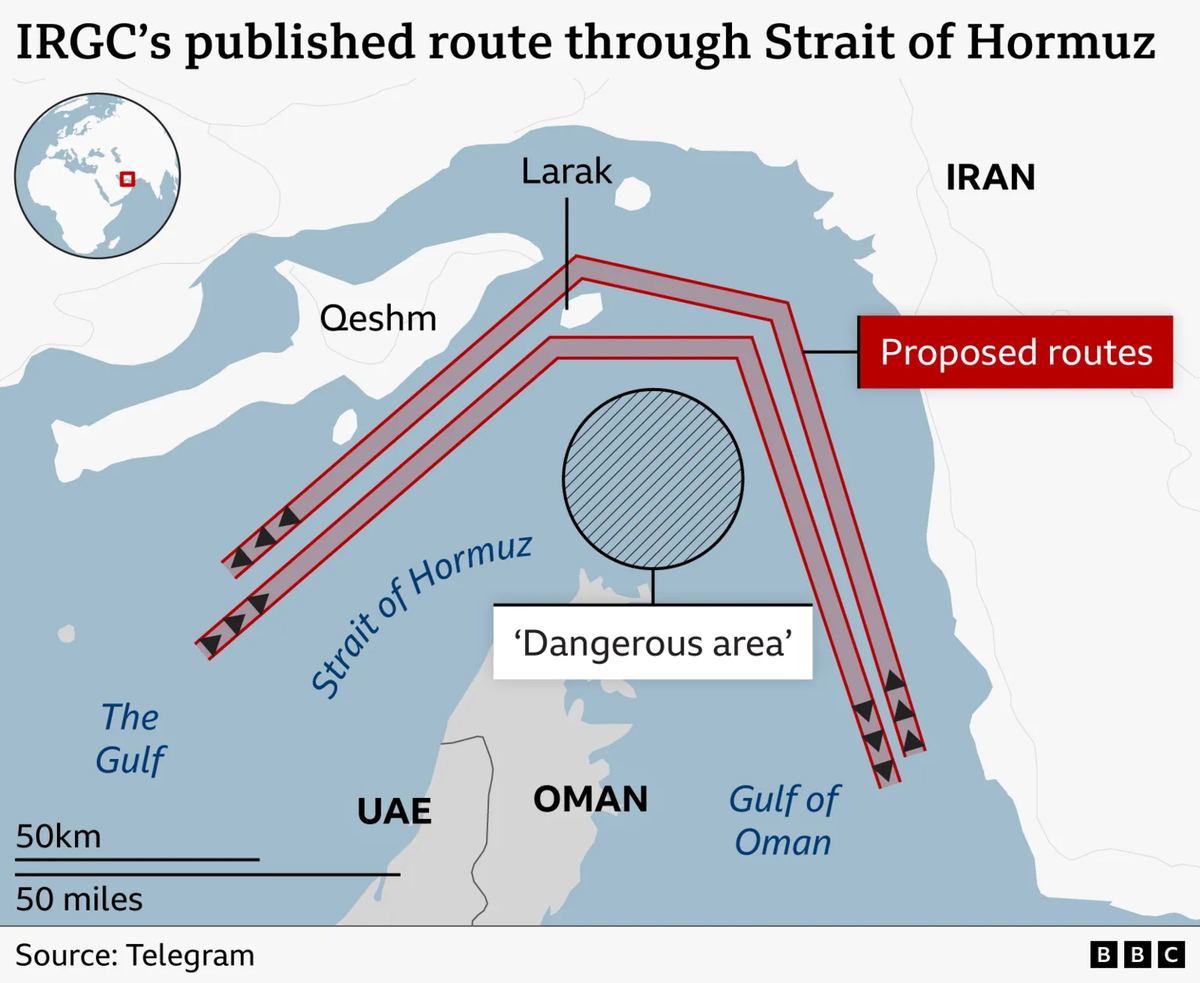
The map that matters more than the calendar. Iran's published route through Hormuz threads tankers past a narrow band it now calls a dangerous area, with the deep-water channels running close to Larak and Qeshm. A confirmed closure with vessels visibly diverting around the Cape of Good Hope would be a supply shock of historic proportions, the scenario that makes a September Fed hike near-certain and collapses whatever rate-cut pricing is left. The most violent surprise of the week is a geographic one. Source: BBC.
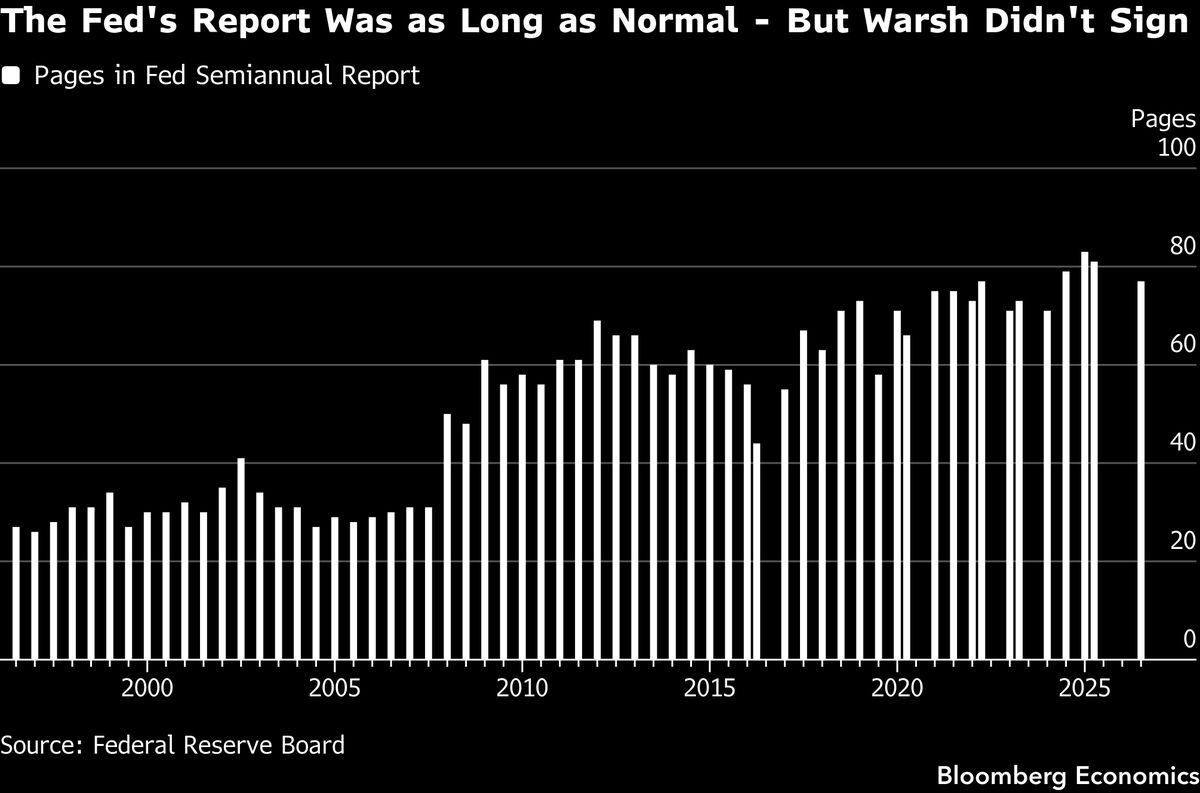
The Fed's report came in as long as normal, and that itself is the tell. For all the talk of a communications overhaul under the new chair, the July Monetary Policy Report ran a similar length to recent editions. What was different: it landed early, ahead of the testimony rather than alongside it, and it went out unsigned by the chairman. This week he defends it in person, House on Tuesday and Senate on Wednesday, his first-ever Congressional testimony, with fresh June CPI in hand and no dot plot to hide behind. He dislikes forward guidance, so the value is in tone, not signals, on whether a September move is on the table and whether AI-driven demand counts as an inflation driver. Source: Bloomberg Economics.
What is the plan this week?
Big week, with CPI and the Fed chair testimonials, and the outcome will pretty much be the decider of the July FOMC decision later this month. The market prices only about a one-in-four chance of a hike then, so it would take a genuinely hot inflation print and an overtly hawkish chair, both landing within the same few hours on Tuesday, to make the meeting live. Before any of that, the escalation in the conflict over the weekend might steal the limelight of global markets to start the week. Fresh strikes around the Strait of Hormuz, Iran declaring the strait closed, and the tape will watch the tanker tracks more closely than any data release. Oil prices bounced from the lows since the middle of last week, the first weekly gain in five, and the dollar is facing one of its longest accumulation-day streaks on record according to the CFTC data, the positioning quietly building long into all of it.
This week we also get the top banks earnings to kick off the season, and expectations are running for perfection, deal activity topped two and a half trillion in the first half and the trading desks that fed on this year's volatility are expected to show it. The markets are still frothy with activity on tech. SK Hynix's ADR is trading strongly in its debut, up double digits, and the concentration keeps building, three chips are now more than a quarter of the entire emerging-market index. China GDP lands midweek, seen slipping below the floor of the official target, though most of the quarter ran before the energy shock so the number reads as a floor rather than a snapshot. The split-screen is the frame for the whole week, the macro moving together on Iran while the micro pulls apart on who wins and loses in AI. And underneath the equity story sits the plumbing, balance-sheet capacity has become the scarce resource of the cycle, dealers net short corporate bonds for the first time on record just as the banks report.
On the data itself, headline CPI is expected to fall for the first time since the war began, a collapse in gasoline dragging the monthly number negative, but core is the harder read, still sticky on shelter and services with the tariff impulse fading. The bigger job is mapping the print into PCE, the gauge the Fed actually targets, and this cycle that is unusually messy. A scheduled change to the software and portfolio-management-services deflators due in late September means the clean read on the core run rate has to be backed out twice, once as reported and once on the revised basis, before it says anything about where year-on-year core PCE settles once the base effects are allowed for. One month of CPI, in other words, moves the tape but barely moves the argument.
And the argument is closer than the dot plot suggests. For all the hawkish flavour of the dots, only around four voting members actually back a hike this year, so a July move needs the marginal voter to shift, and the bar to July specifically looks high. Warsh testifies Tuesday but rejects forward guidance on principle, so the House committee is unlikely to get much from him. The real tell is the three centrist Governors, Williams, Cook and Jefferson, who all speak after the inflation data and before the blackout, Williams just after Wednesday's PPI, Cook that afternoon and Jefferson on Thursday. At least one would need to break cover and signal support for a hike for July to gain traction, and Williams has set his own bar at core PCE falling back to 0.2% month-on-month in the second half, which a single June print cannot satisfy and which by September he can judge with the July and August prints in hand. The task-force appointments point the same way, credible hawks on inflation and the venture-and-AI world on productivity, a framework built for patience rather than a July surprise.
The Asian currencies mostly sit at their weakest points, the yen near four-decade lows and the won near multi-year lows, both closing weaker again last week even as their equity markets ran. That divergence is the AI trade seen from two sides, and only a proper dollar-weakness run reconciles it. A soft core CPI is the most direct catalyst to unwind it, USDJPY through 161.50 opening a move back toward 159.50 to 160.50, which would not end the yen's structural problem but would hand Tokyo and the Bank of Japan some breathing room. The Bank of Korea is seen starting a tightening cycle on Thursday, a rate tailwind to the won leg. Tokyo is already on a no-telegraph intervention doctrine and Seoul is watching, so any official move would come without warning.
The plan is to stay short USDJPY and USDKRW, coming off another weak close last week. Last week's re-escalation on the Strait of Hormuz caused a spike in oil prices, and so did USDJPY and USDKRW, but both closed back lower, the pattern that keeps the trade honest. Stay short while that pattern holds, and stop out if the lower-highs, lower-lows structure breaks. The upside is smaller than it was a fortnight ago, but so is the case for the Fed forcing the issue in July on subdued jobs and a softening inflation path. A soft core print with the chair sitting in front of Congress is the cleanest fuel for the correction, a hot one with a hawkish chair is the stop. Stay nimble.
What did I learn last week?
Mon Jul 6: Iran fired at least two missiles at vessels in the Strait of Hormuz on Monday night, the ceasefire fraying in real time. Euro-zone Sentix jumped to -3.1 from -10e. Samsung preliminary Q2 operating profit beat at 89.4 trillion won, but investors used the print to take money off the table and the Kospi wobbled. Aramco cut its August Arab Light price to Asia by $11 a barrel, a far deeper move than expected. Trump said Walmart was cutting prices at his request.
Tue Jul 7: US CENTCOM confirmed strikes on Iran, and Treasury revoked the June license that had allowed Iranian oil sales. Atlanta Fed GDPNow nudged Q2 up to 1.4%. May trade balance -77.6B. The $58B 3-year auction drew 4.179%. Saudi Arabia is weighing up to 2M bpd of new pipeline capacity to the Red Sea coast, routing crude around the chokepoint it keeps having to defend.
Wed Jul 8: Trump declared the Iran ceasefire and the MOU are over, and the US confirmed wider-scope strikes inside the strait with a naval blockade floated. China June CPI slipped to 1.0%, the reflation stalling as the war shock fades. A former BOJ official said the Bank may push its policy rate above 2% this cycle. May consumer credit fell for the first time since late 2024. The $39B 10-year reopening tailed at 4.580%. Grok 4.5 launched as an Opus-class model.
Thu Jul 9: The new Fed chair named the leaders of his policy task forces, the announcement that frames this week's testimony. Anticipating a blockade, Iran shipped out some 10 million barrels of crude and fuel oil overnight. Initial claims 215k. A US forecaster put the odds of El Niño persisting into early 2027 at 97%. Netflix was reported to be exploring live TV. OpenAI's GPT-5.6 went to general availability and moved to the top on coding.
Fri Jul 10: SK Hynix ADRs opened for US trade at $170 and closed the week up 13% on debut after a $26 billion raise, fuelling speculation more Korean names follow. China imposed a temporary export restriction on helium. A US truckload-demand indicator hit its second-highest since April 2022, with rate increases flagged through year-end. Delta beat and guided constructively.
All week: The dollar was mixed, oil put in its first weekly gain in five weeks, and the front end climbed with it. The New Zealand dollar topped the majors on a hawkish hike, the Norwegian krone rode the oil bounce, and the yen and franc sat at the bottom. The yen pared losses only after Japan's finance minister urged pension funds to buy domestic. Oil ended near $71 WTI and $76 Brent, gold at $4,129, the dollar index at 100.95, the two-year and ten-year both firm. Amazon's new bond deal opened lacklustre, and Apple quietly closed the market-cap gap with Nvidia.
What to look out for next week?
Mon Jul 13: The week opens under the weekend's Hormuz strikes, the tape watching AIS tracks more than any data. India trade and CPI, the latter likely poking above the 4% target for the first time in over a year. OPEC publishes its Monthly Oil Market Report. Fed speakers Bowman and Waller both appear, the first Fedspeak before the chair's testimony. EU foreign ministers meet in Brussels on Ukraine and the Middle East. The Labour hustings that shape the UK leadership handover are scheduled today. Wimbledon men's final.
Tue Jul 14: The full day's test: June CPI before the open, the chair's first House testimony at 10am New York, and five of the six largest US banks reporting all within a few hours. Headline CPI seen falling for the first time since the war began, core the harder read. China trade and Singapore GDP overnight. Bastille Day in Paris, the UK Chancellor and BOE Governor both speaking in the City. NFIB small-business optimism. The single most reactive session of the summer.
Wed Jul 15: China Q2 GDP, seen slipping below the 4.5% floor of the target range, with the June activity details soft. The chair returns for his Senate testimony, often the more pointed exchange. PPI, Empire manufacturing and the Beige Book in the US. The Bank of Canada is expected to hold at 2.25%. Morgan Stanley, ASML, BlackRock and J&J report. The Treasury Secretary chairs a financial-stability meeting on geopolitical and AI risk.
Thu Jul 16: TSMC reports, the clearest single read on whether the AI-hardware rally still has legs, days after the SK Hynix blockbuster. The Bank of Korea is seen kicking off a tightening cycle with a 25bp hike on above-target inflation and AI-chip-driven growth. US retail sales, Philly Fed and claims. UK May GDP, the first data test for the incoming government. Netflix, UnitedHealth and GE Aerospace also report. The ECB enters its pre-meeting quiet period.
Fri Jul 17: Euro-area final CPI, US housing starts, industrial production and the preliminary Michigan sentiment with its inflation-expectations reading. Malaysia GDP and CPI. The World Artificial Intelligence Conference and the global AI-governance meeting open in Shanghai through July 20. The UK leadership handover is expected to formalise around now. The Open Championship begins at Royal Birkdale. The tape exhales into the weekend, if the strait lets it.
Beyond next week
Jul 20: Andy Burnham expected to formally become UK prime minister, inheriting 10-year gilts near 4.87%.
Jul 22-23: ECB decision — a hold the base case, though the June CPI undershoot has weakened the September-hike talk.
Jul 28-29: FOMC — this week's CPI and testimony decide whether the meeting is even live. Market-implied July-hike odds sit near 24%.
Jul 30: US Q2 GDP and June PCE — the quarter that ran mostly before the energy shock.
Aug 1: US July payrolls — the seasonally weak print that turned dovish two summers ago.
Aug 11: RBA meeting — likely on hold into the fourth quarter.
Mid-Aug: Iran talks deadline — technical discussions continued in Oman over the weekend, with little visibility on whether they hold.
Regimes
The Warsh era is people as policy. Trade the credibility, not the cuts. The task-force roster says it plainly, kill inflation with credible hawks, let productivity do the growing. He hates forward guidance, gave no dot plot, and testifies twice this week with fresh CPI in hand. There is little chance of a July hike, the market prices roughly a one-in-four probability, and the more likely first move is October, a way to dilute the September projections and prove independence to the White House. The trade is a sequence: fade the hawkish tail into the testimony while the jobs miss holds down the front end, and only pay up for USD if a hot CPI genuinely revives September-hike conviction. evolved, week 4 under Warsh
Oil is offered despite the war, and the shale charts are why. Strikes resumed around Hormuz, Iran called the strait closed, and crude still trades back near pre-war levels. The marginal barrel no longer waits on the Gulf, US output near 13.6 million a day, Texas alone two-fifths of it. The trade is to fade oil spikes on strike headlines while transits keep recovering, and to respect the genuine tail only if AIS data shows tankers actually diverting around the Cape. Long-dated Brent calls stay cheap insurance against the one scenario the offered tape is not pricing. evolved, war week 6
Balance-sheet capacity is the scarce resource of this cycle. Primary dealers have gone net short corporate bonds for the first time on record, the levered-ETF complex has more than doubled since April, and multi-manager platforms near a trillion have tripled since the pandemic. The plumbing is rented out to the top. The trade is to lean against credit-spread complacency, spreads near multi-decade tights paying almost nothing for the asymmetry, and to watch bank earnings for any tightening in the space they will lend. If the S&P wobbles, the scarce balance sheet is the accelerant, not the cushion. new, week 1
Asia FX pinned at the weak point, and the plan is short the highest-beta pair. The yen sits near four-decade lows, the won near multi-year lows, both closing weaker again last week even as their equity markets ran. A soft CPI is the most direct catalyst to unwind it, USDJPY through 161.50 opening 159.50 to 160.50. Short USDJPY and USDKRW is the cleanest expression of the dollar correction, with Tokyo already on a no-telegraph intervention doctrine and Seoul watching. Stop out if the lower-highs, lower-lows structure breaks. CNY stays the exception, the fix at three-year lows. evolved, week 7
UK political-fiscal handover. Tracking only, not traded. The leadership formalises around July 20 with 10-year gilts near 4.87% and a defence-budget hole to fill. Sterling is faring better than the euro but needs a credible fiscal story before the crowded bearish positioning can unwind. Watchlist item. Gilts and sterling stay off the book until the handover and the first fiscal signals land. evolved, week 3
Shifts (if → then)
If core CPI prints soft while the chair testifies → a violent short-covering rally in the front end, the dollar sells off, USDJPY breaks 161.50 and the short trade pays into the move. The cleanest bull case for the correction. new
If CPI runs hot on core and the chair sounds hawkish → the two-year back through the 2026 high, USD strength, equities soft, the JPY and KRW shorts stopped. The combination the market is least positioned for. new
If one of the three centrist Governors breaks cover for a hike → Williams, Cook or Jefferson signalling support after the data is what gives a July move the traction the dots alone cannot, only around four voters back a hike this year so the marginal voter is everything. The front end backs up and the dollar firms. Absent it, the hawkish dots overstate the odds. new
If China Q2 GDP misses below 4.4% → AUD and the commodity complex soften, copper and iron ore lower, HSI and CSI 300 wobble, the growth-verdict day the region has been dreading. new
If the Bank of Korea hikes as expected Thursday → the won gets a rate tailwind into the short-USDKRW trade, and the Asia-Pacific hawkish repricing that started with the RBNZ extends. new
If tankers visibly divert around the Cape → the offered-oil regime breaks, Brent gaps toward triple digits, breakevens catch a bid and a September Fed hike moves from tail to base case. new
If bank earnings flag any credit or NII deterioration → the balance-sheet-scarcity theme turns from plumbing to headline, regional banks lead lower, IG and HY spreads finally wake from multi-decade tights. new
If FX vol stays pinned while rate vol and correlations climb → the gap closes the wrong way and currency vol catches up in a hurry, the cheapest hedge in the room becoming the one everyone wants at once. carried
Tails
Full, confirmed closure of the Strait of Hormuz → the single most violent surprise on the board. Roughly a fifth of seaborne oil, Brent potentially toward $100 to $110, a September hike near-certain, equities gapping lower with energy the only long. Tanker diversions on AIS are the trigger, not the rhetoric. war week 6, evolved
A materially soft core CPI with the chair in the chair → the mirror-image dislocation, a Treasury melt-up and dollar sell-off while the chair explains to Congress why the Fed still cannot cut. Extraordinary intraday vol across every asset class. new
Balance-sheet stress turns from scarce to seized → dealers net short into a spread rally, levered-ETF and multi-manager leverage all leaning the same way, a covering squeeze that amplifies rather than cushions the move. new
AI concentration cracks at a single earnings print → three chips are now more than a quarter of the EM index, and TSMC reports Thursday. One miss or one memory-price wobble becomes an index-level event across Asia. week 1, new
Inflation expectations de-anchor on Friday → the long-run Michigan series ticks higher while the Fed insists it can wait, the quiet signal that forces the chair's hand more than any single CPI. new
UK handover meets a gilt market with no patience → a new prime minister around July 20, a defence-budget hole, borrowing at post-pandemic highs and 10-year yields already near 4.87%. week 3
Super El Niño into 2027 → a 97% chance of persistence into early next year, on the heels of the hottest years on record, with Europe already glowing several degrees above norm this month and heat now a live macro variable. week 4, carried
Powder-Keg Monday
The week does not ease in. It opens on a weekend of fresh strikes around Hormuz, Iran declaring the strait closed and a maritime group insisting the southern route is technically still open, and the only number that matters is one nobody schedules, the tanker tracks. India trade and CPI overnight, the inflation print likely nudging above the 4% target for the first time in over a year. OPEC's monthly oil report lands into all of it. Then the first Fedspeak before the main event, two governors out ahead of the chair's testimony, and EU foreign ministers meeting on the very conflict setting the tone. A quiet data day sitting on top of a loud geopolitical one.
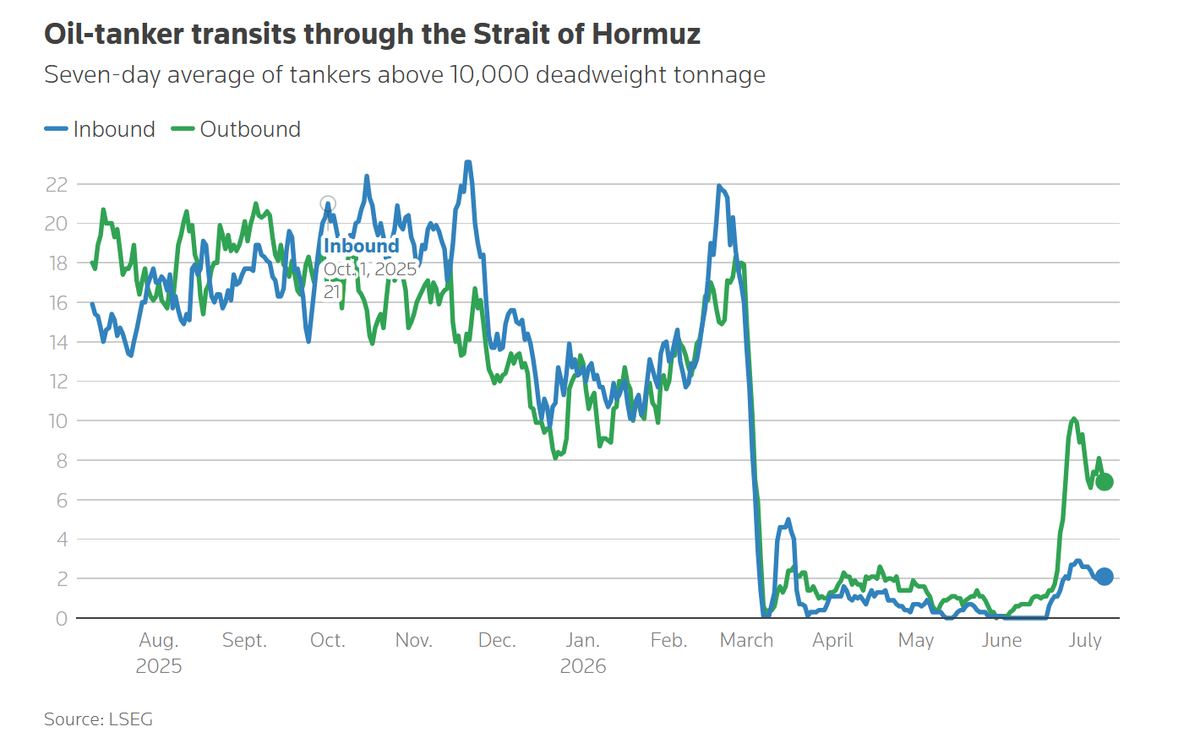
Hormuz tanker transits are the single most important number nobody schedules. The seven-day average of large tankers moving through the strait collapsed when the war first broke out and has recovered only in fits. Roughly a fifth of the world's seaborne oil passes here. Iran declared the strait closed over the weekend, a maritime group said the southern Omani route was technically still open, and the gap between those two claims is worth more to the oil price than any data release this week. Watch the AIS tracks, not the headlines. Source: Reuters / LSEG.
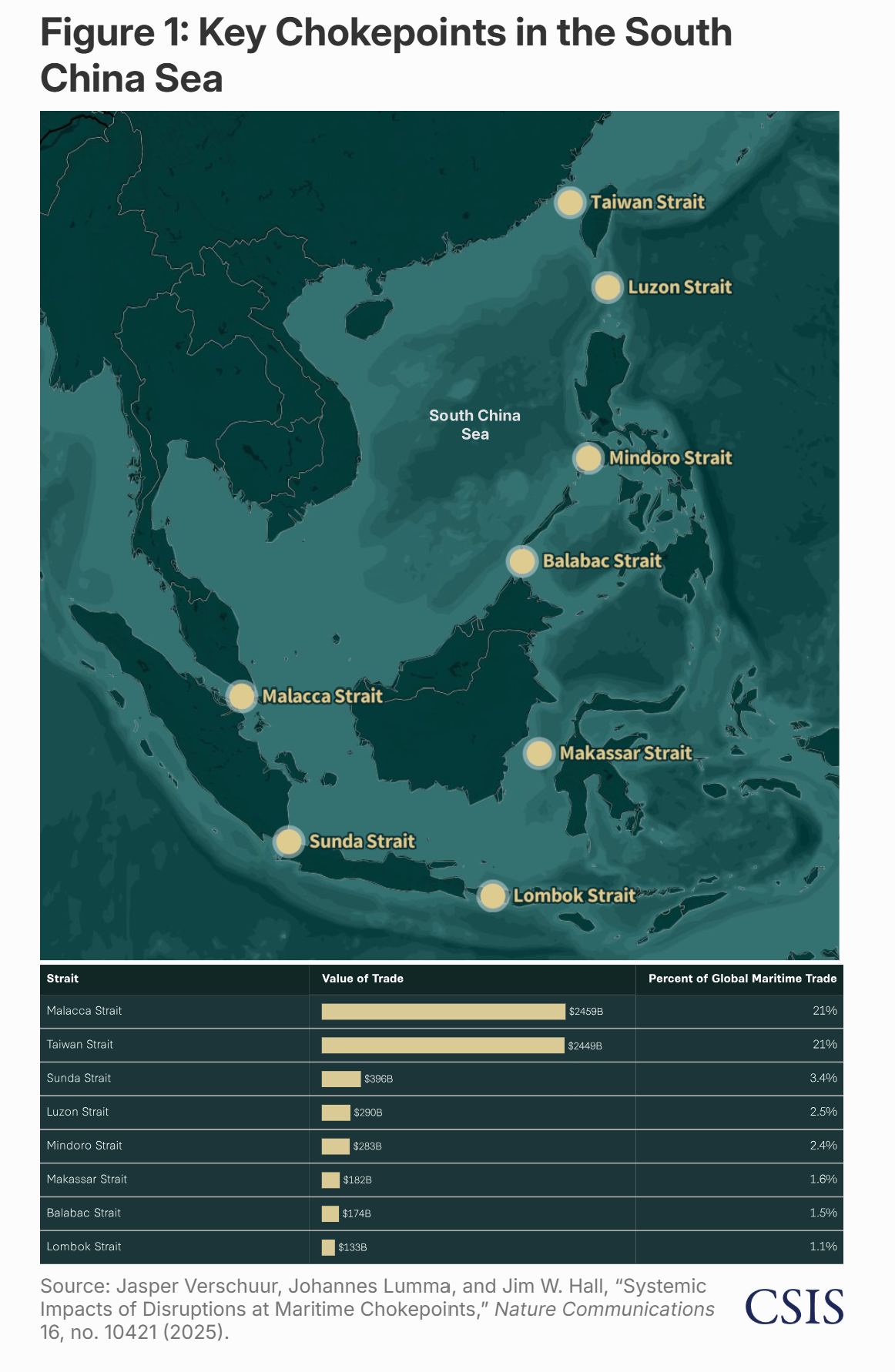
One chokepoint rarely travels alone. While Hormuz holds the tape, the other maritime pressure points stay on the board, the South China Sea straits through which a third of global shipping and much of Asia's energy passes. The point is not that both blow up at once. It is that a market pricing correlations in the 93rd percentile has little cushion left if a second chokepoint so much as flickers. Geography is the tail that the growth-and-earnings story keeps trying to ignore. Source: CSIS.
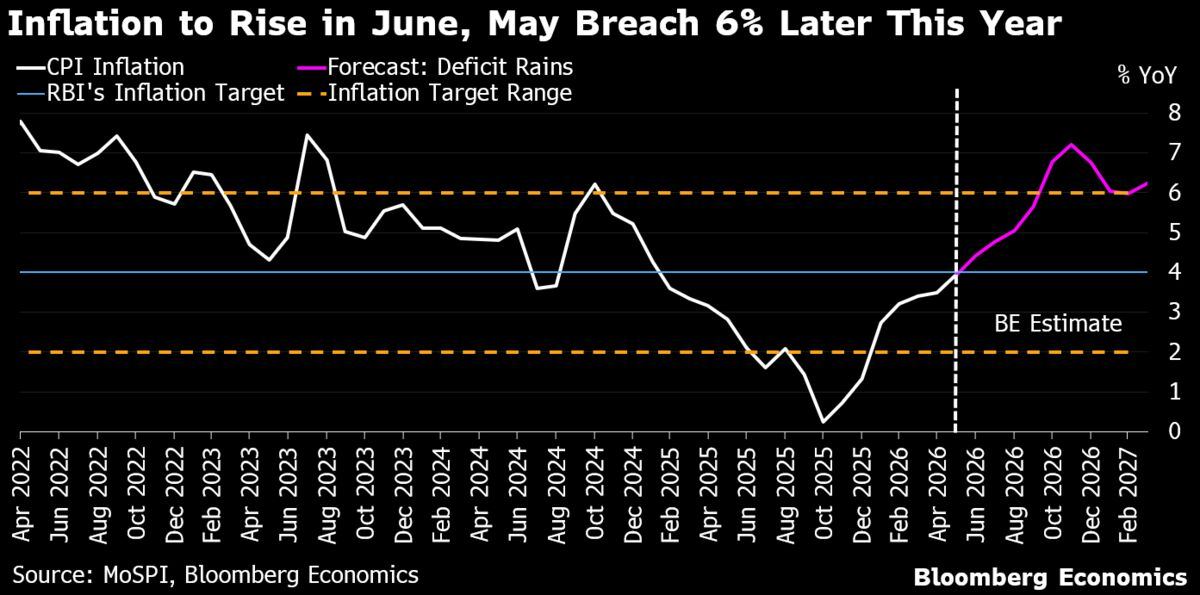
India's inflation likely poked above target for the first time in 17 months. CPI is seen rising to 4.2% in June from 3.9%, energy the main driver as the mid-May fuel-price hike fed through. The bigger risk sits ahead in a weak monsoon and an oil market that has not settled. On current base cases inflation climbs through the second half and starts a modest tightening cycle by December, one more Asian central bank drifting from cuts toward holds and hikes as the war reshuffles the energy math. Source: Bloomberg Economics.
Triple-Header Tuesday
One session, three catalysts that would each headline a normal week. June CPI before the New York open, expected to fall for the first time since the war began on collapsing gasoline, with core the harder and stickier read. At 10am the new chair takes his seat before the House for his first-ever testimony, the June print fresh in his hand and no dot plot to hide behind, so every sentence on inflation and AI-driven demand is the signal. And through the same few hours, five of the six largest US banks report, the trading desks that fed on this year's volatility expected to show it. Overnight, China trade and Singapore GDP. It is Bastille Day in Paris. Be awake for all of it.
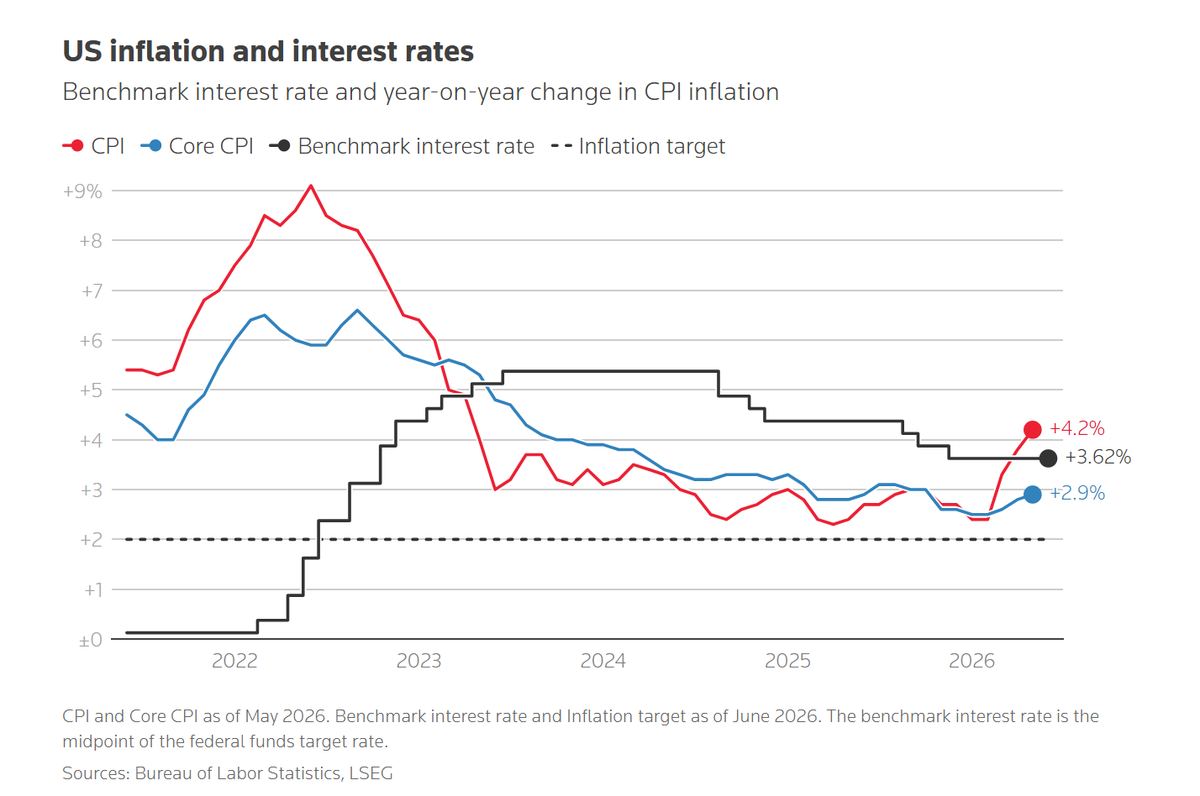
The print the whole week hinges on. Headline CPI is expected to fall for the first time since the war began, a 9% drop in gasoline dragging the monthly number to around minus 0.1% and the annual rate down toward 3.8 to 3.9% from 4.2%. Core is the harder read, seen still firm near 0.2 to 0.3% on the month and 2.8 to 2.9% on the year, tariff effects fading while shelter and services stay sticky. Anything hot on core, arriving as the chair testifies, is the day's dislocation risk. The subtler work comes after the headline, mapping the print into PCE, the Fed's actual target, a read muddied this cycle by a late-September change to the software and portfolio-management deflators that has to be backed out both ways to see the true core run rate. Source: Reuters / LSEG.
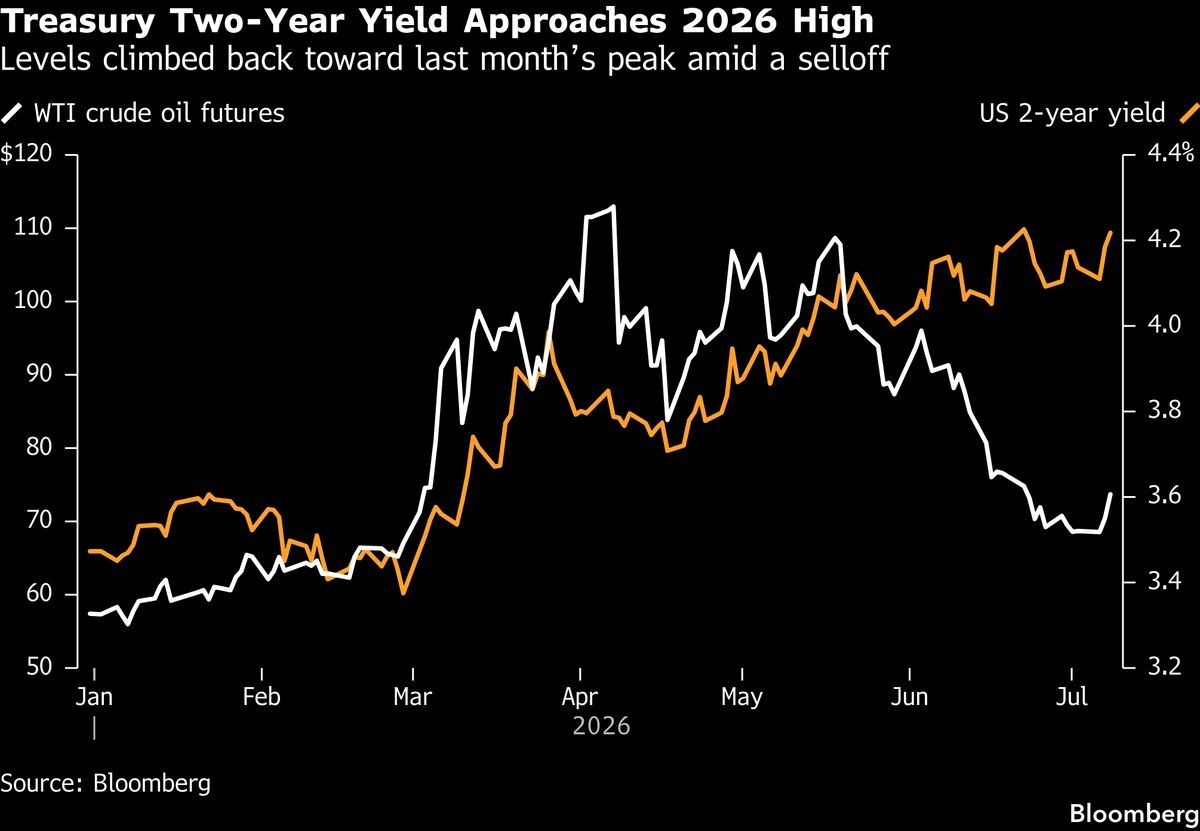
Oil and the front end are climbing together again. The two-year yield has pushed back toward its 2026 high as crude re-rated on the weekend strikes, the same move that has quietly lifted real rates all year. This is the transmission the whole week tests: a hot CPI or a hawkish chair pushes the two-year higher, and as goes the two-year, so goes the dollar. A soft core print does the opposite, violently, with the chair sitting in front of Congress trying to explain why the Fed still cannot cut. Source: Bloomberg.
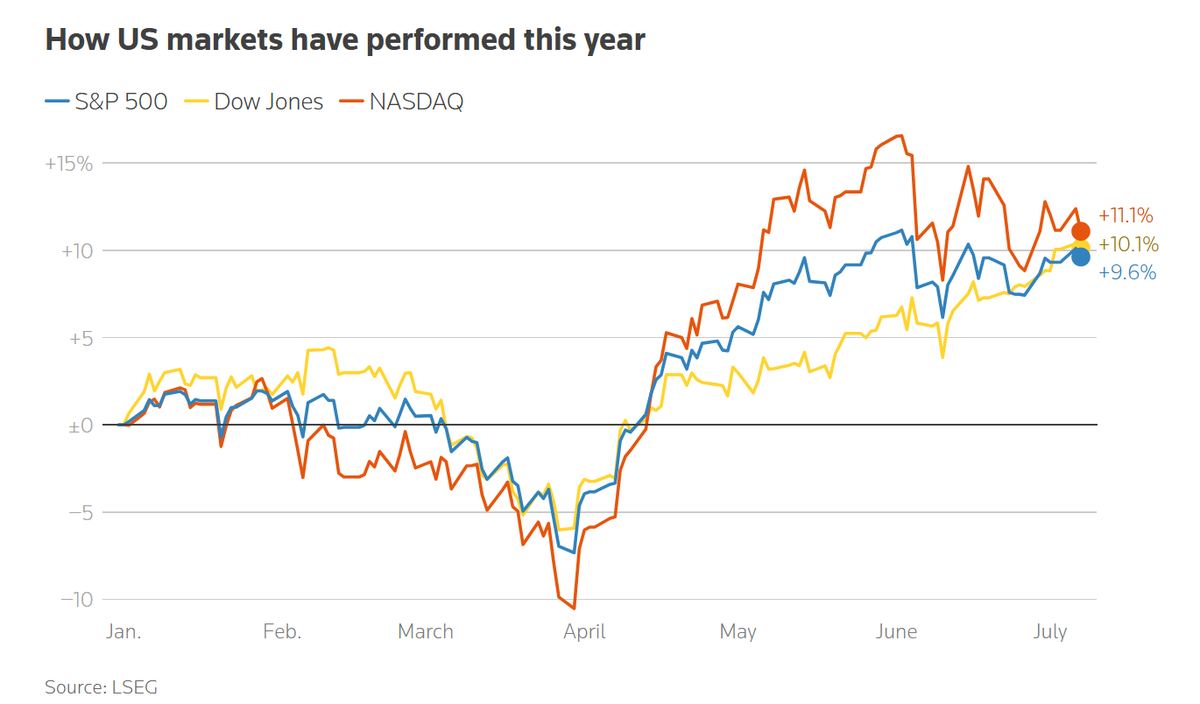
The tape the banks are reporting into. US equities sit near record highs, the S&P up double digits on the year with the Dow and Nasdaq close behind, and the five lenders reporting Tuesday are expected to show trading desks that feasted on exactly this volatility. Deal activity topped $2.5 trillion in the first half and IPO volumes ran triple last year's pace. S&P 500 earnings are forecast up more than 23% from a year ago. Expectations, in other words, are already priced for perfection. Source: Reuters / LSEG.
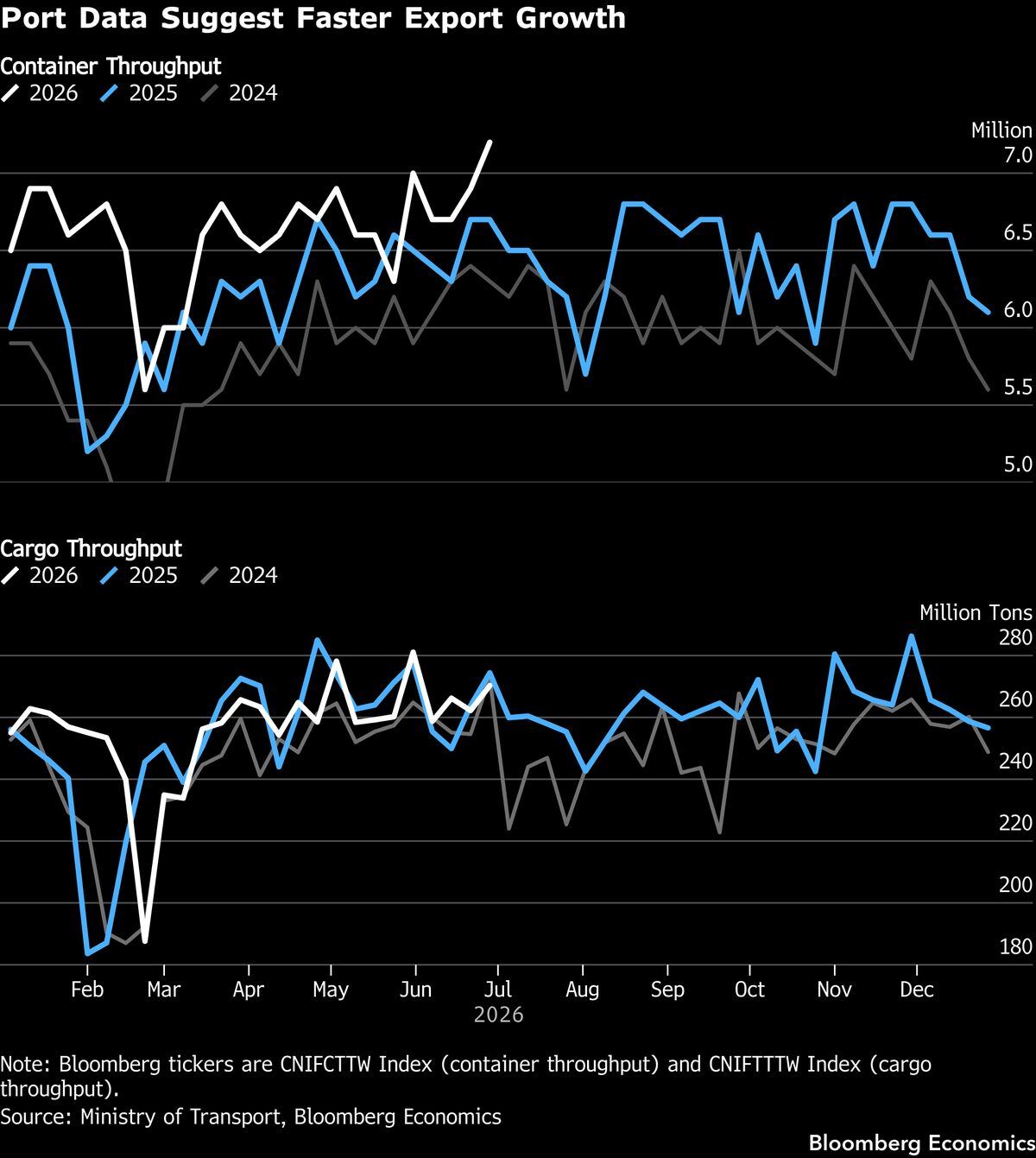
China's exports keep doing the heavy lifting. Shipments likely rose around 21% in June, a third straight monthly pickup driven by global demand for AI hardware, even as exports to the US cooled on tougher base effects. Trade is the one bright spot as Beijing tries to steer growth away from property and toward a consumer that will not spend. It is also the number most exposed to the war, since most of the quarter ran before the energy market was roiled. The trade data lands Tuesday, the GDP verdict Wednesday. Source: Bloomberg Economics.
Balance Sheet Season
The bank earnings are not just an equity event, they are a window into the plumbing. This year the scarce resource is not capital, it is the space to warehouse everyone else's leverage, and the signals are stacking up. Primary dealers have gone net short corporate bonds for the first time on record. The levered-ETF complex has more than doubled since April and the multi-manager platforms have tripled since the pandemic, all of it renting balance sheet from the same banks now reporting. The quote at the top of this letter is the theme. Watch the earnings calls for any hint that the space to lend is tightening, because that is the line between plumbing and headline.
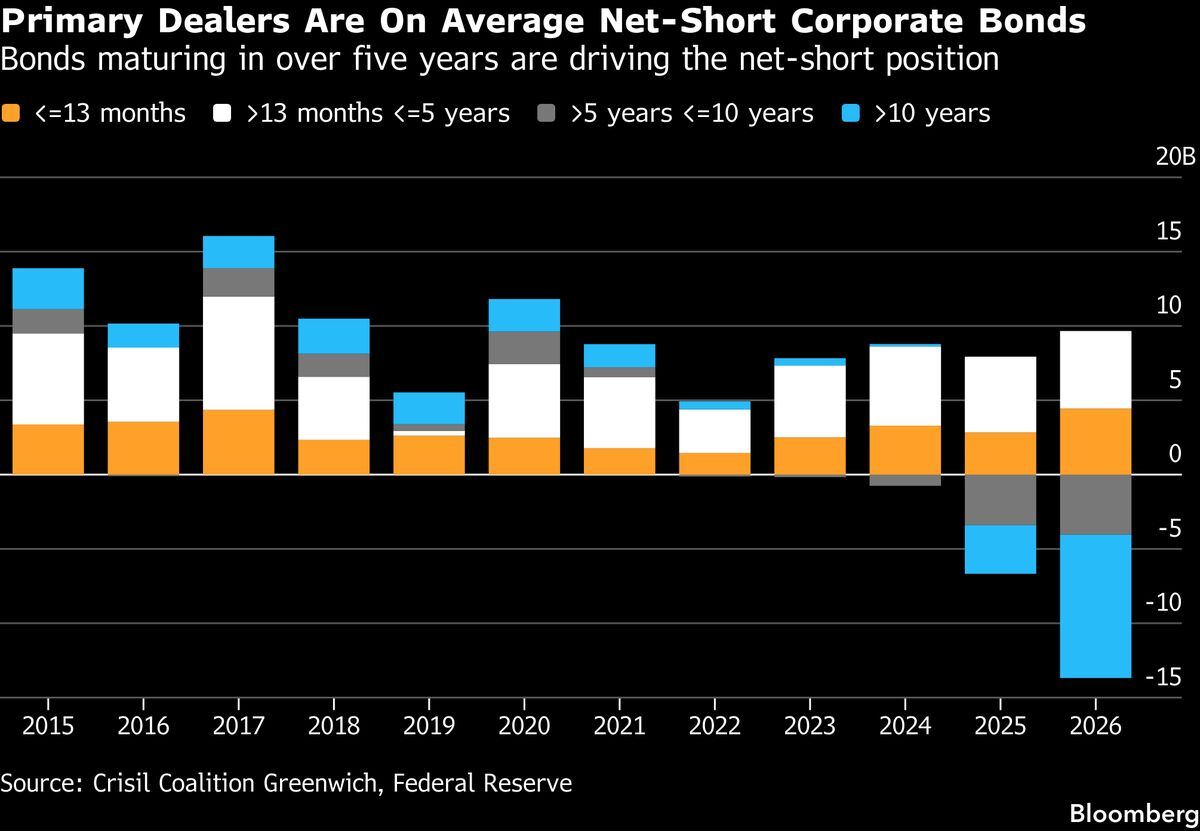
The chart behind this week's Q3 quote. For the first time in recent history, primary dealers are running a net-short position in corporate bonds, short roughly $13.7 billion of paper maturing in five years or more against a smaller long in shorter maturities. Read it two ways: dealers braced for a weaker market, or a market so hungry for yield that banks simply cannot keep bonds on the shelf. Either way, balance-sheet capacity is scarce, and the asymmetry bites hardest if spreads rally into thin supply and shorts have to cover. Source: Crisil Coalition Greenwich, Federal Reserve / Bloomberg.
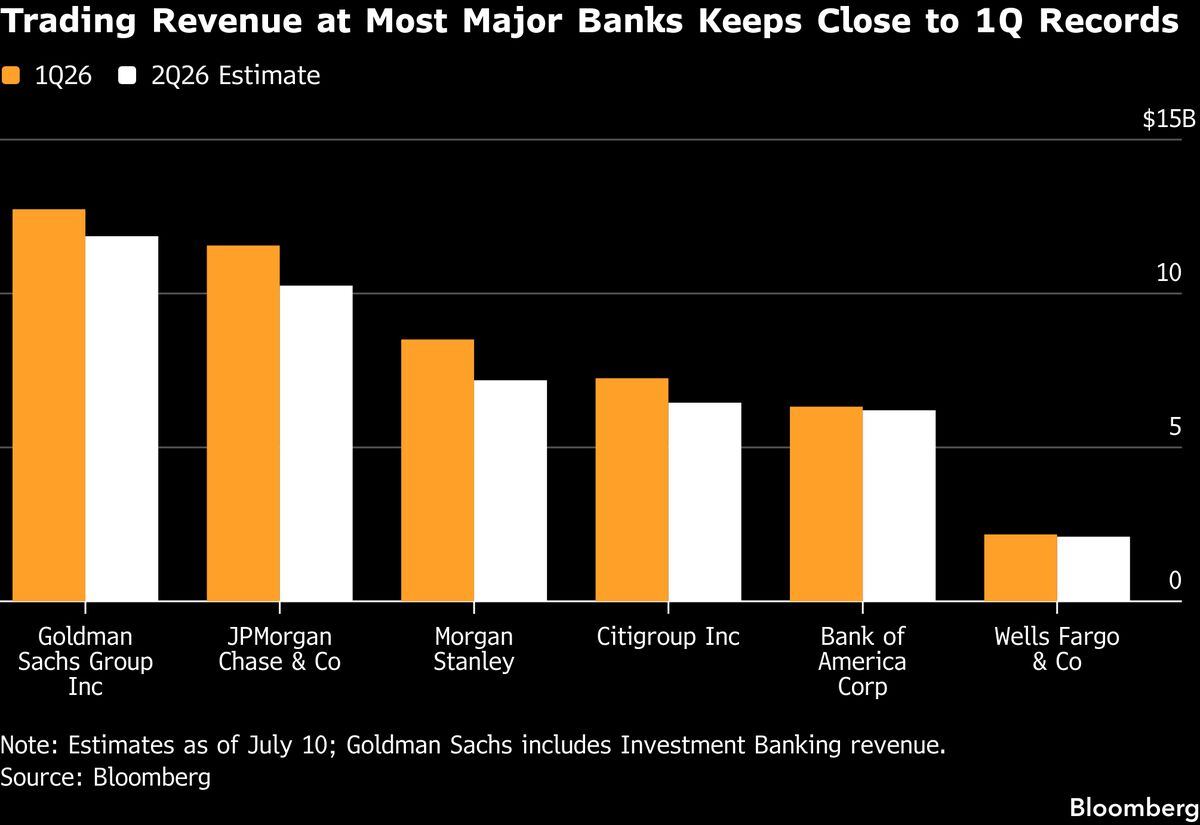
Trading revenue is doing the talking this earnings season. At most of the big lenders, second-quarter trading is running close to the record set in the first quarter, the war-driven volatility that punished portfolios feeding straight into desk revenue. That is the constructive read the market has already bought. The question underneath is capacity: with dealers net short and balance sheets rented out to prime-brokerage and swap exposure, how much of this is durable franchise and how much is a scarce resource being lent at the top of the cycle. Source: Bloomberg.
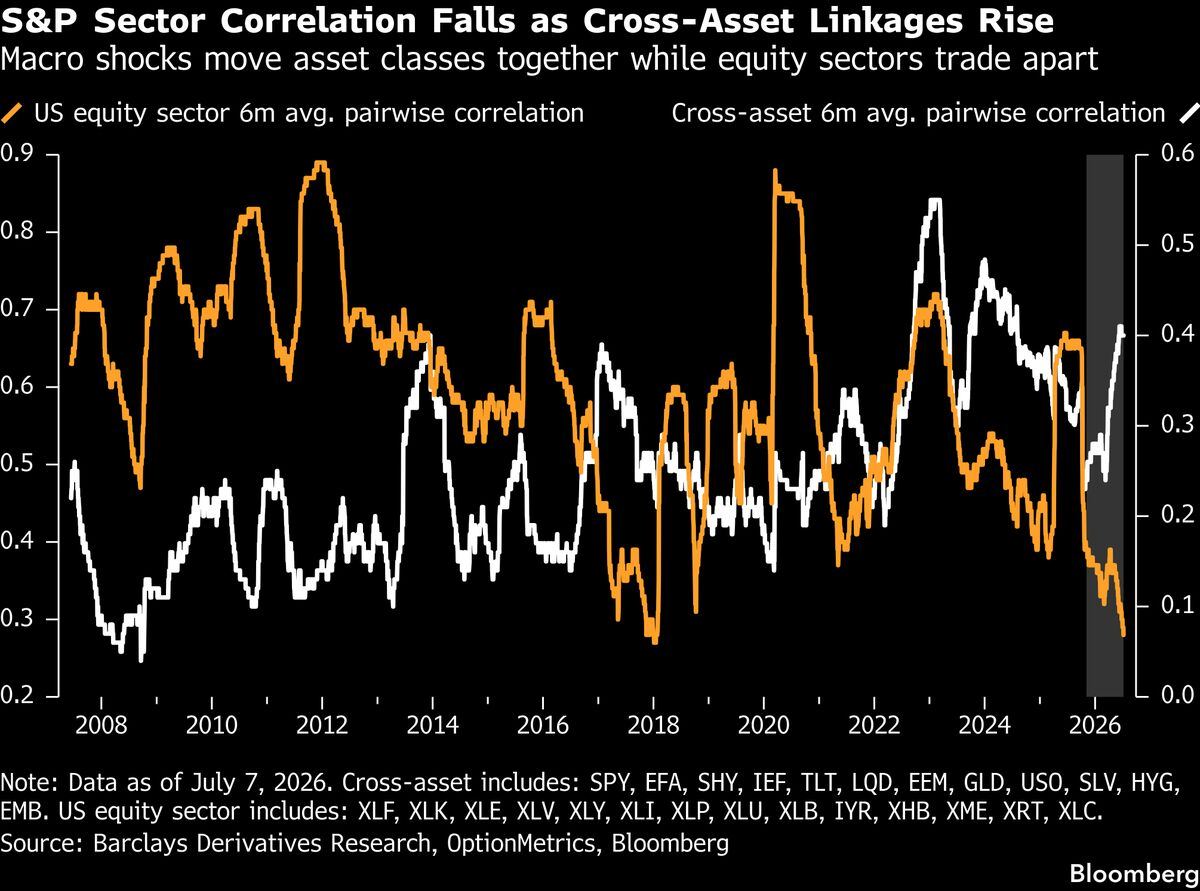
A split-screen market, in one chart. Cross-asset correlations sit near the 93rd percentile of their historical range, oil, bonds and currencies moving together as the Iran shock ripples through the macro layer. At the same time the average correlation between S&P sectors has fallen to its lowest in more than a decade, the index pulling apart from the inside as investors sort AI winners from losers. The macro is one trade and the micro is another, and the whole week lives in the gap between the two lines. Source: Barclays Derivatives Research, OptionMetrics / Bloomberg.
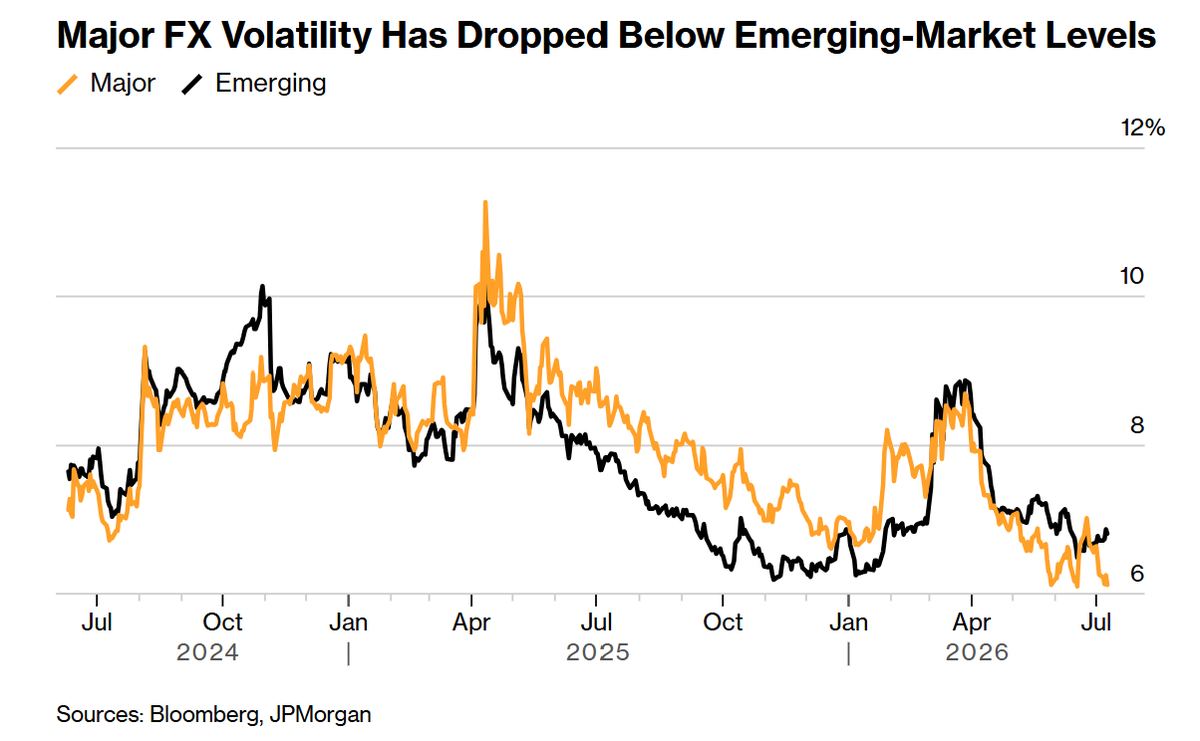
The calm in currencies is the odd one out. Major-market FX volatility has drifted below emerging-market levels and stayed there, even as rate vol and cross-asset correlations climb. That gap is the market's complacency expressed in one line, an FX market pricing a summer lull while oil, the front end and a first-ever chair testimony all queue up in a single week. If any of them lands wrong, currency vol is the cheapest thing in the room and the first to catch up. Source: Bloomberg, JPMorgan.
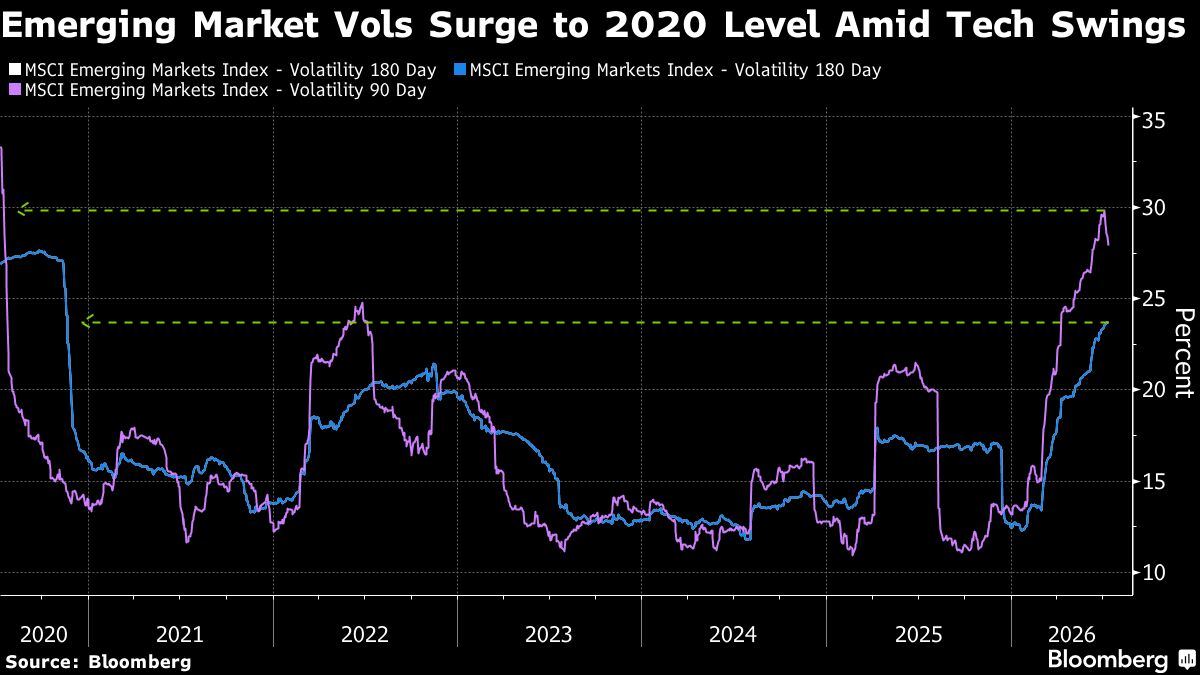
Emerging-market volatility has already woken up. EM equity vol has surged back toward levels last seen in 2020, whipsawed by the tech swings running through Korea and Taiwan and the war premium bleeding through oil. The AI-concentrated indices that carried the region higher are the same ones that shake hardest when the narrative turns. It is the mirror image of the FX calm above, and a reminder that the split-screen is not just a US story. Source: Bloomberg.
China-Check Wednesday
The growth verdict, and the chair's second act. China reports Q2 GDP seen slipping below the floor of the official target, the June details soft on retail sales and investment while trade stays the lone bright spot, though most of the quarter ran before the energy shock so the number reads as a floor rather than a snapshot. In the US, PPI is the pipeline check the day after CPI, and the two speakers around it matter more than the print, Williams just after the PPI with time to reflect on the CPI and Cook that afternoon, two of the three centrists whose move, or lack of one, decides whether July is live. The Beige Book is the first qualitative draft of a post-ceasefire economy already one weekend out of date, and the chair returns for his Senate testimony, usually the more pointed room. The Bank of Canada is the easy hold. Morgan Stanley, ASML and BlackRock report into the balance-sheet theme.
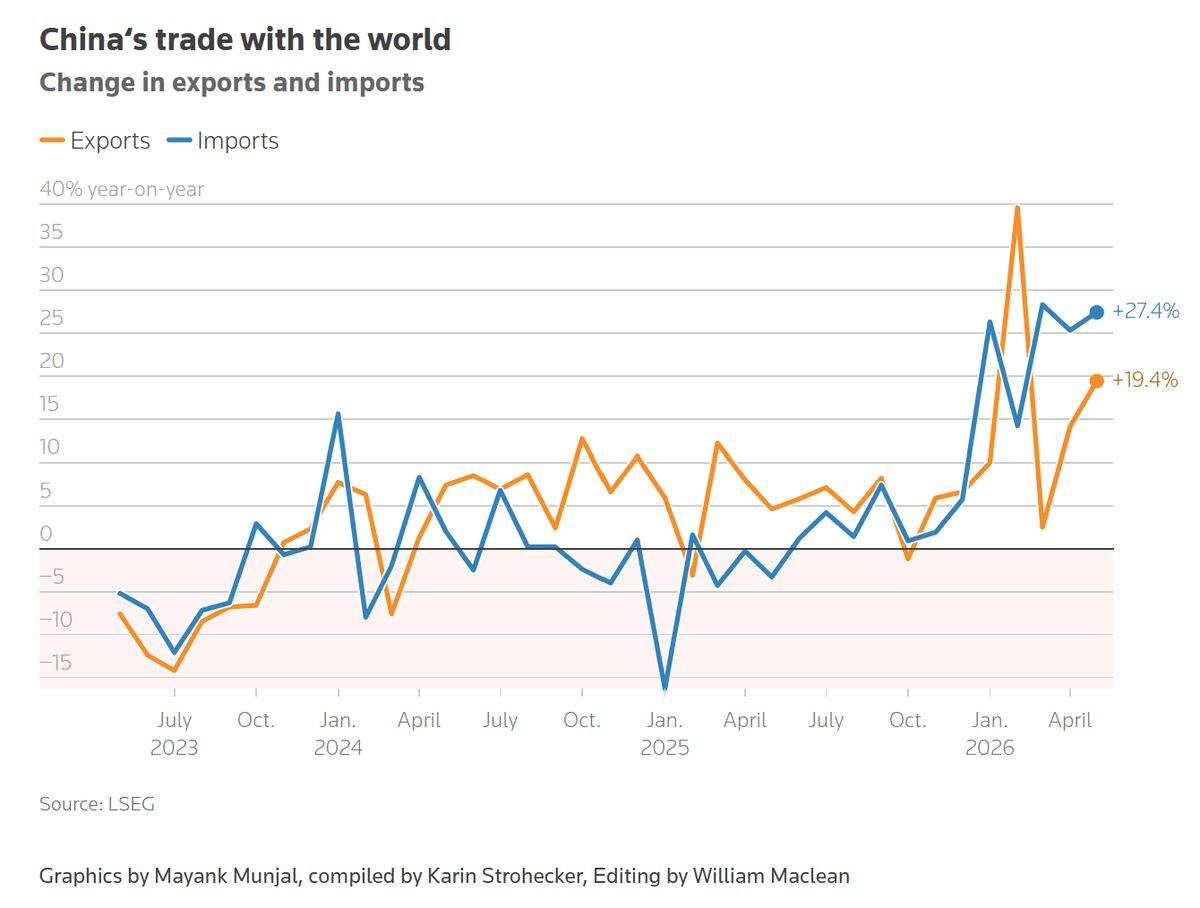
The growth verdict, with most of the war left out. China reports Q2 GDP on Wednesday, seen slipping to around 4.4 to 4.5% from 5% and below the bottom of the official target range. The details look soft, retail sales still contracting year on year and investment falling as the property drag and an anti-involution campaign bite. Trade, shown here, is the exception. The catch is timing: the quarter mostly predates the energy shock, so the number reads as a floor, not a snapshot of where momentum sits now. Source: Reuters / LSEG.
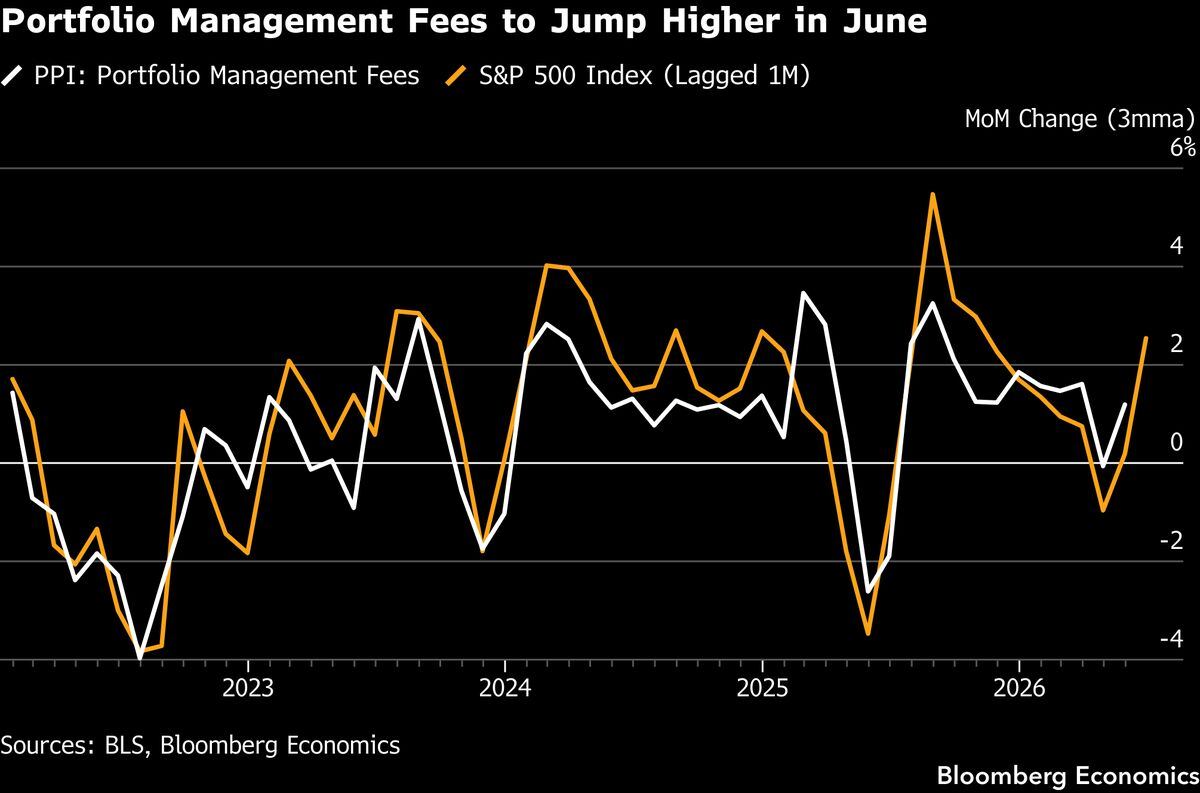
PPI is the pipeline check the day after CPI. Headline producer prices likely held flat in June, lower energy offsetting firm core goods and services, with the annual rate easing toward 6.2%. Core is seen up around 0.4%. The components that feed the Fed's preferred inflation gauge matter more than the headline, portfolio-management fees and healthcare the ones to watch. A hot PPI stacked on a hot CPI is what would cement hike expectations and push the long end higher, the two-print combination the curve fears most. Source: Bloomberg Economics.
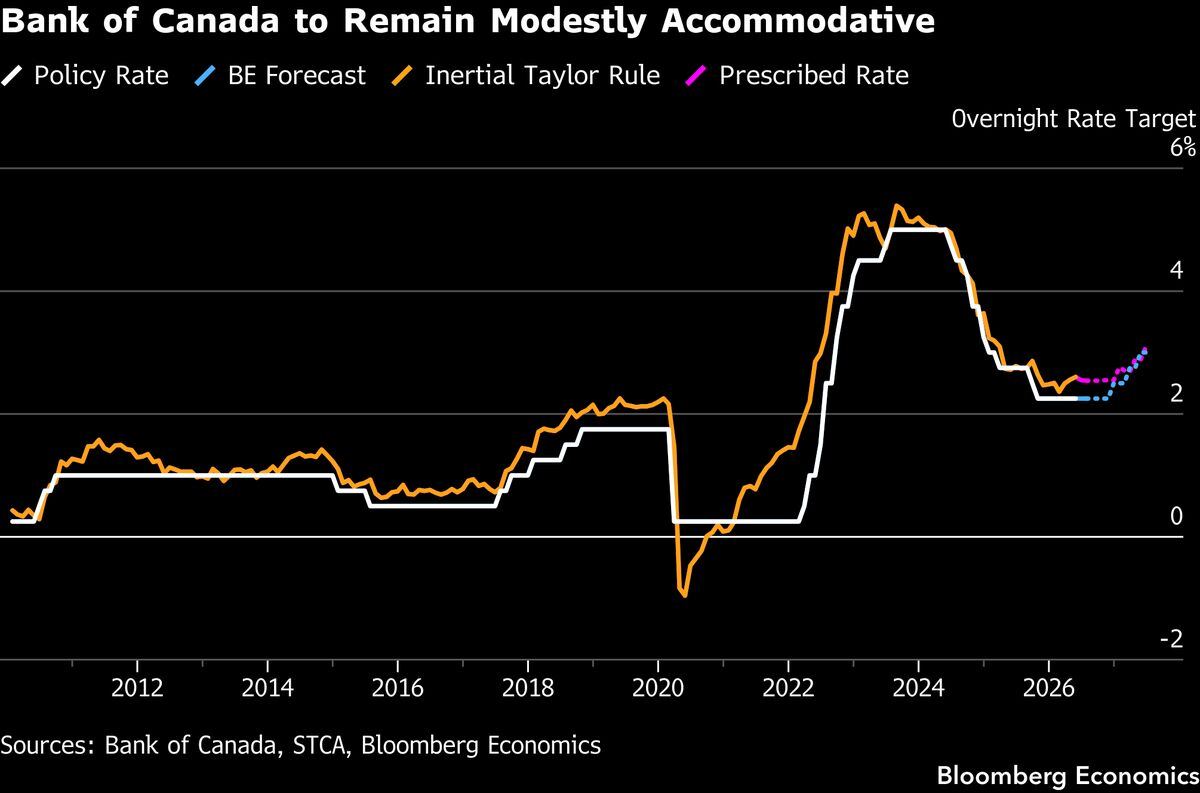
The Bank of Canada is the easy hold of the week. Rates stay at 2.25%, the Governing Council content to sit through what it calls a period of global upheaval, the trade war with the US and volatile energy both largely beyond its control. Expect a reaffirmed commitment to 2% inflation and a nod that activity rebounded in the second quarter. The interest is in the press conference tone, whether underlying inflation is described as contained enough to keep the door to easing open later in the year. Source: Bloomberg Economics.
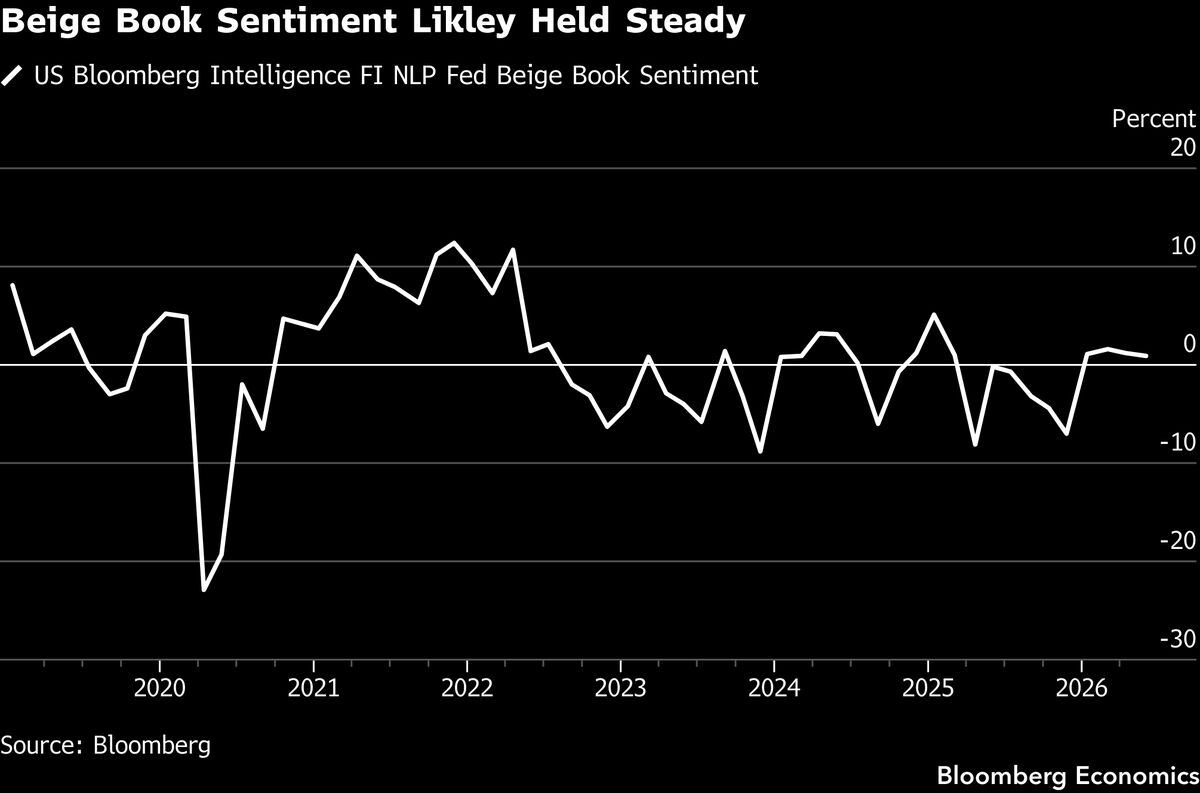
The Beige Book is the first draft of the post-ceasefire economy. It will likely still read as slight-to-moderate growth across most districts, consumer spending mixed, manufacturing a relative bright spot on defence work and data-center construction. The limitation is the calendar: the survey window closes before the weekend's renewed strikes, so the qualitative color on prices and confidence is already one shock out of date. Useful for the trend, blind to the tail that now dominates the tape. Source: Bloomberg Economics.
Silicon Thursday
The AI trade reports for duty, from both sides. TSMC is the clearest single read on whether the hardware rally still has room, days after SK Hynix's blockbuster debut, and three chips are now more than a quarter of the entire emerging-market index, so the print is an index-level event before it is a stock. The Bank of Korea is seen starting a tightening cycle on exactly that AI-chip-driven strength. On the other side sits the counterweight, Indian IT services reporting into open questions about whether traditional consulting survives the technology, and Netflix into a nervous chart with an AI-disruption question hanging over the guide. US retail sales and claims underneath. The winners and losers split runs right through the day.
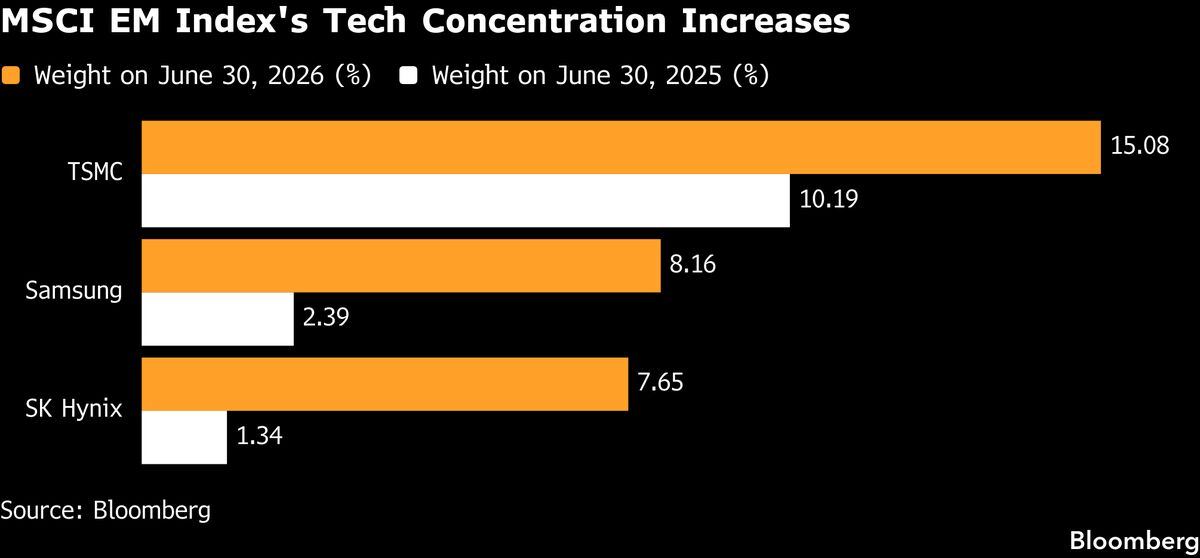
Three chips are now the emerging-market index. TSMC has climbed past 15% of the MSCI EM benchmark, with SK Hynix near 7.7% and Samsung above 6%, the trio's combined weight the highest on record. It is the cleanest picture of how thoroughly the AI hardware trade has colonised the passive EM allocation. The strength that doubled the Kospi and lifted Taiwan is the same concentration that turns a single earnings miss or a memory-price wobble into an index-level event. TSMC reports Thursday. Source: Bloomberg.
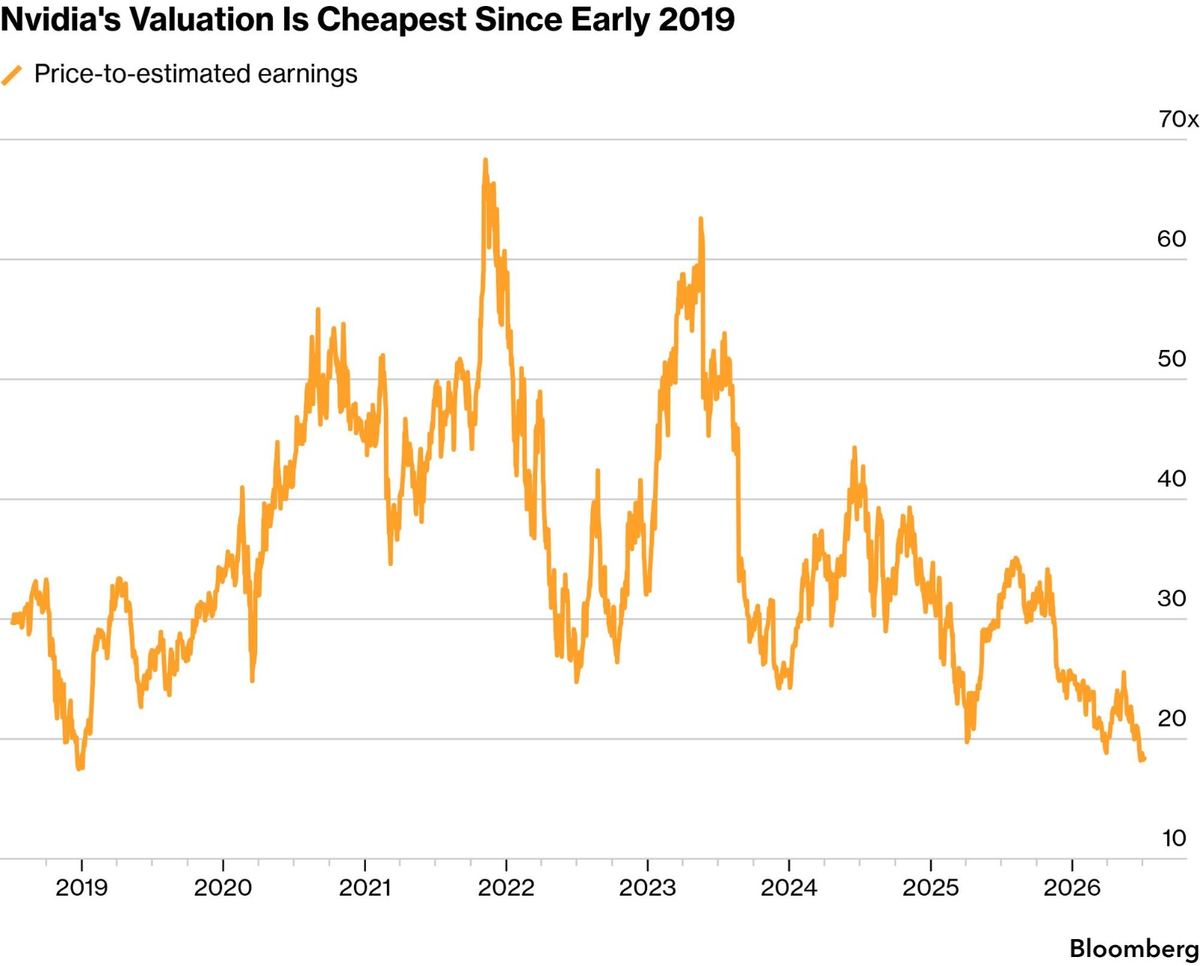
The most expensive stock in the world, on the cheapest multiple in years. Nvidia's price-to-estimated-earnings ratio has fallen to its lowest since early 2019, earnings sprinting faster than even this share price. It is the bull case in one line: the AI leader is not, by its own history, richly valued. It is also the bear case, since the multiple only holds if the estimates keep climbing, and this week's split-screen tape is precisely the market trying to work out whether they will. Source: Bloomberg.
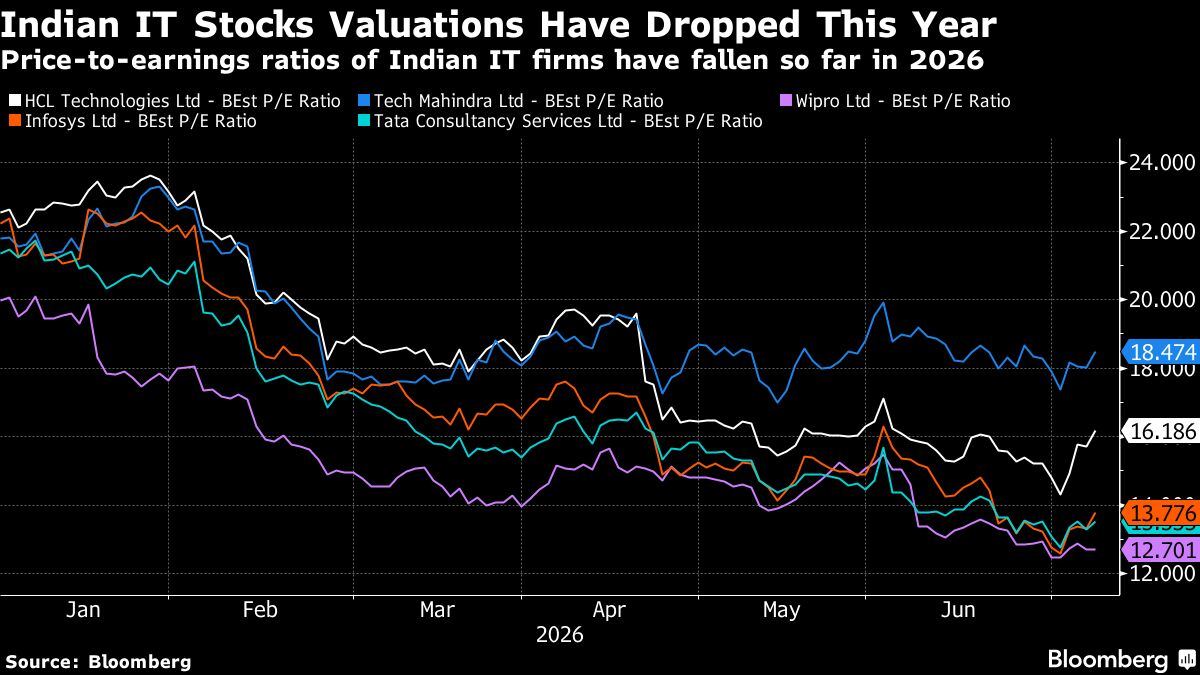
The other side of the AI trade reports too. Indian IT services head into earnings with investors openly questioning the value of traditional consulting in the age of AI, the sector weighed down by macro uncertainty and by the disruption AI itself brings to the business model. Shares have lagged all year. It is the counterweight to the chip euphoria, the same technology that is minting the hardware winners quietly eroding the services incumbents, and a reminder that the AI winners-and-losers split runs inside the supply chain as well as across it. Source: Bloomberg.
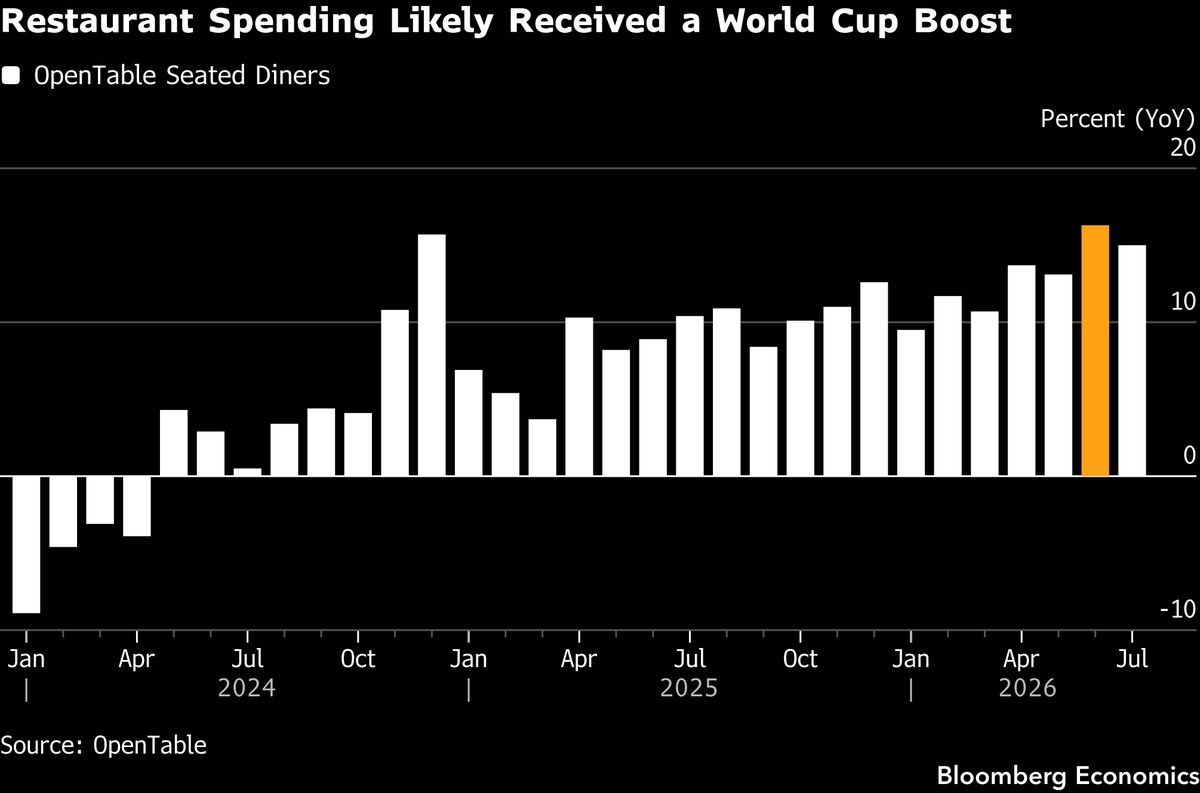
Retail sales are the read on whether the consumer is finally tiring. Spending likely cooled to around 0.2% in June from 0.9%, gasoline prices dragging the headline while autos and the World Cup lent some support. The control group that feeds GDP is seen firmer near 0.4 to 0.5%. Combined with falling headline inflation, real spending probably held up, but the trend of deceleration is the story the Fed is watching, the point at which the last pillar under the expansion starts to soften. Source: Bloomberg Economics.
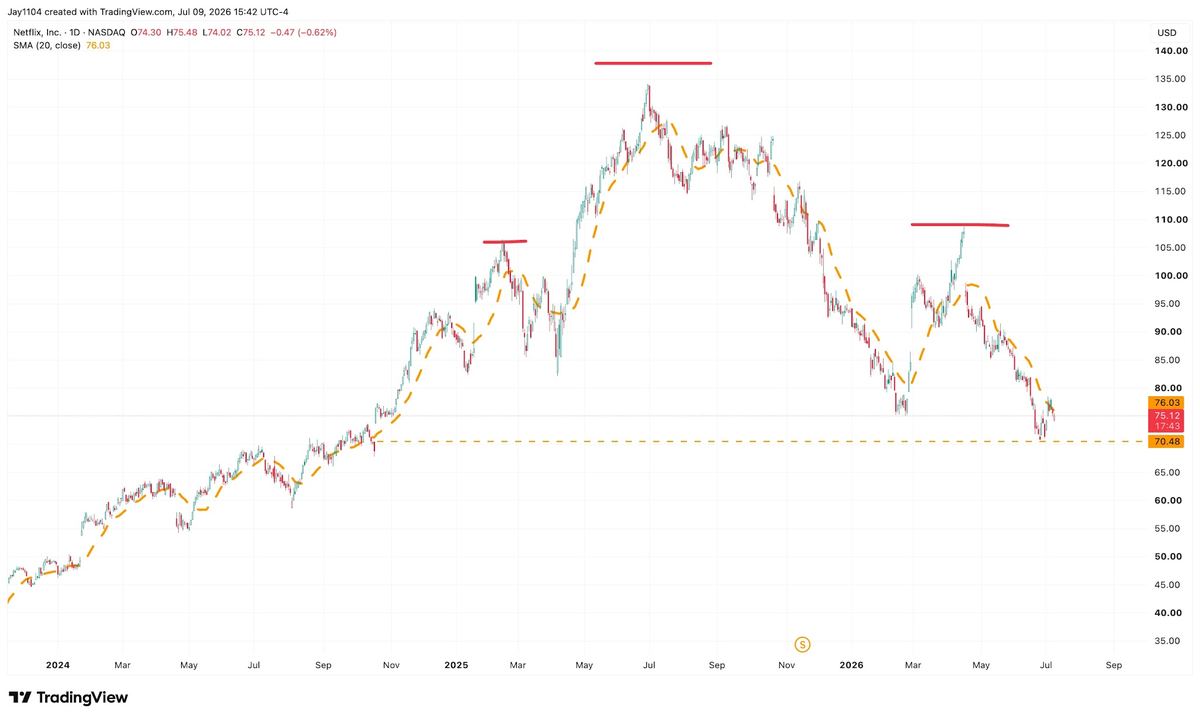
Netflix reports into a nervous chart. The stock has filled its October 2024 gap around $70 and is testing that support, with options pointing to a move of roughly 7% on the print and the strongest resistance clustered near $90. There is a longer-term head-and-shoulders risk in play, the neckline near $75 already breached, a sustained break below $70 the bearish trigger. Positioning looks bearish enough that a clean beat could squeeze it higher instead. The AI-disruption question, short-form and user-generated video, hangs over the guide. Source: TradingView / CMC Markets.
Sentiment Friday
The week ends on the consumer and the handover. Michigan's preliminary July sentiment carries the reading that matters most, the long-run inflation-expectations series, the quiet number that would force the chair's hand if it de-anchors while he insists the Fed can wait. Euro-area final CPI, US housing starts and industrial production fill the morning, import prices adding the border read. Sterling sits at a technical junction as the UK leadership handover formalises around now. And in Shanghai the world AI-governance summit opens, a fitting bookend to a week that spent five days arguing about exactly how much the technology is worth. Then the tape exhales, if the strait lets it.
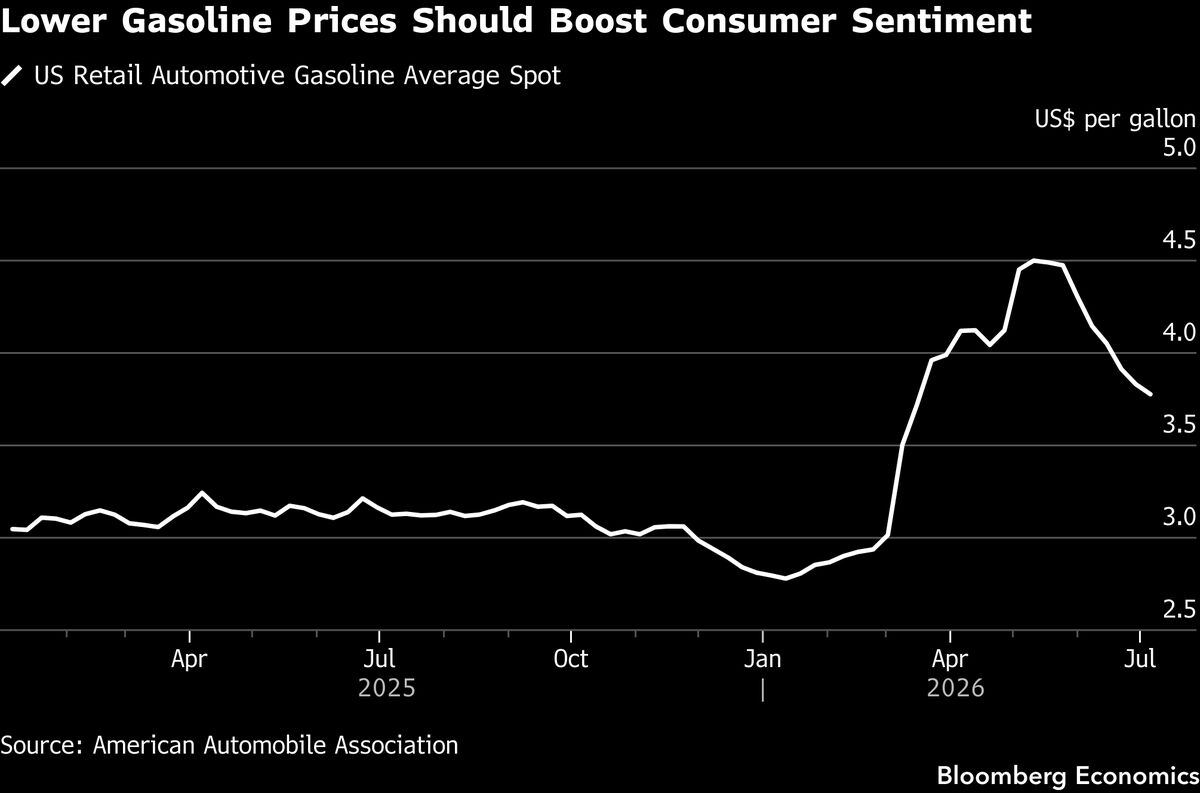
Michigan sentiment closes the week and carries the inflation-expectations sting. The preliminary July reading is seen improving only marginally to around 50.5 from 49.5, still deeply depressed, cheaper gasoline the marginal help. The number that matters sits underneath, the long-run inflation-expectations series, already elevated. A further rise there, de-anchoring expectations while the chair insists the Fed can wait, is the quiet hawkish signal that would force the issue. Any improvement is capped by the oil and headline-risk backdrop. Source: Bloomberg Economics.
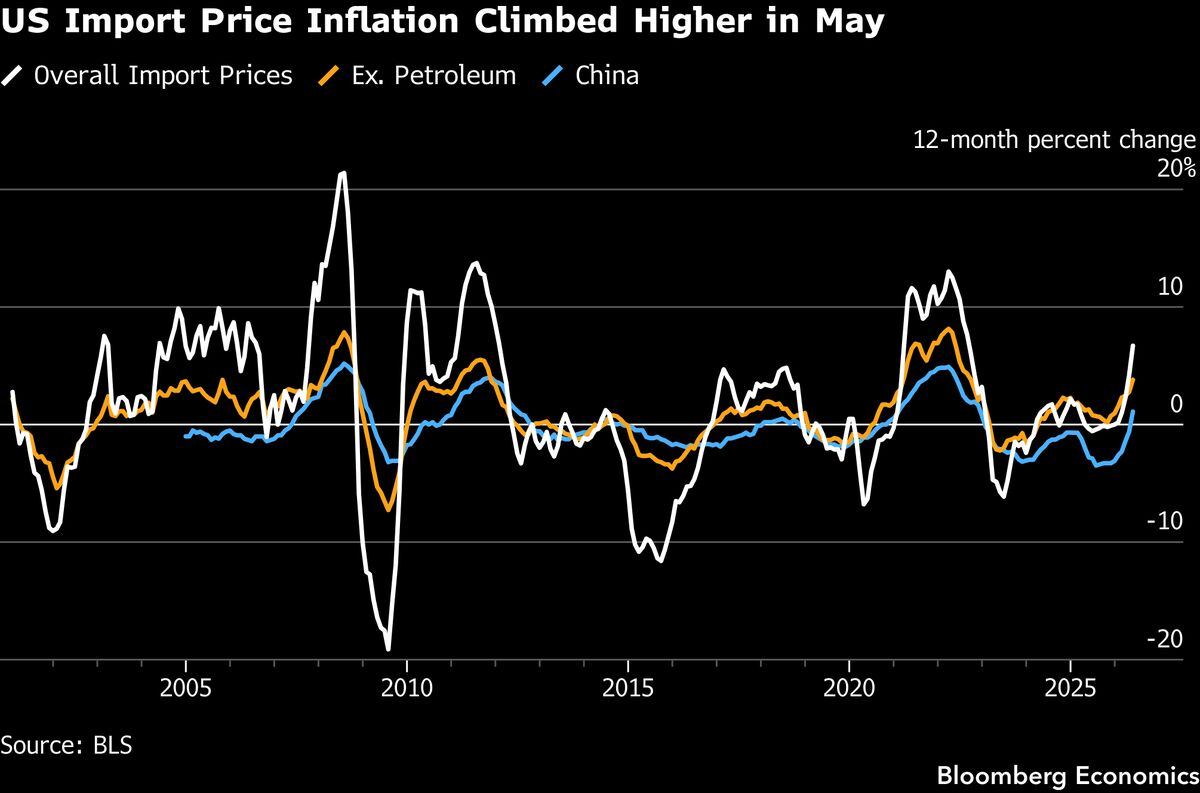
Import prices round out the inflation picture with a first decline in months. June import prices likely fell around 0.5% as petroleum costs retreated from their May peak, the first monthly drop since September. Strip out petroleum, though, and prices still rose, the memory-chip shortage and AI-hardware demand lifting capital-goods prices while foreign exporters show little sign of absorbing tariffs. The border read is the same split as everywhere else this week, energy disinflation on top, sticky underlying goods inflation beneath. Source: Bloomberg Economics.
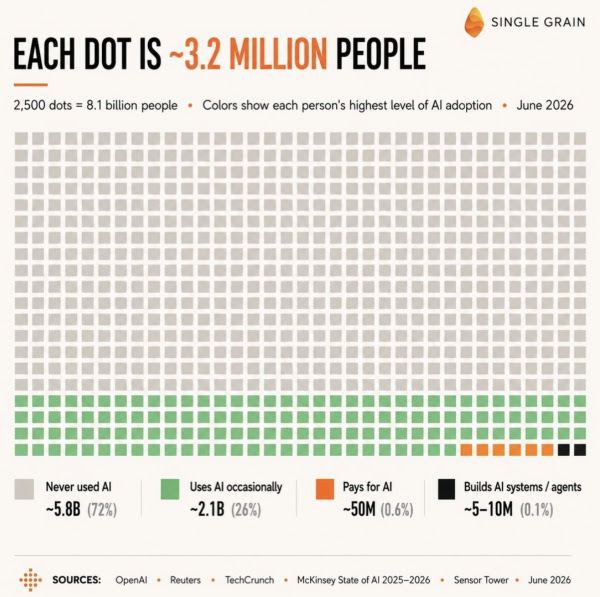
A useful counterweight to the AI supercycle, on the week Shanghai hosts the world AI governance summit. Sort the planet by how it actually uses AI and the picture is sobering: on this reckoning roughly seven in ten people have never used it, a quarter dabble occasionally, and the shares that pay for it or build with it round to rounding errors. The capex, the concentration and the index weights are all real. So is the adoption gap they are being built against. Both things can be true, and the distance between them is the risk. Source: OpenAI, Reuters, McKinsey / Single Grain.
VC+ Special Dispatch — The US Energy Revolution, Part 1
An eight-chart dispatch on the energy base the whole AI trade is being built on. Two hundred and fifty years of American energy went from flat to vertical, and fossil fuels still supply around 82% of it, even after decades of diversification and record renewable output. The shale revolution roughly doubled US oil-and-gas production and turned a net importer into a net exporter, which is the structural reason crude keeps trading offered through a war in the strait. Texas alone produces two-fifths of the oil and a huge share of the gas. And underneath the silicon, electricity is quietly becoming the binding constraint on the entire build-out, the megawatt-hours that matter more than the GPUs. Credit to the VC+ team.
250 Years, One Vertical Climb
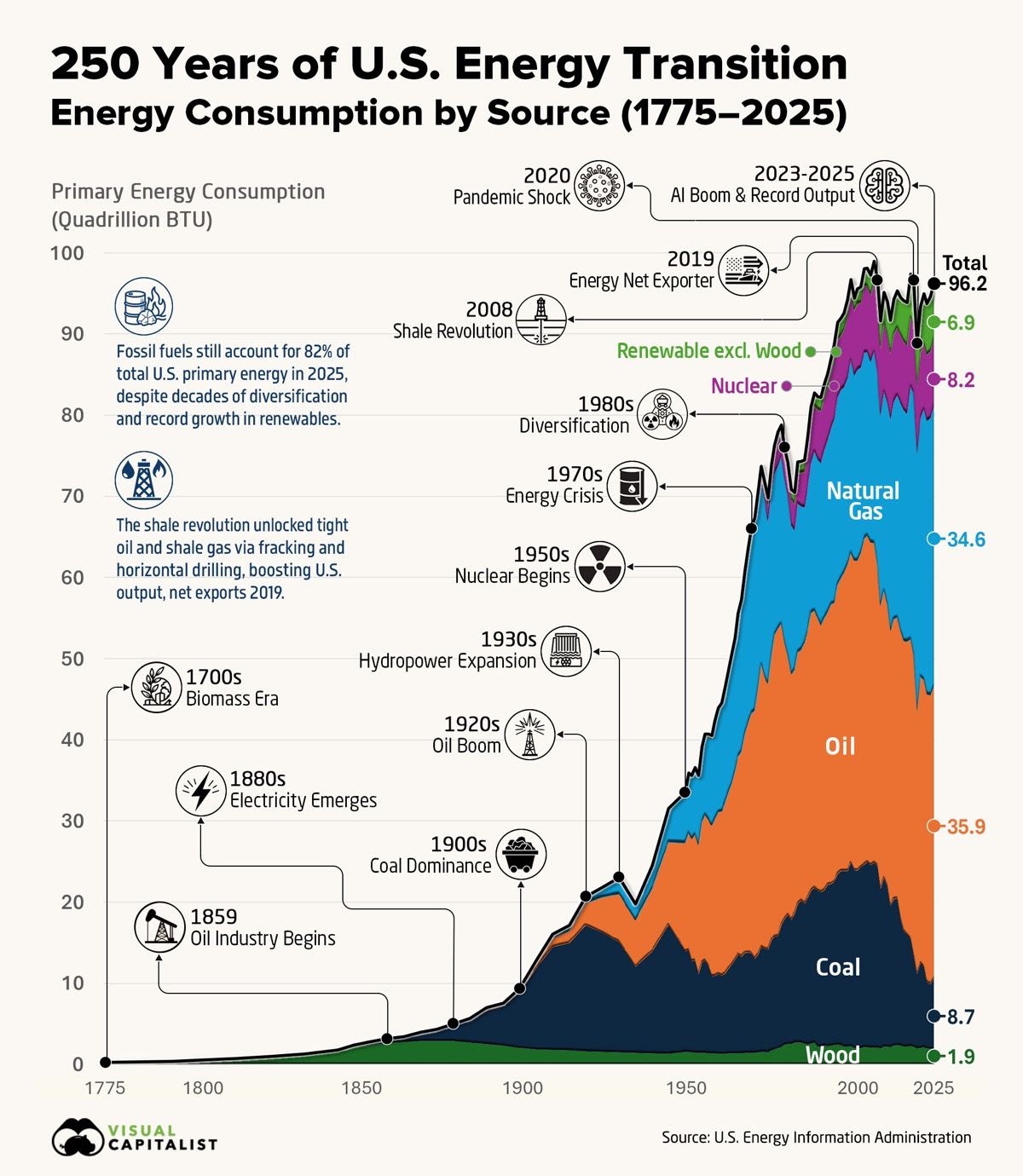
Two hundred and fifty years of American energy, in one climb. Primary energy consumption barely moved for the first century of the republic, then went vertical with oil and gas. The headline that survives all of it: fossil fuels still supply around 82% of US primary energy in 2025, despite decades of diversification and record renewable output. This is the base the whole capital rotation is being layered onto, and the reason electricity, not chips, is quietly becoming the binding constraint on the AI build-out. Source: EIA / Visual Capitalist.
The Shale Bid Under Every Headline
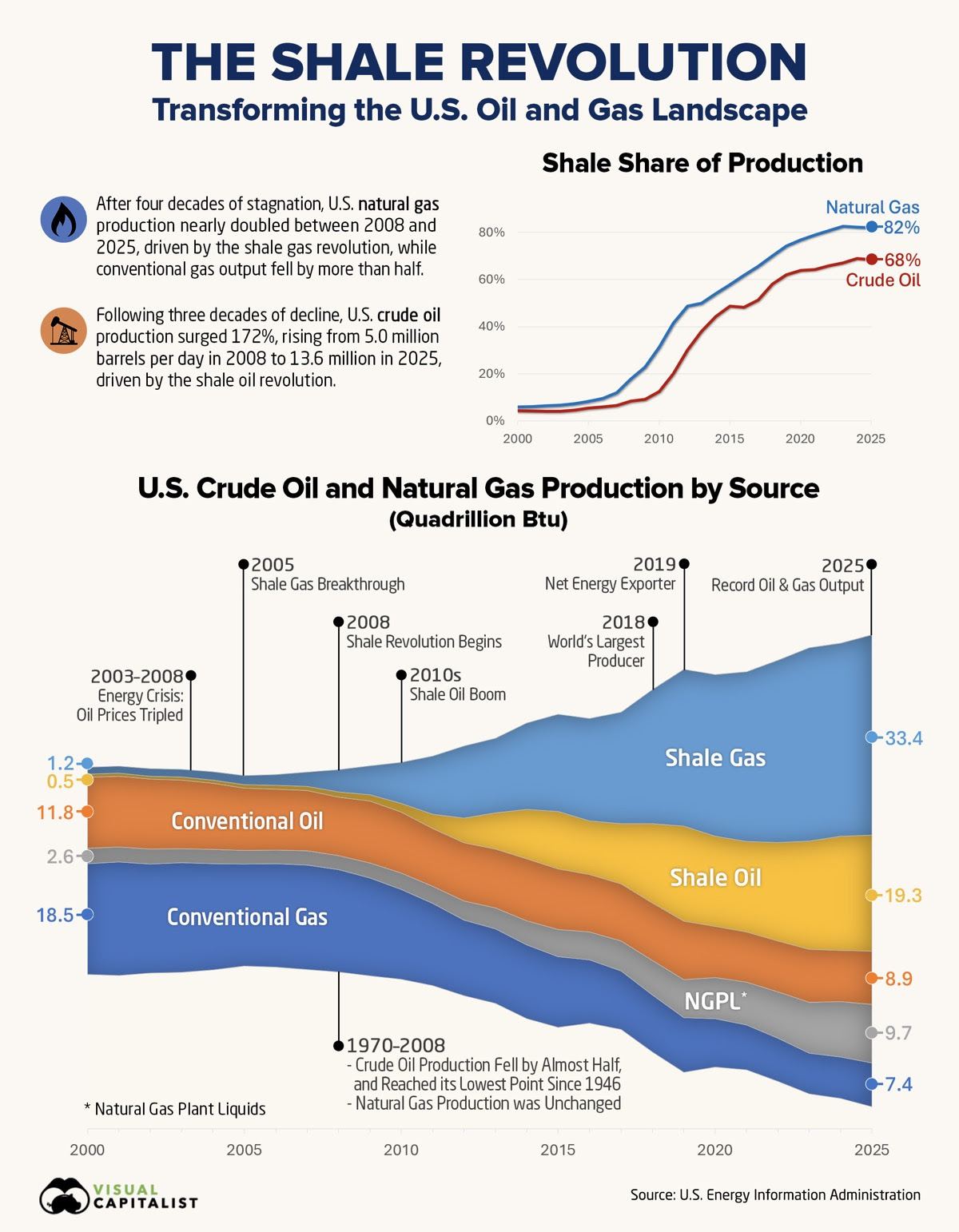
The shale revolution is the reason the war has not broken the oil price. A decade and a half of horizontal drilling and fracking roughly doubled US oil-and-gas output and turned a net importer into a net exporter, shale now the majority of both crude and gas production. It is the structural bid under every Hormuz headline, the spare-barrel story that lets the market re-rate crude and then hand it back within weeks. The offered feel in oil that opens this letter starts in these charts. Source: EIA / Visual Capitalist.
Two-Fifths From One State
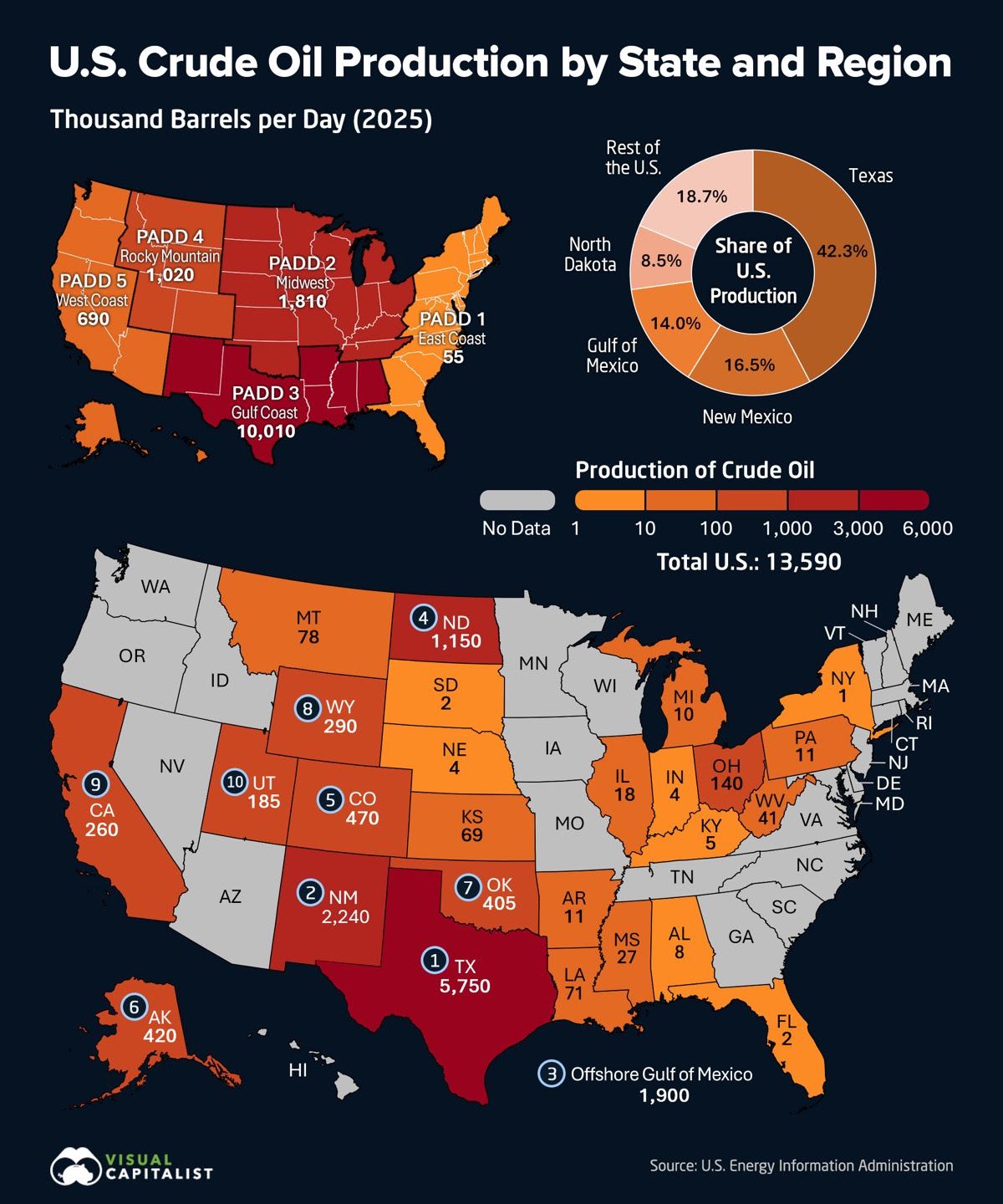
One state produces two-fifths of American crude. Texas alone accounts for around 42% of US oil production, the Permian the gravitational center of the shale complex, with New Mexico and North Dakota the supporting cast. The concentration cuts both ways, a formidable supply engine and a single-geography dependency for the marginal barrel the whole world now leans on when a chokepoint elsewhere flickers. Total US output runs near 13.6 million barrels a day in 2025. Source: EIA / Visual Capitalist.
The Same Map, Drawn in Gas
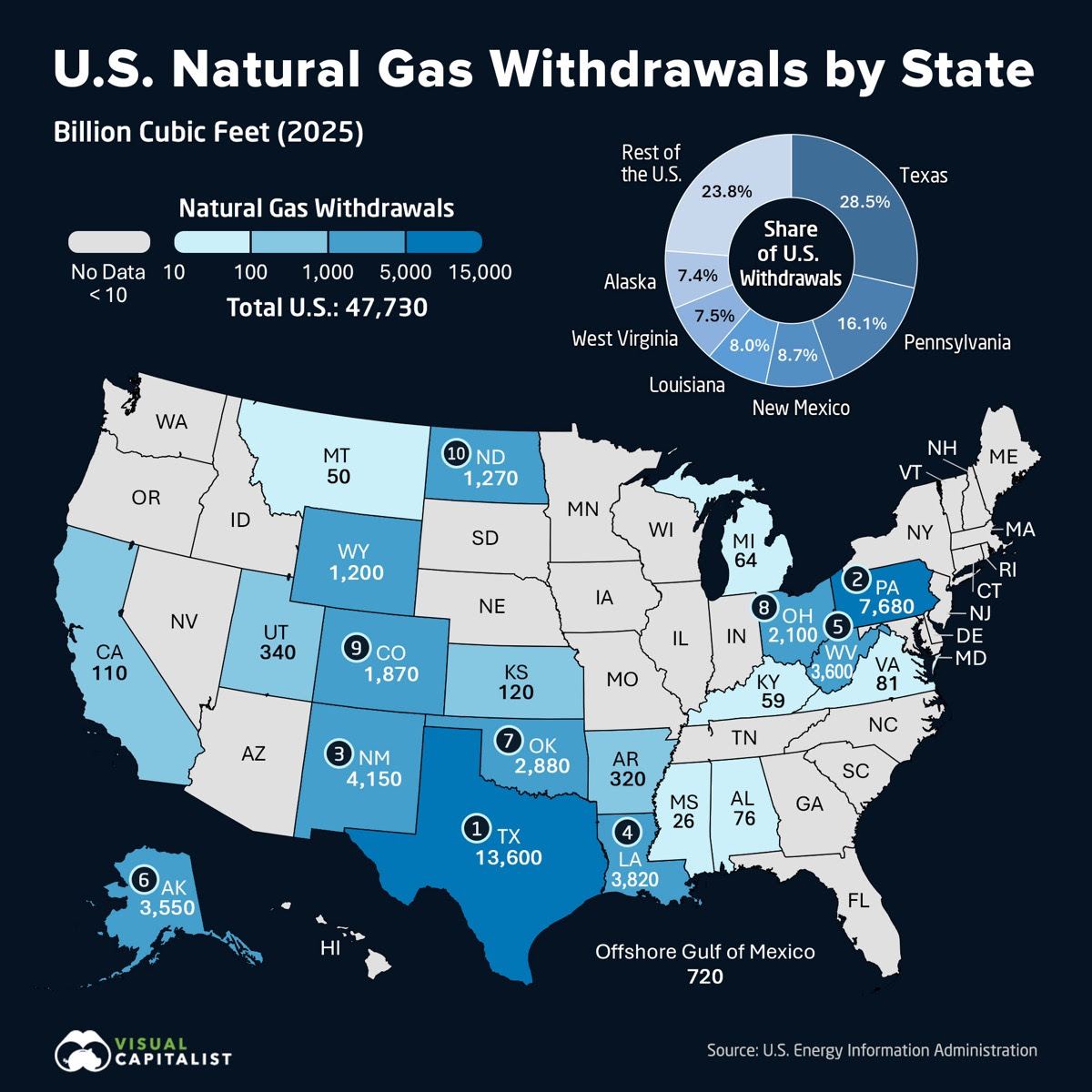
The same map, drawn in gas. US natural-gas withdrawals are just as concentrated, Texas and the Appalachian basin dominating a national total near 47,700 billion cubic feet. Gas is the quiet protagonist of the AI story, the fuel that will actually turn the turbines for the data centers, the reason the electric-power charts below bend the way they do. Where the molecules come from is fast becoming a strategic question, not a utility footnote. Source: EIA / Visual Capitalist.
Production, Recomposed in a Lifetime
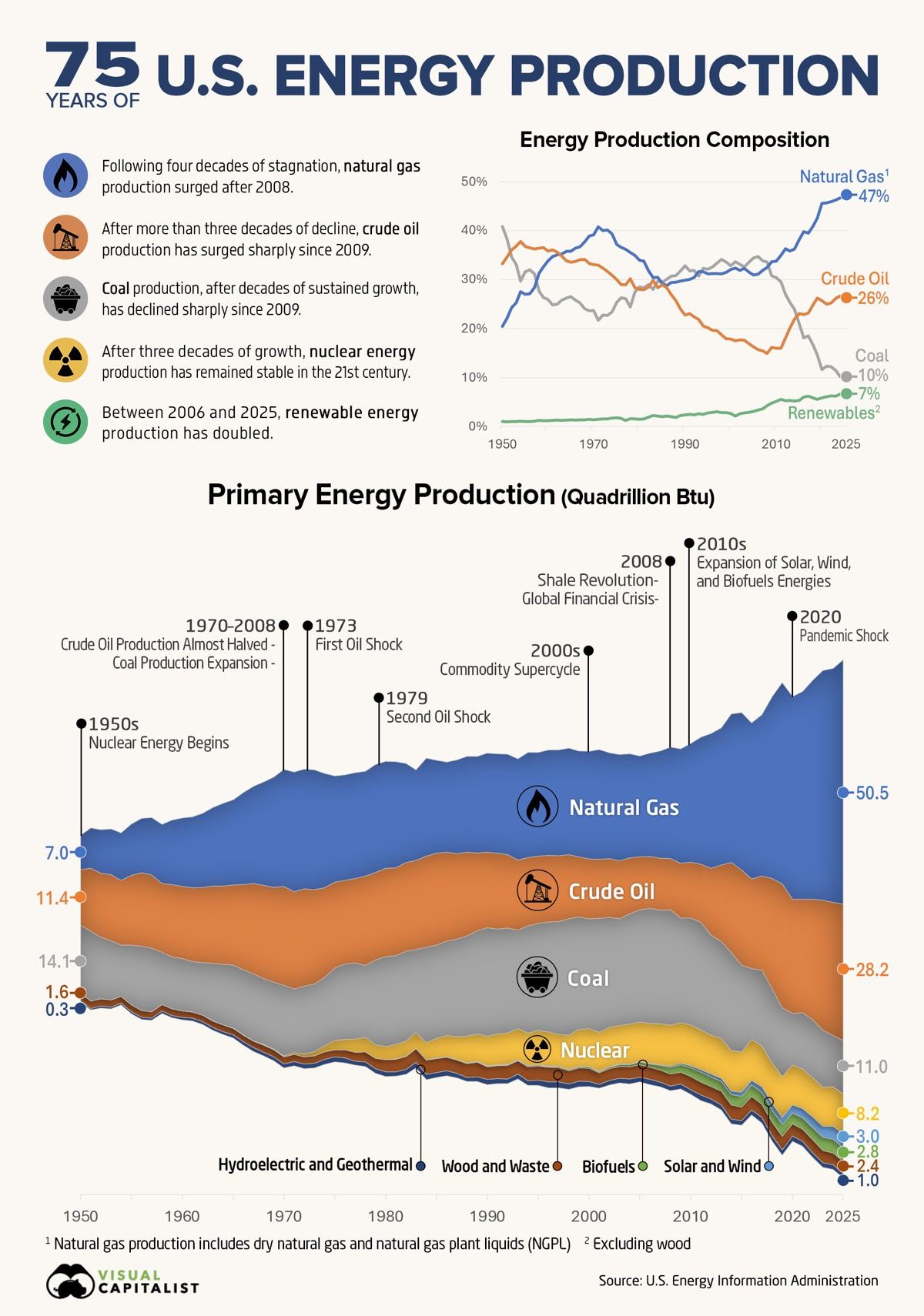
Seventy-five years of US energy production, recomposed. The production mix has been rebuilt in a lifetime, coal receding, natural gas and then shale oil surging, nuclear plateauing, renewables climbing off a low base. Read alongside consumption, it is the story of a country that became an energy exporter again almost by accident. For a macro book the takeaway is the terms-of-trade shift buried in it, the reason a US energy shock now travels through the world differently than it did in the 1970s. Source: EIA / Visual Capitalist.
Where the AI Trade Actually Clears
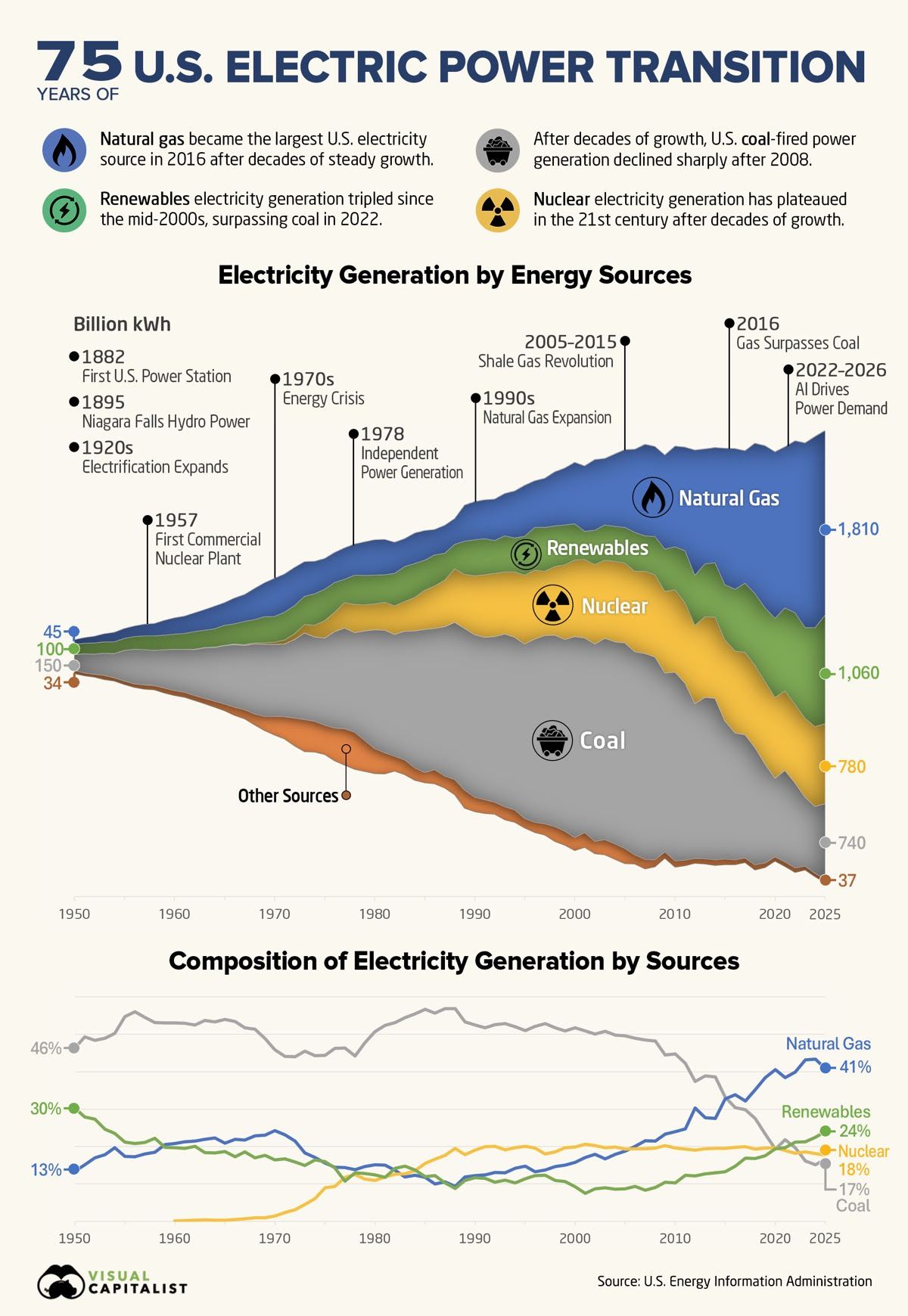
Electricity is where the AI trade actually clears. Three-quarters of a century of US power generation shows natural gas overtaking coal as the workhorse, with renewables the fastest-growing share and nuclear steady. Every server rack is a claim on this chart. The data-center boom is, underneath the silicon, a demand shock on the grid, and the constraint that decides how far the build-out can run is not GPUs but megawatt-hours and the transmission to move them. Source: EIA / Visual Capitalist.
Renewables Find Real Share
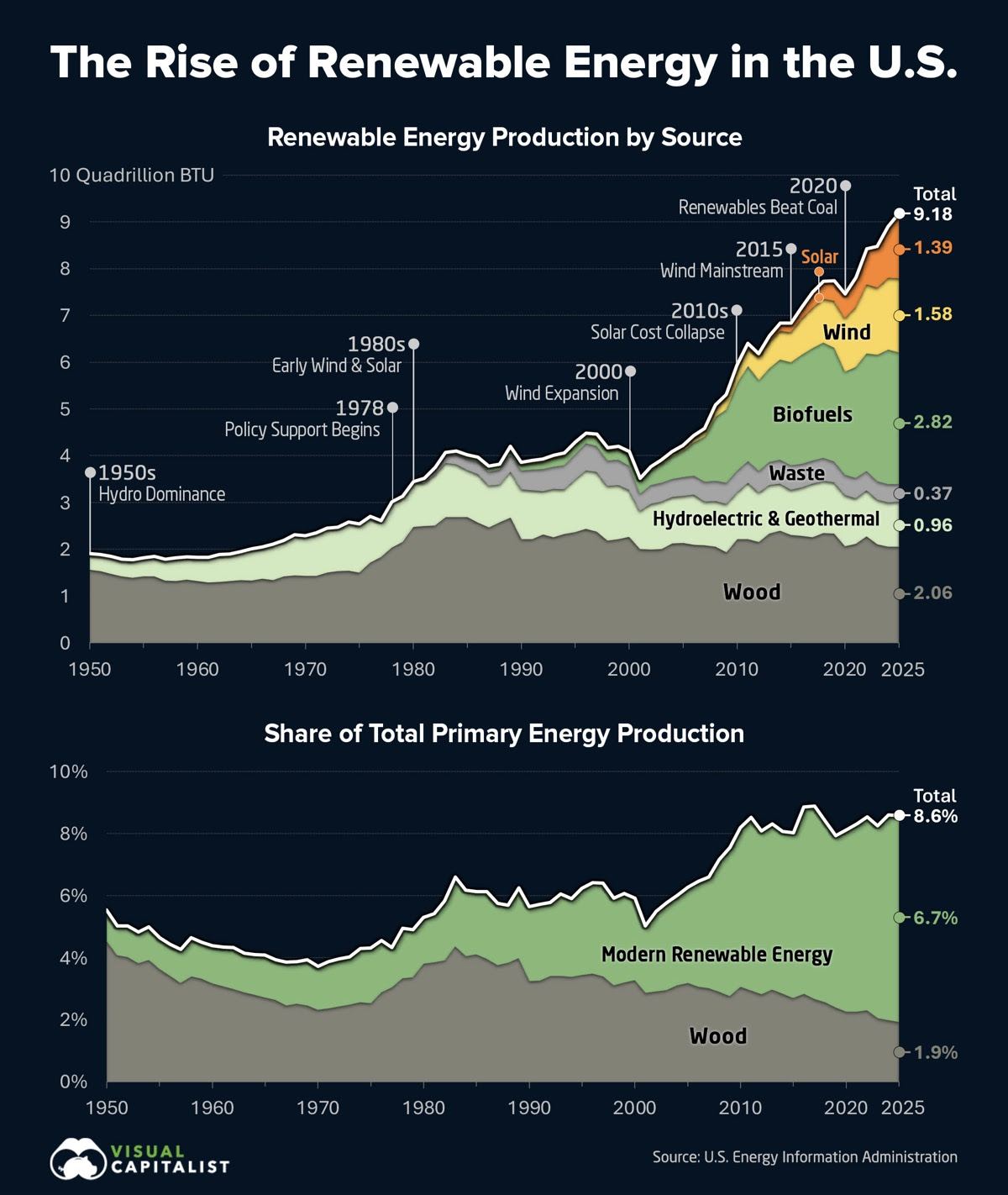
Renewables have gone from rounding error to real share. Wind and solar have driven US renewable energy to roughly 9% of primary supply, a genuine structural climb even against the 82% fossil base. The line that matters for the rotation is the slope, not the level, because it is renewables plus gas that are being asked to power the AI grid without breaking the emissions math. Whether that slope can steepen fast enough is the multi-trillion-dollar question the dispatch is really about. Source: EIA / Visual Capitalist.
Doing More With Less
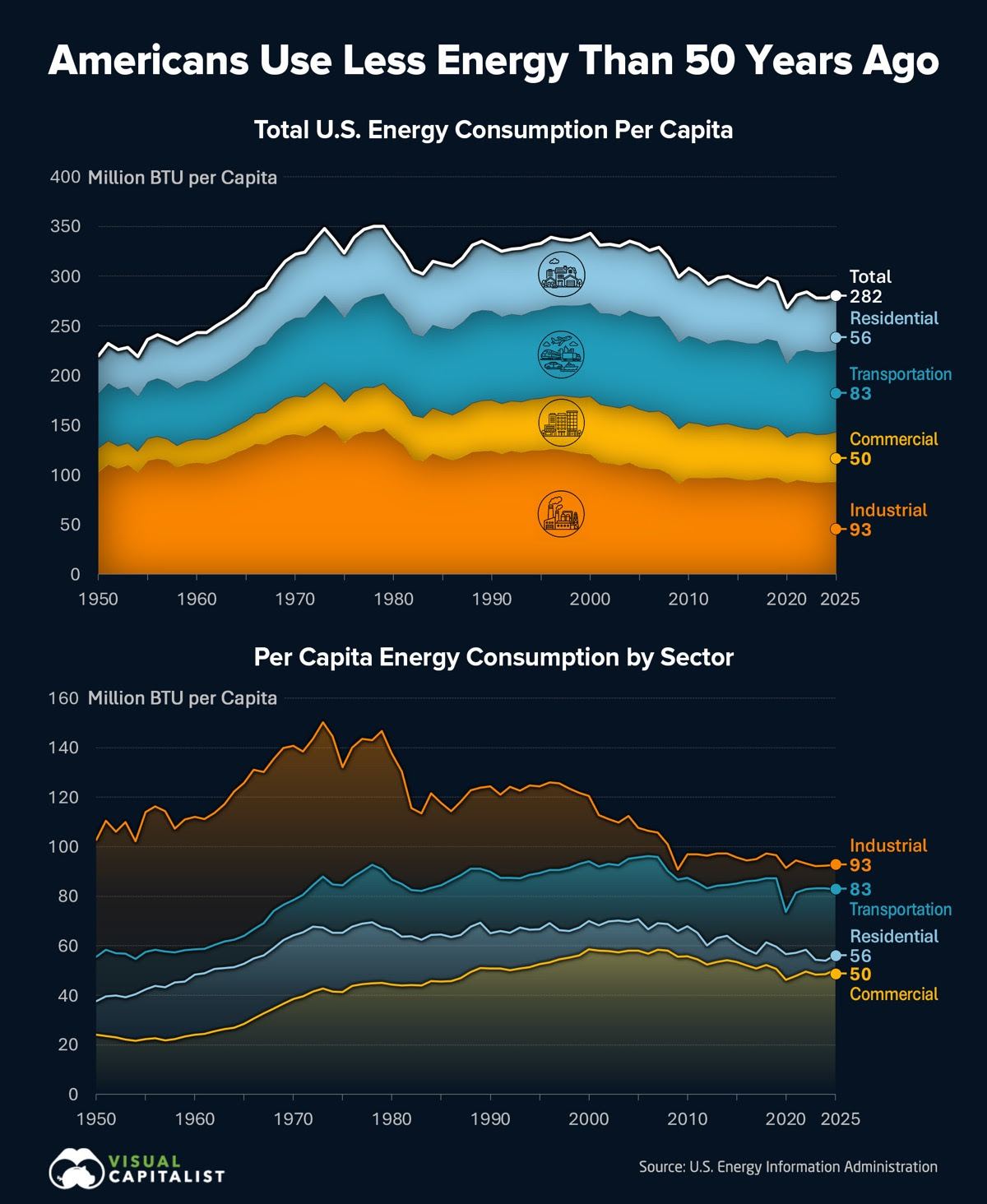
Americans use a fifth less energy per person than fifty years ago. Per-capita consumption has fallen steadily as the economy grew more efficient and shifted toward services, even as total consumption rose. That decoupling is the optimistic counter-note to the whole dispatch: the AI build-out lands on a system that has spent decades learning to do more with less. The open question is whether data-center demand is large enough and fast enough to reverse a fifty-year efficiency trend in a handful of years. Source: EIA / Visual Capitalist.
The Good Wrap
What is left at the close. A two-century read on US institutional freedoms, the slow-moving foundation under the risk premium a country commands, worth a glance in the republic's 250th year. Europe having the summer the models warned about, heat now a macro variable rather than a weather story. A two-thousand-year-old library being read by machine without being opened, the version of AI that is easy to love. Half the world's seafood now coming from farms, another system quietly rebuilt while the headlines looked away. A map of where the money actually lives. And to finish, because the busiest scheduled week of the summer has earned it, a flavor map of Champagne. Mind the process, not the print.
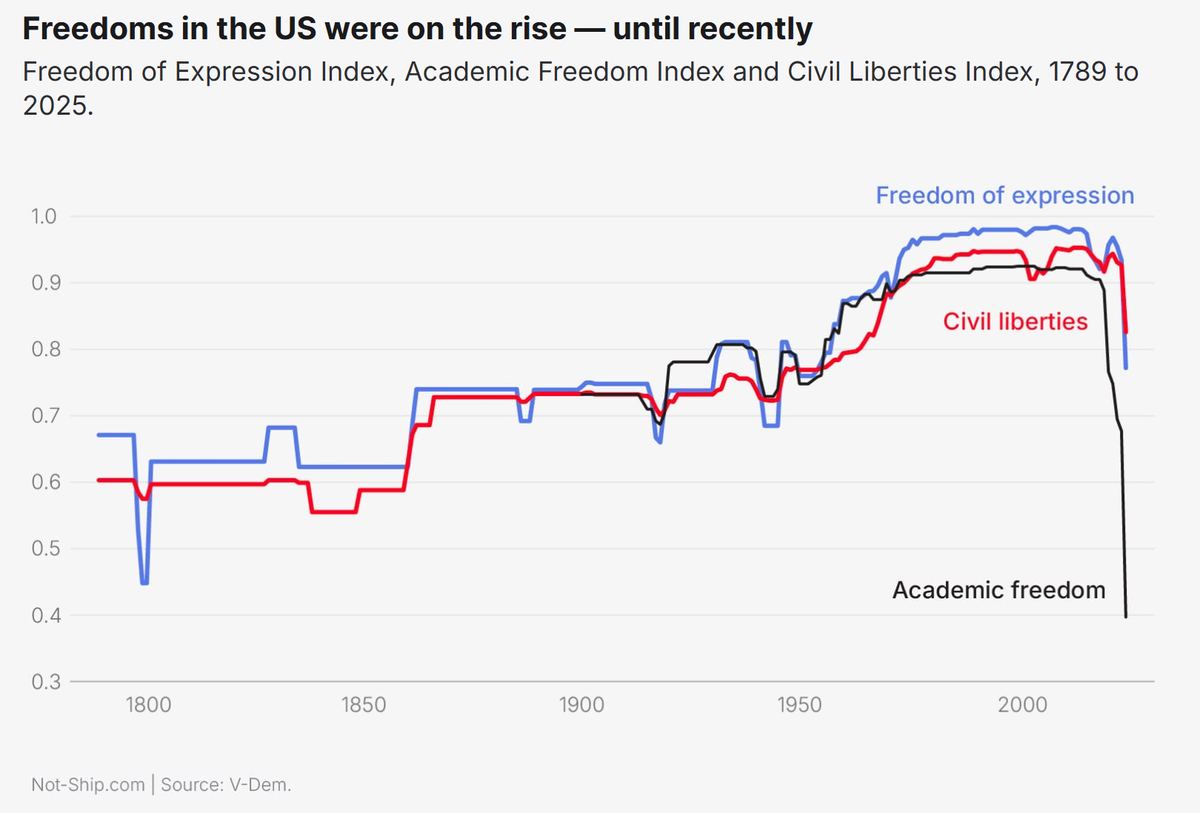
A longer-horizon chart to close the loop. Measures of academic freedom and civil liberties in the US rose for most of two centuries and have ticked lower recently, the kind of slow-moving institutional signal that never trades but sits underneath the risk premium a country commands. On the republic's 250th year it is worth a glance, a reminder that the exorbitant privilege markets keep paying for rests on foundations that are usually assumed and occasionally worth checking. Source: Our World in Data / V-Dem.
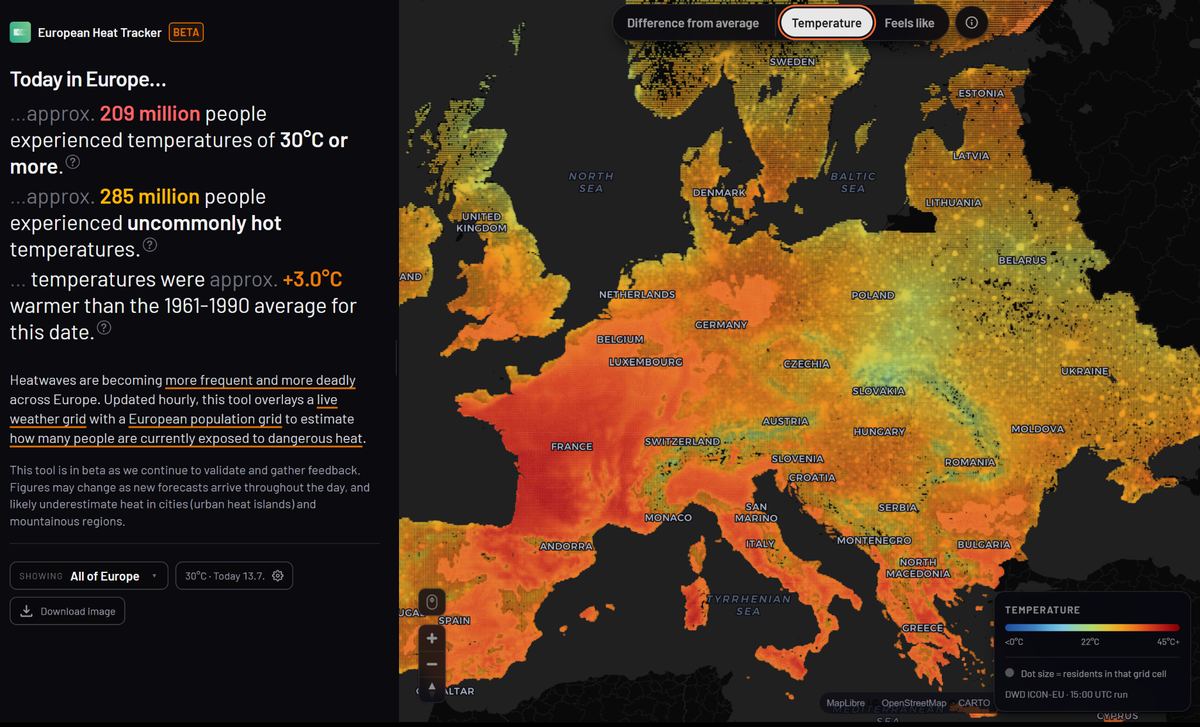
Europe is having the summer the models warned about. A single day this month put more than 200 million people across the continent above 30 degrees and nearly 285 million in uncommonly hot conditions, the map glowing several degrees above the late-century norm. It is the supply-side shock nobody puts in a calendar, a drag on UK and euro-area growth via energy demand and a recurring hit to productivity that quietly raises the floor under inflation. Heat is now a macro variable. Source: European Heat Tracker.
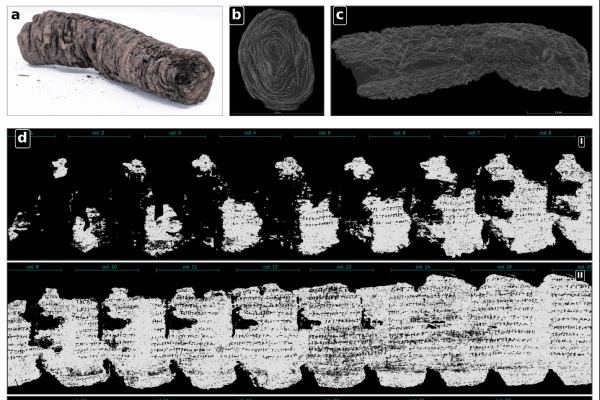
A two-thousand-year-old library is being read without opening it. The carbonised scrolls buried by Vesuvius are being unrolled virtually, CT scans and machine learning teasing legible Greek out of char that would crumble at a touch. It is the version of AI that is easy to love, no token business model, no capex arms race, just a genuinely impossible problem quietly solved. A small reminder, in a week of oversell and adoption gaps, of what the technology can actually do when pointed at the right thing. Source: Vesuvius Challenge.
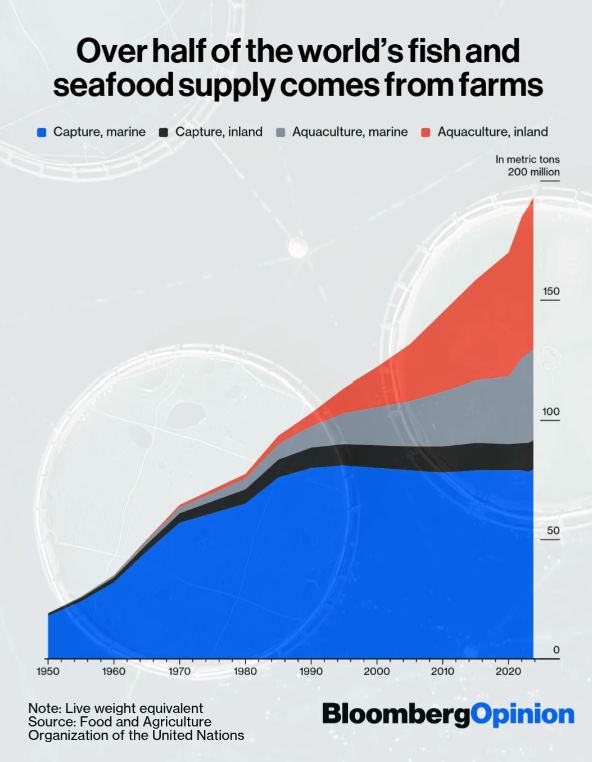
More than half the world's fish now comes from farms. Aquaculture has overtaken wild capture as the source of global seafood, a quiet structural shift with the same shape as every other chart in this letter, a system quietly rebuilt while the headlines looked elsewhere. Wild catch flatlined decades ago; farmed supply did all the growing. It is the food-system version of the energy transition, and a reminder that the biggest changes are often the ones that never make the tape. Source: FAO / Bloomberg Opinion.
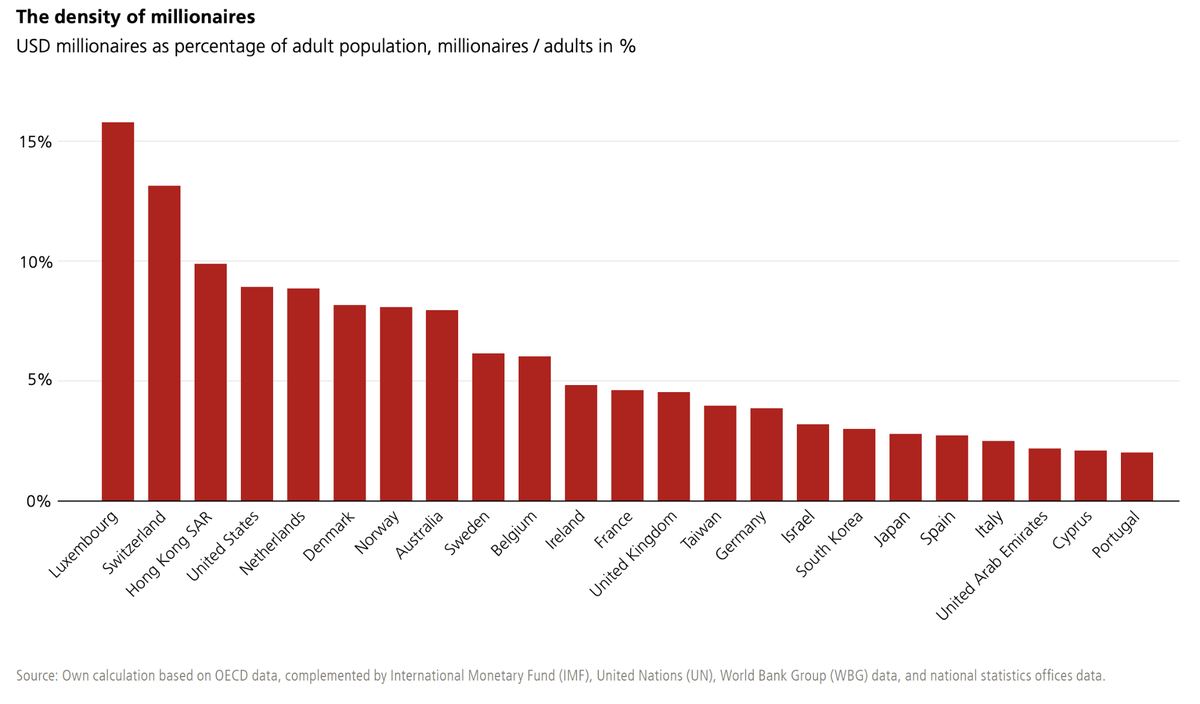
Where the money actually lives. Ranked by the share of adults who are dollar millionaires, the small, rich European enclaves top the table, the US dense but not densest. It is a snapshot of a wealth distribution that keeps concentrating, the backdrop to every debate about capital flows, tax competition and where the marginal savings pool chooses to sit. For a macro book it is the slow tide under the fast headlines, the pool of capital that the whole welcome-and-well-treated question is fought over. Source: UBS Global Wealth Report / Visual Capitalist.
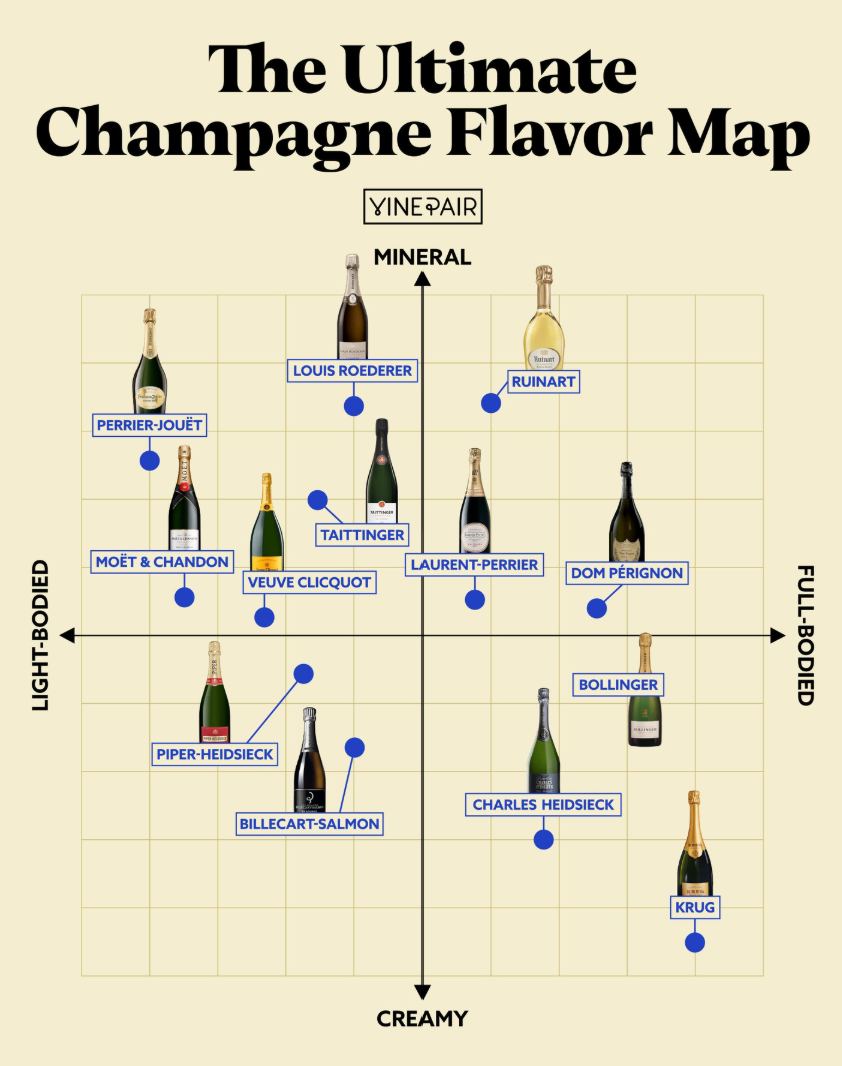
And to close, the map with no yields on it. A flavor map of Champagne, plotted from light and mineral to full and creamy, because after the busiest scheduled week of the summer something has to mark the finish. The discipline that makes a good bottle, patience, small choices repeated, an eye on the long maturation rather than the daily reading, is the same discipline the week demands of a book. Mind the process, not the print. Source: VinePair.
Best,
Hoelon
WITPTW is a personal publication. Everything here is personal opinion and market commentary, written in a personal capacity. It is not investment advice and not a recommendation to buy or sell any security. It is not associated with, endorsed by, or representative of any employer, fund or company. Charts and images are reproduced from their original publishers, credited to their sources for commentary and discussion; all rights remain with the respective copyright holders.