The Correct Expression
Personal views and market commentary. Not investment advice. Not associated with any employer or firm.
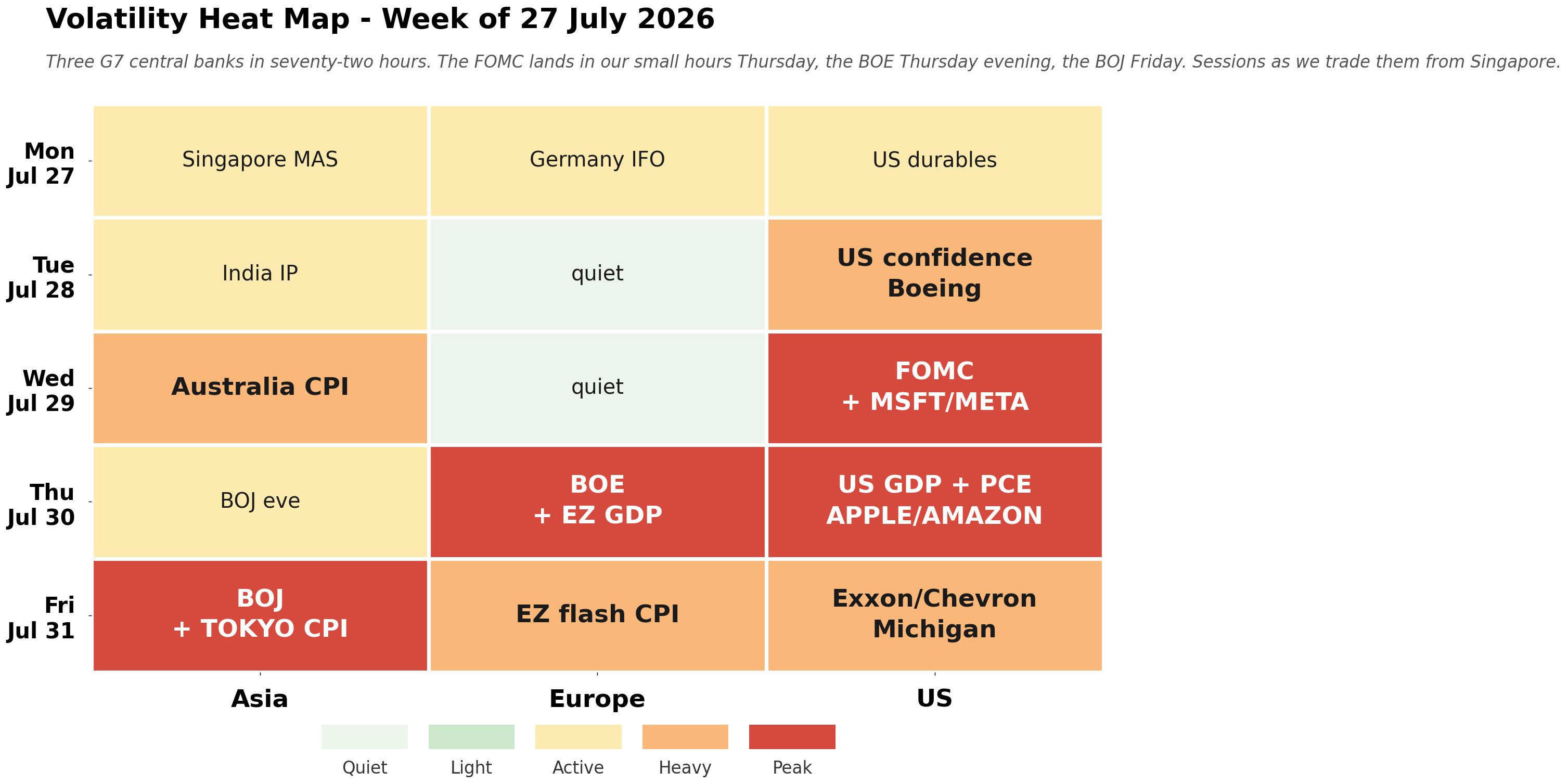
Volatility heat map for the week ahead, sessions as we trade them from here. Three G7 central banks in seventy-two hours, and the sequence runs FOMC first, in our small hours Thursday, then the Bank of England Thursday evening, then the Bank of Japan on Friday. Around them, US Q2 GDP and PCE on Thursday, euro-area flash CPI and Tokyo CPI on Friday, and the two biggest weeks of earnings of the year, Microsoft and Meta midweek, Apple and Amazon Thursday, the oil majors Friday. And behind all of it, Brent back above $100 with the strait still shut. The most consequential macro week of 2026.
"It's not whether you're right or wrong that's important, but how much money you make when you're right and how much you lose when you're wrong." — George Soros. The most painful lesson in this business is not being wrong. It is being right and still not making money, because the view was correct and the instrument was not. India this month is the parable. A judge called some unemployed young people cockroaches, and within days that insult had become a youth revolution in the streets. But the cockroach was only the trigger. The root cause was a voided exam that forced two million students to sit it again, and a generation with degrees and no jobs. Markets are the same. The catalyst everyone watches is rarely the thing that moves the trade, and being right about the surface story is worthless if you express it in the wrong place. My own week said it plainly, the dollar view right and the Korean expression of it wrong, and the two do not net.
"Inflation is as violent as a mugger, as frightening as an armed robber, and as deadly as a hit man." — Ronald Reagan. The consensus has decided that AI is disinflationary and the oil spike transient, and both halves may be dangerously complacent. The near-term reality of the build-out is inflationary, a vast demand shock for power, capital and skilled labour arriving at once, financed by a fiscal deficit that is itself an inflation engine. And behind it a Godzilla is forming in the Pacific, an El Nino forecasters put at stronger than the record 2015-16 event, sea-surface temperatures already through the super threshold and projected to peak well above it by November. The last three super events cut global growth by trillions and lifted food prices by a tenth to more than double. Layer that on crude back above $100 and a Fed that declared victory at $70, and the mugger everyone thought they had outrun is waiting in the next doorway.
"From this point forward, any time the Islamic Republic of Iran shoots at a ship in the Strait of Hormuz, the United States will bomb and destroy one bridge or power plant." — Donald Trump on Truth Social last week, days after telling reporters he is seriously considering restarting major combat operations and is close to a decision. You can hear the arithmetic problem in it, because there are only so many bridges. The point is not the threat, it is that this is a war with no exit ramp narrated one post at a time, and the market keeps pricing an interim deal the man in charge keeps declining to sign. Into a second week of strikes, an attack on the Caspian pipeline has taken roughly a million barrels a day off the market, the Houthis have declared a Saudi blockade and hit two tankers in the Red Sea, and a drone has reportedly struck a data centre in Bahrain. The tape wants this over. Everything about it says it is not.
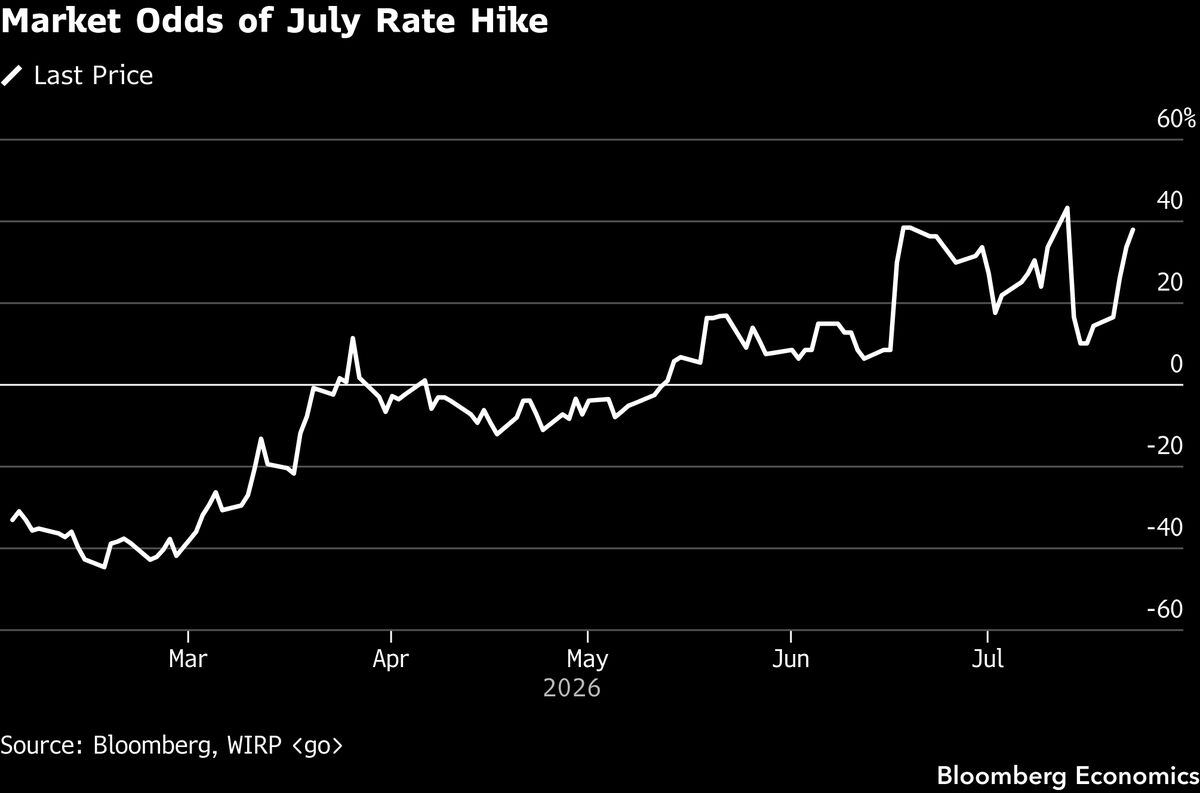
A live meeting, priced by the market. The market-implied odds of a July hike have climbed back to roughly a third, having collapsed to the teens after the soft mid-month CPI and then rebuilt as crude pushed back above $100. This is only the second meeting under the new chair, who has said nothing about his lean, so the odds chart is really a picture of how little conviction anyone has. A September move is close to two-thirds priced. The base case is a hawkish hold, but a live meeting means the tails are fat in both directions, and Warsh's press conference is the most important forty-five minutes of the week. Source: Bloomberg WIRP.
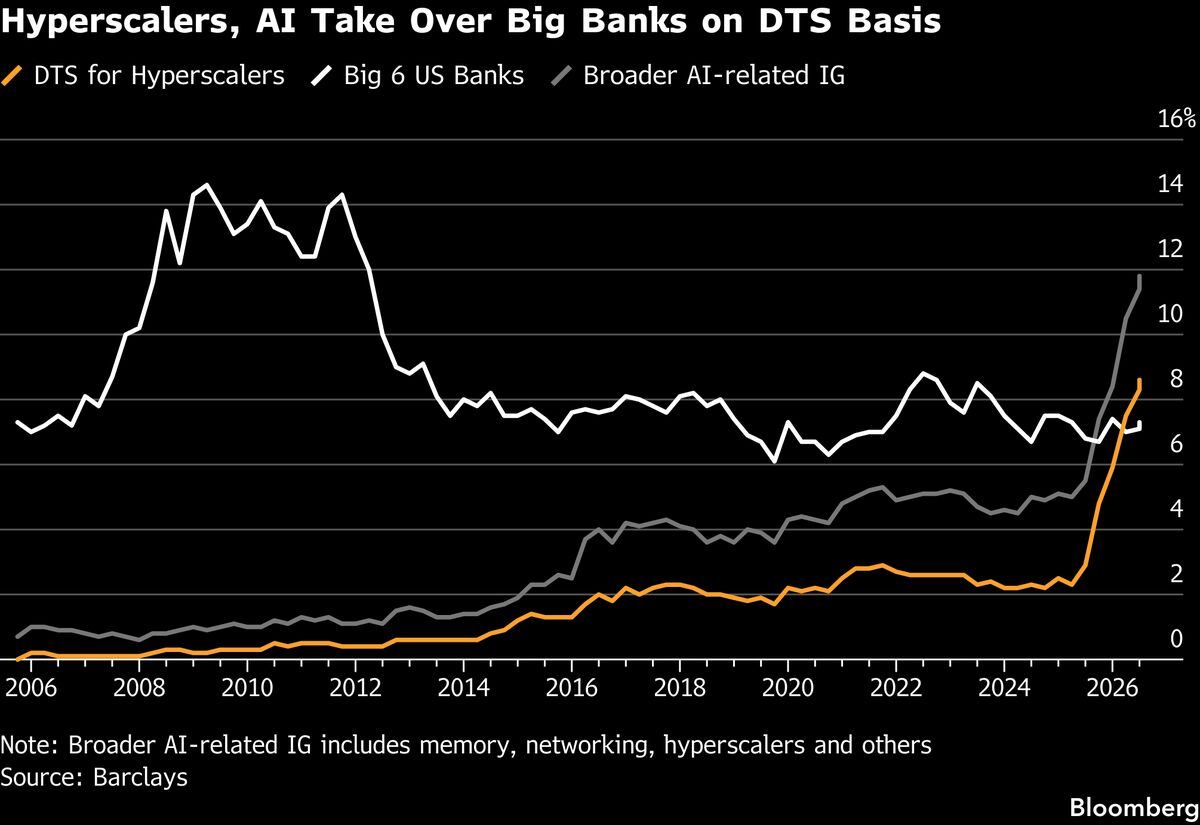
And here is what everyone is quietly worried about. Measured by duration-times-spread, the contribution of risk to the US investment-grade market, the six biggest technology names have now overtaken the six largest banks, at roughly 8.6% against 7.3%. In one chart, the marginal driver of credit risk in the world's deepest bond market has shifted from the institutions that are regulated and stress-tested to a handful of companies funding an AI build-out. Hyperscalers are set to issue around $285 billion of high-grade debt this year. The equity market frets about capex. The bond market is starting to fret about who is holding the paper. Source: Barclays / Bloomberg.
What is the plan this week?
The global markets are full of troubles. The Middle East keeps escalating with more casualties, oil is testing $100 again with very little to stop it, and tariffs are back, the administration rebuilding under a new legal authority the same import taxes the Supreme Court struck down in February. Fed pricing has crept back higher, roughly a third of a July hike now priced from the teens a fortnight ago. And it is not just oil and higher yields. The two-year is above 4.30% at an eighteen-month high, the ten-year has broken 4.70% for the first time since early 2025, gilts set their longest run of daily closes above 5% in nearly two decades. Yet the currency market itself looks perplexed, stuck in range, and some Asian currencies actually traded stronger last week.
This week we get three G7 central banks in seventy-two hours, and the sequence matters because of when they land for us. The Fed decides in our small hours Thursday, the Bank of England Thursday evening, the Bank of Japan on Friday. The last Fed meeting happened with oil near $70 and trending lower, and the committee cut. This one happens with oil above $100 and trending higher, which is not a tweak to the same meeting, it is a different meeting entirely. It is only the second under the new chair, who has said nothing about his lean, so the base case is a hawkish hold but the meeting is genuinely live.
Around the central banks sits the heaviest data and earnings run of the year. US second-quarter GDP and the June PCE deflator on Thursday, euro-area flash CPI and Tokyo CPI on Friday, and the two biggest weeks of corporate reporting, Microsoft and Meta midweek, Apple and Amazon on Thursday, the oil majors on Friday. The AI world carries its own worries into all of it. Semis retraced hard, the cheaper Chinese models keep advancing, Alphabet already tanked on a capex guide toward $200 billion, and the Nasdaq now looks a precarious setup on the chart. The newer worry is the debt underneath the build-out, the hyperscalers having quietly become a larger source of credit risk than the biggest banks.
In Asia the tape is contradictory, which is the whole problem. The yen sits at a forty-year low, past 163 and toward 164, weaker than at any point since 1986, and the dollar index is testing its highs for the year. And yet the Korean won strengthened, Seoul leaning on the currency with heavy selling of dollars, so the two legs of the same trade went opposite ways. Underneath, a quiet rotation is running out of the crowded chip names and into the region's laggards, ASEAN and India drawing the inflows, the beaten-down Indian IT names up double digits even as the cockroach movement fills the streets.
So the honest read on last week is that the long dollar view against Asia was right and got stopped out anyway. The yen was the most sensitive short, running to four-decade lows on higher US yields and the shifting Bank of Japan calculus, while the sheer selling in dollar-won and Seoul's indirect intervention took the other leg out from under the position. Right on the dollar, wrong on the expression. This time it looks much harder for oil to retreat than it did a month ago, and inflation may hit harder than the consensus is set up for, which is the risk sitting under every dovish hope priced into this week.
The plan is to read the reaction function, from the Fed on Thursday and the Bank of Japan on Friday and from what they signal about the meetings ahead. Stay light into the trifecta and let the central banks show their hand before committing, because a live Fed and a drifting Bank of Japan into a forty-year-low yen can move any expression violently in either direction. The view is not the hard part this week. To win is to pick the correct expression. Stay nimble.
What did I learn last week?
Mon Jul 20: The US moved to impose an additional 50% tariff on certain Canadian goods, effective in thirty days, over alleged trade discrimination. Andy Burnham was sworn in as UK prime minister. Oracle was said to face a $7 billion collateral bill on its Wisconsin data centre. Ryanair warned that some airlines are on the edge and could fail this winter.
Tue Jul 21: China was reported to be weighing tighter export controls on AI models and chips, the mirror image of Washington's own moves. Two Saudi tankers made U-turns in the Red Sea on Houthi threats. Trump was said to be poised to unleash fresh tariffs on dozens of countries. The Treasury Secretary said open-source AI models could be sanctioned for IP theft, and Washington moved to redirect around $200 billion of research funding toward AI and away from universities. GM beat and raised.
Wed Jul 22: Trump posted that the US would bomb a bridge or power plant every time Iran fired on a ship in Hormuz, and Brent touched $95. South Korea's Q2 GDP beat at 0.6%. A Bank of Japan source said the Bank was close to anchoring inflation and open to raising faster than every six months. Alphabet beat but raised its capex guide toward $200 billion and the shares fell, and reports had one AI lab lifting cloud spending to $750 billion from $600 billion. The 20-year auction tailed badly at 5.163%.
Thu Jul 23: The ECB held unanimously and signalled it is ready to move in September, with the chief saying no one pushed for a hike this time. Trump told an interviewer he is seriously considering restarting major combat operations in Iran and is close to a decision. US jobless claims fell to 187k, the lowest since early 2024. Washington announced new 10 to 12.5% tariffs to replace the expiring emergency import surcharge. Intel beat and guided strong. Brent retested $100.
Fri Jul 24: Trump launched a Section 301 trade probe against the EU over its treatment of American companies, citing a fresh $1 billion fine on Google. China was said to have encouraged Pakistan and Iran to reopen talks with Washington, and the US and UK were reported to be convening a Hormuz conference in London. US new home sales beat. Germany's manufacturing PMI expanded for a sixth month. Qualcomm told customers prices would rise double digits.
All week: Brent surged back above $100 for the first time since May, and the bond market broke with it, the two-year to an 18-month high and the ten-year above 4.70%. The S&P lost 0.6%, the Dow 0.4% and the Nasdaq 2.1%, with tech firmly out of favour. Tesla sold off hard on mixed results and a massive new capex plan, while the defence names, Lockheed, RTX and Northrop, posted big numbers on the war footing. Alphabet's strong quarter was sandbagged by the same capex worry haunting the whole complex.
What to look out for next week?
Mon Jul 27: The week eases in under $100 oil, with US durable goods the only hard print and the Monetary Authority of Singapore reviewing its currency band. Germany's IFO business climate, China industrial profits, Hong Kong trade. The Chinese memory maker CXMT lists on Shanghai's STAR market, the debut that has hung over the chip complex for weeks. A quiet day by design, the calm before the trifecta.
Tue Jul 28: US consumer confidence is the read on whether $100 oil has reached sentiment, with the jobs-plentiful sub-index the one to watch. Boeing, Coca-Cola, Visa and UPS headline the earnings, Chile decides on rates, India reports industrial production into its inflow surge. The RBA governor speaks in Sydney. Still a warm-up, but the confidence number is the first place the oil price becomes a data point.
Wed Jul 29: The FOMC decision lands in our small hours Thursday, a live meeting with roughly a third of a hike priced and the chair's press conference the event. Australia CPI overnight is the clean preview of the oil pass-through. Then Microsoft, Meta and Qualcomm report after the New York close, so we read the first hyperscaler capex numbers, and SK Hynix, on Thursday morning our time. The single most important forty-five minutes of the month.
Thu Jul 30: A data deluge: the Bank of England decides, US second-quarter GDP and the June PCE deflator print, and euro-area GDP with German CPI lands into the September-hike debate. The BOE is expected to hold and the vote split is the trade. Apple and Amazon report after the close. This is the heaviest single session of the week, central banks and growth and the two largest companies in the world all inside a few hours.
Fri Jul 31: The Bank of Japan decides into a forty-year-low yen, with Tokyo CPI printing first, and the risk is a hawkish forecast revision rather than a hold. China's official PMIs, euro-area flash CPI, Taiwan GDP and the final Michigan sentiment with its inflation expectations. Exxon and Chevron close the earnings week. The tape exhales into the weekend, if the strait and the yen let it.
Beyond next week
Aug 1: The new Section 301 tariffs take effect as the emergency surcharge expires, with the generic-drug tariff schedule the one to watch.
Aug 7: US July payrolls, the first read on the labour market since the oil shock, and the print that has twice turned a policy cycle.
Aug 11: RBA, into an Australian inflation gauge that is catching a fresh energy updraft.
Sept: The Fed, ECB and BOJ meetings the market is pricing hikes into, the September the doves are trying to talk down and the hawks are trying to lock in.
Sept: BOJ hike odds sit above four-in-five for October, so a hawkish forecast this week pulls that forward.
Nov: US midterms, the political clock that a war with no exit ramp is quietly running against.
Ongoing: Hormuz and the Red Sea. Two chokepoints now, a blockade declared, no scheduled date on which any of it resolves.
Regimes
Oil is above $100, and the second leg is no longer a forecast. The thesis that reversed two weeks ago has arrived. Strait shut, Red Sea blockaded, a million barrels a day off the market from the Caspian pipeline, crude in steep backwardation. The first oil move was met by central banks leaning against currencies and curves holding. The second lands with the developed world's bond markets already broken and a Fed that eased at $70. Respect the direction, hold long-dated crude calls, and treat every dovish central-bank hope this week as a fade rather than a signal. upgraded, war week 8
A live Fed, and the chair is the only variable that matters. Roughly a third of a July hike priced, a hawkish hold the base case, September near two-thirds. The chair has revealed nothing in two meetings, so the press conference is the trade, not the statement. The asymmetry is a dovish hold, which almost nobody is positioned for and which would collapse the front end. Be positioned for the reaction function rather than the decision, cheap options both ways into the print, and read the September signal harder than the July one. evolved, week 2
The AI trade is now a credit story, not just an equity one. The hyperscalers have overtaken the six biggest banks as a source of investment-grade credit risk, long-dated tech paper drifts toward junk pricing, off-balance-sheet obligations at the five biggest spenders climb toward two trillion. Capex the equity market frets about is being funded from the bond market. Lean against credit-spread complacency, watch this week's Microsoft, Meta, Apple and Amazon capex guides as the confirming signal, and treat any forced selling in the levered credit vehicles as the transmission channel. evolved, week 3
Right on the dollar, wrong on the expression. Fix the instrument. The long-dollar-Asia view was correct and the Korean leg still stopped out on Seoul's intervention, while the yen ran to forty-year lows. The lesson is the whole letter: the view is not the edge this week, the expression is. Concentrate the dollar-strength view into the yen where policy and yields do the work, keep the won leg small and respect the intervention, and let the Fed and BOJ reaction functions pick the vehicle rather than forcing one. evolved, week 9
Inflation is set up to hit harder than the consensus, from three directions at once. Oil back above $100, an AI build-out that is inflationary before it is deflationary, and a super El Nino forming into the crop year. The market is priced for disinflation to resume. Stay paid on the front end into any dovish repricing, hold breakeven and energy-equity expressions of the second inflation leg, and treat the soft June prints as a photograph of a world that the energy tape has already begun to reverse. new, week 1
Shifts (if → then)
If the Fed holds but Warsh sounds hawkish on Thursday → the front end backs up, the two-year through 4.40, the dollar firms and the yen weakens further toward the level that forces Tokyo's hand.
If the Fed holds and Warsh sounds comfortable with the June softness → the genuine shock, a violent unwind of the September-hike pricing, the two-year sharply lower, the dollar off and equities relieved. Almost nobody is positioned for it.
If the Bank of England splits five-four → September reprices from two-thirds toward near-certain, sterling jumps almost as much as an actual hike and the two-year gilt lurches higher.
If the Bank of Japan revises its inflation forecasts up → that is the cover for action even without a hike, the yen rallies hard, the Nikkei sells off and the global carry trade starts to unwind.
If euro-area flash CPI prints above 3% → the ECB September hike moves from debate to near-decision, the euro squeezes higher and Bunds sell off into an already-broken global bond tape.
If Apple or Amazon guides capex sharply higher → the AI-debt story gets its confirmation, the credit worry moves from the letter to the tape, and the funding question overtakes the earnings beat.
If oil takes another leg with the strait still shut → every central bank's dovish option closes at once, breakevens catch a bid and the simultaneous global bond selloff becomes the base case rather than the tail.
Tails
Hormuz and the Red Sea shut together → the double chokepoint, a fifth of seaborne oil plus the Suez route, Brent gapping toward $110 or beyond, and every dovish hope priced this week erased in a single session. The base case is being repriced toward it. war week 8, evolved
A Bank of Japan surprise into a forty-year-low yen → the largest single-asset move on the board, a violent yen rally and a global carry unwind, the kind of dislocation that historically follows an intervention and a hawkish forecast in quick succession. week 3, evolved
The AI debt pile becomes an AI credit event → hyperscalers now a bigger IG risk than the banks, long-dated paper at junk-adjacent spreads, two trillion of off-balance-sheet obligations, and a technology whose economics changed twice this month. week 2, evolved
The Godzilla El Nino hits the crop year → sea-surface anomalies through the super threshold and rising, prior events cutting global growth by trillions and lifting food prices by a tenth to more than double, arriving on top of $100 oil. new, week 1
The long end breaks on fiscal supply, not just oil → the ten-year through 4.70% with foreign Treasury buyers slowing and net issuance above two trillion a year, the Gulf recycling fewer petrodollars into US assets exactly as the war lifts the deficit. week 4, evolved
The everything-hawkish Thursday → a hawkish Fed hold, hot US GDP, a BOE vote split and euro CPI above 3% inside sixteen hours, every major central bank signalling tighter-for-longer at once and global bonds selling off in unison. new, week 1
Youth unrest spreads from the streets to the risk premium → the cockroach movement in India, a generation with degrees and no jobs, the slow social variable that never trades until it suddenly sets the terms on which a market is priced. new, week 1
Slow-Burn Monday
The week does not want to start fast, and the calendar obliges, but the backdrop will not let anyone relax. Oil sits above $100 and the whole week routes through it. US durable goods is the only hard American print and it carries a wide survey range, genuine uncertainty about whether the no-landing story still holds. In Asia the Monetary Authority of Singapore reviews its currency band, the cleanest early read on how a central bank that targets the exchange rate chooses to absorb an energy shock. Germany's IFO and China's industrial profits fill the rest, and the Chinese memory maker CXMT finally lists in Shanghai, the supply threat the chip complex has been bracing for. A quiet day sitting on a loud oil price.
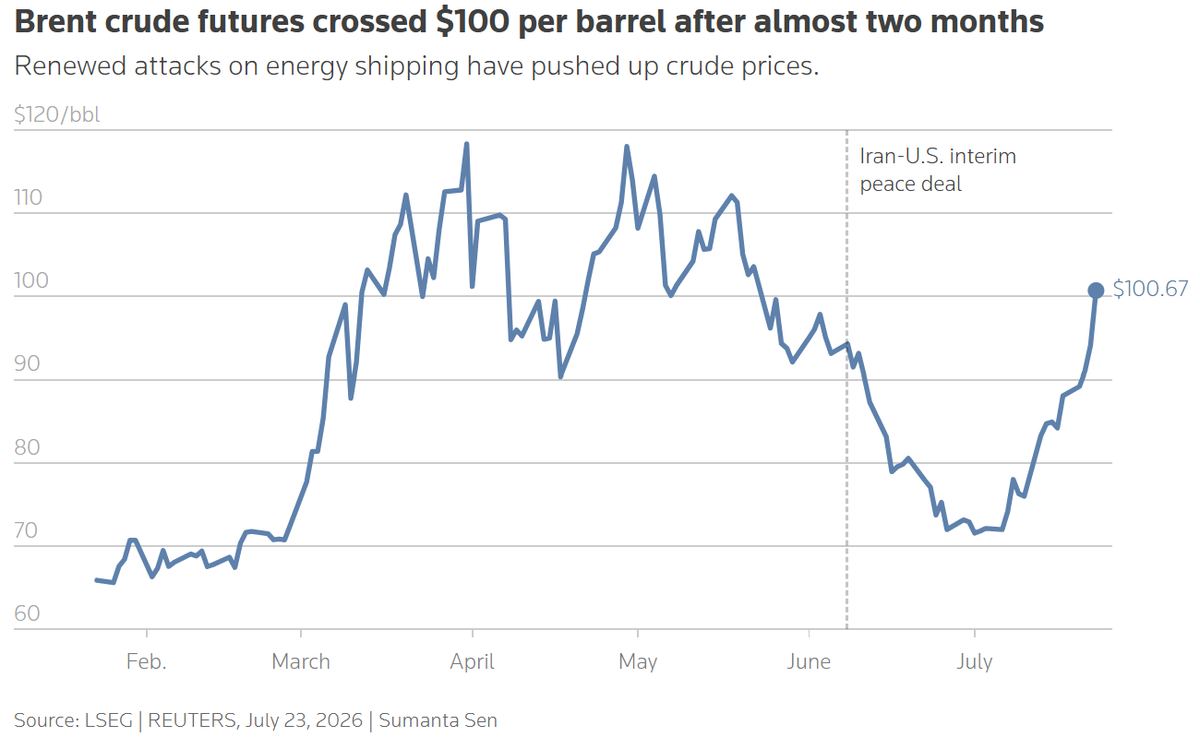
The number that reprices everything else. Brent crude pushed back through $100 a barrel last week, the first time in almost two months, as renewed strikes on energy shipping and a second squeezed chokepoint in the Red Sea did the work. The front-month contract is up roughly a quarter over three weeks and the curve is in steep backwardation, the widest of the year. Every central bank decision this week, every inflation print, every yield, routes through this one line. The last Fed meeting happened with oil near $70 and trending lower. This one happens with it above $100 and trending higher, which is an entirely different meeting. Source: Reuters / LSEG.
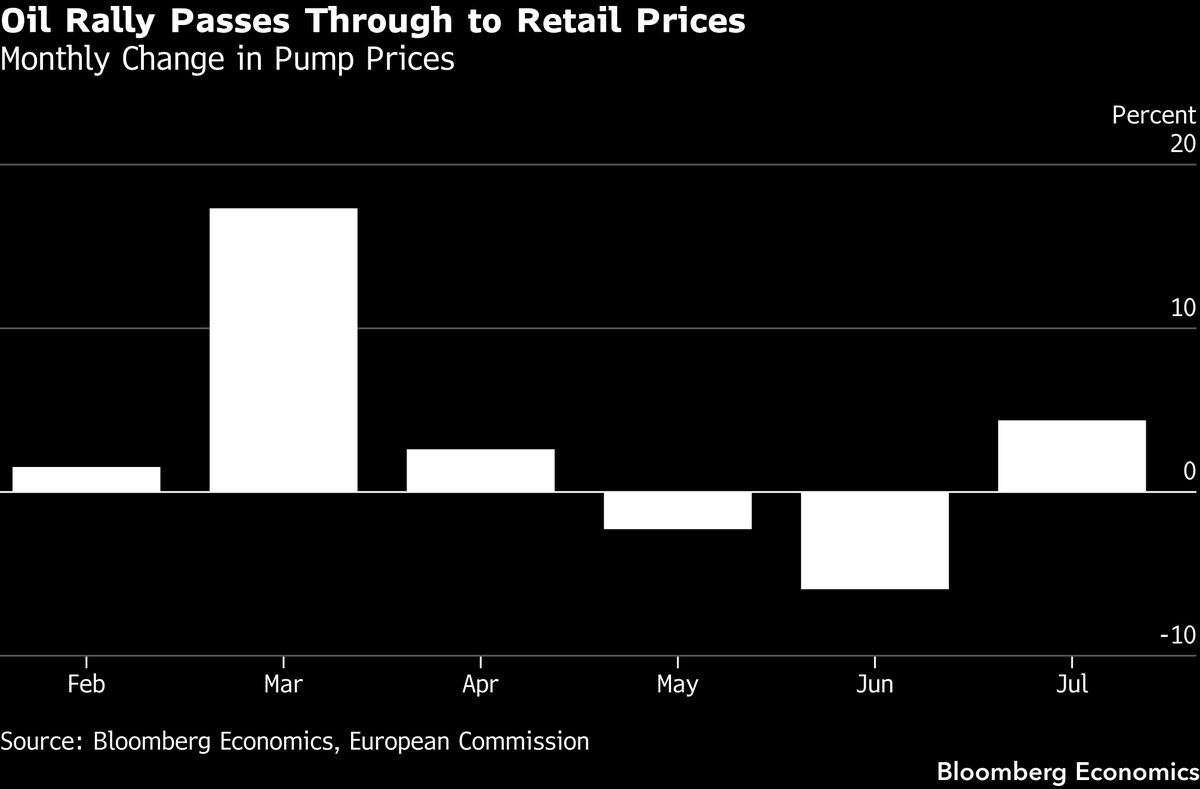
The oil rally is already reaching the pump. Monthly changes in US retail gasoline prices have turned sharply positive after months of relief, the fastest pass-through since the war began. This is the transmission that matters for the Fed, because gasoline is the most visible price in the economy and the one that moves inflation expectations regardless of what core does. A soft June inflation print bought the disinflation story a fortnight of comfort. The pump is quietly taking it back, and the July numbers that land next month will show it. Source: Bloomberg Economics, European Commission.
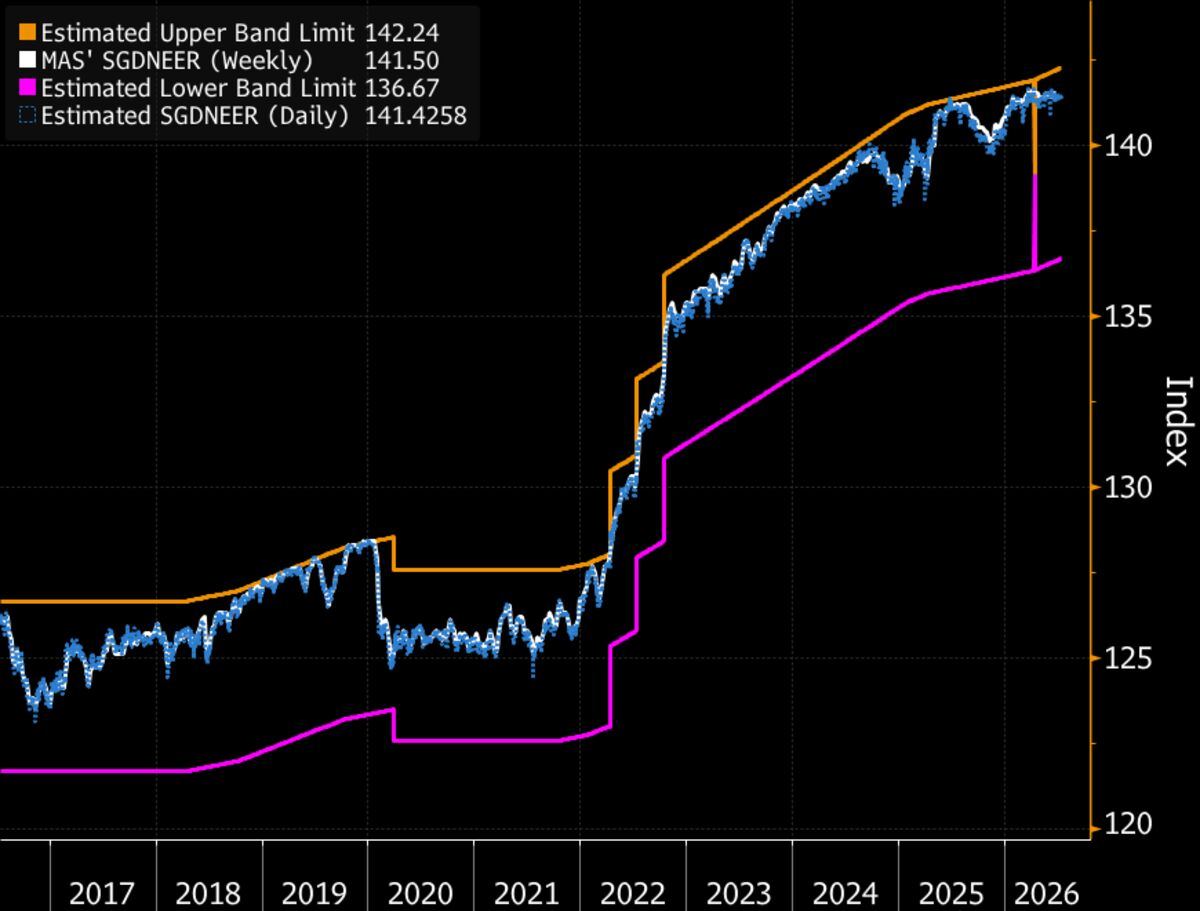
Singapore's dollar sits at the top of its band as the oil shock lands. The trade-weighted rate has run near the strong side of the policy band, and the monetary authority reviews settings Monday. As a price-taking, energy-importing entrepot, Singapore transmits a crude shock faster and more honestly than almost anywhere, so the band setting is a useful early read on how a central bank that targets the currency rather than a rate chooses to absorb $100 oil. Standing pat lets imported inflation through. Steepening the band leans against it at the cost of growth. Source: Bloomberg Economics.
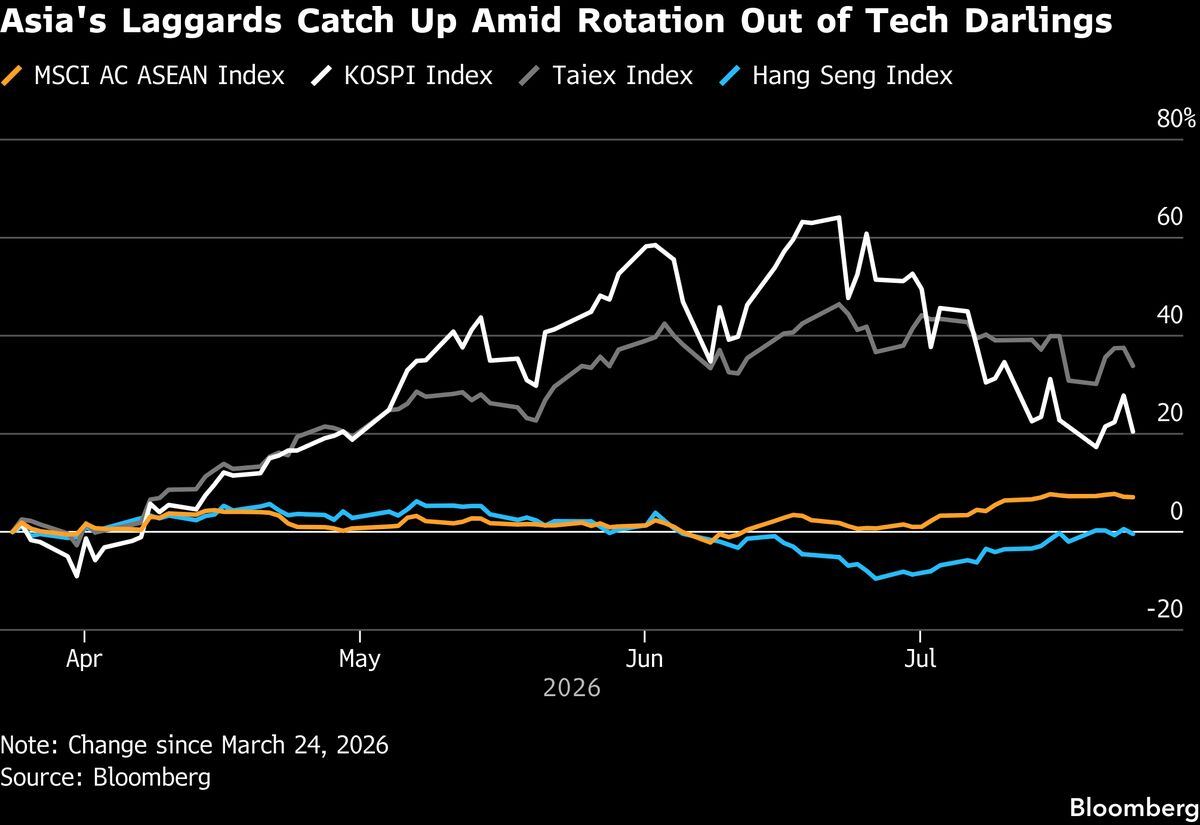
The quiet rotation that has nothing to do with the central banks. Since late March, the region's laggards have caught up hard, the ASEAN, Taiwan and Hong Kong benchmarks closing the gap on a Korean market that led on the way up and has since broken. Money is leaving the crowded chip trade and looking for the parts of Asia that were left behind. India has drawn about $2 billion of foreign equity inflows this month, its beaten-down IT names up double digits. This is where being right on the region and wrong on the instrument gets expensive, and it is the week's clearest example. Source: Bloomberg.
Confidence Tuesday
Tuesday is where the oil price stops being a headline and becomes a data point. US consumer confidence is the read on whether $100 crude has reached the household, and the number that matters is buried in the detail, the jobs-plentiful sub-index that tracks payrolls more tightly than anything else on the calendar. A soft reading there would reprice the labour market faster than the GDP print two days later. Boeing, Coca-Cola, Visa and UPS carry the earnings, a broad cross-section of the real economy rather than the AI tape. India reports industrial production into the month's inflow surge, and the RBA governor speaks. Still a warm-up, but the first day the war's price shows up in an American survey.
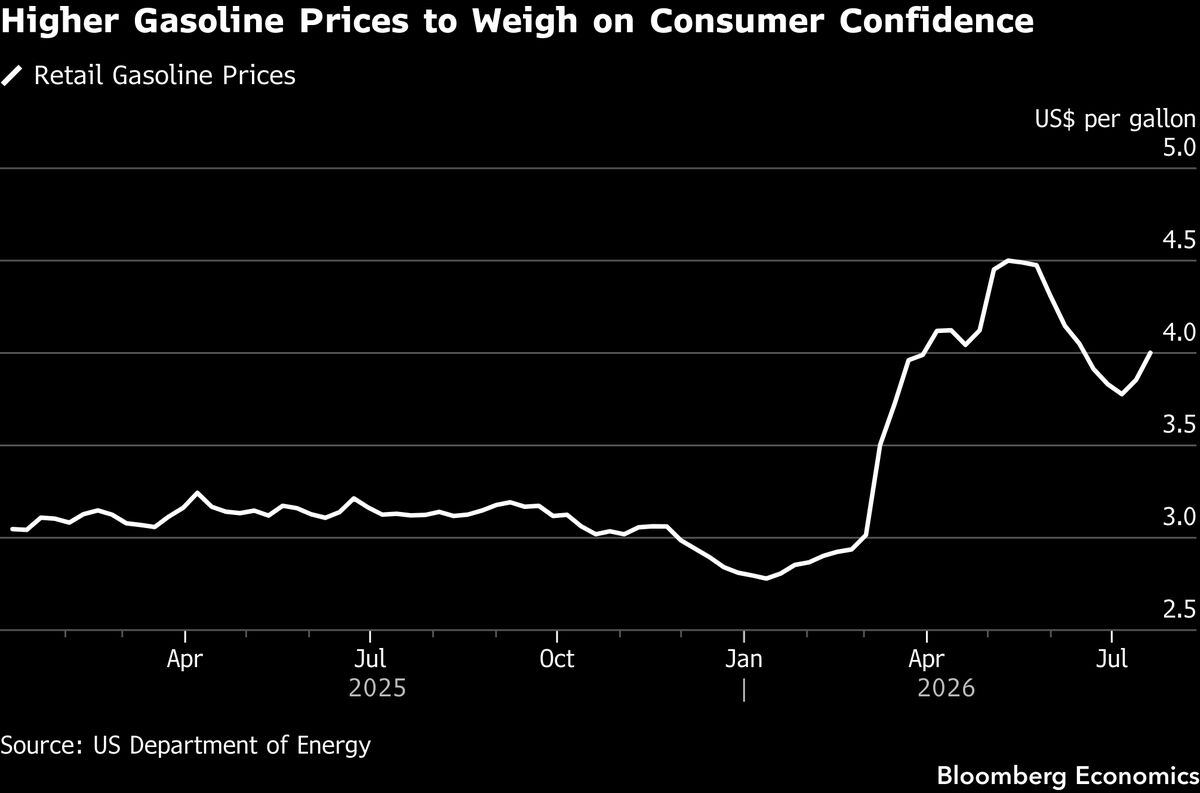
Confidence is where the oil price becomes a political problem. Higher gasoline is set to weigh on July consumer confidence, due Tuesday, with the retail-price series leading the sentiment index lower. The number to watch is not the headline but the jobs-plentiful sub-index, the component most tightly linked to payrolls, because a soft reading there would reprice the labour-market outlook faster than any data point this week. High prices meeting a wobbling consumer is the stagflation signal the equity market is least prepared for. Source: US DoE / Bloomberg Economics.
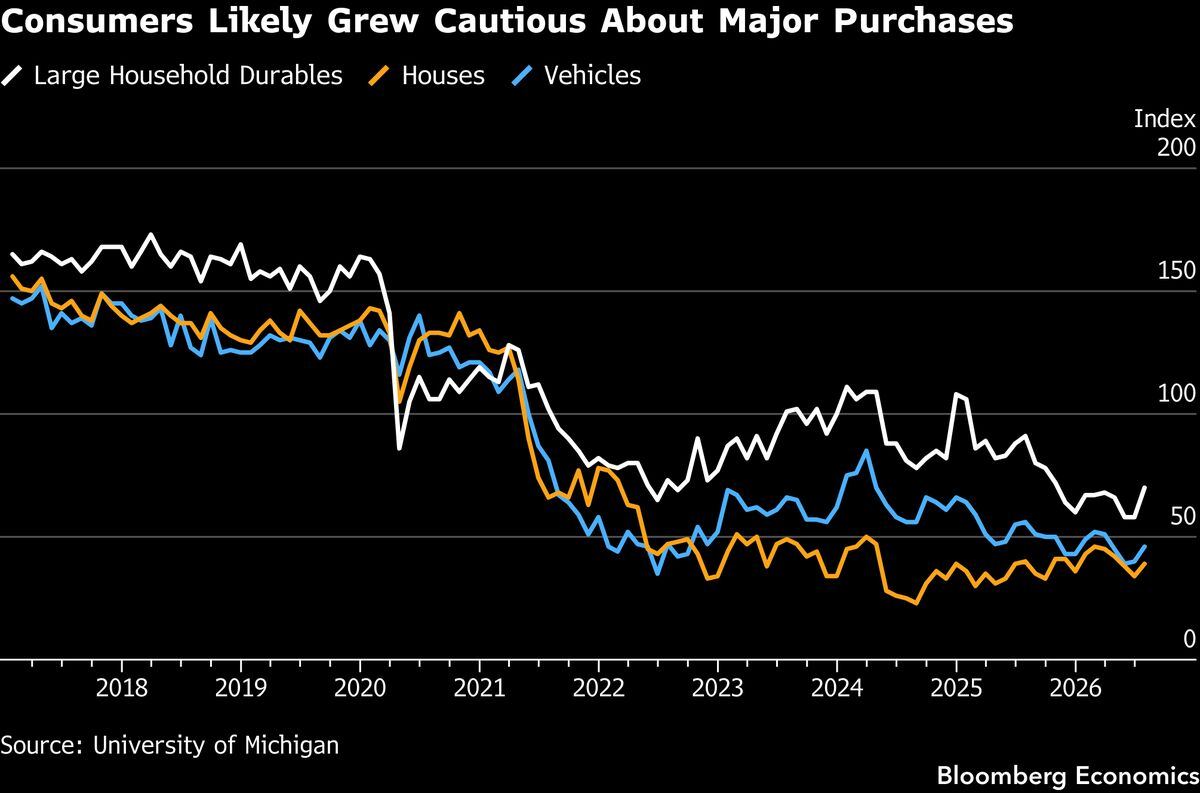
The consumer was already growing cautious before the pump moved. Plans for major purchases, homes, vehicles and large household durables, have drifted lower for months, the University of Michigan detail showing intentions well below their post-pandemic run. Layer a fresh gasoline shock on top and the risk is a consumer that stops leading the expansion just as every central bank is being asked to lean against inflation. This is the tension the Fed cannot resolve on Wednesday, strong output on one side and a tiring household on the other. Source: University of Michigan / Bloomberg Economics.
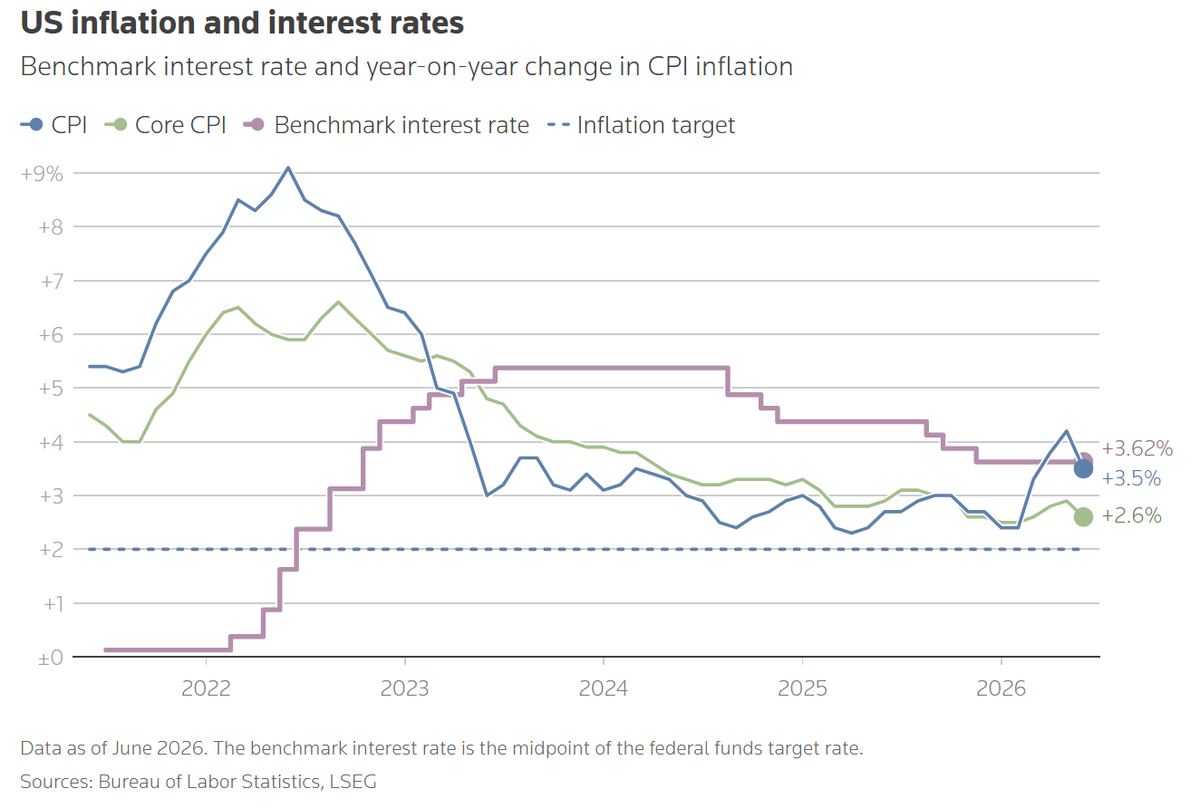
US inflation and the rate path, before the meeting that tests both. Headline and core CPI have eased from their war-driven highs while the benchmark rate has held, the gap the Fed has been waiting to see widen before it can relax. The oil rally threatens to close it again. The chair inherits a committee that cut to the current setting and now has to decide whether $100 crude is a level shock to look through or the start of a second inflation leg to lean against. The June softness said one thing. The energy tape is saying another. Source: Reuters / LSEG.
Warsh Wednesday
The gate of the week, and it opens in our small hours Thursday. The Fed decides with roughly a third of a hike priced and a base case of a hawkish hold, but a live meeting means the tails are fat both ways, and with the chair having said nothing across two meetings the forty-five-minute press conference is the entire trade. Australia's CPI overnight is the clean preview of what $100 oil does to an inflation gauge. Then, after the New York close, Microsoft and Meta report, so the first hyperscaler capex numbers reach us Thursday morning alongside SK Hynix, and the question the whole letter keeps circling, whether the spending is still being rewarded, gets its first answer. Be awake for the conference, not just the statement.
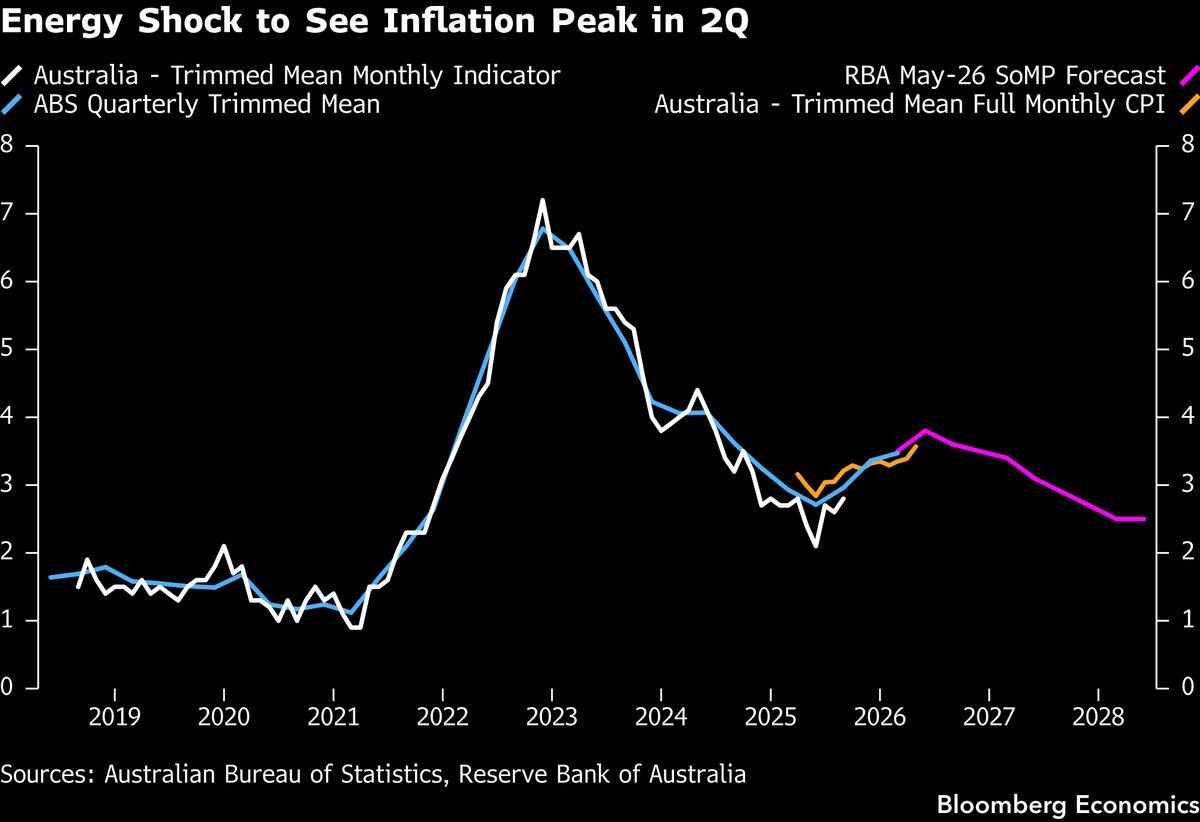
Australia is the preview of the oil pass-through, and it prints on Fed morning. The trimmed-mean gauge is expected to show inflation, having peaked and rolled over through 2025, catching a fresh updraft from energy in the second quarter. For a commodity economy the crude shock is more ambiguous than for an importer, lifting the terms of trade even as it lifts the CPI, but the read-across is clean enough. Where oil goes, the inflation gauges follow, and the central banks that declared victory too early are the ones now exposed. Source: ABS, RBA / Bloomberg Economics.
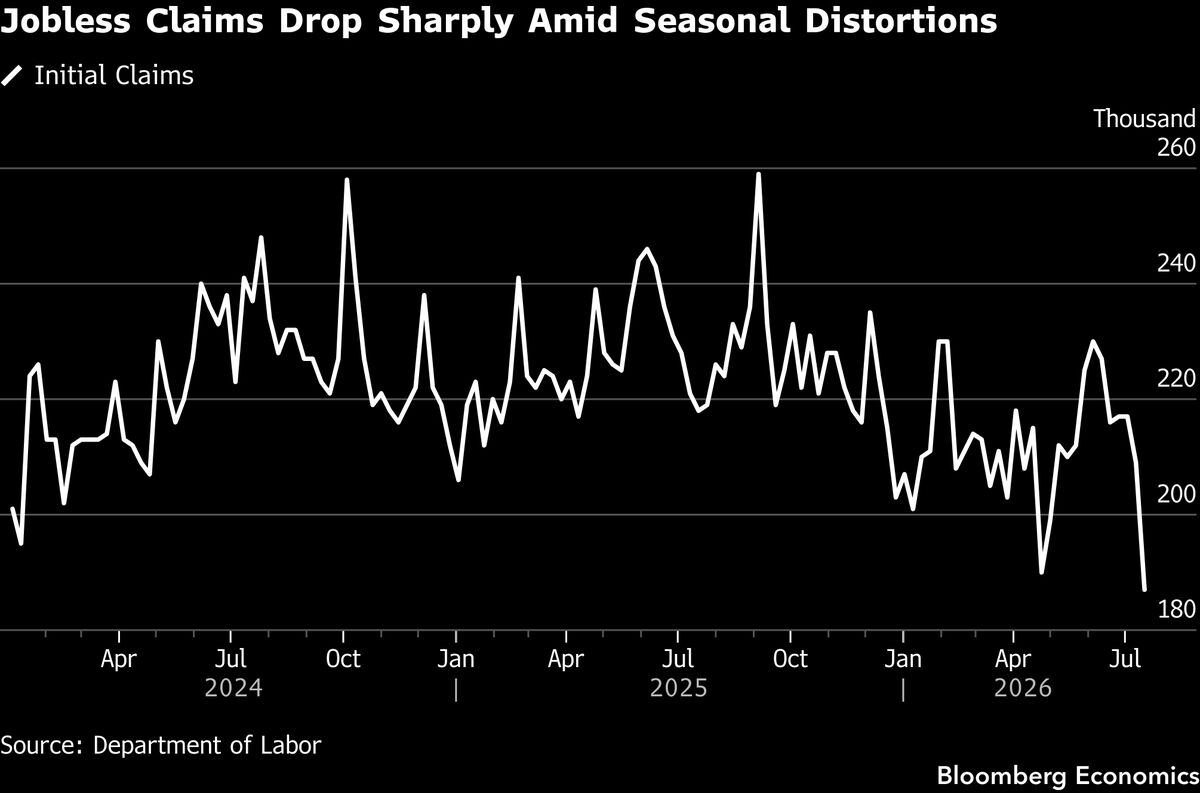
Claims keep dropping, which hands the hawks the labour market they need. Initial jobless claims fell sharply to their lowest since early 2024, and while seasonal distortions flatter the read, the trend still shows no crack in employment. That is the awkward fact underneath the whole week. A labour market this firm gives the Fed room to treat the oil shock as a reason to hike rather than a reason to wait, and it removes the recession excuse that a dovish hold would need. Strong jobs plus $100 oil is the hawkish combination. Source: Department of Labor / Bloomberg Economics.
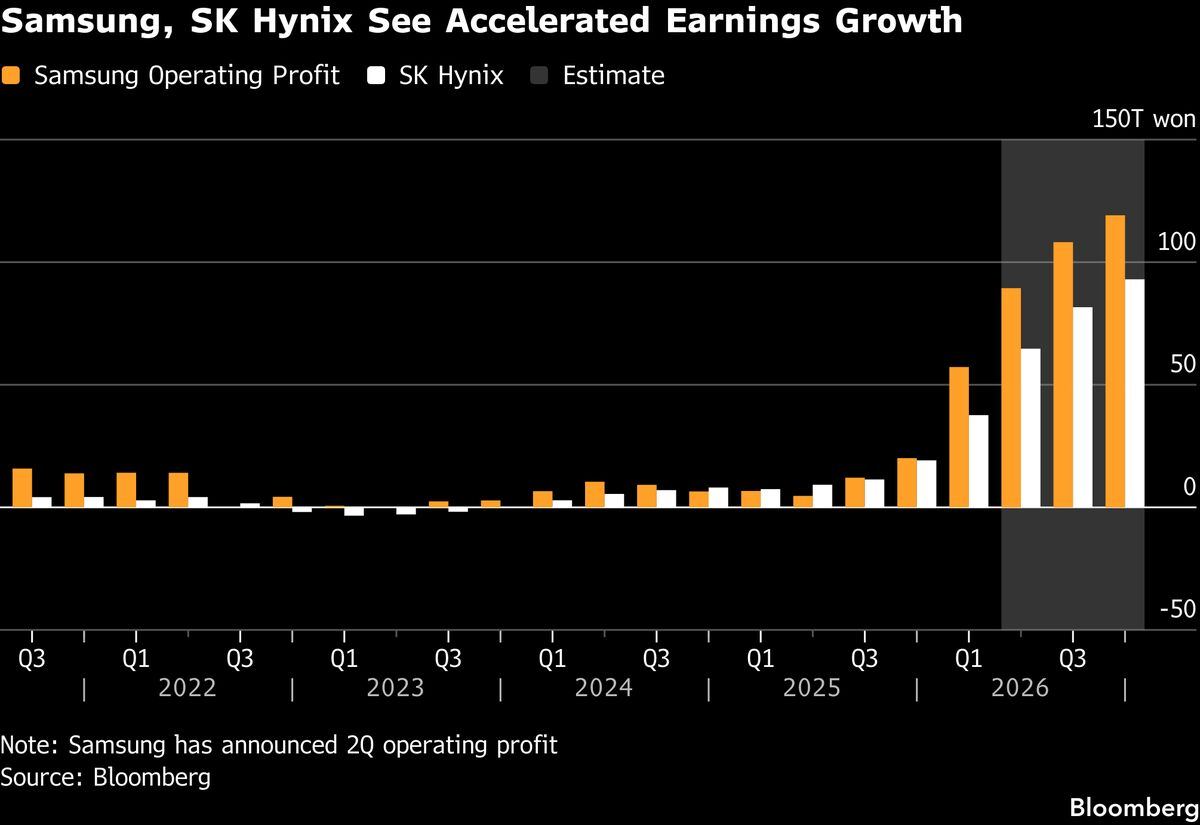
The memory makers report into the same tape that broke them. Samsung and SK Hynix are set to post accelerated earnings on the AI-hardware boom, with SK Hynix among the names reporting midweek, even as the Korean market that carried them has fallen into a bear market and the currency has been defended. The split is the story of the whole AI complex, record fundamentals arriving exactly as the multiple compresses, because the market has stopped paying for the growth and started pricing the capex and the competition behind it. Source: Bloomberg.
The AI Debt Pile
This is the theme that has quietly become the most important one, so it gets its own section. The equity market has spent a month worrying about AI capex. The bond market has started worrying about who is funding it, and the answer is increasingly itself. The hyperscalers now carry more investment-grade credit risk than the six largest banks, their longest-dated paper trades toward junk spreads despite pristine ratings, and the obligations that never show up as debt, the leases and power contracts and take-or-pay compute deals, have climbed toward two trillion dollars. Capex is being funded from the bond market, off-balance-sheet risk is migrating to where the accounting cannot see it, and the reset spread on bank preferreds is telling you investors are being paid less to hold the riskiest paper exactly as the quantity of it rises. It is the same shape as every credit cycle. This week's earnings guides are where it gets tested.
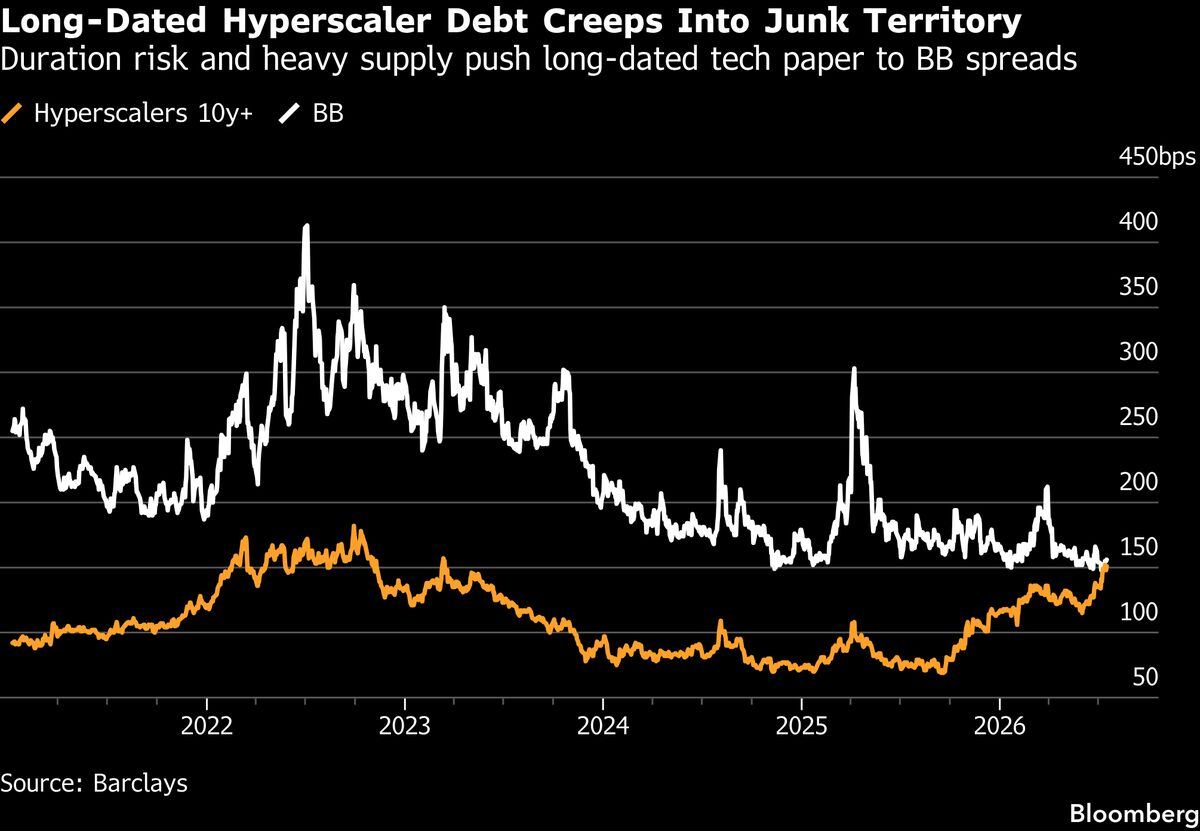
And the paper is already drifting toward junk pricing. The longest-dated hyperscaler bonds, the ten-year-plus maturities, are trading at spreads that creep toward the BB range despite carrying top investment-grade ratings, as duration risk and a heavy supply pipeline do the work. Nearly half of hyperscaler issuance over the past year has been long-dated, against a quarter for typical deals. The market is telling you it does not fully trust a thirty-year bet on a technology whose economics changed twice this month, and it is charging accordingly. Source: Barclays / Bloomberg.
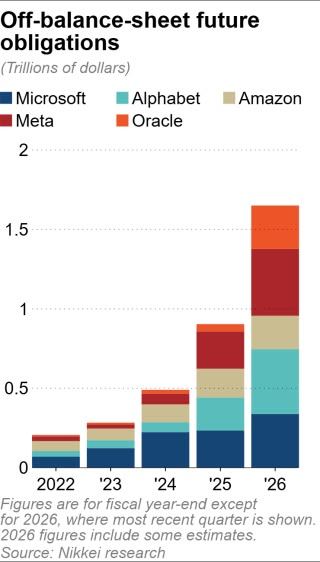
The obligations that do not show up as debt. Off-balance-sheet future commitments at the five biggest AI spenders, leases, power contracts, take-or-pay compute deals, have climbed toward two trillion dollars and are still rising steeply. This is the part of the build-out that the headline debt figures miss entirely. A company can look conservatively financed on its bond stack and still have committed a decade of cash flow to contracts that behave exactly like debt when the revenue disappoints. It is the same shape as every credit cycle, the risk migrating to where the accounting cannot see it. Source: Nikkei research. Read more
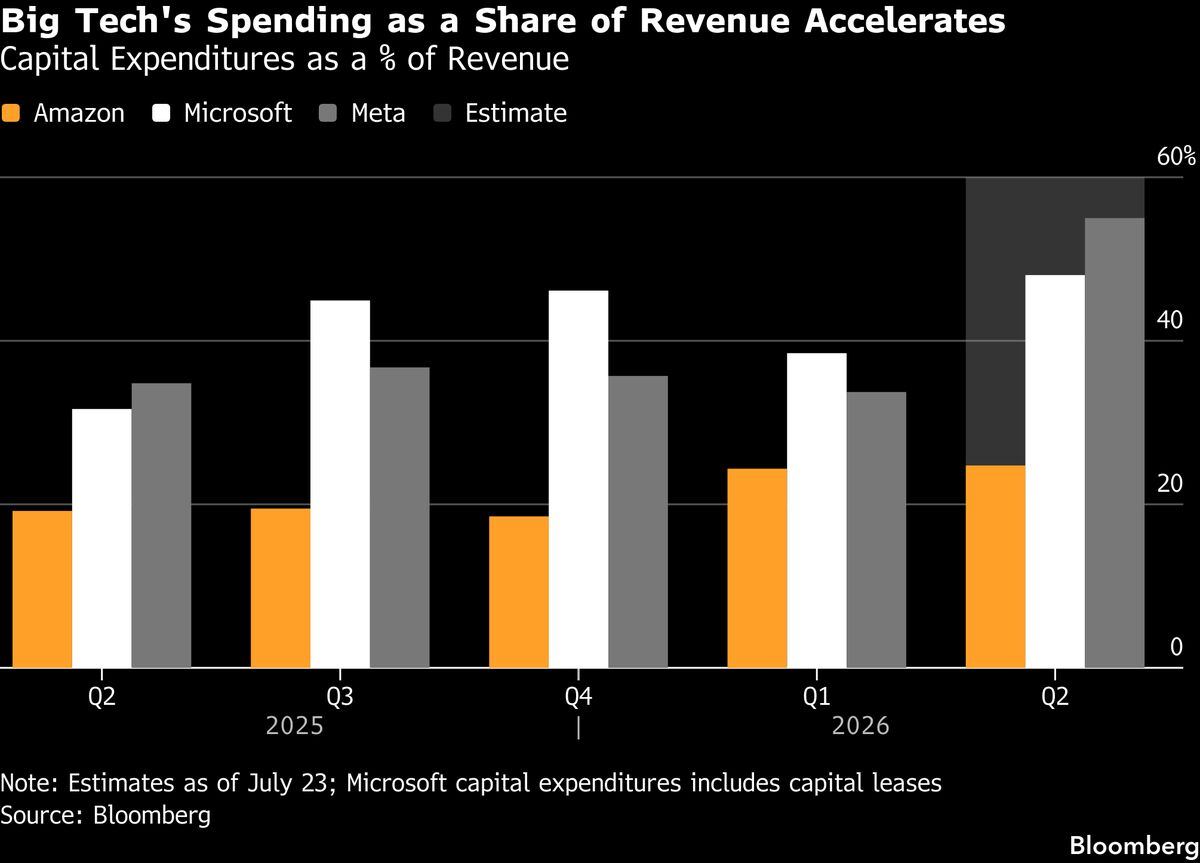
This is the spending the bond market is now underwriting. Capital expenditure as a share of revenue at the largest technology firms is accelerating hard, with the current quarter set to take the ratio to levels no mature company used to sustain. Alphabet guided its capex up to around $200 billion for the year and the shares fell. One AI lab lifted its cloud commitment to $750 billion from $600 billion. When spending of this size stops being funded from cash flow and starts being funded from the bond market, a capex story quietly becomes a credit story. Source: Bloomberg.
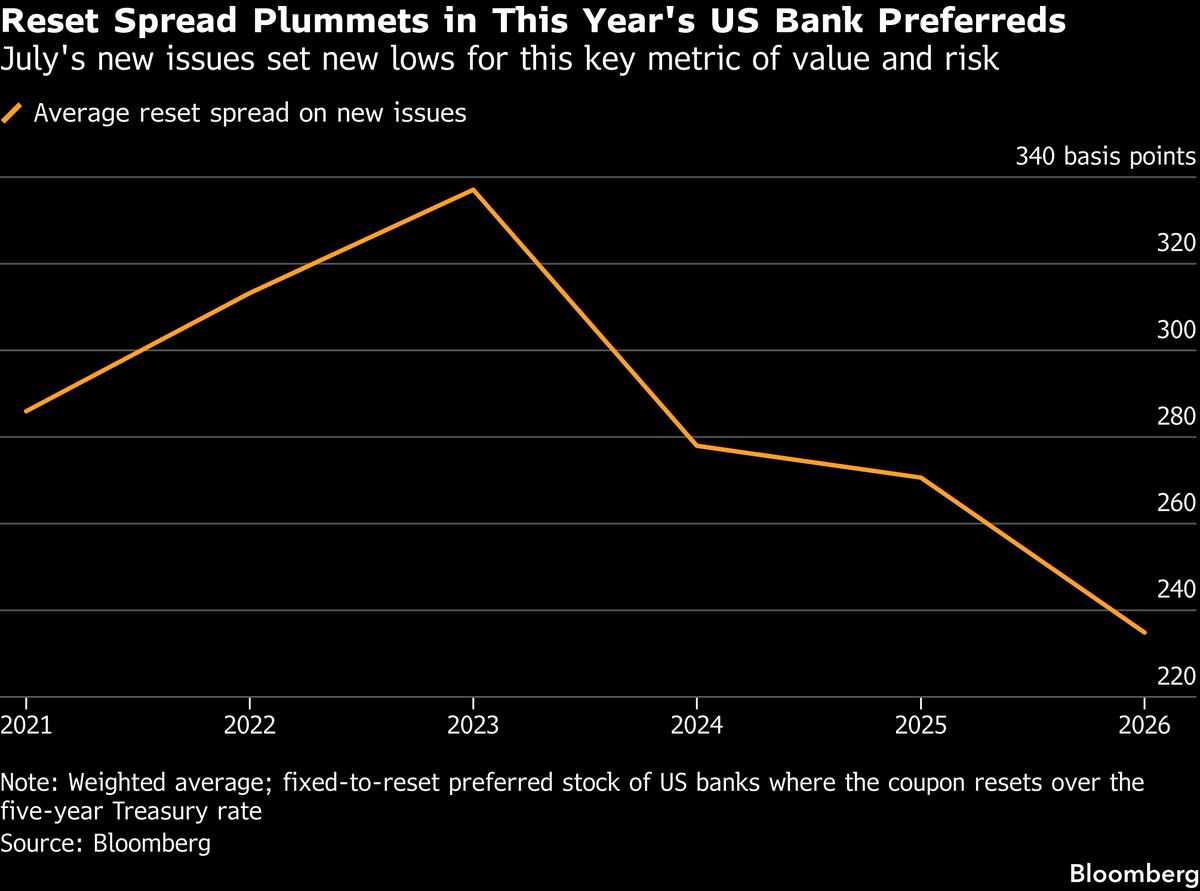
The warning is already visible in bank preferreds. The reset spread on this year's new US bank preferred issues has plummeted to fresh lows, a key gauge of both value and risk in the part of the capital structure that sits closest to equity. Tighter reset spreads mean investors are being paid less to hold the riskiest bank paper just as the credit cycle turns and the AI debt pile grows. When the compensation for risk falls at the same time the quantity of risk rises, the two lines are heading for each other. Source: Bloomberg.
Data Deluge Thursday
The heaviest session of the week and possibly the year. The Bank of England decides in our evening, a near-certain hold where the vote split is the whole trade, a five-four division moving sterling almost as much as an actual hike into a gilt market with no patience left. US second-quarter GDP and the June PCE deflator print the same afternoon, growth that leans hawkish and an inflation read that is already one oil shock out of date. Euro-area GDP and German CPI land into the September debate, Ireland flattering the aggregate as ever. And after the close, Apple and Amazon, the two largest companies in the world reporting into a tape that has stopped paying for AI spending. Central banks, growth, inflation and mega-cap earnings, all inside a few hours.
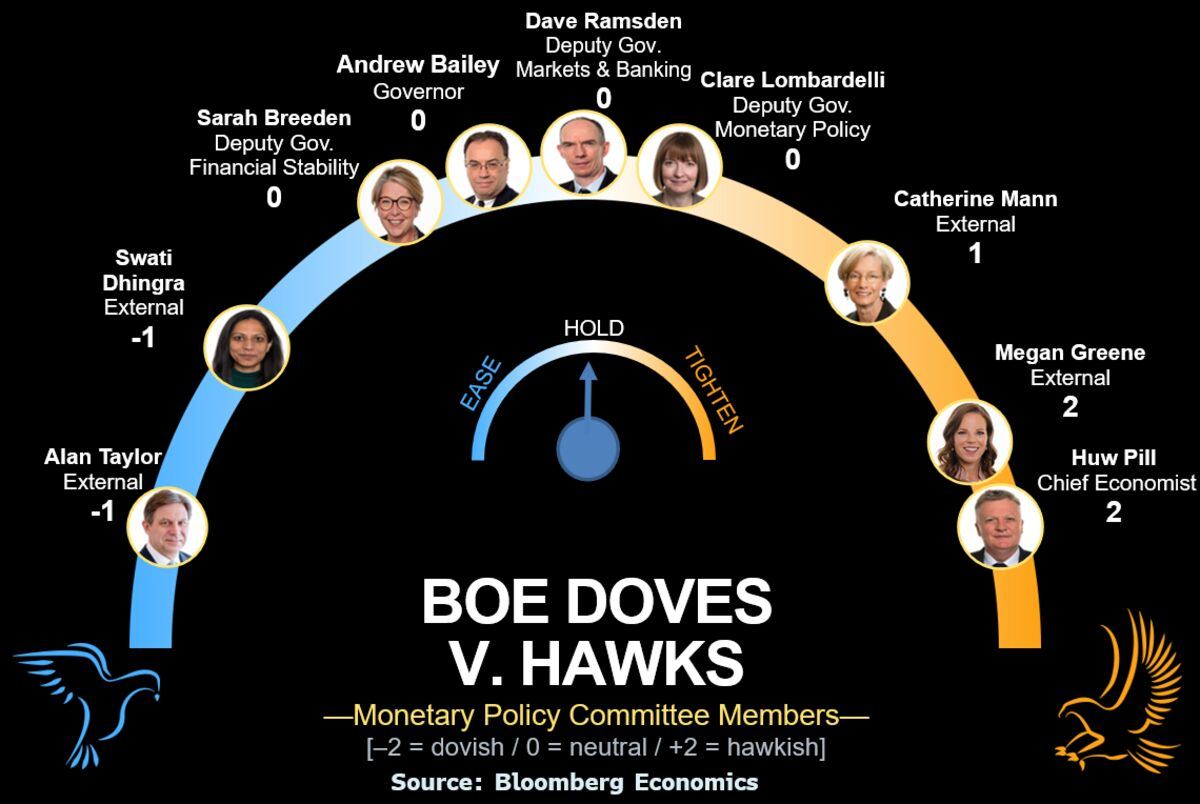
The Bank of England holds, and the vote split is the whole trade. With a move barely priced, the interest is entirely in how the committee divides, a spectrum running from the external doves to the hawks who wanted to go already. A five-four hold reprices September from roughly two-thirds toward near-certainty and moves sterling almost as much as an actual hike would. Gilts set their longest run of daily closes above 5% in nearly two decades last week, so a market this jumpy about UK inflation needs very little from the split to move hard. Source: Bloomberg Economics.
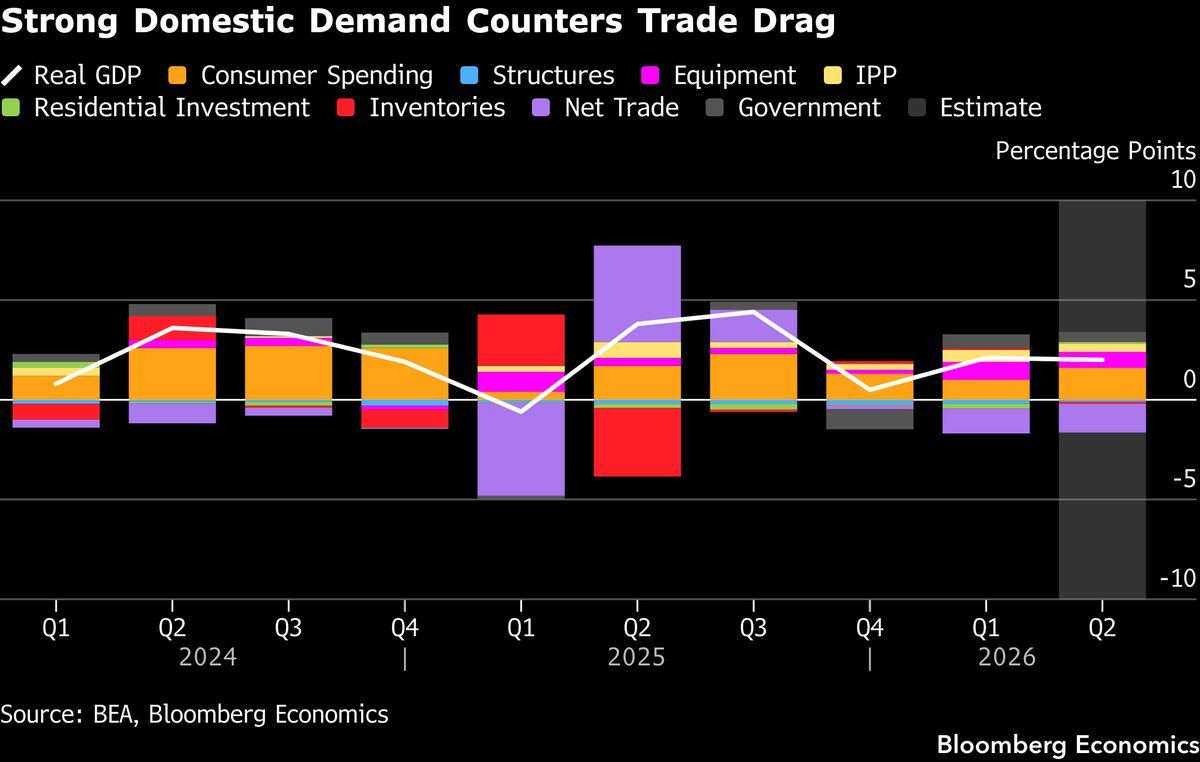
US growth is the fact that makes the hawks comfortable. The Q2 advance, due Thursday, is set to show domestic demand carrying the economy despite the trade drag, with the regional nowcast running well above the consensus. A print near the high end validates the no-landing narrative and cements September hike expectations regardless of what the chair says Wednesday. The uncomfortable version is a strong output number arriving alongside a spike in claims, strong growth and a softening labour market at once, which would leave the Fed with no clean read and the market with maximum volatility. Source: BEA / Bloomberg Economics.
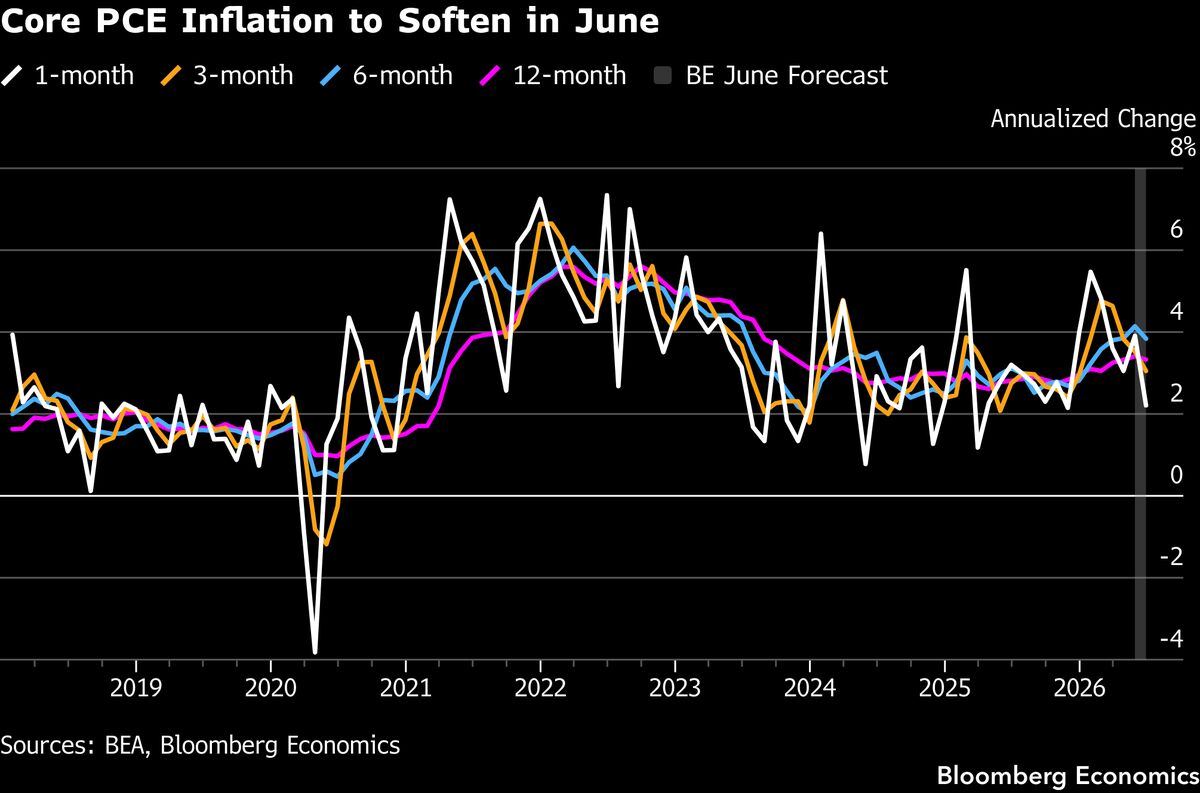
Core PCE softens on the month, which is the disinflation the Fed is clinging to. The June core deflator is expected to have cooled, taking the annual rate down toward the mid-threes, a genuinely encouraging monthly figure. The problem is timing. This print captures the world before oil went back through $100, so it is a photograph of a disinflation that the energy tape has already begun to reverse. The Fed has to decide whether to weight the month it can see or the quarter it can forecast, and the answer determines September. Source: BEA / Bloomberg Economics.
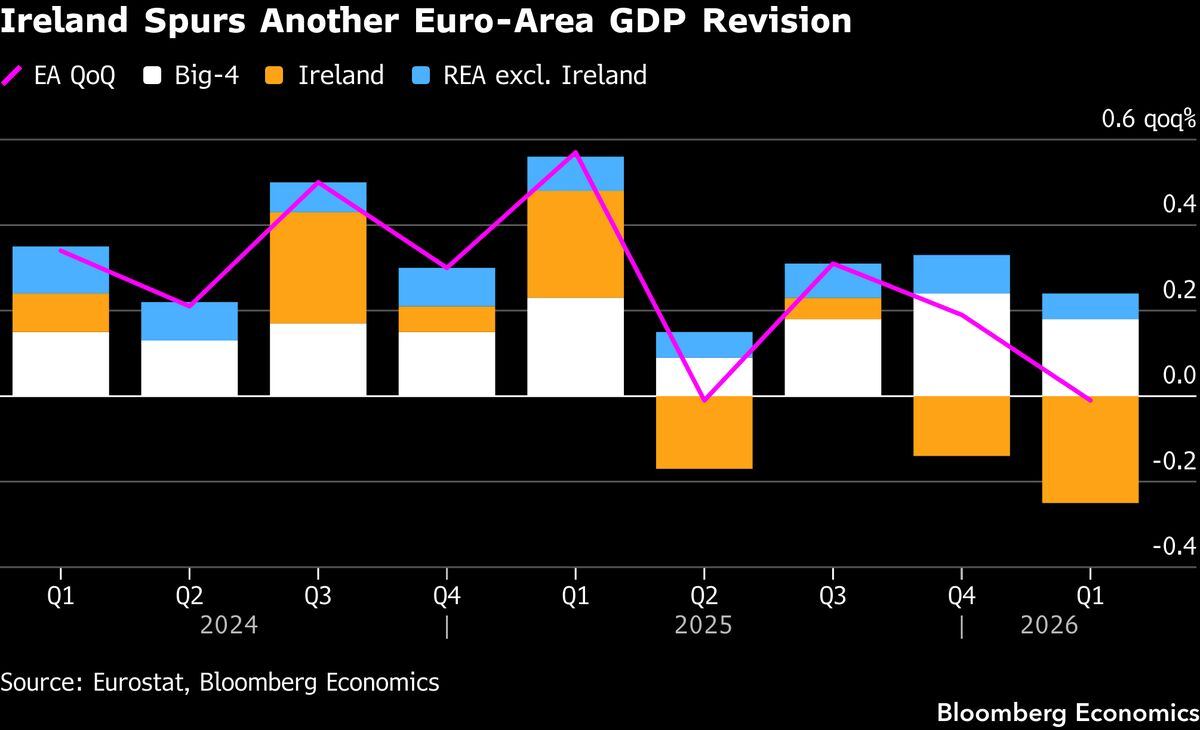
Euro-area growth is quietly better than the mood, thanks to the usual distortion. The Q2 flash is set to show modest expansion, with Ireland's volatile, pharma-and-tech-inflated GDP once again flattering the aggregate and the underlying euro-area-ex-Ireland number a good deal softer. German private-sector activity unexpectedly returned to growth in July, which combined with a flash CPI drifting back toward 3% gives the September hawks a real case. Lagarde has already laid the groundwork. The data on Thursday and Friday decides whether the groundwork becomes a decision. Source: Eurostat / Bloomberg Economics.
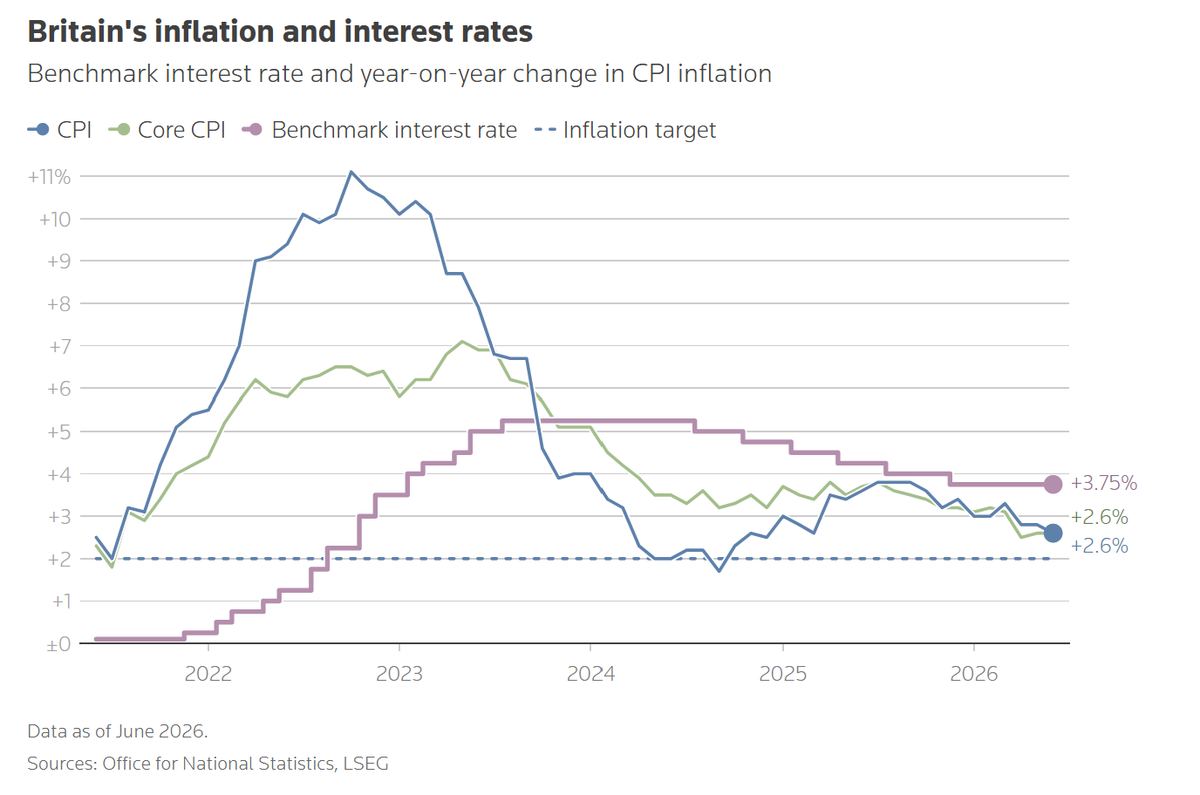
Britain's inflation is the reason the gilt market has no patience. Headline CPI has eased but sits stubbornly above target while the benchmark rate holds, and the market has convinced itself at least one more hike is coming this year. The energy shock cuts against the labour-market softness that would argue for patience. Into this walks a new prime minister and the market's willingness to give the incoming government the benefit of the doubt, a willingness that a hot inflation print or a hawkish vote split could withdraw quickly. Source: Reuters / LSEG.
Yen Friday
The week ends where the pressure is highest. The Bank of Japan decides into a currency at a forty-year low, and while nobody expects a hike, the risk is a hawkish revision to the inflation forecasts that would serve as cover for the next one, and with forty-year yields jumping and the yen past 163 the pressure to surprise is real. Tokyo CPI prints first and moves the pair before the decision. China's official PMIs likely split again, manufacturing barely above the line and services back below it, the deflation the rest of the world would envy. Euro-area flash CPI, Taiwan GDP and the final Michigan sentiment with its inflation expectations fill the rest, and the oil majors close the earnings week. Then the tape exhales, if the strait and the yen allow it.
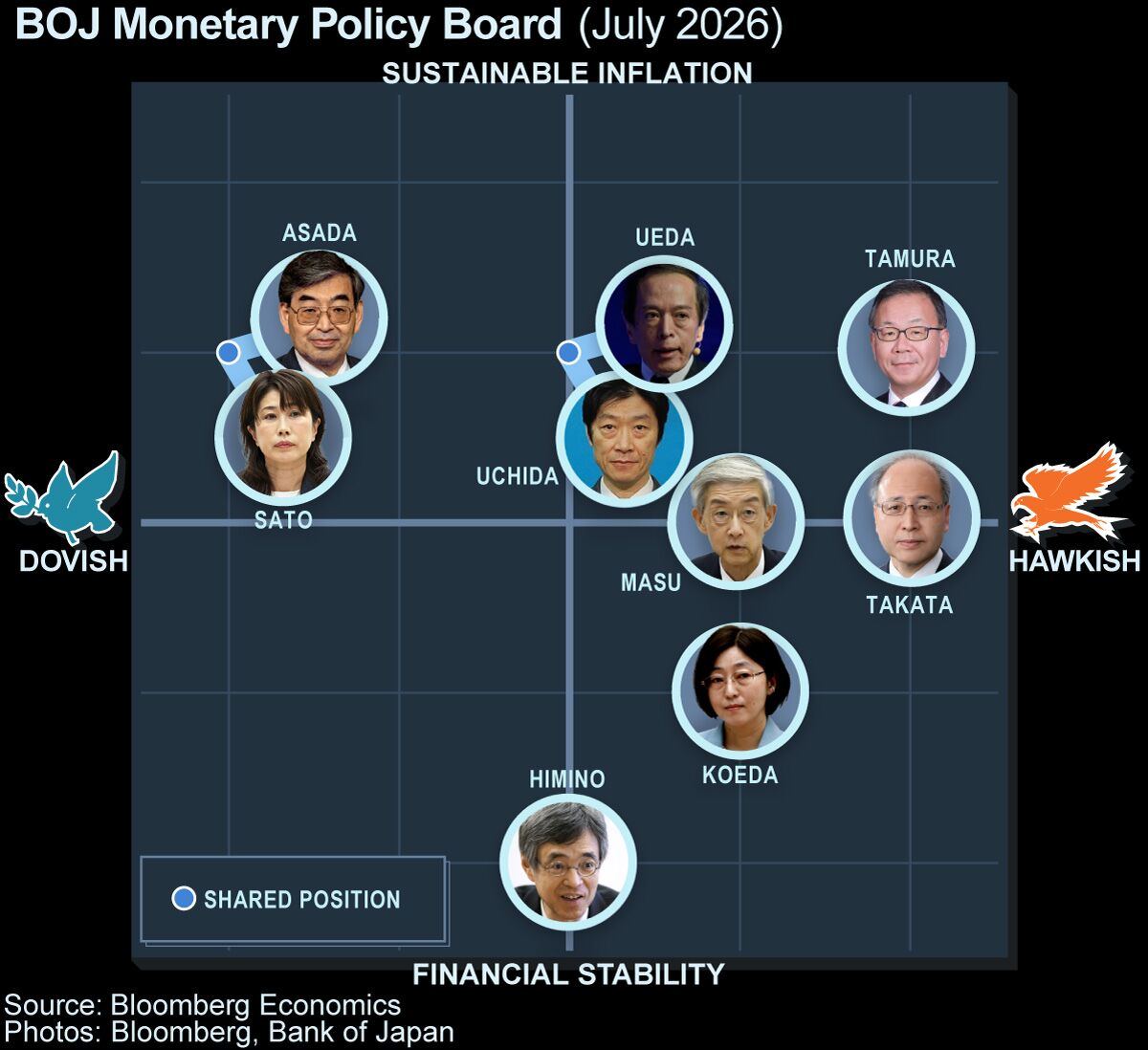
The Bank of Japan holds, but the board has drifted hawkish and the yen is at a forty-year low. Mapped by leaning, more of the policy board now sits on the sustainable-inflation and hawkish side than a year ago, and the market prices a hike by October at better than four-in-five odds. Nobody expects a move Friday. But a hawkish revision to the inflation forecasts would be cover for action, and with the currency this weak and forty-year yields jumping, the pressure to surprise is building. A hike here is the largest single-asset move on the board. Source: Bloomberg Economics, Bank of Japan.
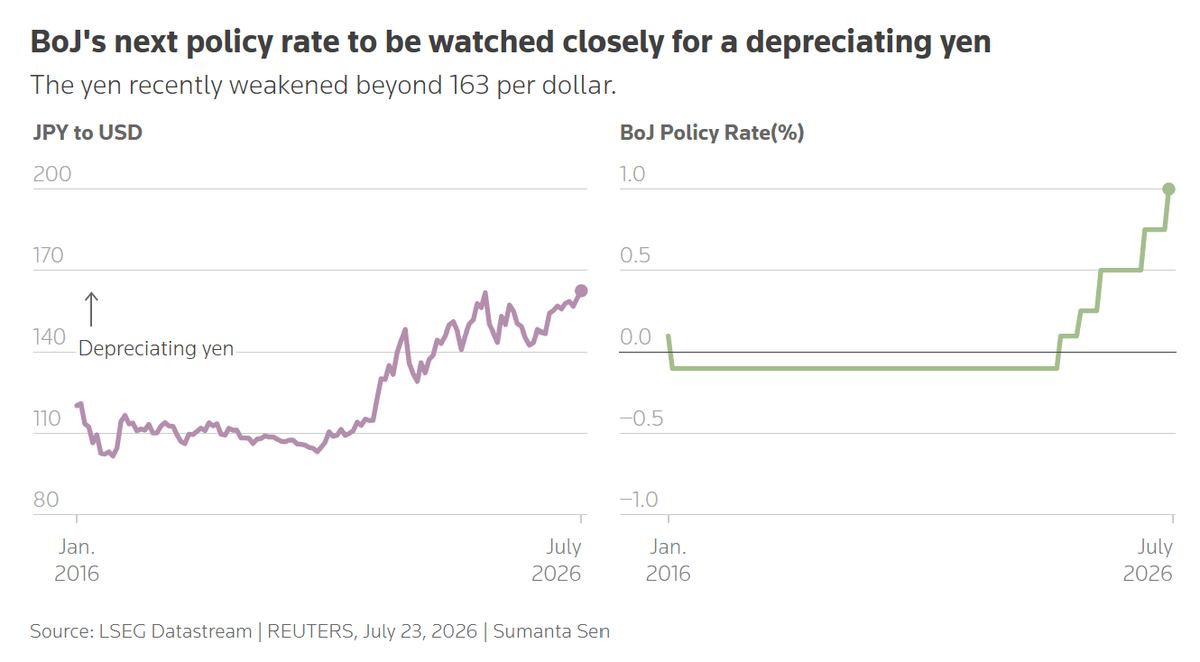
The yen is the pressure gauge for the whole week. USD/JPY pushed beyond 163 and toward 164, the weakest the currency has been since 1986, and last month's hike plus a large intervention has not arrested it. The BOJ's next move is being watched precisely because the currency has made the decision urgent, an energy importer with the developed world's weakest exchange rate and rising core inflation is the textbook policy trap. A break above 165 opens air toward levels that would force Tokyo's hand, whatever the board decides Friday. Source: Reuters / LSEG.
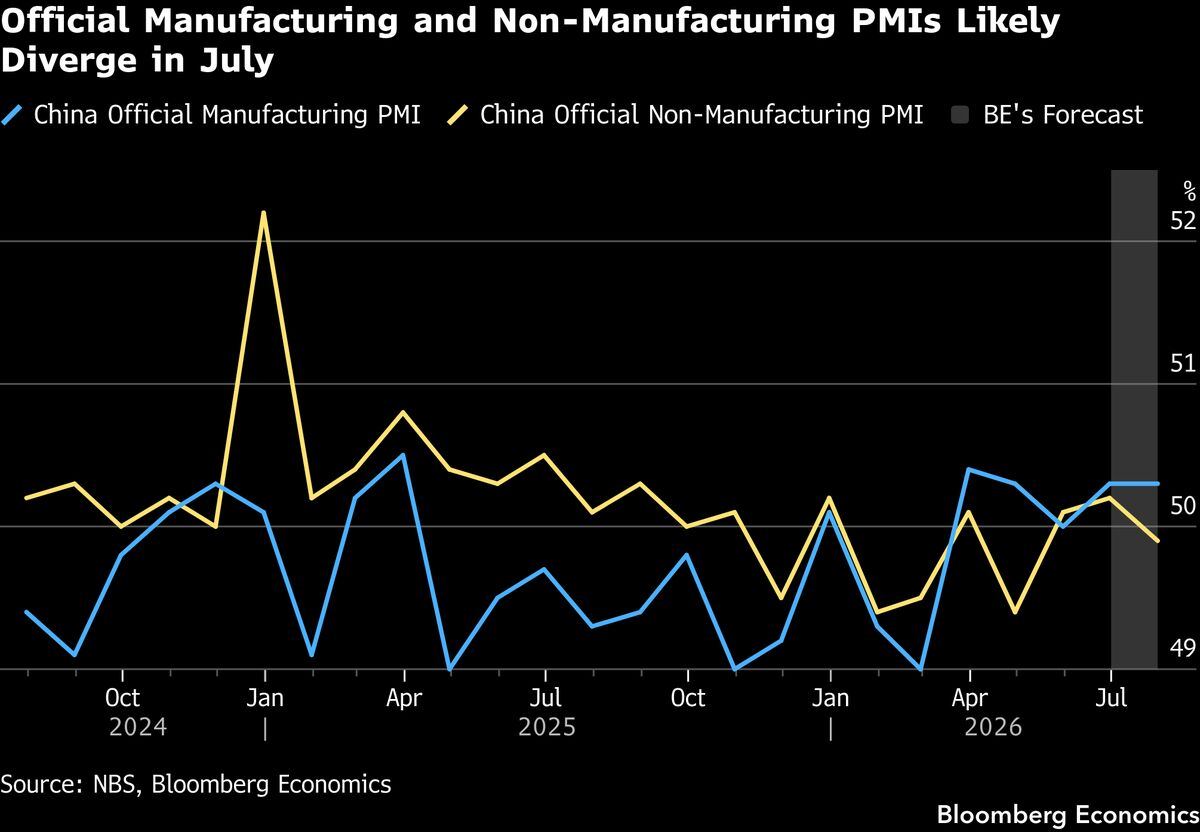
China's official gauges likely split again, and one dips back into contraction. Manufacturing PMI is seen holding barely above the line while the non-manufacturing measure slips back below it, the services weakness that has dogged the domestic recovery all year. It is the quiet counterpoint to the week's inflation panic, the world's second-largest economy still fighting deflation while the developed world fights the opposite. That divergence is why Chinese assets have become the funding source for the Asia rotation, and why a soft PMI would not stop the inflows. Source: NBS / Bloomberg Economics.
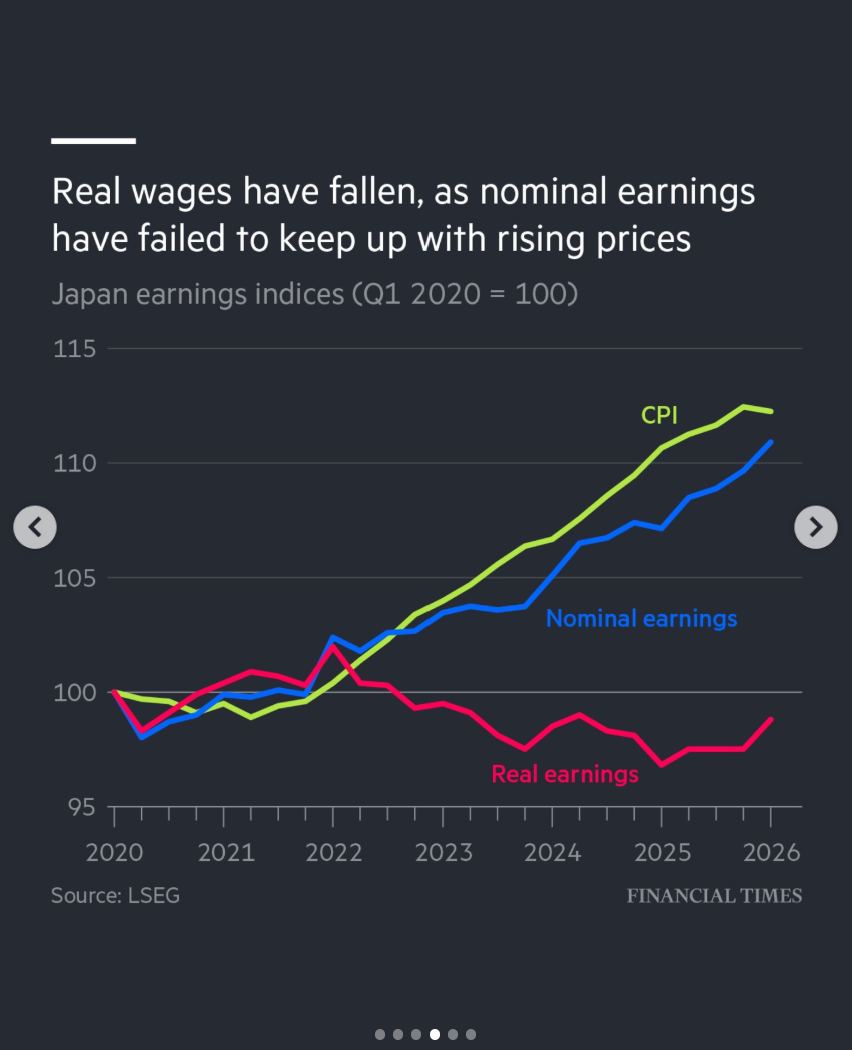
Japan's households have been getting poorer for four years, which is the politics behind the trap. Nominal earnings have risen but real earnings have fallen since 2022 as prices outran pay, the gap that a weak yen and $100 oil will only widen. This is the domestic pressure that sits under every BOJ decision, because a central bank that keeps policy easy to protect exporters is also the one letting imported inflation erode the paycheck. The currency that helps the Nikkei is the one hurting the voter, and that tension does not resolve quietly. Source: LSEG / Financial Times.
VC+ Special Dispatch — The Energy Independence Dividend
An eight-chart dispatch on the one structural fact that changes what a Gulf war means. Over two decades the United States has swung from a deep energy-trade deficit to a record surplus, crude and products and gas and even coal all flipping from import to export, while Europe and China deepened their import dependence. The country that sets the world's interest rate now also sells the marginal barrel, which is why a crude spike that terrifies every energy importer lands so differently on Houston. The dispatch maps the reversal, the export routes, the gas that powers the data centres and the coal that still flows east to the economy drawing the region's inflows, and closes on the one mineral where the leverage runs entirely the other way. Credit to the VC+ team.
From Deficit to Surplus
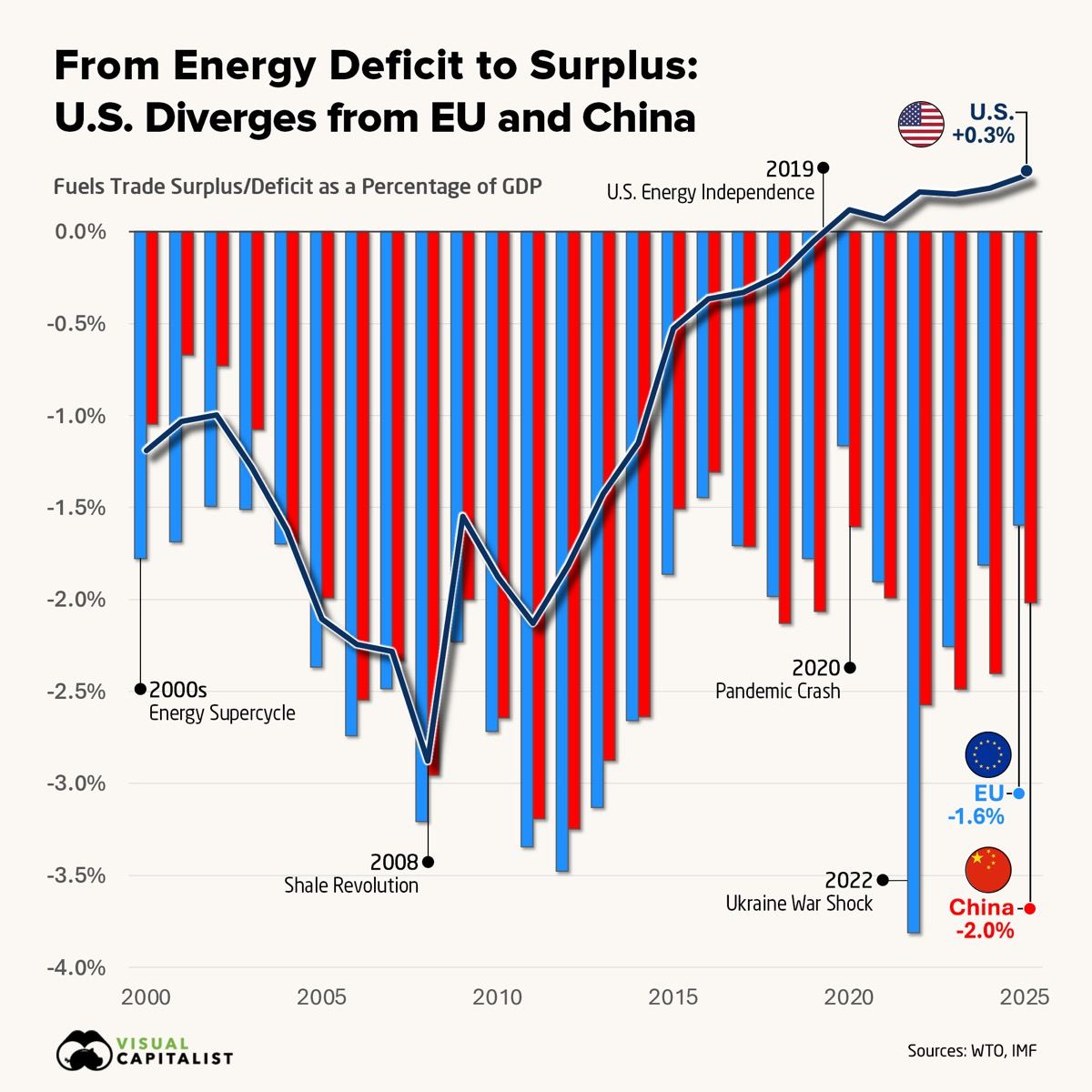
From energy deficit to surplus, the shift that changes what an oil shock means. The US fossil-fuel trade balance has swung from a persistent deficit through the 2000s to a record surplus, crossing into positive territory around the shale revolution and widening since. Europe and China moved the other way, their import dependence deepening. This is the structural reason a crude spike is no longer an unambiguous negative for America, and the leverage that sits behind every Hormuz headline. The country setting the world's interest rate now also sells the barrel. Source: WTO, IMF / Visual Capitalist.
The Reversal, Drawn by Fuel
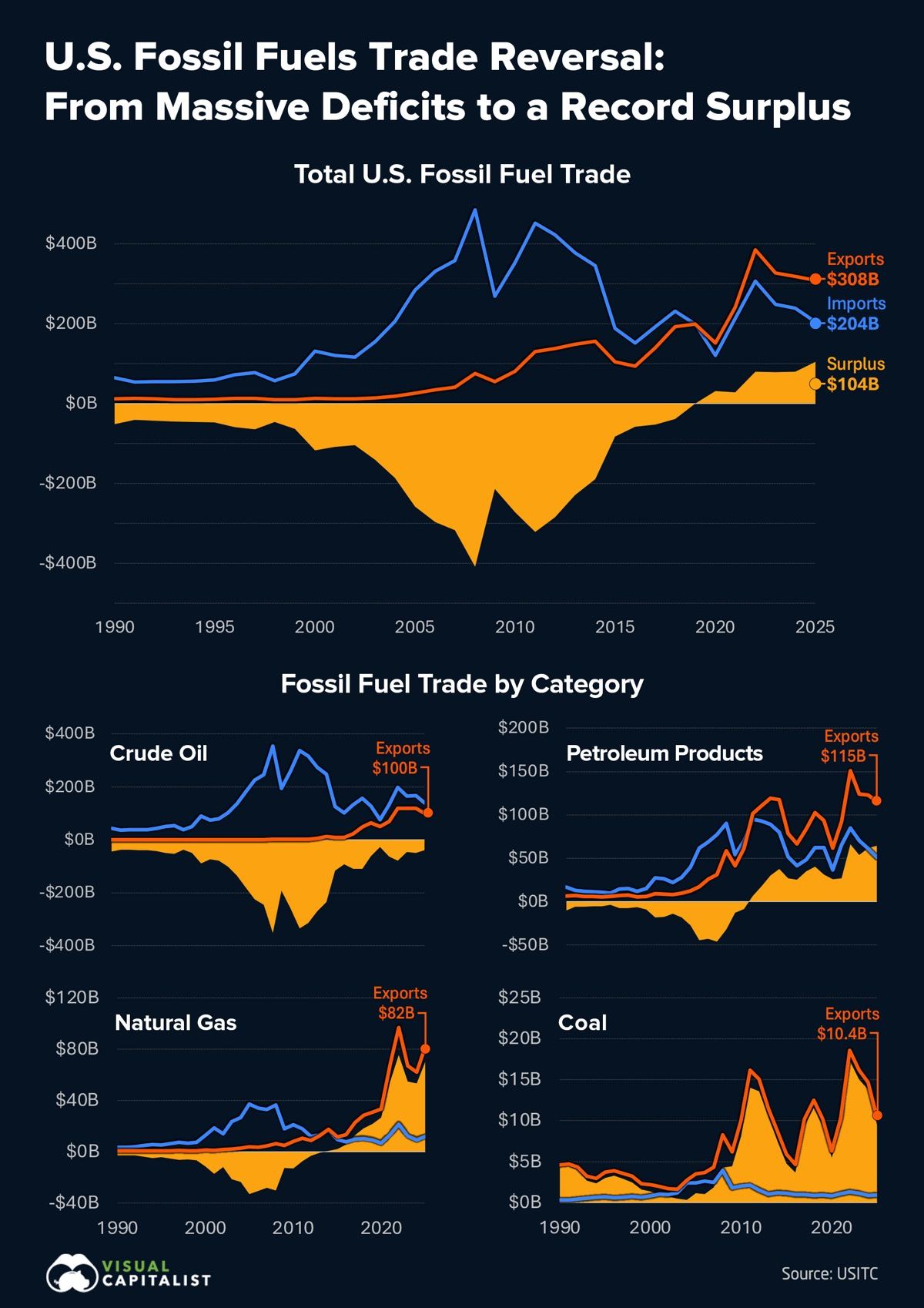
The reversal, drawn by fuel. US net trade in crude, refined products, natural gas and even coal has flipped from deep deficit to surplus over two decades, each panel telling the same story of a country that became an energy exporter almost by accident. Read alongside a war in the Gulf, it is a map of who has options and who does not. The economies that import their energy are the ones whose currencies and curves move most when the strait closes, and the US increasingly is not one of them. Source: EIA / Visual Capitalist.
Walking Away From OPEC
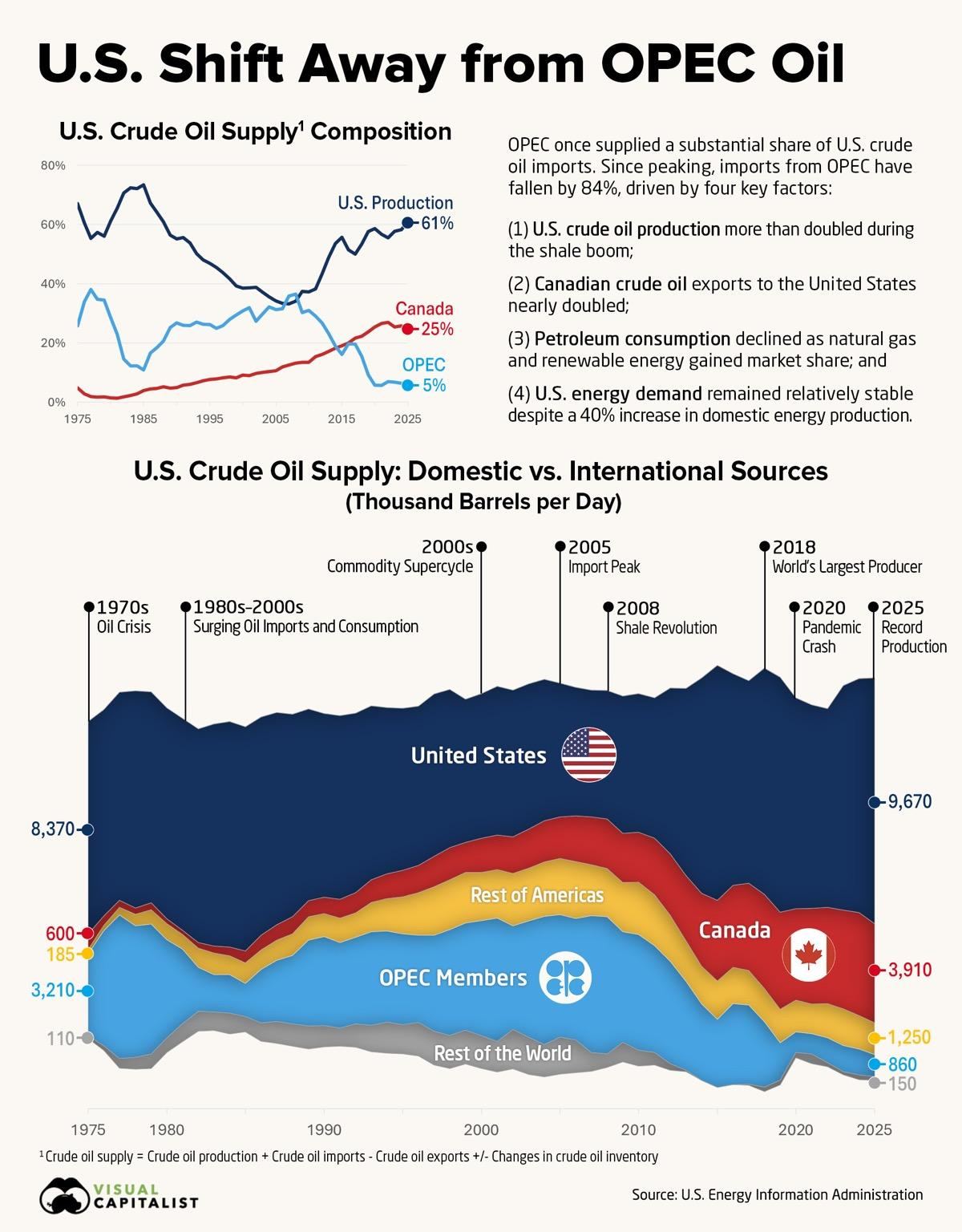
America has spent two decades walking away from OPEC oil. The share of US crude supply coming from domestic production has climbed steadily while the OPEC share has collapsed, the import slate now dominated by Canada rather than the Gulf. The strategic consequence is the quiet story under the oil price, the world's largest consumer has insulated itself from the exact supply shock that is roiling everyone else. It does not make $100 oil painless, but it changes who holds the leverage in a Gulf crisis, and the answer is increasingly Washington. Source: EIA / Visual Capitalist.
Where the Barrels Move
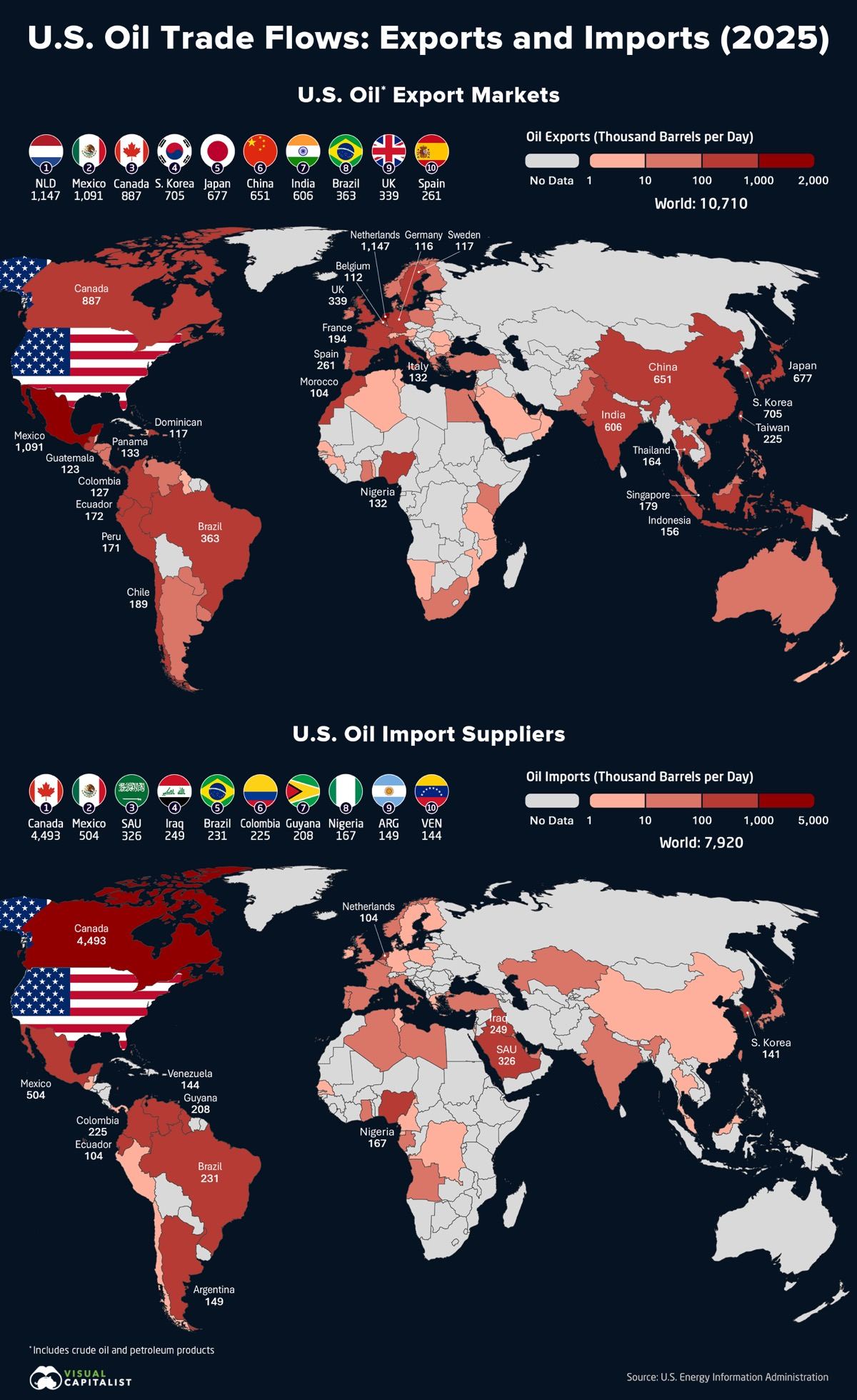
The physical map of where the barrels actually move. US oil export markets and import suppliers, drawn to scale, show an America shipping crude and products across the Atlantic and Pacific while sourcing its remaining imports overwhelmingly from its own hemisphere. In a week when a fifth of the world's seaborne oil is hostage to one waterway, the geography is the point. The trade flows that used to run through the Gulf increasingly do not, which is why the same crude price lands so differently on Houston than on Rotterdam or Singapore. Source: EIA / Visual Capitalist.
Gas Is the Quiet Leverage
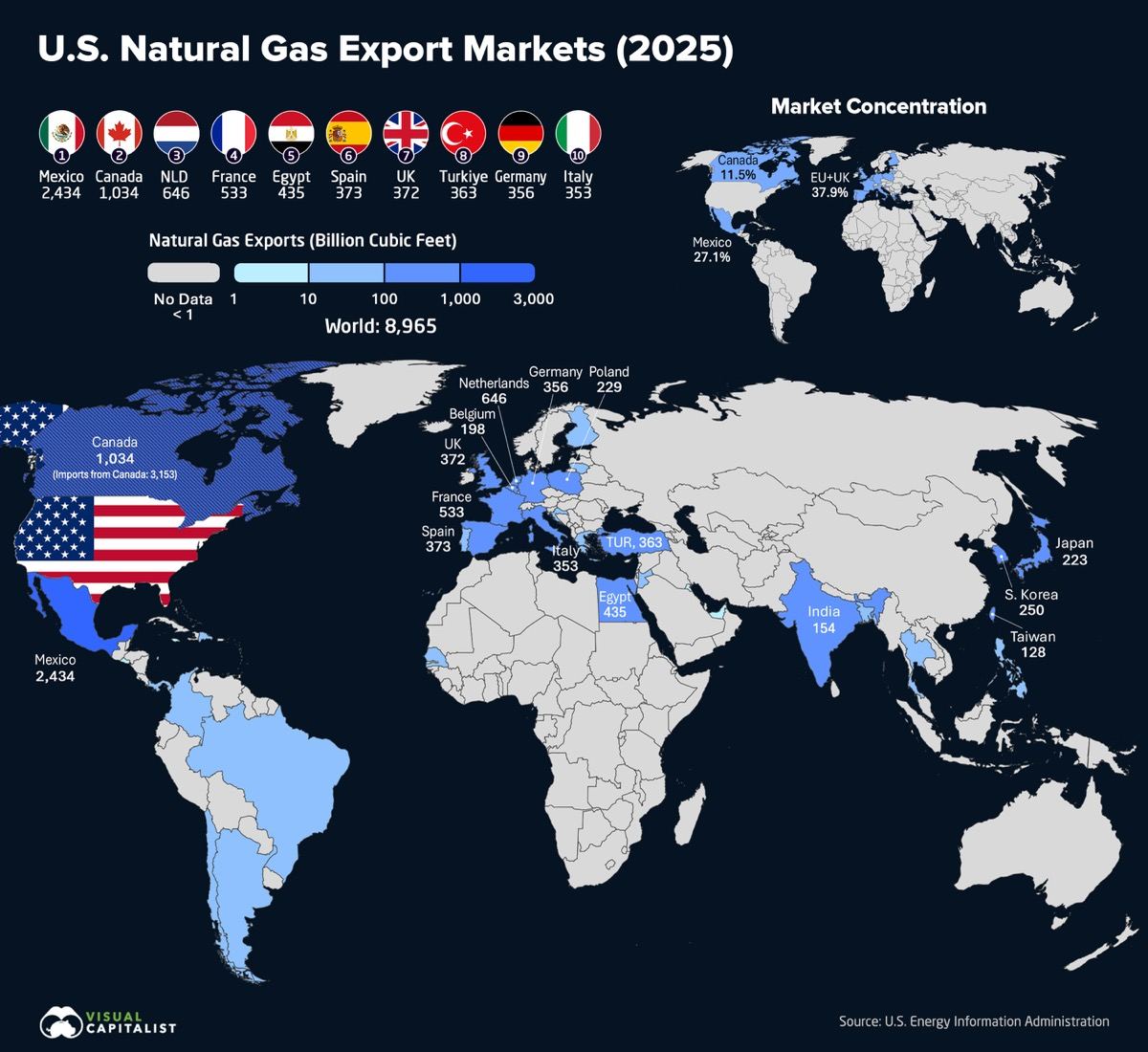
Gas is the quiet leverage, and the map shows the reach. US natural-gas export markets now span the Atlantic and Pacific basins, the country having built itself into the swing supplier of liquefied gas in barely a decade. With European storage running well below normal into winter and the war squeezing every alternative, that reach is strategic power priced in molecules. The data-center build-out that this whole letter keeps circling back to runs on this gas, which is why the export map and the AI-debt map are the same story seen from two ends. Source: EIA / Visual Capitalist.
And the Coal Flows East
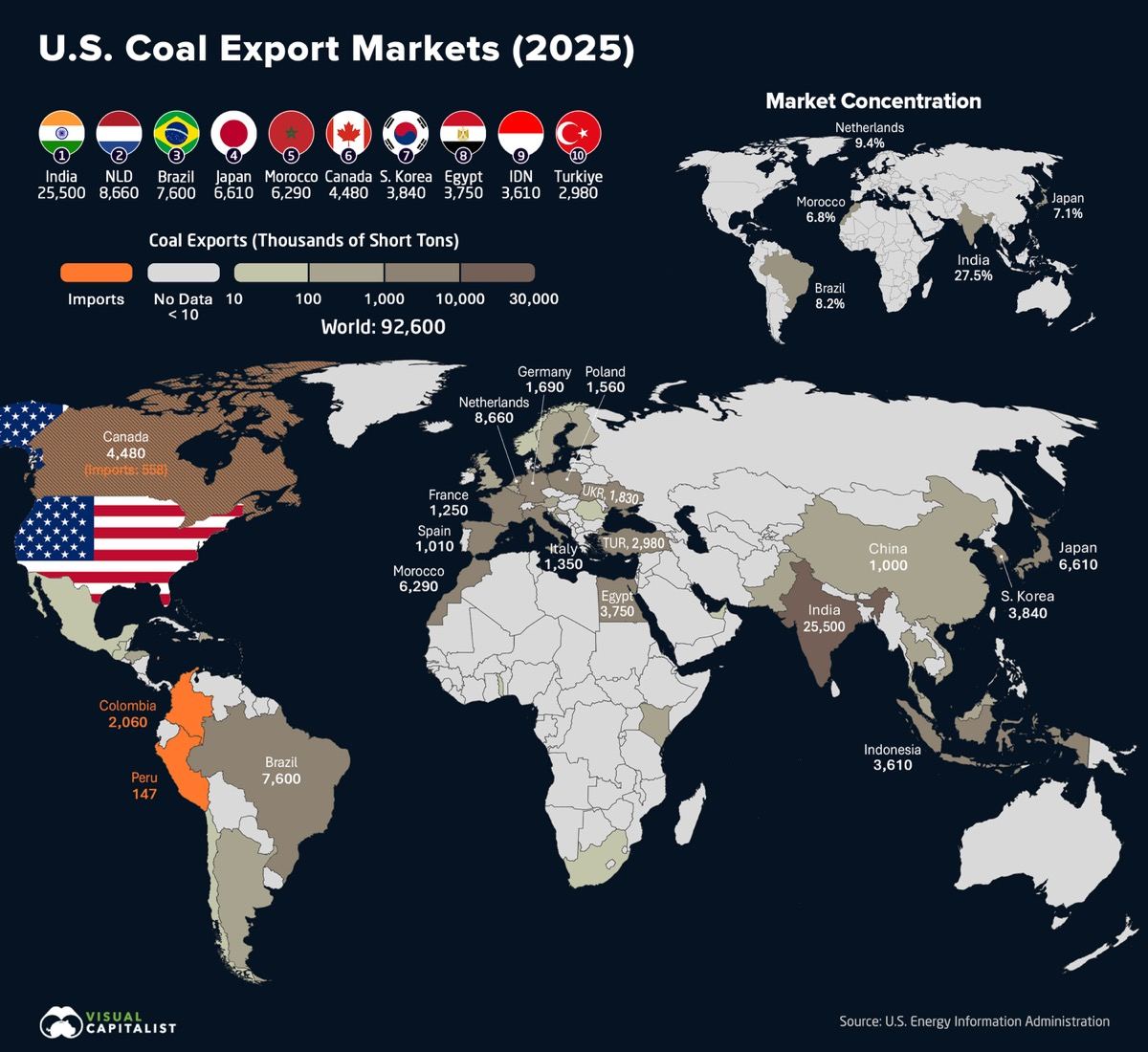
And the coal still flows east, to the economy the rotation loves. US coal exports are concentrated in metallurgical grades bound for Asia, with India by far the largest single buyer, feeding the steel that builds the economy now drawing the region's inflows. It is a useful corrective to the clean-energy narrative. The country diversifying away from OPEC oil is simultaneously one of the world's largest coal exporters, and the fastest-growing buyer is the same market whose youth are in the streets over jobs that this industrial build-out is supposed to create. Source: EIA / Visual Capitalist.
The Production Behind It
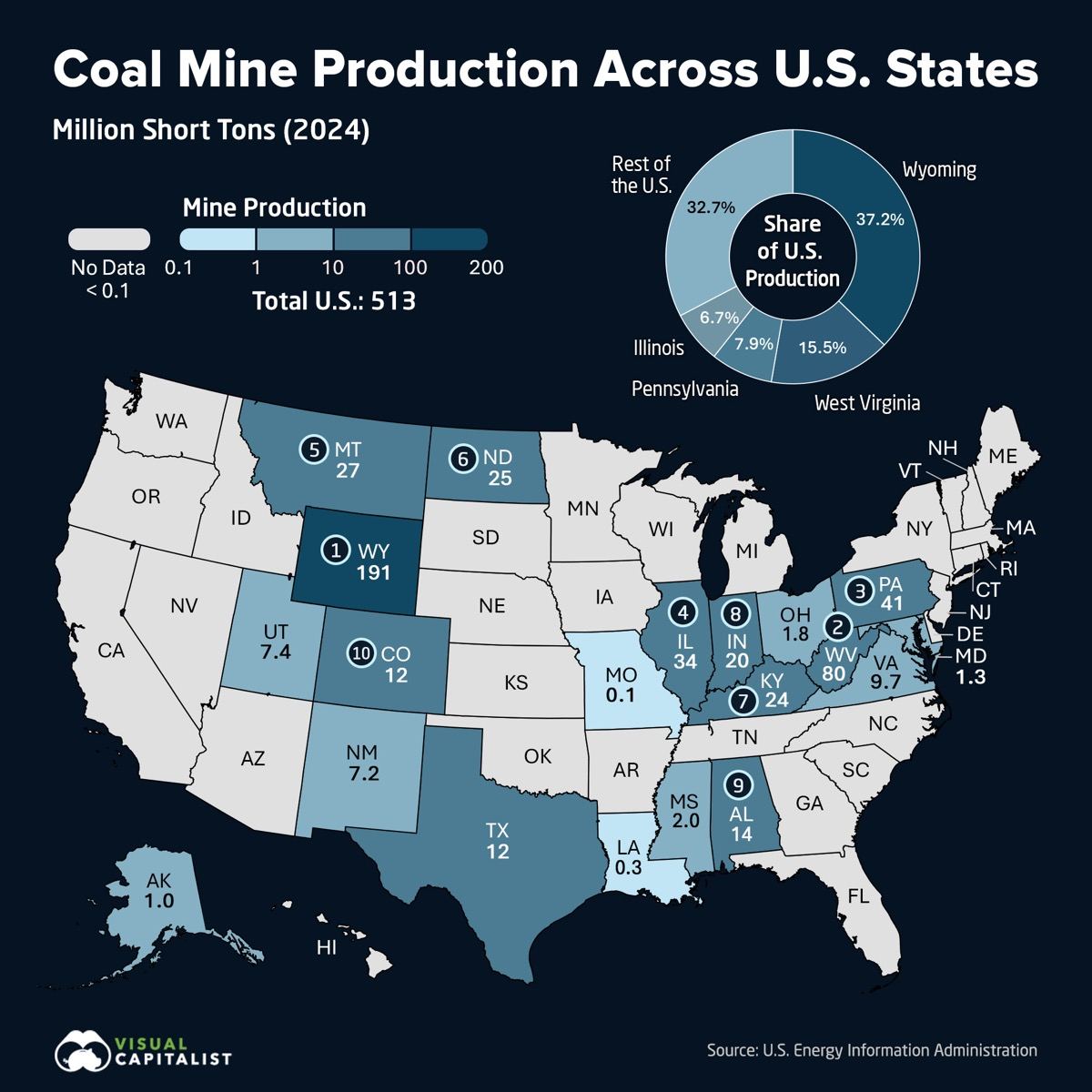
The production behind the exports, state by state. US coal output remains concentrated in a handful of states led by Wyoming, a reminder that the energy independence story is also a domestic-politics story, tied to specific regions and specific jobs. As the trade balance flips and the export map widens, the question of who benefits and who is left behind runs straight into the same grievances driving unrest elsewhere. Energy is never only an economic variable. It is a map of political constituencies too. Source: EIA / Visual Capitalist.
Where the Leverage Runs the Other Way
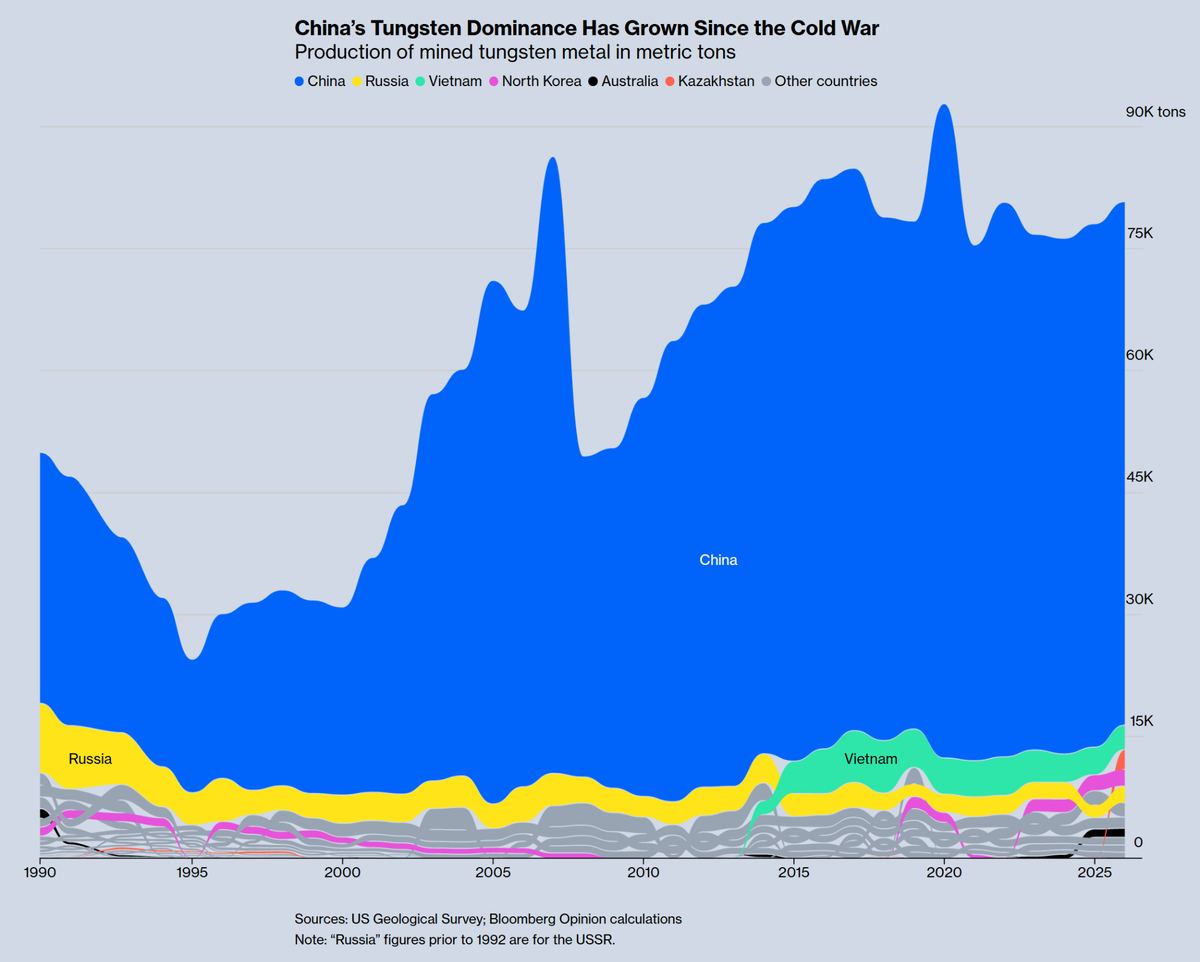
The mineral where the leverage runs the other way. China's dominance of tungsten production has deepened since the Cold War, the metal essential to munitions, drilling and machine tools now overwhelmingly sourced from one country. For all America's energy independence, the critical-minerals map is where the vulnerability sits, and a war economy that needs to replenish munitions runs straight into it. Every story of Western self-sufficiency has a chart like this underneath it, the one input that cannot yet be re-shored, and this is the one that matters most for defence. Source: Bloomberg Opinion. Read more
The Good Wrap
What is left at the close, and this week it circles back to the lesson at the top. Why the painful trades are the ones that teach, because the loss reaches the ancient part of the brain before the rational mind gets a vote. The slow tide of economic gravity shifting back toward Asia over two centuries, the context a single central-bank week can obscure. A map of Odysseus lost at sea, ten years to make a journey of weeks, blown off course by forces that never announced themselves, which is every macro book in a week like this one. A reminder that the real risk hides where nobody is looking, dressed up as a kitchen sponge. And to finish, the chemistry of patience in a glass of wine, none of it able to be hurried, the same discipline of letting a right view mature into the right expression.
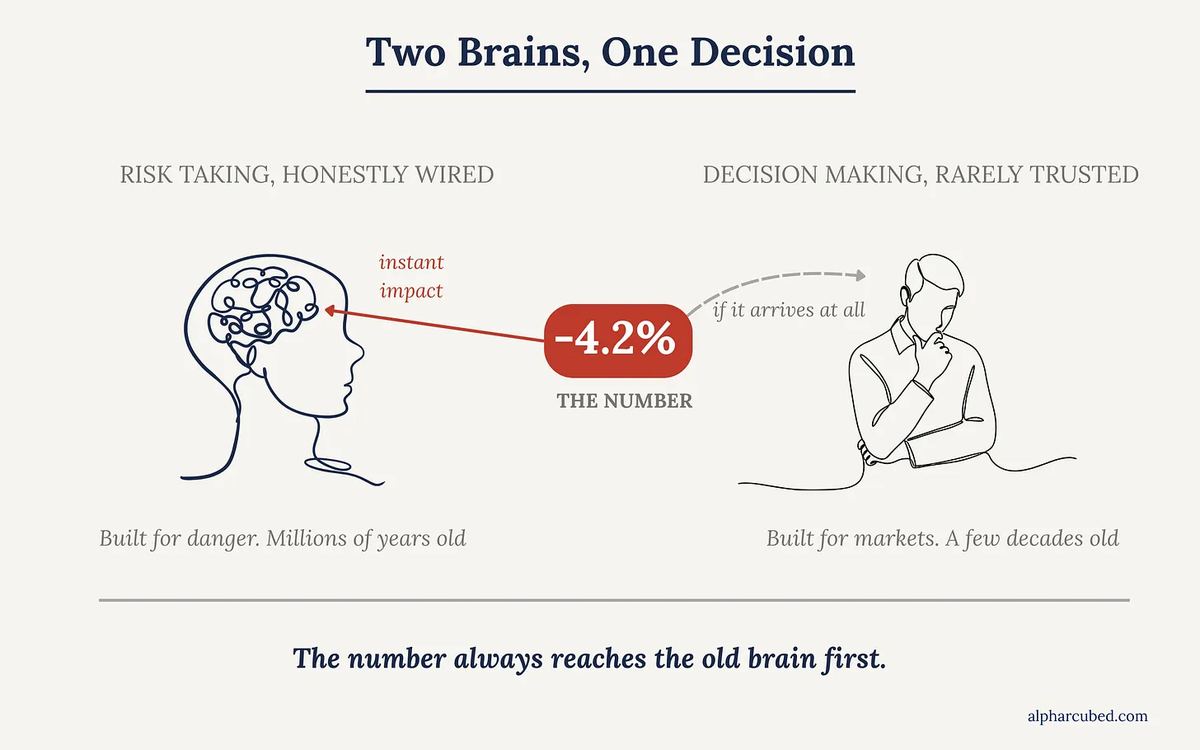
The number reaches the old brain first. A neat illustration of why the painful lessons are the ones that stick, that the instinctive, risk-taking part of the brain is built for danger and millions of years old, while the deliberate, decision-making part is built for markets and only a few decades old. The number, the loss, the drawdown, arrives at the ancient wiring before the rational mind gets a vote. Every trader knows the feeling of being right on the analysis and wrong in the moment. This is the chart of why, and it is worth keeping on the wall. Source: Alpha Mind. Read more
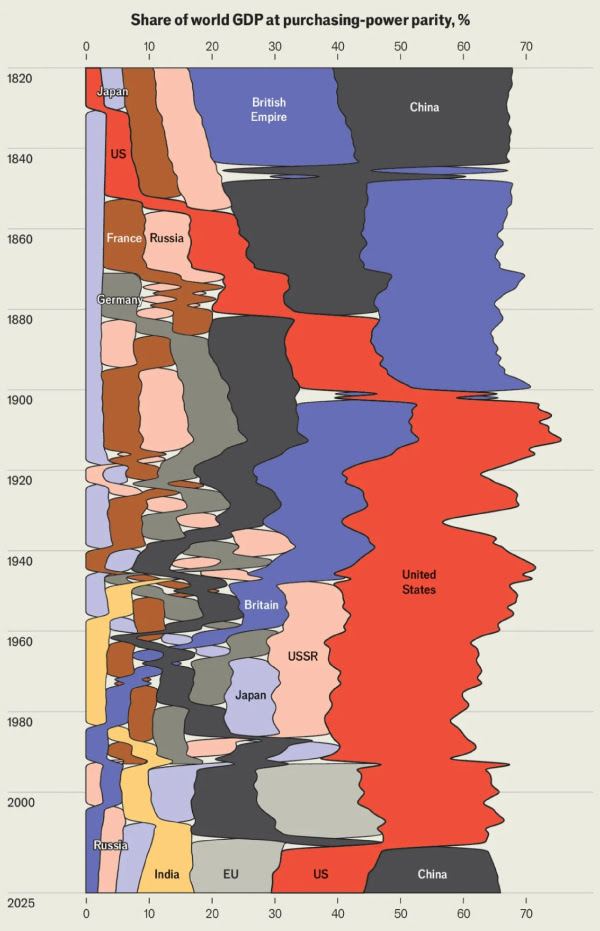
The slow tide under all the fast headlines. The share of world output at purchasing-power parity, drawn as a flowing stream over two centuries, shows the long arc, the West's share cresting and receding, China and now India climbing back toward the weight they held before the industrial revolution. It is the context that a single week of central-bank decisions can obscure, that the argument over a 25bp hike sits on top of a tectonic redistribution of economic gravity. The youth in Delhi and the capital in Mumbai are both, in the end, this chart. Source: Visual Capitalist.
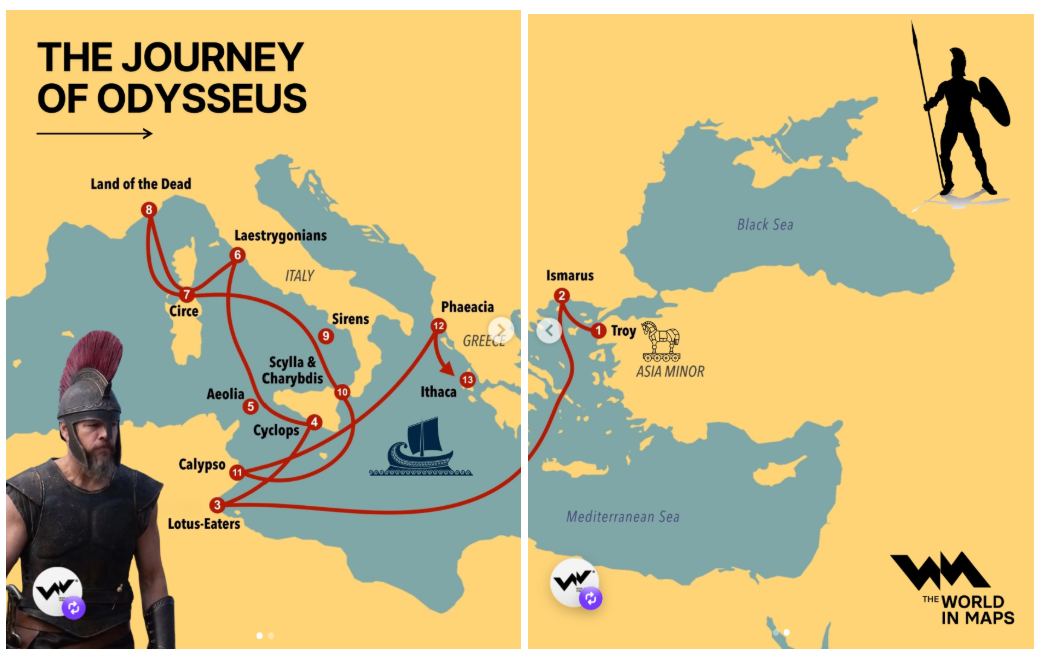
A map for a week spent lost at sea. The journey of Odysseus, plotted across the Mediterranean, ten years to travel what should have taken weeks, blown off course by his own crew and by gods who kept moving the target. There is no better metaphor for a macro book in a week like this one, the destination clear, the route entirely at the mercy of forces that do not announce themselves. Being right about the harbour was never the hard part for Odysseus either. The hard part was the getting there. Source: World in Maps.
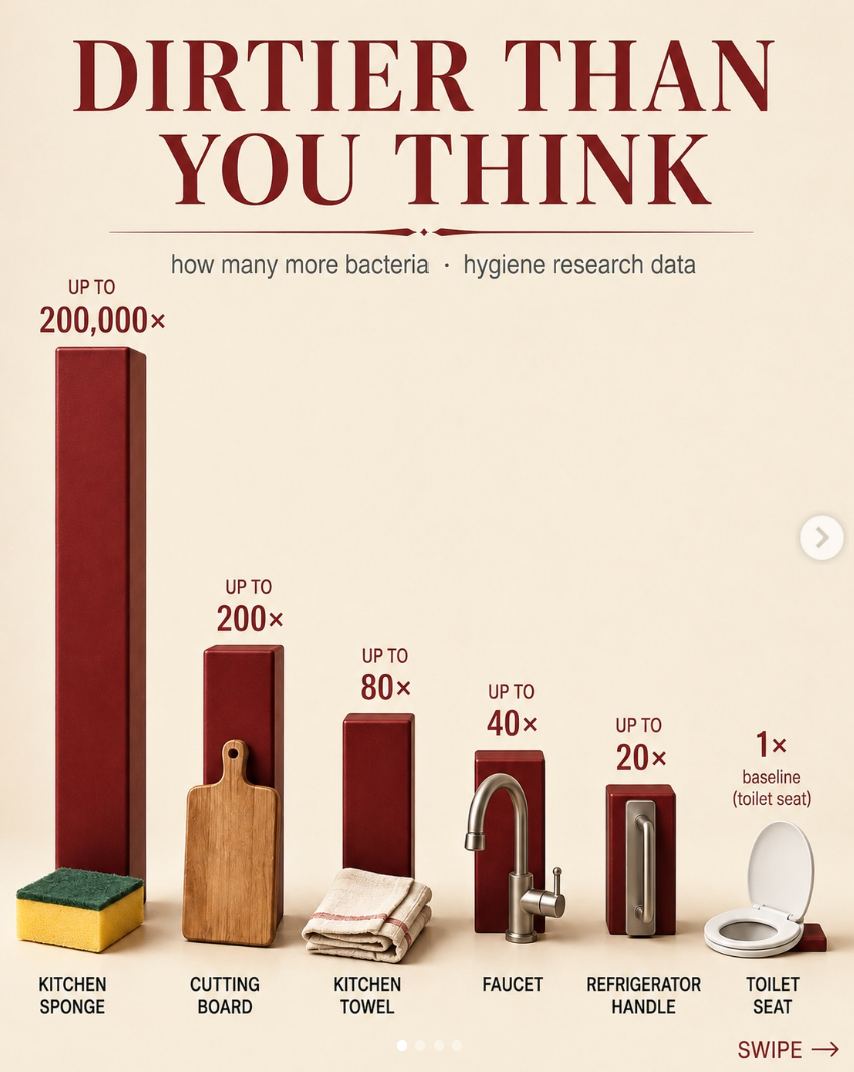
Dirtier than you think, and a lesson in where the real risk hides. A tour through the household objects that carry far more bacteria than the ones we actually worry about, the kitchen sponge dwarfing the toilet seat by orders of magnitude. It is a small, useful reminder that the thing everyone is watching is rarely the thing that gets them, and that risk concentrates in the places nobody is looking. Which, come to think of it, is the entire thesis of the credit charts above, dressed up for the kitchen. Source: Visual Capitalist.
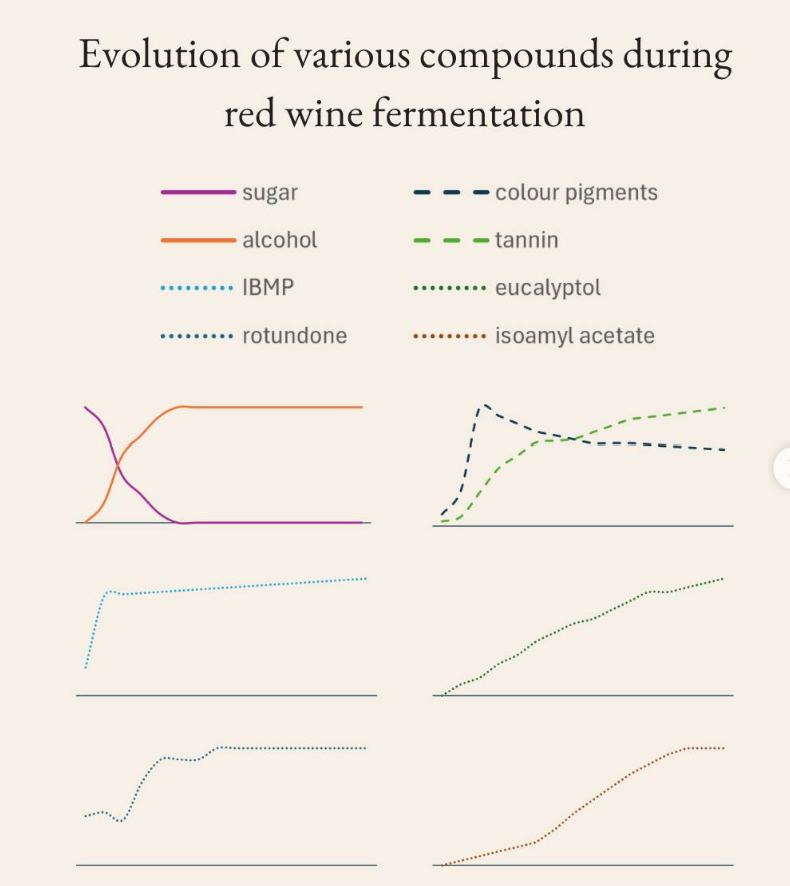
And to close, the chemistry of patience. The evolution of compounds during red-wine fermentation, sugar falling as alcohol rises, tannins and colour and aromatics each finding their own curve on their own schedule. None of it can be hurried, and the winemaker's whole craft is knowing which small adjustment matters at which moment and then waiting. It is the same discipline the week demands of a book, the conviction to let a right view mature into the right expression rather than forcing it. Best opened once the central banks have spoken. Source: VinePair.
Best,
Hoelon
WITPTW is a personal publication. Everything here is personal opinion and market commentary, written in a personal capacity. It is not investment advice and not a recommendation to buy or sell any security. It is not associated with, endorsed by, or representative of any employer, fund or company. Charts and images are reproduced from their original publishers, credited to their sources for commentary and discussion; all rights remain with the respective copyright holders.