All at Once
Personal views and market commentary. Not investment advice. Not associated with any employer or firm.
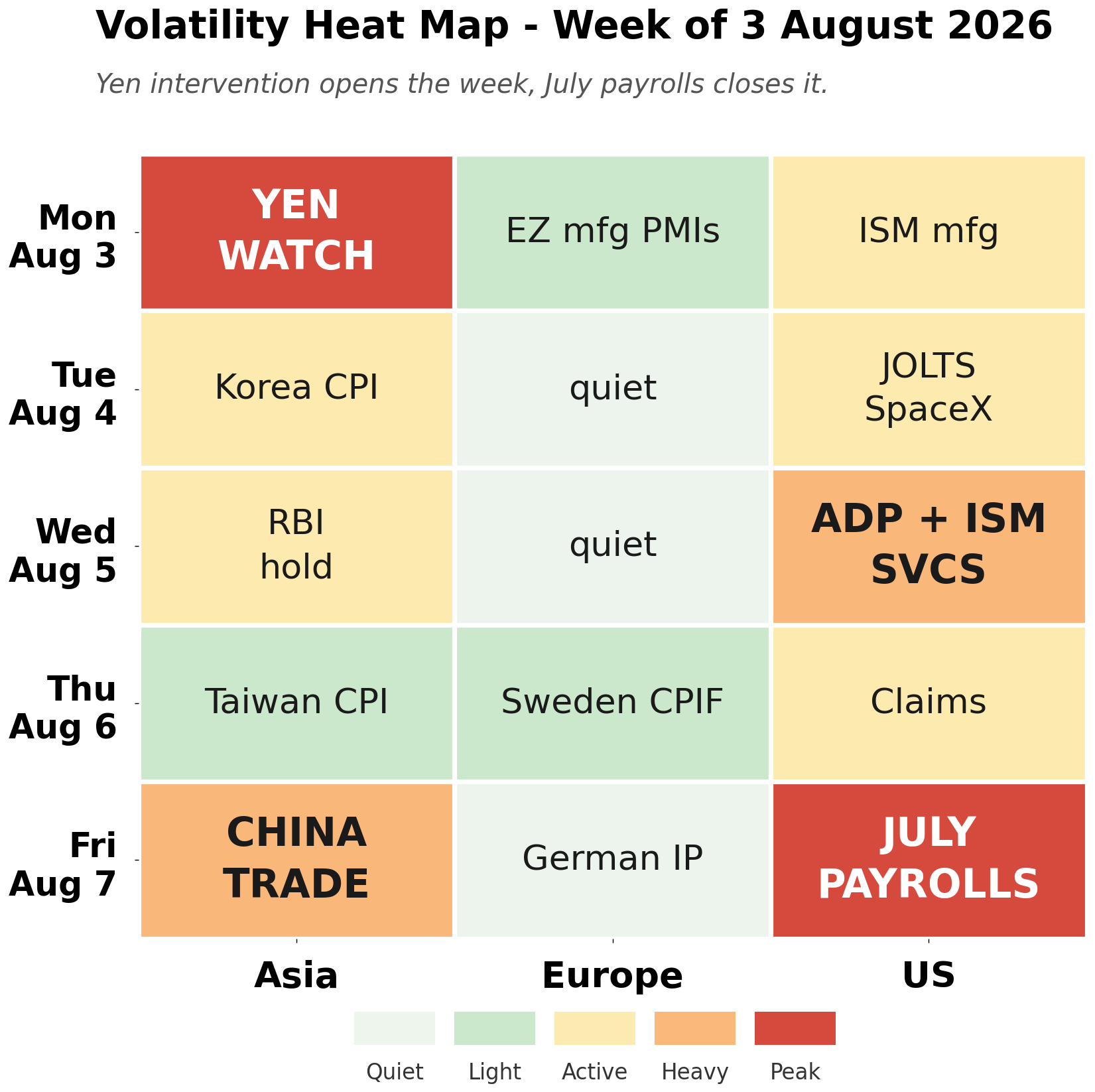
Volatility heat map for the week ahead, sessions as we trade them from here. The week opens on a live, coordinated yen intervention, the first joint US-Japan FX action in nearly thirty years, expected to be formalised in our Monday morning. Around it, ISM manufacturing Monday, ADP and ISM services Wednesday, claims Thursday, and the apex event, July payrolls on Friday night our time, with OPEC+ meeting somewhere in the middle and AMD and SpaceX reporting into a fractured AI tape. Everything at once, and the VIX at the lows.
"You have a portfolio that is extraordinarily highly concentrated, you have large positions, you cannot demonstrate a clear and concise competitive advantage in why you own those positions... there are some people that just, with full information, are unable to help themselves." — Ken Griffin, asked two years ago why portfolio managers wash out at Citadel. Last week he bought exactly that portfolio, at a discount. This is the ruthlessness the trading world runs on, said out loud. Griffin described the failure mode clinically, concentration without edge, conviction that cannot save itself, the same standard he holds his own managers to, and then waited. The most famous AI bull in the hedge fund world, a former OpenAI researcher whose fund grew past $20 billion in barely two years on exactly such concentrated bets, was forced to sell the bulk of its public book in the rout after a reported 46% loss in July alone. The buyer was Citadel, whose market-making arm had publicly called for a rate hike into the FOMC even as the seller bled. The remaining book, reportedly still holding SK Hynix and the private Anthropic stake, is this week's overhang. He never disagreed with the thesis. He disagreed with the sizing, and he got paid for the difference.
"If you can't spot the sucker in your first half hour at the table, then you are the sucker." — the old poker adage, immortalised in Rounders. Markets are a poker room, not a lecture hall. Every cycle a brilliant newcomer walks in with the best-argued thesis in the building, and the regulars do not argue back, they wait. They wait for the leverage, the concentration, the redemption terms, the moment the brilliant view has to be sold regardless of whether it is right. Then they clean up, buying the thesis they always agreed with at prices the author can no longer refuse. The market does not pay for being the smartest reader of the future. It pays for situational awareness, the street-smart kind, knowing who is holding what, who is forced, and when. Book smarts write the essay. Street smarts buy it at the fire sale.
"To be interested in the changing seasons is a happier state of mind than to be hopelessly in love with spring." — George Santayana. Do not fall in love with the spring data. The July jobs report has become a season of its own. Twice in recent years the summer print has arrived far from consensus and rewritten the autumn in a single morning, the shocker two summers ago turning into the jumbo cut that September. The pattern is seasonal, the hiring that fades in July, the adjustments that flatter spring and punish summer. Three dissenters just voted to hike. It would take exactly one bad Friday night for the conversation to flip from hikes to cuts, and almost nothing in the front end is priced for that turn of season.
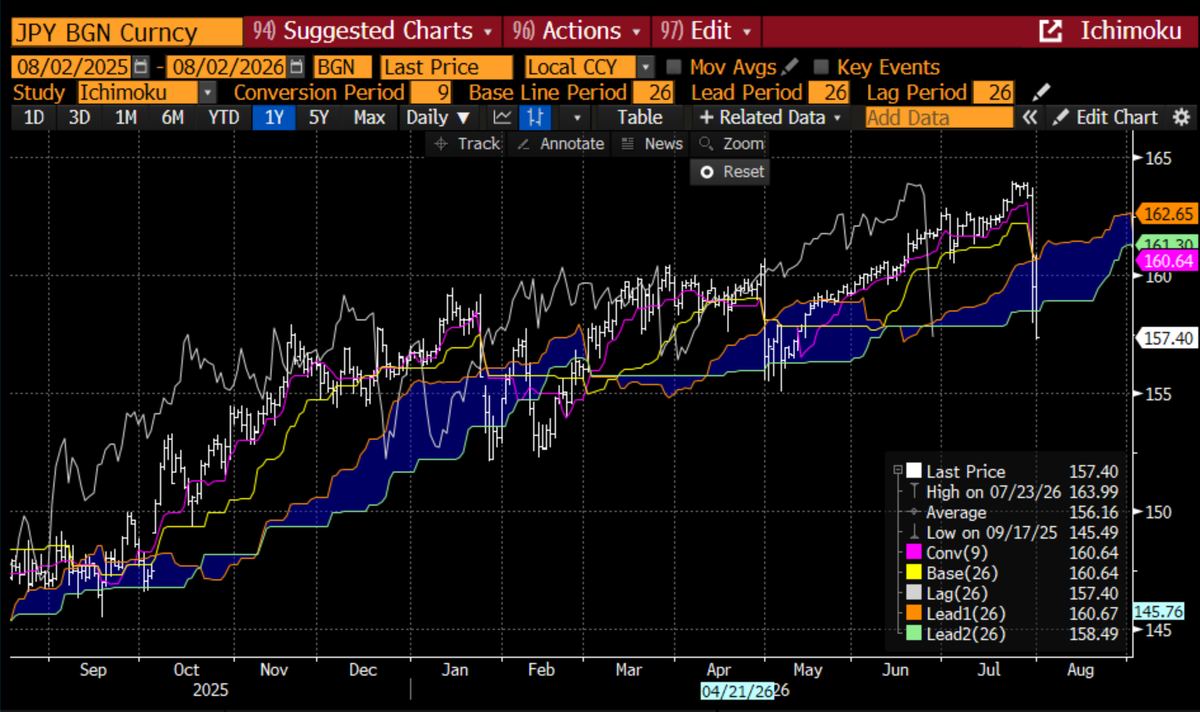
The chart of the week. Dollar-yen had been a one-way trade for months, grinding to its weakest levels since the 1980s, until the intervention hit. Rate checks first, then the selling, and by Friday's New York close the pair sat at 157.40, below its 200-day average for the first time since October, with the US Treasury telling banks it might act directly and Tokyo expected to formalise the coordination in our Monday morning. The cloud on the chart has broken. So has the one-way trade. Source: Bloomberg JPY BGN Curncy.
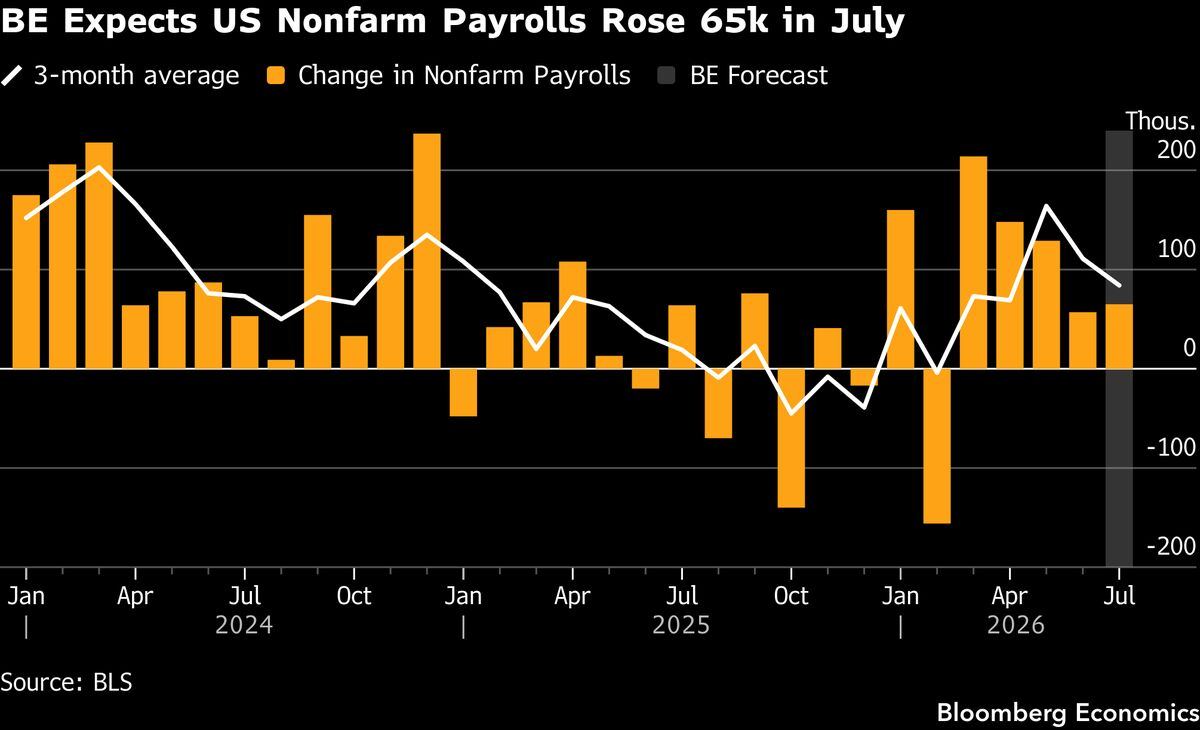
Payrolls are expected at 65k, and the bars tell you why Friday is the apex event. The three-month average has been grinding lower all year, the prior month printed a deeply disappointing 57k, and consensus sits near 85k with the unemployment rate seen holding at 4.2%. Look at the July bars across the last few years, the seasonal dip is real and it has twice turned the policy cycle, the weak July of 2024 becoming the jumbo September cut. Three dissenters just voted to hike. One soft print and the argument flips overnight from hikes to cuts, which is exactly what the front end is not priced for. Source: BLS / Bloomberg Economics.
What is the plan this week?
It feels like everything is happening all at the same time. And in contrast, the VIX and implied volatility are trading at the lows. Global equities rebounded, and the net numbers undersell it, the Nasdaq closed the week up 1.6% but rebounded almost 4% from the Wednesday low, and the Kospi jumped 18% on Thursday after a three-day fall of 17%, and it is debatable whether that is the sign of a broken market or of a bottom being found. The joint intervention on the yen, the first coordinated US-Japan action in nearly thirty years, is the biggest variable of all. Will it stabilise the currency from weakening, or is it the push that starts the carry-trade dominoes? And the weekend nearly changed everything else, reports of massive coordinated strikes on Iran, energy infrastructure included, called off by Trump late on Saturday.
Last week gave us the full central-bank set. The Fed held in a 9-3 vote, three dissenters wanting a hike, and the chair told us markets are taking the lead in tightening while the thirty-year ran to an almost two-decade high. The Bank of England held with three hawkish dissents of its own. Then the Bank of Japan held 8-1 on Friday and the real action started, rate checks, over fifty billion dollars of Japanese selling, and dollar-yen down from a multi-decade low near 164 to close at 157.40, below its 200-day average for the first time since October. Reports put ten billion plus of American buying alongside, with unspecified Korean participation. That is not a warning shot. That is the policy.
We get the US jobs data all week, and the narrative will turn into the seasonal weakness of the July payrolls report. JOLTS on Tuesday, ADP and ISM services Wednesday, claims Thursday, then the print itself on Friday night our time, where the whisper is soft and the seasonals do the arguing. The GDP data last week cut both ways, a soft second quarter with a hot deflator, and the Atlanta nowcast opened the third quarter at five percent. Nobody has a clean read, which is exactly why one seasonal shocker can move the whole rate path.
The meme community had a good week on Situational Awareness. The forced sale of the most famous AI book in the market cleared some of the pressure, and the squeeze that followed was violent, but headlines around leverage and divestment could still derail this fragile rally in the thin liquidity of the summer months. SpaceX reports its first quarter as a listed company on Tuesday with its market value down about a trillion dollars from the post-IPO peak. And the lenders have started saying no, CoreWeave had to pay 5.5% over benchmark on a new loan against initial talk of 4.25 to 4.5, the first time in years the AI build-out has had its terms pushed back on.
Asia has its own full slate underneath the yen story. The RBI decides Wednesday with the rupee one of the region's worst performers, retail inflation just through the top of the target band and more than twenty billion of inflows in the first month of the new access measures, a hold the least bad option. Korea's CPI should cool toward the high twos, keeping the August hike conversation alive. Indonesia's growth likely slowed toward five percent, the Philippines reports growth with a hot CPI, Taiwan's inflation feeds its September hike case, and China's trade on Friday is the week's real Asia event, exports seen moderating from the twenties. The region is hiking, holding and intervening all at once, which is the ground the yen move lands on.
The key focus in markets will be dollar-yen. Given the actions are so well telegraphed and so detailed, I read it as both the Treasury and the Ministry of Finance meaning business. The plan is to pick a good level to sell dollar-yen and get long the yen, for asymmetric risk-reward. A lower dollar-yen is a VAR shock to every easy carry trade in the system, which on balance is risk-off, so I am also fading the won and Taiwan dollar rallies rather than chasing them, the won is up on intervention, not on flows that stay. It will be a week to invest in preparing for the trades of the coming months. Stay nimble.
What did I learn last week?
Mon Jul 27: The Chinese memory maker CXMT listed in Shanghai and the chip complex held its breath. The Monetary Authority of Singapore left its band settings unchanged. Markets marked time into the central-bank trifecta with oil drifting back from its highs, and the Citadel founder's interview landed, the build-that-damn-data-center line doing the rounds.
Tue Jul 28: Reports said the EV maker is weighing a sale of its China business toward a possible merger with the rocket company, the kind of financial engineering that marks a top in imagination if nothing else. US consumer confidence held up. Boeing and the payments names carried an unremarkable earnings day, the calm before three central banks.
Wed Jul 29: The Fed held 3.50-3.75% on a 9-3 vote, three dissents for a hike, one regional president saying she preferred to move now. Microsoft beat with capex guided near $175 billion and quietly extended its data-centre depreciation life from fifteen years to twenty-five, an accounting sentence worth more attention than the beat. Meta missed and raised spending anyway, and was punished for it.
Thu Jul 30: The most famous AI fund in the market was forced to sell most of its assets at a discount, and after the big one-day unwind the Kospi surged 18% on the clear-out. The Bank of England held at 3.75% with three hawkish dissents. US Q2 GDP printed a soft 1.5% with a hot 3.2% deflator, claims stayed at 197k, Apple guided soft on the outgoing chief's farewell call, and Amazon was the one mega-cap the market actually liked.
Fri Jul 31: The Bank of Japan held 8-1 and then the intervention began, rate checks and tens of billions of official selling, dollar-yen from near 164 to 157.40. Euro-area CPI printed 2.9%, China's official factory PMI slipped to 49.2, the first contraction in four months, and the Atlanta nowcast opened Q3 at five percent.
All week: The S&P added 1.1%, the Dow 1.0% and the Nasdaq 1.6%, a rebound week that settled nothing. The curve steepened hard, the ten-year closing at 4.73% and the thirty-year at 5.27%, an almost two-decade high, after the chair blessed the market doing the tightening. Oil retreated to the mid-80s. The momentum factor gave back 19% in twenty-seven trading days, one of the worst runs since 2002, which is the quiet statistic underneath every squeeze and unwind of the fortnight.
What to look out for next week?
Mon Aug 3: The intervention is the open, with Tokyo expected to formalise the coordination in our morning and every carry desk watching the follow-through. OPEC+ set September quotas on Sunday. China's private factory PMI prints after the official gauge contracted. US ISM manufacturing is seen near 54, an eleventh month of expansion. Swiss and Turkish CPI, euro-area final PMIs. Nissan opens the Japanese earnings run.
Tue Aug 4: Korea CPI is seen cooling to the high-twos, which keeps an August hike in play without forcing it. US JOLTS is expected near 7.5 million with the vacancy ratio inching up. The record IPO reports its first public quarter after the New York close, a trillion below its peak, so we read it Wednesday morning. Toyota guides through its Middle East provisioning. US primaries in four states.
Wed Aug 5: ADP and ISM services are the stagflation-lite test, hiring decelerating toward 67k while services hold near 54.5. The RBI holds with the rupee misbehaving, Brazil is expected to cut 25bp to 14%, Indonesia's growth likely slowed toward 5%, New Zealand unemployment grinds higher, and Japan's cash earnings should confirm the wage story the Bank of Japan needs. A Fed governor speaks in Anchorage.
Thu Aug 6: Claims are the last read before the print, expected near 205k, with any spike above 220k starting the Friday positioning early. Mexico holds, the Czechs hold, Sweden's CPIF undershoots, Taiwan and Thailand CPI fill out the Asian inflation cluster. US productivity and unit labour costs give the Fed its efficiency read. Nintendo and the Singapore banks report.
Fri Aug 7: July payrolls, Friday night our time, the apex event, with consensus in the 80s and the whisper well below. China trade lands in our afternoon, exports seen moderating to the mid-twenties. Canada jobs print alongside. Philippines GDP, Mexico and Chile CPI, a Fed president fireside after the number. Ratings reviews for Romania and Switzerland. Then the weekend decides what it all meant.
Beyond next week
Aug 11: RBA, with the market split on another hike this year.
Aug 19: The threatened 50% tariffs on $20 billion of Canadian goods take effect unless negotiated away.
Late Aug: Jackson Hole, the chair's first, and the stage where fewer-meetings talk would become policy talk.
Sept: The BOJ meeting the intervention is clearing the runway for, October odds already above four-in-five.
Sept: BOK and Taiwan's central bank both live, the region's hikers moving as the Fed argues.
Sept: Xi's reported US trip, the summit the tariff architecture is being built toward.
Nov: US midterms, the clock every policy and every war now runs against.
Regimes
The yen intervention is policy now, not noise. Trade with it, not against it. A joint operation, the first in thirty years, telegraphed in detail, with the Treasury telling banks it may act directly and Tokyo formalising the coordination. Both sides mean business, and the wage data now supports the Bank of Japan hiking into it. Sell dollar-yen rallies at good levels, long yen for asymmetric risk-reward, and respect that 155 is where the carry unwind stops being orderly. new, week 1
The July payrolls season. One print flips the argument. Three dissenters voted to hike into a labour market whose vacancies are rolling over and whose July prints have form. The seasonal shocker is a repeating pattern, not a tail, and the front end is priced for the dissent, not the flip. Hold front-end optionality into Friday night, cheap either way, and treat the ADP-services combination on Wednesday as the early tell. evolved, week 3
The AI fracture has reached the loan market. The lenders are now underwriting the story. The first genuine lender pushback in years, a compute borrower paying 550 over against 425 talk, average loan prices below January, junk spreads the widest since April, and a quarter-trillion of maturities through 2028. Equity argues about capex while credit reprices it. Stay leaning against spread complacency and watch the data-centre bond calendar as the supply tell. evolved, week 4
Fade the intervention rallies in the rest of Asia FX. The won is up strongly this year on official action and the Kospi squeeze, not on durable flows, and the Taiwan dollar rode the same wave. A lower dollar-yen is a VAR shock to the carry complex, which is risk-off for the region even as the yen strengthens. The complex splits: long yen, fade the won and Taiwan dollar strength. The correct expression matters more than the dollar view. evolved, week 10
Inflation pressure carried, but the oil leg has cooled. Crude retreated to the mid-80s as the ceasefire broke and reformed, the euro-area printed 2.9%, and the harder-inflation regime rests this week on wages, the deflator and the El Nino food channel rather than the barrel. Keep the breakeven and energy expressions smaller, keep the front-end paid bias, and let Friday's print decide which way this regime evolves. evolved, week 2
Shifts (if then)
If Tokyo formalises the joint intervention in our Monday morning → dollar-yen gaps lower, the Nikkei sells off, and the first hours tell you whether the carry unwind is orderly or not.
If dollar-yen breaks 155 → the systematic deleveraging level, forced selling across every yen-funded position, reduce gross and stop treating dips as entries.
If payrolls print below 50k → the seasonal shocker arrives, the dissents become irrelevant, the front end rallies hard and the conversation is suddenly about cuts.
If payrolls print above 120k → the hike camp takes the floor, September reprices toward a done deal, and the long end decides whether it believes the economy or fears the supply.
If the record IPO misses on Tuesday night → the AI-adjacent complex takes another leg, and the remaining forced-seller book becomes the market's obsession again.
If Brazil hawkish-holds instead of cutting → the EM easing story stumbles, and the carry money that fled the yen finds fewer places to hide.
If China's exports miss badly on Friday → the one engine Beijing has left sputters, the commodity complex softens, and the regional currencies the intervention lifted give it back.
Tails
The carry dominoes → the August 2024 precedent, a 12% single-session fall in the Nikkei when the funding currency turned. The same structure is larger now, and the intervention just turned the funding currency deliberately. week 1, new
The remaining forced-seller book → the public positions not yet cleared, hitting a thin summer tape in blocks, with the buyer hedging its discounted inventory through index and options flow. week 1, new
Fewer FOMC meetings → the reported proposal to cut the meeting count, a communications revolution that would reprice how every rate path is discounted, floated into a market that already cannot read the chair. week 1, new
The seasonal print becomes a seasonal pattern → a third consecutive July shocker would stop being noise and start being the labour market telling us something the annual revisions keep confirming too late. week 2, evolved
A second front at Suez → the drone strike on tankers at Damietta extends the war to Egypt's coast, and a Red Sea coalition of fourteen states is now patrolling. Two chokepoints was the tail. Three is the nightmare. war week 9, evolved
The loan market moves from pushback to refusal → a quarter-trillion of maturities through 2028 meeting lenders who have rediscovered pricing power, the refinancing cliff the AI build-out pretends is not there. week 2, evolved
Super El Nino into the northern winter → the Pacific anomaly still building toward its November peak, food inflation arriving into economies already fighting the energy kind. week 2, carried
Yentervention Monday
The week opens where the last one ended, in the yen. Tokyo is expected to formalise the coordination in our morning, and the first Asian session tells us whether 157.40 was a level or a direction. Around it, China's private factory survey prints after the official gauge contracted, the ISM lands in the US evening, and OPEC+ has already set its September quotas. The wage data mid-week matters more than any of it, because wages are what turn an intervention into a policy cycle.
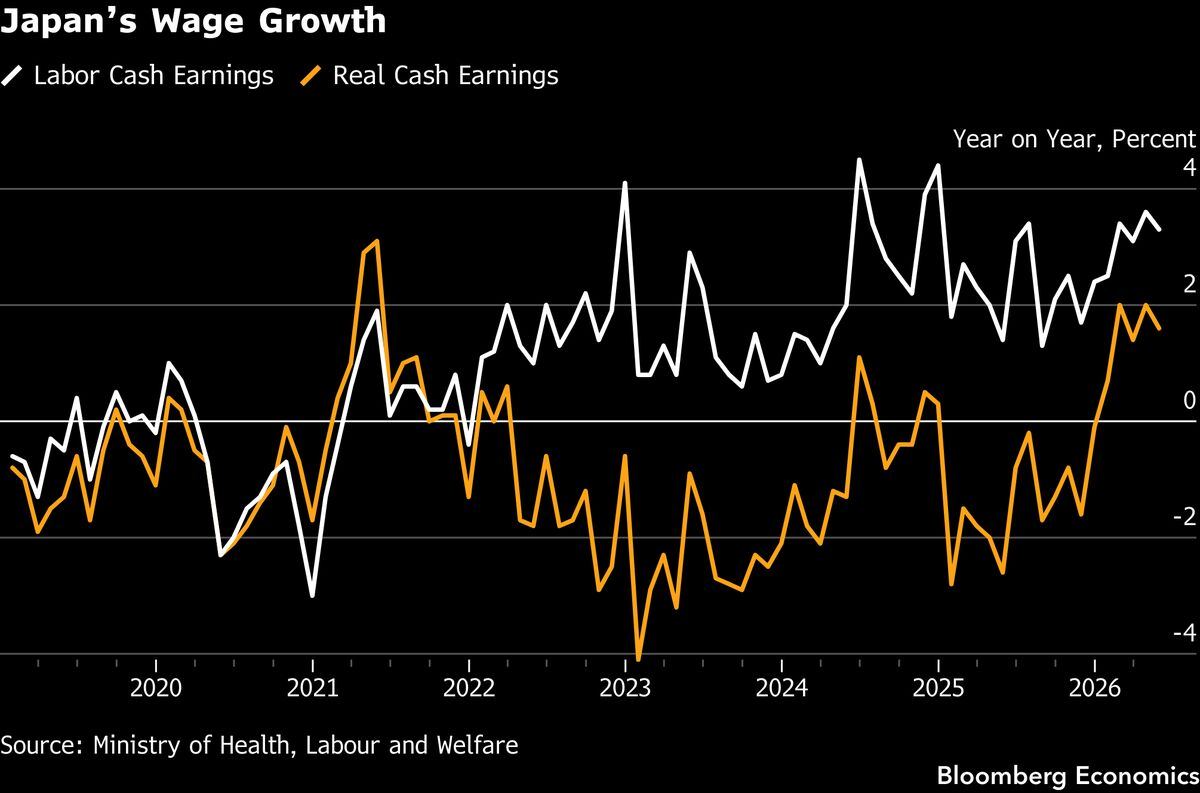
Japan's real wages have finally turned positive, which changes the Bank of Japan math. Labour cash earnings are running near 4% with real earnings just above zero for the first sustained stretch of the cycle. This is the missing condition for the September hike the Bank hinted at when it held on Friday. A central bank that believes wages have anchored can raise into a strengthening yen, and that combination, hikes plus intervention, is what makes the short-dollar-yen asymmetry real. Source: Ministry of Health, Labour and Welfare / Bloomberg Economics.
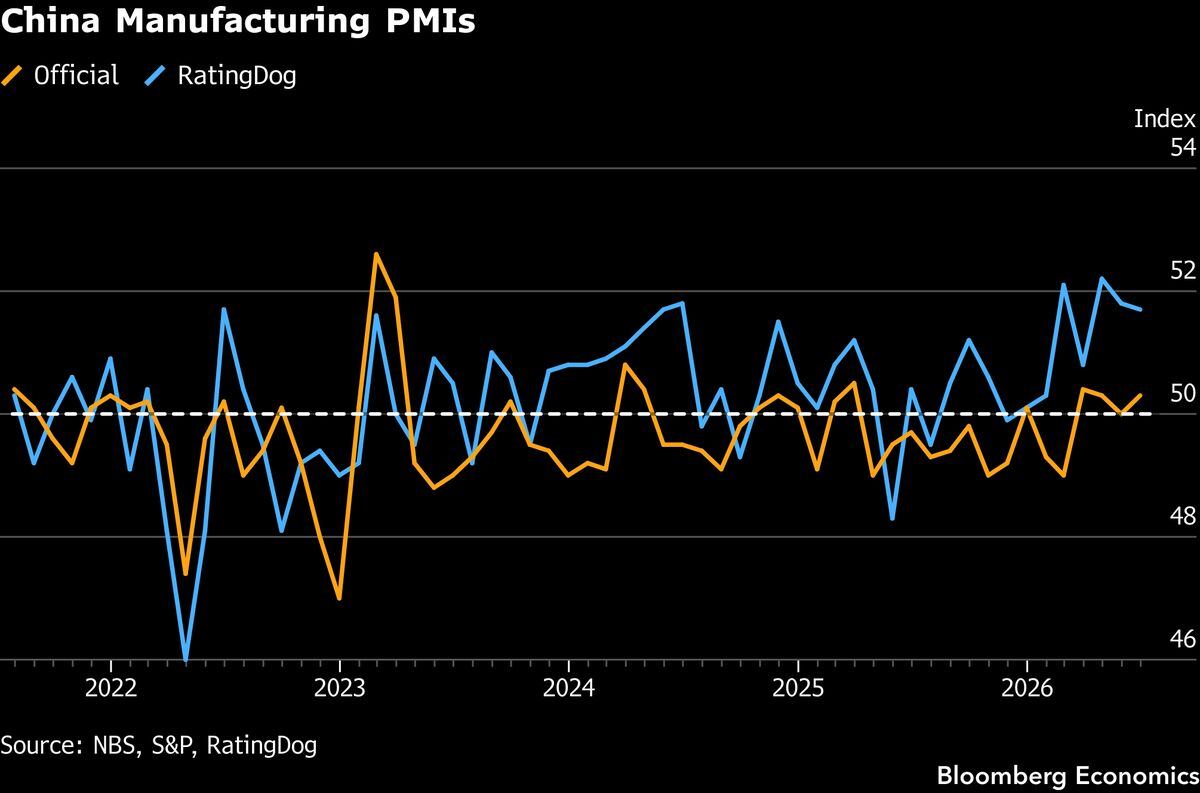
China's factory gauges keep splitting the difference. The official PMI hugs the line while the private survey runs slightly warmer, neither confirming recovery nor collapse. The July export data due this week is the harder test, consensus has shipments moderating to around 17% from 27% as the war disruptions bite. The economy that exports its deflation is now exporting less of everything, which is the quiet global demand signal underneath the noisy week. Source: NBS, S&P, RatingDog / Bloomberg Economics.
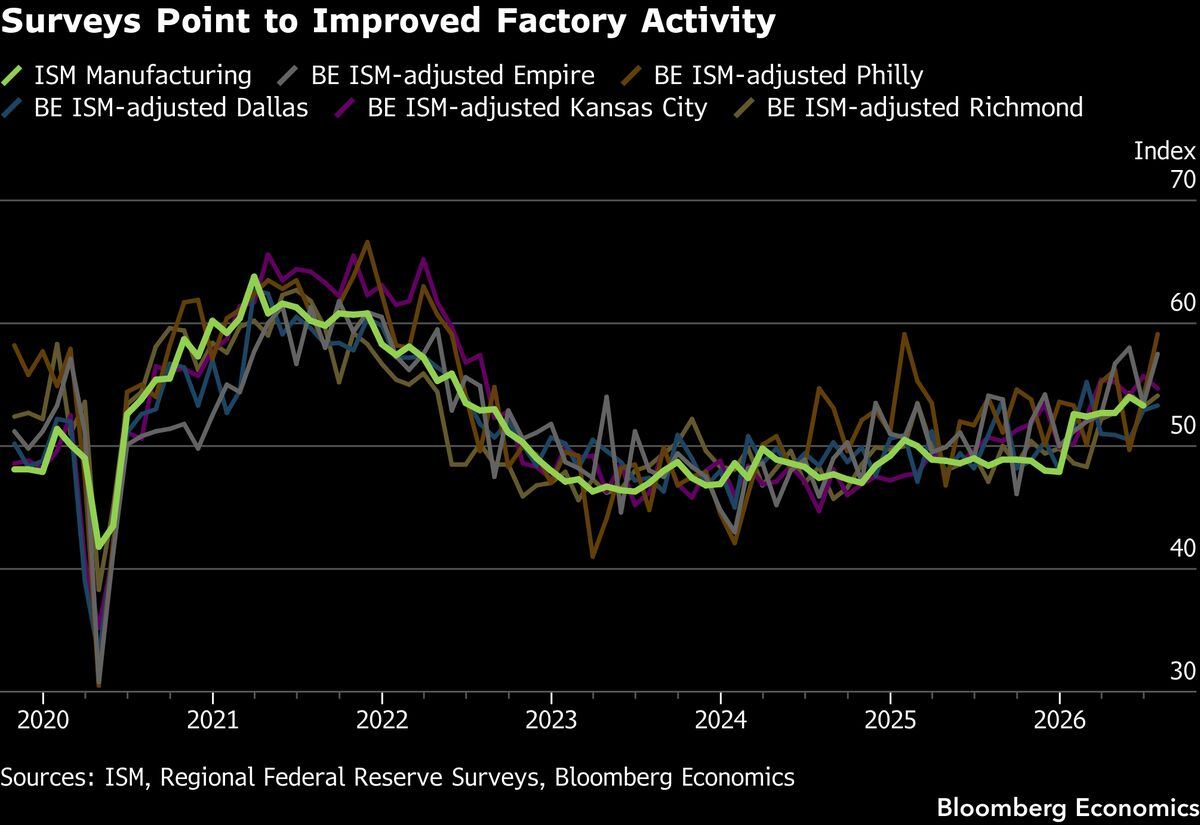
The factory surveys have quietly improved into Monday's ISM. The regional Fed composites have converged higher and consensus looks for 53.9 from 53.3, an eleventh month of expansion. A print above 55 would reignite the hike argument at the very start of the week, before the labour data gets its chance to argue the opposite. The manufacturing economy is not the story this week, but it sets the tone for the one that is. Source: ISM, Regional Fed banks / Bloomberg Economics.
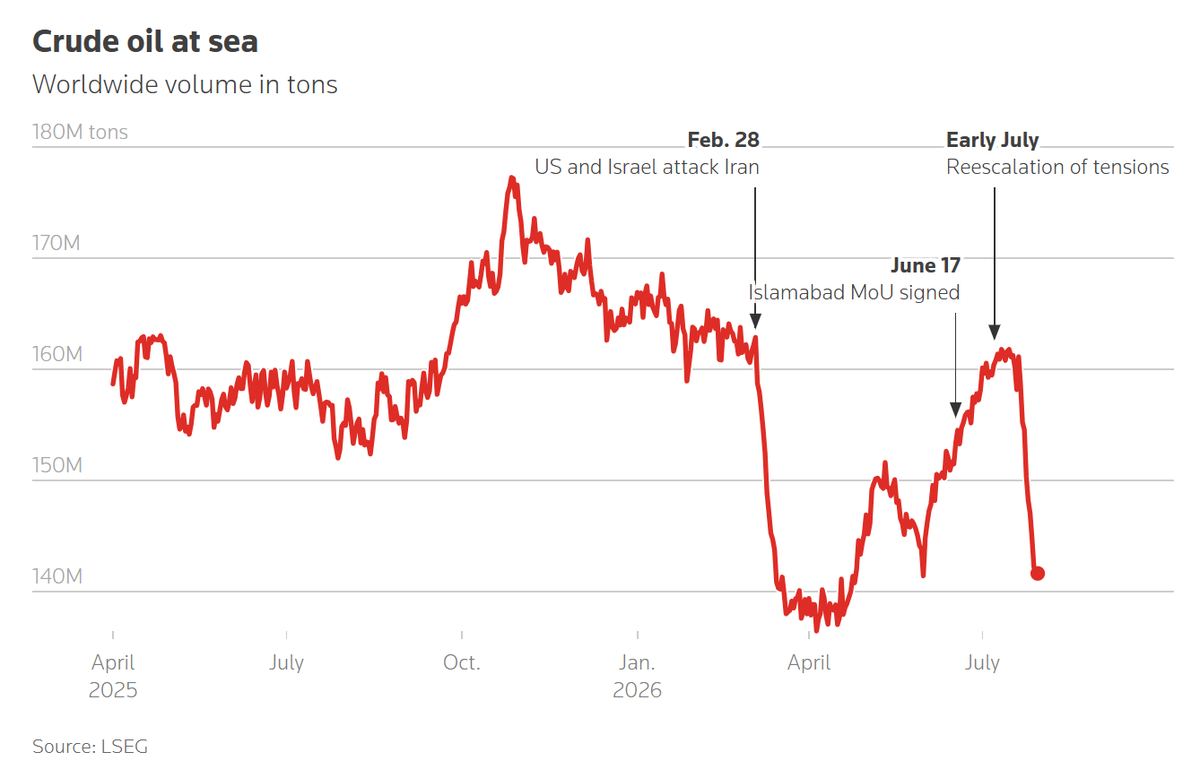
Crude at sea is the war's inventory. The volume of oil on the water spiked when the strait closed, collapsed on the ceasefire, and has surged again since the resumption, tankers as floating storage while the chokepoints reprice. It is the physical mirror of the futures curve, and the reason the price can gap on a single headline, the barrels are not where the buyers are. Source: Reuters / LSEG.
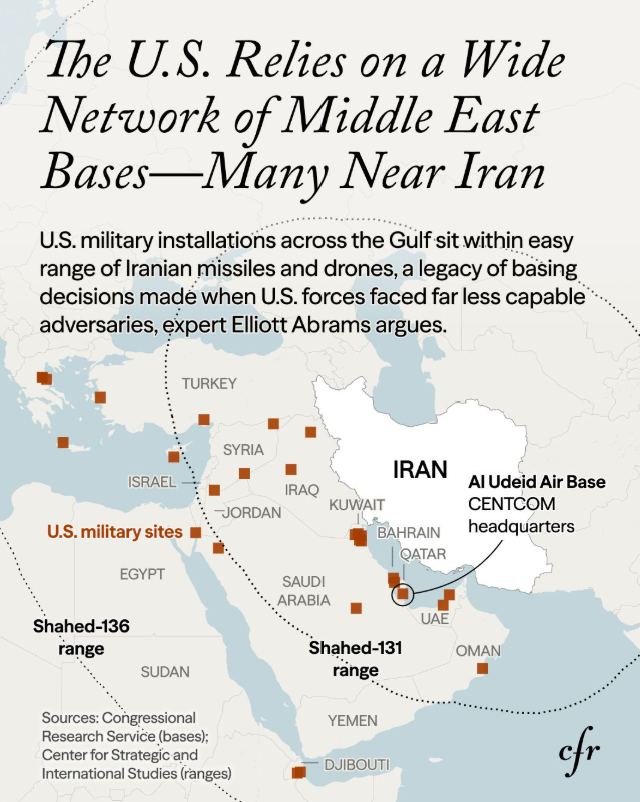
The base map that explains the drone map. American installations ring the Gulf within range of the missile families the war keeps expanding, the legacy of basing decisions made against weaker adversaries. Every week the conflict continues, this geography converts from deterrent to target list, and the regional energy infrastructure shares the same ranges. Source: CSIS / CFR.
Rocket Re-Entry Tuesday
The labour-market week starts from the demand side. Vacancies are expected near 7.5 million, drifting lower, the slow evidence behind the seasonal-shocker risk. Korea's CPI in our morning should cool toward the high-twos, keeping the August hike conversation alive without settling it. And after the New York close the record IPO reports its first public quarter, a trillion dollars below its peak, so we read the verdict Wednesday morning with the rest of Asia.
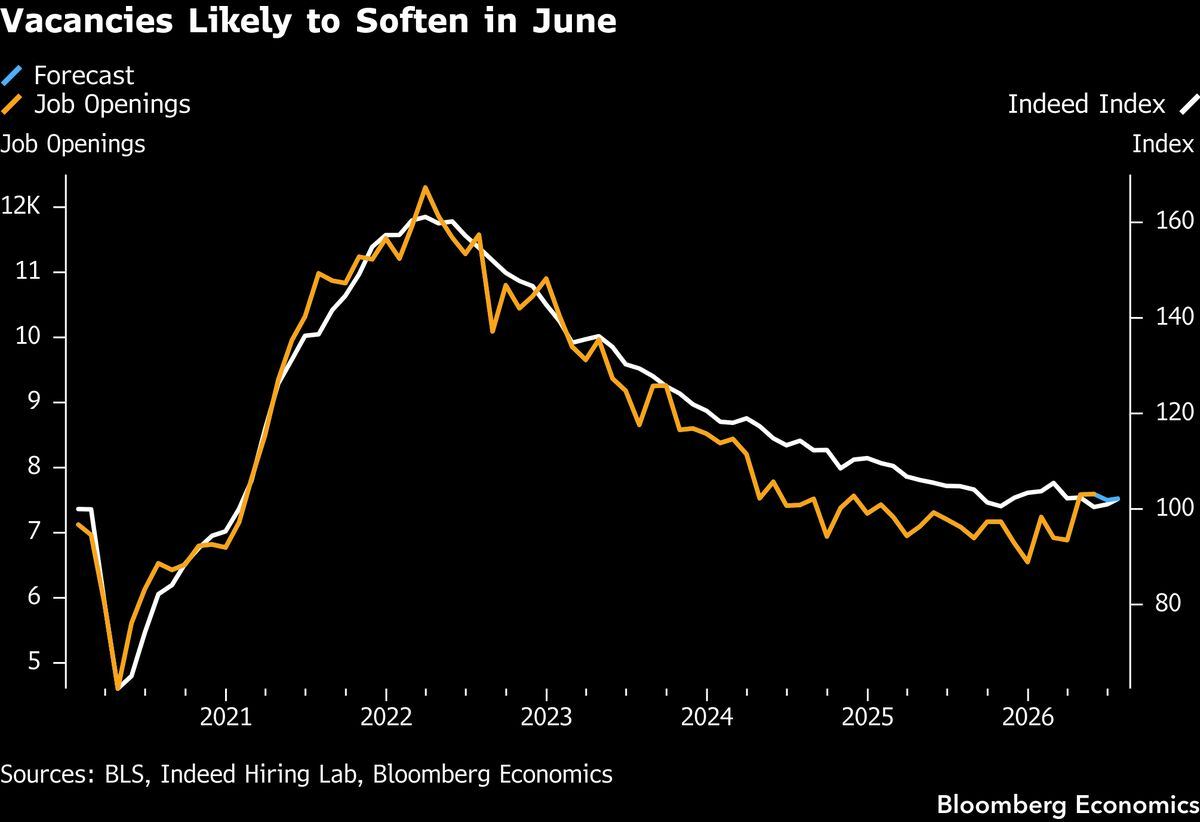
Vacancies are softening underneath the calm. Job openings have rolled over on both the official series and the higher-frequency job-board data, the labour market cooling from the demand side before it shows in the unemployment rate. This is the slow-moving evidence behind the seasonal-shocker risk, a market where hiring intentions fade tends to deliver its bad news in the summer prints, when the seasonal adjustments are least forgiving. Source: BLS, Indeed Hiring Lab / Bloomberg Economics.
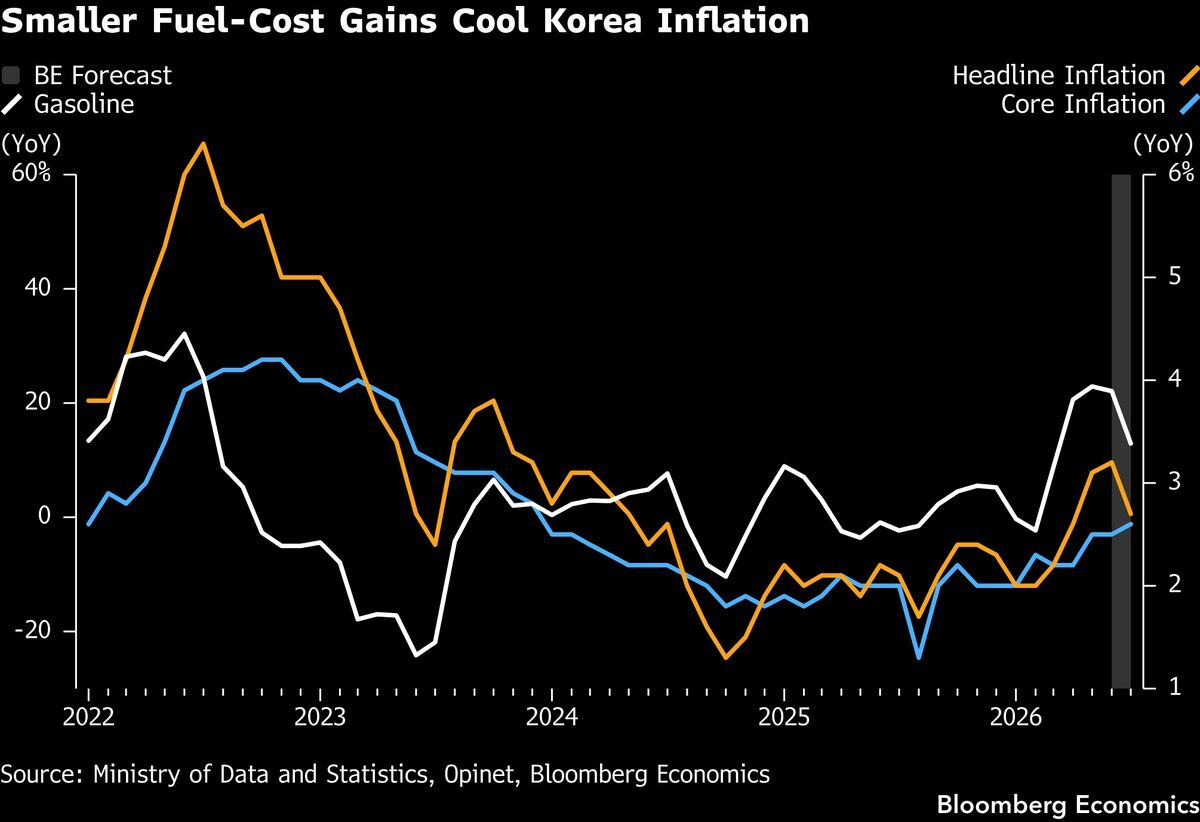
Korean inflation is cooling as fuel costs ease. Headline is tracking back toward the mid-twos with core following, gasoline's contribution fading from the June peak. It hands the Bank of Korea room to pause after starting its hiking cycle, and it makes the won story this week about flows and intervention rather than rates. The inflation argument for currency strength is fading exactly as the official buying appears. Source: Opinet / Bloomberg Economics.
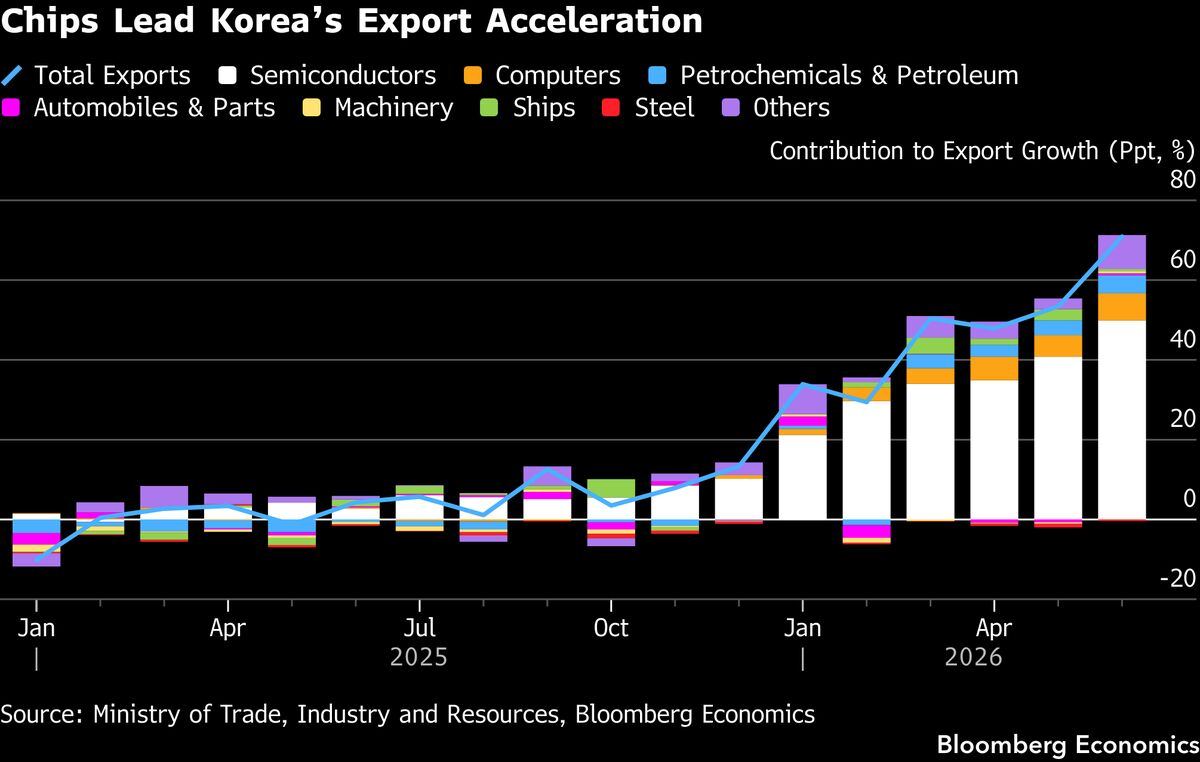
Korea's exports are accelerating on one product. Semiconductors now drive the bulk of export growth, the contribution bars increasingly a single colour, with the July trade data confirming the chip engine running while everything else idles. It is prosperity and fragility in the same chart. The economy grew 3.7% year on year last quarter on this engine, and the currency strengthened on intervention, which is why fading that strength needs care this week. Source: Korea Ministry of Trade / Bloomberg Economics.
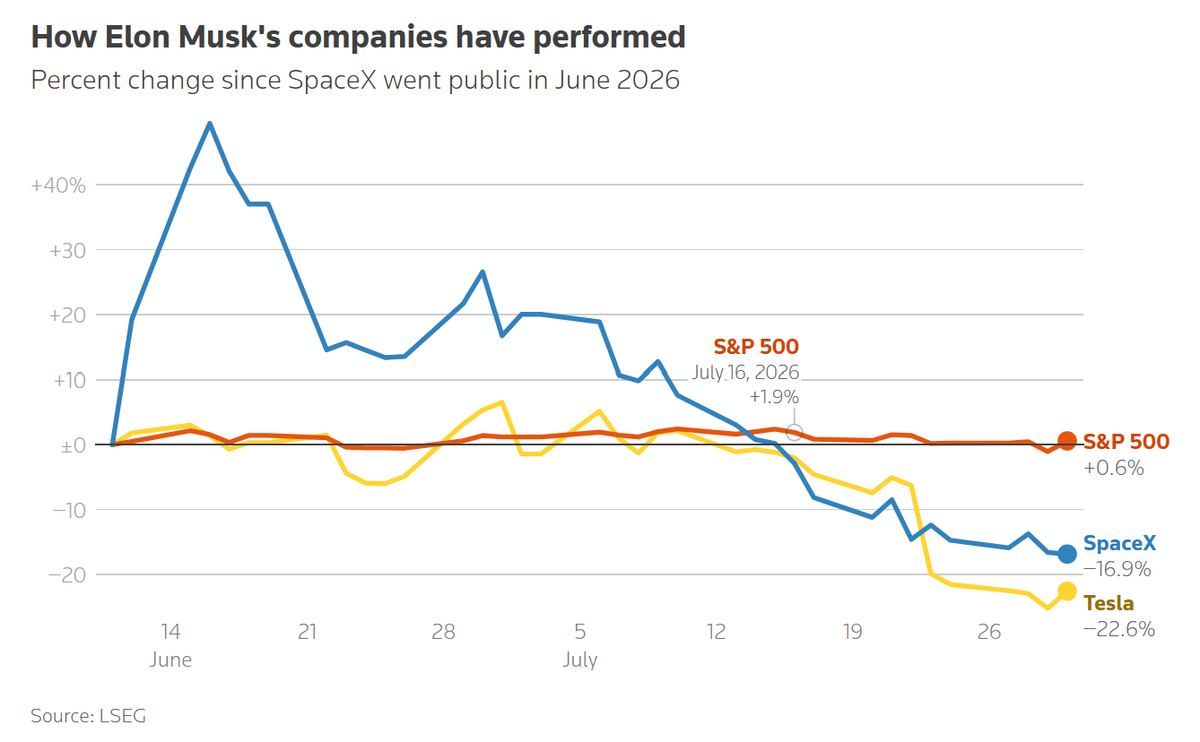
The listing of the year is now the drawdown of the year. Performance since the June debut, the S&P grinding higher while the record IPO trades more than a fifth below its offer price. This week it reports its first earnings as a public company, into speculative positioning that never got its rally. A miss here does not stay contained, it bleeds into the whole complex of AI-adjacent paper that priced perfection at the top of the cycle. Source: Reuters / LSEG.
Two-Handed Wednesday
The confusing day by design. ADP decelerating toward 67k while ISM services holds near 54.5 is the stagflation-lite mix, softening hiring and resilient activity in the same morning, and neither the hike camp nor the cut camp gets a clean claim on it. Asia's morning is full, the RBI holding with the rupee misbehaving, Indonesia's growth slowing, Japan's wages confirming, New Zealand's labour market undershooting. Brazil cuts in the US evening. A day for reading, not trading.
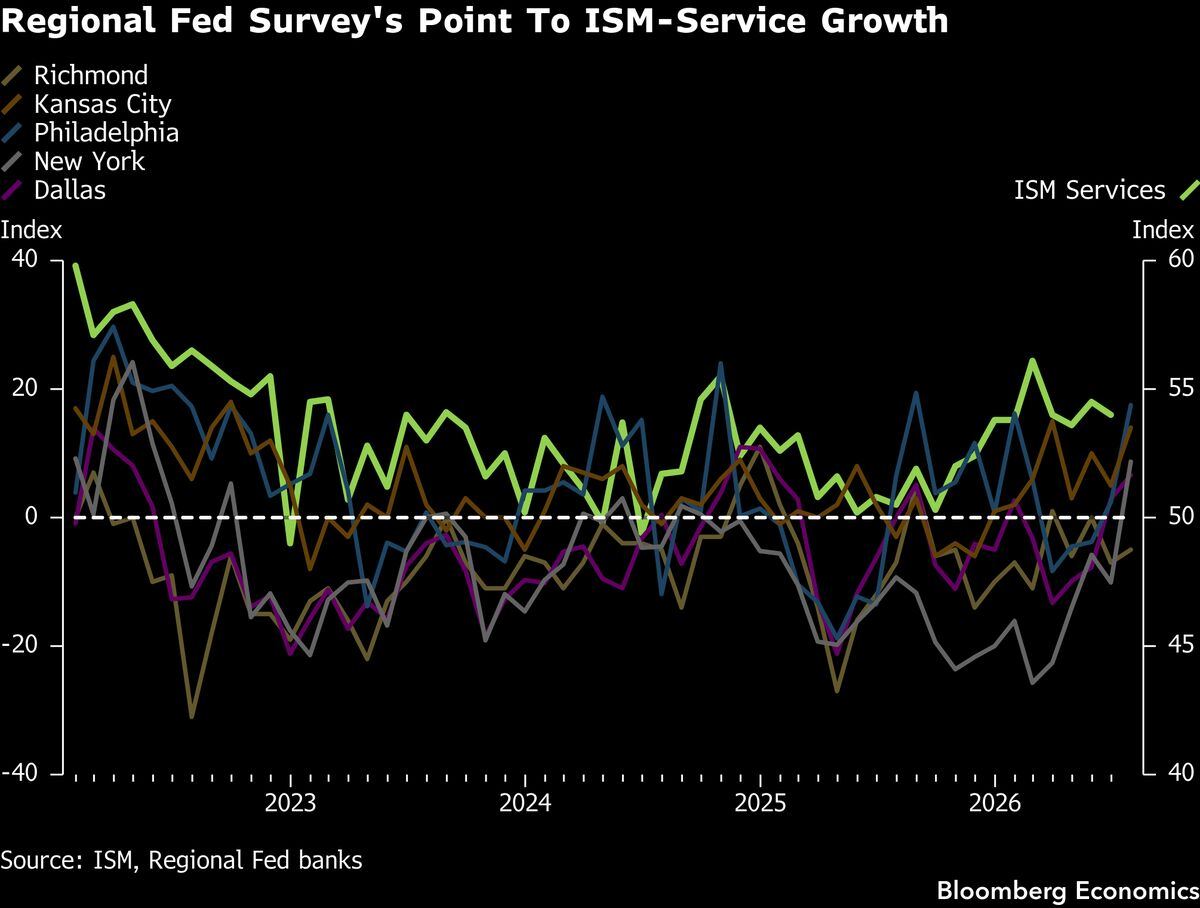
And the same surveys point to services growth holding up. The regional Fed services gauges track the ISM services index higher, with Wednesday's print seen at 54.5 from 54.0. Wednesday is the day the week's confusion could peak, a decelerating ADP alongside a resilient services read is the stagflation-lite combination, strong prices and softening hiring in the same morning. The clean narratives, either way, are the unlikely ones. Source: ISM, Regional Fed banks / Bloomberg Economics.
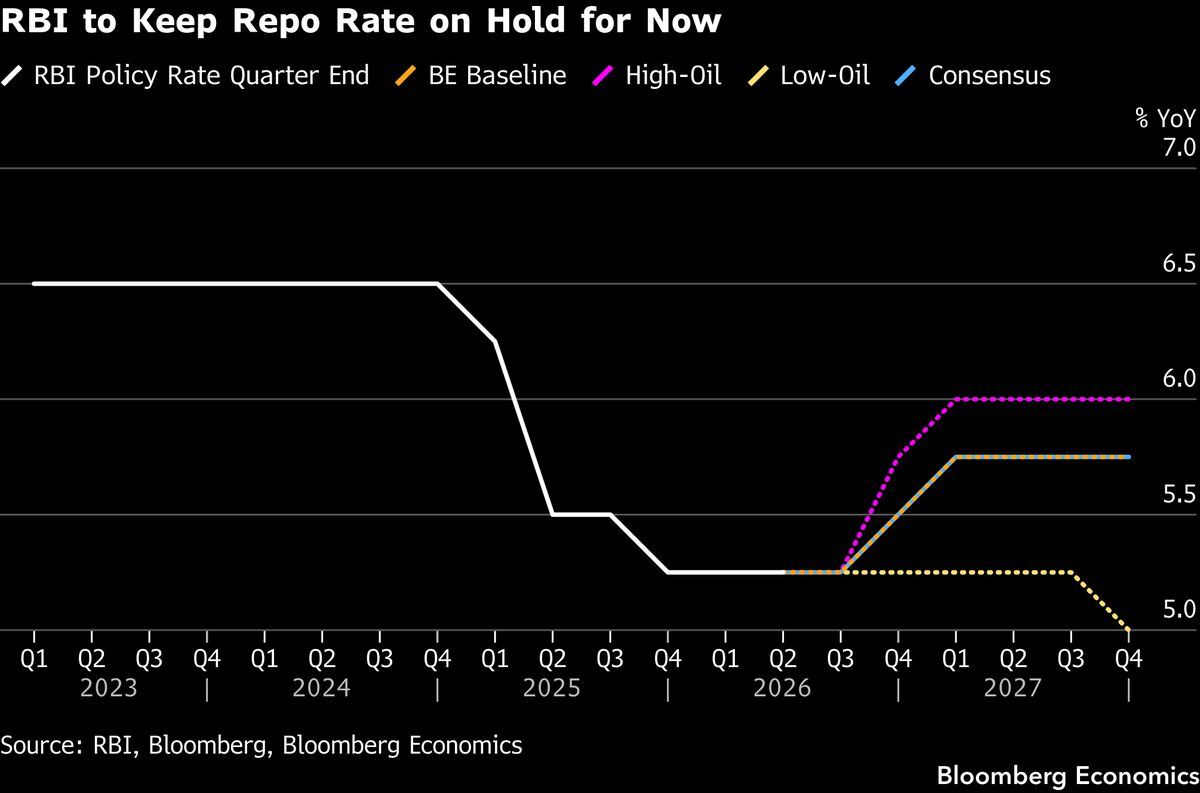
India's central bank stays on hold, with the oil scenarios doing the arguing. The repo path is flat in the base case with the high-oil scenario pulling forward hikes and the low-oil path opening cuts. For an economy importing most of its crude, the strait decides the rate path. The rupee, the inflows and the street protests all orbit the same variable, and it is not one Mumbai controls. Source: RBI / Bloomberg Economics.
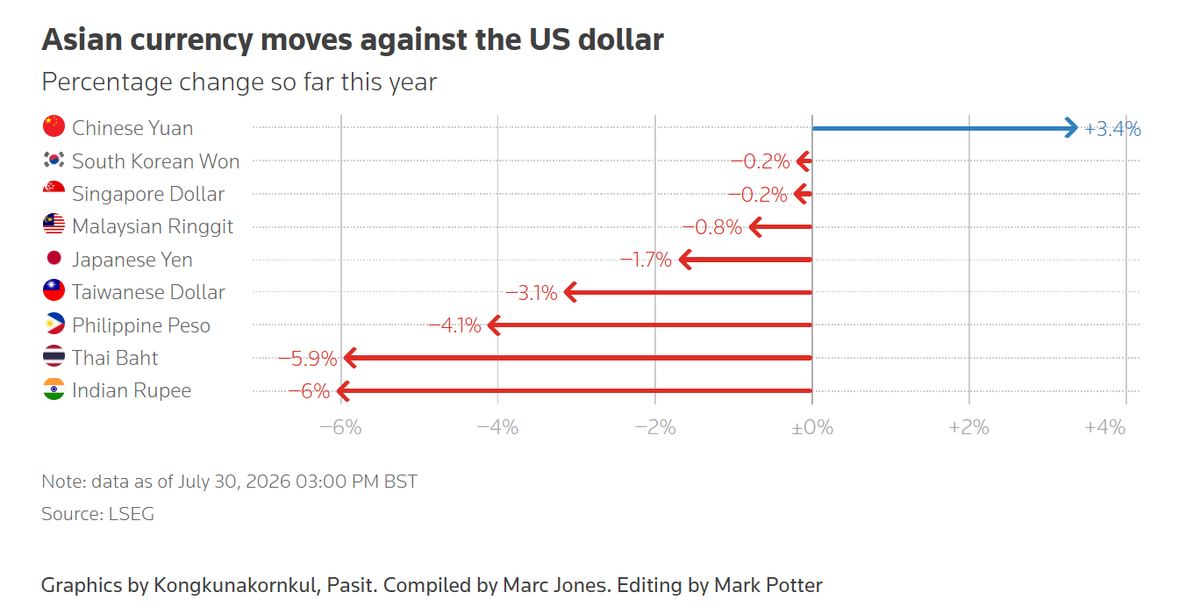
The rupee is the region's other policy headache. One of Asia's worst-performing currencies faces a central bank expected to hold on Wednesday, with retail inflation having just breached the target band for the first time in over a year and the June inflow measures having drawn more than $20 billion in their first month. An oil importer with street protests, sticky food prices and a currency that will not stabilise is running out of easy options, and the hold is the least bad one. Source: Reuters / LSEG.
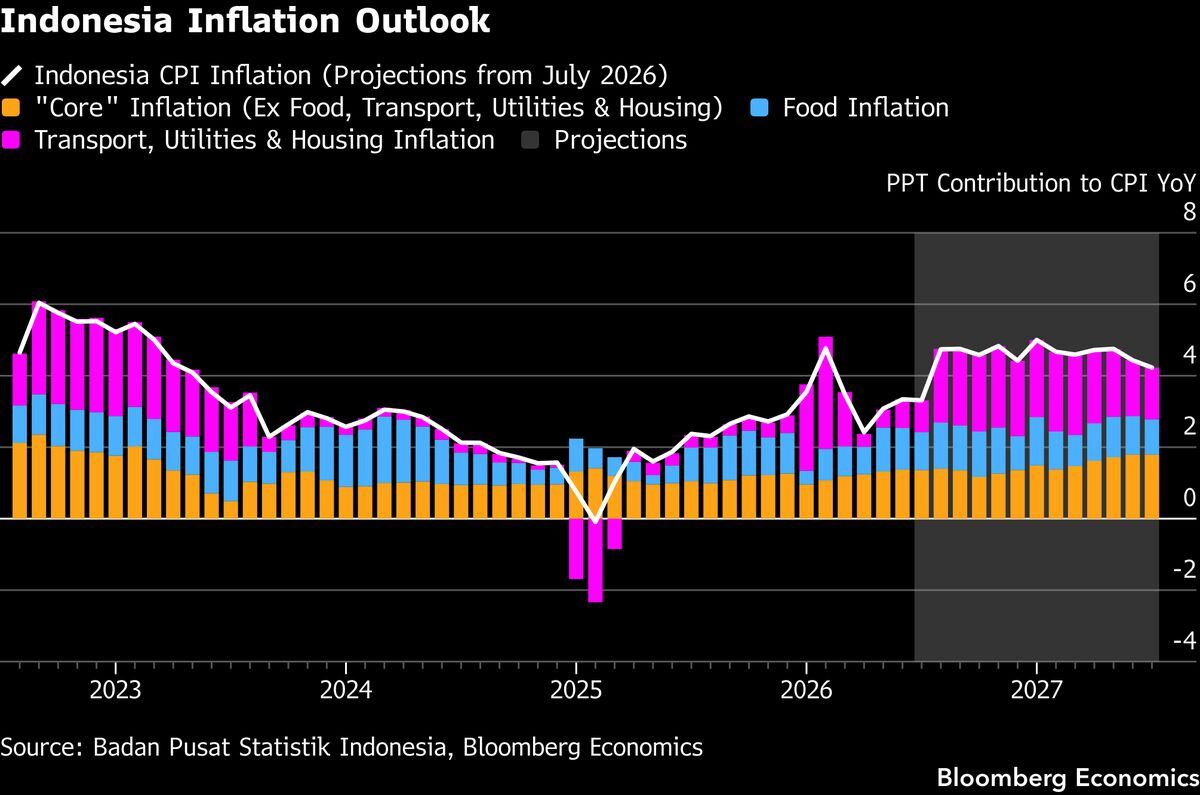
Indonesia's inflation outlook is the same story with higher stakes. The projections show the transport and utilities component driving the path back above the mid-band, exactly the shock an oil importer with a pressured currency cannot absorb quietly. The central bank already hiked defending the rupiah. The energy math says it may not be done, whatever the growth data prefers. Source: Badan Pusat Statistik / Bloomberg Economics.
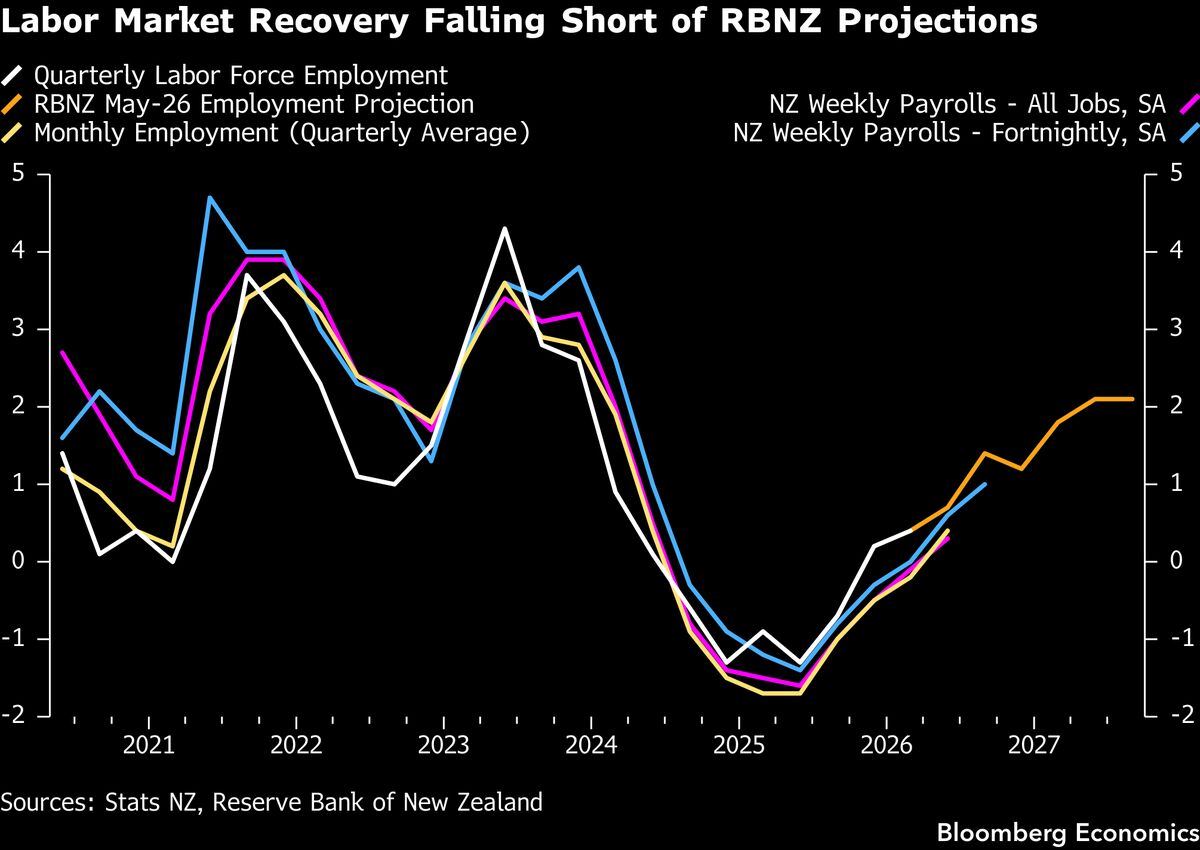
New Zealand's labour market is falling short of the central bank's projections. Employment has undershot the May projections for three straight quarters, the early-hiker economy now wearing the cost. It is the cautionary chart for every committee currently being urged to hike into an oil shock, the demand damage arrives later, and it arrives anyway. Source: Stats NZ, RBNZ / Bloomberg Economics.
Last Looks Thursday
The region's inflation prints arrive in a cluster, Taiwan and Thailand in our morning, Sweden's undershoot and the EM holds through the evening, with US claims the last labour read before the print. The cluster tells one story in two directions, energy pass-through still working into Asian CPIs while the northern economies rediscover disinflation. Both camps will find what they need. Friday decides who keeps it.
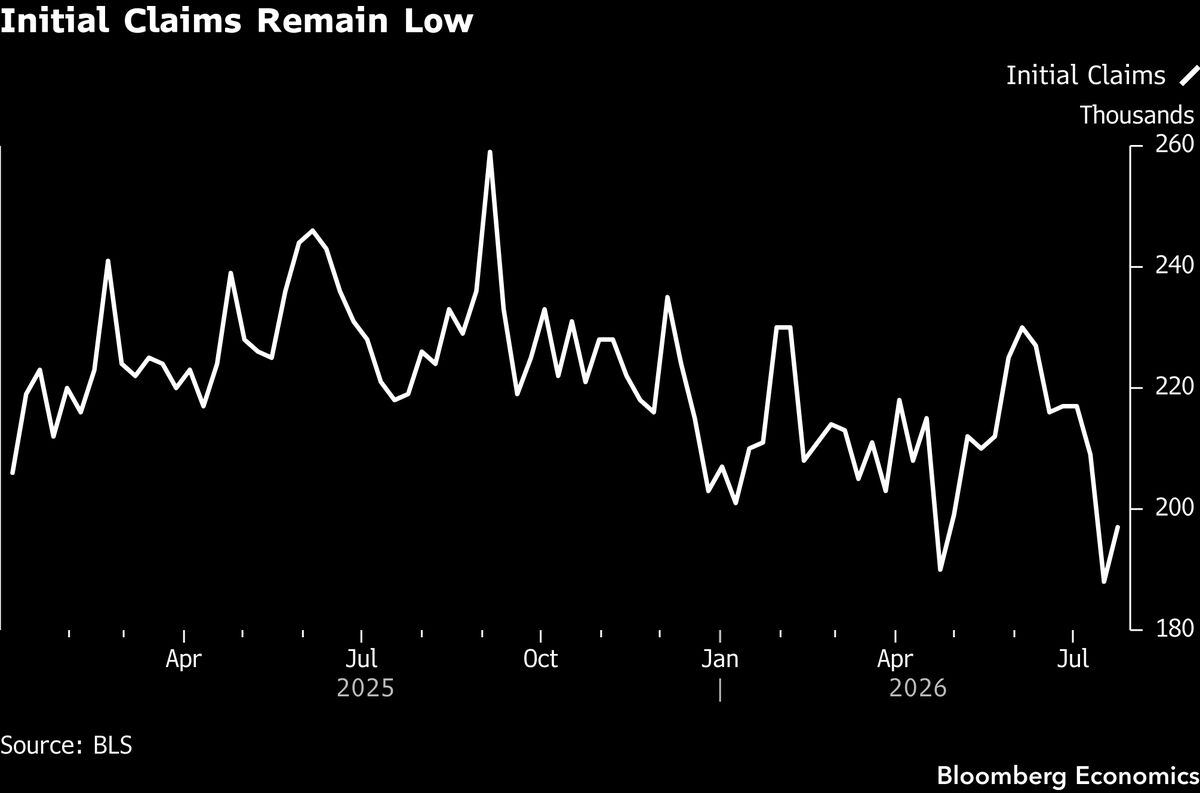
Claims are the calm before Friday. Initial claims have stayed pinned near cycle lows, 202k expected against 197k prior, still giving no confirmation of the layoff headlines. The gap between announced job cuts and actual filings remains the most important unresolved question in the US labour market. Thursday's print is a tier-two release with a tier-one job, any spike above 220k and the pre-positioning into Friday night starts early. Source: BLS / Bloomberg Economics.
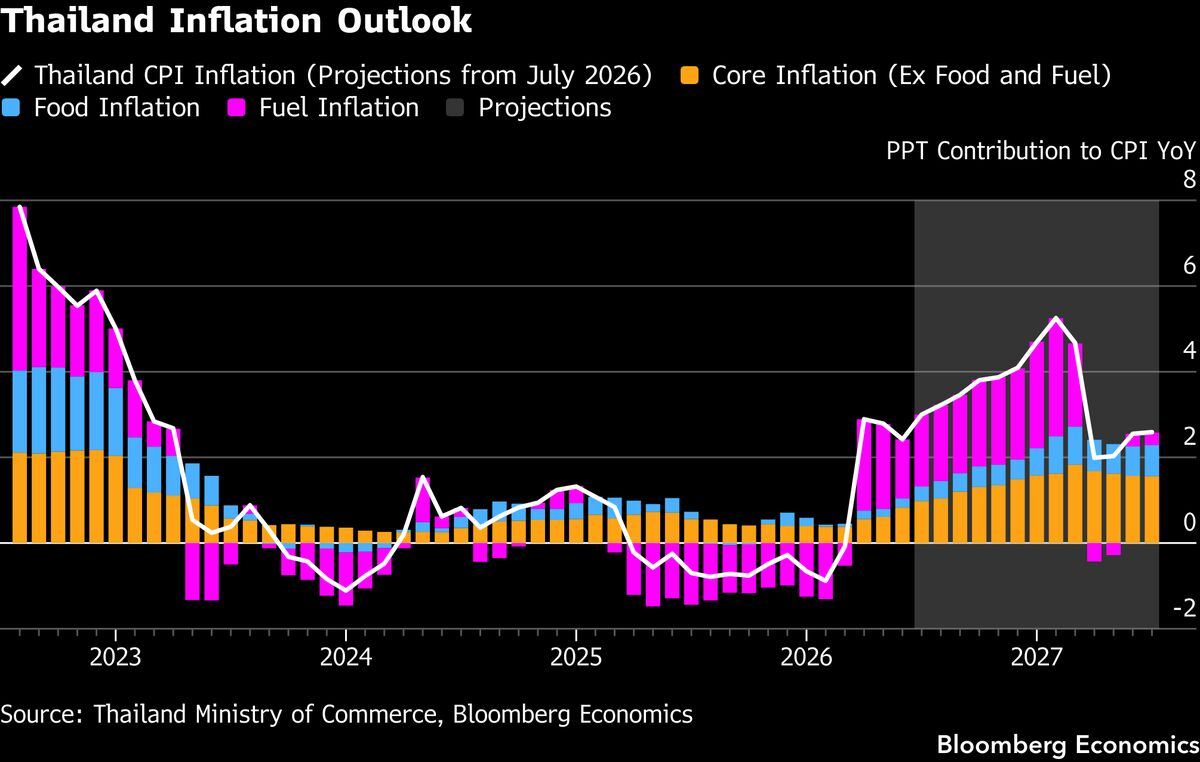
Thailand's inflation projections are catching the energy updraft. The contribution stack shows core and food steady while the fuel component swings back positive into 2027. Another Asian forecast built when oil was retracing, now being marked to a world where it is not. The pattern repeats across the region's inflation outlooks, and it is why the central banks that cut early are the ones now exposed. Source: Thailand Ministry of Commerce / Bloomberg Economics.
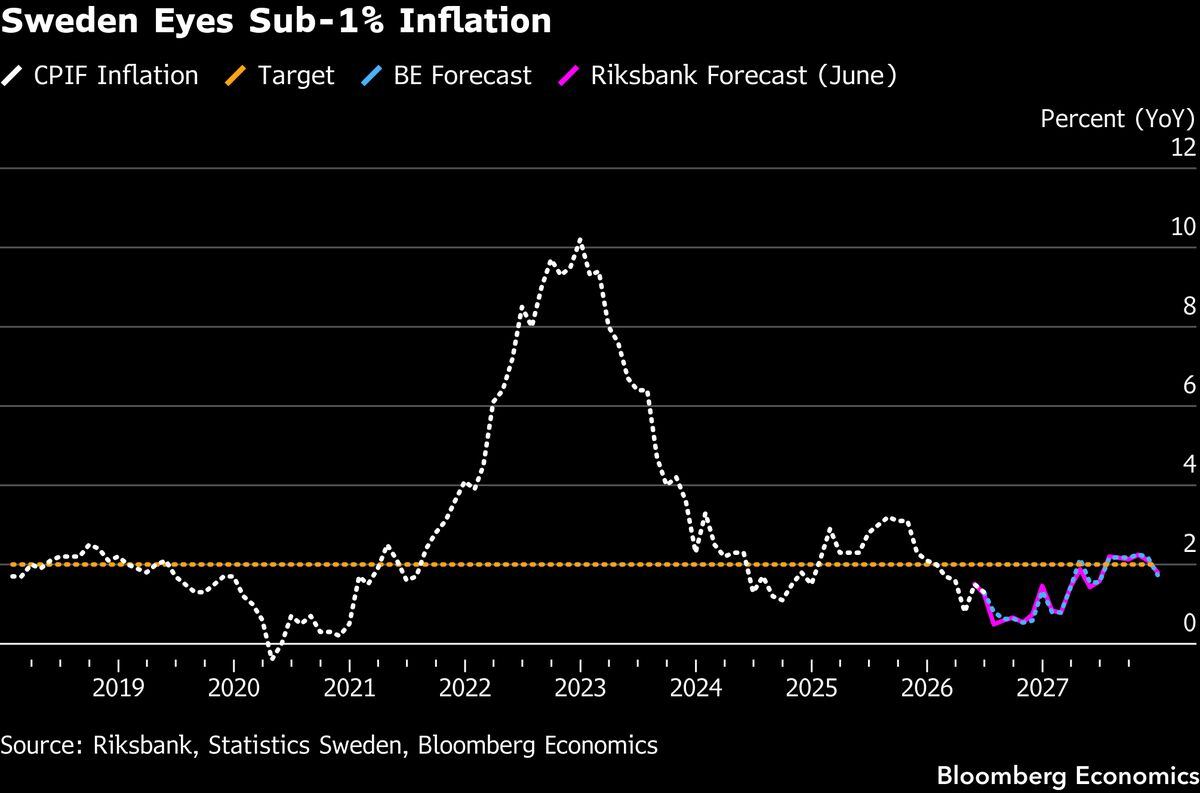
Sweden eyes sub-1% inflation, the outlier the other way. CPIF is projected to undershoot, a full percentage point below target, the Riksbank's problem the mirror image of everyone else's. It is a useful reminder that the global inflation picture is not one story, it is an energy story wearing different currencies, and the countries without the energy exposure are staring at the old disinflation everyone else has forgotten. Source: Riksbank, Statistics Sweden / Bloomberg Economics.
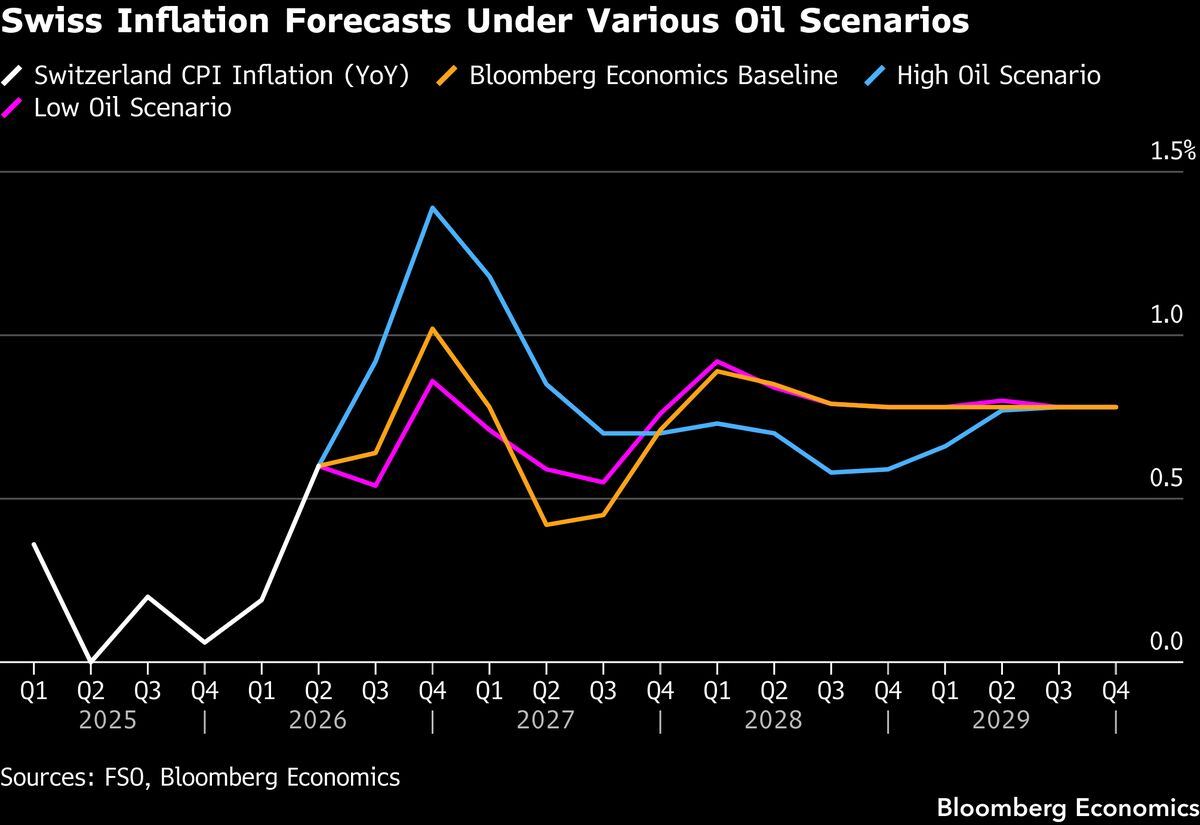
Switzerland runs the same fork in miniature. The inflation forecast splits cleanly on oil scenarios, the high-oil path holding the profile near 1% and the low-oil path sliding under it. For the franc, a safe haven with no energy problem, the scenarios are almost policy-neutral, which is precisely why it keeps catching the flows every time the strait makes headlines. Source: FSO / Bloomberg Economics.
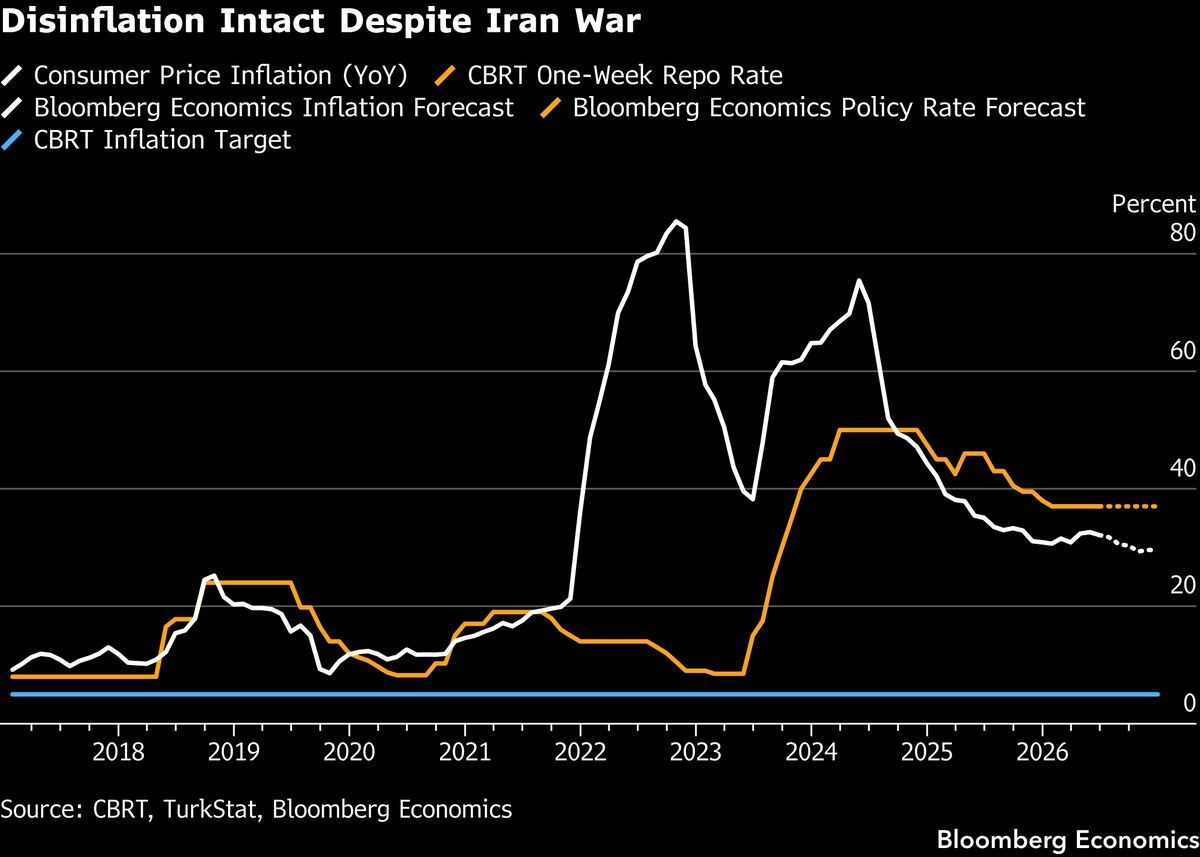
Turkey's disinflation is intact despite the war. Inflation has ground down from the post-2022 extremes with the policy rate finally above the price path, the orthodox experiment surviving its first oil shock. It is one of the few emerging-market stories this year where the direction of travel is unambiguous, and the ratings reviews are starting to notice. Source: CBRT, TurkStat / Bloomberg Economics.
Season Finale Friday
The apex, at 8:30pm our time. Expected in the 60s to 80s from 57k, the unemployment rate at risk of 4.3% on returning participation, the World Cup hiring unwinding out of the seasonals. China's trade data lands in our afternoon as the warm-up, exports moderating from the twenties. Then the number, the revisions, and the hour of repricing that follows. The whole week is positioning for this print. Position sizes should already reflect that by Thursday.
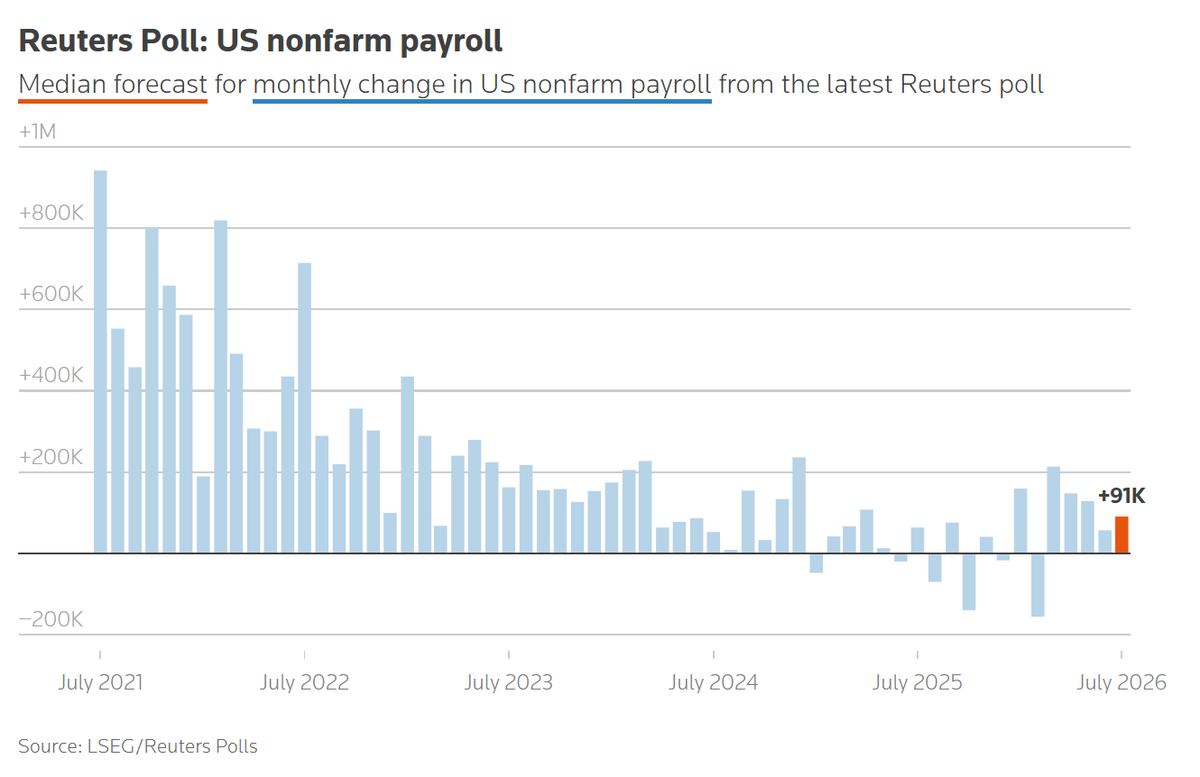
The polling behind Friday's print. The median forecast sits modestly positive against a monthly series that has spent two years decelerating, the bars shrinking summer by summer. The market's real vulnerability is not the median, it is the tails, the last few Julys have printed far from consensus and repriced the entire autumn path within an hour. Position for the distribution, not the point estimate. Source: Reuters / LSEG.
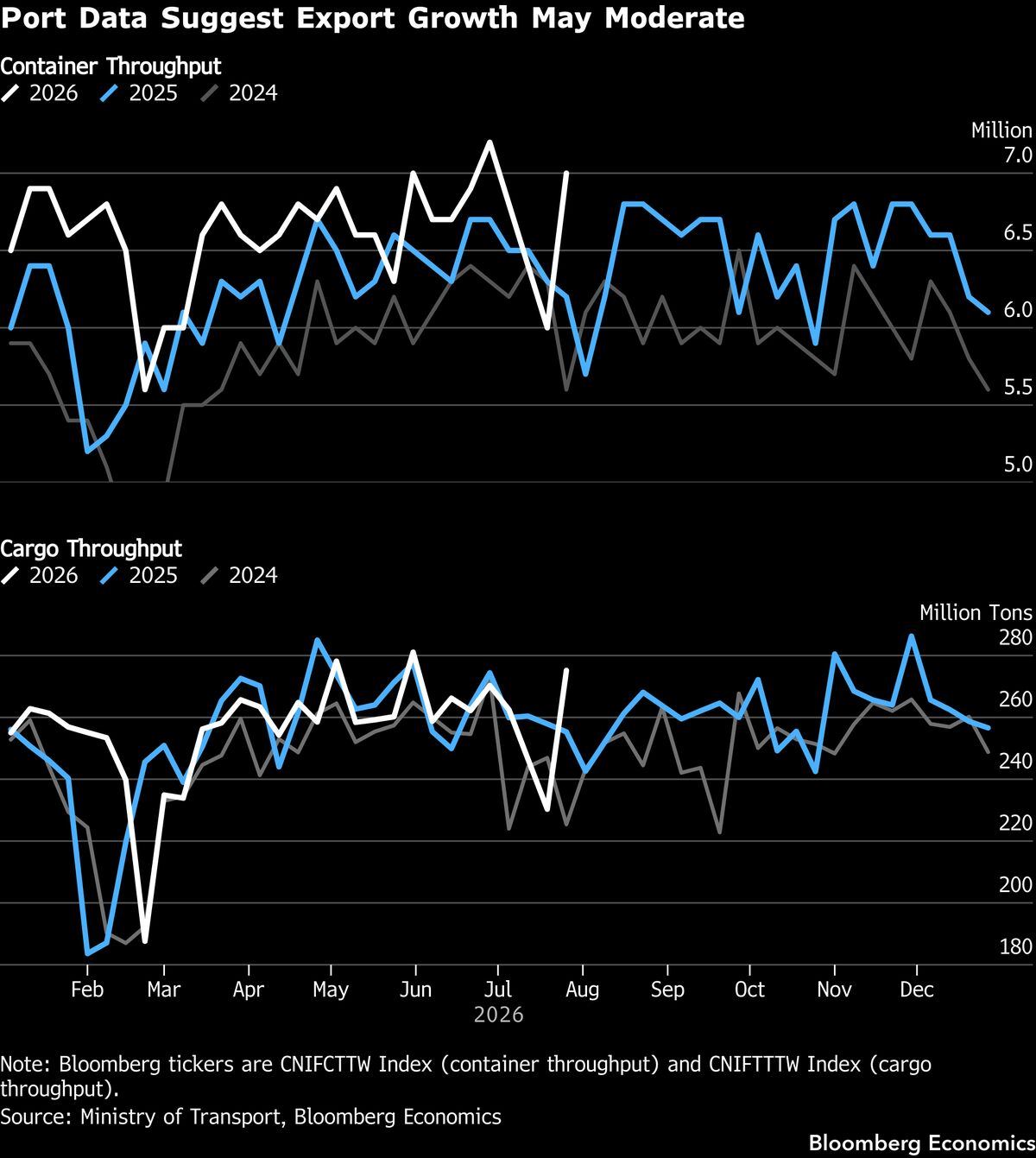
The port data already hints at the moderation. Container and cargo throughput have rolled off their highs versus the prior two years, the leading indicator for the export print due this week. After a first half where trade was the only engine Beijing had, a genuine deceleration would put the stimulus question, and the currency question, back on the table into the autumn. Source: Ministry of Transport / Bloomberg Economics.
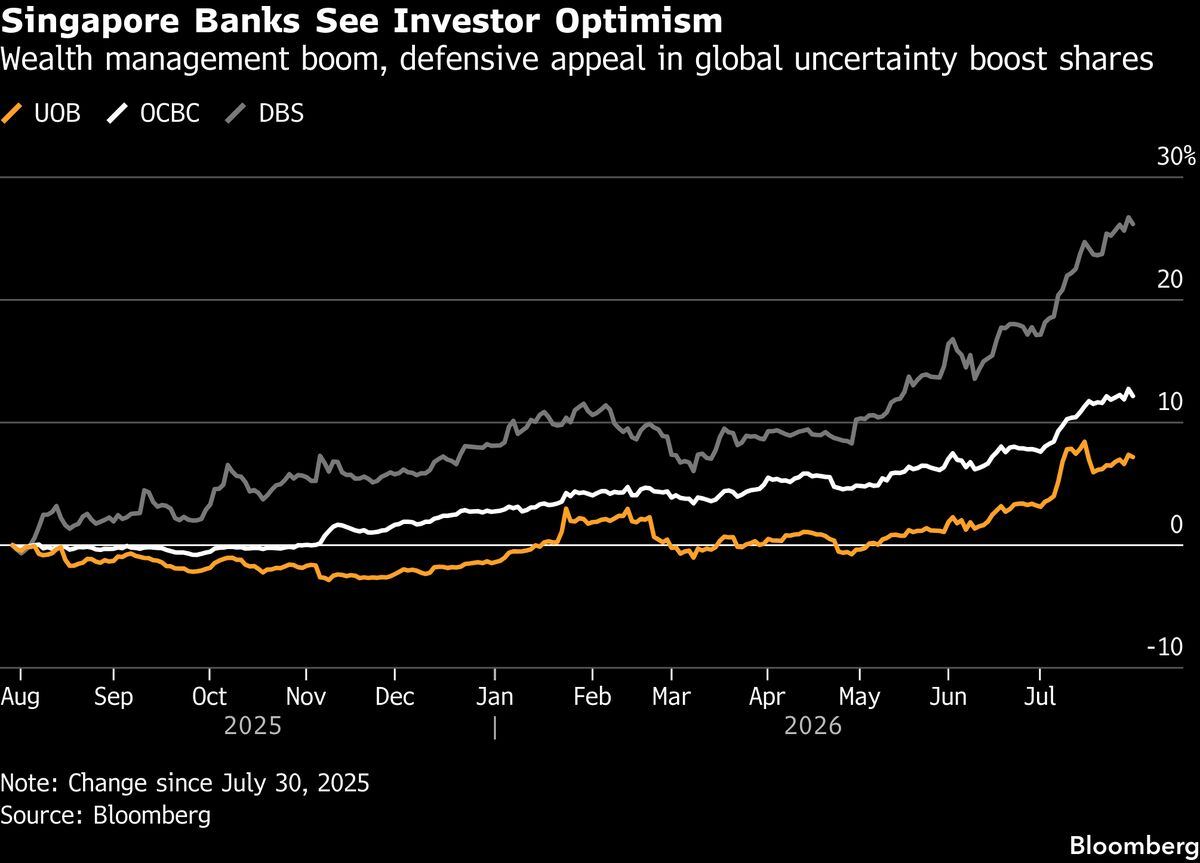
Singapore's banks are the quiet winners of the uncertainty. The three lenders have outperformed on wealth-management inflows and their defensive appeal, the money that leaves everywhere else in the region tends to arrive here. In a week of intervention and unwind, the safe-haven bid inside Asia has an address, and it is not only the currency. Source: Bloomberg.
The AI Fracture
The theme continues, and this week it has a balance sheet. The squeeze cleared the most famous forced seller, the earnings keep beating, and the crowd now names the AI correction as its single biggest fear, all at once. Underneath, the loan market has begun charging properly for compute risk, the first lender pushback in years, which is how every capex cycle eventually meets its banker. The fracture is no longer between winners and losers. It is between the equity story and the credit story, and only one of them can be right.

The squeeze that answers nothing. The Kospi jumped 18% on Thursday, its biggest day in years, after a three-day fall of 17% completed a six-week 40% drawdown, the forced seller finally out of the tape and the shorts covering into the vacuum. A single-day rally of that size is not a verdict, it is a symptom, the sign of a market trading on positioning rather than price discovery. Whether this was the bottom or merely the unwind pausing for breath is the question the whole AI complex carries into the week. Source: Reuters / LSEG.
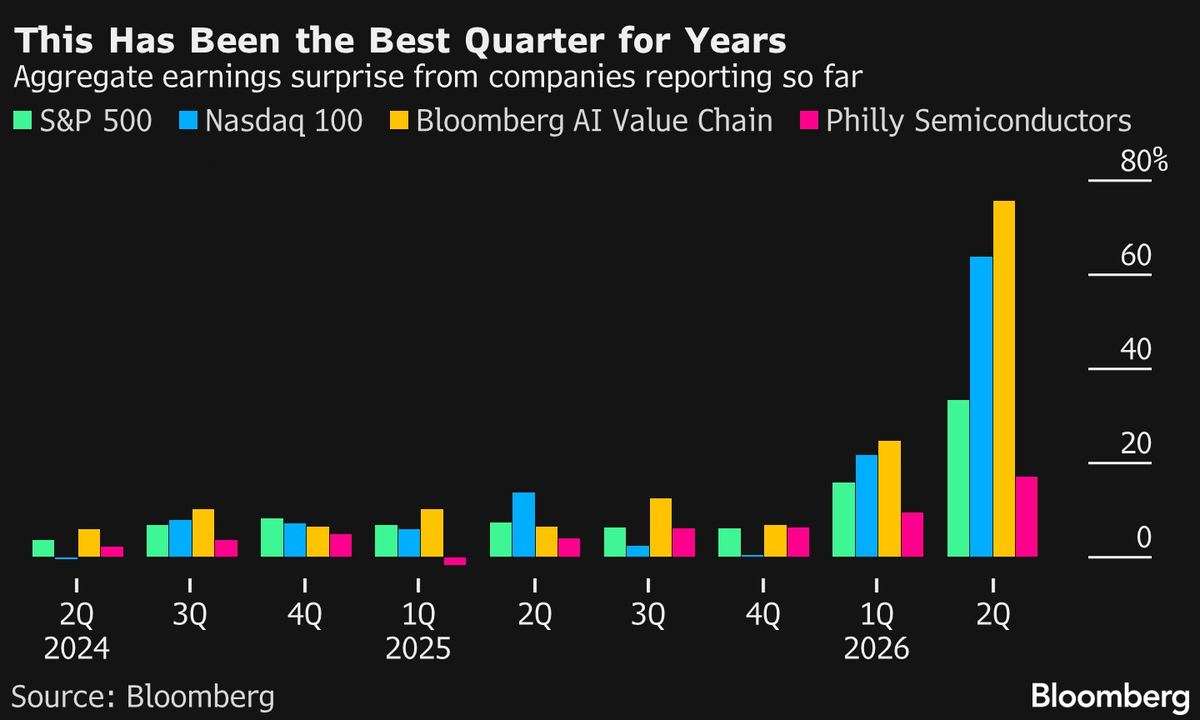
The earnings are not the problem. Aggregate surprise from companies reported so far is running at the best in years, across the index, the Nasdaq, the AI value chain and the semis. That is precisely the tension, record delivery and falling prices for the deliverers. When the best beat rate in years cannot hold a bid in the names producing it, the market is no longer paying for the quarter, it is repricing the decade. Source: Bloomberg.
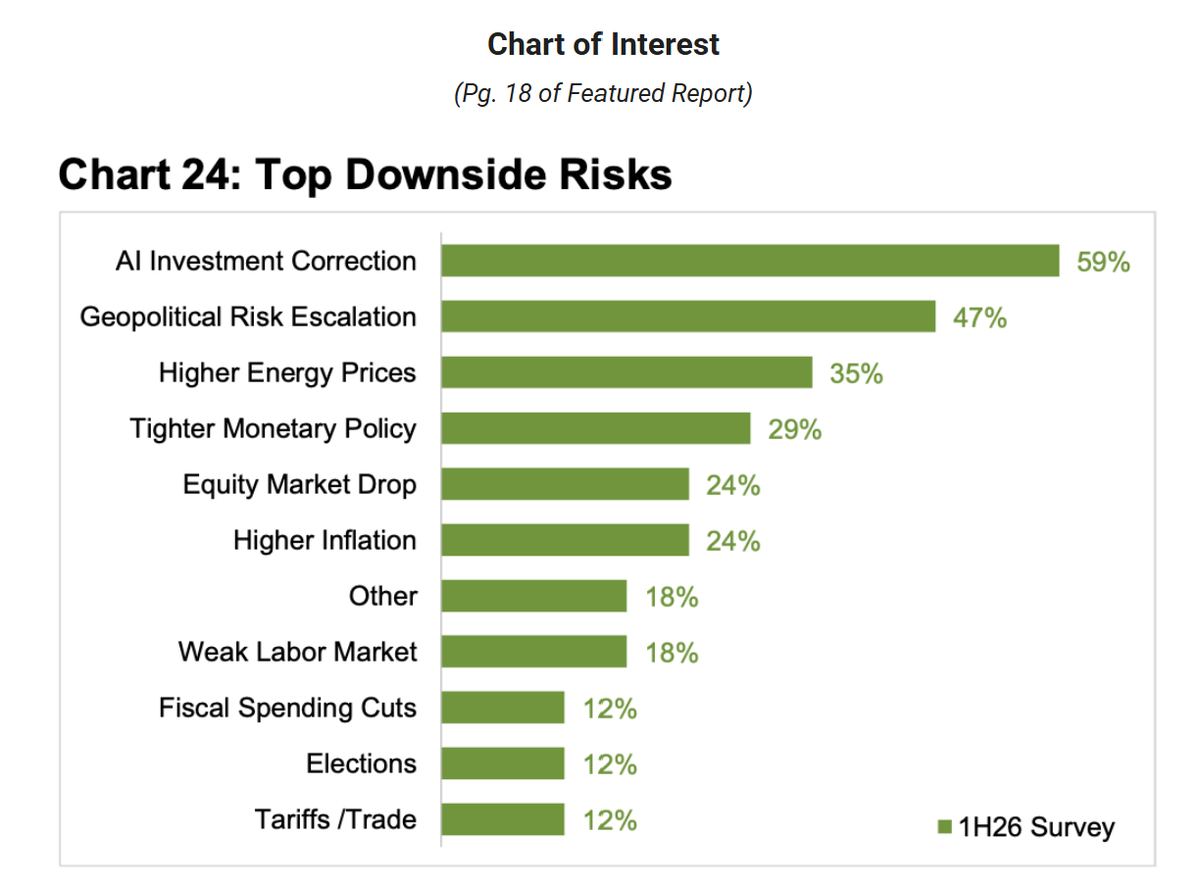
The survey says it plainly, the crowd's biggest fear is now the trade itself. Asked for the top downside risks, 59% named an AI investment correction, ahead of geopolitical escalation at 47%, energy at 35% and tighter policy at 29%. The most consensus fear on the board is the very position the market spent two years building. Crowded longs with crowded doubts is the setup for violent air pockets, in both directions. Source: BofA survey / Bloomberg.
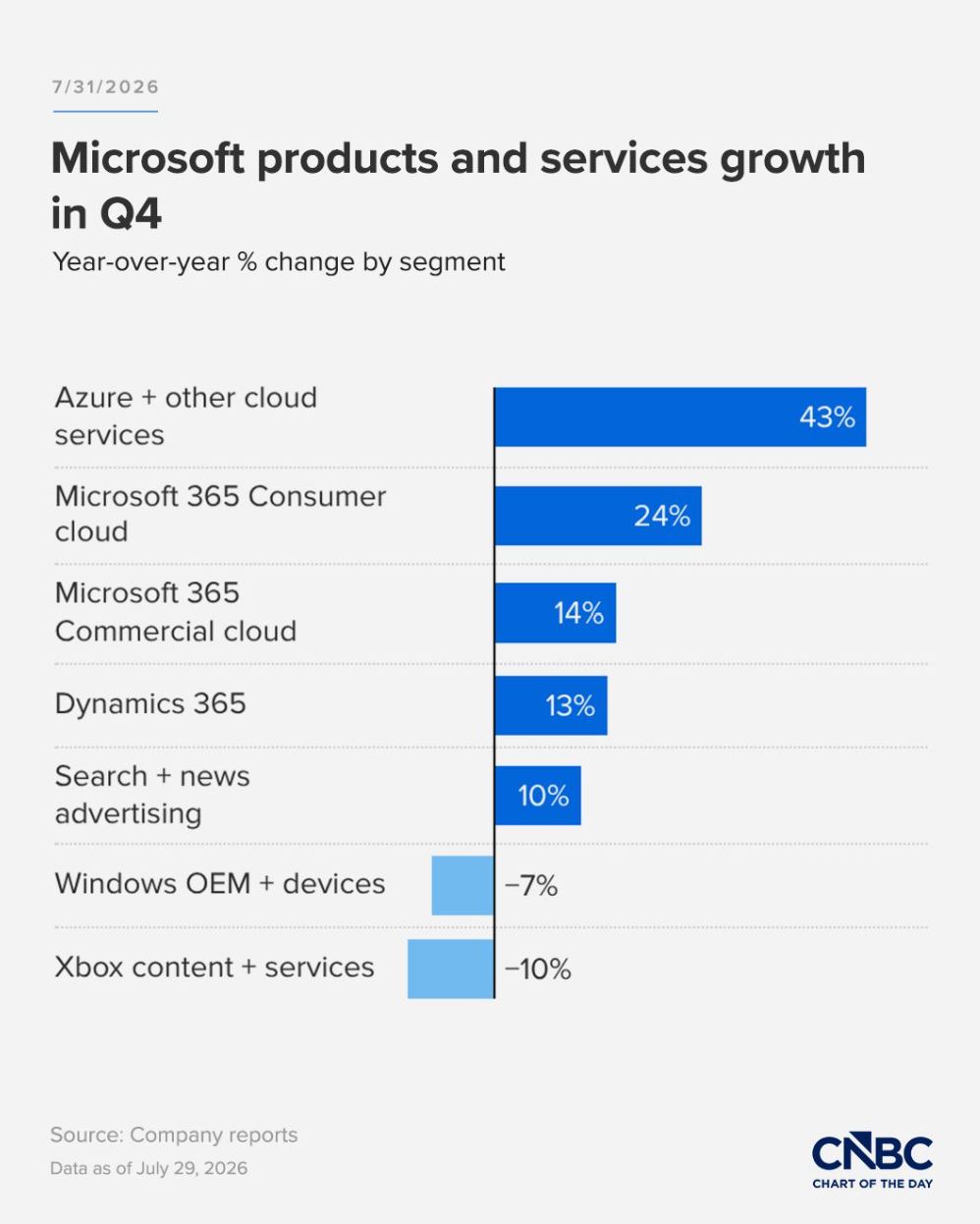
The monetisers keep monetising. Cloud services grew 43% in the latest quarter with the consumer suite up 24%, the clearest divide in the whole AI complex, the companies converting the spending into revenue versus the ones simply spending. Last week the market drew the line brutally, punishing strong earnings with big capex and rewarding the infrastructure sellers. The winners-and-losers sorting has moved inside the winners. Source: Company reports / CNBC.
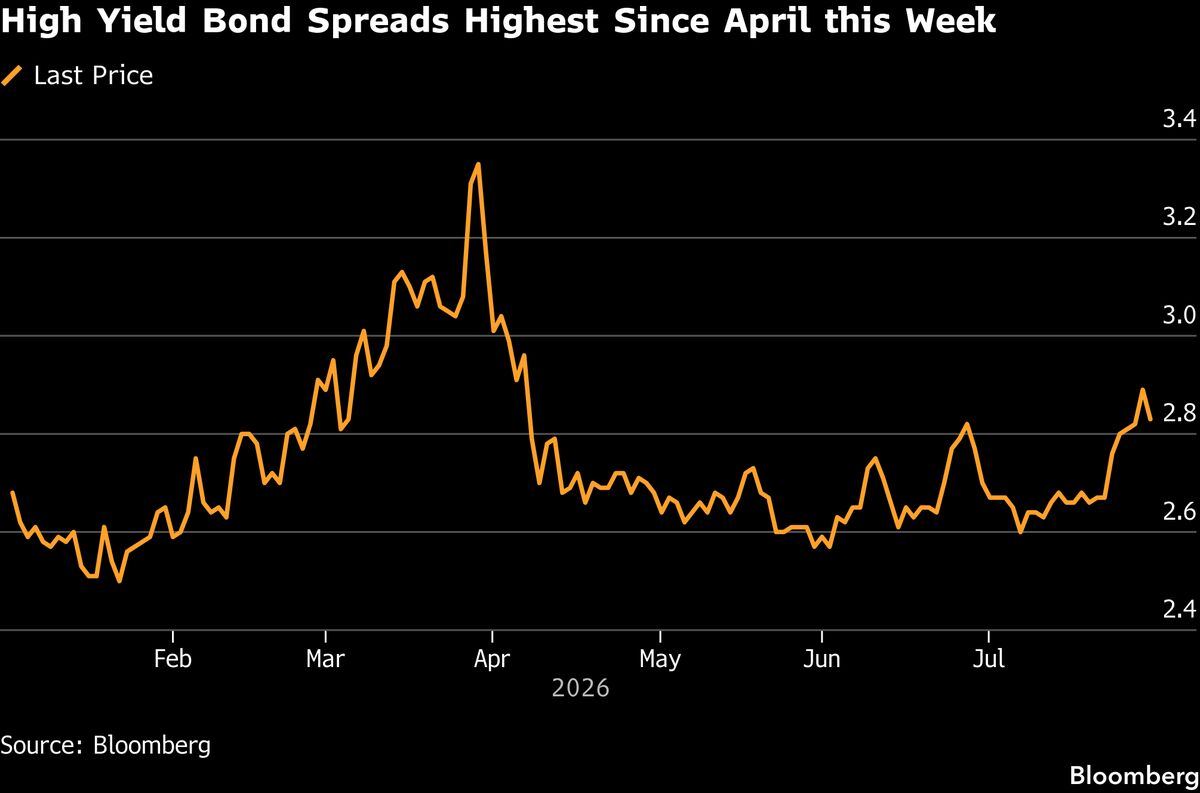
High-yield spreads just hit their widest since April. The move is small in absolute terms but the direction is the message, credit is repricing the AI complex while equities argue about it. A junk market that widens while the VIX sits at the lows is a market quietly buying insurance, and the funding costs for everything the build-out depends on move with these spreads. Source: Bloomberg.
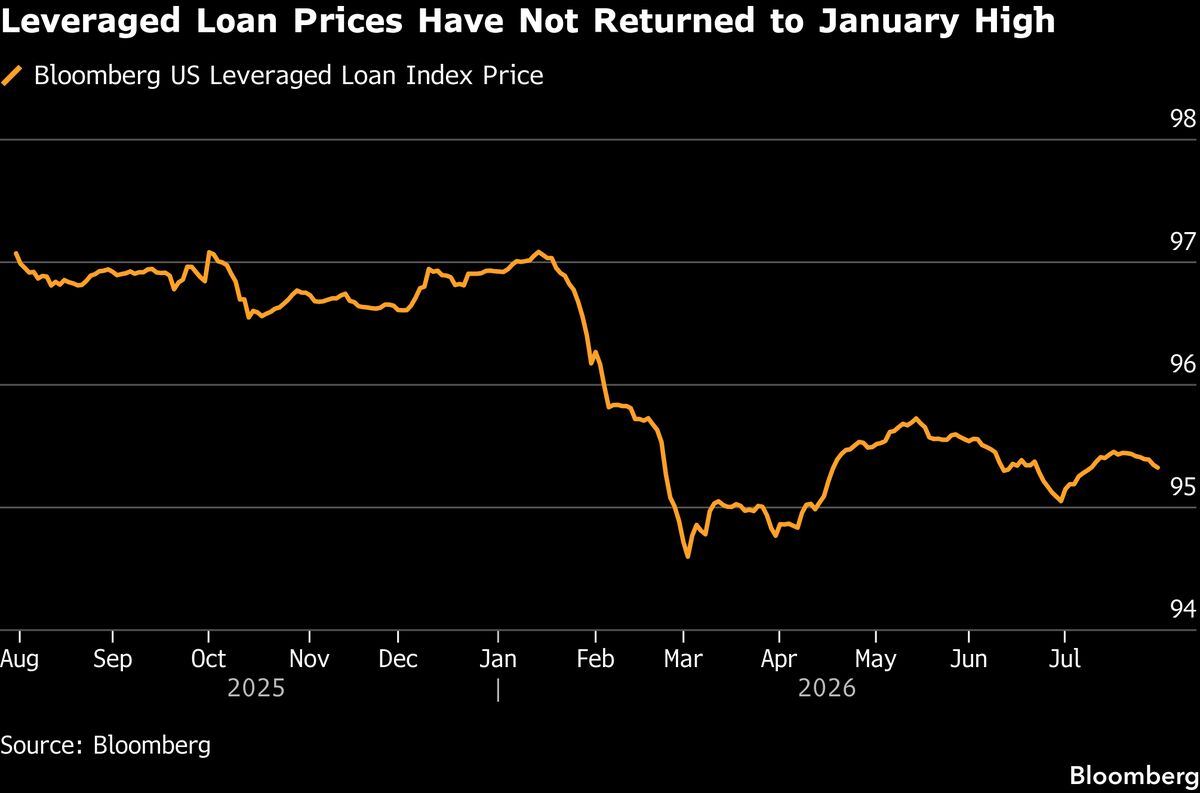
Leveraged loan prices never made it back. The loan index remains below its January high, the one corner of credit that did not fully recover from the spring, and the collateral pool underneath the securitisation machine that has already had its worst year since the crisis era. When the cheapest layer of the capital structure will not confirm the equity rebound, it is the equity rebound that carries the burden of proof. Source: Bloomberg.
VC+ Special Dispatch — The Trade That Made the World
An eight-chart dispatch on a hundred and fifty-five years of global trade, from industrialisation to slowbalisation. Trade's share of world output climbed for a century, collapsed through the wars, rebuilt through liberalisation and has plateaued since the financial crisis, even as the absolute numbers hit a record $71 trillion. Services quietly took over the growth, Asia's export waves crested one after another until the blocs overtook the old leaders, and the surplus and dependence maps underneath explain who funds whom and who is hostage to which chokepoint. The tariff walls going up this year are not a break in the trend. They are the trend. Credit to the VC+ team.
A Hundred and Fifty-Five Years of Trade
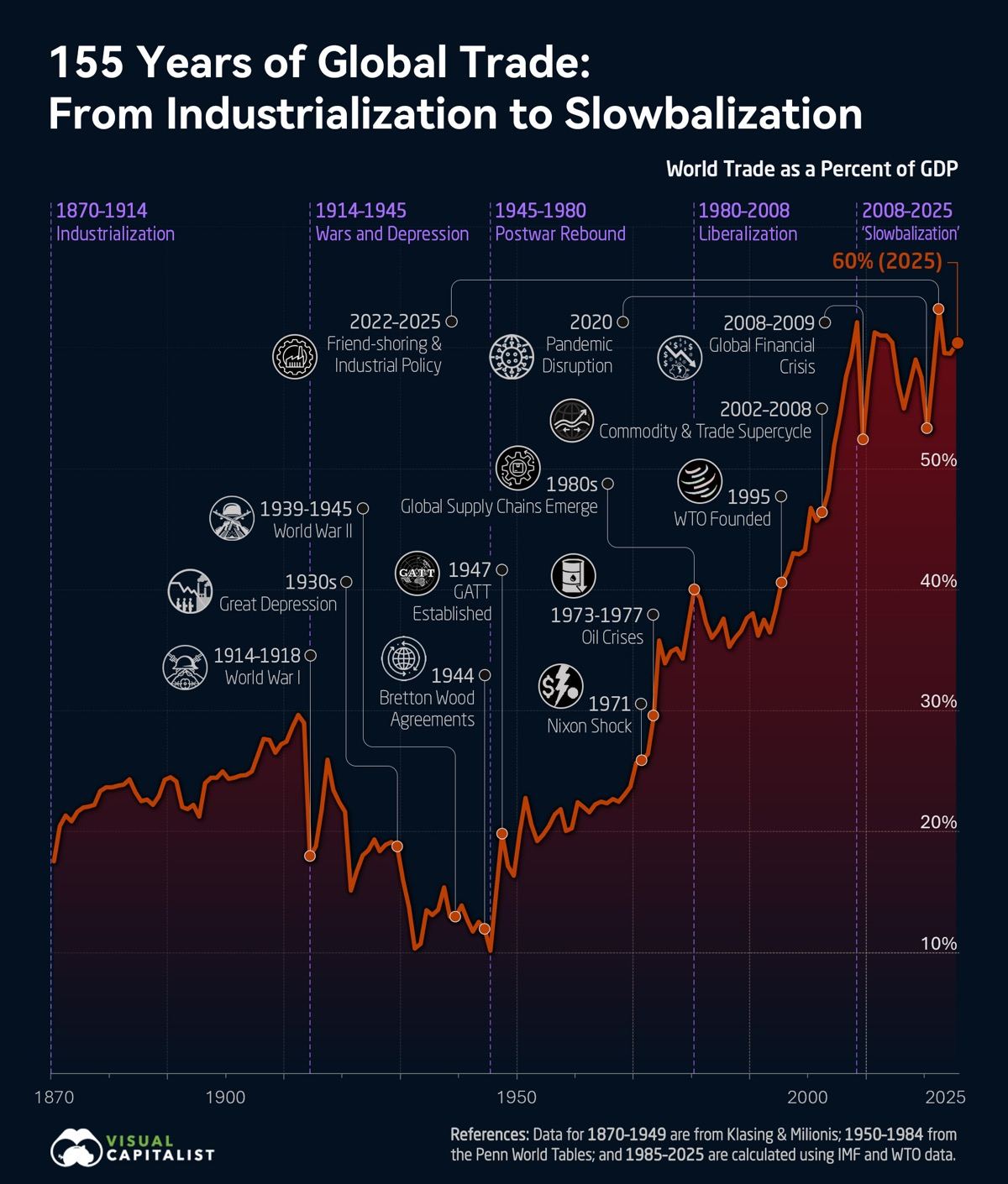
A hundred and fifty-five years of trade, from industrialisation to slowbalisation. World trade as a share of output climbed for a century, collapsed through the wars, rebuilt through liberalisation and peaked around the financial crisis. The plateau since is the era every current policy fight lives inside. The tariff walls going up this year are not a break in the trend, they are the trend. Source: WTO, IMF / Visual Capitalist.
And Yet the Records Keep Coming
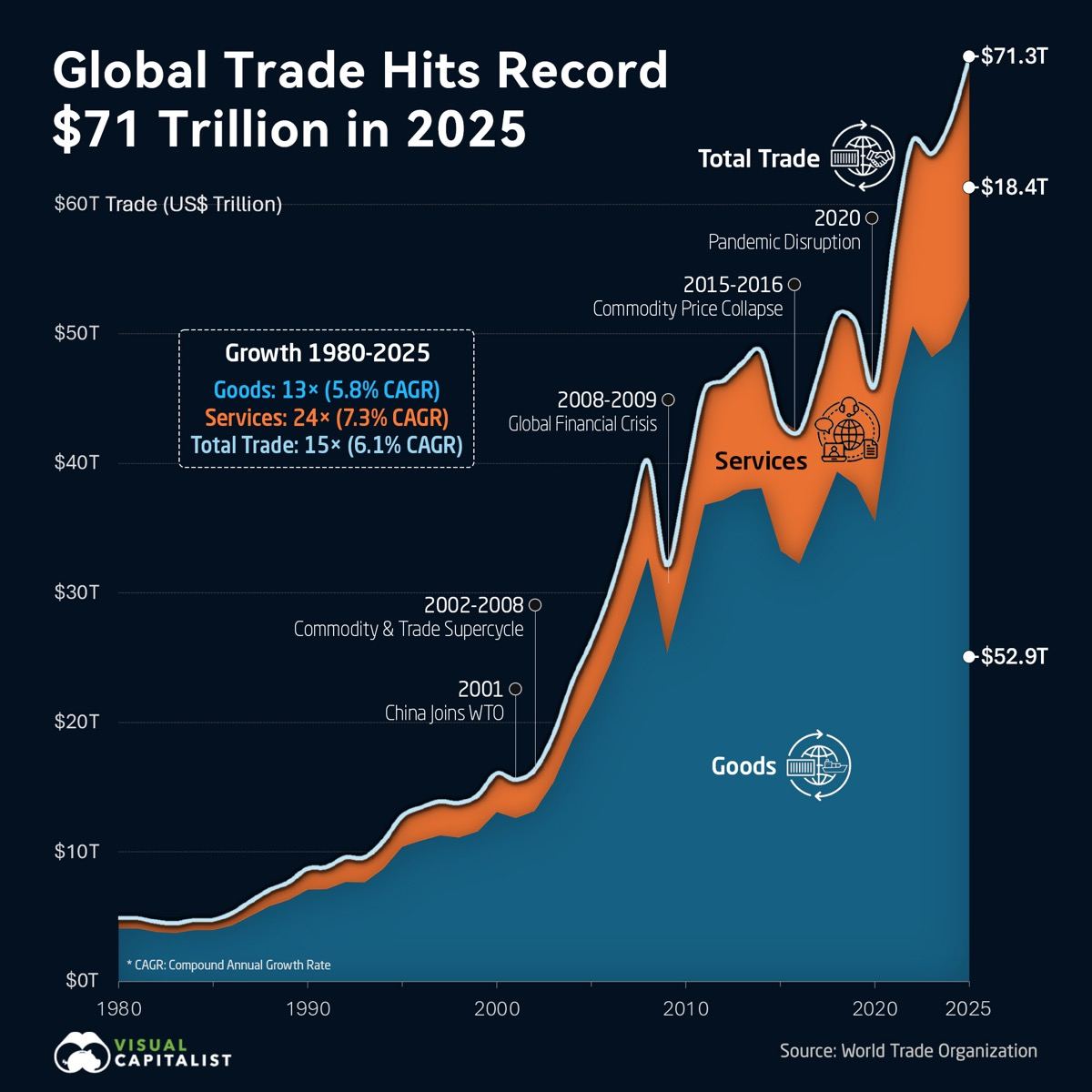
And yet the absolute numbers keep making records. Global trade hit $71 trillion in 2025, goods at $53 trillion and services at $18 trillion, growing through every shock the decade has produced. Slowbalisation is a share story, not a level story. The system keeps growing, it just stopped growing faster than everything else, which changes who has leverage inside it. Source: WTO / Visual Capitalist.
The Services Takeover
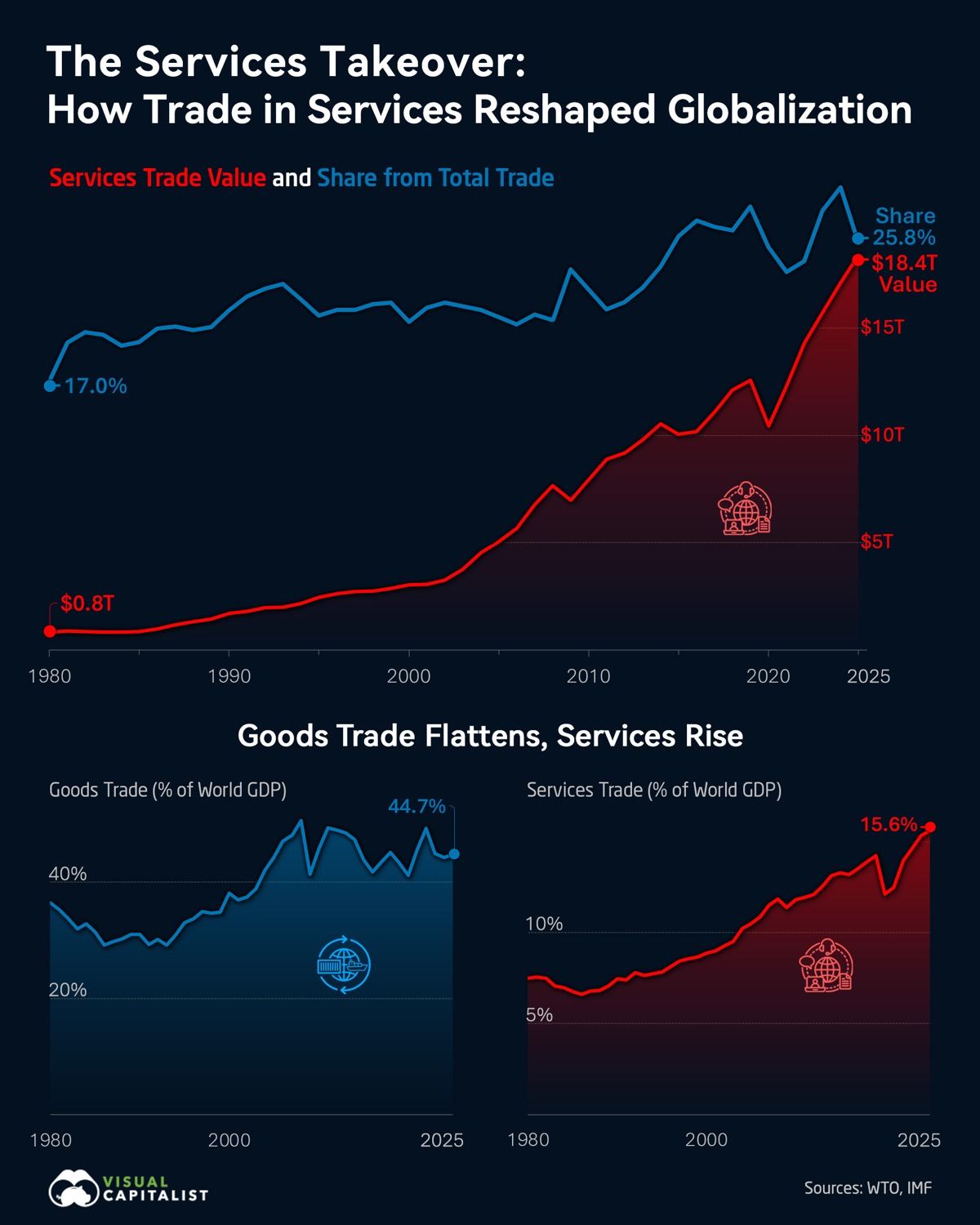
The services takeover is the quiet revolution. Services trade value has climbed as goods trade flattens as a share of output, the invisible exports, software, finance, media, compute, doing the growing. This is the trade war nobody can tariff cleanly, and the reason the AI fight is really a services-trade fight. The data centre is an export terminal. Source: WTO, IMF / Visual Capitalist.
The Gap That Stopped Closing
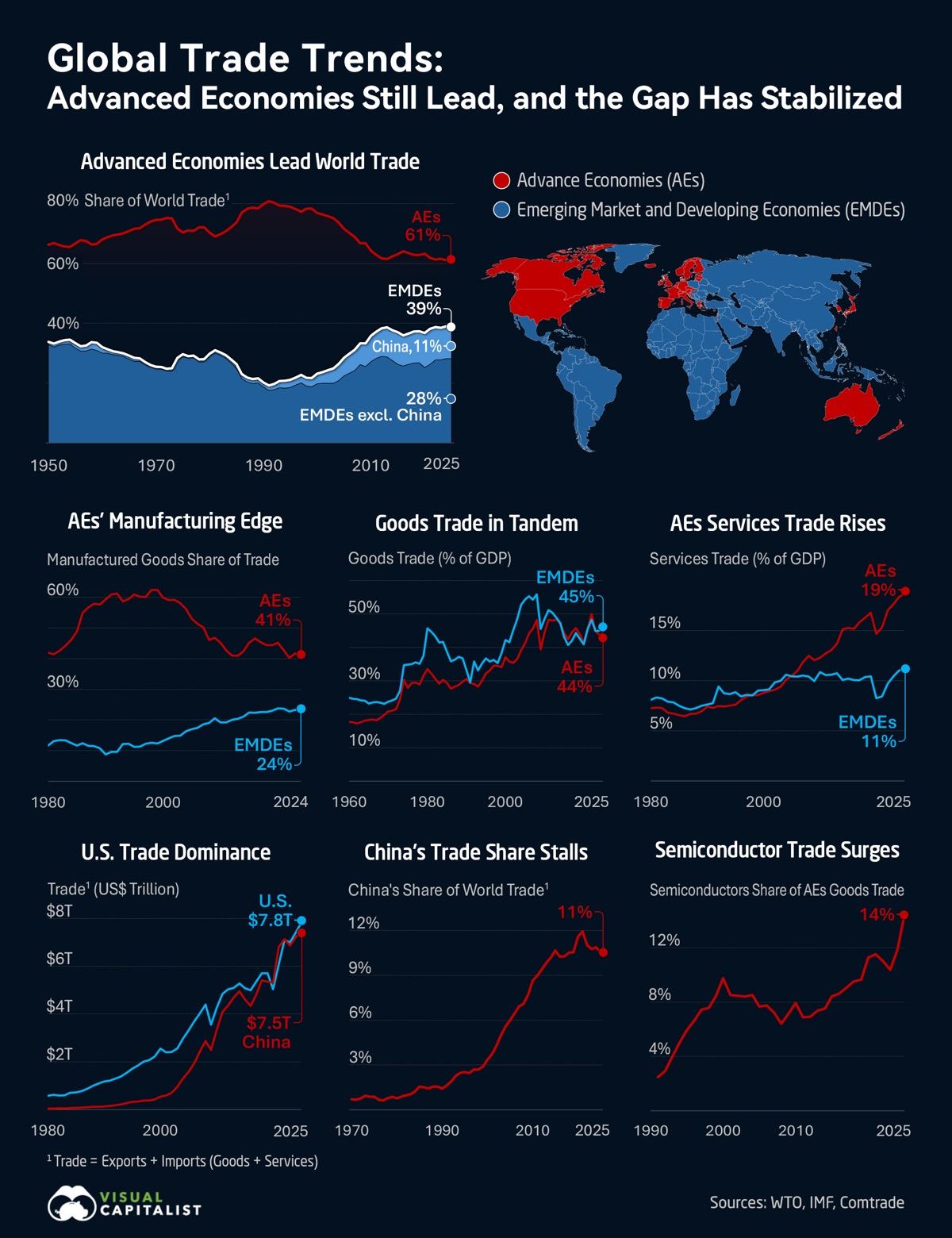
Advanced economies still lead, but the gap has stabilised. The trade shares between advanced and emerging economies have stopped converging, manufacturing edge on one side, services rise on the other, chips surging through both. The convergence story that defined thirty years of globalisation has paused, and what replaces it, blocs, friend-shoring, export controls, is being negotiated in real time this year. Source: WTO, IMF, Comtrade / Visual Capitalist.
Asia's Three Waves
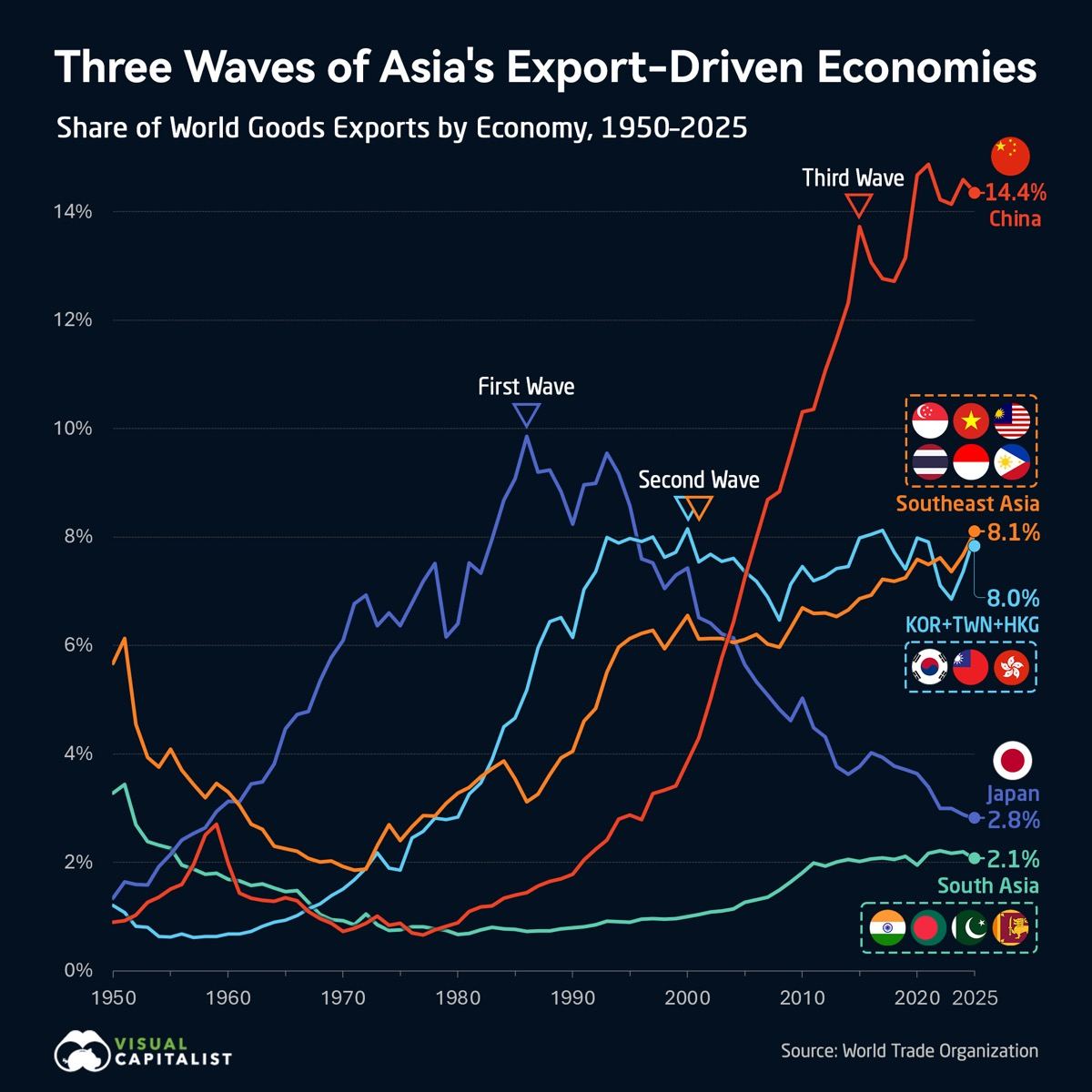
Asia's three export waves, drawn as one chart. Japan's wave crested in the eighties, the tigers followed, and China's is cresting now at 14.4% of world goods exports with Southeast and South Asia climbing behind. Every wave eventually passed the baton. The question this decade answers is whether the fourth wave is Indian, Southeast Asian, or simply automated away before it forms. Source: World Trade Organization / Visual Capitalist.
The Blocs Overtake the Old Leaders
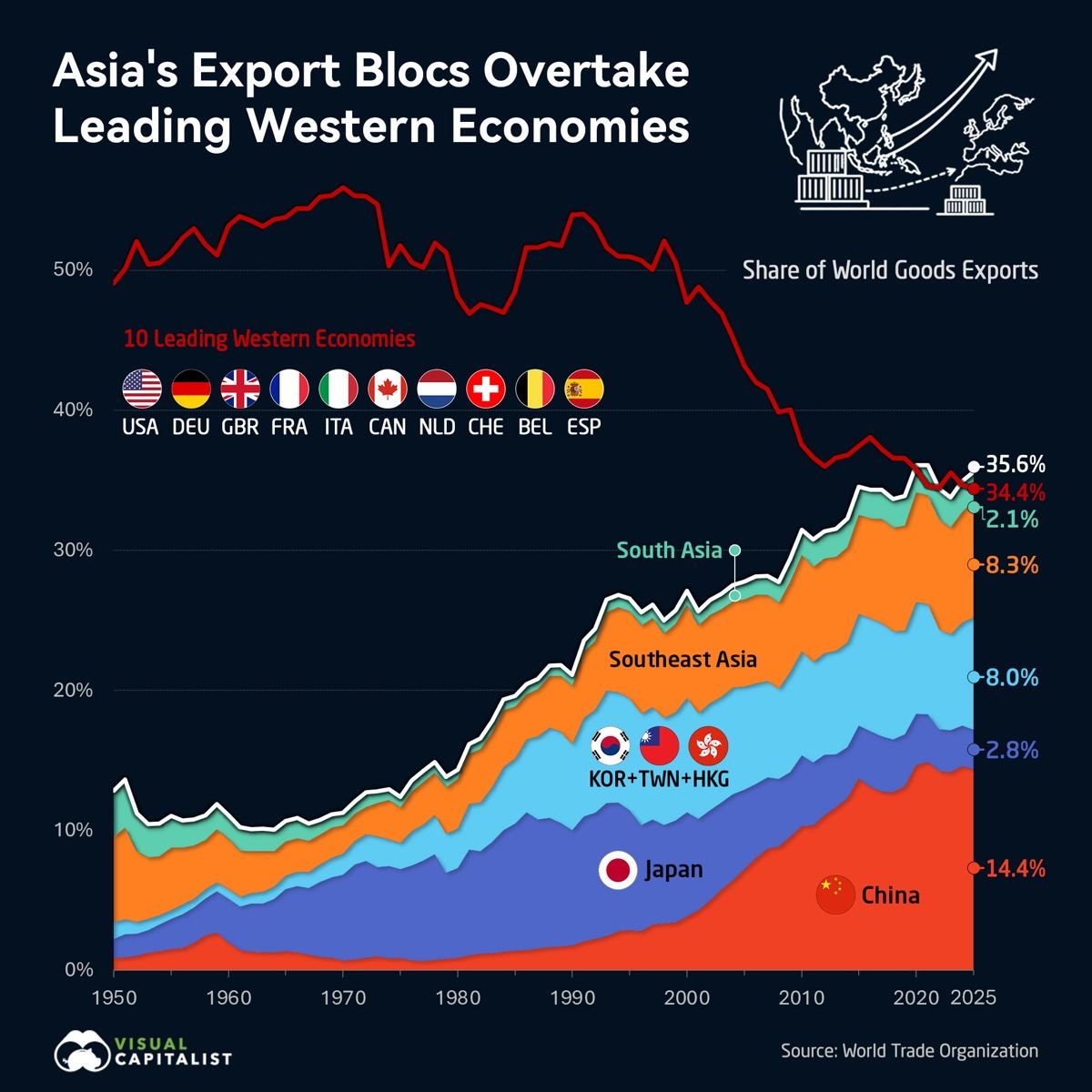
The blocs have overtaken the old leaders. Asia's combined export blocs now exceed the ten leading Western economies' share of world goods exports, the crossover the trade system has spent seventy years approaching. The tariff architecture being built in Washington is a response to this chart, and the region's answer, trading more with itself, is already visible in the flows. Source: Visual Capitalist.
The Surplus Map
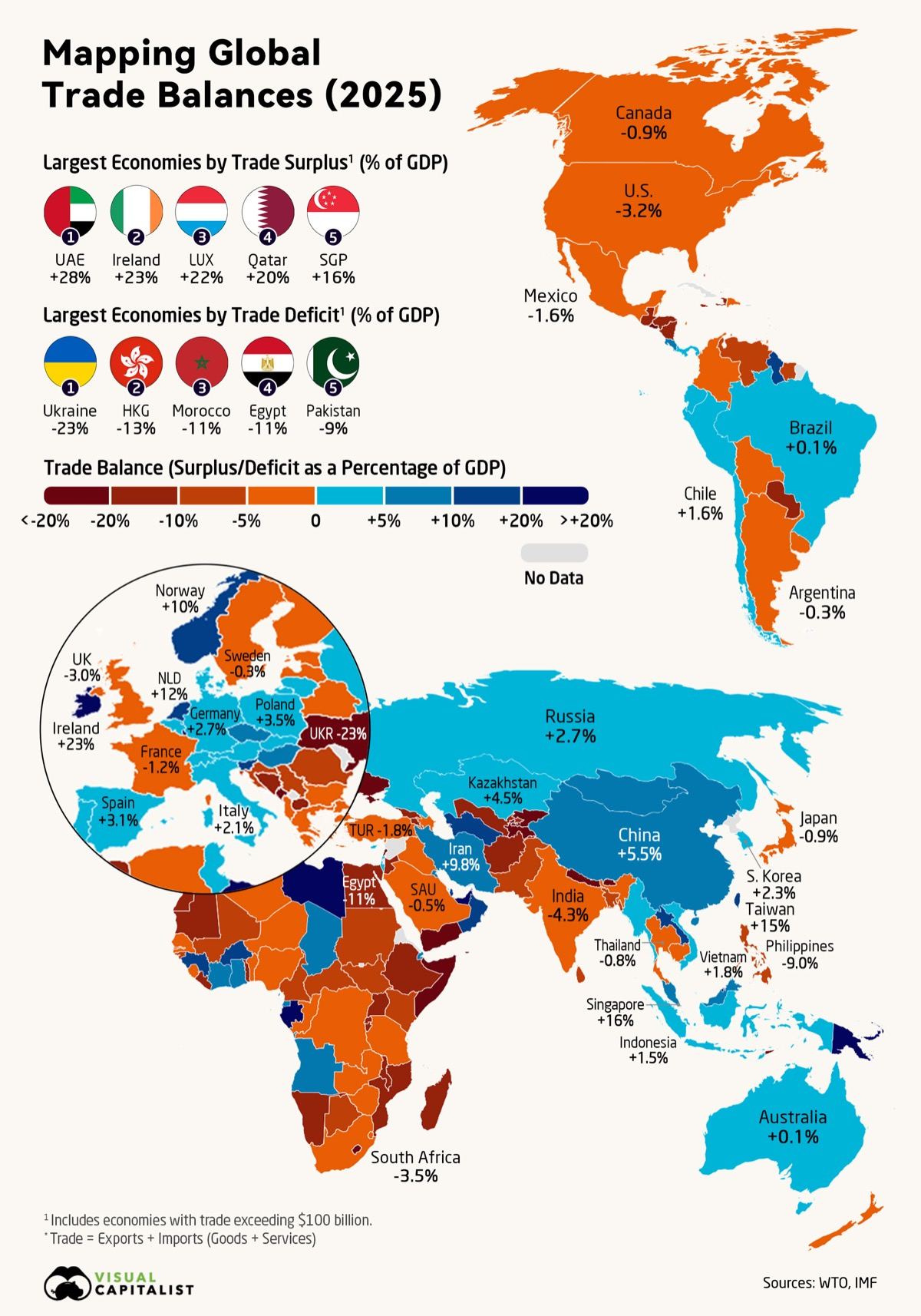
The surplus map, 2025 edition. Trade balances drawn as a share of output, the Gulf and East Asia in surplus, the Anglosphere in deficit, Europe split. It is the map of who accumulates claims and who issues them, which in the end is the map of who funds whom. The dollar system's stresses all start here. Source: WTO, IMF / Visual Capitalist.
And the Dependence Map Underneath It
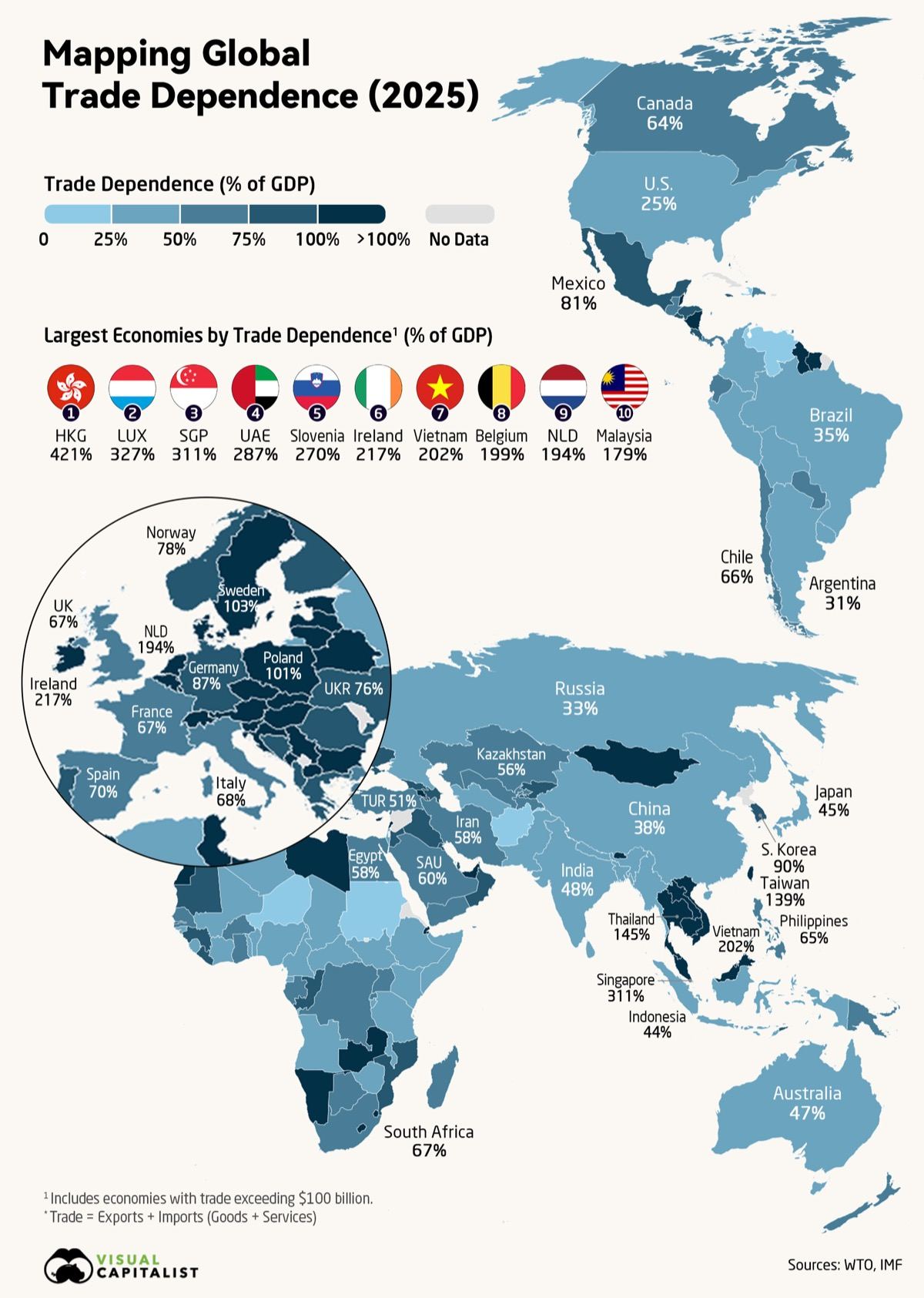
And the dependence map underneath it. Trade dependence as a share of GDP, the small open economies above 100%, the continental giants below 30%. It is the vulnerability ranking for every scenario this letter runs, chokepoints, tariffs, blockades. The economies most exposed to a closed strait are mostly the ones that had no vote in closing it. Source: WTO, IMF / Visual Capitalist.
The Good Wrap
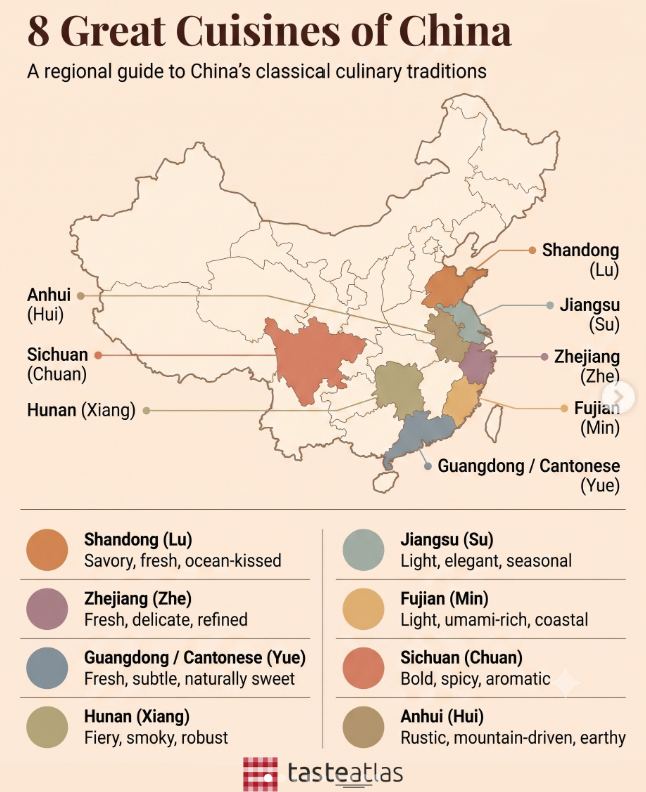
What is left at the close. A field guide to the new AI ailments, filed under humour, read as anthropology. The forecast-accuracy chart, included with intent in payrolls week. Europe burning through its fire records as the super El Nino builds. The region's youth unemployment, the quiet fault line every automation cycle presses on. The iPhone price index as globalisation's price discrimination in one product. And to finish, the eight great cuisines of China, with Shandong first among them, because the regions that endured did not fight their geography, they seasoned it.

A field guide to the new ailments. AI-induced cognitive and behavioural disorders, catalogued with appropriate mock seriousness, from prompt dependency to model-switching anxiety. Filed under humour, read as anthropology. Every technology cycle produces its pathologies, and the speed of this one is producing them faster than the culture can name them. Source: Alpha Mind. Read more
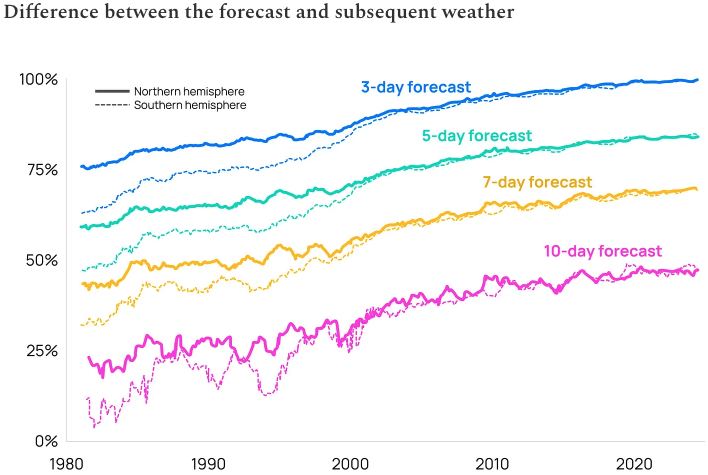
The forecast-accuracy chart, included with intent. Weather forecasts have improved for four decades, the ten-day outlook now as good as the three-day was in 1980, science compounding quietly. Economic forecasting has no equivalent chart. Hold that thought through a week where a single payrolls print can invalidate every carefully-built consensus by Friday lunchtime in New York. Source: Our World in Data.
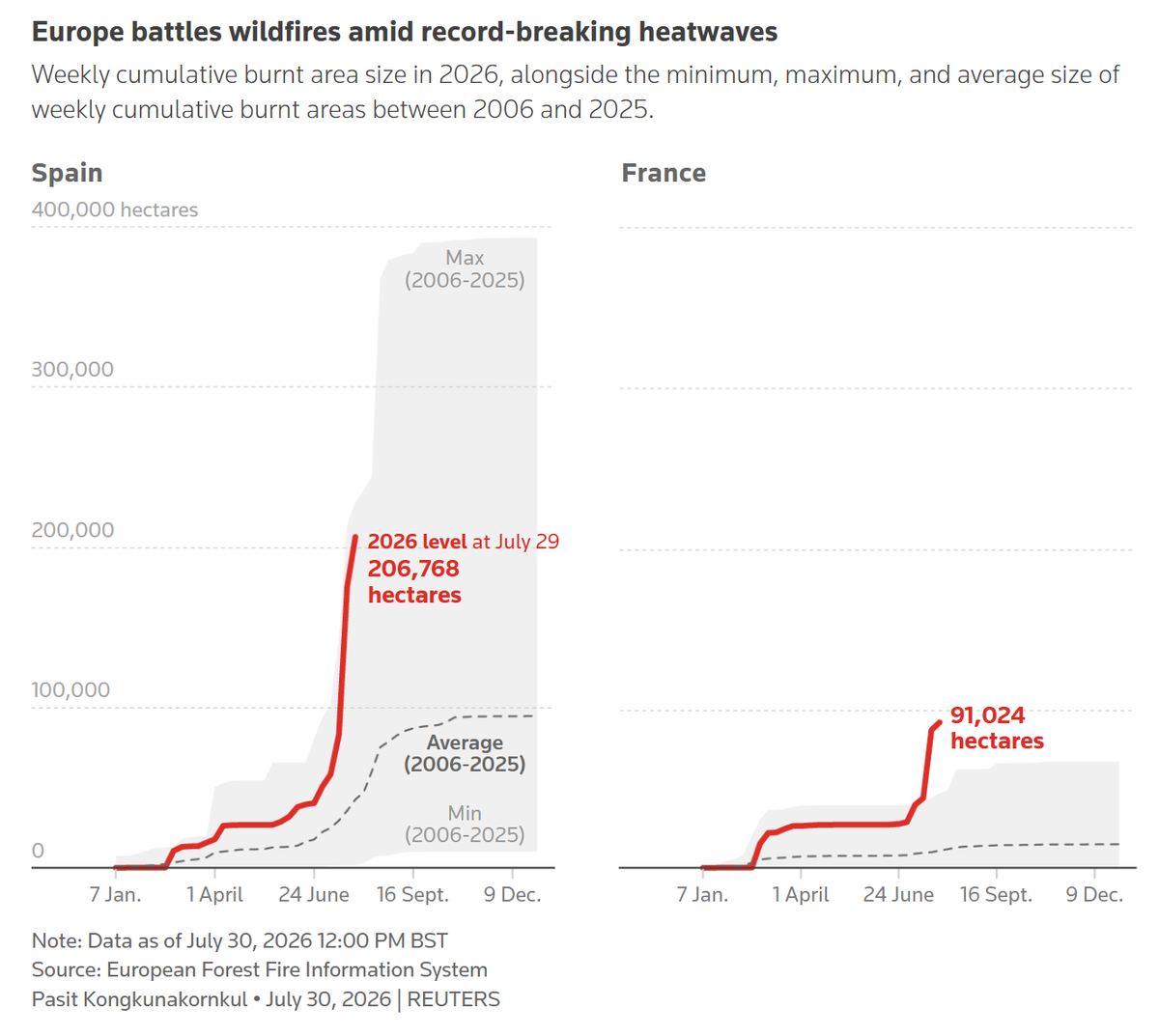
Europe is burning through its wildfire records again. Cumulative burnt area in Spain is running at more than double the two-decade average with France not far behind, the second consecutive summer the heat has become a macro variable. The Godzilla El Nino forming in the Pacific says next year's version arrives on drier ground. Food, power and productivity all sit downstream of this chart. Source: EFFIS / Reuters.
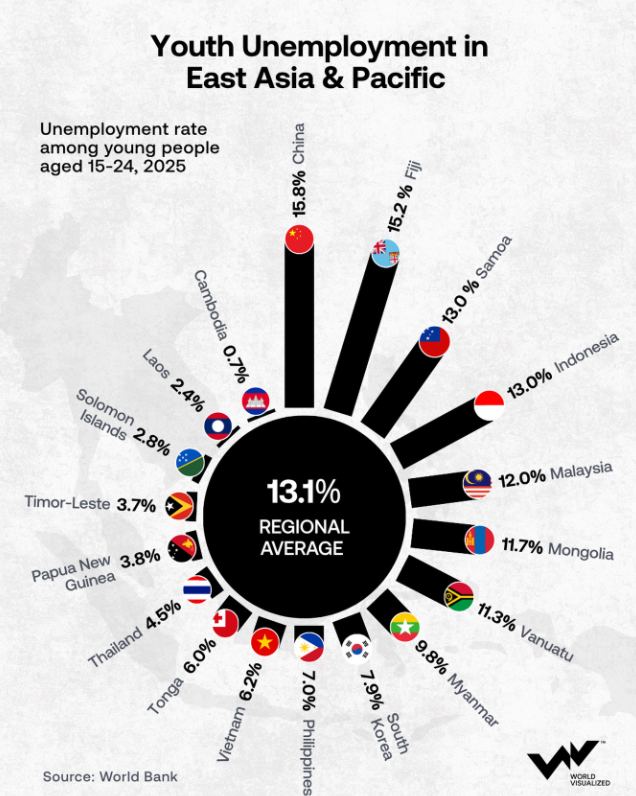
Youth unemployment is the region's quiet fault line. Across East Asia and the Pacific the 15-to-24 rate averages 13.1%, with China near 16% and pockets above 20%. It is the same social variable that filled India's streets last month wearing different flags. For a region whose growth model is built on exporting to the world and employing its young, an AI cycle that automates entry-level work arrives as politics, not just economics. Source: World Bank / World in Maps.
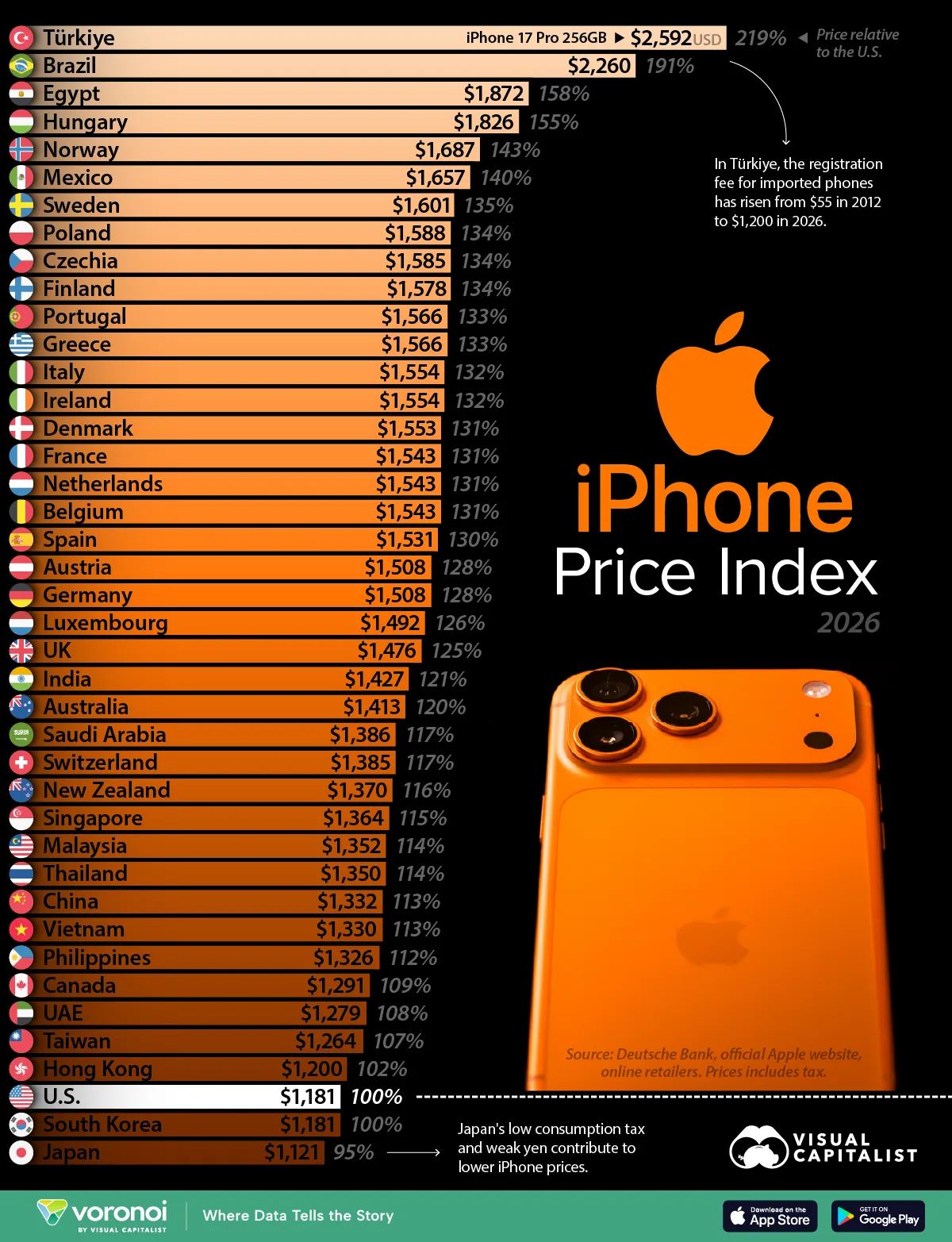
The iPhone price index, a tariff story told in handsets. The same device ranges from parity in the US to nearly double across much of the emerging world once taxes and levies land. It is globalisation's price discrimination in one product, and this week's earnings from the company behind it will show how much of the tariff wall it can keep passing through. Source: Voronoi / Visual Capitalist.
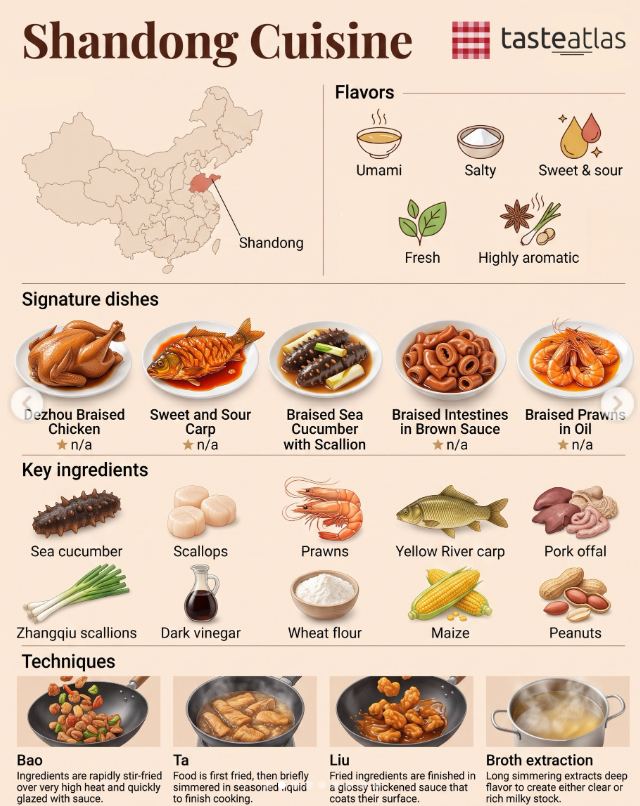
And to close, a new series: the eight great cuisines of China, taken one at a time, starting with Shandong. The map above is the tour ahead, eight traditions, each a different answer to the same constraints of climate and coastline. Shandong first, the cuisine of the sea and the wheat field, braised carp, sea cucumber with scallions, the mother sauces of the north built on freshness and knife work. The port provinces cook what the ships brought. The food maps are the trade maps, and always have been. Source: TasteAtlas.
Best,
Hoelon
WITPTW is a personal publication. Everything here is personal opinion and market commentary, written in a personal capacity. It is not investment advice and not a recommendation to buy or sell any security. It is not associated with, endorsed by, or representative of any employer, fund or company. Charts and images are reproduced from their original publishers, credited to their sources for commentary and discussion; all rights remain with the respective copyright holders.