Size for Wednesday
Personal views and market commentary. Not investment advice. Not associated with any employer or firm.
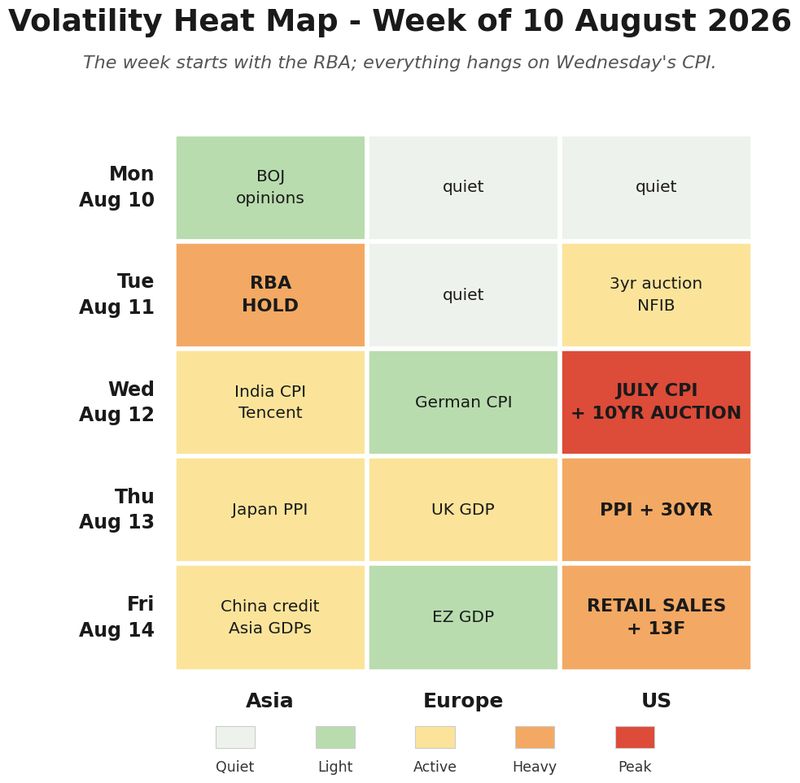
Volatility heat map for the week ahead, sessions as we trade them from here. The week starts with the RBA on Tuesday and our National Day replacement holiday on Monday, then narrows to a single fulcrum: July CPI on Wednesday night our time, the only event of its weight between here and the September FOMC, with a $42 billion 10-year auction pricing hours after the number. PPI and a $25 billion 30-year Thursday, UK GDP for Britain's new prime minister, retail sales and the 13F unveiling Friday, and Tokyo quietly testing its own bond market with a linker auction Wednesday and super-long supply Friday. The S&P sits at a record 7,757 and the VIX at 14.90. Priced for perfection, into the one print that can end the argument or restart it.
"I'm his lawyer." — Todd Blanche, asked at his Senate confirmation hearing about his relationship with the President. He caught himself a beat later: was his lawyer. This week the President's former personal criminal defence attorney was confirmed as Attorney General of the United States, 50-49. Susan Collins and Lisa Murkowski joined every Democrat in opposition after a weeks-long standoff over the Epstein files and the $1.8 billion anti-weaponization fund. The narrowest of margins for the office, and the discomfort was not partisan. The Attorney General is meant to be the lawyer of the American people, not the personal protector of the President. Institutions rarely lose their independence overnight. They erode one precedent, one exception and one appointment at a time, and injustice tolerated anywhere becomes a threat to justice everywhere. The damage outlasts the person who caused it.
"The power of our many is greater than the power of their money." — Abdul El-Sayed, on winning Michigan's Democratic Senate primary despite being outspent eleven to one. A 41-year-old Medicare-for-All progressive absorbed roughly $70 million of establishment money and won the state that may decide control of the Senate. His diagnosis of why should worry both parties: voters were not paying attention to the election, they were paying attention to the price of gas, groceries, housing and health care. New York in June, Michigan in August. Affordability anger is now the strongest force in American politics, and it does not care how much the other side spends.
"As long as they keep spending, the economy should avoid recession, but if they turn more cautious, for whatever reason, the economy has a big problem." — Mark Zandi, Moody's chief economist, on an economy tethered to its wealthiest households. He said it after last July's jobs dip. This July's was worse. Payrolls fell 23,000, the first negative print of the cycle, with 103,000 in downward revisions behind it. Food inflation is near 3 percent and beef is still climbing. The bottom 80 percent of households have merely kept pace with inflation since the pandemic; the growth belongs to the top. Job losses land first on the people food inflation taxes hardest. That squeeze already found its politics. It found Michigan on Tuesday.
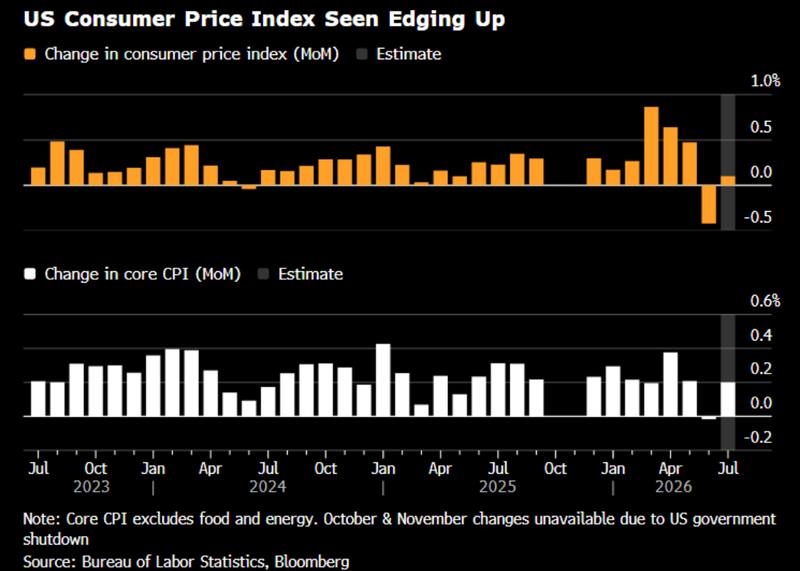
The chart of the week. The gray bars are the estimate: headline CPI edging back to +0.1% after June printed the first negative headline in six years, core to +0.2%. The consensus path takes core to 2.5% year on year, the house view says 2.4%, the lowest since March 2021, which would quietly bury the favourite hawkish talking point that inflation has been above target for five years and demands action. Three dissenters voted to hike into this chart. One camp does not survive Wednesday morning, and the market at record highs has already decided which one it expects to win. That is the vulnerability, not the forecast. Source: BLS / Bloomberg.
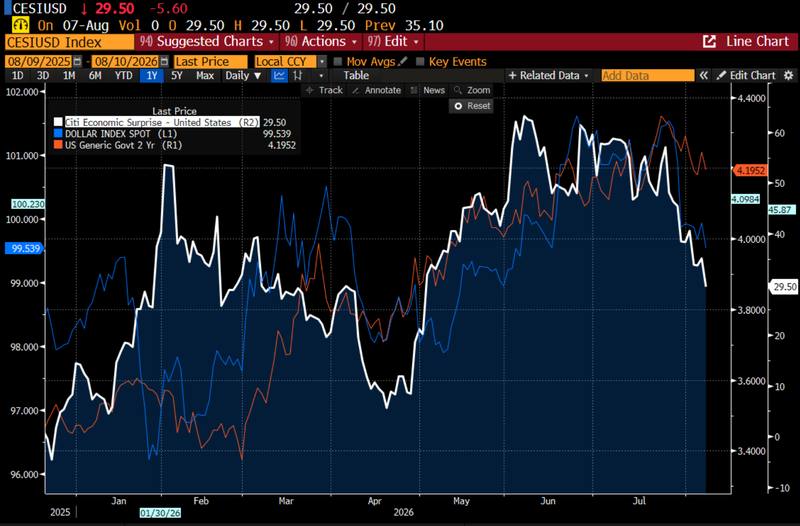
The white line is the tell. US economic surprises rolled over hard into the payrolls miss, from 35.1 to 29.5 in a session, and the dollar and the two-year followed it down the stairs. The Dollar Index closed at 99.54, below 100 with a double top behind it, both peaks printed in the dying days of June and July, and the 200-day average waiting just below at 99.20, a level it has not closed under since mid-May. Data momentum has turned before positioning has. If the surprise index keeps bleeding through CPI week, the double top projects toward 98.80 and the dollar's structural story gets tested rather than debated. Source: Bloomberg.
What is the plan this week?
We will spend the coming week deliberating whether the weak US labour data has taken the rate hikes off the table for the year. The July report was a strange one, negative payrolls with negative revisions, softer earnings, and yet lower unemployment because the labour force shrank again. September hike odds collapsed from 72% to about 44% within the hour, the dollar closed the week softer, and equities barely blinked, the S&P up 3.6% to a record and the Nasdaq up 5.2%. Positions feel small after a zig-zag summer, volatility sits at the lows, and nobody says stagflation while the tape is at highs. There were plenty of calls this week that AI has bottomed, and that gold and silver have bottomed alongside a peaking dollar. In our internal poll on the AI trough I was the only dissent, which I note without comfort.
We start the week with the RBA policy meeting, beside our National Day replacement holiday. The hold at 4.35% is not in question, the tone is, and a hawkish statement into a softening dollar makes the Aussie the cleanest expression in the region. China opened even earlier, July prices landing Sunday morning with factory-gate inflation expected to moderate for the first time since the war lifted it out of deflation, and credit later in the window with growth in the stock slipping to a fresh low. The yuan does not care, 6.74 and the strongest since February 2023, fixes falling, the undervaluation argument getting louder. India's CPI eases toward 4.3% as the monsoon deficit narrows, Korea's unemployment ticks up Wednesday, Singapore reports GDP Tuesday, and Malaysia's GDP and Prabowo's address close the week Friday.
The US inflation data is the justification test for the ten basis points of hike still priced for September. CPI Wednesday, consensus 0.1% on the month and 3.4% on the year, core at 2.5% with the house views nearer 2.4%, the lowest since March 2021. PPI Thursday still runs near 5% upstream, and Friday's retail sales carry the widest gap of the week, consensus at +0.1% while credible desks see -0.5%. Threaded through it is the supply: $58 billion of 3-years Tuesday, $42 billion of 10-years Wednesday pricing hours after CPI, $25 billion of 30-years Thursday, the front edge of a $739 billion borrowing quarter that came in $68 billion larger than the May estimate. A soft CPI followed by a sloppy 10-year auction would be the most honest test of the year, does the bond market want disinflation, or does it simply want to be paid more for the paper.
Japan runs the mirror experiment the same week. The Ministry of Finance sells 10-year linkers Wednesday into a producer price series expected at 7.5% Thursday night, then tests the super-long end Friday with the liquidity enhancement auction in 11-to-39-year paper. The intervention range has settled at 155/159, swaps price September hike odds near 65% from 23% before the joint operation, and Monday's Summary of Opinions tells us how close the Bank already was. If the linker sells well and PPI shocks higher, September becomes the base case and the yen story stops being about the Ministry and starts being about the Bank. The Treasury and JGB auctions are the same question asked in two currencies, how much duration does the world want at these levels of fiscal ambition.
Europe is a Thursday story. Britain's new prime minister gets his first GDP print and the arithmetic will flatter him, Q1 momentum, World Cup spending and hot weather carrying the quarter to 0.3-0.4% while the underlying pulse fades. Sterling posted a bullish outside day into the weekend. The euro took out two downtrend lines and closed near $1.1550 with everything clustered at $1.1625, the 200-day, the mid-June high and the year's halfway mark, and the swaps market prices an 83% chance of a September ECB hike. Russia's 6.3% CPI on Wednesday is the reminder of what the war still costs.
The war enters its 24th week with its strangest deal yet on the table, an Iran-Oman arrangement Washington has not signed, US and Israeli flags excluded, the Iranian parliament reviewing terms while five million barrels a day flow dark and Aramco counts 18 months to refill the stocks. And the domestic institutions are being tested as hard as the foreign ones, a White House moving on a Fed governor despite the Supreme Court, an Attorney General confirmed by one vote. The plan this week. Stay short the dollar but do not chase it in this volatility. The DXY 200-day test after a double top makes the AUD the choice buy into a hawkish hold, AUDNZD holds its 1.20 pivot and the carry trade is back on, with Asia longs better expressed in crosses, the yuan and the Aussie against the won, than against a dollar this stretched. If CPI is hot, all of the above is wrong within an hour. Size for Wednesday, not for the week.
What did I learn last week?
Mon Aug 3: Trump cancelled a planned strike on Iran "subject to a rapid deal", phase one of talks aimed at reopening Hormuz. ISM manufacturing smashed at 55.6 versus 53.9 expected. The Treasury will borrow $739 billion this quarter, $68 billion more than May's estimate. Palantir blew out and raised.
Tue Aug 4: El-Sayed won Michigan's Senate primary against $70 million of outside money. JOLTS eased to 7.36 million. Axios reported a US-Iran-Oman interim deal near. Aramco's CEO: 100 million barrels lost weekly, 18 months to refill stocks. AMD beat, Toyota announced a 1 trillion yen buyback, SpaceX beat.
Wed Aug 5: Iran and Oman agreed the geographic terms of the strait routes. The refunding set $58, $42 and $25 billion of 3s, 10s and 30s. Brazil cut 25 basis points to 14%. Lilly and Novo beat and raised on weight-loss momentum. DeepSeek said it will raise API prices, a quiet bullish tell for the AI complex.
Thu Aug 6: The SpaceX lockup freed 912 million shares, 1.6 times the float, and the stock bottomed at 9:30:00 on the open, textbook. Claims stayed low at 199k, productivity beat with unit labour costs just 1.3%. BofA card data showed the K still closed, spending growth equal across income cohorts ex-gas.
Fri Aug 7: Payrolls -23k versus +80k expected, first negative since February, with -103k revisions; unemployment fell to 4.1% on collapsing participation. September hike odds fell to about 44% from 72% and the DXY hit a two-month low. Blanche was confirmed 50-49 overnight. The White House moved to fire Governor Cook despite the Supreme Court ruling.
All week: S&P +3.6%, Dow +3.0%, Nasdaq +5.2%, a rebound week that repriced the Fed without repricing risk. The curve bull-flattened, crude drifted lower on deal hopes, gold broke its triangle to a two-month high near $4,341. Pharma owned earnings on weight-loss drugs. Korea's volatility ebbed as the leveraged ETFs were flushed, though foreigners kept selling.
What to look out for next week?
Sun Aug 9: China CPI and PPI, the first factory-gate moderation since March expected at 4.0% from 4.1%, consumer prices near 0.9%. The print sets Monday's Asia tone. KeyBanc's tech forum runs through Tuesday.
Mon Aug 10: Singapore takes the National Day replacement holiday, thin regional liquidity. Japan's June current account, seasonal deterioration expected at 1,577 billion yen, and the BOJ's Summary of Opinions from the July 30-31 meeting, the first read on how close the September hike already is. Colombia CPI. Ayala Land opens a quiet earnings Monday.
Tue Aug 11: RBA holds at 4.35%; expect a hawkish statement and Bullock's press conference to lean against easing bets, with futures near 60% for one more hike this year. The $58 billion 3-year auction opens the UST supply run. NFIB (97.7 consensus), existing home sales (4.05 million, a second monthly fall), Brazil CPI and BCB minutes, Singapore GDP, Malaysia industrial production. CBA and Foxconn Industrial report. South Carolina holds the special primary for the late Senator Graham's seat.
Wed Aug 12: The fulcrum. US July CPI at 20:30 our time, consensus +0.1% headline and 3.4% year on year, core +0.2% and 2.5%; the house view has core at 2.4%, the lowest since March 2021. Hours later the $42 billion 10-year auction tests whether duration buyers agree with the disinflation story. Japan sells 10-year linkers into 7%-plus PPI. Germany, India (4.3% expected) and Russia (6.3%) all print CPI, Korea unemployment ticks to 2.8%, Tencent reports with its capex under the microscope, and the IEA and OPEC monthly reports land. A total solar eclipse crosses Iceland and Spain, in case the week needed an omen.
Thu Aug 13: US PPI (+0.2% headline to 4.9%, core +0.3% to 4.2%), the immediate cross-check on Wednesday, with the portfolio-fees component feeding straight into PCE. Claims expected near 200k, a fourth straight sub-200k week. The $25 billion 30-year bond auction closes the UST run. UK Q2 GDP, 0.3-0.4% expected on Q1 momentum and World Cup arithmetic. Japan PPI expected at 7.5%, the number that could lock September. Norges Bank and Peru hold, Argentina CPI near 33.5%, New Zealand inflation expectations should ease. Fed's Barkin and Hammack speak, the unscheduled intraday risk. Lenovo reports; Zambia votes.
Fri Aug 14: US retail sales, the widest consensus gap of the week, +0.1% expected against credible calls of -0.5%. University of Michigan preliminary August sentiment, watch the 5-10 year inflation expectations at 3.3%, anything toward 3.5% is a policy alarm. Business inventories and the July budget deficit. The 13F deadline shows every crowded AI book into a thin summer tape. Japan's MOF runs the liquidity enhancement auction in 11-39 year JGBs, the super-long test. Eurozone Q2 GDP revision and June trade, Hong Kong, Taiwan and Malaysia GDP, India WPI. Bullock testifies in Canberra, Prabowo addresses parliament. UK and Austria ratings reviews. China's July credit lands by Saturday, 810 billion yuan of new TSF expected.
Beyond next week
Aug 18 / Aug 20: Japan's 5-year and 20-year JGB auctions, the fuller test of the curve the BOJ may hike into.
Aug 19: The threatened 50% tariffs on $20 billion of Canadian goods take effect unless negotiated away; talks on partial relief reportedly progressing.
Late Aug: Jackson Hole, the chair's first, where fewer-meetings talk and reaction-function talk become policy talk.
Sep 10 / 16 / 17: ECB (83% priced for a hike), FOMC, BOE, then the BOJ decision the intervention is clearing the runway for.
Sept: Xi's reported US trip. The Iranian parliament's Hormuz review has no fixed date; it is the binary that overrides everything else.
Nov: US midterms, now less than five months out, the clock every policy and every war runs against.
Regimes
The September coin flip. The seasonal shocker fired, and the argument reset. Last week this regime said one print flips the conversation, and it did: -23k with -103k of revisions took hike odds from 72% to 44% in an hour. But three dissenters have not gone anywhere, the chair has abandoned forward guidance, and CPI now decides which camp walks into Jackson Hole with the floor. Hold front-end optionality through Wednesday, it is still cheap both ways, and treat PPI Thursday as the confirmation print, not a separate event. changed
The yen intervention is policy, week two. The range is the message. 155/159 has held through a payrolls shock and a week of jawboning. The Bank of Japan's September odds sit near 65%, wages support it, Monday's Summary of Opinions and Thursday's 7.5% PPI can lock it. The euros-not-dollars composition of the US side still bothers the market, and credibility questions linger over the notepad diplomacy. Sell dollar-yen rallies toward the top of the range, respect that 155 is where orderly stops being the word. held, week 2
The AI fracture, week five. Credit is now the main character. Alphabet sold $25 billion of AI bonds into one of the year's biggest order books, SoftBank margin-loaned $10 billion against its OpenAI stake, a second $36 billion private package is being shopped for Anthropic's compute, and $600 billion of chip financing is projected for two labs alone. Meanwhile banks are refinancing private credit three deals to one and BDCs bleed. DeepSeek raising prices is the quiet bullish tell for the monetisers. The equity story and the credit story still cannot both be right. held, week 5
Fade the intervention rallies in Asia FX, week 10. The fade retires into crosses. Ten weeks this regime said official strength is not durable strength, and for ten weeks the won's intervention pops faded on schedule, foreigners still selling $6.2 billion in July and $4.3 billion already in August. What changed is the other leg: the dollar itself has turned, double top in place, 200-day just below, the funding-currency role migrating from yen to dollar. Fading the won against a falling dollar is fighting two trends to win one. Tempted as I am to keep the outright fade, the honest expression now is the cross, long yuan and Aussie against the won and Taiwan dollar, keeping the ten-week view alive as a leg rather than a trade. changed, week 10
Inflation pressure carried, but the sources are rotating. The oil leg keeps cooling as deal hopes build, and China is exporting disinflation again. What remains is upstream and eastern: Japan PPI at 7% plus, US PPI near 5%, Russia at 6.3%, El Nino building into the northern winter's food prices. Headline convergence with sticky pipelines is the confusing kind of disinflation. Keep breakevens and energy expressions small, let Wednesday and Thursday argue it out. held, week 3
Shifts (if then)
The payrolls shifts from last week fired on the soft side and are retired; Wednesday inherits their role.
US core CPI prints 0.3% or higher → September hike odds surge back toward 60-70%, the 2-year jumps 12-18 basis points, and a market at records with VIX at 14.90 takes a 2-4% air pocket. The week is binary and this is the bad branch. new
CPI benign and Hormuz moves toward a signed deal → the remaining rate-hike paids get stopped out, the DXY closes below the 200-day at 99.20 and the double top projects to 98.80. The dollar-lower, Asia-stronger trend gets its confirmation. new
The 10-year auction tails hours after a soft CPI → the term premium story returns through the supply door, the curve steepens from +45 basis points, and gold's breakout gets its macro justification. Watch the 30-year Thursday for the echo. new
Dollar-yen breaks 155 → the systematic deleveraging level, forced selling in every yen-funded position, reduce gross and stop treating dips as entries. carried
Retail sales print negative while CPI printed firm → the stagflation mix, weak demand with sticky prices, the worst cross-asset combination; defensives over cyclicals into the weekend and size down. new
China's new credit misses 810 billion yuan badly → the second, independent downside catalyst under Asia risk; fade AUD rallies, expect industrial metals softer, and the yuan's appreciation pauses without Beijing needing to say anything. new
Tails
The carry dominoes → the August 2024 precedent, a 12% single-session Nikkei fall when the funding currency turned. The structure is larger now, the funding currency turned on purpose, and week two is when the first dominoes would show. carried, week 2
The Fed governor removal goes through → a White House firing a sitting governor despite the Supreme Court, into a 9-3 committee and a chair without forward guidance. Front-end whipsaw, dollar risk premium, gold's real bid. The fewer-meetings proposal folds into this tail now, it is all one independence story. changed, upgraded
Bonds and equities sell together → the correlation has quietly turned positive, which un-hedges every 60/40 and risk-parity book at once. A hot CPI plus a failed auction is the trigger pairing. VIX at 14.90 is the price of not believing this. new
A second front at Suez → Houthi operations continue against tankers and Saudi targets; two chokepoints was the tail, three is the nightmare, and the war is 24 weeks old. carried, war week 10
The loan market moves from pushback to refusal → the 2028 maturity wall meets lenders who rediscovered pricing power; a $3 billion refinancing was just pulled after finding no palatable price. The AI build-out's refinancing cliff is no longer hypothetical. carried, week 3
Super El Nino into the northern winter → still building toward its November peak, food inflation arriving into economies already carrying the energy kind, and into the politics that Michigan just demonstrated. carried, week 3
Majulah Monday
The week starts at home with the National Day replacement holiday and a thin Asian tape reading Sunday's China prices. Japan's current account and the BOJ's Summary of Opinions are the substance, the first written record of how close the committee already stands to September. The yen holds its enforced range while the market decides whether week two of an intervention is a level or a direction. And the payrolls autopsy continues, because the strangest jobs report in years deserves a second look.
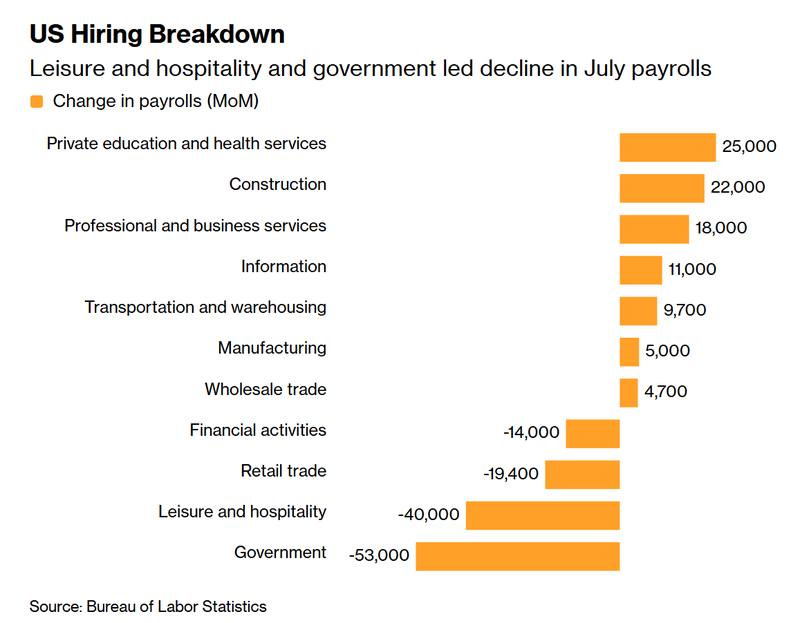
The autopsy, part one. The -53,000 in government is mostly a local-education seasonal quirk and the -40,000 in leisure is the World Cup hiring unwinding, which means the two biggest negative bars are one-offs wearing a recession costume. Private education, health, construction and professional services all still added. Strip the noise and July was a stall, not a collapse. The trouble with stalls is that nobody can tell them apart from stall speed until the next print. Source: BLS / Bloomberg.
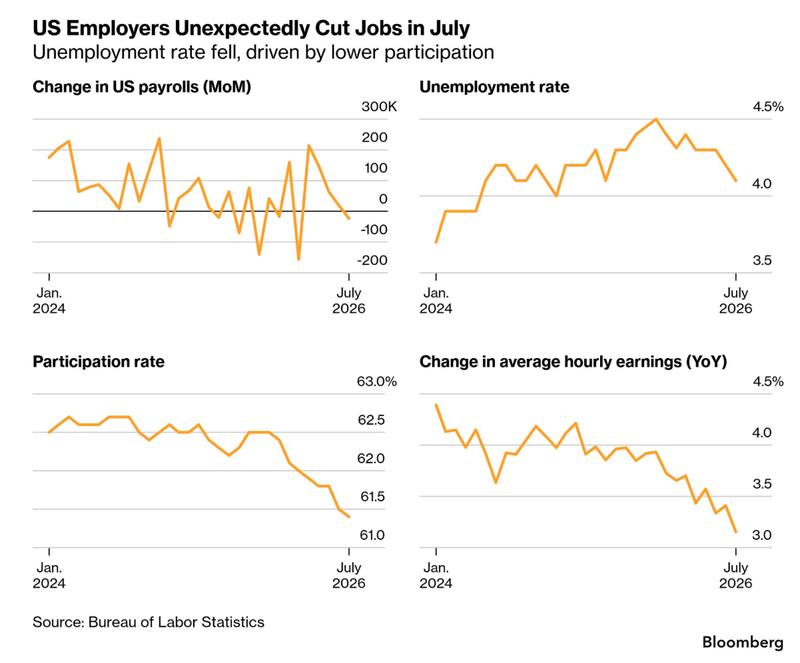
The autopsy, part two. Unemployment fell to 4.1% for the least reassuring reason available: participation sank to its pandemic-era low, so the jobless rate improved while the economy shed workers. Wage growth at 3% is the softest of the cycle. Labour supply and labour demand are shrinking together, the no-hire, no-fire market in its purest form, and it makes every single headline number less meaningful than the pair of them together. Source: BLS / Bloomberg.
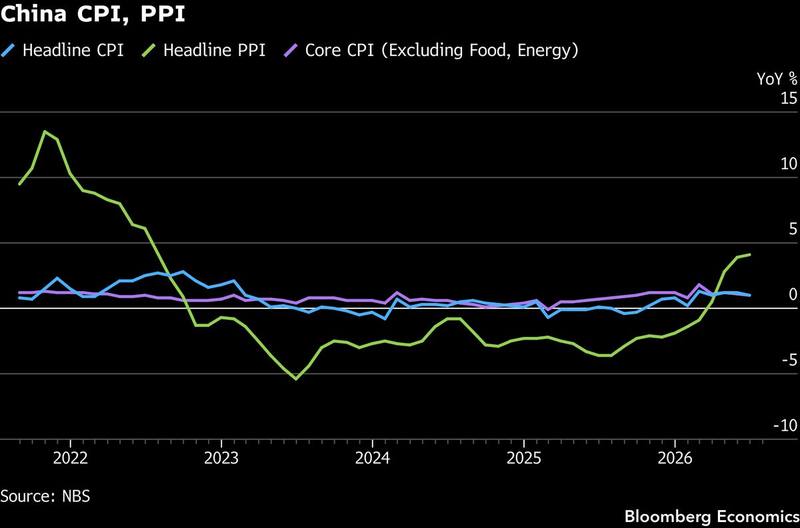
Factory-gate inflation was expected to moderate for the first time since the war pulled it out of deflation in March, with consumer prices barely holding above zero. The economy that spent two years exporting deflation caught six months of imported energy inflation, and is now handing the world disinflation again just as everyone else's central banks debate hikes. Weak domestic demand and overcapacity are doing what no Fed speech can. The question is whether Beijing reads this as room to ease or as the argument for the stimulus it keeps not delivering. Source: NBS / Bloomberg Economics.
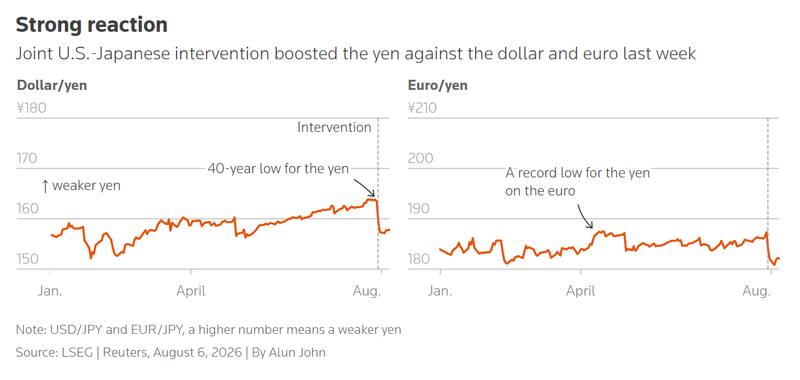
The intervention in two panels: a 40-year low against the dollar and a record low against the euro, both reversed in a day by the first joint US-Japan operation in nearly thirty years. Week one enforced a 155/159 range. Week two decides whether the authorities are defending a level or engineering a turn, and history says coordinated intervention works eventually but rarely immediately, 1998 and 2011 both took months of back and forth. The market is still probing, politely so far. Source: LSEG / Reuters.
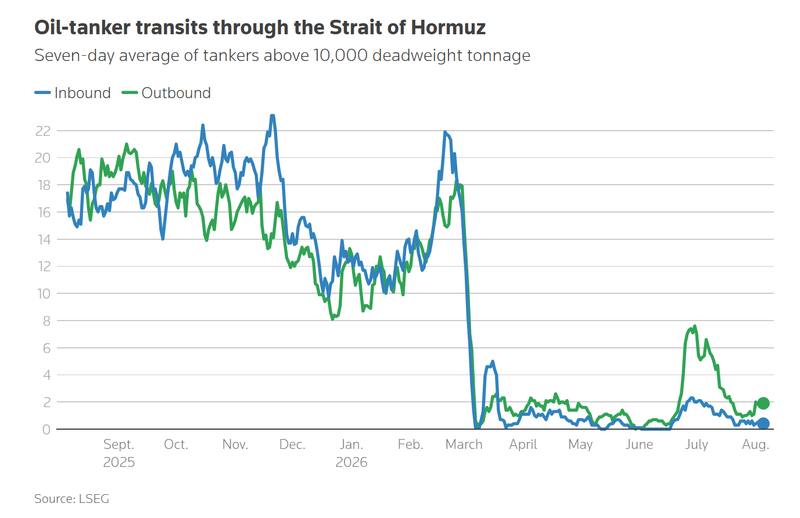
Transits above 10,000 tonnes have flatlined near zero since March, with July's brief recovery already fading. This is what the deal being negotiated would reopen, and also what it would formalise: terms that reportedly hand Tehran control of the lanes and exclude US and Israeli flagged vessels. Meanwhile roughly 5 million barrels a day leak through dark, which is why the physical market softened while the headline risk did not. A signature moves this chart violently. So does its absence. Source: LSEG.
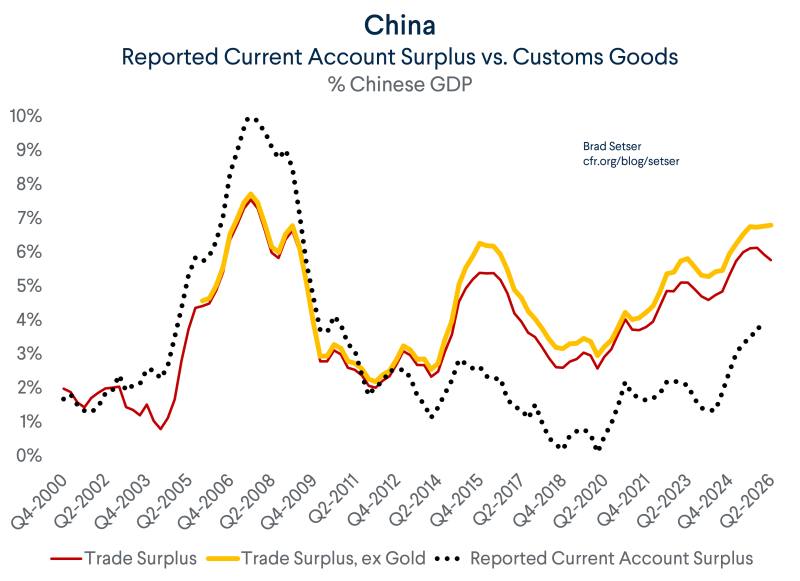
The gap between the lines is the argument. China's customs goods surplus runs near 7% of GDP while the officially reported current account shows barely 4%, and state banks absorb roughly $2 billion a day to keep the currency from appreciating. The yuan at 6.74 is the strongest since February 2023 and Beijing keeps guiding the fix lower, which reads like quiet consent. Source: CFR, Brad Setser.
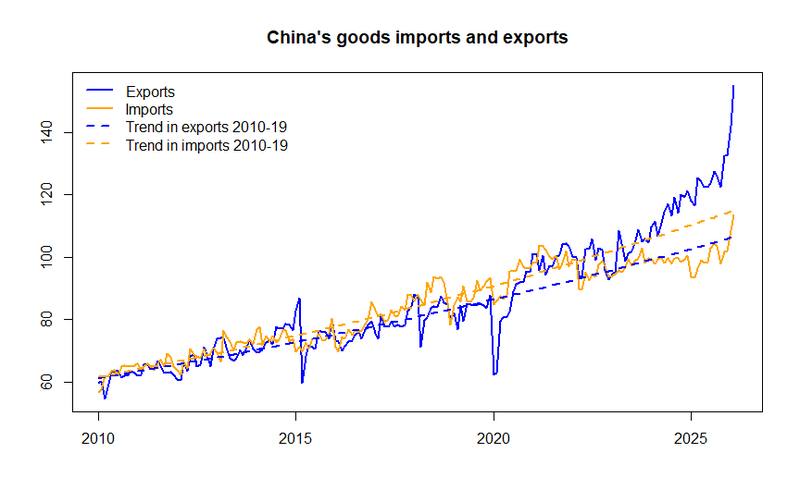
And the exports underneath have gone parabolic, running far above their 2010-19 trend while imports flatline along it. If the undervaluation estimates of 20-35% are even half right, the next leg of dollar-yuan lower is not a trade, it is a policy. Is this the time for it? Source: CFR, Brad Setser.
Hawkish Hold Tuesday
The RBA holds and talks tough, the market prices the next move as up but not soon, and the US supply run opens with $58 billion of 3-years. NFIB and existing home sales fill in the picture of an American economy where sentiment improves while housing quietly stalls.
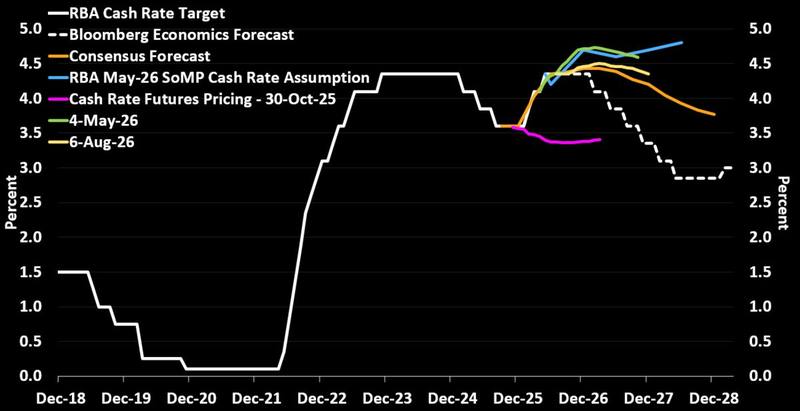
Everyone agrees on the hold; nobody agrees on what follows. The RBA's own assumption path sits near 4.8% by 2027 while the house forecast has cuts to 3% by 2028, one of the widest central-bank disagreements anywhere. Inflation undershot the RBA's forecast by nearly a point last quarter, the housing downturn is widening, and yet futures still price a 60% chance of one more hike this year. Bullock's press conference decides which end of that disagreement blinks first. Source: RBA / Bloomberg Economics.
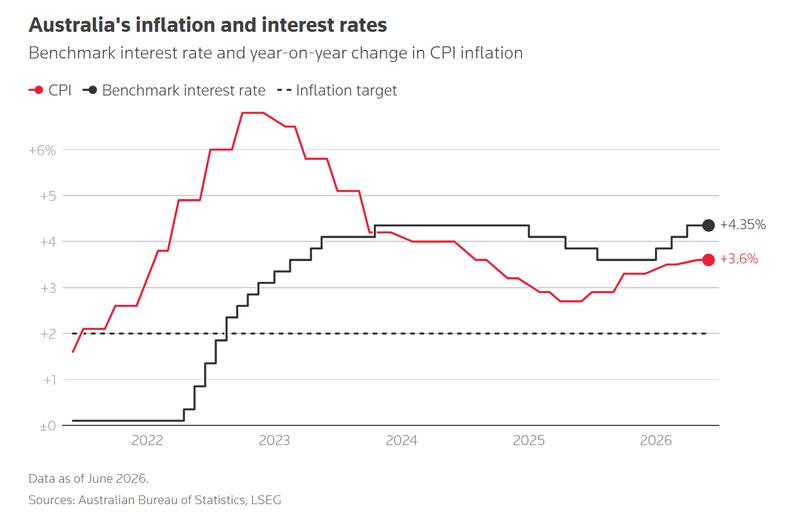
Three hikes this year did their work: CPI at 3.6% now sits below the 4.35% cash rate, the first properly positive real rate of this cycle. That is the RBA's reward for hiking into an energy shock while others waited, and its licence to sit still while the currency does the rest. The Aussie near $0.7080 is the strongest since June, and if the DXY takes out its 200-day this week, it is the region's cleanest long. Source: ABS / LSEG.
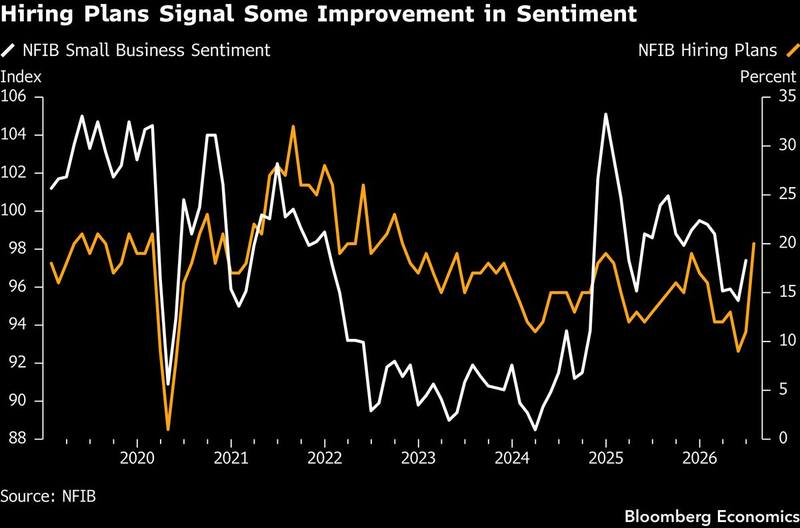
Small business hiring plans jumped to their highest since October 2022, and the stated constraint is not demand but qualified workers. This is the same message as the payrolls report read backwards: labour supply is shrinking faster than labour demand. An economy short of workers does not collapse into recession, it grinds into wage-supported stickiness, which is precisely the inflation the doves need to not see this week. Source: NFIB / Bloomberg Economics.
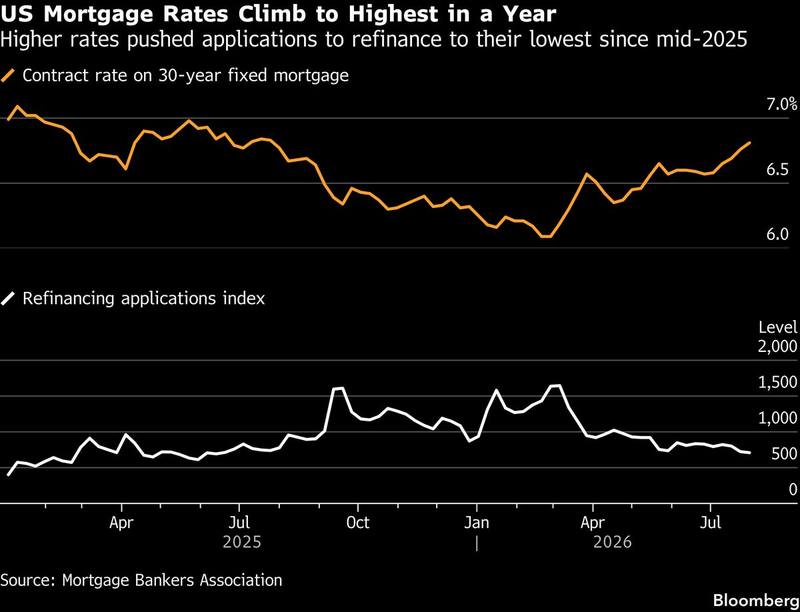
The 30-year fixed at its highest in a year, refinancing applications at their lowest since mid-2025, pending sales already soft. The chair said markets are doing the tightening, and housing is where the market's tightening bites first. Improving supply against softening demand means home prices ease from here, which is disinflation arriving the slow, painful way, through the biggest asset most households own. Source: MBA / Bloomberg.
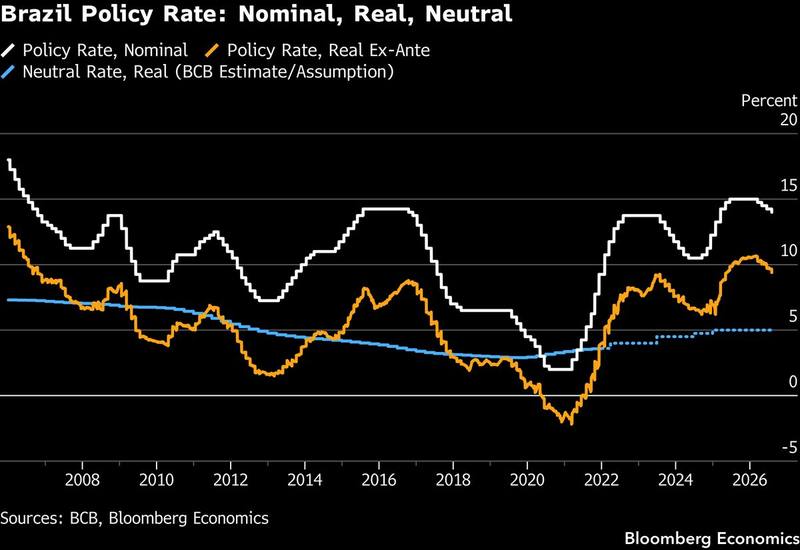
Brazil cut to 14% with a real ex-ante rate near 9% against a neutral estimate around 4.5%, the most genuinely restrictive major central bank in the world even while easing. This is what earned credibility looks like: cutting slowly from a fortress while inflation drifts back inside the band. The EM carry complex reprices around it, especially with the funding leg migrating from yen to dollars. Source: BCB / Bloomberg Economics.
Fulcrum Wednesday
CPI at 20:30 our time, the 10-year auction hours later, Tokyo's linker auction the same day, Tencent after the Hong Kong close. The most compressed macro day of the month, and the one the whole tape is priced against.
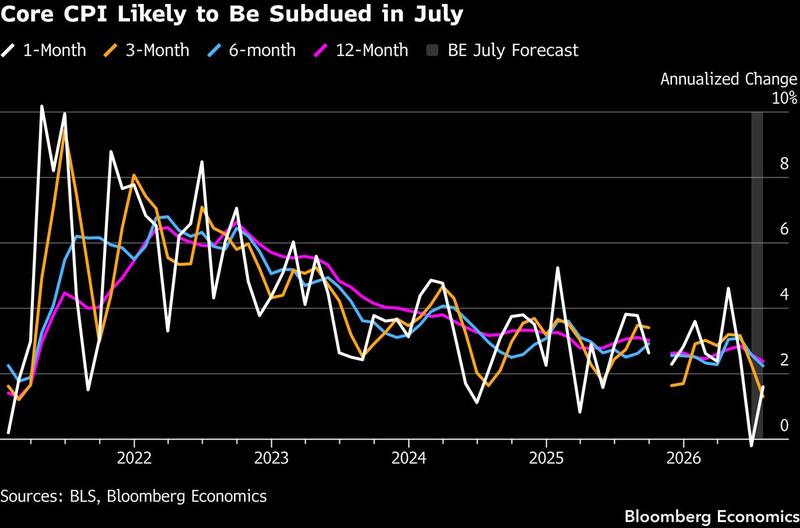
All four momentum measures have converged toward 2% for the first time since 2021, and the July forecast bar extends the convergence. If core prints 2.4% on the year, the claim that inflation has run above target for five years and demands action loses its arithmetic, because 2.4% on CPI has historically meant core PCE at 2. The dissenters' case then rests entirely on the PCE gap and the upstream pipeline. Wednesday is less a data release than a hearing. Source: BLS / Bloomberg Economics.
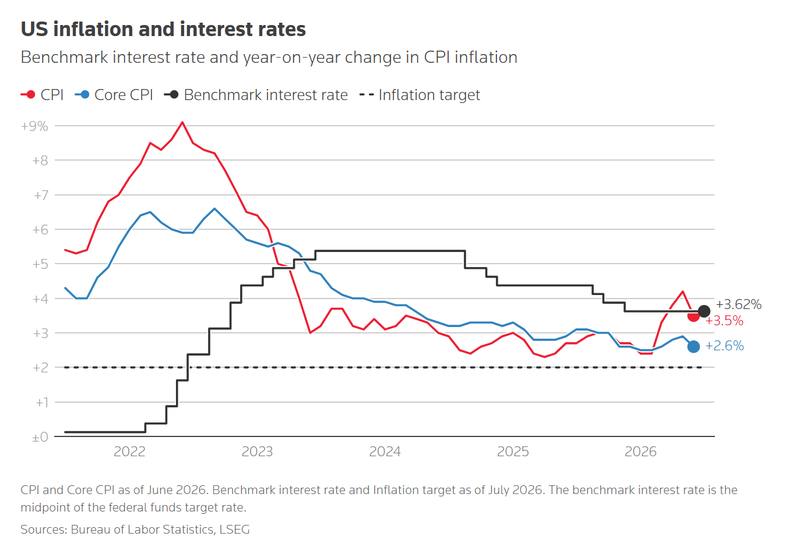
The hawks' picture: headline 3.5%, core 2.6%, and a policy rate at 3.62% that leaves the real rate barely positive against headline. No previous inflation fight ended with policy this close to the price level it was fighting. That is why three members dissented and why the market cannot fully bury September. The doves' answer is the direction of every line on this chart. Both are right, which is what makes it a coin flip. Source: BLS / LSEG.
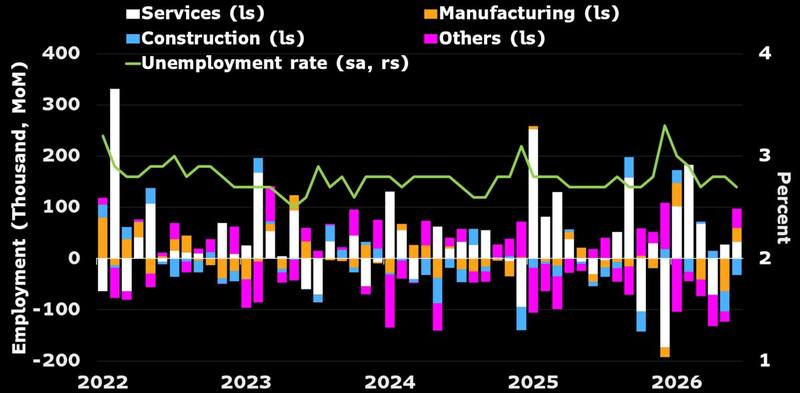
Korea's labour market cools at the edges, unemployment ticking to 2.8%, still under any estimate of the natural rate. War-hit petrochemicals shed manufacturing jobs while the weak won fills hotels and restaurants, prosperity and fragility swapping sectors. The chip engine still runs. The question for the won is whether the flows that lifted it were policy or preference, and this chart says the economy underneath does not need a stronger currency yet. Source: Ministry of Data and Statistics / Bloomberg Economics.
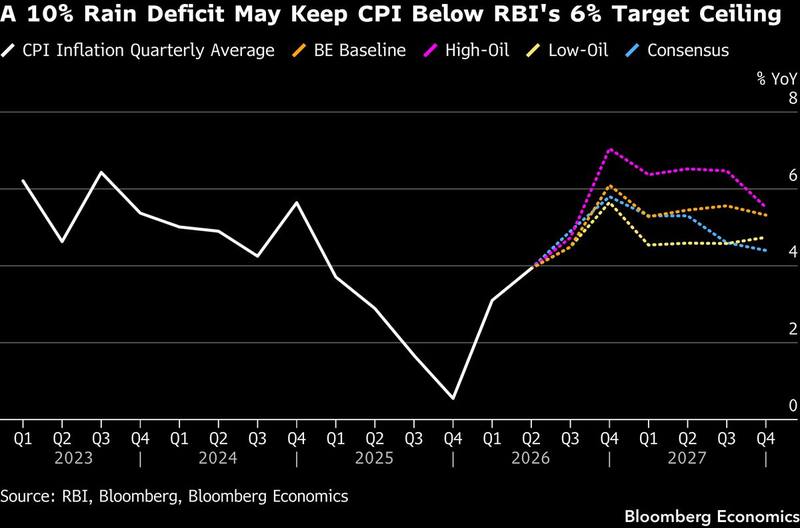
The monsoon deficit narrowed from 35% to 12% in a month, oilseed sowing has passed last year's acreage, and cereal stocks sit above buffer norms. Food risk fading pulls the July print toward 4.3% and reinforces the RBI's dovish hold, with the scenarios splitting purely on oil: $80 crude keeps fiscal-2027 inflation near 5%, $65 buys 4.7%. For an economy that imports its energy and grows its food, this year the weather is the central bank. Source: RBI / Bloomberg Economics.
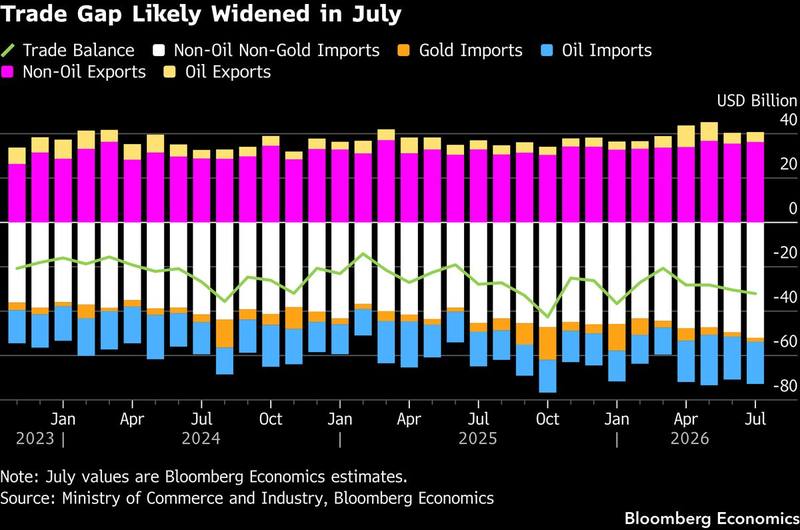
The other side of India's ledger is less kind: the trade deficit likely widened toward $32 billion as the closed strait cut exports to the Gulf while the oil import bill held at $14.4 billion. An economy this exposed to the chokepoint's tax pays it twice, once at the pump and once at the port. The UK trade deal that went live in July is the offset the coming months get to prove. Source: Ministry of Commerce / Bloomberg Economics.
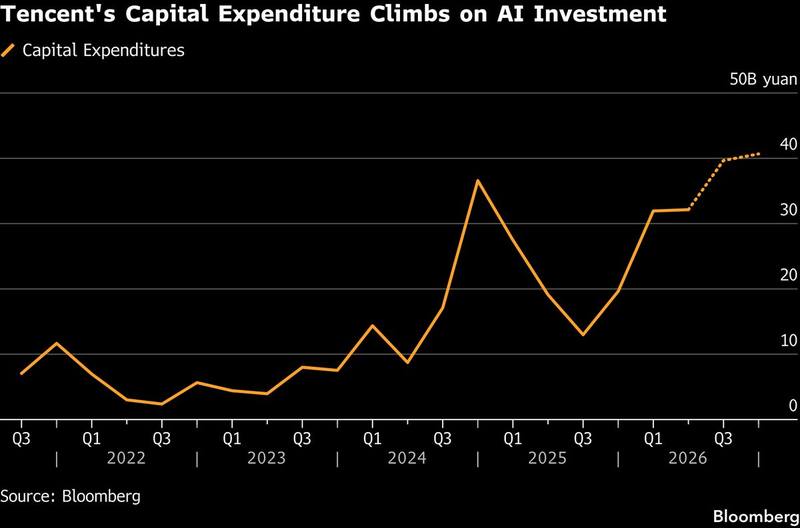
Tencent walks into earnings with capex approaching 40 billion yuan a quarter, weeks after the Magnificent Seven lost $797 billion in a day on exactly this behaviour, and weeks after raising $4.7 billion of long bonds to fund it. The WeChat AI agent is the story management wants to tell; the spending curve is the one investors will price. The capex reckoning has crossed the Pacific, and Wednesday shows whether Chinese tech gets the same punishment for ambition that American tech just took. Source: Bloomberg.
Cross-Check Thursday
PPI is the immediate audit of Wednesday's verdict, claims the freshest labour read, the 30-year bond the last and longest test of the supply week, and Britain's new prime minister gets his growth number.
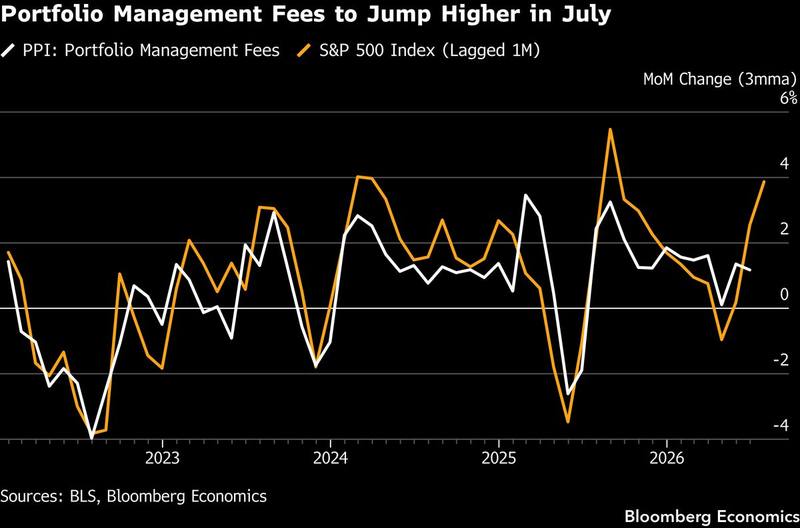
The market rally taxes itself into the inflation data: portfolio management fees follow the S&P with a month's lag, and July's record tape means the fees component jumps, feeding roughly four basis points into the PCE print due August 26. It is the strangest inflation loop in the system, stocks at records making measured inflation firmer, giving the hawks ammunition against the very easing hopes that lifted stocks. Watch the core PPI print for it. Source: BLS / Bloomberg Economics.
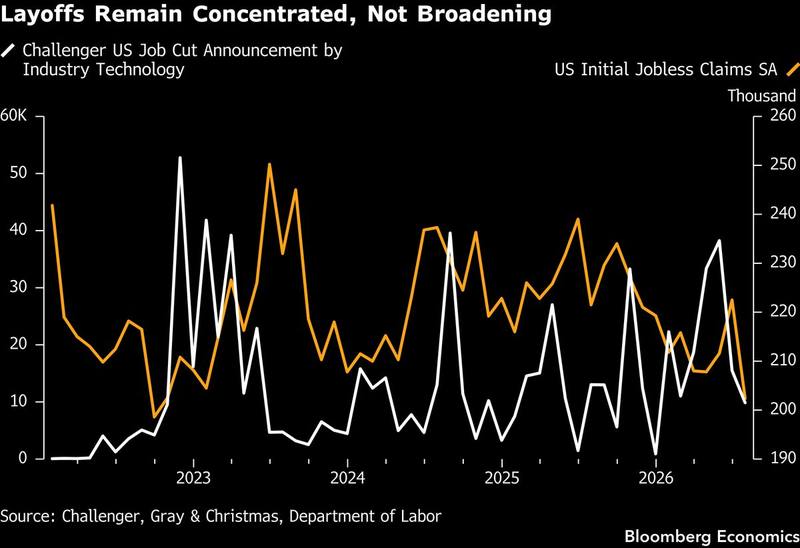
Announced job cuts fell to a two-year monthly low in July, running 41% below last year with technology alone taking 31% of them, while claims sit under 200k for a fourth straight week. The no-hire, no-fire market holds: companies will not add, but outside the AI-exposed sectors they will not cut either. The gap between layoff headlines and actual filings remains the most important unresolved question in the US labour market, and this chart says the headlines are losing. Source: Challenger, Department of Labor / Bloomberg Economics.
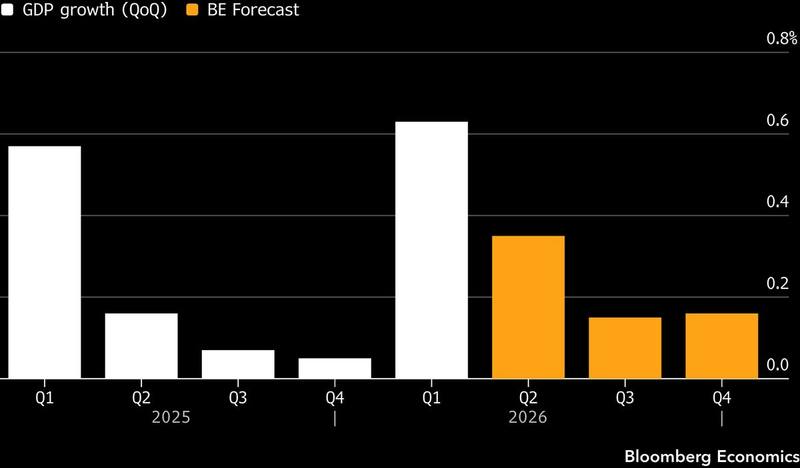
The print will read 0.3-0.4% and the campaign posters will write themselves, but the strength is arithmetic: a strong Q1 handoff, World Cup spending, hot weather. The forecast bars fade toward 0.15% by year-end as July's utility-bill jump bites and the labour market loosens. The Burnham bounce is a base effect wearing a rosette. The gilt market's benefit of the doubt is the thing to watch, not the growth rate. Source: ONS / Bloomberg Economics.
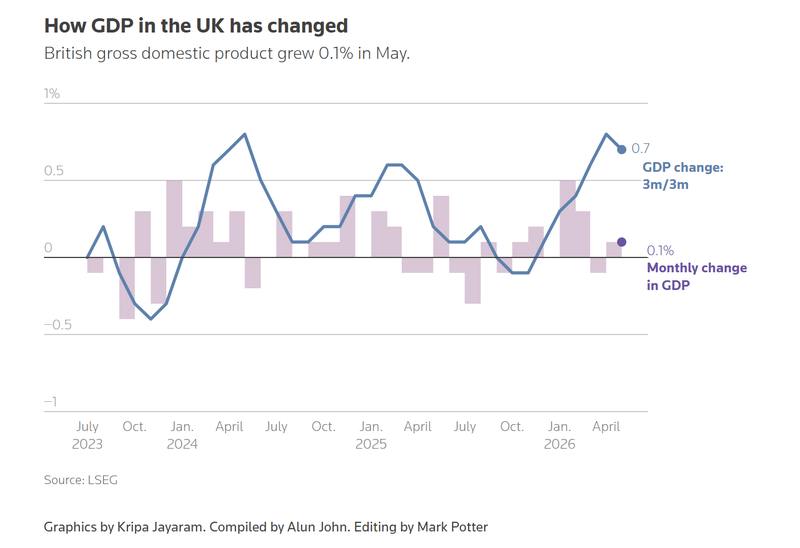
The monthly path tells the honest version: May grew just 0.1% and the three-month rate peaked with June's one-offs inside it. Sequential momentum cooled through the spring before the World Cup flattered the finish. New prime ministers get one honeymoon print; the second one, in November, arrives with the energy bills in it. Source: LSEG.
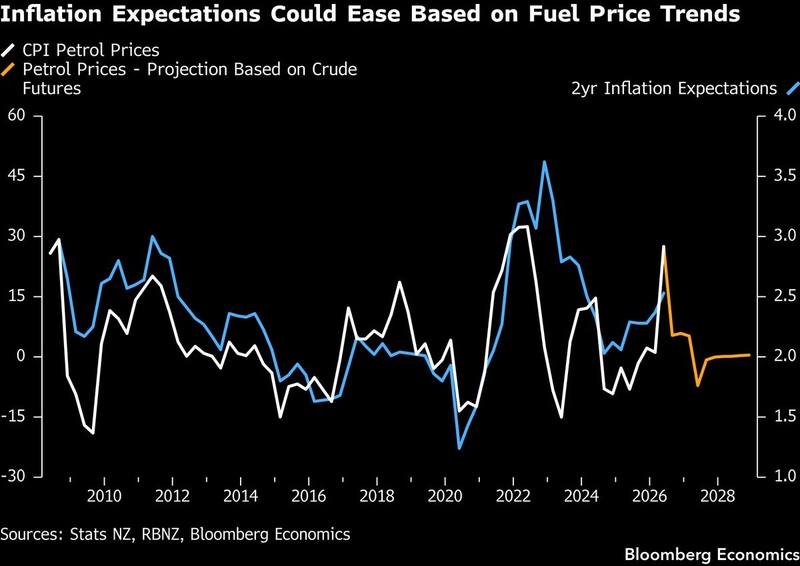
Two-year expectations track petrol prices with unnerving fidelity, and the crude futures curve now drags the projection back toward 2%. New Zealand hiked early, wore the demand damage, and gets the anchored expectations as its prize. It is the counterfactual for every committee currently debating whether to hike into an oil shock: the damage arrives either way, the anchoring is what you buy with it. Source: Stats NZ, RBNZ / Bloomberg Economics.
Show Your Hands Friday
Retail sales with the widest consensus gap of the week, Michigan's inflation expectations, the 13F unveiling of every crowded AI book, the super-long JGB auction, and China's credit data somewhere in the window. The week's verdict gets its footnotes.
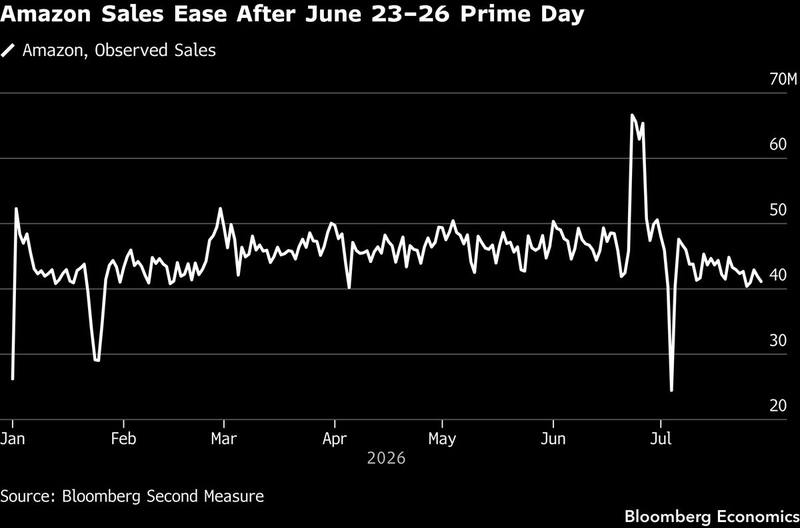
The Prime Day spike has fully unwound into the softest observed run rate of the year, which is most of the reason serious desks see retail sales printing -0.5% against a +0.1% consensus. Higher gasoline ate the discretionary budget mid-month, autos softened, and the online boost simply was not renewed. If the control group holds anyway, the American consumer is fine and July was calendar noise. If it does not, the stagflation-lite conversation starts Monday. Source: Bloomberg Second Measure.
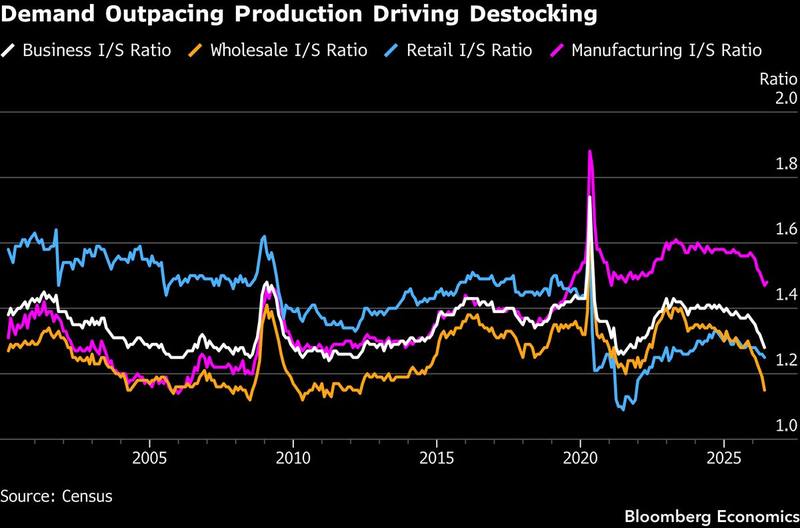
Demand has been outrunning production all year: every inventory-to-sales ratio is rolling down from its cycle high, and the ISM's customers' inventories index still reads too low. Destocking flatters current GDP and guarantees future production, which is the quiet bull case underneath any weak retail print. An economy that has to restock is hard to recess. That is also, inconveniently, the hawks' growth argument. Source: Census / Bloomberg Economics.
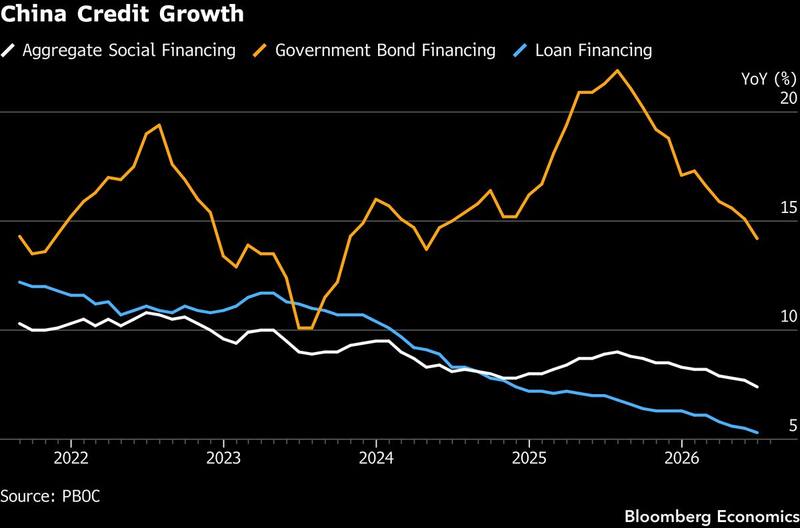
Aggregate financing growth slips to a fresh low near 7.3% with government bond issuance decelerating from 20% and loan growth under 5%. The structural read matters more than the monthly miss: an economy migrating toward credit-light technology sectors simply needs less debt per unit of growth, which permanently mutes the old stimulus impulse everyone still waits for. The stimulus question is back on the table into autumn. The answer keeps being the exchange rate. Source: PBOC / Bloomberg Economics.
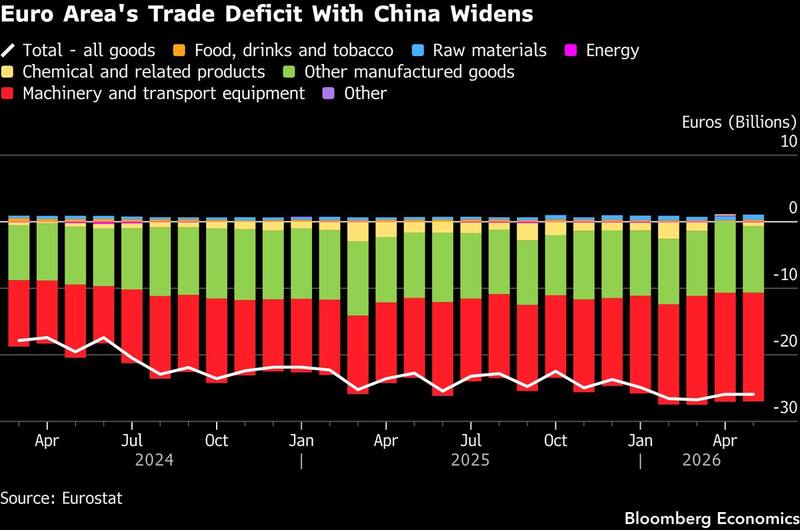
Europe replaced its lost American demand with non-EU European buyers, a quiet diplomatic success, but the import side has no such answer: the deficit with China runs near 26 billion euros a month against a 21 billion pre-2025 average, machinery and transport equipment doing the widening. One bloc's overcapacity is another's deindustrialisation risk. The ECB may be about to hike into it. Source: Eurostat.
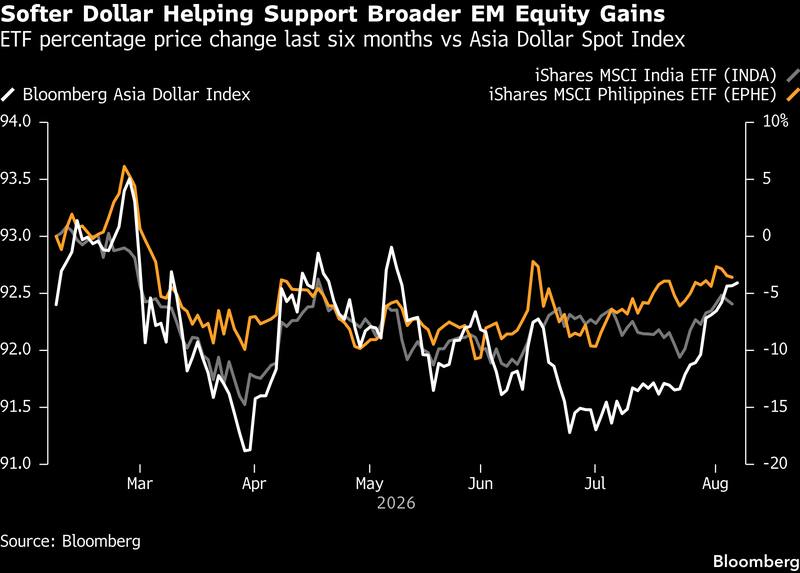
India and Philippines ETFs have quietly outperformed the Asia Dollar Index's own recovery, the early evidence that a durable dollar downtrend is the permission slip battered EM equities have waited for outside the AI trade. Money that spent two years hiding in seven American stocks does not rotate because valuations argue; it rotates when the funding currency turns. The 13Fs on Friday show who moved first. Source: Bloomberg / MLIV.
The AI Fracture, week six: the bill arrives
The theme continues, and this week it went to the bank. Alphabet's $25 billion AI bond, SoftBank's $10 billion margin loan against OpenAI paper, a second $36 billion private package shopped for Anthropic's compute, $600 billion of chip financing projected for two labs, and the first price rise from the supposed commoditiser, DeepSeek, which quietly undermines the LLMs-to-zero thesis. Equity argues about the capex; credit is writing the cheques and setting the terms.
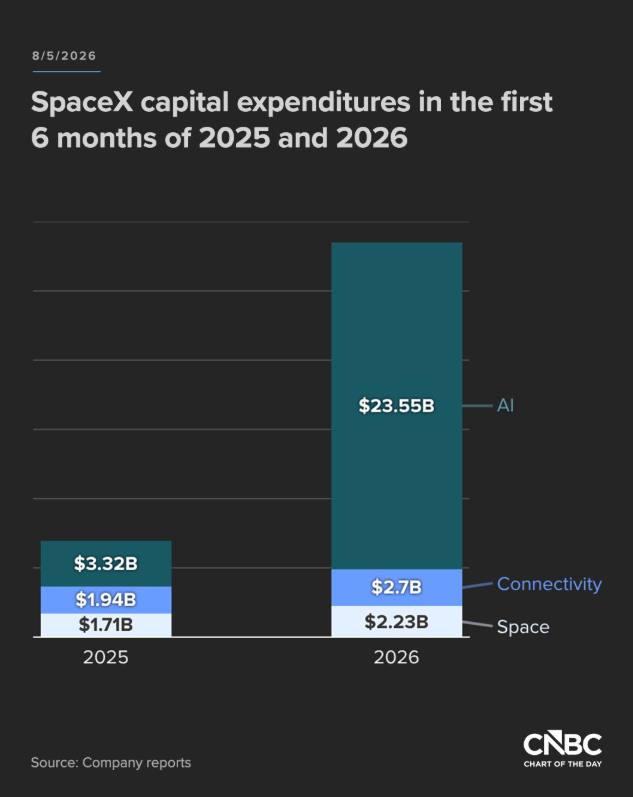
The rocket company spent $23.55 billion on AI in six months, seven times last year's total capex, with space and connectivity now a rounding error on their own income statement. Starlink pays the bills; AI spends them. The lockup passed its first test on schedule, with tranches releasing through December and the founder's 6.4 billion shares free in June 2027. The supply shock was priced. The capex shock, the market is still deciding whether to price. Source: Company reports / CNBC.
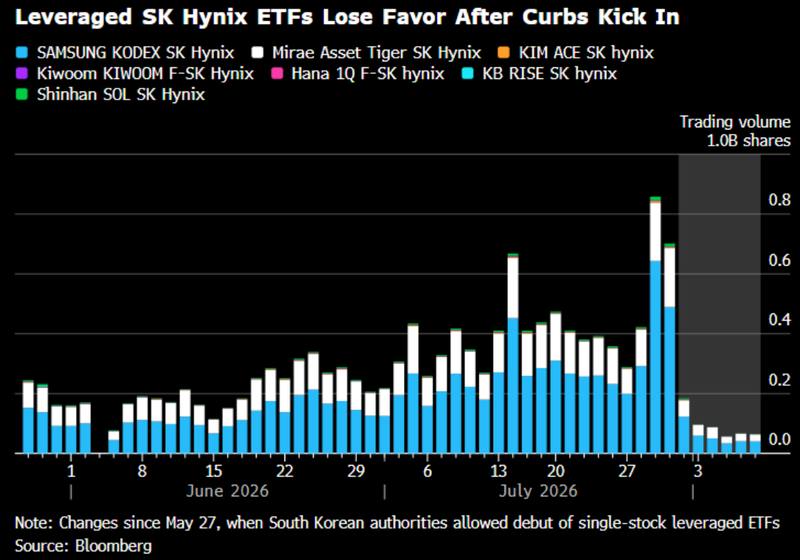
Single-stock leverage on the memory champion went from debut in May to 800 million shares a day at the July peak to near zero after the curbs, the full lifecycle of a speculative instrument in ten weeks. The deleveraging is reportedly more than half done, volatility has ebbed from its record, and yet foreigners still sold $6.2 billion in July and more in August. The froth is gone; the exodus is not. Those are different problems, and only one of them is fixed. Source: Bloomberg.
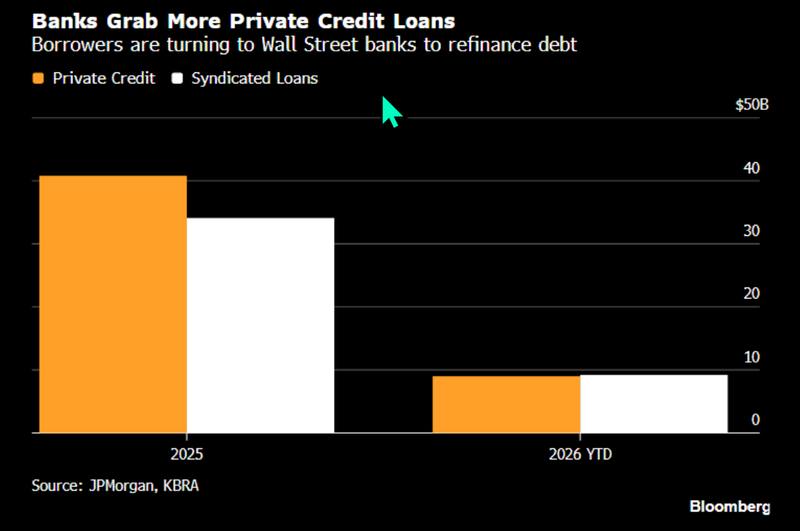
Companies are refinancing out of private credit into bank loans at three times the reverse rate, with one pharma borrower alone saving 225 basis points on $4.1 billion. Higher-for-longer has inverted the pecking order: the premium borrowers once paid direct lenders for speed and certainty is now just a premium. BDC outflows shrink the dry powder while banks grow C&I books at 14% annualized. The cheapest capital is winning again, which is normal, and exactly what the last three years were not. Source: JPMorgan, KBRA / Bloomberg.
The tax machine
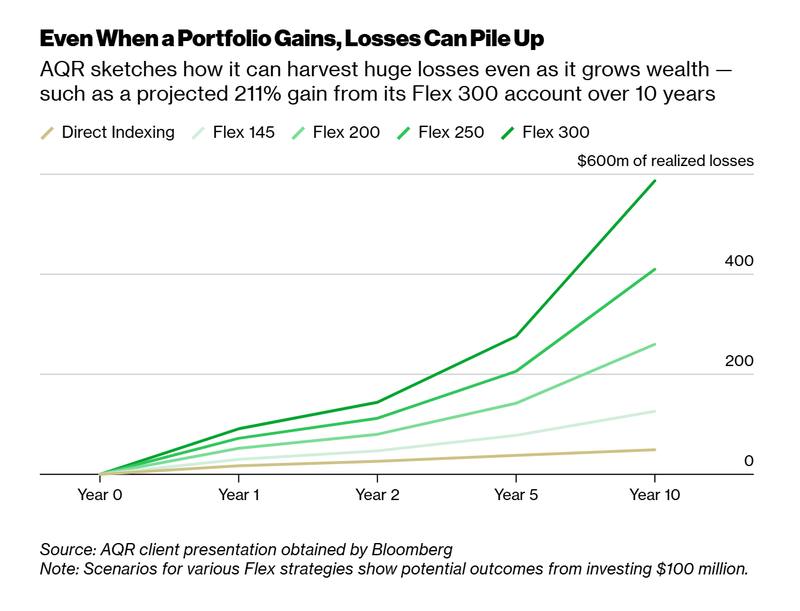
A client presentation sketches how a $100 million account can realise up to $600 million of paper losses over a decade while growing 211%, losses manufactured by leverage and long-short churn, harvested against gains elsewhere in a billionaire's ledger. Source: Bloomberg reporting, AQR public information.
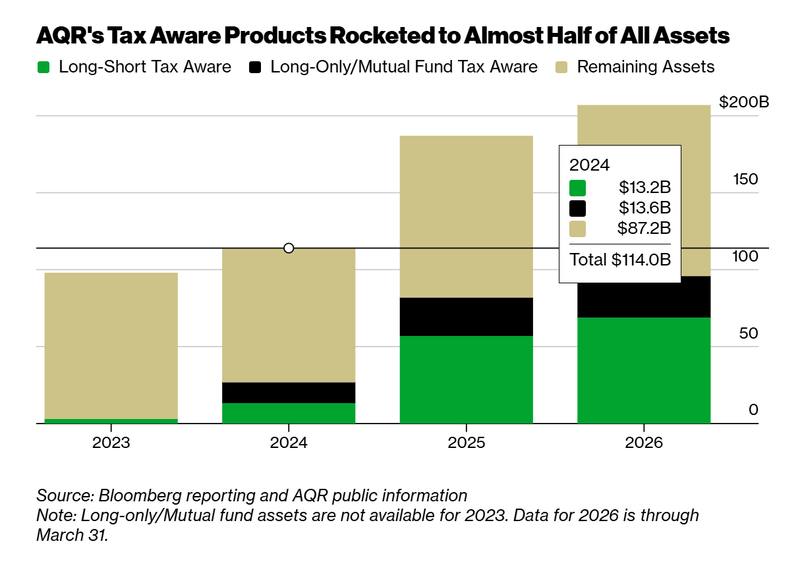
And the product family has rocketed to nearly half of the firm's $200 billion in assets in three years. It is entirely legal, increasingly industrialised, and a reminder that in the American tax code, volatility itself is an asset class, if you can afford the machinery. Worth knowing it exists; happily, not a Singapore problem. Source: Bloomberg reporting, AQR public information.
VC+ Special Dispatch — The Global Trade Machine, Part Two
Part one gave us a hundred and fifty-five years of trade in eight charts. Part two gets specific: what every country sells and buys, which categories are pulling ahead, and how China redrew the map in twenty-five years. Global trade set a record $71.3 trillion in 2025 even as its share of output plateaued, which is the whole story in one sentence: the system keeps growing, it just stopped growing faster than everything else. Credit to the VC+ team.
Global Trade by Category
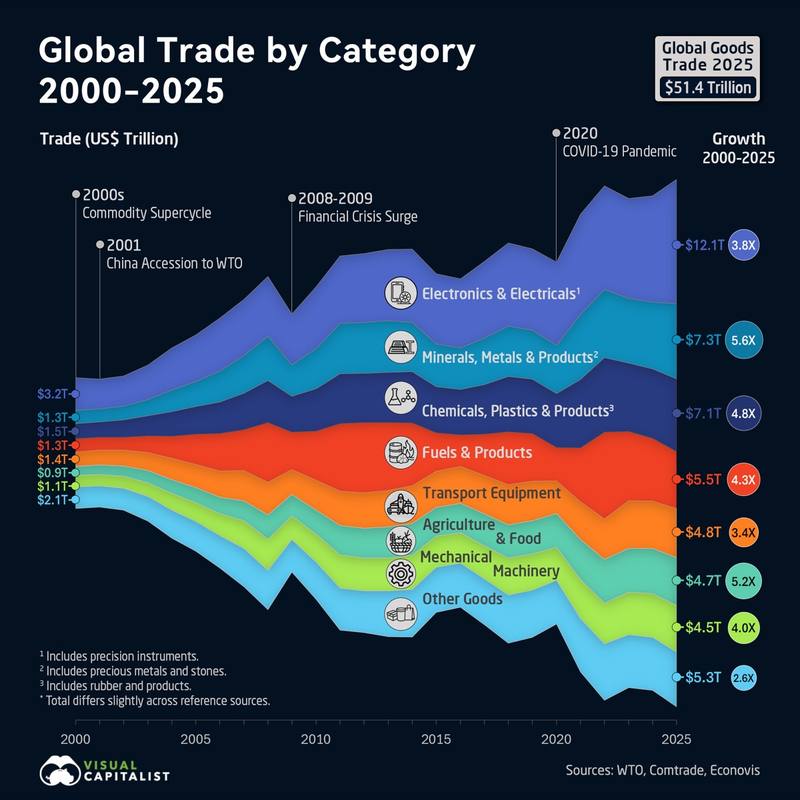
Goods trade more than tripled to $51.4 trillion, but the leadership rotated: electronics and electricals grew to $12.1 trillion while fuels, the old king, managed only 4.3 times growth to $5.5 trillion. The commodity supercycle built the century's first decade; the semiconductor built its third. Every tariff and chokepoint fight this year is a fight over the blue band at the top. Source: WTO, Comtrade, Econovis / Visual Capitalist.
Semiconductors and Precious Metals Lead
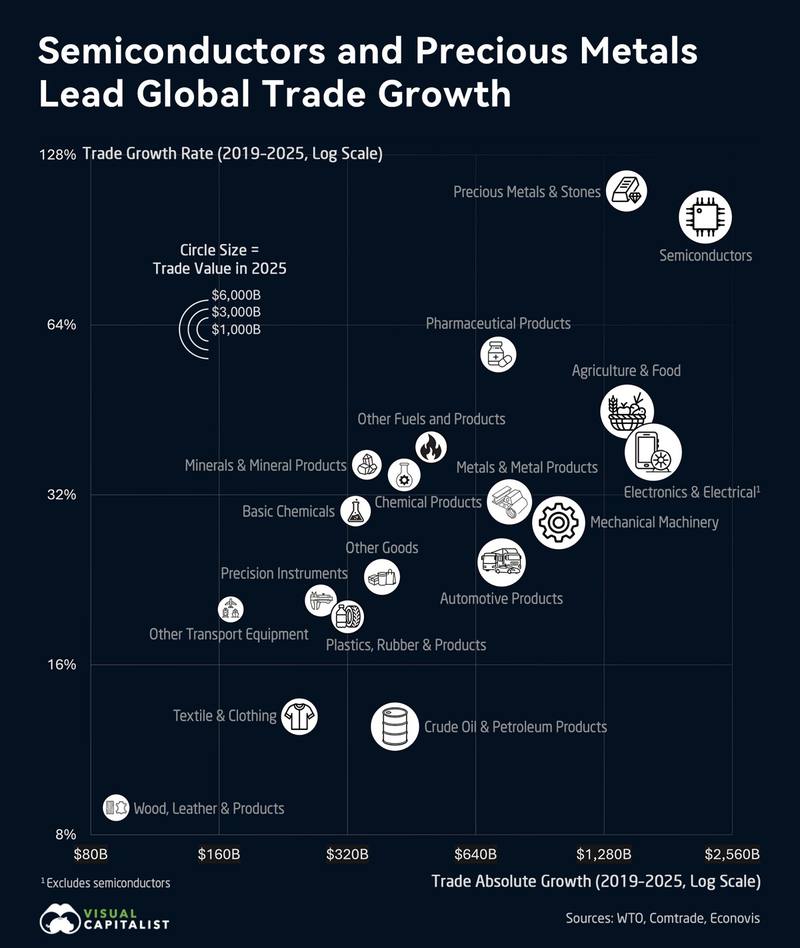
Of every category on the map, semiconductors sit furthest to the upper right, the fastest growth on the biggest base, with precious metals beside them, the war and the central banks' gold bid visible in a trade statistic. Crude oil sits in the lower half, growing slower than textiles. The strategic commodities of this decade are computation and collateral, not energy, whatever the strait headlines say. Source: WTO, Comtrade, Econovis / Visual Capitalist.
Every Country's Largest Import
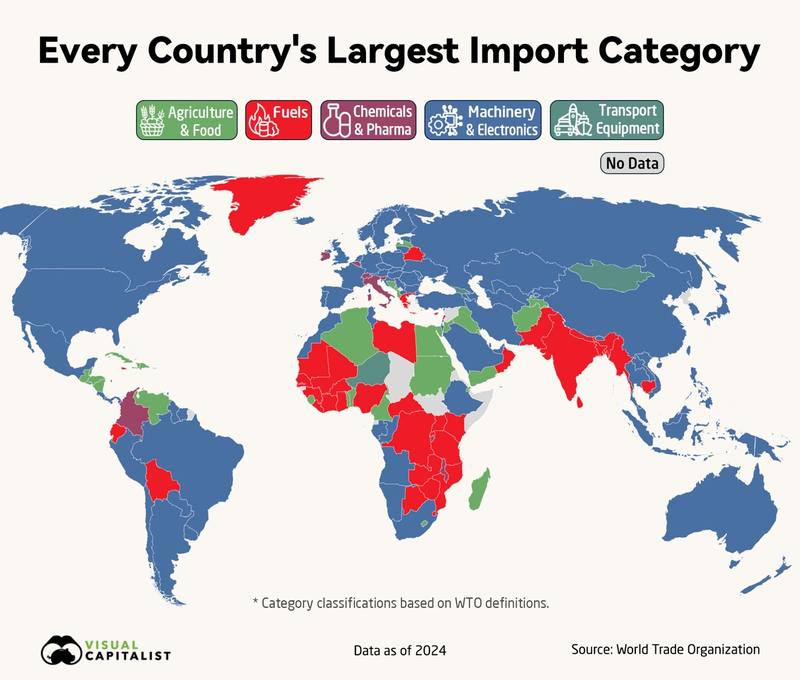
Machinery and electronics dominate the import map of the entire developed world and most of Asia, while fuels colour Africa and South Asia red, the energy-poor importing energy while the technology-poor import technology. Almost nobody's biggest import is food, which is globalisation's quietest achievement. The countries where fuel is the largest import are the ones a closed strait taxes hardest, and most had no vote in closing it. Source: WTO / Visual Capitalist.
Every Country's Largest Export
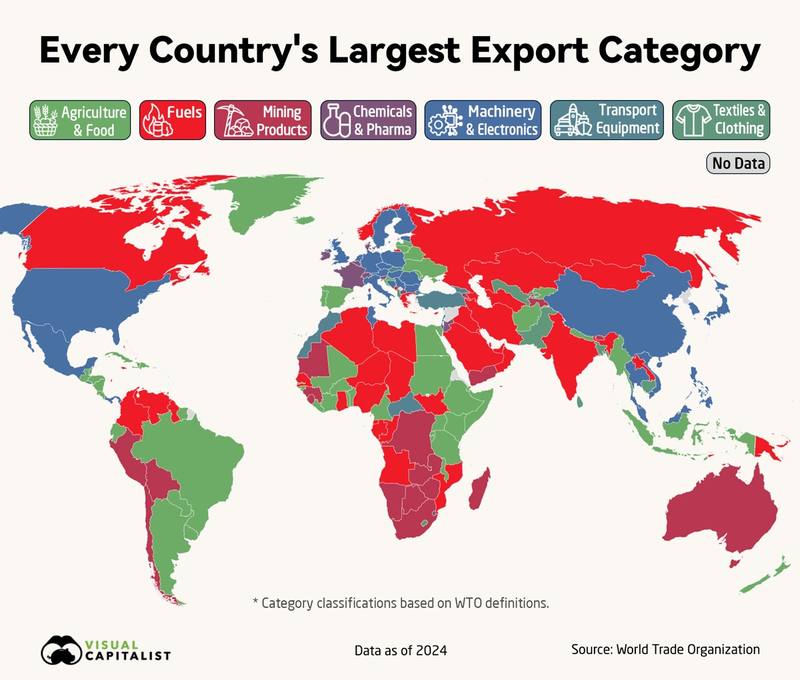
The mirror map: machinery and electronics for East Asia and the old industrial core, fuels for the resource belt from Moscow through the Gulf to Lagos, agriculture for the southern cone. A country's biggest export is its geopolitical personality. The interesting cases are the ones that changed colour in a generation, and almost all of them changed toward the blue of electronics, almost all of them in Asia. Source: WTO / Visual Capitalist.
US, EU, or China
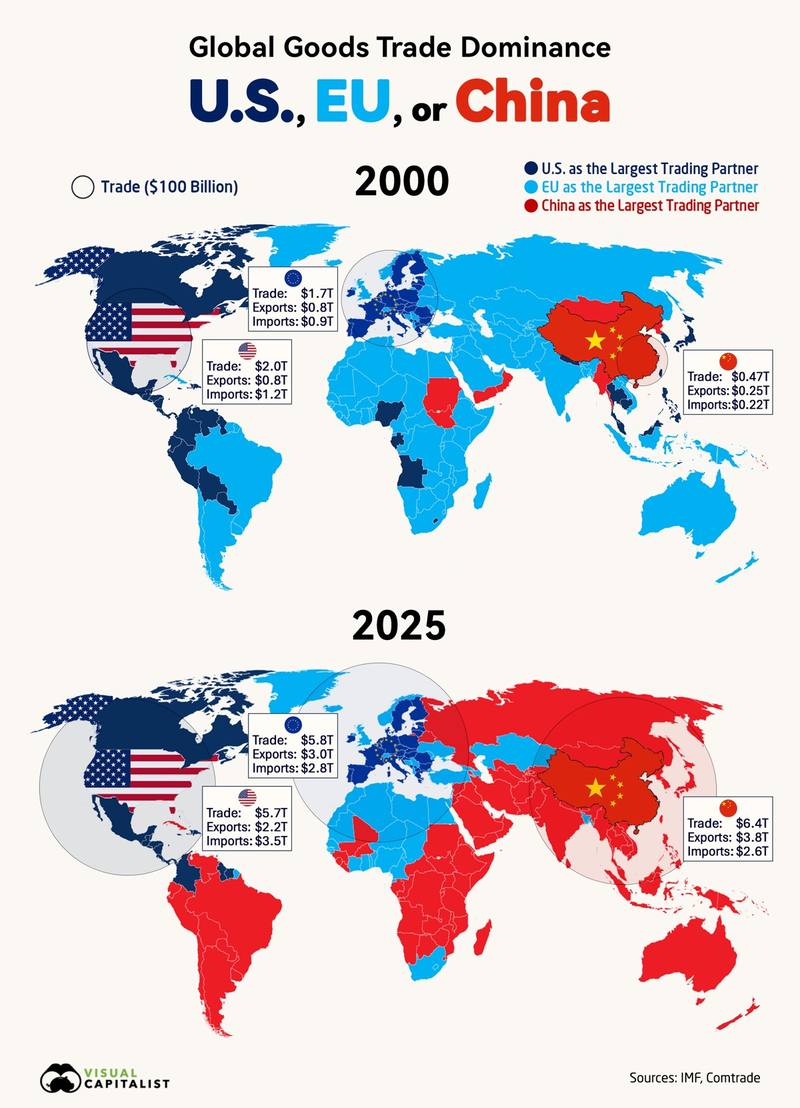
In 2000, China was the largest trading partner of almost nobody, with $0.47 trillion of trade. By 2025, at $6.4 trillion, it is the largest partner of most of the planet's surface, the red tide covering South America, Africa, the Gulf and Southeast Asia while the US retreats to its hemisphere's north. This is the map the tariff architecture is built against, twenty years too late to redraw cheaply. Source: IMF, Comtrade / Visual Capitalist.
Trade by Continents
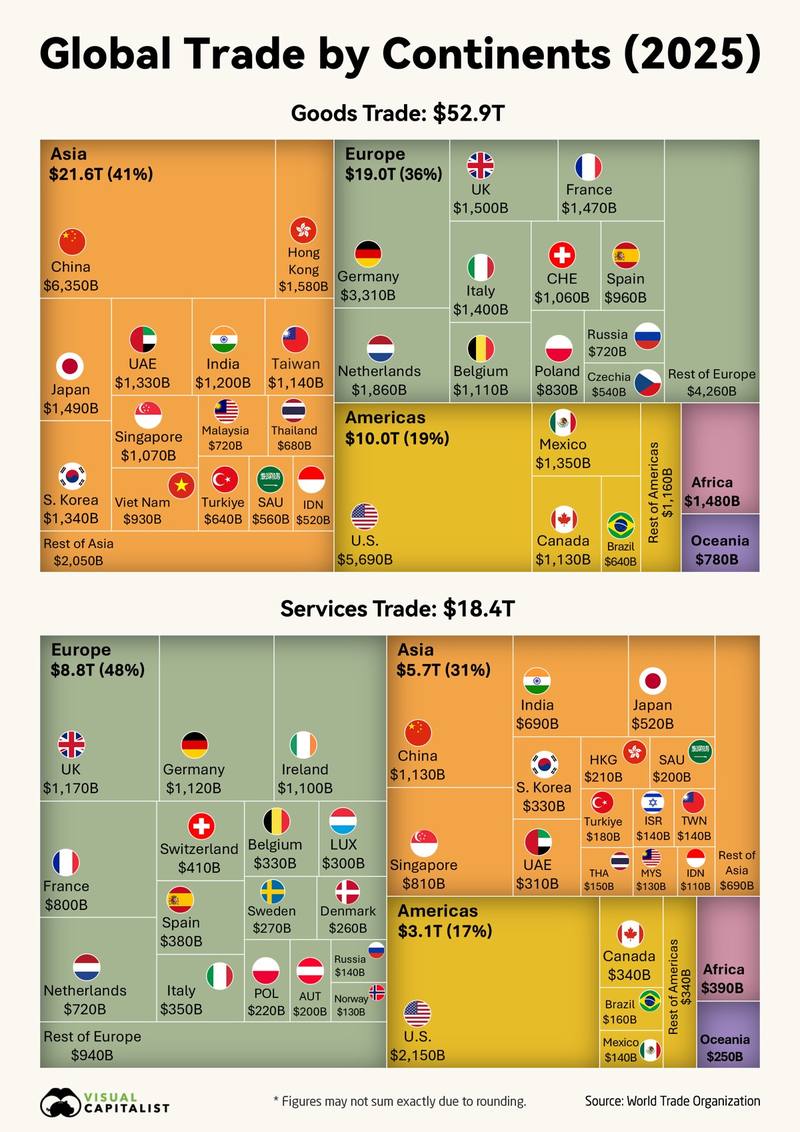
Asia moves 41% of the world's goods but only 31% of its services; Europe flips it, 36% of goods against a commanding 48% of services. The Americas trail in both. Services are where the margins live, software, finance, media, compute, and the data centre is an export terminal. The next trade war is already visible in this split, and it cannot be fought with tariffs on containers. Source: WTO / Visual Capitalist.
The Good Wrap
What is left at the close. The highest-paid athletes in history, led by a man who retired twenty-three years ago. Week two of our tour through China's eight great cuisines, south to the merchant kitchens of Zhejiang. And a public service announcement for the Singapore readers before the next long weekend.
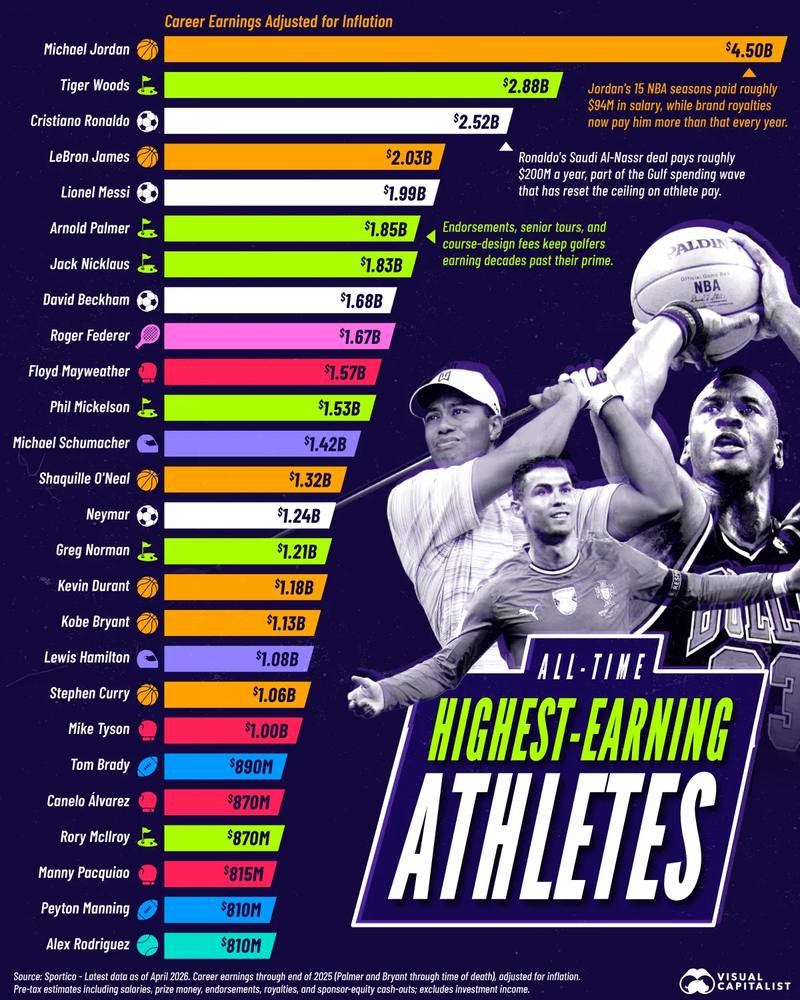
Michael Jordan's $4.5 billion leads a list he stopped playing on in 2003, his brand royalties now paying more per year than his entire fifteen-season salary of roughly $94 million. Ronaldo's $200 million Saudi contract is the new ceiling-setter, the Gulf money that repriced sport the way it repriced golf and is trying to reprice everything else. The lesson for every earner on the list: the salary was never the asset. The name was. Source: Sportico / Visual Capitalist.
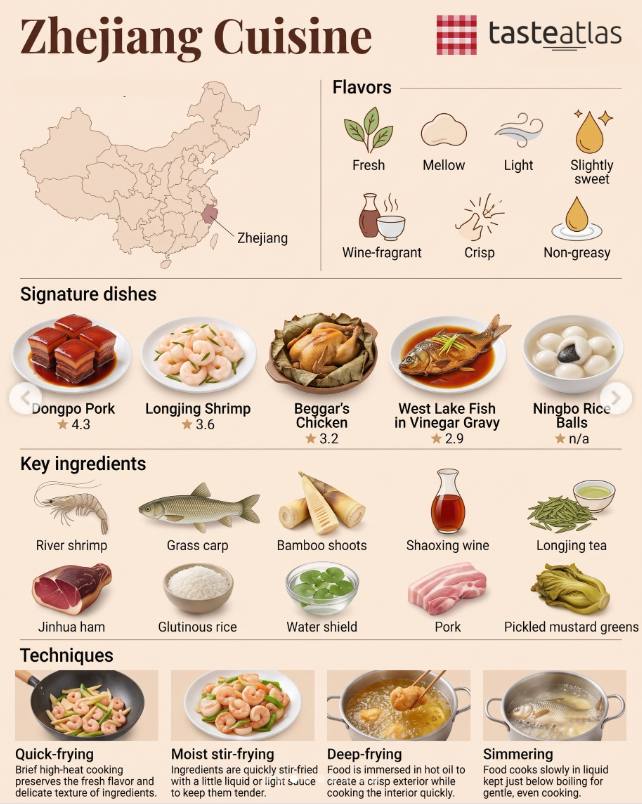
Week two of the eight great cuisines, and the tour turns south to Zhejiang, the merchant province at the Yangtze delta: Dongpo pork, Longjing shrimp with tea leaves, West Lake fish in vinegar. Where Shandong cooked the sea and the wheat field, Zhejiang cooks the canal and the counting house, fresh, light, slightly sweet, wine-fragrant, food built by traders who could afford freshness and had the tea to pair with it. The port provinces cook what the ships brought. The rich ones cook what the ships took away. Source: TasteAtlas.

A reminder to our Singapore friends, passed in parliament on August 4: the breath limit drops from 35 to 15 micrograms, less than a single drink for most, phones, tablets and smart watches all banned in hand, and dangerous-driving sentences extended. The practical translation for this readership: after the second glass at Sunday lunch, the car does not move. Grab is cheaper than seven years. Source: Ministry of Home Affairs / CNA.
Best,
Hoelon
WITPTW is a personal publication. Everything here is personal opinion and market commentary, written in a personal capacity. It is not investment advice and not a recommendation to buy or sell any security. It is not associated with, endorsed by, or representative of any employer, fund or company. Charts and images are reproduced from their original publishers, credited to their sources for commentary and discussion; all rights remain with the respective copyright holders.