Change of Subject
Personal views and market commentary. Not investment advice. Not associated with any employer or firm.
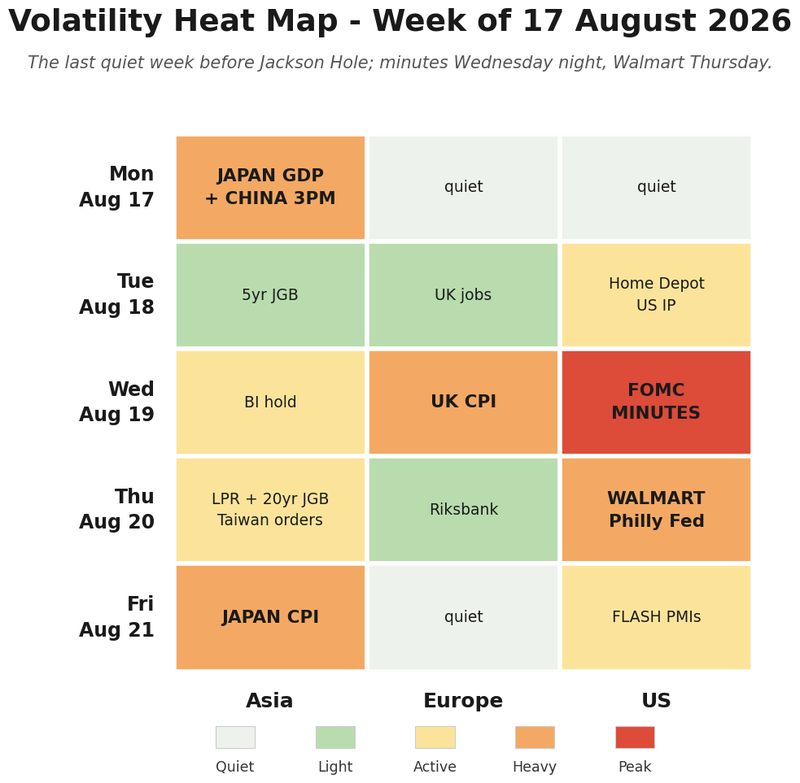
Volatility heat map for the week ahead , sessions as we trade them from here. The last quiet week before Jackson Hole, and it is quiet only on paper. Japan's GDP and China's oddly rescheduled 3pm activity data open Monday, the FOMC minutes land at 2am our Thursday, Walmart reports the same day as the 20-year JGB auction and China's loan prime rates, and flash PMIs close the week. Next Friday the chair takes the Jackson Hole microphone for the first time, which makes this the week to reposition, not to press. The S&P sits at 7,786 and the VIX at 14.25. Cheap gamma, expensive complacency.
"Going forward, there is a reasonable probability that we will soon find ourselves in a bubble." — Greg Jensen, Bridgewater's co-CIO, in the note behind A Critical Time for AI, the video that did the rounds of every trading-floor chat this week. The arithmetic underneath the sentence is the chilling part: the video's own charts show data-centre spending of $1.75 trillion in 2027, of which $1,030 billion, more than a trillion dollars in a single year, must come from external financing. Data-centre and project financing has run to $125 billion this year against $15 billion last year, the hyperscalers will spend $650 billion in 2026 against $410 billion, and the labs face what the note calls their massive and final private fundraisings, with OpenAI's cash negative by early 2027 without new money. The companies that used to lend their spare cash to the system through bills and money funds are becoming its largest borrowers, so the strain shows in credit supply and the curve before any money fund feels it. Success is priced. The financing is not yet raised.
"AI is structurally a technology that tends to concentrate power, for reasons that have nothing to do with regulation." — Dario Amodei, replying to Gavin Baker on X, in the most substantive public exchange the AI debate has produced all year. The man running one of the frontier labs says concentration is the default setting, not the failure mode. Baker, channelling Zuckerberg, argued the opposite corner: the only risk worth fearing is the concentration itself, and Amodei, having lost the regulatory argument, should advocate for his own industry. Amodei refused the marketing brief: the most accurate criticism of the labs is that they have not delivered, the only fix is "actually curing cancer", and the first glimmers are promised within months, from a man who lost his father a few years before the drug that would have cured him. Note the timing: the labs are raising their final private rounds, and the executive told to smile more is about to run one of the most important public companies in the world. The power, like the funding above, is being priced before it is raised.
"Your eyes are part of your brain. They're the only part of your brain that sits outside the cranial vault." — Andrew Huberman, the Stanford neuroscientist, on why light was never just for seeing. The brain devotes 40 to 50% of its real estate to processing light, and the most ancient cells in the retina exist only to tell the body what time it is. Morning sun sets the clock that runs sleep, hormones, mood and focus; a life under LED panels leaves it unset. In East and Southeast Asia, 80 to 90% of high-school children are now myopic, and the driver is not the screens but staying indoors, away from the sunlight that keeps a young eye in shape. An indoor species, short on perspective. I am taking the morning walks seriously again.
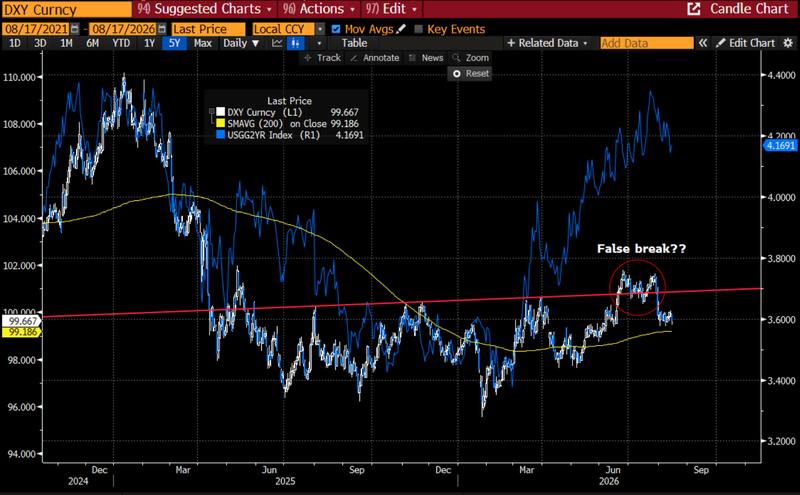
The chart of the week. The dollar's double top has resolved into a false break, the index back at 99.67 with the 200-day at 99.19 directly below, while the two-year yield, the blue line, sits near its highs at 4.17%. That gap between the lines is the story: the dollar has stopped following its own rate advantage. Ten-year yields have risen through two months of weakening labour data even as the long end cheapens, and still the dollar cannot rally. USD longs were bought into a hawkish Warsh and two to three hikes; both of those are gone, and the unwind may need to run further. The caveat is carry: shorting the dollar still costs money, so the move lower grinds unless the interventions turn joint again. Source: Bloomberg.
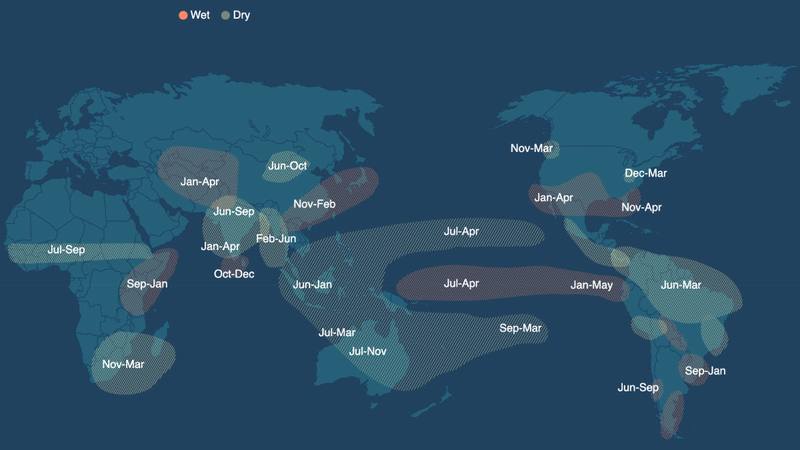
The other macro force this week has no ticker. El Nino has officially returned to the tropical Pacific, and this map of who turns wet and who turns dry is a forward calendar of food prices: the UN's food agency warns the world is verging on another wave of food inflation, a strong El Nino alone can add about 0.7 points to global food inflation at its peak, and the burden lands hardest across Asia and Latin America, where food is the biggest line in the household budget and the most political number in the CPI. Fertiliser shortages from the war and disrupted Black Sea grain add to the same side of the scale. Explore the full visual story. The central banks that cut early into an energy shock now get to meet a food one. Source: SCMP.
What is the plan this week?
We got another week of weaker-than-expected US data, the probability of a Fed hike dropped further, and equities loved it all the way to new records. The strange part is everything else. Yields stayed supported and the curve steeper, the 30-year selling at 5.22%, the highest since 2008, two days after an in-line CPI. The dollar fell while its rate advantage rose. When yields rise on weak data and the currency ignores them, the market is not repricing the cycle, it is repricing the borrower: two trillion dollars of borrowing this fiscal year without a recession, forty trillion of gross debt approaching, and a Treasury already hinting it will trim long-end issuance to manage the optics. Gold at 4,376 with the biggest central-bank second quarter on record is the same sentence written in a different asset.
We start the week with Japan's Q2 GDP in our Monday morning and China's July activity at its strange new three o'clock slot, rescheduled from ten, and the rescheduling is itself information. Japan is expected to print 2% annualised with the deflator cooling toward 2.3, business spending swinging positive, and Friday's CPI back at the 2% target for the first time in months; the September hike to 1.25% is close to fully believed, which makes the yen's problem the Ministry's no longer. China expects retail sales at 1.7%, investment still contracting and industrial production near 5, with the 70-city property prices alongside and loan prime rates unchanged Thursday. Taiwan's export orders near 67% remain the AI counterweight to everything soft in the old economy. Bank Indonesia holds Wednesday with an acting governor signalling continuity, and IDR and PHP stay quietly on the radar as the high-yielder rally broadens.
The US data calendar is thin; the signal calendar is not. The FOMC minutes land at 2am our Thursday, and they may renew the hike bets rather than bury them: nine of eighteen June dots projected at least one hike this year, the chair called July's debate active and robust, and the market prices barely ten basis points for September. The asymmetry is hawkish. The real consumer data comes from earnings: Home Depot Tuesday, Target and Lowe's midweek, then Walmart Thursday with sentiment sitting at 55 off May's record low and gas above four dollars. Walmart's tone can further build the weaker-consumption story, essentials over discretionary, trade-down inside the basket. Philadelphia Fed is expected to halve, and Friday's flash PMIs close the week, where a services print below 53 would be the first real crack in the soft-landing floor.
The duration tests run on both sides of the Pacific. The Treasury sells $16 billion of 20-years an hour before the Fed's own minutes on Wednesday and $8 billion of 30-year TIPS on Thursday; the MOF sells 5-year JGBs Tuesday and 20-years Thursday, into a super-long complex that peaked in May and a BOJ whose hike is nearly priced. A tail in either 20-year would read as the market testing backdoor yield-curve control everywhere at once. The UK is Europe's print: CPI Wednesday expected to re-accelerate to 2.9% from 2.6 on the household energy cap, with jobs and 2.8% pay growth Tuesday beforehand, and supermarkets already warning of a food-price shock. The distinction that matters for gilts is an energy headline versus a core and services overshoot; the first is a fade, the second reprices the Bank of England. Riksbank holds Thursday with hawkish guidance, and Canada's 50% tariff deadline on twenty billion of goods lands Wednesday unless the partial-relief talks conclude first.
The structural stories run underneath the week. Nvidia assembled a $500 billion financing coalition for its customers' build-out while investors count roughly $70 billion of shadow backstops that sit on nobody's balance sheet, the industry now writing its own put, which gets a section below. And Germany quietly passed the biggest savings reform since Bismarck: from January 2027 the Riester system gives way to subsidised brokerage accounts, up to €56 billion a year of new flows into markets from the deepest deposit culture in Europe, a slow structural bid for European assets that arrives just as American exceptionalism is being repriced. File both under the same heading: the world is rearranging who funds whom.
The war enters its 25th week with the Hormuz review still unscheduled, and the domestic clock is louder: a president at a record-low net approval of -25 with 60% of Americans calling the war overspent, a Senate map at 47-46 with seven toss-ups, and Michigan's new progressive nominee trailing by two. Every policy between now and November runs against that clock, and next week the chair speaks at his first Jackson Hole. The plan this week. Stay short the dollar and expect the long-dollar unwind to extend; EURUSD through 1.16 opens the next leg. Not expecting intervention at 159.50, but the case for holding dollar-yen longs keeps deteriorating into Monday's GDP and Friday's CPI, so the yen story is now the Bank's calendar, not the Ministry's. High-yielders keep Asia FX's tailwind, IDR and PHP under the radar, crosses still the expression. Harvest carry, own cheap tails with the VIX at 14.25, take profit by Thursday, and walk into Jackson Hole week light. If the minutes read hawkish, everything above waits a week.
What did I learn last week?
Mon Aug 10: The replacement holiday thinned the tape. The BOJ's Summary of Opinions kept September alive, and dollar-yen began creeping back through 158, the intervention's afterglow already fading.
Tue Aug 11: The RBA held 4.35% and talked tough as scripted. The $58 billion 3-year auction passed without drama, the calm before the long end spoke. Singapore's GDP and the regional data cleared quietly into CPI eve.
Wed Aug 12: US CPI matched expectations and buried the September hike, but the tell was elsewhere: the yen could not rally even on a friendly print, and the 10-year auction cleared without enthusiasm. Japan's linker auction went through into 7%-plus PPI.
Thu Aug 13: The $25 billion 30-year sold at 5.22%, the highest since 2008, two days after the benign CPI. UK GDP beat on World Cup arithmetic and weather, as advertised. The bond market had changed the subject and nobody could pretend otherwise.
Fri Aug 14: Retail sales missed, capping the week of soft US data that took the urgency out of the hike case. The 13Fs showed the crowd still concentrated in the AI names, Nvidia's $500 billion financing coalition dominated the tape's imagination, and the DXY closed below 100 for a second week with gold ETFs drawing inflows again.
All week: The S&P ground to a record 7,786 with the VIX at 14.25. The 10-year backed up to 4.69% and the curve steepened; dollar-yen ended at 159.32, the top of the old range. Gold rose to 4,376, nearly 10% off June's low, on the biggest central-bank Q2 on record. Full-time US jobs are down 1.7 million since December, the statistic underneath every payrolls argument. Private-debt defaults hit a fresh record, and Incheon overtook Dubai as the world's busiest international airport.
What to look out for next week?
Mon Aug 17: Japan Q2 GDP in our morning, 2% annualised expected with business spending swinging positive; a beat accelerates the BOJ. China's July activity lands at the new 3pm slot: retail sales 1.7%, fixed investment -6.3, industrial production 5.0, with 70-city property prices alongside. Singapore NODX after June's deceleration to 20.7%, Thailand Q2 GDP, Malaysia CPI, and India's trade balance with imports near $71 billion. The US evening brings Canada CPI (2.9% expected), Empire manufacturing seen easing to 12.5. Korea is shut for Liberation Day as the Ulchi Freedom Shield drills begin.
Tue Aug 18: Japan's 5-year JGB auction opens the duration tests. UK jobs with pay growth seen at 2.8%, the soft prelude to Wednesday's CPI. US housing starts seen -6%, industrial production +0.1%, and import prices running 7.1% on the year. Home Depot and BHP open earnings week; primaries in Alaska, Florida and Wyoming.
Wed Aug 19: The pivot day. UK CPI expected at 2.9% from 2.6, the energy cap doing the lifting; core versus headline decides whether gilts fade it or reprice the Bank. Bank Indonesia holds at 5.75% with continuity the message. Canada's 50% tariff deadline on $20 billion of goods arrives unless the partial-relief talks land first. The RBA's Hauser speaks in Brisbane, and the eurozone's final July CPI shows whether airfares drove the core uptick. Target, Lowe's and TJX report. The Treasury sells $16 billion of 20-year bonds one hour before the Fed's minutes. Then at 2am our Thursday, the July FOMC minutes: the market wants to know whether hawkishness ran beyond the three recorded dissents. With barely ten basis points priced for September, the asymmetry is hawkish.
Thu Aug 20: Walmart, the week's true consumer print, with sentiment at 55 and gas above $4; guidance beats the quarter in importance. Japan's 20-year JGB auction tests the super-long end the BOJ may hike into. China holds loan prime rates at 3.0 and 3.5. Taiwan export orders near 67.5%, the AI counterweight. Alibaba reports alongside Walmart. Australia unemployment seen rising to 4.5%, Riksbank holds at 1.75%, Philadelphia Fed seen halving to 24.5, claims near 205k, the 30-year TIPS reopening, Hong Kong CPI, Malaysia trade, and Japan's July trade data with exports seen slowing from 19%.
Fri Aug 21: Japan CPI expected back at the 2.0% target with core at 1.8, the last box the September hike needed ticked. Global flash PMIs close the week: US services at 53.9 prior 54.6, manufacturing 53.9; below 53 on services is the crack that matters. Australia and Japan PMIs open our morning; the eurozone flash composite (52.0 prior) and the UK's (seen slipping to 51.1) decide whether Q2's resilience carried into Q3, with the ECB's negotiated-wages indicator at a friendly 2.5%. Canada retail sales, New Zealand trade, India's FX reserves near $693 billion, Indonesia's current account. Deere and BJ's round out the earnings week. Do not chase a weak Friday print into the weekend; Jackson Hole is Monday's problem.
Beyond next week
Aug 24-28: Jackson Hole, the chair's first, the dominant vol event of the summer, into a market positioned for cuts.
Late Aug: Nvidia earnings, the quarterly referendum on the entire AI complex, now doubled as a referendum on its own $500 billion financing coalition.
Sep 10 / 16 / 17: ECB, FOMC, BOE in an eight-day window, with the BOJ's near-priced hike to 1.25% behind them. The September everyone has been arguing about finally arrives.
Sept: Xi's reported US trip; the Hormuz review still undated, the binary that overrides everything.
Jan 1, 2027: Germany's pension reform goes live, up to €56 billion a year of new flows into markets.
Nov: US midterms. A -25 president, a 47-46 Senate with seven toss-ups, and every policy running against the clock.
Regimes
The bond market changed the subject. From the Fed to the fiscal. Last week this regime was the September coin flip, and the coin landed: in-line CPI, hike odds buried. But ten-year yields have risen through two months of weakening labour data, the 30-year just sold at the highest yield since 2008, and the Treasury is hinting at trimming long-end issuance. Weak data no longer buys duration rallies; the market is pricing the borrower, not the cycle. Trade steepeners rather than outright duration, treat gold's central-bank bid as the same regime in another asset, and stop expecting the old reflex. new, week 1
The yen intervention, week three: the range broke, the argument moves to the Bank. Dollar-yen at 159.50 with no rate checks; the Ministry's operation is fading and the fundamentals reasserted through a friendly CPI the yen could not rally on. What remains is the real story: wages positive, CPI back at target Friday, the September hike to 1.25% close to fully believed. Only the Bank can turn this currency now. Sell rallies on the Bank's calendar, not the Ministry's, and respect that the risk case has flipped from 155 to 162. changed, week 3
The AI fracture, week seven: the industry is writing its own put. Nvidia assembled $500 billion of outside financing for its customers and offered residual-value guarantees on up to a quarter of projects; investors count roughly $70 billion of shadow backstops that appear on no balance sheet, built on the Meta and Broadcom templates. It is nearly costless in the boom and lands exactly when customers default and hardware prices fall. Private-debt defaults are at records and the SaaS disruption trade has its own name now. Equity story versus credit story continues, with the put-writer now the industry itself. held, week 7
Asia FX in crosses, week 11. The dollar leg keeps paying. The double top resolved into a false break and the unwind has room, but shorting the dollar is still negative carry, so the grind stays a grind. High-yielders lead, IDR and PHP move onto the radar, the yuan holds its strength, and the won and Taiwan dollar remain the funding legs. Keep the crosses small into China's Monday data; a third activity disappointment tests the whole region's floor. held, week 11
Inflation rotating: the food leg arrives. El Nino is officially back, the UN food agency warns of another wave, a strong event alone adds 0.7 points to global food inflation at peak, UK supermarkets are pre-announcing a shock and Wednesday's UK CPI re-accelerates on the energy cap. Oil is the calm leg now; food is the loud one, and it lands hardest on Asia and Latin America, where it is the most political number in the basket. Keep breakevens small, watch the EM central banks that eased early. held, week 4
Shifts (if then)
Last week's shifts mostly resolved: CPI fired benign, the auction shift fired at the 30-year instead of the 10-year, the DXY never closed below the 200-day, and the 155 line in dollar-yen is retired with the risk now on the other side.
The minutes read hawkish beyond the three dissents u2192 the ten basis points priced for September is the wrong side, the front end sells off, the dollar bounces and the record tape wobbles. Every short-dollar expression waits a week and Jackson Hole becomes the confirmation, not the catalyst. new
UK core and services overshoot alongside the headline u2192 an energy-cap headline is a fade, but a core overshoot reprices the Bank of England properly: gilts bear-flatten, SONIA reprices toward a hike, and sterling outperforms the euro rather than the dollar. new
Dollar-yen prints 160 without a rate check u2192 the intervention regime is functionally over; stand aside until the Bank speaks, because the next stop is 162-163 and fast. The inverse also binds: any fresh joint operation into Japan-CPI week is a gift to sell into. new
China's 3pm data disappoints across the board u2192 a third consecutive miss against the growth target tests the stimulus-reflex floor that has held all year. Fade AUD pops rather than chase them; Thursday's unchanged loan prime rates would confirm no urgency in Beijing. carried, evolved
Walmart guides down on traffic, not just margin u2192 the weaker-consumption thesis gets its earnings stamp, the trade-down becomes measurable, and the stagflation-lite conversation restarts with retail evidence instead of survey evidence. Defensives over cyclicals into Jackson Hole. new
The 20-year JGB auction tails badly u2192 the market is testing backdoor yield-curve control at its weakest point; super-long JGB yields drag global duration, the US long end echoes it, and gold gets its next leg. Watch Tuesday's 5-year first for the warning shot. new
Tails
El Nino is no longer a tail in the traditional sense; it fired into the inflation regime above. The loan-market-refusal tail evolves into the backstop tail below.
The carry dominoes u2192 at 159.50 the funding trade is quietly rebuilding itself, which means the August 2024 structure is being reassembled larger. A BOJ hike into a crowded rebuild is exactly the trigger shape. carried, week 3
The backstop put gets exercised u2192 roughly $70 billion of residual-value guarantees crystallise pro-cyclically: customers default, hardware values fall, and the chipmakers honour pledges precisely when their own earnings crack. Costless in the boom, decisive in the bust. changed, upgraded, week 4
The Fed governor removal goes through u2192 a White House firing a sitting governor despite the Supreme Court, into a committee with no forward guidance and a chair about to give his first Jackson Hole speech. Front-end whipsaw, dollar risk premium, gold's real bid. carried, week 2
Bonds and equities sell together u2192 the correlation stays positive and the long end is already selling into records; a hawkish minutes surprise plus a tailed JGB auction is the pairing that un-hedges every 60/40 at once. carried, week 3
A second front at Suez u2192 the war is 25 weeks old, the Hormuz review has no date, and the Red Sea coalition patrols on. Two chokepoints was the tail; three is the nightmare. carried, war week 12
A hawkish first Jackson Hole u2192 the chair uses the mountain to rebuild inflation-fighting credibility at the market's expense, blessing the bond market's new subject. The cheapest hedge on the board is next week's gamma, bought this week. new, week 1
Three O'Clock Monday
Asia does the week's heavy lifting before the west wakes. Japan's GDP sets the Bank of Japan's runway, and China's activity data arrives at its strange new mid-afternoon slot, moved from ten in the morning without explanation, which markets will read as the data needing extra briefing. Thailand's GDP, Malaysia's CPI, Singapore's exports and India's trade fill the margins. The west has nothing on the calendar and everything on its mind.
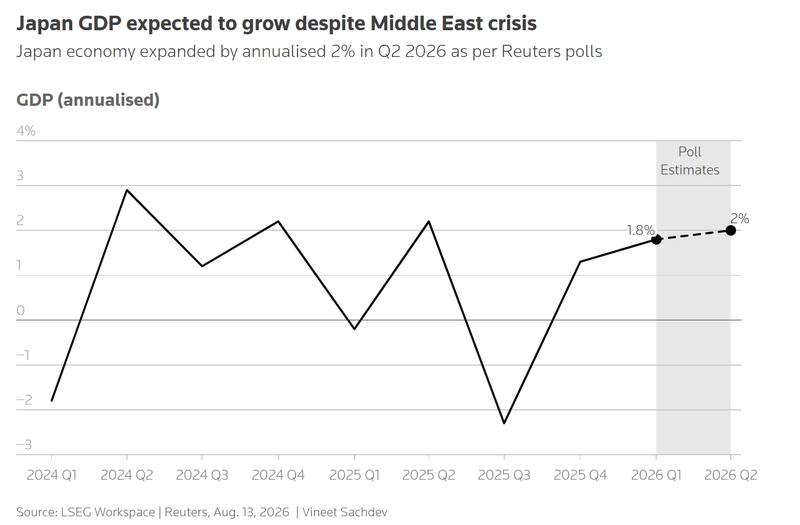
A third straight quarter of growth is the forecast, 2% annualised with the deflator cooling from 3.2 toward 2.3 and business spending swinging back from -0.7. That combination, growth holding while the price pressure moderates from imported-cost extremes, is exactly the mix a central bank wants before a hike, which is why the swaps market treats September's move to 1.25% as close to done. The wildcard cuts the other way: a collapsing deflator would argue the imported inflation is dying on its own, and give the doves one more meeting. Friday's CPI back at target would close that door. Source: LSEG / Reuters.
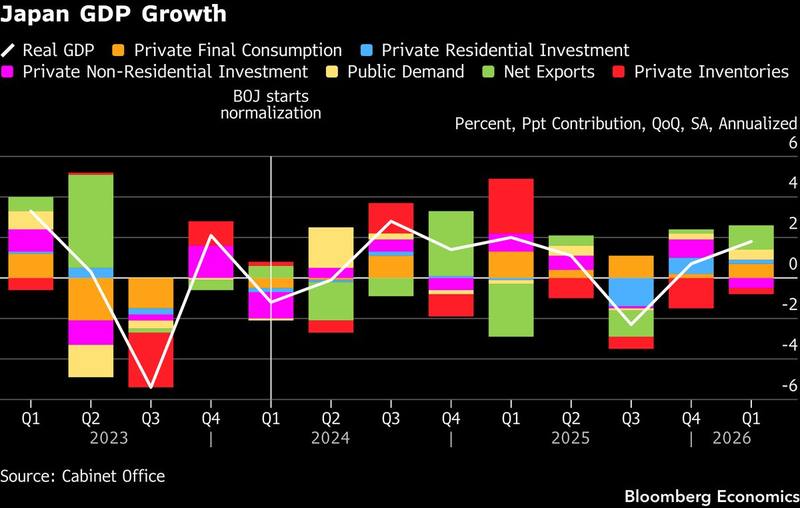
The composition is the hawk's argument: consumption and business investment both contribute while net exports hold, the domestic engine finally running alongside the external one. The house views sit far above consensus, as high as 3.1% annualised against the 2% survey, and the Bank's own potential-growth estimate is just 0.7. Anything near the high estimates makes the September-or-October hike a formality and the yen's fundamentals argument urgent. Source: Cabinet Office / Bloomberg Economics.
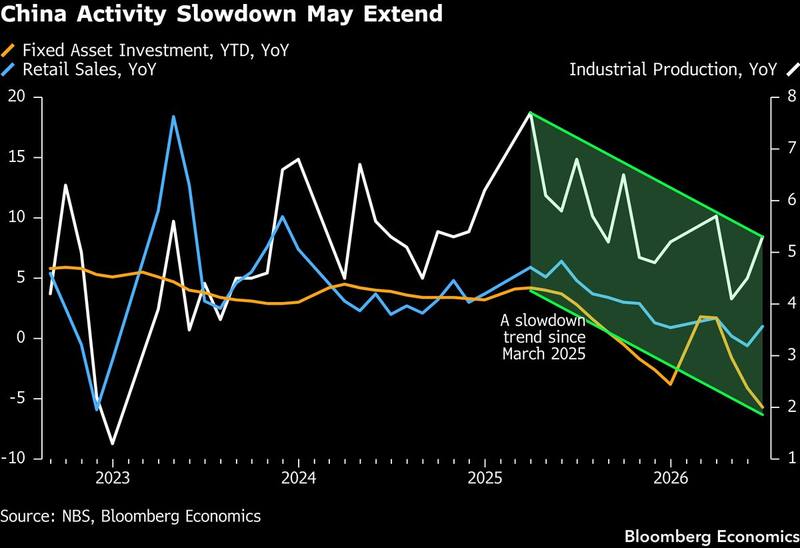
The slowdown channel since March 2025, drawn in green: industrial production stair-stepping lower, retail sales barely positive, investment contracting -6.4% on the year. The Politburo chose implementation over fresh stimulus at July's meeting, which makes Monday's print a test of the floor the market keeps assuming. Three o'clock instead of ten o'clock suggests someone wanted extra time to brief. Source: NBS / Bloomberg Economics.
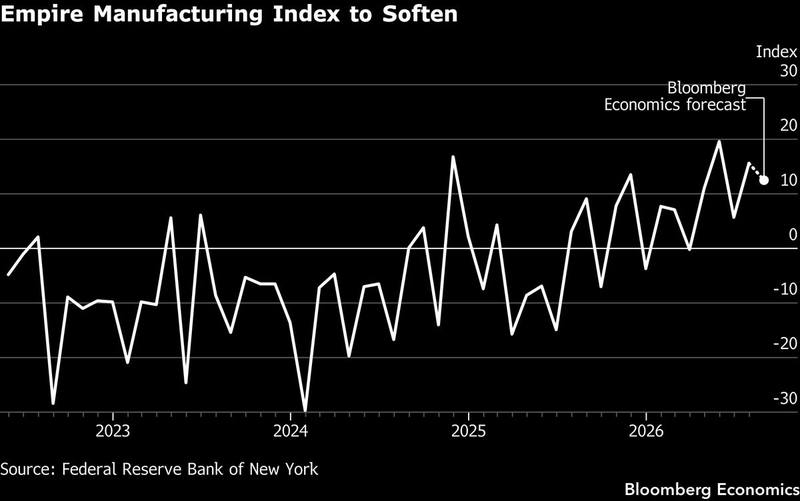
The counterpoint nobody trades but everybody quotes: Empire manufacturing seen easing only to a still-elevated 12.5, with July's new orders at 22 and shipments at a four-year high. The regional surveys keep insisting the industrial economy is fine while the payrolls insist the labour market is not. Both being right is exactly the stagflation-lite mix the minutes will be read against. Source: NY Fed / Bloomberg Economics.
Five-Year Tuesday
The duration tests open in Tokyo with the 5-year auction, the warm-up for Thursday's 20-year. The UK reports jobs with pay growth fading toward 2.8%, the soft prelude that makes Wednesday's CPI print so awkward. Home Depot opens the retail-earnings week and about twenty billion of US high-grade supply front-loads itself before the minutes.
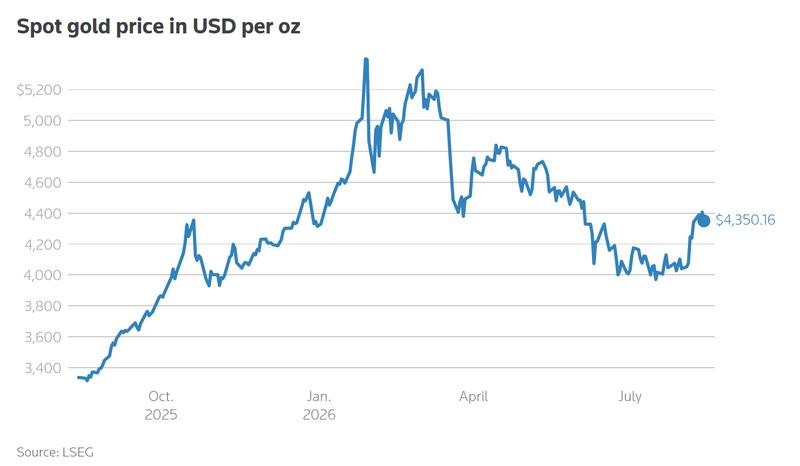
Gold's round trip is the week's quiet scoreboard. A 25% collapse from the war-panic highs restored its reputation the hard way, and from June's low near 3,965 it has climbed back almost 10% to 4,350. The buyers are not the ones who left: central banks bought 289 tonnes in the second quarter, the biggest on record, the PBOC has added for twenty straight months, and the ETFs have turned to inflows after four months of bleeding. Mine supply grew 3% while official demand grew multiples of that. In a week where the bond market questions the borrower, the asset that cannot be printed keeps finding official bids. Source: LSEG.
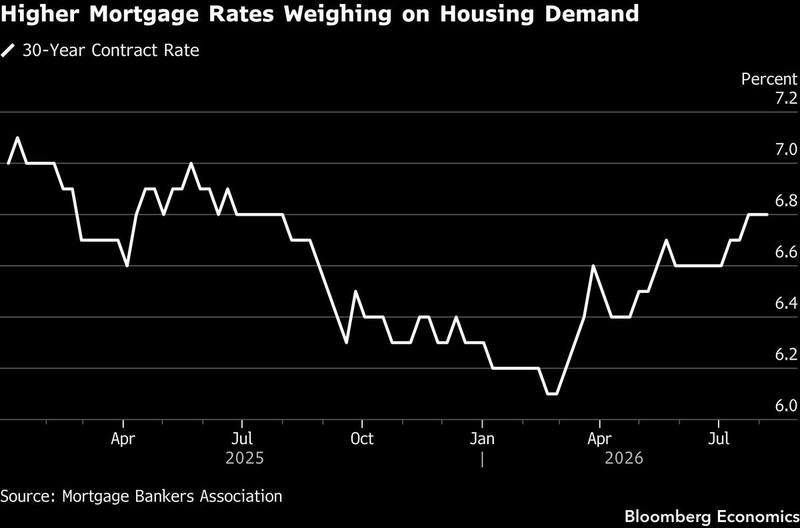
The housing week begins where the pain is: the 30-year contract rate back near 6.8%, its highest in a year, with starts seen falling 6% and pending sales depressed. The chair says markets are doing the tightening; this chart is the transmission, and it is why builders keep pivoting to multifamily while the median buyer waits. Source: MBA / Bloomberg Economics.
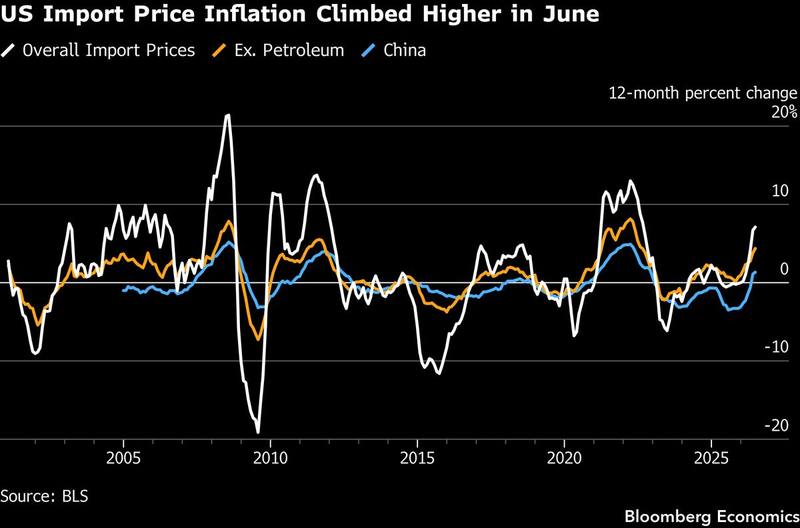
The quiet hawk in Tuesday's data: import prices running 7.1% on the year with the ex-petroleum measure accelerating, memory-chip shortages and AI hardware demand pressing on capital-goods prices. This is the pipeline inflation that never made the CPI debate, and it is the chart the three dissenters would show you first. Source: BLS / Bloomberg Economics.
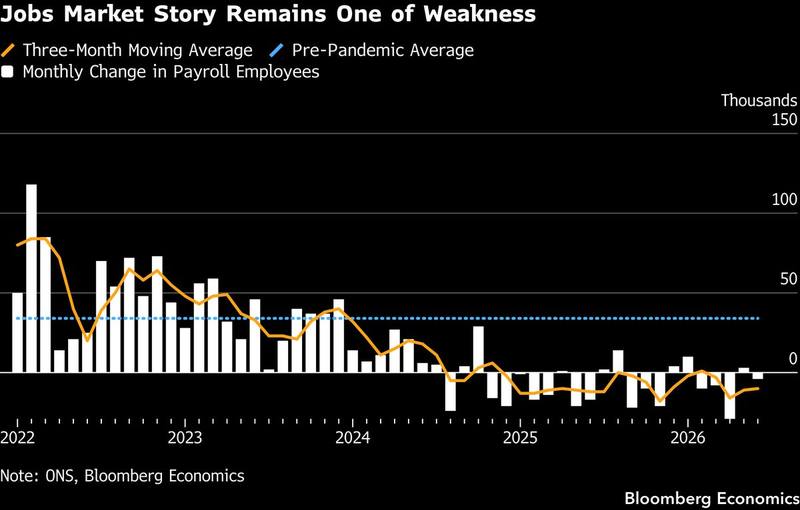
London's prelude, and it argues the doves' case: payroll employment has fallen in most months since the war began, the three-month average pinned below zero and far under the pre-pandemic norm. Pay growth near 2.8% is already consistent with target inflation. Everything pushing UK inflation higher this week is external; everything domestic is cooling. That tension is Wednesday's whole story. Source: ONS / Bloomberg Economics.
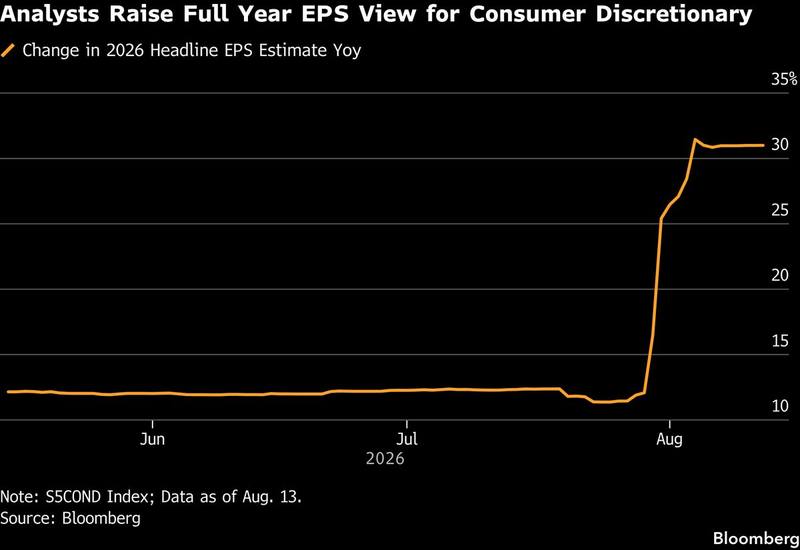
The bar Walmart's week must clear, redrawn in a fortnight: 2026 consumer-discretionary earnings estimates leapt from about 12% growth to 31% in two weeks of beat-and-raise results. Retailers are clearing lowered macro expectations with prudence-proof margins. The risk is no longer the quarter, it is the guidance against a bar that just tripled. Source: Bloomberg.
Energy-Cap Wednesday
The pivot day. UK CPI in the London morning, Bank Indonesia through our afternoon, Canada's tariff deadline in the US session, Target and Lowe's around it, and then, at two in our Thursday morning, the July FOMC minutes. A day that starts with a food-and-energy inflation print and ends with the committee's private argument made public.
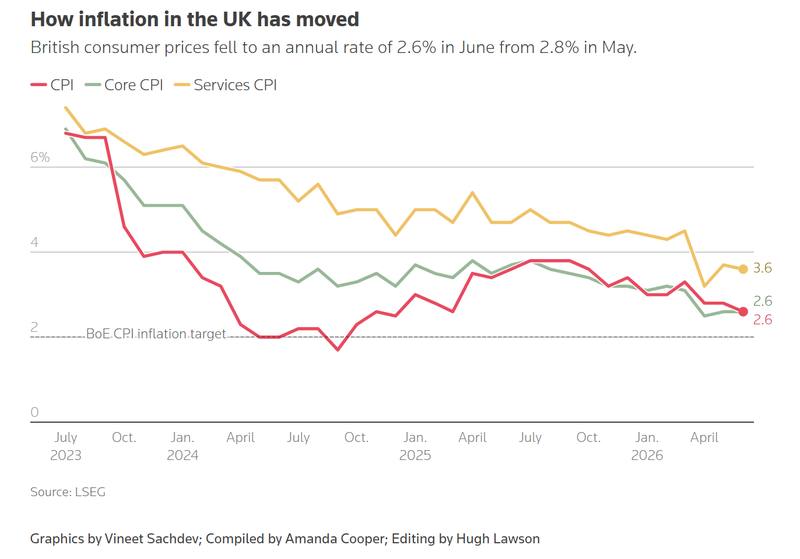
The re-acceleration is scripted; the composition is not. Headline is seen jumping to 2.9% from 2.6 as the household energy cap resets, with services still at 3.6 and core at 2.6. The gilt market's rule this week is composition over level: an energy-driven headline is a base effect wearing a headline, and fades; a core and services overshoot into 2.8% pay growth is the true repricing event, because it hands the Bank of England a hike argument just as the cost-of-living politics peak. Supermarkets are already pre-announcing a food shock. The new prime minister's honeymoon meets its first hot print. Source: LSEG.
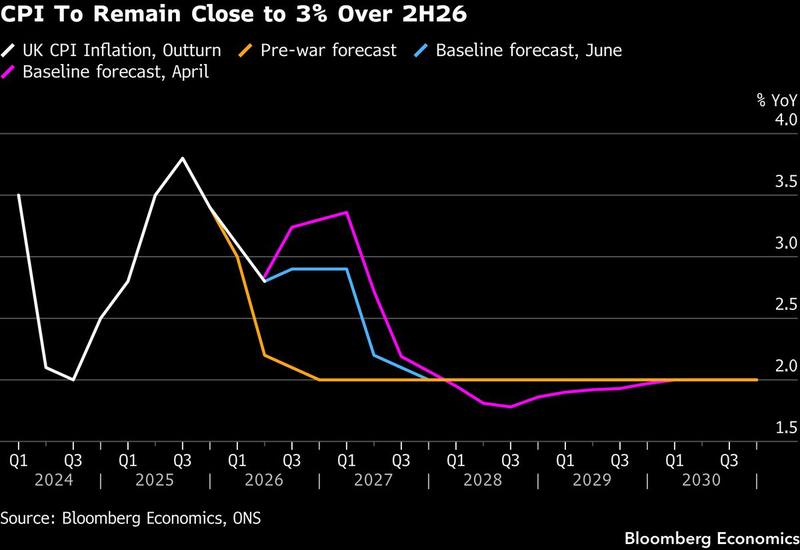
The path after Wednesday is the argument for patience: the house forecast holds UK inflation near 3% through year-end before a 2027 fade, entirely an energy story, with the pre-war path two full points lower for reference. The Bank of England's bar for hiking into externally driven inflation is high while pay cools. The overshoot that would matter is domestic, and so far it is not there. Source: ONS / Bloomberg Economics.
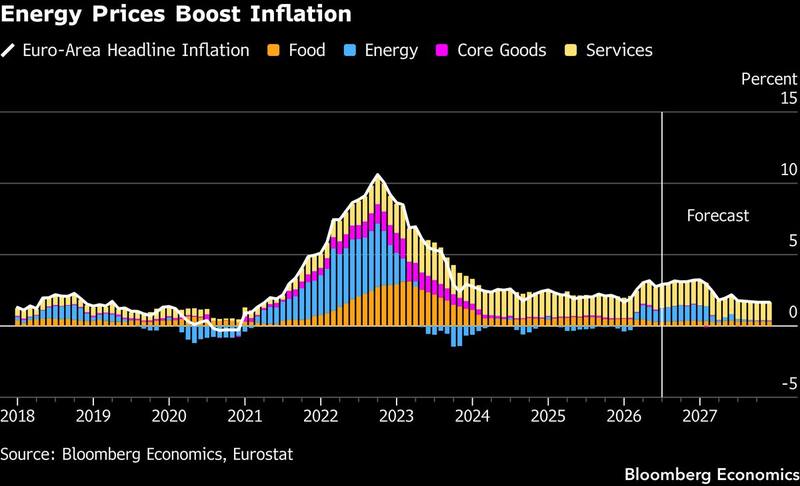
The euro area runs the same decomposition with a different conclusion: headline at 2.9% with the blue energy band doing the recent lifting and services still fat. The ECB reads resilience plus energy pass-through as licence for a September hike, priced above 80%. Friday's negotiated wages at 2.5% are the offset; the second-round effects have not arrived, but the Council intends not to wait for them. Source: Eurostat / Bloomberg Economics.
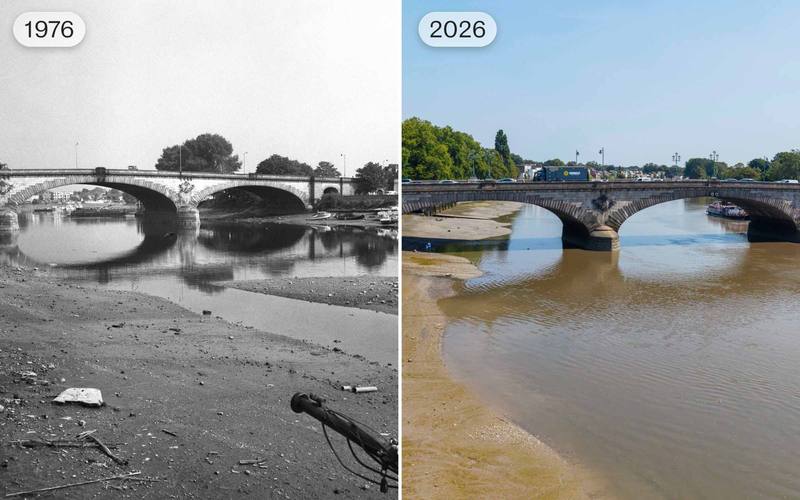
The same bridge, fifty years apart, and the reason food is in the UK print: Kew's stretch of the Thames in the 1976 drought and this month. The old drought was longer; 2026 reached the same river levels in a fraction of the time, which is what worries the hydrologists, and the supermarkets pre-announcing a food-price shock. The energy cap lifts Wednesday's headline; the dry riverbed is working on the next one. Source: The Times.
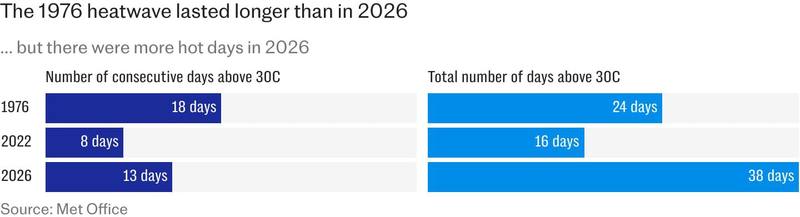
The scoreboard behind the photographs: 1976 keeps the record for consecutive days above 30C, but 2026 has already logged 38 total hot days against 24, with August unfinished. Fewer streaks, more heat. It is the quiet input behind the food-inflation regime, and behind the El Nino map at the top of this letter. Source: Met Office.
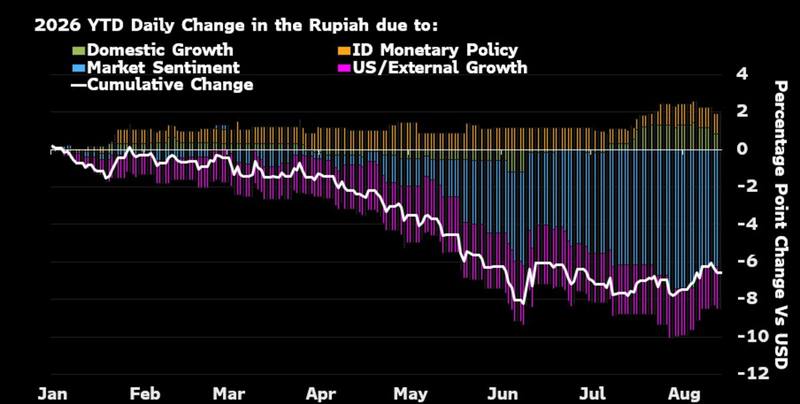
Bank Indonesia's afternoon, decomposed: the rupiah's decline this year is almost entirely the purple and blue bars, external growth and sentiment, while the orange policy bar has fought the other way all year. That is the case for the new governor holding at 5.75% and defending with tools rather than rates. IDR stays on the radar precisely because the damage is imported, not earned. Source: Bloomberg Economics.
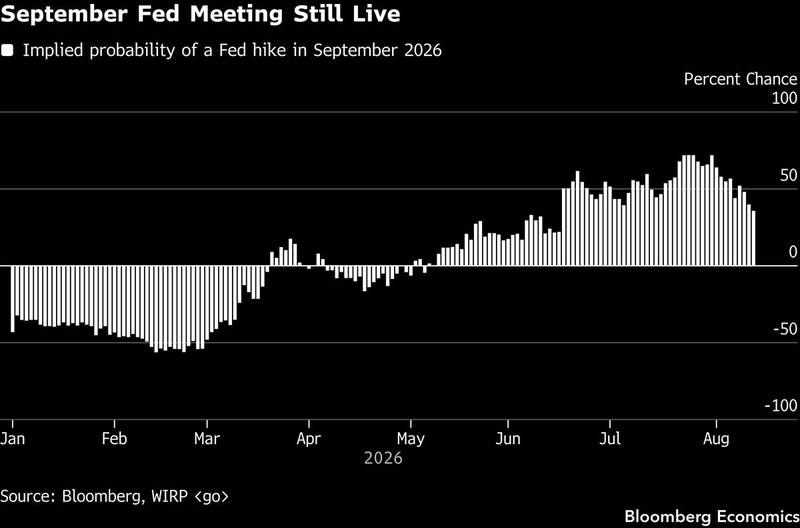
And the chart the minutes land on: September's implied hike probability spent late July above 50% and has bled toward a third since the payrolls shock. The minutes predate that shock, which is exactly the danger: nine of eighteen June dots wanted at least one hike this year, and a hawkish transcript hitting a dovish tape is how 30% becomes 50% overnight. The market is short conviction either way; the minutes supply some. Source: Bloomberg WIRP.
Receipts Thursday
The week's verdicts arrive stacked: the minutes at 2am our time, Walmart before the US open, the 20-year JGB auction in our morning, China's loan prime rates, Taiwan's export orders and the Riksbank in between. By Thursday night the week's three questions, the Fed's temperature, the consumer's pulse, and the bond market's patience, all have answers.
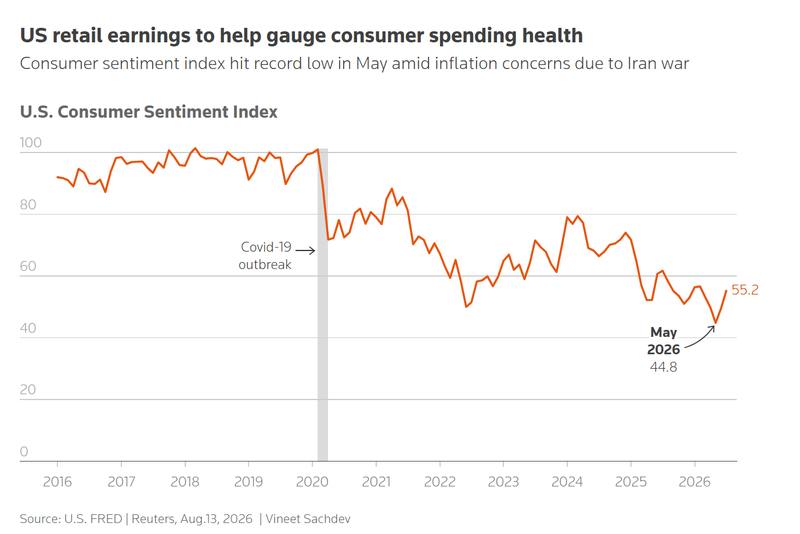
Walmart reports into this chart. Consumer sentiment at 55.2 is barely off May's record low of 44.8, lower than the depths of Covid, with gas above four dollars and the war's costs polling terribly. Yet spending has not cracked, which is precisely the tension retail earnings resolve better than any survey: Walmart shows whether households are trading down inside the basket, Home Depot and Lowe's whether the home-improvement dollar survived higher rates, Deere whether the farm economy absorbed its input costs. The gap between what Americans say and what they scan has never been this wide. Receipts beat feelings; Thursday we get the receipts. Source: FRED / Reuters.
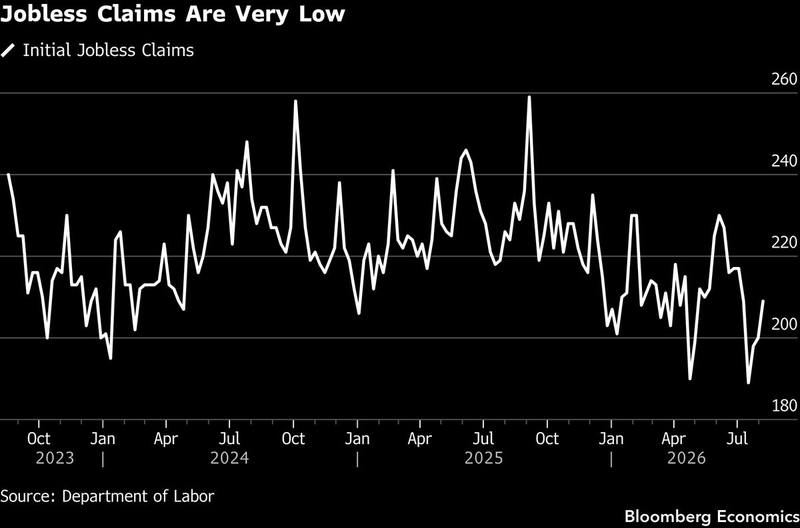
The other half of the no-hire, no-fire bargain is holding: claims near 205k, historically low, drifting lower through the very months payrolls went negative. Firms are not shedding; they have simply stopped adding. That distinction is what keeps the hike camp alive, because a labour market weak on hiring but tight on firing does not scream for insurance cuts. Source: Department of Labor / Bloomberg Economics.
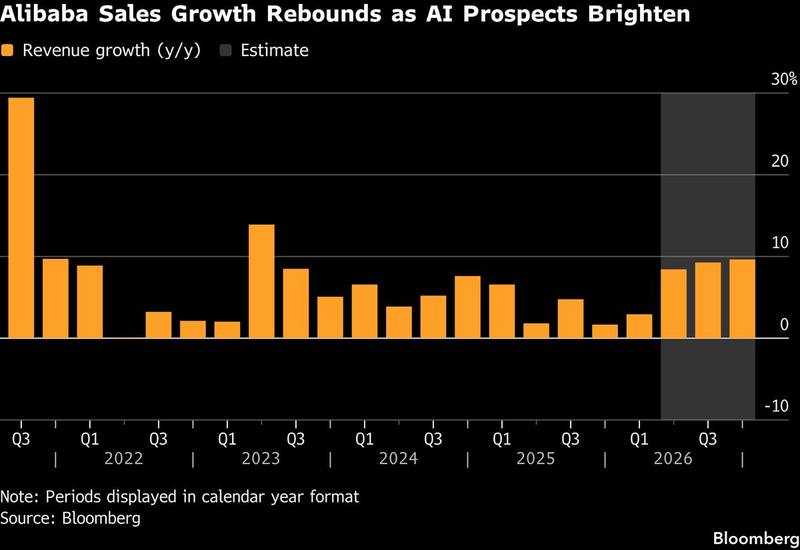
The other Thursday heavyweight reports from the far side of the fracture: Alibaba's revenue growth rebounding toward 9% as its AI story brightens, the first genuine reacceleration since 2023. Chinese tech spent two years repricing for a slowdown Beijing would not stimulate away; an AI-led revenue turn, if it holds, is the cheapest optionality in the complex. The capex question travels with it. Source: Bloomberg.
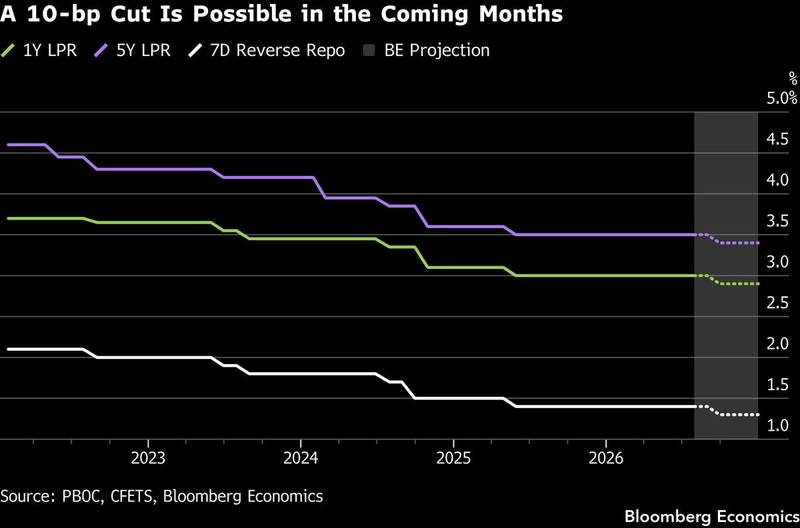
The fixing that says nothing and signals everything: loan prime rates expected unchanged for a 15th straight month Thursday, but the house view has a 10-basis-point PBOC cut within a month or two, with the LPRs to follow. Beijing's patience with the slowdown is measured on this chart. When the dotted line finally steps down, the stimulus-reflex trade gets its confirmation, at the yuan's expense. Source: PBOC / Bloomberg Economics.
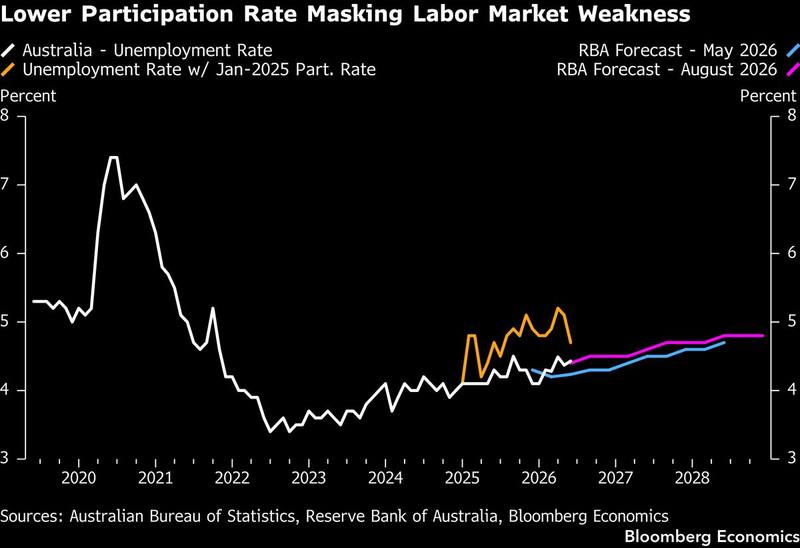
Australia's labour data carries a hidden line: the orange series shows unemployment near 5% if participation had held at January-2025 levels, half a point above the published rate. The RBA's own August forecast just shifted higher. After June's freak 76k jobs surge, a reversal Thursday would confirm the softening the hidden line already shows, and cap the AUD's rate support. Source: ABS, RBA / Bloomberg Economics.
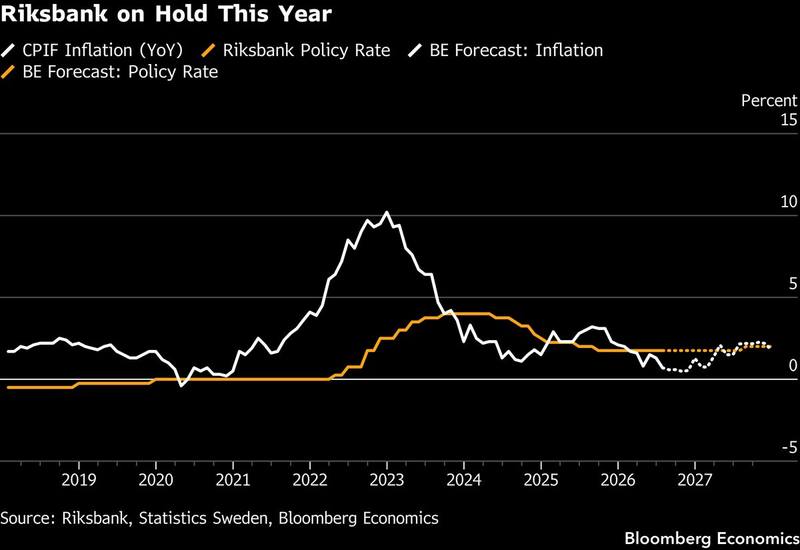
Sweden is the mirror-image curiosity of the week: headline inflation pushed below 1% by fiscal relief, a policy rate at 1.75%, and guidance expected to stay vigilant anyway because the relief unwinds into winter. Stockholm is what the post-shock world looks like when energy exposure is small: boring, and enviable. File it as the control group for everyone else's food-and-energy argument. Source: Riksbank / Bloomberg Economics.
Flash Friday
Japan's CPI in our morning is the last box on the September checklist, and the flash PMIs walk the week out. The rule from the top of the letter applies: whatever Friday prints, Jackson Hole is Monday's problem, and positions carried through the weekend should be the ones sized for a chair with a mountain microphone.
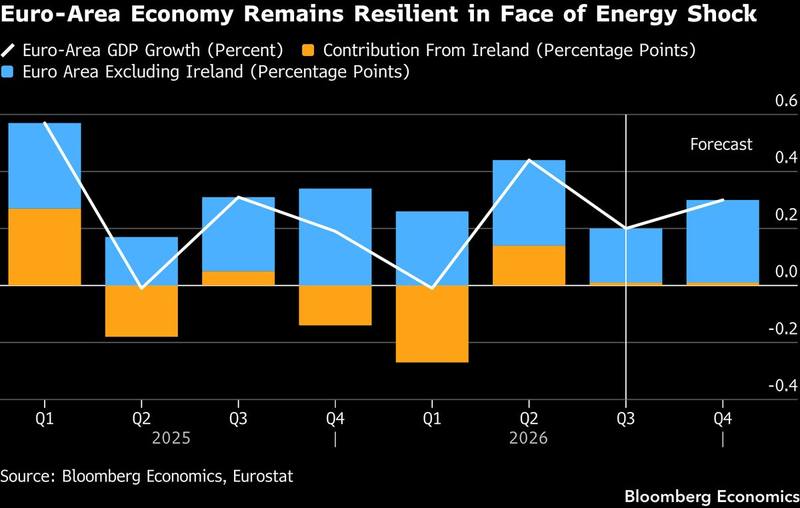
What Friday's flash PMIs are testing: euro-area growth of 0.4% in Q2 even stripping the Irish distortion, resilience the energy shock was supposed to prevent. July's composite at 52.0 says the momentum carried into Q3; confirmation Friday underwrites the ECB's September hike and the euro's claim on 1.16. The upside surprise of 2026 has quietly been Europe. Source: Eurostat / Bloomberg Economics.
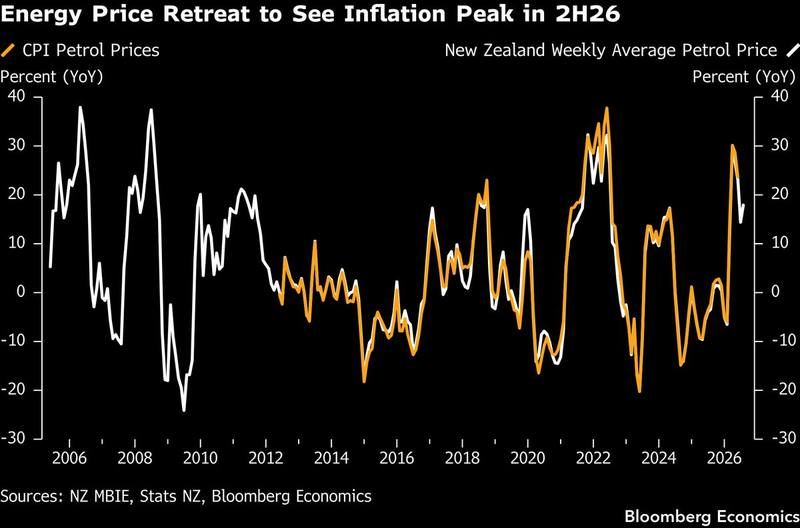
The little chart with the big lesson: New Zealand's CPI petrol component tracks the weekly pump price almost perfectly, and both are rolling over from the war spike. Fuel is the fast channel; food is the slow one now taking over, which is this year's whole inflation sequencing in one small economy. The RBNZ gets its relief first and its food problem second. Source: NZ MBIE / Bloomberg Economics.
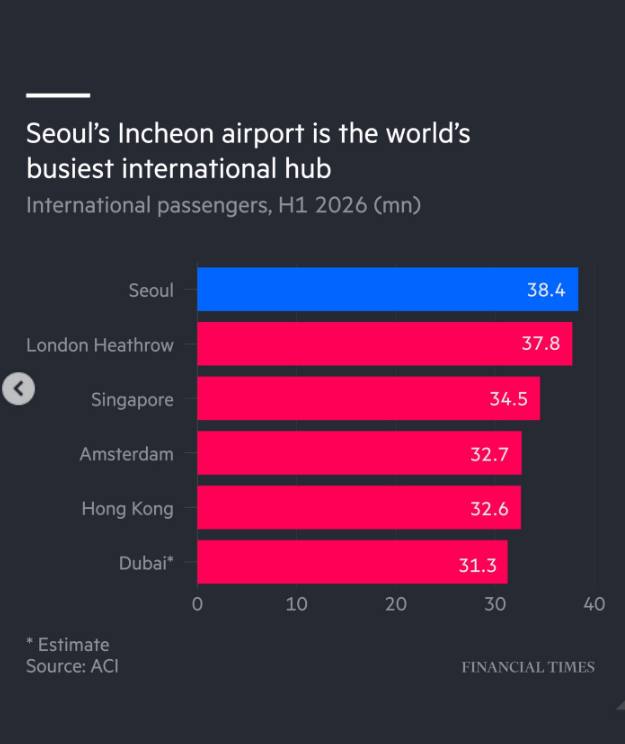
A war reroutes the world's connections quietly. Incheon handled 38.4 million international passengers in the first half, overtaking Heathrow, Singapore and a Dubai diminished by the Gulf conflict, the first time Seoul has topped the table. Traffic that used to connect through the Middle East now connects through Northeast Asia, and infrastructure follows traffic with a lag measured in decades. File it with the travel dispatch below: the war's most permanent effects may be the ones that never make the front page. Source: ACI / FT.
The AI Fracture, week seven: the industry writes its own put
The theme's new chapter is off balance sheet. Nvidia assembled six investment giants, BlackRock, Goldman, Apollo, Blackstone, Brookfield and KKR, into a $500 billion financing coalition for its customers' build-out, and offered residual-value guarantees on up to a quarter of individual projects. Investors count roughly $70 billion of such shadow backstops already written on the Meta and Broadcom templates, including the $29 billion supporting the chips leased to Anthropic, liabilities that appear on no balance sheet because their triggering is deemed "not probable". One desk called it what it is: writing a put that is nearly costless in the boom and lands precisely when customers default and hardware values fall. Private-debt defaults just set a fresh record, the software-disruption trade has its own name now, and the regulator quietly made data-centre securitisation easier the same week. Credit is no longer just funding the build-out; it is insuring it, with the insurer and the beneficiary increasingly the same industry.

The slide that explains the coalition. Data-centre spending triples from $567 billion in 2025 to $1.75 trillion in 2027, but the operating-cashflow share barely doubles, leaving $1,030 billion of external financing needed in 2027 alone, and the leading lab's cash runs negative by early 2027 without new money. This is why the chipmaker is orchestrating half a trillion of other people's capital, why the backstops exist, and why the labs' fundraisings are described as final. The build-out has outgrown the industry's own cash machine; from here, it borrows from everyone else's. Source: Bridgewater, A Critical Time for AI.
The 500 billion euro habit change
The special report of the week is Germany's pension overhaul, the biggest since Bismarck invented the system 130 years ago. From January 2027, the guaranteed-capital Riester system gives way to subsidised brokerage accounts, ETFs capped at 1% fees, private markets via ELTIFs for those who pay up, and the private pension pot is projected to double to €500 billion within a decade, with €26 to €56 billion a year of fresh inflows once onboarding completes. Trillions sit in German bank deposits earning nothing; the state is finally paying its citizens to move them. Every asset manager in Europe is racing to be on the shelf by January, because the first fund a German saver buys is the one they keep. File this next to the dollar's false break: the structural bid for European assets keeps getting new legs.
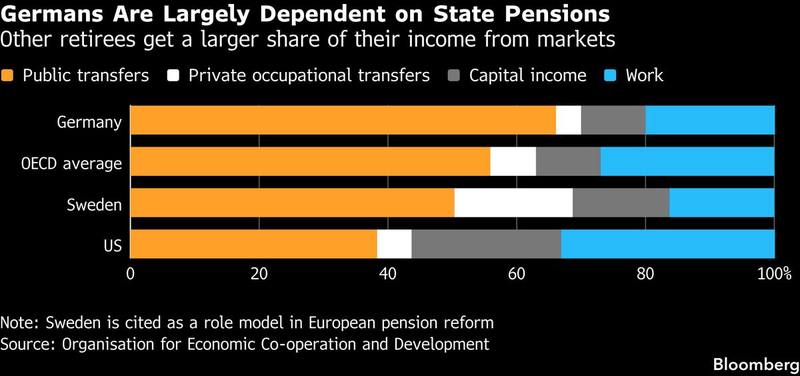
The dependence being unwound: German retirees draw two-thirds of their income from public transfers against an OECD average near 56%, with capital income the thinnest slice among the big economies. The mandatory pension's replacement rate for workers starting this decade is 53% against the 80% advisers recommend. The gap is the product being sold from January 2027, and it is the widest in the developed world. Source: OECD / Bloomberg.
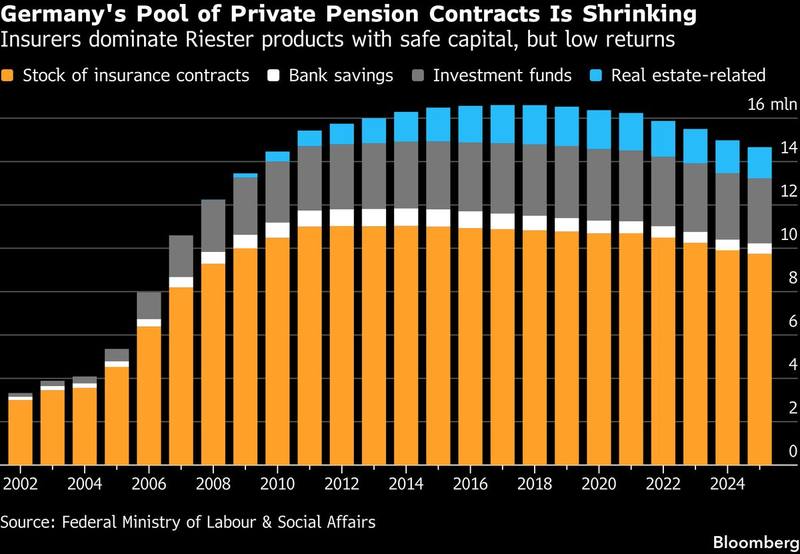
The system being replaced is already shrinking: Riester contracts peaked a decade ago and have bled ever since, insurers dominating a product whose guaranteed capital guaranteed mostly low returns. Roughly €225 billion sits inside, and consultants expect more than a quarter of it to move. A shrinking pool of guaranteed products meeting a subsidised brokerage account is how a deposit culture ends, one transfer form at a time. Source: Federal Ministry of Labour / Bloomberg.
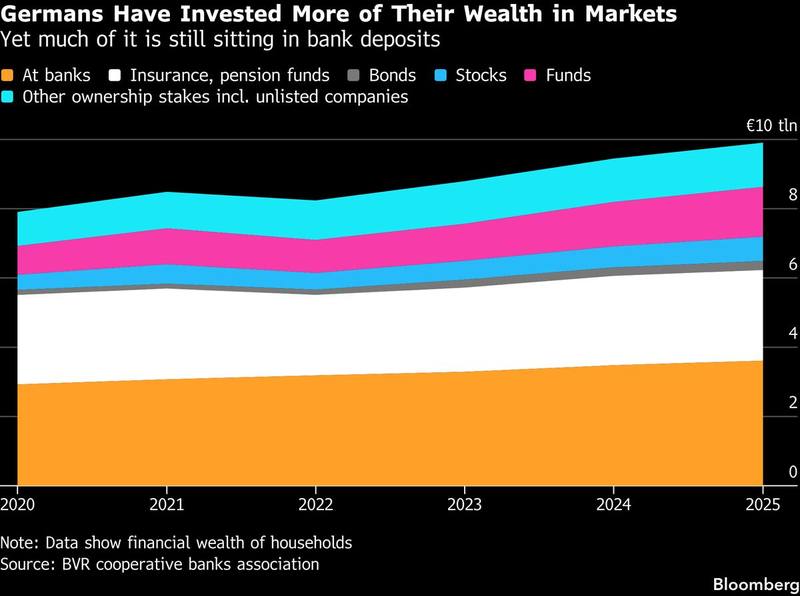
The prize, drawn to scale: German household financial wealth approaches €10 trillion, and the orange band, plain bank deposits, is still the largest single slice, more than three trillion earning next to nothing. The reform does not need to convert Germany into a nation of stock-pickers; it needs to move a few percentage points of the orange band, and a few points of ten trillion is the entire German fund industry's decade. Source: BVR / Bloomberg.
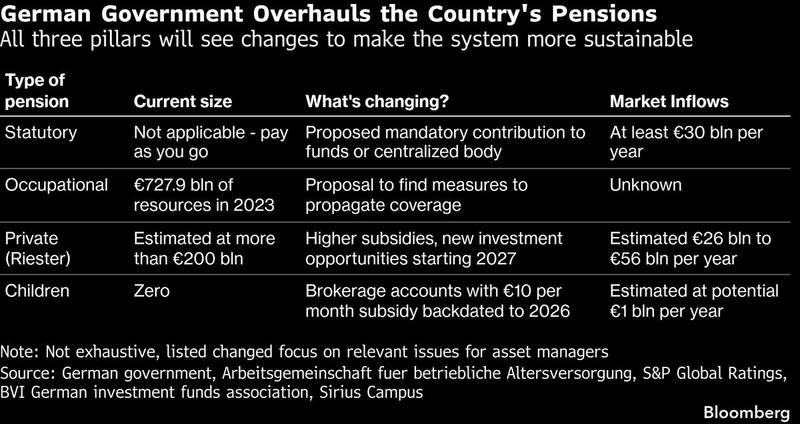
All three pillars move at once: the statutory system channels €30 billion a year into markets, occupational coverage gets propagated, private accounts get higher subsidies and real investment menus, and children get brokerage accounts with a €10 monthly subsidy backdated to 2026, an entire generation onboarded to capital markets by default. The inflow estimates of €26 to €56 billion a year are the widest-ranged number in the story, because nobody knows how fast a 130-year habit breaks. Source: German government, S&P / Bloomberg.
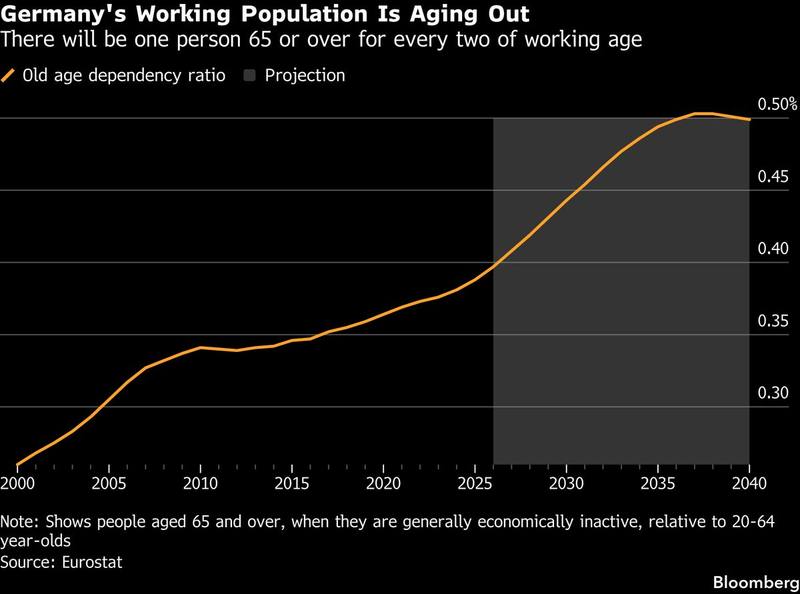
And the reason there is no alternative: by the mid-2030s there will be one German aged 65 or over for every two of working age, the dependency ratio crossing 0.5 within the projection window. The pay-as-you-go system already consumes a quarter of the federal budget. This chart is why the reform is happening under a conservative chancellor, why the insurers lost the argument, and why the flows are structural rather than cyclical: demography does not mean-revert. Source: Eurostat / Bloomberg.
The Midterm Clock
Eleven weeks to the midterms, and the political charts now belong in a market letter, because the clock disciplines every policy from tariffs to the war to the pressure on the Fed. The war is the wedge: 60% of Americans say the administration is spending too much on it, and the golden-age economic message is not landing against four-dollar gas and grocery bills.
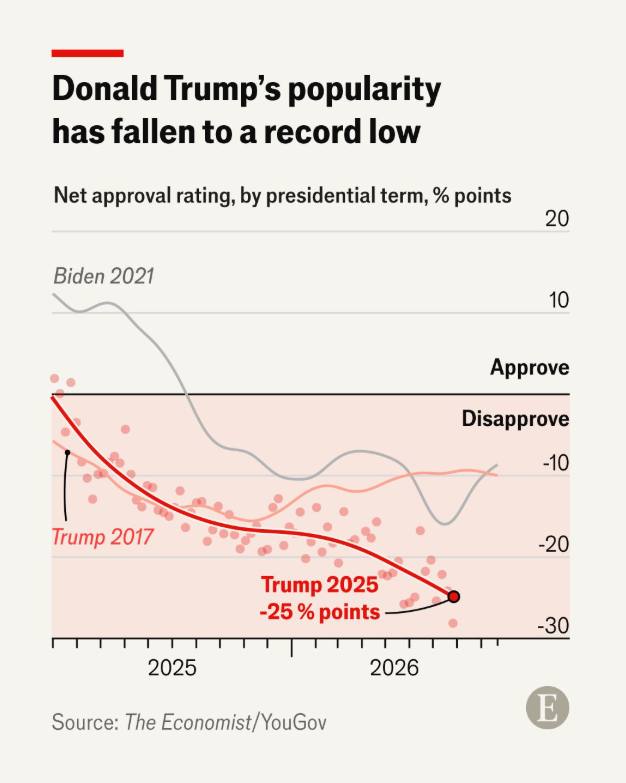
A record low, and the trend matters more than the level: net approval at -25, below every point of both terms, with the inflation rating lower still. The mid-July resumption of strikes on Iran maps almost exactly onto the latest leg down. Presidents at these numbers do not sit still; they reach for off-ramps, deals and scapegoats, and all three are tradeable. Source: The Economist / YouGov.
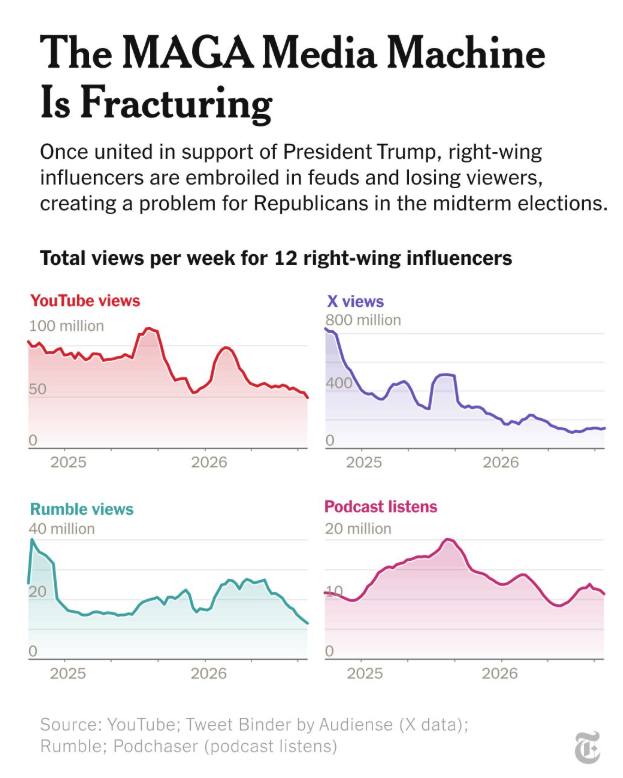
The messaging machine is fracturing at the wrong moment: weekly views across the twelve biggest pro-administration creators have fallen from their peaks on every platform at once, while the critics gain unevenly. For a coalition that relies on a united content front to drive turnout, a fractured machine eleven weeks out is a structural problem no ad budget fixes quickly. Source: NYT analysis.
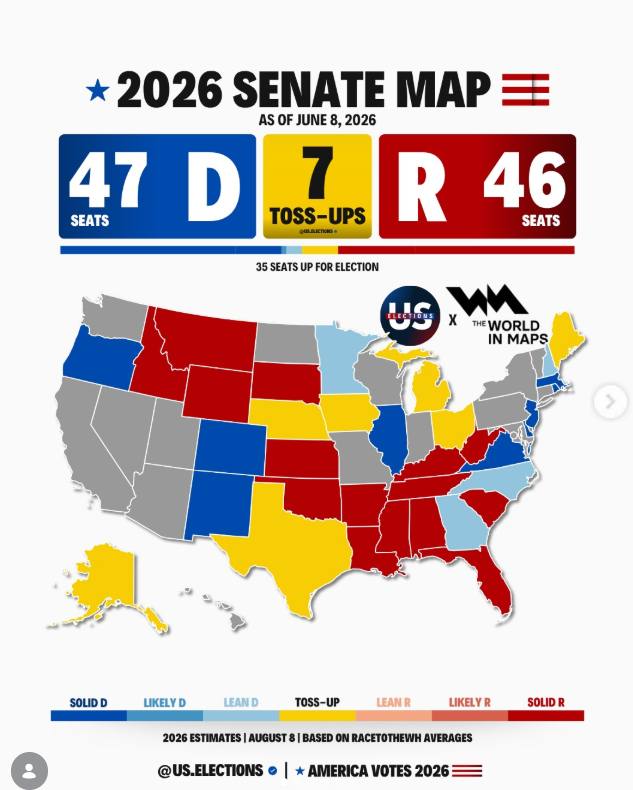
The map prices a coin flip: 47 Democratic seats, 46 Republican, seven toss-ups, with Alaska and Maine drifting into the undecided column and North Carolina tightening. Every seat on this map now trades off the same three inputs: grocery prices, the war, and turnout the content machine used to supply. Source: US Elections / RacetotheWH.
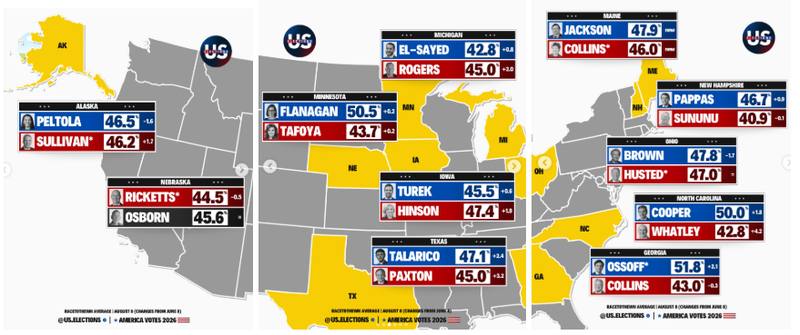
And the race this letter has followed: Michigan shows El-Sayed at 42.8 against Rogers at 45.0, the progressive who beat $70 million of establishment money now trailing by two with the affordability message both sides want to own. Ohio, Iowa and Texas within striking distance explain why nobody is pretending the map is settled. The politics of grocery prices, again. Source: RacetotheWH averages.
VC+ Special Dispatch, The New Geography of Global Travel
Nine charts on where tourism boomed, strained and pulled back, and the map has been redrawn: the rebound favoured a different set of destinations, Asia's passports and airports climbed the rankings, and North America's cross-border market suffered a historic reversal. Travel is the most human of the trade flows, which is why its geography moves first when politics and war move. Credit to the VC+ team.
Infographic 1 - Countries Losing and Gaining the Most Tourists
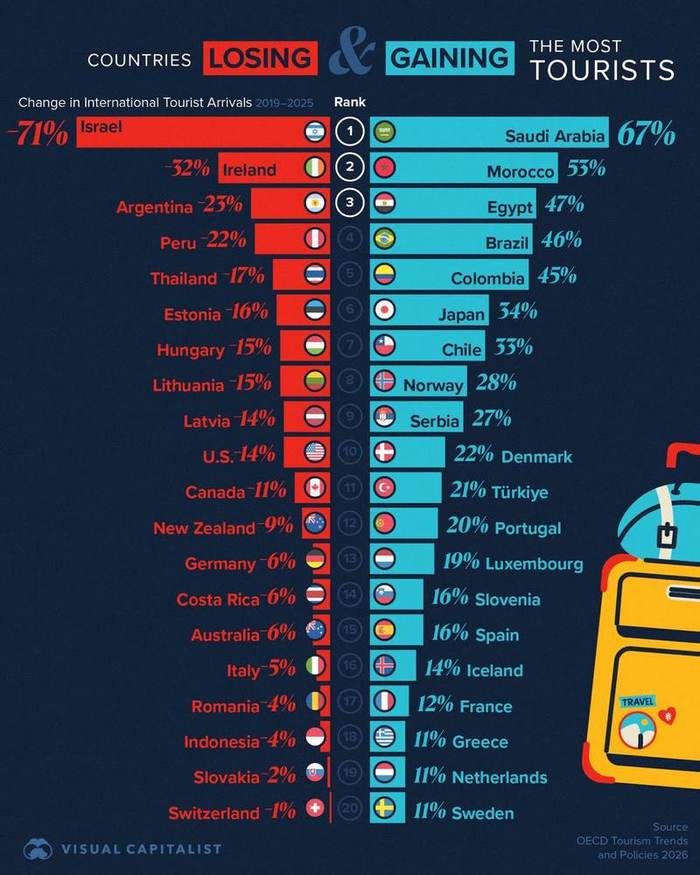
The rebound chose sides: Saudi Arabia +67%, Morocco +53% and Egypt +47% since 2019 while Israel sits at -71% and, remarkably, the US at -14%, one of only two rich western countries in the losing column with Canada. Wars empty some destinations and policy empties others; the winners built capacity while the losers built barriers. Source: OECD / Visual Capitalist.
Infographic 2 - Tourism Reliance by Share of GDP
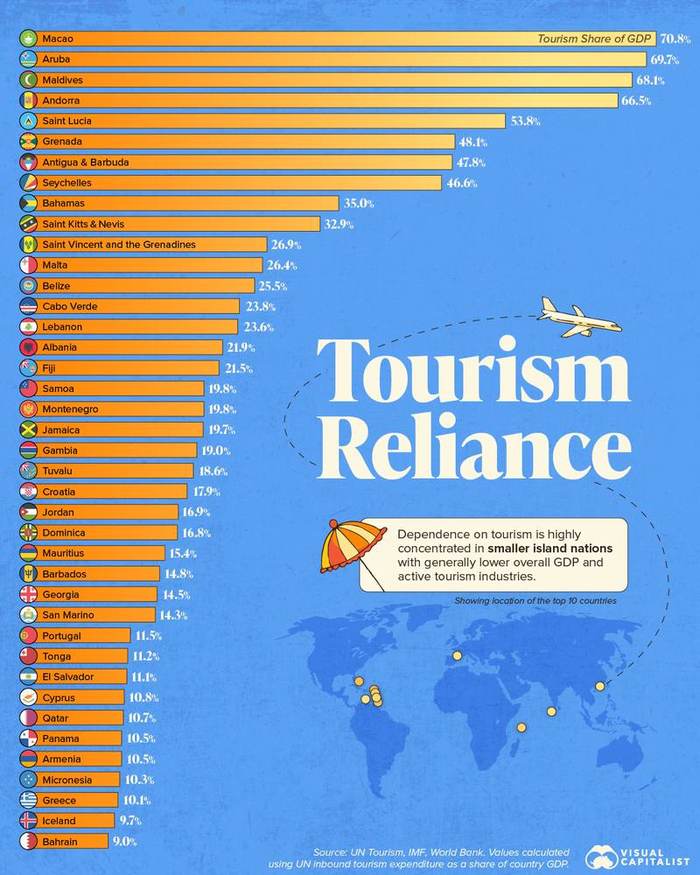
Who cannot afford the reshuffle: Macao at 70.8% of GDP, the Maldives at 68, a dozen island states above a quarter of their economies. For these balance sheets tourism is not an export, it is the export, and every shift in the arrival map above is a sovereign-credit event somewhere on this list. Source: UN Tourism, IMF / Visual Capitalist.
Infographic 3 - Where Tourists Outnumber the Locals
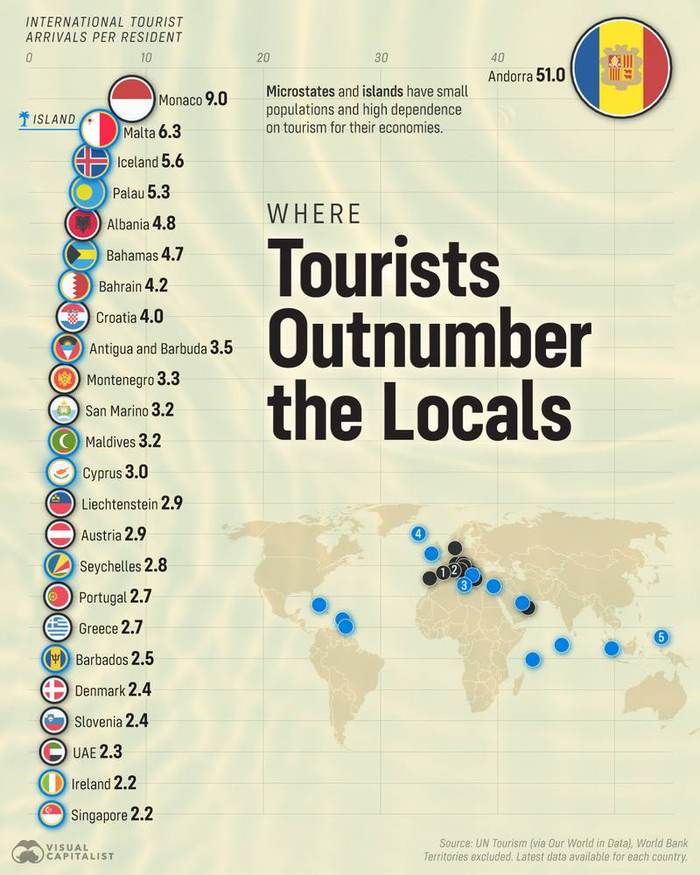
Andorra receives 51 visitors per resident, Monaco nine, and everything above 2 on this chart is a polity whose infrastructure, housing and politics are built for people who do not vote there. Overtourism backlash is this chart's shadow; the places most reliant are the places most likely to start charging for entry. Source: UN Tourism / Visual Capitalist.
Infographic 4 - Europe's Tourism Hubs
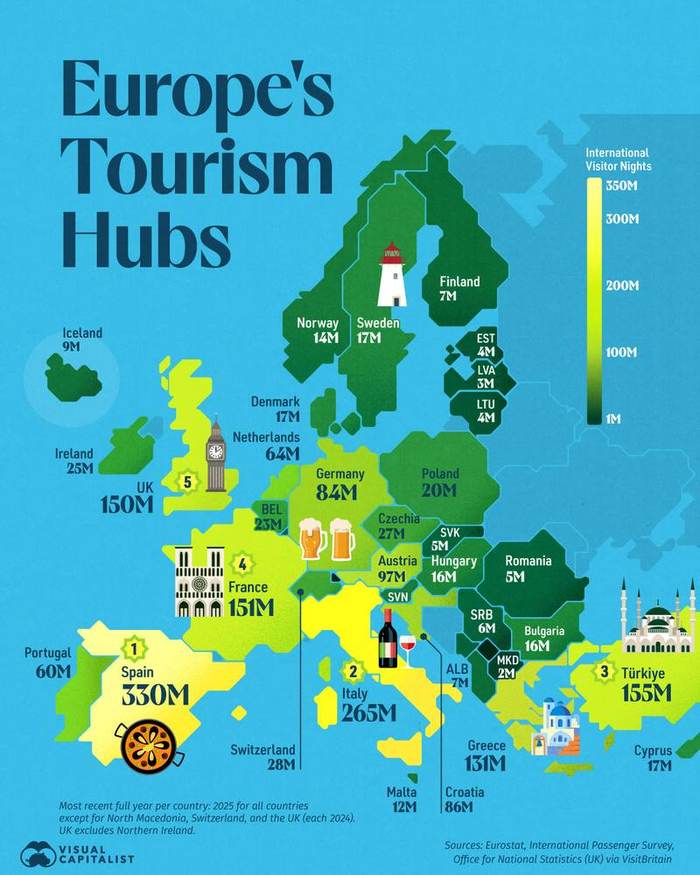
Spain absorbed 330 million international visitor nights, Italy 265, France and Türkiye around 150 each, the Mediterranean carrying the continent's tourism economy while the north stays green and quiet. Now overlay this map on the heatwave and drought charts further down: Europe's tourism engine sits exactly where the climate is turning hostile in August. Source: Eurostat / Visual Capitalist.
Infographic 5 - The Most Visited Cities in the US
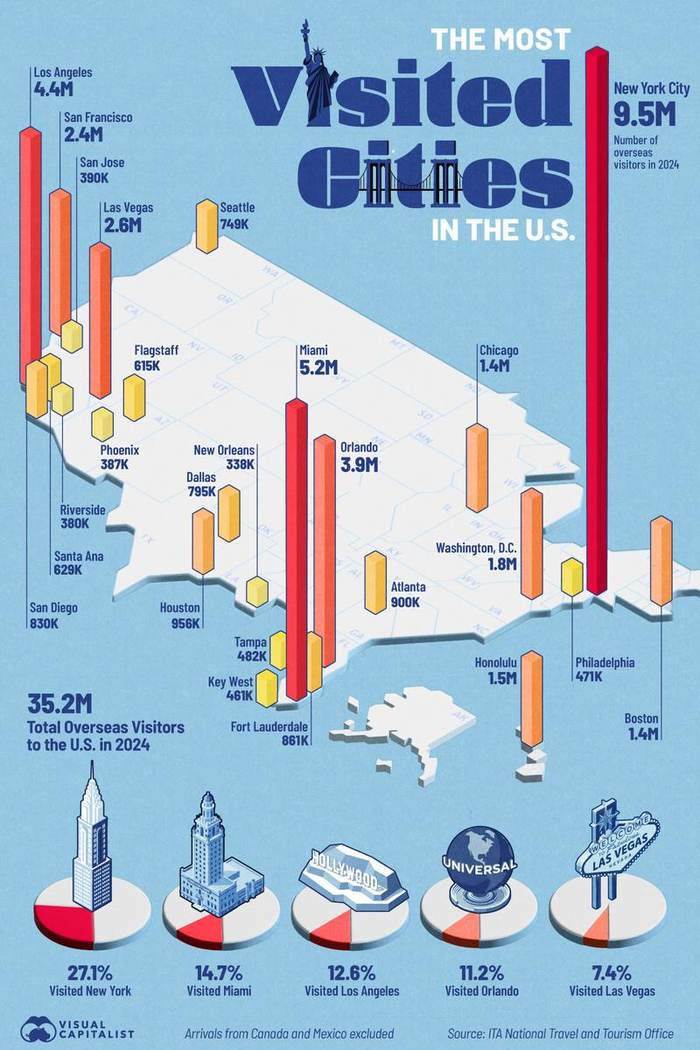
New York alone drew 9.5 million overseas visitors, more than a quarter of the 35.2 million US total, with Miami, LA, Orlando and Vegas rounding out the funnel. The concentration is the vulnerability: when overseas demand softens, as it now is, five metros absorb most of the pain, and four of them are in states on the Senate map above. Source: ITA / Visual Capitalist.
Infographic 6 - The Decline of Canadian Travel to the US
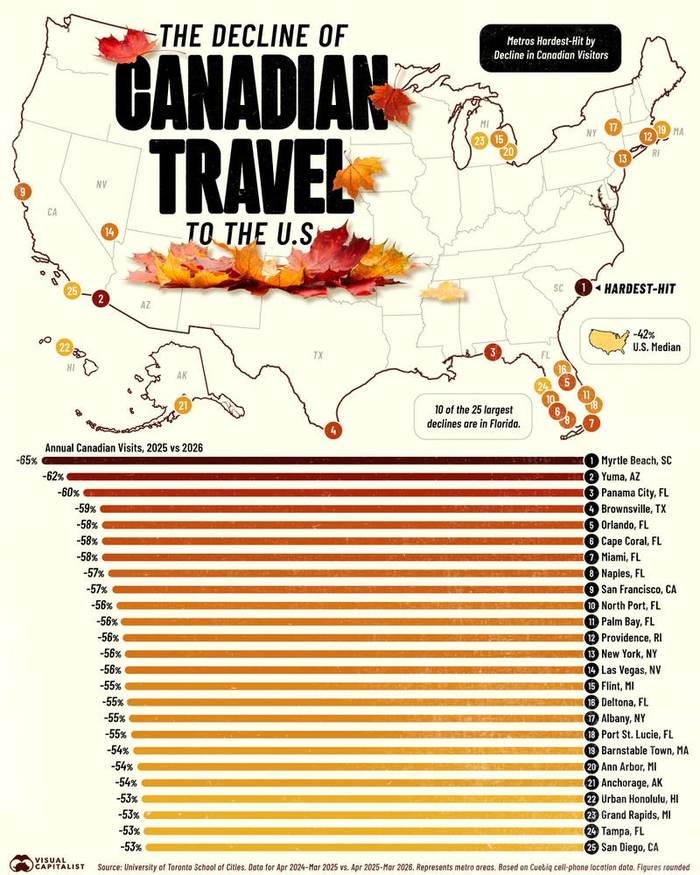
The historic reversal, city by city: Canadian visits down a median 42% across US metros, Myrtle Beach down 65%, ten of the 25 steepest declines in Florida. This is what a trade war does to the most discretionary flow of all; the tariff deadline on Wednesday decides whether the snowbirds get a reason to return before winter. Source: University of Toronto / Visual Capitalist.
Infographic 7 - The World's Busiest Airports
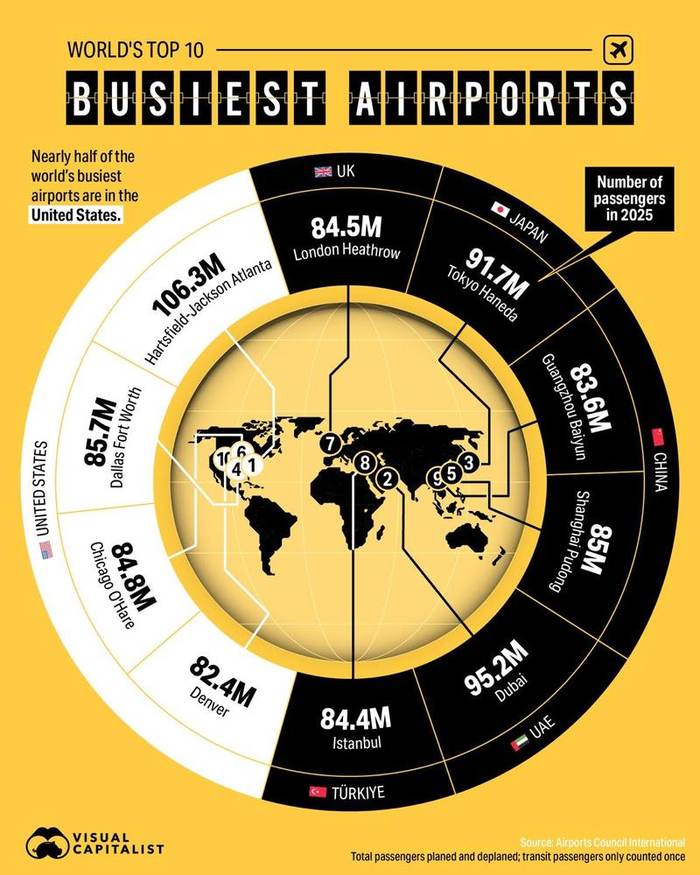
Half the top ten are still American, Atlanta first at 106 million total passengers, but the international rankings tell the real story: Dubai's war-diminished traffic let Seoul take the crown, and Tokyo, Guangzhou and Shanghai all sit inside the top ten. Domestic scale is American; international growth is Asian; infrastructure spending follows the second number. Source: ACI / Visual Capitalist.
Infographic 8 - Passport Power 2026
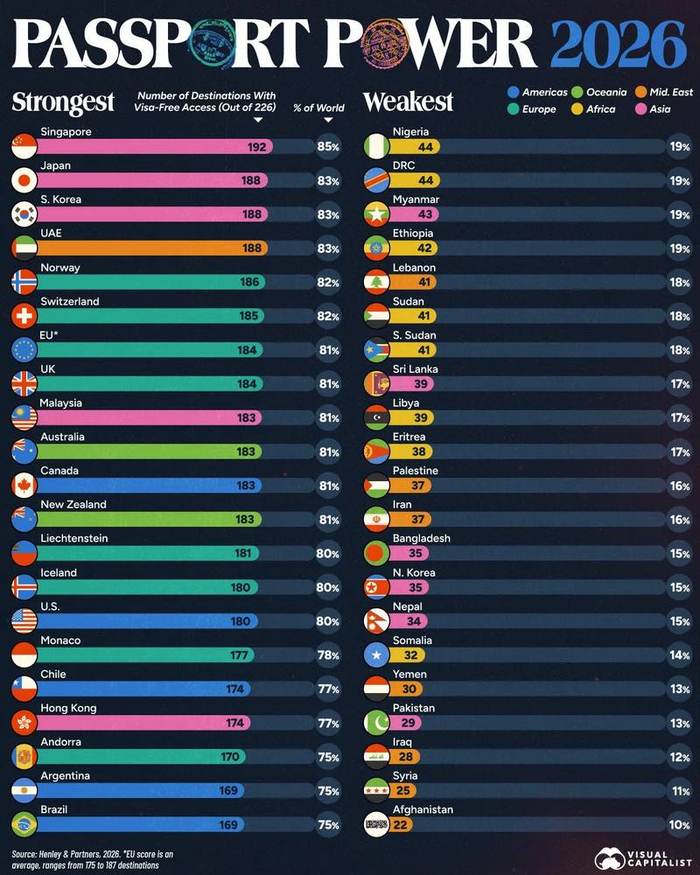
Singapore's passport opens 192 destinations, 85% of the world, with Japan, Korea and the UAE at 188 and the US down at 180 alongside Iceland. At the other end, Afghanistan's opens 22. The gap between the strongest and weakest passport is 170 destinations, the starkest inequality chart in this letter, and the one nobody prices. Source: Henley & Partners / Visual Capitalist.
Infographic 9 - The Most Powerful Passports, 2016 vs 2026
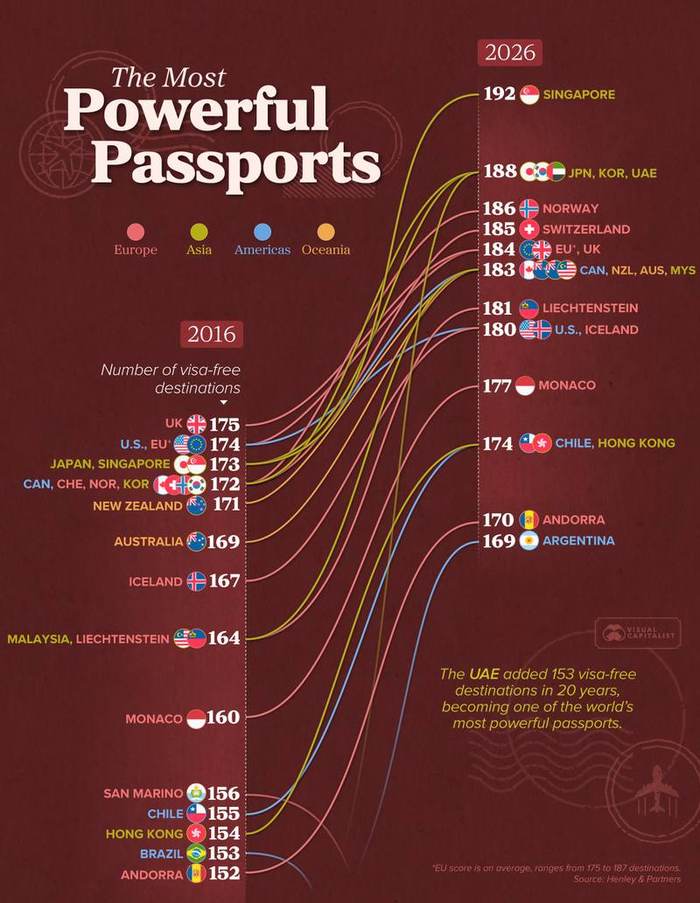
A decade of quiet diplomacy, drawn as flows: the UK held the top spot in 2016 and now shares sixth; Singapore climbed from third to first; the UAE added 153 destinations in twenty years, the fastest diplomatic ascent on record. Passports are treaties made visible, and the direction of travel matches every other chart in this dispatch: the centre of gravity moved east. Source: Henley & Partners / Visual Capitalist.
The Good Wrap
What is left at the close. The peppers that change their names when they dry. A sommelier's map of what "red fruit" actually means, for the blind-tasting readers. And week three of the eight great cuisines, inland to Hunan, the kitchen of dry heat, because this letter ends where every good week should: at the table.
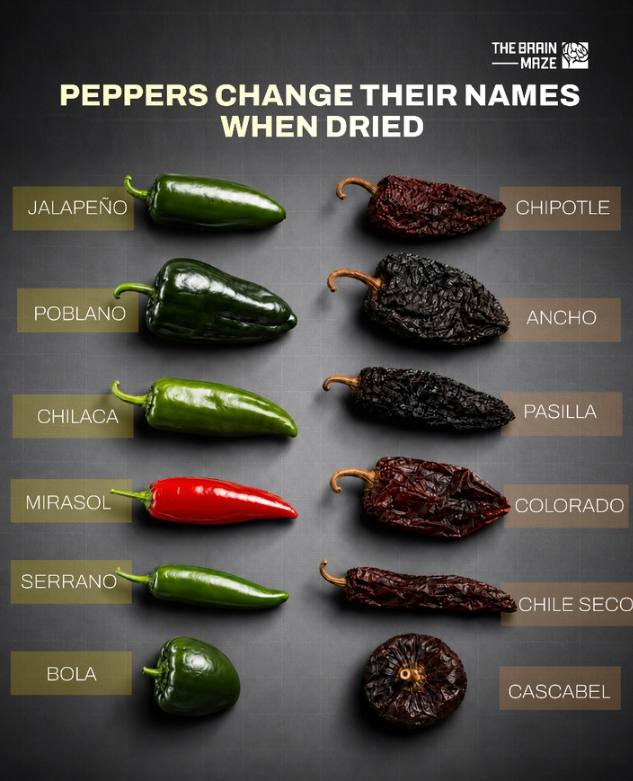
The jalapeno becomes the chipotle, the poblano becomes the ancho, six peppers, twelve names, one drying rack. Moisture leaves and the name changes because the thing itself has changed, smokier, sweeter, darker. A useful reminder in a letter about regimes: the same asset under different conditions deserves a different name, and different handling. Source: The Brain Maze.
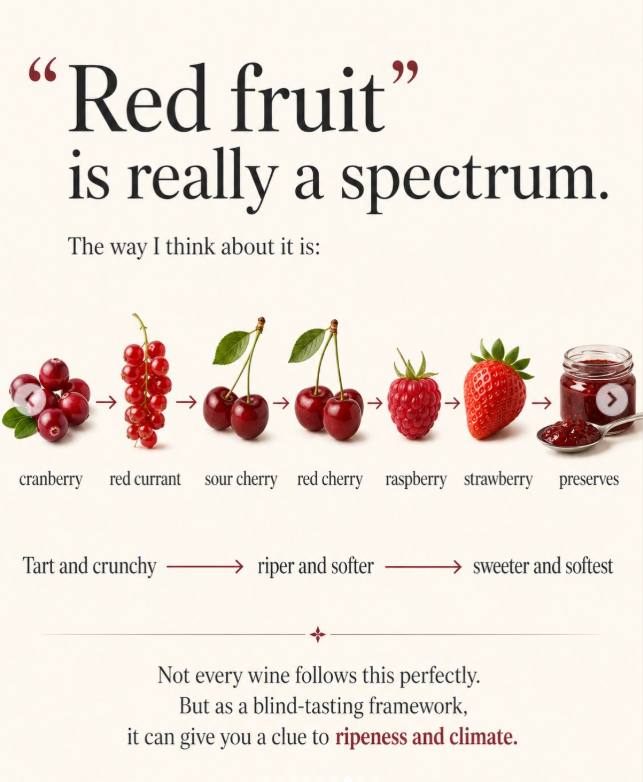
For the blind-tasting readers, a map of a single word: "red fruit" runs from cranberry to preserves, tart-and-crunchy to sweet-and-softest, and where a wine sits on that spectrum is a clue to ripeness and climate before the label ever confirms it. The discipline scales: get the macro right first, red fruit or black, then narrow. Most tasting errors, like most trading errors, come from reaching for precision before direction. Source: Sommelier notes.
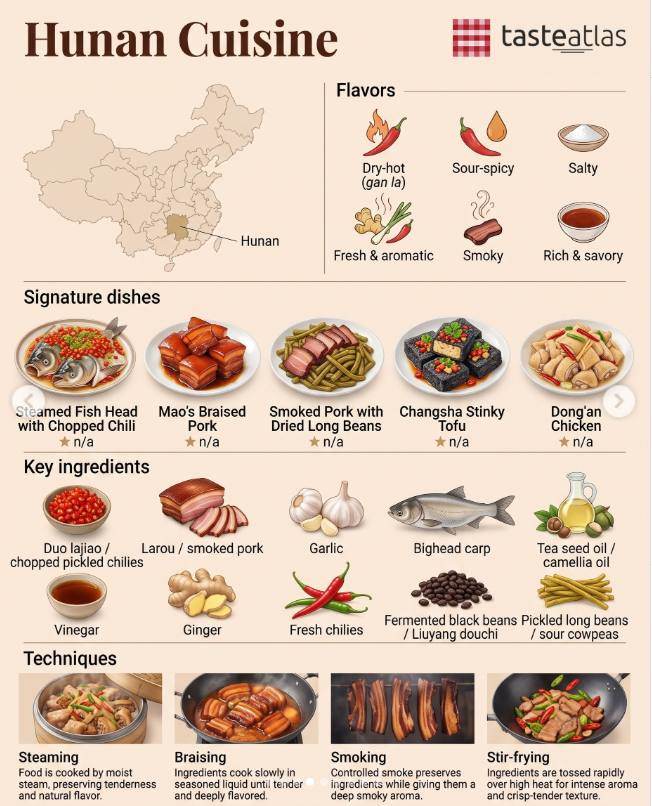
Week three of the eight great cuisines: Hunan, the inland province that answers humidity with gan la, dry heat, chopped pickled chillies on steamed fish head, Mao's braised pork, smoked larou with long beans. Where Shandong cooked the sea and Zhejiang cooked the counting house, Hunan cooks the climate: ferment, smoke and dry everything, because the air preserves nothing. The chairman's home cooking conquered the country's canteens the way the province's generals conquered its history, by outlasting everyone. Source: TasteAtlas.
Best,
Hoelon
WITPTW is a personal publication. Everything here is personal opinion and market commentary, written in a personal capacity. It is not investment advice and not a recommendation to buy or sell any security. It is not associated with, endorsed by, or representative of any employer, fund or company. Charts and images are reproduced from their original publishers, credited to their sources for commentary and discussion; all rights remain with the respective copyright holders.