Jackson Hawk
Personal views and market commentary. Not investment advice. Not associated with any employer or firm.
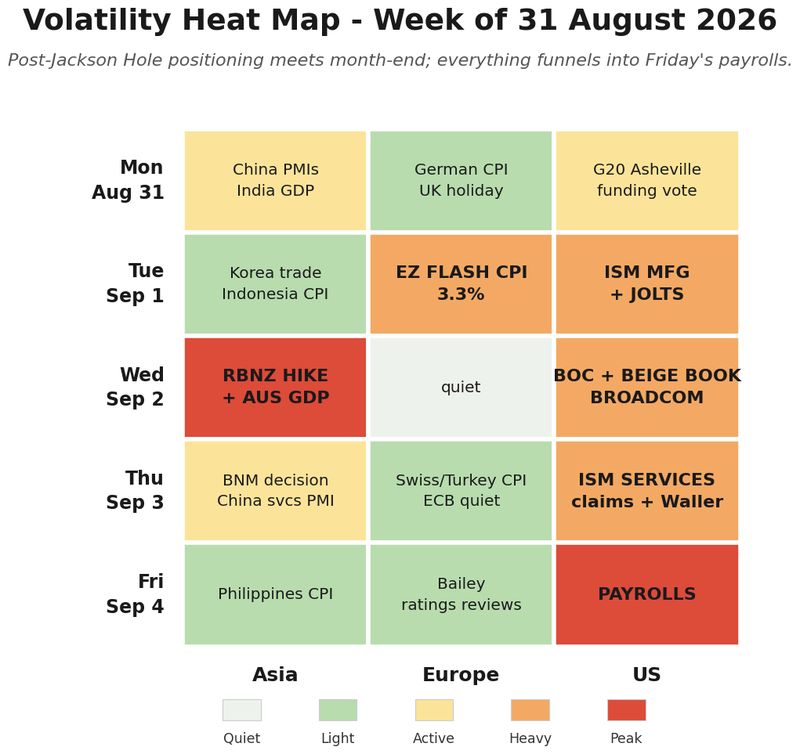
Volatility heat map for the week ahead , sessions as we trade them from here. Wednesday is the double session: the RBNZ's hike call and Australia's GDP in our morning, then the Bank of Canada, the Beige Book and Broadcom in the US day. Bank Negara decides Thursday at 3pm our time, and payrolls land at 8:30pm our Friday. No coupon auctions all week, the first empty calendar since July. The S&P enters at 7,711 with the VIX at 14.43, the year's cheapest insurance into its most binary print.
"As I learned years ago, you can take two different kinds of hikes on the trails around Jackson Hole. I can sum up my hikes with former Vice Chairman Don Kohn in two words: I survived." — Kevin Warsh, "In Our Time", Jackson Hole, 28 August 2026. He said "hike" three times about mountains before saying a word about rates; an hour later the market had a September hike at better than even odds. The substance earned it: Warsh called 2% "a firm, fixed target", exactly what Druckenmiller asked for, do not intervene and do not fall behind the curve. The front end sold off, the long end held its ground, and the curve flattened massively: a hawk is the best defence Treasuries have. Add Bessent's doubled buybacks and the rout looks arrested. But buybacks are liquidity pointed at a solvency problem, and when a government leans on its own bond market the pressure escapes through the currency; that is Japan's lesson. So last week's simple idea, the debasement trade of long gold and short the dollar, faces its first test: proven wrong in one speech, or a can kicked past the point of no return?
"Chronic wrongdoing… may… require intervention by some civilized nation." — Theodore Roosevelt, 1904, the corollary to the Monroe Doctrine. In 1902 it was European gunboats blockading Venezuela over unpaid debts; in 2026 the gunboats are American. Roosevelt wrote those words to justify policing the hemisphere after that blockade. This weekend, nine months after US forces removed Maduro, Trump announced a venture giving the United States 55% of the output of 17 Venezuelan fields holding 65 billion barrels, second only to Saudi Aramco as a reserves holder, with the right to take the oil at cost. Military power first, commercial control follows. Trump is not reviving the Monroe Doctrine; he is turning it back into gunboat diplomacy, the new warlord-coloniser of the Western Hemisphere. Watch oil, and watch how every producer in the hemisphere reprices political risk.
"Access to AI advice raises people's confidence in their decisions from 30% to 76%, while their accuracy fell from 27% to 9%." — 13D Research, "The Fluency Gap", What I Learned This Week, 27 August 2026. The machine makes parents two and a half times more confident and three times less accurate, and 86% of children aged 9 to 17 already use it regularly. The most important example in the piece is one we already lived through. When Instagram took over, parents shrugged, because their reference point was Facebook, a tool for calling distant relatives; by the time the damage to their children showed, the moment for the conversation had passed. The same gap is open again: 40% of children say no parent has ever discussed AI safety with them, while the kids hand it their homework, the very struggle that builds a mind. Ask your children this week what they actually use it for. You will discover the gap first-hand.
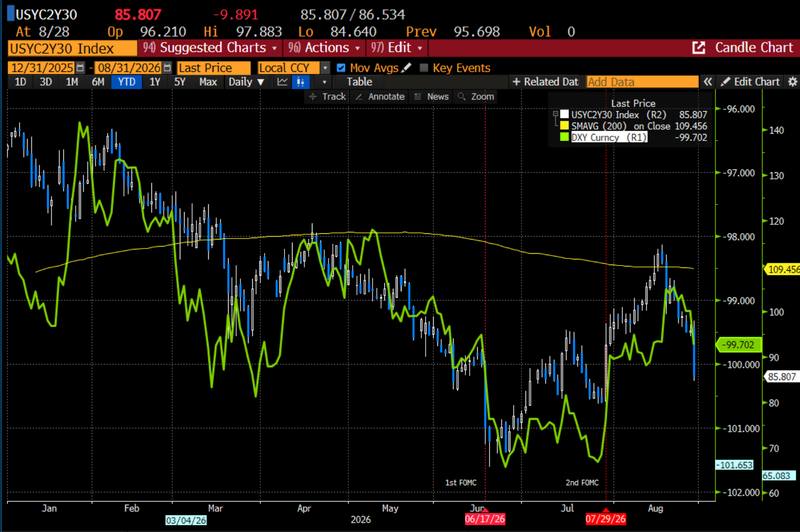
The chart of the week: the round trip. The 2s30s curve, back exactly where Warsh's June debut left it, with the dollar index climbing back toward its 200-day along the way. The steepener that ran from the July FOMC through Yentervention and the buyback announcement has been fully unwound, nearly 40 basis points of flattening in a fortnight, about ten of them in Friday's session alone. Positioning, not fundamentals, did most of the work, which is exactly why the reversal was so fast. The solvency arithmetic has not changed; the sponsor of the trade has. A Fed with credibility flattens curves that a Treasury with buybacks could not. Source: Bloomberg.
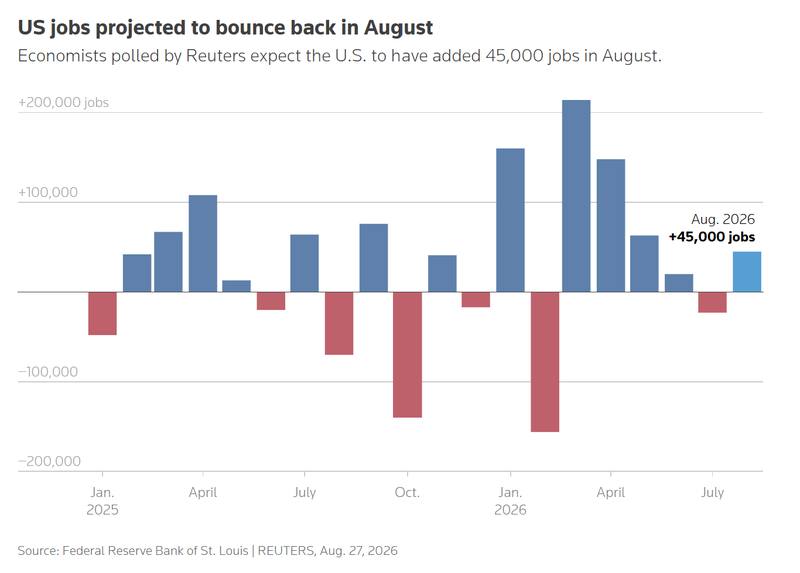
The other chart of the week: the US jobs bounce that decides September. Reuters' poll looks for +45,000 August jobs after July's -23,000 shock, the bar chart of the last twenty months wobbling around zero like an economy that cannot decide what it is. Bloomberg's consensus sits near 58k and Bloomberg Economics all the way down at 12k on weak teacher hiring, the widest forecast spread of the year. The trap is that the level may matter less than the wages under it: Warsh has already reframed soft hiring as demographics, so only a print weak enough to move claims, or hot enough to move wages, changes the September argument. Source: St. Louis Fed / Reuters.
What is the plan this week?
The week starts with the post-Jackson Hole reaction. Warsh on Friday read much closer to the June tone than to the reassurance the market wanted, and it caught positioning the wrong way. The two-year had been reversing all week and simply pushed through after the speech, and the strip now prices roughly 85% odds of one hike by December, a full flip from the cuts priced earlier this year. August ends as a round trip: the 10-year back near 4.72%, the dollar index at 99.70 and back at the border of its 200-day, gold down 3.2% on the week for the first weekly reversal of its run. The dollar-short and the steepener are the trades paying for it. Inflation-fighting credibility is back at the Fed, and with positioning still leaning the other way, the path of least resistance runs back toward dollar exceptionalism.
The thing to respect is the speed with which the priced-out hikes came back. From here it is data dependent and skewed hawkish: payrolls on Friday, survey +55k after July's -23k shock with wages seen at 0.3%, then CPI the following Friday and the FOMC on September 16. One distinction worth keeping is that the front end is mostly pricing fewer cuts plus one possible hike, not a hiking cycle, and those are different trades. The repricing runs entirely on inflation credibility while the employment side keeps deteriorating, small-business hiring at a six-year low and the three-month payroll average at +20k. A weak print on Friday unwinds the August round trip as fast as it was built.
The week itself builds toward Friday. G20 finance ministers gather in Asheville and China's PMIs land on a UK-holiday Monday, with month-end flows on top. Then three decisions in two days, all rhyming with the Fed rather than against it: the RBNZ is priced to hike on Wednesday, the Bank of Canada is expected to hold at 2.25% for a sixth consecutive meeting with roughly forty basis points of hikes priced further out, and Bank Negara decides on Thursday, expected on hold with inflation still benign. The Beige Book on Wednesday gives Warsh his first district-level reading as chair, Waller is the last Fed voice before the blackout matters, and payrolls close the show.
Away from rates, two threads open the new month. El Nino is back in the commodity conversation, and weather-driven food and power costs are exactly the kind of inflation a credibility-minded Fed cannot look through; that theme runs into year-end. And equities have made their preference clear: they would rather have a Fed that hikes for credibility than a market that sells America. With the worry-about-America trades peaking last week alongside the war headlines and Venezuela, the focus rotates to the October IPO window, Anthropic and OpenAI both scheduled, and to the midterms beyond that. Xi is reportedly bringing a delegation of executives to the US, which would support the trade-truce story. A new month can bring the AI-led tape back despite the noise in credit.
The plan this week is neutral dollars, a change after three weeks short. The theme moves inside Asia: surplus versus deficit. The Philippines already looks broken, Indonesia has less reason to keep rallying bonds and currency now that US rates and liquidity have turned, and the deficit countries are not the ones catching AI and data-centre flows. The long side is Taiwan and possibly China. The tension stated plainly: long Taiwan dollar into a hawkish Fed only works if the trade leans on AI export receipts and repatriation flow rather than on a weak dollar, so that is the thesis, not a dollar view. Sizing starts small into Friday, and the surplus-deficit framework below carries the full workings. With vol this cheap, protection through payrolls costs little. Stay nimble.
What did I learn last week?
Mon Aug 24: Bessent's presser named the weapon: cut "every economic lifeline that Iran runs on", secondary sanctions with China explicitly inside the reach, and "a major financial institution" promised within the week. Oil barely moved; Iran and Oman were already sketching a Hormuz management deal behind the fanfare. Trump added 50% tariffs on Canadian autos, parts and steel for January 2027.
Tue Aug 25: The $69 billion 2-year came clean at 4.204%, the safe part of the curve staying safe. Druckenmiller's op-ed landed the week's best lines: "Governments defending prices against fundamentals always lose", and a 30-year that must trade at 5.5% "isn't a crisis. It is an invoice." Canada named its 700 products for September 8. Darline Graham took the runoff for her late brother's seat, the race the president asked to be judged on.
Wed Aug 26: PCE printed hot, 0.2% and 3.7% headline against 3.6 expected, with core as scripted; the GDP revision kept 1.5% with consumption at 3.4%. The $70 billion 5-year stopped through. Then Nvidia: $96.2 billion against $91.9 expected, FY28 guided to grow ~70% and called "supply-constrained". Salesforce embedded its entire CRM into Claude. And away from the tape, a glacier collapse sent floods through the valleys on the Nepal-Tibet border; the search for the missing continues, and our thoughts are with the families.
Thu Aug 27: Asia tightened on schedule: the BOK's back-to-back hike to 3.00% with one dissent, then the BSP's third consecutive hike to 5.00%, naming oil, El Nino and wages. Claims 203k. The 7-year closed out $183 billion of belly supply without incident. Axios trailed the Venezuela deal a day early. Hammack: "now is the time to raise rates."
Fri Aug 28: Warsh confirmed the June tone and September went to 59% from 35%. The benchmark revision, the week's "most underpriced event", fired the other way: -79k against +183k consensus, and the soft-labour story survived untouched. Chicago PMI collapsed to 47.1 against 57.9. Tokyo core accelerated a third month to 1.8%, and Iran showed renewed interest in talking, with Hormuz targeted to carry 50 ships a night by mid-September.
All week: The S&P added 0.5% and the Nasdaq 0.8%; the violence was in rates and FX, not equities. USD/JPY finished at 160.06, the highest since the July intervention. the won closed August up 4.4%, the strongest major anywhere, and oil ended the week lower despite the crushing-operation theatre; the war premium is leaking out through diplomacy. Iceland's referendum finished on a knife edge, the yes side narrowly ahead as counting closed.
What to look out for next week?
Mon Aug 31: The G20 opens in Asheville, and Ueda skipped Jackson Hole for it, arriving with Japan's finance minister; with USD/JPY at 160, the yen conversation happens in North Carolina. China's PMIs test whether Beijing's support has finally arrived, consensus still in contraction at 49.5 but Bloomberg Economics seeing a return to expansion at 50.2. India's GDP prints near 7.5%, Germany's flash CPI near 3%, and the House votes on government funding, the first October-shutdown tail. London is shut; month-end flows cut both ways.
Tue Sep 1: The gauntlet opens. ISM manufacturing seen near 55 with prices paid above 70, the component that forces the Fed's hand above 72; JOLTS follows with the openings-to-unemployed ratio near its January 2025 high. Eurozone flash CPI is forecast at 3.3%, the highest in nearly three years, landing as the ECB goes quiet with the hike fully priced and no appetite to signal more. The Treasury's coupon calendar is empty for the first week since July; buybacks continue regardless. Israel decides, Ternus takes over Apple, and Shein lists in Hong Kong at $26 billion.
Wed Sep 2: Two decisions rhyming with the Fed: the RBNZ's hike to 2.75% is a done deal with 3.00% seen by December, and the Bank of Canada holds a sixth time into its trade war. The Beige Book gives Warsh his first district reading, Australia's GDP may print near stall speed, and Korea's CPI spikes to 3.3% on base effects. Then Broadcom after the close: 84% revenue growth expected, options pricing up to an 8.8% move, and the $29 billion Big Sky financing for Anthropic somewhere in the Q&A.
Thu Sep 3: Bank Negara at 3pm our time, expected on hold with inflation benign, the region's exception to the tightening wave. ISM services is the sleeper: the headline seen flat at 54 but prices paid at 70, the services-inflation engine that keeps September live. The trade deficit blows out toward $90.8 billion on AI hardware imports. Claims, then Waller moderated at a Reuters event, with Hammack and Goolsbee the same day.
Fri Sep 4: Payrolls. Consensus is scattered, Reuters' 45k through Bloomberg's 58k down to Bloomberg Economics' 12k, after July's -23k, with unemployment seen ticking to 4.2% and wages the real variable. It is the first print on the freshly revised baseline and the last major input before CPI on the 11th and the FOMC on the 16th. The Philippines prints CPI near 6.2% into a hiking BSP, Canada reports jobs, Bailey speaks, and Portugal, Iceland and Qatar face ratings reviews. Do not carry Friday's reaction into Saxony-Anhalt's Sunday election.
Beyond next week
Sep 6: Three German state elections begin with Saxony-Anhalt, where the AfD eyes an outright majority the market is not prepared for.
Sep 8: Canada's counter-tariffs on $20 billion of US goods take effect; the 3s, 10s and 30s open the supply week.
Sep 10 / 11: ECB hike fully priced with no signal of more; US CPI the next day, the single most important print of the month.
Sep 16 / 17 / 18: FOMC with September better than even odds, BOE, then the BOJ, where a hike is now 85% priced, September, no longer October.
Sep 24: Xi meets Trump in Washington after UNGA opens; trade and rare earths on the table, the yuan pointedly not.
Oct: The Anthropic and OpenAI IPO window opens; Treasury buybacks run to early November; midterms nine weeks out.
Regimes
The bond market changed the subject, week three: the Fed answered it. For two weeks nothing bought duration, not weak data, not official buying. A hawk did. The long end rallied on a chair promising to fight inflation and the curve flattened massively; the defence changed from liquidity to credibility, exactly the trade Druckenmiller demanded in print. Buybacks keep running regardless. The next test is supply: the 3s, 10s and 30s arrive next week into a market that now believes someone. changed, week 3
The dollar's credibility repricing goes two-way. The round trip is complete: DXY back at the border of its 200-day, gold's first weekly reversal, the strip pricing hikes. The solvency arithmetic has not moved, $40 trillion and the buybacks still running, but a Fed hiking for 2% removes the acute leg. The book goes neutral dollars; the debasement trade becomes a position to re-enter on evidence, not a conviction to defend through month-end squeezes. changed, week 13
The AI fracture, week nine: the tab moves to the bond desk. Nvidia guided FY28 up 70% and called itself supply-constrained, yet the week's real prints were in credit: traders ramping Broadcom's credit risk as it backstops mega-financings, SoftBank sounding a $10-20 billion bond to refinance its OpenAI loan, JPMorgan pre-marketing $5 billion for data centres. The Guggenheim stain shows how fast one name's trouble spreads through levered structures. October's IPO window is the exit everyone is financing toward. held, week 9
Two inflations, week six: the Fed picked its data. Warsh made prices the "predominant focus" while claims sat at 203k and Chicago PMI collapsed to 47.1, so the labour inflation argued the opposite and lost the podium. Headline PCE at 3.7%, the eurozone expected at a three-year-high 3.3%, Korea accelerating, and El Nino lifting food from Manila to Lima. The resolution still comes from the barrel, and now the paddy field. changed, week 6
The war goes financial, week two: the market calls the bluff. The crushing operation launched with full fanfare and oil ended the week lower, because behind it Iran and Oman are sketching Hormuz management and Washington wants 50 ships a night moving by mid-September. Venezuela shows the doctrine's other face: regime change first, 65 billion barrels at cost second. Economic warfare is turning into acquisition. held, week 2
Surplus versus deficit, the new crosses. Asia's external balances have split from its FX. Taiwan ran a $58.5 billion quarterly current-account surplus and the market is still short the currency; the Philippines runs deficits with the peso at record lows and a central bank defending volatility, not levels. Long TWD and KRW against PHP and IDR, dollar-neutral, with the rule stated: fundamentals set direction, price sets entry. new, week 1
Shifts (if then)
Last week's board was half right in the most instructive way: Warsh delivered the framework speech, but the long end rallied instead of selling off; the BOK hike extended the won; the belly auctions never tailed; core PCE behaved; and the benchmark revision, our "most underpriced event", fired backwards at -79k. The lesson carried into this week's regimes: hawkishness turned out to be the long bond's friend.
Payrolls print weak, under 40k with soft wages → the August round trip starts to unwind, hike odds fade, the dollar recovery stalls, and the debasement re-entry signal arrives weeks early. Mind the trap: Warsh reframed soft hiring as demographics, so with claims at 203k the unwind may be shallow until CPI on the 11th confirms it. new
Payrolls mean-revert hard, over 120k with wages at 0.4% → the July shock becomes noise, a September hike becomes consensus, the 2-year runs toward 4.50-4.60, and USD/JPY presses the pain threshold. The tail scenario; size for it, do not argue with it. new
Either ISM prices-paid prints above 72 → the inflation engine revs before payrolls even arrive, hike pricing extends on a survey, and Thursday's services version carries more weight than Tuesday's headline. This is the number that forces the Fed's hand. new
Eurozone flash CPI prints 3.4% or hotter → the September ECB hike stops being the story and December starts getting priced, EUR/USD retests 1.17, and the Fed-ECB divergence becomes the quarter's FX driver. new
Broadcom beats but the backstop questions dominate the call → the AI trade's credit leg reprices where its equity leg cannot, SOX volatility wakes from year-to-date lows, and the options rails at $350 and $400 decide the week for semis. new
USD/JPY trades through 160.80 while Ueda sits at the G20 → round three of intervention arrives with coordinated messaging from Asheville rather than Tokyo alone, and the carry unwind hits a market with no auction supply to hide behind. new
Tails
The carry dominoes → the Ministry has spent roughly $98 billion defending the yen this year and USD/JPY still sits above 160 with the real effective rate below July's intervention level. A strong payroll presses 160.80, and the response, if it comes, gets coordinated from a G20 room in Asheville rather than announced from Tokyo. Thin holiday-Monday liquidity is exactly when they like to move. carried, week 5
The backstop put gets exercised → the bond desks have started charging for it: Broadcom's credit risk is being repriced into Wednesday's print precisely because it now underwrites other people's financings. When the insurer's own spread widens, the insurance is being doubted. Nvidia's $500 billion coalition marks weekly; the put-writers report quarterly. carried, week 6
Bonds and equities sell together → vol-control funds run roughly 82% exposure, the implied daily move is 0.5% against 0.42% realised, and the VIX enters the week at 14.43. Hot ISM prices plus a strong payroll is the trigger shape, and the mechanical selling does the rest. Cheap convexity is the whole risk budget this week. carried, week 5
The search bar beats the statistics → claims say 203k and nothing is wrong; Chicago's PMI just printed 47.1 against 57.9 expected, an outlier that means nothing or everything. Searches for mortgage help remain above the 2008 record. If the weak-signal chorus is right, the labour data is not soft, it is early. carried, week 2
The cash account becomes a campaign tool → a hollowed-out Treasury, seven of sixteen confirmed officials gone, now runs a near-$1 trillion general account that reporting says may fund the buybacks. Drawn down ahead of a midterm it is stimulus by plumbing; left low, it shortens the debt-ceiling runway into 2027. No evidence of political use yet, and the perception risk alone can move term premium. carried, evolved
Hormuz reopens but the refined-product war does not → escorted shuttles and dark transits have crude flowing near 5 million barrels a day and quick-resolution odds still under 50%. Crude softens while diesel sits near post-war highs, European gas at 220 on the year's index, and food and fertilizer at multi-year peaks. The inflation pipeline has moved downstream of the strait, where no negotiation reaches it. carried, war week 14
Month-End Monday
The month closes with the G20 gathering in Asheville, and the guest list is the story: Ueda skipped Jackson Hole for this one, arriving with Japan's finance minister while USD/JPY sits at 160. China's PMIs test whether Beijing's support has finally arrived, India prints GDP, and the House takes a government-funding vote that opens an October shutdown tail. London is closed, liquidity is thin, and month-end flows cut both ways.
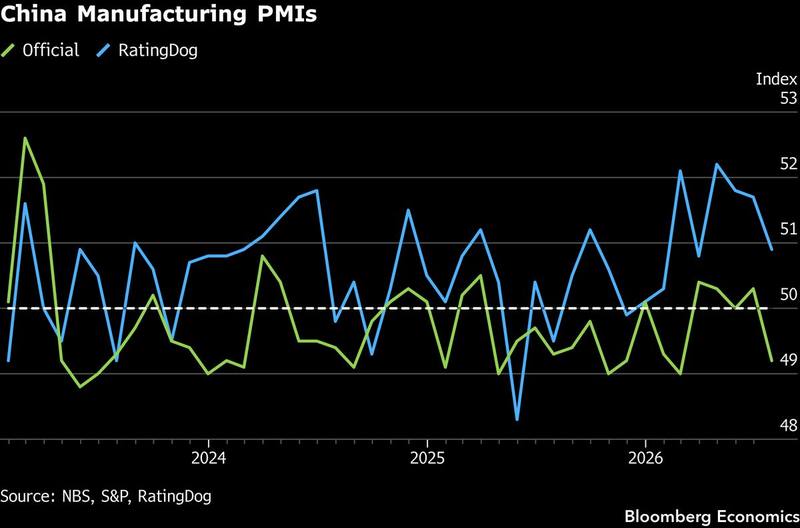
The first data of the month asks whether Beijing has finally shown up: consensus has the official manufacturing PMI still contracting at 49.5, but Bloomberg Economics sees a return to expansion at 50.2, services and construction lifting, and the export-facing RatingDog gauge near 51.9. Refinery runs and travel data back the call. A five-handle would be the first hard evidence of stimulus arriving, and it lands straight into the September Xi-Trump narrative. Source: NBS / Bloomberg Economics.
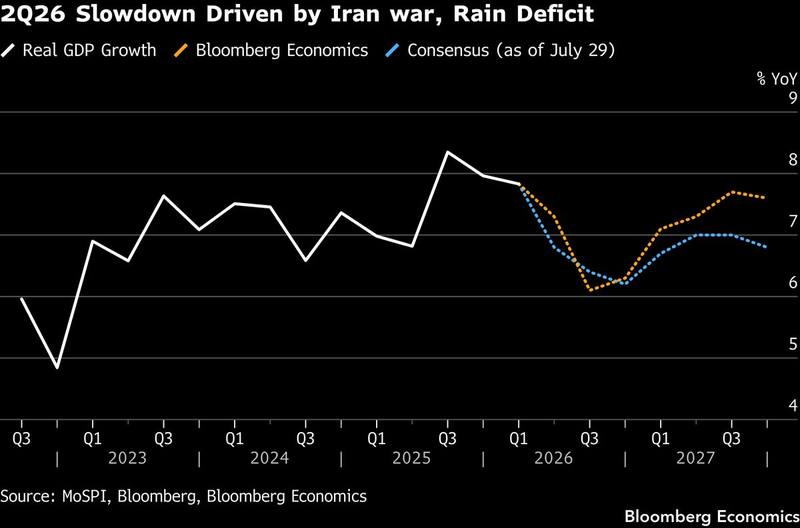
India, the economy paying the war's oil tax twice, keeps compounding anyway: GDP seen easing to 7.3% from 7.8 as April's oil spike and a 35% June rainfall deficit bite, yet India stays the fastest large economy in the world with the nowcast even stronger. The monsoon deficit has narrowed to 13%; El Nino is the risk that has not fully arrived. Source: MoSPI / Bloomberg Economics.
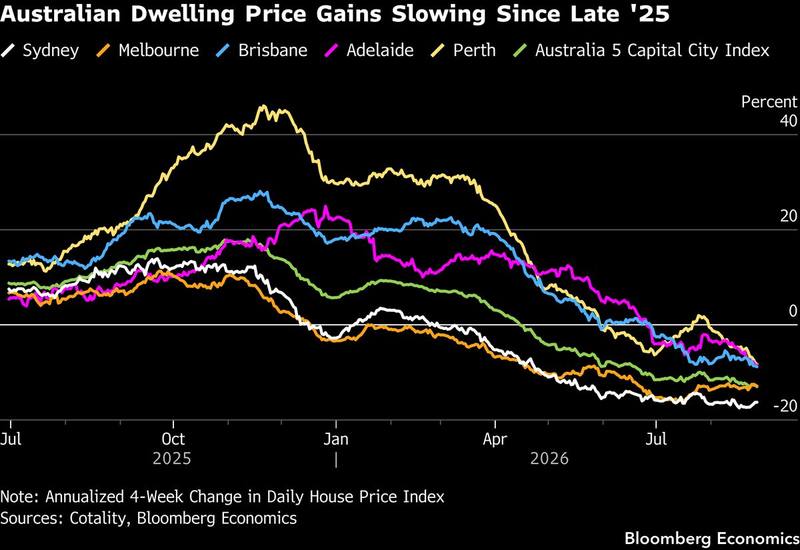
Australia's housing downturn is the tightening the RBA never announced: home values seen down 1.1% in August, the biggest monthly fall since 2022, the five-capital index off nearly 4% since April as rate hikes, war uncertainty and investor tax changes land together. The weakness has spread from the top end to the affordable end and out to the regions. Bloomberg Economics thinks the wealth effect eventually forces the RBA to reverse; the market still prices another hike. Source: Cotality / Bloomberg Economics.
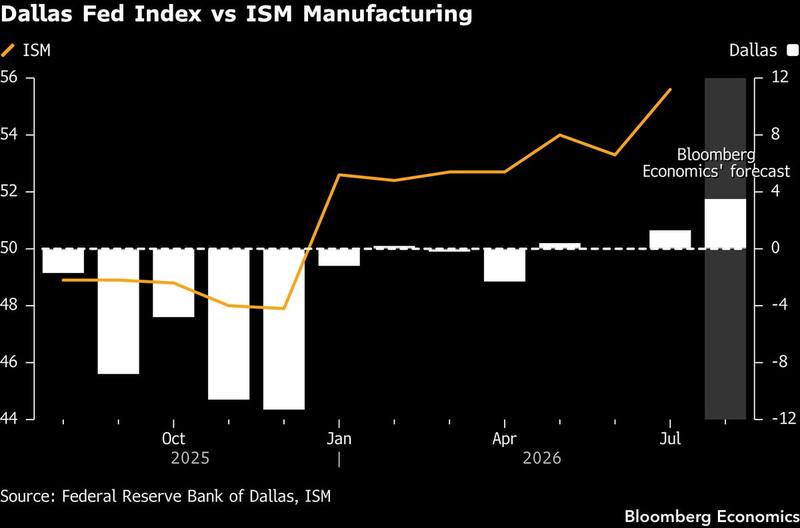
And the US regional surveys keep breaking upward: the Dallas Fed seen at 3.5, its strongest since January 2025, with production at 10.1 and a third of firms reporting higher output. Prices, though, are holding near extreme levels, and that is the line Warsh reads. The manufacturing rebound is real; so is what it does to the inflation trend. Source: Dallas Fed / Bloomberg Economics.
Gauntlet Tuesday
The data gauntlet opens with no coupon supply to hide behind, the Treasury's first empty auction week since July. ISM manufacturing and JOLTS in the US evening, the eurozone's flash CPI in ours, Israel decides, Massachusetts votes, Ternus takes over Apple, and Shein lists in Hong Kong at $26 billion.
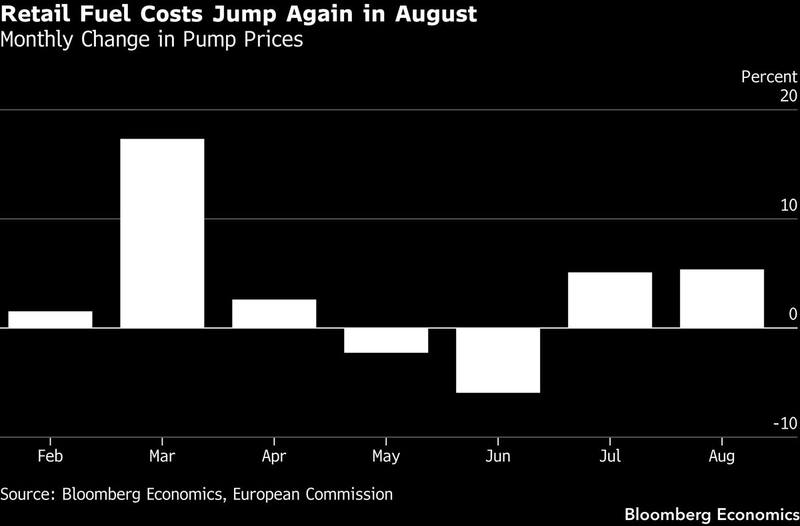
Europe's three-year inflation high is made almost entirely of fuel: European pump prices jumped again in August, a second straight monthly rise worth roughly 0.3 points of the flash HICP that is seen hitting 3.3% from 2.9, while core holds at 2.5. It cements September's hike; the argument it opens is December's. Reuters' sources say the Council has little appetite to signal more, which is exactly what makes a hot print awkward. Source: Eurostat / Bloomberg Economics.
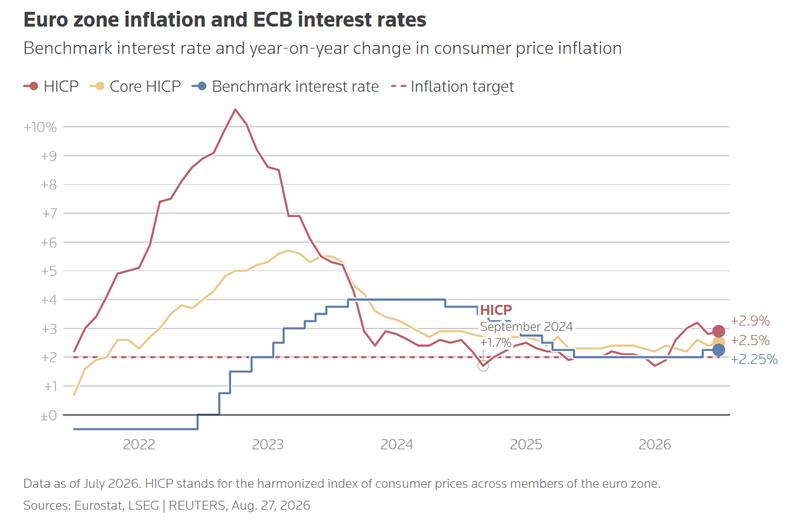
The picture the ECB would rather not frame: headline back at 2.9% and rising against a policy rate of just 2.25%, a gap the September hike only begins to close; the last time inflation was here, rates were near 4%. Energy is doing the pushing, and the ECB's own July account says the hawks want December if it persists. Source: LSEG / Reuters.
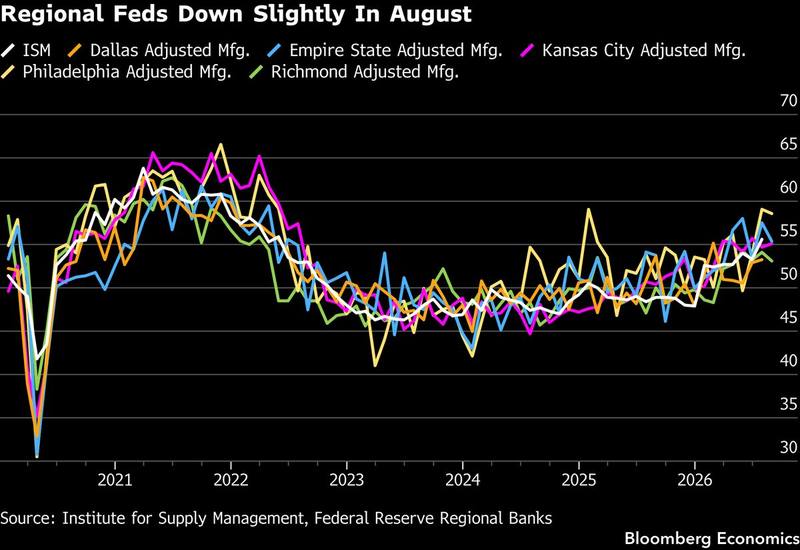
The US survey that can force the Fed's hand before Friday does: three of the four August regional Fed surveys ticked down, implying ISM manufacturing eases toward 54.8-55.2 from 55.6, still firmly expansionary after the two-year sub-50 stretch, with prices paid above 70 for another month. Above 72 and the hike pricing extends on a survey alone, no payrolls required. Source: ISM / Bloomberg Economics.
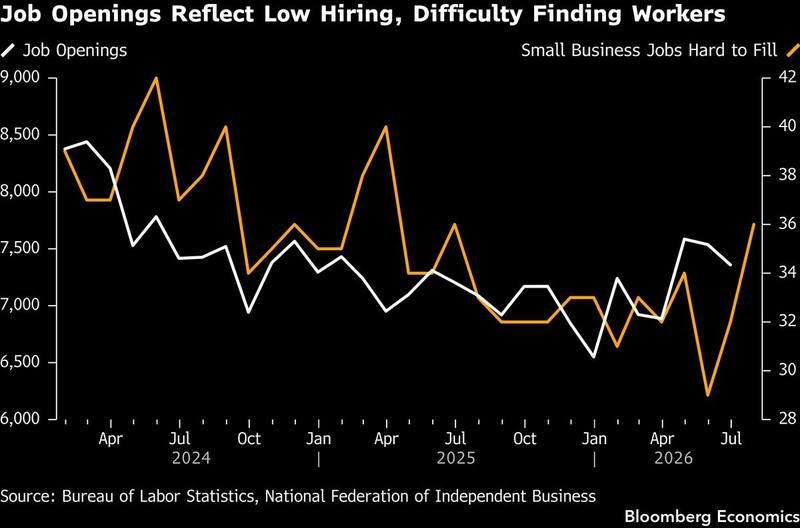
America's job openings will not quite fall: vacancies seen near 7.25 million, a third straight modest decline that still leaves the openings-to-unemployed ratio near an eighteen-month high. Businesses report trouble filling jobs even as hiring stalls: low firing, low hiring, and a ratio that reads tight to a chair who already called this labour market full employment. Source: BLS / Bloomberg Economics.
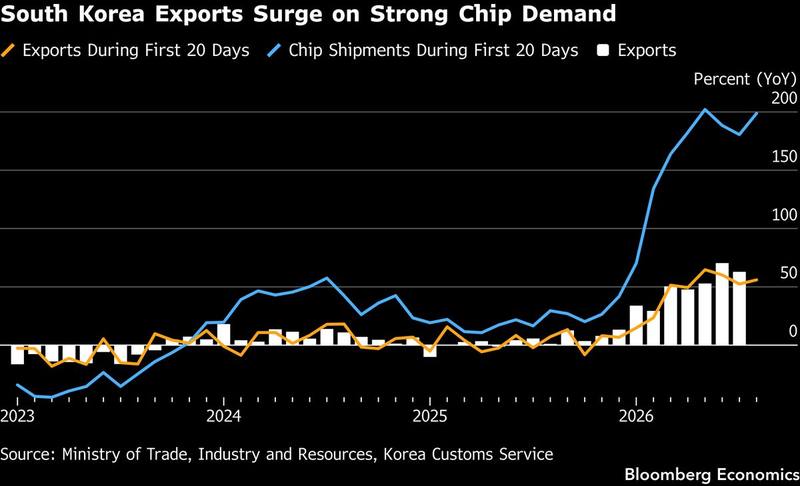
The AI boom's trade ledger, Korean edition: exports seen up 63.5% on the year, chip shipments nearly tripling and computer peripherals up 242% in the first twenty days, the surplus widening past $31 billion. This is the external-balance engine under the won's 4.4% August, and under the whole surplus-versus-deficit regime above. Source: MOTIE / Bloomberg Economics.
Broadcom Wednesday
Two decisions that rhyme with the Fed, a district-level first, and the AI trade's next underwriting test after the close. The RBNZ's hike is priced as done, the Bank of Canada holds a sixth time into its trade war, the Beige Book gives Warsh his first regional reading as chair, and Broadcom reports into an options market pricing a bigger move than Nvidia's.
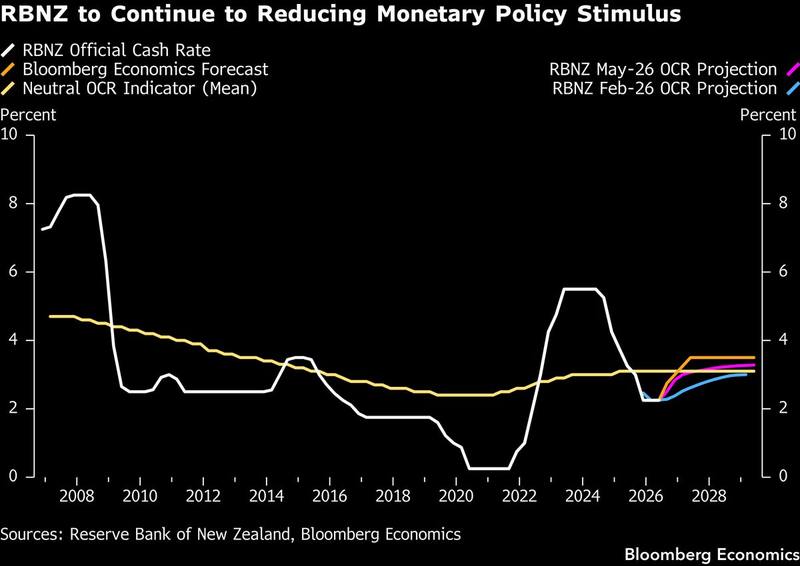
New Zealand's done deal, and the forecast that matters more: a hike to 2.75% is consensus everywhere; the signal is the updated OCR track, likely pointing to 3.00% by December and an earlier return to neutral in the first half of 2027. With inflation at a two-and-a-half-year high on war-priced fuel, the risk is buy-the-rumour-sell-the-fact in the kiwi unless the terminal guidance upgrades. Source: RBNZ / Bloomberg Economics.
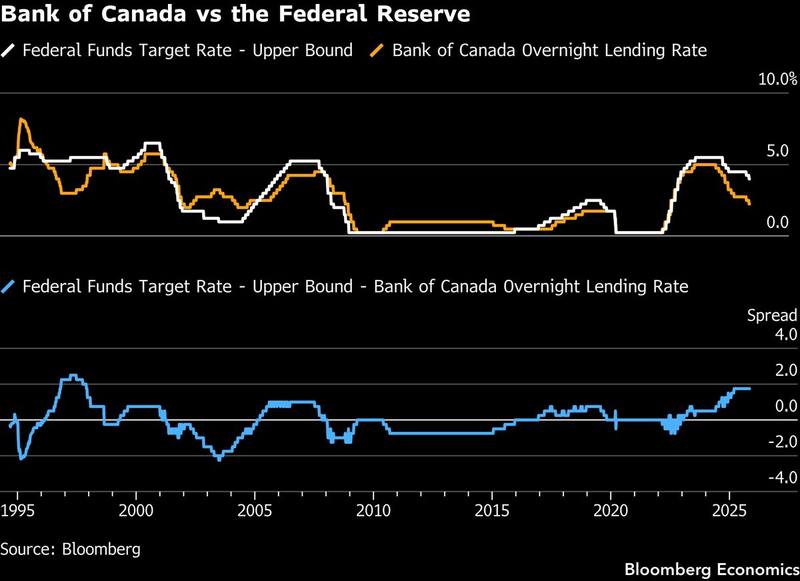
Canada's sixth pause, held against a trade war: 2.25% again, the gap to the Fed the widest in three decades, with Q2 GDP at 3.3% giving Macklem room and the September 8 counter-tariffs about to take some away. A hawkish-toned hold is the base case, and the currency cares more about any trade-war language than about the decision itself. Source: BoC / Bloomberg Economics.
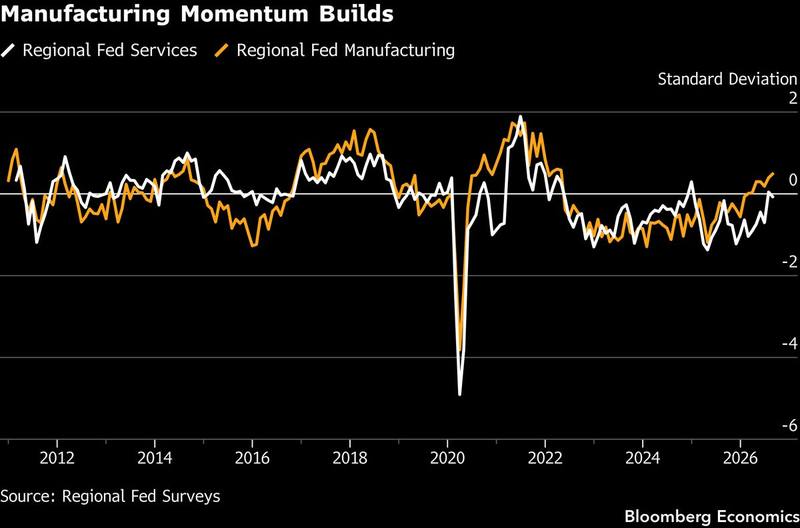
Warsh's first Beige Book as chair should read like his speech: activity picking up, manufacturing optimism rising on the Philadelphia and New York surveys, spending resilient, and price pressure that will not go away. The rapid rise in long yields is the likely caveat. District anecdotes are suddenly policy inputs again, under a chair who distrusts stale data by declared principle. Source: Federal Reserve / Bloomberg Economics.
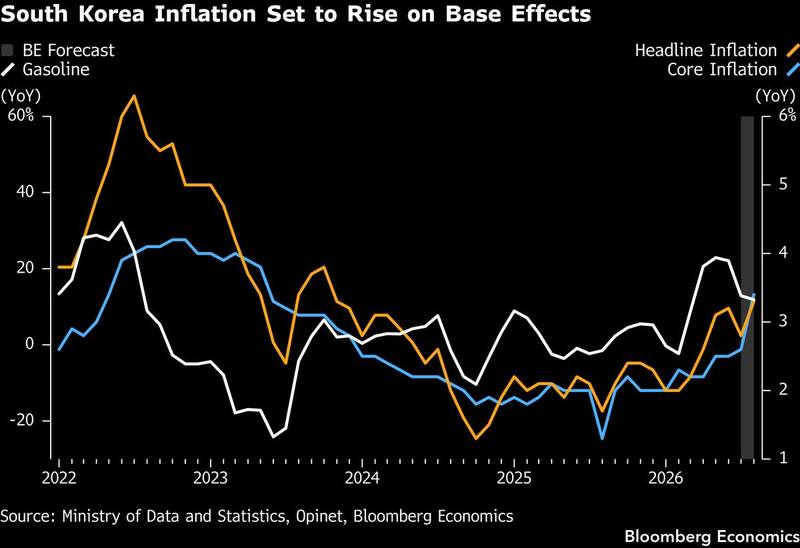
Korea's CPI spike is mostly optics, which does not make it harmless: headline seen jumping to 3.3% and core to 3.4 as last August's telecom discount drops out of the base. The BOK knows the distortion; the market will read the headline anyway, and either way it underwrites the tightening the Bank just delivered. Source: Statistics Korea / Bloomberg Economics.
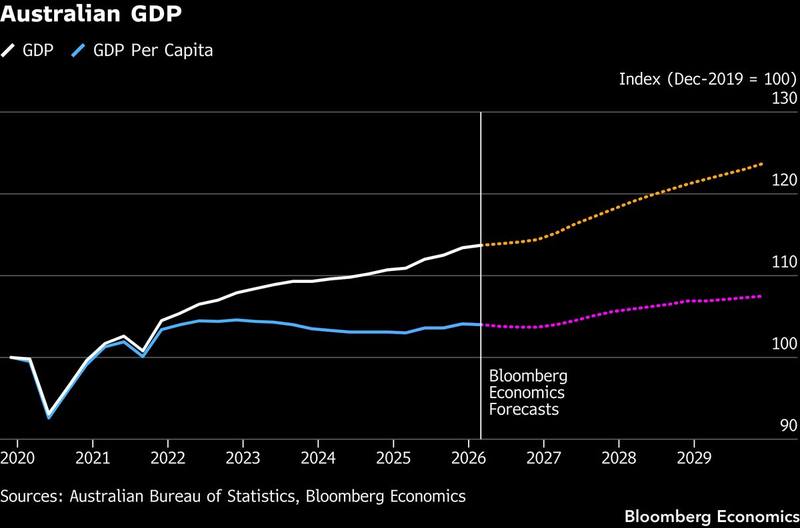
The other Wednesday print Australia would rather skip: GDP seen at just 0.1% for the quarter on Bloomberg Economics' numbers against 0.4 consensus, per-capita output falling and housing turnover slumping. A weak print rapidly unwinds RBA hike pricing and leans on AUD/NZD into the RBNZ decision an hour later; the divergence trade of the antipodean morning. Source: ABS / Bloomberg Economics.
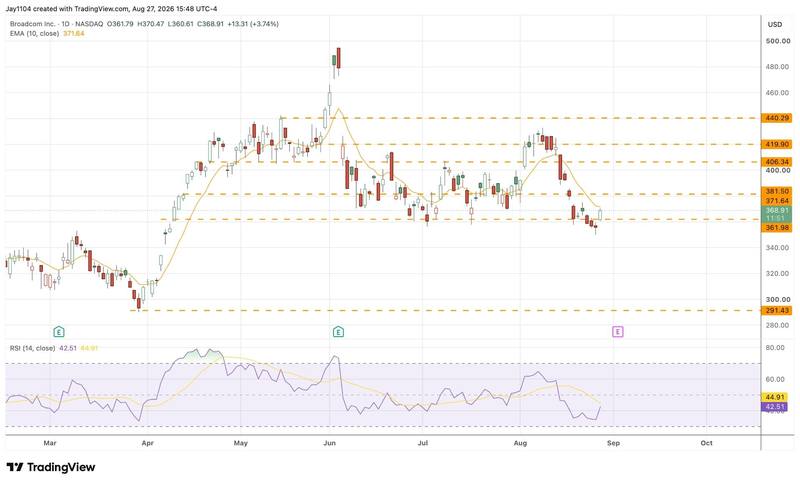
Broadcom, the AI trade's backstop, reports its own mark: Broadcom into the print at $368 with a 91.5% earnings-growth setup, options gamma pinned between $350 and $400 and the implied move at 7.6-8.8%, well above Nvidia's. The quarter is barely the question. The credit desks spent August repricing Broadcom's risk as it backstops the $29 billion Big Sky financing for Anthropic, and the call's financing answers move semis, AUD-Asia beta and credit spreads together. Source: TradingView / CMC Markets, Barclays.
Services Thursday
Bank Negara at 3pm our time is the region's exception, expected on hold with inflation at 1.8% and oil revenues funding the subsidies that keep it there. The US session stacks ISM services, the claims cross-check, a trade deficit blown open by AI hardware, and Waller speaking the day before payrolls with Hammack and Goolsbee alongside. The ECB goes quiet for September.
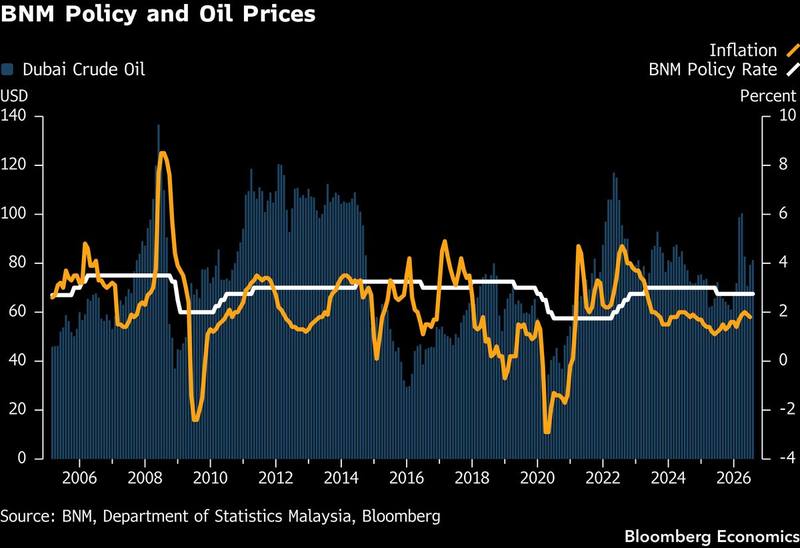
Malaysia's hold is the one that proves the theme: the policy rate at 2.75% with inflation benign at 1.8%, subsidies cushioning the oil shock and electronics exports riding the AI boom. Malaysia is what a surplus country with fiscal room looks like in this war. The risk is second-round effects if the shock outlasts the subsidy scope; for now, the luxury of doing nothing. Source: BNM / Bloomberg Economics.
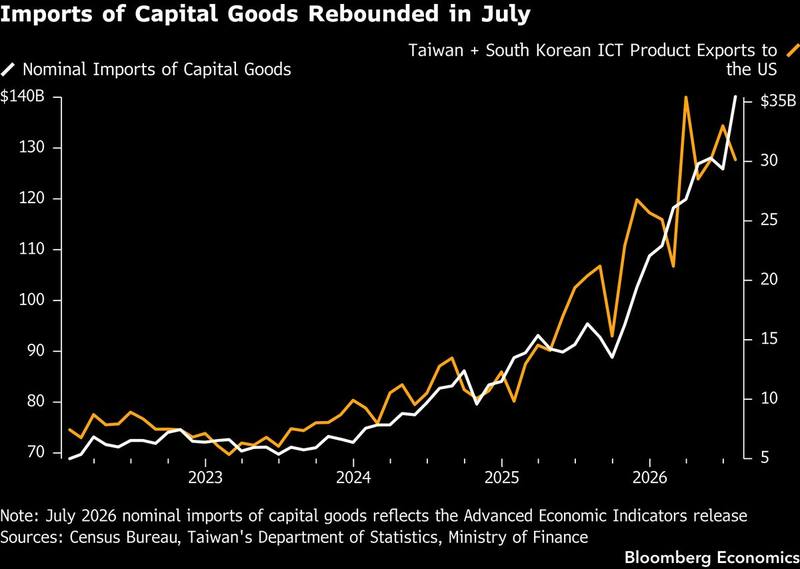
America's trade deficit belongs to the dispatch below: July's gap seen blowing out to $90.8 billion, the widest since March 2025, on an 11.3% jump in capital-goods imports, semiconductors and computers increasingly routed through Mexico, while oil-led exports fell. The AI build-out is now the swing line in America's trade arithmetic, and the tariffs cannot touch it without touching the boom. Source: Census / Bloomberg Economics.
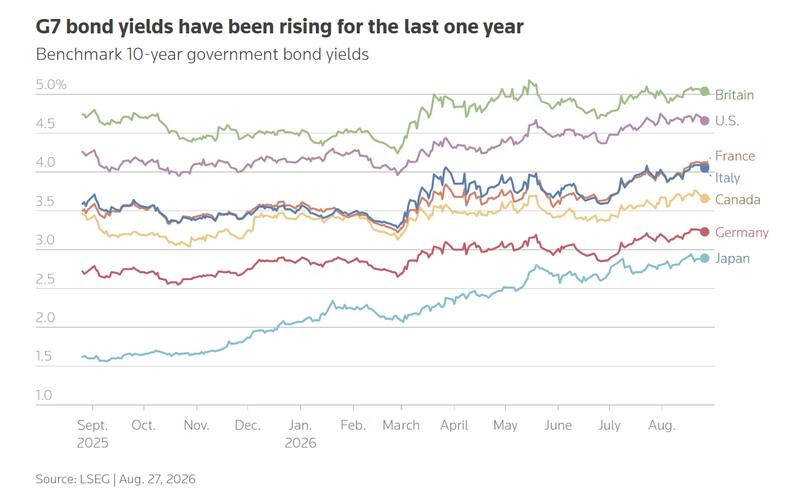
The company the US 10-year keeps: every G7 benchmark yield higher over the past year, Britain near 5%, Japan approaching 3 with its own fiscal arithmetic under a new prime minister, France and Italy converging at 4. The sharper point from the flow data: since June, the fiscal-risk steepening lives in France, the UK and Japan more than in the US. The problem is the debt, everywhere; America is just the biggest borrower in the room. Source: LSEG / Reuters.
Baseline Friday
Payrolls at 8:30pm our time, the first print on a baseline the benchmark revision just moved, and the last major input before CPI on the 11th and the FOMC on the 16th. The Philippines opens the Asia morning inside the new regime's short leg, Canada reports jobs into its trade war, Bailey speaks, and Portugal, Iceland and Qatar face the raters.
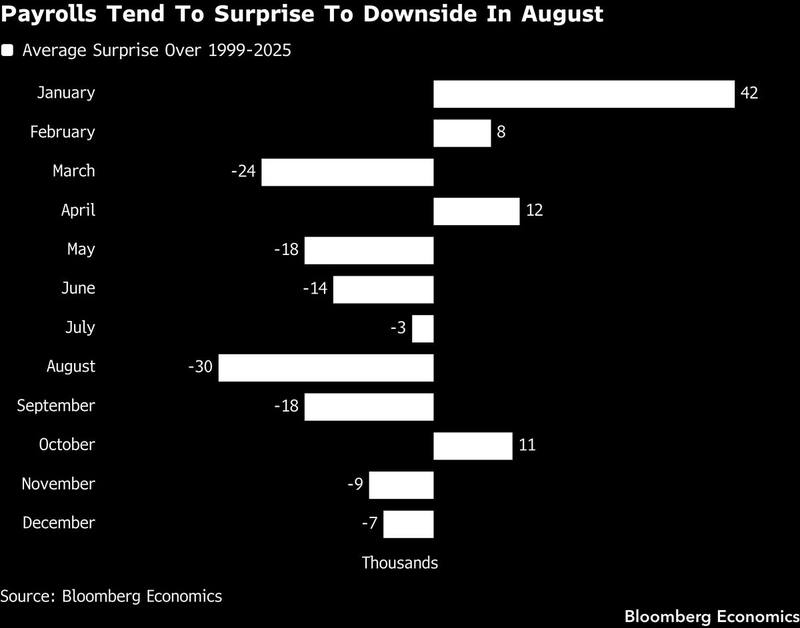
US payrolls: the forecast spread is the story, and the season leans one way: Reuters' poll says 45k, Bloomberg's consensus 58, and Bloomberg Economics just 12 on weak teacher hiring, against July's -23k. August is also the year's worst month for surprises, averaging -30k below consensus since 1999. The trap Warsh set at Jackson Hole: soft hiring reframed as demographics means a weak headline with low claims may not unwind the repricing. Wages at 0.3% would do more damage than any payroll number. Source: Bloomberg Economics, Reuters.
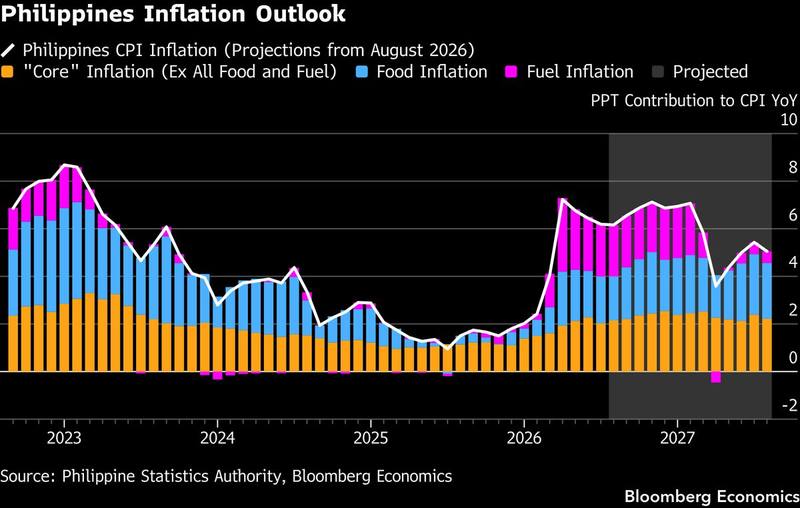
The Philippines prints the short leg's fundamentals: CPI seen at 6.2%, triple the top of the target band's midpoint, El Nino queued in food, the peso at record lows feeding import costs, and Manila's 12% wage rise threatening second-round effects. The BSP stays hawkish and it may not be enough; that asymmetry is the point of the trade. Source: PSA / Bloomberg Economics.
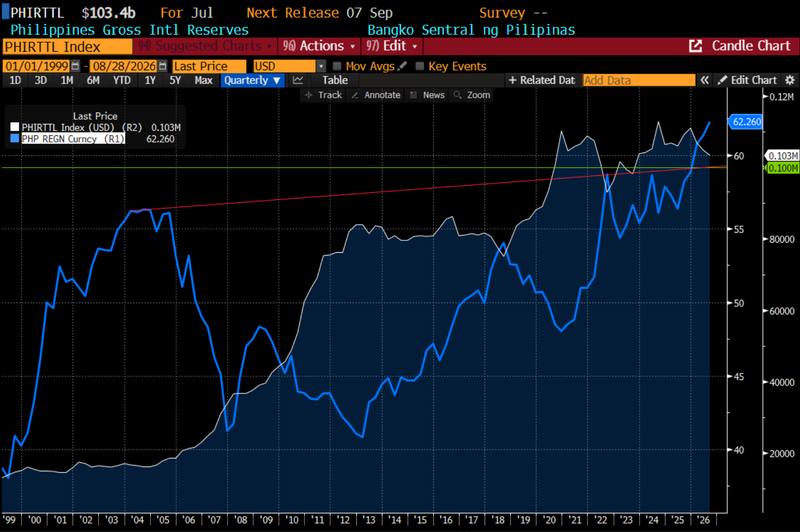
The peso, under the new regime's short leg: USD/PHP at 62.26, through two decades of resistance, while gross reserves at $103.4 billion drift down toward the red line. The central bank has ammunition but is defending volatility, not a level, and reserves approaching the $100 billion optic invite exactly the speculative test they are meant to deter. Structural depreciation, officially tolerated. Source: Bloomberg, BSP.
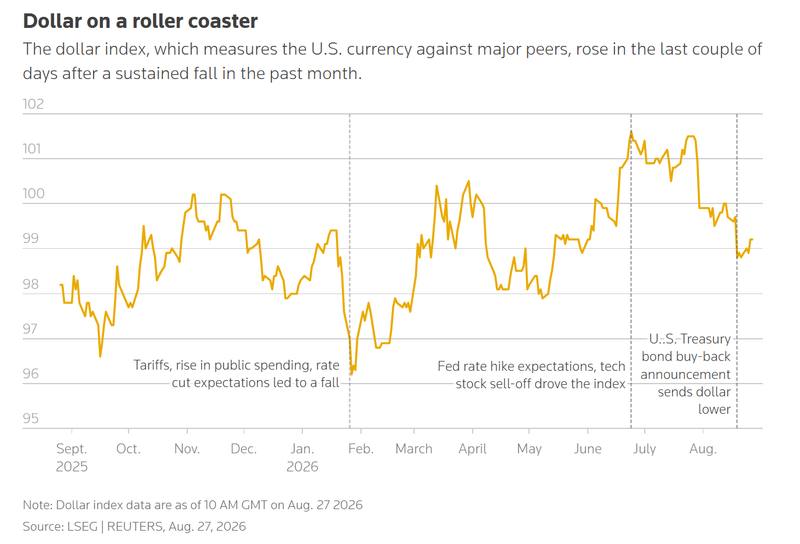
The dollar's month, annotated: the slide from the buyback announcement, the bounce off 98.8 on Warsh, and a strip of levels that decide September. CTAs flipped net short the dollar on August 20 and that signal is already evaporating, which leaves a bullish asymmetry toward short-covering on any further rally, against month-end model flows that still lean to dollar selling. The two-way tape payrolls lands on. Source: LSEG / Reuters.
The Strategic Cash Reserve
The week's most underpriced document was not the speech; it was the reporting on how the buybacks get paid for. The Treasury may fund its expanded bond buybacks from the roughly $1 trillion Treasury General Account rather than from new bill issuance. Draining the government's checking account mechanically adds reserves to the banking system, which is a liquidity easing by another name, and it invites the Strategic Petroleum Reserve comparison: an account that size, drawn down ahead of a midterm, will be perceived politically whether or not it is used that way. The liquidity reverses when the account gets rebuilt, and if it is simply left lower, the government has less runway when the debt ceiling returns in the first half of 2027. The rates desks are pricing the mechanics rather than the politics: a $20 billion-a-month long-end buyback is worth roughly 25 basis points off long yields, with bills drifting toward a quarter of the debt stock. Investor flows already vote: ultra-short Treasury ETFs took $7.6 billion last week, the most since March, while foreign purchases of US bonds thinned to almost nothing. Every mechanism in this paragraph is the same trade, moving the problem somewhere less visible, closer to the election. The chair, for his part, says he stands "committed to a discipline, not to a decision". This week tests whose discipline the market believes.
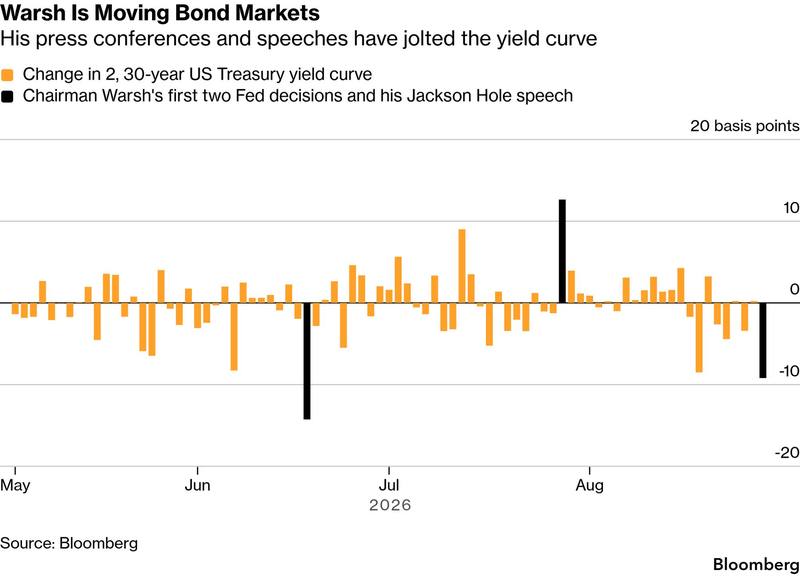
The chair moves the curve more than the Treasury does: every Warsh set-piece since May has jolted the 2s30s curve, the June debut and July hold steepening it, Friday's speech flattening it roughly 11 basis points in a session and nearly 40 over the fortnight with the buybacks. Policy expectations, not duration supply alone, still drive curve shape, which is precisely why credibility is cheaper than intervention. Source: Bloomberg.
The AI fracture, week nine: the tab moves to the bond desk
Nvidia guided FY28 revenue up roughly 70% and called itself supply-constrained; the equity story is intact. The week's real prints were in credit. Bond desks are ramping the credit risk they assign to Broadcom as it backstops mega-financings, SoftBank is sounding out a $10-20 billion bond to refinance its OpenAI loan, JPMorgan is pre-marketing $5 billion for Volta's data centres, and Thoma Bravo needed forty creditor concessions to refinance Proofpoint, the new template for software debt. Salesforce embedded its entire CRM into Claude and called the demand incredible, while a Chinese lab served a hundred trillion tokens a day entirely on Chinese chips at Nvidia-class cost, testing the CUDA moat from below. And the Guggenheim affair is the dry run for how trouble travels through the new system: one billionaire's regulatory problem repriced an unrelated insurance broker's loans ten points in a month. October's IPO window is the exit all of this financing is racing toward.
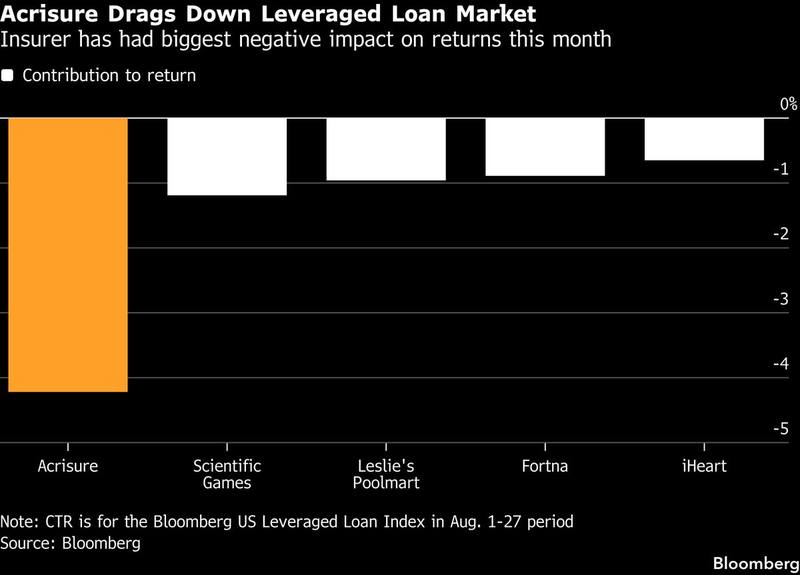
How one name, insurance broker Acrisure, drags a whole index: Acrisure's $4.4 billion loan fell to 83 cents and became the single biggest drag on the leveraged-loan index in August, the second biggest on high yield, on Guggenheim links its own investors call overstated. Levered structures turn association into contagion. The AI credit complex, building levered structures at ten times this scale, should study the mechanism. Source: Bloomberg.
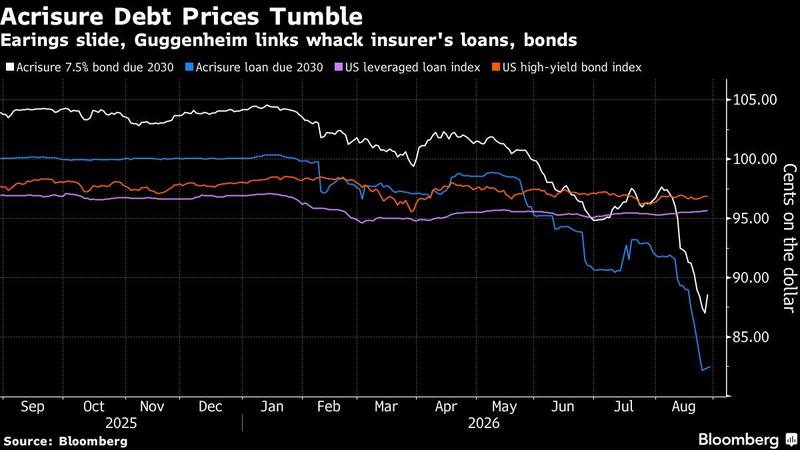
The anatomy of the Acrisure stain: bonds and loans tracking the indices for months, breaking in June on a 12% EBITDA decline, then collapsing in August when the Guggenheim scrutiny compounded 9.6-times leverage, 15.4 counting the preferreds. Nothing in this chart is AI, and everything in it is the template for what happens when a levered borrower meets a narrative. Source: Bloomberg.
El Nino, the generational one
Scientists declared onset in June; the tropical Pacific is running the hottest sea-surface temperatures on record and the event is expected to persist into 2027, which is widely forecast to be the hottest year ever measured. The price list is already printing. Panama Canal transits cut from 36 to 32 with lock auctions at $2.5 million against a normal $800,000, a second chokepoint in a world already short one. Peru's anchovy season suspended and fish meal at record prices. A freak storm dropping five million cubic metres of snow on Chile's Los Pelambres mine, into a record copper market. India's monsoon running 13% behind, with rice across southern Asia called "the big one" by the climate scientists. Bloomberg Economics estimates consumer prices rise nearly two percentage points in Indonesia and the Philippines after an El Nino drought, which lands directly on this letter's newest regime: the deficit countries get the food inflation too. The winners' list is shorter: Atlantic insurers if hurricanes stay away, Europe's gas bill if the winter is mild, and the Colorado ski season.
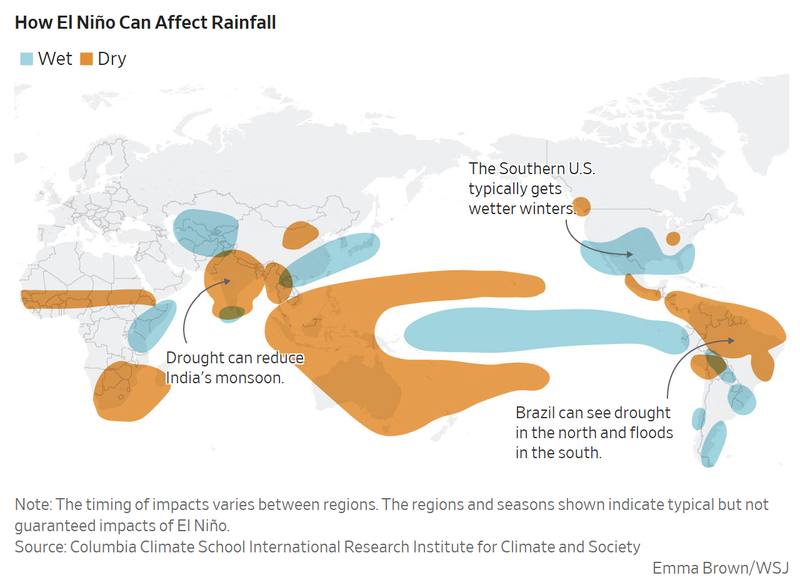
The dice, loaded by region: El Nino's typical rainfall signature, drought across India's monsoon belt, southeast Asia and northern Brazil, wet across the southern US and Latin America's Pacific coast. Every commodity in this letter lives somewhere on this map, and so does every deficit country in the new regime. Source: Columbia Climate School / WSJ.
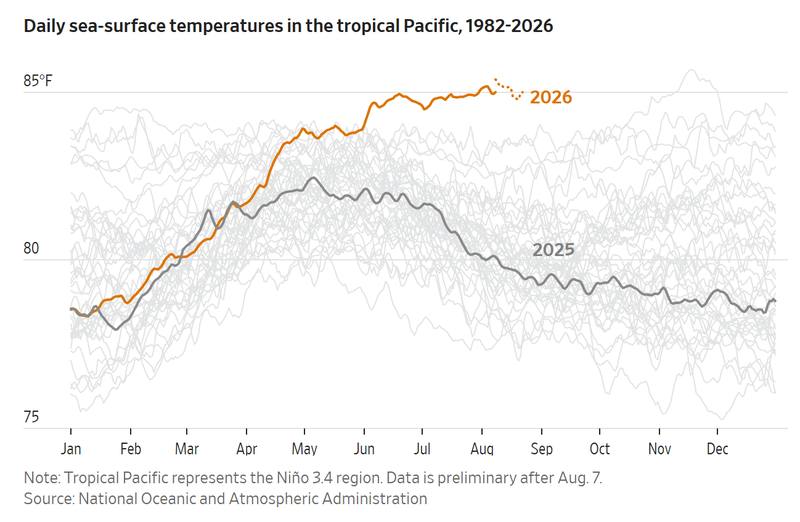
The reason this one is different: 2026's tropical-Pacific temperature line has run above every year since 1982 and is still separating from the pack heading into September. "Generationally strong" is the scientists' phrase; trillions in lost tropical income is the economists'. It compounds the war's food-and-fuel inflation, and it does not expire until 2027. Source: NOAA / WSJ.
VC+ Special Dispatch, Inside the US Semiconductor Boom
Part one of the new dispatch follows the boom from record sales to a widening trade imbalance, and it reads like this letter's macro in miniature: American firms capture the value, the hardware crosses borders anyway, and the money has outgrown the categories built to measure it. Eight charts. Credit to the VC+ team.
Infographic 1 - A New Semiconductor Supercycle
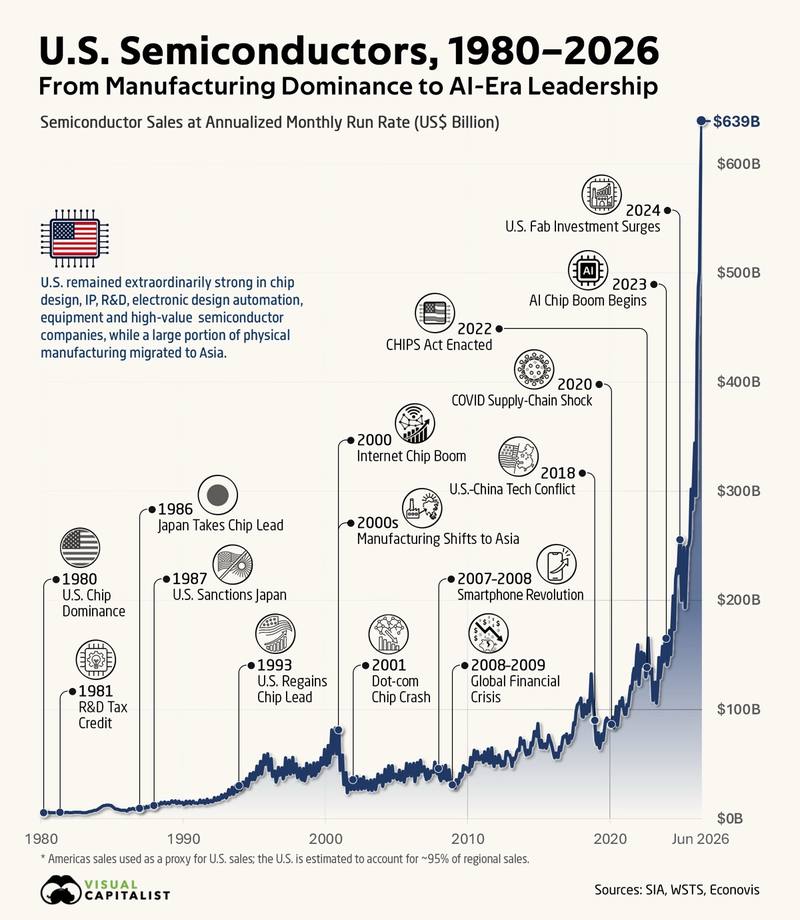
US semiconductor sales passed a $639 billion annualized run rate in June, a line that spent four decades climbing and three years going vertical, with every prior spike, 2000, 2008, 2020, reduced to foothills. The AI chip boom that began in 2023 is now the steepest demand shock in the industry's history. Source: SIA, WSTS / Visual Capitalist.
Infographic 2 - Chips Claim a Bigger Piece of the Economy
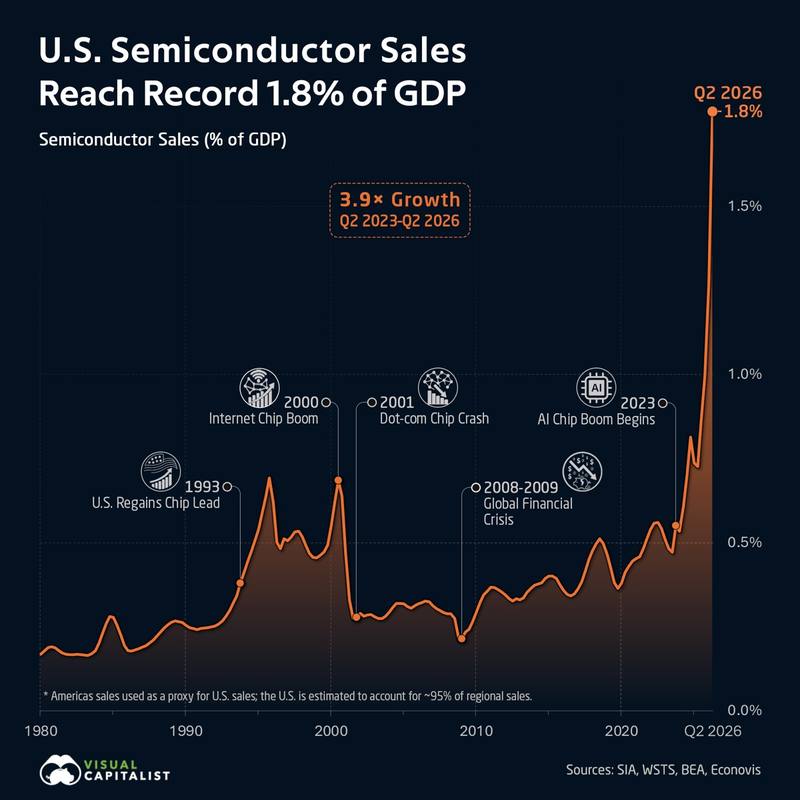
Semiconductor sales reached a record 1.8% of US GDP in Q2, nearly four times their 2023 share, past every cyclical peak since 1980. At this scale the chip cycle stops being a sector story and becomes a material force in US investment, trade and, as Thursday's deficit print will show, the national accounts themselves. Source: SIA, BEA / Visual Capitalist.
Infographic 3 - The US Reclaims the Lead
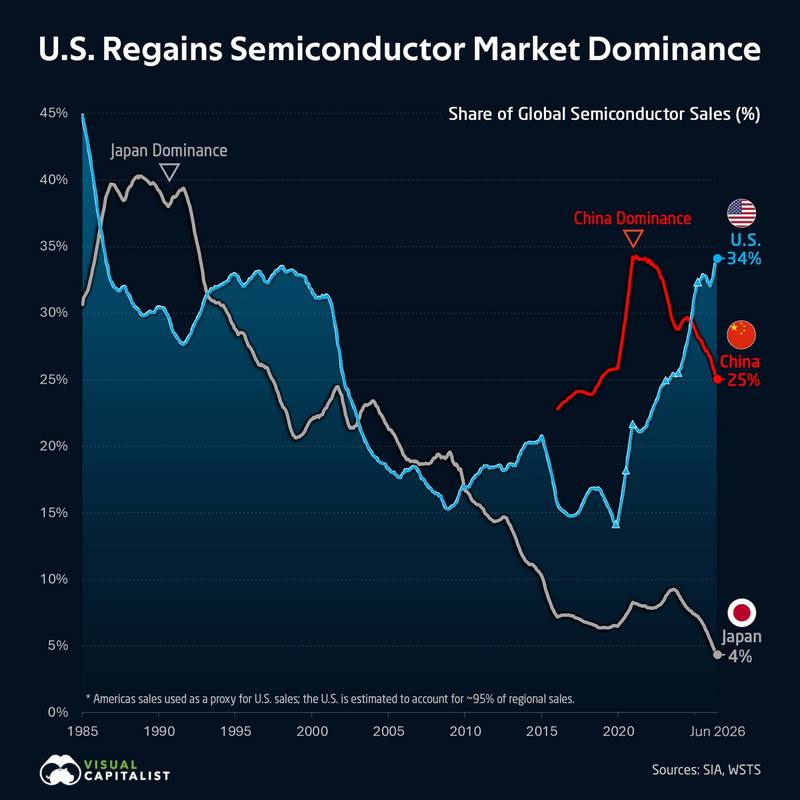
America's share of global semiconductor sales hit 34% in June, reclaiming the lead from China at 25%, with Japan, the 1990 hegemon, at 4%. Three dominances in forty years, each broken by the next platform shift; the AI era handed the crown back to the country that kept the design layer. Sales leadership, the SIA is careful to note, does not erase manufacturing dependence. Source: SIA, WSTS / Visual Capitalist.
Infographic 4 - The Boom Has Three Clear Winners
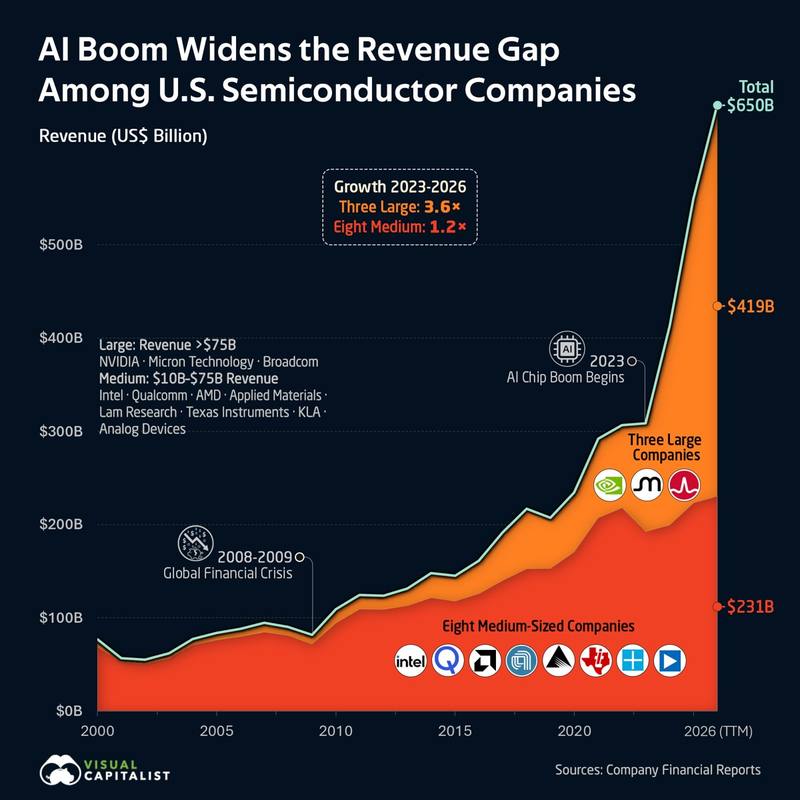
Nvidia, Micron and Broadcom captured 89% of the revenue increase among eleven major US chipmakers, the three large growing 3.6x since 2023 against 1.2x for the eight medium. Accelerators, memory and networking sit at the data centre's bottlenecks; everyone else sells into the parts of the machine that are not scarce. Concentration is the boom's defining trait, in revenue as in everything. Source: Company reports / Visual Capitalist.
Infographic 5 - The Import Paradox
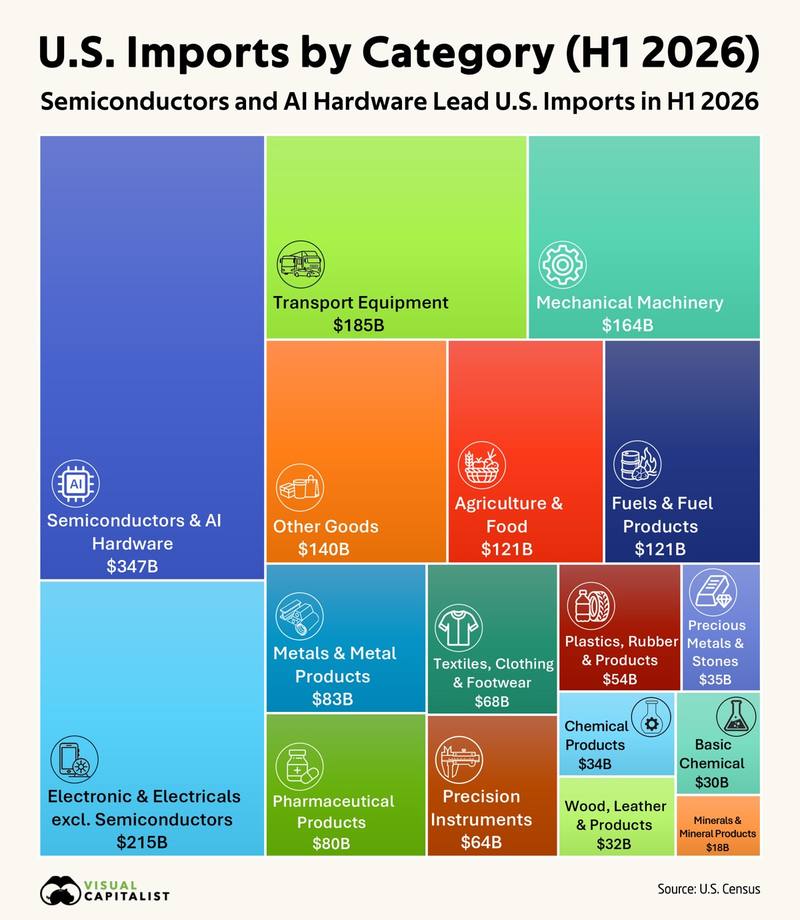
Semiconductors and AI hardware became America's largest import category, $347 billion in the first half, nearly a fifth of everything the country bought abroad, ahead of transport equipment and machinery. The AI build-out is no longer just a technology story; it is reshaping what America buys from the world, and from whom. Source: US Census / Visual Capitalist.
Infographic 6 - AI Hardware Drives Record Import Surge
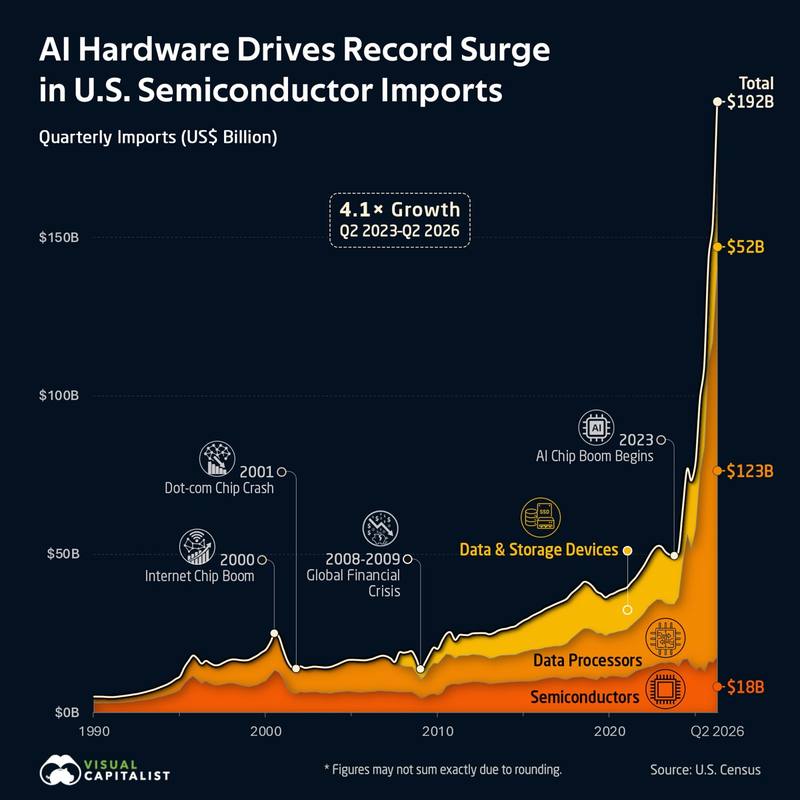
Quarterly imports hit $192 billion, 4.1x their level of three years ago, with data processors at $123 billion doing most of the work; over 95% of a server rack's value is chips, but it crosses the border as computers and storage, not as semiconductors. The categories that used to measure the trade can barely see it. Source: US Census / Visual Capitalist.
Infographic 7 - One Category Holds Up US Imports
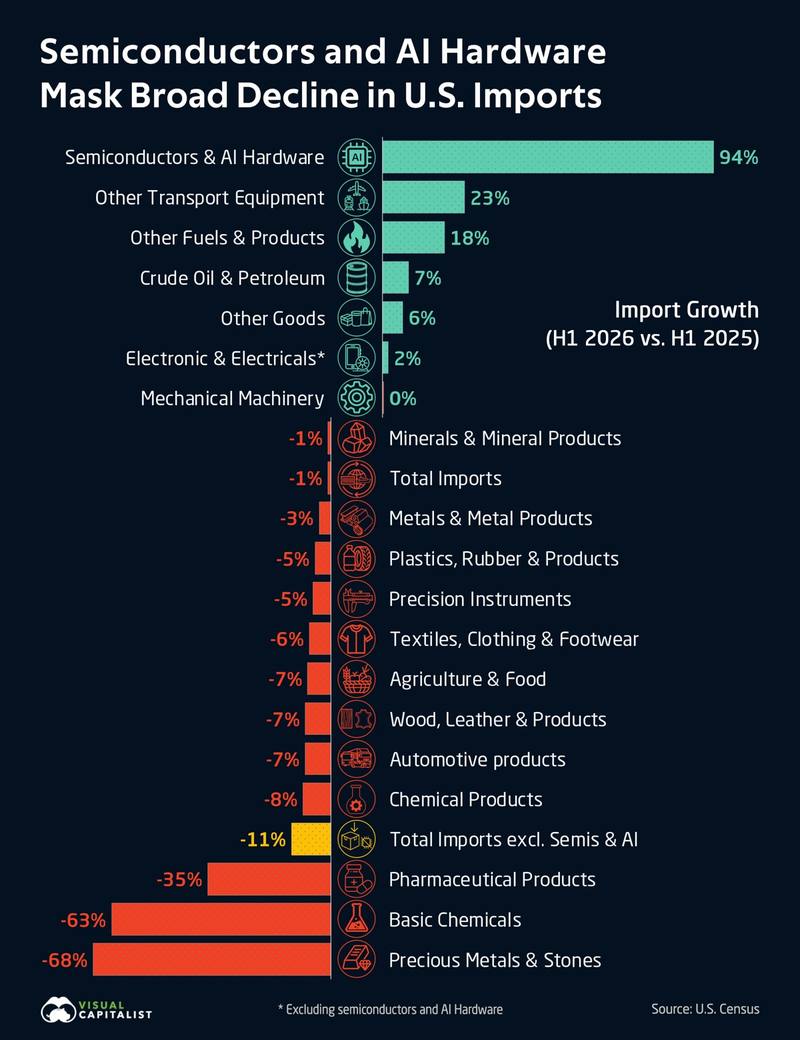
Without semiconductors and AI hardware, US imports would have fallen 11% in the first half; with them, the decline was 1%. The 94% growth in one category is masking a genuine trade contraction everywhere else, pharmaceuticals down 35%, precious metals down 68%. Read the headline import number accordingly: it is a data-centre capex line wearing a trade statistic's clothes. Source: US Census / Visual Capitalist.
Infographic 8 - The Trade Gap Breaks Open
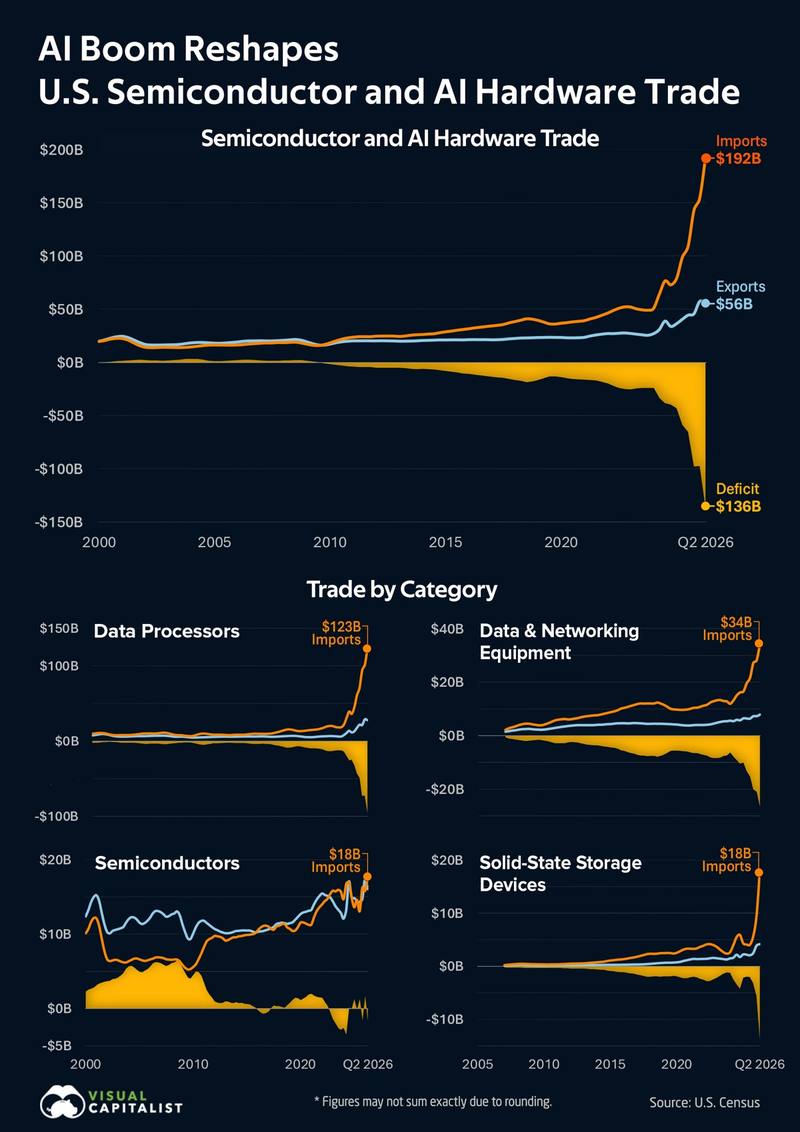
The semiconductor and AI hardware deficit reached $136 billion in Q2, imports growing more than twice as fast as exports since 2023. The broader trade deficit can narrow while this line explodes, which is precisely what Thursday's report will show. America leads the boom and imports its body; the value stays, the hardware arrives COD. Source: US Census / Visual Capitalist.
The Good Wrap
What is left at the close. The prediction markets promote a new challenger, the world's favourability tables quietly flip, the graduate premium turns out to be a national choice, the family offices buy more of the same tape, and the AI job cuts stop being a rounding error. Then week five of the eight great cuisines, from the province that gave the world its most famous chop suey and its most honest fish. At the table, as always.
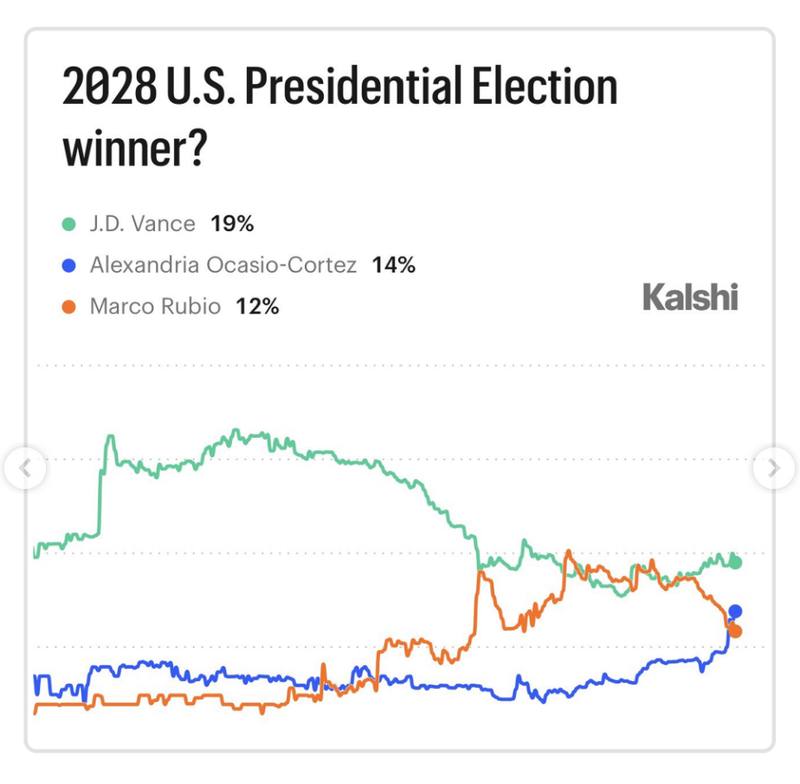
The 2028 board reshuffles: Vance at 19%, and AOC at 14 passing Rubio's 12 on the prediction markets, the first real money-signal of the midterm season. A vice-president and a democratic socialist as the two favourites is the polarisation trade expressed as a price, eleven weeks from the midterms that will set both their launch pads. Source: Kalshi.
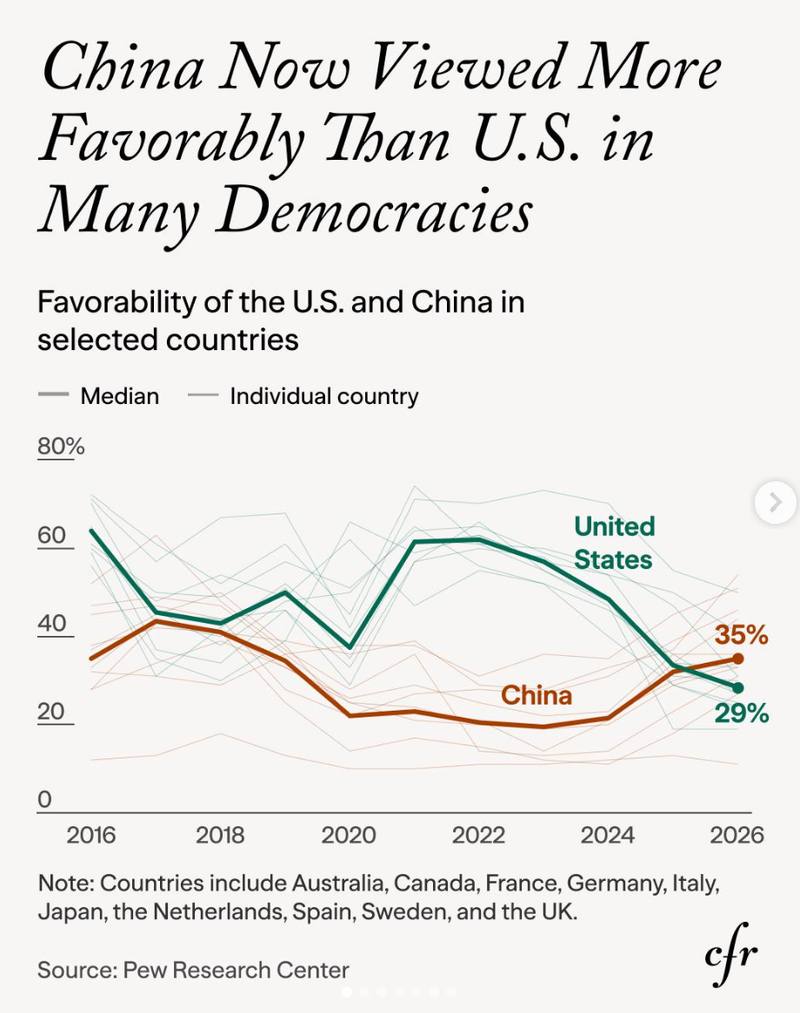
The soft-power crossover, now measured: China is viewed more favourably than the United States across most of 36 countries surveyed, 35 to 29 at the democracies' median, and CFR's read is blunt: a story of American decline more than Chinese surge. Beijing has won the comparison, not yet hearts and minds. The recoverable part, the analysts say, is the institutions. Source: Pew Research Center / CFR.
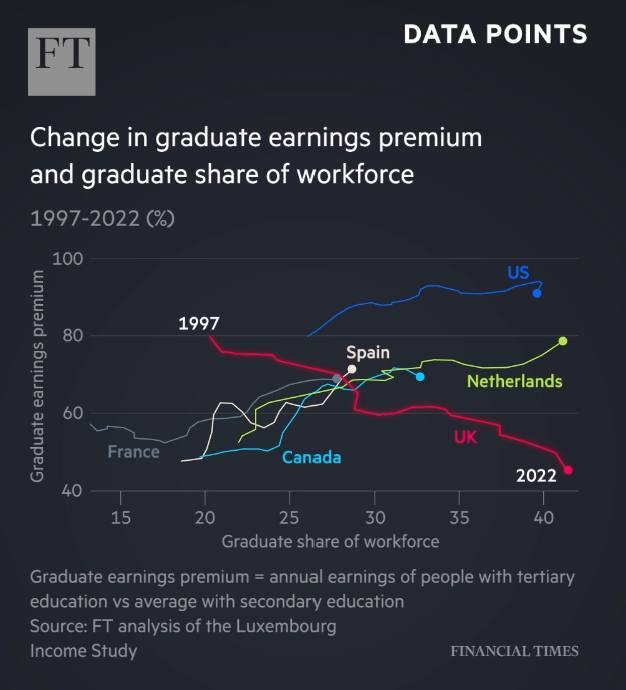
The graduate premium is a choice economies make: England's schools climbed the world rankings while its graduates' earnings premium collapsed toward 45%, the US holding above 90 on the same chart. Supply of graduates met stagnant demand in one economy and dynamic demand in the other. It is the macro version of Q3's fluency gap: the credential is not the moat; the labour market it lands in is. Source: FT / Luxembourg Income Study.
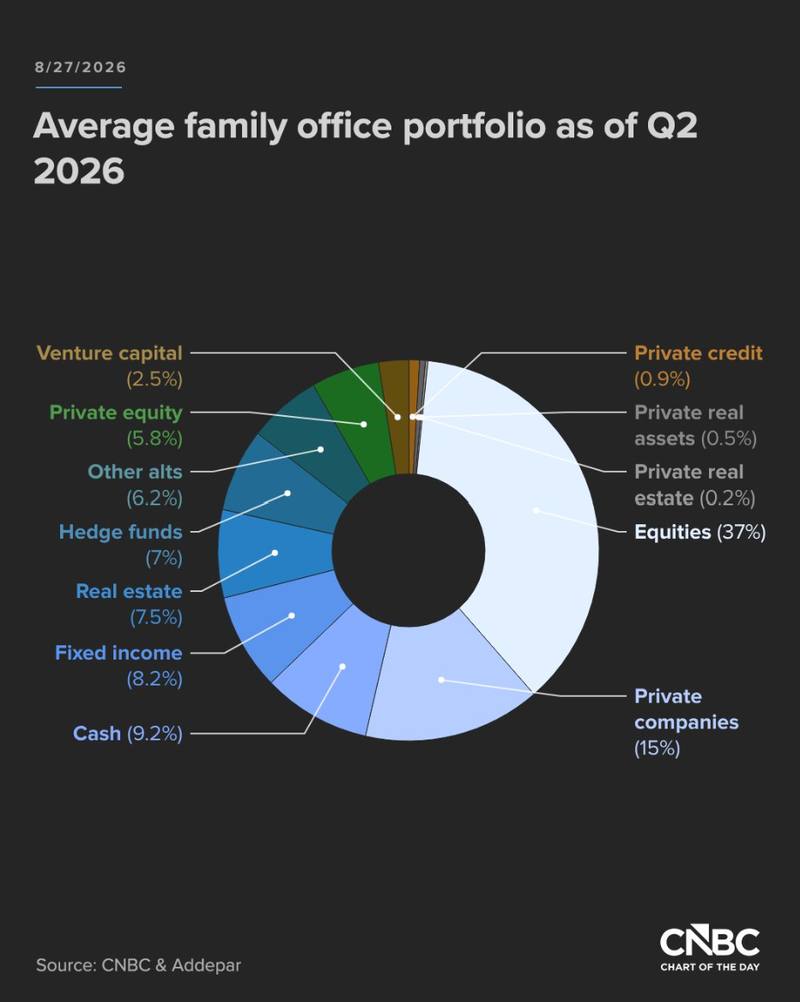
The patient money votes with its allocation: family offices lifted equities to 37% of the average portfolio in Q2 per CNBC's tracker, trimming real estate and private markets, cash still above 9. The most patient capital in the system is adding to the same tape the vol-control funds are levered to. Everyone is in the pool together; the deep end and the shallow end just report differently. Source: CNBC / Addepar.
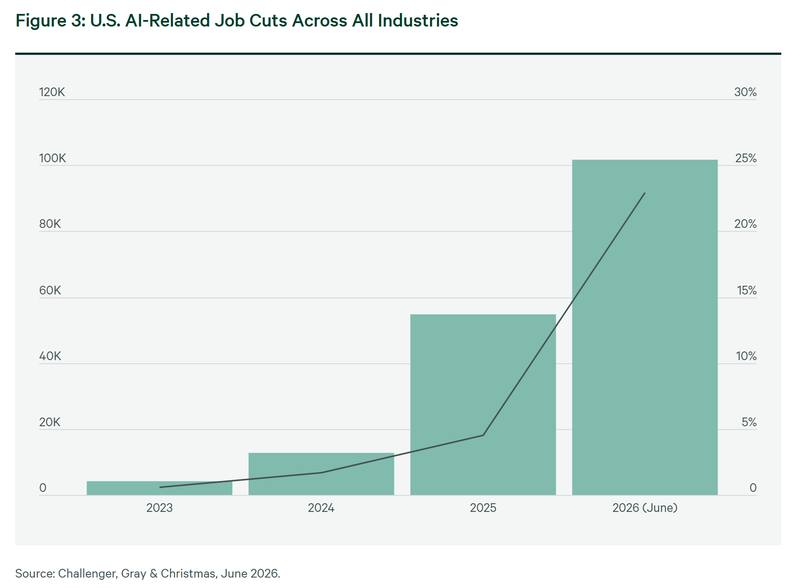
The AI job cuts stop being an anecdote: 101,743 US job cuts attributed to AI through June, nearly double all of 2025, 22.9% of every cut announced per CBRE's talent report, while AI roles hit 57% of Bay Area tech postings and non-AI tech postings fall 60%. Q3's cognitive-commons argument, arriving in payroll form, one benchmark revision at a time. Source: Challenger, Gray & Christmas / CBRE.
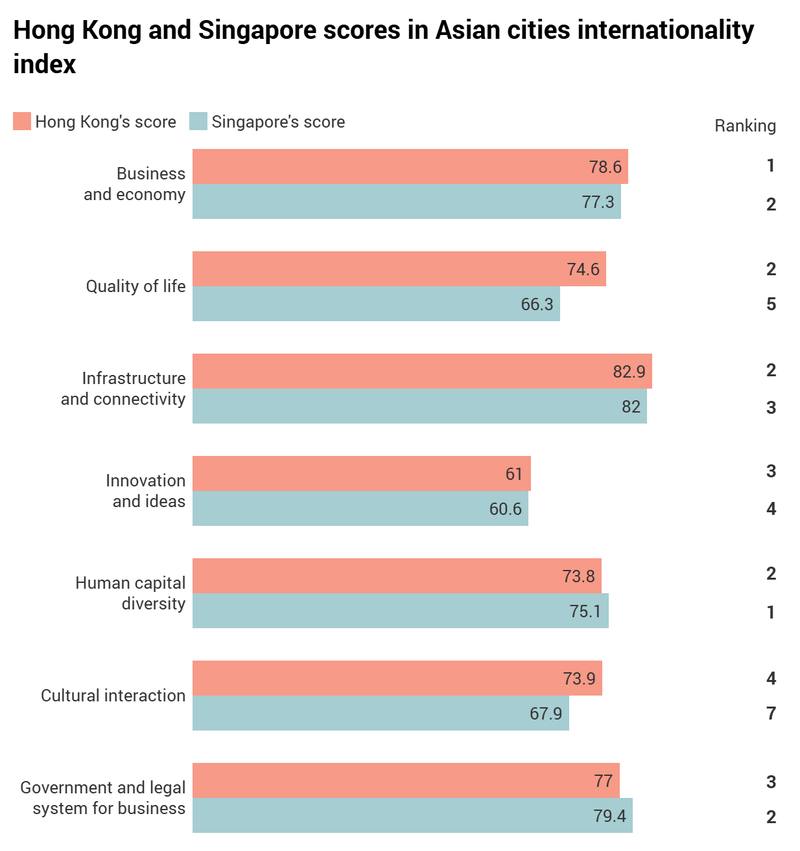
A rivalry we watch from the losing side this year: Hong Kong widens its lead over Singapore atop the Asian internationality index, 74.6 to 72.6, first in business and economy, with Kai Tak and the family-office influx doing the recent work. Singapore keeps the human-capital crown and second everywhere that matters. Healthy competition, and the runner-up still eats very well. Source: HKGCC / SCMP.
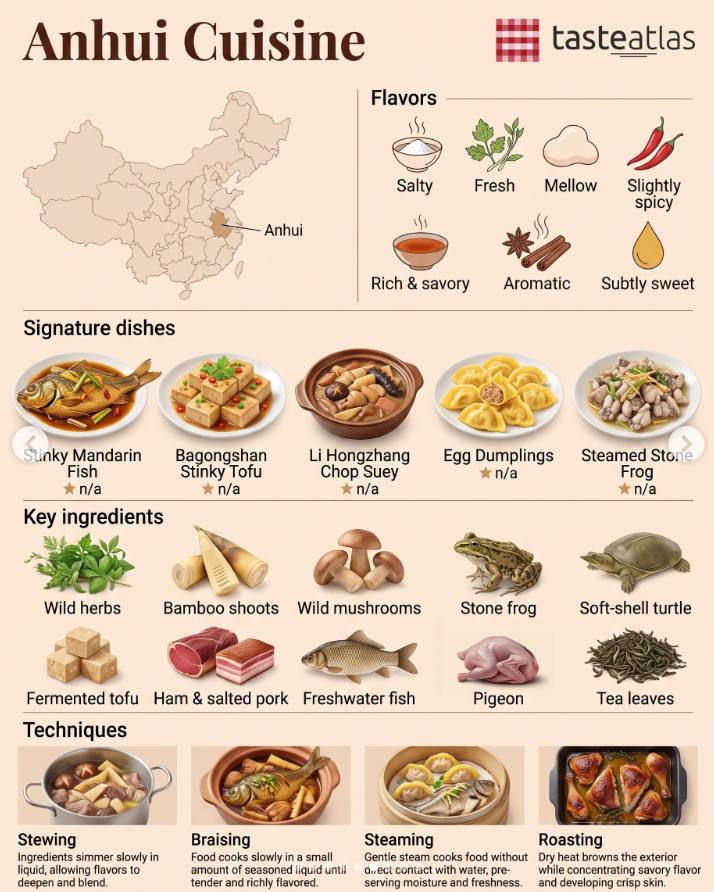
Week five of the eight great cuisines: Anhui, the mountain kitchen. Wild herbs, bamboo shoots, mushrooms, soft-shell turtle, and the famous stinky mandarin fish, fermented until it announces itself from the next room and beloved anyway. Li Hongzhang's chop suey carried the province's name into every overseas Chinatown, and the techniques are patience itself: stewing, braising, slow fire, low flame. After Sichuan's fireworks last week, Anhui is the quiet uncle who cooks better than everyone and never mentions it. Source: TasteAtlas.
Best,
Hoelon
WITPTW is a personal publication. Everything here is personal opinion and market commentary, written in a personal capacity. It is not investment advice and not a recommendation to buy or sell any security. It is not associated with, endorsed by, or representative of any employer, fund or company. Charts and images are reproduced from their original publishers, credited to their sources for commentary and discussion; all rights remain with the respective copyright holders.