I Am Now the House
Personal views and market commentary. Not investment advice. Not associated with any employer or firm.
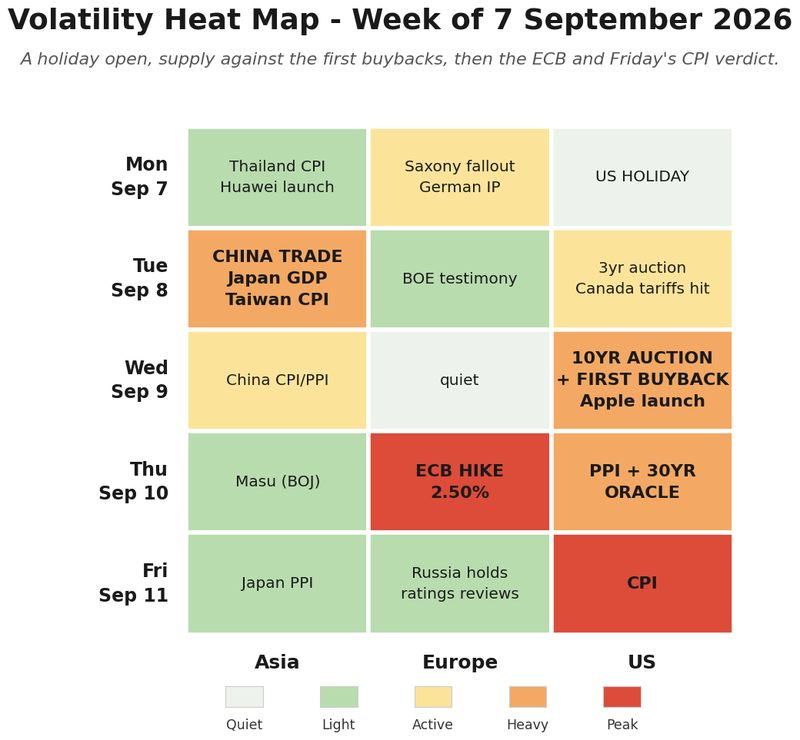
Volatility heat map for the week ahead , sessions as we trade them from here. A holiday Monday digests Saxony-Anhalt and OPEC+, Wednesday pairs the 10-year auction with the first doubled buyback operation, the ECB hikes in Berlin on Thursday with Oracle after the close, and CPI lands at 8:30pm our Friday to decide September. The S&P enters at 7,718, up 13.4% on the year and 1.5% from its high, with gold at 4,430.
"The fun thing for me is, having been in the markets for 40 years… I am now the house." — Scott Bessent, taking questions at the Charlotte Economics Club. The house does not need to win every hand; it needs the game to keep running and the odds to lean its way over time. The whole answer deserved the letter. Economics, he said, is not physics or math but biology, an organism you can never be sure how it will react; his job is "to truncate the very bad outcome", which is why the buybacks buy illiquid long bonds at a discount and free balance sheets for the liquid ones at auction. He cannot change the equilibrium price, he says, only try to move prices toward it. That is a put, described by its author. But a casino's edge is arithmetic; the Treasury's is credibility, and this house runs a 6%-of-GDP deficit at its own table. On Wednesday the buying begins. The house always wins, until the players notice it is borrowing its chips from them.
"Students are spending a lot of time learning to be thieves nowadays… a knack for cutting corners, a disdain for community rules, and an assumption that a spirit of integrity, and the sacrifices it assumes, is the reserve of suckers and wimps. We will be a society of cheats." — John Paul Rollert, twenty years a professor at Harvard and Chicago, in The Atlantic. He describes walking his own campus as being "trapped in the middle of a crime spree", and Princeton just abolished its 133-year-old honor code, declaring it no match for chatbots. A third of Harvard's graduating class admits using AI against instructor permission. MIT's new report says classroom bans are pointless, because AI can now credibly complete "pretty much any undergraduate assignment", and the institute that built modern AI's foundations is considering overhauling its entire education model. The fix is the great irony: Socratic dialogue, oral exams, pen and paper, blue-book sales up 80% since 2023. Last week the fluency gap was at the dinner table; this week it reached the lecture hall.
"History is written by winners." — Alex Haley. Nine weeks to the midterms, and the president is writing the first draft early and loudly. Talking rates down while the Fed talks them up, taking a 65-billion-barrel concession in Venezuela, floating a new name for the Strait of Hormuz: none of it is ridiculous once you see the strategy. Why would you speak weakly and gentlemanly when the whole game is to be the winner who does the writing? The loud claims draft November's story, and the quiet fine print, the buybacks, the cash account, the twist, is written by the same hand. The trading lesson is old: do not fade the theatre because it offends you; price the incentives behind it. From here to November 3, every policy is also a campaign message. Trade the incentive, not the outrage.
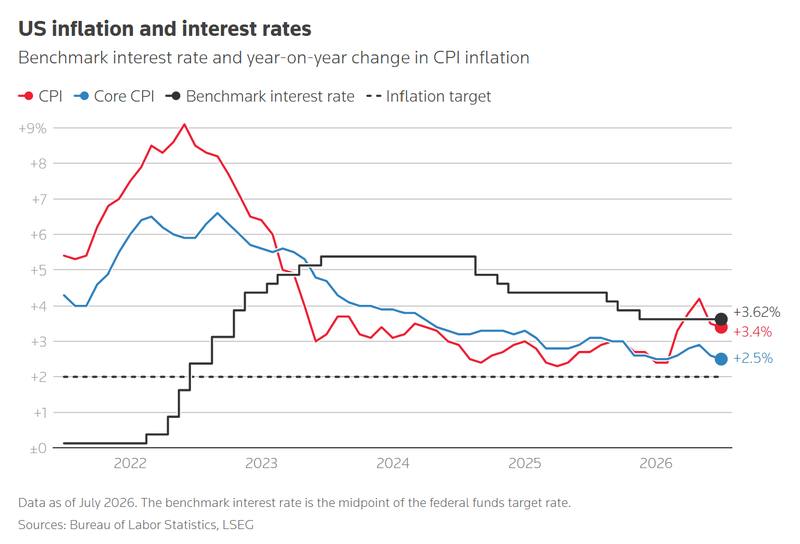
US inflation and the rate that must answer it. Headline CPI at 3.4%, core at 2.5% and falling, the funds rate at 3.62%, and the dotted 2% line below them all. Friday's print decides whether the gap starts closing from the rate side: 0.4% headline and 0.2% core are expected, which would ease core to 2.4%, the lowest since 2021, while gasoline holds the headline. A soft core and the Fed waits; an upside surprise and the hawks have their September votes. One number, one meeting, and every other market trades the answer. Source: BLS, LSEG / Reuters.
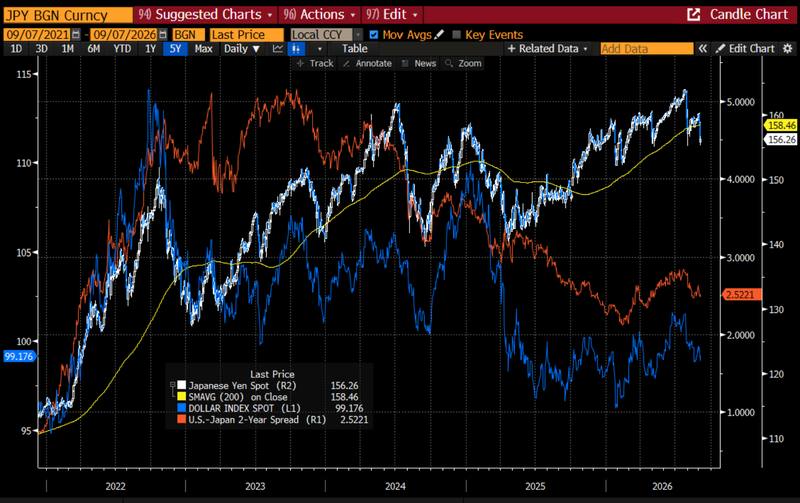
Five years of the weak-yen era, ending. Dollar-yen at 156.26, breaking below its 200-day average at 158.46 for the first sustained spell of the cycle, with the US-Japan two-year spread at 2.52 and narrowing as the BOJ's hike gets fully priced for the 18th. The squeeze came without intervention, nearly three percent in two days, which is exactly the point: the turn is organic now. 155 has held three times and remains heavily supported, but it should not be treated as a line in the sand of any sort; when a five-year trend bends with this much momentum, the levels are waypoints, not walls. Source: Bloomberg.
What is the plan this week?
The week starts quietly and on purpose: an American holiday Monday, the Saxony-Anhalt result landing from Sunday, and OPEC+ setting quotas before Asia even opens. The noise last week came from inside the Fed. The family fights have reached the public domain: Waller said his decision hangs on the inflation data and he is inclined to hold if it cools, Trump joined in for the first time after a long patient wait, loudly demanding the lowest rates in the world, and the chair went into the blackout saying nothing. Markets were thrown around accordingly, and this is what we should prepare for: much more volatility in FX, because the argument is now conducted in the open. Even payrolls could not settle it, +162k against 55 expected, the biggest beat since April, yet unemployment held at 4.1% and wages at 3.1%, so both camps kept their story.
This week, PPI Thursday and CPI Friday probably seal the chances of a Fed hike. The case looked like it was fading; since Waller and Trump it has hardened again into a genuine coin flip, with futures pricing roughly 60% odds of a hike on September 16. Bloomberg Economics expects headline CPI at 0.4% on gasoline with core at 0.2, which would put core at 2.4% on the year, the lowest since 2021, numbers that may not tilt the committee strongly either way. Experts tell me a 6-6 FOMC with the chair casting the deciding vote has never happened; it is now imaginable, and it would advertise the disagreement at maximum volume. The discipline for the week is not to carry large directional risk into CPI and the ECB at once; the real gauntlet is the week after, FOMC on the 16th, BOE on the 17th, BOJ on the 18th.
The bond market gets its own test regardless: 3s, 10s and 30s across Tuesday to Thursday, and on Wednesday the Treasury's doubled buybacks begin their first operation, the house buying at its own table for the first time. Yields survived last week with the 10-year near 4.78%, the highest in decades, and the vigilantes are still short. But Bessent said he is now the house, and the early evidence is that the table is being managed: the long end has stopped panicking even with oil above $90.
The USDJPY move was the week's most important price action, and it was welcomed everywhere it matters: JGBs and the Nikkei both traded like a pressure valve easing. If Bessent and Katayama really are manufacturing the turn of the extreme weak-yen trend, bond markets get relief as confidence builds back, and the swaps market now has the BOJ's hike near fully priced for the 18th. Meanwhile the dollar's price action was preparing a much lower move, but fighting against USD carry is not natural, and the selling is much clearer in the surplus Asian countries: USDCNH at its lowest since January 2023, the won and Taiwan dollar bid, and Trump's attention on the high-surplus countries echoing a liberation-day type of trigger. Much lower USDCNH, USDTWD and USDKRW, even from here. The ECB hikes Thursday into inflation back above 3% and the market does not believe it is a series; the ruble is quietly weakening to a new point, and I somehow feel the soundbytes from there could get louder.
Geopolitics stays unsolved. The G20 ended without a statement, rarely, and the SCO leaned toward not outcasting Iran, so the economic-outcast operation is not the chokehold advertised; oil is elevated and the markets are not biting. The plan this week is simply to get through PPI and CPI with the book intact. The surplus-versus-deficit crosses carry the theme and get added on discipline rather than chase, the yen turn is respected but not chased below 155, and with the week bracketed by a holiday and a coin-flip print, protection through Friday is cheap relative to what it insures. Stay nimble.
What did I learn last week?
Mon Aug 31: China's PMI came in at 49.8 against 49.5 expected, a second month of contraction with production and new orders quietly back above 50, close to the stimulus signal but not it. The Dallas Fed smashed at 11.6 against 1.6. The Economist reported Putin telling associates that ending the war without all of Donbas means "they will hang me", the sentence that explains why the contacts talk goes nowhere slowly.
Tue Sep 1: The RBNZ hiked to 2.75% by consensus, as priced. Eurozone CPI hit 3.3% as scripted with core softer at 2.4. ISM manufacturing missed at 54.6, JOLTS held at 7.27 million, and the House passed the funding stopgap 370-48, money through December 11, the October shutdown tail closed before it opened. The war came back: US strikes near Hormuz after Iran's "failed attempt at adding sea mines", and the G20 ended without a statement, a first even the 2025 boycott year avoided.
Wed Sep 2: The BOC held hawkishly, Macklem saying multiple increases could be necessary, and the loonie rallied. The yen began its violent squeeze, nearly 3% in two days, a suspected rate check and fighting words from Mimura doing what two interventions could not; Takata said the BOJ should consider more than 25 at a time. Broadcom beat for a ninth straight quarter, AI revenue up 221%, and fell 6% on a guide $200 million short. The market is now grading AI on the guide, not the quarter.
Thu Sep 3: Bank Negara held a seventh time but dropped the word "appropriate" from its statement, the region's quietest hawkish turn. Claims 206k, the trade gap narrower than feared at $88.6 billion. Nvidia confirmed Hugging Face at $11.9 billion, OpenAI shipped GPT-6 Astra, and Oman quietly refused Iran's pitch for Hormuz transit fees. Lululemon touched eight-year lows while Tyson and Campbell's warned on the stretched consumer.
Fri Sep 4: Payrolls +162k against 55 expected, the biggest beat since April, with unemployment steady at 4.1% and wages at 3.1%; hike odds touched 60% and faded into the close. Trump posted that the Fed must "BE PATRIOTS" and lower rates or he'll stop trading with deficit countries. Norway was reported mulling a $75 billion Treasury sale, and China's rare-earth firms began halting US shipments ahead of the Xi visit.
All week: Equities barely moved, the S&P up 0.1%, while everything else did: WTI up 9.2% settling above $90, JGB 10-year yields through 3% for the first time in three decades, the won and yuan grinding stronger, wheat down 5.3% on Putin contact talk. And China printed its best earnings season in five years, profits up 25.7%, into a CSI 300 down 9% on the quarter. Strong numbers no longer work; everywhere, the guide is the product.
What to look out for next week?
Mon Sep 7: A holiday Monday with the tape wide open: the US and Canada are shut while the market digests Sunday's Saxony-Anhalt result, where the AfD leads the polls and a first state-government win would rattle Berlin's every coalition, and OPEC+ sets quotas the same day. Thailand's CPI opens the El Nino food watch at 2.3%, Huawei launches its triple-fold two days before Apple, and the euro area prints the wage gauge the ECB reads before it speaks.
Tue Sep 8: Canada's counter-tariffs on $20 billion of US goods take effect, the trade war's first structured round. China's trade is expected loud again, exports near +25.7% and the surplus around $107 billion, the number Washington reads before Xi's visit. Japan's revised GDP is seen jumping to 2.4% annualised on capex, above potential and another brick in the BOJ's case, with labor earnings near 3.8%. Taiwan's CPI at 2.6% keeps the CBC's first hike in play this month. The supply week opens with $58 billion of 3-years; NFIB and Chile's hold fill the edges.
Wed Sep 9: China's CPI and PPI test the reflation-by-war thesis, 0.7% and 3.7% expected. Apple answers Huawei in Ternus's first launch as CEO. Then the day's real event: the Treasury's first doubled buyback operation runs the same afternoon it sells $39 billion of 10-years, the house buying and dealing at its own table within hours. The Republicans open their first midterm convention in Dallas with Trump keynoting; Poland decides; Korea prints unemployment at 2.8%.
Thu Sep 10: The ECB hikes to 2.50% in Berlin, fully priced; the trade is Lagarde's December language, the staff's 2027 inflation revision, and any answer on America selling euros to buy yen. US PPI lands hot on paper, 0.4% with the annual rate near 5.3%, the first print under the revised PCE mapping that retires the portfolio-fee distortion. The $22 billion 30-year closes the supply week into the buybacks. Then Oracle after the close: options price a 9.5% move, capex guidance doubling, and with Anthropic and OpenAI filing next month it is the cleanest public read on AI compute demand. Turkey and Peru hold; Trump and Vance speak again in Dallas.
Fri Sep 11: CPI at 8:30pm our time decides September: 0.4% headline and 0.2% core expected, which would hold 3.4% and ease core to 2.4%, the lowest since 2021. A soft core and the Fed waits; an upside surprise and the hawks have their votes. UMich's inflation expectations follow, Russia holds at 14%, the UK prints a flat July, and Italy, Spain and Saudi Arabia face the raters on the 25th anniversary of September 11. Take nothing heavy into the weekend; the gauntlet begins Monday.
Beyond next week
Sep 14-19: The gauntlet: FOMC on the 16th at a genuine coin flip, BOE the 17th, BOJ the 18th with a hike near fully priced; Taiwan's CBC may open its cycle the same week.
Sep 24: Xi meets Trump in Washington; the rare-earth halts are the pre-negotiation.
Sep 29 / 30: The RBA with a hike two-thirds priced, then core PCE on the new methodology.
Oct: The Anthropic and OpenAI IPO window opens; buybacks run to November 4; and October 19 falls on a Monday, as it did in 1987.
Nov 3: Midterms, eight weeks out, the clock under every policy in this letter.
Regimes
The bond market changed the subject, week four: the subject went global. The hawk's rescue lasted exactly one week; the 10-year broke out to 4.82% anyway, and now every market is the same market: JGBs through 3% for the first time in three decades, Bunds at 2011 levels, most G7 30-years at decade-plus highs. This week the theory meets the mechanics: 3s, 10s and 30s across three days while the doubled buybacks run their first operation between the auctions. Steepeners stay retired; a tail anywhere is still a gross-down signal. changed, week 4
The dollar goes two-way, week fourteen: strong data, soft dollar. The checklist's most interesting outcome: payrolls beat by the most since April and the dollar could not hold the bid into the close. The selling is concentrated where the surpluses are, and the residual trend is quietly soft. Neutral remains the dollar view; the crosses express everything worth expressing, and CPI on Friday is the only print that can change the regime's direction. held, week 14
The AI fracture, week ten: the guide is the product. Broadcom's ninth consecutive beat sold off six percent on a guide two hundred million light; China printed its best earnings season in five years into a falling index. Yesterday's frontier model keeps getting cheaper within months of shipping, which squeezes every lab's window to monetize a generation just as the next one costs more to build, and just as the IPO window opens. Nvidia buying Hugging Face is the tell: when the model commoditizes, buy the distribution. changed, week 10
The war is the inflation, week seven: the merge. The war regime and the inflation regime become one entry, because they are one trade now. Crude up 9.2% on sea mines and strikes, diesel at a record $5.85 pressing an eighteen-year base, food prices at 2022 highs, PPI printing near 5.3% on the year, while core CPI eases to the lowest since 2021. Two inflations, and the hot one is manufactured in the strait. The G20's failed statement and the SCO's solidarity with Iran say the outcast operation is fraying; the premium is political, and politics does not mean-revert on schedule. changed, week 7; absorbs the war regime, week 3
Surplus versus deficit, week two: the officials confirm it. The strongest evidence yet came from the intervention desks: the surplus central banks spent the month buying dollars, the biggest aggregate Asian FX purchases in over a year, leaning against their own currencies and losing ground slowly. When the official sector is the other side of your trade and still retreating, the flow is real. The won, Taiwan dollar and yuan all pressed on; the crosses stay, adds on discipline. held, week 2
The yen turn, manufactured. The thread returns. Retired at week three when the Ministry left the field; it returns as promised now that the Bank has made it a story. Three percent in two days on a rate check and fighting words, 155 defended three times, a hike near fully priced for the 18th, and repatriation talk reaching the pension funds. The twist: the turn is sponsored jointly, Tokyo and the US Treasury, because a stronger yen relieves both bond markets at once. Respect it, do not chase it below 155 before the Bank speaks. new, week 1; formerly weeks 1-3, retired 23 Aug
Shifts (if then)
Last week's board read the events right and the yen wrong: Broadcom's credit-questions branch fired through the guide, the China five-handle never printed and the leg correctly stayed off, payrolls came in strong but wageless and the dollar faded anyway. And the pair we watched for 160.80 delivered its violence three percent in the other direction. The lesson is written into the new regime six: when positioning is one-way, the shock comes from the side nobody is paid to watch.
Core CPI prints 0.3% or higher Friday → September goes from coin flip to near-certain, the front end sells hard, and the dollar catches its bid. The trap for our book: a squeezed dollar squeezes the surplus-Asia longs first. Trim the crosses into the print, not after it. new
Core CPI prints 0.2% or below → the Fed waits, the strip unwinds toward a hold, and the dollar sellers return with official cover. The debasement re-entry checklist opens, and the decision still happens Monday, never Friday night. new
The 10-year or 30-year auction tails while the buybacks run → the house fails at its own table in week one, the twist trade reprices violently, and gross comes down everywhere. This is the single loudest possible headline of the week. new
Lagarde keeps December alive with upgraded 2027 forecasts → EUR/USD takes 1.17, the hikes-everywhere world extends, and the euro leg of the global flattening gets crowded fast. Ambiguity instead reads dovish at 99.5% priced; then 1.15 comes quickly. new
The AfD takes a majority in Saxony-Anhalt on Sunday → Monday opens with a political premium in Bunds and the euro on a US-holiday book, France's polls become the next question, and the quiet political leg of the European trade wakes up. new
USDJPY closes below 155 before the BOJ meets → the manufactured turn is running ahead of the Bank, the global carry unwind accelerates into the gauntlet, and every book still funding in yen pays for it at the worst moment. Do not be long that funding leg. new
Tails
The carry dominoes, now live → the yen unwind stopped being hypothetical last Wednesday. If repatriation reaches the pension funds while the BOJ hikes into JGBs above 3%, the outflow that built the everything-rally runs in reverse, and the first assets sold are the most crowded ones. carried, week 6
The backstop put gets doubted → a ninth straight beat selling off is the market repricing the insurer, not the quarter. Oracle's capex guide Thursday and the SoftBank refinancing bond are the next premiums due. When the guide is the product, a soft guide is a default. carried, week 7
Bonds and equities sell together → the S&P sits 1.5% from all-time highs while the 30-year sits near nineteen-year highs; September is the year's worst month and midterm years make it worse. A hot CPI plus a tailing 30-year is the full performance, and the hedge is still cheap. carried, week 6
The kindness of strangers ends → foreigners hold $37 trillion of US portfolio assets, 115% of GDP, and Norway is reportedly weighing a $75 billion Treasury sale. Confirmation takes the 10-year through 5%, and the psychological level does more damage than the arithmetic one. new
October rhymes → valuations above every historic peak on record, concentration at 38% of the index, margin debt at records, and October 19 falling on a Monday as it did in 1987. Not a forecast; a seatbelt, worn four weeks early. new
Diesel breaks the base → the refined-product war presses on: diesel sits at a record $5.85, exactly the level that breaks an eighteen-year base and projects toward $8, the inflation pipeline no negotiation reaches. Tehran is expected to move first, calibrated, before the midterms. carried, war week 15
Saxony Monday
The market's Monday is Europe's: the Saxony-Anhalt result lands on a book thinned by the American holiday, and a first AfD state government would be the loudest quiet event of the month. OPEC+ sets quotas from Sunday, Thailand opens the El Nino food watch, Huawei launches its triple-fold two days ahead of Apple, and the euro area prints the wage gauge the ECB reads before Thursday.
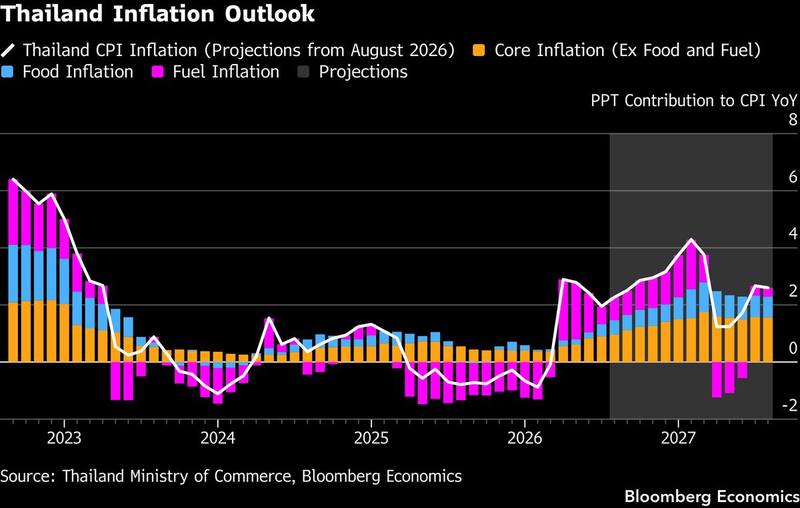
Thailand opens Asia's food-inflation week: CPI seen at 2.3% from 1.95, fuel doing the pushing and El Nino queued in the food bars, with the projection band showing the pressure running well into 2027. Weak domestic demand lets the BOT look through it for now; the deficit countries in our regime do not get that luxury. Source: Thailand Ministry of Commerce / Bloomberg Economics.
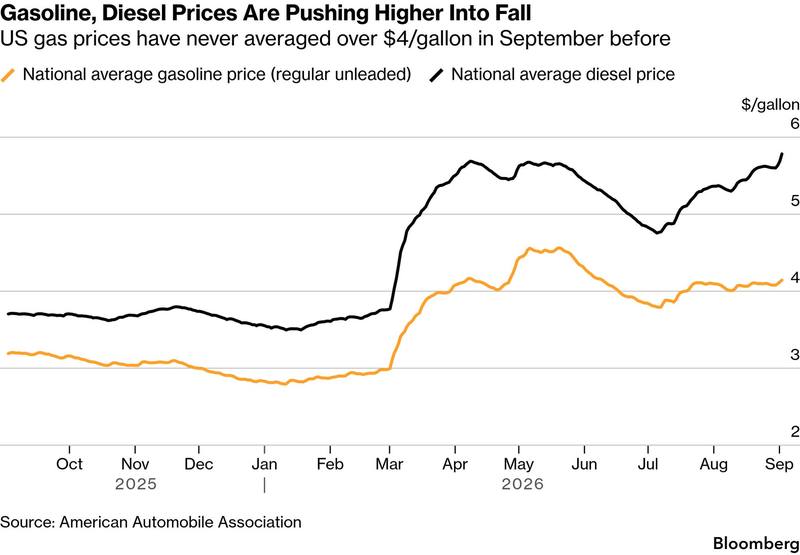
America's holiday postcard, from the pump: gasoline at $4.15, the first September above four dollars on record, and diesel at a record 5.85, with two months to the midterms. Trump has stopped dismissing pump prices and started calling them "important", which is the tell that the polling agrees. The war's inflation is now the campaign's inflation. Source: AAA / Bloomberg.
Three-Year Tuesday
The supply ladder opens with $58 billion of 3-years on the day Canada's counter-tariffs take effect and Asia prints its loudest data of the week: China's trade, Japan's upgraded GDP, Taiwan's above-threshold CPI. The BOE testifies in London, and the NFIB shows the small-business labour market cooling politely.
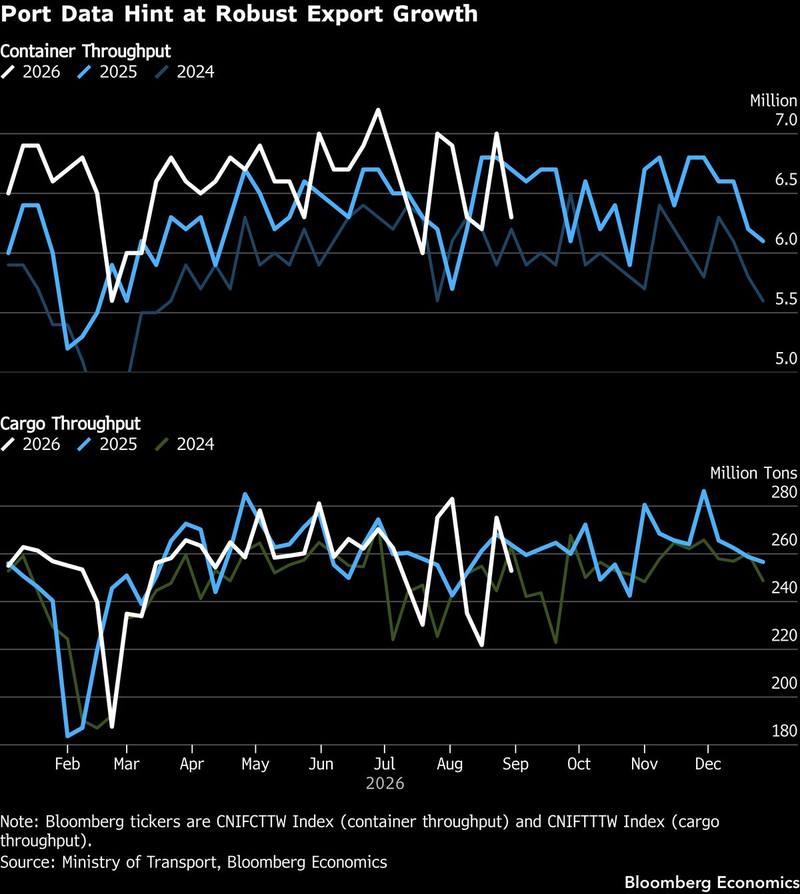
China's ports say the surplus machine never slowed: container throughput running above both prior years all summer, backing expectations of exports near +25.7% and a surplus around $107 billion. This is the number Washington will be reading three weeks before Xi arrives, and the number under our long-CNH leg. Source: Ministry of Transport / Bloomberg Economics.
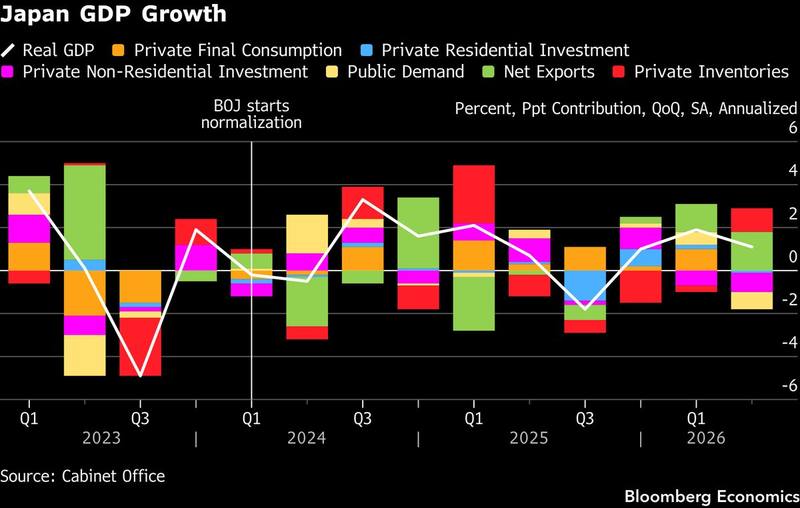
Japan's growth gets marked up while nobody watches: the revision is seen lifting Q2 to 2.4% annualised from 1.1 on stronger capex, comfortably above the BOJ's 0.7% potential estimate. Above-potential growth, wages near 4%, and a currency the government wants stronger: every input the Bank needs for the 18th is now in place. Source: Cabinet Office / Bloomberg Economics.
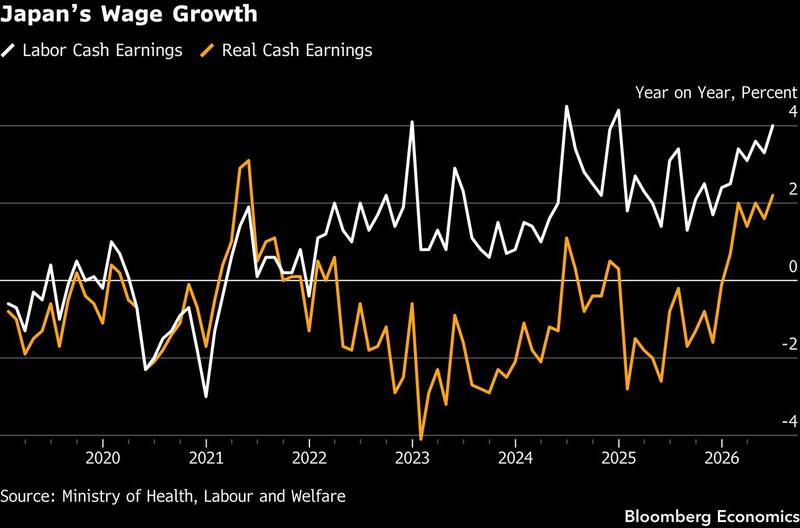
The wage floor under the yen turn: labor cash earnings near 3.8% with real earnings finally positive, the underlying full-time trend brisk even as bonuses fade. This is what makes the BOJ's hike a policy normalisation rather than a gamble, and what makes the carry unwind structural rather than a squeeze. Source: Ministry of Health, Labour and Welfare / Bloomberg Economics.
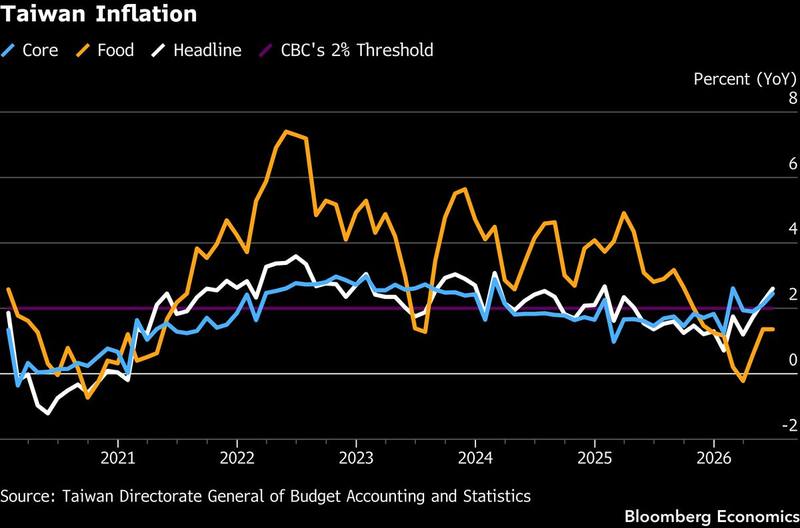
Taiwan's inflation keeps the CBC's first hike alive: headline seen at 2.6%, above the central bank's 2% alert line with core sticky at 2.4, while the AI boom feeds income and demand. Bloomberg Economics expects the cycle to open this month with a 12.5 point move. A hiking CBC on top of a $58.5 billion quarterly surplus is the strongest version of our long-TWD thesis. Source: DGBAS / Bloomberg Economics.
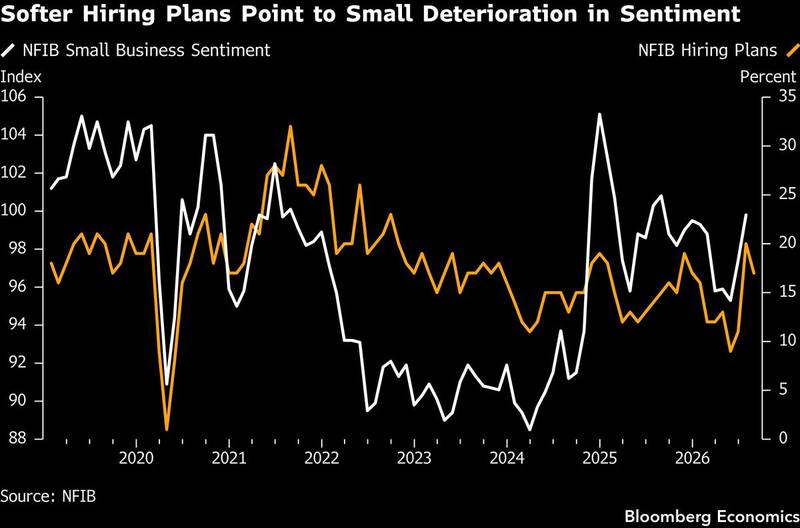
The small-business read on the American engine: NFIB seen easing to 99.5 with hiring plans down three points from July's post-2022 high, yet 35% of owners still cannot fill open jobs, well above the historical 24. Cooling politely is not cooling meaningfully; this is the labour market Warsh called full employment, on purpose. Source: NFIB / Bloomberg Economics.
Buyback Wednesday
The day the house sits down at its own table: the Treasury's first doubled buyback operation runs the same afternoon it auctions $39 billion of 10-years, buying the illiquid to sell the liquid within hours. China prints CPI and PPI in our morning, Apple answers Huawei in Cupertino, and the Republicans open their first midterm convention in Dallas with the president keynoting.
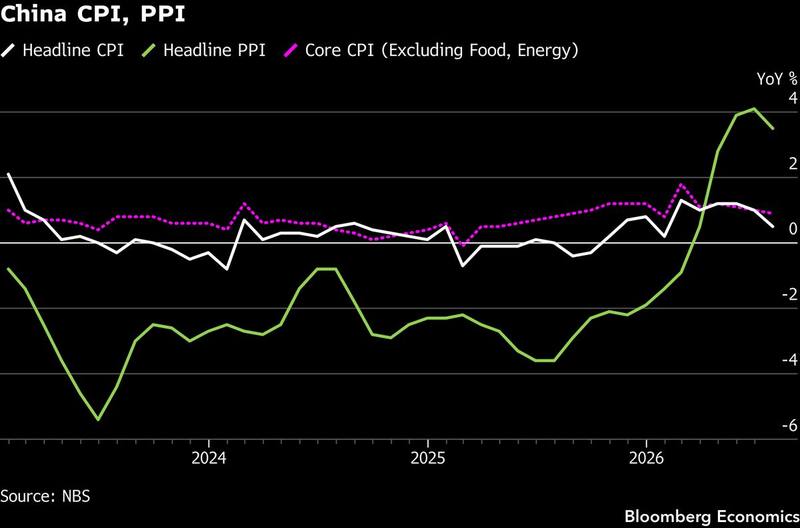
China's prices tell the war story from the supply side: PPI seen accelerating to 3.7%, dragged out of years of deflation by war-priced energy and AI-hardware costs, while CPI crawls to 0.7 and core hovers near one. Reflation by invoice, not by demand: the factory gate is importing the strait's inflation and re-exporting it worldwide. Source: NBS / Bloomberg Economics.
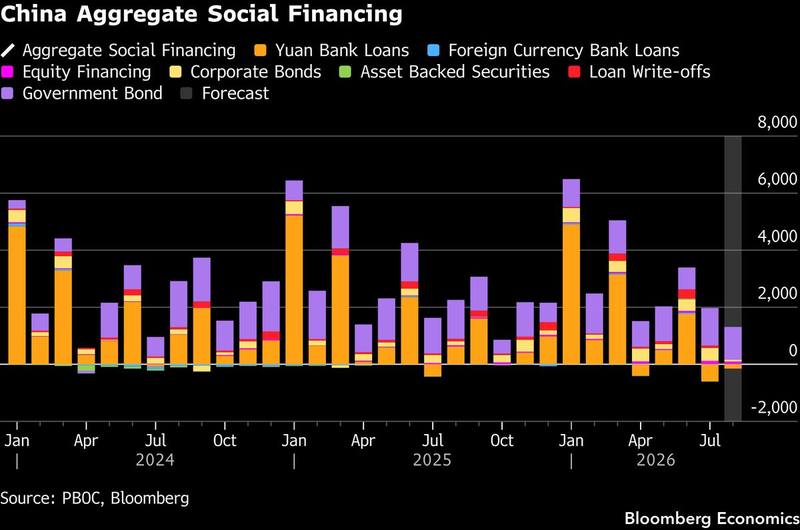
The other China chart is the reason stimulus talk persists: August credit likely slowed to one trillion yuan with corporate borrowing shrinking and only government bonds holding the line. An export machine at full throttle bolted to a domestic credit engine idling: that is the K-shape, and it is why the PMI's 49.8 was close but not the signal. Source: PBOC / Bloomberg Economics.
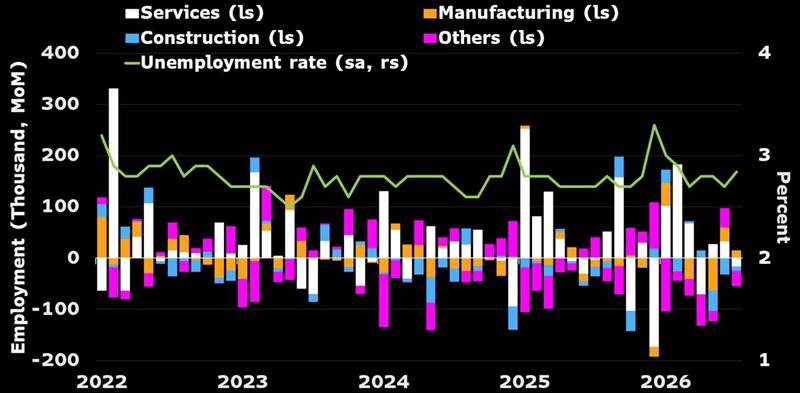
Korea's labour market backs the tightening: unemployment seen holding at 2.8%, below its post-2020 average, with services hiring steady and chips lifting factories. Nothing here argues against the BOK's back-to-back hikes; the won's strength runs on fundamentals, which is precisely what the surplus regime trades. Source: Ministry of Data and Statistics / Bloomberg Economics.
Berlin Thursday
The ECB hikes in Berlin, fully priced, and the market listens only for December. US PPI prints hot on paper the same evening with the 30-year auction closing the supply week into the buybacks, and Oracle reports after the close as the cleanest public read on AI compute demand before the IPOs file. Turkey and Peru hold, and the president speaks in Dallas a second night.
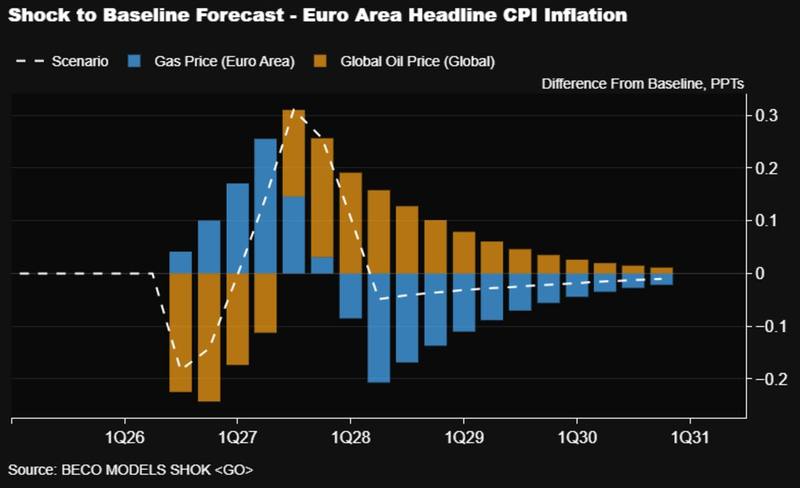
The ECB's own model shows why Lagarde will hedge: the staff's energy-shock scenario adds up to 0.3 points to inflation through 2027 then gives most of it back, which argues for one more hike and no promises. The 2027 forecast revision is the real signal Thursday: 0.2-0.3 points higher and December stays alive; less, and the market hears done. Source: Bloomberg Economics.
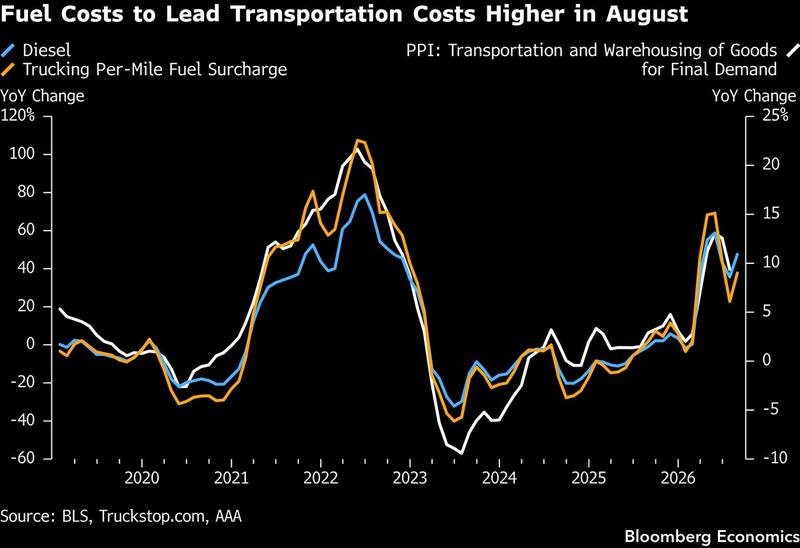
The PPI preview in one transmission chain: diesel and trucking surcharges have swung from deflation to double-digit inflation in six months, dragging transport-and-warehousing PPI with them. Headline PPI is seen at 0.4 with the annual rate near 5.3. This is the pipeline between the strait and the shelf, printing eighteen hours before CPI. Source: BLS, Truckstop.com / Bloomberg Economics.
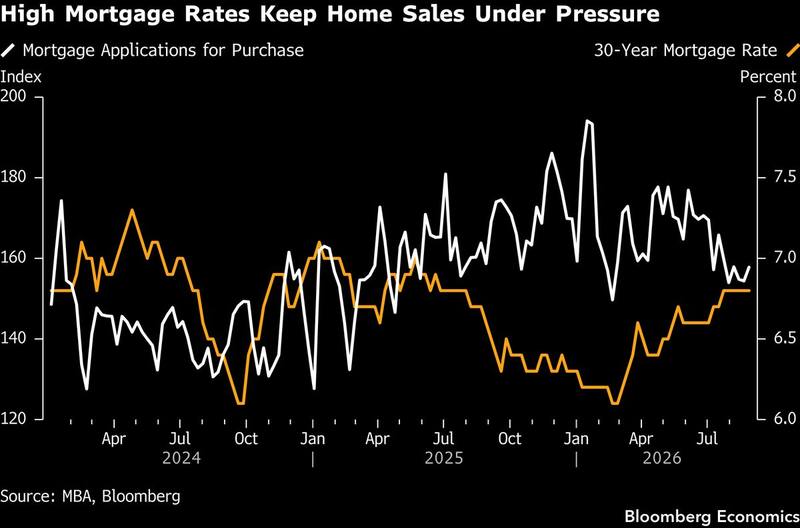
The rate the bond selloff actually charges: mortgages back near 7% with purchase applications sliding since July; existing home sales are seen falling again to 4.02 million. Four years of frozen housing is the part of the economy that already lives with the long end the rest of the market is only now repricing. Source: MBA / Bloomberg Economics.
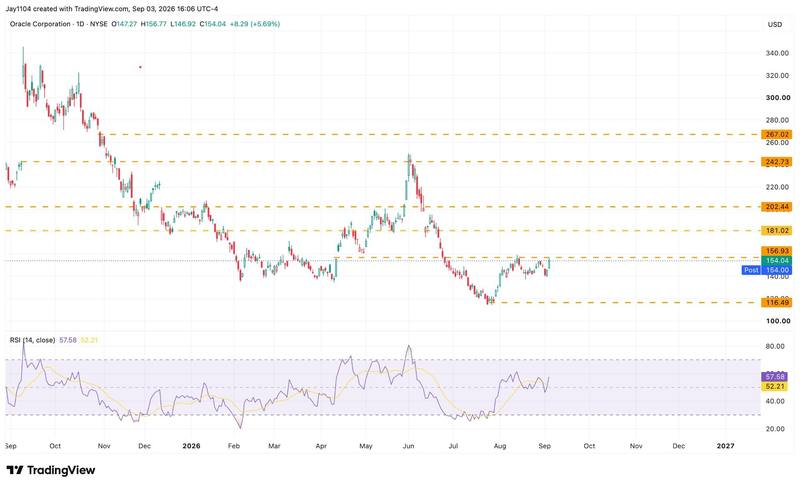
Oracle walks in as the AI trade's public proxy: the stock at $154 against gamma rails at $140 and $200, options pricing a 9.5% move, capex guidance expected to more than double to $19.3 billion. With Anthropic and OpenAI filing next month, Thursday's RPO and capex numbers are the closest thing to a public order book for compute. A soft guide here reprices more than one ticker. Source: TradingView / CMC Markets.
Verdict Friday
CPI at 8:30pm our time, the last big input before the gauntlet: FOMC Tuesday-Wednesday next week, BOE Thursday, BOJ Friday. UMich follows with its inflation-expectations reading, Russia holds at 14% with the ruble leaking, and Italy, Spain and Saudi Arabia face the raters on the 25th anniversary of September 11.
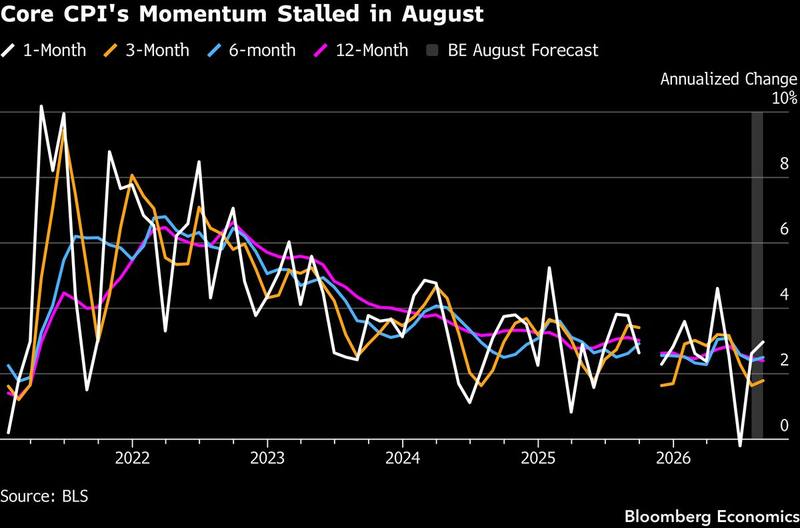
The case for patience, in four lines: core CPI momentum stalled in August on every horizon, with the 12-month pace at 2.5% and falling and Bloomberg Economics' forecast bar showing 0.24 for the month. This is the chart Waller is holding when he says he is inclined to wait. The hawks need the white line to jump; the doves just need it flat. Source: BLS / Bloomberg Economics.
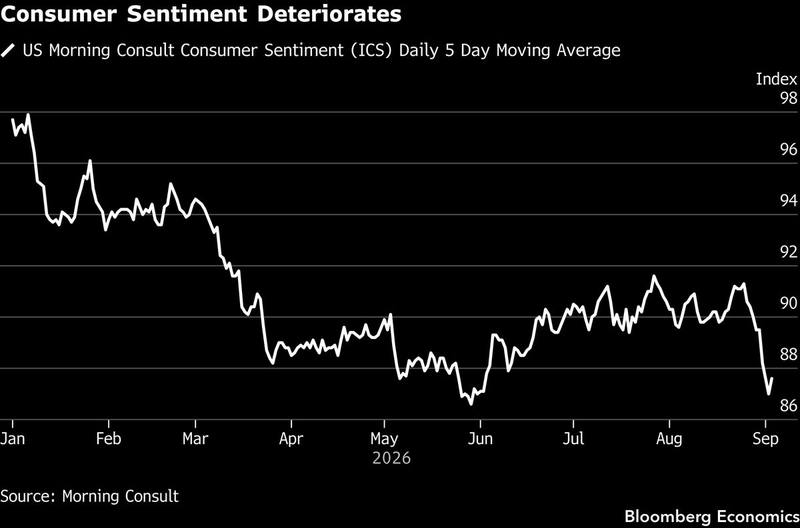
The consumer walks into the print already grim: Morning Consult's daily gauge just broke below its June floor to the year's lows, and UMich is seen at 50.0, half its long-run norm. Spending has ignored sentiment all year, but inflation expectations from this cohort are what Warsh flagged as the thing that looks stable until it does not. Source: Morning Consult / Bloomberg Economics.
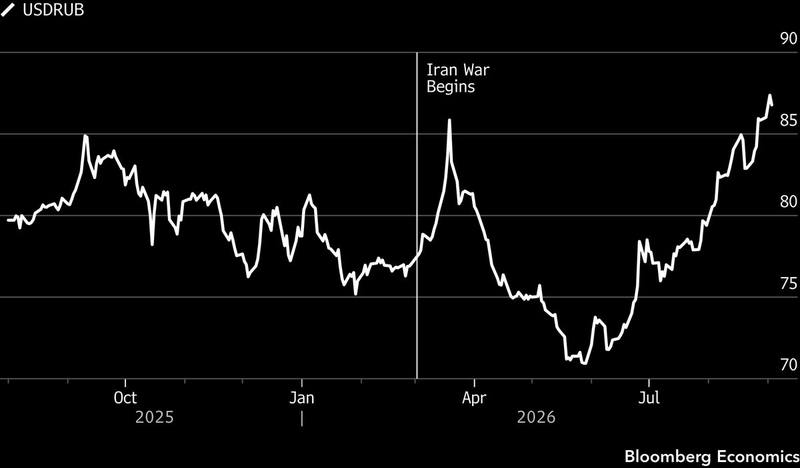
The quiet weakening we flagged, on one axis: the ruble at 86 and change, past its Iran-war spike, down 8% in August and 21% since May as drone strikes take refineries offline faster than they return. The central bank holds at 14% Friday with fuel inflation feeding the core. When a war economy's currency bends this way, the soundbytes usually get louder next. Source: Bloomberg Economics.
The kindness of strangers, and the 1929 question
Put this market against Andrew Ross Sorkin's new account of 1929 and five rhymes stand out: margin-fueled speculation, gains concentrated in a handful of names, a softening underlying economy, new-era technology darlings, and tariffs. The valuations are past every historic marker, the Buffett indicator at 236% of GDP against roughly 80 at the 1929 peak, the top ten at 38% of the index, margin debt at records, and the whole edifice financed by foreigners holding $37 trillion of US portfolio assets, 115% of GDP: the kindness of strangers. The strangers' taste is also shifting: for the first time outside the financial crisis, foreign inflows into US equities have overtaken inflows into bonds, the private balance sheet booming while the public one deteriorates. Todd Edgar's counterpoint deserves equal billing: he lists every reason to worry, notes the S&P sits 1.5% from its high after each one, and lands where four decades of survivors land, that the bias should stay long until the cause itself arrives, because corrections need causes, not vibes. Both can be true. The letter's verdict is the tails section: seatbelts, not forecasts, and RCA's chart taped inside the locker. The radio really did change the world; its shareholders still lost 98%.
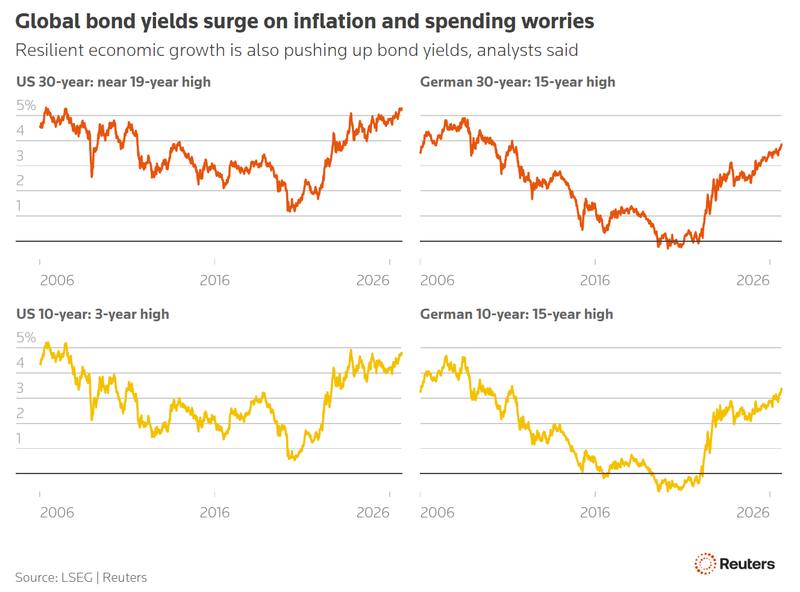
The global bond backdrop to every equity conversation: the US 30-year near nineteen-year highs, German yields at fifteen-year highs, all four panels saying the same thing: the discount rate that justified every valuation of the 2010s is gone on both sides of the Atlantic. Orderly so far, is doing heavy lifting in every strategist note. Source: LSEG / Reuters.
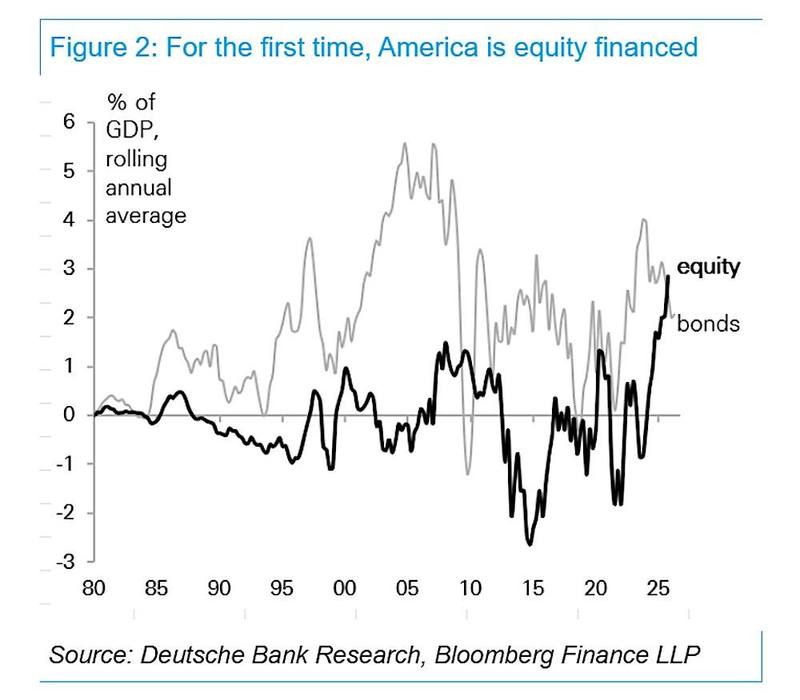
For the first time, America is equity financed: foreign equity inflows overtaking bond inflows as a share of GDP, the GFC the only precedent. The strangers still fund America, but they now fund the private balance sheet and shun the public one, which is exactly the split between a booming AI economy and a 6%-deficit government that this letter keeps trading. Source: Deutsche Bank Research.
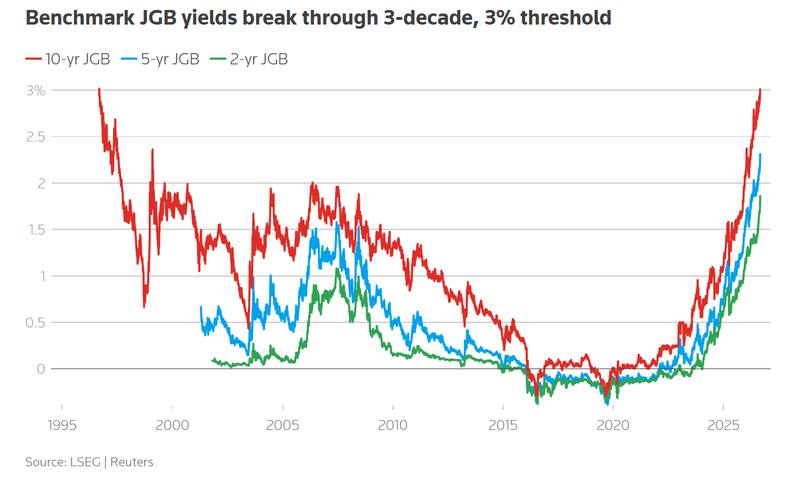
And the chart that ends the era quietly: JGB 10-year yields through 3% for the first time in three decades, the anchor of global carry lifting after thirty years on the seabed. Japan funded the world's risk premium; the repatriation question is no longer whether but how fast, and the GPIF's $2 trillion is the whale everyone watches. Source: LSEG / Reuters.
The guide is the product
The AI trade's grading system changed this month. Broadcom beat for a ninth straight quarter and fell six percent on a guide $200 million light; CXMT, Hygon and Cambricon printed monsters and sold off; China's best earnings season in five years, profits up 25.7%, landed on a CSI 300 down 9% for the quarter. The mechanism underneath is intelligence getting cheaper: yesterday's frontier capability is available within months at a fraction of the price, from more providers, increasingly on domestic Chinese silicon, GLM's hundred-thousand-card cluster and DeepSeek's planned 160,000 Huawei accelerators being the loudest examples. Cheaper intelligence accelerates adoption, and it also shortens each model generation's window to earn back its training bill, just as the next generation costs more and the IPO window opens. So the money is moving to where commoditization cannot reach: Nvidia bought Hugging Face for $11.9 billion to own distribution, Salesforce's data-and-agents business tripled in a year because the data moat survives any model, and the labs pivot to partnerships and premium tiers. Meanwhile the physical constraint tightens from the other side: 46 US data-centre projects worth $170 billion have been blocked or delayed by communities since 2024, and the pace is accelerating.
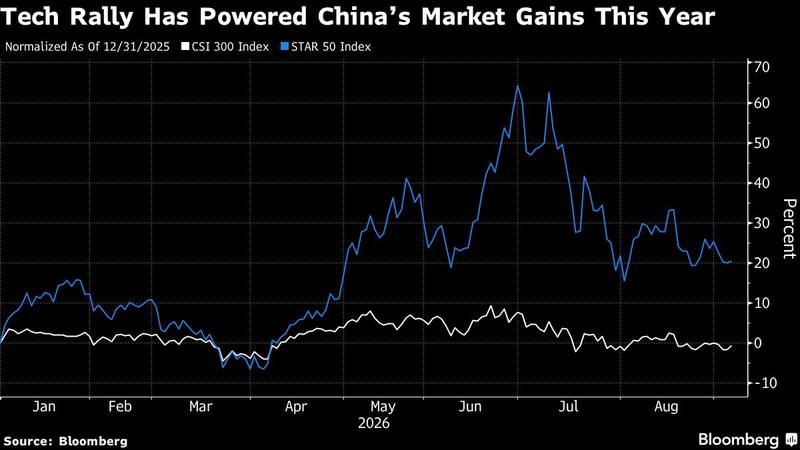
China's tech tape stopped paying for good news: the STAR 50 up 76% into June, then down 29% for the quarter while earnings doubled; the CSI 300 gave back its year. When indices fall through record profits, the market is repricing the multiple on the future, not the present. It is the same message as Broadcom's six percent, in Mandarin. Source: Bloomberg.
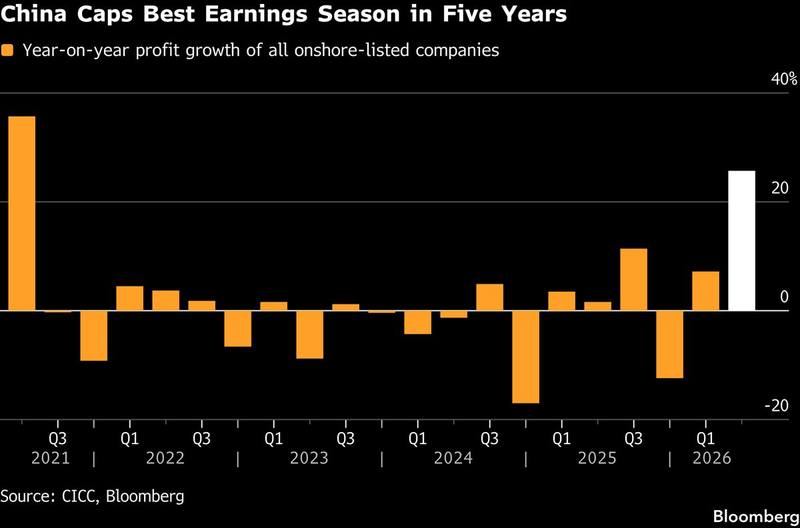
The earnings that stopped working: the best profit season in five years, up 25.7%, driven overwhelmingly by AI-linked boards, ChiNext up 42% and STAR up 370%. A stronger yuan even cost A-shares 107 billion yuan in FX losses, the highest share of profit in a decade; the surplus regime cuts both ways when you are the exporter. Source: CICC / Bloomberg.
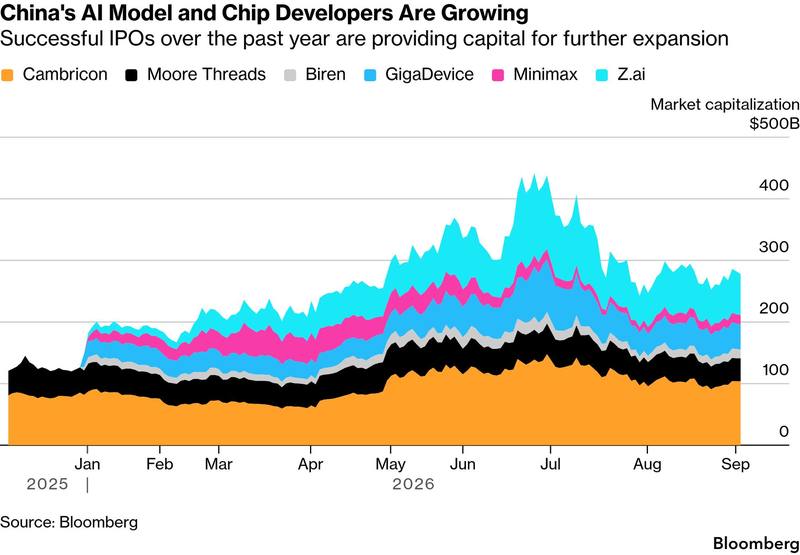
The listed Chinese AI complex, one year old: Cambricon, Moore Threads, Biren, GigaDevice, Minimax and Z.ai together peaked above $400 billion in July and have shed a quarter since, even as their models run entirely on domestic chips. The IPO capital arrived, the valuations wobbled; October's American filings walk into the same weather. Source: Bloomberg.
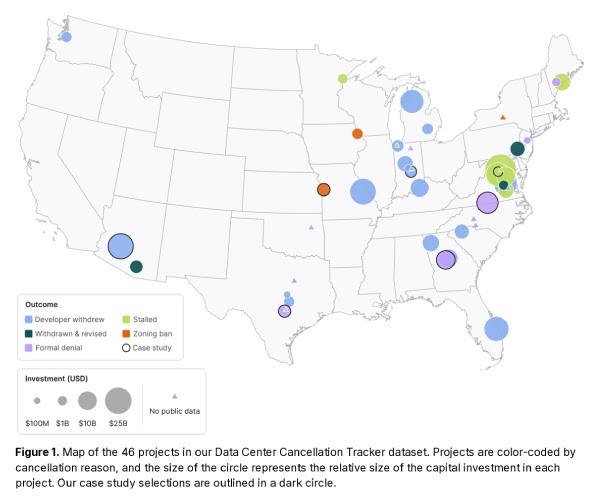
The build-out meets the neighbours: 46 data-centre projects across 20 states, $170 billion of announced investment, derailed or delayed by community pushback, and accelerating from six cases in 2024 to 25 in 2025. Power was the first constraint; consent is the second. Both bind before capital does. Source: Carbon Direct.
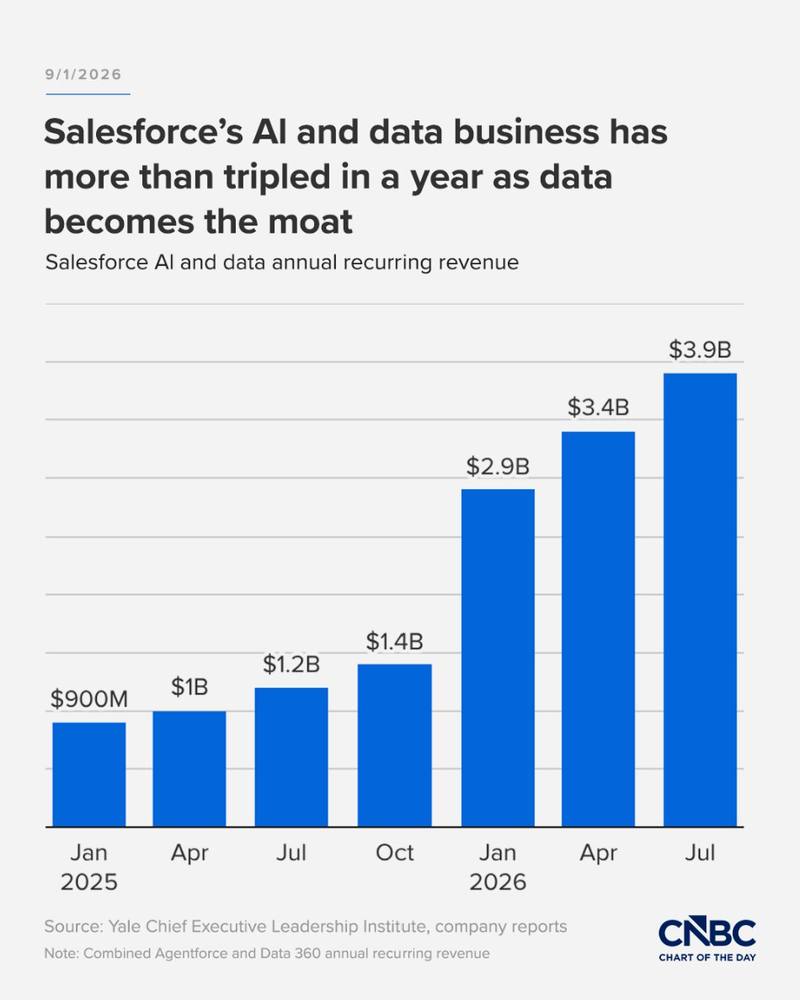
And the quiet winner of commoditization: Salesforce's AI-and-data revenue tripling in a year to $3.9 billion ARR, 104 trillion customer records ingested last quarter, because agents are only as good as the data they stand on. When models become interchangeable, the moat moves to whoever owns the context. Data is the new oil, again, this time on purpose. Source: Yale CELI / CNBC.
VC+ Special Dispatch, Where America's AI Hardware Comes From
Part two of the dispatch follows the money across borders, and it belongs beside this letter's surplus-versus-deficit regime like a map beside a trade. One dollar in five of US imports now buys AI hardware (part one is here), the category is 43% of the entire trade deficit, and the supply runs through a corridor so narrow it has a name: Taiwan and Mexico. Seven charts. Credit to the VC+ team.
Infographic 1 - One in Five Import Dollars Buys AI Hardware
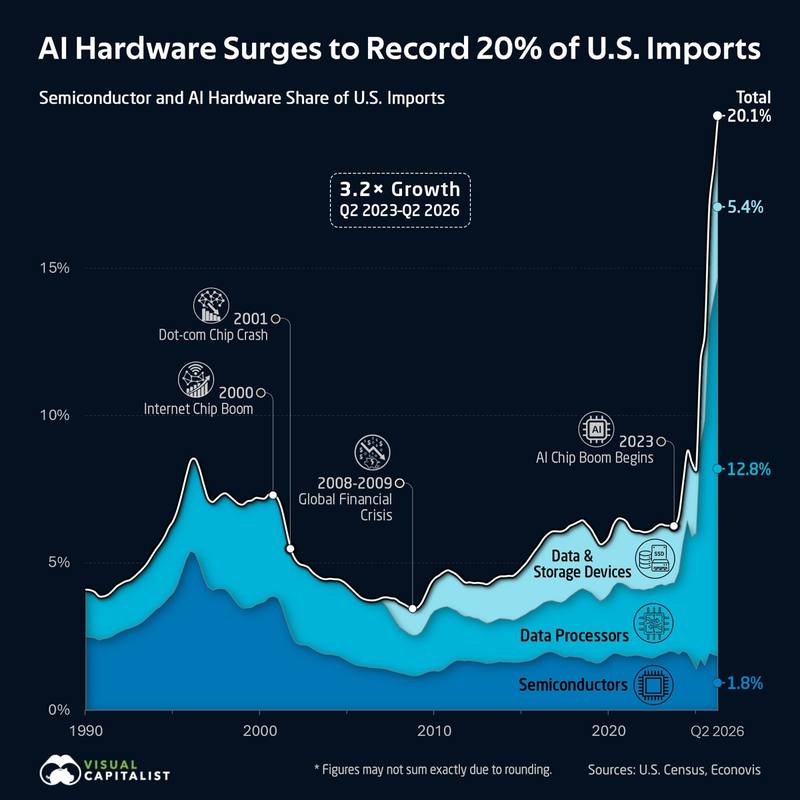
AI hardware hit a record 20.1% of US imports, up from 6.3% three years ago and more than double the dot-com peak. The chips themselves held steady at 1.8%; data processors jumped to 12.8% and storage tripled to 5.4. The boom crosses the border as computers, not as semiconductors. Source: US Census, Econovis / Visual Capitalist.
Infographic 2 - Exports Are Booming Too, Just Not as Fast
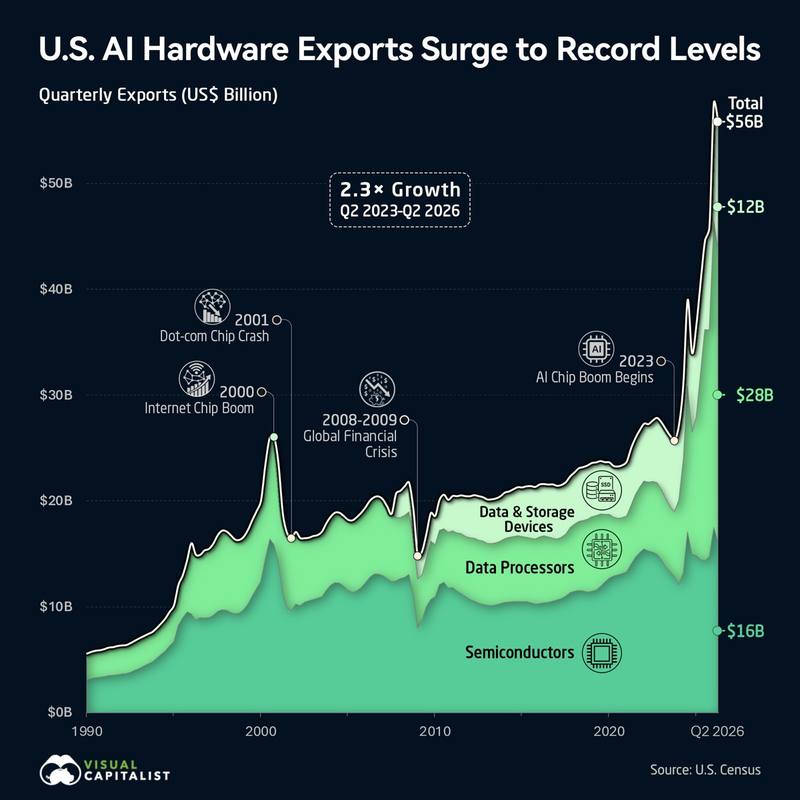
US AI-hardware exports hit a record $56 billion a quarter, 2.3x in three years, data processors up 381% and carrying 70% of the gain. America sells the systems it designs; it just buys six dollars of hardware for every two it sells, and policy now decides where those exports may go. Source: US Census / Visual Capitalist.
Infographic 3 - AI Hardware Is Now 43% of the Trade Deficit
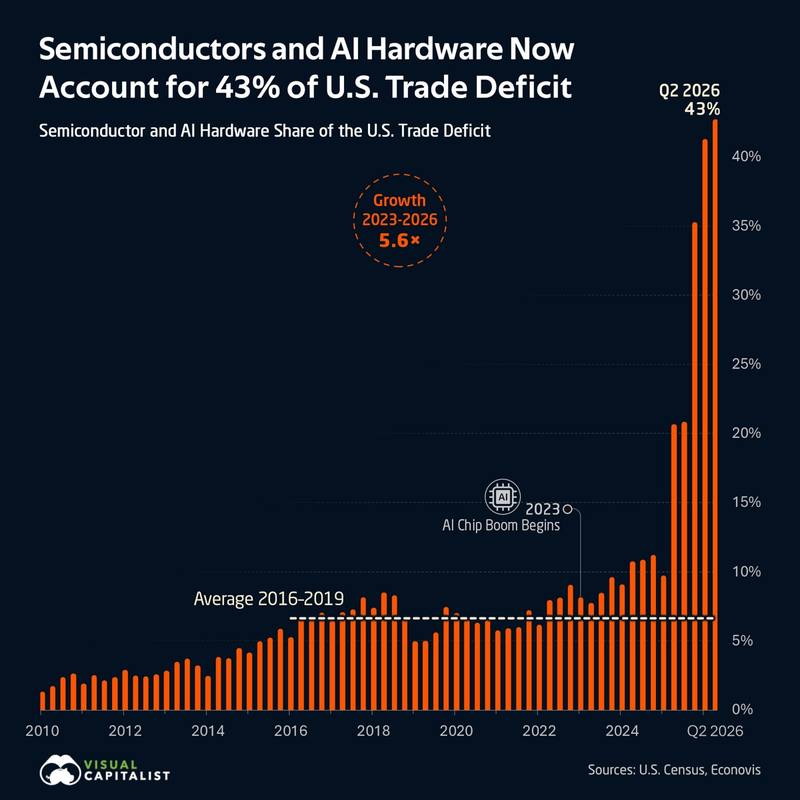
From 8% to 43% of the US trade deficit in three years, a 5.6-fold rise that reframes the number the tariffs are supposed to fix: a growing share of the deficit is capital investment in AI infrastructure, not consumer imports. July's record $119.6 billion goods gap was mostly this. Tariff the deficit and you tariff the boom. Source: US Census / Visual Capitalist.
Infographic 4 - The Deficit Is an Asian Story
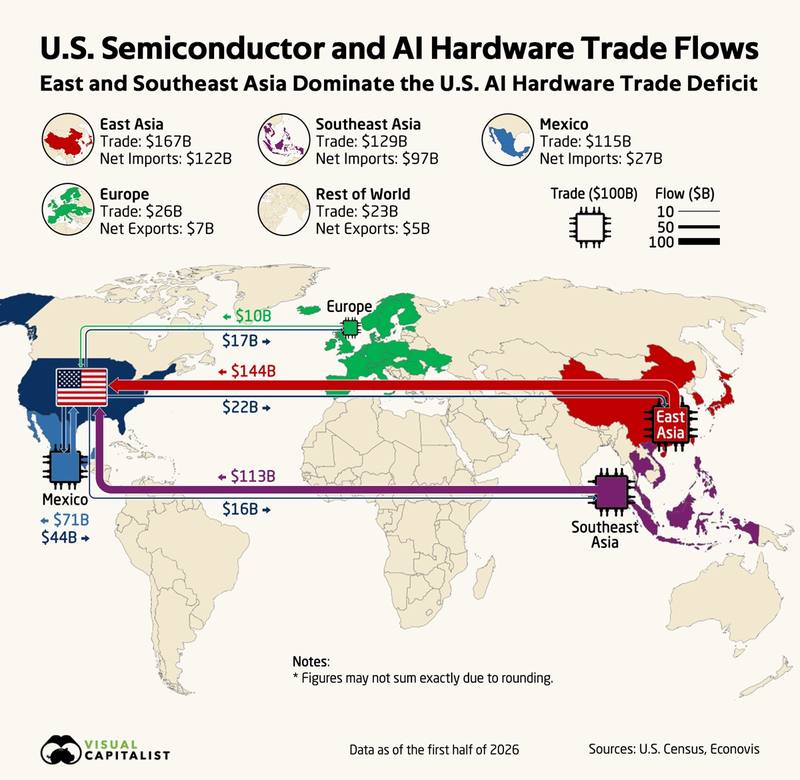
East Asia runs a $122 billion AI-hardware surplus with America, Southeast Asia $97 billion, while Mexico's $115 billion of two-way trade nets to just $27 billion because the components flow south first. Europe is actually a small US surplus. The AI hardware imbalance is a Pacific phenomenon, tightly policed: Taiwanese prosecutors just charged nine people, an Nvidia manager included, for routing restricted servers to China. It is also a map of our long book. Source: US Census / Visual Capitalist.
Infographic 5 - Taiwan Is the Center of Gravity
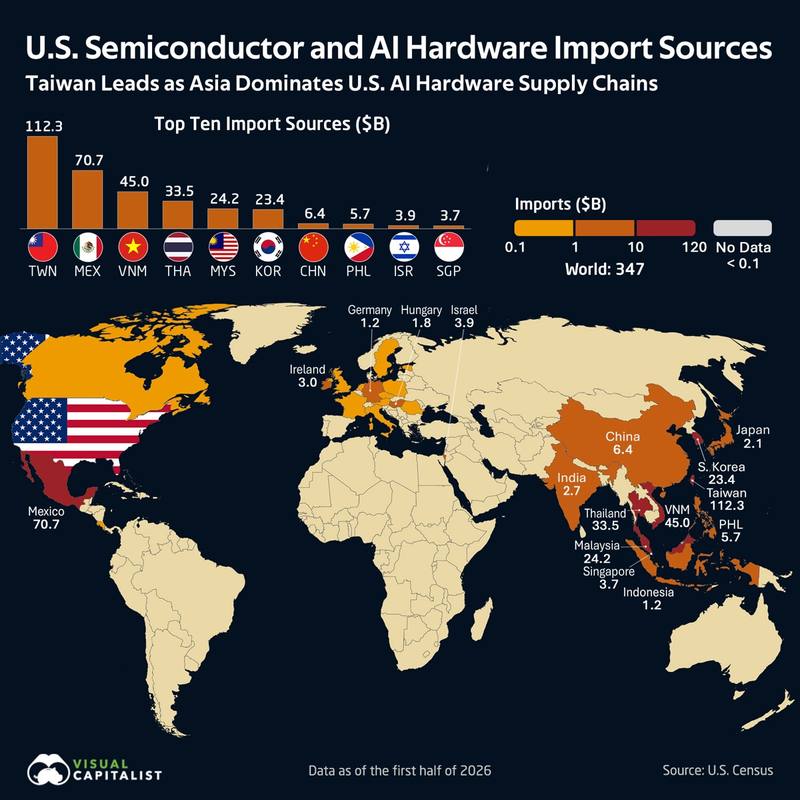
Taiwan supplied $112.3 billion of US AI-hardware imports in six months, a third of the total, nearly the next two combined, against China's $6.4 billion, less than Taiwan ships in a fortnight. Taipei just doubled its growth forecast to 7.7% on this trade. There is no better one-chart argument for the TWD leg, or for what hangs on the island staying quiet. Source: US Census / Visual Capitalist.
Infographic 6 - Mexico Is America's Assembly Line
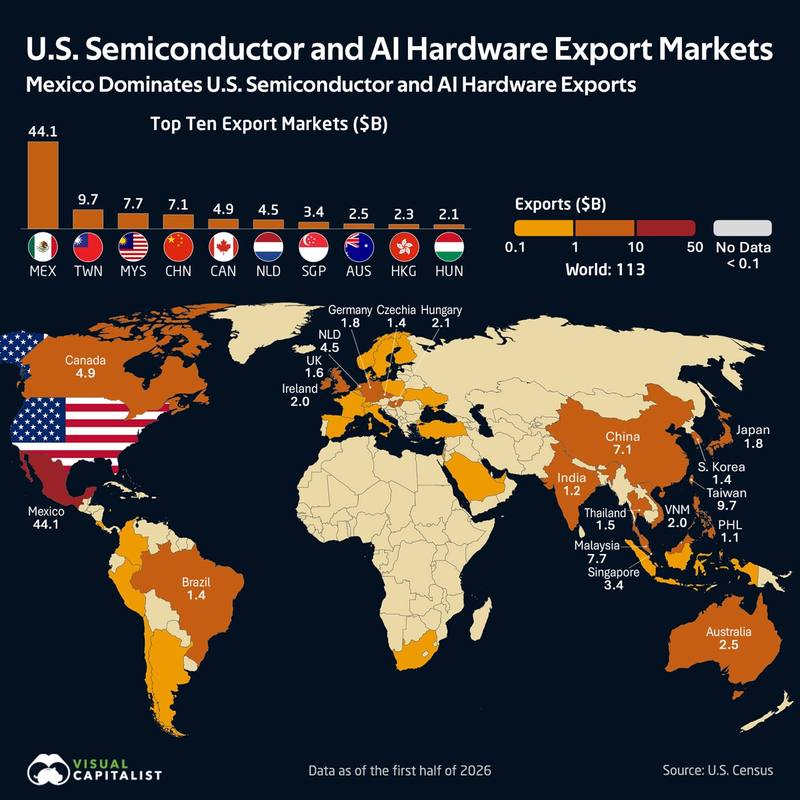
Mexico takes 39% of US AI-hardware exports, $44.1 billion, four times Taiwan's share, because the supply chain is circular: components go south, finished servers come back under USMCA, and Mexico overtook Taiwan as America's top server source in Q2. Foxconn's Guadalajara plant makes it structural. Assembly, not silicon margins, but structural. Source: US Census / Visual Capitalist.
Infographic 7 - Sixteen Years of Concentration
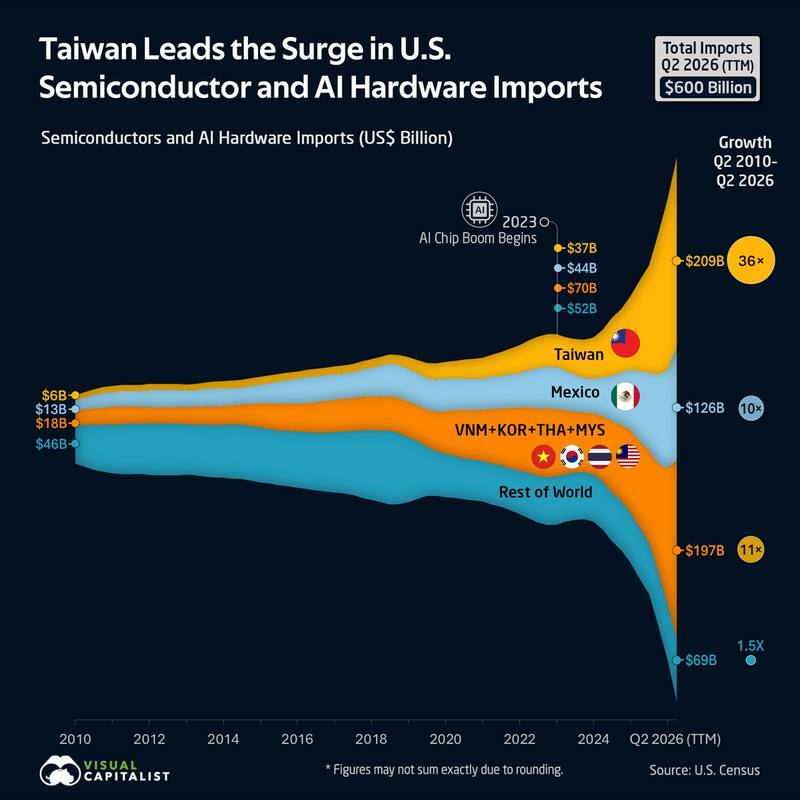
Taiwan's shipments grew 36-fold since 2010, to $209 billion of a $600 billion total, with the Vietnam-Korea-Thailand-Malaysia group at $197 billion and Mexico at $126, while the rest of the world managed 1.5x. Diversification away from China concentrated everything else. The corridor is the single point of failure in the world's biggest trade. Source: US Census / Visual Capitalist.
The Good Wrap
What is left at the close. The gold buyers return with a five-thousand-dollar target, the planet sends a half-trillion-dollar annual invoice, the young can't find work while the world runs out of young, a canal shortens the map of our region, and a statistical agency discovers America may be undercounting its own boom. Then week six of the eight great cuisines, in the scholar's kitchen of the lower Yangtze. At the table, as always.
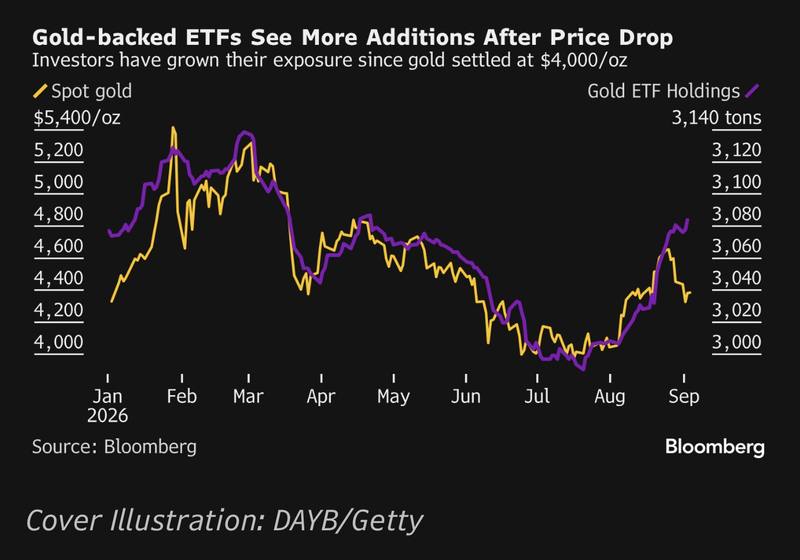
The gold dip found its buyers in a hurry: ETF holdings climbing straight through the price drop, Amundi and Fidelity rebuilding positions and Amundi calling $5,000 by year-end. The debasement checklist from the regimes section has a constituency waiting; they are simply waiting for Friday's print like everyone else. Source: Bloomberg.
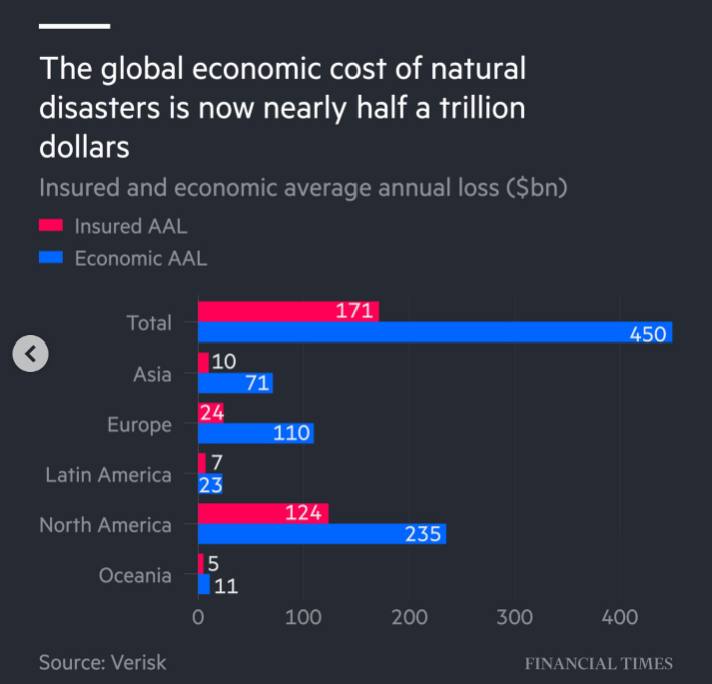
The planet's standing invoice: natural catastrophes now cost the world about $450 billion in a typical year, and less than half is insured; North America carries over half the bill. Climate, urban sprawl and construction costs compound annually, which makes this the one deficit in the letter nobody plans to buy back. Source: Verisk / FT.
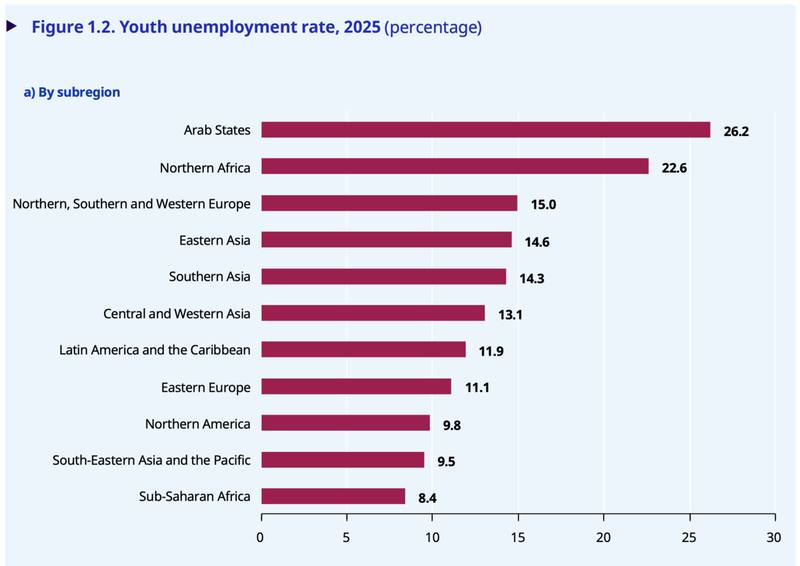
The young are struggling in the countries that have them: youth unemployment at 26.2% in the Arab states, 22.6% in North Africa, while North America's has climbed to 9.8% and is projected higher, the AI era's entry-level squeeze showing up in the one region where hiring data can see it. The cognitive-commons problem from Q2, in an ILO bar chart. Source: ILO.
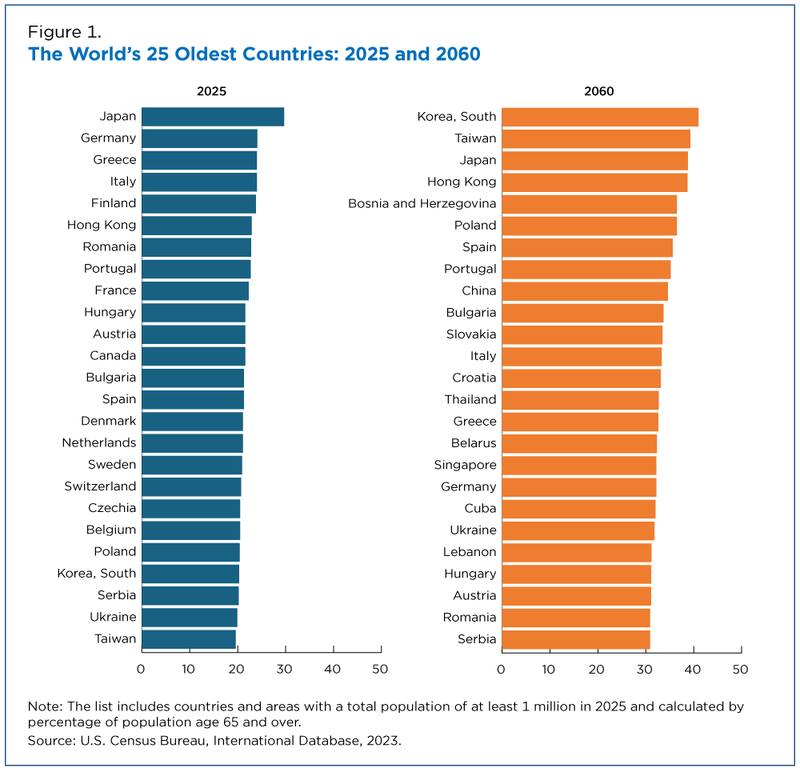
And the world is running out of young entirely: by 2060 South Korea tops the ageing table at 41% over 65, with Taiwan second and Japan third; today's surplus powerhouses are tomorrow's oldest societies. The same countries funding the world's capital today will be drawing it down within our careers. Demographics is the slowest trade in this letter, and the surest. Source: US Census Bureau.
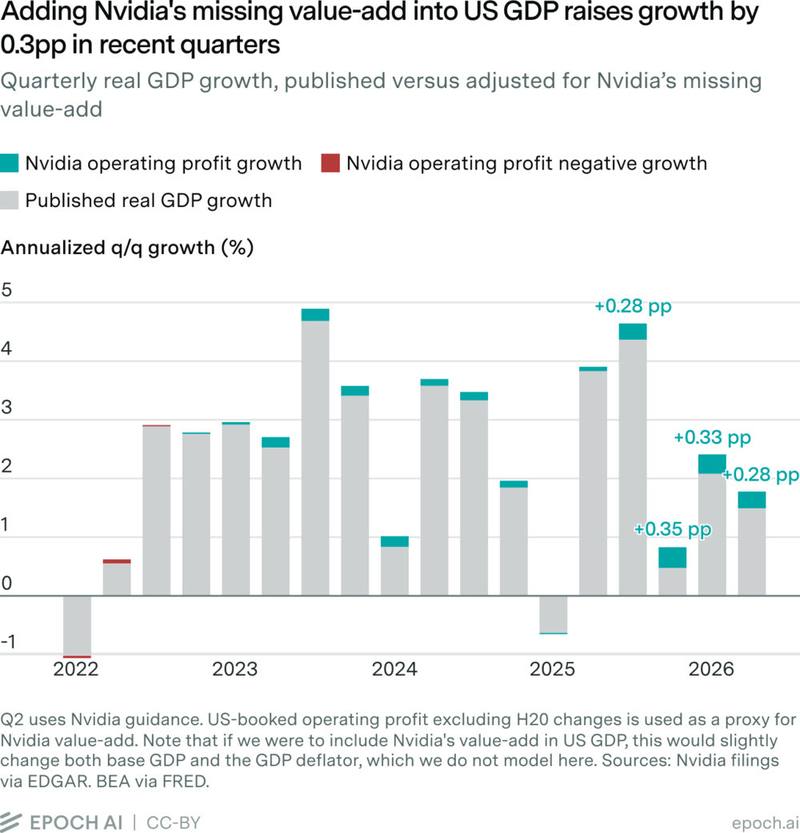
America may be growing faster than it can count: Nvidia's chips are designed at home but built and sold abroad, so their value lands outside GDP; adding it back would have lifted recent quarters by about 0.3 points. The statistical system was built for steel, not silicon. Worth remembering every time a growth print disappoints by exactly a rounding error. Source: Epoch AI.
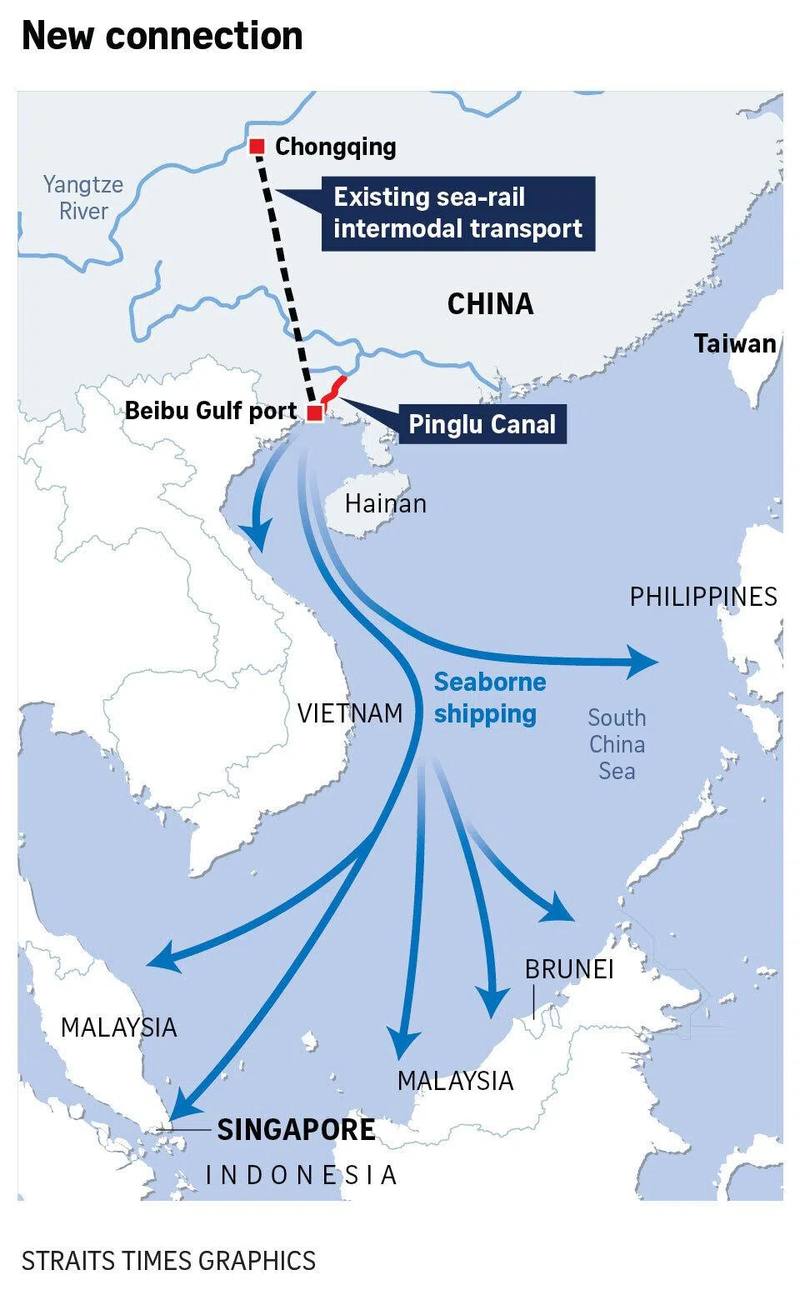
A new river in our neighbourhood: China's $10.8 billion Pinglu Canal opens this month, 134 kilometres connecting inland factories straight to the Gulf of Tonkin and ASEAN's ports, the first major waterway China has cut in seven centuries. Maps of our region keep being redrawn in concrete; trade finds a way, and increasingly the way is built for it. Source: SCMP / Straits Times.
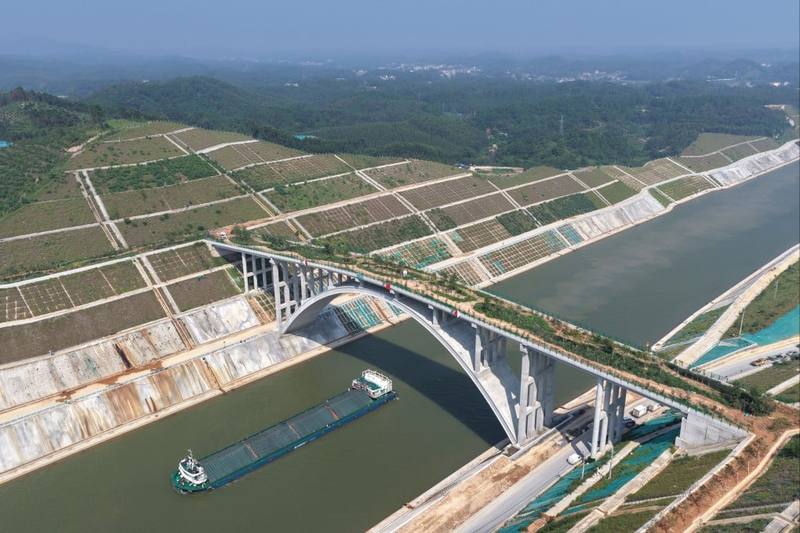
And the canal itself, ready for service: the first command vessel was delivered Monday ahead of an opening later this month, 72.7 billion yuan of concrete cutting 134 kilometres from Nanning to the Gulf of Tonkin. Seven centuries since China last dug a major waterway; the next one points at our neighbourhood. Source: SCMP.
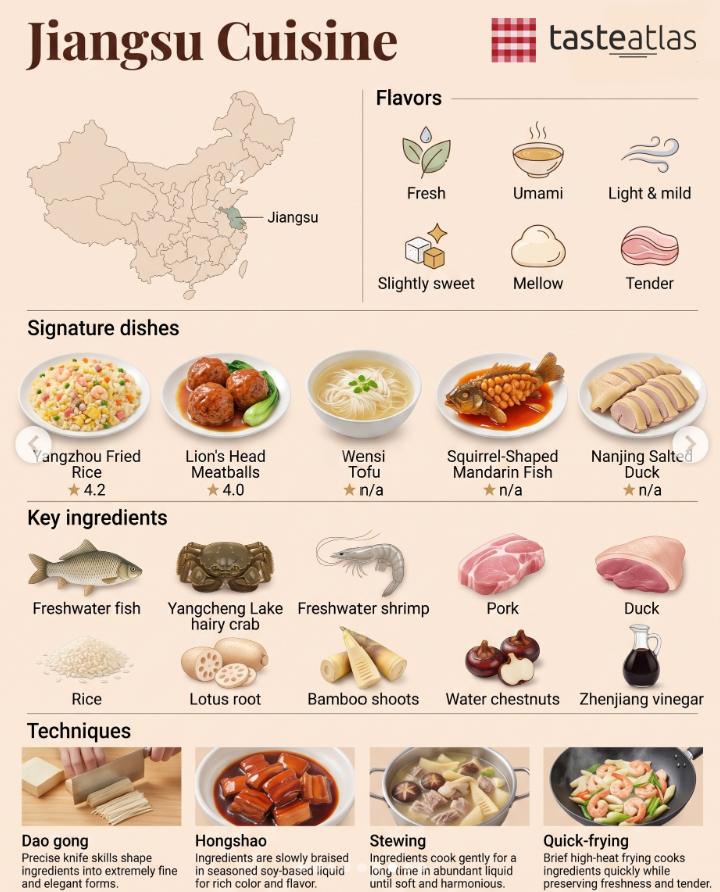
Week six of the eight great cuisines: Jiangsu, the scholar's kitchen. Knife work so fine that Wensi tofu turns a block of bean curd into ten thousand silk threads, squirrel-shaped mandarin fish carved to bloom in hot oil, Lion's Head meatballs braised soft enough for a spoon, and Yangzhou fried rice as the ambassador the whole world knows. Yangcheng Lake hairy crab arrives with autumn, Zhenjiang vinegar goes on everything, and the flavours stay fresh, mellow and slightly sweet. Where Sichuan performs and Anhui broods, Jiangsu refines: banquet cooking from canal cities that got rich and stayed patient. Crab season opens this month, the letter's only outright buy recommendation. Source: TasteAtlas.
Best,
Hoelon
WITPTW is a personal publication. Everything here is personal opinion and market commentary, written in a personal capacity. It is not investment advice and not a recommendation to buy or sell any security. It is not associated with, endorsed by, or representative of any employer, fund or company. Charts and images are reproduced from their original publishers, credited to their sources for commentary and discussion; all rights remain with the respective copyright holders.