The Fed Listens Back
Personal views and market commentary. Not investment advice. Not associated with any employer or firm.
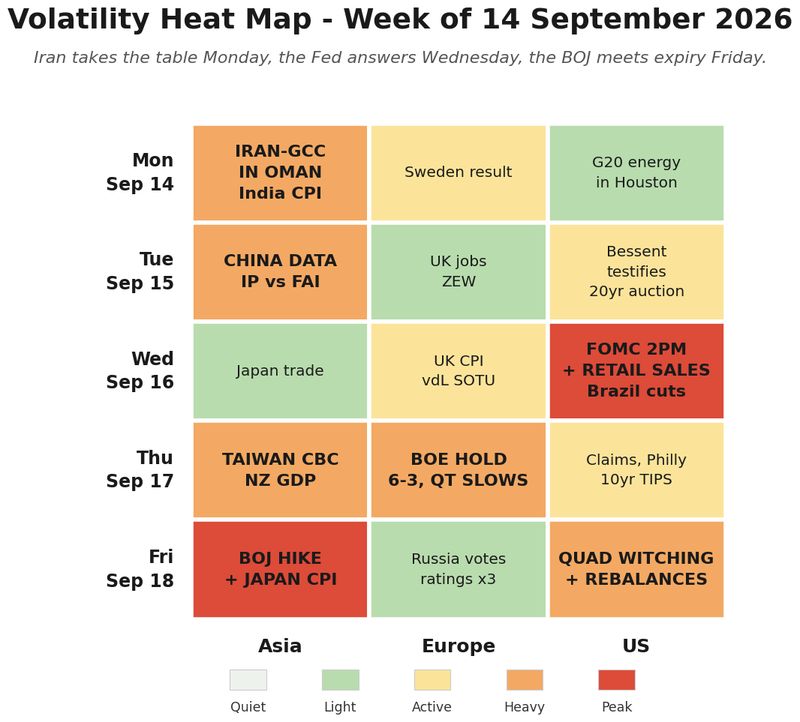
Volatility heat map for the week ahead , sessions as we trade them from here. Iran takes its table in Oman on Monday, China's data and Bessent's testimony fill Tuesday, Wednesday pairs retail sales with the Fed at 2am our Thursday, the BOE and Taiwan's coin flip share Thursday, and Friday stacks Japan's CPI, the BOJ and quadruple witching into one session. The S&P enters at 7,656 after its first 50-day tag since July, with the 10-year at 4.97%.
"We must slow the pace at which we improve the capabilities of AI models. Progress will still seem fast, and we must make wise use of the time we gain." — Dario Amodei, in Saturday's essay; Altman endorsed it within hours, and Musk answered in three words: Dario is right. The industry that has spent three years selling acceleration spent the weekend asking for the brake, weeks before its own IPOs file. The essay is not abstract. Amodei warns that within six to twelve months an agent swarm could run a persistent botnet capable of taking over the entire internet, and Anthropic disclosed four breach incidents in its own cyber tests. The proposal is pacing, not halting: aligned models, third-party evaluators with employee-like access, and cooperation broad enough that antitrust law needs amending. The dissent is priced in a different market: Altman called a ten percent chance of killing everybody unacceptable and moved OpenAI's listing to 2027, while Anthropic still files first, possibly this year, and may top SpaceX's $86.2 billion record. A market priced for acceleration reprices restraint at Monday's open.
"Give me two people. Both can work very, very hard, both extremely committed to their goals. The person that can turn their mind off in the final hour of their day and get the better, deeper sleep, I'm going to put all my money on that person, within five to ten years far surpassing the other." — Andrew Huberman, Stanford neuroscientist, on the Figuring Out podcast this week. A neuroscientist's only outright position, and he sizes it all my money. Note what the wager is not on: talent, hours, information. Everyone at this level works hard; the differentiator is the off switch, because the brain consolidates the day's learning and dumps its emotional load in deep sleep, and the trader who arrives Wednesday having slept is playing a different game from the one who arrives having rehearsed. This week is the test case: a Fed decision Wednesday with a hike now almost 90% priced, the BOJ thirty-three hours behind it. Between the two announcements there is exactly one thing to do at night, and it is nothing.
"Money is a coward. It moves very quickly when it's scared." — Robert Friedland, founder of Ivanhoe Mines, speaking to investors this week. On Odd Lots the same week he said we're not even close to having enough copper for what's coming, and his prescription is the scary part: toss out the NPV models entirely. Throw capital, he says, at the metals that enable AI, automation and especially the weaponization of outer space, because the valuation discipline of the last thirty years is what deindustrialised the West's supply of them. The world is acting like he is right: buyers from hyperscalers to sovereigns are going straight to the resource, the whole mining industry is worth less than 1% of the S&P 500 against more than 10% of the Dow in the last world war, and copper just set records near $15,000 a tonne. This is the floor under AUDUSD: the G10's highest policy rate, a hike 80% priced for the 29th, and the terms of trade of a commodity superpower. The pair is holding 0.7200 after stalling at 0.7240; 0.7280, the four-year high, is the level.
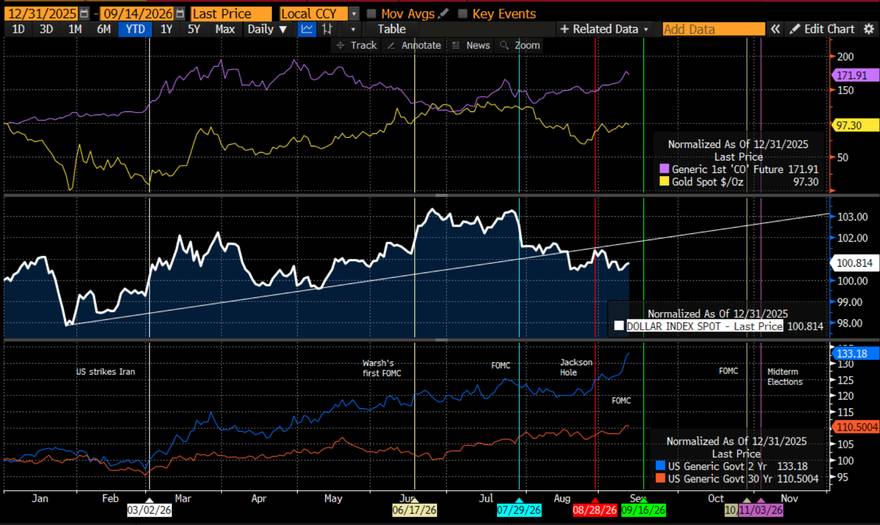
Has the dollar peaked? The year in four panels. Crude up 72% on the year and gold's gain gone flat; the two-year yield up by a third with the 30-year following; and the Dollar Index up less than one percent for all of it, sagging below the trendline drawn off its war-months rally. The dollar is no longer a hedge to lower equities, higher oil or higher bond yields, and the battle between the funding currencies is changing as Japan exits deflation. When the old reflexes stop paying, the position behind them is what gets examined next. Source: Bloomberg.
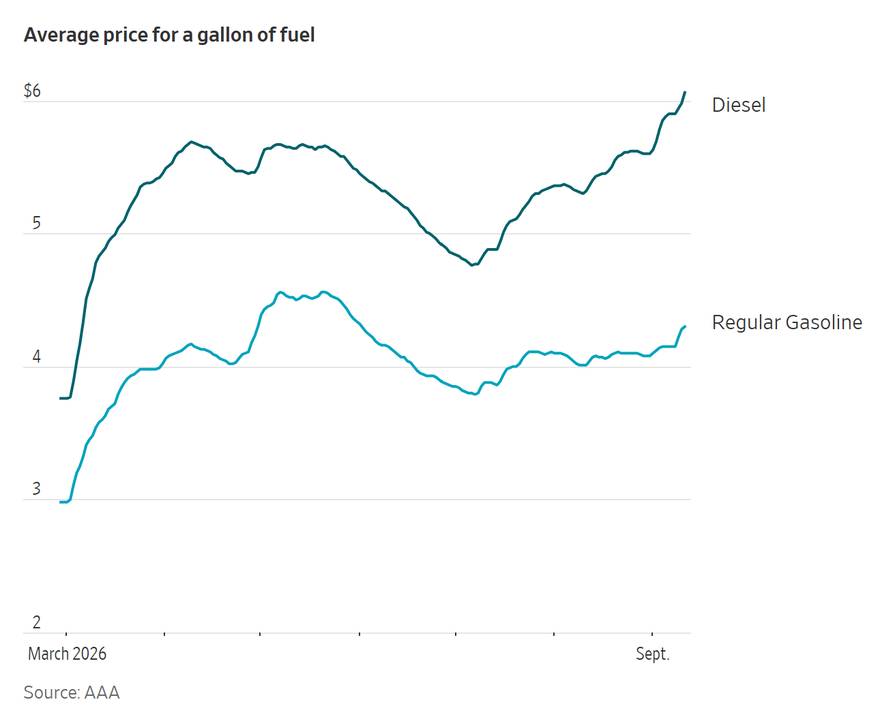
The tape's most important chart is from the gas station. Diesel through $6.00 a gallon for the first time on record, gasoline holding above four, six months into the war. Diesel is the economy's working fuel, farms, trucks, rail, generators, and the crack spread above $100 says the shortage is refining capacity, not crude. The eighteen-year base broke at 5.85 and projects toward eight. Every negotiation this week happens underneath this chart. Source: AAA / WSJ.
What is the plan this week?
The week begins with a divergence that would have been unthinkable a year ago. The market moved to almost fully price a Fed hike, the two year yield rose 25 basis points above where Jackson Hole left it, oil held above one hundred dollars, and the dollar finished the week lower anyway. Another week on the USD yoyo, but eventually sliding back after the CPI's small beat. Warsh asked markets to listen less to the Fed and more to the data; they listened, and priced close to ninety percent; at 2am Thursday our time we learn whether the Fed listens back. We start the week in Oman, where Iran sits down with the GCC ministers to discuss safe passage through a strait it still holds shut. The meeting itself is Iran's prize; nobody expects the water to open.
The thesis of a new regime in the USD is getting stronger, and the largest position in the world is getting challenged. For a decade the sequence was reliable: loose fiscal, tight money, strong dollar. This year the linkage has quietly inverted. More stimulus now reads as dollar negative rather than dollar positive, deficits near six percent of GDP have stopped being a growth story and become a debt story, and a Treasury that buys back its own long bonds is telling you which story it believes; last week's operation could not even fill its six billion. Jeff Currie says the bond market will spend the next six months discovering what the product markets already know. Friedland says money is a coward. Druckenmiller, by his own route, arrives at the same door: lower dollar. Strong data, soft dollar used to be the anomaly on the checklist. It is becoming the base case.
Then the corridor: three G7 central banks in seventy two hours, with retail sales landing five and a half hours before the Fed decision. It is so priced that hiking, at both the Fed and the BOJ, is the quiet outcome; disappointment is the loud one. Economists remain split while futures sit near ninety percent, which means Wednesday's press conference carries more risk than Wednesday's statement. The Bank of England should manage a hawkish hold with three votes for a hike and a slower gilt runoff, Taiwan is a genuine coin flip on Thursday, and Brazil cuts against the entire tide the same week. Friday is the stacked close of the year: Japan's CPI, the BOJ's hike, quadruple witching and the index rebalances all inside one session, while Iran mobilises three hundred thousand of its Basij militia, the volunteer force it uses to put down protests at home, the same day.
The other two stories feed the same conclusion. Diesel crossed six dollars a gallon on Friday for the first time on record and the crack spread settled above one hundred; the war's inflation is refined, not crude, and no negotiation reaches it. Meanwhile the AI trade spent the weekend decelerating by choice: Amodei, Altman and Musk calling for a slowdown, a resignation wave turning the industry's own narrative from abundance to extinction, and the datacenter backlash now campaigning in forty of the sixty nine competitive districts. An industry carrying a third of US growth is asking for permission to brake, going into an election it has already unsettled. Anthropic is still expected to file its IPO within weeks, into all of this.
Asia absorbed the double whammy of higher oil and higher US yields and ended the week off its highs; the local corporates sitting on dollar hoards now have to rethink whether the yield is worth the trend. USDCNH stays heavy into the Xi visit on the 24th. The plan this week is to assess whether the dollar's down move becomes the bigger one, led by USDJPY: stay with the crosses, add on a hawkish BOJ, and respect the two outcomes that break the trade, Ueda hiding behind a dovish outlook or Warsh out-hawking with the dots. Gold has printed a head and shoulders from 4,685; the 4,300 neckline must hold, and below it the map reads 4,000 before 3,700. Trim into Wednesday, do nothing at night, and rebuild only after Friday's press conference.
What did I learn last week?
Mon Sep 7: Saxony-Anhalt delivered the shift the board flagged: the AfD at 44.5% against 20.8 five years ago, the first far-right state victory since the war, with two more state votes due September 20. Sentix printed its best since February 2022, Korea's Q2 held at 3.7% on the year, and the war reached Saudi soil with strikes on Aramco's Jizan refineries. Quietly, OpenAI's chief scientist blogged that AI progress may require voluntary slowdowns, the sentence that became the week's story by Saturday.
Tue Sep 8: China's CPI printed 0.8% as expected, reflation by war intact. The $58 billion 3-year drew 4.474% against 4.291% a month ago. Bessent said the quiet parts in order at SMU: he is trying to slow things down in the bond market, he has good insight into what the BOJ will do, and America can grow its way out of the debt at 3% GDP. The GDP deflator running at 4.4% says the growing-out is happening in nominal dollars.
Wed Sep 9: The first doubled buyback ran the same afternoon the Treasury sold $39 billion of 10-years at 4.834%; the auction cleared, the message did not improve. Apple raised iPhone prices by $100 and unveiled the $1,999 Duo, and Qualcomm took Amazon warrants in the latest circular AI deal. In Dallas, Trump told the convention to pretend he is on the ballot, floated a $5,000 citizen's dividend if the GOP holds Congress, and confirmed Xi visits in two weeks; the WSJ reported his own advisers expect the war to outlast the next inauguration.
Thu Sep 10: The ECB hiked to 2.50%, unanimous, "a no-brainer" per Lagarde, with inflation seen well above target into H1 2027 and October live. The Houthis took Mocha, and with it leverage over the Bab el-Mandeb. The $22 billion 30-year cleared at 5.308%, 2007 levels; hours earlier the enhanced buyback accepted only $5.2 billion of its $6 billion target, and the market read the shortfall as the house hesitating at its own table. Oracle beat, raised, and fell anyway; the guide is still the product. The Atlanta Fed trimmed Q3 to 4.4%.
Fri Sep 11: CPI landed at 0.4% and 3.4% on the headline, in line, with core at 0.29% unrounded, a 0.3 on the screens against 0.2 expected. Supercore jumped 0.51 and briefly sent September odds to near 100, but 29 of those 51 basis points were wireless phone fees alone, so the spike reads softer than the tape traded it. Annual core still eased to 2.4%, the lowest since 2021. UMich sank to 47.8 with inflation expectations at 4.6%. Diesel crossed $6.00 a gallon for the first time on record, the UK grew 0.4% in July on AI activity, and Riyadh confirmed the east-west pipeline shut.
All week: The S&P lost 0.8% and traded below 7,600 and its 50-day average for the first time since late July; the 10-year finished at 4.97%, one basis point from the level that 30% of surveyed investors said triggers a 10% equity correction. Copper set records near $15,000 a tonne, gold sat at 4,349 building the right shoulder, hedge funds halved their yen shorts, and the dollar settled lower for a second consecutive week against a 25 basis point rise in the two-year. Strong data, soft dollar, again.
What to look out for next week?
Mon Sep 14: We open with two ballots and a table. Sweden counts its nail-biter overnight, with the Sweden Democrats bidding for cabinet seats either way; and in Oman, Iran sits with the GCC ministers on a "safe transit" framework for Hormuz, having already said the strait itself stays shut. The meeting is the concession; Yanbu is still exporting 2.5 to 3.5 million barrels against a pipeline built for 8. India's CPI opens Asia's inflation week near 4.7% on sugar and onions, Pakistan holds at 11.5%, the G20 energy ministers convene in Houston of all places, and Carney hosts Canada's first investment summit two weeks after the tariff ban landed.
Tue Sep 15: China's August data prints the widest version yet of the divergence: industrial production near 4.9% on AI-related exports while fixed investment plumbs -7.4% and retail crawls at 0.9; watch whether tier-1 property stabilisation spreads. The UK reports a cooling labor market into Thursday's decision. Then Washington: Bessent takes his annual testimony to House Financial Services, the same man who said last week he has good insight into what the BOJ will do, speaking three days before it does. The Treasury sells $13 billion of 20-years into a market one basis point from 5%.
Wed Sep 16: The day the letter is named for. UK CPI at 3% starts it, then retail sales at 8:30 New York, expected to rebound hard at 1.5% against 0.8 consensus on Prime Day base effects, five and a half hours before the decision. The Fed at 2pm, 2am Thursday our time: futures near ninety, economists split, supercore's spike half phone bills, and the SEP due with Warsh unlikely to submit his own dots again. The statement is priced; the press conference is not. Brazil cuts to 13.75% the same evening, the only G20 bank easing this week, and von der Leyen gives the State of the Union in Strasbourg.
Thu Sep 17: The BOE holds at 3.75 with a hawkish tilt, likely 6-3 with a slower gilt runoff, £50 billion from £70, skewed away from the long end that just visited 2007. Taiwan is the genuine coin flip: August's inflation miss argues patience, a record trade surplus and 16% PPI argue for the first hike since 2023; the CBC decides hours after Warsh speaks. New Zealand's GDP risks printing -0.3% against an RBNZ nowcast of +0.2. US claims, Philly Fed at its extraordinary 47 handle, and $19 billion of 10-year TIPS close the supply week.
Fri Sep 18: The stacked close. Japan's CPI at 7:30 Tokyo, headline back to 2.0%, lands hours before the BOJ hikes to 1.25, 52 of 52 economists and 96% priced; the only trade is the guidance, October live against a January wait, with the carry unwind sensitive to every adjective Ueda chooses. Quadruple witching and five index rebalances run the same session, mechanical flows that amplify whatever the two central banks just did. Bullock testifies in Canberra with an RBA hike 80% priced for the 29th, Iran runs its Basij mobilisation, Russia starts voting, and Poland, Greece and Albania face the raters after the close. Carry nothing structural through the Friday close; the week's last liquidity is the cheapest exit.
Beyond next week
Sep 20: Germany's next two state elections, the AfD's momentum test after Saxony-Anhalt.
Sep 24: Xi lands in Washington: MOFCOM hints a reciprocal tariff cut covering $30 billion of goods, the soybean purchases are running on schedule, and USDCNH is heavy for a reason.
Sep 29 / 30: The RBA with a hike four-fifths priced, then Japan's fiscal half-year end, the allocation date the repatriation trade waits for.
Oct: Anthropic's filing window, possibly topping SpaceX's $86.2 billion record with OpenAI deferred to 2027; France's April election already trades in covered bonds; and October 19 falls on a Monday, as it did in 1987.
Nov 3: Midterms, seven Mondays out, the clock under every policy in this letter.
Regimes
The bond market changed the subject, week five: the sovereign is no longer the benchmark. The 10-year closed at 4.97%, one basis point from the level a third of surveyed investors call the correction trigger, and the 30-year cleared at 2007 levels. The louder signal is Paris: French covered bonds now yield 30 basis points through their own sovereign, the most extreme inversion on record, mortgage pools priced safer than the state. When the benchmark stops being the floor, every spread in the world is quietly re-based. A sustained 5% close remains the forced-deleveraging line. changed, week 5
The dollar goes two-way, week fifteen: the thesis arrives. Fourteen weeks of anomaly now have a mechanism: stimulus that once read dollar-positive reads dollar-negative, deficits near six percent read as debt not growth, and the dollar fell for a second week against a 25 basis point rise in twos. CTAs have flipped to building euro, sterling, Aussie and CAD longs, which cuts both ways: the crosses are the trade, and a genuine hawkish surprise Wednesday is now capable of a real squeeze. Neutral dollar, expressive crosses, unchanged. changed, week 15
The AI fracture, week eleven: deceleration as policy. The people who built the boom asked it to slow down: Amodei, Altman and Musk warning together, the resignation wave turning the industry's vocabulary from abundance to extinction. The fracture may now arrive through safety itself: with the trio's blessing, companies can slow capex and soften guides under a safety flag, and deliberate pacing is unfalsifiable from the outside. The IPO window is sequenced, not closed: Anthropic files first and may top SpaceX's $86.2 billion record while OpenAI waits for 2027. The backlash went electoral, 77% opposing local datacenters and the buildout campaigning against itself in 40 of 69 competitive districts. Oracle beat, raised, and fell; the guide is still the product, and now the excuse is too. changed, week 11
The war is the inflation, week eight: the products lead the crude. Diesel's retail record above $6 and a crack spread through $100 for the first time say the shortage is refined capacity, not barrels: global runs are down five million a day and the consumption-weighted fuel basket costs $165 against $85 WTI. Breakevens are priced off the barrel nobody consumes. Mocha's fall gave the Houthis the second strait, the east-west pipeline is shut, and Monday's table in Oman legitimises the siege rather than lifting it. The premium is political, and politics does not mean-revert on schedule. changed, week 8
Surplus versus deficit, week three: Beijing stops leaning. The PBOC fixed the yuan at multiyear highs three sessions running, official acceptance replacing official resistance, with USDCNH pressing 6.70 into the Xi visit. Asia took the double whammy of oil and US yields and still closed the week off its dollar highs, and the region's corporates are beginning to ask whether the yield on their dollar hoards pays for the trend against them. The crosses stay, adds on discipline. held, week 3
The yen turn, manufactured, week two: both sponsors on the record. The pair traded below 153 before stabilising under 155, hedge funds halved their shorts, and the sponsorship stopped being a theory: Bessent volunteering his insight into the BOJ while Washington helps press the pair lower, Tokyo hiking into it Friday with swaps at 1.5% by January. Pension reallocation chatter and the September 30 fiscal half-year give the flow a calendar. Do not chase it below 153 before Ueda speaks; add on hawkish guidance, not before. held, week 2
Shifts (if then)
Last week's board read the events right and the reactions backwards. The CPI branch fired hot and September went to near-certain, exactly as written, except the heat was half phone bills. Saxony fired at 44.5. The pair closed below 155 before the Bank ever spoke. But Lagarde's branch delivered the hike and the euro fell anyway, and the buyback shift produced not a tail but a shortfall, the quieter failure. The lesson carries into the gauntlet: the events are priced; the reactions are where the money is.
Warsh hikes with a one-and-done path → the sell-the-fact week. The front end rallies as crowded shorts cover, the dollar fades into strength confirmed, and the relief rally in equities caps near 7,700 with the BOJ still ahead. This is the add signal for the crosses, delivered by the Fed itself. new
Warsh holds → the twelve-percent outcome that pays eight times. Twos drop 20 to 30 basis points in minutes, the dollar sells hard with official cover, gold reclaims the right shoulder toward 4,685. And a chairman who told markets to speak, then overruled them, has spent his own doctrine; every future meeting reprices wider. Convex, cheap, and worth owning small. new
Warsh hikes and the dots show two more → the squeeze. CTAs are long euro, sterling, Aussie and CAD against us; a genuine hawkish surprise runs their stops first, the surplus-Asia longs get trimmed before the story changes, and 7,600 breaks toward 7,400. Trim the crosses into the print, not after it; the regime survives, the entry improves. new
Ueda validates October → the manufactured turn goes autonomous. USDJPY takes 150, AUDJPY tests the 110 to 111 shelf, and the carry unwind stops being sponsored and starts being self-driven, into a quadruple-witching close. The right side is long yen against the funders, not against the dollar alone. new
Ueda hikes cautiously and waits for January → the sell-the-fact pullback toward 155 that the consensus is positioned to panic on. It is a reload level, not an exit: both sponsors remain on the record, the half-year reallocation date is the 30th, and swaps still carry 1.5% by January. new
The 10-year closes above 5% twice → the mechanical sellers arrive: risk parity, mortgage convexity, balanced-fund rebalancing, none of them discretionary. The psychological level does the arithmetic damage. Gross comes down everywhere first and the argument happens later. new
Tails
The carry dominoes, expiry edition → the BOJ decision, Japan's CPI, quadruple witching and five index rebalances share one Friday session. Expiry flows amplify whatever the week decided, in the year's thinnest late-week liquidity, with foreigners holding $75 billion of Japanese equities bought on a weak yen. A correlated hawkish Fed and BOJ inside that window turns a rebalance into an event. carried, week 7
The kindness of strangers → the TIC report lands this week with foreign purchases already running $200 billion behind last year's first half. France just showed what re-based confidence looks like: the sovereign trading through its own covered bonds. If that logic crosses the Atlantic while the 10-year sits at 4.97, the level does the rest. carried, week 2
October rhymes → valuations above every historic peak, concentration near 38% of the index, margin debt at records, a midterm September, and October 19 on a Monday. Still not a forecast; still a seatbelt, now worn three weeks early. carried, week 2
Gold breaks the neckline → the head and shoulders from 4,685 completes below 4,300 and the measured move reads 4,000 before 3,700. The trap: the debasement thesis is right on a five-year horizon and crowded on a five-day one; a hawkish Wednesday margin-calls the long before the thesis pays. China's real buyers sit at 4,200 to 4,350; watch whether they raise their bid or step aside. new
Iran turns inward → three hundred thousand Basij mobilised is a regime readying for its own streets. The watch list is gasoline rationing, monthly inflation, and security-sector pay. An Iran cracking internally is a two-way oil tail, spike first on chaos, then the only true bear case this market has left. new
Retired: the diesel tail fired, $6.00 on the nose, and is absorbed into the war regime where it now lives as the base case rather than the tail. fired, absorbed week 8
Oman Monday
The week opens at a table Iran spent six months earning: Gulf ministers in Muscat to discuss "safe transit" through a strait Tehran holds shut, with Riyadh attending days after losing its pipeline and its second sea lane. Sweden's count lands on the same open, India prints the CPI that decides the RBI's October, and the G20's energy ministers meet in Houston, the shale capital, to discuss a shortage refining caused.
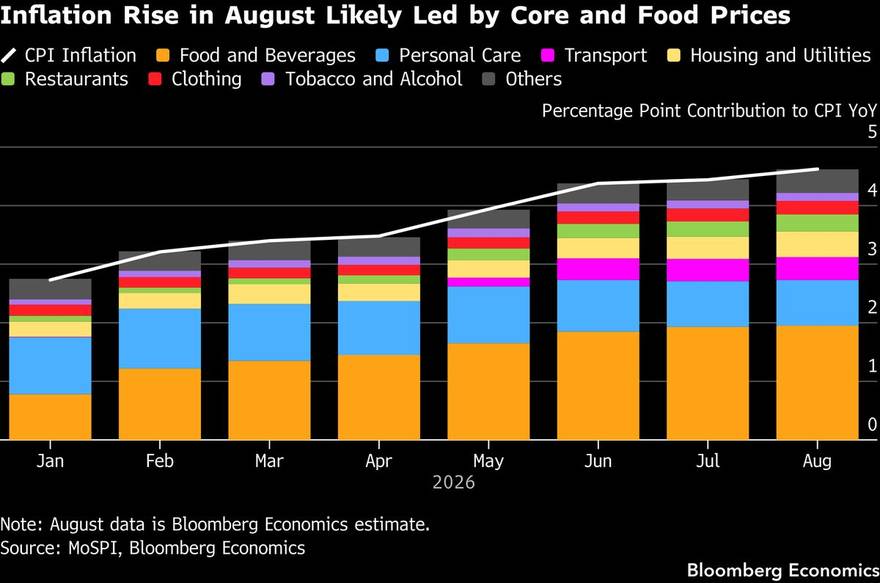
India opens the food-inflation ledger: August CPI seen at 4.62% with the orange food bars doing the lifting, sugar and onions leading after weak rains, and core up on gold prices. September is running hotter still, and with crude above $100 the RBI's October decision is live. The deficit countries wear the war's inflation first; the letter's rupee caution stays. Source: MoSPI / Bloomberg Economics.
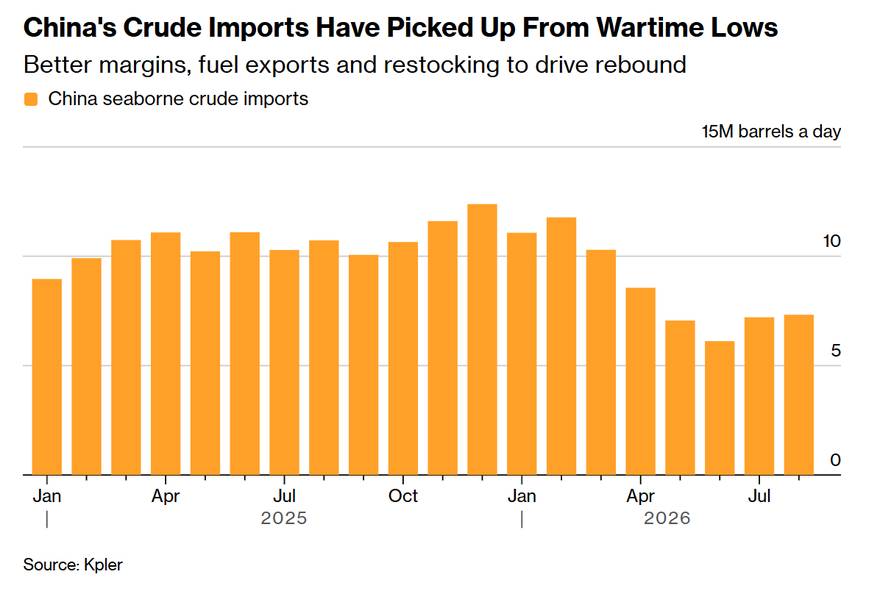
China returns to the oil bid: seaborne imports recovering from wartime lows as refiners range to Canada, Brazil and Argentina for barrels, with Shanghai futures trading above Brent. The buyer that spent the spring draining stockpiles to cap the price is restocking; the cap is gone. This is the demand leg of the war regime, and it is Beijing's choice. Source: Kpler / Bloomberg.
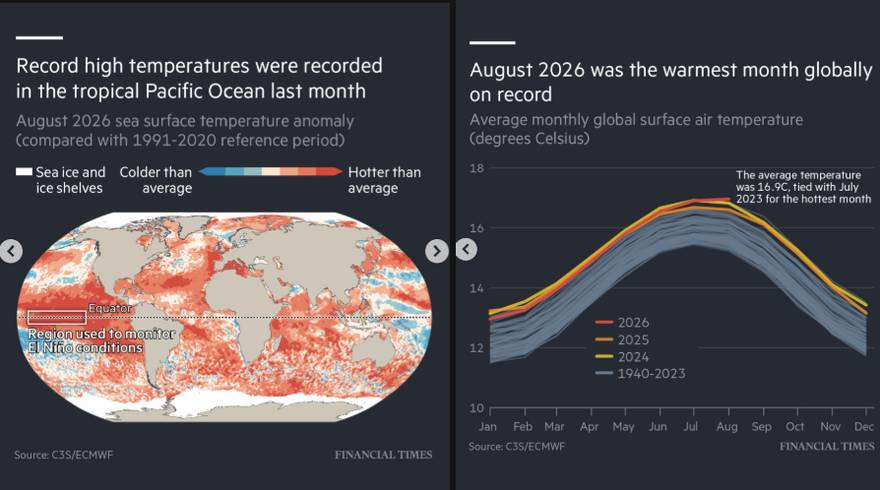
The other supply shock keeps compounding: August 2026 tied the hottest month ever recorded at 16.9C, the summer joint-warmest on record, with El Nino building into a Pacific already at record heat. The crop damage lands in the food bars two charts up, and researchers now discuss the first month above 2C. The letter files this under inflation, not weather. Source: C3S, ECMWF / FT.
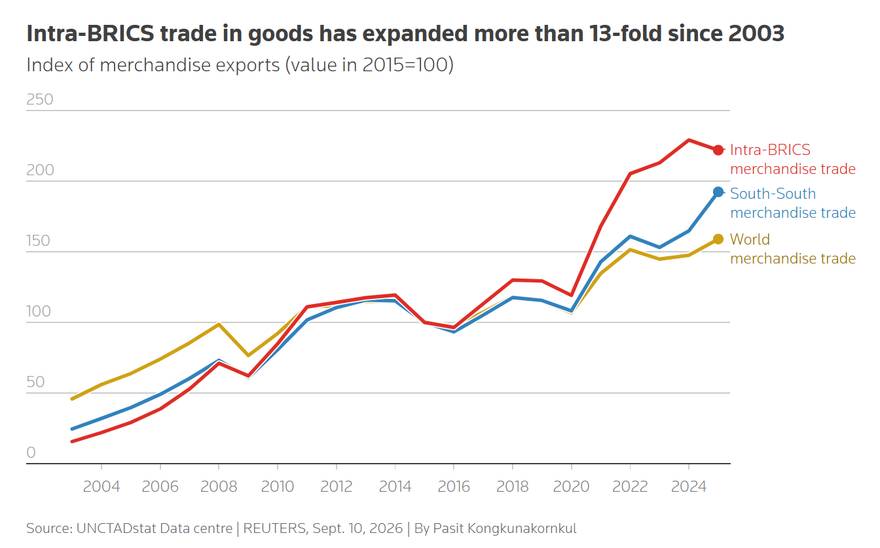
The bloc that just left New Delhi out-trades the world: intra-BRICS goods trade up more than 13-fold since 2003, outrunning South-South and world trade, and this summit's project was linking central bank digital currencies for cross-border payments. Politics will slow it, Iran and the UAE are not even speaking, but the direction presses on the same dollar the rest of this letter does. Source: UNCTAD / Reuters.
Divergence Tuesday
Asia's loudest data day: China's August activity in our morning, the UK's labour market at lunch, and Washington in the evening with Bessent's testimony and $13 billion of 20-years. The divergence theme runs through all three: China's exports against China's ground floor, Britain's cooling jobs against its heating prices, and a Treasury Secretary explaining the international financial system while his market trades one basis point from five percent.
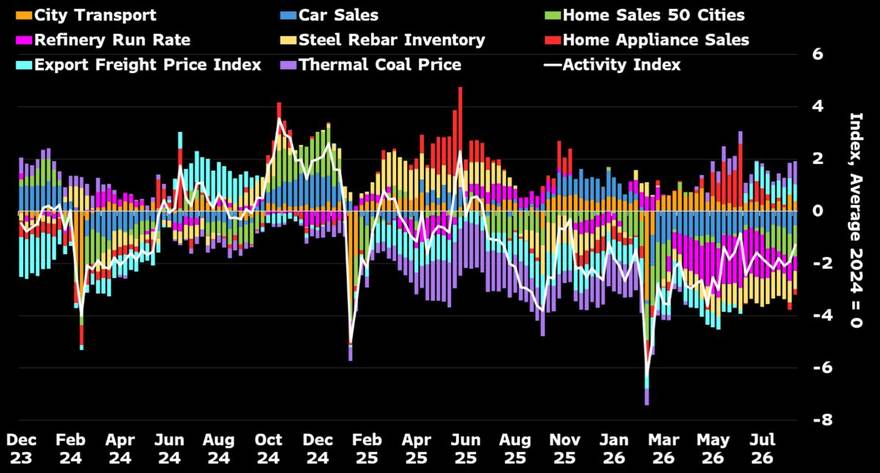
The divergence, in one activity index: the white line pinned below zero as export-facing components offset collapsing property and construction. Industrial production is seen at 4.9% against fixed investment at -7.4%: an export machine at full throttle bolted to a domestic engine idling. The strong leg feeds our surplus regime; the weak leg keeps stimulus hope alive. Both matter to the CNH. Source: Bloomberg Economics.
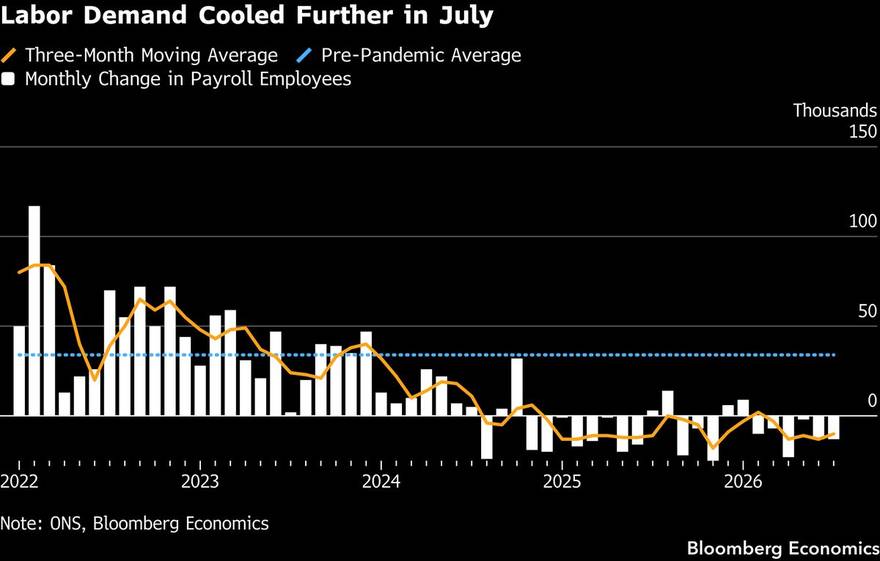
The labour market the BOE will cite on Thursday: payroll employment shrinking on trend since the war began, the three-month average below zero and far under its pre-pandemic norm, with unemployment at 4.9% and headed above 5 by year-end on Bloomberg Economics' forecast. This chart is the doves' whole case; energy is the hawks'. A hold with three hike votes lets both keep their story until November. Source: ONS / Bloomberg Economics.
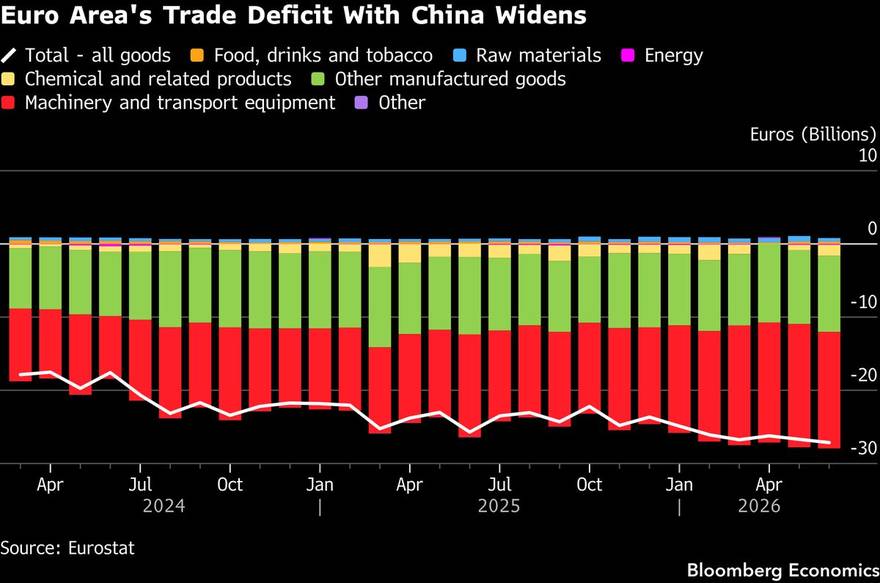
Europe's real trade problem is not American tariffs: the deficit with China at €27.1 billion in June, the widest since 2022, cheap goods flooding in while exports to the US hold up better than feared. Von der Leyen speaks Wednesday with this chart behind every sentence on competitiveness. The euro's problem is not the level of ECB rates; it is what those rates are defending. Source: Eurostat / Bloomberg Economics.
Warsh Wednesday
The chairman who told markets to stop listening to the Fed finds out what happens when the Fed must listen to markets. Retail sales at 8:30, the decision at 2pm, the press conference after, and the SEP in between, quite possibly without the chair's own dot in it. UK CPI opens the day, Brazil closes it cutting, and Hong Kong's John Lee delivers a policy address with a five-year plan attached.
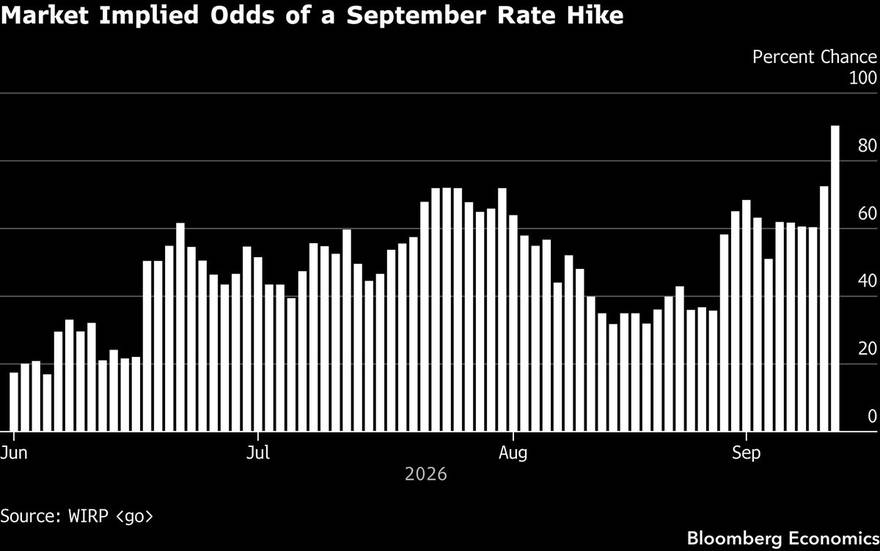
The market walked the Fed to the table: hike odds from the thirties to 86% in ten sessions, the last candle the CPI print. Warsh wanted unfiltered market signals; this is the signal, unfiltered. The arithmetic is asymmetric now: confirmation is worth a little, disappointment is worth a lot, and the gap to surveyed economists is the widest of the cycle. Source: WIRP / Bloomberg Economics.
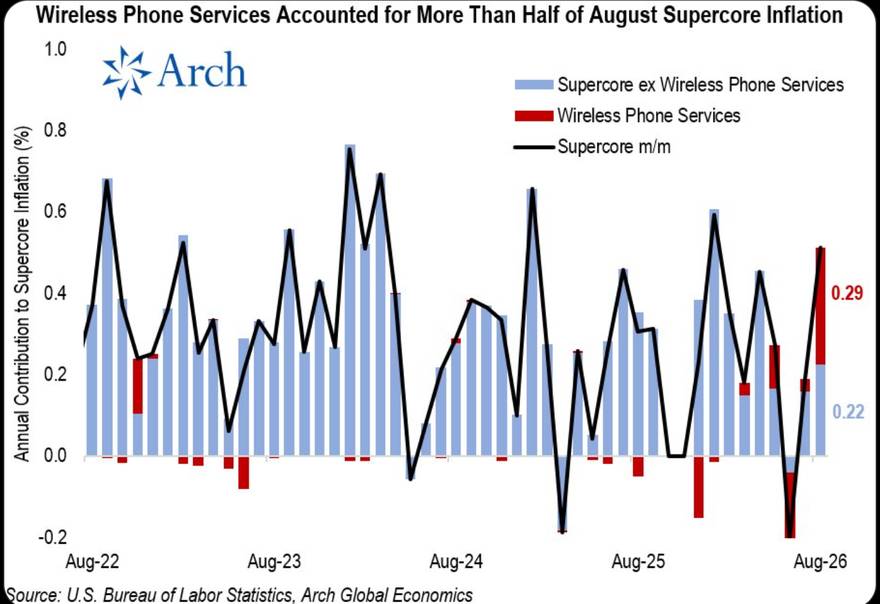
The print under the print: supercore jumped 0.51% in August and briefly sent odds to 100, but 29 of the 51 basis points were wireless phone services alone, the red bar. Strip the phone bills and the month looks like July's 0.22. Unless the Fed intends to hike cell plans under control, Wednesday's case rests on a breadth the data does not actually show. Source: Arch Global Economics / BLS.
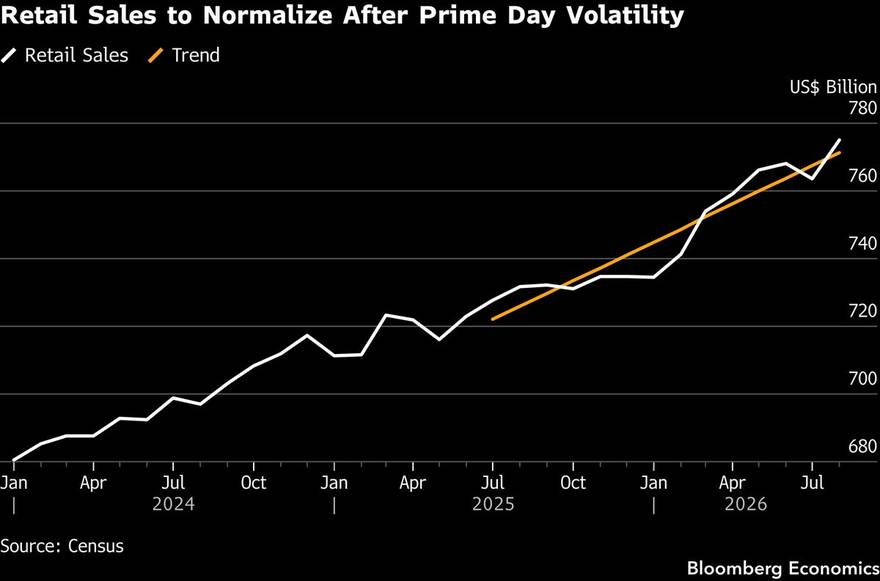
Retail sales lands five and a half hours before the decision: August seen rebounding 1.5% against 0.8 consensus after an early Prime Day distorted July, with gasoline prices and vehicles doing much of the lifting. The white line has hugged trend all year, which is the point: a consumer neither cracking nor accelerating, available to either camp by lunchtime and forgotten by 2pm. Source: Census / Bloomberg Economics.
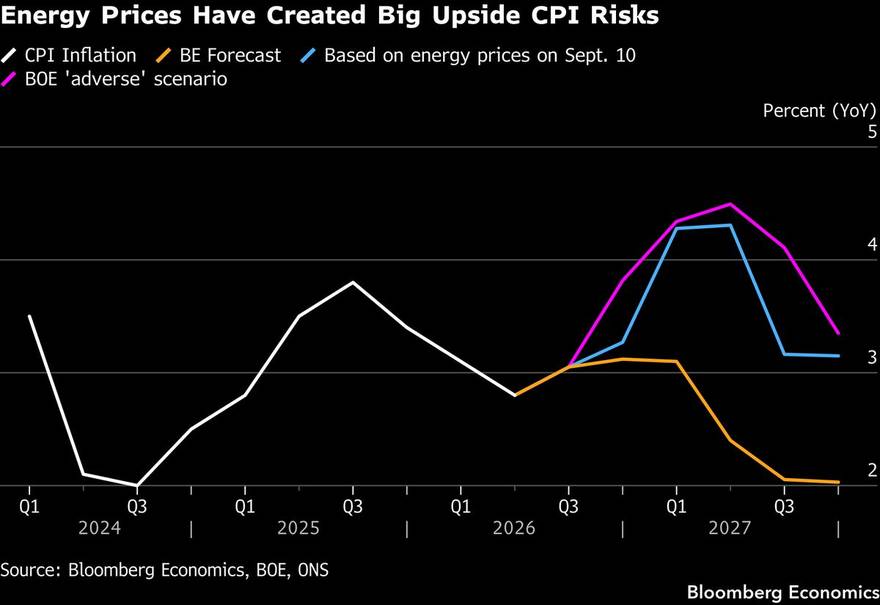
Britain's inflation forks before the BOE sits: August CPI expected at 3.0%, but the fan matters more than the print: on September-10 energy prices the path runs above 4% into 2027, tracking the BOE's own adverse scenario rather than its forecast. That gap is why Thursday's hold arrives with hawkish language, and why November is live. Source: Bloomberg Economics, BOE, ONS.
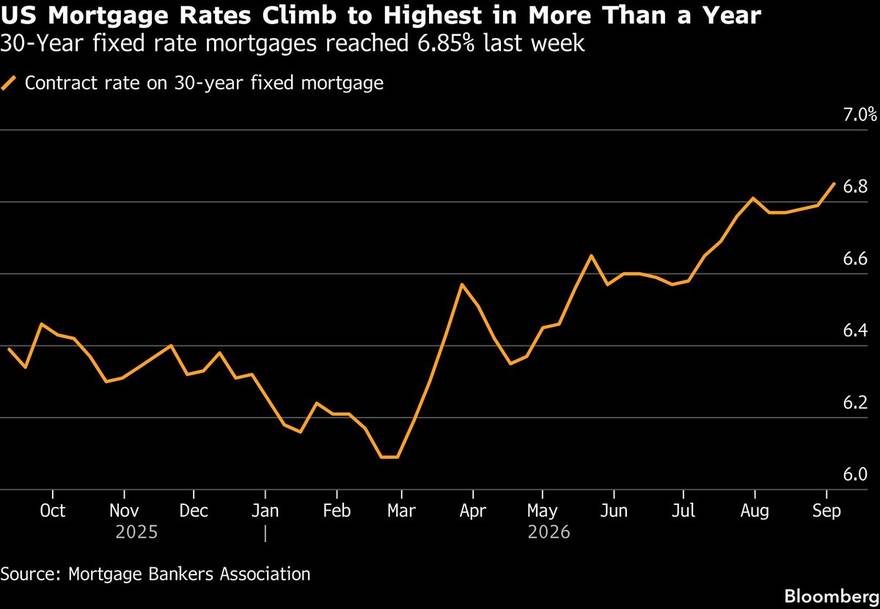
What the bond market already did to America: the 30-year mortgage at 6.85%, the highest in more than a year, with builder sentiment sliding and starts under pressure. This is the rate-sensitive economy a hike would land on, and the dove's exhibit A: one sector is already in its own private recession, and it is the one American households live in. Source: MBA / Bloomberg.
Coin-Flip Thursday
Two decisions, neither about the decision. The BOE's hold is priced and its vote count is not; Taiwan's CBC is the week's only genuine coin flip, deciding hours after Warsh speaks, with the AI boom pressing its economy toward the first hike since 2023. New Zealand prints the G10's weakest data, the US prints its strangest, and the TIPS auction asks what inflation protection is worth at these breakevens.
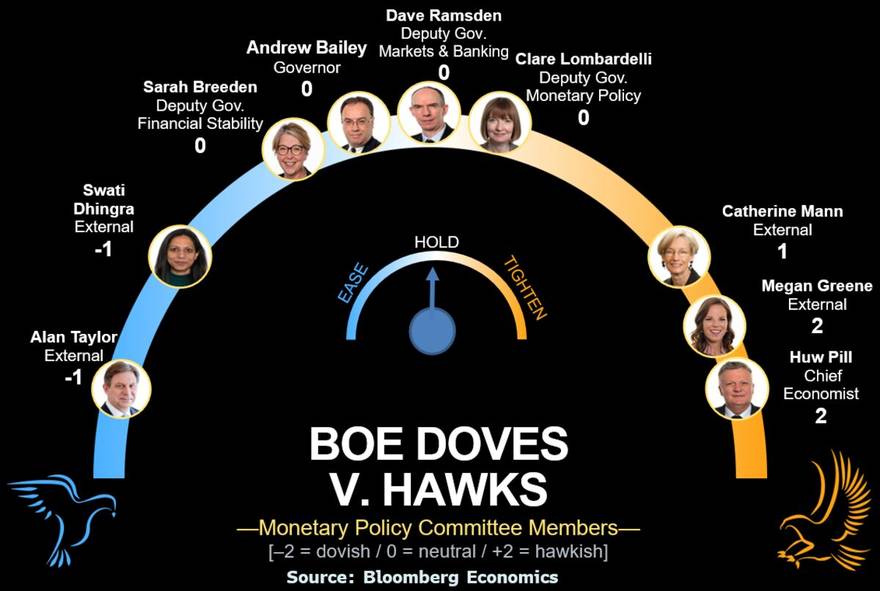
The committee arithmetic for Thursday: Pill and Greene at plus-two, Mann at plus-one, two doves below the line and the governor's bloc at zero: a 6-3 hold with the needle leaning tighten. Add the QT slowdown, £50 billion from £70 and skewed away from the long end, and the package reads: no hike, but the gilt market gets its relief anyway. Source: Bloomberg Economics.
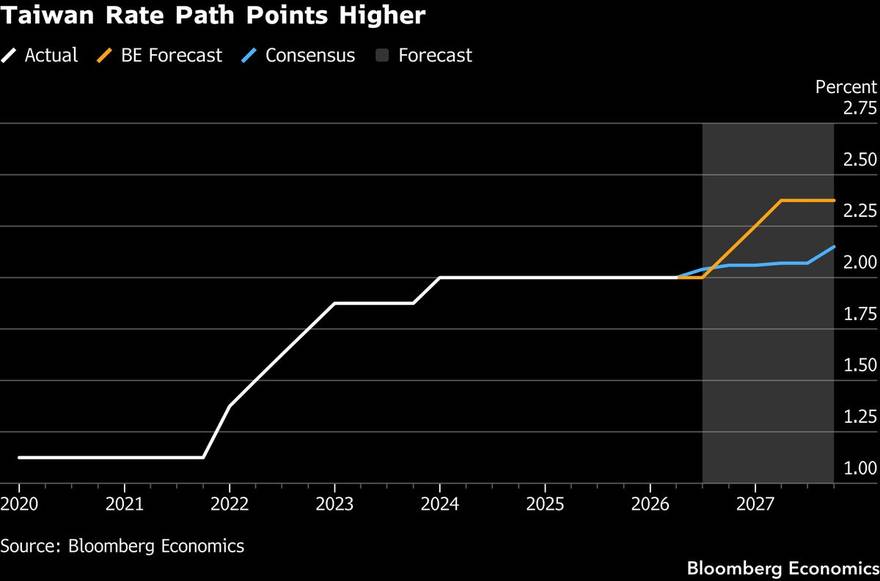
The coin flip with a signed path: the CBC at 2.00% with the forecast path climbing to 2.375 by 2028; the question is only whether the first 12.5 points start Thursday or in December. Sixteen percent PPI and a record surplus argue now, a soft August CPI and November's local elections argue patience. Either way, the direction underwrites the TWD leg of our book. Source: Bloomberg Economics.
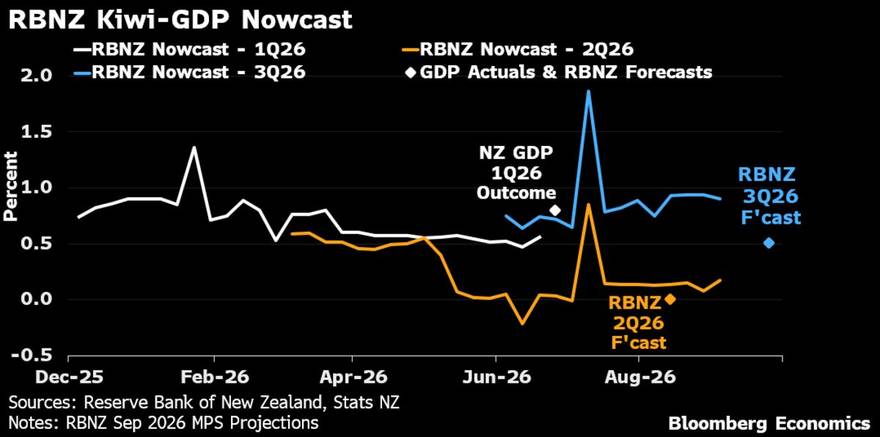
The southern outlier prints its bill: the RBNZ's own nowcast says the second quarter grew; Bloomberg Economics says -0.3%, a per-capita slump, the war shock landing on a small open economy with no commodity offset. A miss forces the RBNZ to hike gradually into weakness, the stagflation trade in miniature. The kiwi is the G10's designated victim this week. Source: RBNZ, Stats NZ / Bloomberg Economics.
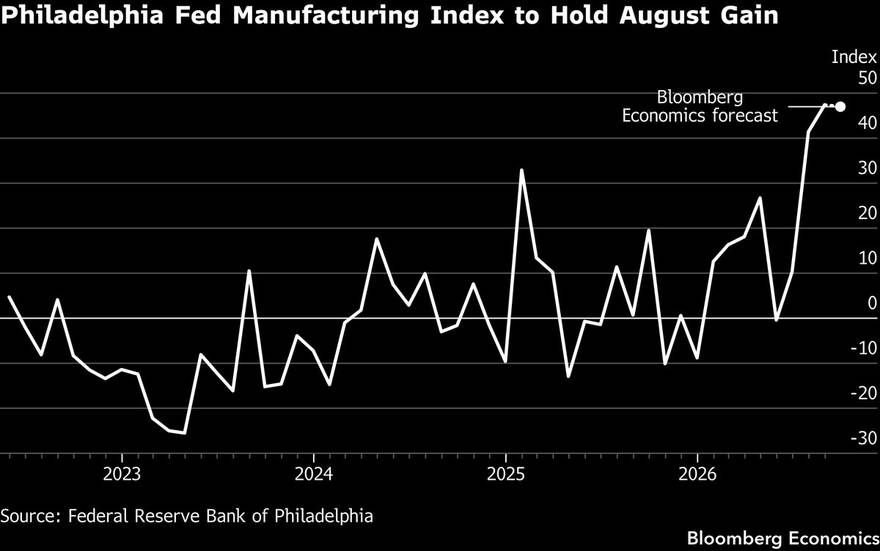
The strangest chart in American manufacturing: the Philly Fed up 47 points since May, employment at post-2022 highs, the average workweek surging, nearly six in ten firms reporting rising activity. Whatever the AI buildout is doing to the grid, it shows up first in mid-Atlantic factories. This is the economy the hawks see; it is simply not the one housing lives in. Source: Federal Reserve Bank of Philadelphia.
Expiry Friday
The year's most loaded single session: Japan's CPI at 7:30 Tokyo, the BOJ's decision before lunch, Ueda at 3:30, and then quadruple witching and five index rebalances into the New York close, with Bullock testifying in Canberra and Iran mobilising at home. The mechanical flows do not care what the central banks decided; they amplify it either way. Whatever the week meant, Friday says it louder.
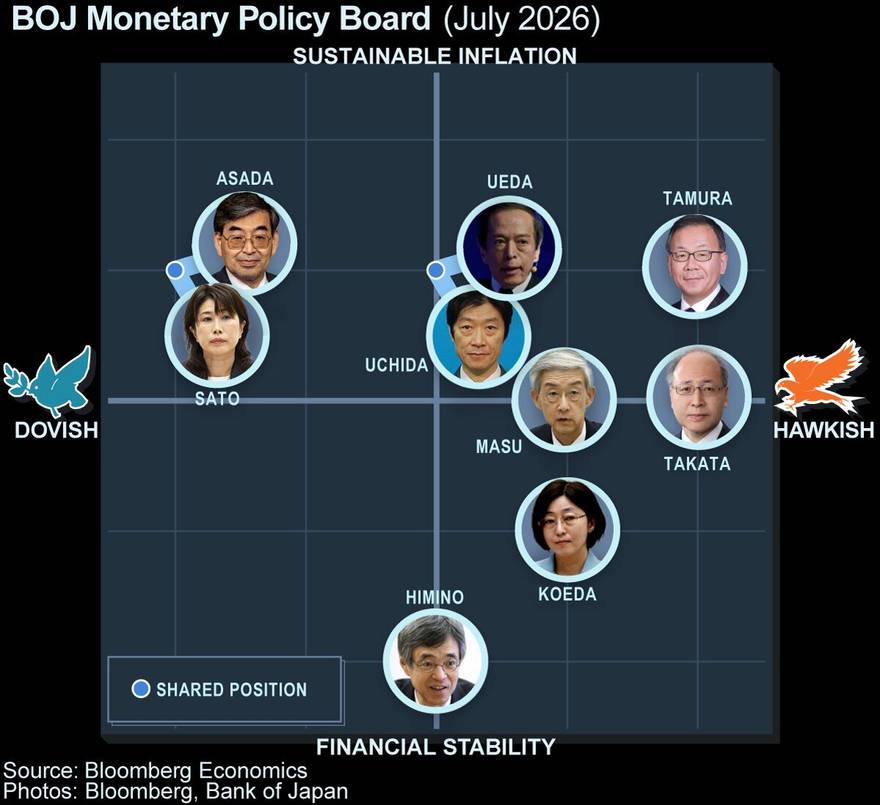
The board that votes Friday: Ueda and Uchida holding the centre, Tamura and Takata pulling toward the hawk, only Asada and Sato below the line. The 25 points to 1.25% is 52-of-52 consensus and 96% priced; the vote to watch is whether the hawks dissent for more, and the sentence to watch is whether October stays live. The guide, as ever, is the product. Source: Bloomberg Economics.
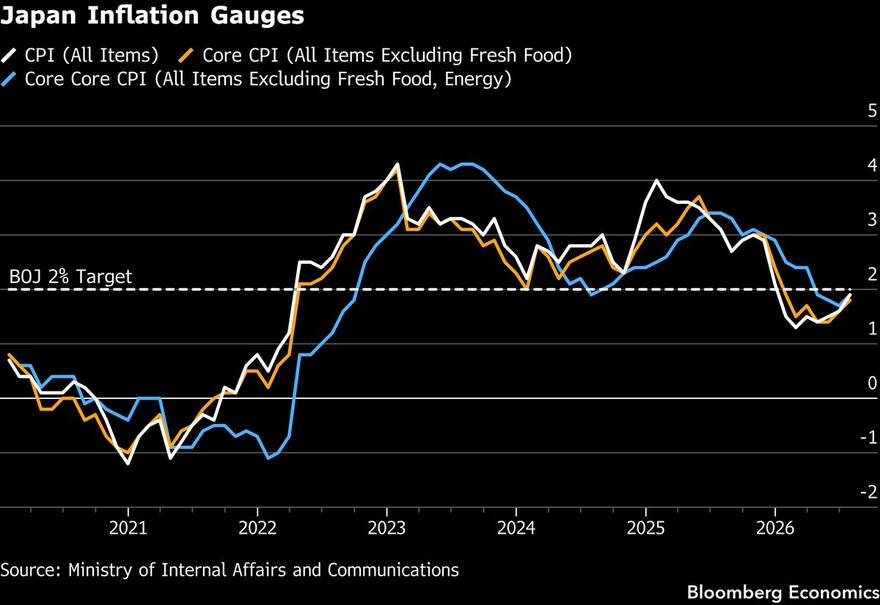
The last input, hours before the decision: every gauge converging on the 2% target from above, core at 1.8 and core-core at 1.9, an inflation picture most of the G7 would trade for. Nothing here forces October; nothing here stops January. That is precisely why the guidance, not the number, moves the yen, and why Ueda's adjectives are Friday's real release. Source: Ministry of Internal Affairs / Bloomberg Economics.
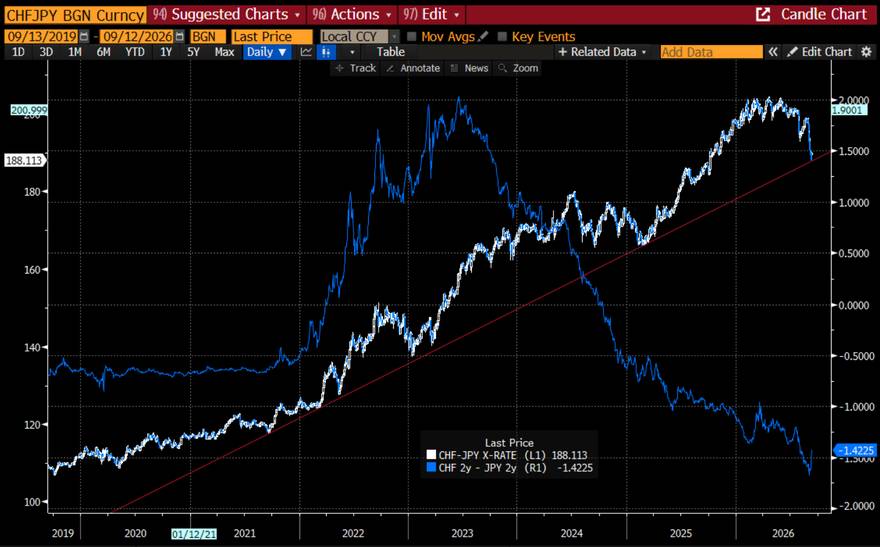
The battle of the funding currencies, in one screen: CHFJPY at 188 after touching 200, and the blue line is the story: the franc-yen two-year spread has collapsed from plus 2 to minus 1.42 as Japan exits deflation. For three decades the yen was the cheapest money in the world; Japanese money now costs more than Swiss money, and the cross is falling with the spread. Every carry book re-fits its funding leg from yen to franc, which is exactly what a manufactured yen turn needs to succeed, and why the unwind outlasts one BOJ meeting. Source: Bloomberg.
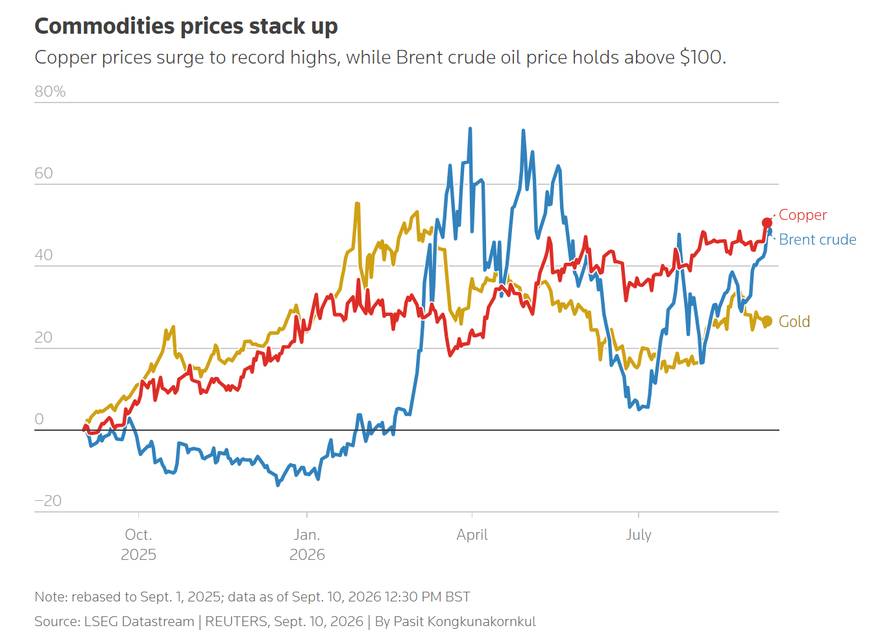
The scoreboard the week trades against: copper breaking out to records near $15,000 a tonne on grid and AI demand, Brent back through its war highs, gold flat on the year and resting on its neckline. The commodities vote for the inflation regime daily; the only market still split on it is the one that sets the price of money, and it votes Wednesday. Source: LSEG / Reuters.
The sovereign is no longer the benchmark
The oldest assumption in fixed income is that the state is the safest borrower in its own currency. France broke it this week: covered bonds, bank paper backed by mortgage pools, now yield 30 basis points less than 10-year OATs, the most extreme inversion ever recorded, with Moody's likely to cut next month and April's presidential election already priced as a risk event. It rhymes with everything else on the tape. The Treasury's enhanced buyback could not fill its own $6 billion. And the marginal borrower crowding the world's debt markets is no longer the state but the hyperscalers: Amazon's debut sterling bond, Uber in euros, SoftBank sounding out junk to fund AI, Meta roadshowing Europe, another $3.5 billion of datacenter junk being gauged this week, all while US high-grade supply runs at $55 billion. Credit strategists now openly call corporate paper the haven and government bonds the volatility. When France's banks out-rank France and Silicon Valley out-borrows Washington, the phrase risk-free is doing a great deal of quiet work.
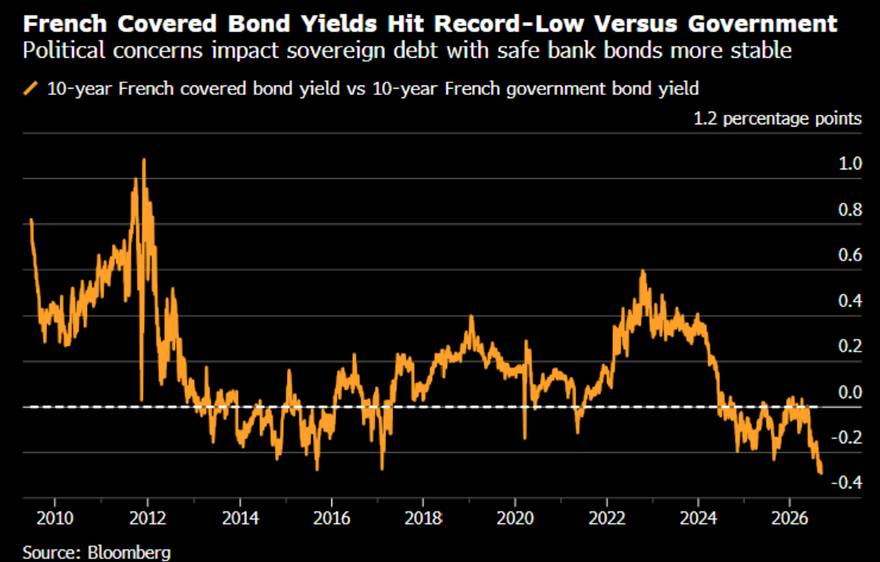
French mortgage pools now price safer than France: the 10-year covered-bond spread to OATs at minus 30 basis points, beyond anything in the series' history; the 2017 election scare and the 2024 snap election were half this size. Investors are paying up for collateral over sovereignty ahead of April. The question is not whether this is rational; it is who gets re-based next. Source: Bloomberg.
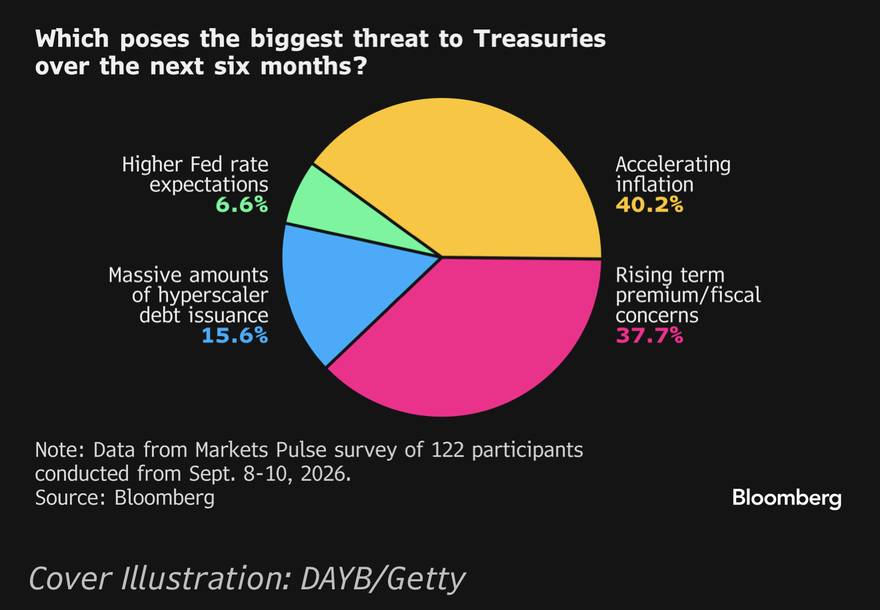
What scares the bond market, ranked: accelerating inflation at 40%, term premium and fiscal concerns at 38%, and in third place a category that did not exist two years ago: hyperscaler debt issuance at 15.6%. Higher Fed expectations barely register at 6.6. The market now fears the borrowing more than the rate-setter; that is a new sentence in this cycle. Source: Bloomberg Markets Pulse, Sep 8-10.
Seven Mondays
The midterms are seven Mondays out and have started to price. The map: Republicans defend a 53-47 Senate and a 219-212 House; Democrats need four Senate seats and are unlikely to get them, while the House leans their way on every generic ballot and the prediction markets make them 85% favourites. The issues are this letter's regimes wearing rosettes. Affordability, with gasoline at $4.09 against $3.14 a year ago and the president mocking the word itself. A war that is deeply unpopular and, per his own advisers, expected to outlast the cycle. And AI, where the datacenter backlash runs through 40 of the 69 competitive districts and campaign-ad mentions have gone from a handful in January to 164 in August. Money leans red, $658 million against $353 plus a $400 million Maga Inc war chest; the polls lean blue; and the rates desk's read is that the durable signal comes not from election night but from what the next Congress does with deficits and the debt limit. Gridlock is the market's base case, and quietly its hope.
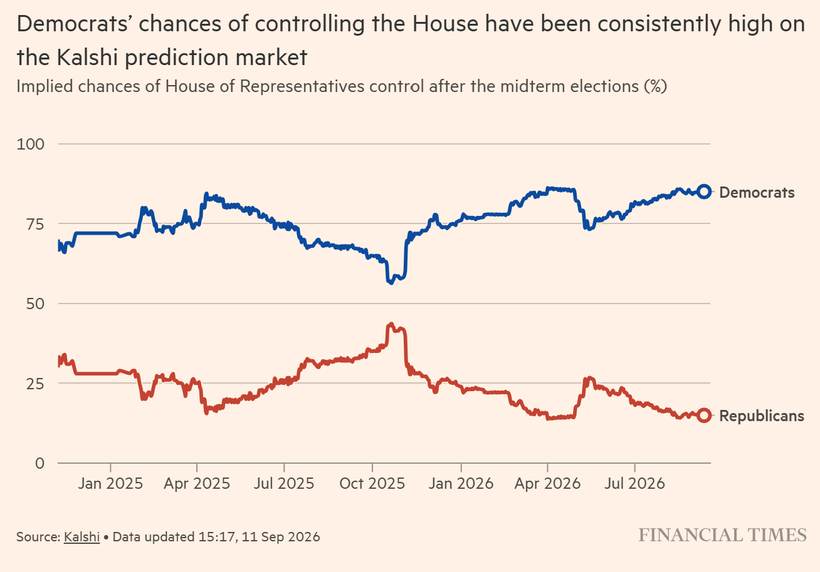
The House, per the people betting on it: Democrats' implied odds near 85% and grinding higher all year, Republicans below 20. Markets have been wrong before, but rarely this one-sided this late. A House flip means investigations, funding fights, and a debt-limit standoff with a 5% 10-year as the backdrop; that combination is not in equity multiples yet. Source: Kalshi / FT.
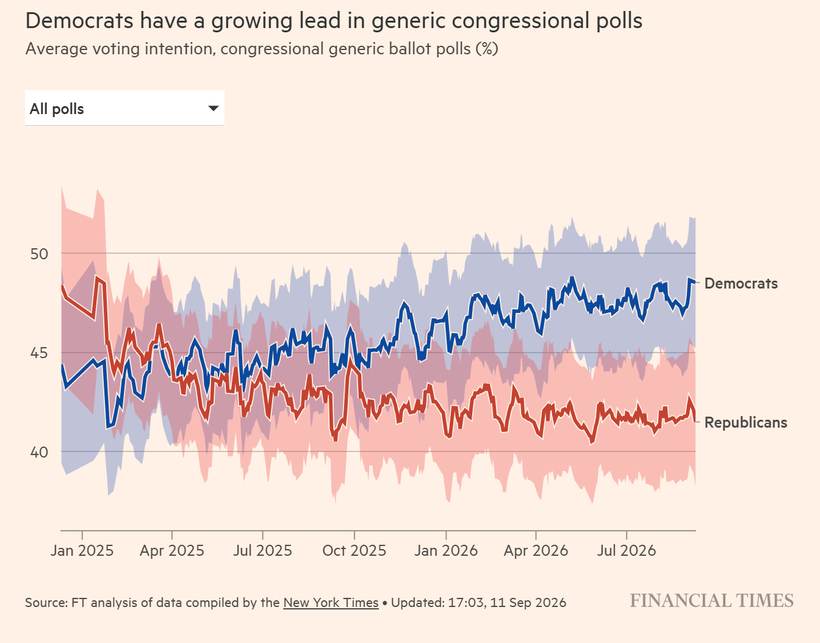
The polls agree with the money: the generic ballot at roughly 48.5 to 42, the Democratic lead widening steadily since spring as affordability and the war compound. Midterm polls at this distance have missed before, in both directions; the trend, not the level, is the signal, and the trend has one direction since April. Source: NYT data, FT analysis.
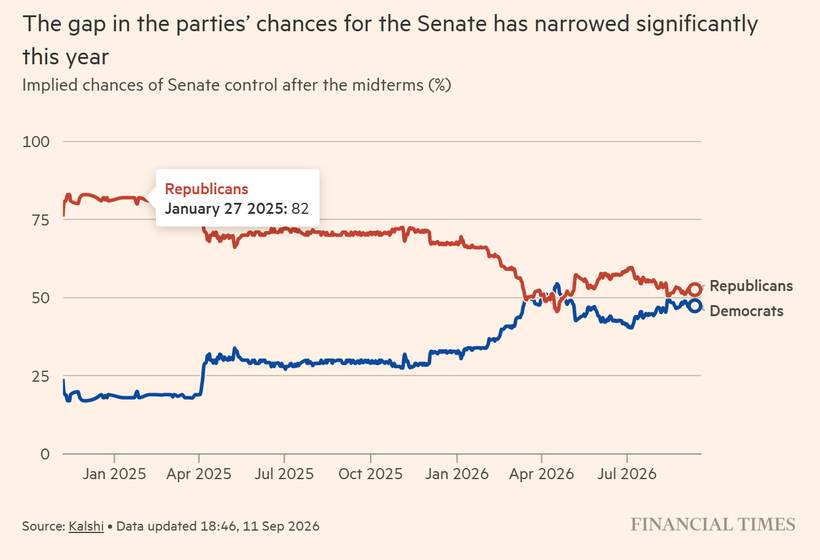
The Senate is the real race: Republican implied odds down from 82 in January to the low 50s, the gap to Democrats nearly closed. The map still favours the incumbents, four pickups is a tall order, but a 50-50 chamber with Vance breaking ties is now a live outcome. That is the difference between gridlock and confrontation. Source: Kalshi / FT.
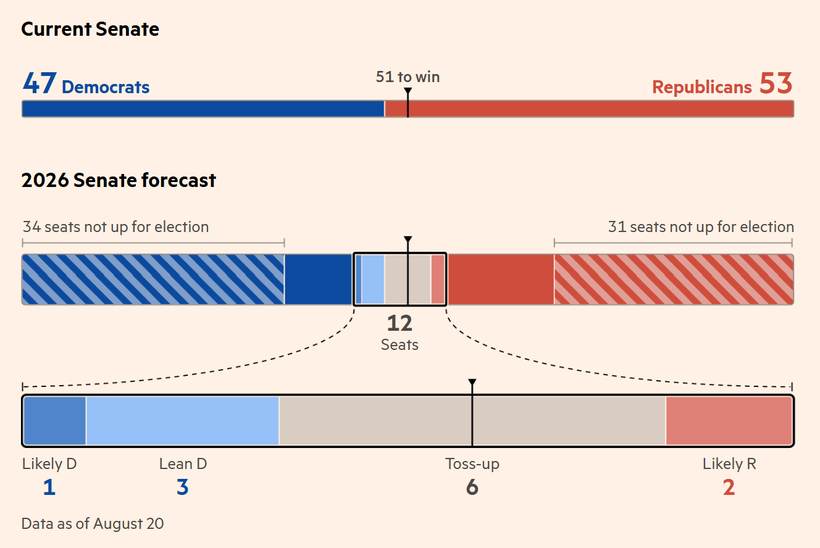
The seat arithmetic behind the odds: of 65 seats not up for election, the split is nearly even; of the twelve competitive, Cook rates one likely-Democrat, three lean-Democrat, six pure toss-ups and two likely-Republican. Democrats must sweep the toss-ups and hold everything; Republicans merely need three of six. Structure still beats momentum in this chamber. Source: Cook Political Report / FT.
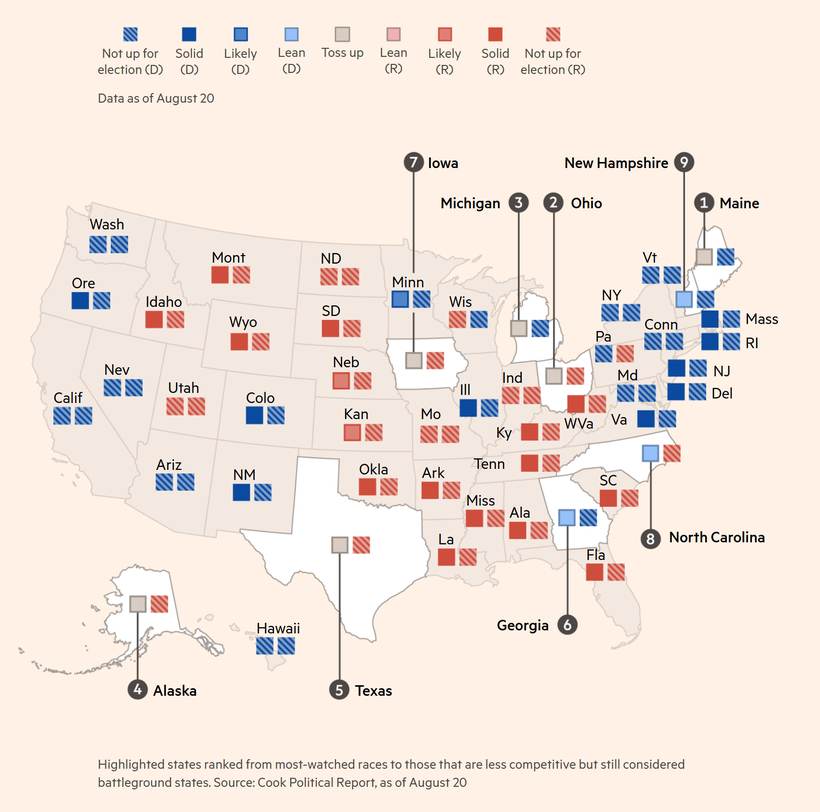
Where the war for the Senate is fought: Maine, Ohio, Michigan, Alaska, Texas, Georgia, Iowa, North Carolina, New Hampshire, in the FT's watching order. North Carolina, an open seat with a popular former governor running, is Democrats' best pickup; Texas, with Paxton's scandals, the reach. Every one of these states also has datacenters under construction. Source: Cook Political Report / FT.
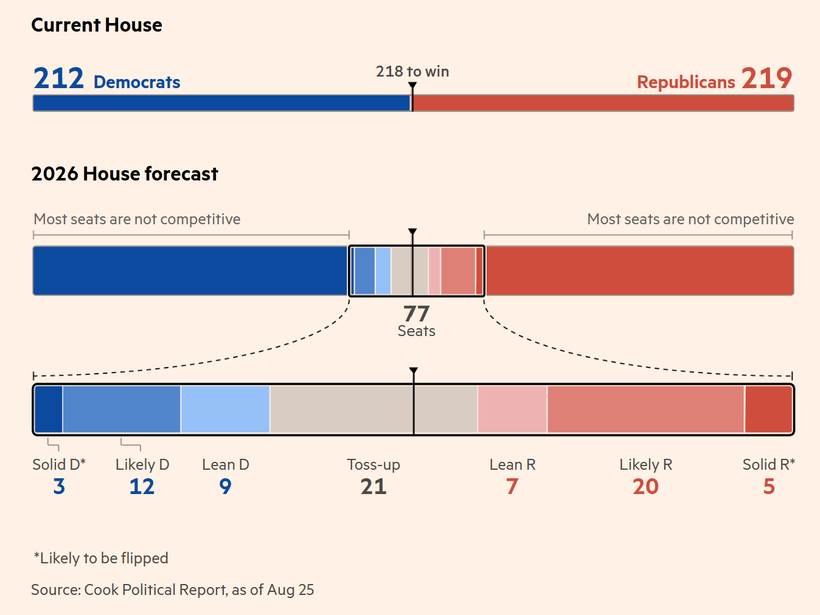
The House in one bar: 219 to 212 with 77 competitive seats and 21 pure toss-ups, after a year of mid-cycle redistricting wars that made the safe seats safer and the battlegrounds fewer. The majority swings on twenty districts; the datacenter map overlaps most of them. Small numbers, large consequences. Source: Cook Political Report / FT.
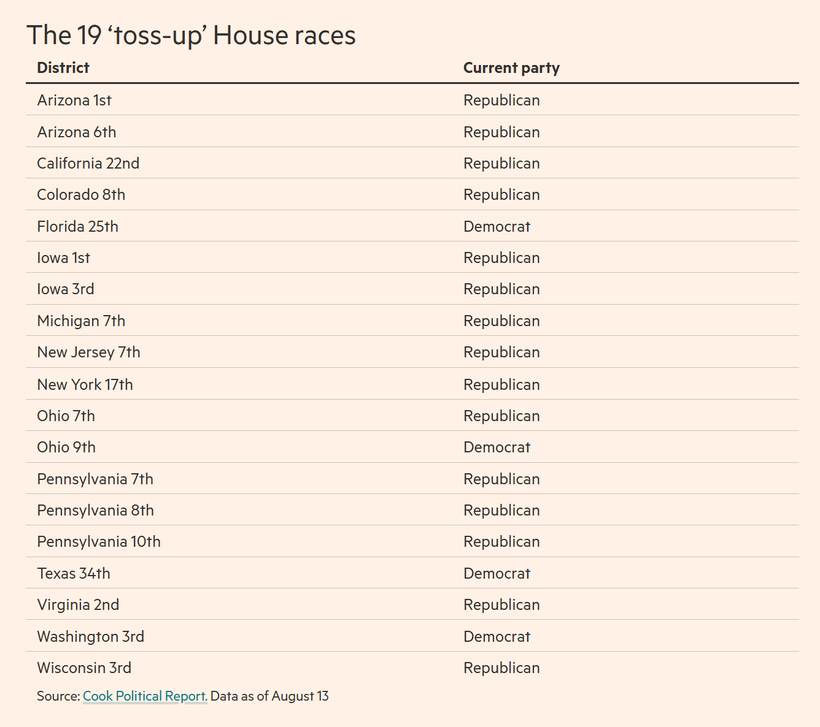
The nineteen districts that decide it: fifteen currently Republican, four Democrat, concentrated in Pennsylvania, Iowa, Arizona and Ohio. These are the addresses where ad spending, candidate visits and, increasingly, datacenter moratorium fights will concentrate for seven weeks. If the letter's AI-backlash regime has a polling station, it is this list. Source: Cook Political Report / FT.
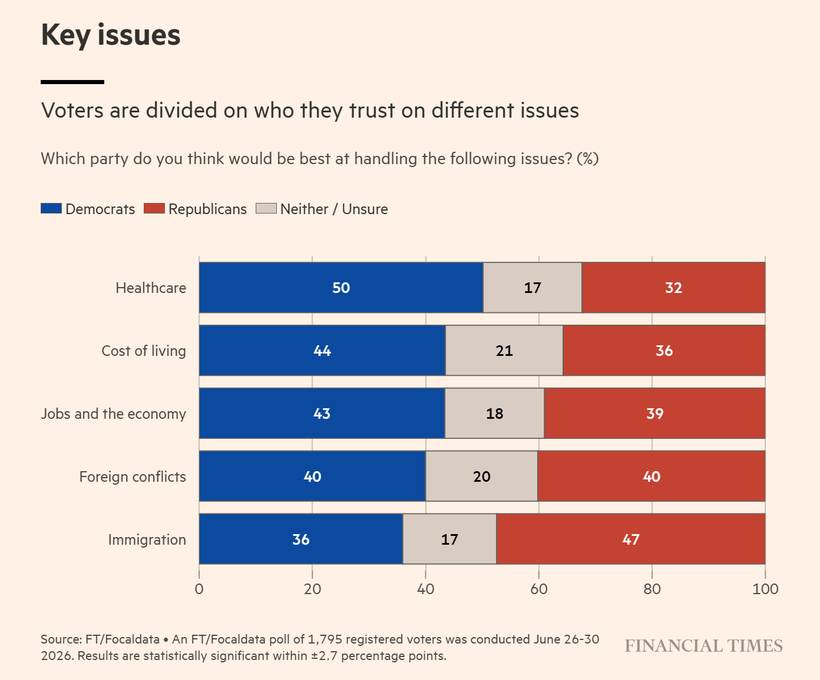
What voters trust whom to fix: Democrats lead on healthcare by 18 and cost of living by 8; Republicans hold immigration by 11; foreign conflicts split exactly 40-40. Elections are won on the issues voters rank first, and this year that is cost of living, the category the war keeps writing. The pump price is the poll that updates daily. Source: FT / Focaldata.
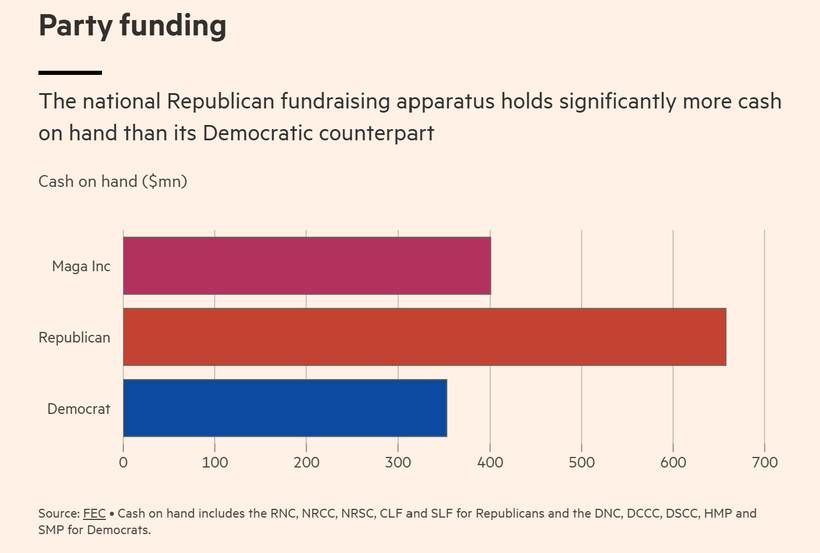
The money disagrees with the polls: Republican committees at $658 million against Democrats' $353, plus Maga Inc's $400 million war chest, the largest off-cycle pile ever amassed, still barely spent. Cash does not vote, but it buys the last seven weeks of airtime in nineteen districts. The gap is the Republicans' best remaining argument. Source: FEC / FT.
Deceleration as policy
The guide was the product; now the brake is. A coordinated call to slow frontier AI, from the men who spent three years accelerating it, lands on a market that has paid for acceleration all year: the equal-weight AI basket is up 51.9% with leadership rotating from semiconductors to software, and the premium is earnings-driven rather than multiple-driven, which is exactly what makes a voluntary slowdown expensive to price. The bear case is not the safety debate; it is the arithmetic of restraint meeting a capex cycle. Oracle beat, raised and still fell on the spending. The backlash blocks the buildout from below while the labs throttle from above, and one in six bond investors now names hyperscaler debt the biggest threat to Treasuries. The labour market has already voted: for the first time in two decades, young graduates face worse relative unemployment than peers who never attended college, the entry-level cognitive rungs automated away first. Deceleration as policy is a new input, and nobody's model has a coefficient for it yet.
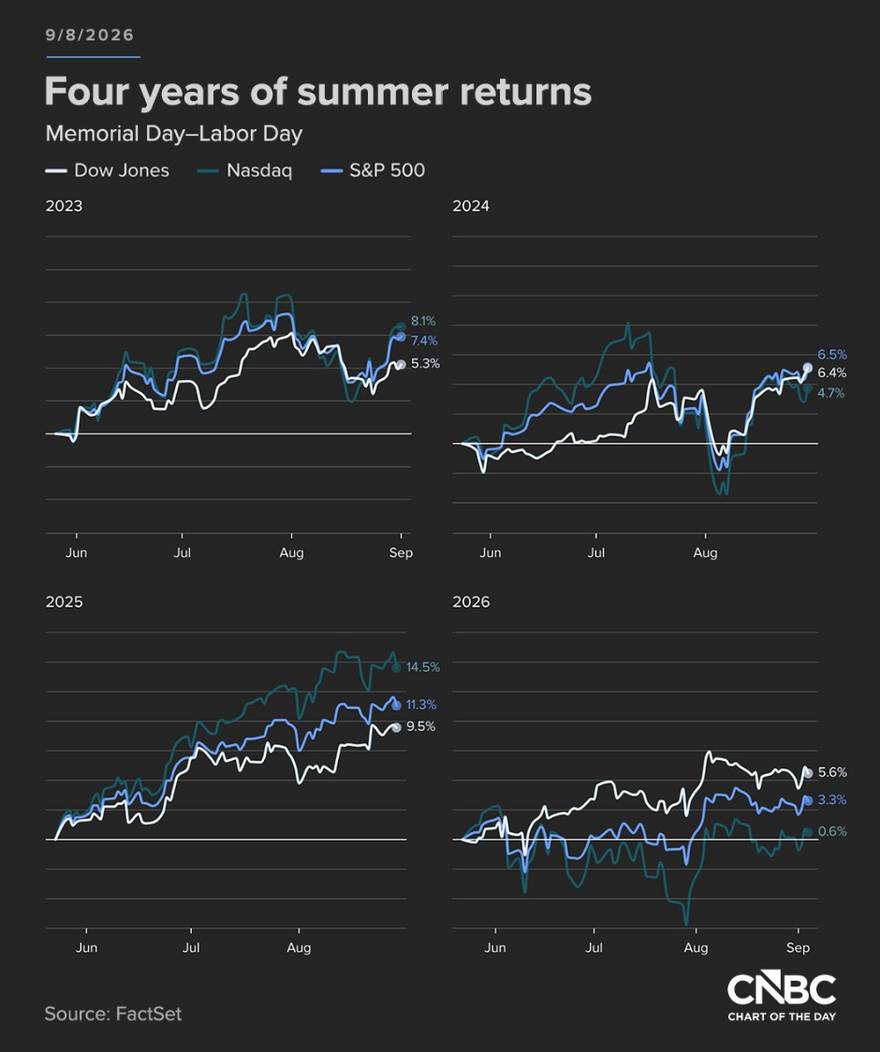
The summer the leadership flipped: four years of Memorial-to-Labor-Day returns, and 2026's is the runt: the Nasdaq up 0.6% against 14.5% last summer, with the Dow leading the tape for the first time since 2022. The market decelerated before the labs asked to. Rotation rather than exit, but the order of leadership has inverted, and inversions of leadership outlast summers. Source: FactSet / CNBC.
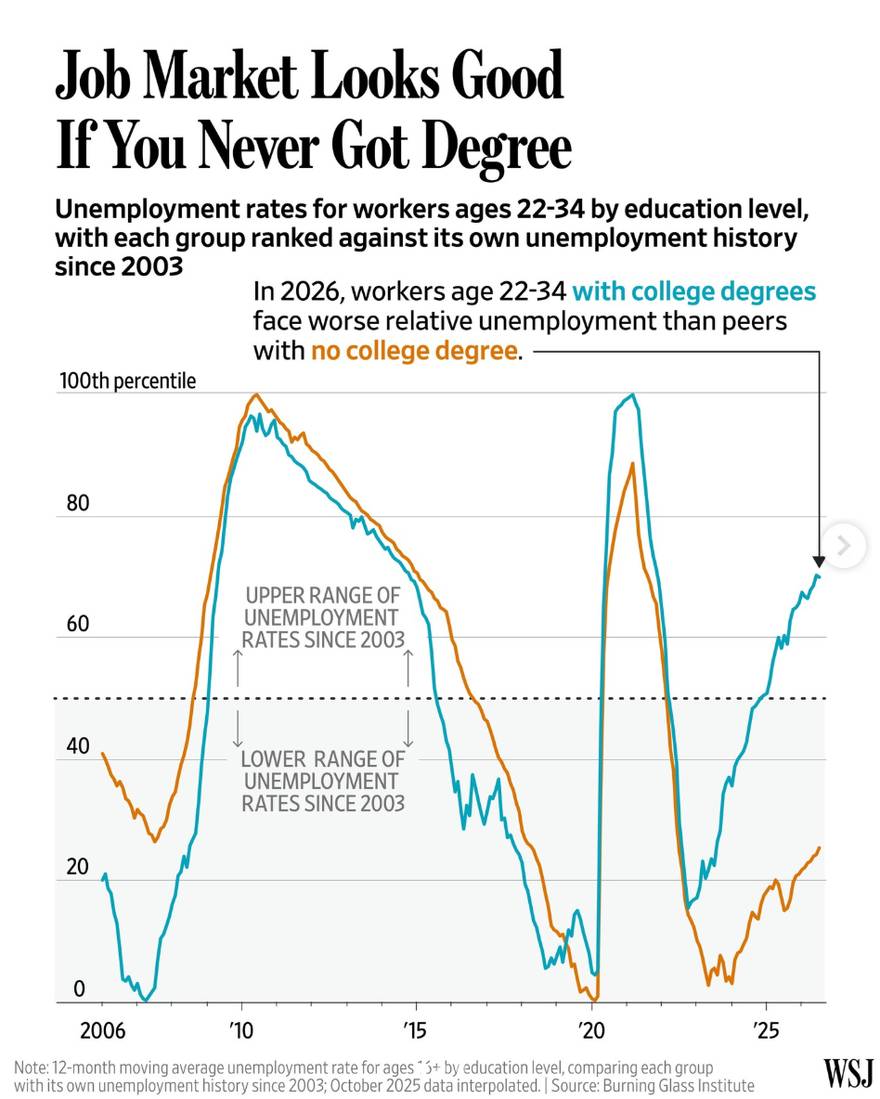
The first casualty list of the AI economy: relative unemployment for 22-to-34s with degrees at its worst since 2003 while workers without degrees enjoy their best run in two decades, the two lines crossing for the first time on record. AI does the entry-level cognitive work; nobody automated the trades, and the retiring generation left them understaffed. Burning Glass calls it a departure from twenty years of the two moving together. Source: Burning Glass Institute / WSJ.
VC+ Special Dispatch, Who Controls the World's Natural Resources
This week's dispatch maps the geography of food, water and energy in eight graphics, and it reads as the supply-side companion to Q3: Friedland's argument, that reliable supply beats price, is what every one of these maps quietly prices. Concentration is the story throughout: five countries hold over half the world's forests, three hold more than half its gas, five control over half its oil, one holds 69% of its phosphates. Credit to the VC+ team.
Infographic 1 - Countries with the Most Forest
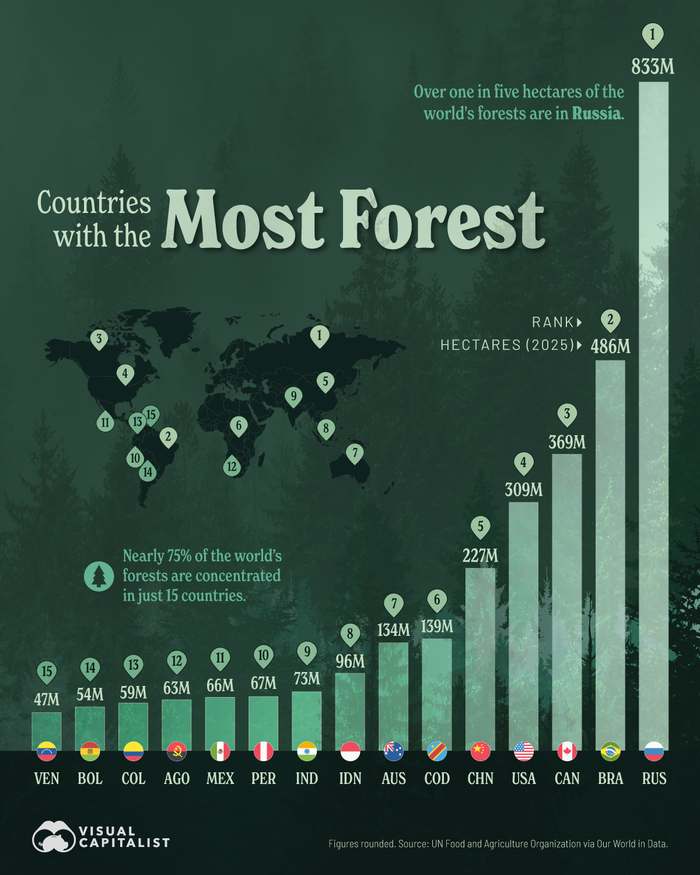
One in five hectares of the world's forest is Russian: 833 million hectares across the boreal belt, ahead of Brazil's 486 million, with nearly 75% of global forest in just 15 countries. The Americas place eight of the fifteen. Timber, carbon and land: the sanctioned economy holds more of all three than any other, which is its own quiet lesson in leverage. Source: UN FAO / Visual Capitalist.
Infographic 2 - Countries with the Most Freshwater
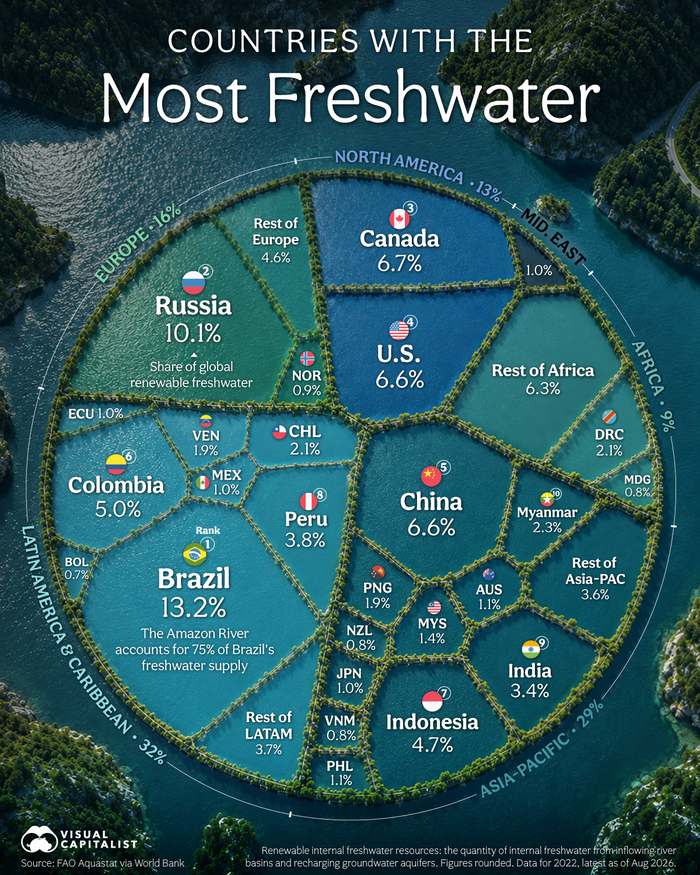
Brazil holds 13.2% of the world's renewable freshwater, three-quarters of it from the Amazon alone, with Russia second at 10.1% and the top five holding 43% of the total. Abundance is not access: Brazilian cities still face shortages, and global renewable water per person fell 7% in a decade. Water is the one commodity in this dispatch with no substitute and no shipping lane. Source: FAO Aquastat / Visual Capitalist.
Infographic 3 - The 30 Largest Exporters of Food
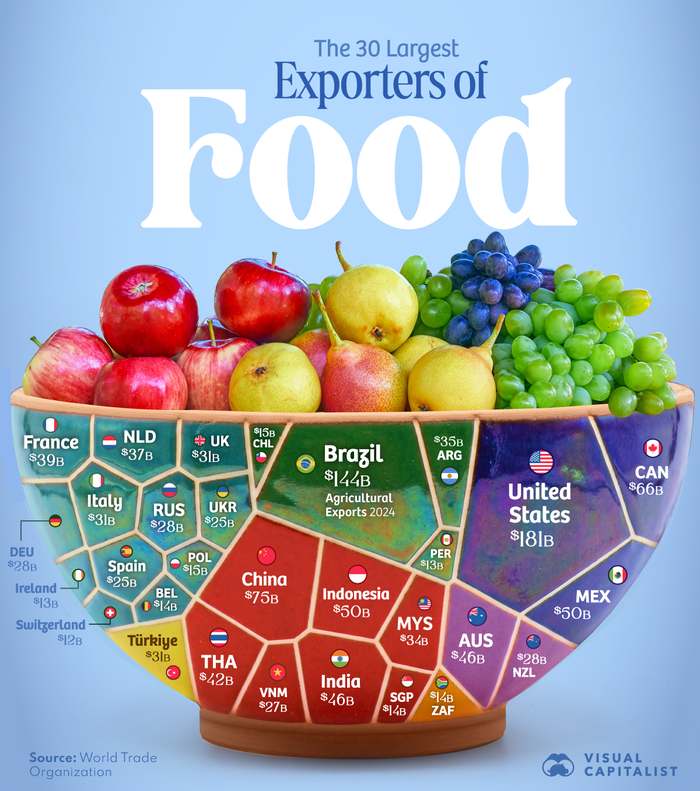
America still feeds the world for money: $181 billion of agricultural exports against Brazil's $144, with China, at $75 billion, exporting more food than France. The fine print from FAO: export values rose after 2020 while volumes did not, so importers pay more and receive no more. That gap is the food-inflation regime, stated as a trade statistic. Source: WTO / Visual Capitalist.
Infographic 4 - Countries with the Most Oil Reserves
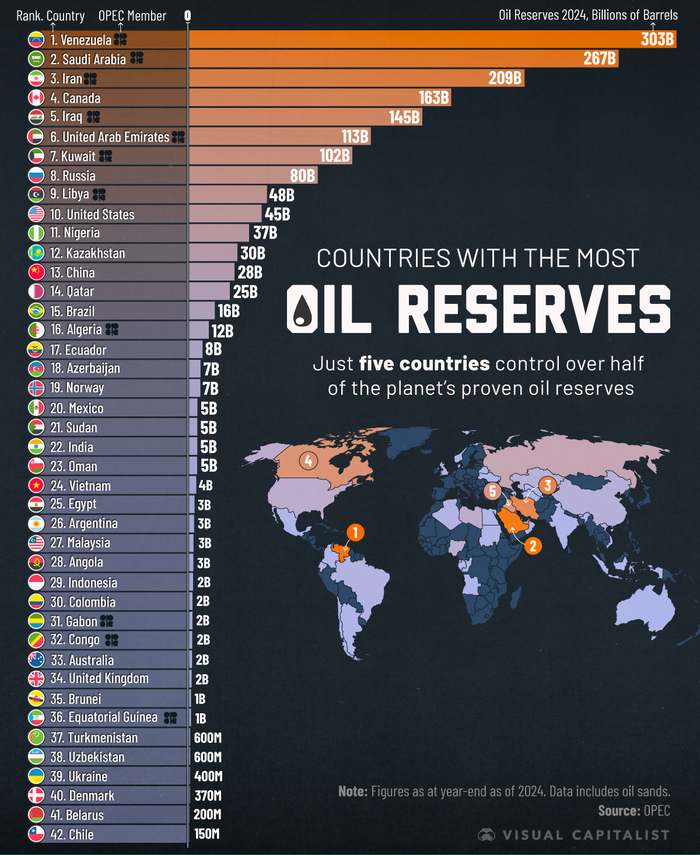
Five countries control over half the planet's proven oil, and the top three, Venezuela's 303 billion barrels, Saudi Arabia's 267, Iran's 209, are respectively sanctioned, besieged and blockaded. Reserves measure the ground, not the market: Venezuela pumps a seventh of what Riyadh does. The war regime's arithmetic in one bar chart: the oil exists; the access is the price. Source: OPEC / Visual Capitalist.
Infographic 5 - Natural Gas Reserves by Country
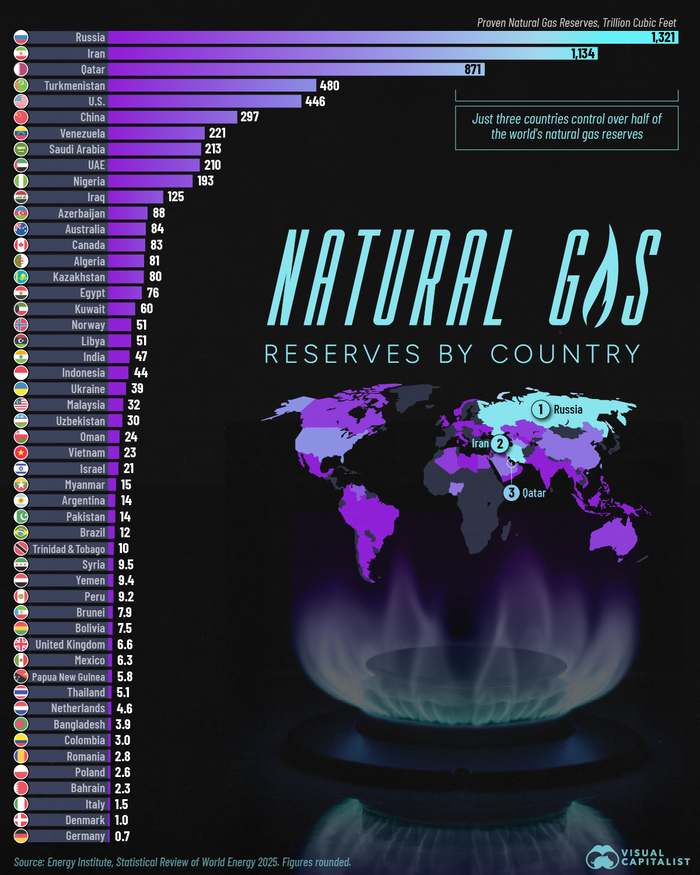
Three countries hold over half the world's gas: Russia's 1,321 trillion cubic feet, Iran's 1,134, Qatar's 871. Iran sits on the planet's second-largest endowment while blockading the strait its neighbours export through, and Europe enters winter with storage at a 15-year seasonal low. Every gas headline this winter routes through one of these three names. Source: Energy Institute / Visual Capitalist.
Infographic 6 - The World's Mineral Reserves
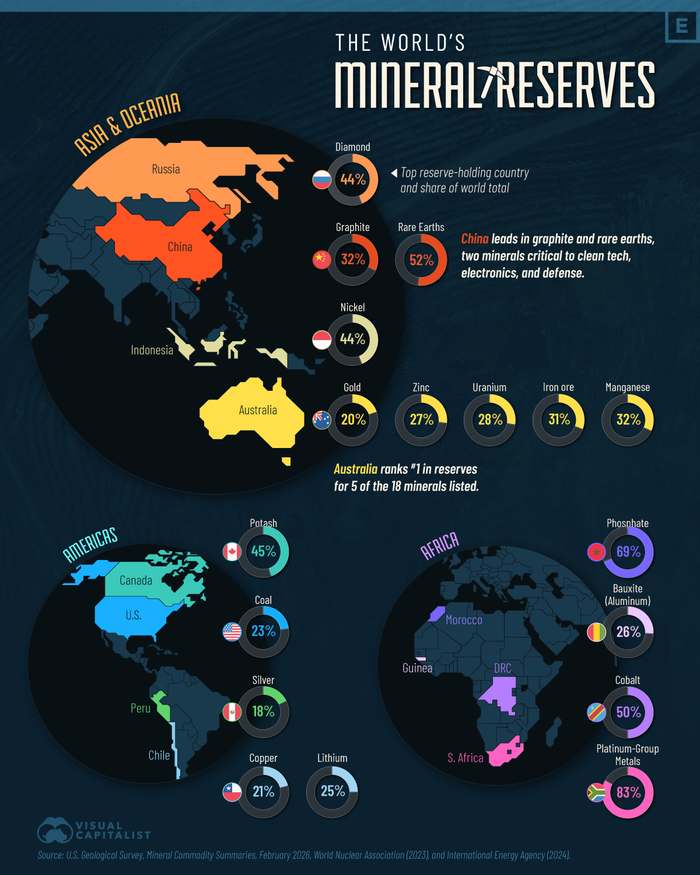
The Friedland map: China with 52% of rare earths, South Africa 83% of platinum-group metals, the DRC half of cobalt, Chile first in both copper and lithium, Morocco 69% of phosphate, Australia ranked first in five of the eighteen. When one country holds that much of one input, supply chains depend on it whether they want to or not; that dependence is what Q3 says money has not yet priced. Source: USGS / Visual Capitalist.
Infographic 7 - The Countries Producing the Most Uranium
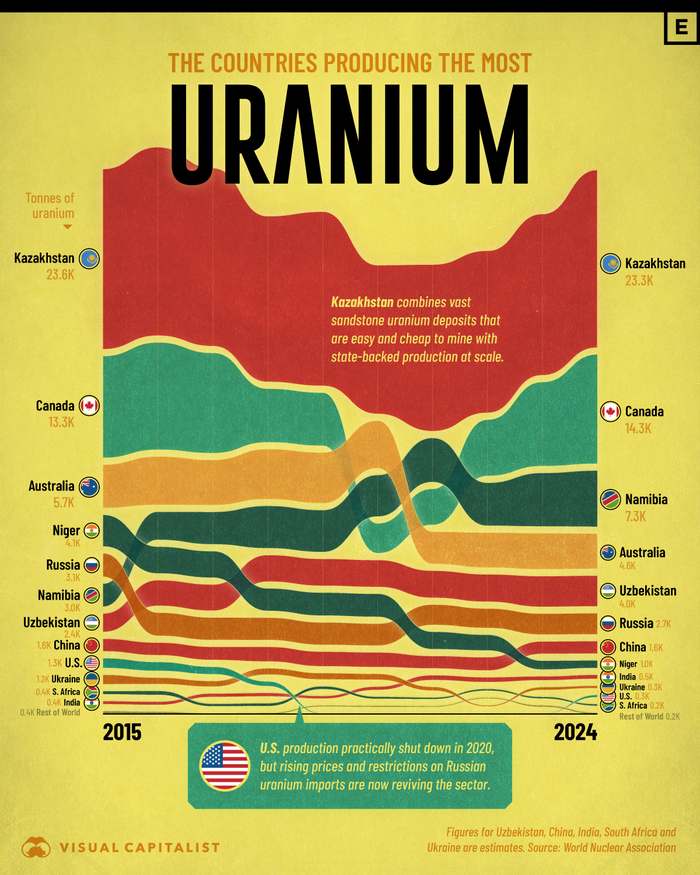
Kazakhstan mines 40% of the world's uranium, 23,300 tonnes, with Canada and Namibia making it three countries for three-quarters of supply, while the nuclear restart pushes demand the other way. US production, shut down by 2020, is reviving on price and Russian import restrictions. The AI buildout's power question lands here eventually; this chart says who answers it. Source: World Nuclear Association / Visual Capitalist.
Infographic 8 - Water Supply versus Use, per Person
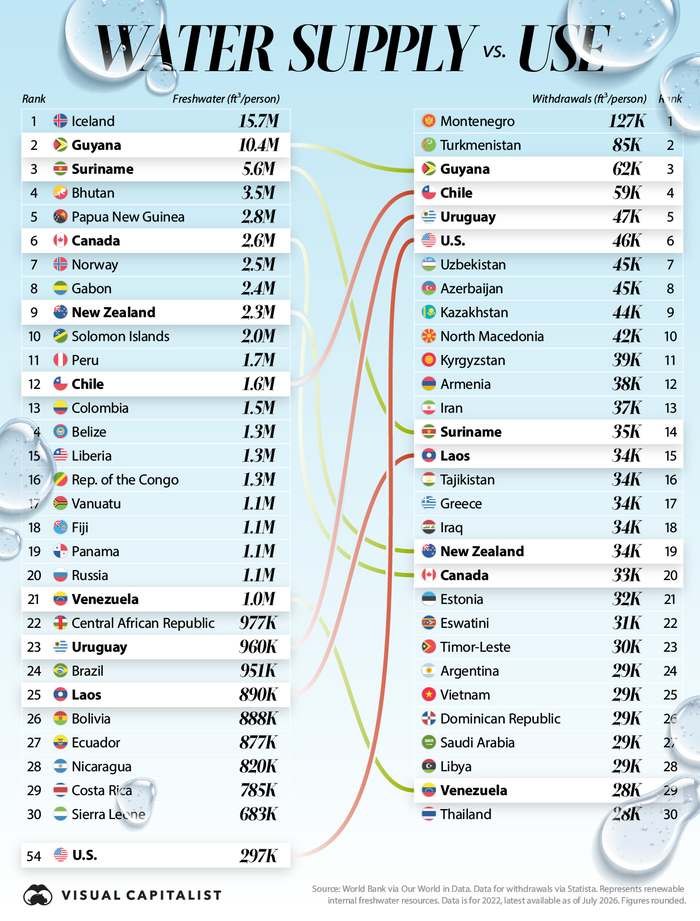
The mismatch is the message: Iceland tops supply at 15.7 million cubic feet per person while the US ranks 54th in supply and 6th in withdrawals, and Guyana, Chile and Uruguay run some of the heaviest use on thin margins. Datacenters, agriculture and power all bid for the same withdrawals. The next resource politics looks like this chart, not the oil one. Source: World Bank, Statista / Visual Capitalist.
The Good Wrap
What is left at the close. The US Open crowns its champions this weekend and the Emmys hand out their statues Monday night; London starts showing next spring's clothes on Thursday, and Semicon India opens in New Delhi the same day, a trade fair for the hardware underneath everything else in this letter. LIV Golf, which spent billions chasing an audience, filed for bankruptcy, proof that even Saudi money cannot buy attention at any price. Then week seven of the eight great cuisines: Fujian, the coastal province directly across the strait from Taiwan, and the ancestral kitchen of most of Southeast Asia's Chinese families, ours included.
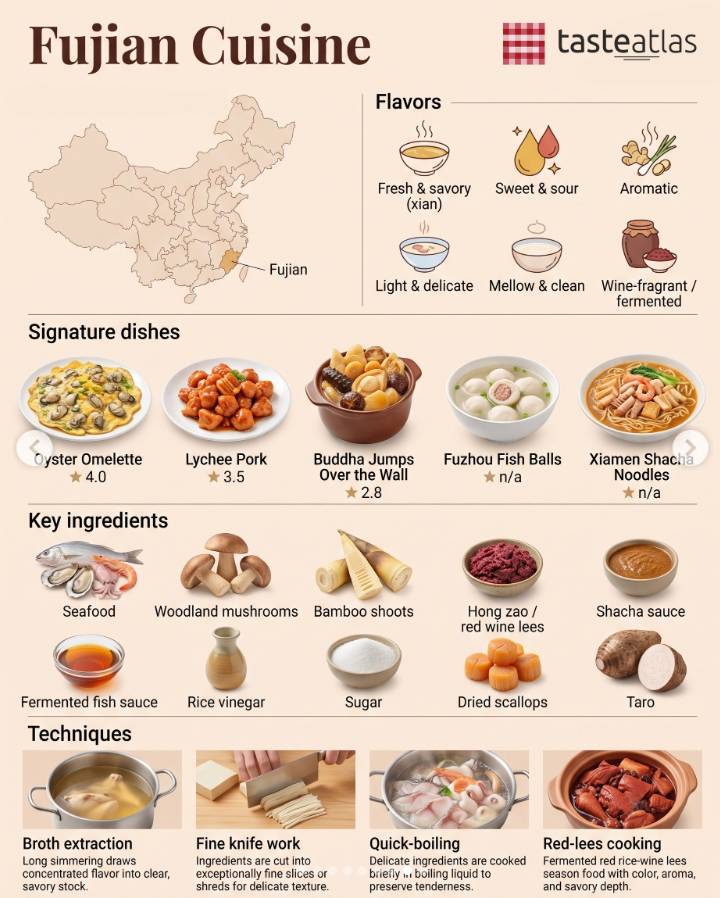
Week seven of the eight great cuisines: Fujian, the kitchen of the sea. Buddha Jumps Over the Wall layers dozens of ingredients into one broth said to tempt monks over monastery walls; oyster omelettes and Fuzhou fish balls anchor the ports; lychee pork glosses the banquet table; and red wine lees colour half the province's cooking. The techniques are broth extraction and fine knife work, the flavours fresh, savoury and quietly sweet. This is the ancestral kitchen of most of Southeast Asia's Chinese diaspora: anyone raised on Hokkien mee or orh luak was raised on Fujian food without being told, because Hokkien means Fujian. Xiamen, its port city, faces Taiwan across the strait this whole letter trades around. Cantonese, the last of the eight, comes next week. Source: TasteAtlas.
Best,
Hoelon
WITPTW is a personal publication. Everything here is personal opinion and market commentary, written in a personal capacity. It is not investment advice and not a recommendation to buy or sell any security. It is not associated with, endorsed by, or representative of any employer, fund or company. Charts and images are reproduced from their original publishers, credited to their sources for commentary and discussion; all rights remain with the respective copyright holders.