The Returns Dollar
Personal views and market commentary. Not investment advice. Not associated with any employer or firm.
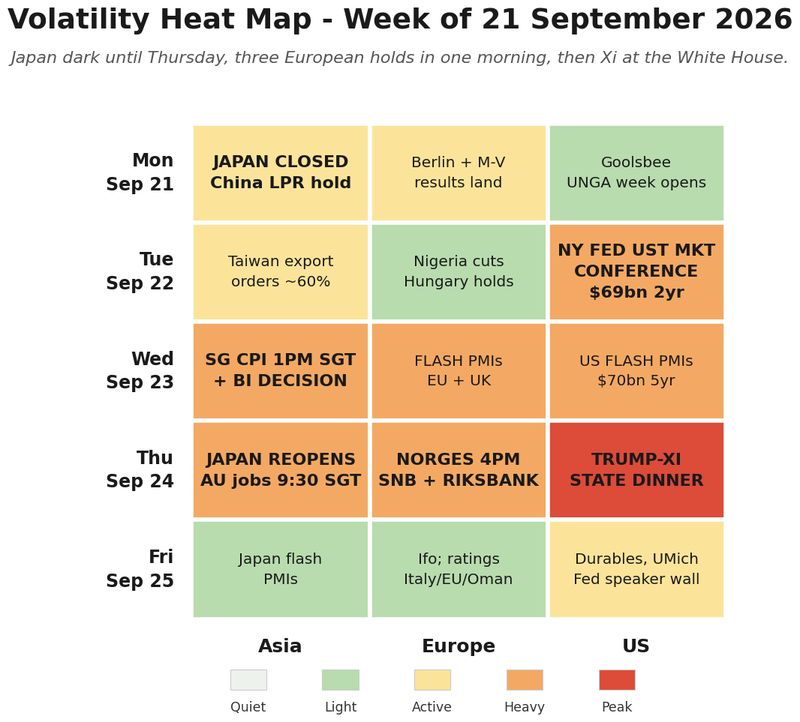
Volatility heat map for the week ahead , sessions as we trade them from here. Japan is closed Monday through Wednesday, Singapore's CPI and Bank Indonesia share our Wednesday, three European central banks decide inside Thursday morning, and Xi reaches the White House Thursday with a state dinner to follow. The S&P enters at 7,650 with the 10-year a tick under 5% and the dollar index at 100.2.
"We're in backward land, and in the next recession long-term rates are going to go up, and they'll go up because of the debt crisis that it's going to usher in." — Jeffrey Gundlach, DoubleLine CEO, speaking in New York this week. The safe haven fails exactly when it is needed. That is the whole warning, and he brings the arithmetic. A recession takes the deficit "easily to 12% of GDP," roughly $3 trillion a year of interest expense, "and you just can't do it." So the next easing cycle meets a bond market that sells off instead of rallying, and Washington reaches for the unconventional: he expects a new Operation Twist somewhere around 6.5% on the long end, and floats the darker option, restructuring every coupon above 1% to cut interest expense 75% overnight, at the price of never borrowing again. He is short duration and only "a little less negative" than last year. Note what already exists: a Treasury buying its own long bonds weekly. The Twist has a pilot program, and the 30-year sits at 5.37.
"Don't obsess about the dollar's share in formal FX reserves... The dollar's global role is increasingly as a source of returns, not a source of safety." — Brad Setser, Follow the Money, Council on Foreign Relations, this week. De-reservification, not de-dollarization: the dollar is not losing its place, it is changing jobs, and the new job pays. The reserve manager's dollar, bought for safety and held through anything, has been shrinking for years; that selling is old news and already in the price. The dollar being bought today is bought for returns, private and quasi-sovereign money chasing the highest yields and strongest growth in the G10, sitting in state-bank back rooms rather than central-bank front windows. That is why the dollar keeps catching bids the de-dollarization crowd cannot explain. The regime implication cuts later, not now: an asset held for returns is loyal only to the returns. While American yields and growth lead the world, the flow is buy. The safety bid is what is gone, and nobody needs it until the returns stop.
"Common sense versus pure unadulterated crazy." — JD Vance, calling the midterms a referendum while stumping in Iowa on Friday. He calls the other side crazy. Look at the year his side had. A criminal investigation opened into the last Fed chair. American citizens killed in immigration raids. Congressional maps redrawn between censuses because the president asked. A war the president campaigned against starting. A $5,000 dividend promised from a government already borrowing six percent of GDP. Every one of these was unthinkable two years ago; none of them gets called crazy on a stage. Gasoline is up 27% in a year and still rising; that is the one line the frame cannot cross out. Seven Mondays to November 3.
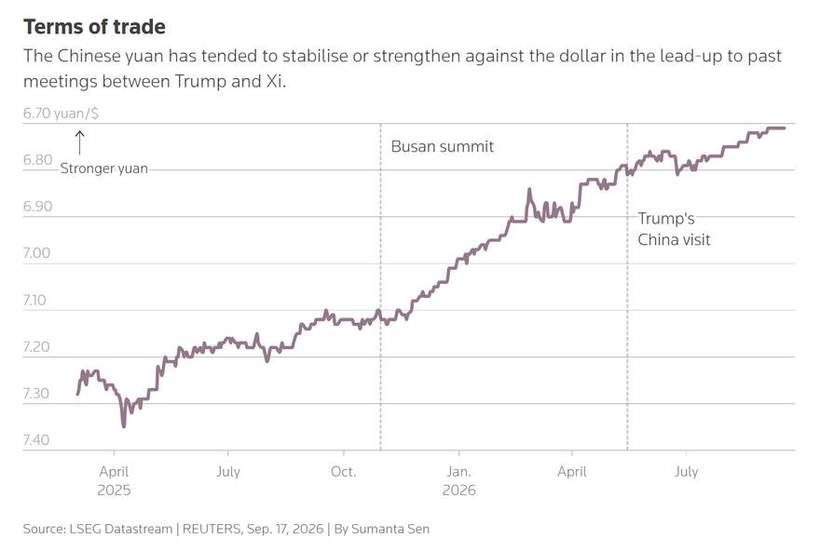
The most watched meeting of the week, priced in yuan. The Chinese currency has strengthened into every Trump-Xi meeting of this cycle, and it arrives at this one at 6.70, the strongest since early 2023, with the PBOC's daily fixes doing the signalling. Goodwill, managed in advance and by design. The pattern says the fix is the message; the question for Thursday is what Beijing expects in return for a currency this polite. Source: LSEG / Reuters.
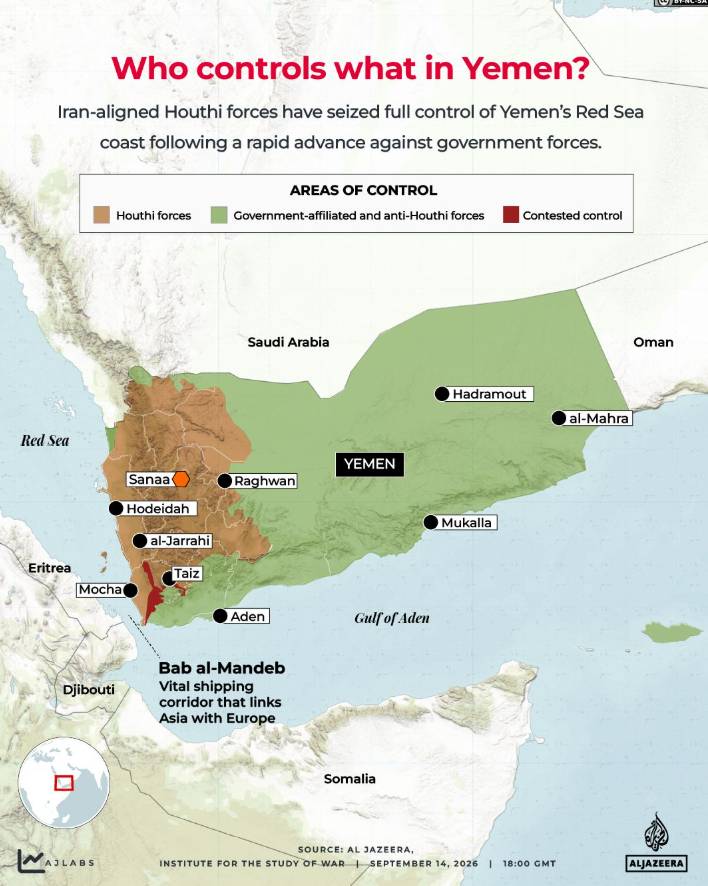
The Middle East tension has evolved to the next level. Iran-aligned Houthi forces now control Yemen's entire Red Sea coast, holding Mocha and Perim Island in the Bab al-Mandeb, after a rapid advance the Saudi air campaign could not stop. 13D's satellite work shows the East-West pipeline damage runs to subsurface infrastructure, four to six weeks from normal flows. And the Saudi trap, as analyst Danny Citrinowicz frames it: escalation offers no guarantee, diplomacy strengthens the Houthis, Washington has declined to help, and every road between those options runs through higher costs for Riyadh. The more the Houthis raise the price without paying one themselves, the narrower the Kingdom's room becomes. There is no simple return to the status quo ante. Source: Al Jazeera, ISW, Sep 14.
What is the plan this week?
It feels like a hangover week coming. We got the Fed hike, and most importantly the clearer direction of travel in rates. Honestly, if I take out Trump's influence, there would not have been a second thought that rates are too high here. My view stays focused on the capital shortage, Lacy Hunt's pivot still in mind, and the price action in global rates confirmed it: the pivot is most evident at the front end, where stops have bear-flattened every curve, hard. There are plenty of flows underneath this move switching the same way.
Then the USD. The BOJ's hike came on a split vote, political more than economic, and Governor Ueda did his best to lean hawkish, limited by his presentation, or was it actual intentions; the market called the bluff straight away. USDJPY, which was already short covering, got fueled higher. Last week I argued the dollar's new regime was getting stronger; the week proved that call wrong, and better to say so plainly than to defend it. The index has risen in seven of eight sessions through 100.5, and the CTA models point to more dollar buying still pending. Nikkei confirmed the Bank ran rate checks on Friday night, and the debate now is whether the rate check leads to actual intervention at these levels.
The week will start yet again on the Middle East, which is focusing on how Saudi Arabia works itself out of the worst situation it has faced in decades. The Trump administration is meanwhile busy welcoming China, with President Trump reported to be respecting President Xi and receiving him at the tarmac on Thursday.
Not a lot of data that is meant to move markets; the bigger question is how equities hold up while accepting a higher cost of funding and higher commodities, especially energy. Japan is closed for three days, Monday through Wednesday, which thins Asia's liquidity just as the yen is on the move. The central banks mostly hold: Norges Bank, the Riksbank and the SNB all decide Thursday, with Norges the only live hike risk; Bank Indonesia holds Wednesday; China's loan prime rates stay unchanged Monday. The exception worth watching is at home: MAS came out of last week's briefing unequivocally hawkish, Singapore's CPI lands Wednesday with core inflation broadening, and October slope tightening looks a done deal.
The plan is to keep long USD against the G10 funding currencies, with the DXY breaking higher. JPY shorts should continue to short cover, and actual intervention only comes above 160 in my view. Short USDCNH into the long holidays in the first week of October, as the fixing pattern is intentionally lower. Nothing new trades in yen crosses while Tokyo is closed, and the big decisions wait until Xi has left Washington. Stay nimble.
What did I learn last week?
Mon Sep 14: China's August data printed the divergence at its widest yet: industrial production beat at 5.2% while retail sales crawled at 0.4 against 0.8 expected. The AI tape opened the week selling off on Amodei's slowdown essay before finding its feet. Trump announced Russia and Ukraine had agreed to stop hitting each other's energy infrastructure, a sentence the diesel market chose not to price.
Tue Sep 15: The 10-year crossed 5.021%, the first five-handle since 2007, and the $13 billion 20-year reopening drew 5.42%, the highest auction yield since 1986, into decent demand. The Empire survey missed at 7.6 against 15. The BOE was reported to be overhauling its debt sales and stopping 20- and 30-year gilt sales altogether. Dollar General told a conference that even $100,000-plus households no longer feel affluent; OpenAI was reported weighing another private round at a $1.2 trillion valuation before any listing.
Wed Sep 16: The Fed hiked 25 to 3.75-4.00%, unanimous at 12-0, the first increase since 2023. Warsh said he was hard-pressed to call financial conditions restrictive, kept one more hike in the projections, and cut his own press conference short by half an hour; the market read hawkish and priced above the dots. Trump demanded 1% rates on Truth Social the same afternoon. New Zealand's GDP beat at +0.2%, the Atlanta Fed raised its Q3 tracker from 4.4% to 5.1%, and import prices ran hot.
Thu Sep 17: The BOE held 6-3 and delivered the week's quiet structural news: QT cut to £46 billion, unanimous, long-end gilt sales scrapped outright and auctions paused until April 2027. Taiwan's CBC held at 2.00%, the coin flip landing on patience; the house leaned 60% hike and the 40% branch fired, Governor Yang once again finding his thresholds not quite met. The PBOC set the yuan at its strongest fix since February 2023. Claims printed 196k; housing starts missed. And Loudoun County, Virginia, the largest datacenter concentration on earth, voted to pause new development; the backlash reached Data Center Alley itself.
Fri Sep 18: The BOJ hiked 25 to 1.25% on a split vote and the yen fell anyway, USDJPY briefly above 158 before settling under 157, up 2% on the week, the biggest weekly move since October 2025, with Nikkei confirming rate checks by evening.
All week: The S&P slipped 0.1% while the Nasdaq added 0.7%; the SOX sits 20% below its June high against the 10-year's climb. Brent neared 110 before Saudi restart hopes and reported US-Houthi contacts took some premium out. Gold held the 4,300 neckline at 4,378. USDCNH broke 6.70. Grading the board honestly: the hawkish-surprise branch fired and the crosses were trimmed into it by design; the yen reload zone at 155 was run straight through, and that miss now shapes the plan above.
What to look out for next week?
Mon Sep 21: Japan begins three days of holidays, and the yen trades without its home market while the dollar presses; Standard Chartered reckons the yen alone is 59% of the rise in global FX volatility since July, so thin Tokyo liquidity is the week's first risk, not a footnote. China's loan prime rates stay unchanged a sixteenth month. Berlin and Mecklenburg-Vorpommern's election results land from Sunday, the AfD's momentum test two weeks after Saxony-Anhalt. Goolsbee speaks in London, the first Fed voice since the hike.
Tue Sep 22: The UN General Assembly opens its general debate, "Restoring trust, managing transformation," the horse-trading over the next Secretary-General running underneath. The quiet risk is at the New York Fed, which hosts its Treasury Market Conference with Williams and Jefferson speaking while the 10-year sits at 5%; the supply week opens with $69 billion of 2-years the same day. Taiwan's export orders, expected above 60%, test the AI-export cycle; Nigeria cuts; the RBA's speakers frame Bullock's decision a week out.
Wed Sep 23: The week's one real macro test: flash PMIs across the US, Europe and UK, with the US services print the higher-for-longer narrative's proof point and Europe's 52.0 defending its surprising resilience. It is also Singapore's day: August core CPI, expected at 2.1-2.2% with inflation broadening a second month, lands two days after the MAS financial stability report, with October's slope tightening near a done deal. Bank Indonesia holds at the new governor's first full meeting, mindful of the MSCI downgrade chatter. The Treasury sells $70 billion of 5-years.
Thu Sep 24: The day the week is built around. Xi at the White House, tariff rollbacks near $30 billion with a truce extension and an LNG package discussed, and a state dinner seating Huang, Altman, Musk, Bezos and Pichai; the House China panel lobbies loudly for the opposite outcome. Three European central banks decide inside two hours: Norges with the only live hike risk, the Riksbank likely lifting its forecasts toward a spring hike, the SNB at zero pushing back on 2027 pricing. South Africa hikes, Mexico holds with swaps split, Australia's jobs report is the last input before the RBA on the 29th, and Japan reopens to three days of accumulated yen headlines. Costco reports after the close.
Fri Sep 25: Durables, with the core capex line (+0.6% expected) the real signal under a negative headline, and final UMich sentiment carrying the 1-year inflation expectation Warsh watches at 4.6%. Fed and BOE speakers stack up at Oxford and Cleveland, and Italy, the EU, Oman and Morocco face the raters after the close. Quarter-end and Japan's fiscal half-year land Tuesday next; carry nothing binary out of the summit into the weekend.
Beyond next week
Sep 29: The RBA, a fourth hike of the year near-fully priced, taking the G10's top cash rate to 4.60% two days before quarter-end.
Sep 30: Quarter-end and Japan's fiscal half-year on the same Tuesday, the allocation date the repatriation debate has waited for all month.
Oct 1: China's Golden Week begins, the target of the USDCNH short; NFP week runs alongside with December's hike pricing at 77%.
Oct 9: Malaysia's budget, Anwar's fiscal goodies after the Najib pardon closed the early-election door.
Nov: Anthropic's IPO, slipped from October to November to show third-quarter numbers first: roughly $2 trillion sought, up to $100 billion raised, the largest listing in history if it prices. OpenAI waits for 2027 and raises privately in the meantime. October 19 still falls on a Monday.
Nov 3: Midterms, six Mondays out.
Regimes
Retired this week: the yen turn, manufactured, retired at week three. The manufacture failed against a hawkish Fed and a called bluff: 155 broke the wrong way, the pair traded 158, and the sponsors' next credible act only exists above 160. The thread folds into the new funding-currency regime below, and returns as its own regime only if actual intervention comes. retired, week 3
The bond market changed the subject, week six: the capital shortage. The 5-handle finally printed, the 20-year auctioned at 5.42%, the highest since 1986, and the front end bear-flattened every major curve as stops went through. Underneath sits Lacy Hunt's pivot: capital is scarce, so nobody issues long, 5% of this month's investment grade, the least since 2020, while ten dollars chase every one of 30-year paper on offer, and the only size sellers left at the long end are hyperscalers, whose Oracle paper now trades like junk. The BOE scrapping long-end gilt sales makes it two sovereigns managing their long ends. Flatteners remain the house expression; no outright duration. changed, week 6
The dollar goes two-way, week sixteen: the returns dollar. Last week's board called the down-thesis arriving and the week reversed it; graded, learned. The mechanism was never wrong, only the sign: a dollar held for returns follows the returns, and after a hawkish hike with growth tracking 5%, the returns point up. Seven up sessions in eight, CTAs signalling pending buying, and the plan is long dollars against the funders. The two-way name survives because the structure does: when the returns fade, there is no safety bid underneath. Until then, the up-leg runs. changed, week 16
The funding-currency battle, week one. The new regime formalises the plan's other half: short the funders, not just long the dollar. The yen's central bank hiked and the yen fell; the franc's central bank sits at zero explicitly pushing back on hike pricing, and the franc has been sliding against the euro all quarter; the euro's ECB is priced for three more and the euro still cannot hold 1.15. The world still needs to borrow something cheap, and it is auditioning all three. Japan closed for three days with the yen at 157 is this regime's first stress test. new, week 1
The AI fracture, week twelve: deceleration got bought. Monday's Amodei selloff was fully reversed by Friday, on price increases from AI infrastructure and another circular Amazon deal; the SOX sits 20% below June, but on rates, not on safety. Meanwhile the President called the warnings a hoax while seating the warners at Thursday's state dinner, Loudoun County paused Data Center Alley itself, and chip earnings projections keep climbing. The IPO window sequenced again: Anthropic slips to November at a $2 trillion ask, OpenAI to 2027, and the market gets one more month of private AI paper before it must price the public kind. The guide is still the product; the debt is still the tell. changed, week 12
The war is the inflation, week nine: the Saudi trap. The East-West pipeline needs four to six weeks, not days; the Houthis hold Perim Island and the full Red Sea coast; dated Brent trades at a widening premium to paper, and diesel's crack spread set an all-time record at $111 over Brent, an effective $210 barrel for the fuel that moves everything. The deeper shift is political: Washington rebuffed Riyadh's request for help, and a kingdom that spent decades buying American protection is discovering the umbrella is conditional. Hedging toward Beijing begins here. The premium is political, and it now has two capitals. changed, week 9
Surplus versus deficit, week four: the real house. Bessent said he is the house; the PBOC has been demonstrating what the house actually looks like: USDCNH through 6.70 at the strongest fixes since February 2023, official purchases of $30 billion in August slowing the very appreciation the fix invites, goods traders converting 63% of their dollars and repatriating nearly all of it. A currency managed stronger into a summit, against a rising dollar, without a press conference. The crosses stay, the USDCNH short into Golden Week is this regime's live expression, and Thursday is its event risk. held, week 4
Shifts (if then)
Last week's board fired strangely: the committees were more unanimous than anyone priced, 12-0 at the Fed, 9-0 on the BOE's QT, and the market's response was to price the Fed above its own dots anyway. The hawkish-surprise branch delivered the right trade for a mislabeled reason: the dots showed one hike, not two, but the delivery read hawkish and the pre-trim earned its keep. The hold branch never breathed. The Ueda branch fired and overshot: the pullback we called a reload zone at 155 ran to 158, and that regime is retired above. The 5% trigger traded but never closed twice; it stays armed.
The summit delivers (truce extension, $30 billion, LNG) → sell the news, not the story: trim China and Hong Kong beta into the strength by Thursday's close, because the benign outcome is largely priced. The USDCNH short is kept for the fixing pattern and Golden Week, not for the headline. new
The summit breaks (chip exports tightened, Taiwan pressed) → the topside USDCNH hedge earns, KRW and TWD get trimmed with the AI-export complex, and the Nasdaq carries the worst of it. The dollar longs do the defensive work on their own. new
US services PMI prints below 54.5 → the one data branch that matters: a defensively-positioned bond market rallies hard on weakness, and a third of the dollar longs get covered. Cover on American weakness only, never on the funders' strength. new
Norges hikes → the wall-of-holds narrative cracks from its least-watched corner: NOK is the clean expression, and the funders fall faster as the G10 hiking bias reprices. new
Japan reopens Thursday through 158 with no official act → 160 becomes the market's magnet. The plan adds nothing above 158; at 160 the watch is for the act itself, and rate checks no longer count. new
The 10-year closes above 5% twice → carried and still armed: risk parity, convexity hedgers and balanced-fund rebalancing arrive without opinions, and gross comes down first. carried
Tails
The quarter-end duration bid → September 30 is quarter-end and Japan's fiscal half-year in one Tuesday, at the end of the worst bond quarter in years, with the street short the front end everywhere. A pension rebalancing bid into that positioning is the setup for a violent bull-flattening squeeze nobody is paid for. new
The Saudi trap turns political → the kingdom's two exits, escalation without a military answer or negotiation that crowns the Houthis, both keep the premium alive; the third path, hedging toward Beijing, gets easier every week Washington declines to help. Watch for Saudi-China energy or security headlines during Xi's Washington week of all weeks. carried, week 2
Gold at the neckline, still → 4,300 held twice now, positioning is rebuilding from washed-out levels, and the buyers below the line have not been tested at size. A dollar this strong pressing on a level this watched: break it and 4,000 opens; reclaim 4,500 and the debasement re-entry checklist reopens instead. carried, week 2
October rhymes → the seatbelt enters its month: valuations at records, concentration extreme, quarter-end, Golden Week thinning Asia, and the 19th on a Monday. carried, week 4
The AI credit accident → Oracle's investment-grade bonds trade like junk, CoreWeave paid up to borrow, SoftBank wants another $30-40 billion in weeks. One failed jumbo deal reprices the entire AI-debt complex, and the capital-shortage regime meets the AI regime in the worst possible room. new
Indonesia to frontier → MSCI downgrade chatter around a $1.5 trillion economy with a new central bank governor and a just-sacked finance minister: a mechanical outflow event in this letter's home region, hiding behind a "hold" decision Wednesday. new
Silver Week Monday
Japan's markets close for three days just as its currency becomes the world's problem, and Asia's morning runs on reduced liquidity with US-China and Middle East headlines both live. China's banks leave loan prime rates alone for a sixteenth month, Germany digests two more state elections, and the first Fed voice since the hike speaks in London.
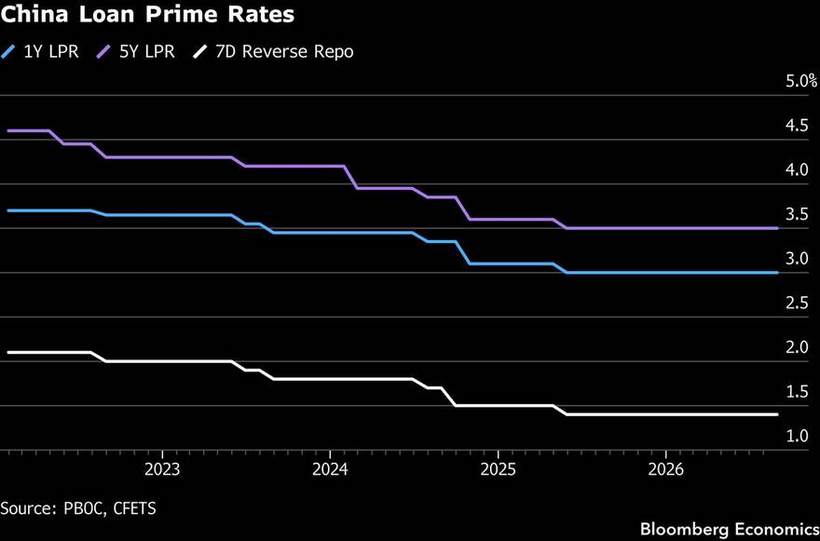
China's rates have not moved in sixteen months, on purpose: both loan prime rates flat since May 2025 while the rest of the world hikes, policy running through the fix and targeted subsidies instead. The easing the market waited for all year has quietly been deferred toward 2027; with IP at 5.2% on AI-led exports, Beijing sees no urgency. The currency, not the rate, is the instrument. Source: PBOC, CFETS / Bloomberg Economics.
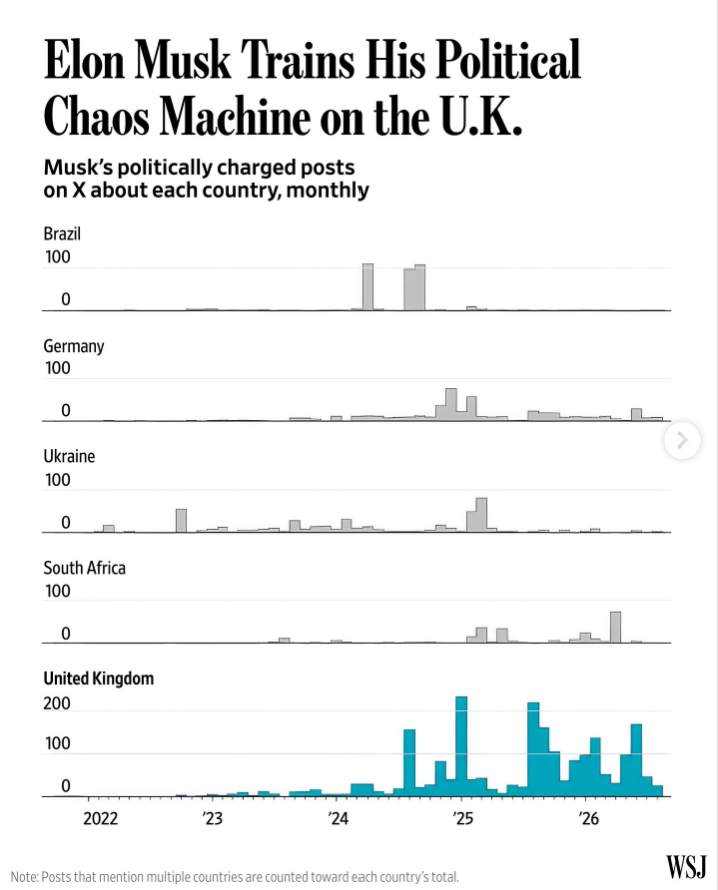
The other ballot influence, counted: the WSJ tallied four and a half years of Musk's politically charged posts by country, and no foreign nation comes close to his current focus on the UK, boosting Rupert Lowe's Restore Britain over Farage's claim to the right. On the day two German states count votes the AfD hopes to win, the chart is a reminder that Europe's political premium now has an amplifier with 200 million followers. Source: WSJ.
Conference Tuesday
The UN General Assembly opens with the world order it was built for fraying in real time, and the New York Fed hosts a Treasury Market Conference at the least comfortable moment in its history: Williams and Jefferson discussing market functioning with the 10-year at 5% and $69 billion of 2-years selling the same day. Taiwan's export orders give the AI cycle its regional pulse.
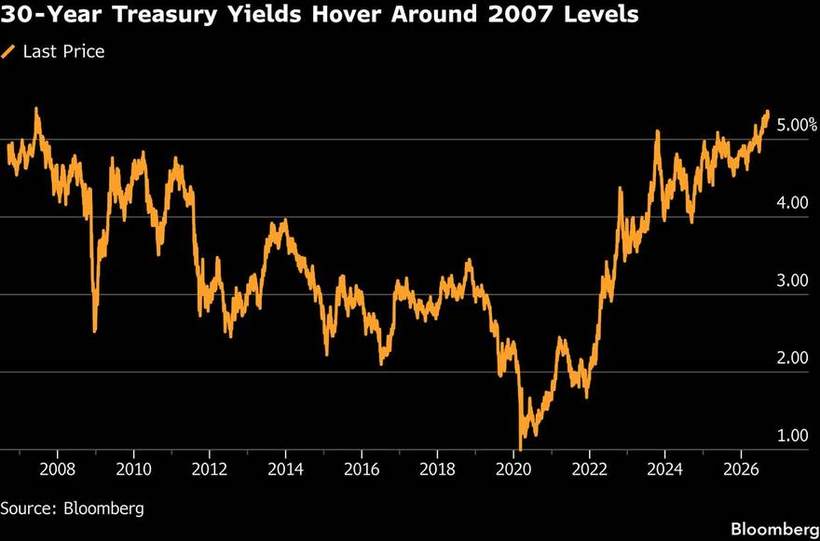
The backdrop to Tuesday's conference agenda: the 30-year at levels last seen in 2007, having closed at a post-crisis high of 5.37% the day before the Fed hiked. Nineteen years of duration bull market unwound to flat. Every panel discussion about "Treasury market resilience" this week happens under this chart, and so does every corporate decision not to issue long. Source: Bloomberg.
Singapore Wednesday
The one macro test of the week: flash PMIs across the majors, with the US services number carrying the higher-for-longer case. At home, Singapore's core CPI prints two days after MAS's financial stability report, with the October policy meeting increasingly priced for slope tightening; Bank Indonesia holds next door under new management and an MSCI cloud.
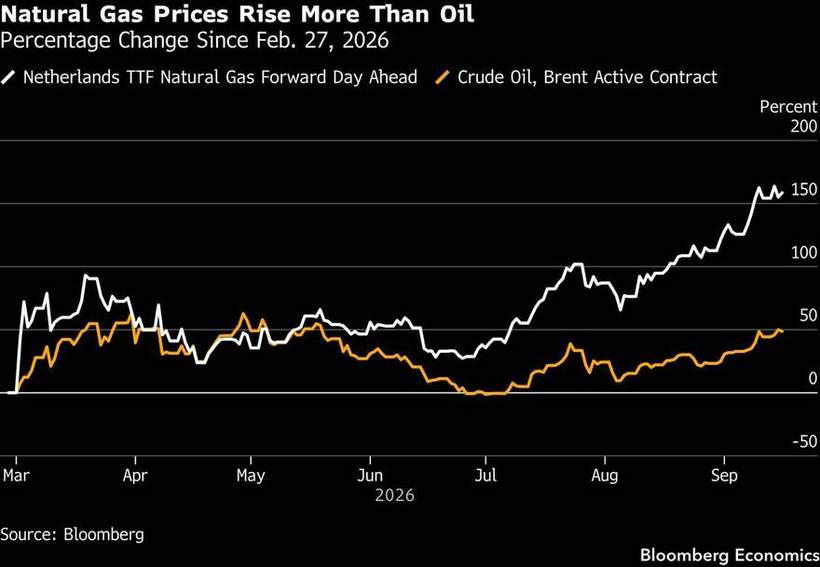
Europe walks into its PMIs wearing this chart: TTF natural gas up around 150% since the war began against Brent's 45%, storage below its 12-year average, and the Russian LNG ban starting January. The euro-area PMI held 52.0 through all of it, the economy's resilience the year's quiet surprise. Wednesday tests whether that resilience survives the autumn energy bill; the ECB's December hike pricing rides on it. Source: Bloomberg Economics.
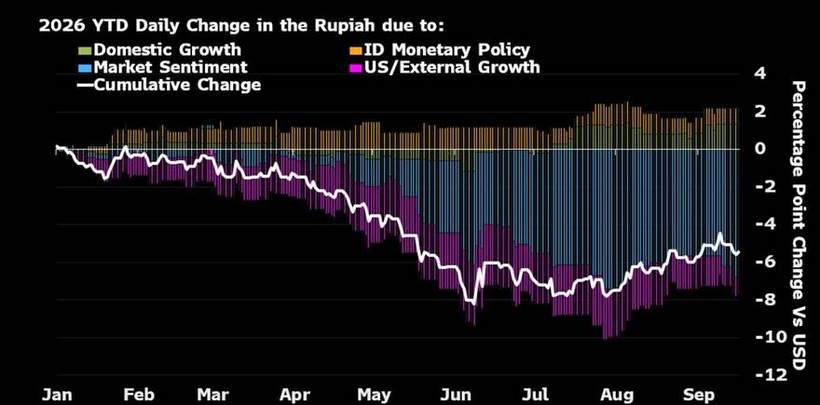
The decomposition of the rupiah's hard year: down over 5% with the drag almost entirely external, US rates and market sentiment, against a small positive from BI's own tightening. That is why Wednesday's hold is the easy part; the hard part is a frontier-downgrade review hanging over a market that imports its stress. The regional tell for every deficit currency in the letter's book. Source: Bloomberg Economics.
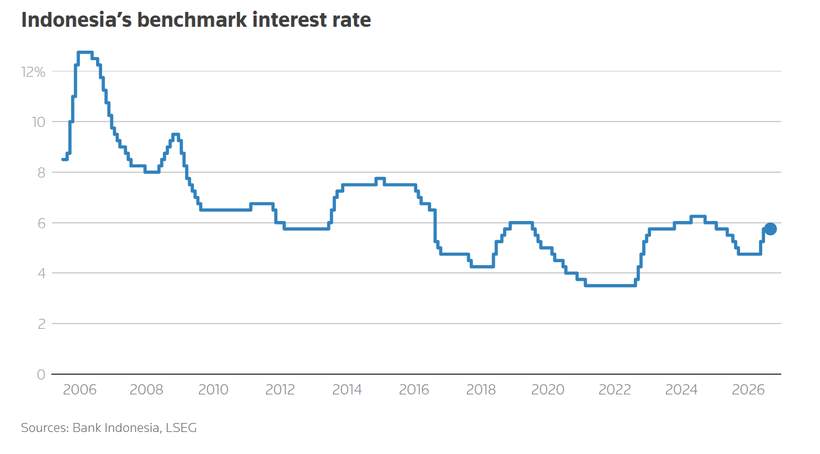
Twenty years of Bank Indonesia, ending at a hold: the benchmark at 5.75% after the May-June hikes that rekindled inflows, a new governor in the chair and a just-replaced finance minister behind her. Wednesday's hold is the consensus; ING still pencils one final hike in Q4 if the dollar keeps pressing. The decision is the easy part; the MSCI review is the tail. Source: Bank Indonesia, LSEG / Reuters.
Xi Thursday
Everything lands Thursday, and it lands in our order: Australia's jobs at 9:30am Singapore, Japan reopening to three days of yen headlines it could not trade, the three European decisions through our afternoon, and then Washington into our night, Xi at the White House with the AI chiefs at dinner, Mexico split, South Africa hiking, claims and housing on the tape. The book carries nothing binary through the day; the plan trades what survives it.
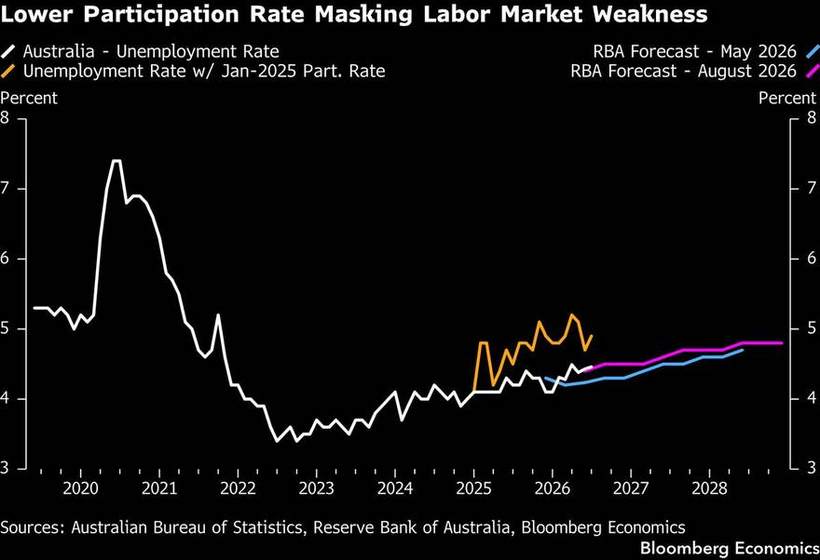
The day opens in Australia, last input before Tuesday's RBA: the unemployment rate at 4.5% against an RBA forecast recently raised toward 4.8%, with the orange line showing what unemployment would be had participation held at January-2025 levels: nearly 5%. The 9:30am print is the final word before a fourth hike of the year that is ~90% priced; a soft number tests the highest-conviction hike in the G10. Source: ABS, RBA / Bloomberg Economics.
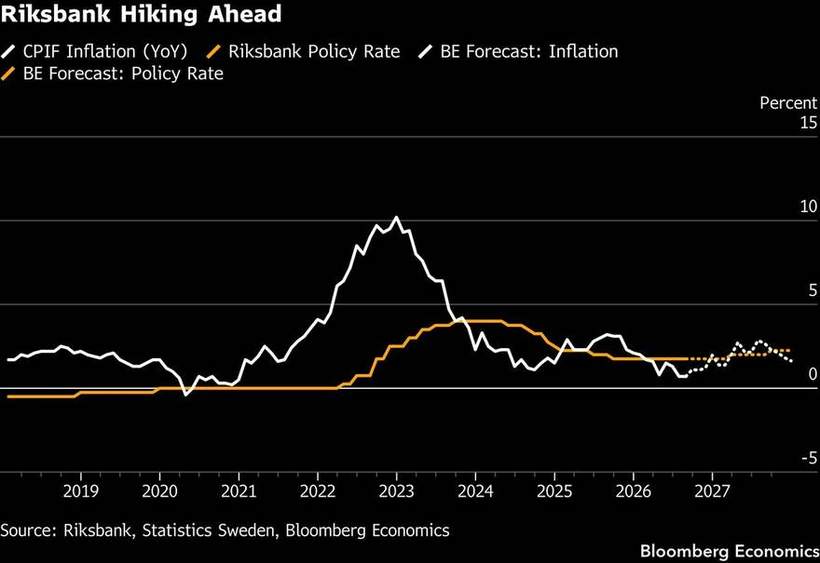
Europe's morning, Sweden first: the Riksbank holds at 1.75% but the forecast revision is the event: CPIF is running above path, and Bloomberg Economics expects the new rate track to point at a spring hike, November if energy misbehaves. A hawkish surprise here reprices the whole northern bloc; NOK and SEK are the week's cleanest expressions of the wall-of-holds cracking. Source: Riksbank / Bloomberg Economics.
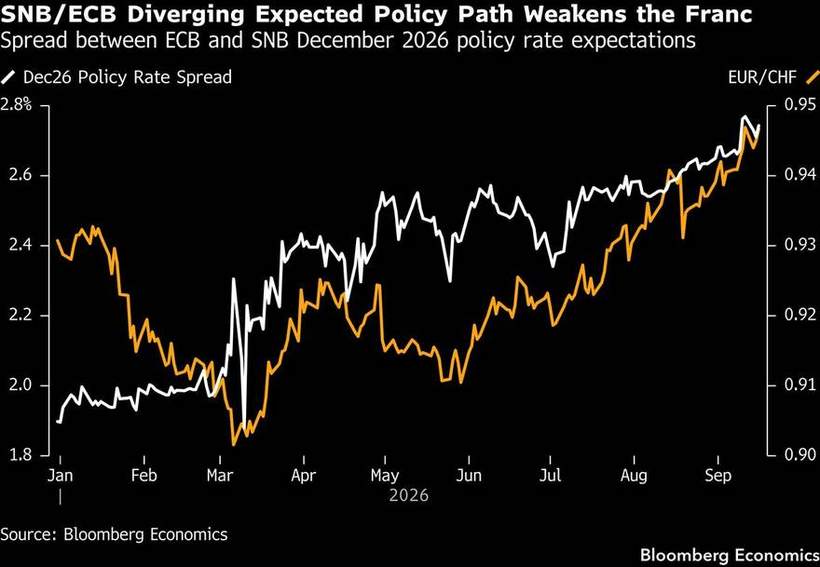
The franc's problem, drawn simply: the ECB-SNB policy spread at 2.75 points and widening, EUR/CHF grinding up all year as the SNB sits at zero and says it intends to stay there. Thursday's pushback against 2027 hike pricing is the regime entry's evidence: the franc is auditioning for the funding-currency job the yen may be vacating, and the SNB is writing the audition script. Source: Bloomberg Economics.
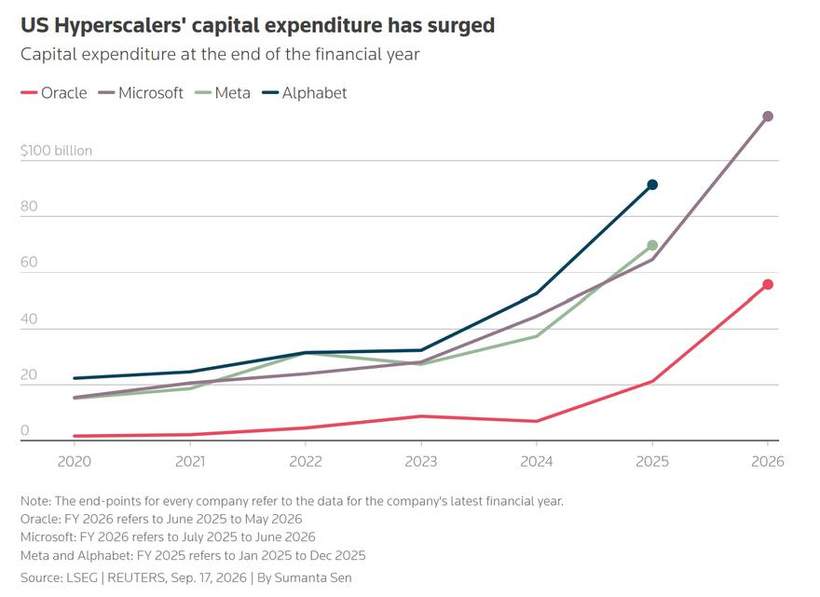
Then Washington, and what the state dinner is actually about: the four hyperscalers' capex lines going vertical, Microsoft past $100 billion a year, Oracle growing capex tenfold in three years. This is the spending the AI slowdown letters asked to pace, the borrowing the bond market now fears, and the buildout the datacenter backlash votes against. The men who own these lines eat at the White House on Thursday; the deal terms decide the direction of every one of them. Source: LSEG / Reuters.
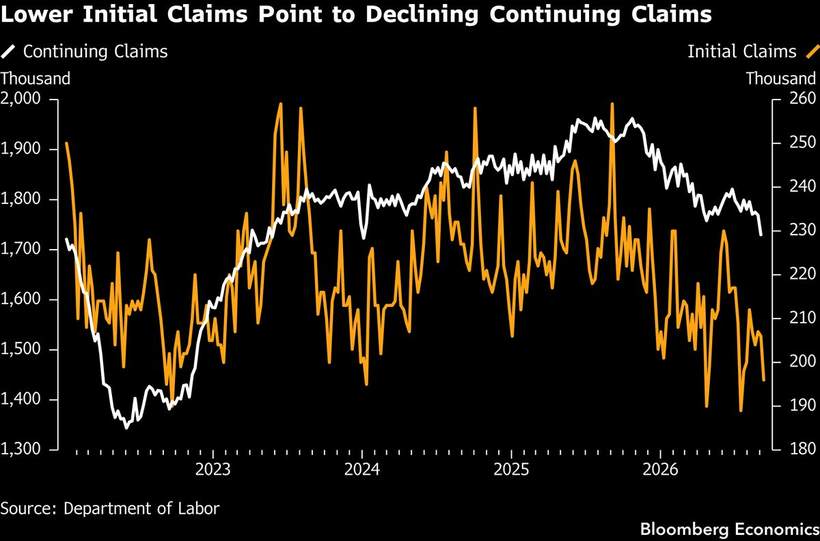
The American labor market, still refusing to crack: initial claims near 196k with continuing claims rolling over, and Bloomberg Economics looking for 187k, lower again. Layoffs this low are the Fed's permission slip; the first sustained move through 230k is the only claims print that changes anything, and it is nowhere in sight. Source: Department of Labor / Bloomberg Economics.
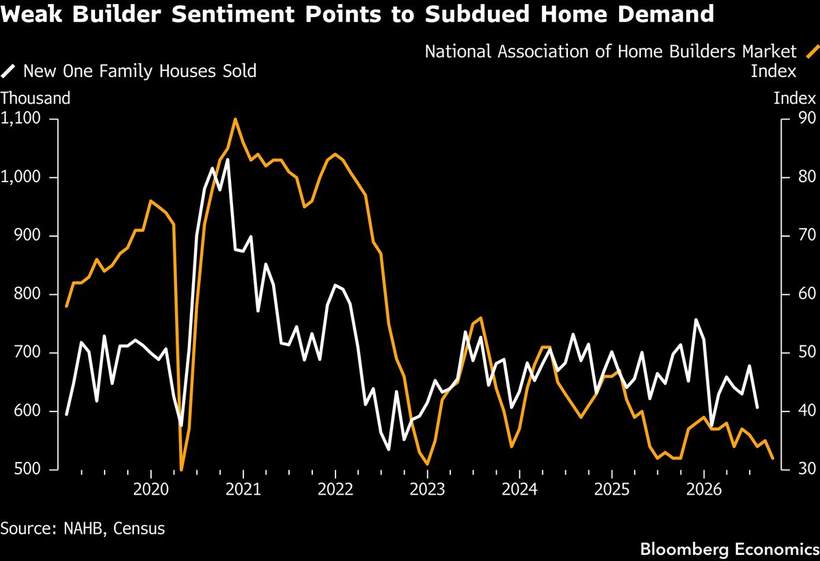
The sector already paying five percent: builder sentiment at a one-year low dragging new home sales toward 620k, with starts and permits both missing last week. Housing is the one American industry living at the long end's prices today; the rest of the economy meets them at refinancing. The dove's whole case, one chart. Source: NAHB, Census / Bloomberg Economics.
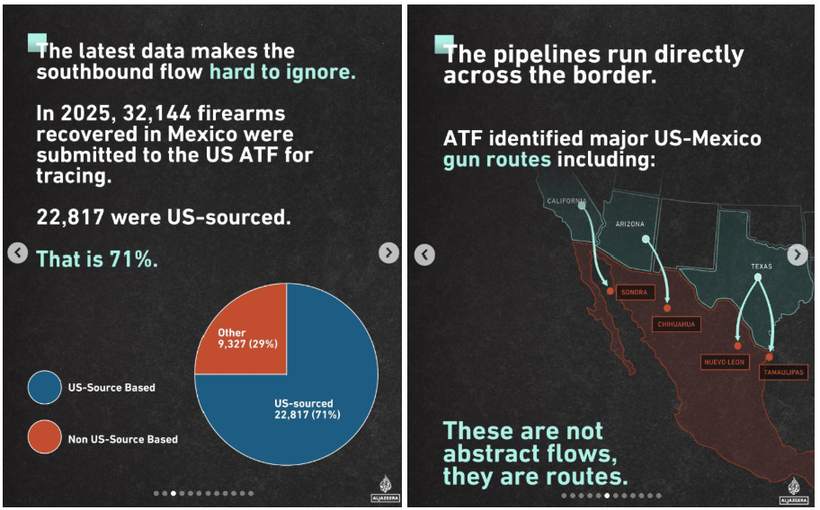
And beside Banxico's hold, the other cross-border flow: 71% of firearms recovered in Mexico and traced in 2025 were US-sourced, 22,817 guns moving south along routes the ATF can name while drugs and remittances move north. The cycle is one economy; Sheinbaum's near-complete trade deal with Trump prices only the legal half of it. Source: ATF / Al Jazeera.
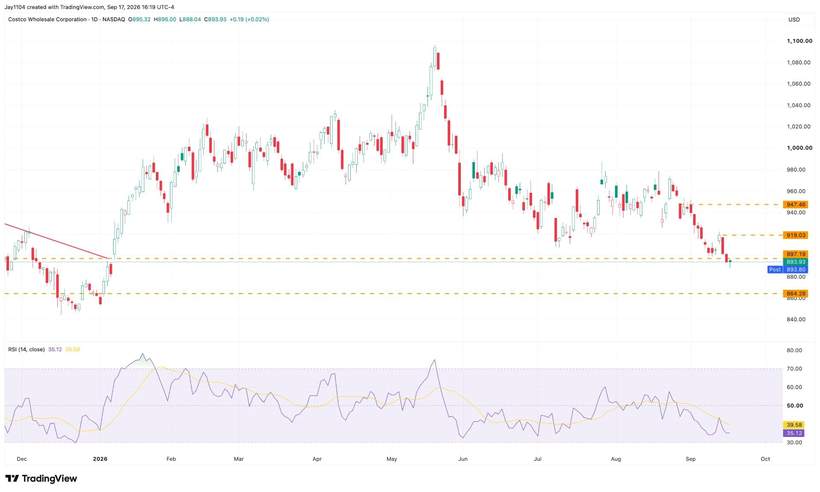
Thursday closes with the consumer's favourite store: Costco into earnings at $894, sitting exactly on Kramer's support at $897-893 after breaking the trendline from its $1,090 May high, with put gamma clustering at $880 and call resistance at $1,000. Bearish options positioning can fuel a post-earnings pop if the numbers hold; a break of $880 opens $864. Ten percent revenue growth expected from the one retailer inflation has helped. Source: TradingView / CMC Markets.
Sentiment Friday
The week closes on the American consumer and the American machine: durables with the core capex signal under a negative headline, and final Michigan sentiment carrying the inflation-expectations number the Fed chair watches. A wall of Fed and BOE speakers at Oxford and Cleveland gets first crack at interpreting the week, and four sovereigns face the raters after the close.
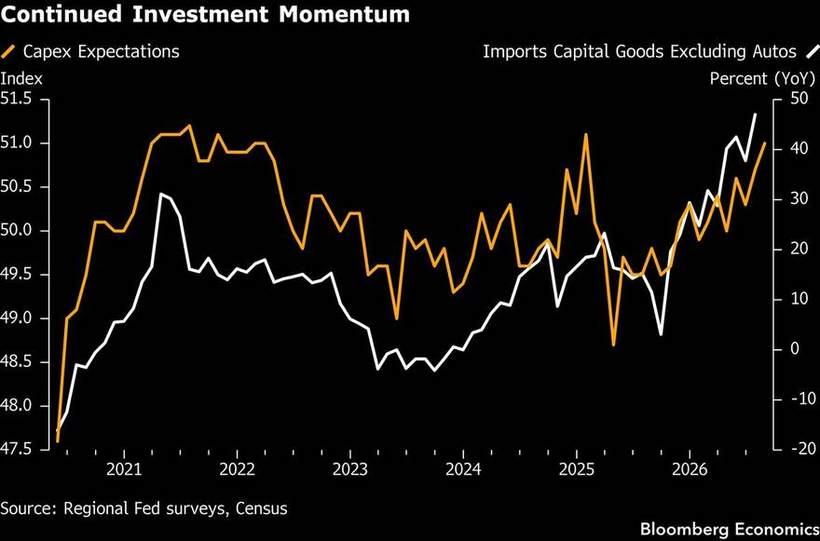
The capex engine has not noticed the rate shock: capital-goods imports ex-autos running at +40% year over year with regional-Fed capex expectations at multi-year highs, both accelerating through the tightening. This is the AI buildout appearing in ordinary macro data, and the reason the Fed could hike into it. The bear case for bonds and the bull case for the economy are the same chart. Source: Regional Fed surveys, Census / Bloomberg Economics.
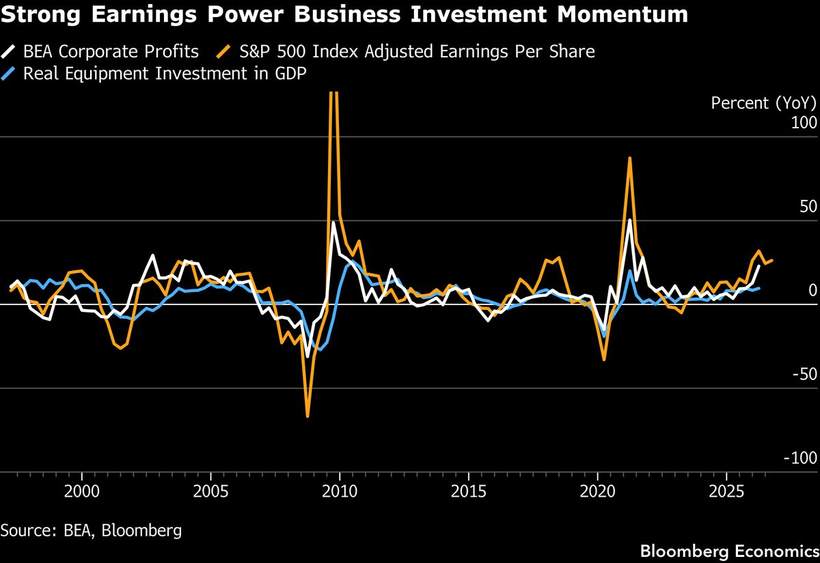
What pays for the machine: corporate profits, index earnings and real equipment investment moving together as they have for thirty years, all three accelerating now. Bloomberg Economics' point is simple: record profitability funds the capex without borrowing more than markets can bear, for now. The chart to reread the day an earnings season disappoints. Source: BEA / Bloomberg Economics.
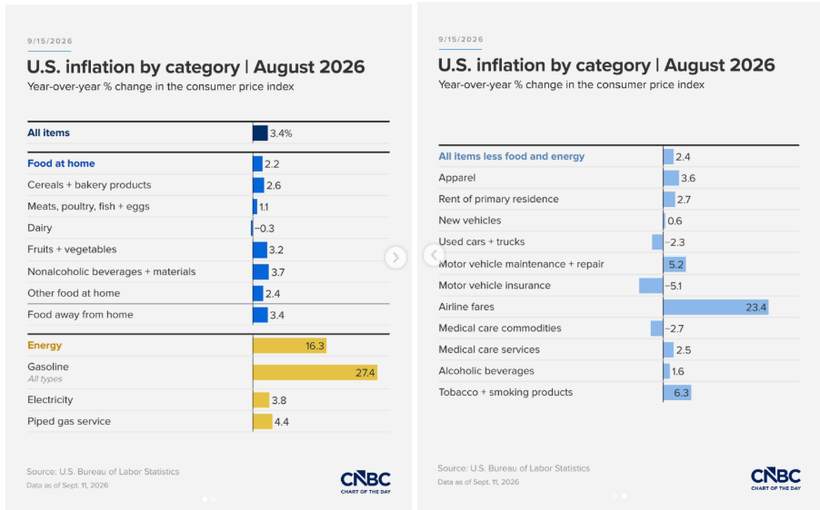
August's inflation, itemised: gasoline +27.4% and airfares +23.4% against dairy negative and used cars falling: the war's inflation on the left panel, an otherwise-normal economy on the right. This is the split the Fed hiked into, the supercore debate in bar-chart form, and the reason Friday's inflation-expectations print matters more than most months. Source: BLS / CNBC.
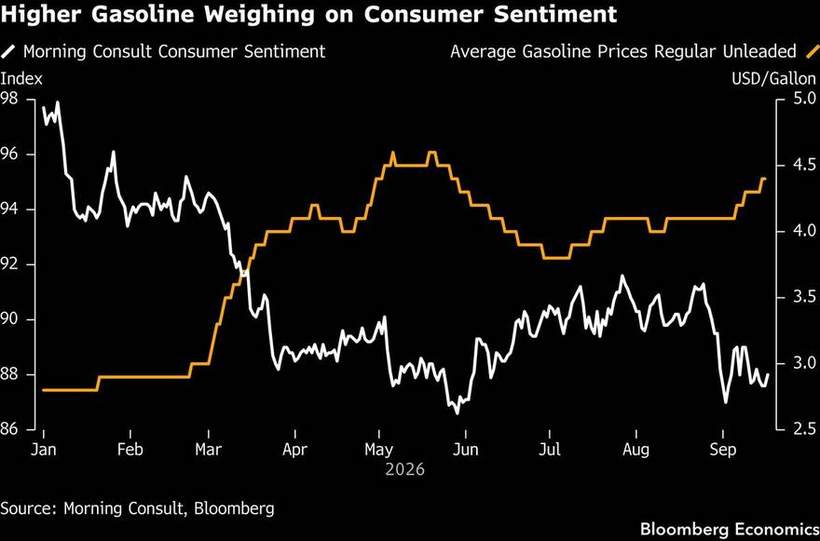
The consumer walks the other way: Morning Consult's daily sentiment sliding as gasoline climbs back toward $4.50, with UMich's final September read expected at 47.5, recession-grade, and 1-year inflation expectations at 4.6%. Business investment accelerating while household sentiment sits on the floor is the widest version yet of this cycle's split; elections are decided by the bottom panel. Source: Morning Consult / Bloomberg.
The capital shortage
Lacy Hunt spent four decades as the bond market's great bull and pivoted this year to the argument that capital itself has become scarce: deficits, war and the AI buildout all bidding for the same savings pool. The week kept proving him right. Companies now refuse to sell time: 5% of September's investment-grade issuance matures in 30 years or more, the least since 2020, average maturities have shrunk from 12.4 to 10.3 years, and when a rare 30-year deal appears the order books run ten times the paper. Insurers and pensions who must own duration are fighting over scraps while the sellers who remain, the hyperscalers, borrow at any tenor the market will give them: Citigroup's biggest bond sale ever, SoftBank stacking $21 billion with more to come, a $22 billion syndicated chip loan, junk-rated datacenter paper four times oversubscribed. Scarce capital is repricing everything that needs it, and the letter's regimes, the 5% ten-year, the flattening stampede, the AI credit tail, are all one story wearing different tickers.
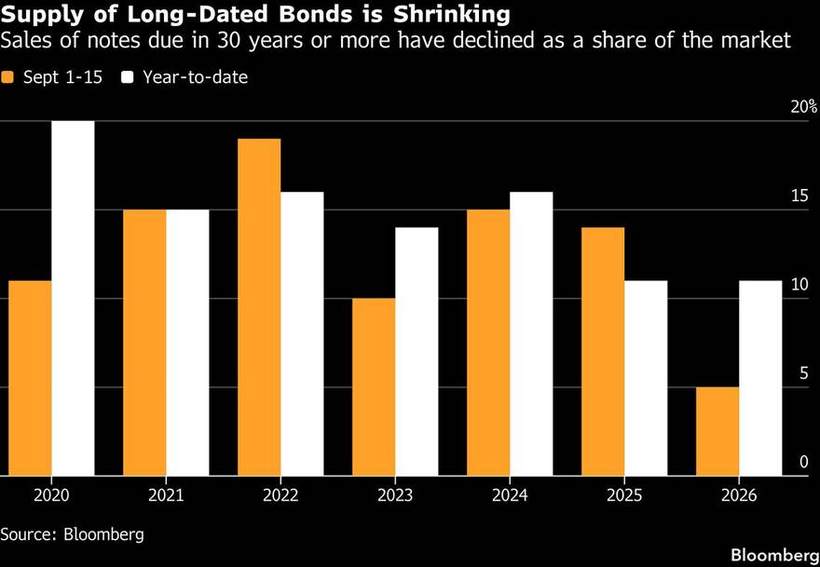
The disappearing long bond: sales of 30-year-plus notes as a share of US high-grade issuance at their lowest September since at least 2020, and falling every year since 2022. Rates did this: nobody locks in 6% for three decades voluntarily. The scarcity feeds on itself, because the fewer long bonds exist, the harder insurers bid for the ones that do. Source: Bloomberg.
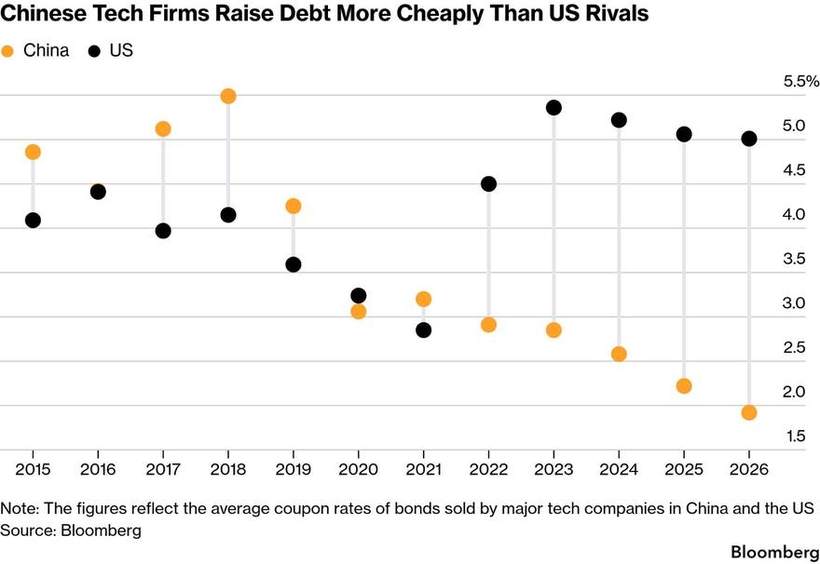
The capital shortage has a geography: Chinese tech now borrows at 1.8% coupons against 5.0% for its American rivals, a 320 basis point gap that was zero in 2020 and inverted before that. One system is saturated with domestic savings and starved of borrowers; the other is saturated with borrowers and competing for savings. Every AI-race comparison should start from this chart, and almost none do. Source: Bloomberg.
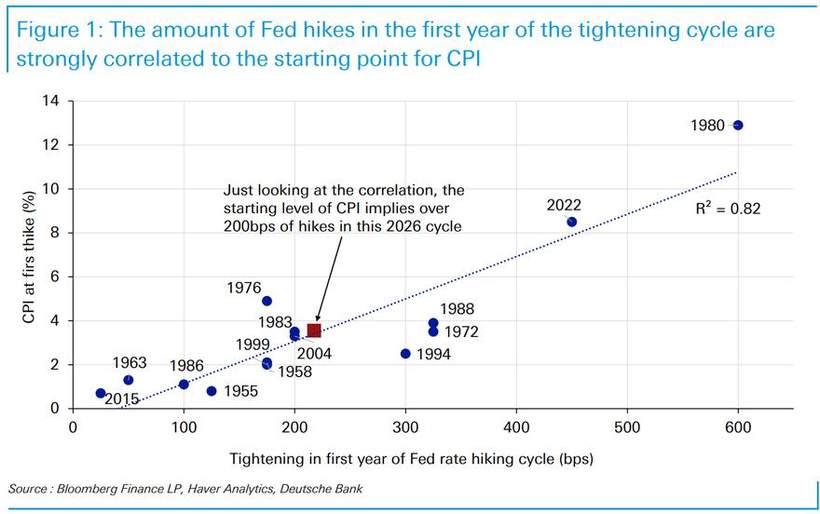
The scatter Deutsche Bank sent its clients this week: first-year Fed tightening plotted against CPI at the first hike, R-squared 0.82, and the 2026 starting point implying over 200 basis points of hikes this cycle. Nobody forecasts that; nobody forecast 2022's 400 either, and the market priced 200 then too. Jim Reid's point is not the number, it is the tendency: markets systematically underestimate hiking cycles at the start. Source: Deutsche Bank, Haver.
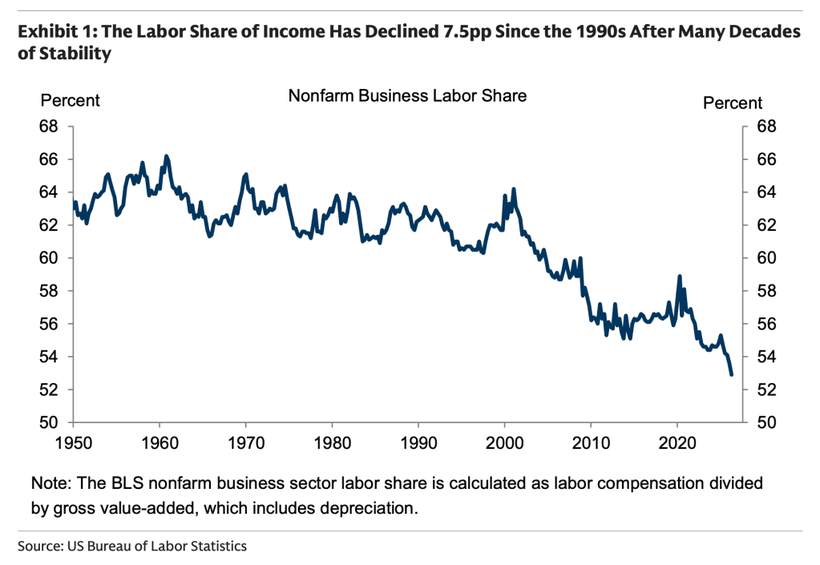
The fifty-year backdrop to scarce capital: labor's share of nonfarm business income down 7.5 points since the 1990s and falling toward 50%, Goldman finding about 60% of the decline real, automation and bargaining power, not measurement. Capital's growing share is precisely the pool the deficits, the war and the AI buildout now compete for; when capital wins the income split and still runs short, its price, the interest rate, does what it is doing. Source: BLS, Goldman Sachs.
The Saudi trap
The kingdom that spent four decades buying American protection spent last week discovering what the receipt is worth. The Houthis took the entire Red Sea coast and Perim Island; Iraqi Shia militia reached the East-West pipeline, the Hormuz bypass itself; and satellite imagery shows subsurface damage that needs four to six weeks against export inventories measured in days. Riyadh asked Washington for help and was declined. That leaves the two roads the trap is built from: escalate, which previous Yemen campaigns show airpower cannot win, or negotiate, which crowns the Houthis and pays Iran. Behind both sits the question the region's capitals are all quietly asking: if the American umbrella is conditional for Saudi Arabia, of all clients, whose is not? Xi's people will make that argument in Washington's own week, and the yuan-priced oil contract has never had a better sales pitch. Every week this stays unresolved, the energy premium compounds through the one channel no negotiation reaches: the refined products the world actually runs on.
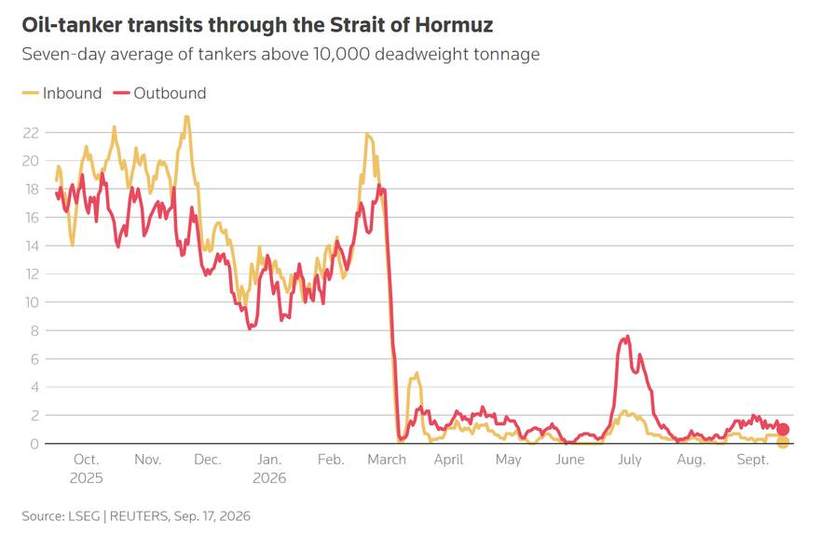
The strait, six months on: tanker transits through Hormuz still running at a fraction of pre-war levels, the July recovery attempt fading back toward the floor. What leaks through does so by daylight convoy and ship-to-ship transfer at premiums. This is the supply half of the letter's war regime, now compounded by the Red Sea's closure: two straits, one buyer's market for insurance. Source: LSEG / Reuters.
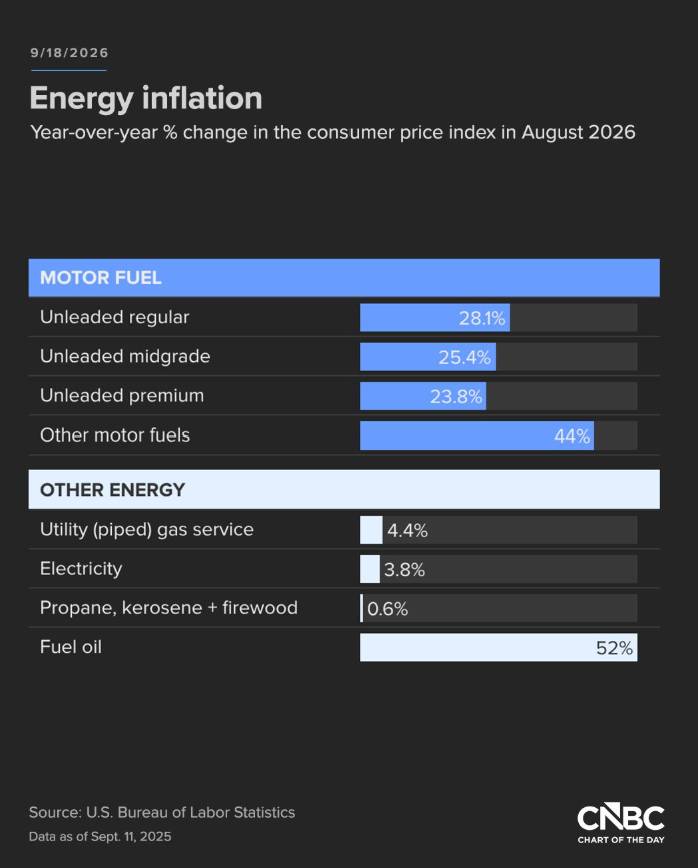
What the war costs at the register: fuel oil up 52% on the year, other motor fuels 44%, regular gasoline 28%, against piped gas at 4% and electricity at 3.8%. The refined-product concentration is the tell: this is a refining and logistics war, not a crude war, exactly as the crack spreads say. These are the numbers voters see weekly; November prices them daily. Source: BLS / CNBC.
Beef prices
An adhoc file this week, because beef is quietly becoming a case study in how inflation actually reaches a household. The herd is the smallest in decades after years of drought and high input costs, record diesel moves every pound of it, and ground beef just set a record at $7.15. Downstream, the adjustment is happening in ounces rather than prices: patties trimmed from 8 to 7 1/4 ounces and dressed up with onion strings, ribeye swapped for picanha, a 36-ounce tomahawk relabelled as dinner for two at the same price. More than 80% of restaurant operators report higher food costs and a third ran unprofitable first halves. This is what the letter means when it says the war's inflation is refined and sticky: by the time it reaches the menu, it no longer looks like oil at all.
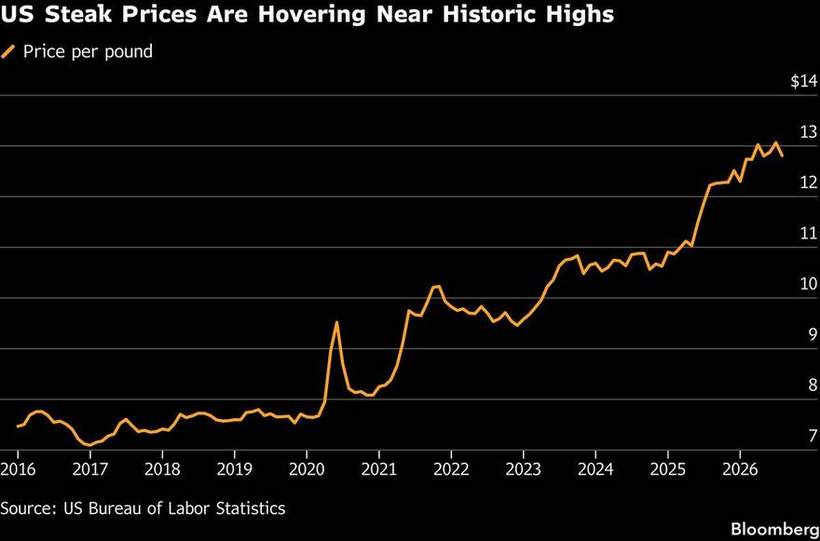
Steak near historic highs: the BLS series at close to $13 a pound, nearly doubling since 2020, with ground beef at a record $7.15 as the smallest cattle herds in decades meet record diesel. The Trump administration's import relief has so far moved ranchers' tempers more than prices. Source: BLS / Bloomberg.
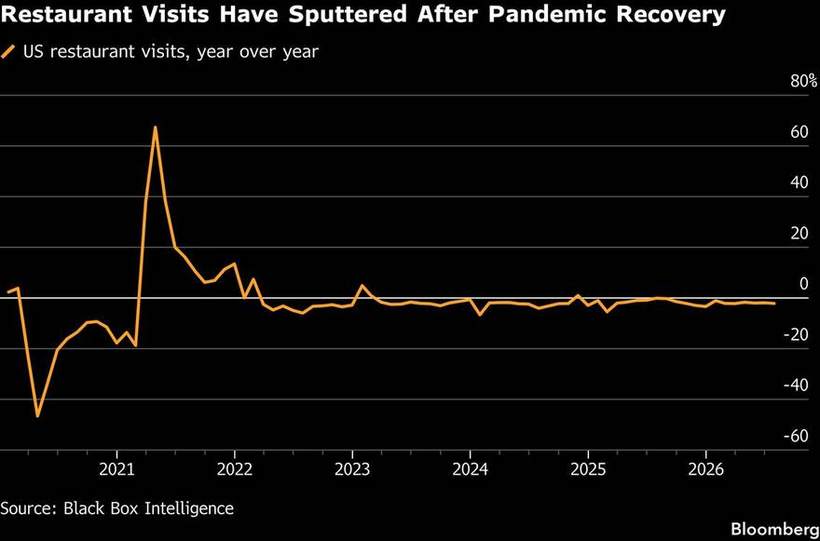
And the customer notices: US restaurant visits have run negative year-over-year almost continuously since 2022, and shrinking patties only stretches so far. Food-away-from-home inflation is the stickiest kind; the affordability election of Q3's quote is being fought one burger at a time. Source: Black Box Intelligence / Bloomberg.
The real house
Two weeks ago the letter quoted Bessent declaring himself the house. The fortnight since has clarified who actually holds the license. The Treasury's buybacks could not fill their own operation, the 10-year crossed five anyway, and the yen's manufactured turn died in a week when the market called Governor Ueda's bluff. Meanwhile the PBOC ran the same playbook without a single press conference: daily fixes walking USDCNH through 6.70 to the strongest levels since February 2023, against a rising dollar, while buying $30 billion of FX in August to keep the move orderly, goods traders converting their dollars at the highest rate in years because the fix told them to. One house talks; the other deals. The gold market has noticed the difference: central banks and investors keep shifting physical metal to London vaults, quietly, the same instinct in bullion form. Thursday's summit is the two houses at one table.
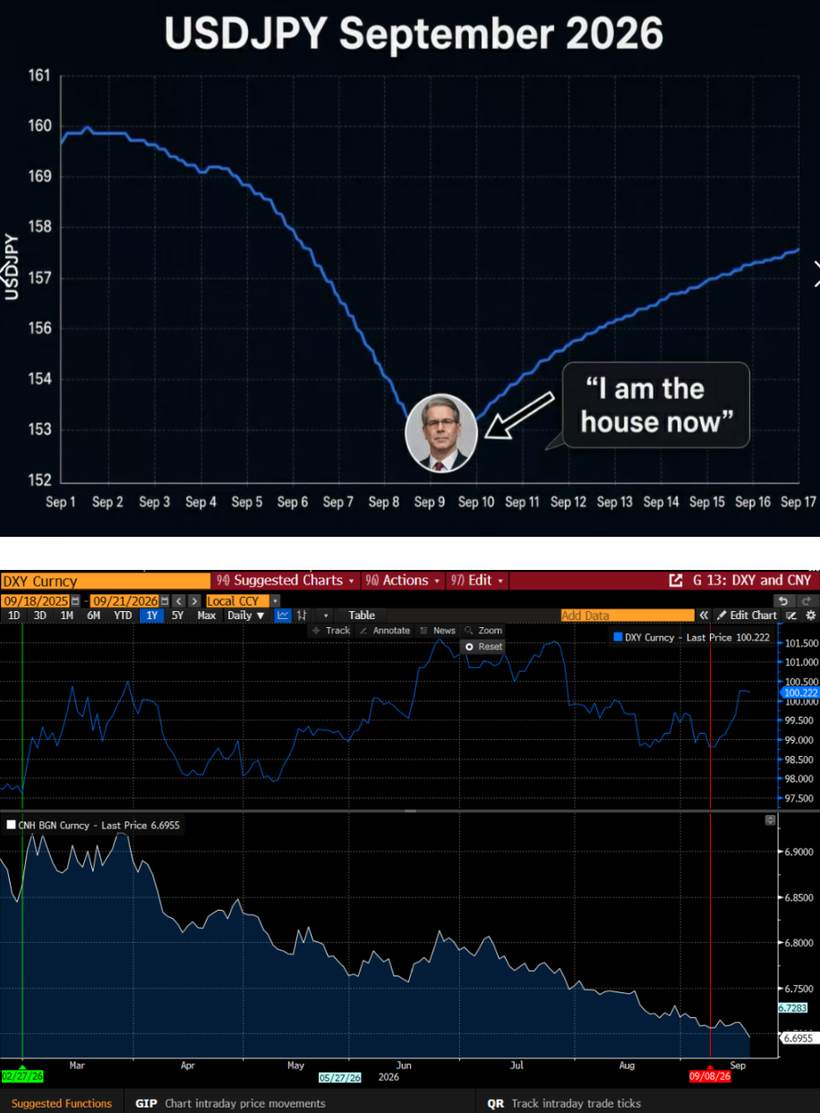
The fortnight in two panels: USDJPY's round trip from 160 through 153, "I am the house now" marking the low, and straight back to 157.5 by Friday; below, the dollar index rising while USDCNH falls to 6.6955, the only major currency appreciating against a strong dollar. The difference between announcing you are the house and simply dealing the cards. Source: Bloomberg.
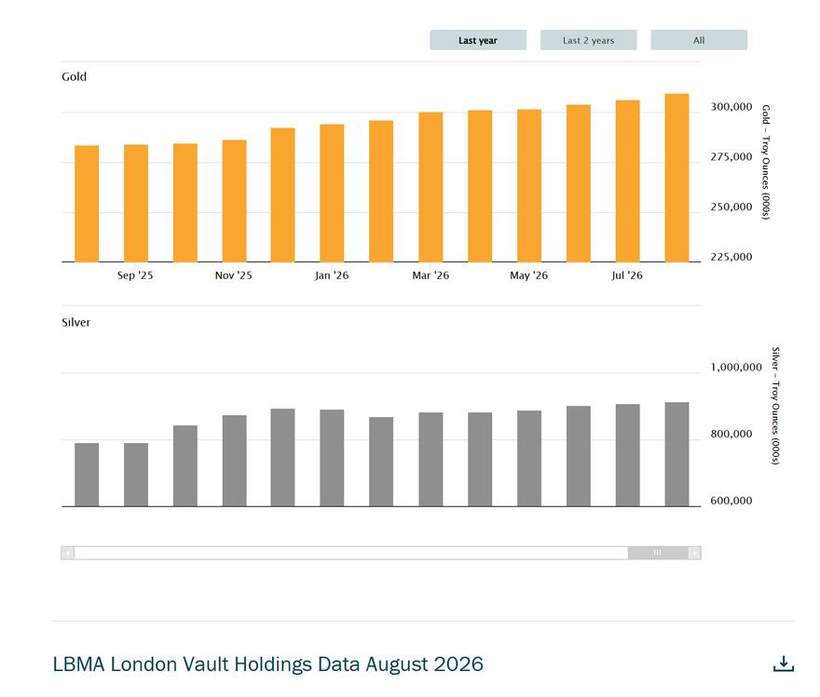
The quiet vote in bullion: London's vaults now hold 9,632 tonnes of gold, $1.4 trillion, rising every month since early 2025 as central banks and funds move metal out of New York; the Dutch central bank cited "increasing geopolitical unrest" and it is not alone. De-reservification in its physical form: the safety bid leaving paper for vault keys, at the same time the returns bid chases the dollar. Both can be true; that is the regime. Source: LBMA / Fortune.
De-reservification, the atlas
Q2's argument, drawn country by country from Setser's charts. The pattern repeats everywhere: the official reserve line has been flat for a decade while the quasi-sovereign line beneath it compounds, in state banks, pension funds, insurers and wealth funds, most of it in dollars, none of it in the IMF's reserve data. This is the pool that now sets the dollar's price, and the pool that would move first in any real de-dollarization.
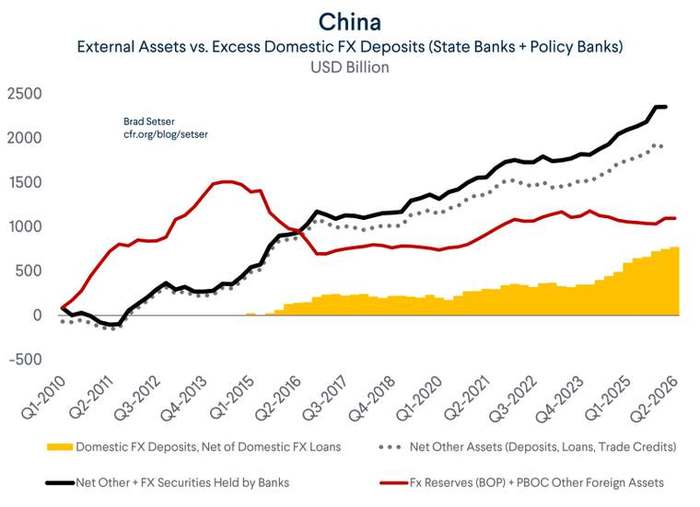
China, the headline exhibit: the state and policy banks' external assets climbing past $2.3 trillion, overtaking the reported reserve line years ago, with domestic FX deposits building alongside. The reserves the market watches stopped growing in 2014; the reserves that matter never stopped. Source: Brad Setser, CFR.
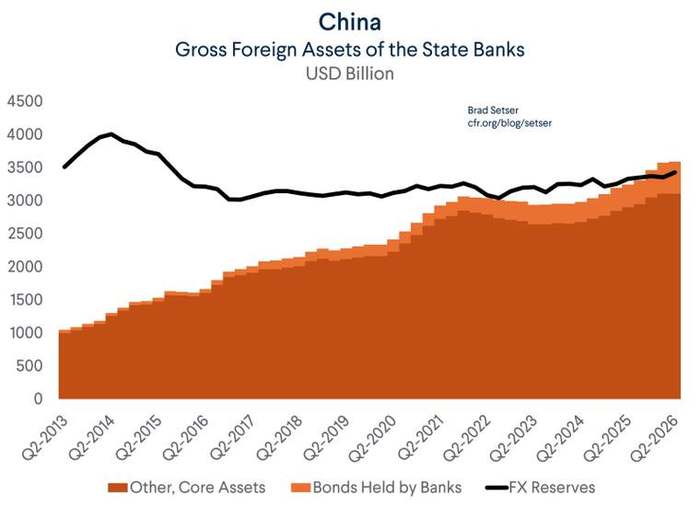
The same banks, gross: $3.5 trillion of gross foreign assets at the state banks against $3.4 trillion of formal reserves: China effectively holds two reserve stacks of equal size, one visible, one not. SAFE's own disclosures put the banks' offshore dollar share near 70%, above the last-disclosed share of the formal reserves. Source: Brad Setser, CFR.
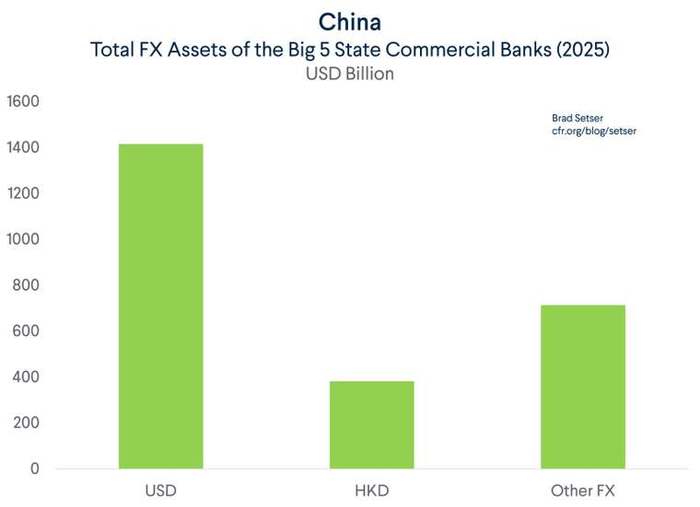
What the big five hold, by currency: $1.4 trillion in dollars against $380 billion in Hong Kong dollars and $700 billion in everything else. The back rooms are a dollar book. Whatever Beijing says about de-dollarization at summits, its banks' balance sheets say the opposite. Source: Brad Setser, CFR.
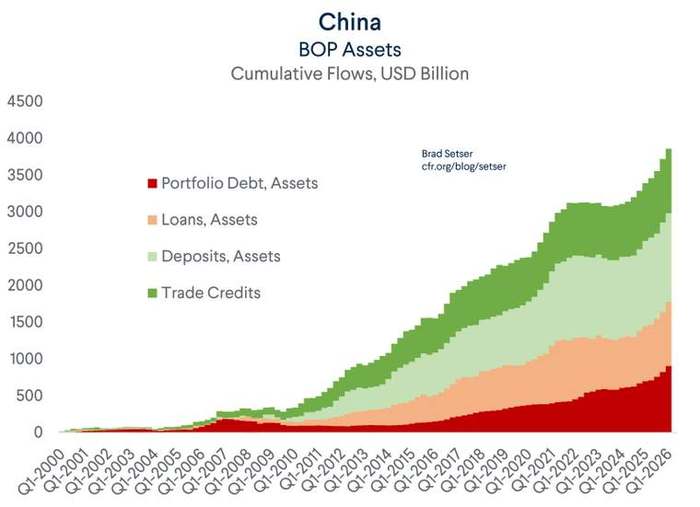
How it accumulated: China's cumulative BOP outflows near $4 trillion since 2000, trade credits, deposits and loans compounding quietly while portfolio debt stays small. The current account surplus never stopped becoming foreign assets; it just stopped becoming reserves. Source: Brad Setser, CFR.
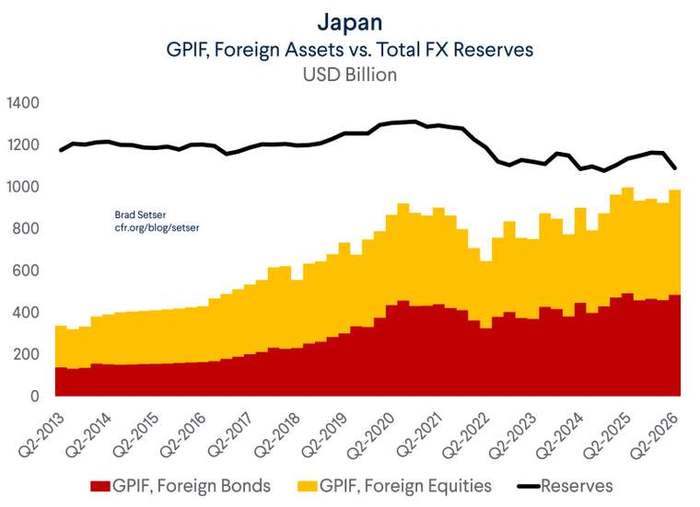
Japan's version: the GPIF's foreign assets near $1 trillion, up from $400 billion in 2014, now nearly matching the MoF's reserves, which have drifted down through intervention. Santander already speculates about $62 billion of GPIF Treasury sales; the reallocation date is September 30, a week Tuesday. Source: Brad Setser, CFR.
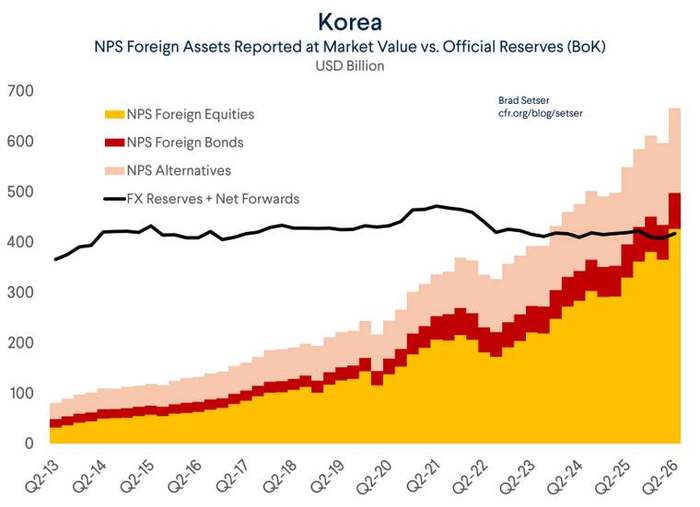
Korea, the more extreme case: the National Pension Service's foreign assets at $660 billion and climbing past the Bank of Korea's reserves, 70% in dollars, three-quarters of the equity book American. The won's fate is decided as much in this fund's allocation meetings as at the central bank. Source: Brad Setser, CFR.
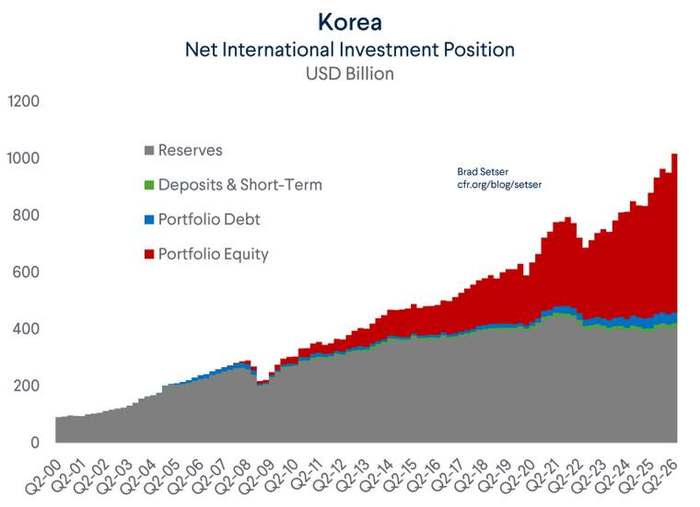
Korea's full balance sheet: the net international investment position past $1 trillion, the growth all portfolio equity while reserves flatlined. A country that was a debtor at the Asian crisis now runs one of the world's great creditor books, in risk assets rather than Treasuries. Source: Brad Setser, CFR.
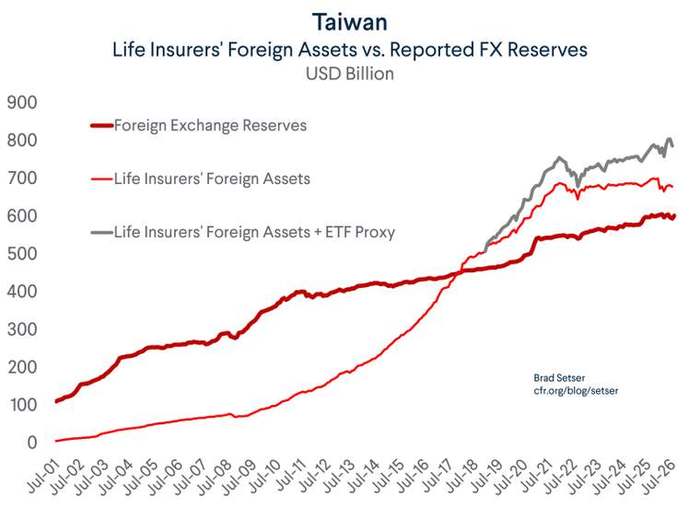
Taiwan, where the letter's crosses live: the life insurers' foreign assets at $700 billion, overtaking the CBC's reserves in 2017 and never looking back, over 95% in dollars, their hedge ratios now used as a policy tool. The TWD leg of our book trades against this shadow reserve, not the official one. Source: Brad Setser, CFR.
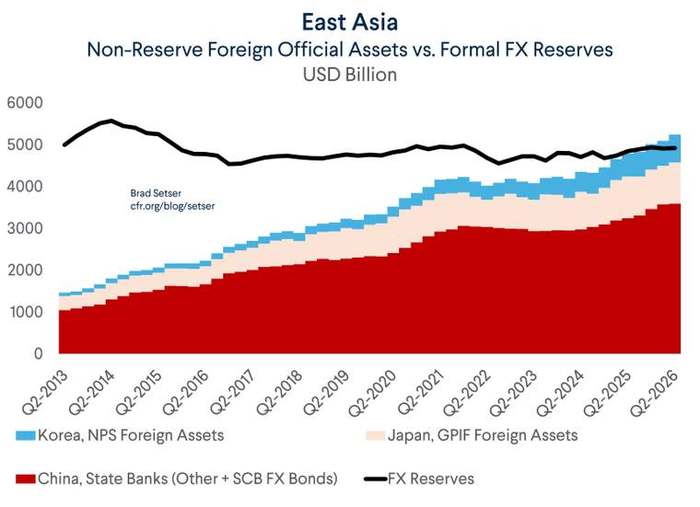
East Asia, stacked: China's banks, Japan's GPIF and Korea's NPS together holding more than the region's $5 trillion of formal reserves, and growing while the formal line stays flat. The region's dollar exposure roughly doubled in a decade without a single reserve headline. Source: Brad Setser, CFR.
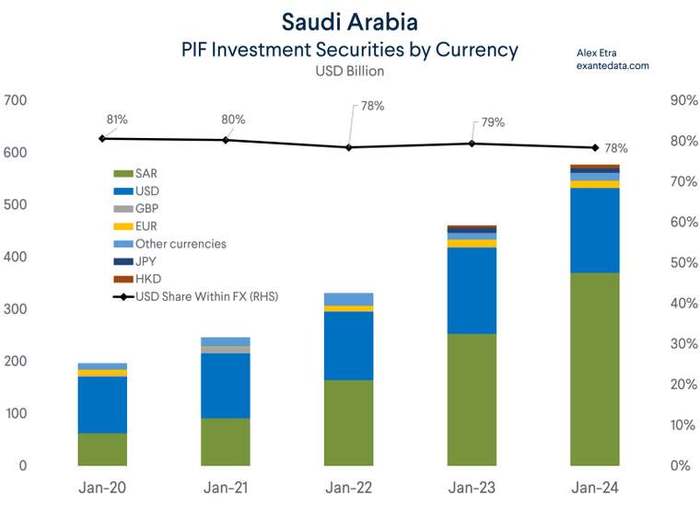
And the oil money runs the same play: Saudi Arabia's PIF investment securities up threefold since 2020 with the dollar share of its FX holdings steady near 78%, well above the dollar's share in global reserves. The kingdom hedging toward Beijing politically still banks in dollars; that contradiction is the whole regime. Source: Exante Data, Alex Etra.
The AI fracture: deceleration got bought
The AI slowdown call lasted one session as a sell signal. By Friday the complex had repriced the pacing letters as pricing power: Nebius raised GPU prices, Generac signed the next circular Amazon deal, and the analysts' earnings lines never blinked. The real deceleration came from the bond market instead, which has taken the SOX down by a fifth since June while earnings projections doubled, the multiple compressing exactly as the cost of capital says it should. That is the fracture in its current form: fundamentals accelerating, financing repricing, politics circling. Thursday's dinner seats the four biggest capex lines in history at one table with both presidents; the House China panel wants the export taps tightened the same week. The trade stays what it was: no AI-adjacent adds, the debt as the tell, and the TWD leg carrying the exposure the letter actually wants.
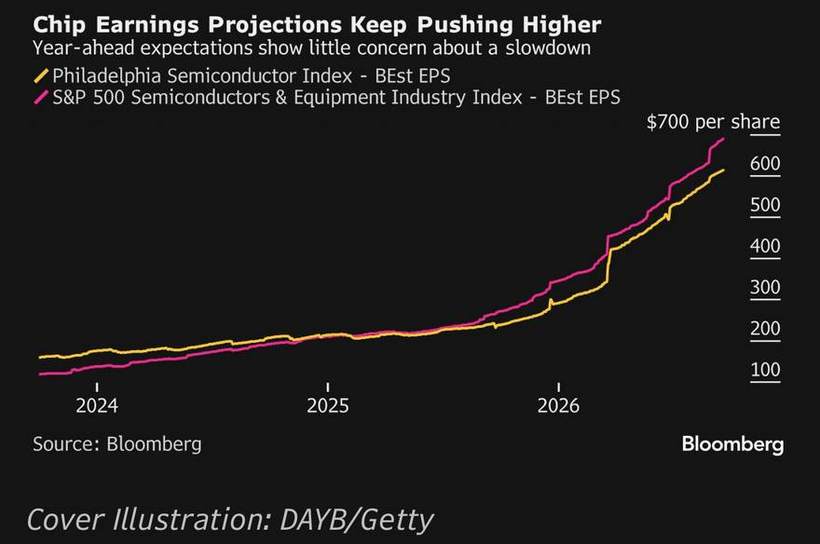
The earnings the slowdown letters did not slow: chip-sector EPS projections for the year ahead still climbing toward $700 a share on the S&P semis index, doubling again on current estimates. Whatever the frontier labs pace, the silicon order book has not paced with them; hardware remains sold out into 2028 and cancelled orders get reallocated, not cancelled. Source: Bloomberg.
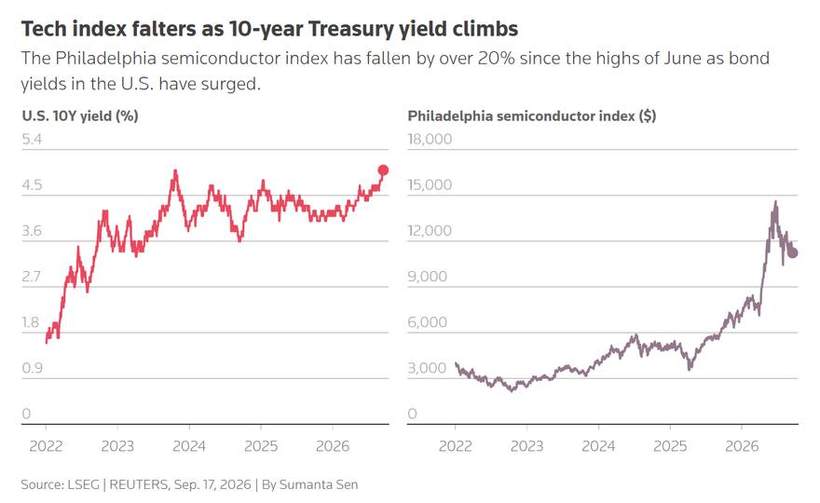
The deceleration that did happen: the Philadelphia semiconductor index down more than 20% from its June high while the 10-year climbed to 5%. Same earnings, higher discount rate, smaller multiple: the bond market is applying the brake the safety letters asked for, indifferent to the reason. Duration is duration, in silicon as in centuries. Source: LSEG / Reuters.
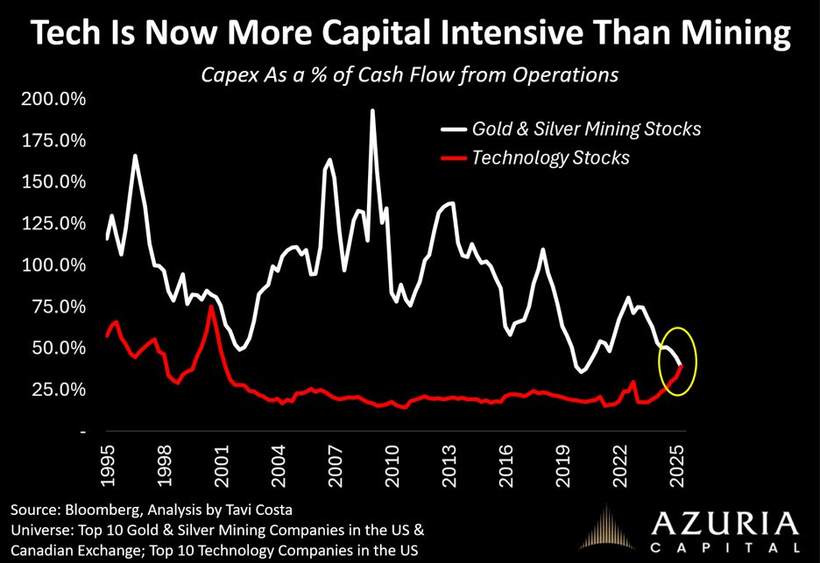
The identity change underneath: capex as a share of operating cash flow, and technology has just crossed above the gold and silver miners for the first time ever, the capital-light industry becoming the capital-heaviest. Alphabet printed its first negative free-cash-flow quarter since listing. When tech spends like mining, it gets financed like mining, and priced, eventually, like mining. Source: Tavi Costa, Azuria Capital / Bloomberg.
VC+ Special Dispatch, The Best Places to Live, Work and Retire
This week's dispatch assembles nine global rankings into one map of the tradeoffs between what people earn, what life costs, and what remains afterward. It reads differently from Singapore than from most places: first in Asia on several boards, most expensive place on earth to retire on another. Credit to the VC+ team.
Infographic 1 - Most and Least Livable Cities
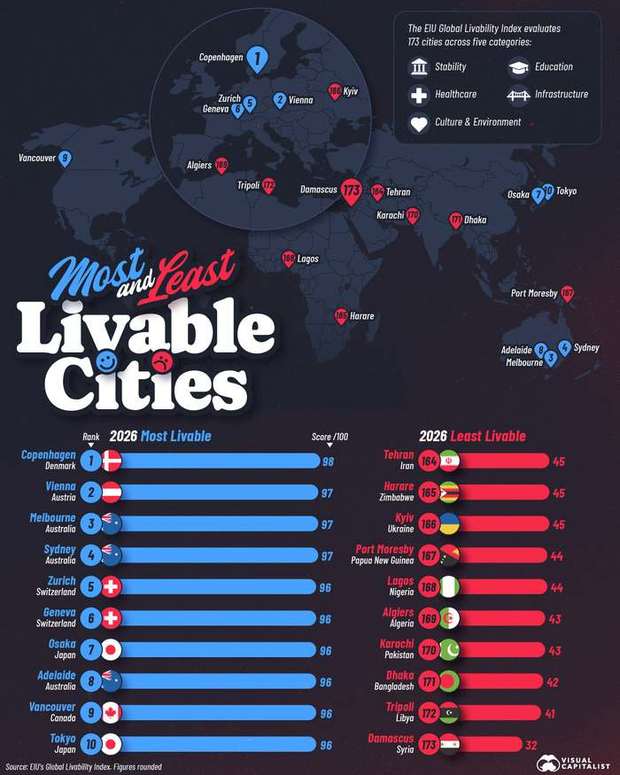
Copenhagen repeats at 98 of 100, with Vienna and Melbourne behind and Australia placing three of the top ten. The bottom of the table is the geopolitics section of this letter in city form: Tehran, Kyiv, Damascus. Livability is not affordability: the top ten are among the most expensive addresses on earth. Source: EIU / Visual Capitalist.
Infographic 2 - The Global Happiness Index
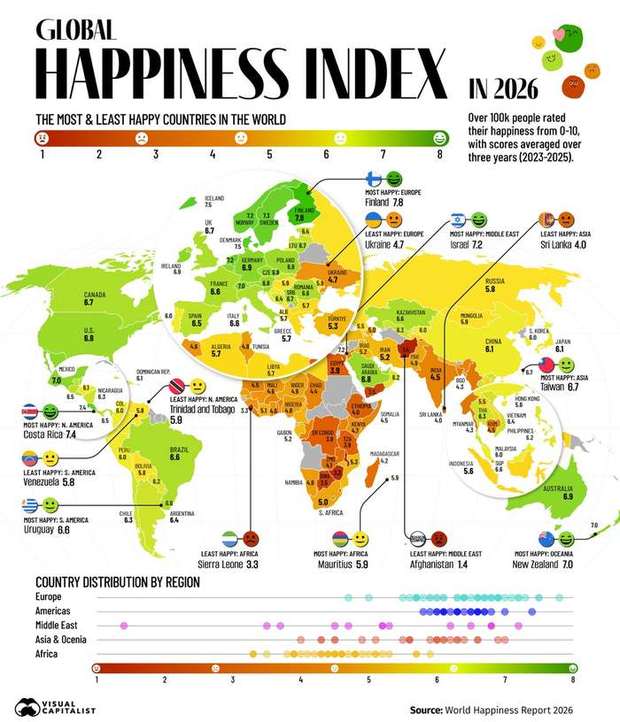
Finland leads at 7.8 for a ninth year, with Costa Rica outranking the US and Canada, Taiwan first in Asia at 6.7, and Afghanistan last at 1.4. Singapore prints 6.6, happier than Japan or Korea. The regional distribution row at the bottom is the chart's real content: Europe clusters high, Africa low, and the Middle East spans almost the whole scale. Source: World Happiness Report / Visual Capitalist.
Infographic 3 - Best Countries for Work-Life Balance
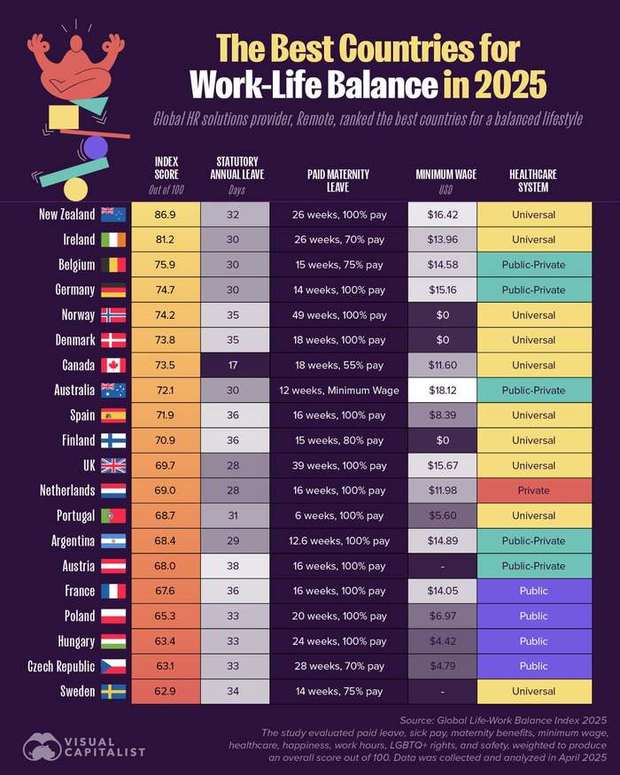
New Zealand wins a third straight year at 86.9, on paid leave, healthcare and working hours, with seven European countries in the top ten. The US places 59th of 60 large economies. Worth noting from a desk that starts at 6am for the London close: nobody surveyed the buy side. Source: Remote / Visual Capitalist.
Infographic 4 - Paid Vacation Days by Country
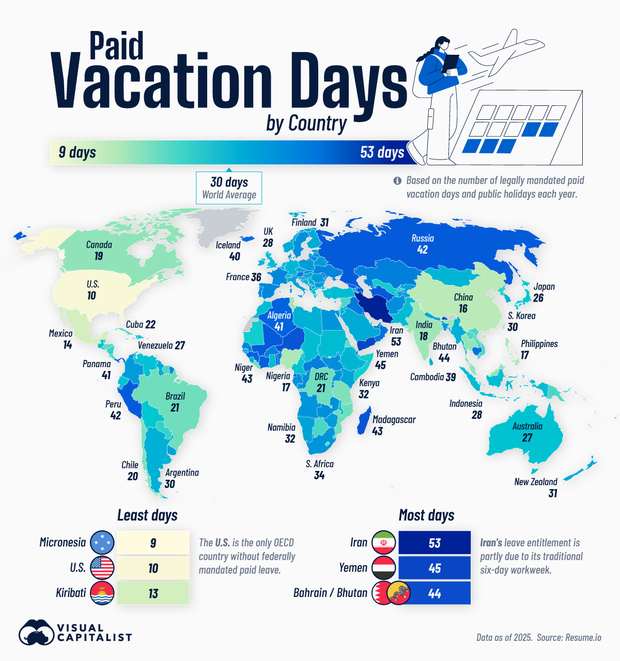
Iran mandates the most paid days off on earth, 53, Yemen 45, while the US guarantees 10 and is the only OECD country with no statutory paid vacation. The two countries at the top of the leave table are the two at the center of the war regime; make of that what you will. Source: Resume.io / Visual Capitalist.
Infographic 5 - Home Prices versus Incomes
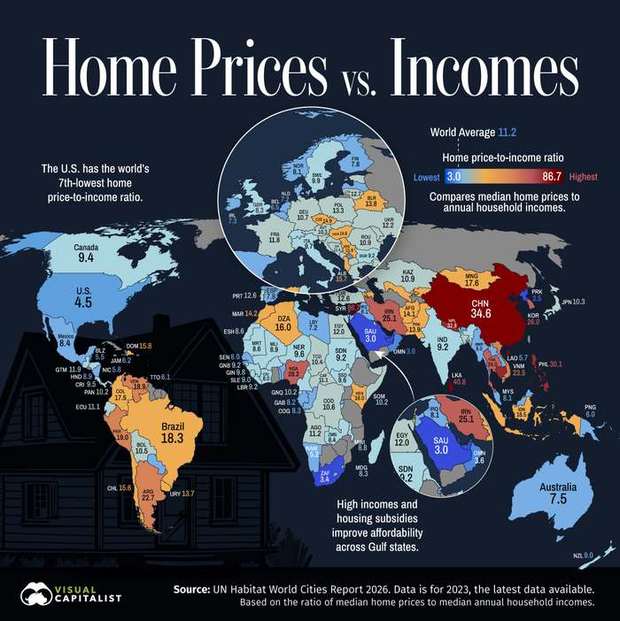
The median home costs 11.2 years of income worldwide, with China at 34.6, Korea and Vietnam deep in the red, and the US, at 4.5, enjoying the seventh-lowest ratio measured. UN-Habitat calls nine-plus impossibly unaffordable; 99 countries qualify. Housing is the quiet variable under every populist result in this letter. Source: UN-Habitat / Visual Capitalist.
Infographic 6 - Average versus Median Wealth
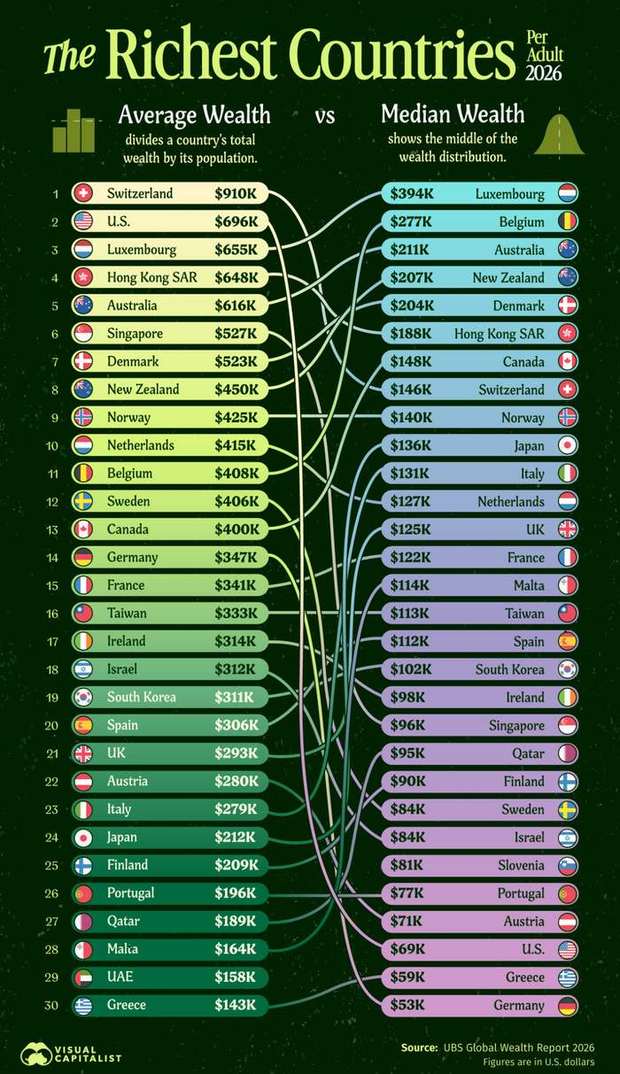
Switzerland averages $910,000 per adult; the median Swiss holds $146,000. The US gap is starker: second by average at $696,000, 28th by median at $69,000. Luxembourg tops the median board at $394,000. The spread between the two columns is the inequality chart the labor-share debate keeps pointing at, in stock rather than flow. Source: UBS / Visual Capitalist.
Infographic 7 - Hours of Work for $1,000
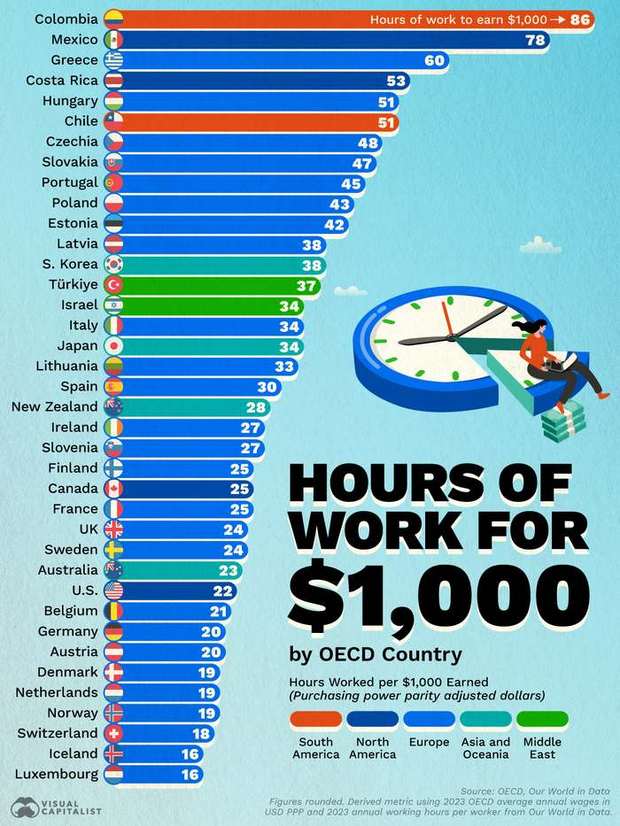
A Colombian works 86 hours for a thousand purchasing-power dollars, an American 22, an Icelander 16. Greece at 60 is the only western European country above 45. Singapore is absent from the OECD frame, but the regional neighbors that anchor this letter's crosses span nearly the full range. Source: OECD / Visual Capitalist.
Infographic 8 - The Retirement-Security Leaders
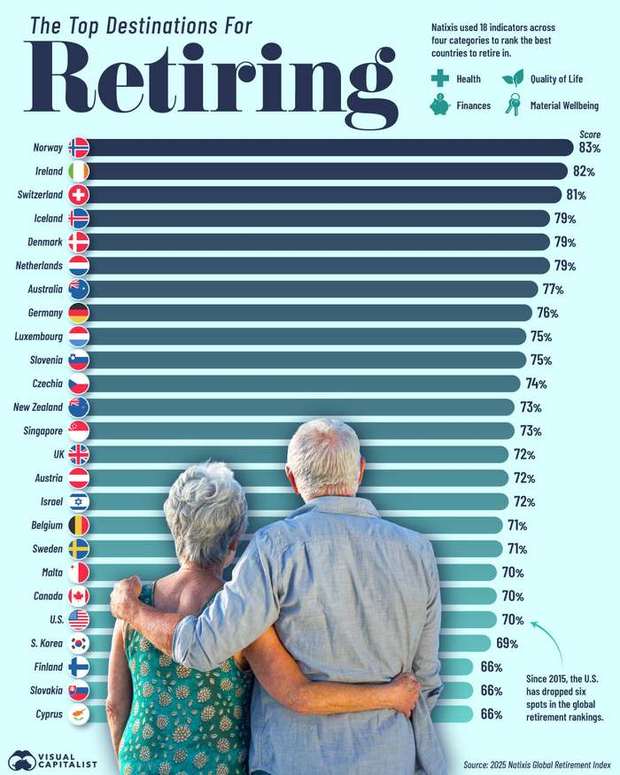
Norway leads retirement security at 83%, Ireland and Switzerland behind, Singapore 13th and first in Asia, the US 21st and six places lower than a decade ago. Natixis's drivers of the decline read like this letter's regimes: persistent inflation, aging, and pressure on public finances. Source: Natixis / Visual Capitalist.
Infographic 9 - What a Comfortable Retirement Costs
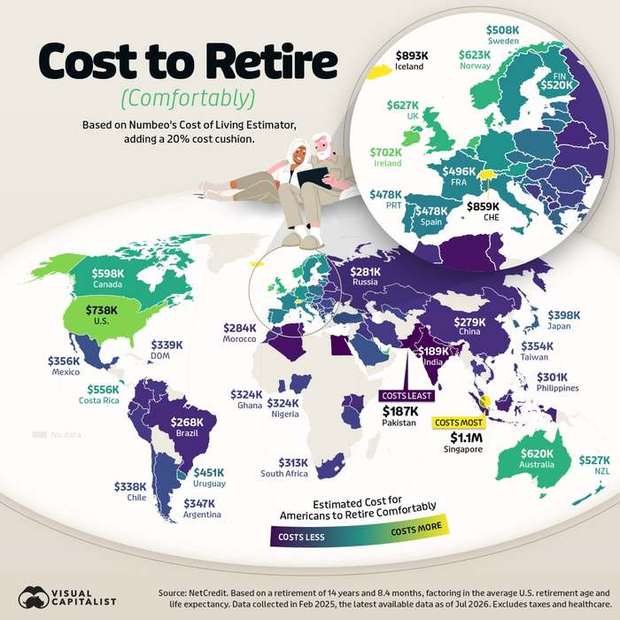
Singapore is the most expensive place on earth to retire, $1.1 million, against $738,000 for staying in America, $356,000 in Mexico, $187,000 in Pakistan. Only Iceland and Switzerland join Singapore above the US figure. For the local reader the dispatch ends at home, with the bill. Source: NetCredit / Visual Capitalist.
The Good Wrap
What is left at the close. A nutrition chart worth keeping on the fridge, two million satellites on filing paper, the sun as a tail risk nobody hedges, and then the table: week eight of eight, the great cuisines complete.
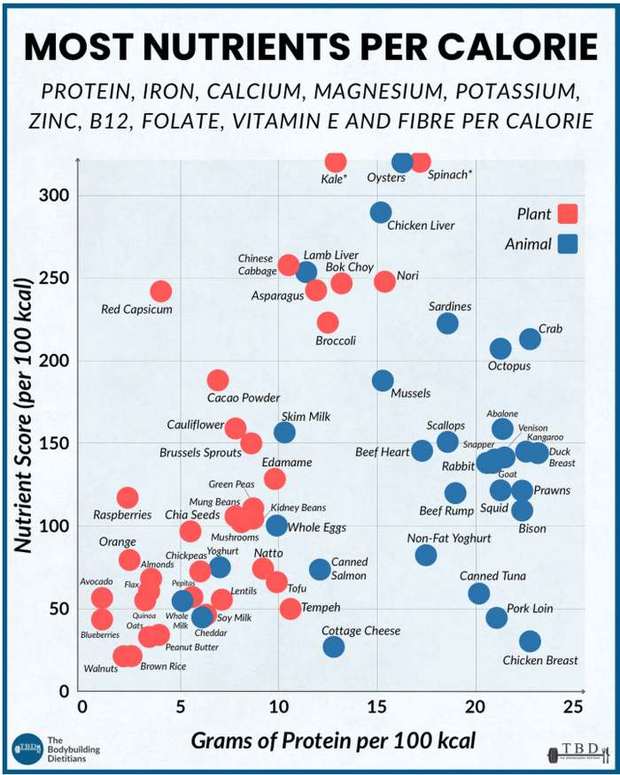
The most useful chart nobody trades: nutrients per hundred calories against protein per hundred calories, oysters, kale and spinach in the far corner, chicken liver and sardines close behind. The practical read is comparing within a family: among the proteins, mussels and sardines dominate; among the greens, everything beats lettuce. Filed under coaching, not markets. Source: The Bodybuilding Dietitians.
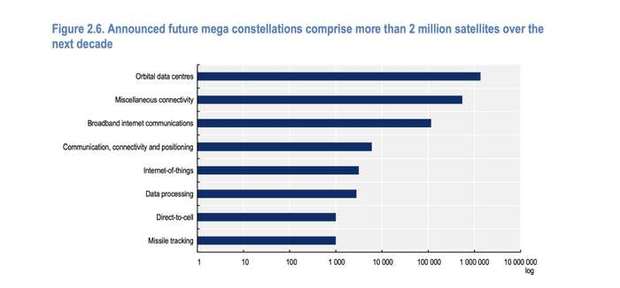
Two million satellites, on paper: announced mega-constellations now cover more than 2 million spacecraft against 15,000 currently in orbit, led by orbital data centres, a category that did not exist a year ago. Most filings are spectrum land-grabs that will never fly. But the space economy already runs $550-600 billion a year, nearly the size of the chip industry, and Friedland's "weaponization of outer space" line from two weeks ago acquires its infrastructure here. Source: OECD.
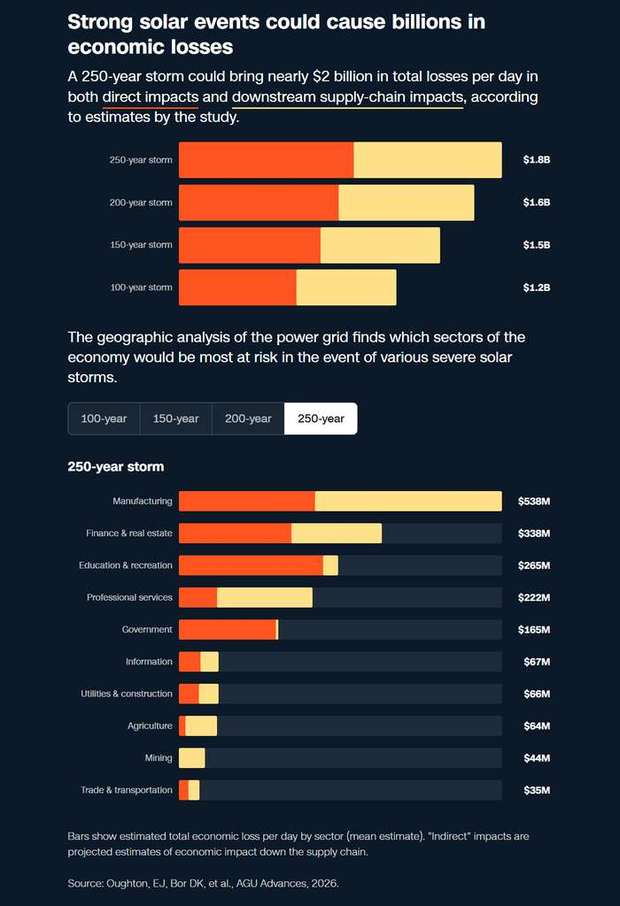
The tail risk with a 250-year clock: new AGU research maps a severe solar storm at nearly $2 billion a day of US economic losses, manufacturing and finance first, with the 2024 Gannon storm, three times weaker than the 1859 benchmark, already costing farmers up to a billion in GPS damage. A grid-down scenario no desk hedges, filed between the seatbelts. Source: AGU Advances / CNN.
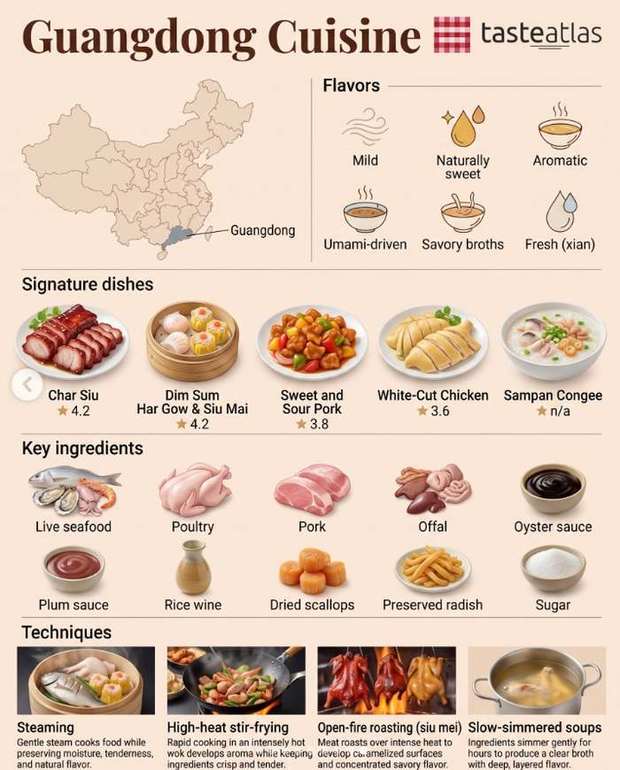
Week eight of the eight great cuisines: Guangdong, the finale, and the one the world already knows: dim sum carts, char siu glistening at the window, white-cut chicken, congee at dawn, the wok breath of high-heat stir-fry and the patience of double-boiled soups. Cantonese cooking prizes the ingredient over the sauce, freshness over fire, which is why it conquered every Chinatown on earth. The series closes where most overseas Chinese food began. Eight cuisines in eight weeks: Shandong's imperial kitchen to Guangdong's harbor table. The tour is complete; the eating, hopefully, never. Source: TasteAtlas.
Best,
Hoelon
WITPTW is a personal publication. Everything here is personal opinion and market commentary, written in a personal capacity. It is not investment advice and not a recommendation to buy or sell any security. It is not associated with, endorsed by, or representative of any employer, fund or company. Charts and images are reproduced from their original publishers, credited to their sources for commentary and discussion; all rights remain with the respective copyright holders.