All Rise, into Q4
Personal views and market commentary. Not investment advice. Not associated with any employer or firm.
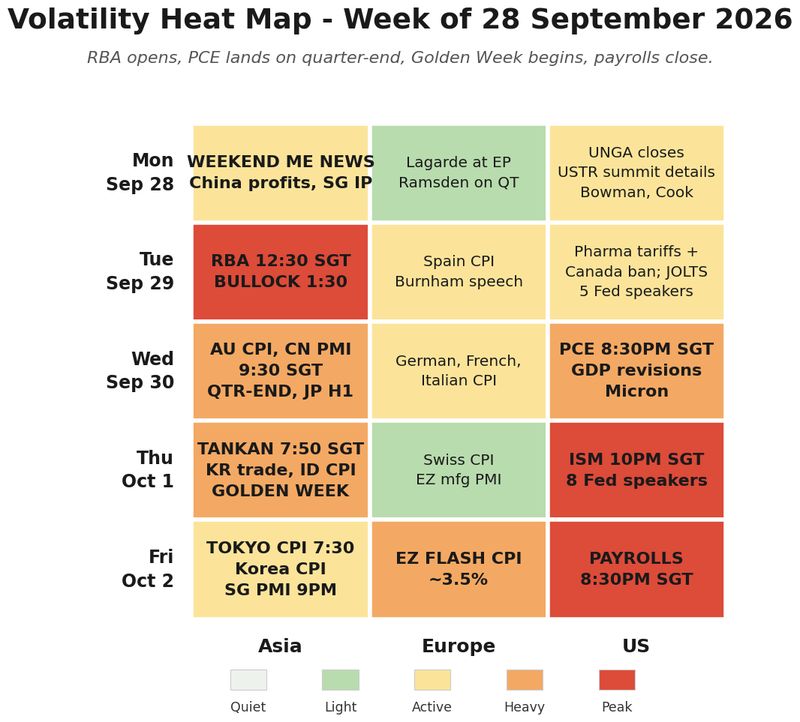
Volatility heat map for the week ahead , sessions as we trade them from here. The RBA opens on Tuesday at 12:30pm, Australia's CPI and China's PMIs share Wednesday morning with quarter-end, China shuts for Golden Week from Thursday, and payrolls close the week at 8:30pm on Friday. The S&P enters at 7,743, the 10-year at 5.17% and the dollar index near 101.
"$55 billion for a gigawatt... But even in a boom, there is plenty of bust... The thing that keeps us up at night the most: underestimating technological disruption." — Jon Gray, President and COO of Blackstone, Where's the Beef?, to Blackstone's investors this month. The biggest builder in AI says it is not a bubble, then names two ways to lose money in it. His conclusion is that the beef is starting to show. Demand is running ahead of supply: a GE Vernova turbine ordered today arrives in 2031. The railroads were the reverse, with about 200 lines failing because the track was laid on leverage ahead of the traffic. So Blackstone buys the scarce physical layer (power, land, data centres) and leaves the software fight to others. His worry is the other side of the same trade. The technology is already compressing multiples in software and professional services, repricing sound businesses for what AI might do to them. Blackstone's answer is to own the factory, and it is one of six firms lining up over $500 billion of AI infrastructure financing with Nvidia.
"I am the code." — Donald Trump, to his first ballroom architect over missing fire exits, as reported by The Washington Post this week. Safety, the law and the budget, all overruled for one room. The first architect, James McCrery, kept flagging designs that skimped on emergency exits and fire protection; he left the project in October. The East Wing came down before Congress was asked. An appeals court ruled Congress must approve, and the Supreme Court let building continue because the preservationists likely lacked standing, leaving the question of authority open. The plan started at $200 million and is now $400 million, with a 250-person crew working 20 hours a day. Then on Thursday, toasting Xi at the state dinner, Trump went off script to promise his guests would be the first to step foot in what he calls the Great Hall of the United States. The first honour went to the adversary. Or he is in a hurry to reciprocate for the Great Hall of the People, which received him in Beijing in May.
"Both MTI and MFA had terrible work-life balance. But we had the highest morale... Sometimes unhappiness may be a precondition for achievement." — George Yeo, former Foreign Minister of Singapore, to Mishal Husain, live from Singapore this week. Lee Kuan Yew's instruction to his ministers: never promise happiness. Husain put it to him that Singapore is among the richest and unhappiest countries. Yeo answered with Lee Kuan Yew's rule: "We can promise economic development, infrastructure, education, whatever. But never promise happiness." His evidence was the civil service's own surveys from his years in government. The two ministries with the worst hours, trade and foreign affairs, reported the highest morale. The premise was off: Singapore ranks 36th of 147 in this year's World Happiness Report. The pushback under Bloomberg's clip came mostly from younger Singaporeans, who read it as a defence of overwork.
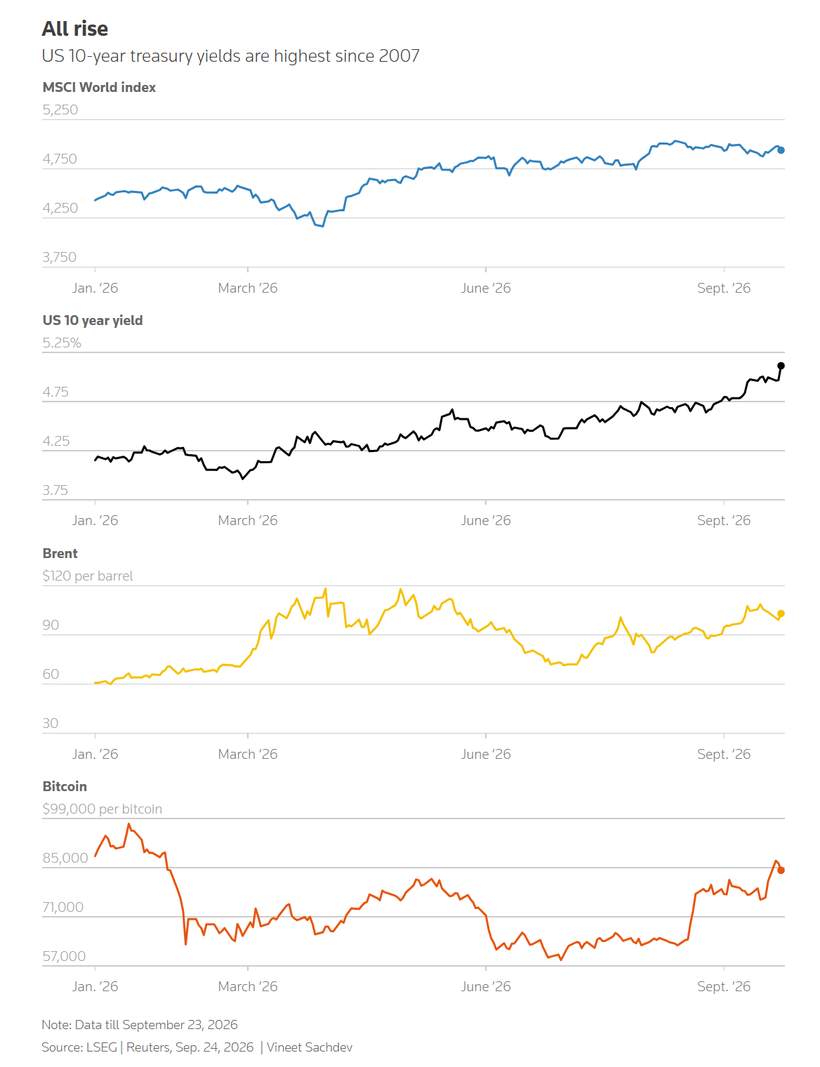
Everything rises together. Four assets that rarely agree, all climbing through September: global stocks at the top of their range for the year, the US 10-year at a new cycle high, Brent back above $100 and bitcoin back toward $85,000. Growth, the price of money and the war premium are rising at the same time, and so far equities have absorbed every one of them. Source: LSEG / Reuters.
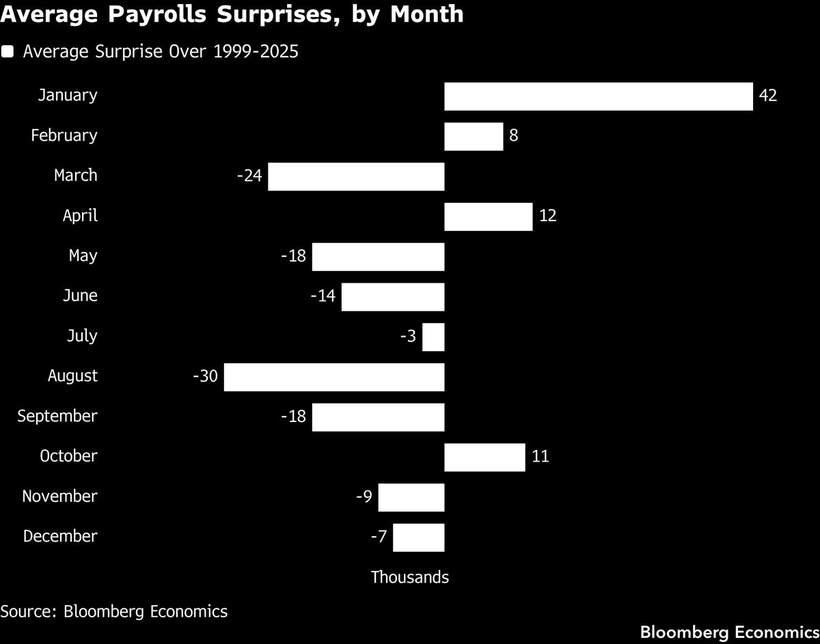
The month that usually disappoints. Since 1999, September payrolls have missed consensus by 18,000 on average, and August, the month that misses most, just beat with 162,000. Friday's consensus is 100,000 and Bloomberg Economics has 80,000. History leans soft; the Fed's October decision hangs on whether this September is the exception. Source: Bloomberg Economics.
What is the plan this week?
Plenty happened last week on the geopolitical fronts, but the end result was again a stalemate in the Middle East, with perhaps more trouble ahead for the GCC countries as the US tries to stay out until past the midterms. The Houthis fired missiles and drones at Riyadh twice in eight days. China and the US put on a great show at the White House, and both sides reported developments; whoever needed what, they wanted different objectives anyway. The truce was extended by only two months, to January 10, and the two leaders meet again in November, after the midterms.
It was one of the biggest weekly moves in rates, again. The US flash services PMI printed 58.7 against 56 expected, with input costs rising at the fastest pace since October 2022. The VaR shock took out large positions and forced the USD to break even higher. It did not help that the week started optimistically with lower oil and then flipped back hard. In my view, even the people in the know were positive on a deal when top Iranian officials went to New York: Foreign Minister Abbas Araghchi sat with Steve Witkoff and Jared Kushner for three hours, yet by Friday Trump had turned down Tehran's seven-day roadmap and was telling aides he expects to resume bombing after November 3.
The week starts in Sydney, where the RBA is set to deliver its fourth hike of the year, to 4.60%, a 15-year high, while the AUD goes through a massive long liquidation. Then the greenback will feed on whether the ISM echoes last week's hot PMI, and whether the jobs numbers hold up, especially unemployment, which could fall to 4% or below against a consensus of 4.2%. The JPY staged a massive rally on Friday on soundbites from the US and Katayama again, after Trump raised the weak yen with Takaichi. By my count, there have been three strikes of Bessent's influence on the JPY proving short-lived, and this is the fourth. Japan shares more inflation data this week with Tokyo CPI on Friday, and there is lots of data from South Korea as it returns from its Chuseok holiday. Can China's PMI snap higher?
Stock indices are once again closing near all-time highs, with everything hot and the demand for capital maxxing: world stocks sit less than 2% off their records while global borrowing costs are the highest since 2007-08. What is going back and forth is whether high real rates will poke equities, but the jury is definitely leaning towards no as we head into Q4. The bond market is less sure: the MOVE index jumped to 105, its highest since March, while the VIX sits near 15. And if higher rates are tolerated in DM equities, then how about EM?
The plan this week is to keep long USD even though the chances of a retracement are high. The market is not ready to stop pushing rates higher without a meaningful outlook for inflation taming. The USDCNH short comes off now the fixing has flipped higher, with the PBOC warning against the herd. Gold is challenging its 4,300 neckline again but has not broken it, and nothing changes until it breaks or reclaims 4,500. Stay nimble.
What did I learn last week?
Mon Sep 21: Goolsbee was the first Fed voice after the hike. Germany woke to two shocks: the CDU fell below 5% in Mecklenburg-Vorpommern, out of a state parliament for the first time since the war, and Die Linke won Berlin for the first time since reunification. Singapore's retrenchments rose to 4,620 in the second quarter, the most since late 2020.
Tue Sep 22: Trump told the UN General Assembly the US would "annihilate" Iran without a deal and would encourage AI rather than rein it in. Hours later Witkoff and Kushner sat with Iran's Foreign Minister Abbas Araghchi for three hours. Saudi Arabia restarted the East-West pipeline weeks ahead of estimates and oil eased. The 2-year auction drew 4.787% against 4.204% last time.
Wed Sep 23: The week turned. US flash services PMI printed 58.7 against 56, manufacturing 57.0, the highest since May 2022, with input costs rising at the fastest pace since October 2022. Barr said more hikes will likely be needed. The 10-year touched 5.13%, the 5-year auction cleared above 5% for the first time since 2007, and oil jumped back above $103. South Africa hiked to 7.25%.
Thu Sep 24: Xi at the White House, a state dinner, pandas, and a truce extended only two months, to January 10. Norges Bank hiked to 4.50% and said it may go again; the Riksbank held hawkishly at 1.75%; the SNB held at zero and pushed back on tightening. Paulson said more may be needed. The Treasury's buyback fell short of its maximum for a second week. Oracle sent a force majeure notice on its New Mexico data centre.
Fri Sep 25: Trump raised the weak yen with Takaichi, and the yen rallied 0.8% to 157.67 after trading beyond 158.50. By evening the WSJ reported Trump had rejected Iran's seven-day roadmap and expects to resume bombing after the midterms.
All week: The 10-year closed above 5% three sessions running, 5.17% on Friday, and our two-close trigger fired. The DXY reached 101.40, its highest since late July. The S&P rose 1.2% and the Nasdaq 2.1%, the S&P finishing 0.7% short of its record. Gold challenged its neckline again near 4,280. USDCNH made a new monthly high at 6.7250 as the PBOC warned against the herd. Grading the board honestly: we scripted only the soft PMI branch, and the hot one moved everything. Norges and the 5% trigger fired as written. And the UN Assembly and the Iran talks were bigger than the space we gave them.
What to look out for next week?
Mon Sep 28: The UN General Assembly's debate closes, and the US Trade Representative, Greer, has promised the summit's details today. Markets open digesting a weekend of Houthi strikes on Saudi Arabia and a refused Iranian roadmap. China's industrial profits slow on base effects. Lagarde faces the European Parliament, Ramsden speaks on QT, and Bowman and Cook open the heaviest Fedspeak week since the hike, with Warsh still absent.
Tue Sep 29: The RBA at 12:30pm, Bullock's press conference at 1:30pm. A hike to 4.60% is near fully priced, so the statement is the trade: guidance toward November pulls the AUD out of its liquidation, while "this may be the last" extends it, with unemployment at a five-year high and house prices falling. US tariffs on pharmaceuticals widen to every remaining company and a ban on some Canadian goods takes effect; Canada's July GDP follows. Burnham gives his first conference speech as prime minister, with the gilt selloff having erased about half of Healey's £23.6 billion buffer. JOLTS and Conference Board confidence follow in New York. Williams, Barr, Waller, Goolsbee and Bowman all speak.
Wed Sep 30: Quarter-end and Japan's fiscal half-year land together, the worst bond quarter in years closing with the street short. Australia's CPI and China's PMIs come at 9:30am, the official manufacturing index seen back above 50 on the eve of Golden Week. Then PCE at 8:30pm: core is seen at 0.3%, but the BEA's revisions could shave 0.1 to 0.3 point off. Hot and broad puts October in play for another hike; soft squeezes a bond market positioned short. Micron reports after the close, up 275% this year while the SOX lost 14% this quarter. G20 trade ministers meet in Milwaukee, and Barkin and Goolsbee speak.
Thu Oct 1: China's Golden Week begins, Hong Kong shut for the day and the mainland through October 7. Japan's Tankan at 7:50am, Korea's exports at 8am after chip shipments jumped 259% in the first 20 days, and Indonesia's CPI at noon, pressing the top of BI's range. ISM Manufacturing at 10pm: prices paid were 71.1 last month; a beat with hot prices confirms last week's PMI, while a print under 53 is the first crack. Eight Fed officials speak, including Williams, Jefferson, Waller and Cook. US truck drivers strike through Saturday.
Fri Oct 2: Tokyo CPI at 7:30am, seen jumping to 2.4-2.7% as last year's childcare waivers drop out. Euro-area flash CPI is seen at 3.5%. Payrolls at 8:30pm, consensus 100,000 and 4.2%, the last jobs report before the October 28 FOMC, with a hike priced at between 50% and 76% depending on the source. Unemployment at 4.0% or below on a strong print puts an October hike fully in play and extends the dollar; 80,000 or fewer with 4.2% or higher squeezes the short-duration crowd, and that is where our retracement risk lives. Singapore's PMI at 9pm; India is shut.
Beyond next week
Oct 4: OPEC+ meets with Hormuz still shut and 2027 baselines due; Brazil votes the same Sunday in what now looks a genuine toss-up.
Oct 5: Quebec votes, the Parti Québécois leading on a deferred sovereignty referendum and no party projected a majority.
Oct 7: The RBI decides, with oil and a weak monsoon both working against it.
Oct: Britain's budget, with half the chancellor's headroom already gone to gilt yields.
Oct 15: MSCI's concentration reviews begin, Indonesia in the frame.
Oct 22-30: The BSP on the 22nd, the Fifth Plenum from the 26th, the Fed and the Bank of Canada on the 28th, the ECB on the 29th, and the BOJ at month-end.
Nov 3: The midterms, and the date Washington has pencilled in to resume bombing Iran. Anthropic's listing follows in November; the trade truce runs to January 10.
Regimes
The bond market changed the subject, week seven: the five-handle holds. The 10-year has closed above 5% three sessions running, the 5-year is above 5% for the first time since 2007, and the MOVE is at 105 while the VIX sits near 15. Credit has not flinched yet at 77bp. But issuance came in short, one borrower stood down, and the Treasury's buyback missed its maximum for a second week. The room's view is rates higher again, and nothing argues otherwise until payrolls do. changed, week 7
The dollar goes two-way, week seventeen: the returns dollar. The DXY reached 101.40, its best since late July, driven by returns: a Fed priced above its own dots, an economy running hotter, systematic buyers rebuilt. Momentum is stretched and a soft payroll print is the trigger for a retracement. The regime holds while American returns lead, and long USD against the funders stays. held, week 17
The funding-currency battle, week two: talked back, not bought back. Words rescued the yen again: Trump raised its weakness with Takaichi, Katayama and Bessent promised coordination, and USDJPY dropped from beyond 158.50 to 157.67. It is the fourth time Bessent's influence has lifted the yen, and the first three did not last. The SNB held at zero and pushed back, the euro is now funding EM carry, and Norges showed which side the hikers are on. changed, week 2
The AI fracture, week thirteen: the price of intelligence falls. Meta's Muse agent reaches for the customer, model prices are being cut, and Anthropic says Claude already leads a quarter of its own R&D. The cost of the buildout goes the other way: Jon Gray's $55 billion a gigawatt. Micron on Wednesday tests whether the spending holds, the stock up 275% this year and the SOX down 14% this quarter. Oracle's force majeure tests who pays if it does not. changed, week 13
The war is the inflation, week ten: Saudi Arabia's dark clouds. The Houthis struck fuel depots at Riyadh's airport, their first hit on the capital since 2022, after taking the port of Mokha and Perim Island at the mouth of the Red Sea. The battles for Ma'rib, the centre of Yemen's oil and gas, and Taiz decide whether the whole country falls to them. Mohammed bin Salman faces the greatest test of his rule with two bad options: fight without the American backing Trump has refused, or accommodate a movement that still disputes Jizan, Asir and Najran, the three provinces Yemen lost to the kingdom in 1934. The restarted pipeline changes little while that threat stands. A kingdom that sells stability to global capital is now buying security from Pakistan and Turkey, and perhaps China next. changed, week 10
Surplus versus deficit, week five: the real house blinks. Ten sessions of lower fixes ended with the summit. The PBOC warned against the "herd effect" for the first time, and USDCNH made a new monthly high at 6.7250. Port throughput is at a record and Korea's chip exports are up 259%, but the fix has stopped pushing, and the Golden Week holiday that was meant to carry the yuan now starts without a tailwind. changed, week 5
Shifts (if then)
Last week's board fired hard, mostly on the lines we underweighted. We scripted the soft PMI branch; the hot one moved everything, and the dollar longs did the work anyway. Norges hiked as written. Japan reopened through 158 and was talked back by Trump himself, not acted on. The summit delivered an extension, not a deal, and selling the news was the right branch. The 5% trigger fired three times over and folds into the bond regime above.
Payrolls strong and unemployment at 4.0% or below → October is fully priced, the 2-year goes through 5%, and the dollar longs extend; the retracement waits. new
Payrolls 80,000 or fewer with unemployment at 4.2% or higher → the short-duration crowd is squeezed, the curve bull-steepens, and a third of the dollar longs are covered. new
The RBA says this may be the last hike → the AUD liquidation extends; hawkish guidance for November ends it instead. new
ISM prices paid holds above 70 on a beat → last week's PMI is confirmed as an inflation story, and October moves from likely to done. new
The 30-year breaks 5.50% → duration-matched pensions and mortgage hedgers sell into it, and the move feeds itself. new
Tails
Retired this week: the Saudi trap turns political, retired as a tail at week three because the politics arrived. The thread now leads the war regime above as Saudi Arabia's dark clouds. retired, week 3
The quarter-end duration bid → quarter-end and Japan's fiscal half-year fall together on Wednesday (last week we wrote Tuesday), at the end of the worst bond quarter in years with the street short. A rebalancing bid into that positioning is the setup for a violent bull-flattening. carried, week 2
Iran after the midterms → Washington has refused Tehran's roadmap and dated the next round after November 3, blockade kept. Anything that pulls the date forward, a strike on a Saudi facility or mines in Hormuz, reprices oil in a session; a surprise reopening is the bigger drop. new, week 1
Gold at the neckline, again → challenged at 4,280, not broken. A break of 4,250 opens 4,000; a weak payroll print that reclaims 4,500 reopens the debasement checklist. carried, week 3
October rhymes → the month arrives: records in stocks, a five-handle in bonds, Golden Week thinning Asia, and the 19th on a Monday. carried, week 5
The AI credit accident → Oracle's force majeure in New Mexico, SoftBank's record $11 billion junk deal, Brightline's bankruptcy, and Paramount's $52 billion debt sale landing this week. One failed jumbo deal reprices the AI-debt complex. carried, week 2
Indonesia to frontier → MSCI's concentration reviews start on October 15, and Thursday's CPI presses the top of BI's range. carried, week 2
Quebec votes → a Parti Québécois win, even as a minority, puts sovereignty back into CAD's risk premium days after the US bans on Canadian goods take effect. new, week 1
Middle East Monday, again
Monday opens the way the last several have, digesting a weekend of heavy Middle East news: Houthi missiles and drones aimed at Khamis Mushait and Riyadh intercepted on Saturday, Washington's refusal of Tehran's roadmap sinking in, and Iranian officials warning the conflict could reach the Indian Ocean. It is a tricky start, with oil opening on those headlines and Asia's liquidity thinning into Golden Week. China's profits and India's output fill the data calendar, the UN debate closes, the US Trade Representative publishes the summit details, and Bowman and Cook open the Fed's week.
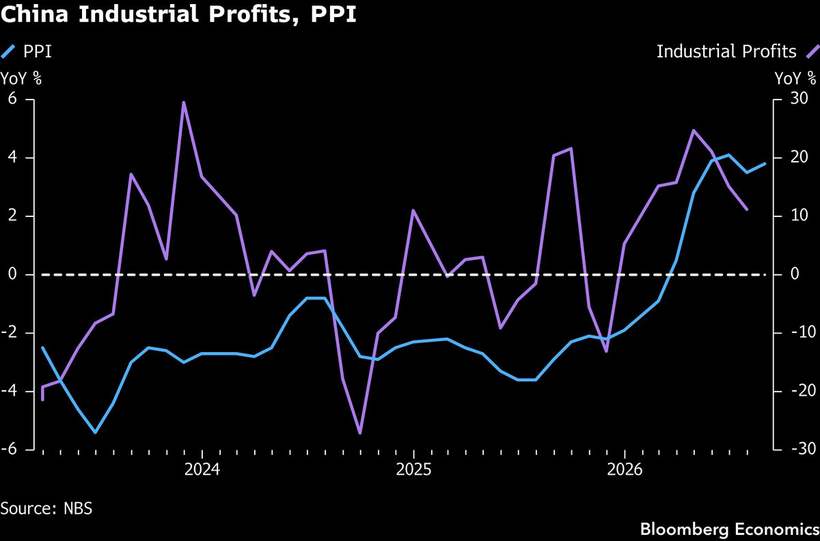
China's profits meet the base: producer prices up 3.8% and output up 5.2%, yet profit growth is seen slowing to about 8% on the year from 11.2%, because August 2025 jumped 20%. The reflation is real; the base effect hides it for a month. Source: NBS / Bloomberg Economics.
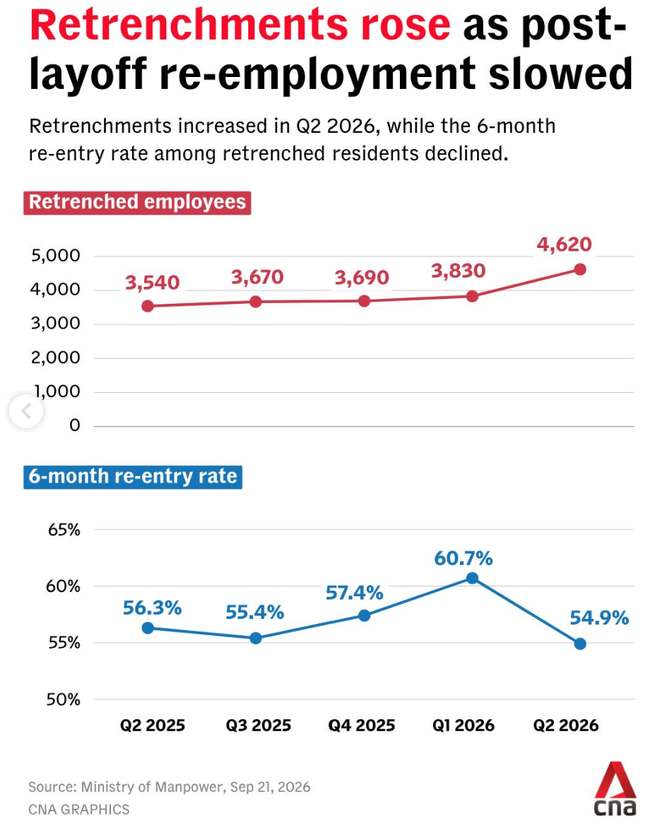
Singapore's labour market, the soft spot: retrenchments rose to 4,620 in the second quarter, the most since late 2020, and only 54.9% of those laid off found work within six months, down from 60.7%. Restructuring in manufacturing, infocomms and finance drove it, the same outward-facing sectors whose output is booming. Strong production with softer hiring is the mix MAS weighs in October. Source: Ministry of Manpower / CNA.
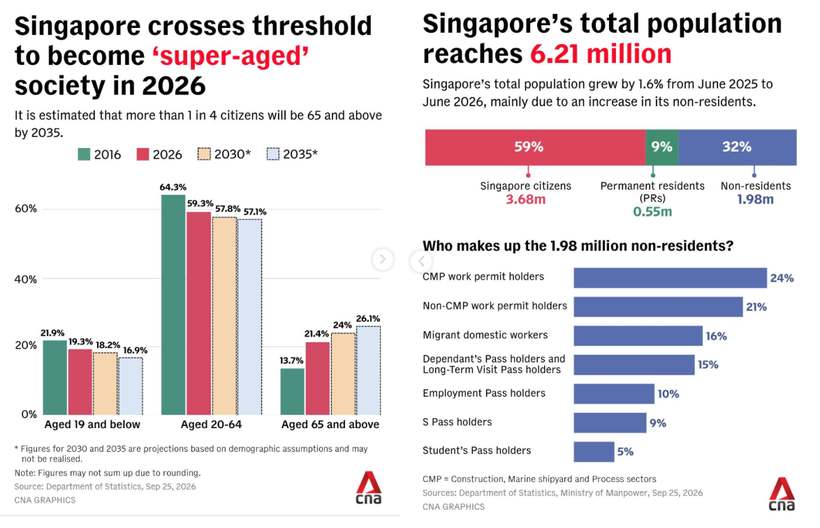
Singapore turns super-aged: 21.4% of citizens are now 65 or older, past the 21% threshold, heading for 26.1% by 2035, while the total population reached 6.21 million on non-resident growth. A shrinking native workforce, filled from abroad, in the economy this letter is written from. Source: Department of Statistics / CNA.
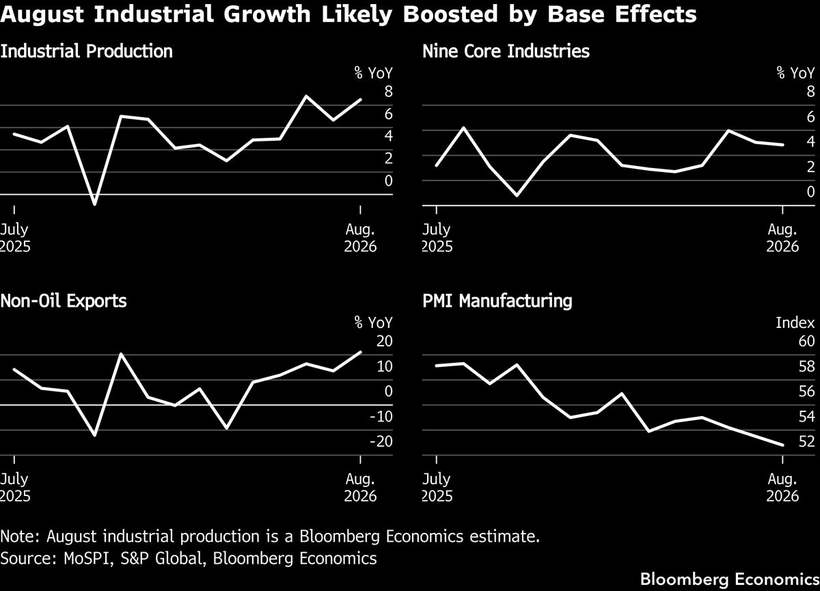
India's output, flattered: August production seen at 8.5% only because a year ago the US tariffs hit; month on month, core industries contracted 1.3%, non-oil exports fell and the PMI slipped to 52.8. Hormuz shut a Gulf export route and a weak monsoon dented rural demand. The RBI decides on October 7 with costs and demand both working against it. Source: MoSPI, S&P Global / Bloomberg Economics.
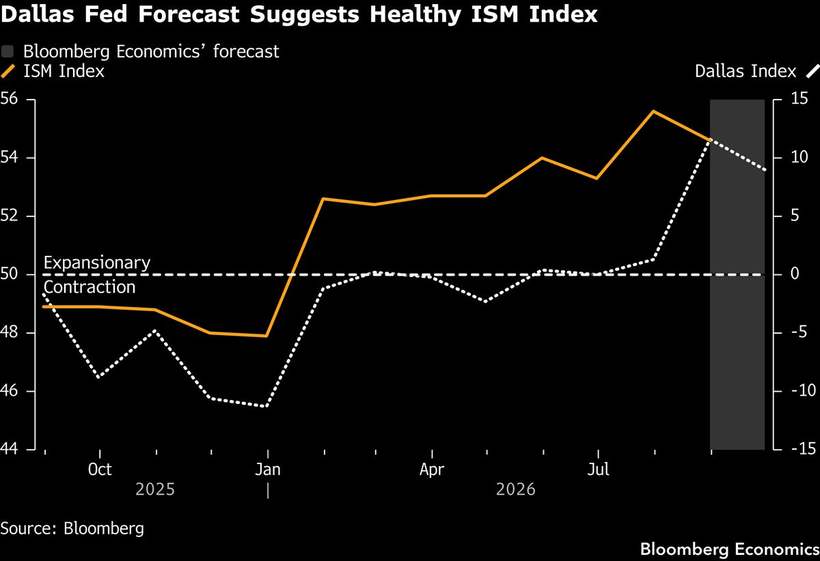
Texas closes America's Monday: the Dallas Fed survey's August jump lined up with an ISM at 55.6, and a September dip to 9 would still leave both expansionary. The raw-materials price index is the line to read; it was elevated in August, and last week's PMI said input costs are rising at the fastest pace since 2022. Source: Bloomberg Economics.
RBA Tuesday
The RBA decides at 12:30pm with Bullock's press conference an hour later, a fourth hike of the year near fully priced into falling house prices and a five-year high in unemployment. Europe gets Spain's CPI and Burnham's first conference speech as prime minister. New York brings pharmaceutical tariffs on every remaining company, a ban on some Canadian goods, JOLTS and consumer confidence, with five Fed officials speaking.
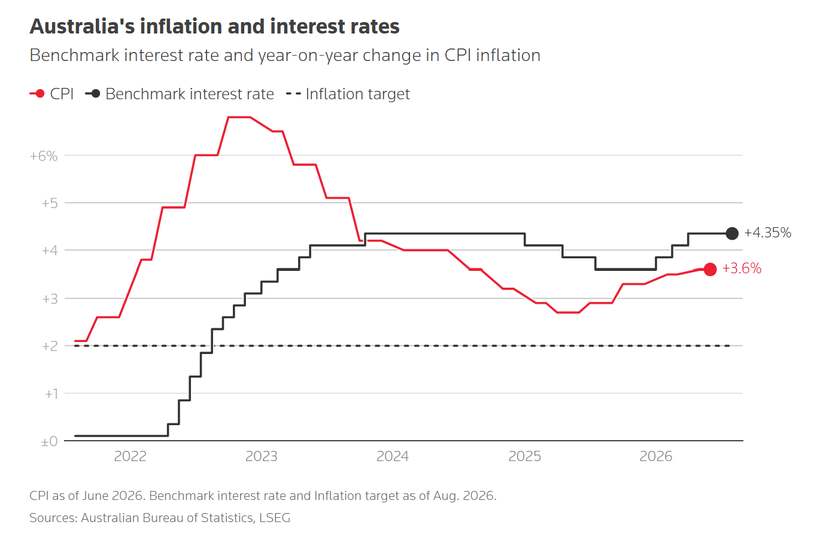
Why Bullock hikes into weakness: the cash rate at 4.35% with CPI at 3.6% and still rising, three hikes already this year and core above the 2-3% band. Falling house prices used to bring rate cuts; oil above $100 has ended that reflex, and the cash rate is now seen peaking near 5%. Source: ABS, LSEG / Reuters.
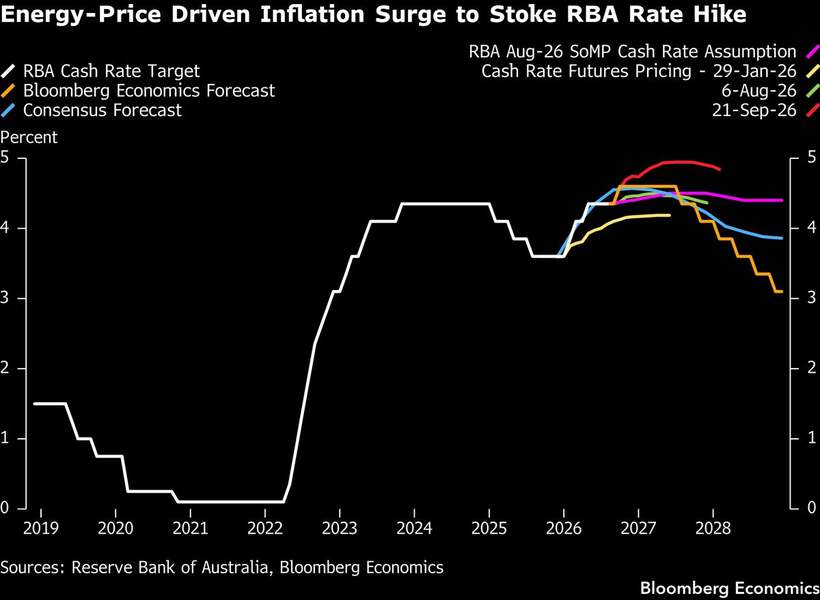
Three forecasts, three paths: futures on September 21 priced the cash rate near 4.95% into 2027, against the RBA's own assumption near 4.5% and Bloomberg Economics' view of cuts to 3.1% by 2028. Tuesday's statement decides which line the AUD follows. Source: RBA / Bloomberg Economics.
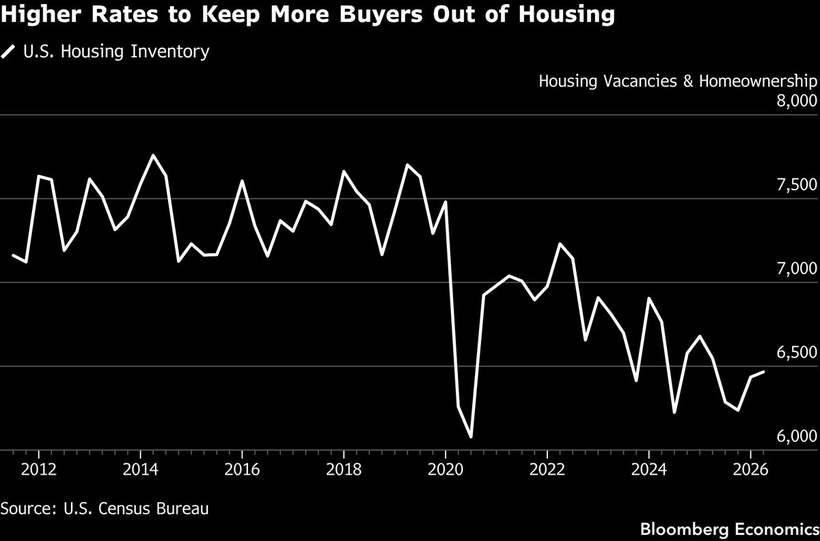
Rates keep buyers out: US housing inventory near 6.45 million, still well below the 7 to 7.5 million range of the 2010s, with mortgage rates above 7%. Case-Shiller at 9pm is seen at 2.2-2.4%, the last warm print before higher financing costs squeeze prices. Source: US Census / Bloomberg Economics.
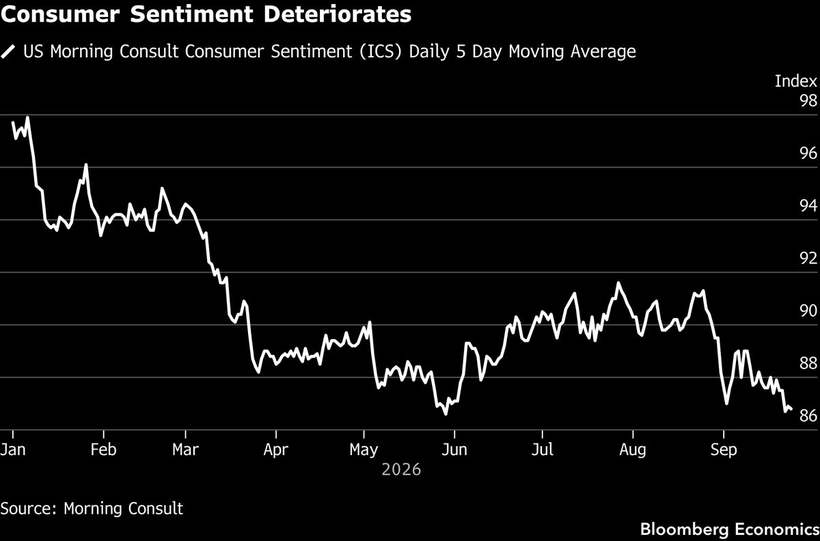
The consumer at a 2026 low: Morning Consult's daily sentiment slid from 98 in January to about 86.5, the year's bottom, as gasoline and borrowing costs eat purchasing power. Conference Board confidence at 10pm is seen near 89; jobs still feel plentiful, incomes do not. Source: Morning Consult / Bloomberg Economics.
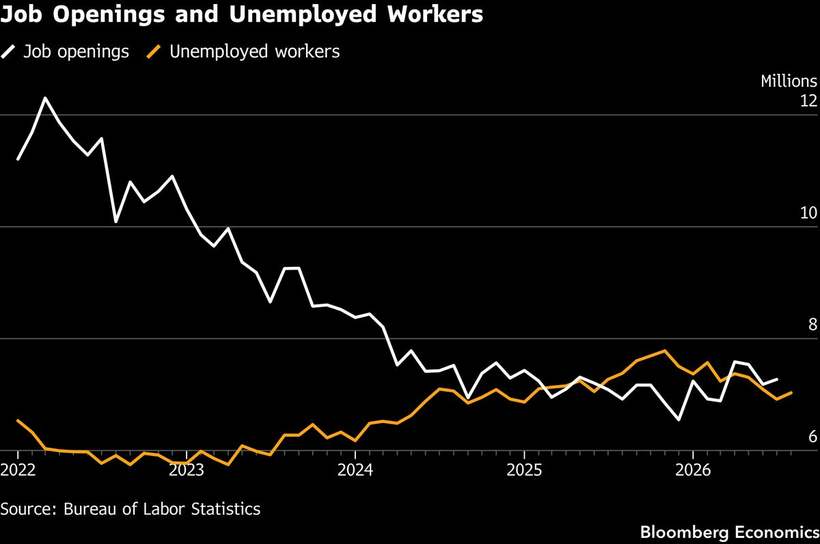
Openings and the unemployed, crossed: job openings seen at 7.23 million against about 7 million unemployed, a ratio near 1.03 and falling. The labour market is balanced, not tight: openings would have to rise 120,000 just to hold the ratio. Soft labour demand with hot prices is the Fed's worst mix. Source: BLS / Bloomberg Economics.
Quarter-end Wednesday
Quarter-end and Japan's fiscal half-year arrive together, at the close of the worst bond quarter in years. Asia's morning is heavy: Korea's and Japan's industrial output, then Australia's CPI and China's PMIs at 9:30am on the eve of Golden Week. Europe's big three publish inflation. The US closes with PCE and five years of GDP revisions at 8:30pm, and Micron after the bell.
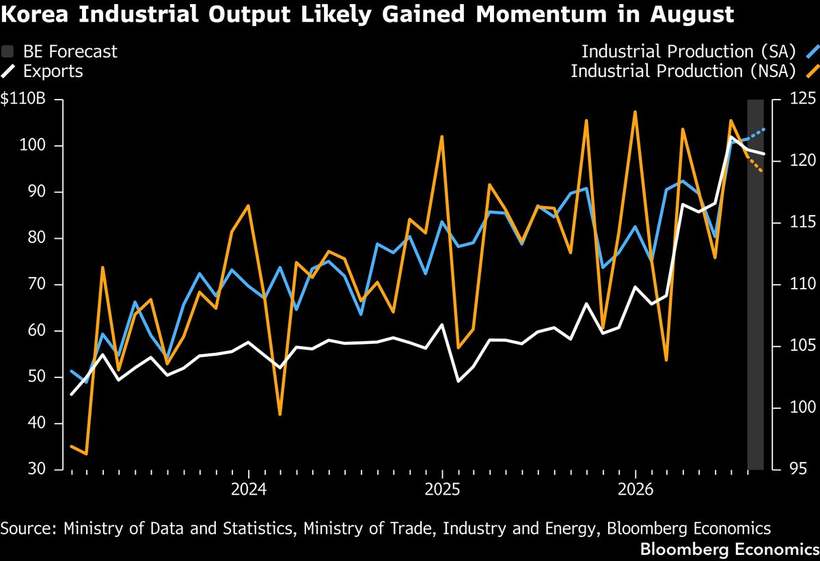
Korea's factories run on chips: output seen up 0.6% on the month and 5.7% on the year, with chip exports up 209% while strikes at Hyundai and Kia cut vehicle production 36%. Exports near $100 billion a month sit at records. The won's problem is not the economy; it is the outflows. Source: Korea statistics, MOTIE / Bloomberg Economics.
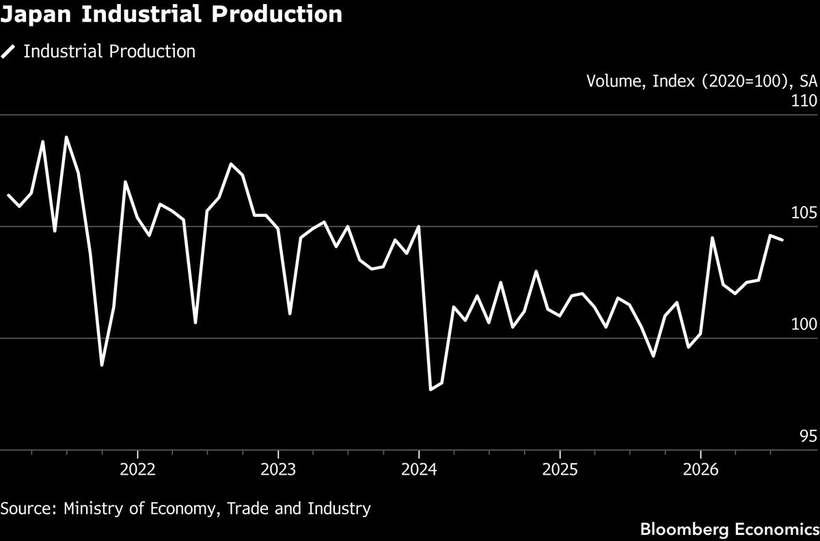
Japan's output, rebounding: a 2.3% monthly jump seen for August on chipmaking equipment, data-centre components and new car models, taking the index back toward its 2024 highs. Stronger production gives the BOJ one more reason to keep a January hike on the table. Source: METI / Bloomberg Economics.
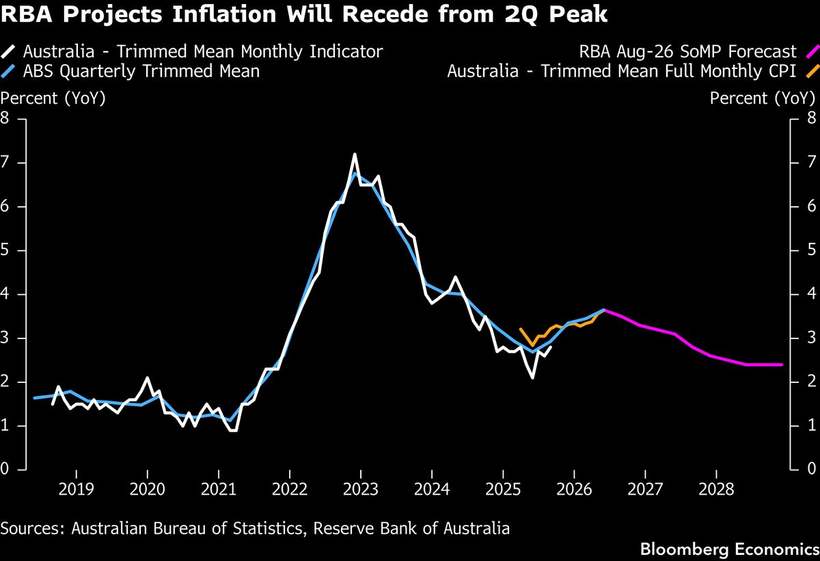
The RBA's own forecast, peaking now: trimmed-mean inflation at about 3.6%, where the RBA's August forecast has it peaking before easing toward 2.4% by 2028. Headline CPI at 9:30am is seen jumping to 4.1-4.5% on a 20% rise in fuel, but the trimmed mean is the number the RBA reads, and it arrives the day after the decision. Source: ABS, RBA / Bloomberg Economics.
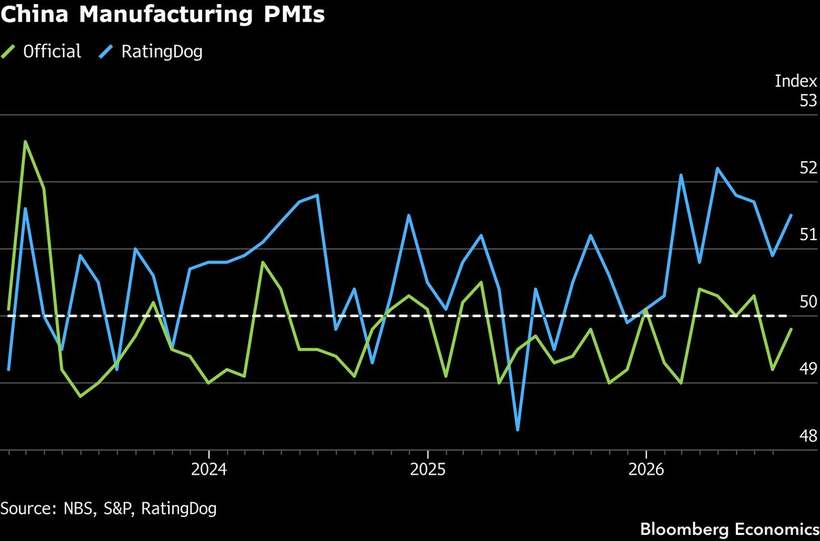
China's factories, testing 50: the official manufacturing PMI seen back at 50.1-50.2 after two months of contraction, and RatingDog's export-heavy index at 51.8, with fiscal spending finally reaching construction. A print below 50 into a week-long holiday leaves the yuan's summit strength with nothing underneath. Source: NBS, RatingDog / Bloomberg Economics.
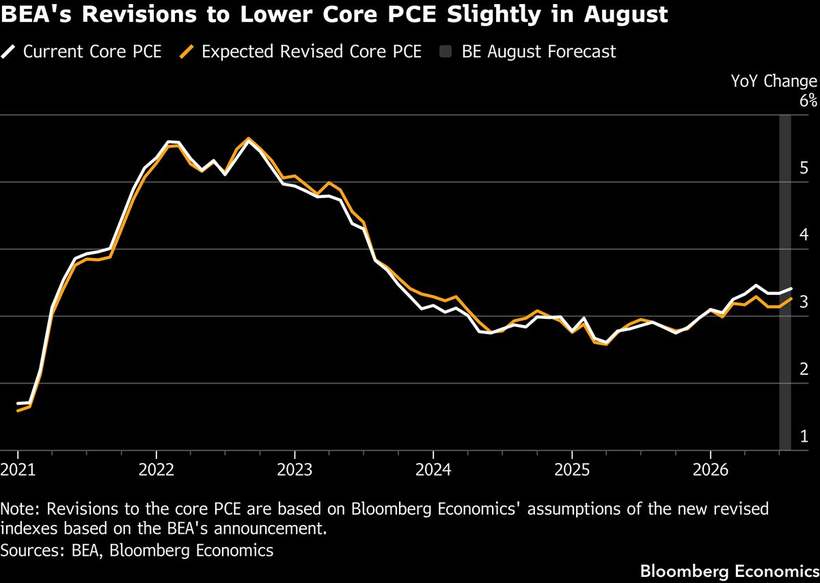
PCE after the revisions: core PCE seen at 0.29% on the month, but the BEA's five-year revisions and new methods for investment advice, software and legal services could lower annual core by about 0.2 point, to 3.3%. A hot month and a softer history in the same release; the market will trade the month. Source: BEA / Bloomberg Economics.
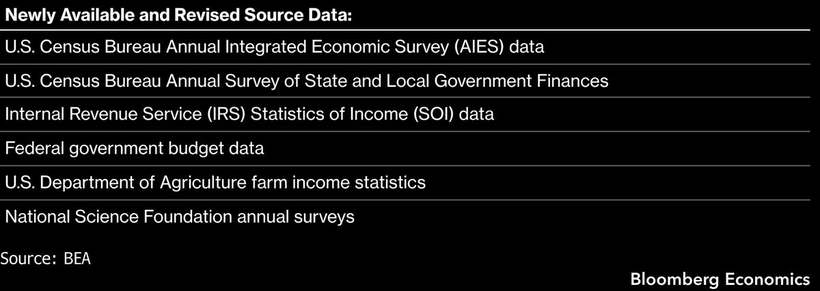
What the BEA brings in: the annual update folds in the Census Bureau's integrated survey, IRS income data, state and local finances, farm income and federal budget data, reworking the national accounts from 2021 to early 2026. GDP, GDI and the saving rate can all move, on quarter-end. Source: BEA / Bloomberg Economics.
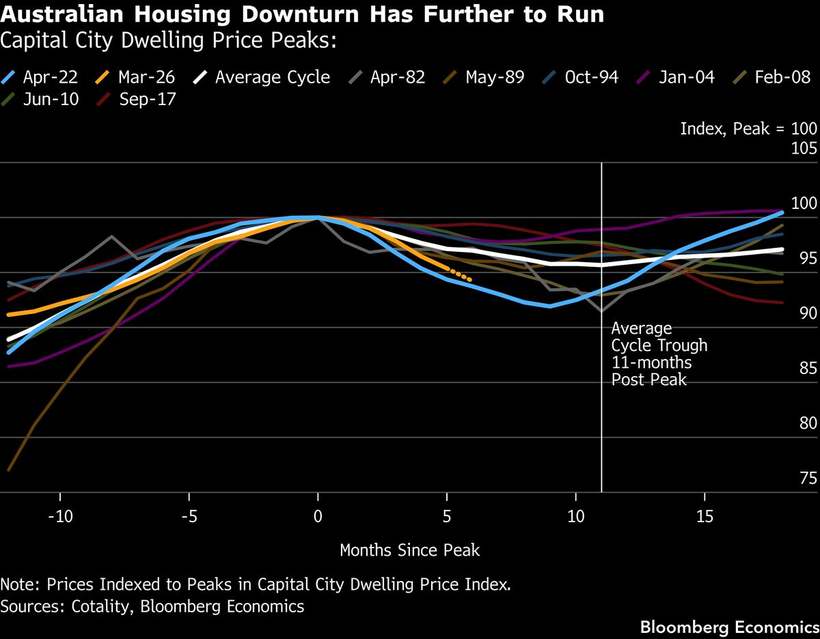
Australia's housing, falling fastest: the cycle that peaked in March is dropping faster than any downturn since the 1980s except 2022, capital cities down about 6% from April, with another 1.2% fall seen for September. The average downturn bottoms 11 months after the peak; this one still has hikes coming. Source: Cotality / Bloomberg Economics.
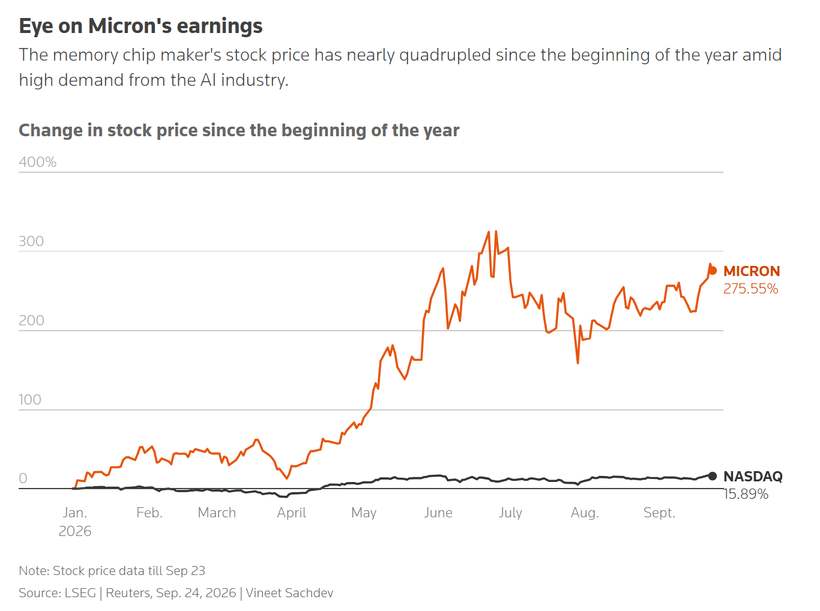
Micron's moment: the memory maker up 275% this year against the Nasdaq's 16%, with revenue expected at $50.8 billion against $11.3 billion a year ago and gross margins near 86%. Options imply a 9% move. The purest single read on whether AI capex keeps flowing into the fourth quarter. Source: LSEG / Reuters.
Golden Week Thursday
China's National Day starts Golden Week, Hong Kong shut for the day and the mainland to October 7, and Asia's morning is Japan's Tankan at 7:50am, Korea's exports at 8am and Indonesia's CPI at noon. Europe gets Swiss inflation and final PMIs. New York has claims, ISM Manufacturing at 10pm and eight Fed officials, while US truck drivers strike through Saturday.
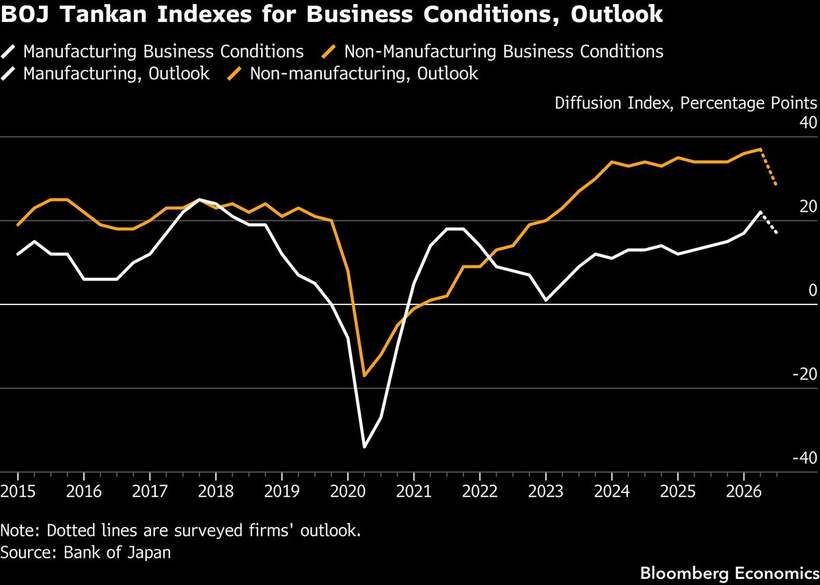
The Tankan, near its highs: large manufacturers' conditions seen rising to 24-25 from 22 on AI demand, non-manufacturers steady near 37, and five-year inflation expectations climbing further above 2%. A firm Tankan with Tokyo CPI a day later keeps the January hike alive. Source: Bank of Japan / Bloomberg Economics.
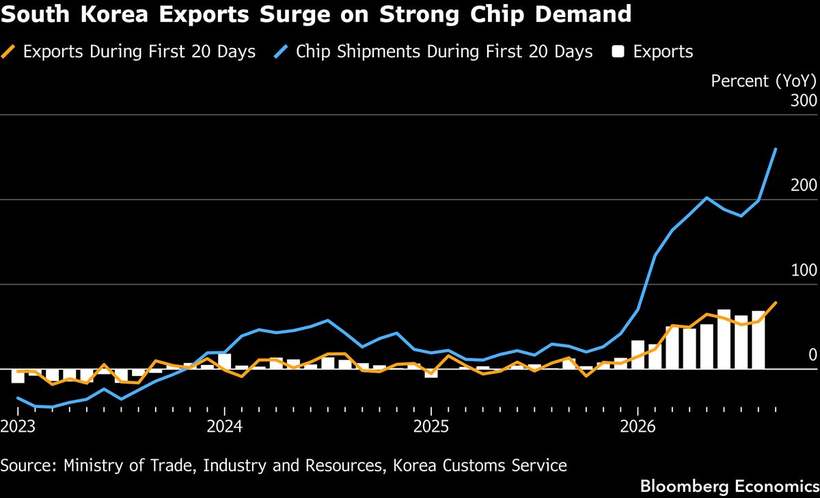
Korea's chips, near vertical: exports up 78% in the first 20 days of September and chip shipments up 259%, with the full month seen at 61-67% and a trade surplus near $40 billion. The AI boom's physical supply chain runs through Korea; the surplus is the won's cushion against the outflows. Source: MOTIE, Korea Customs / Bloomberg Economics.
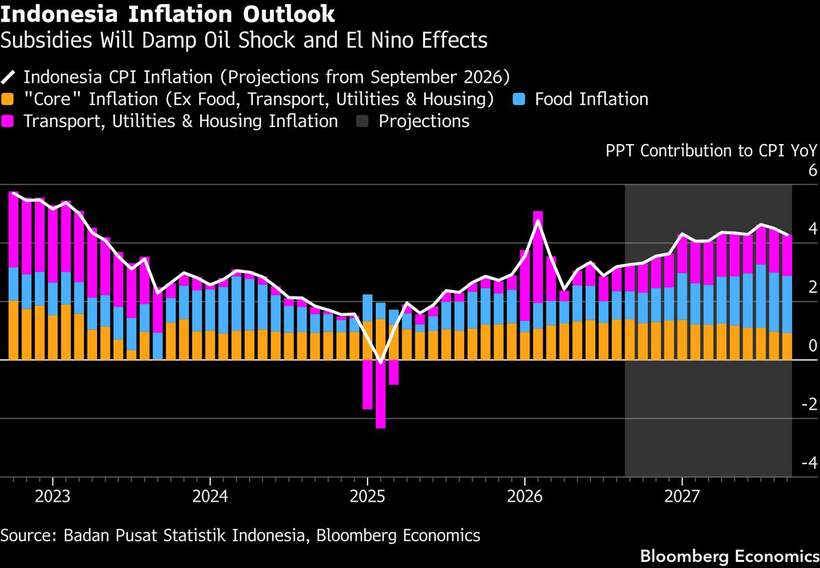
Indonesia's inflation, climbing to the ceiling: September CPI seen at 3.3-3.4% from 3.19%, fuel subsidies holding energy back while El Niño lifts food, with the projections running above BI's 1.5-3.5% target into 2027. The MSCI review starts two weeks later; inflation at the ceiling limits what BI can offer the rupiah. Source: BPS / Bloomberg Economics.
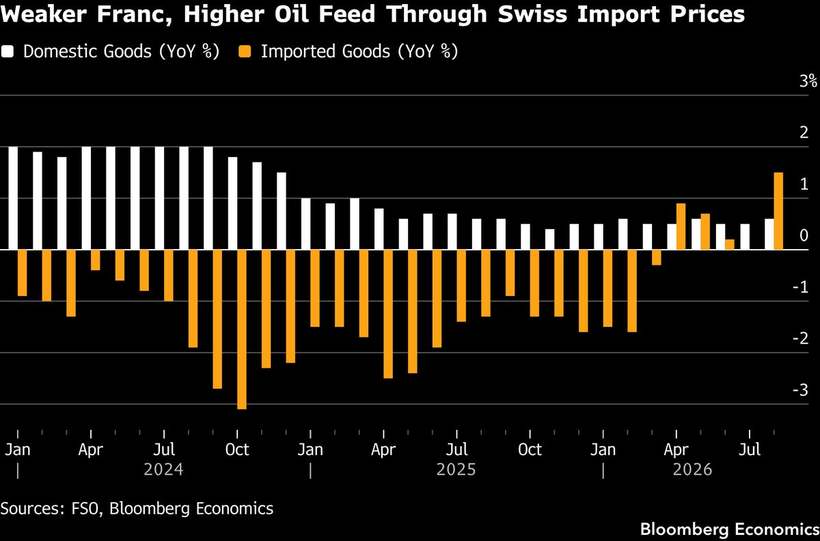
The franc's weakness, arriving in prices: imported-goods inflation jumped to about 1.5% in August after two years below zero, as a weaker franc and higher oil feed through; CPI is seen at 1.1% from 0.8%. The SNB calls it temporary and holds at zero, and the funding-currency regime depends on it staying that relaxed. Source: FSO / Bloomberg Economics.
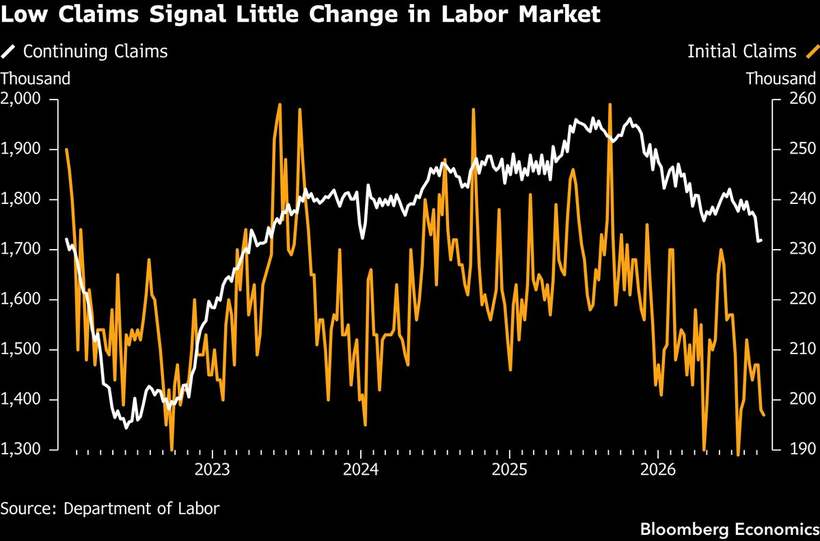
Layoffs still near lows: initial claims at 197,000 last week and continuing claims down to 1.72 million, with 200,000-206,000 expected. Firms are trimming for efficiency, not because of rates. Low layoffs are why the Fed can keep hiking. Source: Department of Labor / Bloomberg Economics.
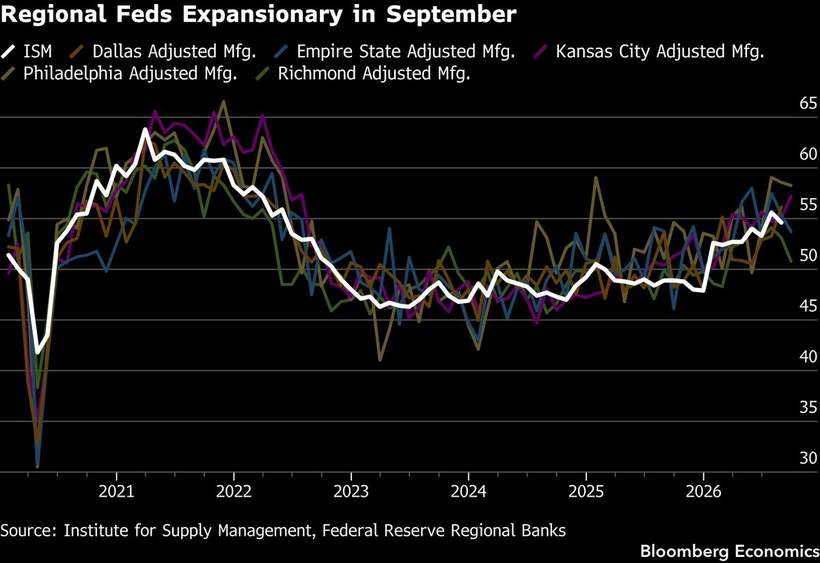
Every regional Fed above 50: Dallas, Empire, Kansas City, Philadelphia and Richmond all expansionary on an ISM-adjusted basis, with ISM seen at 54.7-55.0. Prices paid were 71.1 in August, the number the bond market will read first. Source: ISM, regional Feds / Bloomberg Economics.
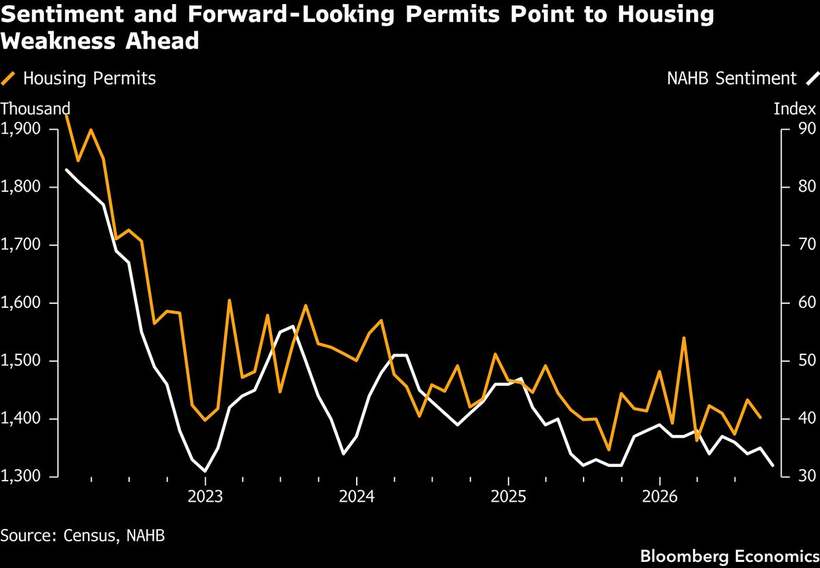
Housing feels the rate shock first: builder sentiment down to 32 and permits sliding toward 1.40 million, both pointing lower. Construction spending at 10pm is seen flat; data centres, up 57% on the year, are the only part growing fast, and they are 3% of the total. Source: Census, NAHB / Bloomberg Economics.
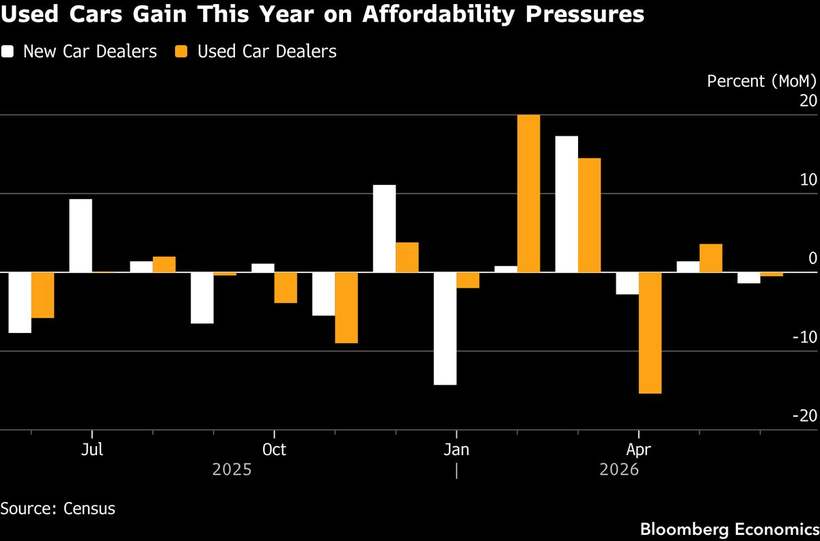
The car market splits: used-car dealers gained through 2026 as new cars priced buyers out, and September sales are seen easing to 16.2-16.5 million. Affluent buyers carry new-car demand while fuel costs push the mix toward hybrids and EVs. Source: Census / Bloomberg Economics.
Payrolls Friday
Korea's CPI at 7am and Tokyo's at 7:30 open the day, the euro area's flash inflation lands in our afternoon, and payrolls arrive at 8:30pm, the last jobs report before the October 28 FOMC. Singapore's PMI follows at 9pm. India is shut and China is on holiday: the week's biggest number arrives with half of Asia away.
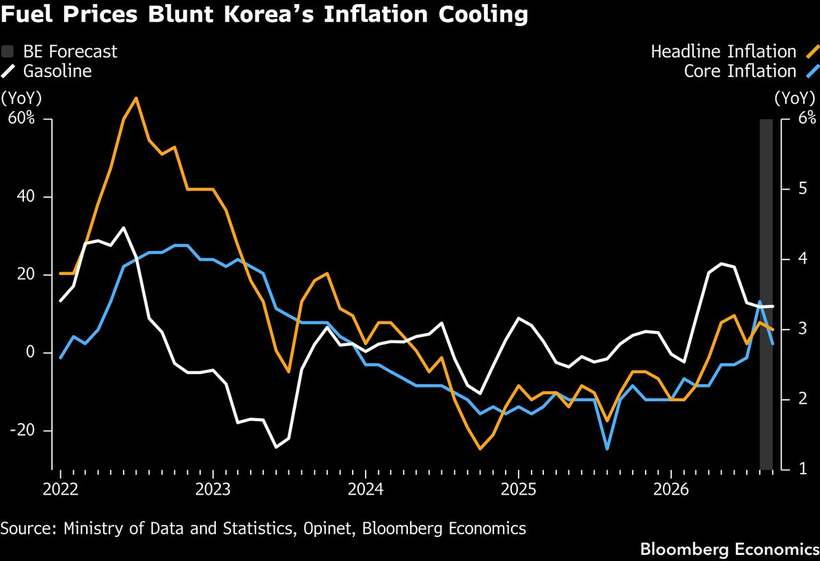
Fuel blunts Korea's disinflation: headline CPI seen at 3.0% from 3.1% and core falling faster to 2.8% from 3.4% as a base effect drops out, with gasoline still up about 12% on the year and pre-Chuseok food, cabbage to beef, keeping the headline sticky. Core above 2% keeps Bank of Korea tightening in play. Source: Korea statistics, Opinet / Bloomberg Economics.
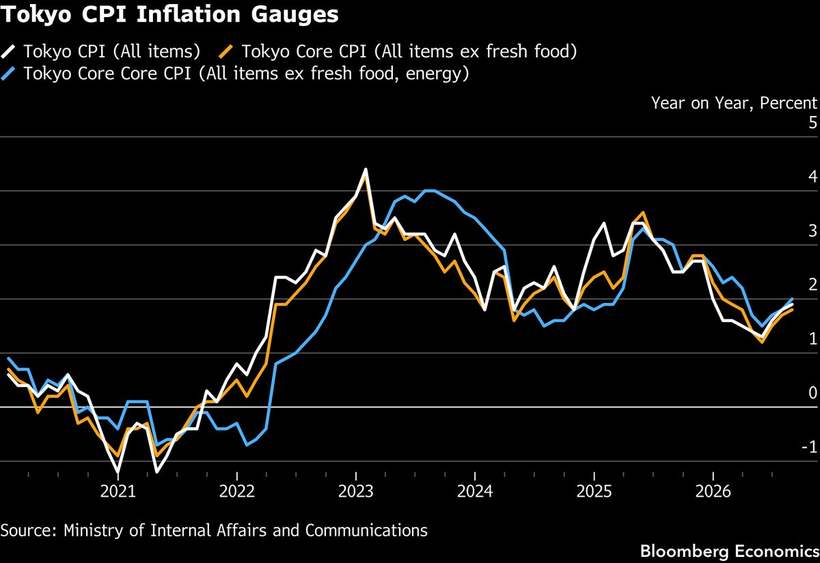
Tokyo's inflation, about to jump: core CPI seen at 2.3-2.7% from 1.8% as last year's childcare waiver and this year's end of water-fee waivers distort the base, with the underlying trend firm on energy, the weak yen and wages. Swaps give an October BOJ hike less than one chance in five; a hot Tokyo print is how that changes. Source: Ministry of Internal Affairs / Bloomberg Economics.
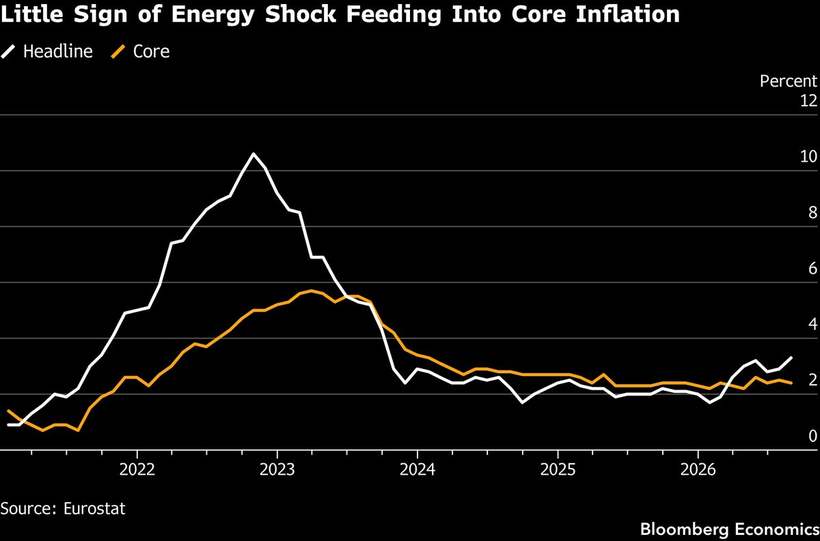
Europe's energy shock, still in the headline: euro-area inflation seen at 3.5% from 3.2%, the highest since the Middle East conflict began, with core only edging up to 2.5%. Bloomberg Economics sees one final ECB hike in December; swaps give October just under even odds. Source: Eurostat / Bloomberg Economics.
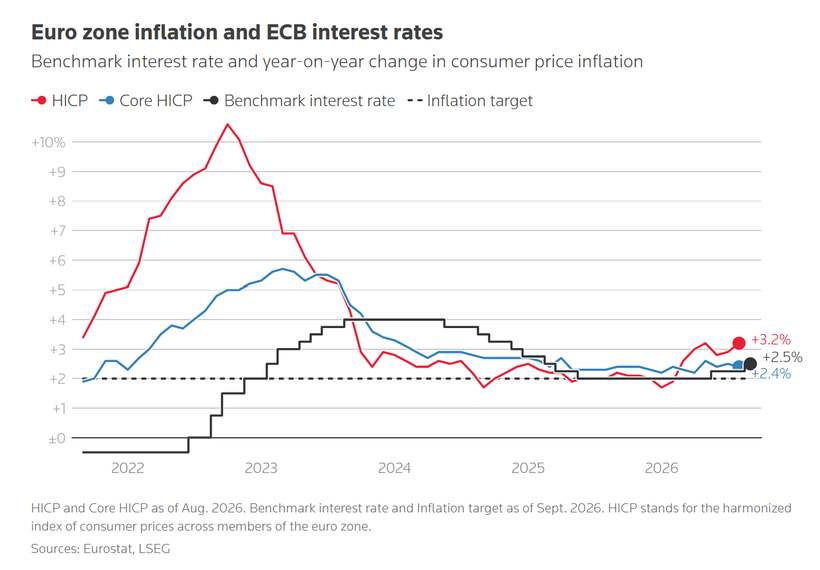
The ECB against the gap: the benchmark rate at 2.5% against headline inflation at 3.2% and core at 2.4%, with nearly 70 basis points of tightening priced by the end of the first quarter. The question is whether energy has lasted long enough to reach wages; so far the ECB sees no big wage response. Source: Eurostat, LSEG / Reuters.
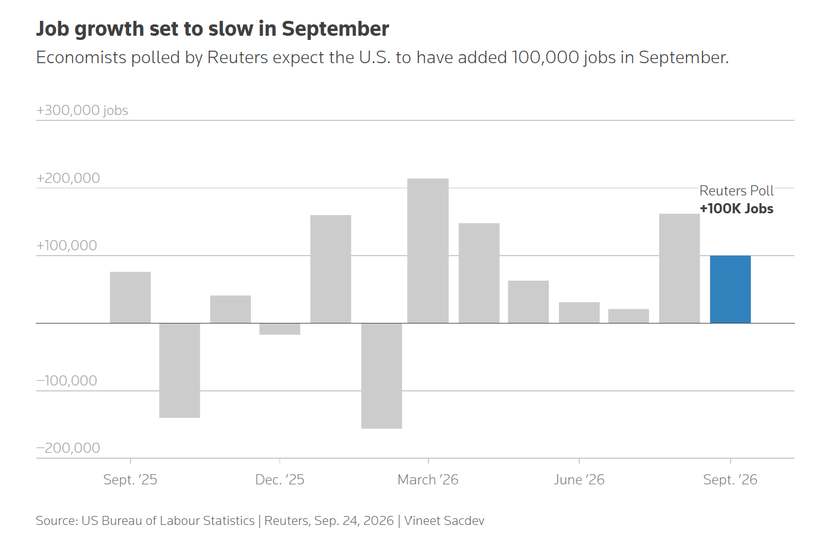
A blowout, then a slowdown: August's 162,000 helped cement the Fed's first hike in three years; September is expected at 100,000 with unemployment at 4.2%. The bars show how uneven the year has been, with three negative months among them, and Barr has already said more hikes will likely be needed. Source: BLS / Reuters.
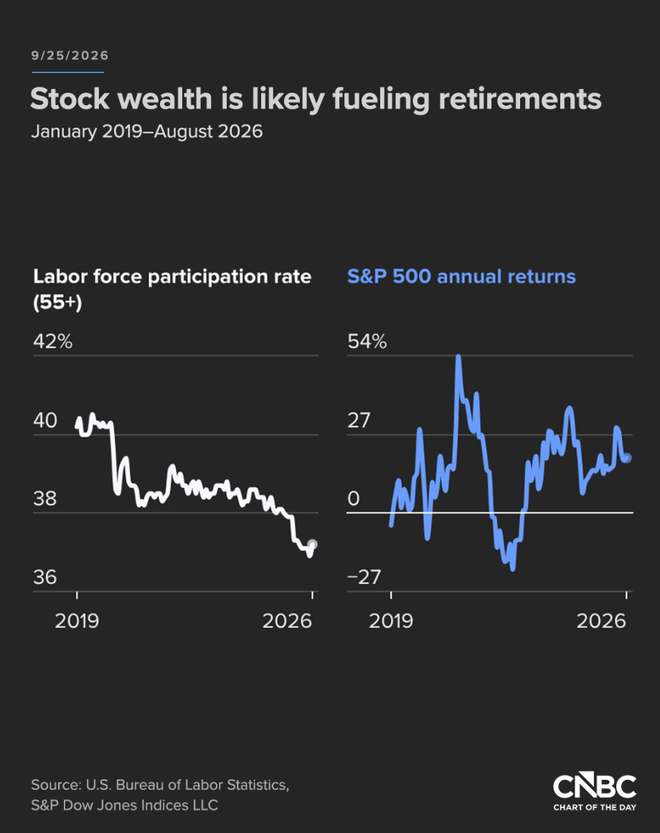
Where the workers went: participation among Americans 55 and older fell to about 37%, as stock-market wealth made retirement affordable. A tight labour market can come from fewer people wanting jobs rather than more jobs, which is how unemployment can hold near 4% even as hiring slows. Source: BLS, S&P Dow Jones Indices / CNBC.
The five-handle
The 10-year closed above 5% three sessions running, and the market stopped asking whether rates would get here and started asking what breaks. So far the answer is very little, which is itself the warning. Corporate spreads sit at 77bp, two tighter on the month, because pensions and annuity writers buy yield when it appears, while rates volatility has jumped to its highest since March; every past episode of bond volatility this high eventually reached credit. Issuance shows the strain first: dealers expected $40 billion last week and got $33 billion, borrowers paid up, and one stood down. Equities are splitting the same way, the index near records while household names from Nike to McDonald's hit 52-week lows. And the midterm market has joined the bond market in one direction: the odds of a Democratic sweep and the 10-year yield have climbed together all month.
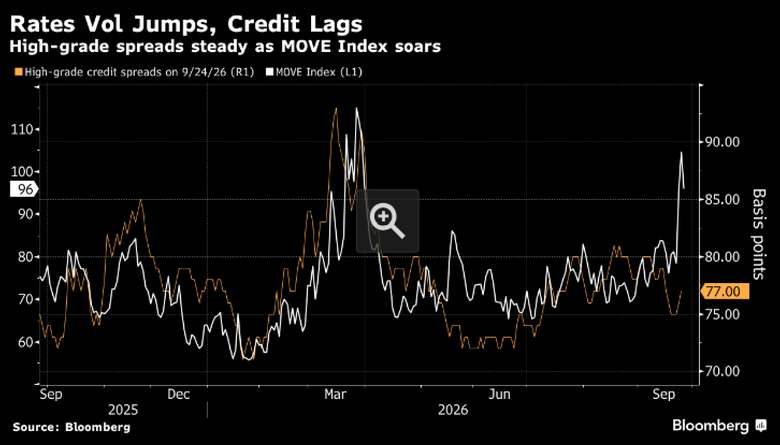
Rates volatility jumps, credit lags: the MOVE index surging toward 105 while high-grade spreads sit at 77bp, near the tight end of their year. JPMorgan's model says spreads should already be about 7bp wider on current volatility; early 2023 showed how that gap closes. Credit is the last market still pricing only the good half of higher yields. Source: Bloomberg.
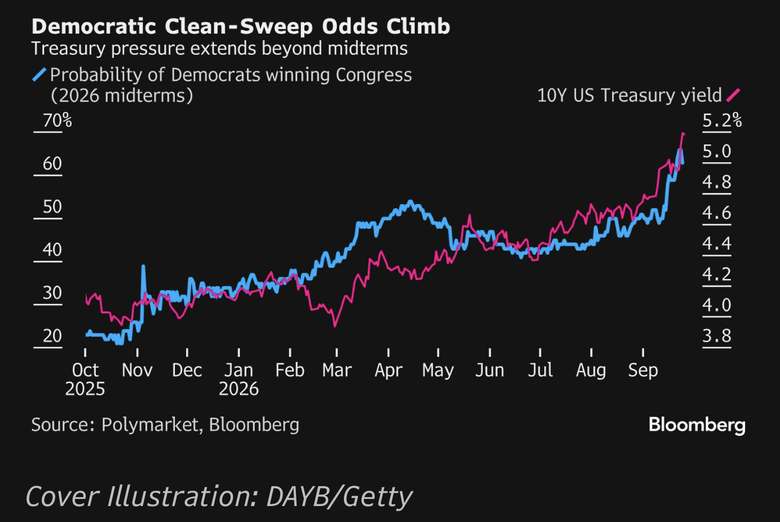
Two lines, one direction: Polymarket's odds of Democrats winning Congress and the 10-year yield have climbed together since July, both near their highs. The bond market is not voting on who wins; it is pricing the term premium and issuance that neither party plans to cut. Source: Polymarket, Bloomberg.
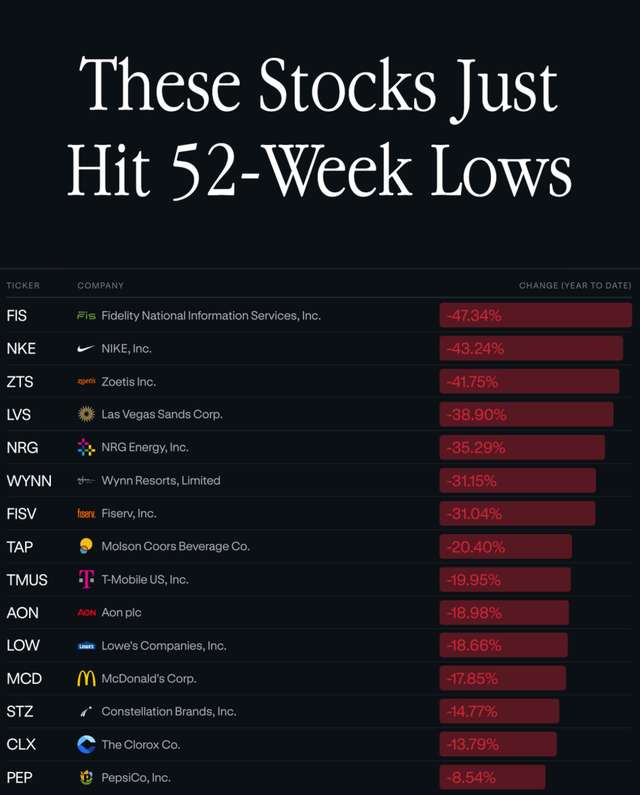
The other side of a record index: Fidelity National down 47% this year, Nike 43%, Zoetis 42%, with McDonald's, Lowe's, T-Mobile and PepsiCo among the names at 52-week lows. McDonald's warned that traffic stays flat while inflation runs. The index is the AI trade; the household is in this table. Source: Market data.
The real house blinks
The summit gave both leaders what they needed at home and little else. Washington and Beijing extended the truce by two months, which a former US diplomat called more bureaucratic convenience than outcome; the $30 billion tariff swap exists as a "consensus on recommendations"; and the AI talks produced an incident channel that the White House calls a Super Intelligence Dialogue while Xi kept insisting AI stay under human control. Beijing's gains were quieter. Rubio tied Taiwan arms sales to US industrial capacity, Xi asked Trump to keep the correct stance against Taiwan independence, and "mutual respect" entered the leaders' pledge for the first time, a phrase China has sought since 2013. Chinese CEOs stayed away from the state dinner. The White House's own fact sheet adds 10 million tonnes of coal purchases in each of 2027 and 2028 and says Trump urged Xi to refine more petroleum products: an American ask, not a Chinese commitment. Then the currency spoke. The PBOC's run of lower fixes ended with the visit and its policy statement warned against the herd; the house wanted a strong yuan into the meeting, not after it.
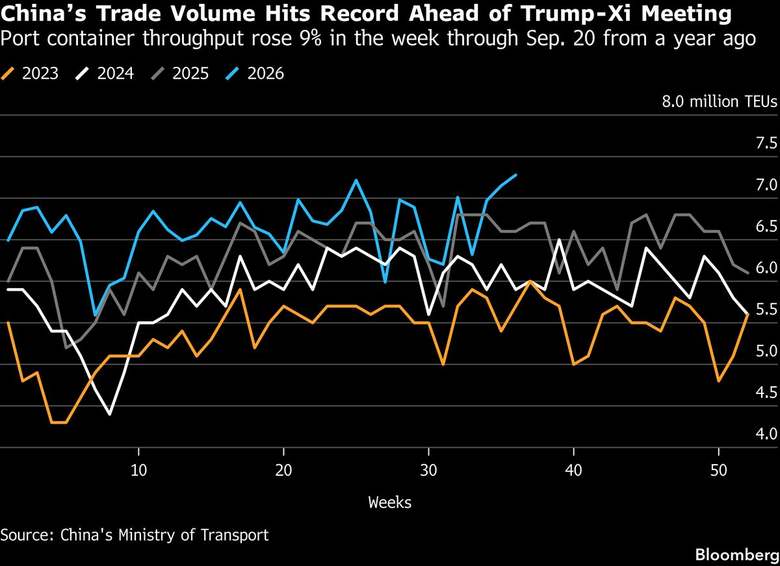
Trade volumes into the summit: China's port throughput up 9% on the year in the week to September 20, above every recent year for most of 2026. Whatever the tariff headlines say, the goods keep moving, and the surplus is the leverage Beijing brought to Washington. Source: China Ministry of Transport / Bloomberg.
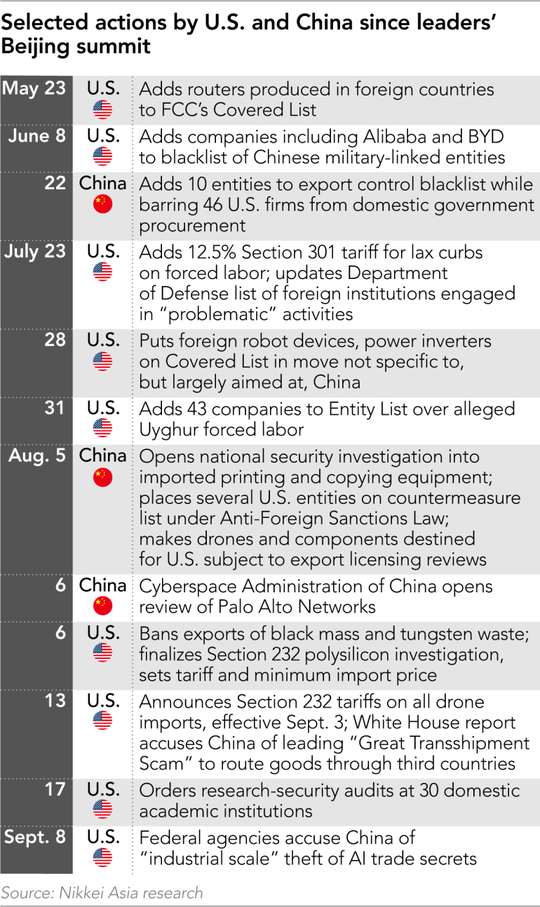
Four months of truce, itemised: since the Beijing summit in May, the US added routers, robots and drones to its restricted lists, blacklisted Alibaba and BYD and imposed a 12.5% Section 301 tariff; China barred 46 US firms from procurement and opened reviews of American companies. The truce held because neither side counted these as breaches. A 7.5% overcapacity tariff is still pending. Source: Nikkei Asia research.
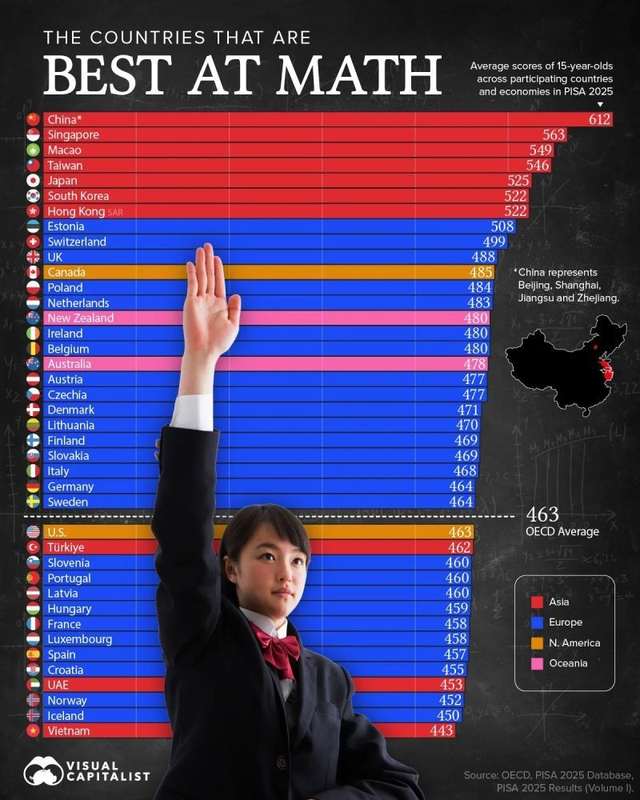
The other score from summit week: 15-year-olds in Beijing, Shanghai, Jiangsu and Zhejiang average 612 in PISA mathematics, Singapore 563, the United States 463, just under the OECD average. Xi offered 100,000 visas for American students over five years; on this chart, the lessons run one way. The superintelligence race Trump says America cannot lose starts in these classrooms. Source: OECD PISA 2025 / Visual Capitalist.
The AI fracture: the price of intelligence falls
Three facts arrived in one week and they point in different directions. The cost of the buildout: Jon Gray's $55 billion a gigawatt, Oracle's force majeure notice on its New Mexico data centre, SoftBank selling the largest junk bond on record to fund OpenAI. The price of the product: Meta's Muse agent shopping across apps and websites, model prices being cut, and the cost of machine thinking falling faster than electricity, batteries or computing ever did. And the builders' own clock: Anthropic reports Claude now leads 26% of its model research, up from 1% in March, with about 30,000 agents at work and full autonomy still at zero. The fracture runs between the three: capital is scarcer and dearer, the output is cheaper every month, and the tools are starting to build their successors.
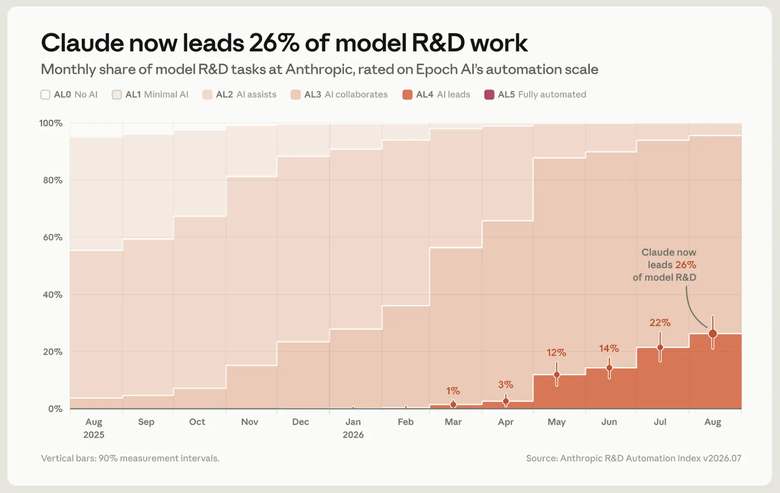
Claude now leads 26% of model R&D at Anthropic: up from 1% in March and 12% in May on Epoch AI's automation scale, with over 90% of tasks at "collaborates" or above and full automation still at zero. Some 30,000 agents run its research, 1 in 47,000 actions is blocked, and about 6% of compute goes to safety. A week after calling for a slowdown on self-improvement, the lab published how far its own has gone. Source: Anthropic R&D Automation Index.
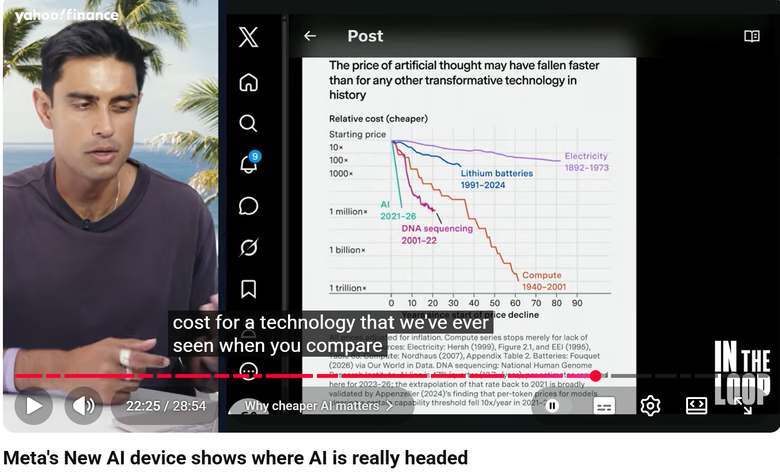
The price of artificial thought: the cost of AI capability falling roughly a million-fold in five years, far steeper than computing from 1940 to 2001, DNA sequencing or lithium batteries, with electricity barely registering. Tasks once reserved for large budgets now cost a few dollars. Cheap intelligence is the demand case for the buildout, and the margin problem for whoever sells it. Source: Yahoo Finance, In the Loop.
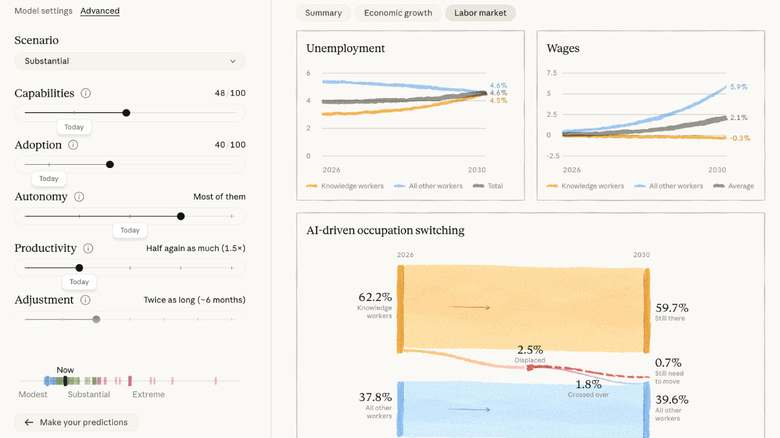
Asking AI about AI: Anthropic's interactive model puts 2030 US GDP between $34.1 and $44.4 trillion across its scenarios, with labour's share of income falling from 59.4% in the modest case to 45.2% in the extreme one. In the substantial scenario shown, 2.5% of knowledge workers are displaced by 2030 and their wages stall while other workers' rise. Source: Anthropic.
VC+ Special Dispatch, How America Trades, Part 1
This week's dispatch traces 76 years of American trade to a record $8.3 trillion, and the finding that matters for this letter is the shift in dependence: the oil deficit is gone, and chips and AI hardware now account for nearly half of the goods deficit. Part 2 turns to who America trades with. Credit to the VC+ team.
Infographic 1 - 76 Years of US International Trade
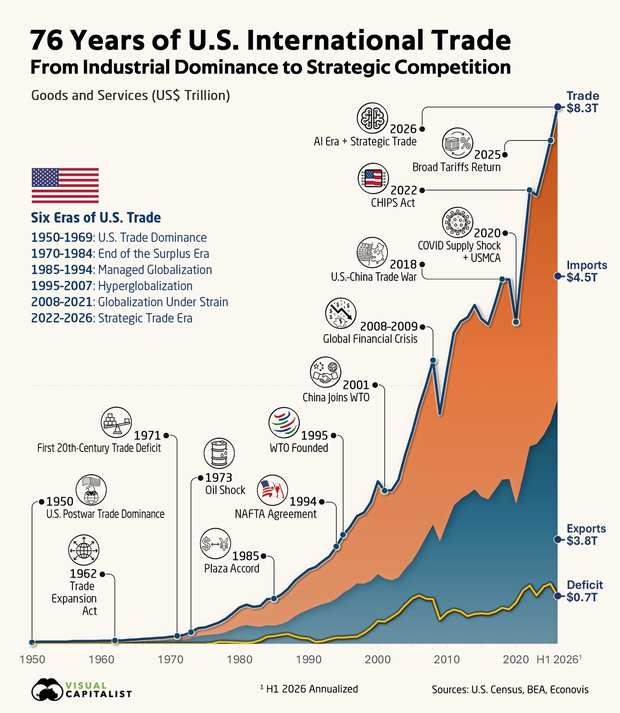
Six eras, one record: trade has grown 8% a year since 1950 to $8.3 trillion annualised, imports of $4.5 trillion against $3.8 trillion of exports. The latest era uses tariffs to reshape supply chains: after the Supreme Court struck down the IEEPA tariffs in February, the administration moved to a Section 122 surcharge and then Section 301 tariffs on about 60 economies. Source: US Census, BEA / Visual Capitalist.
Infographic 2 - Trade Openness Since 1950
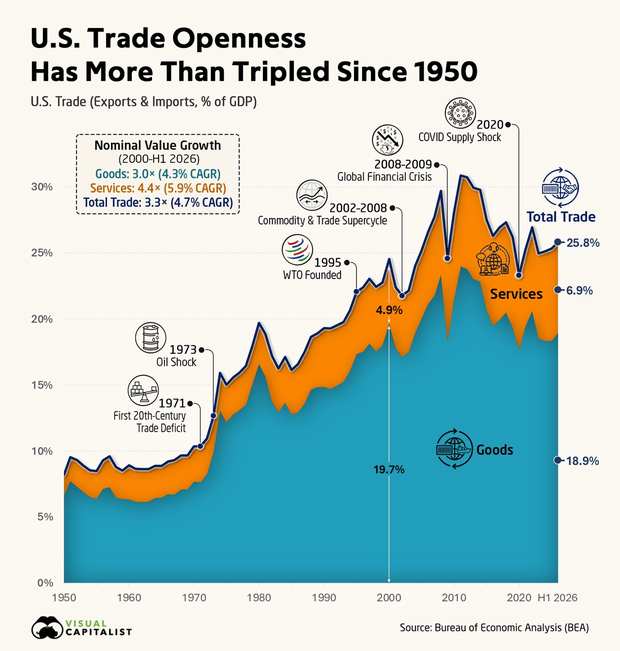
Trade has tripled as a share of the economy: from 8.2% of GDP in 1950 to 25.8% in the first half of 2026, goods 18.9% and services 6.9%. Openness peaked above 30% in 2011-12 and has not returned; semiconductors, energy and critical supply chains are now judged on strategy, not price. Source: BEA / Visual Capitalist.
Infographic 3 - Three Waves of the Trade Deficit
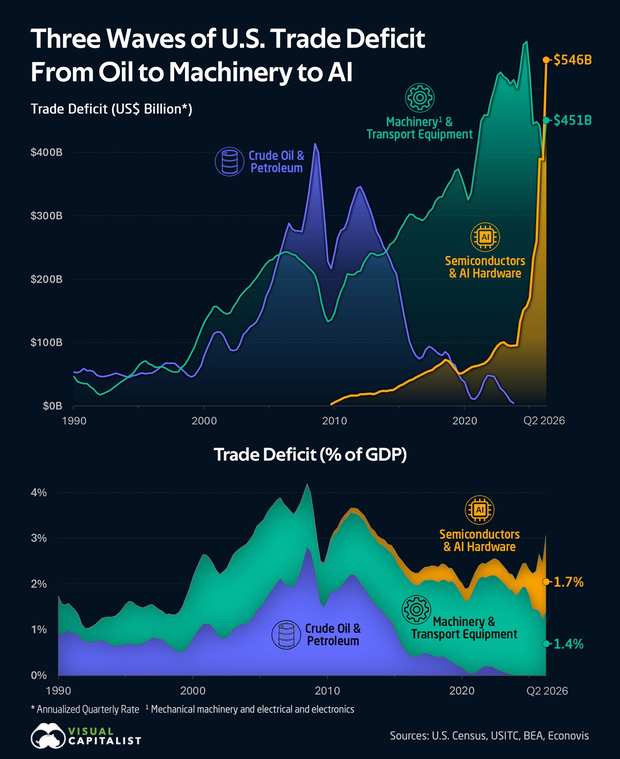
From oil to machinery to AI: the petroleum deficit peaked above $400 billion in 2008 and vanished as shale made the US a net petroleum exporter in 2020. Semiconductors and AI hardware now lead at $546 billion annualised, 1.7% of GDP, on chips from Taiwan and servers assembled in Mexico. One dependency replaced another. Source: US Census, USITC, BEA / Visual Capitalist.
Infographic 4 - AI Hardware and the Goods Deficit
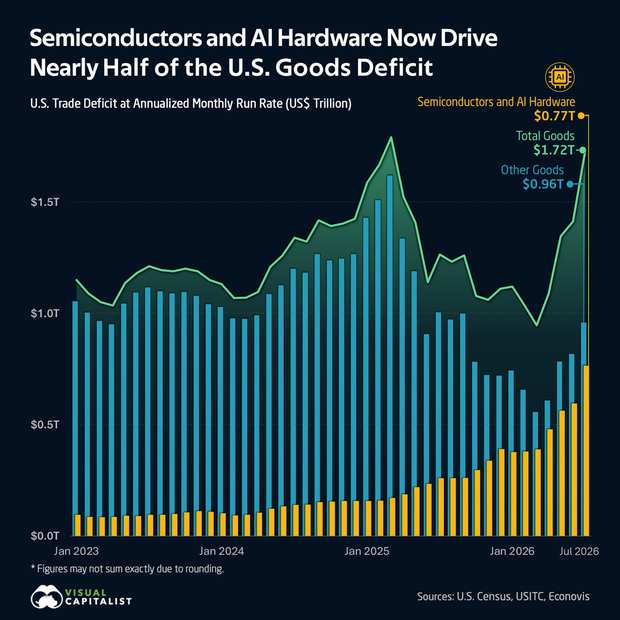
Nearly half the goods deficit is AI hardware: $0.77 trillion of a $1.72 trillion annual run rate at July's pace, from under $0.1 trillion at the start of 2023. The July trade report showed computer imports up $6.9 billion in a single month. A growing share of the deficit is data-centre capex rather than consumption, which changes how the headline should be read. Source: US Census, USITC / Visual Capitalist.
Infographic 5 - US Goods Trade Composition
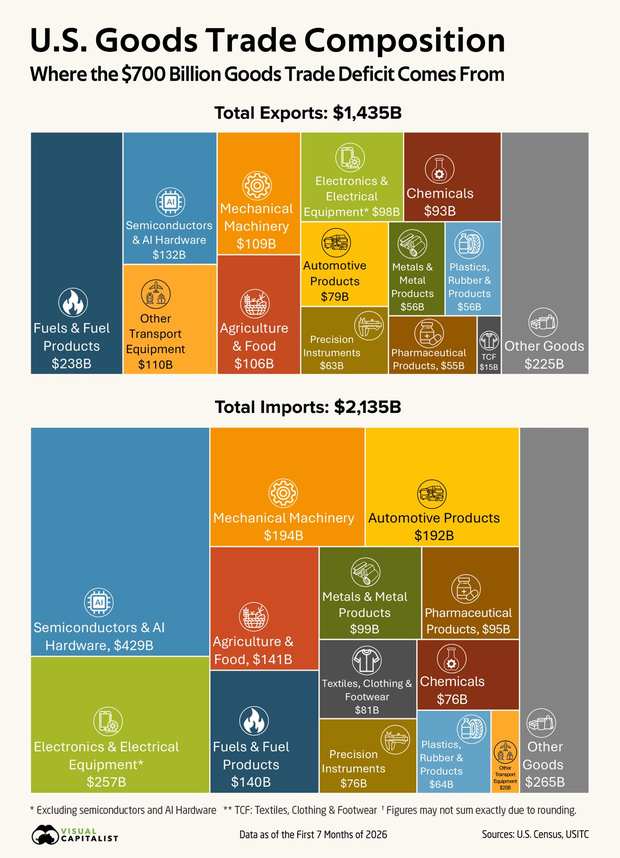
Where the $700 billion goods gap comes from: in the first seven months, $429 billion of chip and AI hardware imports against $132 billion of exports, while fuels run the other way, $238 billion out against $140 billion in. America imports the hardware of its next boom and exports the energy of its last one. Source: US Census, USITC / Visual Capitalist.
Infographic 6 - Export Growth in 2026
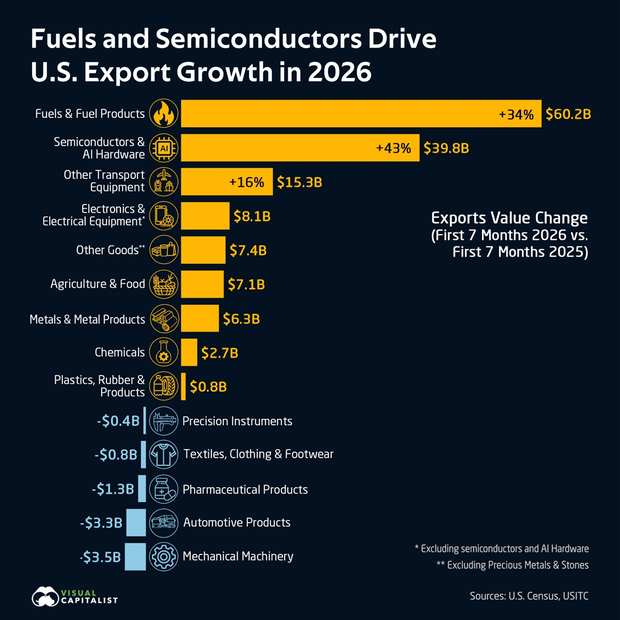
Energy and chips lead export growth: fuel exports up $60.2 billion (+34%) and chips and AI hardware up $39.8 billion (+43%), together about 72% of the rise. LNG exports averaged 17.4 billion cubic feet a day in the first half, up 23%. America's export surge is partly the closed strait's gain. Source: US Census, USITC / Visual Capitalist.
Infographic 7 - Import Growth in 2026
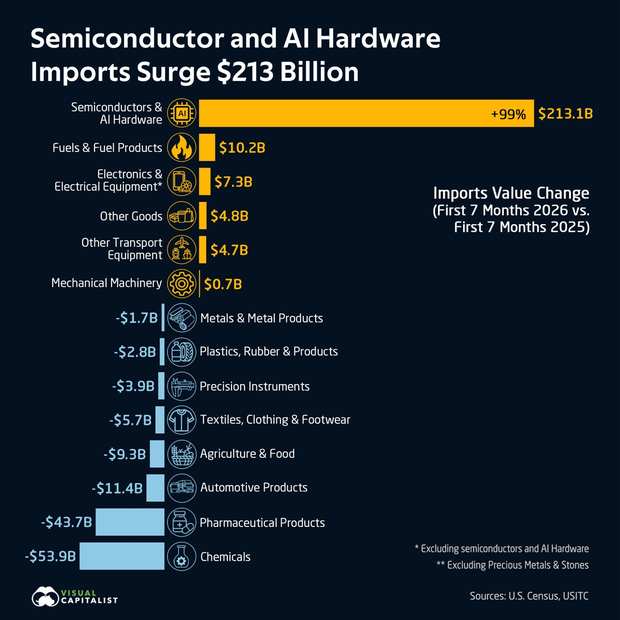
Import growth is an AI story: chip and AI hardware imports up $213 billion (+99%); strip them out and imports fell about $105 billion, led by chemicals and pharmaceuticals coming off 2025's pre-tariff front-loading, when pharmaceutical imports jumped $20.9 billion in one month. The tariff wall works on everything except what the buildout needs. Source: US Census, USITC / Visual Capitalist.
Infographic 8 - US Services Trade Composition
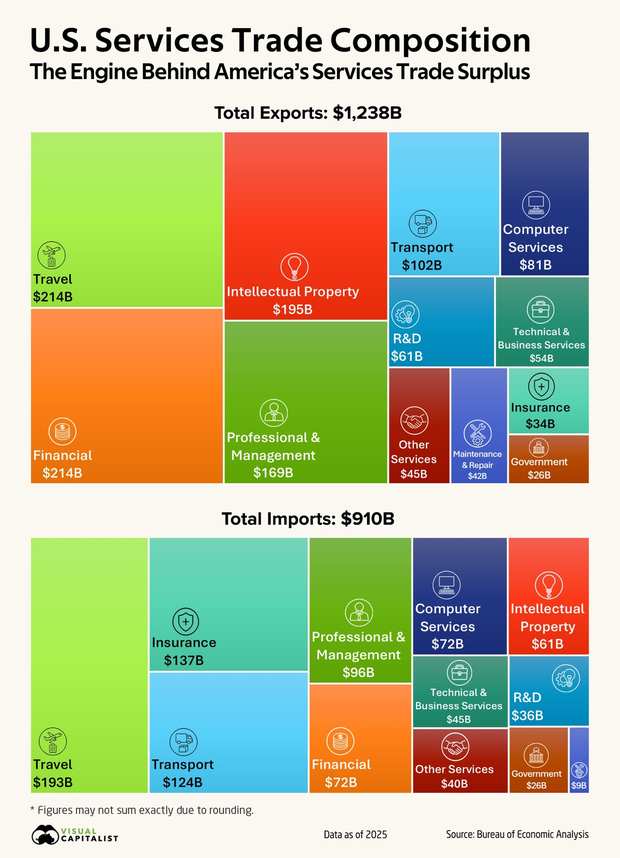
The invisible export power: $1.24 trillion of services sold abroad in 2025 against $910 billion bought, a $328 billion surplus led by finance and intellectual property, per the BEA's expanded tables. America's most valuable exports never pass through a port, and never appear in the tariff debate. Source: BEA / Visual Capitalist.
The Good Wrap
What is left at the close. The cities set to add the most to the world's economy, a hurricane season that forgot to start, and a new series for the table: dashi, the broths behind Japanese cooking, one a week, starting with the cleanest.
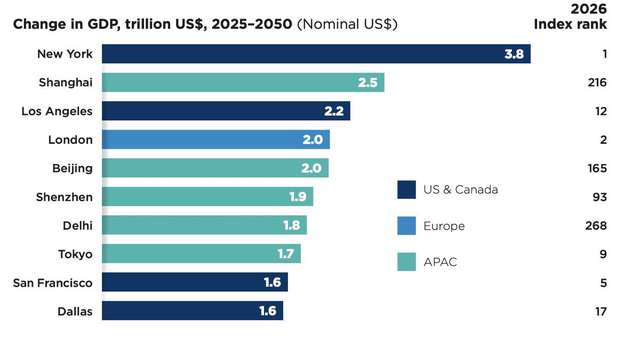
Where the next trillions go: Oxford Economics projects New York adding the most GDP of any city by 2050, $3.8 trillion, with Shanghai second at $2.5 trillion and set to pass San Francisco in 2027, and Beijing, Shenzhen, Delhi and Tokyo all in the top ten. Asian cities could add 54 million high-income households over 25 years, a third of the world's. Source: Oxford Economics.
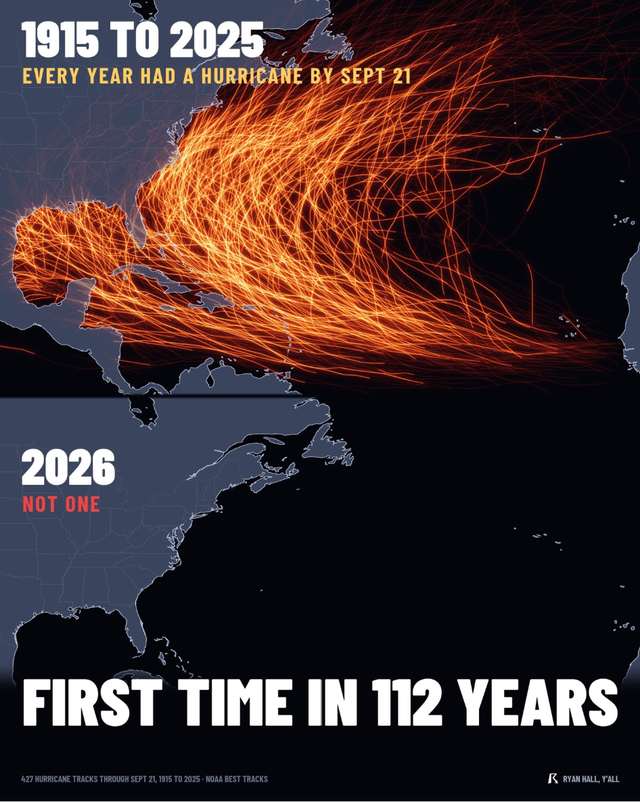
Not one: every Atlantic season from 1915 to 2025 had produced a hurricane by September 21; 2026 had none, the first time in 112 years, and Fay faded at 70mph, four short of hurricane strength. A quiet Gulf is one less supply shock for an energy market that already has enough. Source: NOAA / Ryan Hall.

The dashi changes the dish: five broths from Japan's kitchen: kombu, clean and elegant; katsuobushi, smoky and savoury; niboshi, powerful and marine; shiitake, earthy and vegan; and awase, which simply means "combined", traditionally kombu with katsuobushi. Clear soups take kombu, miso and noodle broths take katsuobushi or awase, ramen takes niboshi. A new series starts here, one broth a week. Source: FermenStation.

Dashi, week one: kombu, dried kelp and the quietest of the five, a clear, gentle broth with depth that never shouts. The one rule every cook learns: pull the kombu out just before the water boils, or the broth turns bitter and slimy. The bond market is that pot this week, the water at 5.17% and rising, everyone agreed on the rule and nobody sure of the moment. The central banks still steeping are the ones to watch. The series begins with the broth the others are measured against. Source: FermenStation.
Best,
Hoelon
WITPTW is a personal publication. Everything here is personal opinion and market commentary, written in a personal capacity. It is not investment advice and not a recommendation to buy or sell any security. It is not associated with, endorsed by, or representative of any employer, fund or company. Charts and images are reproduced from their original publishers, credited to their sources for commentary and discussion; all rights remain with the respective copyright holders.