Between Zero and Zero
Personal views and market commentary. Not investment advice. Not associated with any employer or firm.
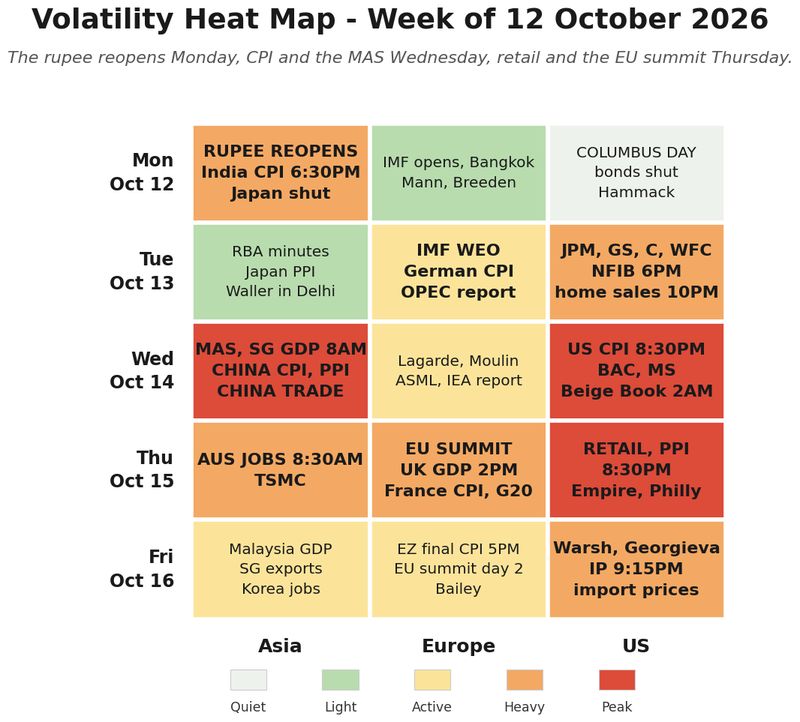
Volatility heat map for the week ahead , sessions as we trade them from here. Monday runs at half speed with Japan and US bonds shut, but the rupee reopens under the RBI's new rules. Wednesday stacks the MAS, Singapore's GDP, China's prices and trade and US CPI into one day, and Thursday brings retail sales and PPI with the EU summit. The S&P enters near 7,810 and the 10-year near 5.24%.
"We are living through an era when international law and human rights are under significant political attack." — Navanethem "Navi" Pillay, 2026 Nobel Peace Prize laureate, on Friday. The prize honoured international law on Friday. Washington sanctioned its court the same day. Pillay, 85, heard the news at Nuremberg's Palace of Justice, where the Nazi leaders were tried. She defended apartheid's opponents, sat as a judge on the Rwanda tribunal and the International Criminal Court, then served as UN human rights chief. Hours later, Rubio announced the first US sanctions on the ICC as an institution: "Either the ICC will end its threats, or we will end the ICC." They take effect in 180 days unless the court's members meet Washington's objections. The measures were months in the making, so the timing may be a coincidence. Or it may be the message.
"Rates are going up. A lot of demand for capital, a lot of government financing... Risks from AI went up 10-fold after Mythos." — Jamie Dimon, JPMorgan CEO, on Bloomberg Television on Tuesday. The banks report their best quarter in years this week, and their shares are falling. Dimon named both reasons. The first is a contest for capital: JPMorgan sees AI spending rising from about $700 billion this year to $1 trillion next, while Washington borrows $2 trillion again. Higher rates for productive investment can be healthy, Dimon says; borrowing for consumption feeds inflation, and the pressure will keep building until it reaches credit spreads. The second is a cost nobody budgets for: AI found vulnerabilities banks did not know they had. Profits are expected up as much as 20%, yet the KBW Bank Index sits 13% below its August peak.
"The probability of rates coming down is between zero and zero." — Paul Tudor Jones, founder of Tudor Investment, at a bank's conference last week. He is selling every rally in bonds, and says only an accident stops it. Tudor Jones says it feels like October 1999: tech exploding, the rest of the economy standing still, a Fed moving slowly. His case is about who borrows and who pays: SpaceX's secured two-year paper yields 8.5%, so why own France or Germany? Deficits near 7% cannot run forever, and each 100bp adds to both interest costs and issuance. Applying Soros's reflexivity, he sells every rally in bonds, because the spending stops only after an accident. Equities, he says, have not yet priced what 7.5-8.5% borrowing costs mean.
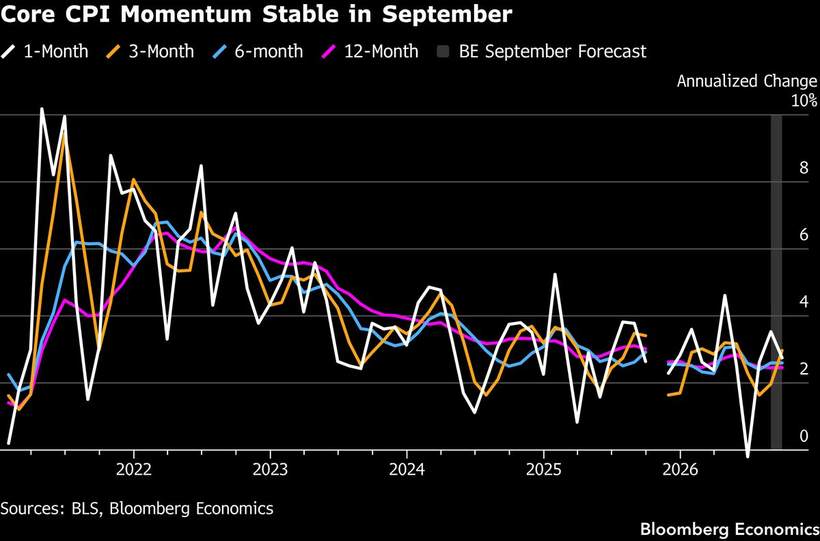
The headline will run hot. The question is whether core follows. Bloomberg Economics sees September CPI up 0.6% on Wednesday, lifting the annual rate to 3.7%, with core up only 0.2%. On that forecast, core's momentum (1-month white, 3-month orange) stays near the 2.5% annualised pace it has held for two years. That is the case for patience: an energy shock, not a broad price spiral. The pipeline says otherwise. Both ISM price gauges are back near their 2022 levels, and New Yorkers expect 3.9% inflation over the next twelve months, the most since May 2023. Source: Bloomberg Economics.
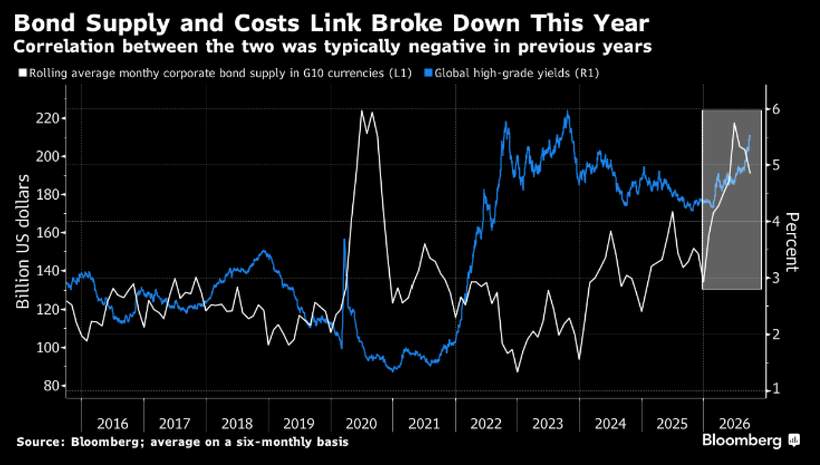
The safety valve has stopped working. For a decade through 2025, companies sold fewer bonds when yields rose, which gave investors a break from new supply. This year the two lines climb together: $1.69 trillion of US corporate bonds sold, up 30%, while average yields rose 1.2 points to 5.97%. The AI borrowers don't care about price, and SpaceX and Broadcom both lined up jumbo chip financings this week. Everyone else is backing off. Only $11.4 billion was sold in the US against $25-30 billion expected, and Europe trailed even the most pessimistic forecast. Below the surface, loans trading under 60 cents reached $65 billion, the most since March 2020. Source: Bloomberg.
What is the plan this week?
Global views are lining up behind one consensus: rates go higher, US equity breadth is alarmingly narrow, and a large correction is the clear and present danger. This week the people who shape that consensus are in one room. The IMF and World Bank bring finance ministers, central bankers and bank chiefs to Bangkok, and my guess is they leave having reinforced each other: capital is short, debt is high and rates stay up. When that many decision makers say it together, the theme has plenty left to run.
The dollar is more divided, between the hard-core debasement bears and the carry longs. The Fed is data dependent for October, and recent Fedspeak, with forward guidance still alive, has taken the odds of a hike down to about 20%. But Warsh is clearly led by credibility and is sticking to inflation targeting, and he speaks with Georgieva in Bangkok on Friday, after the inflation data and on the eve of the blackout.
We are three weeks from the midterms, and a Democratic sweep is now seen as negative for stocks, with turmoil to follow as a new Congress tries to unwind the Trump administration. The fuel bill is the campaign. Trump has turned to Putin for diesel, waiving sanctions for cargoes he puts at about 13.5 million barrels, and on Saturday told Zelenskyy to stop hitting Russian refineries and said Ukraine needs a new president; Europe is left holding the sanctions line alone. He has also promised no attack on Iran before November 3, but the Middle East escalated again over the weekend. A missile hit Riyadh's airport terminal on Saturday, the third strike there in a week and the deadliest attack in the kingdom in more than a decade.
This week US CPI and PPI could surprise to the upside, bring October back to 50/50 and give the dollar the push it needs to continue its upside breakout. If the surprise comes, it will be in the core. Bank earnings start on Tuesday, with the focus on trading income, which is seen falling by almost a fifth at JPMorgan, and on deal fees now that the IPO window has cooled. The regionals on Thursday will show whether deposit costs are eating the gains from higher rates.
Asia has its own week. The RBI went after the rupee at 3:55am on Saturday with a China-style reserve on dollar hedging, and Monday's open is the first test; more on that below. India's CPI the same evening is seen at about 5.7%, a three-year high. Hurricane Isaias halved refining on the US Gulf Coast and put crude back near $104, above the $85 most Asian central banks assumed, and the El Niño index has already passed its 1997 and 2015 peaks, a food shock that reaches the region's inflation early next year. The MAS decides on Wednesday, with a very slight steepening of the slope the consensus and Singapore growing above trend for a sixth straight quarter. China's PPI the same day is seen near 4.4%, the fastest since mid-2022.
In Europe, the question has moved from whether the ECB will speak to whether it will act. Lagarde said on Thursday that it has the tools to counter unwarranted moves; the Bank of France's own governor said the conditions are not met. Both are in Bangkok this week: Moulin speaks on European policy on Wednesday, and Lagarde is on stage that day and at the G20 on Thursday. EU leaders meet in Brussels on Thursday and Friday to decide whether China's offer to halve its hybrid exports is enough to hold off tariffs. France's and the euro area's final inflation figures land on Thursday and Friday, against an ECB the market no longer prices to hike before February.
The plan this week is to see whether global rates get a pullback, a break from the recent push higher, and whether equities survive the recent calls for a correction. I am looking for a dip to get back into USDCHF and USDJPY longs. There are great opportunities lying around. Stay sharp.
What did I learn last week?
Mon Oct 5: Brazil's first round put Flávio Bolsonaro ahead of Lula, 47% to 45%, and sent them to a runoff on October 25. Quebec elected a Parti Québécois minority, short of the majority a referendum needs. Sánchez called a snap Spanish election for November 29 after his housing decrees failed. A fresh attack halted Saudi Arabia's East-West pipeline, Riyadh's route around Hormuz, a day after the Saudi-led offensive in Yemen began. ISM services eased to 54.9, but prices paid rose to 74, the highest since July 2022.
Tue Oct 6: The 3-year auction cleared at 4.93%, against 4.47% a month earlier. The FT reported SpaceX lining up $40 billion, led by Apollo, to buy Nvidia chips. Skydance closed its purchase of Warner Bros. Discovery. The US trade deficit came in near $102 billion.
Wed Oct 7: The RBI hiked to 5.50%, unanimously, its first increase since 2023, and moved its stance to "calibrated tightening". The Fed's September minutes said officials had not seen enough inflation progress and most expect another hike this year, yet they read as milder than feared, with more worry about the run-up in yields. The 10-year reopening cleared at 5.30% on strong demand. The EU prepared a temporary cap on Chinese hybrids, and Samsung's preliminary operating profit came in near 107 trillion won, just short of forecasts.
Thu Oct 8: Trump ruled out striking Iran before the vote while the NYT reported a Pentagon plan for three days of strikes and three carriers on the way. Houthi strikes on Riyadh's airport and a Saudia jet killed three, including a pilot. Lagarde told finance ministers the ECB has the tools for unwarranted, disorderly moves. The 30-year cleared at 5.62% on strong demand, Treasury's buyback took its maximum $6 billion for a second week, and the FT reported OpenAI's revenue run rate nearer $50 billion than $70 billion.
Fri Oct 9: China agreed to cut hybrid car exports to the EU by more than half and speed rare-earth licences, pending EU leaders' approval. Canada lost 68,300 jobs, a second monthly fall, with unemployment at 6.5%. Washington suspended sanctions on Russian diesel for a 3-million-ton delivery. Malaysia's budget raised this year's deficit to 3.6% of GDP on fuel subsidies and targets 3.3% next year. Michigan sentiment came in at 46.3, below forecasts, and Hurricane Isaias came ashore near Destin as a Category 2.
Weekend: The RBI's rupee package landed at 3:55am Singapore time on Saturday, after the rupee closed within a whisker of its record low. Russia partly lifted its diesel export ban, freeing 500,000 tons, while Germany and the UK restated their Russia sanctions.
All week: The S&P rose 1.2% after a record on Tuesday, the Dow 0.9% and the Nasdaq 0.6%. The 10-year touched a new cycle high above 5.35% midweek, then strong auctions gave it its first weekly fall in six, to 5.24%. The euro hit 1.1160, its lowest since May 2025, Beijing fixed the yuan at its strongest since February 2023, gold bounced 1.5% on Friday to about 4,190, and Brent held above $100. Grading the board: the RBI branch fired. The Saudi offensive launched, and the Houthis answered with strikes on Riyadh rather than a retreat from the strait. The ECB's language moved to "unwarranted" and France's spread came back to about 140bp, but the euro never squeezed. Italy stayed near 110bp, far from 150, while France now yields more than Italy by a record. ISM services fired neither branch, and Quebec's tail fired and retires.
What to look out for next week?
Mon Oct 12: The rupee reopens under the RBI's new rules, with the oil companies' dollar window open from today and 97 the line analysts expect it to defend. Japan is shut for Sports Day and US bonds for Columbus Day, while equities trade. The IMF and World Bank meetings open in Bangkok, the economics Nobel is announced, HCL reports, and Malaysia's palm oil board publishes September stocks. India's CPI at 6:30pm, seen near 5.7% from 4.8%: above 6% puts a December RBI hike in the price. Hammack and the Bank of England's Mann speak in Cleveland.
Tue Oct 13: The RBA's minutes and Japan's PPI open Asia, and Waller speaks in New Delhi. Germany's final CPI, then the IMF's World Economic Outlook and Global Financial Stability Report from Bangkok. JPMorgan, Goldman, Citi and Wells Fargo report before New York's open, with Johnson & Johnson and UnitedHealth; NFIB at 6pm, existing home sales at 10pm and the September budget statement, and Collins and Barkin speak. OPEC publishes its monthly report.
Wed Oct 14: The MAS and Singapore's GDP at 8am, China's CPI and PPI at 9:30am and its trade later in the day. Spain's and Sweden's CPI, Lagarde on stage in Bangkok and Moulin on Europe's policy challenges; ASML reports, the IEA publishes its oil report and meets over two days on the G7 stock release. US CPI at 8:30pm, consensus 0.6% headline and 0.2% core. Bank of America and Morgan Stanley report, Dimon speaks in Chicago, Bowman in Bangkok and Barkin in Richmond, and the Beige Book lands at 2am.
Thu Oct 15: Australia's jobs at 8:30am, unemployment seen at 4.7%, then TSMC's results and Japan's machinery orders. Britain's August GDP at 2pm, seen contracting, and France's CPI. EU leaders open their summit in Brussels with China's hybrid offer on the table, and G20 finance ministers meet in Bangkok. At 8:30pm, retail sales, PPI, claims, Empire and the Philadelphia Fed all at once; PNC, US Bancorp and Charles Schwab report, Hammack speaks, and Tesla unveils its new Roadster.
Fri Oct 16: New Zealand's food prices at 5:45am and Korea's jobs at 7am, then Malaysia's GDP, seen near 5.2%, and Singapore's exports. Euro-area final CPI at 5pm, seen at 3.8%, with the EU summit's second day and Bailey in Bangkok. Import prices at 8:30pm and industrial production at 9:15pm; Warsh joins Georgieva in Bangkok, the last Fed word before the blackout, and Uchida reads Ueda's remarks in Tokyo. Citizens, M&T, Regions, Truist and Travelers report, and Turkey, Jordan and the Netherlands face rating reviews.
Beyond next week
Oct 19: Alberta's referendum vote, on a Monday.
Oct 25-29: Brazil's runoff on the 25th, then China's Fifth Plenum from the 26th to the 29th.
Oct 28-Nov 6: One block, ten days: the Fed, the Bank of Canada, the RBNZ and Britain's budget on the 28th; the ECB and US Q3 GDP on the 29th; the BOJ and its Outlook Report on the 29th-30th; Treasury's borrowing estimates on November 2, the RBA, the midterms and the pencilled-in Iran date on the 3rd, the Riksbank and the refunding on the 4th, the BoE, Norges Bank and Bank Negara on the 5th, and payrolls on the 6th.
Nov 14: Malacca's state election, the first test of UMNO working with PAS.
Nov 18-19: APEC in Shenzhen, the third Trump-Xi meeting of the year, with Anthropic's listing due the same month.
Nov 29: Spain's snap general election, a second euro-periphery vote while France's budget is still unresolved.
Dec 11: The US stopgap funding runs out, and Sarawak votes in mid-December.
G10 rates at a glance
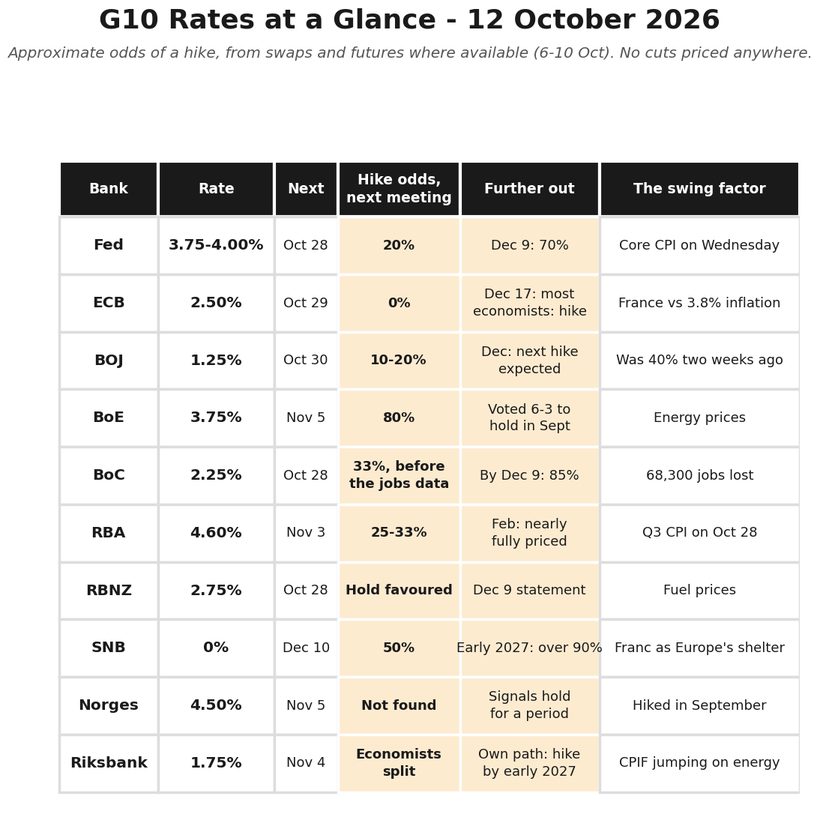
Ten central banks, no cuts priced anywhere. The hiking cycle is broadening, from the BoE at about 80% for November to the SNB's coin flip for December. The odds are snapshots from swaps, futures and polls taken between 6 and 10 October; where we found no market price, the cell says so. We will refresh it every week. Source: CME FedWatch, LSEG, ASX, CORRA futures, Reuters polls, central banks.
Regimes
The capital shortage, week nine: a pause, not a turn. The auctions finally found buyers last week, and the 10-year had its first weekly fall in six from a new high above 5.35%. The demand for capital is not slowing. Vanda Research estimates the private sector absorbed $1.58 trillion of duration-adjusted bonds in the year to September, up a fifth, and expects corporate supply, led by the hyperscalers, to overtake Treasuries as the main source of duration around the turn of the year. The extra pay for holding long bonds is the highest in more than a decade, and Bangkok will reinforce the theme this week. Core CPI decides the timing: at 0.2% the pause can run, at 0.3% the high gets retested. Still no outright duration. changed, week 9
The dollar goes two-way, week nineteen: the returns dollar. New highs for the year against the euro, the Canadian dollar, the krona and the kiwi, but the gains now come from everyone else's problems: France's spreads, Canada's 68,000 lost jobs, Banxico's dovish minutes. Asia is split: Beijing is fixing the yuan at its strongest since February 2023, while India is spending reserves to hold 97. Long USD against the funders stays; the exit is a soft core print. held, week 19
France, the euro's weak link, week two: words, not yet tools. Lagarde said the ECB has the tools for unwarranted moves; France's finance minister and its central bank governor both said the conditions are not met. The spread over Germany came back to about 140bp from 150, but France now yields a record 30bp more than Italy, and about 40% of French corporate bonds trade as if safer than the state. Spain votes on November 29, so watch its spread alongside Italy's. The exits are unchanged: a budget that survives parliament, tools moving from words to purchases, or contagion forcing the backstop. changed, week 2
The funding-currency battle, week four: the carry unwinds. Banxico's dovish minutes sent the peso to its weakest since November, near 18.50, the high-yielder paying again. The yen lost its rate support as the odds of an October BOJ hike fell to 10-20% from 40%, and USDJPY sits on its 200-day average near 158.5. I am out of the yen and franc legs and waiting for a dip to rebuild them. changed, week 4
The AI fracture, week fifteen: cheaper thought, dearer money. The cost of a given level of AI performance is falling about 47% a quarter, while the cost of financing the buildout rises. Hyperscalers are now about 39% of net US corporate bond supply, and if they borrow $700 billion net next year, as one Vanda scenario assumes, they alone would add almost twice the duration the Treasury does. SpaceX's $40 billion chip loan and an 11% leveraged loan for Volta Infrastructure came in the same week the FT said OpenAI's run rate is short of plan. The debt is still the tell. changed, week 15
The war is the inflation, week twelve: Riyadh under fire, Moscow pumping. The Saudi-led offensive began on October 4, and the Houthis answered with missiles on Saudi cities: three strikes on Riyadh's airport in a week and a pumping station on the East-West pipeline, the route around Hormuz. Washington is now managing the war premium politically, buying Russian diesel and leaning on Kyiv to stop hitting refineries: a cap on prices until the vote, and a risk after it. A correction to last week: Reuters' sources said more than 100,000 Yemeni troops could be mobilised, depending on the scale, not that they were. Brent held above $100 through it. changed, week 12
Surplus versus deficit, week seven: China offers Europe a quota. China agreed to cut hybrid exports to the EU by more than half and to speed rare-earth licences, the first time it has moderated exports before a trade fight rather than after one. EU leaders decide on Thursday and Friday whether it is enough. China's exports are still growing by a quarter, so the surplus has to land somewhere; the US truce runs to January 10, and APEC in Shenzhen is the next test. changed, week 7
Shifts (if then)
Last week's branches fired on the event more often than on the market. This week the board hangs on Wednesday's core print and on what the room in Bangkok says.
Core CPI at 0.3% or more → October goes back toward a coin flip, the 2-year retests its 4.96% high, and the dollar's breakout resumes, with USDJPY through 160. new
Core CPI at 0.2% or less → the pause holds, the 10-year extends its first weekly fall, and the dollar dips: the window to rebuild the USDJPY and USDCHF longs. new
The IMF raises its US and Asia forecasts on capex and chips → Bangkok's message becomes strong growth plus scarce capital, the long end stays heavy and curves steepen; another cut for the war keeps the stagflation framing and the front end in charge. new
Warsh tells Georgieva the job is not done → a December hike is fully priced and the dollar extends into the blackout; if he calls policy well placed, the front end rallies. new
Lagarde's "tools" become "transmission" in Bangkok → French spreads compress fast and the euro squeezes against crowded shorts; another week of "conditions not met" and 150bp is retested. new
USDINR holds below 97 all week → the reserve worked as a signal, importers defer, onshore forward points ease and rupee carry looks better again; a break of 97 forces heavier intervention and the next stage of China's playbook. new
The US joins Saudi strikes on the Houthis → the war widens before the midterms despite the Iran pledge, Brent and freight jump and gold gets its bid back; Houthi strikes alone keep the premium where it is. new
Tails
Retired this week: most of the old list had turned into calendars rather than tails. Iran after the midterms retires because the president has dated it himself; the midterm repricing, October rhymes and Indonesia to frontier retire as dates, and the AI credit accident and what breaks first fold into the regimes. Quebec fired and retires. The list below is new, and each one is something the market is not pricing. retired
A US-Iran deal before the vote → Trump talks of "productive discussions" and needs pump prices down by November 3. The market prices strikes after the midterms, not peace before them; a deal that fully reopens Hormuz would take the war premium out of oil in a session and the energy edge out of the dollar. new, week 1
Kyiv's leader pushed out → Washington is buying Russian diesel and has called for a new Ukrainian president. A forced change, or a US-Russia settlement over Europe's head, splits the sanctions front, puts more defence borrowing on Europe's bond markets and hits the euro. new, week 1
The Fed's independence goes to court → the White House has opened an investigation into Governor Lisa Cook. A move to remove her before the vote would push term premium up and the dollar down at the same time, and send gold back above the neckline. new, week 1
The buyer strike → last week's auctions held, and Treasury's buyback filled its maximum. A tail at a 30-year auction, in Washington or Tokyo, or a weak French syndication, is the accident the bond bears say is the only brake on the spending. new, week 1
A hit on Abqaiq → the Houthis have already reached a pumping station at Khurais. A strike on Saudi Arabia's main processing plant would take millions of barrels a day offline in an afternoon, as it did in 2019, with Hormuz still not back to normal. new, week 1
AI breaks into a bank → Dimon puts the cyber risk from AI up tenfold. One successful attack on a systemically important lender would turn the agent-driven deposit run from a thought experiment into a weekend. new, week 1
India's final stage → if 97 goes despite the new reserve, China's playbook says what comes next: heavier intervention, then a squeeze on offshore rupee funding and curbs on outflows. Asia's high-beta currencies would not sit still. new, week 1
Paris falls → a censure vote that brings down the minority government before the budget passes puts 150bp back in play within days, with Italy and Spain close behind. new, week 1
Rupee Monday: the RBI borrows China's playbook
At 3:55am Singapore time on Saturday, 1:25am in Mumbai, the RBI issued its strongest rupee defence since the 2013 taper tantrum, with the rupee a whisker from its record low of 96.965. The hour says how urgent it has become. The package has four parts. A foreign exchange risk reserve: on any rupee derivative above $2 million where the client buys foreign currency to hedge current-account payments, the bank must lodge 20% of the notional with the RBI in cash. A dollar window from Monday that meets the full daily needs of Indian Oil, BPCL and HPCL, taking the biggest buyers out of the market. A ban on rebooking cancelled forwards. And a cut in the limit for hedging without proof of exposure to $5 million from $100 million.
The target is the importer. When USDINR was one of the least volatile pairs in the world, hedge ratios fell; since it turned into a one-way climb, importers have raised them, buying every dip, which is why the dips stayed shallow. The reserve turns that demand into a cost. If the 20% earns nothing, as China's does, a bank funding at 7% loses about 1.4% of the notional and passes it on, so an importer who would have bought dollars at 97 now pays nearer 98.3. Most will wait. The rule applies onshore only, so onshore and offshore forward points should part ways.
China has used the same tool three times. The PBOC imposed a 20% reserve on banks' forward dollar sales on August 31, 2015, three weeks after its devaluation, frozen for a year at zero interest; it brought it back in August 2018, alongside the counter-cyclical factor in the daily fixing, and again in September 2022. Each time it slowed the slide rather than reversed it: the yuan kept weakening through 2016 until capital controls and a dollar top did the work, drifted to just under 7 in 2018, and fell to about 7.3 before the dollar peaked in November 2022. China's sequence runs from the fixing to the reserve to outright intervention, with a squeeze on offshore funding last, as in January 2016, when overnight offshore yuan rates hit about 66%. The reserve is an early-to-middle-stage signal. China cut its own to zero in March this year, to slow the yuan's rise.
The rupee should open stronger on Monday, and analysts expect 97 to hold. Keeping the gains is harder: oil is above $100, foreign funds have pulled more than $30 billion from Indian equities this year, the trade deficit is seen widening to about $30 billion, and CPI lands on Monday evening near a three-year high. The RBI is also further down China's path than the reserve suggests, having spent $51 billion of reserves in four weeks after a record $133 billion diaspora deposit drive lifted them to nearly $800 billion. The tool buys time; oil and flows decide the direction. Watch the gap between onshore forwards and the offshore market, and whether importers come back on the first dip.
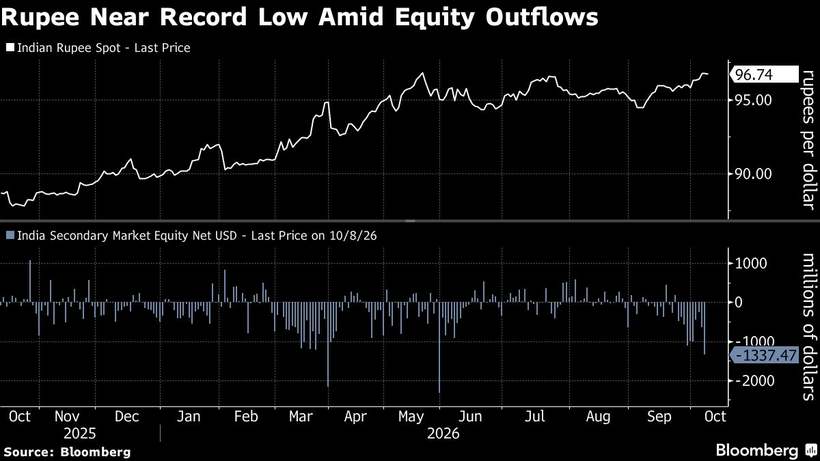
The rupee near its record low: down about 7% this year, the worst in Asia, and at about 96.74 on this chart against a record of 96.965, while foreign investors kept selling Indian equities, $1.34 billion on October 8 alone. Source: Bloomberg.
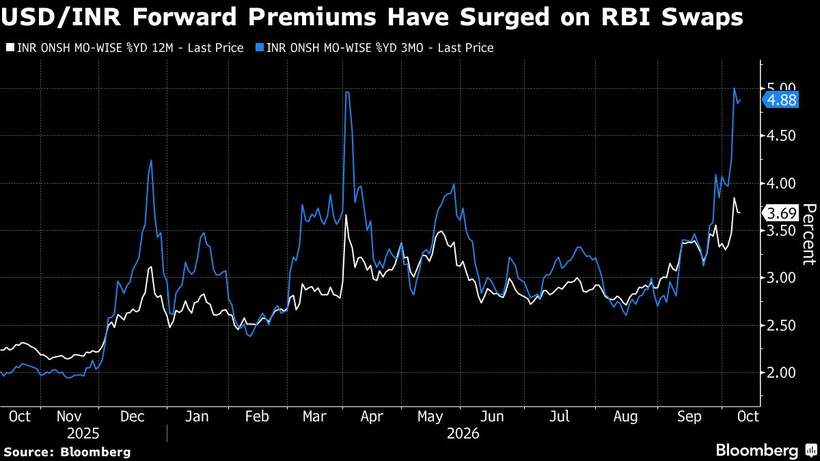
Hedging was already getting dearer: the 3-month USDINR forward premium near 4.9% annualised and the 12-month near 3.7%, the one-year cost up more than 100bp in two months as the RBI's sell/buy swaps soaked up surplus rupee liquidity. The new reserve comes on top. Source: Bloomberg.
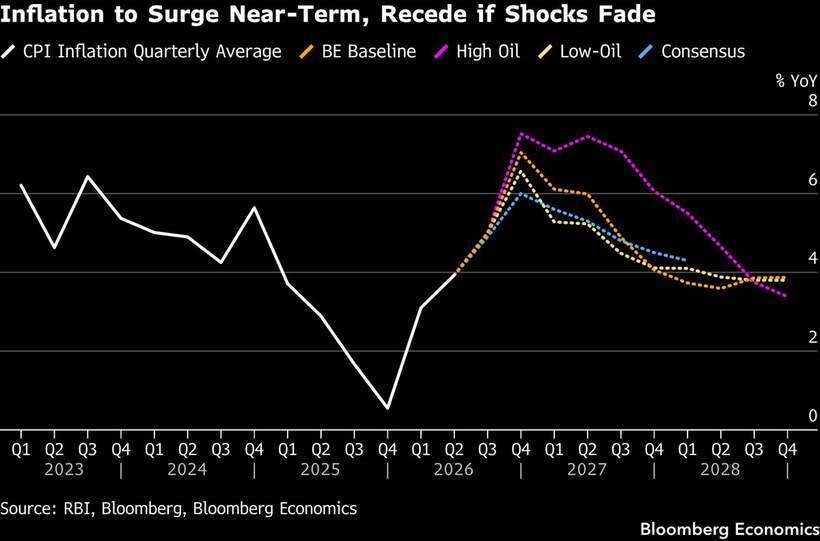
India's inflation, at 6:30pm: seen jumping to 5.5-5.7% from 4.8%, a three-year high, with Bloomberg Economics higher at 5.8%, on food prices after a 13% monsoon shortfall. Its baseline has the quarterly average peaking near 7% this quarter, and nearer 7.5% if oil stays high, before easing in 2027. That is the case for a second RBI hike in December. Source: RBI, Bloomberg / Bloomberg Economics.
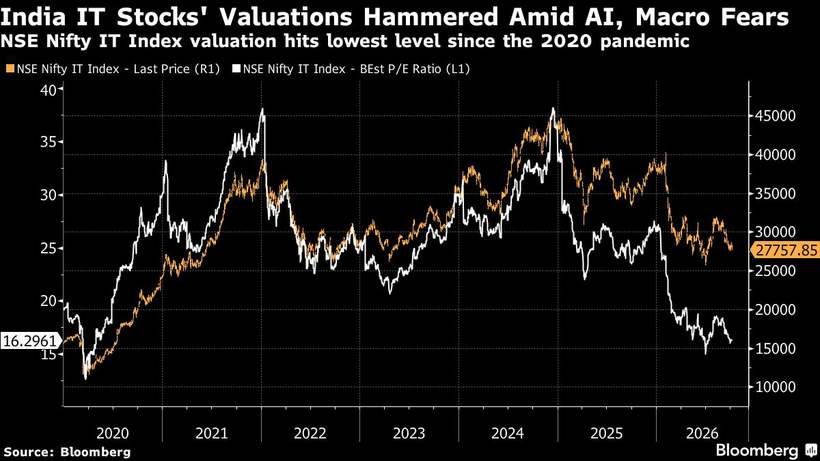
Indian IT at its cheapest since the pandemic: the Nifty IT index is down 27% this year and trades near 16 times forward earnings, the lowest since 2020, on fears that generative AI eats the outsourcing model, with new US visa limits on top. TCS beat on profit last week but grew revenue just 0.5% on the quarter; HCL reports on Monday. Source: Bloomberg.
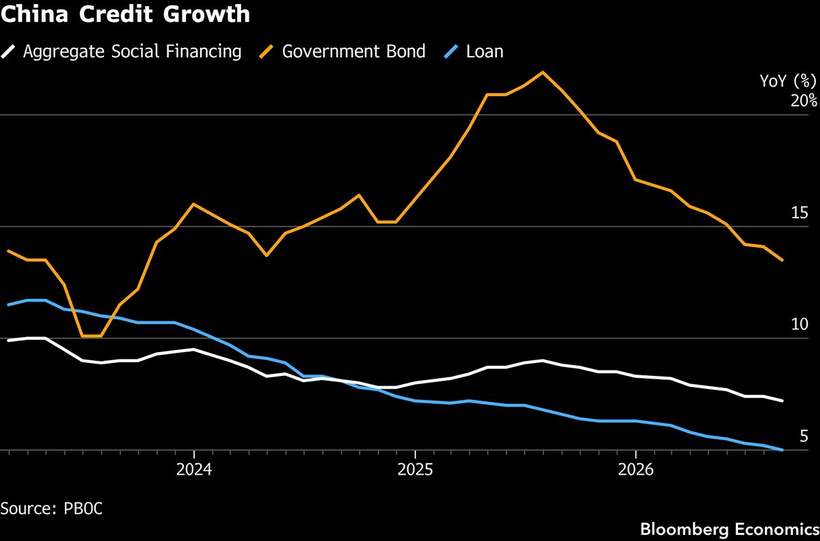
China's credit, due by Thursday: total social financing growth slowing to about 7.1%, loans near 5%, and government bond growth fading from 22% last year to about 13%. The PBOC calls slower credit the "new normal" as the economy tilts to tech; Bloomberg Economics sees September's new financing near 3.4 trillion yuan, below a year ago. Source: PBOC / Bloomberg Economics.
Banks Tuesday
The IMF publishes its outlook in Bangkok, Waller speaks in New Delhi, and the biggest US banks open the earnings season before New York's open. The banks get their own section below.
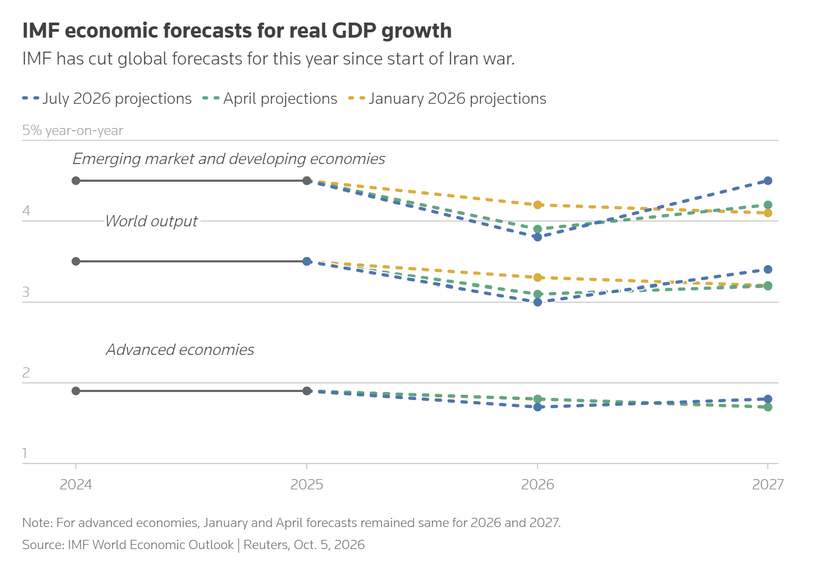
The IMF's outlook, from Bangkok: world growth for 2026 cut from 3.3% in January to 3.1% in April and 3.0% in July since the war began, with emerging markets cut harder, to about 3.8%. Georgieva has warned that Tuesday's update will not make easy reading, with energy prices, record public debt and AI risks the themes. Source: IMF World Economic Outlook / Reuters.
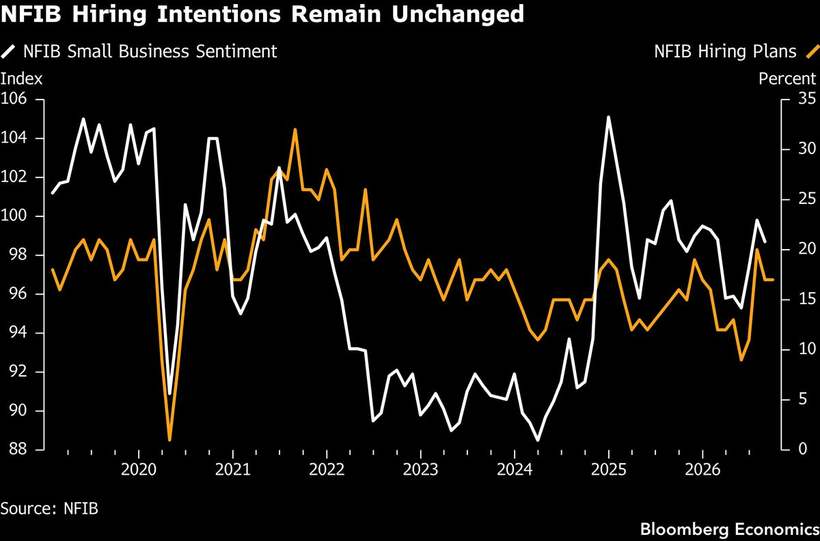
Small business, at 6pm: optimism seen slipping to 98.3 from 98.7 on financing costs and diesel. Hiring plans have held, because the constraint is still finding qualified workers, not demand. Source: NFIB / Bloomberg Economics.
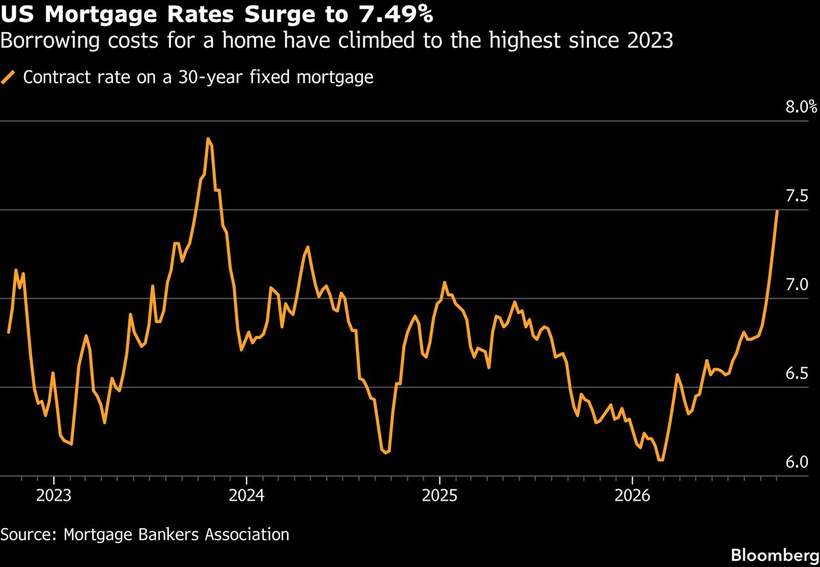
Existing home sales, at 10pm: the 30-year mortgage rate jumped 19bp in a week to 7.49%, the highest since November 2023, and about half a point in three weeks, the fastest rise since early 2023. Sales are seen near 3.96 million, and purchase applications are at their lowest in more than a year. Source: Mortgage Bankers Association / Bloomberg.
CPI Wednesday
The week's busiest day: the MAS and Singapore's GDP at 8am, China's prices at 9:30am and its trade later, US CPI at 8:30pm and the Beige Book at 2am.
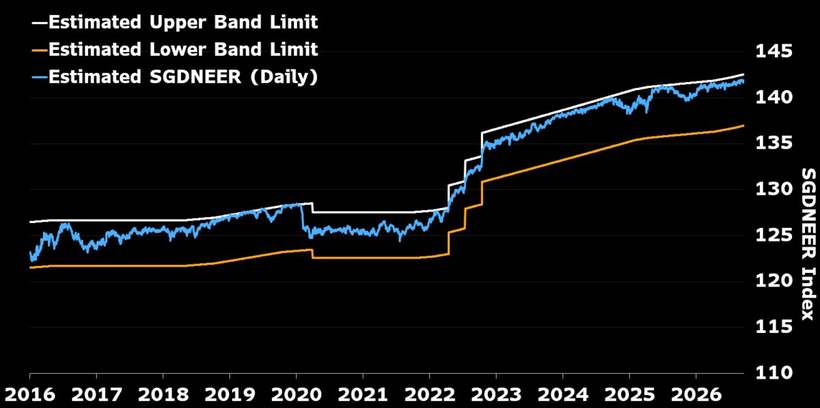
The MAS, at 8am: the trade-weighted Singapore dollar, on these estimates, has held the strong half of its band since 2022 and is pressing the top again. Inflation is 2.3% and growth strong, after tightenings in April and July. A third move would come with the currency already at the ceiling. Source: MAS, Goldman Sachs / Bloomberg Economics.
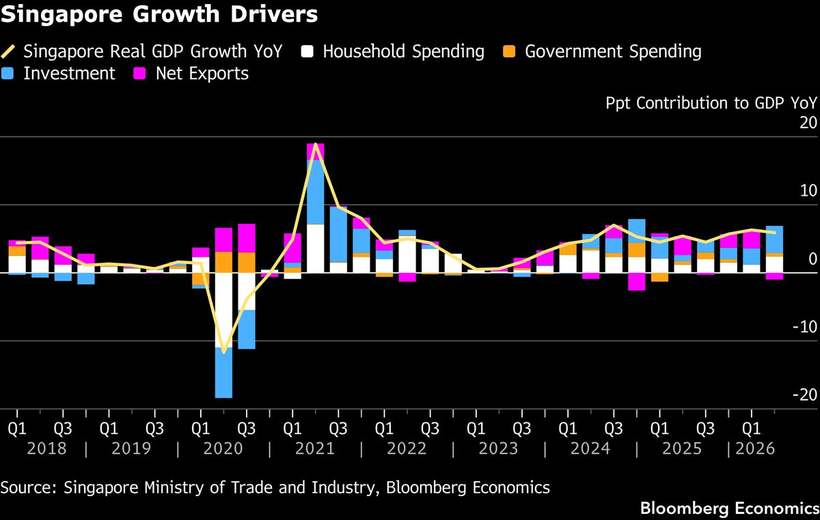
Singapore's GDP, also at 8am: seen at 5.6% from 5.9%, against a consensus of 4.8%. Investment and household spending carried the second quarter while net exports turned negative as import costs rose; electronics shipments were up 122% in July and August. Source: Ministry of Trade and Industry / Bloomberg Economics.
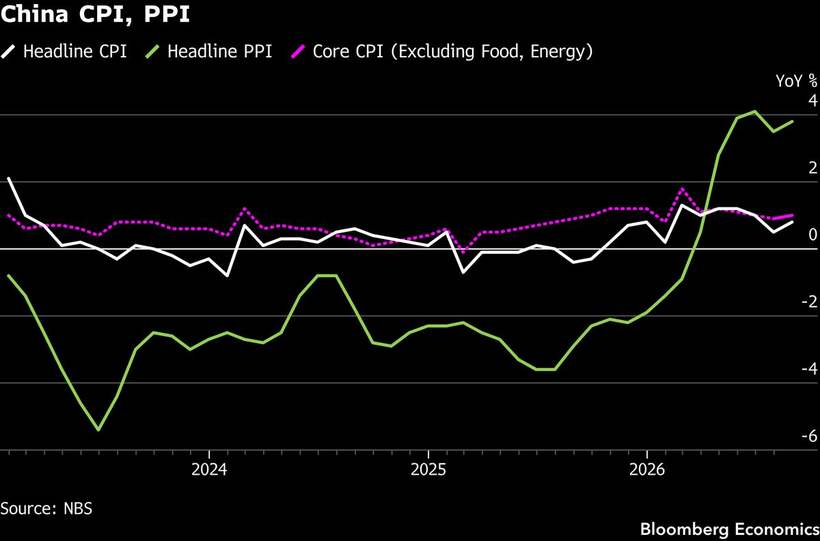
China's prices, at 9:30am: factory-gate prices (green) turned positive in the spring for the first time since 2022 and have run near 4% since, with September seen at 4.3-4.5%, the fastest since mid-2022. Consumer prices barely clear 1%. China is exporting price rises now, not deflation. Source: NBS / Bloomberg Economics.
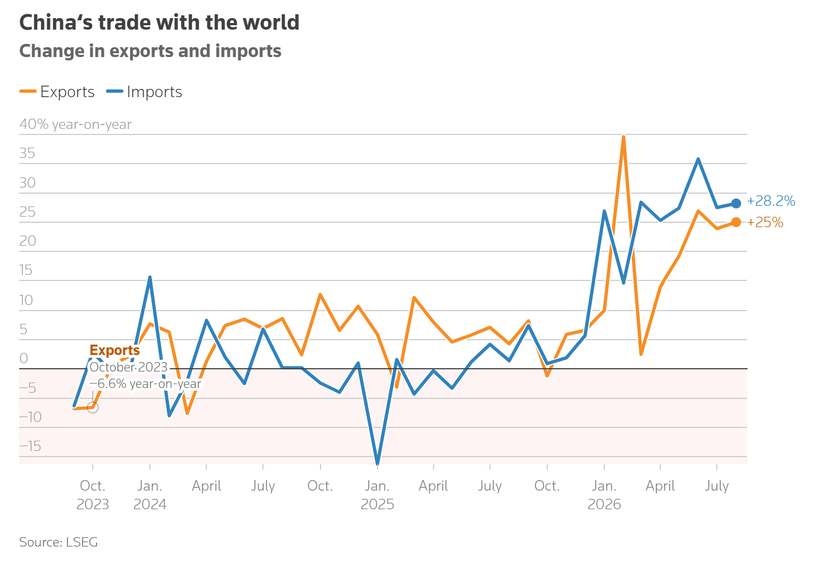
China's trade, later in the day: exports up 25% and imports 28.2% in August, both mostly running at double digits this year. September's exports are seen near 25% again and the surplus near $118 billion, the number EU leaders will carry into Thursday. Source: LSEG / Reuters.
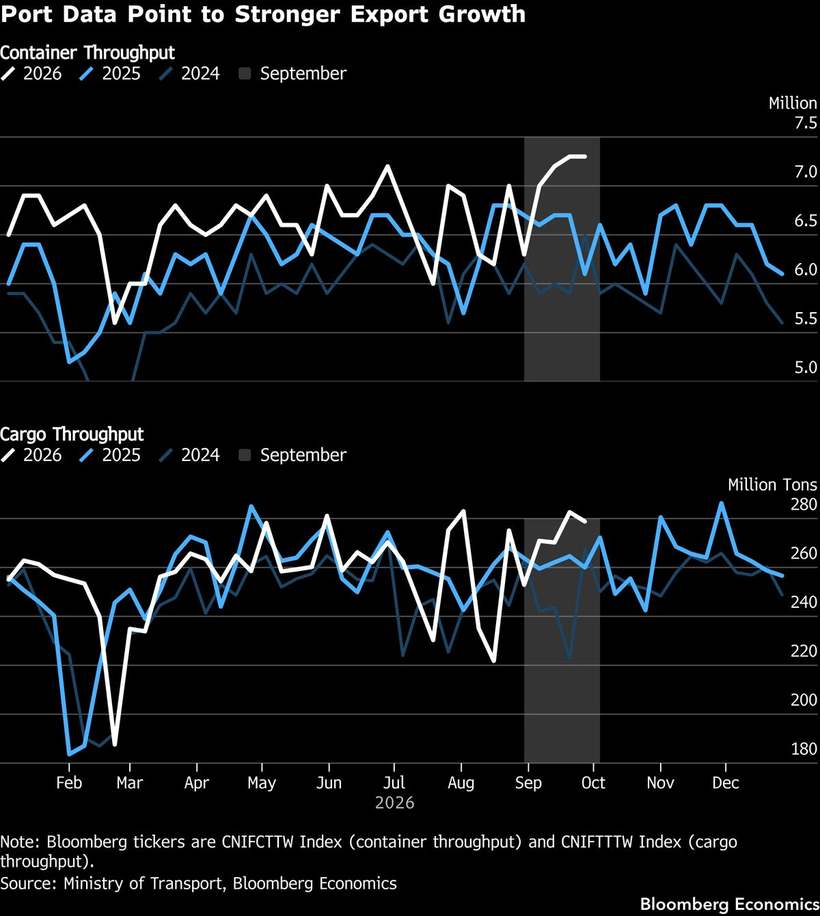
Why Bloomberg Economics is above consensus: container throughput at China's ports reached about 7.2 million in late September, matching its July high and well above 2024 and 2025, with cargo near 280 million tons. It forecasts exports up 30.4%, against a consensus of 25%; AI hardware is the volume. Source: Ministry of Transport / Bloomberg Economics.
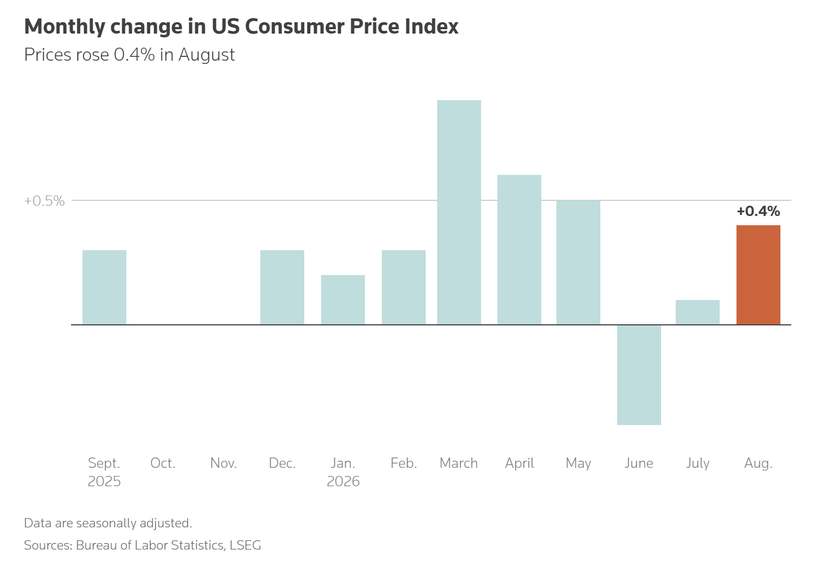
US CPI, at 8:30pm: prices rose 0.4% in August after 0.1% in July and a fall in June; March's jump, near 0.9%, came as the war began. The empty October and November 2025 bars are the shutdown, when the data was never collected. Source: BLS, LSEG / Reuters.
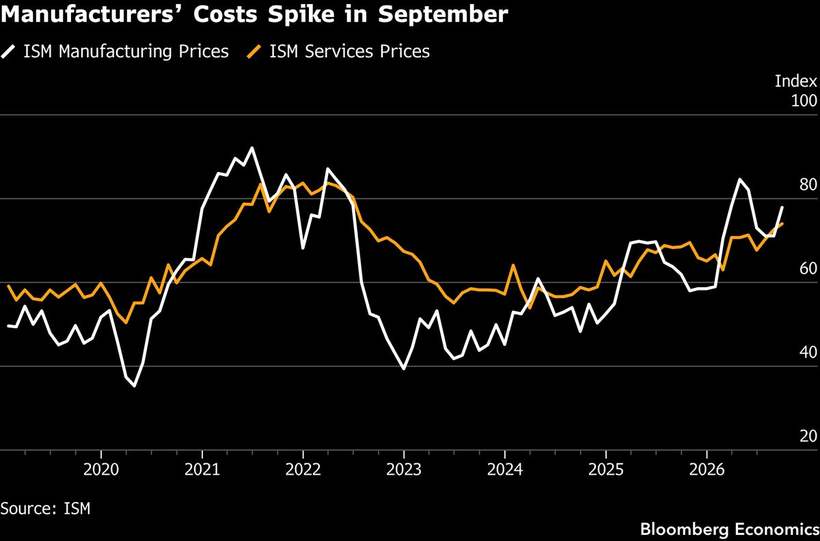
The Beige Book, at 2am Thursday: manufacturers' costs (white) spiked again in September while services' (orange) grind higher, the same shape as 2021 before prices broadened. The anecdotes will say whether firms treat these costs as temporary or are passing them on. Source: ISM / Bloomberg Economics.
Retail and PPI Thursday
Australia's jobs before Asia's lunch, TSMC and Britain's GDP in our afternoon, the EU summit in the evening, then five US releases at once at 8:30pm.
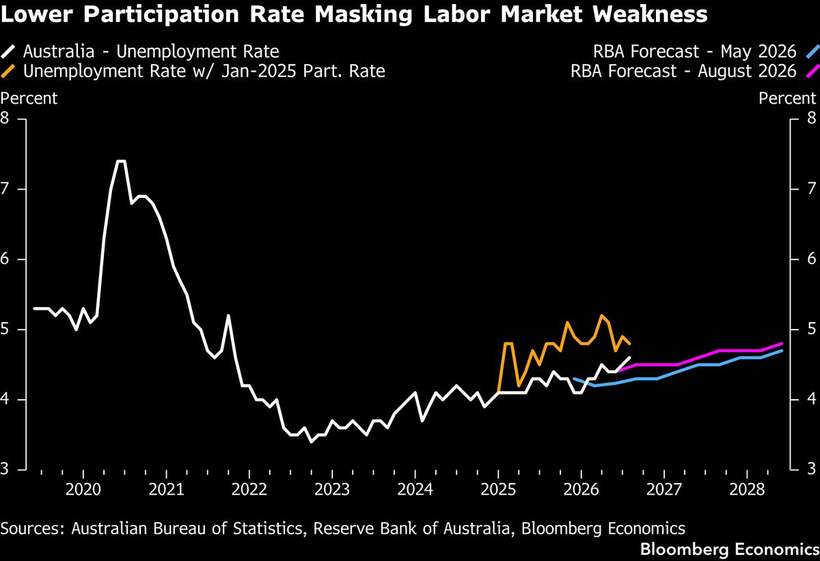
Australia's jobs, at 8:30am: unemployment seen rising to 4.7% from 4.6%. Held at January 2025's participation rate, it would already be near 5%, above both of the RBA's recent forecast paths. A weak print makes a November pause more likely. Source: ABS, RBA / Bloomberg Economics.
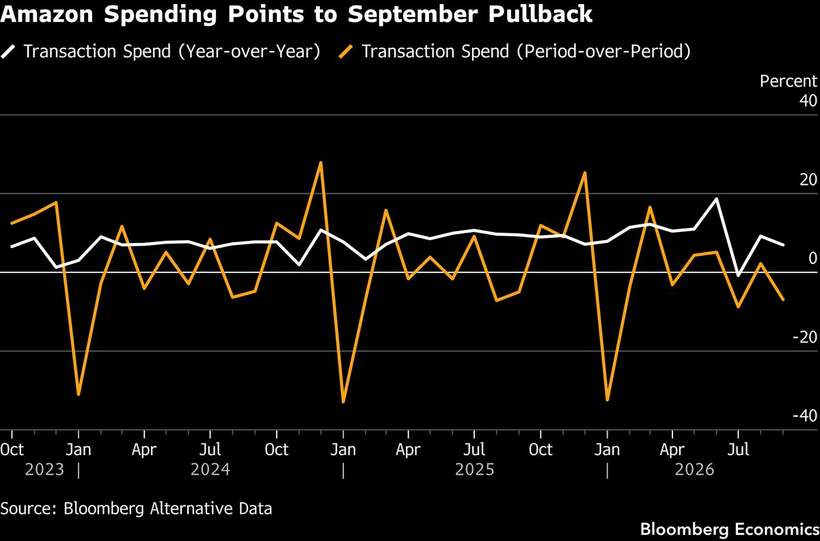
Retail sales, at 8:30pm: seen up 0.3-0.4% from 1.1%, flattered by gasoline up 7.3%, with the control group at 0.1-0.3%. Amazon transaction data points to a September pullback after back-to-school, some of it spending held back for October's Prime days. Source: Bloomberg Alternative Data / Bloomberg Economics.
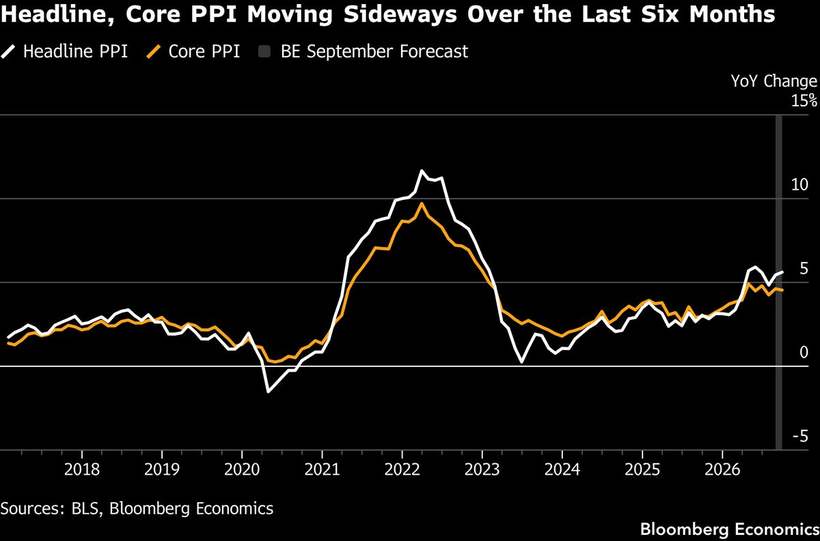
PPI, also at 8:30pm: headline seen up 0.5-0.7% on the month and 5.3-5.6% on the year, core near 4.5%. Both have moved sideways for six months at the highest levels since early 2023; the PCE-relevant pieces add about four basis points to September's PCE. Source: BLS / Bloomberg Economics.
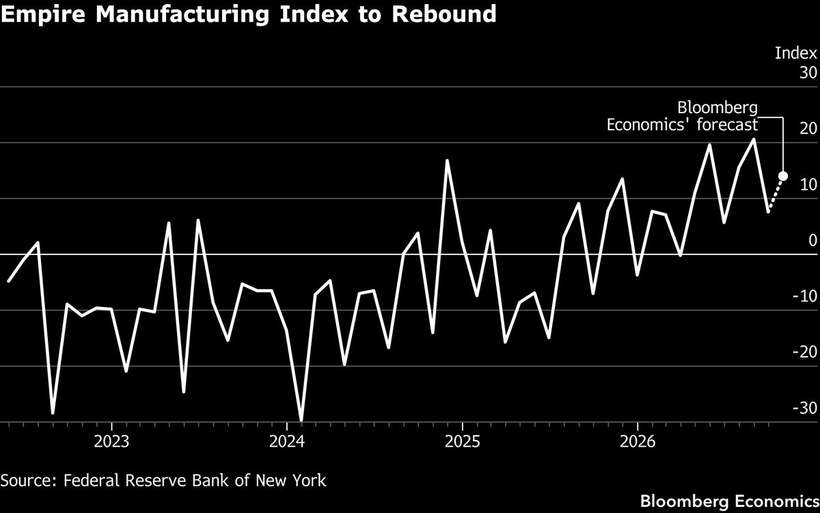
The Empire survey: seen rebounding to 11-14 from 7.6 after September's drop, though new orders fell to 2.0. Prices paid reached 63.1, the highest in four years. Source: Federal Reserve Bank of New York / Bloomberg Economics.
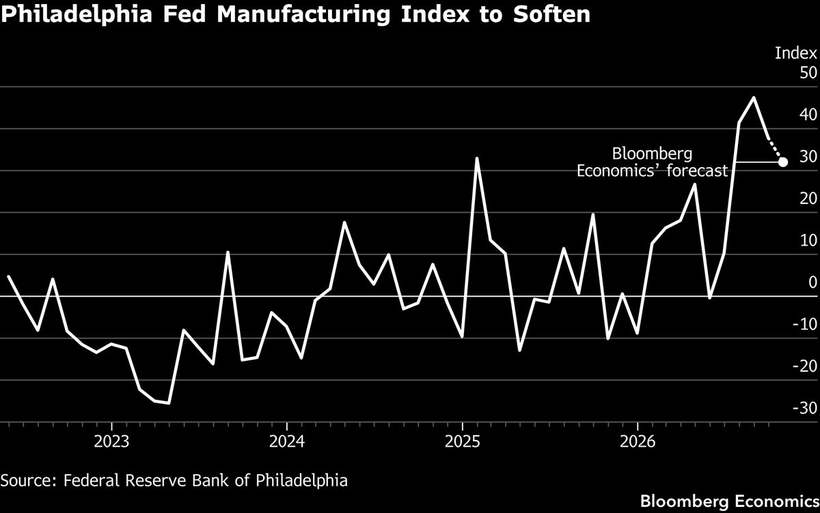
The Philadelphia Fed: seen easing to 30-32 from 37.8 after an exceptionally strong run, with unfilled orders at the highest since 2021. More than half of firms reported higher input costs, up from 41% in August. Source: Federal Reserve Bank of Philadelphia / Bloomberg Economics.
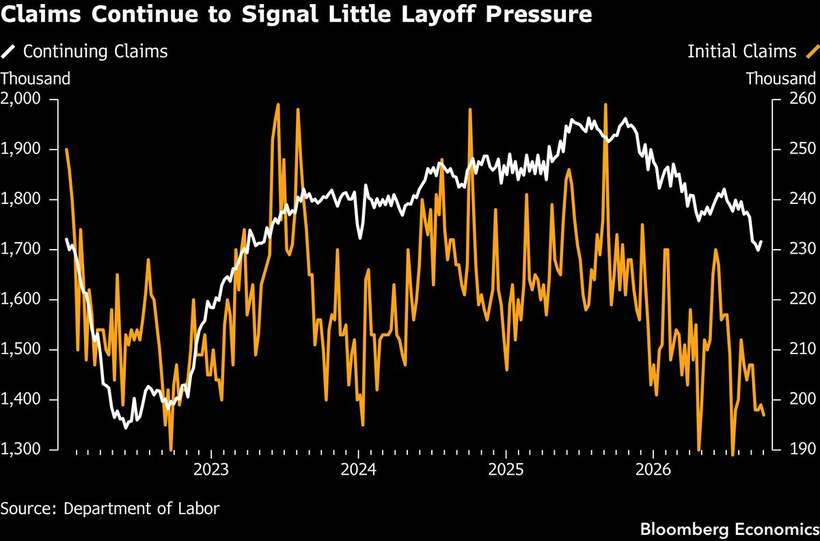
Claims: initial claims seen near 195,000-200,000 and continuing claims falling toward 1.7 million. Still no layoffs; the weakness is in hiring, especially for people entering the job market. Source: Department of Labor / Bloomberg Economics.
Bangkok Friday
Early prints from New Zealand and Korea, Europe's final CPI in our afternoon, then US import prices and industrial production, and Warsh with Georgieva in Bangkok.
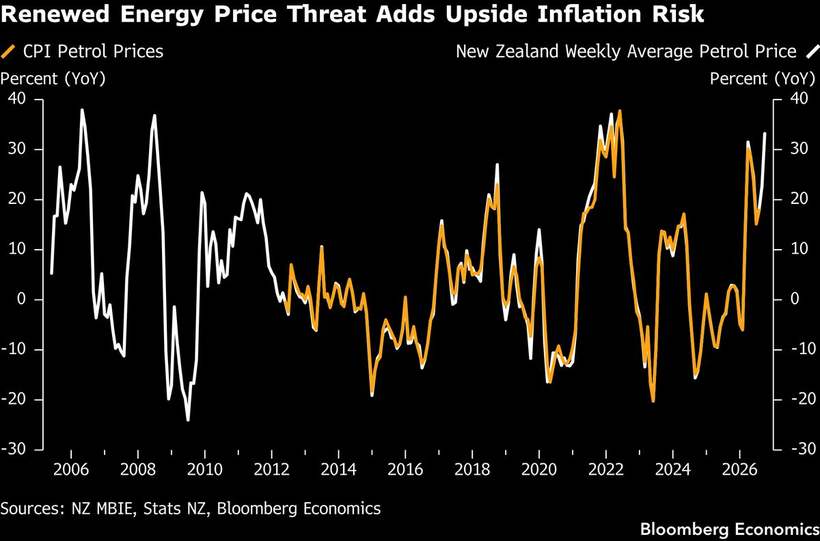
New Zealand's prices, at 5:45am: petrol up more than 30% from a year ago, near its 2022 peak, after food rose 0.3% in August. The RBNZ is removing accommodation despite a wide output gap, and energy is what keeps it going. Source: NZ MBIE, Stats NZ / Bloomberg Economics.
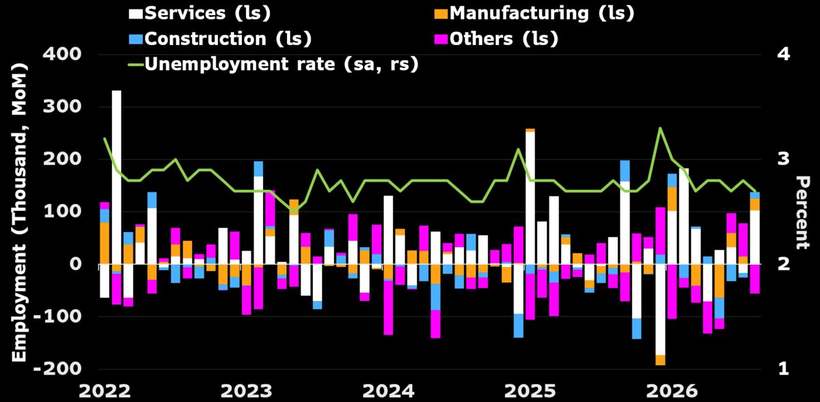
Korea's jobs, at 7am: unemployment seen steady at 2.7%, below its post-2020 average of 3.1%, with services and health care doing most of the hiring. Source: Statistics Korea / Bloomberg Economics.
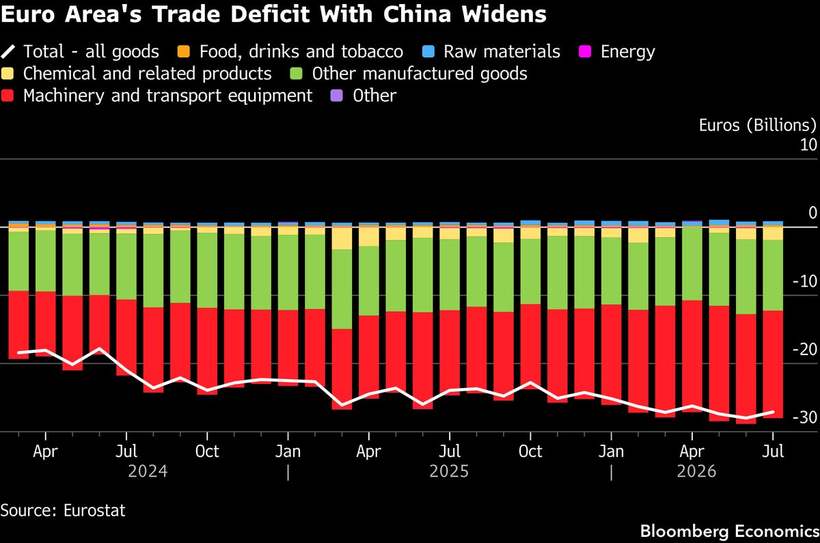
Euro-area trade, at 5pm with the final CPI: the deficit with China was €27.1 billion in July, mostly machinery and transport equipment, against an average of €21.9 billion in the year before April 2025. This is the gap EU leaders will have weighed on Thursday. Source: Eurostat / Bloomberg Economics.
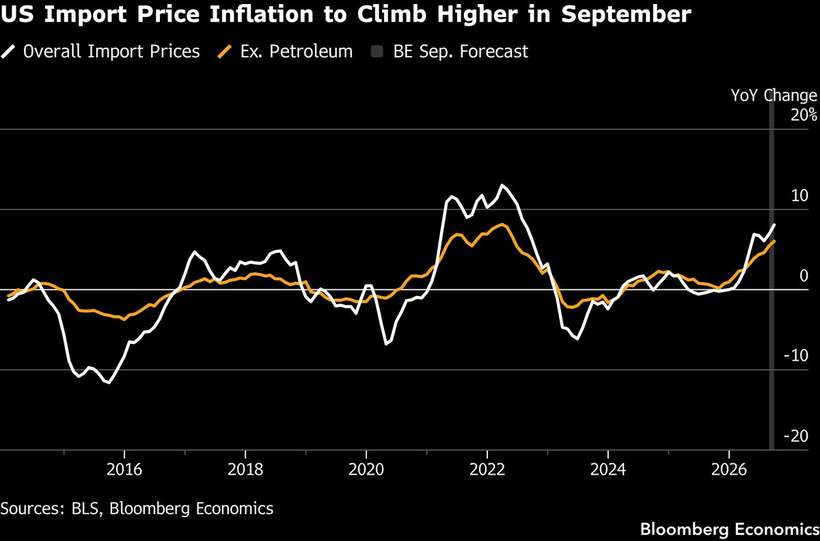
Import prices, at 8:30pm: seen up 0.9% on the month, lifting the annual rate to about 8.1% from 7.0%, the highest since 2022; ex-petroleum near 5.1%. Semiconductors and capital goods for the AI buildout are part of it. Source: BLS / Bloomberg Economics.
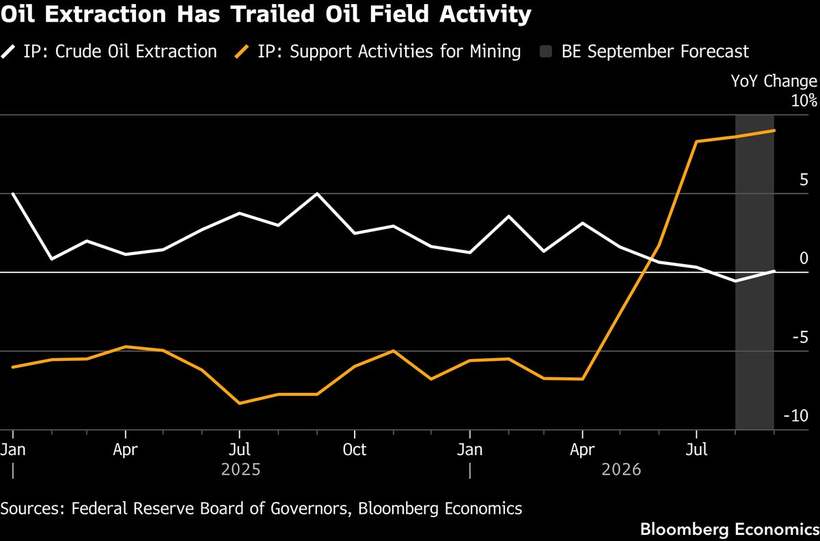
Industrial production, at 9:15pm: seen up 0.1% with factory output down 0.2%; the lift comes from oil. Oil-field support activity is running near 9% above a year ago while extraction is flat, and rig counts, now 603, lead output by five to seven months. Source: Federal Reserve Board / Bloomberg Economics.
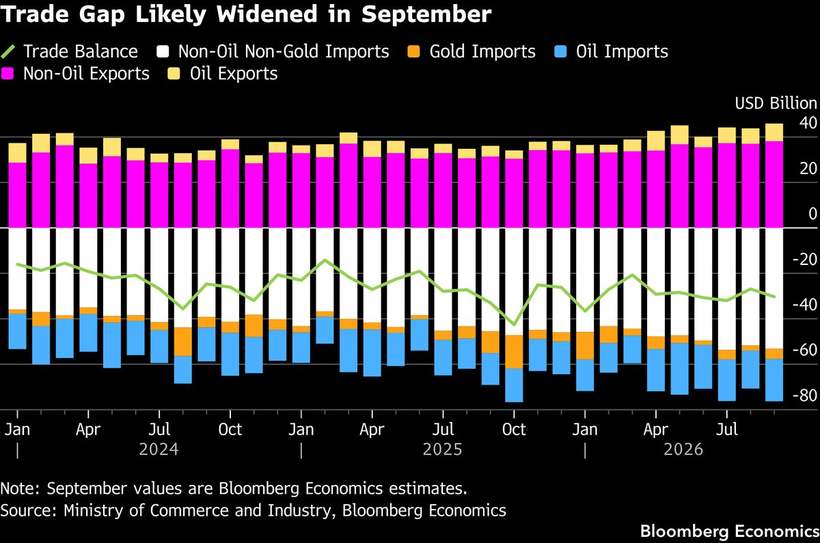
India's trade, due by Friday: the deficit seen widening to about $30 billion from $26.9 billion on crude averaging $102 a barrel in September and festive gold buying. It is what keeps the rupee leaning weaker even after the RBI's hike. Source: Ministry of Commerce and Industry / Bloomberg Economics.
The banks report into 5%
Higher rates are supposed to help banks, and on lending they do: net interest income at JPMorgan is seen up 12% and accelerating at most regionals. The fee businesses are where the quarter turns. IPOs announced in the third quarter came to about $61 billion, less than half the prior quarter's, with Anthropic's and Oura's listings pushed back. Goldman's investment banking is seen snapping a five-quarter run of double-digit growth, Morgan Stanley's could fall for the first time in more than a year, and Bank of America's advisory and debt fees are seen down about 17%. The regionals also face higher deposit costs after the Fed's hike, the New York Fed has been reviewing private-credit exposure at the big banks, and bank shares are falling well beyond America on worries about what higher yields do to the bonds on their balance sheets.
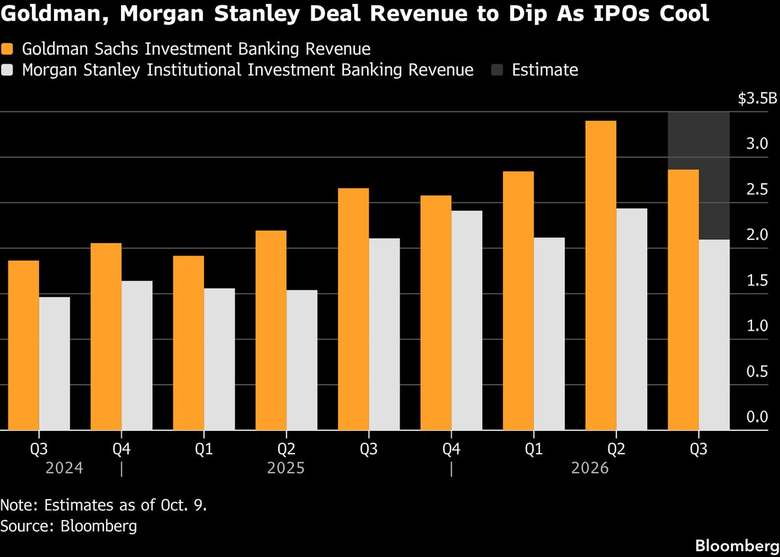
Deal fees dip as IPOs cool: Goldman's investment-banking revenue seen at about $2.8 billion from $3.4 billion in the second quarter, and Morgan Stanley's at about $2.1 billion from $2.4 billion, both still above a year ago. Source: Bloomberg.
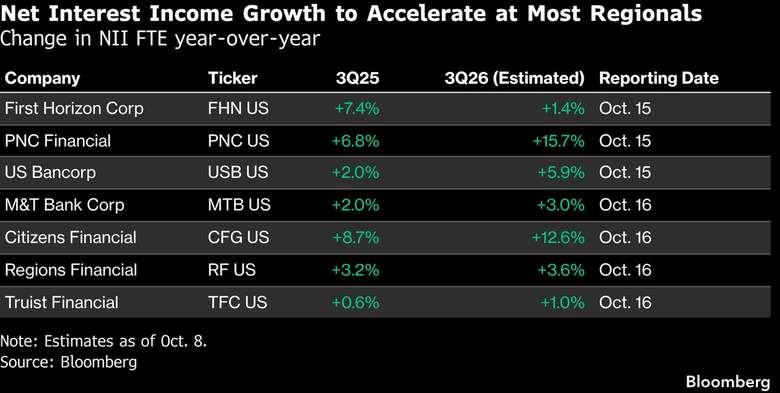
Net interest income accelerates at most regionals: PNC seen up 15.7% from 6.8% a year ago, Citizens 12.6% and US Bancorp 5.9%; First Horizon is the exception, slowing to 1.4% from 7.4%. They report on Thursday and Friday. Source: Bloomberg.
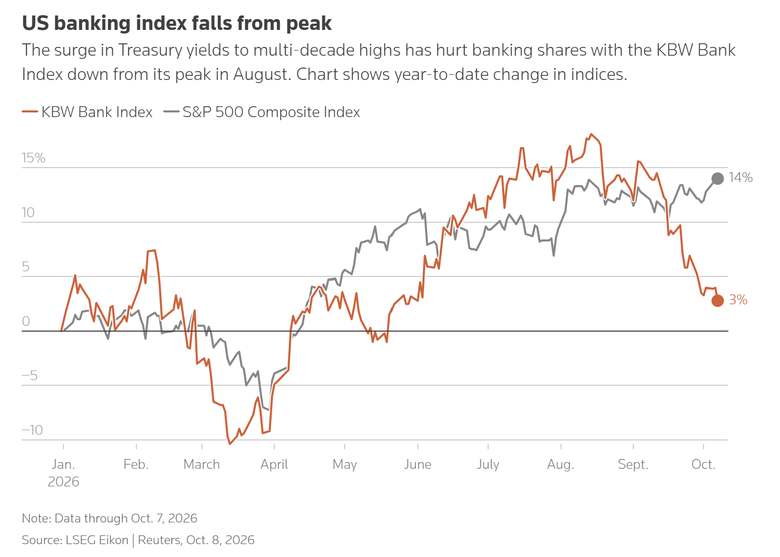
Banks gave back their lead: the KBW Bank Index was up as much as about 18% this year in August and is now up 3%, against 14% for the S&P 500, as Treasury yields climbed to multi-decade highs. Source: LSEG Eikon / Reuters.
The term premium comes back
The part of the bond selloff the Fed does not control is the extra yield investors demand to lock up money for ten years instead of rolling bills. It has surged in recent weeks, and it is why bad news no longer brings long yields down. Among the views doing the rounds at a bank's conference last week: September's bond selloff was really about the megacaps' financing needs; we are in the third or fourth inning of a sovereign debt bubble bursting; and Warsh is more Ueda than Bessent, a chair who will not be co-opted. This week's strong auctions are the first sign the price is getting high enough to find buyers.
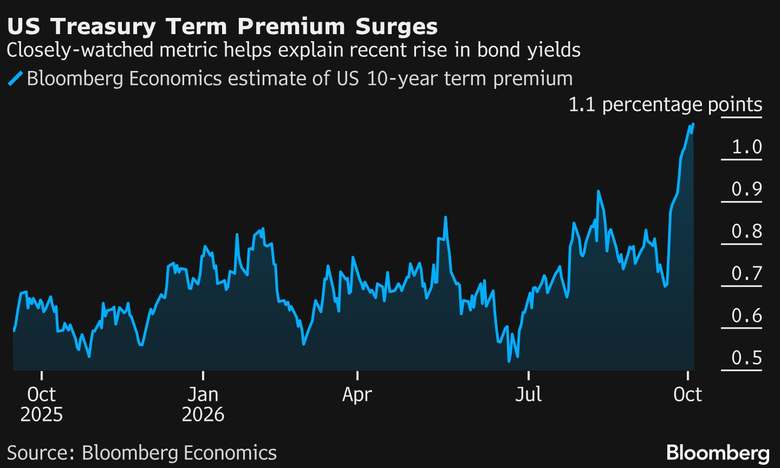
The term premium surges: Bloomberg Economics' estimate of the 10-year term premium jumped from about 0.7 to near 1.05 percentage points in a few weeks, after a year mostly between 0.5 and 0.85. It is the highest in more than a decade. Source: Bloomberg Economics.
France, the euro's weak link
"What happens in Paris doesn't stay in Paris!" RBC's Peter Schaffrik told clients this week. His point is that France is the epicentre, not the whole story: Europe went into this with an energy crisis from two wars, high inflation and high debt, and bondholders were already demanding more to hold government paper. Leveraged carry traders who bet on French bonds now have to sell. The market is drawing its own lines: Air Liquide sold €2 billion of bonds at yields below the French government's, and French banks' credit risk has jumped above their European peers. Bloomberg's FX strategists now call $1.10 in the euro a looming level and $1.05 a risk into the 2027 presidential election.
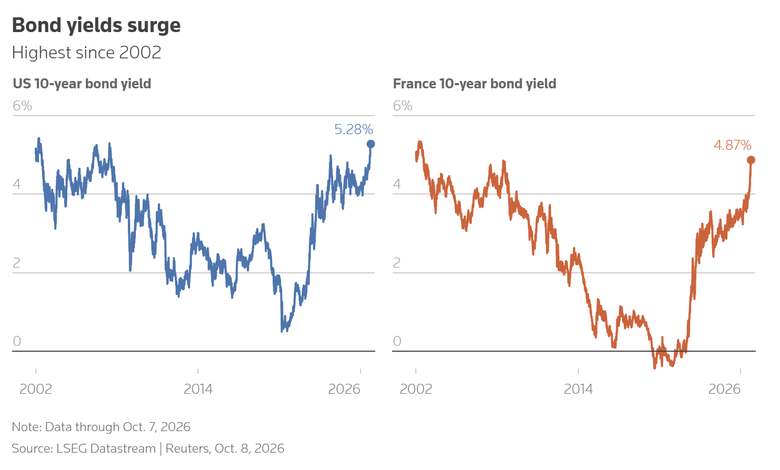
Two 24-year highs: the US 10-year at 5.28% and France's at 4.87% on October 7, both the highest since 2002. France's is the steeper climb, from below zero in 2020. Source: LSEG Datastream / Reuters.
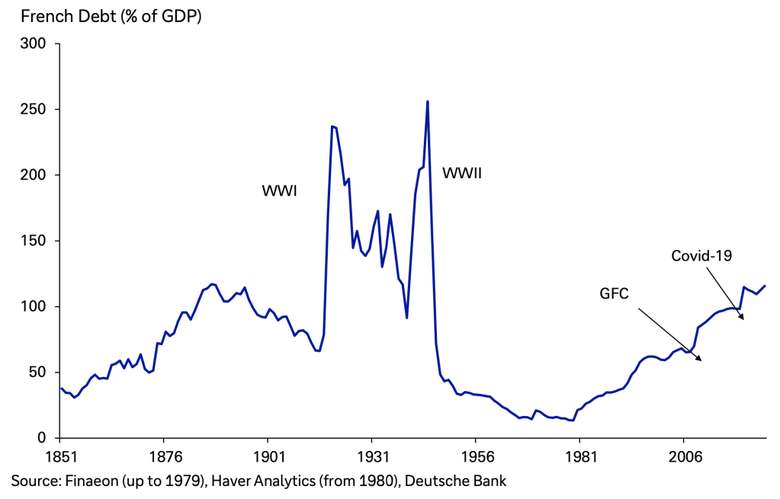
French debt since 1851: near 115% of GDP, the highest outside the two world wars, when it peaked near 240% and 255%. Since 1981 it has ratcheted up through every crisis. Source: Finaeon, Haver Analytics / Deutsche Bank.
Saudi Arabia under fire
The Saudi-led offensive to retake the Bab el-Mandeb is a week old, and so far the Houthis are setting the terms. They have fired missiles and drones at Saudi cities, struck Riyadh's airport three times and hit a pumping station at Khurais that halted the East-West pipeline, the kingdom's route to the Red Sea around Hormuz. The coalition has vowed to respond, and Trump has been asked whether Washington will join. Flows through Hormuz are closer to normal, but energy prices stay high, partly because of what it costs to ship oil at all.
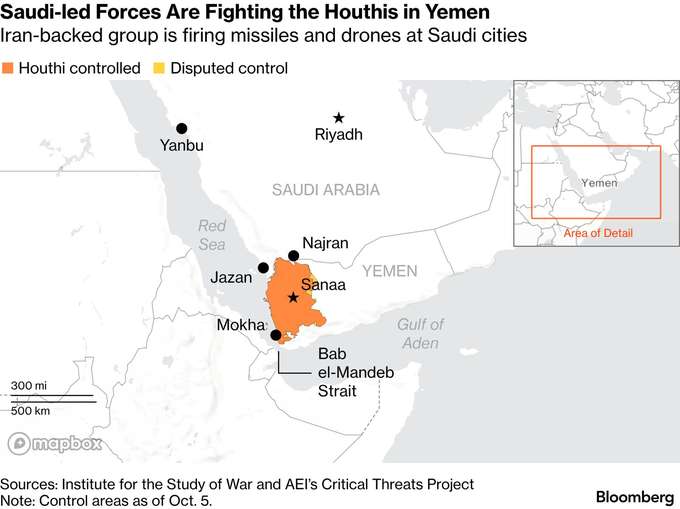
Where the Houthis hold: Sanaa and the west of Yemen down to Mokha and the shore of the Bab el-Mandeb, as of October 5. Jazan and Najran sit on the border; Riyadh and Yanbu, the Red Sea end of the East-West pipeline, are within range. Source: ISW, AEI Critical Threats / Bloomberg.
EU and China: a quota, not a tariff
After two days of talks in Beijing, the EU's trade chief said China will moderate its exports of hybrids and plug-in hybrids, with the prospect of cutting them by more than half, and both sides agreed to speed licences for rare earths. China also offered better access for car parts, olive oil and textiles, worth almost €4 billion in current exports. Sefcovic called it the first time China has moderated exports before a trade fight rather than after one, and Europe's autos rallied. It is not done: EU leaders must endorse it at Thursday's summit, analysts still expect measures on chemicals and machine tools, and Sefcovic called the deficit "a mountain of a challenge".
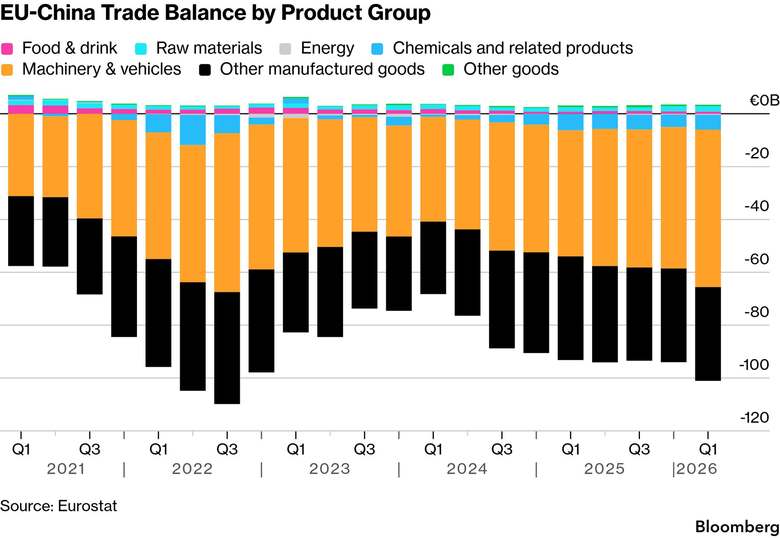
The deficit that started it: the EU's quarterly goods deficit with China back above €100 billion in early 2026, near its 2022 peak, with machinery and vehicles about 60% of it. Source: Eurostat / Bloomberg.
The AI fracture: cheaper thought, dearer money
The price of what comes out of the data centres is falling faster than any technology on record, while the price of building them keeps rising. SpaceX, the year's record listing, is now borrowing $40 billion for Nvidia chips and bought low-band spectrum to sell phone service from orbit. TSMC's sales jumped 51%, Lumentum says its components are sold out to early 2029, and the money is concentrating in America. The bill lands in the bond market: Vanda Research counts the hyperscalers' bonds at $292 billion of 10-year-equivalent duration in the past year, already about a third of what the Treasury supplied, with most of next year's capex still to be financed.
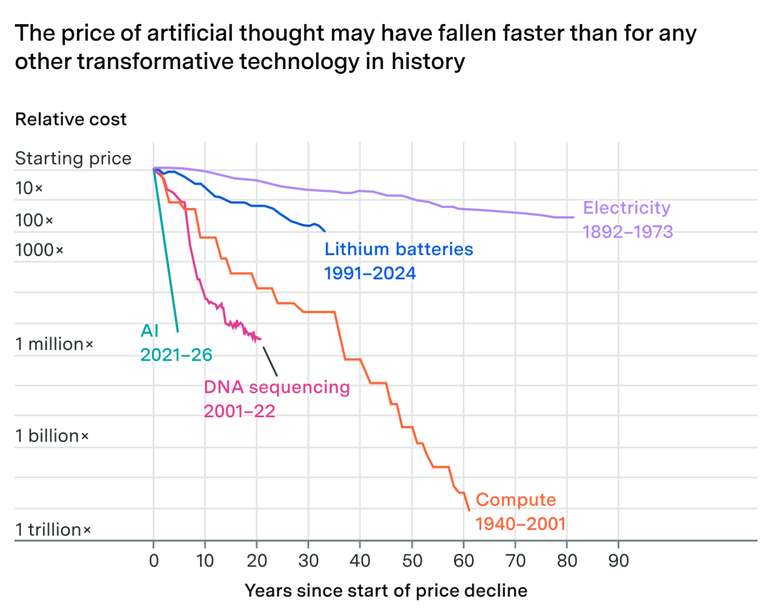
The price of artificial thought: Epoch AI estimates the cost of a given level of AI performance has fallen about 47% a quarter since 2023, 13 times a year: four times faster than DNA sequencing, six times faster than computing and 54 times faster than electricity. A PhD-level science score that cost about $0.30 a question in January 2025 cost $0.0004 eighteen months later. Benchmarks can overstate real-world use. Source: Epoch AI.
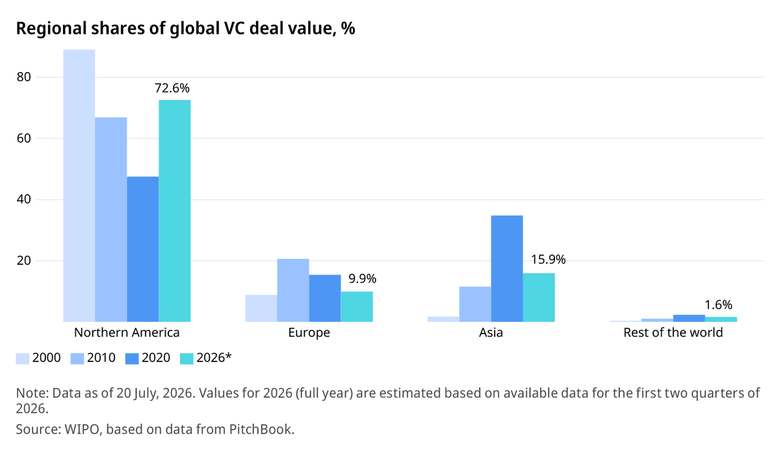
The money goes home: North America's share of global venture deal value fell below half by 2020 as Asia rose past a third; the AI boom has taken it back to 72.6% this year, against 15.9% for Asia and 9.9% for Europe. North America took 86% of AI-related venture money in the first half. Source: WIPO, PitchBook.
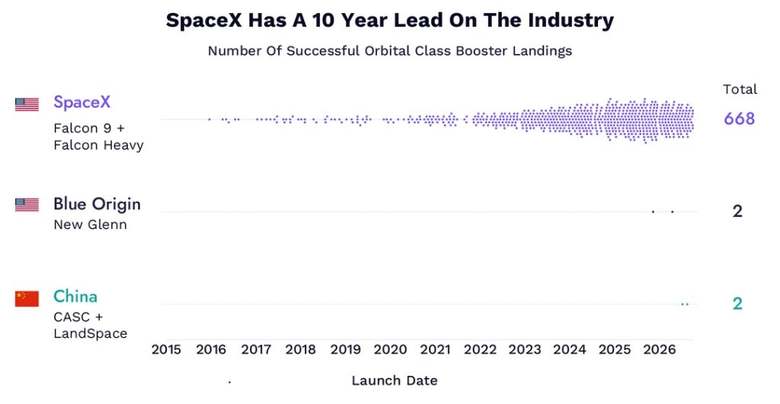
SpaceX's ten-year lead: 668 successful orbital-class booster landings, including three launches in 13 hours last week, against two each for Blue Origin and China. Source: ARK Invest.
Has blockchain found its job?
Citrini Research's argument is that crypto spent fifteen years building rails for users who did not exist yet: always-on, programmable settlement. AI agents that move money all day are those users, and the assets people actually want are coming onchain. The turn came when Iran escalated over a weekend in March and Hyperliquid was one of the few places traders could price crude. Since then the SEC has issued an innovation exemption for tokenized stock trading, the CFTC lists Coinbase's US stock perpetuals as approval pending and its chair is proposing the first crypto rules, and Solana briefly handled more trades than the NYSE in September, mostly bots. Last week's question was what happens when agents sweep deposits; the next one is who earns the fees.
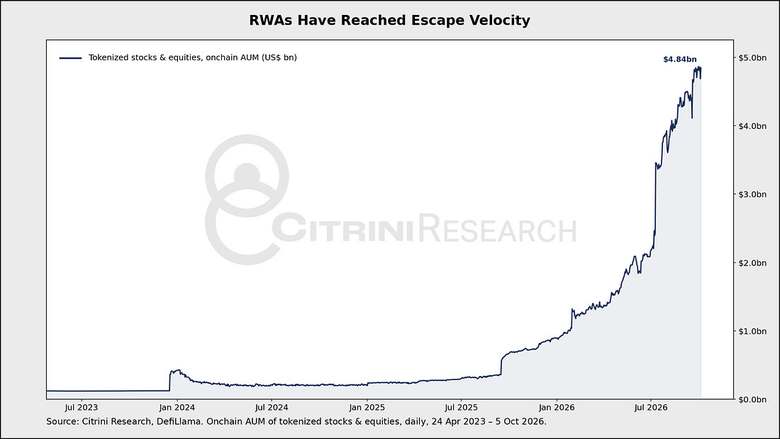
Tokenized stocks reach escape velocity: onchain assets in tokenized stocks and equities rose from under $0.5 billion through mid-2025 to $4.84 billion by October 5, most of it this year. Source: Citrini Research, DefiLlama.
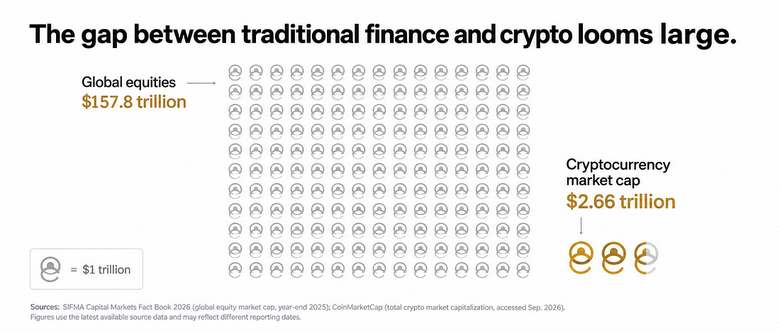
Still a rounding error: global equities worth $157.8 trillion against a total crypto market of $2.66 trillion. The opportunity, if Citrini is right, is the gap. Source: SIFMA, CoinMarketCap.
Slow builds
Two charts on things that take longer than you think, for a week that wants its answers by Wednesday night.
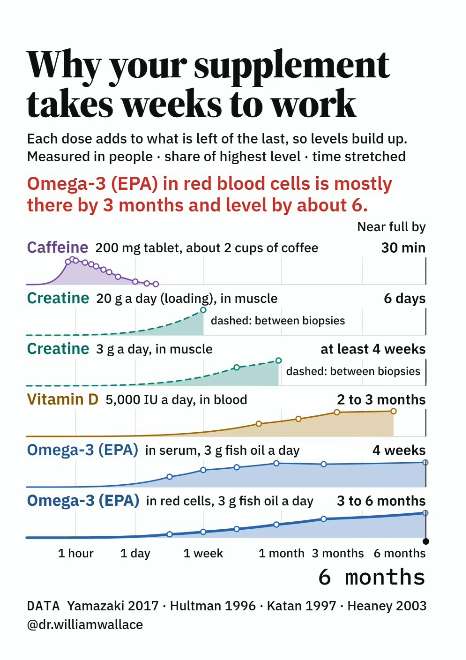
Why your supplement takes weeks to work: caffeine peaks in about 30 minutes, creatine fills muscle in about 6 days loading at 20g a day or at least 4 weeks at 3g, vitamin D takes 2-3 months and omega-3 in red blood cells 3-6 months. A full level is a precondition, not proof: in the VITAL trial, blood levels rose and cancer and heart disease did not fall. Source: Yamazaki, Hultman, Katan, Heaney / @dr.williamwallace.
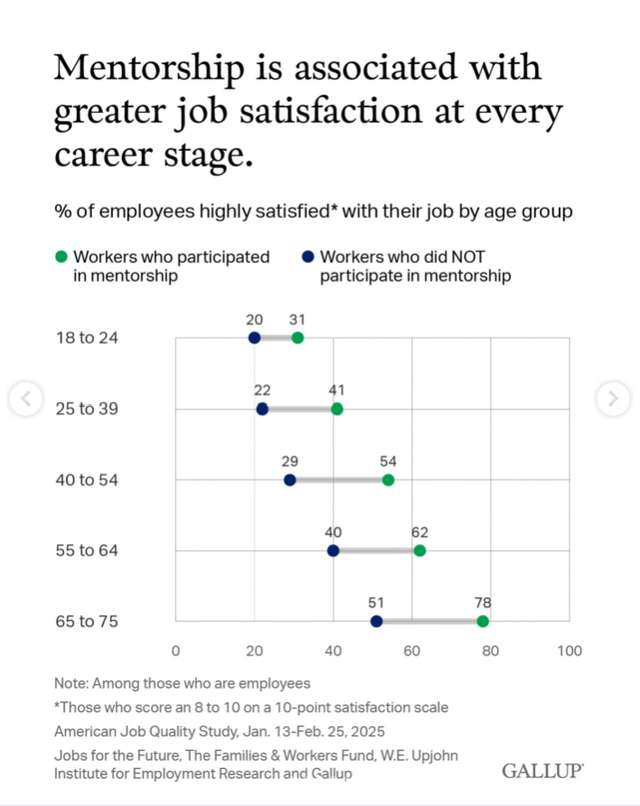
Mentorship pays at every age: among workers aged 40-54, 54% of those mentored are highly satisfied with their jobs against 29% of those who were not, and at 65-75 it is 78% against 51%. Gallup finds that fewer than 1% of employees with someone encouraging their development are actively disengaged. Source: American Job Quality Study / Gallup.
VC+ Special Dispatch, The World of Languages
A lighter dispatch for a heavy week: what we speak, how we write and what we learn. Reach and native speakers are different things, in languages as in currencies, and English is the dollar of the set. Credit to the VC+ team.
Infographic 1 - The World's Most-Spoken Languages
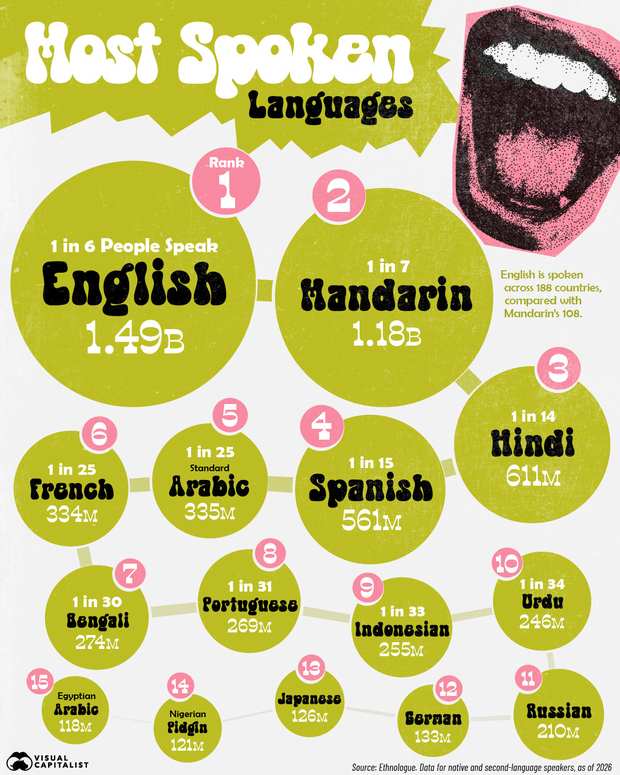
English reaches 1.49 billion people, ahead of Mandarin's 1.18 billion, but English is spoken in 188 countries against Mandarin's 108, and most of its speakers learned it as an additional language. Hindi, Spanish, Arabic and French follow. Source: Ethnologue / Visual Capitalist.
Infographic 2 - Where Language Diversity Is Greatest
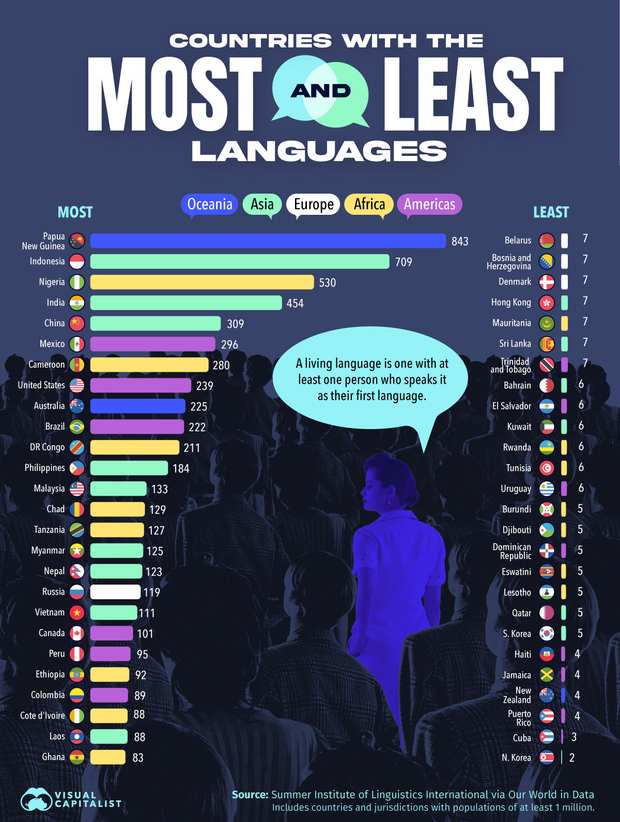
Papua New Guinea has 843 living native languages, more than India or China, with Indonesia at 709 and Nigeria at 530. UNESCO estimates 40% of people lack education in a language they speak fluently. Source: SIL International, Our World in Data / Visual Capitalist.
Infographic 3 - One Script, Many Languages
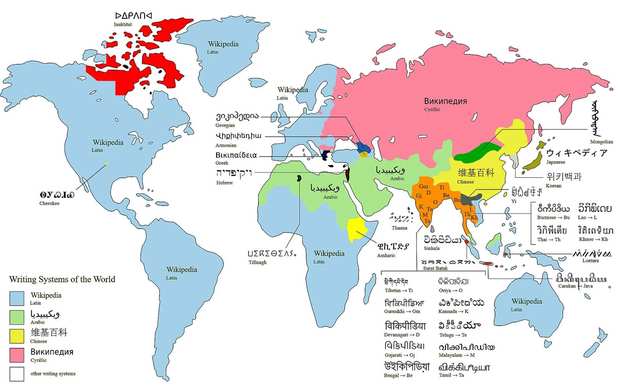
The Latin alphabet spans most of the Americas, Europe and Africa, on a map of scripts used by more than 50,000 people. A country can change its alphabet without changing its language: Türkiye moved from Arabic to Latin letters in 1928. Source: Wikipedia / Visual Capitalist.
Infographic 4 - The Internet's Language Imbalance
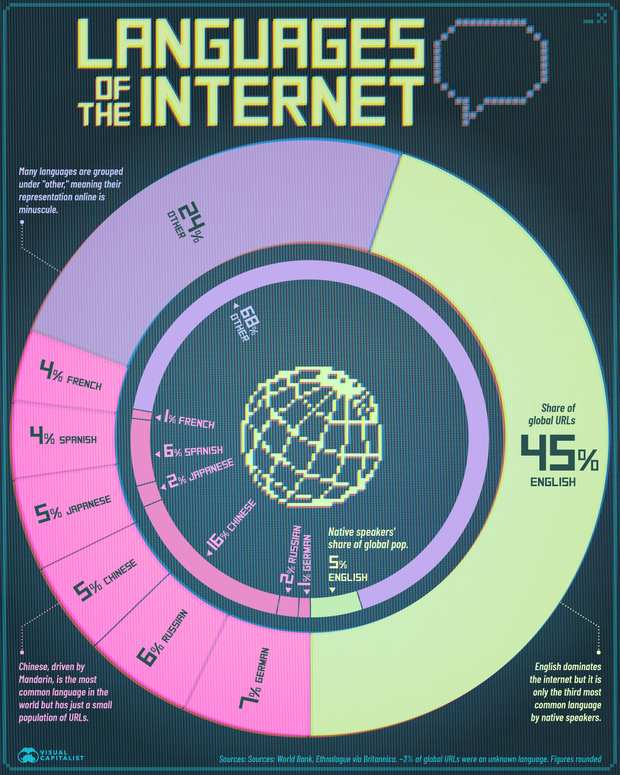
English is 45% of web pages in Common Crawl data, against about 5% of the world who speak it natively. The World Bank calls the shortage of local-language data a barrier to more inclusive AI models. Source: World Bank, Ethnologue / Visual Capitalist.
Infographic 5 - America's Second Language
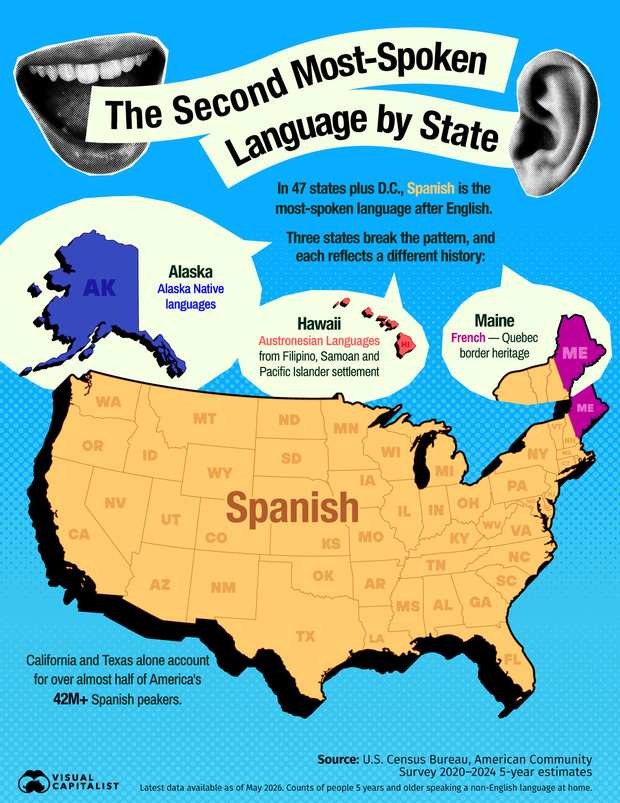
Spanish is the second language at home in 47 states and Washington, D.C., the exceptions being Alaska's native languages, Hawaii's Austronesian languages and French in Maine. In 2019, 55% of Americans who spoke Spanish at home were born in the US. Source: US Census Bureau / Visual Capitalist.
Infographic 6 - Beyond English and Spanish
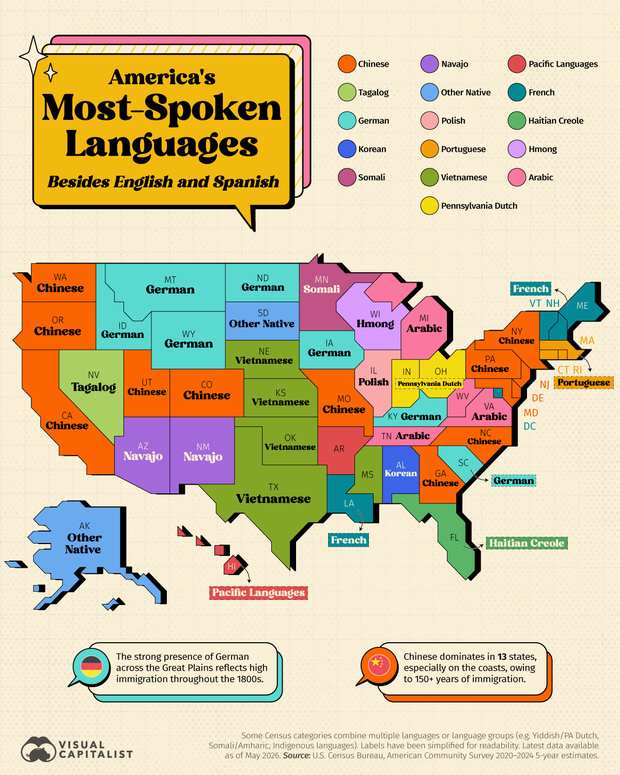
Chinese leads in California and New York, Vietnamese in Texas, Haitian Creole in Florida, Navajo in Arizona and New Mexico, and Hmong in Wisconsin, a community that grew from refugees from Laos in the 1970s. Source: US Census Bureau / Visual Capitalist.
Infographic 7 - Four Decades of Languages at Home

Spanish at home grew from 11.1 million speakers in 1980 to 44.9 million in 2024, Chinese climbed from sixth to second, and Italian and German, second and third in 1980, fell out of the top ten. Source: US Census Bureau / Visual Capitalist.
Infographic 8 - How Long Does Learning Take?
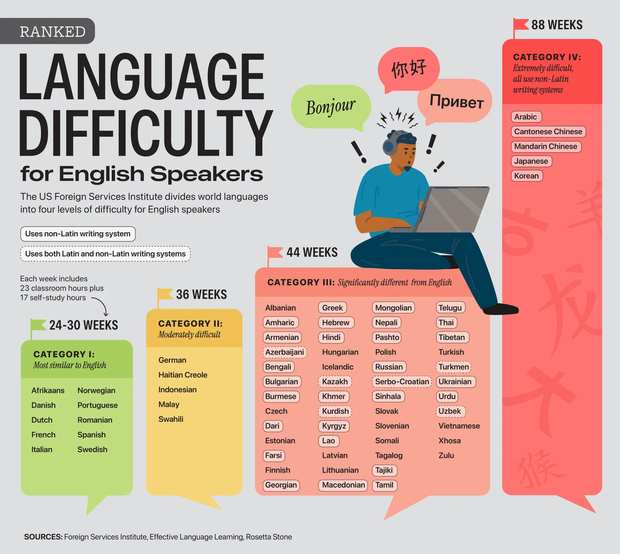
From 24-30 weeks for Spanish or Italian to 88 weeks for Arabic, Mandarin, Japanese and Korean, the Foreign Service Institute's full-time estimates for English speakers. Vietnamese uses Latin letters and still sits in the 44-week group with Russian and Hindi. Source: Foreign Service Institute / Visual Capitalist.
The Good Wrap
What is left at the close: an atlas of orbits that refuse to settle, and week three of the dashi series, the broth with the loudest voice.

Three bodies, no general solution: almost any starting arrangement of three bodies under gravity dissolves into chaos and, eventually, an escape, yet hidden in the chaos are orbits that repeat forever. Three Body Orbits maps 3,942 of them from half a century of research, figure-8s, butterflies and moths; give one a kick and the stable ones hold their path while the unstable unravel. Source: threebodyorbits.com.

Dashi, week three: niboshi, small sardines dried whole, for a bolder broth with a distinct marine character; it carries ramen, miso soup and the heartier broths, and you pinch off the heads and bellies first or it turns bitter. This week is a niboshi market: one small print, a tenth of a point of core CPI, will flavour the whole pot, and if the bitter bits are not taken out first, the broth sours. Next week, shiitake. Source: FermenStation.
Best,
Hoelon
WITPTW is a personal publication. Everything here is personal opinion and market commentary, written in a personal capacity. It is not investment advice and not a recommendation to buy or sell any security. It is not associated with, endorsed by, or representative of any employer, fund or company. Charts and images are reproduced from their original publishers, credited to their sources for commentary and discussion; all rights remain with the respective copyright holders.