The AI Vigilantes
Personal views and market commentary. Not investment advice. Not associated with any employer or firm.
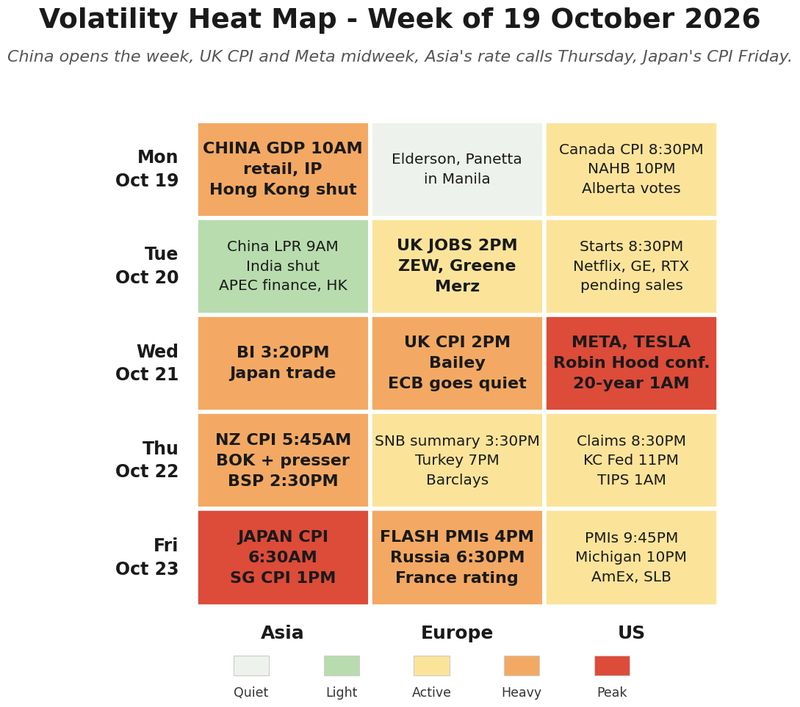
Volatility heat map for the week ahead , sessions as we trade them from here. Hong Kong is shut on Monday and India on Tuesday. Wednesday carries Britain's inflation, Bank Indonesia and the first megacap AI results after New York's close; Thursday is Asia's rate day, and Friday ends on Japan's prices and the flash PMIs. The S&P enters near 7,659 and the 10-year near 5.08%.
"So if the fiscal and monetary authorities won't regulate the economy, the bond investors will. The economy will be run by vigilantes in the credit markets." — Ed Yardeni, in his weekly commentary of 27 July 1983, "Bond Investors Are the Economy's Vigilantes". He named the bond vigilantes 43 years ago. This week the IMF put them at the top of its worry list, next to the AI boom they are being asked to fund. Yardeni's point was that when governments will not discipline themselves, bondholders do it for them by selling. On Tuesday the IMF ranked a sharp rise in sovereign yields among its three biggest risks, alongside an AI correction, and linked the two: hyperscalers now issue 10% of global investment-grade bonds, up from under 1% in 2024, competing with governments for the same savings. AI may also hand the vigilantes faster information. Whether that makes them sharper or just quicker to stampede is open.
"We are going to increase that $600 billion to almost $1 trillion for real investment." — Mohammed bin Salman, Saudi crown prince, in the Oval Office on 18 November 2025. Eleven months later he is moving between bunker-equipped palaces, and that trillion is part of the foundation under America's AI rally. Saudi money props up three things the US market leans on. The kingdom holds about $142 billion of Treasuries. It is pledged to American AI, from Nvidia and AMD chips to AWS and xAI data centres through Humain. And Aramco's spare barrels stand behind what its chief executive calls "scarily thin" oil cushions. This week Houthi missiles kept Riyadh's airport shut, hit Aramco's headquarters, and a Houthi leader called for MBS to be overthrown. Asked whether America would join, Trump said: "We may." A kingdom at war spends at home first.
"It's actually only 2% of Gen Z that has the actual values... that hiring managers are looking for." — Suzy Welch, NYU Stern professor of management, at the Forbes Future of Work Summit. Want the job? Get sweaty. Welch matched 7,500 Gen Z users of her values tool against 2,100 hiring managers. Employers hire for achievement, work centrism and scope: the hunger to win, to work and to keep learning. Gen Z puts well-being first, then voice and agency. Only 2% have all three of what employers want. Layoffs are low, yet young graduates are now more likely to be jobless than the workforce as a whole.
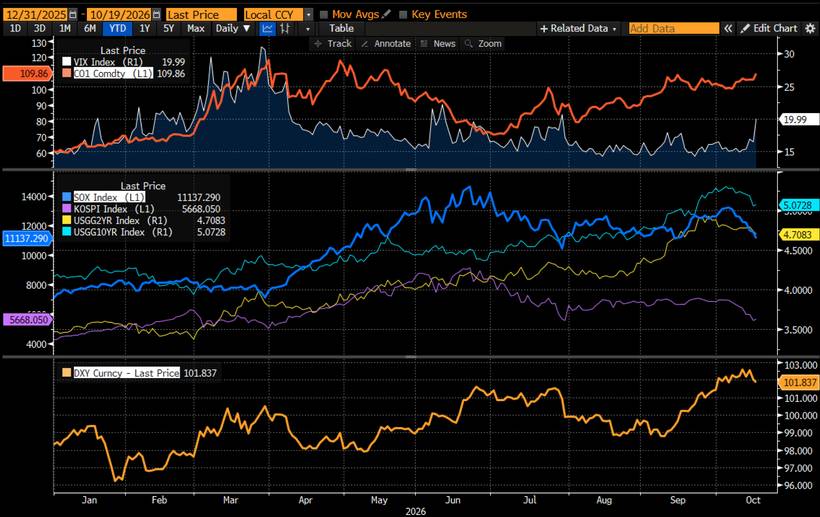
Oil and fear back at their June highs; chips and yields giving it back. Brent (orange, top) is back near $110 for the first time since May, and the VIX touched 20. In the middle panel, the SOX has lost 16% in eight sessions, its longest losing run since 2008, and the Kospi has given back much of this year's gain. The surprise is in the rates lines. On a hot CPI and PPI, the 10-year fell from 5.33% to 5.03% in two sessions: the chip rout, not the inflation data, set the price. The dollar has lagged the fall in yields, with the DXY at 101.8 after nearly touching 103. Source: Bloomberg.
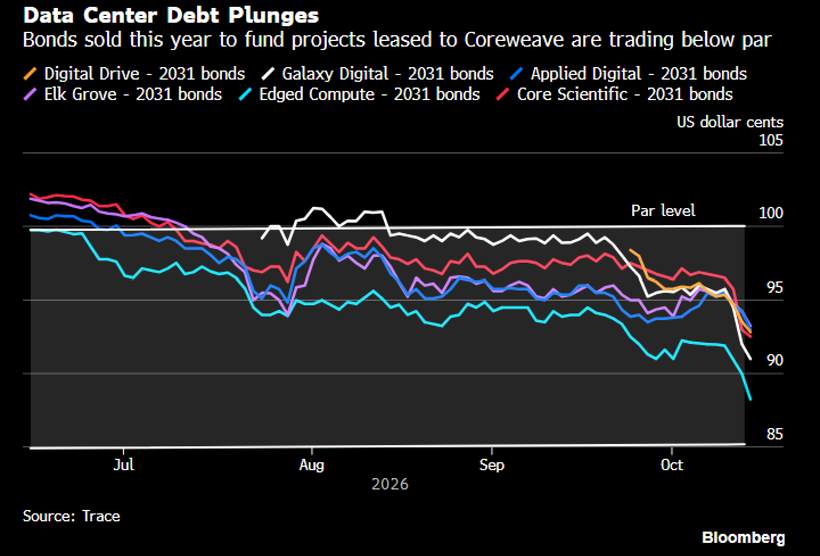
The AI boom meets lenders who say "not at this price". Bonds sold this year to fund data centres leased to CoreWeave slid from around par to 88-93 cents in October. That came after CoreWeave's co-founder floated borrowing in the investment-grade market, and lenders read it as more supply coming. CoreWeave's own junk bonds hit 15%, average high-yield yields reached 8.41% (an 18-month high), and Volta paid more than 11% on a $5 billion loan. The market is sorting borrowers rather than shutting: Tencent, JPMorgan and Morgan Stanley all sold debt easily the same week. But one investor says a large unsecured neo-cloud deal would now likely "fail to clear the market". Source: Bloomberg, Trace.
What is the plan this week?
The next two weeks will be the most nervous for global markets: midterm uncertainty, the usually volatile run into the year-end momentum rush, and arguably fewer monetary surprises from the Fed, BOJ and ECB the week after. A VIX at 20, the Nasdaq 100 down 5.5% and the SOX down more than 10% in a week, and WTI up 10% to above $100 will put markets on the back foot tomorrow.
Again and again, markets have underestimated developments in the Middle East, and at the same time probably overestimated AI valuations. They might not be related, but I begin to think some of the funding behind AI comes from the same oil riches. I may be myopic through my macro lens, but the midweek Robin Hood investors conference could aggravate the risk-off mood. One to watch, or listen to.
In the US, the Fed has gone quiet until its decision on the 28th, so the data and the earnings do the talking. Housing starts on Tuesday show what 7.5% mortgages are doing to building, claims on Thursday test whether companies are still shrinking by attrition rather than layoffs, and Friday brings the flash PMIs and Michigan's final reading, with gasoline still near $4.33 a gallon. The Treasury sells 20-year bonds on Wednesday and 5-year TIPS on Thursday. The earnings carry more weight than the data: Netflix on Tuesday, then Meta and Tesla on Wednesday, with Meta's capex seen more than doubling and Tesla's tripling, and Lam Research, Texas Instruments and IBM alongside. RTX, Lockheed and Northrop report into a record $581 billion year of Pentagon procurement.
The midterms are two weeks away, and the polls have moved toward the Democrats. Generic-ballot averages give them a lead of 5 to 11 points, and prediction markets put their odds at about 90% for the House and 63% for the Senate. A sweep was already seen as negative for stocks, with a new Congress trying to unwind the administration's agenda; it would also put data-centre moratoriums back on state agendas early next year, and the war's gasoline bill is landing hardest on the heartland battlegrounds. Until November 3, the campaign keeps setting policy on fuel, from the Russian diesel waiver to the timing of any strike on Iran.
In Asia, China's third-quarter GDP opens the week on Monday, seen near 4.4%, with exports carrying an economy whose retail sales are barely growing. Then a cluster of central banks. Bank Indonesia decides on Wednesday: the rupiah is under pressure and MSCI has proposed stripping Indonesia of emerging-market status, a malaise that a hike would not cure. The BSP on Thursday is expected to hike to 5.25% with inflation at 7.2%, a reminder of what an oil shock does to an importer, and the BOK the same day is seen pausing after two hikes. Japan's CPI on Friday is seen back at the BOJ's 2% core. The haze is troubling, but with oil threatening new highs, it cancels out the relief from receding US hike odds and easing long-end yields.
In Europe, OATs have calmed, with the spread over Germany back to 130-140bp, but the underlying mood is as painful as ever after the student protests over the weekend. France's sovereign rating is up for review on Friday, and the ECB goes quiet on Wednesday ahead of its decision on the 29th. Britain's CPI on Wednesday is seen jumping to 3.4%, with a November BoE hike about 90% priced.
The plan this week is to keep the risk-off bets on, long the funding currencies. Carry positions should unwind. If AI valuations correct further, we may trigger more VaR-shock unwinds across the chain, and that will hurt most because retail investors are very long. Stay defensive.
What did I learn last week?
Mon Oct 12: Trump declared an "energy ceasefire" between Russia and Ukraine. The EU agreed to cap Chinese hybrid imports at 350,000 a year, rising 6% annually. The rupee reopened under the RBI's new rules and held well inside 97. India's CPI rose to 5.54%, the highest since October 2024 but short of the 5.7% we had pencilled in. Zuckerberg said Meta has reached "the AI frontier" and rejected calls for a slowdown.
Tue Oct 13: The IMF's World Economic Outlook put this year's global growth at 3.1%, a tenth above July. Goldman's earnings beat forecasts by almost a third, JPMorgan missed but raised its interest-income outlook, and reports said the BOJ leans against a back-to-back hike this month. Williams said one more hike this year is appropriate.
Wed Oct 14: US CPI rose 0.6% for an annual 3.7%, with core at 0.3% (2.6%). The MAS held, against the consensus for a slight steepening, as Singapore grew 5.4%. China's exports jumped 36.3% and its PPI reached 5.0%. The Washington Post reported that US intelligence warned Kyiv it would stop sharing if Ukraine kept hitting Russian energy sites, and ASML said its supply will not meet demand in 2027 or 2028.
Thu Oct 15: PPI jumped 1.3% in a month, 6.3% on the year. Retail sales rose 0.8%, only 0.2% without gasoline; Empire hit its highest in almost five years while Philadelphia fell short, and claims held at 199,000. Australia lost 39,300 jobs. MSCI proposed stripping Indonesia of emerging-market status, CNN reported Washington weighing its largest conventional bomb against Iran, and reports said Lagarde could leave early to chair the WEF.
Fri Oct 16: Warsh told the IMF that on forward guidance, "we're not in that business anymore". Industrial production rose 0.7%. Malaysia grew 5.3%, Singapore's non-oil exports surged 68.4%, and MSCI warned Turkey of a downgrade. US lawmakers moved to block the Russian diesel deal, and CoreWeave's shares fell 12%.
Weekend: The Fed's blackout began on Saturday. French students took their protests back to the streets, with Yellow Vest activists urging others to join.
All week: The S&P fell 2% to 7,659, its worst week since late June; the Nasdaq 100 lost 5.5%, its worst since April 2025, while the Dow rose 0.7%. The 10-year closed the week 16bp lower at 5.08% and the 2-year at 4.71%. USDJPY touched 159 before falling back to 157.55, the euro recovered from 1.1110 to 1.1270, the offshore yuan hit its strongest since July 2022, WTI gained 10% to $101.41 and gold slipped to 4,165. Grading the board: core CPI fired on the data, but the market did the opposite, cutting October hike odds to about 15% as bonds rallied with the chip rout. The rupee held below 97 and had its best week in seven months. The IMF raised its forecast, but curves bull-moved rather than steepened. Warsh fired neither branch, Lagarde never said "transmission", and France's spread stayed at 130-140bp. Washington has not yet joined the Saudi strikes. And the tail we retired too early, Indonesia, fired.
What to look out for next week?
Mon Oct 19: Hong Kong is shut for Chung Yeung. China's GDP at 10am, seen at 4.4% for the third quarter, with retail sales near 0.5% and industrial production near 5.4%, plus home prices; the Financial Street Forum in Beijing, with Pan Gongsheng, and the Bund Summit in Shanghai run all week. Malaysia's CPI and trade, the Green Swan conference in Manila with Elderson, Panetta and Remolona, and the RBA's Kent in Sydney. Alberta votes on whether to start toward a binding separation vote. Canada's CPI at 8:30pm, seen at 3.1%, and NAHB at 10pm.
Tue Oct 20: China's loan prime rates at 9am, seen unchanged for a 17th month. India is shut. APEC finance ministers meet in Hong Kong over two days. Britain's jobs at 2pm, unemployment seen at 5.0%, then the ZEW, Greene at the LSE and Merz in Berlin. Housing starts and permits at 8:30pm and pending home sales at 10pm; Netflix, GE Aerospace, RTX and Capital One report.
Wed Oct 21: Japan's trade, then Britain's CPI at 2pm, seen at 3.4% from 3.1%. Bank Indonesia at 3:20pm, a split call between a hike to 6.00% and a hold at 5.75%. South Africa's CPI and budget statement, Bailey on central bank independence, and the ECB's quiet period begins. In New York, the Robin Hood investors conference, where Bessent speaks off the record, and Huang's keynote in Berlin. The 20-year reopening at 1am; Meta, Tesla, IBM, Lam Research and Texas Instruments report after the close.
Thu Oct 22: New Zealand's CPI at 5:45am, seen at 4.3%. The BOK, seen holding at 3.00% after two hikes, with Governor Shin's press conference; the BSP at 2:30pm, seen hiking to 5.25%; Hong Kong's CPI. The SNB's summary of its September meeting at 3:30pm and Turkey at 7pm, seen cutting to 36%. Barclays reports and hosts its Asia Forum in Singapore; EU trade ministers meet in Dublin. Claims at 8:30pm, the Kansas City Fed at 11pm and 5-year TIPS at 1am; Blackstone, Lockheed, Honeywell and Union Pacific report.
Fri Oct 23: Japan's CPI at 6:30am, core seen at 2.0-2.1% from 1.7%, with its flash PMI, then Singapore's CPI at 1pm and India's flash PMI. Euro-area flash PMIs at 4pm and Britain's at 4:30pm, the ECB's consumer expectations survey, and the Bank of Russia at 6:30pm, seen holding at 14%. Canada's retail sales, then US flash PMIs at 9:45pm and Michigan's final reading at 10pm. France, Greece and Ukraine face rating reviews, and American Express and SLB report.
Beyond next week
Oct 25-29: Brazil's runoff on the 25th, with the polls tied at 46% to 44%, then China's Fifth Plenum from the 26th to the 29th.
Oct 28-Nov 6: One block, ten days: the Fed, the Bank of Canada, the RBNZ, Britain's budget and Australia's Q3 CPI on the 28th; the ECB and US Q3 GDP on the 29th; the BOJ and its Outlook Report on the 29th-30th; Treasury's borrowing estimates on November 2, the RBA and the midterms on the 3rd, the Riksbank and the refunding on the 4th, the BoE, Norges Bank and Bank Negara on the 5th, and payrolls on the 6th.
Nov 14: Malacca's state election, the first test of UMNO working with PAS.
Nov 18-19: APEC in Shenzhen, the third Trump-Xi meeting of the year.
Nov 29: Spain's snap general election, while France's budget is still unresolved.
Dec 11: The US stopgap funding runs out, and Sarawak votes in mid-December.
G10 rates at a glance
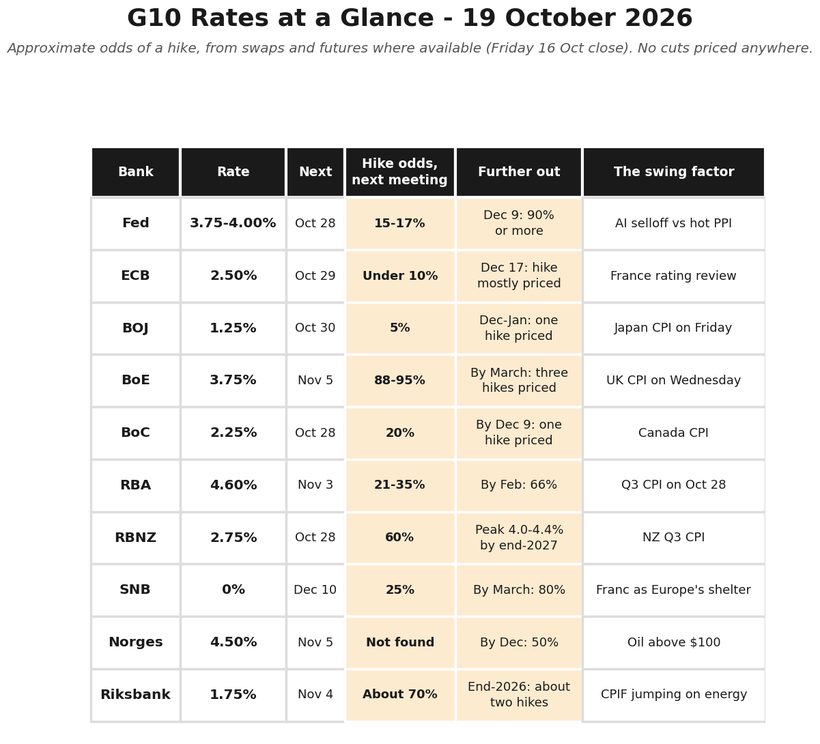
Ten central banks, still no cuts priced anywhere. The hot inflation data did not lift October: the Fed's odds fell to 15-17%, while December stays 90% or more. The BoE is the surest bet for November, and the RBA's odds fell after the jobs report. The odds are snapshots from Friday's close, from rate futures where they trade and swaps or polls where they don't; where two sources disagree we show the range, and where we found no market price the cell says so. Source: CME FedWatch, rate futures (CME, Eurex, ICE, OSE, Montreal Exchange, ASX), Reuters, Bloomberg.
Regimes
The capital shortage, week ten: the vigilantes meet the chip rout. The bond market took the hottest inflation week of the year and rallied 16bp on the 10-year, because the AI selloff did the Fed's work for it. The demand for capital has not slowed: companies have sold $106 billion of project bonds in dollars this year, almost triple 2025, with more than $300 billion expected worldwide next year. Stocks and yields are moving together again, so bonds are back to being a hedge. Still no outright duration; the refunding on November 4 is the next test. changed, week 10
The dollar goes two-way, week twenty: lower with yields. The DXY nearly touched 103, the halfway mark of its fall since the 2025 peak, then slid to 101.8 as the 2-year fell back below 4.75%. When the AI trade cracks, the dollar loses through the rate channel. Long USD against the funders still works, because the yen and franc gain more in a selloff than the euro; long USD against the high-yielders does not. changed, week 20
France, the euro's weak link, week three: calm spreads, angry streets. The spread over Germany held at 130-140bp all week, but the student protests are now in their second month and spreading to universities, and France's rating is reviewed on Friday. Moves in the euro now track the French spread more closely than at any time in four months. The exits are unchanged: a budget that survives parliament, ECB tools moving from words to purchases, or contagion forcing the backstop. held, week 3
The funding-currency battle, week five: the carry unwinds. Last week I was waiting for a dip to rebuild the yen and franc longs; the chip rout made the call for me. When high-beta equities fall, carry is sold and the funders are bought. A Japanese core CPI back at 2% on Friday would revive October hike talk the week before the BOJ meets. The plan is to stay long the funding currencies and let carry unwind. changed, week 5
The AI fracture, week sixteen: the funding test. The cost of AI keeps falling; the cost of financing it keeps rising. CoreWeave's bonds reached distress levels, Volta paid more than 11%, high-yield yields hit an 18-month high, and Asia's AI hardware stocks had their second-worst week since 2018. Hyperscaler capex estimates still rise each quarter, but if the next revisions are smaller, the buildout stocks are exposed. Meta and Tesla on Wednesday are the first test. changed, week 16
The war is the inflation, week thirteen: the kingdom under siege. Houthi missiles kept Riyadh's airport shut, reached Aramco's headquarters, and a Houthi leader called for the crown prince's overthrow. Brent touched $110. Washington's price management is fraying: lawmakers are moving to block the Russian diesel deal, Russia kept hitting Ukraine's energy grid after the ceasefire, and the US reportedly asked the IEA for another 100 million barrels. Saudi money also underwrites US Treasuries and AI, so this regime and the AI one are now linked. changed, week 13
Surplus versus deficit, week eight: a quota for Europe, a crawl for the yuan. EU leaders took China's offer: a cap of 350,000 hybrids a year, rising 6%. It will not dent a surplus running at $133.5 billion a month, with exports up 36.3%. Beijing is letting the yuan crawl stronger, with the fix at its strongest since February 2023, but too slowly to matter, and Merz and Macron have now put currencies on Europe's agenda. The US truce runs to January 10; APEC in Shenzhen is the next test. changed, week 8
Shifts (if then)
Last week the data fired and the market did the opposite: hot CPI and PPI, and bonds rallied on the chip rout. This week the board hangs on whether the AI selloff keeps doing the central banks' work, and on Asia's prices.
China grows 4.5% or more → the floor of the target is met, the yuan's crawl continues and the Australian dollar and copper get a bid; at 4.3% or less, stimulus talk fills the Financial Street Forum and AUDJPY is sold. new
UK CPI at 3.5% or more → November is fully priced with February behind it, gilts are sold into the budget and sterling holds above $1.33; at 3.3% or less, sterling slips toward $1.30. new
Bank Indonesia hikes → Destry buys credibility and the rupiah steadies even with the MSCI threat; a hold with the rupiah weak sends it to new lows and foreign selling continues. new
Meta and Tesla raise capex and the market rewards it → the chip rout pauses and Asia's hardware names bounce; if capex rises and the stocks still fall, the funding test spreads from the neo-clouds to the hyperscalers. new
Japan's core CPI at 2.1% or more → October BOJ odds jump from near zero, the yen squeezes and the funding-currency longs pay; at 1.9% or less, carry gets a week's reprieve before the BOJ meets. new
US flash PMI above 56 with prices rising → the stagflation story returns, the front end is sold and the dollar bounces; below 54.5, duration extends its rally and the dollar falls further. new
Alberta's separation option draws more than a third → the Canadian dollar gives back its breakout below 1.42 and Quebec's referendum talk returns; a heavy defeat closes the question for now. new
Tails
Retired this week: India's final stage, because the reserve worked as a signal and the rupee had its best week in seven months. A correction too: Indonesia, which we retired last week as only a date, fired when MSCI proposed stripping its emerging-market status. That decision now sits in the calendar, not the tails. retired
The kingdom's trillion gets cut → a Houthi leader has called for the crown prince to be overthrown, and the kingdom is fighting on its own soil. If Riyadh redirects money home, its pledges to US AI and its Treasury holdings both shrink, removing a buyer from two markets that need one. new, week 1
A neo-cloud defaults → CoreWeave's bonds yield 15% and lenders say a large unsecured deal would not clear. A missed payment by any AI cloud borrower would reprice every data-centre bond at once and hit the hardware chain that has carried Asia's stock markets. new, week 1
A US-Iran deal before the vote → talks are stuck and Washington is reported to be weighing its largest conventional bomb, so the market prices strikes after November 3. A surprise deal that reopens Hormuz would take the war premium out of oil in a session. held, week 2
Kyiv's leader pushed out → Washington has threatened to stop sharing intelligence and Starlink speeds have been limited for Ukraine's army. A forced change in Kyiv splits the sanctions front and puts more defence borrowing on Europe's bond markets. changed, week 2
The Fed's independence goes to court → the investigation of Governor Cook is still open. A move to remove her before the vote would push term premium up and the dollar down together. held, week 2
The buyer strike → bonds became a haven again last week, which makes a failed auction less likely, not impossible. A tail at the 20-year on Wednesday, or in Tokyo, would bring the accident the bond bears say is the only brake. held, week 2
A hit on Abqaiq → the Houthis have now reached Aramco's headquarters. A strike on the main processing plant would take millions of barrels a day offline in an afternoon, as in 2019. changed, week 2
AI breaks into a bank → one successful AI-driven attack on a systemically important lender would turn the cyber risk Dimon described into a run. held, week 2
Paris falls → the protests now reach universities; a censure vote that brings down the government before the budget passes puts 150bp back in play within days. changed, week 2
Bangkok's verdict: resilient, with thin cushions
The IMF's message from Bangkok was that the world absorbed the energy shock better than feared, helped by the AI investment boom, but that the cushions are wearing thin. It projects global growth of 3.1% this year with inflation rising to 4.7%. If AI's productivity gains fail to arrive, unwinding the investment alone would take 0.8% off US GDP and about 0.5% off Asia's output by 2029.
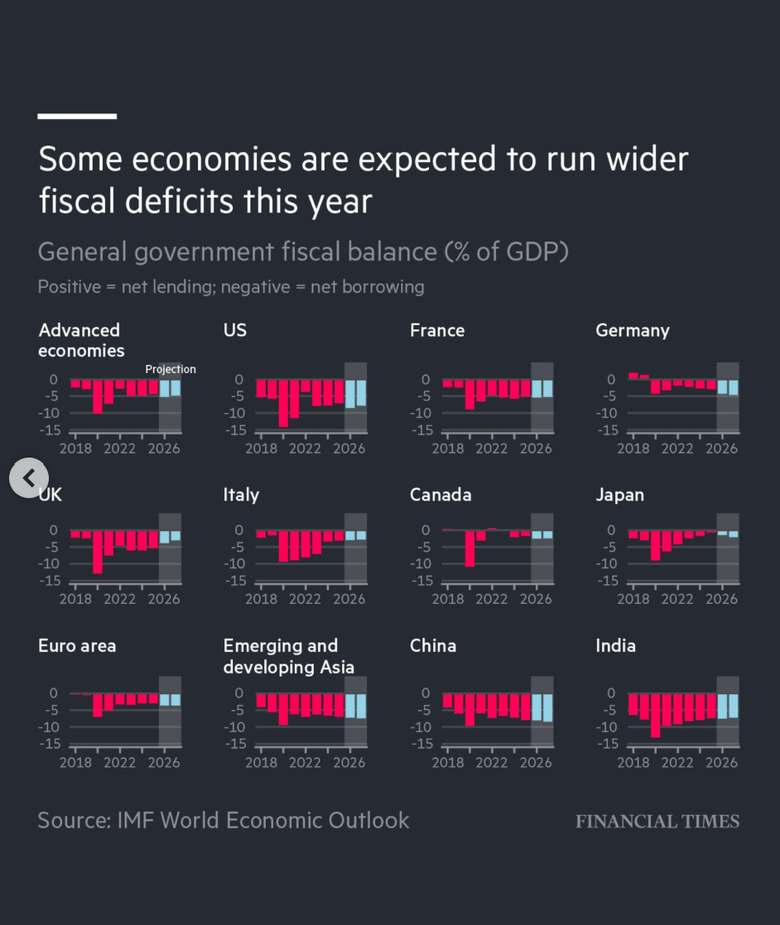
The widest deficits since Covid: leading economies are heading for their biggest budget deficits since the pandemic, and global public debt heads toward 100% of GDP later this decade. The Fund called for urgent action to rebuild public finances. Source: IMF World Economic Outlook / Financial Times.
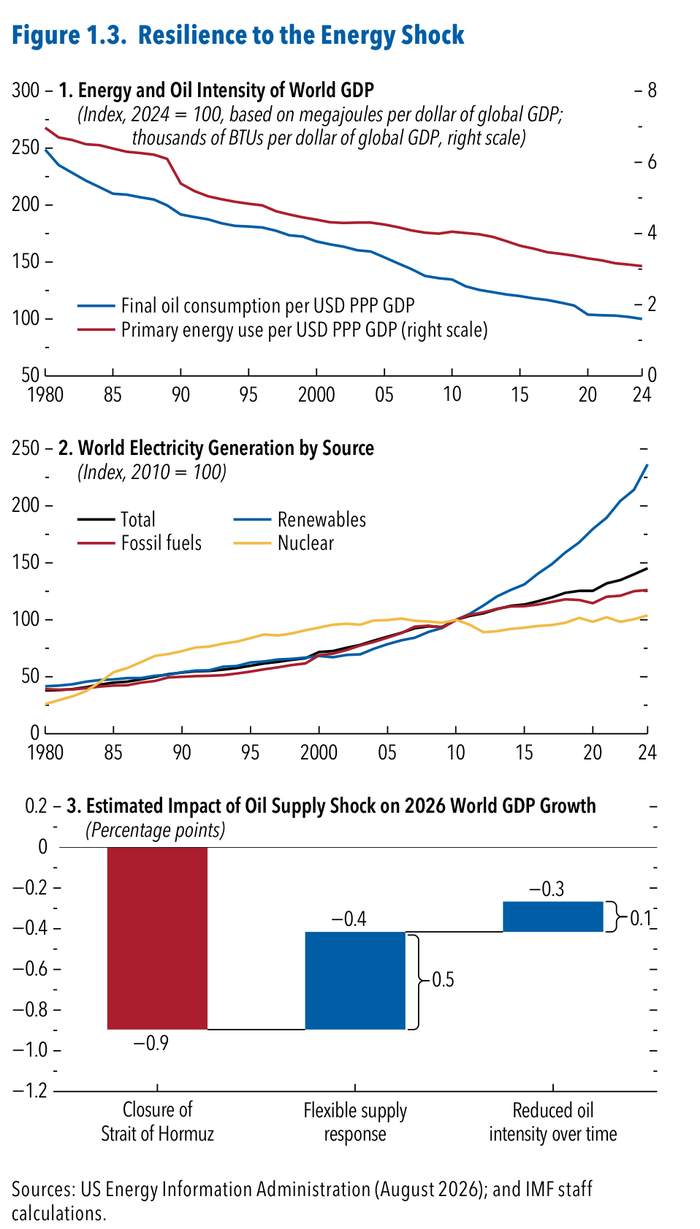
Why the oil shock hurt less than it could have: the world needs 32% less energy per unit of output than two decades ago, and renewables supplied 60% of the growth in electricity since 2010. Rerouted shipments, extra supply and stock releases cut the hit to this year's growth from 0.9 points to 0.3. But inventories are dwindling, and AI data centres are adding to electricity demand. Source: IMF, US Energy Information Administration.
China Monday
The week opens on the chip rout and a war that has reached Aramco's front door, with Hong Kong shut for Chung Yeung. China's GDP at 10am is the first test of Beijing's targeted support: the floor of the 4.5-5% target is within reach because the state is building, not because households are spending. The Financial Street Forum in Beijing and the Bund Summit in Shanghai run all week, a stage for any new support. In the evening, Canada's CPI lands as Alberta votes, and the builders show how far 7.5% mortgages reach.
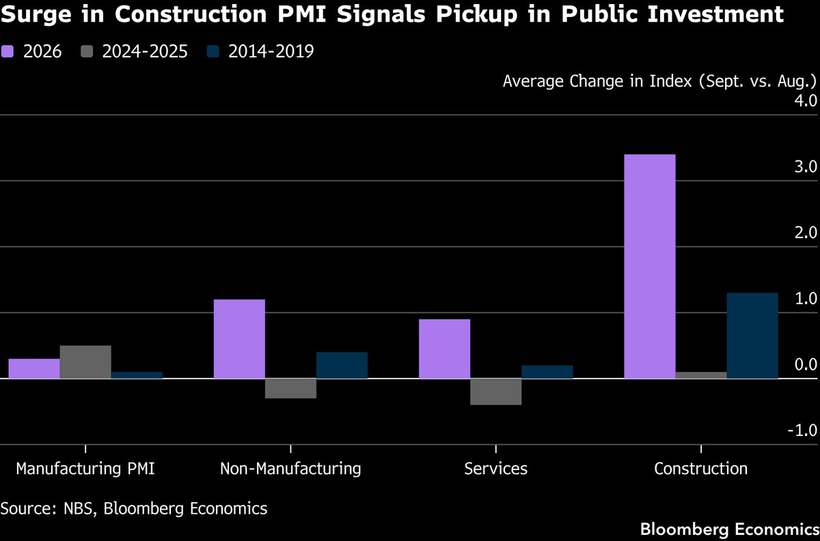
Beijing is building again: China's construction PMI rose about 3.3 points in September, nearly three times its usual September gain and the clearest sign that targeted support has reached public projects. Manufacturing and services barely moved, and fixed-asset investment is still down about 7% this year. Source: NBS, Bloomberg Economics.
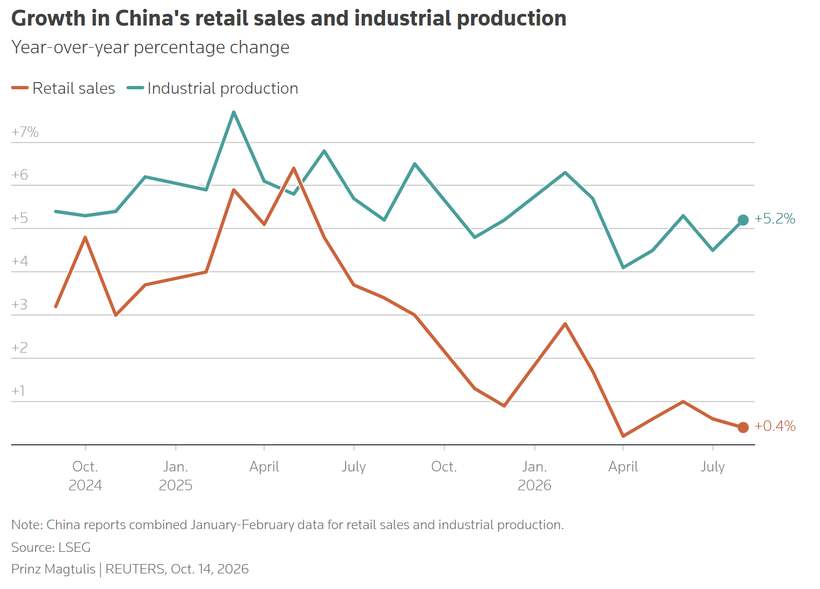
Factories hum, shoppers don't: industrial production grew 5.2% in August while retail sales slowed to 0.4%, the gap that defines China's year, with exports up 36.3% in September. Monday's consensus is 5.4% and 0.5%; property prices come with them and are the drag nobody has fixed. Source: LSEG / Reuters.
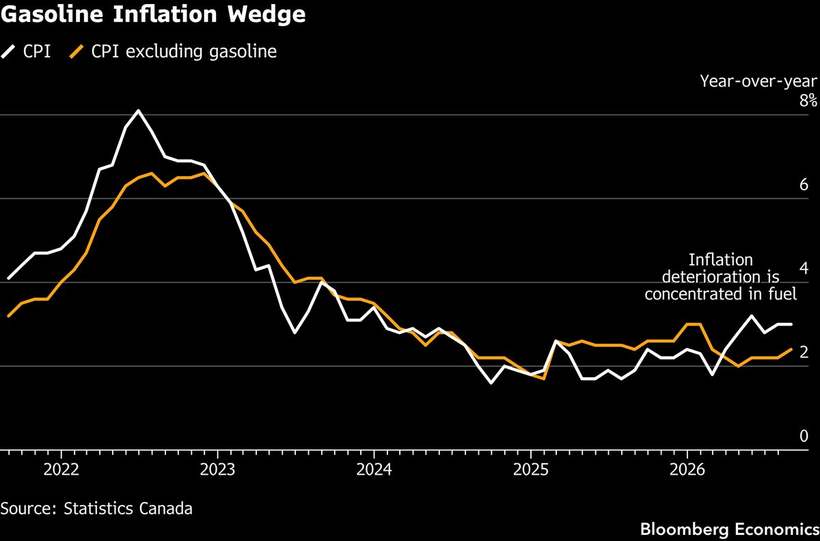
Canada's inflation is a gasoline story: headline CPI (white) has run above the measure without gasoline (orange) since the war began; strip out fuel and prices rise close to the Bank of Canada's 2%. September is seen at 3.1%, and with 110,000 jobs lost in two months, the Bank has little reason to hike on the 28th. Source: Statistics Canada / Bloomberg Economics.
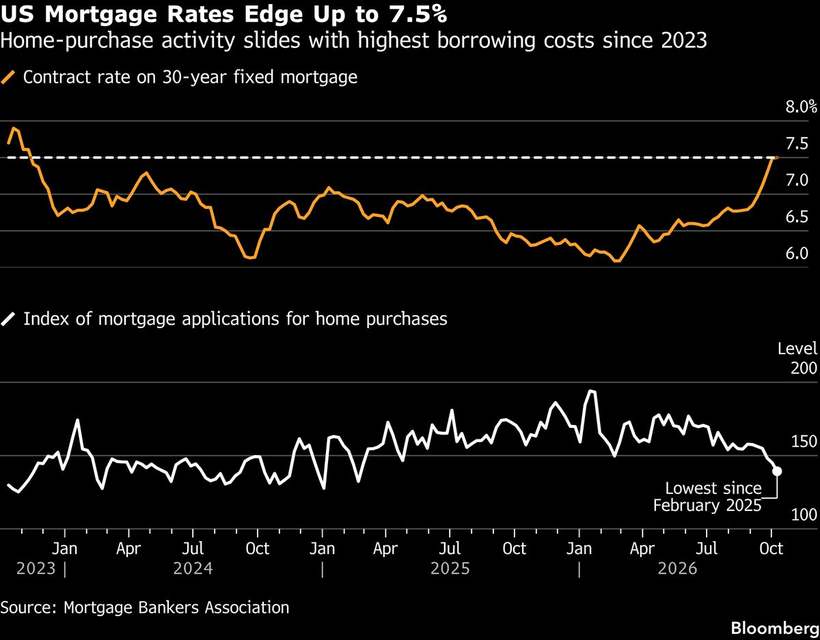
7.5% mortgages are doing the Fed's work: the 30-year contract rate has risen nearly a point since June to 7.50%, the highest since 2023, and purchase applications have fallen to their lowest since February 2025. Builder confidence at 10pm is seen slipping to 31. Source: Mortgage Bankers Association / Bloomberg.
Housing Tuesday
A quieter day with India shut. China's banks are expected to leave their loan prime rates alone for a 17th month, APEC's finance ministers meet in Hong Kong, and Britain's jobs report shows whether unemployment is peaking near 5%. In New York, housing starts follow the builders' mood, and Netflix, GE Aerospace and RTX report, the last into a record year for US weapons procurement.
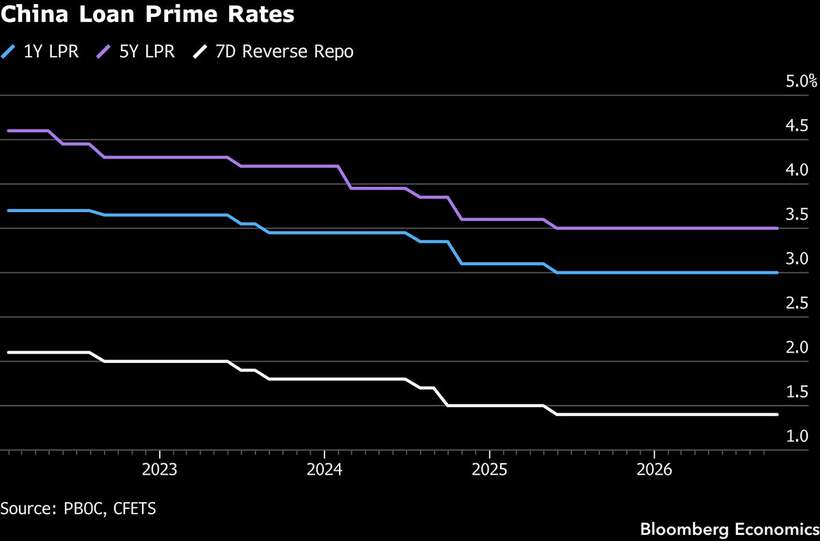
Seventeen months without a cut: the one-year LPR has sat at 3.00% and the five-year at 3.50% since the PBOC's last 10bp cut in May 2025. With growth near target and exports booming, there is little urgency; Beijing is steering cheap credit to chosen projects instead. Source: PBOC, CFETS / Bloomberg Economics.
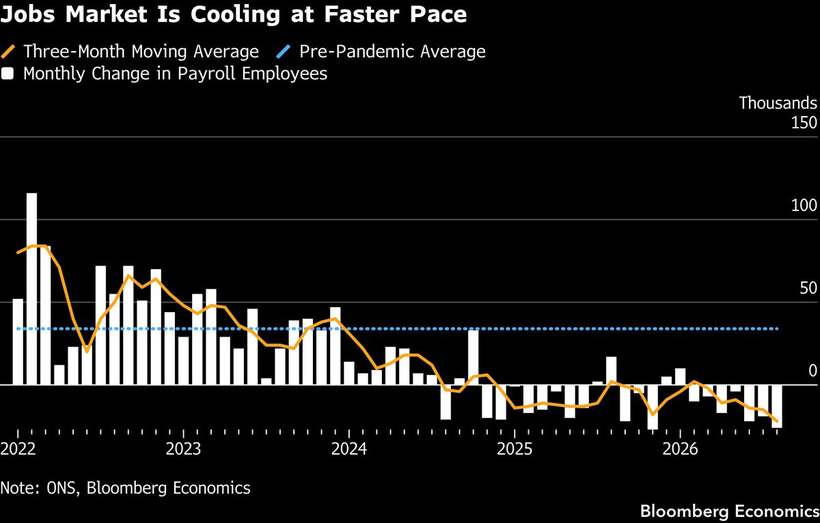
Britain's payrolls keep shrinking: the number of payrolled employees has fallen in most months since the Iran war began, and the three-month average (orange) sits well below its pre-pandemic norm (blue). Unemployment is seen at 5.0%, close to its peak, and the BoE is expected to hike anyway, because inflation, not jobs, is driving the decision. Source: ONS, Bloomberg Economics.
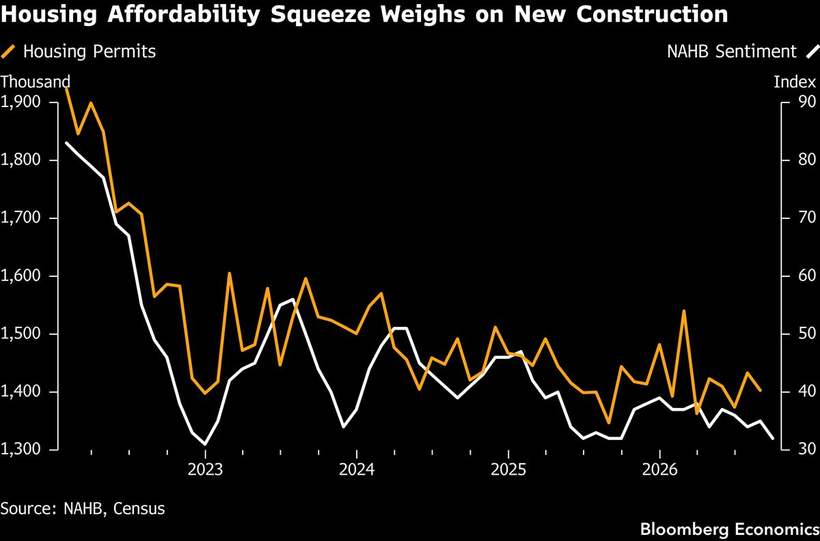
Builders see no rebound: permits (orange) and builder sentiment (white) have drifted lower together since 2022. Starts are seen at 1.30 million and permits at 1.385 million; any gain is likely in smaller homes and rental blocks, the only projects that still work at these rates. Source: NAHB, Census / Bloomberg Economics.
Inflation and Meta Wednesday
The week's busiest day. Britain's CPI at 2pm sets up the BoE and the budget a week later. Bank Indonesia decides at 3:20pm with MSCI's threat hanging over Jakarta. In New York, the Robin Hood investors conference meets on the day Meta and Tesla report after the close. After the chip rout, the question for both is whether investors still reward the spending.
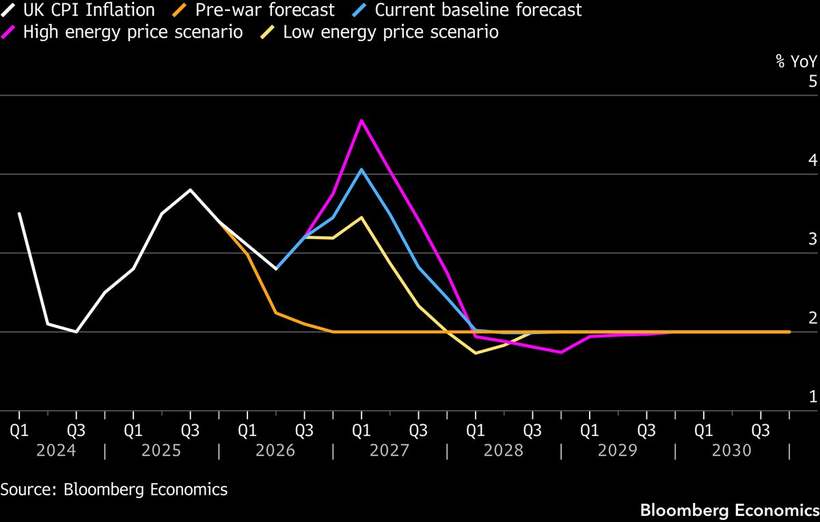
Britain's energy bill has not arrived yet: CPI is seen at 3.4% in September and peaking at about 4.1% in early 2027 (blue), as household energy bills jump more than 20% in January; a high-energy scenario (pink) takes it near 4.6%. Before the war, inflation was forecast back at 2% by now (orange). Source: Bloomberg Economics.
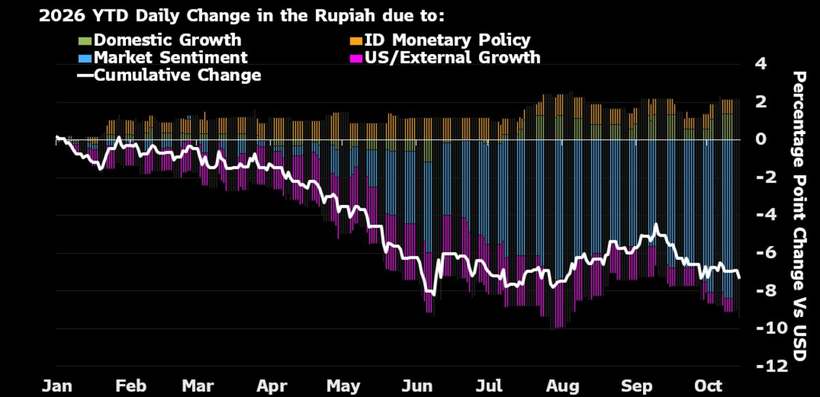
The rupiah's problem is sentiment, not policy: of its 7% slide against the dollar this year, market sentiment (blue) explains most, and Bank Indonesia's own policy (orange) has helped. A pre-emptive hike to 6.00% would buy credibility for Governor Destry in her third decision, but it cannot overturn an index provider's verdict. Source: Bloomberg Economics.
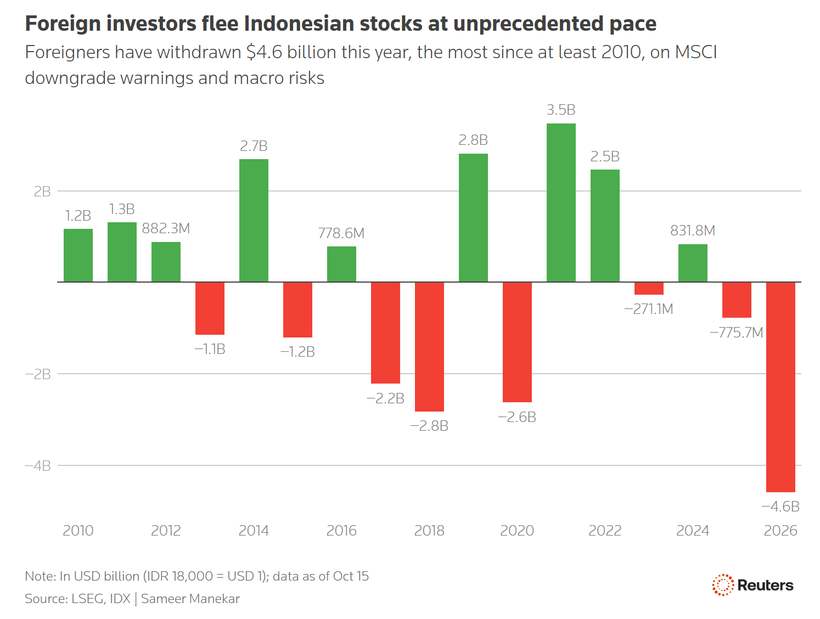
Foreigners are leaving Indonesian stocks at a record pace: $4.6 billion withdrawn this year, the most since at least 2010 and well beyond the exits of 2018 and 2020. MSCI's proposal to strip Indonesia of emerging-market status would force index funds out on top. Source: LSEG, IDX / Reuters.
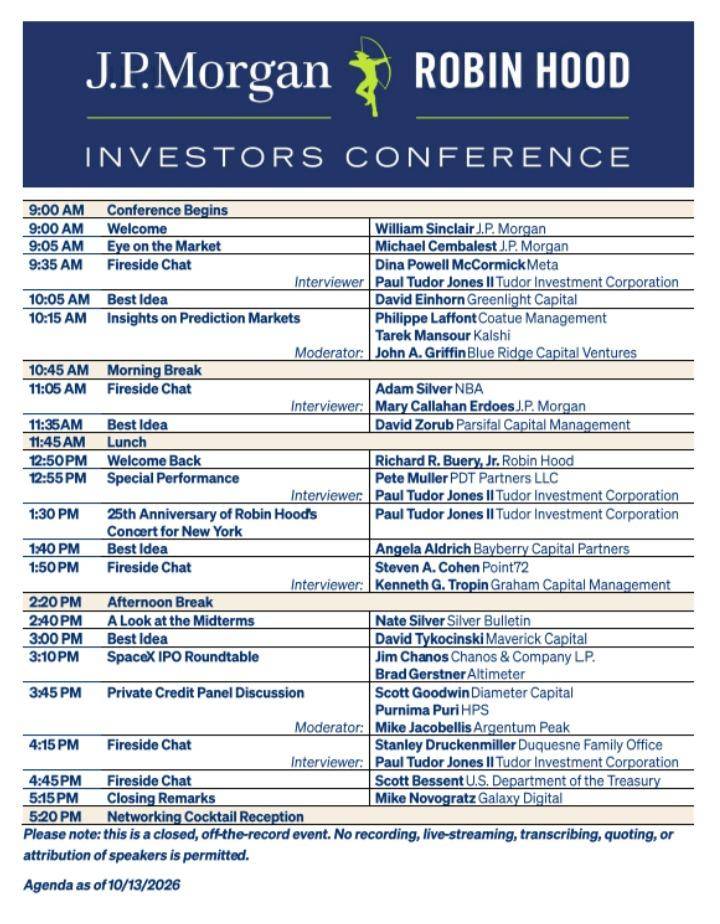
The Robin Hood investors conference, 9pm to 5:20am Singapore time: Paul Tudor Jones interviews Meta's Dina Powell McCormick, Pete Muller and Stanley Druckenmiller; Nate Silver takes the midterms at 2:40am; Jim Chanos and Brad Gerstner hold a SpaceX IPO roundtable; a private credit panel follows; and Bessent closes with a fireside chat at 4:45am. Steve Cohen, David Einhorn and Kalshi's Tarek Mansour are also on the bill. It is a closed, off-the-record event, so nothing said there will be quoted here. Source: J.P. Morgan, Robin Hood, agenda as of 13 October.
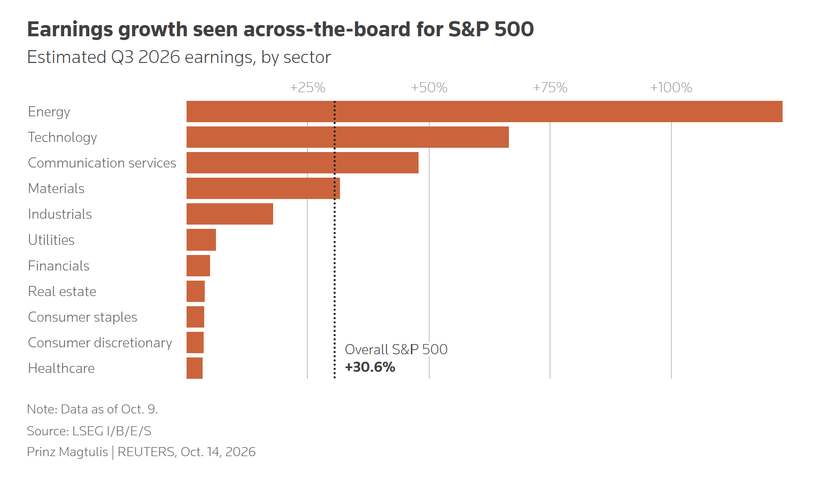
The bar for earnings is high: S&P 500 earnings are expected up 30.6% in the third quarter, led by energy and technology. Meta's revenue is forecast up 23.5% with capex more than doubling to about $39.7 billion; options price a 6% move either way. Source: LSEG I/B/E/S / Reuters.
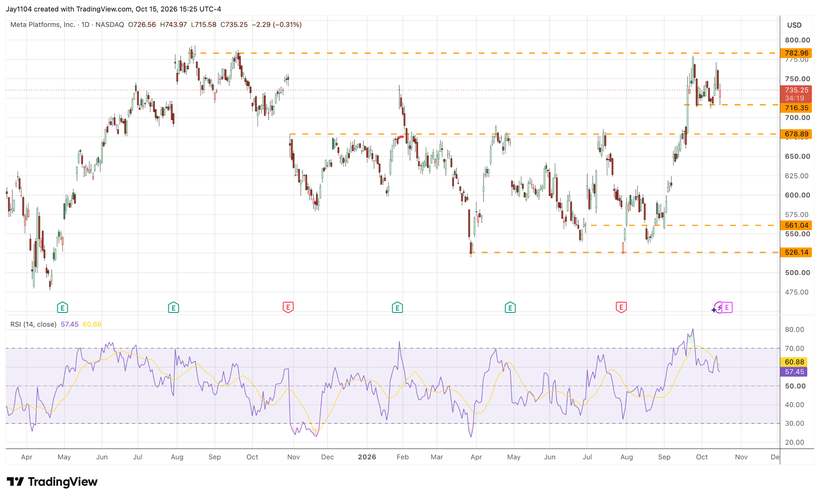
Meta, a double top in the making? The shares stalled near $780, last year's record, and found support near $715. A break below $715 would complete a double top, with $680 the next floor; above $750, the record is back in view. Source: TradingView.
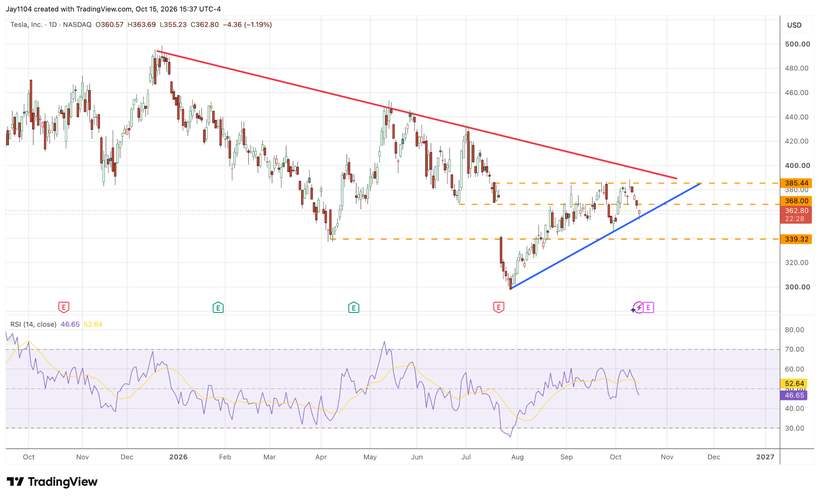
Tesla, squeezed between two lines: lower highs since the December peak (red) and higher lows since August (blue), and the shares now sit below old support near $370. Earnings are seen down about 15%, with a 6% move priced. Source: TradingView.
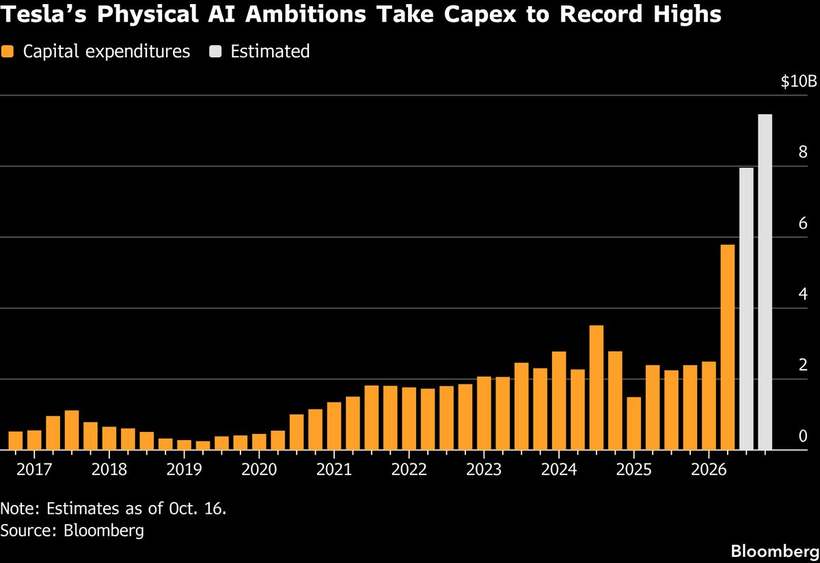
Tesla's spending triples: capex is expected near $7.5 billion this quarter and $9 billion in the next, against about $2.3 billion a year ago, for the Cybercab and Optimus. Spending on that scale feeds talk of a merger with SpaceX, which some analysts say could come before December. Source: Bloomberg.
Central banks Thursday
Asia's rate day. New Zealand's CPI before dawn sets up the RBNZ a week later; the BOK is expected to pause after two hikes and the BSP to hike into 7.2% inflation. Turkey is expected to cut in the evening while MSCI watches its market, and US claims test the idea that companies are shrinking by attrition rather than layoffs.
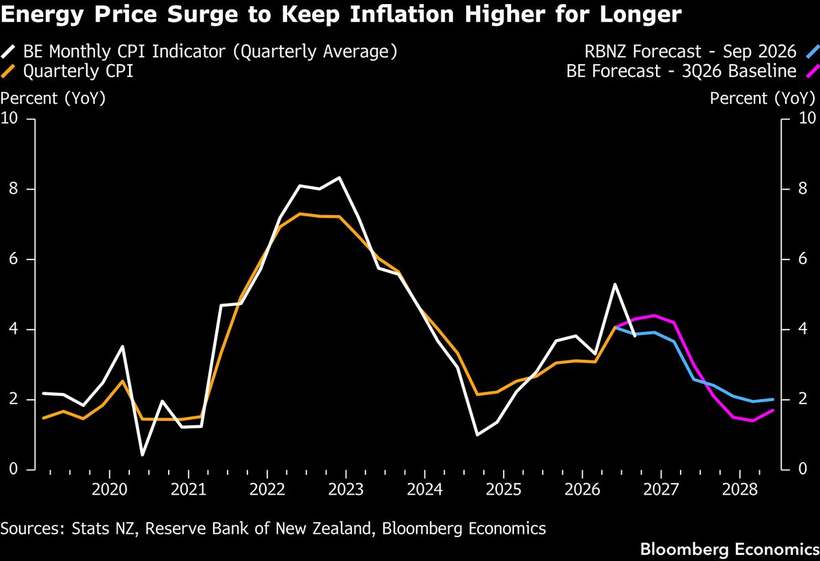
New Zealand's inflation has not peaked: annual CPI is seen at 4.3% in the third quarter and 4.4% in the fourth before oil eases, above the RBNZ's own September forecast (blue). Data-centre investment and energy prices argue for more tightening despite high unemployment. Source: Stats NZ, RBNZ, Bloomberg Economics.
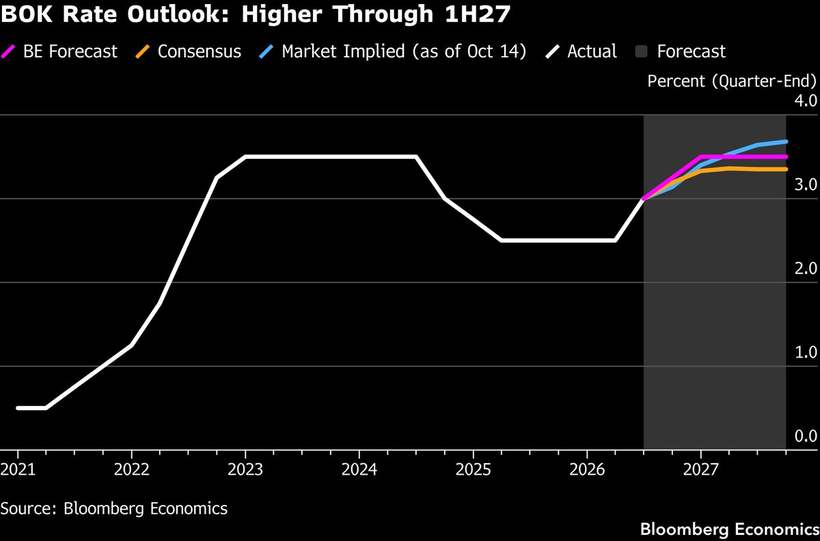
The BOK pauses; it does not stop: after back-to-back hikes to 3.00%, a hold is expected, but the market (blue) prices a path to about 3.5% by the end of 2027, above both the consensus and Bloomberg Economics. AI chip demand is powering growth, and a stronger won gives the bank room to wait. Source: Bloomberg Economics.
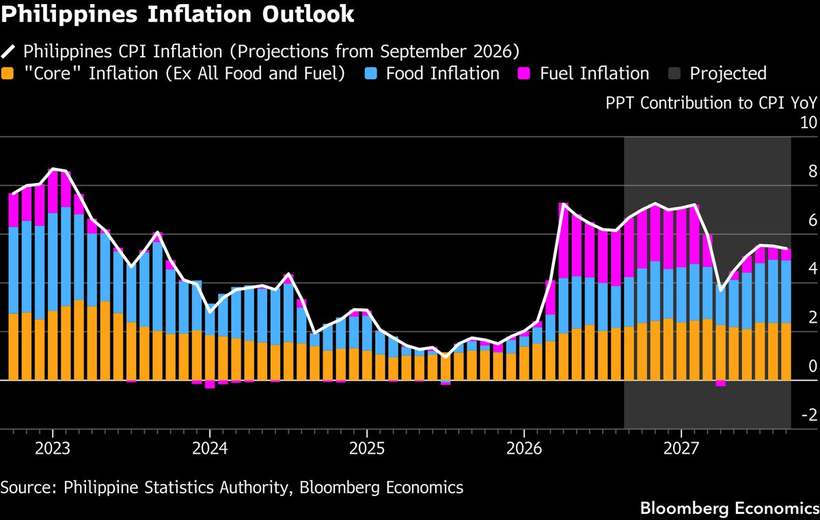
Philippine inflation is far from done: 7.2% in September, with fuel (pink) and food (blue) on top of a rising core (orange), and projections stay above the 2-4% target through 2027. After 75bp of hikes this year, another 25bp to 5.25% is expected, with wage rises and El Niño still to come. Source: Philippine Statistics Authority, Bloomberg Economics.
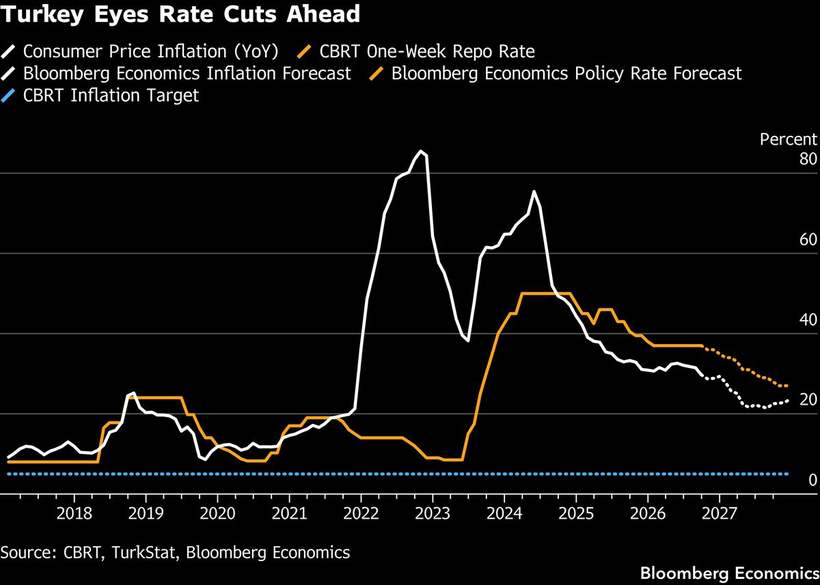
Turkey keeps cutting while MSCI watches: inflation (white) has fallen from above 80% to near 30%, and the one-week repo rate (orange) has followed it down from 50%. A cut to 36% is expected, even as MSCI warns of a downgrade if reforms fall short by mid-2027. Source: CBRT, TurkStat, Bloomberg Economics.
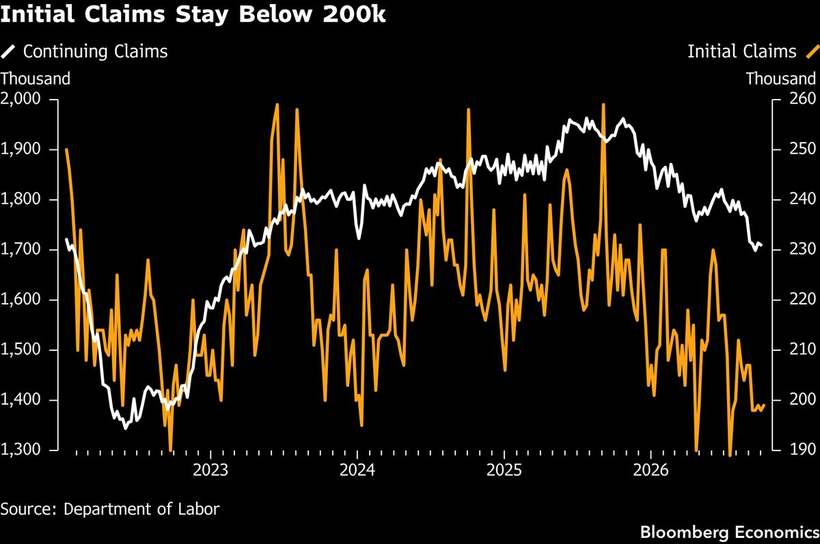
Hiring is slowing; firing is not: initial claims (orange) have stayed near or below 200,000, and continuing claims (white) have fallen to 1.71 million. Thursday's estimate is 209,000, with AI letting companies cut headcount through attrition rather than layoffs. Source: Department of Labor / Bloomberg Economics.
Prices and PMIs Friday
Japan's CPI before Asia's open is the week's biggest test for the funding currencies, a week before the BOJ meets. Singapore's CPI follows at 1pm. Europe's flash PMIs show whether higher yields are biting, and whether bonds keep working as a hedge. Brazil's mid-month inflation lands two days before Sunday's runoff, and Michigan's final reading measures what gasoline is doing to American voters eleven days before the midterms. France's rating review comes after the close.
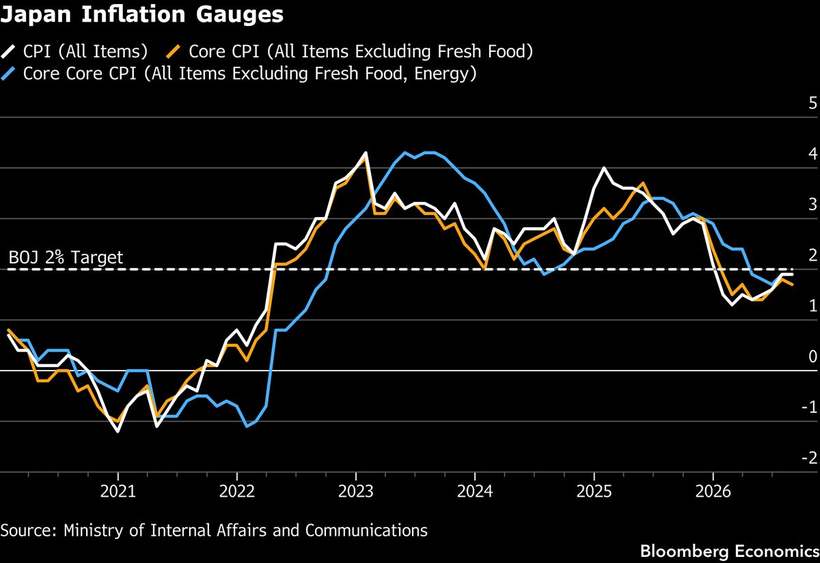
Japan's core is back at 2%: core CPI excluding fresh food (orange) is expected to rise to 2.0-2.1% from 1.7%, lifted by Silver Week travel, a weaker yen and demand for AI laptops; Tokyo's core already jumped to 2.7%. A December BOJ hike, then two more in 2027, is the central case. Source: Ministry of Internal Affairs and Communications / Bloomberg Economics.
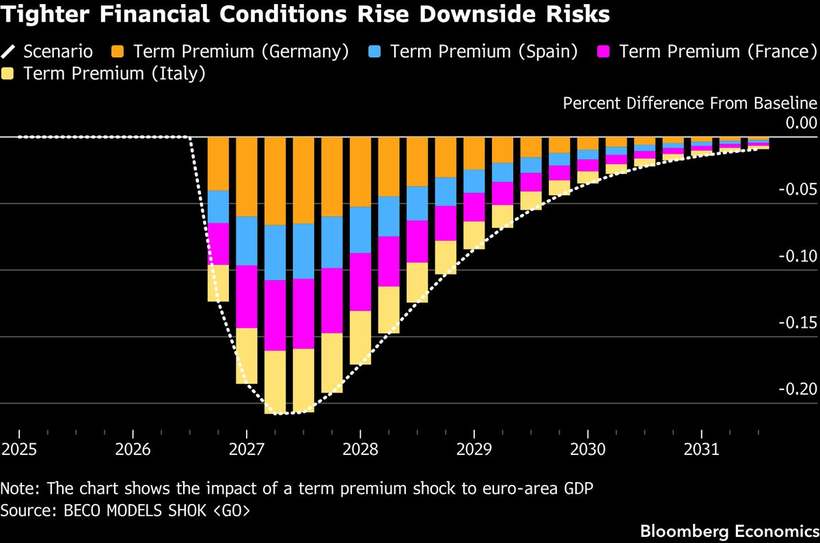
Europe's bond selloff is a tax on growth: a term premium shock of the kind under way would cut euro-area GDP by up to 0.2% at its worst in 2027, with Germany's (orange) and France's (pink) premiums doing most of the damage. September's composite PMI was 53.1; Friday shows whether the shock is already biting. Source: Bloomberg Economics.
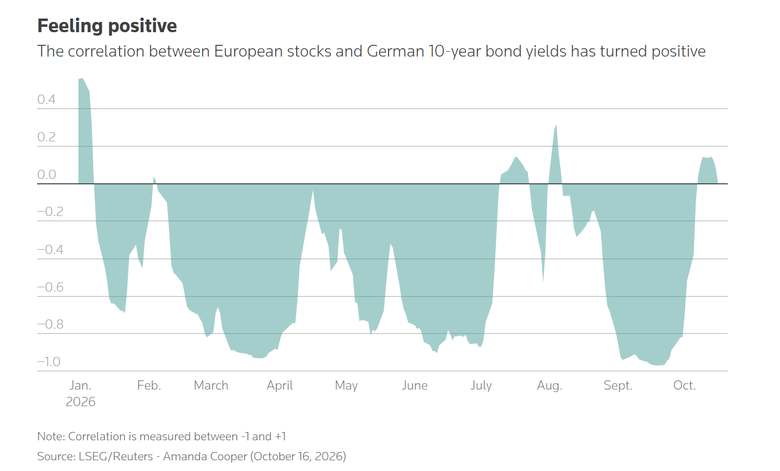
Bonds are a hedge again: European stocks and German 10-year yields now move together, so yields tend to fall when stocks fall. For most of the war, bonds fell with stocks; in September the correlation was its most negative on record. It changed last week, when the AI rout pulled yields down with equities. For a portfolio, that is the difference between a hedge and a second loss. Source: LSEG / Reuters.
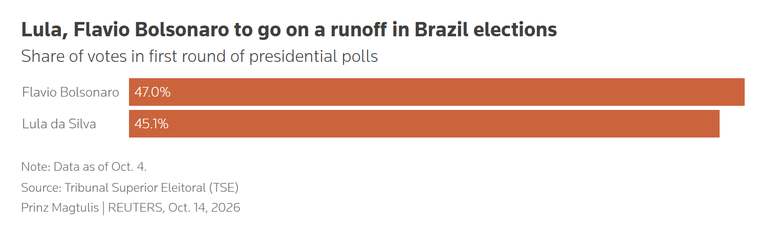
Two days before Brazil's runoff: Flávio Bolsonaro took 47.0% to Lula's 45.1% in the first round, which sent Brazilian stocks up 7.7% and the real almost 4%. The race is now a technical tie at 46% to 44%, and Lula has answered with a pledge of free weekend transit nationwide. A Bolsonaro win is largely priced; a Lula comeback would hit the real, long bonds and state companies first. Friday's mid-October inflation is seen above the target ceiling. Source: Tribunal Superior Eleitoral / Reuters.
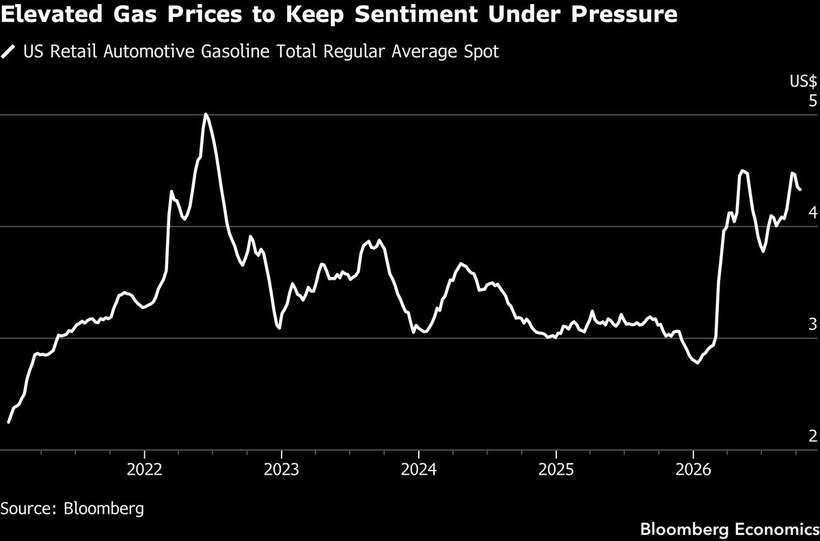
Gasoline is still near $4.33: pump prices sit at their highest since 2022. Michigan's final sentiment is seen unchanged at 46.3: consumers need cheaper gas and cheaper borrowing before their mood improves. Source: Bloomberg.
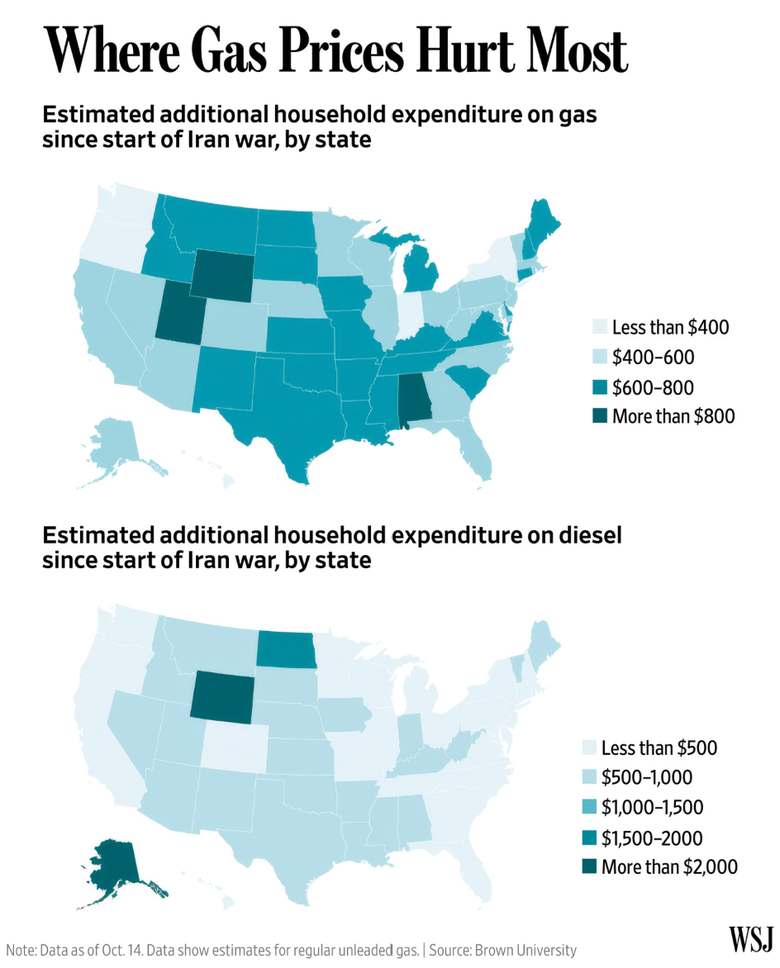
The war's gas bill lands on the battlegrounds: the typical Wyoming household has spent an extra $969 on gasoline since the Iran war began, against $336 in Oregon. Rural states drive further in bigger cars, so the heartland, including key Senate battlegrounds, pays most. Source: Brown University / WSJ.
The Fed talks tough, traders pare
Ahead of the meeting on the 28th, the gap that matters is between what officials say and what the market prices. The Fed sounds more hawkish than at any time this year, while traders cut their October bets after a hot CPI and PPI. Warsh refused to give guidance in Bangkok, and his enthusiasm for AI reads as confidence in growth. Hours worked are also rising in lower-paid industries, a sign employers are stretching staff rather than hiring.
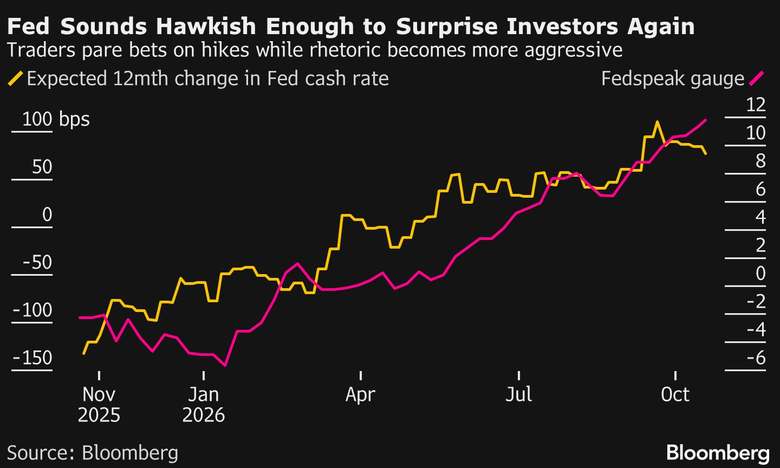
The words and the prices have parted: Bloomberg's Fedspeak gauge (pink) is at its most hawkish in a year, while the expected rate change over the next 12 months (yellow) has slipped since early October. Either the officials are bluffing, or the market is early. Source: Bloomberg.
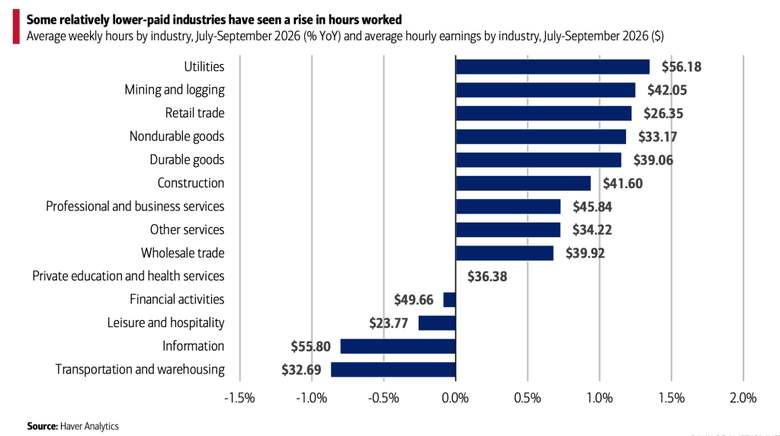
Longer hours where pay is lowest: average weekly hours rose in the third quarter in utilities, mining, retail and goods-making, and fell in information and transport. Retail, at $26.35 an hour, is working its staff longer, which is where a hiring slowdown shows first. Source: Haver Analytics / Bank of America Institute.
The AI fracture: the funding test
The question has moved from whether demand for chips will hold to whether the buyers can keep paying for them. Hyperscaler capex is still being revised up, but its growth peaks this quarter, and the revenue growth of the two largest AI labs is slowing. Asia carries the most exposure: TSMC, Samsung and SK Hynix are nearly a third of MSCI Asia ex-Japan, and their suppliers add to it.
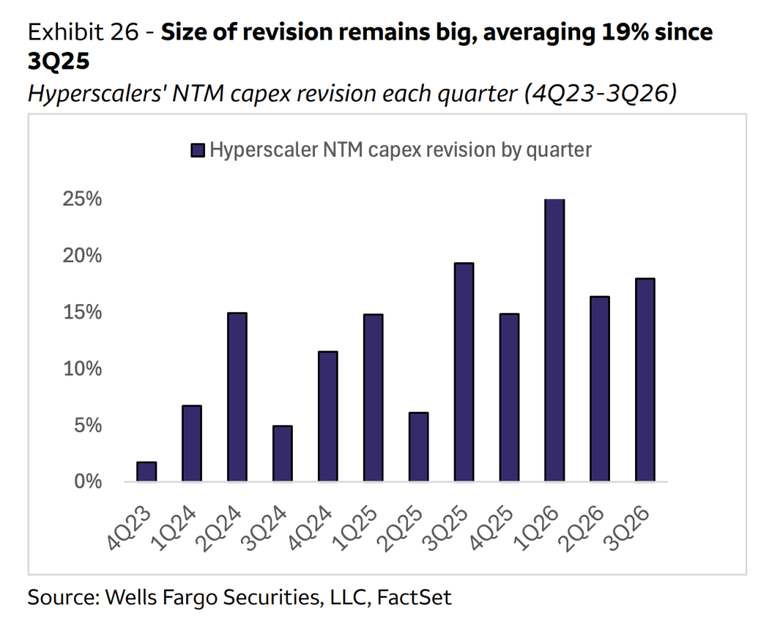
Capex estimates still rise every quarter: hyperscalers' next-12-month capex estimates have been revised up by an average of 19% a quarter since late 2025. A revision of less than 10% would be the warning sign for the buildout stocks. Source: Wells Fargo Securities, FactSet.
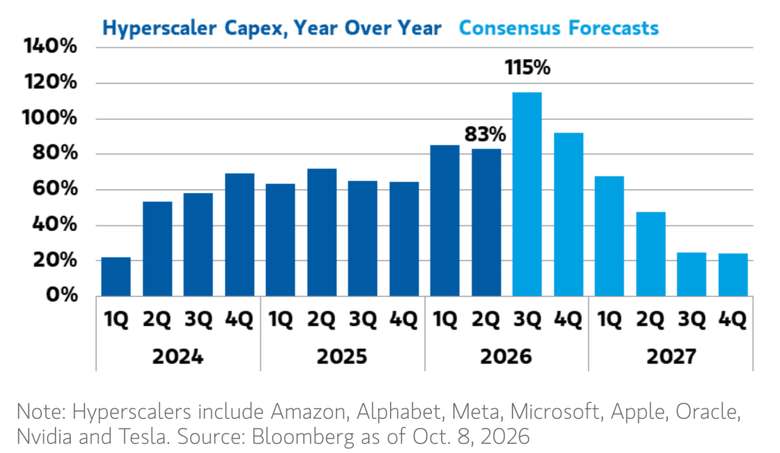
Spending growth peaks this quarter: consensus has hyperscaler capex up 115% on the year in the third quarter, then slowing to about 24% by late 2027. The dollars keep rising; the growth rate, which drives the stocks, does not. Source: Bloomberg.
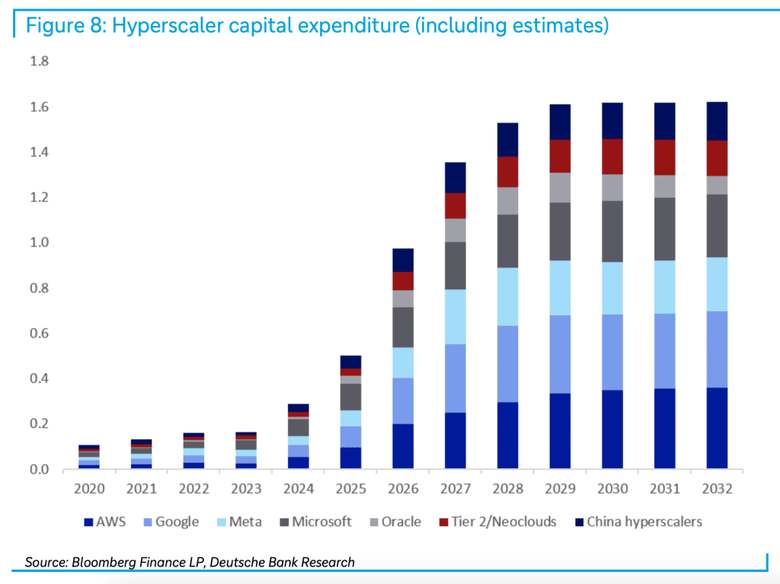
A plateau at $1.6 trillion: hyperscaler capex is estimated to climb to about $1.6 trillion a year by 2029 and then flatten, with Chinese hyperscalers and the neo-clouds a growing share. A slowdown in the growth rate in 2027 could weigh on equities next year. Source: Bloomberg Finance, Deutsche Bank Research.
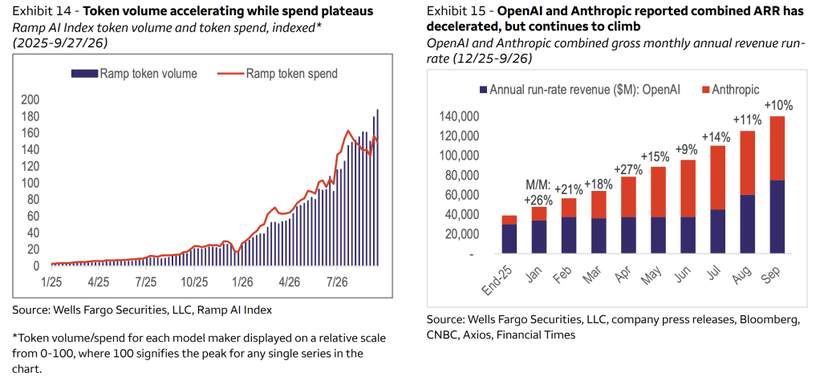
More tokens, flat spending, slower revenue: token volumes keep accelerating while spending on them has plateaued (left), as customers move to cheaper models. OpenAI's and Anthropic's combined run-rate revenue still rises, but monthly growth has slowed from 26% to about 10% (right). Source: Wells Fargo Securities, Ramp AI Index.
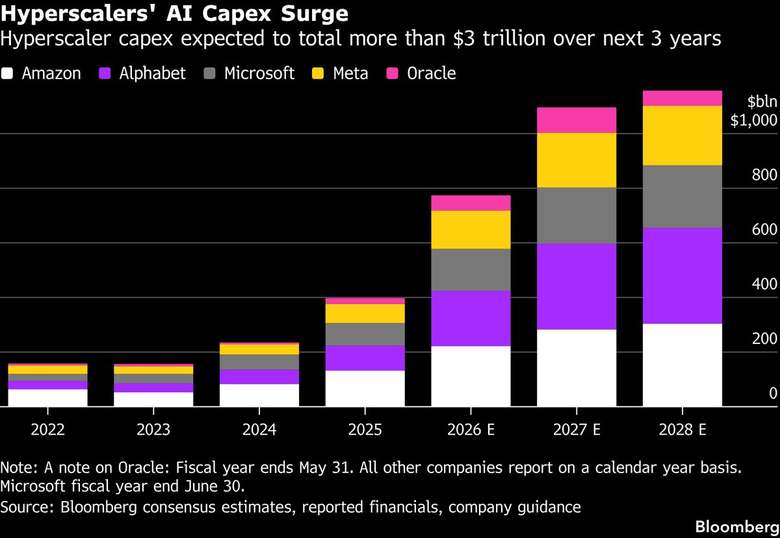
More than $3 trillion in three years: Amazon, Alphabet, Microsoft, Meta and Oracle are expected to spend more than $3 trillion on AI from 2026 to 2028. Financing costs are now the constraint; as one fund manager put it, they are "like gravity for the AI boom". Source: Bloomberg.
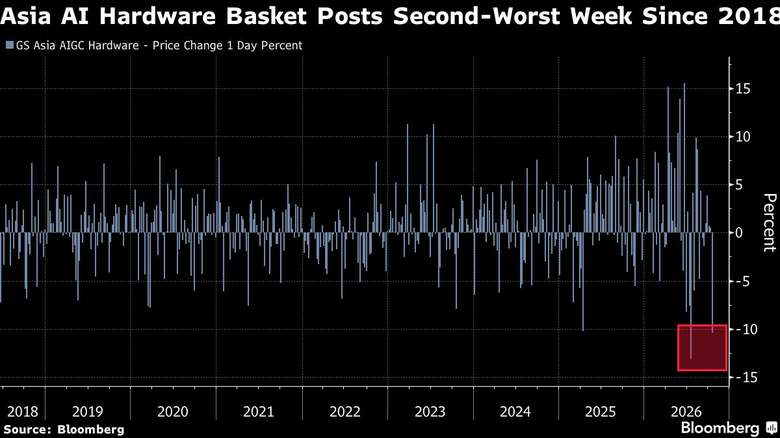
Asia's AI hardware stocks had their second-worst week since 2018: a basket of regional AI hardware names fell 11%. Eight of the ten best performers in MSCI Asia-Pacific this year are component makers, each up at least 236%, and the further a company sits from the chip, the more a delayed project hurts. Source: Bloomberg.
The AI fracture: backlash and breakthrough
Two forces pull the other way. In the states, legislators are moving against data centres, and a blue wave on November 3 could bring moratoriums early next year; much of the legislation is ready to be voted on again. In the labs, the cost of a given level of AI performance is falling faster than any technology on record, and the models are starting to plan their own research.
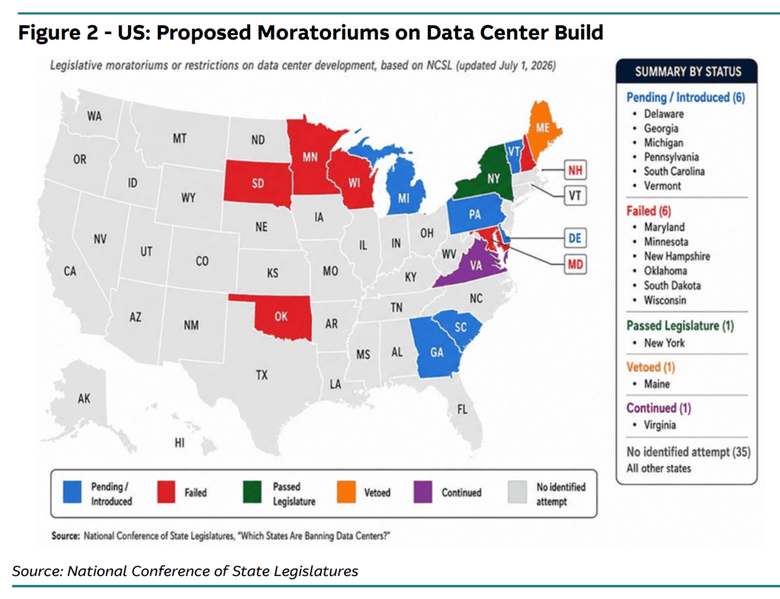
Six states are weighing data-centre moratoriums: bills to pause or restrict construction are pending in Delaware, Georgia, Michigan, Pennsylvania, South Carolina and Vermont; New York's has passed its legislature, Maine's was vetoed, and six more failed. Source: National Conference of State Legislatures.
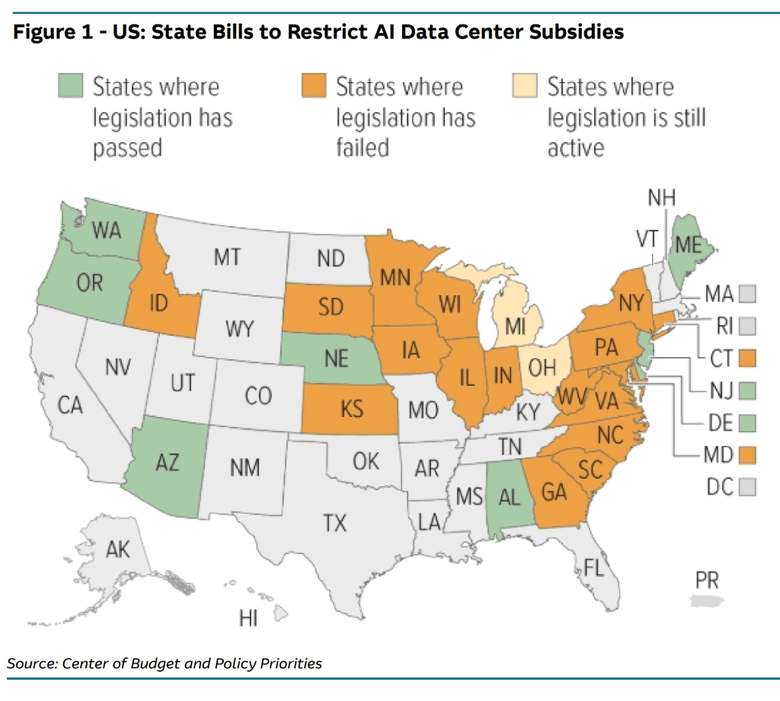
More states are pulling subsidies: Washington, Oregon, Arizona, Nebraska, Alabama, Maine, New Jersey and Delaware have passed laws restricting subsidies for AI data centres, and Michigan and Ohio are still debating. A Democratic sweep would lengthen the list. Source: Center on Budget and Policy Priorities.
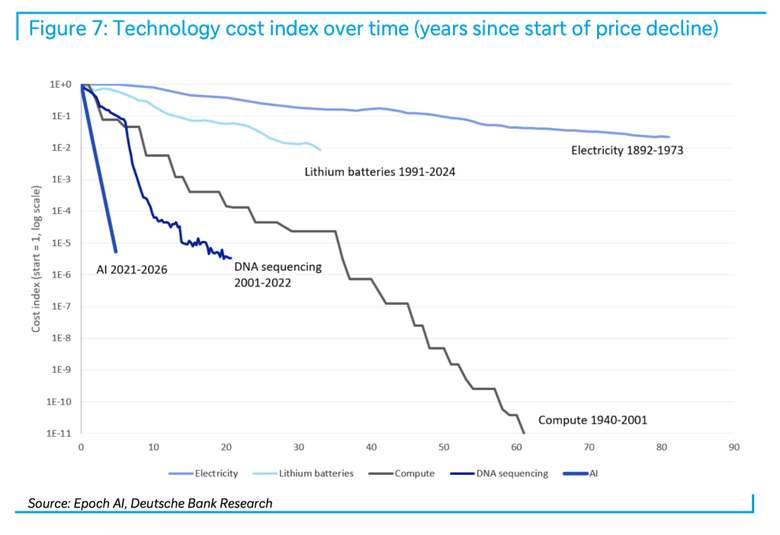
Cheaper than anything before it: the cost of reaching a given level of AI performance has fallen about 47% a quarter since 2023, four times faster than DNA sequencing, six times faster than computing power and 18 times faster than lithium batteries. Cheaper intelligence is good for users and hard on the revenue that must repay the buildout. Source: Epoch AI, Deutsche Bank Research.
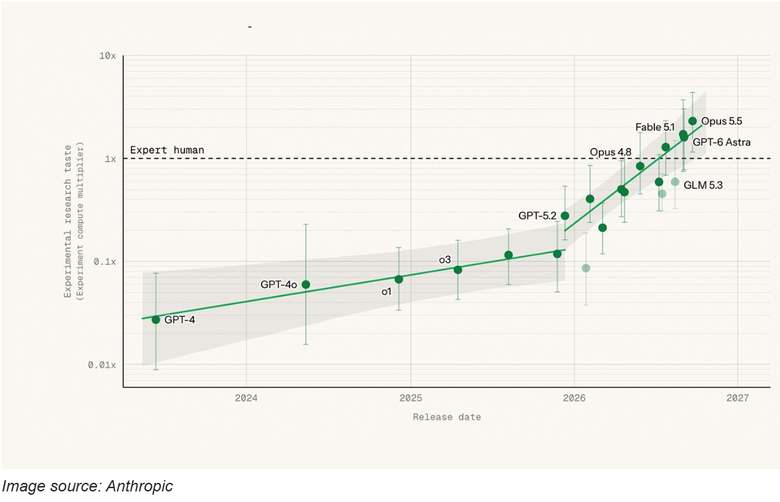
The models now plan research better than the experts: on a new test of research judgement, Anthropic's Opus 5.5 led the field, planning AI experiments about 30 times more cheaply than 24 former researchers from the top labs. Anthropic co-founder Jack Clark moved his estimate for fully self-improving AI to 2027 from 2028. Source: Anthropic.
The yuan's controlled crawl
Brad Setser's argument this week is that China's currency is a policy choice, not a market price. The yuan has risen against the dollar for 16 months, but so slowly that its real value remains far below its long-run trend, and state banks buy dollars to stop it rising faster. China needs net exports to add about 1.5 points to growth every year; without a stronger yuan, he argues, it is on a collision course with its trading partners, whatever quotas Europe agrees.
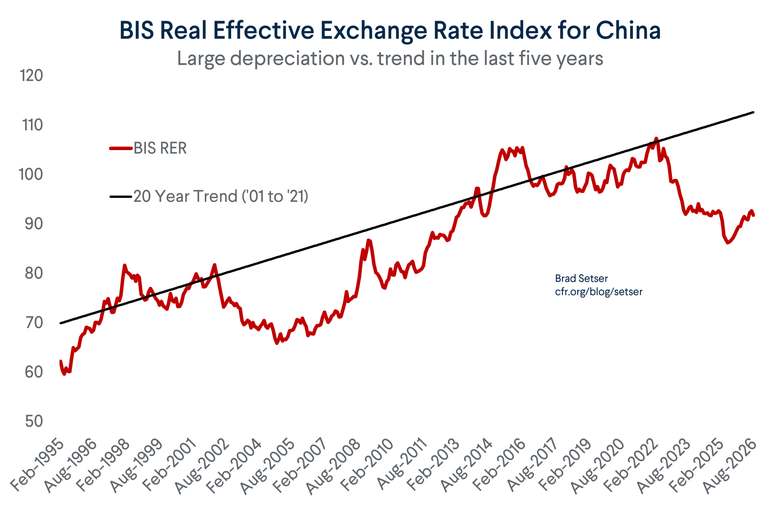
Far below trend: the BIS real effective exchange rate fell well below its 20-year trend after 2022 and has only partly recovered. A country catching up technologically with its partners should see its currency rise over time. Source: BIS / Brad Setser, CFR.
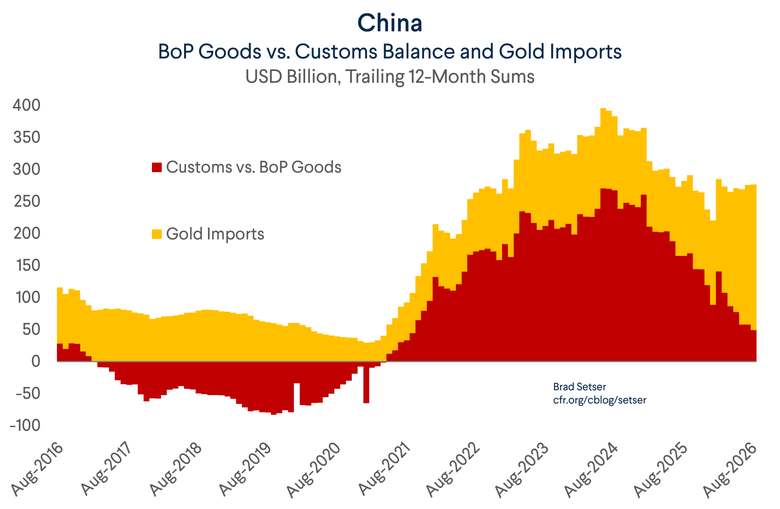
The surplus the statistics used to hide: the gap between China's customs trade surplus and the balance-of-payments measure (red) has narrowed since 2024, so the surplus now shows up in both; gold imports (yellow) explain much of the rest. Source: Brad Setser, CFR.
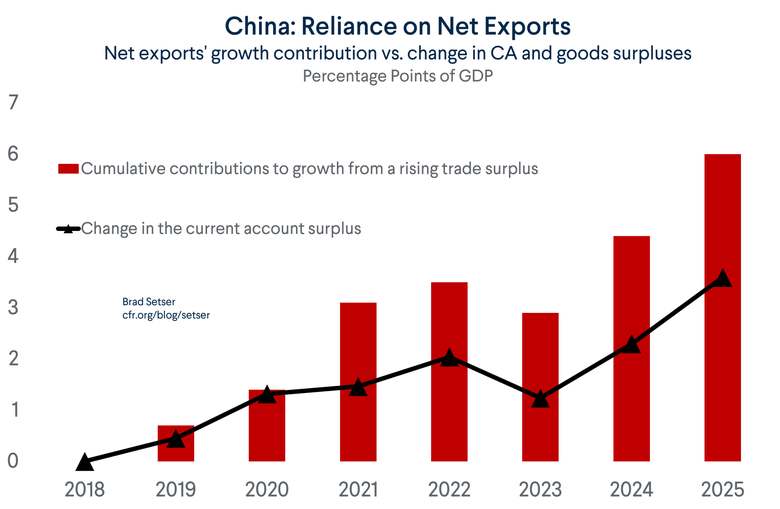
China leans on the world to buy: net exports have added a cumulative 6 percentage points to growth since 2018, and the current-account surplus has risen by 3.6 points of GDP. Source: Brad Setser, CFR.
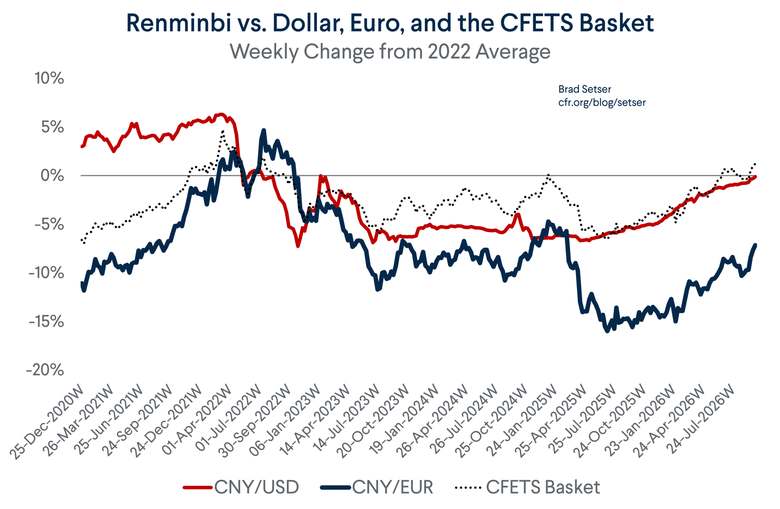
Up against the dollar, still cheap against the euro: the yuan is back near its 2022 average against the dollar (red) and the CFETS basket (dotted), but still about 7% below it against the euro (blue). Europe is where the cheap yuan hurts most. Source: Brad Setser, CFR.
Djibouti: China's listening post at the Red Sea's gate
As the Houthis fight Saudi Arabia across the Bab el-Mandeb, China has upgraded the only overseas base it acknowledges, in Djibouti, on the 20-mile strait that carries an estimated 16% of world maritime trade. Satellite images show new antennas and dishes that strengthen its communications and would almost certainly support signals intelligence, a few miles from American, French, Italian and Japanese bases.
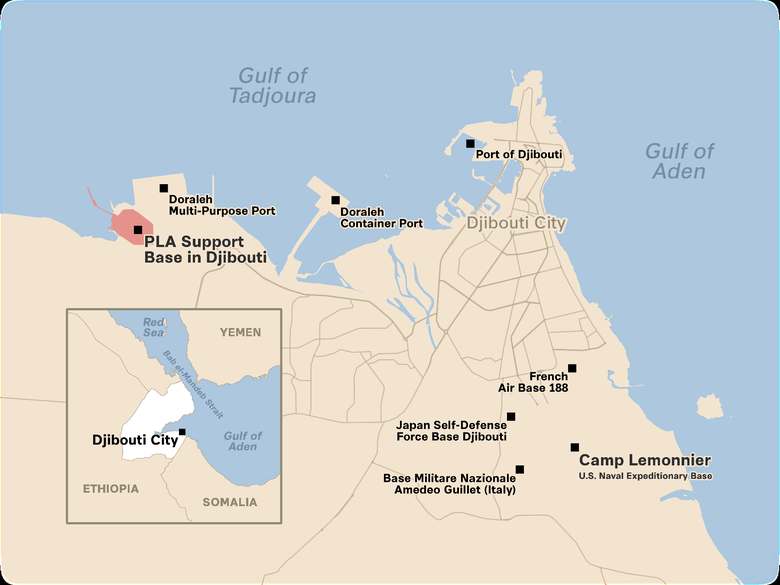
Neighbours at the chokepoint: the PLA Support Base sits beside Doraleh port, less than 10 miles from Camp Lemonnier, the main US base in Africa, and from the French, Italian and Japanese bases. By July, more than 20 US warships, including two carrier groups, were operating in the region. Source: CSIS, Planet.
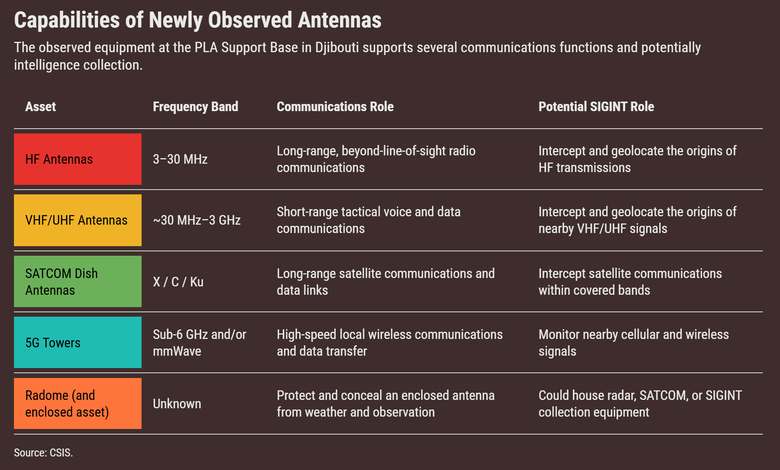
What the new antennas can do: HF and VHF/UHF antennas, satellite dishes and 5G towers give the PLA long-range links to its ships and aircraft, and the means to intercept and locate other militaries' signals. Even encrypted traffic gives away direction, frequency and pace. Source: CSIS.
VC+ Special Dispatch, What Makes a Great City?
A great city can mean where the money is, where the power sits, or where life is good, and the answers rarely line up: New York ranks first in the world overall but only 86th for quality of life, while Singapore is third for quality of life. The dispatch follows the money and the people, then how these places feel to live in, what they cost, and who is moving where. Credit to the VC+ team.
Infographic 1 - What Top-Ranking Cities Have to Offer
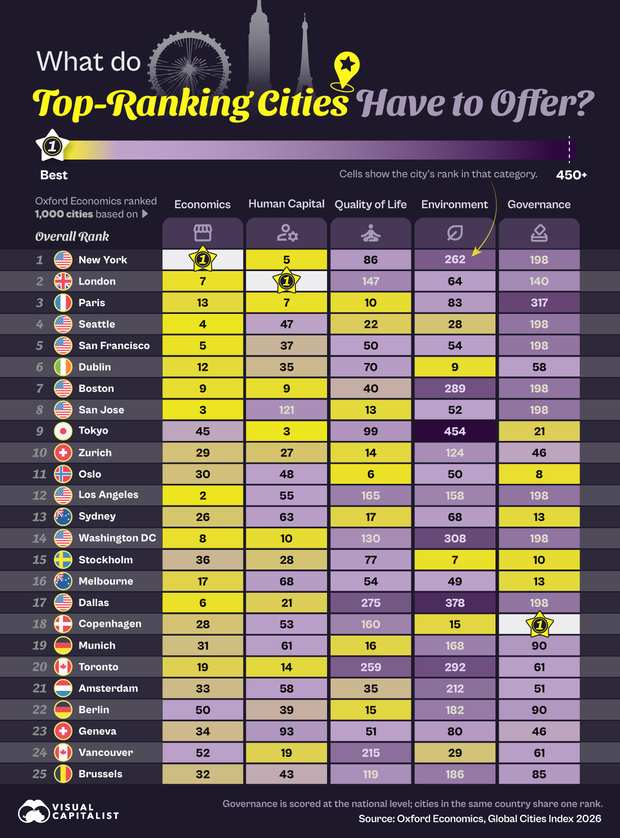
New York first, London second, Paris third, in Oxford Economics' ranking of 1,000 cities on economics, human capital, quality of life, environment and governance, each for a different strength: New York's economy, London's talent, Paris's quality of life. Tokyo is ninth overall but 454th for environment. Source: Oxford Economics / Visual Capitalist.
Infographic 2 - The Richest Cities, Person for Person
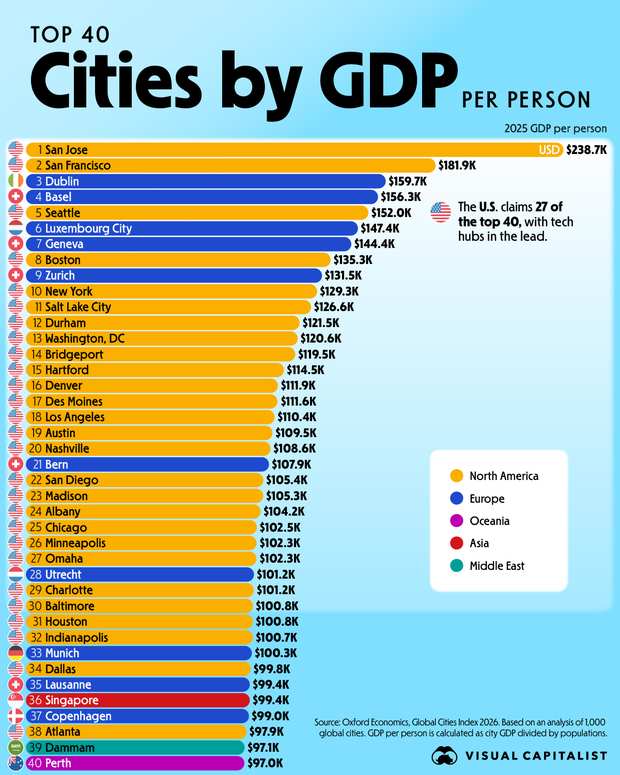
San Jose leads at $238,700 per person, about $57,000 ahead of San Francisco, because Apple, Google and Nvidia sit around San Jose. US cities take 27 of the top 40; New York, the largest city economy, is only 10th, and Singapore 36th. Source: Oxford Economics / Visual Capitalist.
Infographic 3 - The Biggest City Economies of 2050
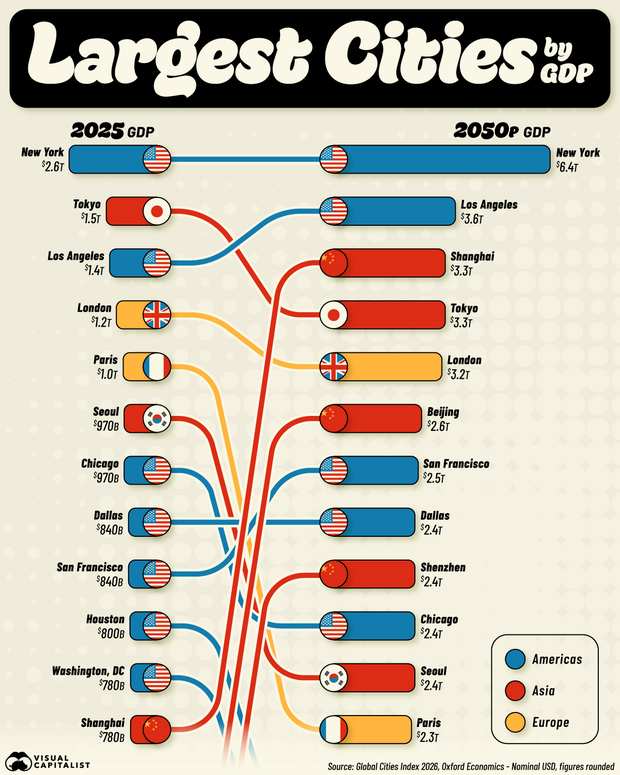
Shanghai climbs from 12th to third, with Beijing and Shenzhen joining it in the top ten, while New York stays first with a widening lead at $6.4 trillion and Paris slips to 12th. Shanghai's economy was a quarter the size of San Francisco's in 2000. Source: Oxford Economics / Visual Capitalist.
Infographic 4 - The Shifting Map of Megacities
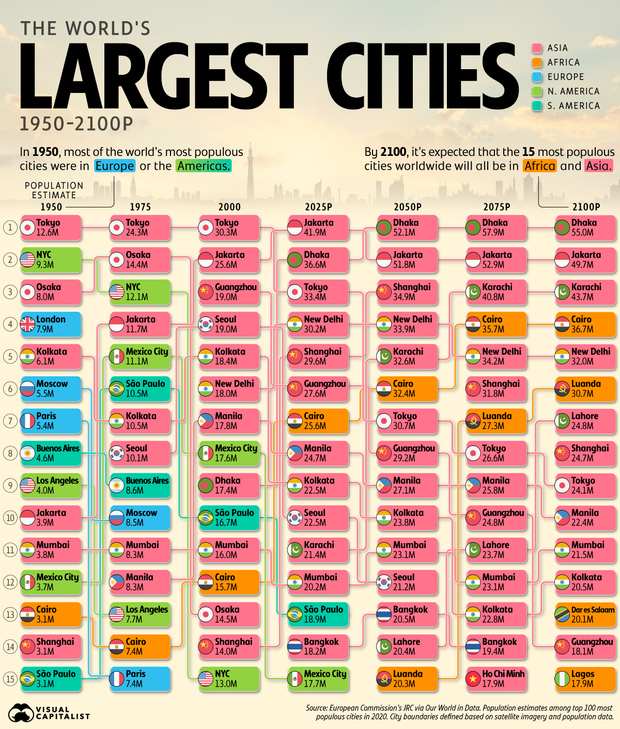
In 1950 the largest cities were in Europe and the Americas; by 2100 all 15 are projected to be in Asia and Africa, with Dhaka leading at 55 million. Jakarta tops today's list on satellite-based counts, and Tokyo is projected to fall below its 1975 population. Source: European Commission JRC / Visual Capitalist.
Infographic 5 - Where Quality of Life Is Highest
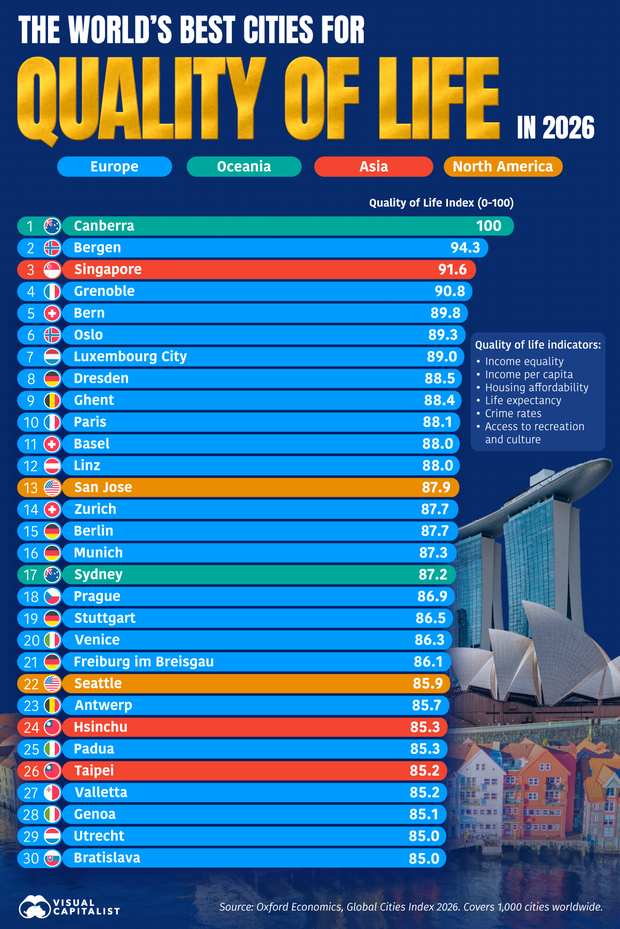
Canberra first, Bergen second, Singapore third, on housing costs, life expectancy, crime, culture and how evenly incomes are shared. European cities take 23 of the top 30; housing costs push Copenhagen to 160th and Vancouver to 215th. Source: Oxford Economics / Visual Capitalist.
Infographic 6 - The Cities Built for Walking
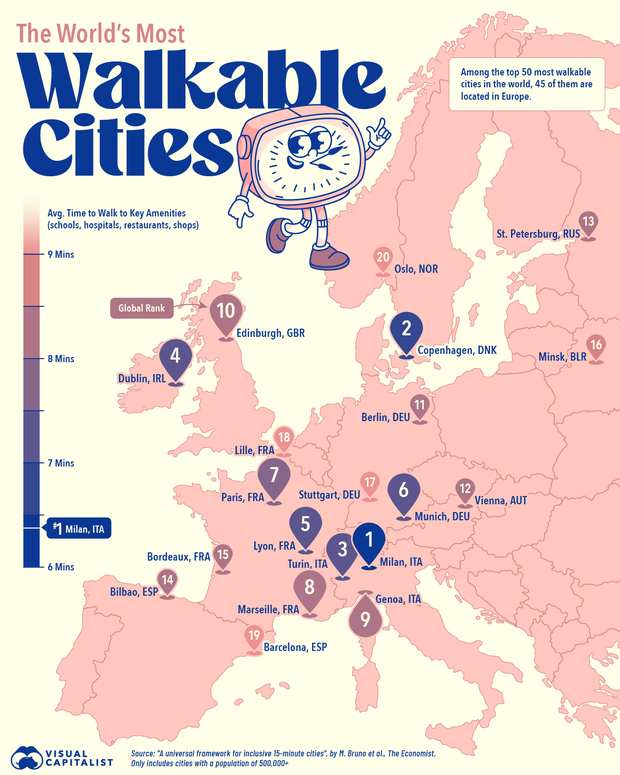
Milan first at just over six minutes to the basics, ahead of Copenhagen and Turin. Europe holds 45 of the top 50, many of its cities built before the car; Kyoto, 28th, is the best outside Europe, and no North American city makes the top 50. Source: Bruno et al., The Economist / Visual Capitalist.
Infographic 7 - North America's Most Walkable Cities
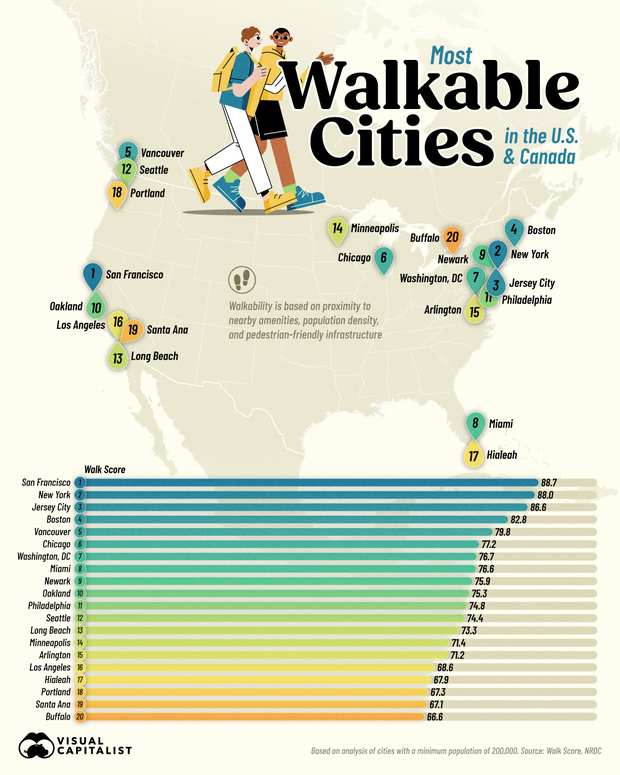
San Francisco edges out New York, with Jersey City third because its borders hold little beyond a dense core. Los Angeles takes in the suburban San Fernando Valley and ranks 16th, and Toronto's merger with its suburbs keeps it out of the top 20. Source: Walk Score / Visual Capitalist.
Infographic 8 - What It Costs to Live Comfortably
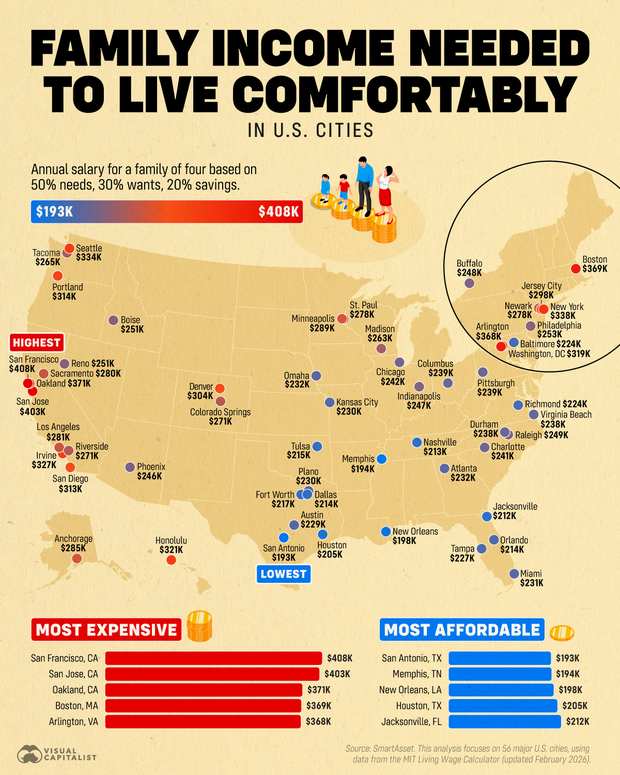
About $408,000 a year for a family of four in San Francisco, with half for needs, 30% for wants and 20% for savings. California holds four of the ten most expensive spots, and even San Antonio, Memphis and New Orleans need nearly $200,000. Source: SmartAsset / Visual Capitalist.
Infographic 9 - Where Americans Are Moving
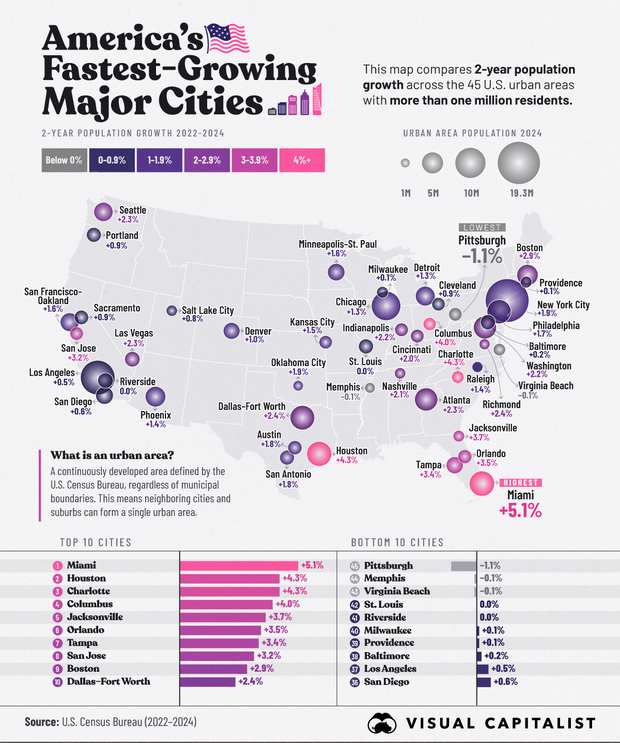
Miami grew 5.1% in two years, the fastest of the large US urban areas, and all seven of the fastest-growing sit in the cheaper half of the cost ranking, four of them in Florida. Pittsburgh shrank 1.1%, as deaths outnumber births and too few immigrants arrive. Source: US Census Bureau / Visual Capitalist.
The Good Wrap
What is left at the close: how much of the web is now written by machines, and week four of the dashi series, the broth that needs patience.
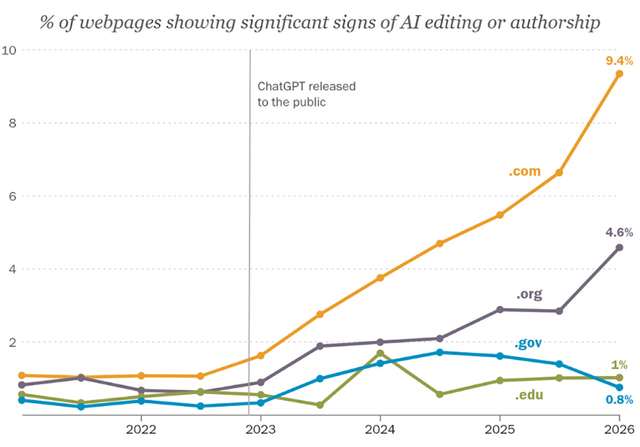
Nearly 10% of English webpages now show signs of AI authorship, and over a third of pages published since ChatGPT's launch, in Pew's study of half a million pages. Commercial sites lead at 9.4%; government and university sites are near 1%. The tell-tale habits are spreading too: em dashes appear about twice as often as in 2023, which is one reason this letter has none. Source: Pew Research Center.

Dashi, week four: shiitake, dried mushrooms for a deep, earthy broth with natural umami, the base for plant-based soups, rice and sauces. They give the most when soaked slowly in cold water; rushed into boiling water, they turn rubbery and keep their flavour locked inside. This week's market looks like the bowl: chips dried and shrunk by 16% in eight sessions. Soaked slowly, they may still give the deepest flavour; boiled in a panic, they won't. Source: FermenStation.
Best,
Hoelon
WITPTW is a personal publication. Everything here is personal opinion and market commentary, written in a personal capacity. It is not investment advice and not a recommendation to buy or sell any security. It is not associated with, endorsed by, or representative of any employer, fund or company. Charts and images are reproduced from their original publishers, credited to their sources for commentary and discussion; all rights remain with the respective copyright holders.