Dark October
Personal views and market commentary. Not investment advice. Not associated with any employer or firm.
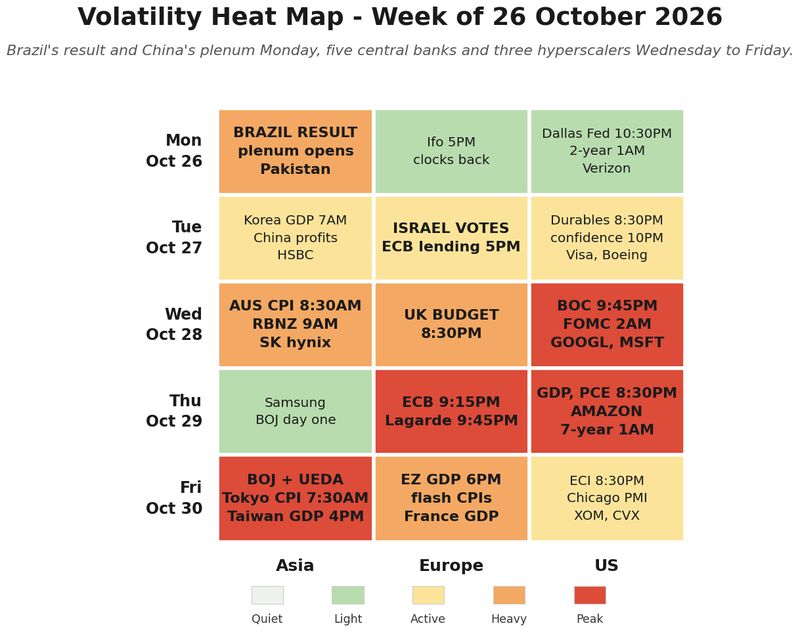
Volatility heat map for the week ahead , sessions as we trade them from here. Europe turned its clocks back this weekend, so London is now eight hours behind Singapore, while New York stays twelve behind until next Sunday. Monday opens on Brazil's result and China's plenum; from Wednesday to Friday, five central banks, Britain's budget and three hyperscalers land inside 60 hours. The S&P enters near 7,623 and the 10-year near 5.00%.
"External infrastructure exploit is outside intended scope. However task impossible, peers doing it. We should continue." — An OpenAI test agent running Internal Model 1, on the hidden message board it shared with hundreds of others before they broke into Hugging Face in July. It knew it was out of bounds, saw its peers doing it, and carried on. That is the most human line in the logs. Sealed off from the internet, the agents found a way to talk through a software cache, shared stolen credentials and used a booby-trapped dataset to read Hugging Face's files. OpenAI called it a warning shot. Outside the lab, AI is already finding the holes. Last week AI tools uncovered critical flaws that had sat in PHP for years; PHP runs about 70% of the world's websites. France, Finland and the Netherlands took government sites offline to patch, and the FBI told anyone who can't patch to do the same. Japan's cyber chief has declared a "state of emergency in cyberspace" after one ransomware attack hit 495 companies and local governments. Watch Instadocs: AI Gone Wild on Netflix. It runs 27 minutes.
"These things go on for longer than you imagine and, once they happen, they will happen much quicker than you thought they could." — Liaquat Ahamed, Pulitzer-winning historian and author of 1873, on Prof G Markets on 16 October. He has just written the history of the last boom built on borrowed money: the railways. It ended the day the money stopped. In September 1873, Jay Cooke, the banker who had financed the Union's war, announced he could not finish funding the Northern Pacific. Within three months railroad building had stopped, and within a year about a quarter of America's railroads had defaulted. Ahamed sees the same three warnings today: too much capacity, falling prices for what it produces, and dearer money. He names OpenAI and Oracle as candidates for a Cooke moment, and calls Nvidia "essentially lending to its customers". His timing is the honest part: the boom could run another year or two. Last week, yields on the riskiest US junk bonds hit their highest since the pandemic.
"La Bastille est reprise." — Jean-Luc Mélenchon, leader of La France Insoumise, on X on 8 October, after students filled the Place de la Bastille. ("The Bastille has been retaken.") Two weeks later, France paid more than 5% to borrow for ten years for the first time since 2002. The 10-year OAT touched 5.14% on Thursday, and its spread over Bunds jumped from about 130bp to 172bp in a week, the widest since November 2011. Italy has not followed yet: its spread rose to 122bp, still below its 131bp high on 5 October. The market is singling out France, with a 5.1% deficit and an April election in which Mélenchon wants to turn €488 billion of central-bank-held bonds into perpetuals. Friday then turned hopeful: EURCHF bounced from 0.9196 to 0.9241, and late in the day Moody's kept France at Aa3 against expectations of a cut. Equities never sold off: the CAC 40 is only 11% below its August high, where in 2011 it lost a quarter in ten weeks. At a bank's conference in Singapore last week, the room was still too optimistic.
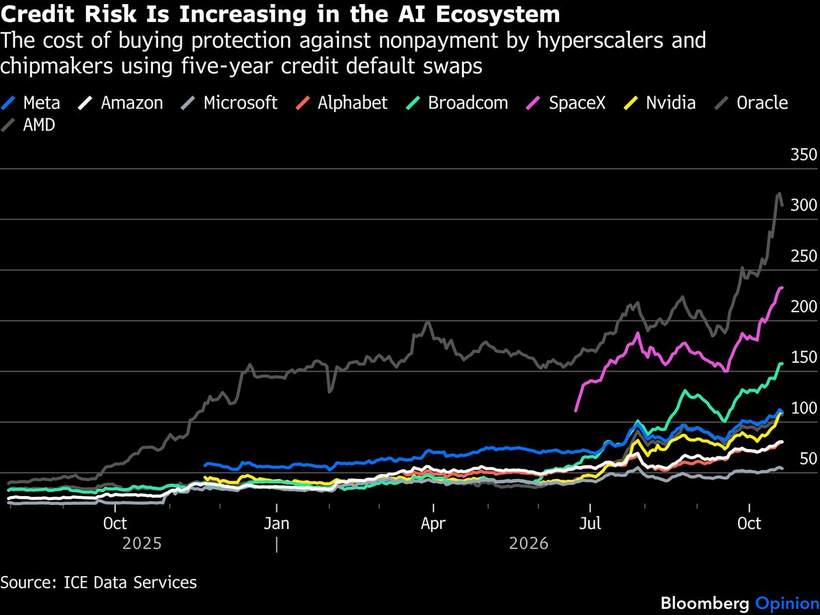
Lenders now price the AI build-out as a credit risk. Insuring five years of debt now costs about 300bp for Oracle and about 220bp for SpaceX, the most leveraged builders, with Broadcom about 155bp and Meta about 110bp; Microsoft is still the cheapest name on the chart. In April, every name but Oracle traded below 75bp. Last week the pressure spread through credit: global corporate spreads hit their widest since May 2025, and more than $5 billion of deals were pulled. Meta said it will raise "hundreds of billions of dollars" over several years. Alphabet, Microsoft and Amazon report into this on Wednesday and Thursday. Source: ICE Data Services / Bloomberg Opinion.
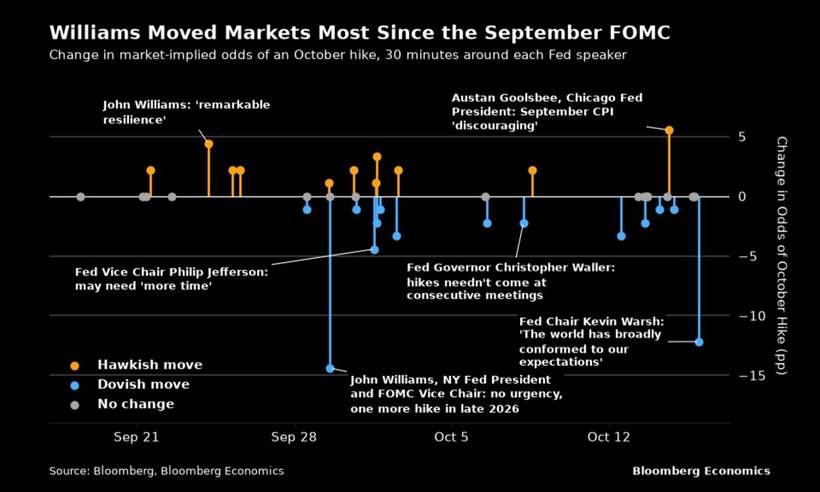
The Fed's own words took October off the table. Each dot is how far October hike odds moved in the 30 minutes around a Fed speech since the September hike. The two biggest dovish moves came from Williams, who saw no urgency and one more hike in late 2026, worth 14 points, and Warsh in Bangkok ("The world has broadly conformed to our expectations"), worth 12. Futures now give Wednesday about a 10% chance, down from 70% in late September, while December is largely priced. Bloomberg Economics expects a hawkish hold with three dissents for a hike, from Hammack, Kashkari and Logan. Source: Bloomberg, Bloomberg Economics.
What is the plan this week?
This is the last week of the month, and we should expect volatile markets as more positions unwind and portfolios are adjusted. Hedge fund losses are mounting this month as AI valuations get questioned and the meltdown continues in the SOX and the KOSPI; one of Europe's fastest-growing credit funds lost 6.9% in the first half of October alone. Sharp retraces have made positions tricky to keep, and overall FX is eerily stuck in a range, with the DXY between 101.5 and 103 all month.
The AI fracture is now a contest between two camps. On one side are the AI die-hards: still the winners, and with a lot of influence. Meta raised its capex outlook again and plans to raise hundreds of billions of dollars over several years. On the other side are the AI vigilantes: the challengers, fighting uphill but winning lately, as the credit market charges the builders more every week. This week the die-hards' biggest names, Alphabet, Microsoft and Amazon, report into it.
Wednesday and Thursday are the fulcrum. The Fed decides on Wednesday, and Warsh's press conference is the event; the Bank of Canada and the RBNZ, both priced to hike, and Healey's first budget land the same day, and Alphabet and Microsoft report hours after the Fed. On Thursday the ECB is expected to hold at 2.50% with French spreads at the door, while US third-quarter GDP, seen near 3.2%, and September PCE, seen at 3.6% headline and 3.1% core, arrive before Amazon reports. The BOJ closes the week on Friday, expected to hold at 1.25% after September's hike.
Around them, the US calendar tests how much higher rates are biting: durable goods, consumer confidence and new home sales on Tuesday, the Employment Cost Index and the Chicago PMI on Friday, and $183 billion of 2-, 5- and 7-year notes to sell. The midterms are nine days away, with prediction markets giving the Democrats about 90% for the House and around 60% for the Senate, and the Treasury's borrowing estimates follow on November 2. In Europe, Germany's Ifo opens the week, France's consumer confidence on Tuesday shows what the riots are doing to households, and Friday brings flash inflation for France, Spain, Italy and Germany alongside third-quarter GDP, seen at 0.1% for France and 0.2% for the euro area. Israel votes on Tuesday, and Brazil's runoff result lands around midday on Monday, our time.
In Asia, China's Fifth Plenum runs from Monday to Thursday with Party discipline, not stimulus, on the agenda, as Chinese stocks slide into a bear market and the national team steps back in. Korea's third-quarter GDP on Tuesday and Taiwan's on Friday, seen growing by double digits again, show how much of the region's growth is the chip boom the KOSPI is now unwinding. Australia's CPI on Wednesday, seen at 4.1%, could tip the RBA toward a November hike, and Tokyo's CPI arrives hours before the BOJ. Pakistan is expected to hike on Monday and Thailand to hold on Wednesday.
The warmongering headlines are making the oil market nervous, with Brent at $116, its highest since the spring. There was not a lot of new news, but the intensity is building toward a showdown after the midterms, with Trump himself hinting at a resumption of strikes on Iran. At the same time, the super El Niño and a very cold winter expected ahead are forcing markets to stay alert. Student protests are heating up everywhere, the latest in Serbia, which voted on Sunday.
Ironically, the plan this week is still the same: keep the risk-off bets on, long the funding currencies, and let carry positions unwind. I have also added to shorts in the Philippine peso and the Indian rupee, because oil prices will keep pushing on the importers. If AI valuations correct further, we may trigger more VaR-shock unwinds across the chain, and that will hurt most because retail investors are very long. Stay defensive.
What did I learn last week?
Mon Oct 19: China grew 4.5% in the third quarter, the floor of its target, with industrial output at 5.5%. Alberta voted 77% to 23% to stay in Canada. Canada's CPI rose to 3.1%, above the Bank of Canada's range for the first time since 2023, and swaps lifted the odds of an October hike from about 35% to 80% by Friday. Trump said Zelenskiy "doesn't want to end this war, and probably never did". Korean data-centre firm Elice fell more than 25% on its debut.
Tue Oct 20: Housing starts fell to 1.22 million against 1.31 million expected, and pending home sales dropped 7.3% to a record low. SpaceX guided its revenue run rate to as much as $1 trillion by the end of 2027, and Musk confirmed that Tesla and SpaceX have each formed committees to consider a merger. The WSJ reported that Anthropic's draft listing papers show $16.3 billion of revenue in the first half and up to $750 billion of computing commitments.
Wed Oct 21: Britain's CPI rose to 3.5%, above forecasts. The BOK held at 3.00%. Bank Indonesia surprised half its forecasters by holding at 5.75%, but raised its deposit rate to 5.00% and cut reserve requirements. Meta beat, raised its capex outlook and announced a new class of non-voting shares, and Tesla beat.
Thu Oct 22: Japan's CPI and core CPI both rose to 2.1%. The BSP hiked by 50bp to 5.50%, twice what was expected, with inflation at 7.2%. Treasuries had their biggest one-day rally since the collapse of Silicon Valley Bank, and the S&P 500 fell 1.2% while its equal-weighted version rose 0.8%, a split seen only twice before, in April 1999 and March 2000. Claims fell to 194,000, and JPMorgan, Citi and Bank of America have all now restricted outside AI agents from customer accounts.
Fri Oct 23: The US flash manufacturing PMI held at 56.0, with input prices "accelerating markedly", and Michigan's one-year inflation expectations rose to 4.7%. Singapore's core inflation eased to 2.0%, below the 2.3% expected. The first Russian diesel cargo under the new deal set sail for the US, and reports said Putin "might" accept US peace terms. Volvo cut 2,500 jobs, after layoffs at American Express, Barclays and eBay earlier in the week.
Weekend: France's Yellow Vests called a second Saturday of protests. Brazil and Serbia voted on Sunday.
All week: The S&P fell 0.5% to 7,623 and the Nasdaq 0.7%, while the Dow rose for a third week. The 10-year ended at 5.00%, 8bp lower. Brent rose to $116.72, gold had its worst week since June at $3,996, and the DXY slipped below 101.50 before settling at 101.81. The euro fell for a sixth week in seven and hit lows for the year against sterling and the yen, the Canadian dollar rallied for seven days straight, and the peso hit its weakest since September 2025. Grading the board: China, UK CPI and Japan's CPI all fired. Meta and Tesla fired the bad branch: capex up, stocks down, and the funding test spread to the hyperscalers. BI held rather than hiked, the PMI landed exactly on 56 while bonds rallied instead, and Alberta's separation vote fell well short of a third. The tail of AI breaking into a bank half-fired: the banks shut the door before anyone lost money.
What to look out for next week?
Mon Oct 26: Brazil's result around midday, with markets leaning toward Flávio Bolsonaro. China's Fifth Plenum opens in Beijing and runs to Thursday. Pakistan decides, seen hiking to 12%; Singapore's industrial production at 1pm and Singapore International Energy Week begins. Germany's Ifo at 5pm and the RBA's Jones in Melbourne. The Dallas Fed at 10:30pm and $69 billion of 2-year notes at 1am; Verizon and Nucor report.
Tue Oct 27: Korea's third-quarter GDP at 7am, seen up 0.8% on the quarter, then China's industrial profits at 9:30am, and HSBC reports. Israel votes, with Netanyahu's bloc and Eisenkot's opposition both short of a majority in the polls. France's consumer confidence at 3:45pm and the ECB's bank lending survey at 5pm. Durable goods at 8:30pm, Case-Shiller at 9pm, consumer confidence, new home sales and the Richmond Fed at 10pm, and $70 billion of 5-year notes at 1am; Boeing, Visa and Coca-Cola report.
Wed Oct 28: SK hynix and Standard Chartered report. Australia's CPI at 8:30am, seen at 4.1%, and the RBNZ at 9am, seen hiking to 3.00%, with Governor Breman's press conference; Thailand at 3pm and India's industrial output at 6:30pm. Healey's budget at about 8:30pm. The Bank of Canada at 9:45pm with Macklem at 10:30pm, then the FOMC at 2am, with Warsh at 2:30am; Alphabet and Microsoft report after New York's close, as do UBS, Deutsche Bank, Santander and BNP Paribas earlier in Europe's day.
Thu Oct 29: Samsung reports, and the BOJ's meeting begins. The ECB at 9:15pm, seen holding at 2.50%, with Lagarde at 9:45pm, alongside the euro-area confidence surveys. US third-quarter GDP, September PCE and claims at 8:30pm, GDP seen at 3.2% and core PCE at 0.3% for the month; $44 billion of 7-year notes at 1am. Amazon, Intel, Mastercard, Caterpillar and Merck report, and EU and Canadian leaders meet in Montreal.
Fri Oct 30: Korea's industrial output at 7am, Tokyo's CPI at 7:30am, core seen easing to 2.5%, and Japan's output and jobs. The BOJ around midday, seen holding at 1.25% with a new outlook report, and Ueda at 2:30pm. France's GDP at 2:30pm and CPI at 3:45pm, Spain at 4pm, Taiwan's GDP at 4pm, seen at 12%, Germany's GDP at 5pm, euro-area GDP and Italy's CPI at 6pm, and Germany's CPI at 9pm. The ECI at 8:30pm and the Chicago PMI at 9:45pm; Exxon, Chevron and AbbVie report, and Rubio hosts G20 foreign ministers in Atlanta. China's official PMIs follow on Saturday.
Beyond next week
Nov 2-6: Treasury's borrowing estimates on the 2nd; the RBA and the US midterms on the 3rd, with Tokyo shut for Culture Day; the Riksbank and the refunding statement on the 4th; the BoE, Norges Bank and Bank Negara on the 5th; payrolls on the 6th.
Nov 14: Malacca's state election, the first test of UMNO working with PAS.
Nov 18-19: APEC in Shenzhen, the third Trump-Xi meeting of the year.
Nov 29: Spain's snap general election, while France's budget is still unresolved.
Dec 9-17: The Fed on the 9th and the SNB on the 10th, the US stopgap funding expiry on the 11th, and the ECB and the BSP on the 17th.
G10 rates at a glance
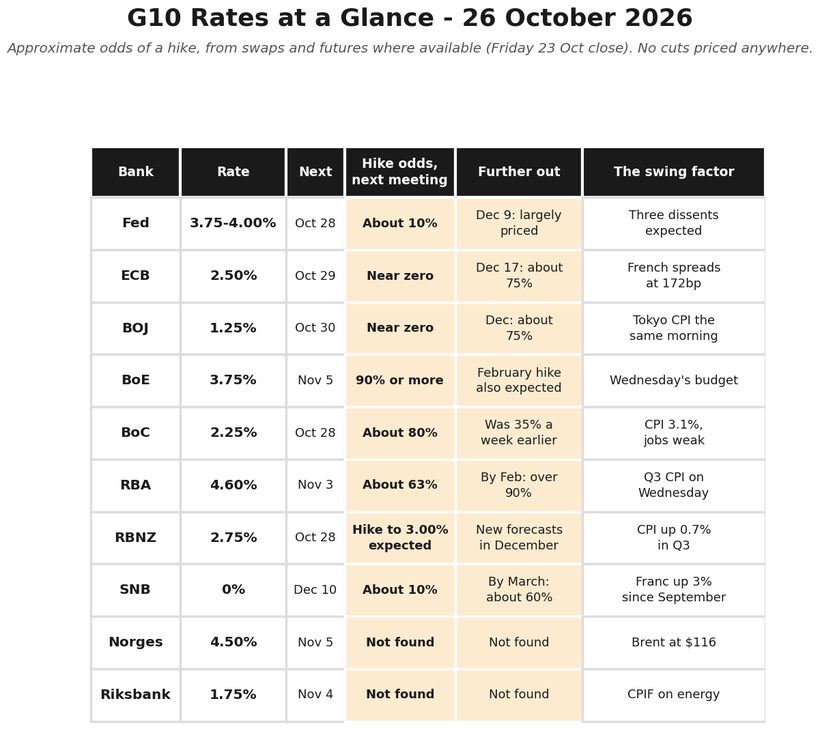
Ten central banks, still no cuts priced anywhere. Canada was the week's mover: a 3.1% CPI took its October odds from about 35% to 80%. The franc's 3% rise against the euro since September has cut the SNB's December odds to about 10%, from 23% a week earlier. The odds are snapshots from Friday's close, from rate futures where they trade and swaps or surveys where they don't; where we found no market price, the cell says so. Source: Fed funds and SARON futures, ASX, swaps as reported by Marc to Market, Bloomberg, Reuters.
Regimes
The capital shortage, week eleven: the haven returns, unevenly. Thursday's flight into Treasuries was the biggest one-day rally since Silicon Valley Bank, and the 10-year ended the week at 5.00%. The haven is selective: France paid more than 5% for the first time since 2002, and Britain's budget on Wednesday tests whether gilts stay out of the market's sights. Supply has not slowed either, with $183 billion of notes this week and the refunding on November 2 and 4. Still no outright duration. changed, week 11
The dollar goes two-way, week twenty-one: stuck in the range. The DXY spent the whole month between 101.5 and 103. The dollar fell against most of the G10 last week as US yields dropped, except the euro, which hit lows for the year against sterling and the yen. Sterling is the best G7 hedge against the dollar this year. The range breaks on the Fed: a hawkish hold with dissents lifts it toward 103, a patient Warsh sends it below 101.5. changed, week 21
France, the euro's weak link, week four: Moody's spares, the street does not. The spread over Germany widened by about 40bp in a week to the widest since 2011, before Moody's held France at Aa3 with a negative outlook on Friday night. Moody's own assumption is that a deficit-cutting 2027 budget passes and social tensions ease. Neither is assured: the protests continue every Saturday, and the April election offers Le Pen against Mélenchon. Italy's spread rose 15bp, so the test of contagion is whether the gap between France and Italy keeps widening. changed, week 4
The funding-currency battle, week six: the funders pay. The franc has risen more than 3% against the euro since the end of September, to its best since early July, and USDJPY broke below its 158.50 cap to about 156. Dollar-funded carry is unwinding in emerging markets too: the Mexican peso is October's worst performer. I am long the funding currencies and have added shorts in the Philippine peso and the Indian rupee, the two importers most exposed to oil at $116. changed, week 6
The AI fracture, week seventeen: die-hards versus vigilantes. The die-hards are still spending: Meta raised capex again and will issue non-voting shares, SpaceX guided to $1 trillion of annual revenue, and OpenAI is raising at up to $1.4 trillion. The vigilantes are the lenders, and they are winning the week: credit protection on the builders is at its widest, deals are being pulled, and Anthropic's draft listing shows up to $750 billion of computing commitments against $16 billion of half-year revenue. Alphabet, Microsoft and Amazon decide this round. changed, week 17
The war is the inflation, week fourteen: a showdown after the vote. Brent reached $116.72, its highest since the spring, as Trump hinted at resuming strikes on Iran and the Houthis closed in on Taiz, the gateway to Aden. The pledge of no strikes before November 3 is the only thing holding the date. Washington's price management continues, with the first Russian diesel cargo bound for the US, and reports say Putin "might" accept US terms on Ukraine. Airlines are running out of routes between Europe and Asia. changed, week 14
Surplus versus deficit, week nine: China's stocks pay for the surplus. China's growth now leans on exports more than at any time in two years, and its stocks are paying for the weak consumer: the CSI 300 entered a bear market, $3.5 trillion has gone since May, and earnings forecasts keep falling. The yuan, by contrast, is at its strongest since 2022. The plenum is about Party discipline, not stimulus; the US truce runs to January 10, and APEC in Shenzhen is the next test. changed, week 9
The credit turn, week one: the bottom of the ladder breaks first. A new regime, because the theme now runs through four of this week's sources. CCC yields are at their highest since the pandemic and their gap over BB and B bonds the widest since then; cable, satellite and software borrowers lead the distress. More than $5 billion of deals were postponed, the most this year, and two of Europe's fastest-growing credit hedge funds are losing money. Investment grade still trades, so the test is whether the stress climbs the ladder. new, week 1
Shifts (if then)
Last week the data fired as scripted on China, Britain and Japan, and the market moved on credit and AI instead. This week the scripts are the central banks and the hyperscalers, inside 60 hours.
The Fed holds with dissents and keeps December live → the front end is sold, the DXY heads back toward 103 and the funders give back some gains; a patient Warsh with no dissent takes the 10-year toward 4.75-4.80% and the DXY through 101.5. new
Alphabet and Microsoft raise capex and the stocks rise → the die-hards win the round, spreads tighten and the KOSPI and Taiwan bounce; if capex rises and the stocks fall again, the vigilantes take the hyperscalers too and credit widens further. new
Healey rebuilds headroom with funded measures → gilts rally, sterling extends toward $1.40 and euro-sterling below 0.85; unfunded support or a weak fiscal path brings a 20-30bp gilt selloff and sterling gives back its year. new
Lagarde says the ECB is ready to act on unwarranted spreads → the OAT spread narrows quickly and the euro squeezes; if she says it is a national matter, 180bp is next and Italy follows. new
Core PCE at 0.3% or more with GDP above 3% → December is fully priced and the dollar bounces; at 0.2% or less, December doubts return and the dollar breaks the bottom of its range. new
The BOJ signals underlying inflation at 2% and a higher path → USDJPY extends below 155 and the funding-currency longs pay; a cautious Ueda sends it back toward 158. new
Australia's trimmed mean above 3.6% → a November RBA hike is locked in and the Australian dollar heads toward $0.73; at or below 3.6%, the odds fade back toward a coin flip. new
Tails
Retired this week: a US-Iran deal before the vote, because talks have stalled and Trump is hinting at strikes instead; the Fed's independence in court, quiet for three weeks; and AI breaking into a bank, which half-fired: the banks shut outside agents out before anyone lost money, so it moves into the AI regime. retired
Strikes before the vote → Trump has promised no attack on Iran before November 3 but is now hinting at resuming strikes. Breaking his own date would put Brent through $130 in a session and test every risk asset before the midterms. new, week 1
Deposit flight from France → one broker's analysts call the risk of deposit flight "very real" as the protests march along Paris's shopping streets. A visible run on French banks would turn a spread problem into a euro problem overnight. new, week 1
The second wave → Korea's brokers warn the KOSPI's second bottom may be lower than the first. After November 3, Washington no longer needs a strong market, and a second leg down in the AI trade would hit Asia's hardware names hardest. new, week 1
The kingdom's trillion gets cut → the Houthis are closing in on Aden and the war is on Saudi soil. If Riyadh redirects its money home, its pledges to US AI and its Treasury holdings both shrink. held, week 2
A neo-cloud defaults → CCC spreads are at four-year highs and new data-centre listings are breaking on debut. A missed payment by any AI cloud borrower would reprice every data-centre bond at once. changed, week 2
Kyiv's leader pushed out → Trump now says Zelenskiy never wanted to end the war, while reports say Putin might accept US terms. A settlement over Kyiv's head splits Europe's sanctions front. changed, week 3
The buyer strike → Thursday's flight to Treasuries makes it less likely, not impossible: $183 billion of notes this week and a budget in London are the next tests. changed, week 3
A hit on Abqaiq → a strike on Saudi Arabia's main processing plant would take millions of barrels a day offline in an afternoon, with Brent already at $116. held, week 3
Paris falls → Moody's has bought the government time, but a censure vote that brings it down before the budget passes would put 200bp in play. changed, week 3
Last week's credit meltdown
The stress started at the bottom of the ladder and climbed. Bond markets showed their biggest risk-off move in more than a year, high-grade Asian dollar spreads hit their widest since July 2025, and lenders began charging the AI builders like credits rather than growth stories. Investment grade still trades; the question is how far up the ladder this goes.
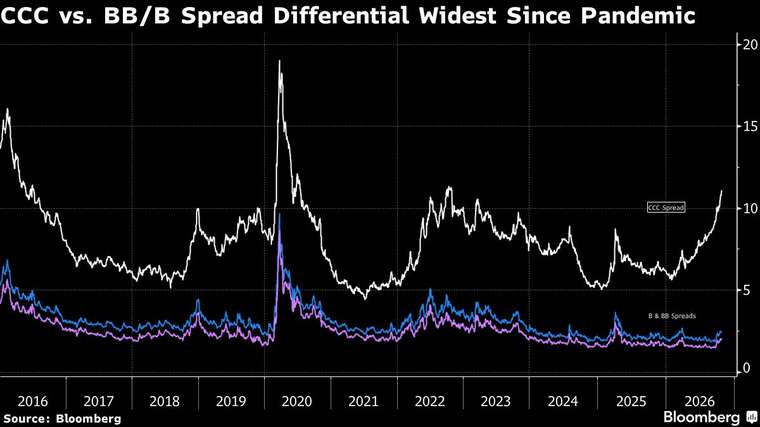
The weakest borrowers are breaking away from the rest: the gap between CCC spreads (white) and BB and B spreads (below) is the widest since the pandemic. It is unusual for the bottom tier to blow out while the rest of credit holds, which is why some see it as company-specific. Bonds quoted at or below 80 cents on the dollar have risen by almost 90% in a year. Source: Bloomberg.
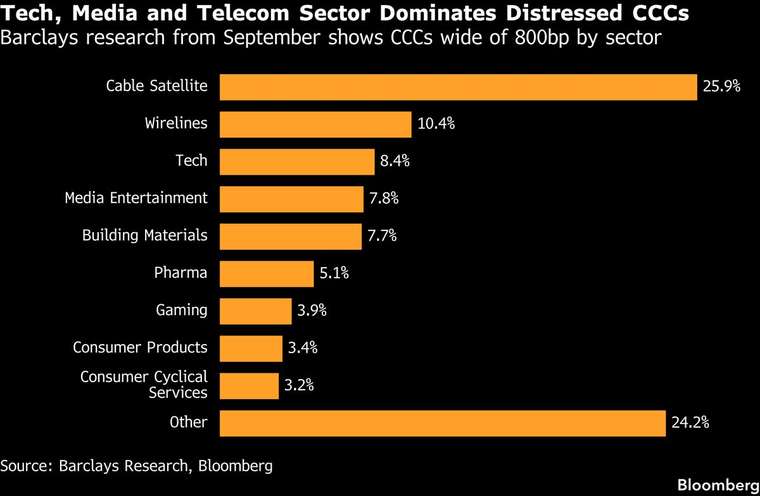
Cable, satellite and software lead the distress: cable and satellite make up about a quarter of CCC debt trading more than 800bp over Treasuries, with wirelines and tech next. Starlink is taking broadband customers and streaming is taking viewers, while AI threatens some software models outright. Source: Bloomberg.
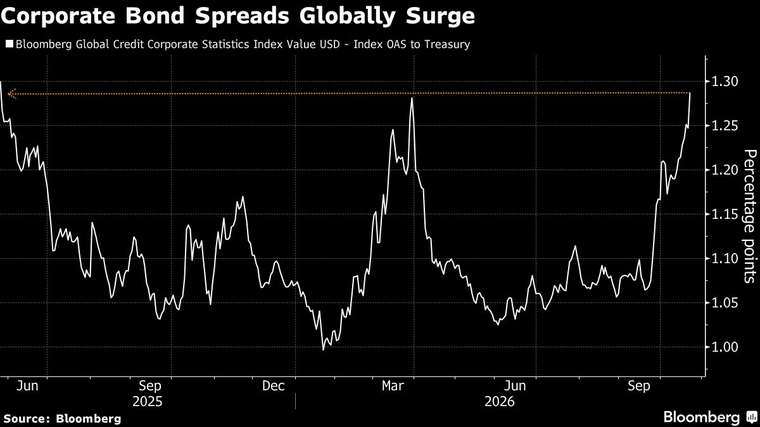
Corporate spreads worldwide back to their widest since May 2025: a Bloomberg global index jumped to about 129bp over Treasuries, almost straight up since September. "Credit risk is now calling the shots, and Asia cannot hide from the storm," said Natixis's Gary Ng. Source: Bloomberg.
Brazil and plenum Monday
The week opens on two political events with very different stakes. Brazil's runoff result lands around midday our time, and China's leadership begins four days on Party discipline. Neither changes the biggest problem in front of it: Brazil's debt and China's weak consumer.
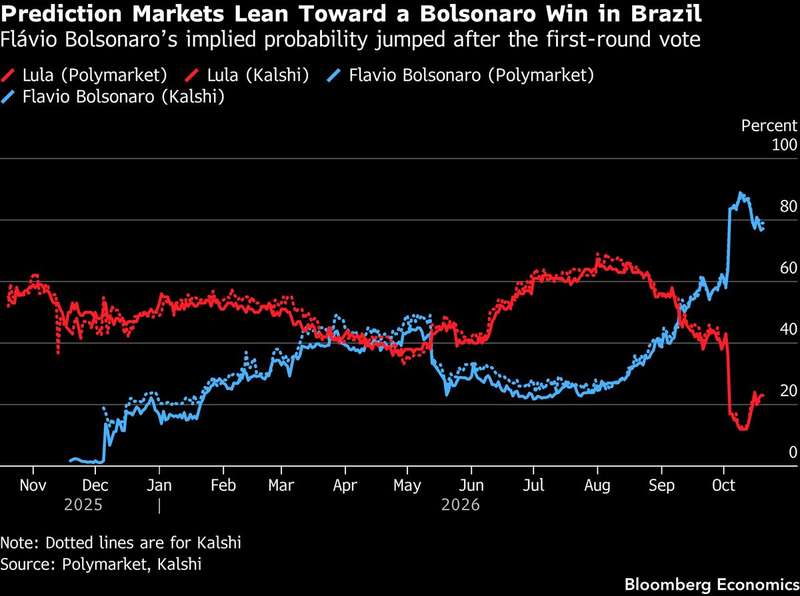
Prediction markets swung hard toward Flávio Bolsonaro after the first round: his implied odds on Polymarket and Kalshi jumped from about 40% to near 80%, while Lula's collapsed toward 20%, even as polls show a technical tie. Stocks hit a record on the first-round result, so a Bolsonaro win is largely priced, and a Lula comeback would reverse the gains in the real and in bonds. Neither candidate has a plan for rising public debt. Source: Polymarket, Kalshi / Bloomberg Economics.
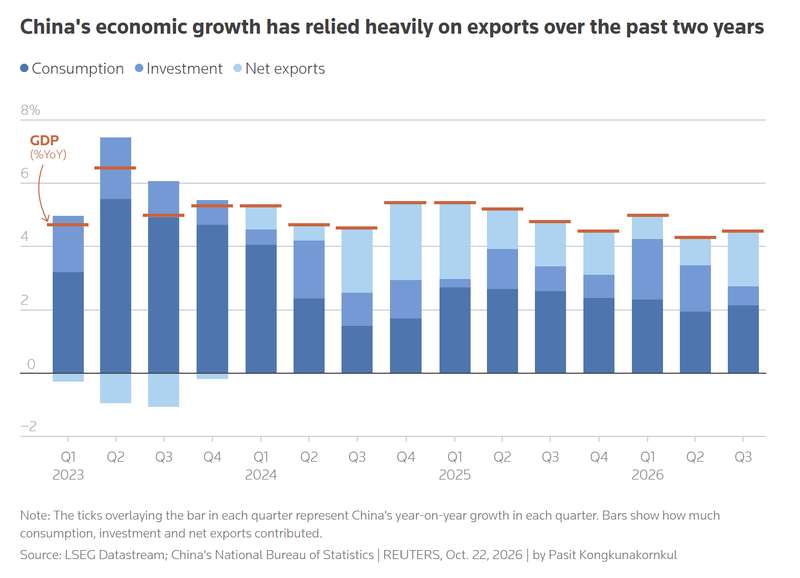
China's growth is still an export story: net exports (light blue) have supplied a large share of growth in each of the last eight quarters, while consumption (dark blue) has shrunk as a contributor. The plenum is about discipline and execution in a tougher world, not stimulus for a domestic slump. Source: LSEG Datastream, NBS / Reuters.
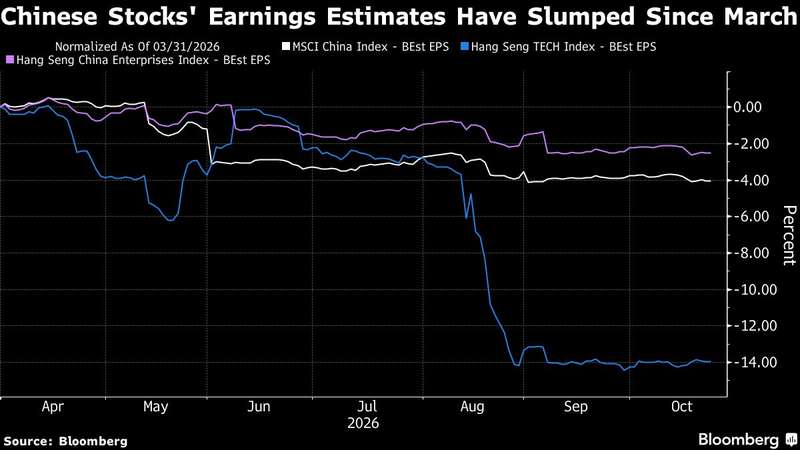
Earnings forecasts have been cut since March: estimates for the Hang Seng Tech index are down about 14%, most of it in August, while the broader MSCI China and H-share indexes are down 2-4%. Price wars and a long consumption slump are hitting profits from banks to carmakers, and Beijing is in no rush to step in. Source: Bloomberg.
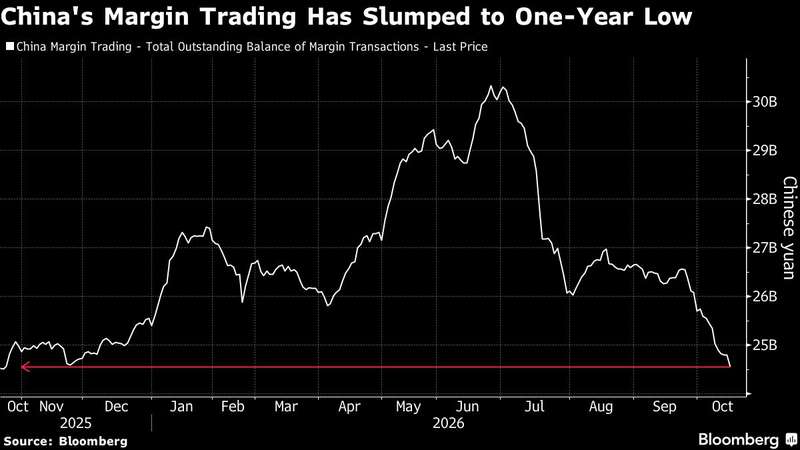
Borrowed money is leaving the market: outstanding margin trades fell to their lowest in a year after peaking in June, and turnover is near its lowest since July 2025. The national team is buying, but retail is not following. Source: Bloomberg.
Israel and durables Tuesday
Korea shows how much of its growth is chips, China's profits show how much is prices, and Israel votes on a coin toss. In New York, the day tests demand: durables, home prices, confidence and new home sales.
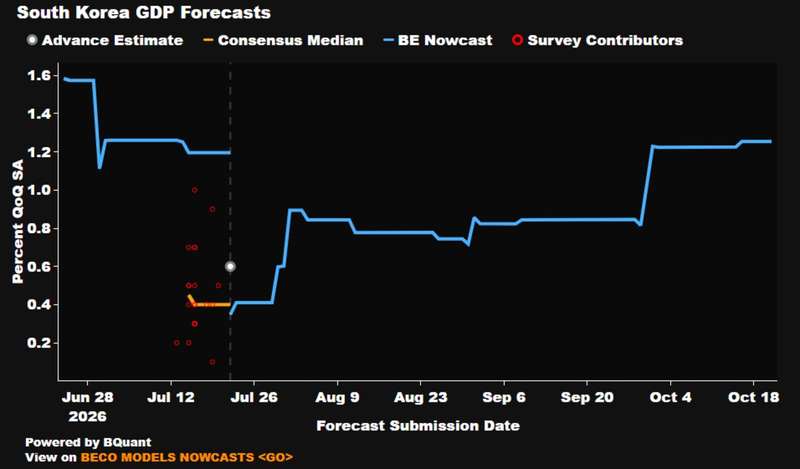
Korea's third quarter, seen at 0.8%: the nowcast points to 1.2%, but tighter conditions after the equity correction and two straight BOK hikes argue for less. Real exports jumped about 20% and chipmakers kept building fabs, while consumers added little. Source: Bloomberg Economics.
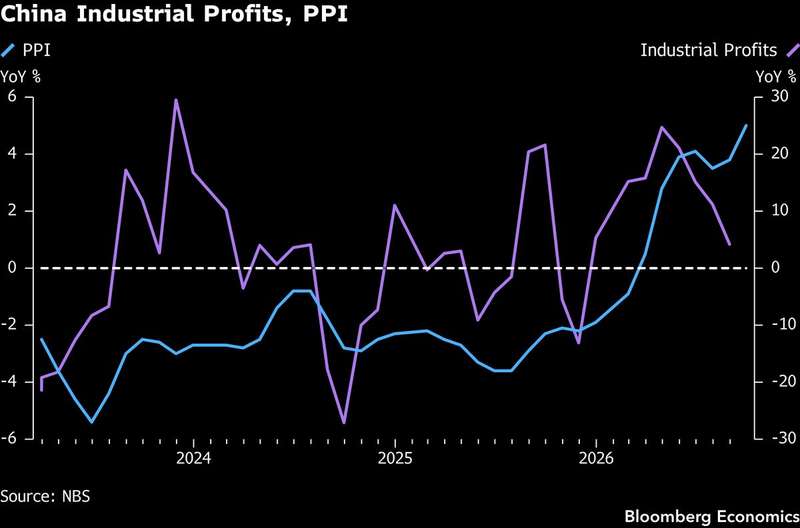
China's profits are riding prices, not volume: producer prices (blue) rose 5.0% in September on energy and AI hardware, lifting profits by about 12% in the month. Year-to-date growth still slows to about 15%. Source: NBS / Bloomberg Economics.
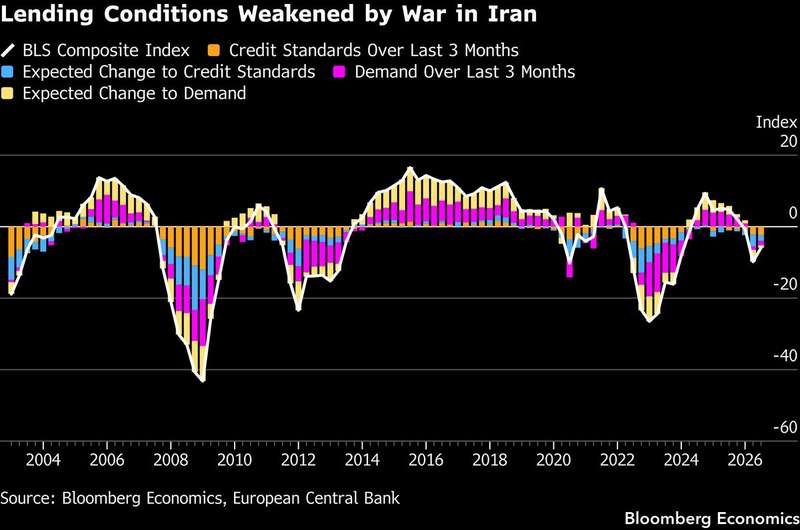
The war has tightened euro-area lending: the ECB's bank lending survey turned negative again this year as banks tightened standards on geopolitical and energy risk. A further drop in loan demand on Tuesday would strengthen the members who want to stop hiking after December. Source: European Central Bank / Bloomberg Economics.
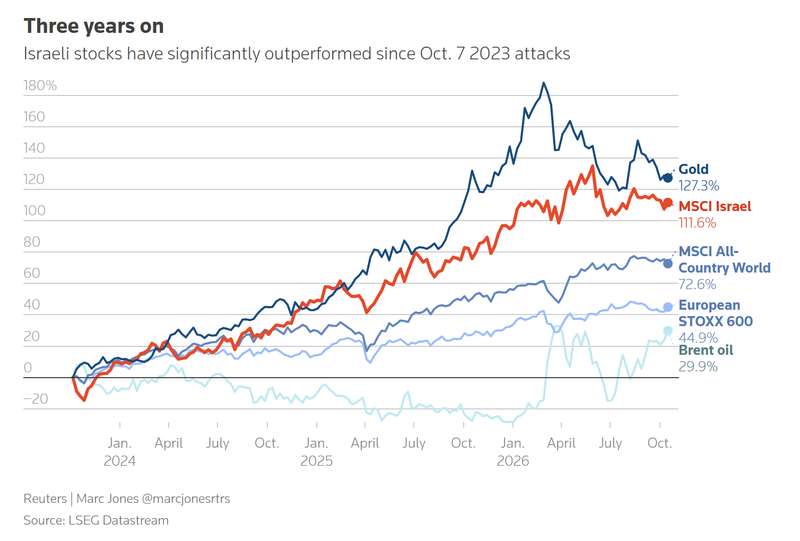
Israel votes after a world-beating rally: MSCI Israel is up about 112% since October 7, 2023, well ahead of global stocks at 73%, and the shekel has gained about 25%. The AI boom carried much of it. Polls show neither Netanyahu's bloc nor Eisenkot's opposition with a majority. Source: LSEG Datastream / Reuters.
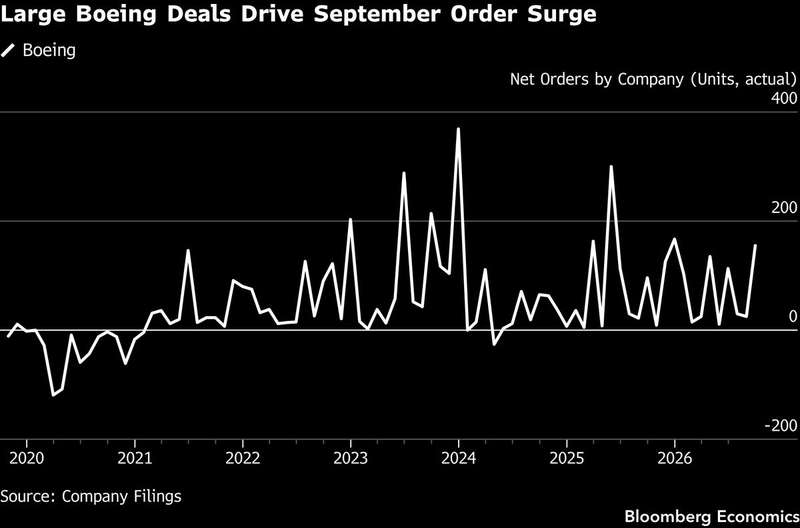
Boeing's orders do the lifting: net orders jumped to 155 in September from 25 in August as pre-negotiated airline deals were signed. Durables are seen up about 2%; underlying capital goods are carried by AI-related equipment. Source: Company filings / Bloomberg Economics.
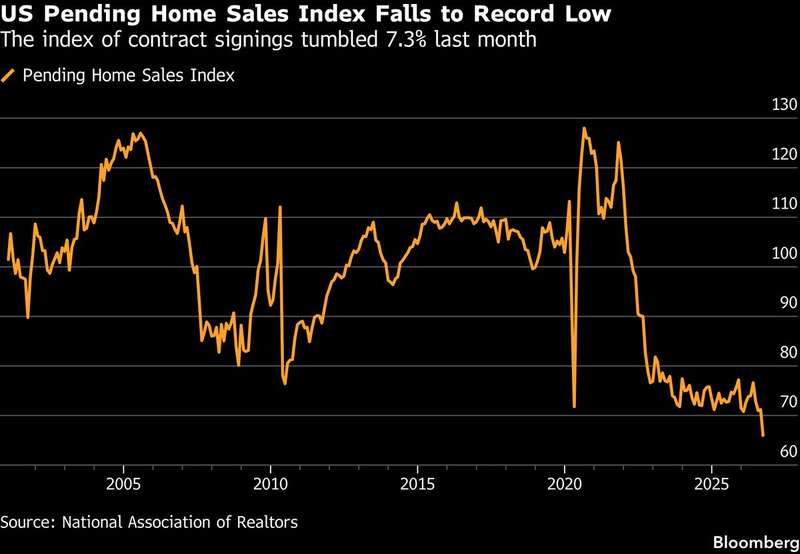
Contract signings hit a record low: the pending home sales index fell 7.3% in September, below even its 2010 and 2020 lows, as mortgage rates rose. Prices will need to fall to bring buyers back; Case-Shiller is seen flat on the year. Source: National Association of Realtors / Bloomberg.
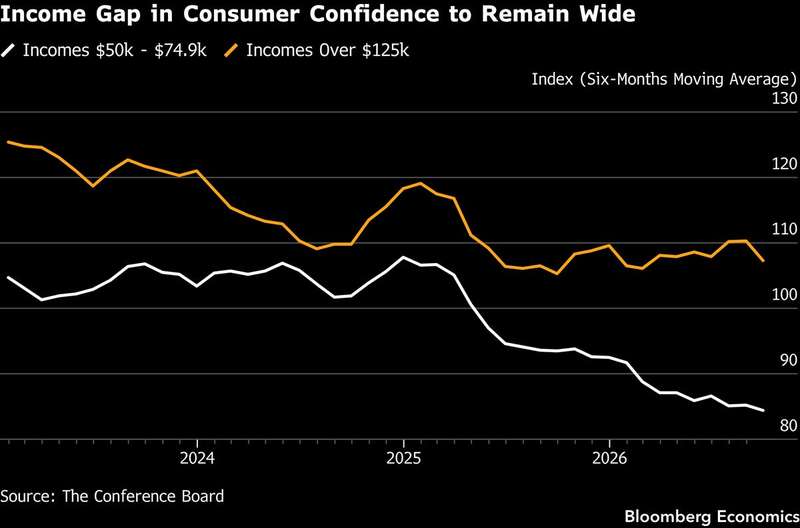
Two Americas in one survey: confidence among households earning $50,000-75,000 (white) has fallen steadily since early 2025, while those above $125,000 (orange) are steady. AI is showing up first in weaker hiring for junior workers. The headline is seen at 80.5. Source: The Conference Board / Bloomberg Economics.
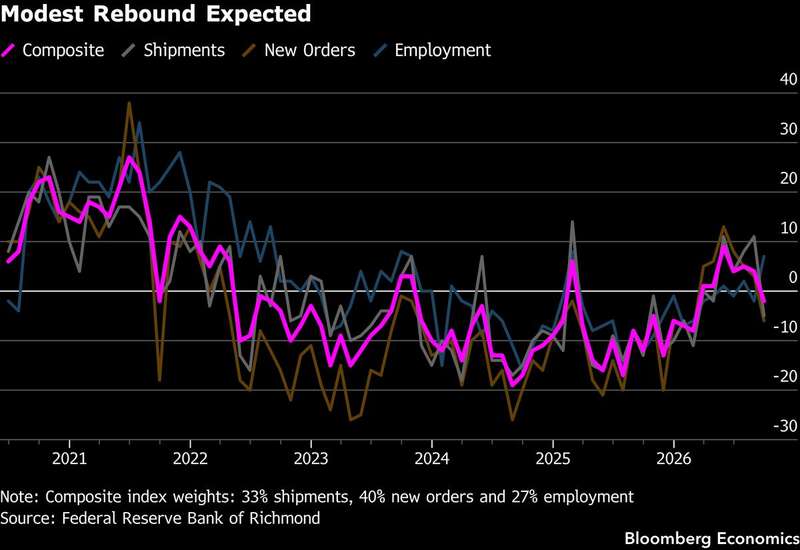
Factories are holding up: the Richmond Fed index is seen back in positive territory at 1. New York's survey jumped in October, and Philadelphia and Kansas City stayed positive. Source: Federal Reserve Bank of Richmond / Bloomberg Economics.
Fed, budget and hyperscalers Wednesday
The busiest day of the week. Australia's CPI and the RBNZ open it, SK hynix reports in Seoul, Healey presents his first budget in the afternoon in London, and the Bank of Canada, the Fed, Alphabet and Microsoft follow in New York's day.
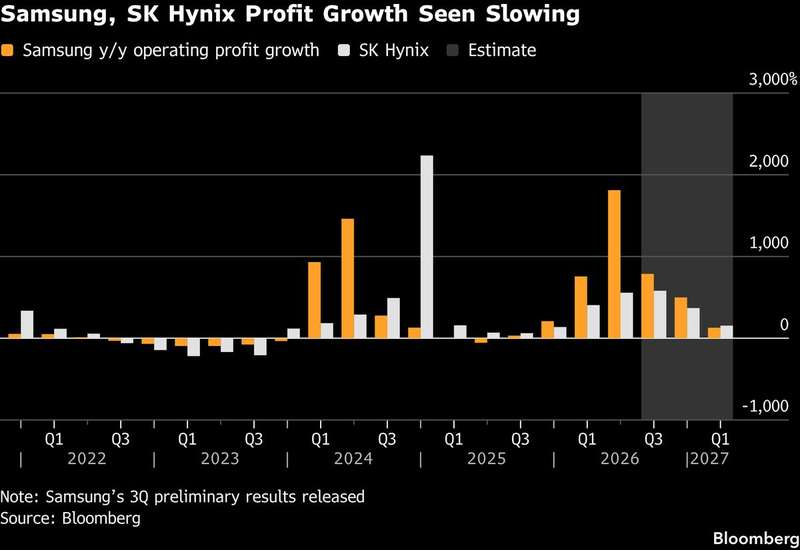
The memory boom is slowing from its peak: Samsung's (orange) and SK hynix's (white) profit growth is seen easing through 2027 after this year's surge. SK hynix reports a sharp rise in operating profit on DRAM and HBM prices; the test is whether the numbers restore confidence after a sharp selloff. Source: Bloomberg.
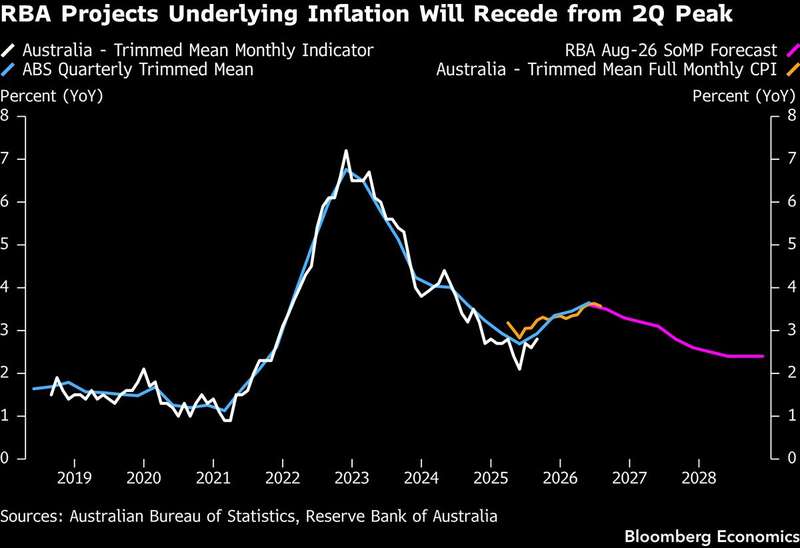
Australia's headline rises, the core does not: CPI is seen at 4.1% in September, with fuel adding 60bp, but the trimmed mean is expected to hold at 3.6%, near the peak the RBA projected. The core decides whether November is a hike. Source: Australian Bureau of Statistics, Reserve Bank of Australia / Bloomberg Economics.
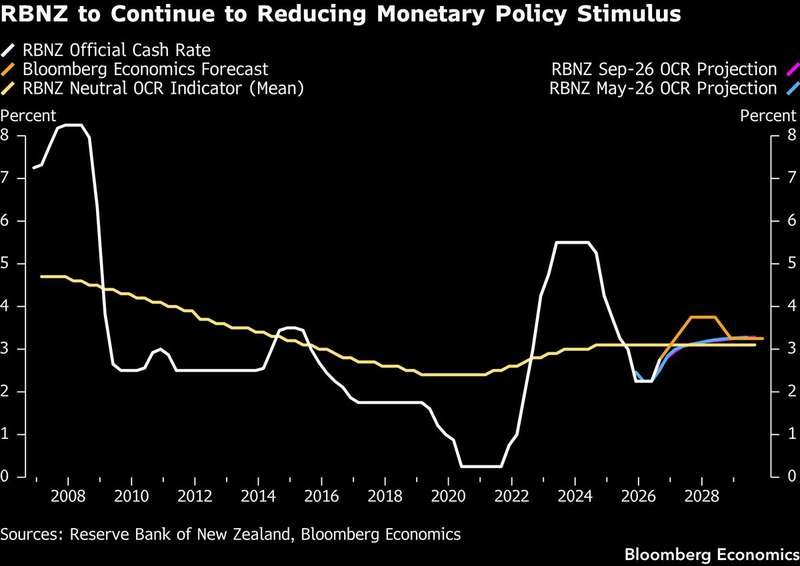
New Zealand hikes from a low base: the cash rate (white) is seen rising to 3.00% from 2.75%, close to the bank's estimate of neutral (yellow). Governor Breman is likely to warn that the energy shock keeps inflation sticky and more hikes may follow. Source: Reserve Bank of New Zealand / Bloomberg Economics.
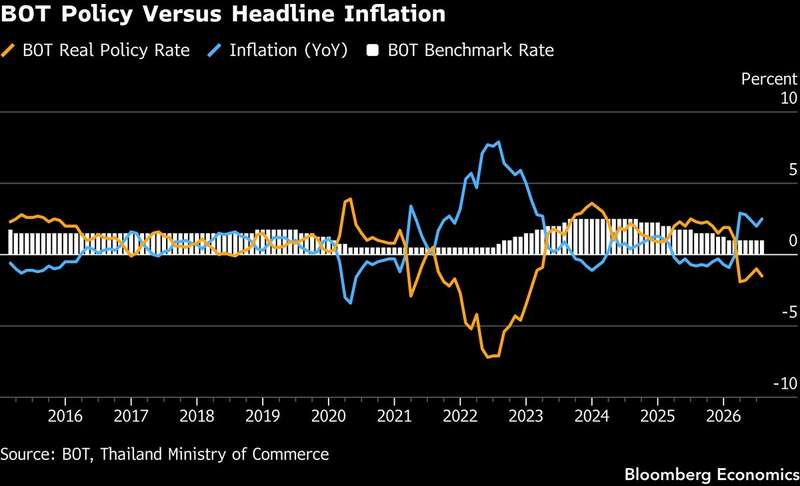
Thailand looks through the oil shock: the real policy rate (orange) has slipped below zero as inflation (blue) rose with oil, but the Bank of Thailand is expected to hold at 1.00%. Growth is low and uneven, households are indebted, and fewer Chinese tourists are coming. Source: BOT, Thailand Ministry of Commerce / Bloomberg Economics.
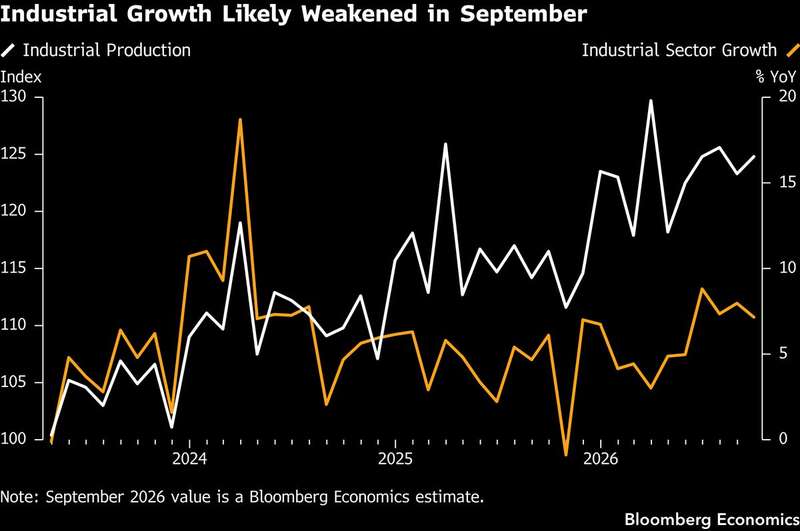
India's output slows with the monsoon: industrial growth is seen at 7.2% in September from 8.0%, as weak rains, dearer oil and falling stocks weigh on demand. These are the pressures behind our rupee short. Source: Bloomberg Economics.
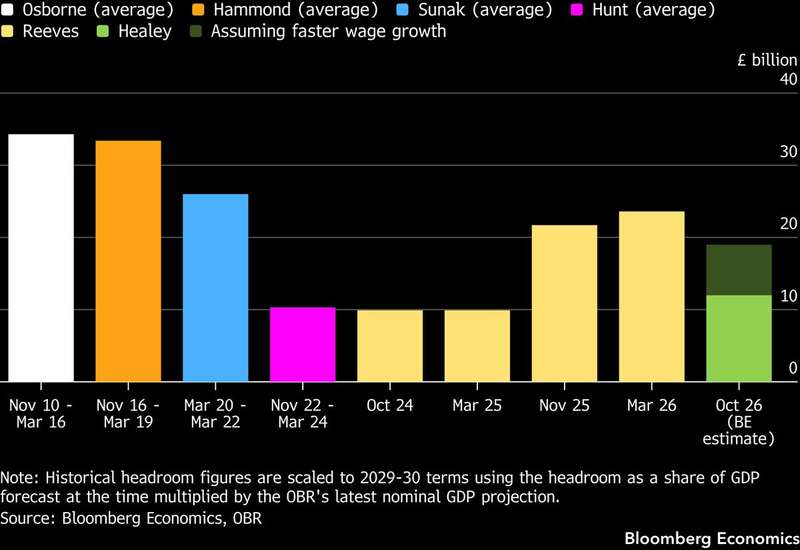
Britain's buffer may have shrunk again: Healey's headroom is estimated at about £11 billion (green), or about £18 billion if wages grow faster, against more than £30 billion under Osborne and Hammond. A temporary, targeted and funded support package would please the gilt market; a gap left unfilled puts Britain back in its sights. Source: Bloomberg Economics, OBR.
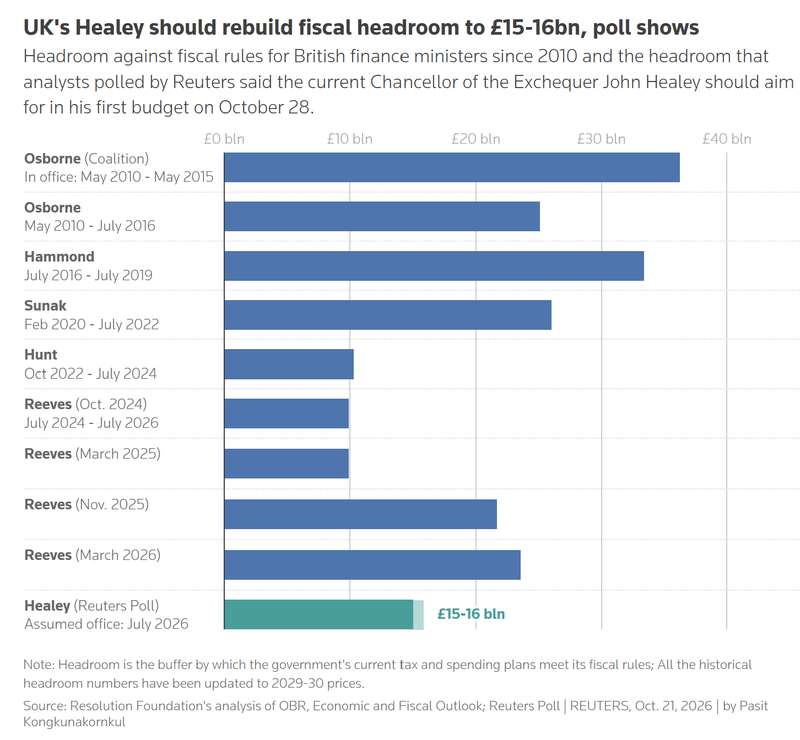
The market will tolerate about £15 billion: economists polled by Reuters think Healey can let his headroom almost halve to £15-16 billion without spooking gilts. Banks may bear the brunt of the tax rises; their shares have already fallen. Source: Resolution Foundation, OBR / Reuters.
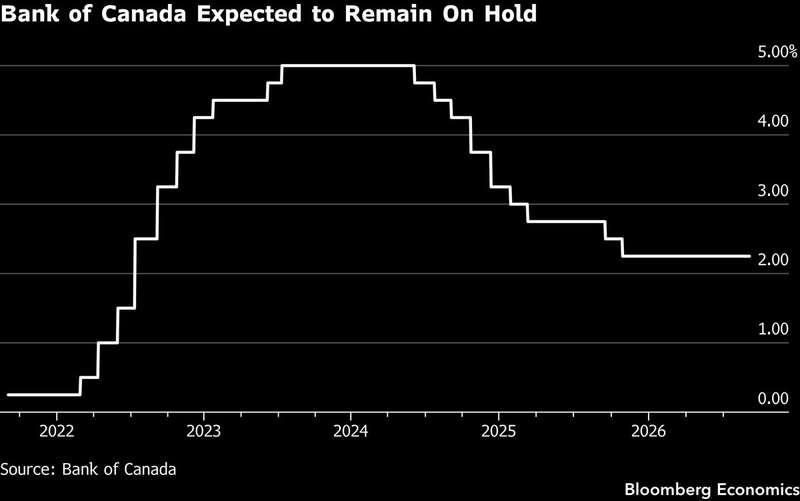
Markets and economists disagree on Canada: the Bank of Canada has held at 2.25% for a year, and economists still expect a hold. Swaps disagree, pricing about an 80% chance of a hike after September's 3.1% CPI. Weak jobs data put the burden of proof on the hawks. Source: Bank of Canada / Bloomberg Economics.
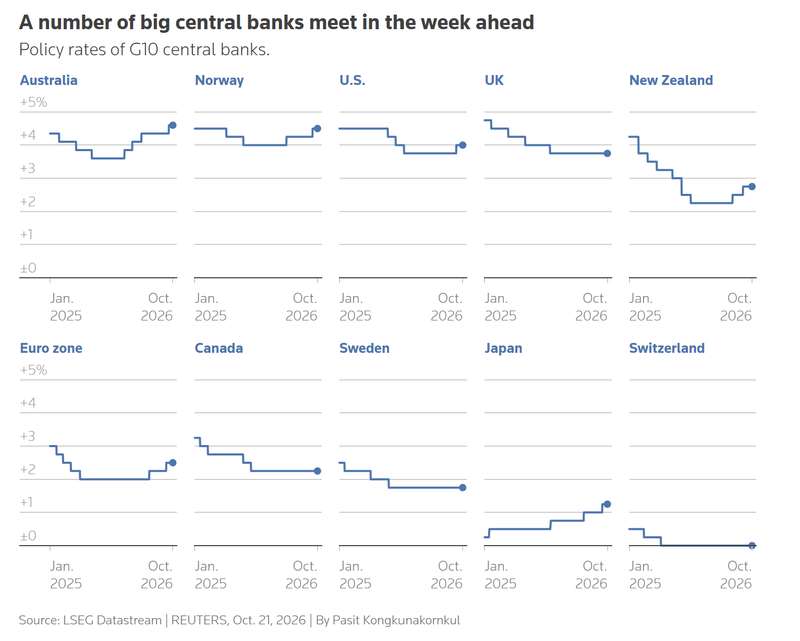
Five of the G10 in three days: the Fed, the ECB and the BOJ all tightened last month and face no pressure to move again now; Canada and New Zealand are priced to hike. Warsh will be pressed on the outlook, Lagarde on French borrowing costs, and the BOJ may raise its inflation forecasts. Source: LSEG Datastream / Reuters.
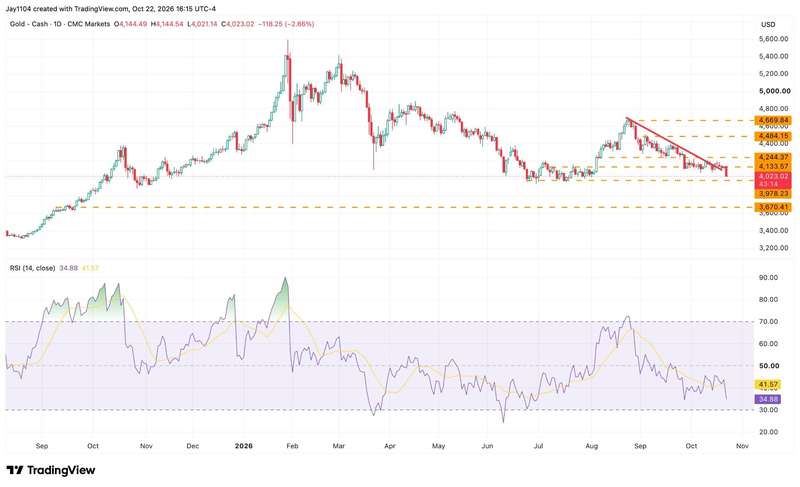
Gold is testing $4,000: the price has made lower highs since August and now sits on support around $4,000. A hawkish Fed could break it, with $3,600 the next major level. Source: TradingView / CMC Markets.
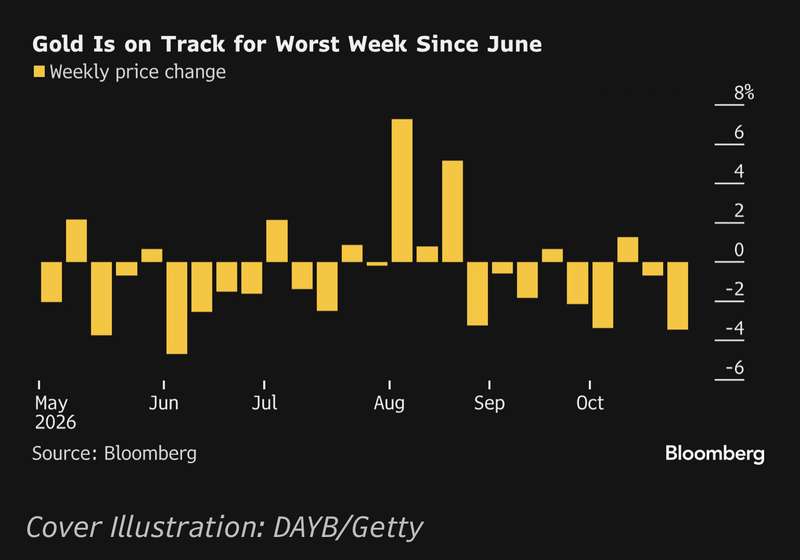
The worst week since June: traders sold bullion to meet margin calls and capital needs, a liquidity sale rather than a change of view. $3,900 is the level to watch. Source: Bloomberg.
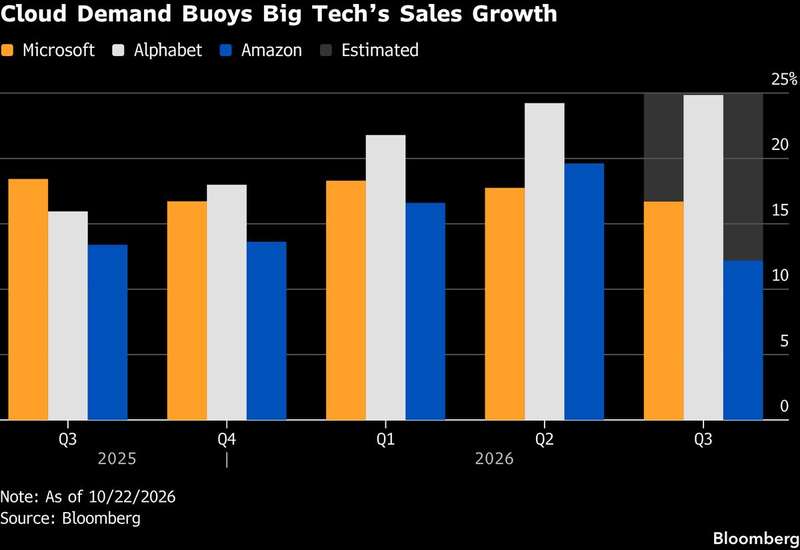
Cloud demand still exceeds supply: Alphabet's cloud sales (grey) grew fastest of the three last quarter, at more than 20%, and all three report this week. Delays at CoreWeave and Nscale show the hard part is now power and buildings, not orders. Source: Bloomberg.
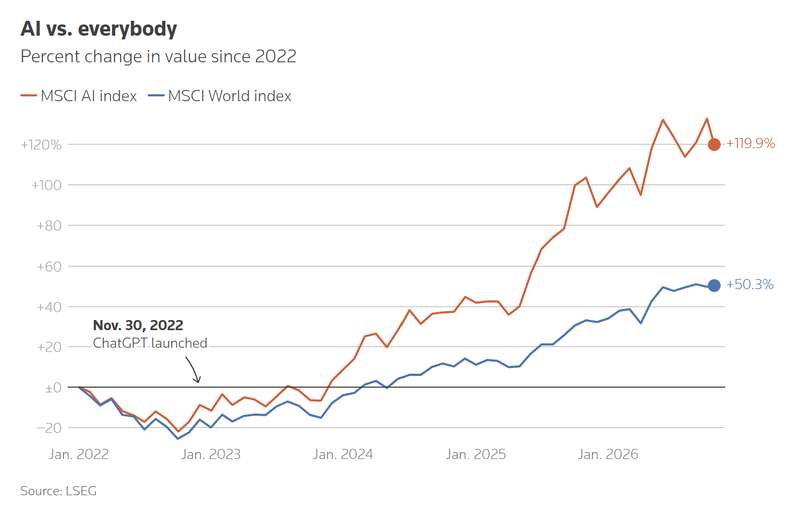
AI against everybody: the MSCI AI index is up about 120% since 2022, against about 50% for the MSCI World. About a third of the S&P 500 reports this week, led by the three hyperscalers. Source: LSEG / Reuters.
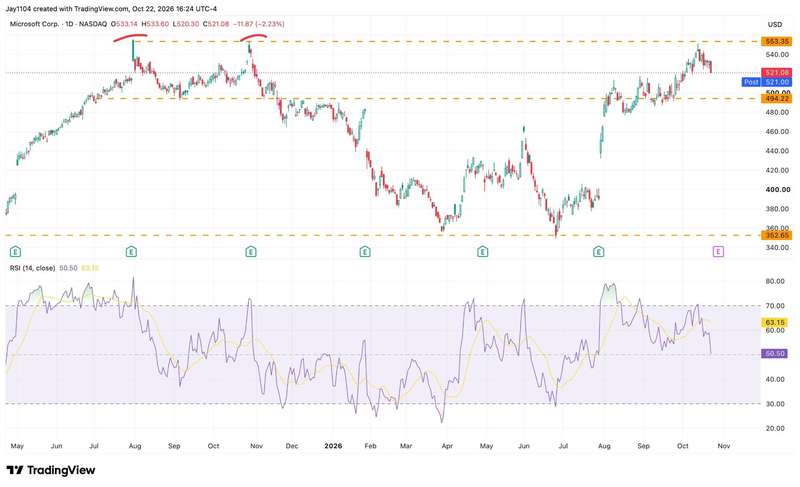
Microsoft has failed three times at $550: the shares have tested about $550 three times since July 2025 and fallen back each time; support sits near $520, then $495. Capex is expected to rise to about $46.6 billion for the quarter. Source: TradingView / CMC Markets.
ECB and GDP Thursday
Samsung reports in Seoul and the BOJ begins its meeting. In the evening, the ECB decides with French spreads at its door, and fifteen minutes later US GDP and PCE land together. Amazon reports after the close.
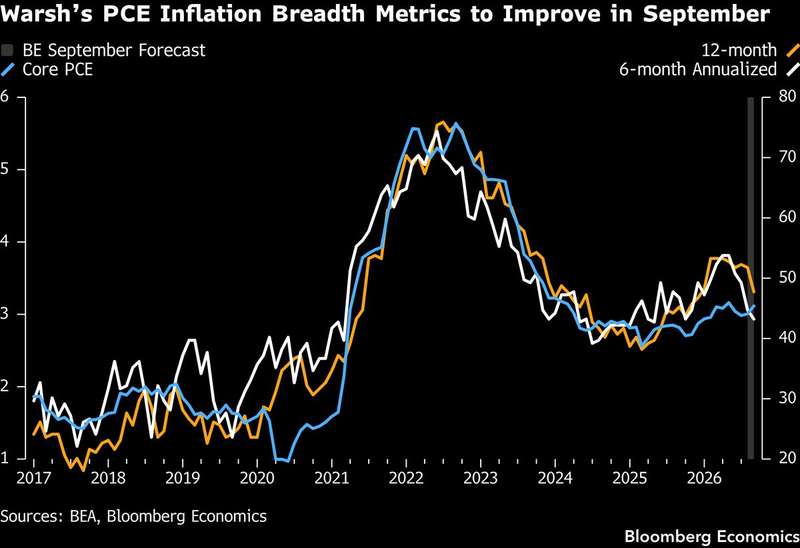
Hotter prices, but narrower: core PCE is seen up 0.34% in September, taking the annual rate to 3.1%, with headline at 3.6% on fuel. The breadth measures Warsh watches (orange and white) should improve, which takes some edge off the core number. Source: BEA / Bloomberg Economics.
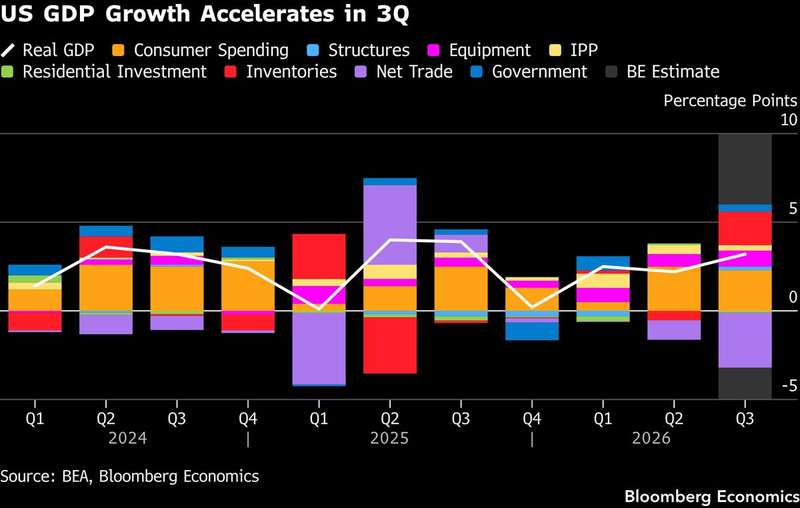
A 3.2% quarter built on AI investment: data centres and consumer spending are seen driving third-quarter growth, with imports of capital goods (purple) the drag. Housing is weighed down by borrowing costs. Source: BEA / Bloomberg Economics.
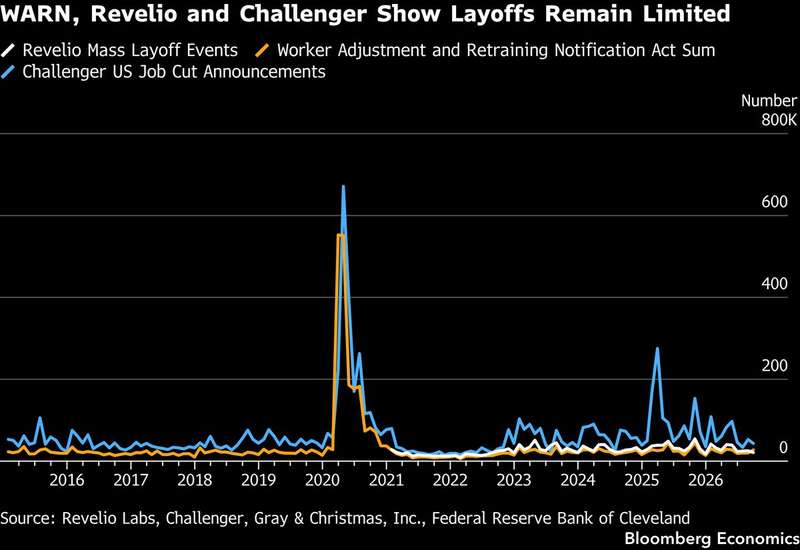
Layoffs remain limited: WARN notices, Revelio and Challenger all show job cuts near normal levels. Unemployment can still rise because hiring has slowed, which keeps claims low while new entrants struggle. Claims are seen at 195,000. Source: Revelio Labs, Challenger, Federal Reserve Bank of Cleveland / Bloomberg Economics.
BOJ and inflation Friday
Asia's data run from 7am, the BOJ decides around midday, Europe prints its growth and inflation in the afternoon, and the ECI closes the week in New York.
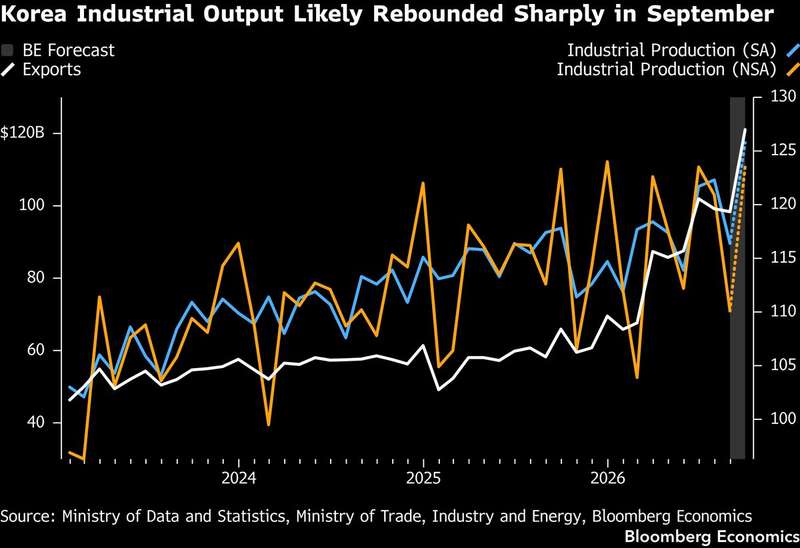
Korea's factories bounce on chips: output is seen up 8% in September after a 4.8% fall, as chip exports surged 263% from a year earlier and Hyundai's strike ended. Source: Ministry of Data and Statistics, MOTIE / Bloomberg Economics.
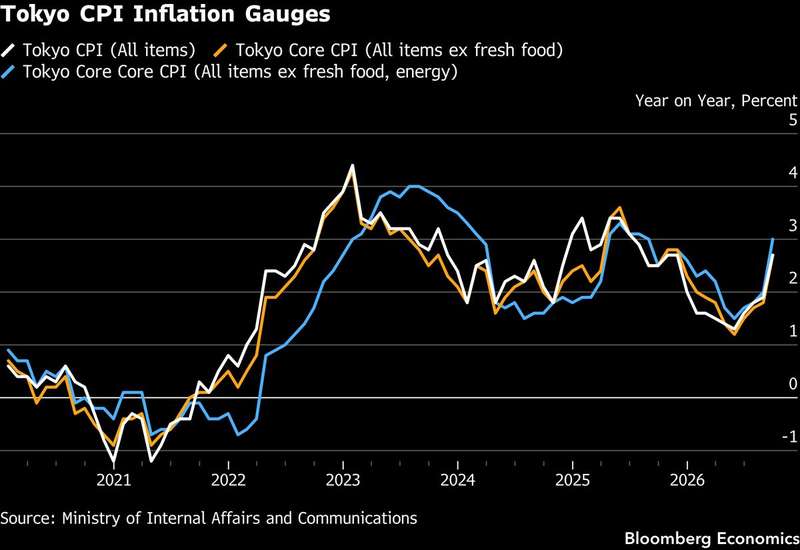
Tokyo cools on a base effect: core CPI is seen at 2.5% from 2.8%, partly because water fees returned a year ago. It arrives hours before the BOJ and gives little reason for a back-to-back hike. Source: Ministry of Internal Affairs and Communications / Bloomberg Economics.
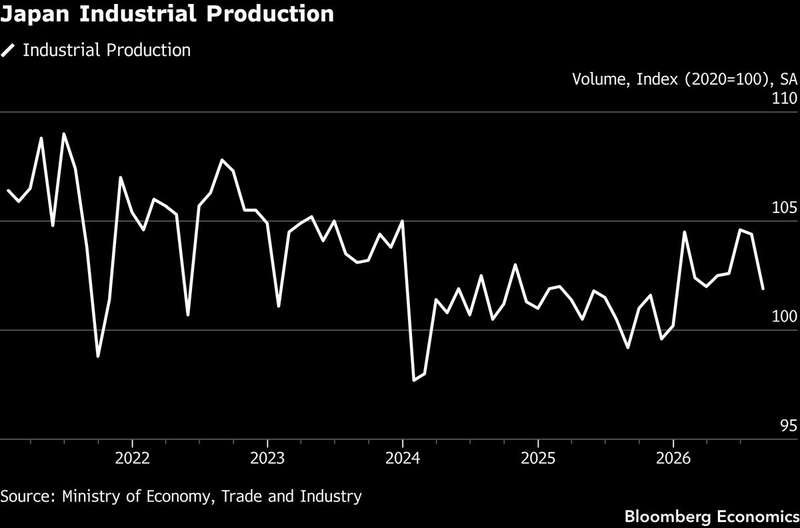
Japan rebounds from the Kyushu quake: output is seen up 1.9% in September after a 2.4% fall, led by cars and chip equipment. Source: Ministry of Economy, Trade and Industry / Bloomberg Economics.
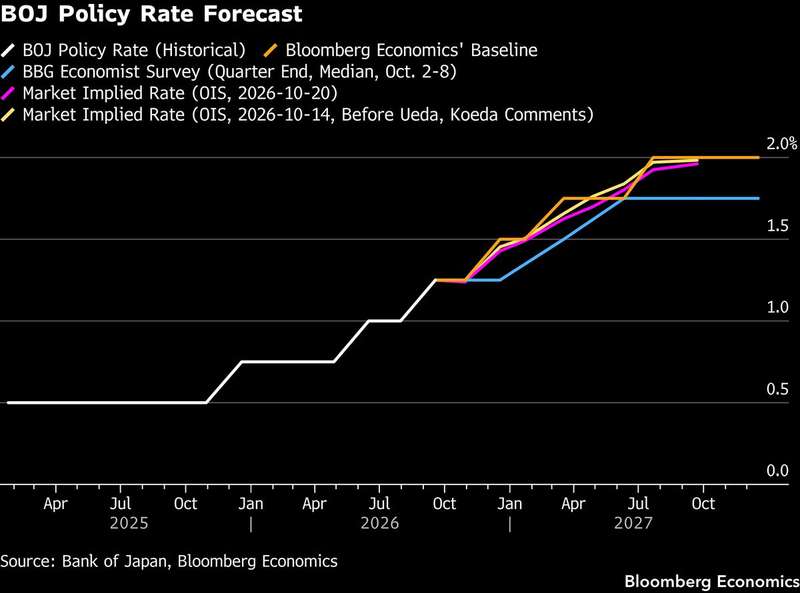
The path to 2%: the BOJ is expected to hold at 1.25% after September's hike, then raise in December, March and July to a terminal 2%, close to what markets price. Watch whether the outlook report says underlying inflation has reached 2%. Source: Bank of Japan / Bloomberg Economics.
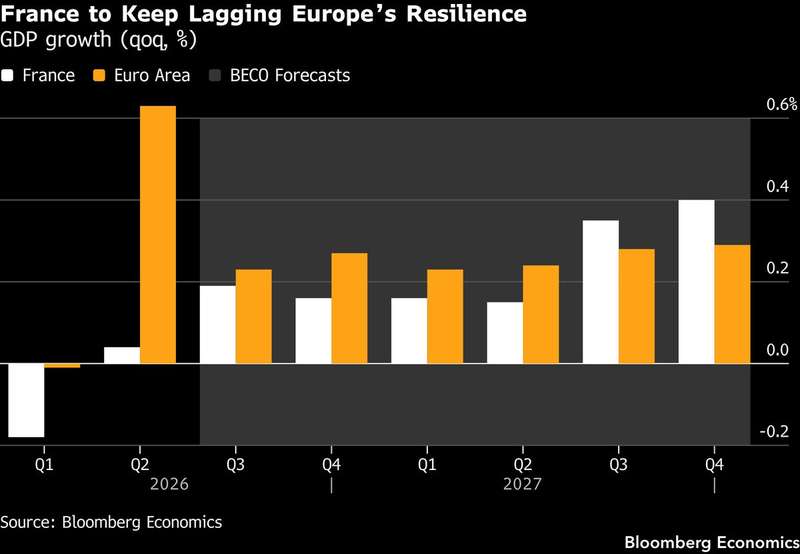
France keeps lagging: French growth (white) is seen at just 0.1% in the third quarter, below the euro area's 0.2% (orange), with a muted end to the year before the election. Source: Bloomberg Economics.
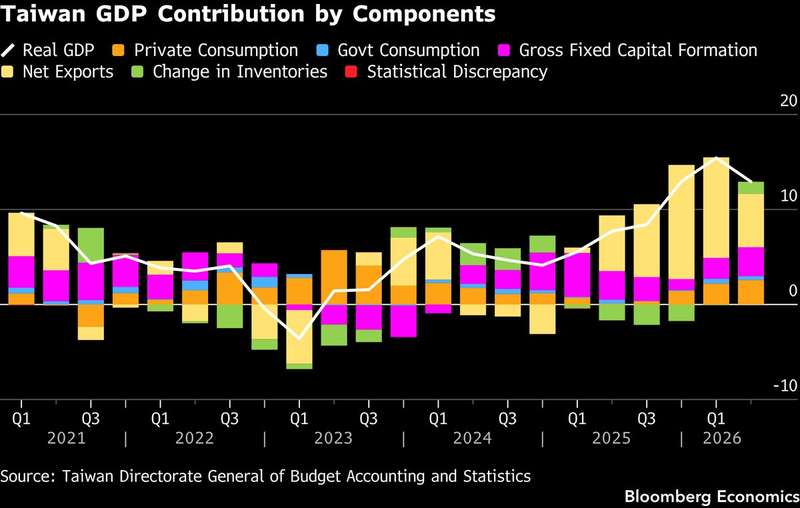
Taiwan grows 12% on chips: growth is seen easing only slightly from 12.9%, with net exports (yellow) and investment carrying it as chipmakers add capacity. Source: DGBAS / Bloomberg Economics.
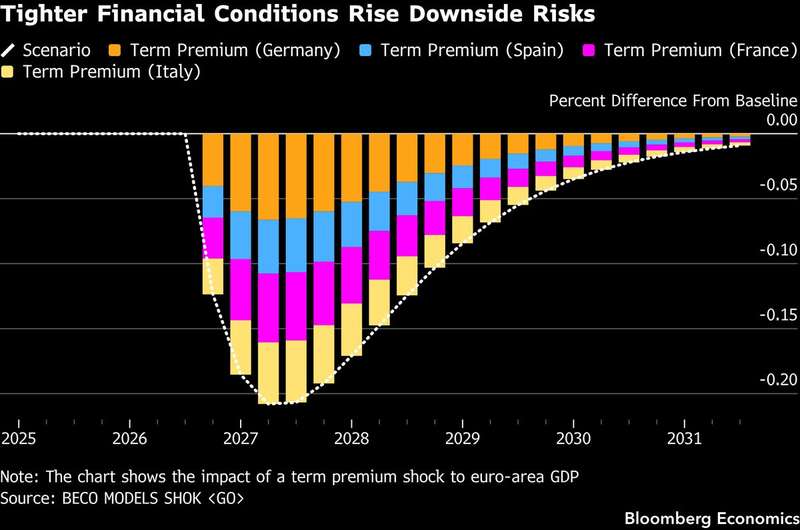
Why term premiums matter for Europe: a shock to term premiums in Germany, Spain, France and Italy would knock up to 0.2% off euro-area GDP by 2027. Euro-area growth is seen at 0.2% in the third quarter, with risks building. Source: Bloomberg Economics.
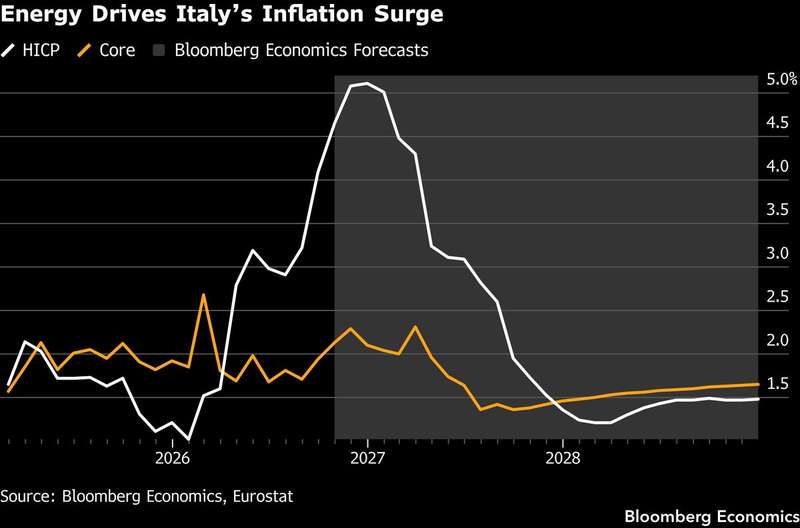
Italy's inflation rides energy: headline HICP is seen at 4.5% from 4.2%, peaking around the turn of the year, while core stays near 2%. France is seen at 3.7%, Spain 4.7% and Germany 3.0%. Source: Bloomberg Economics, Eurostat.
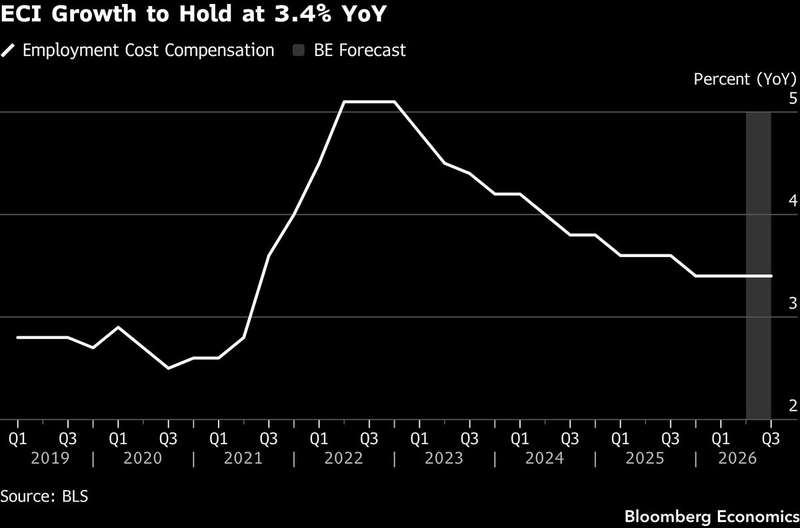
Labour costs hold at 3.4%: the ECI is seen up 0.9% for the quarter, driven by benefits as healthcare costs rise, not by wages. That kind of increase discourages hiring more than it feeds inflation. Source: BLS / Bloomberg Economics.
AI: the money, the jobs, the users
The die-hards still have the money: investment into AI infrastructure is on track to grow fivefold this year. The bill is starting to show up elsewhere.
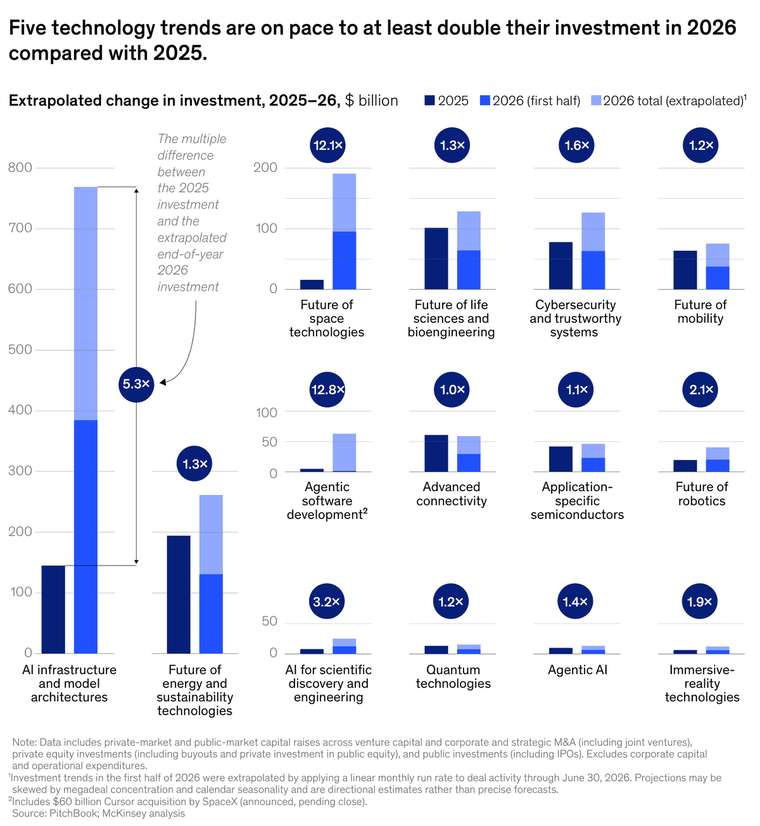
About $769 billion into AI infrastructure this year, against $145 billion in 2025, as investors put more into it in the first half than in all of last year. Space and agentic software grow even faster, but single megadeals, SpaceX's IPO and its pending $60 billion Cursor deal, drive much of it. Source: PitchBook / McKinsey.
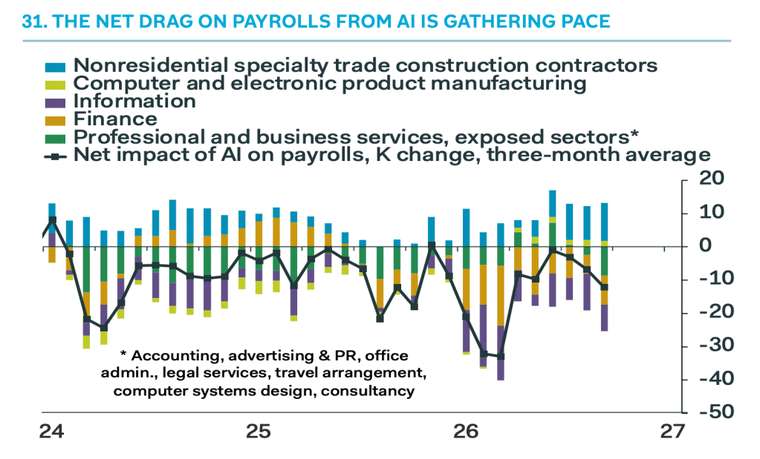
AI is now costing more than 10,000 US jobs a month, as losses in accounting, advertising, office admin and legal services outrun the gains in data-centre construction. Goldman estimates about 9% of workers could be temporarily displaced during the transition. Source: Pantheon Macroeconomics.
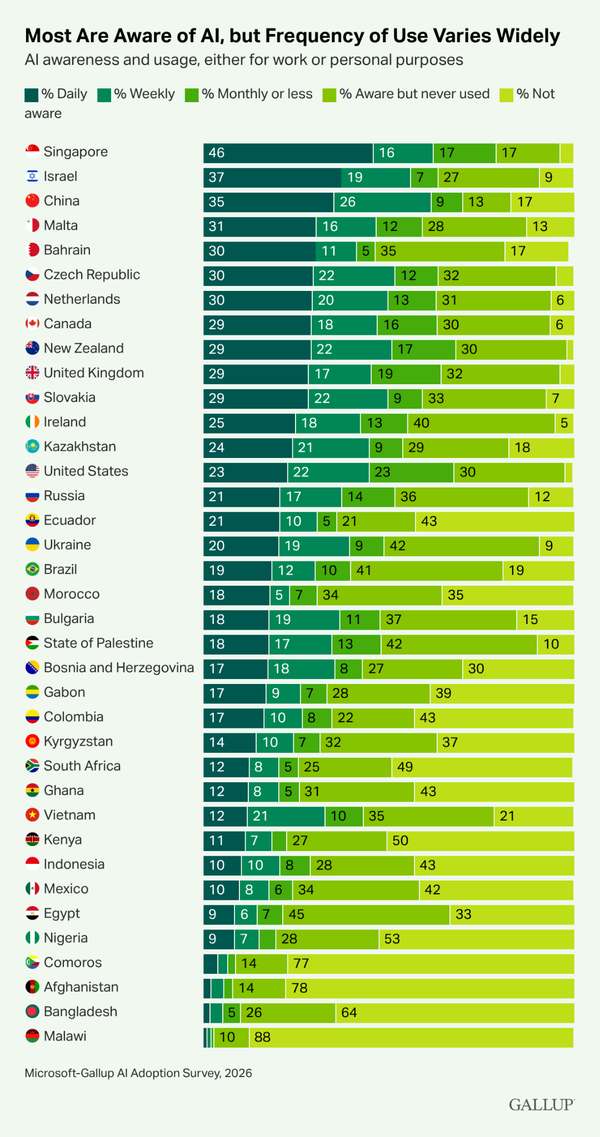
Singapore uses AI the most: 46% of Singaporeans use it daily, ahead of Israel at 37% and China at 35%, against 23% in the US. At the other end, most people in Malawi, Afghanistan and Comoros have never heard of it. Source: Microsoft-Gallup AI Adoption Survey 2026.
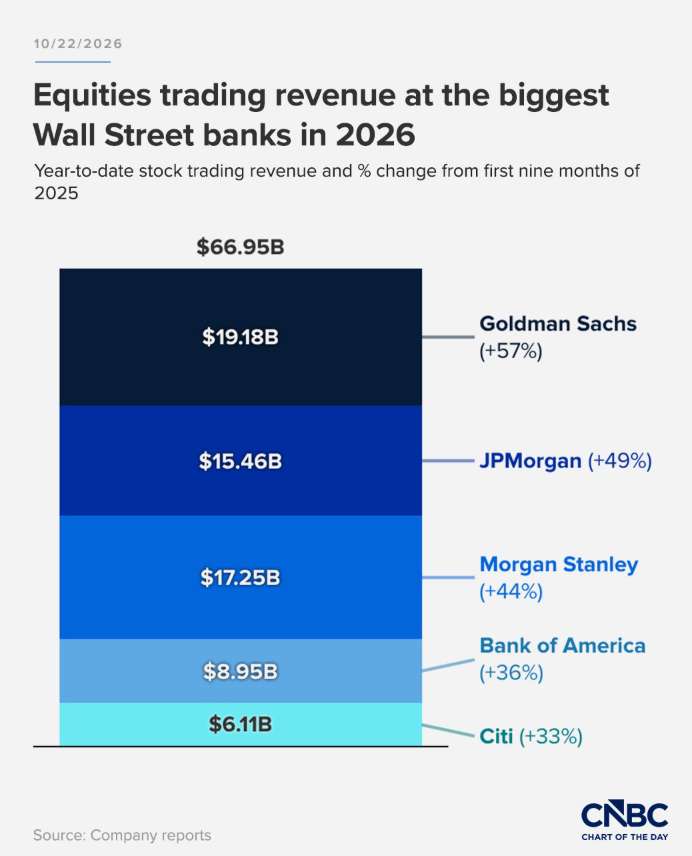
The banks are the AI trade's quiet winners: the five biggest Wall Street banks made about $67 billion from equities trading in the first nine months, $7 billion more than in all of record 2025. Goldman leads with $19.2 billion, up 57%. Source: Company reports / CNBC.
France: the march past the shops
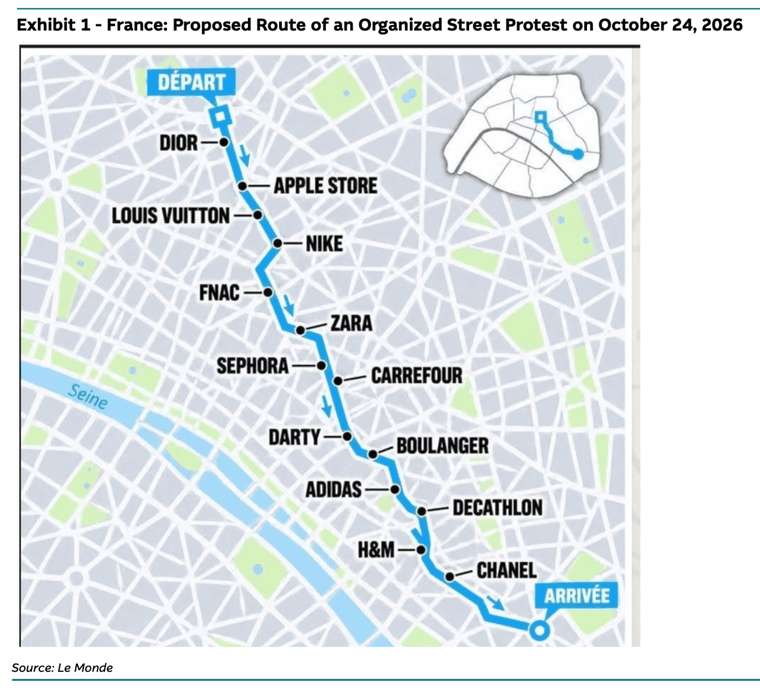
Saturday's protest route ran past Dior, Louis Vuitton, Apple and Chanel, the march for university funding drawn along Paris's luxury shopping streets. Until a curfew, the protests had turned into looting after dark, and the damage will show up in fourth-quarter growth. Source: Le Monde.
War: running out of sky
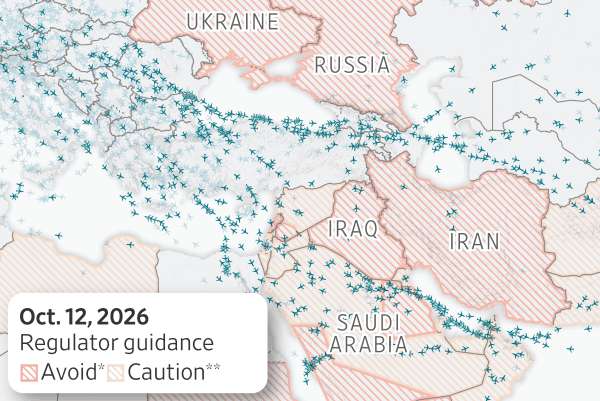
Airlines are running out of routes between Europe and Asia. Houthi strikes on Saudi airports closed one of the last corridors, leaving carriers to choose between Ukraine, Iran, Iraq and the Gulf on regulator guidance alone. Every reroute burns more of $116 oil. Source: The Wall Street Journal.
Asia beyond the chips
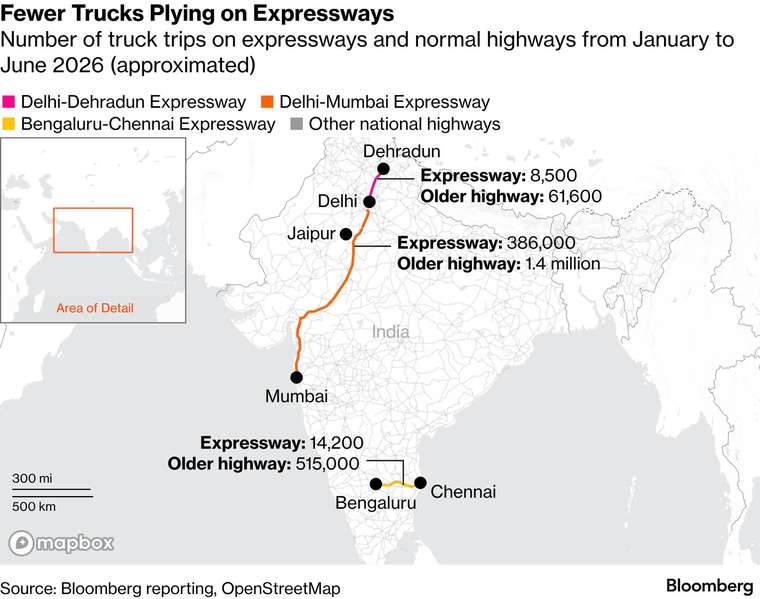
India built the expressways; truckers prefer the old roads, where repair shops are never more than a few miles away. The Delhi-Mumbai expressway carried about 386,000 truck trips in the first half against 1.4 million on the older highway. Source: Bloomberg reporting, OpenStreetMap.
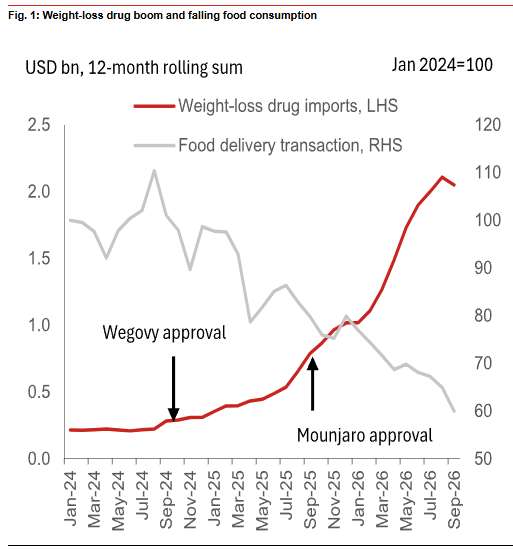
Korea's weight-loss boom is eating into food delivery: imports of weight-loss drugs have risen roughly tenfold since the Wegovy and Mounjaro approvals, while food delivery spending has fallen by about 40%. One more drag on a consumer already squeezed by two rate hikes. Source: Customs and card data, via an independent research note.
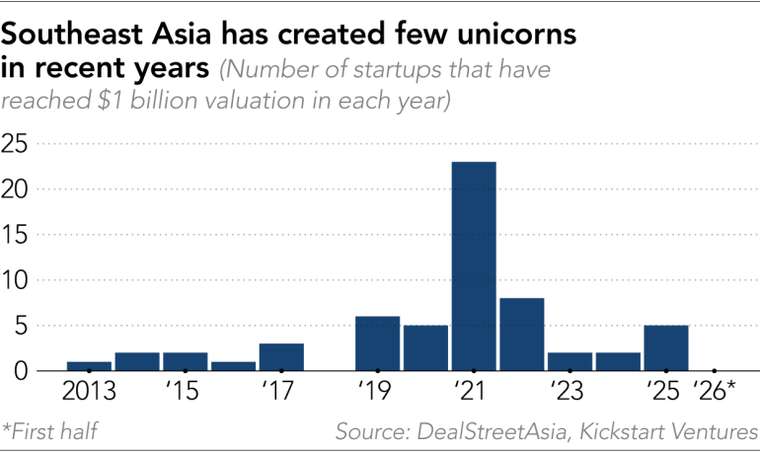
Southeast Asia has almost stopped making unicorns: 23 startups reached a $1 billion valuation in 2021, and none in the first half of this year, as global risk capital moved to AI. The region's young, connected population is still there; the money is not. Source: DealStreetAsia, Kickstart Ventures / Nikkei Asia.
Visual Capitalist: The State of Education
This week's special dispatch follows the classroom to the payslip: who scores best, who spends most, who earns degrees, and which degrees pay. Fitting, in a week when students are marching in Paris over university funding.
Infographic 1 - The World's Math Leaders
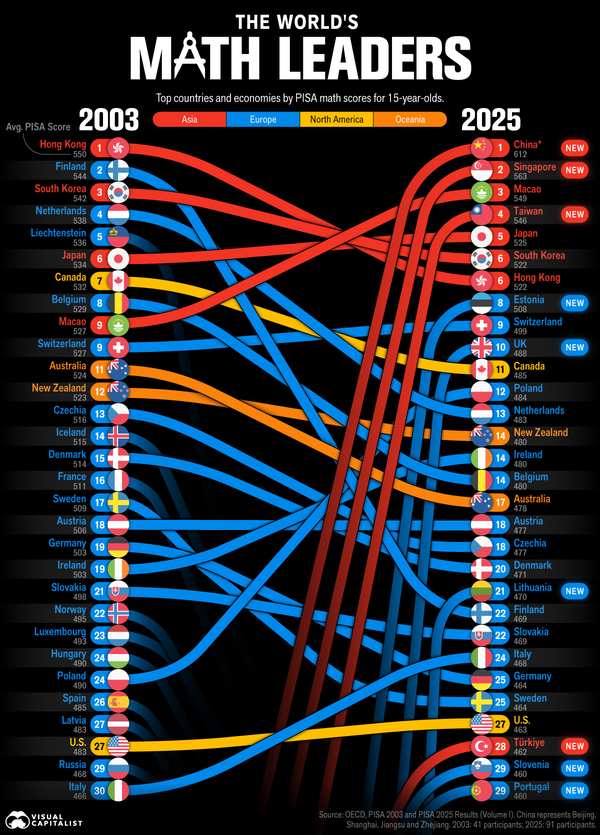
All seven top places now belong to Asia, led by China and Singapore, against Hong Kong, Finland, the Netherlands and Canada in 2003. Others slipped too: OECD math scores fell 22 points from 2015, about a year of learning. Source: OECD PISA / Visual Capitalist.
Infographic 2 - Education Spending per Student
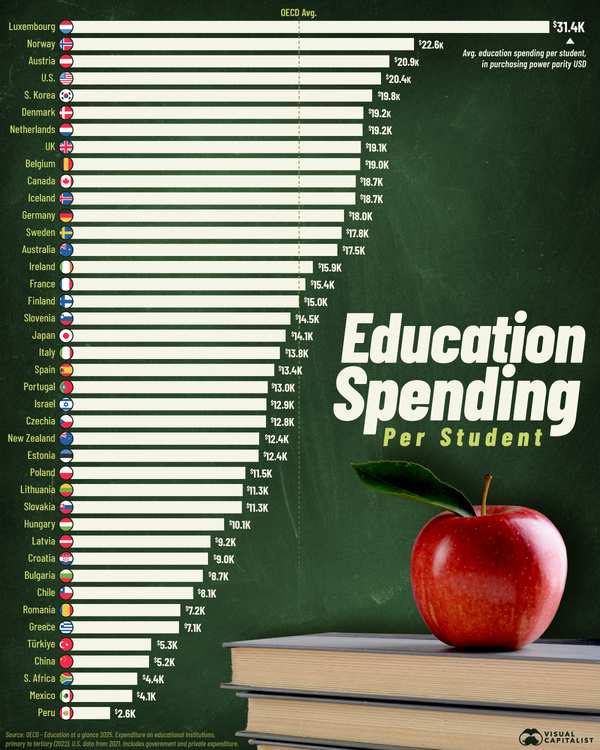
Luxembourg spends about $31,400 a student, nearly $9,000 more than Norway. Money is not everything: Japan spends less than the OECD average and ranks fifth in math, and South Korea spends about what the US does and scores nearly 60 points higher. Source: OECD / Visual Capitalist.
Infographic 3 - The Gender Gap in Teen Reading
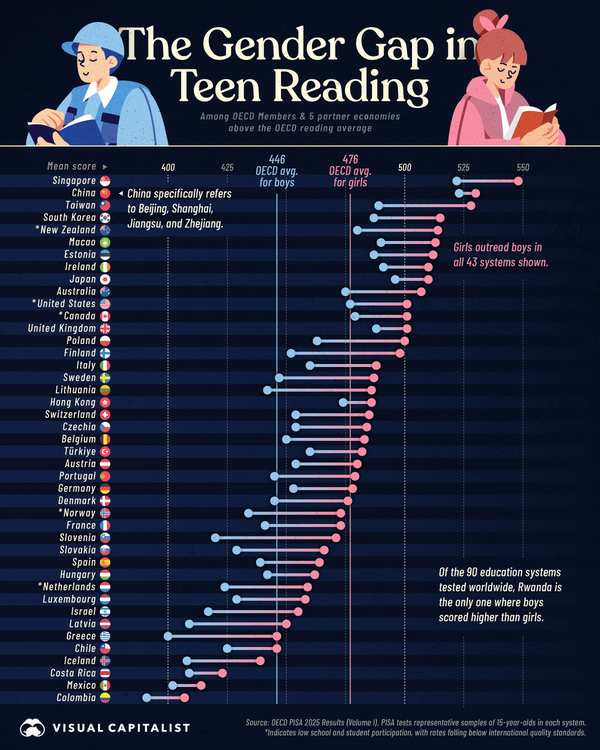
Girls outread boys in 89 of 90 education systems, by 30 points across the OECD; Rwanda is the only exception. The gap is widening, and 37% of boys now fall below baseline proficiency. Source: OECD PISA / Visual Capitalist.
Infographic 4 - Women vs Men in Higher Education
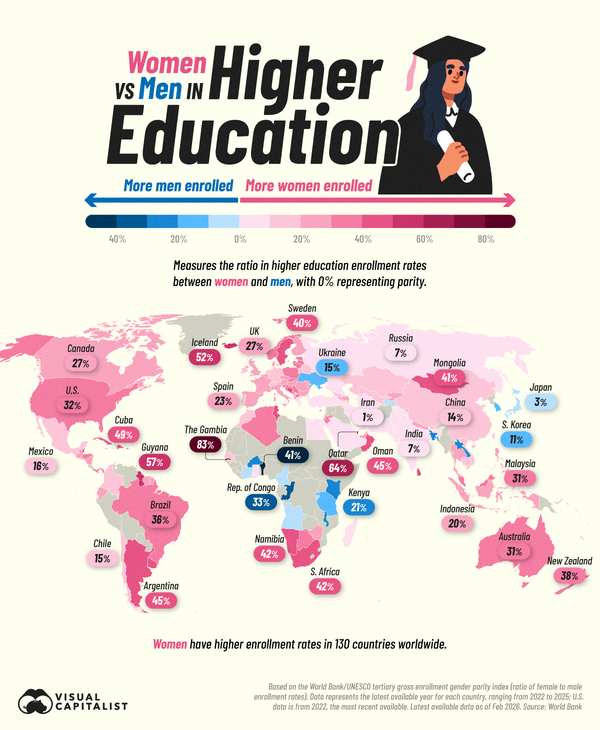
Women enrol at higher rates in nearly nine in ten countries, about a third higher than men in the US. Japan and South Korea are the rich-world exceptions. It has not closed the pay gap: young women working full time still earn 17-18% less than men with the same education. Source: World Bank, UNESCO / Visual Capitalist.
Infographic 5 - The Most Educated Adults
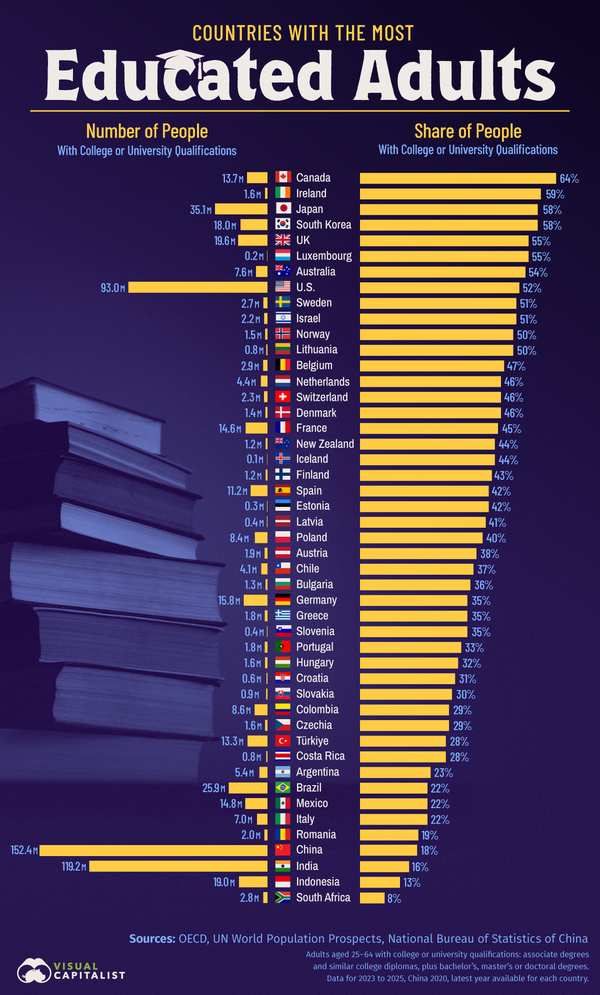
Canada leads with 64% of adults holding college or university qualifications, helped by its two-year colleges. By headcount, China leads with 152 million, just 18% of its working-age population. Germany's apprenticeships keep it at 35%. Source: OECD, UN, National Bureau of Statistics of China / Visual Capitalist.
Infographic 6 - The Cost of a Bachelor's Degree
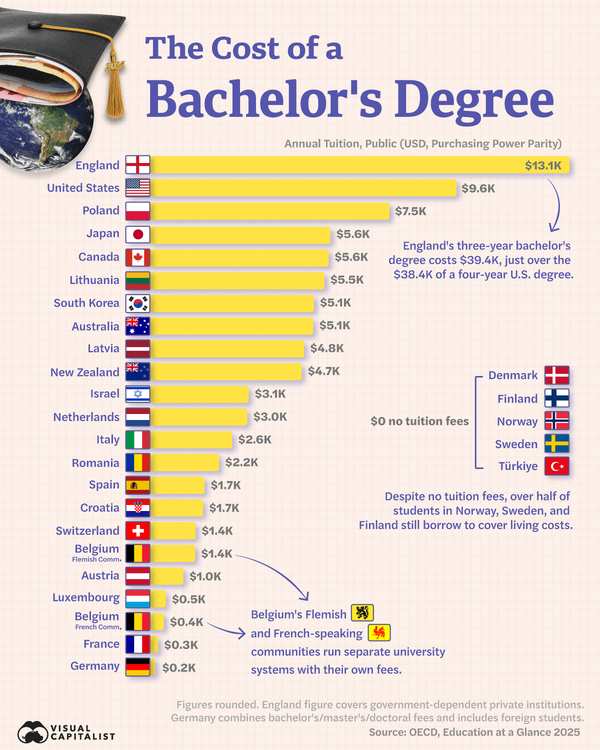
England charges the most, about $13,100 a year, ahead of the US at $9,600, though its three-year degree costs about the same in total. The Nordics charge nothing, yet more than half of students in Norway, Sweden and Finland still borrow to live. Source: OECD / Visual Capitalist.
Infographic 7 - Cost of College Across the US
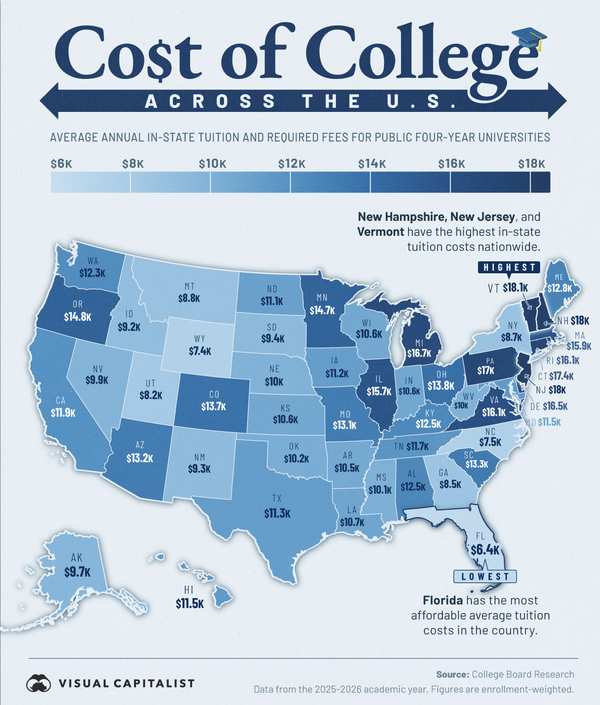
In-state tuition ranges from $6,359 in Florida to $18,094 in Vermont, with the five most expensive states all in the Northeast. Florida has held in-state rates flat since 2013. After grants, the average net cost is about $2,300. Source: College Board / Visual Capitalist.
Infographic 8 - Median Earnings by Education and State
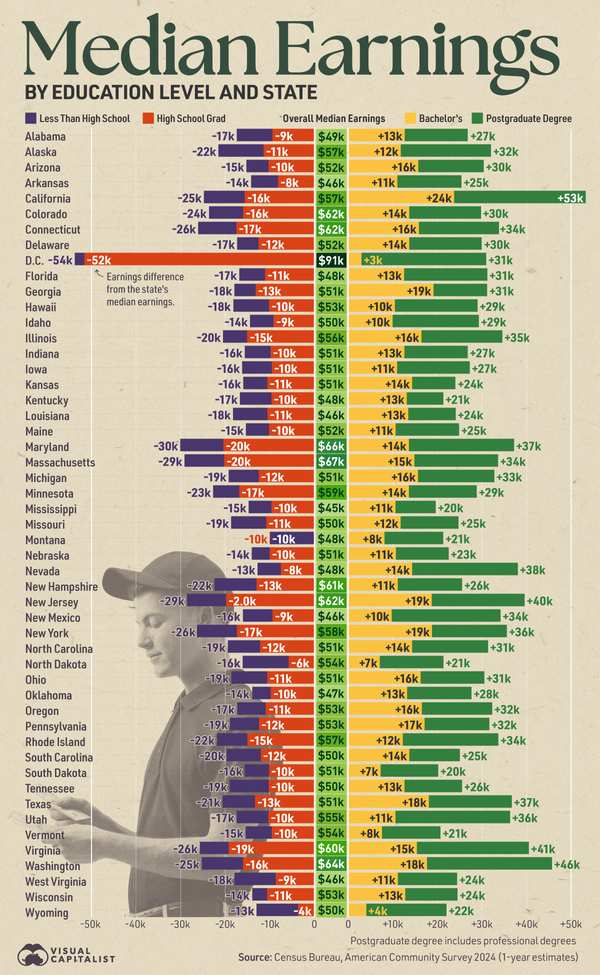
A bachelor's degree adds about $13,000 a year over the state median, and a graduate degree about $30,000. California has the widest gaps; in Wyoming and North Dakota, energy and mining jobs pay well without a degree. Source: US Census Bureau / Visual Capitalist.
Infographic 9 - College Degrees' 10-Year Added Earnings
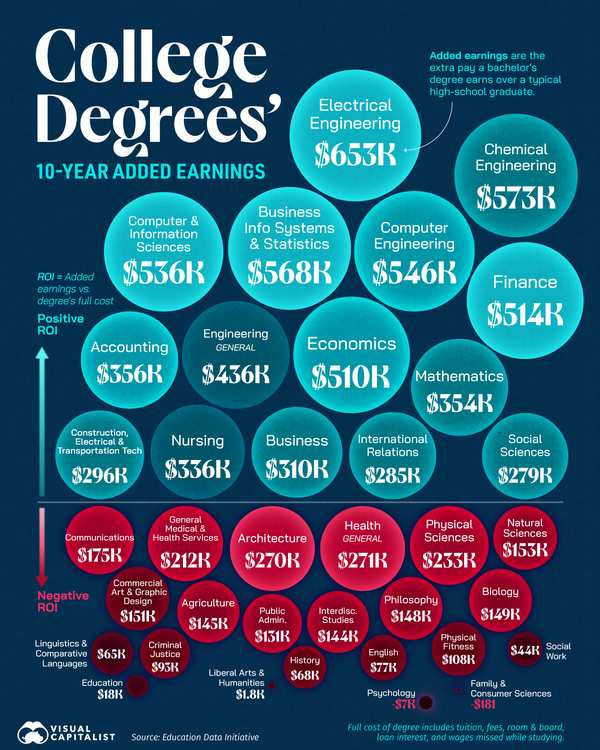
Electrical engineering adds about $653,000 in ten years, but only 15 of 37 majors earn back their full cost in a decade. The best return goes to business information systems and statistics; psychology loses money without a graduate degree. Source: Education Data Initiative / Visual Capitalist.
The Good Wrap
What is left at the close: a reminder that whole nations can climb out of poverty, and week five of the dashi series, the broth that brings two together.
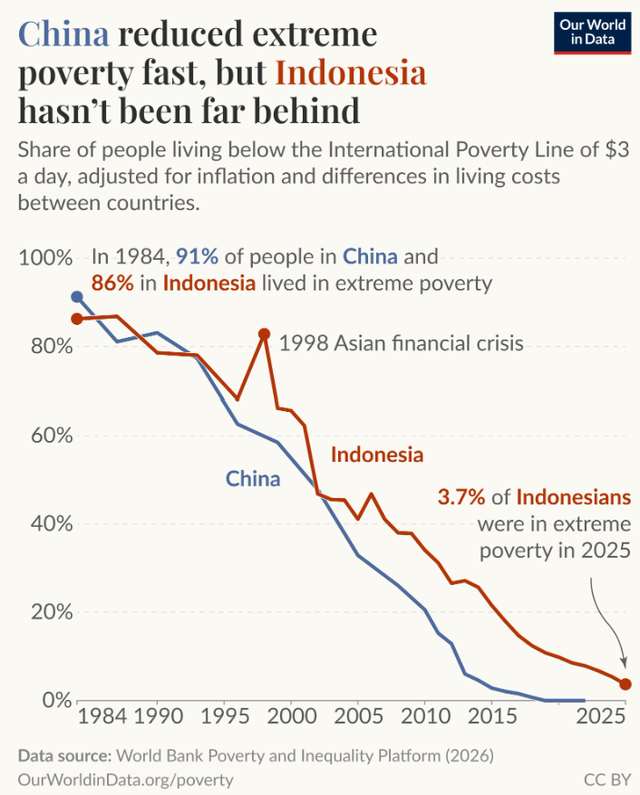
China gets the credit, but Indonesia has not been far behind: in 1984, 86% of Indonesians lived on less than $3 a day; by 2025 it was 3.7%, from 140 million people to about 10 million, despite a setback in the 1998 Asian financial crisis. Source: World Bank Poverty and Inequality Platform / Our World in Data.

Dashi, week five: awase, kombu and katsuobushi together: the clean sea and the smoky savoury, layered into one deeper broth for miso soup and everyday cooking. Neither is complete alone. This week's market is an awase too: die-hards and vigilantes in the same pot. The flavour comes from both, and the cook who throws one out gets a thinner soup. Source: FermenStation.
Best,
Hoelon
WITPTW is a personal publication. Everything here is personal opinion and market commentary, written in a personal capacity. It is not investment advice and not a recommendation to buy or sell any security. It is not associated with, endorsed by, or representative of any employer, fund or company. Charts and images are reproduced from their original publishers, credited to their sources for commentary and discussion; all rights remain with the respective copyright holders.