Bluenami Aftermath
Personal views and market commentary. Not investment advice. Not associated with any employer or firm.
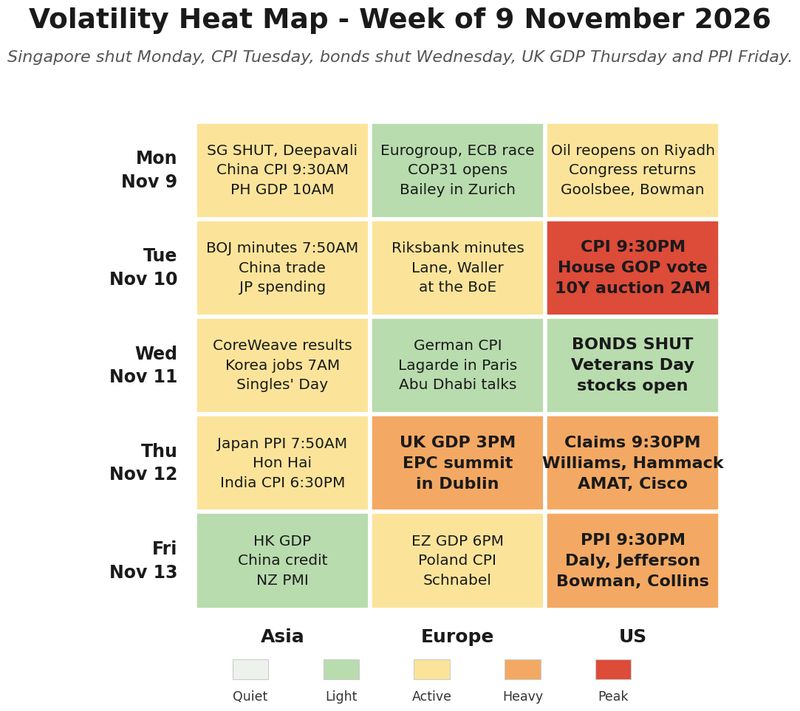
Volatility heat map for the week ahead, in Singapore time. Singapore is shut on Monday for Deepavali and the US bond market on Wednesday for Veterans Day, though stocks trade. The S&P enters near 7,377, the 10-year near 4.86% and Brent near $98.
"The reason we lost is the war." — JD Vance, Vice President, on X the morning after the midterms. Convenient, and only half true. Voters did dislike the war: 62% told NBC's exit poll it was the wrong call. But when AP asked what was crucial to their vote, corruption and the cost of living came well ahead of Iran. Blaming the war lets the heir keep the brand and drop the boss. Ohio still gave Vance's own old Senate seat to Sherrod Brown. Trump blames fuel prices and says he "would have done it again." Rubio is reported to be weighing an exit, which State calls a hoax. Johnson won't lead House Republicans next year. This lame duck is losing his own bench.
"I believe the very best money is made at the market turns. Everyone says you get killed trying to pick tops and bottoms and you make all your money by playing the trend in the middle. Well for twelve years I have been missing the meat in the middle but I have made a lot of money at tops and bottoms." — Paul Tudor Jones, in Jack Schwager's Market Wizards (1989). Turns are where the money is, and where the bodies are. Thursday looked like a turn. The semiconductor index lost 12% in a day, Seoul tripped its circuit breaker and Taiwan switched on its stock stabilisation fund. Capitulation has a look: forced sellers, official buyers and a VIX near 30. But a turn is a process, not a day, and Friday's bounce proves nothing yet. Exhaustion shows up in what stops happening: leaders that no longer fall on bad news, and sellers who run out of reasons.
"灭六国者,六国也,非秦也;族秦者,秦也,非天下也。 It was the Six States that destroyed the Six States, not Qin. It was Qin that wiped out Qin, not the world." — Du Mu, Rhapsody on the Epang Palace (825), written to warn a Tang emperor busy building palaces. The day after the vote, Trump took reporters to watch the last steel beam go into his ballroom. "Watch the beam go up," he said, while his party counted the damage. Kansas elected a Democratic senator for the first time since 1932, Texas for the first time since 1988. Colorado Springs, home to Focus on the Family, will send its first Democrat to Congress. The NRCC chair lost a district Trump won by 16. Democrats flipped 44 House seats and lost two. Nobody beat the Republicans but the Republicans.
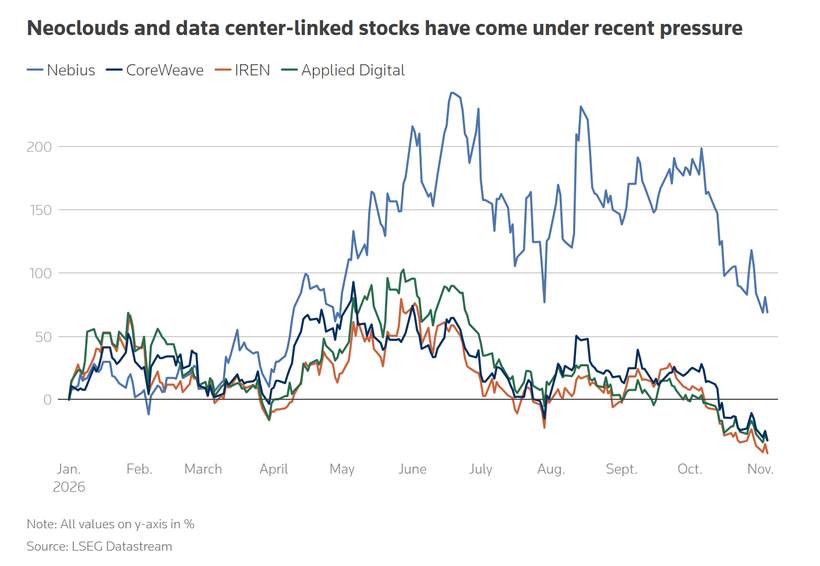
The AI trade lost its political cover in a day: Thursday's Nasdaq slump was its biggest since the Liberation Day rout of April 2025 and wiped about $2.5 trillion off one index. Worries about the cost of the build-out were already there; voters in Texas and Georgia turned them into a regulatory story. The question for the next two weeks is whether something in the financing chain breaks. Source: Reuters.
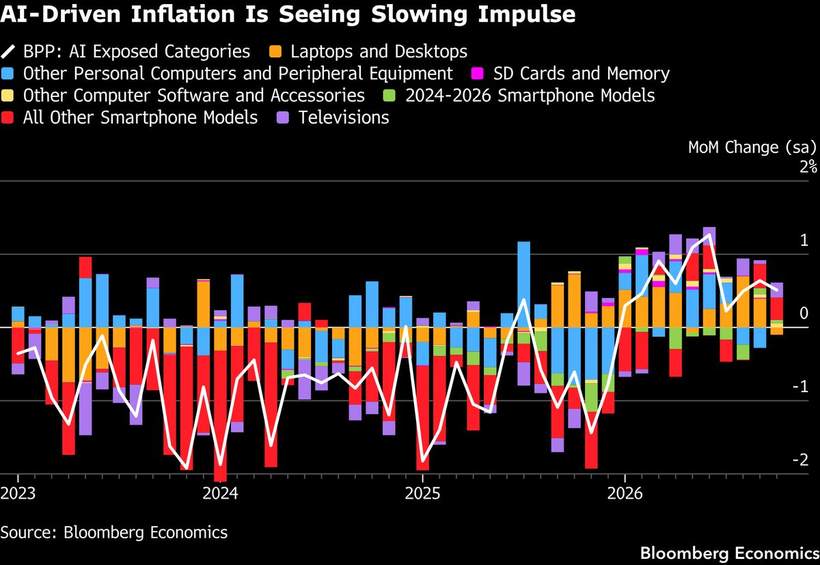
October's CPI is expected to cool, and that is the problem for the hawks: consensus sees headline at 0.3% after September's 0.6%, and core at 0.2%, with used cars and electronics easing and rents a third below their September spike. There will be no official annual rate, because October 2025 was never collected during the shutdown; a private price series puts it near 3.8%. A soft print on top of an equity rout is the case for the Fed to skip December. Source: Bloomberg Economics.
What is the plan this week?
A lot has happened in a week. A spectacular Democratic sweep can still surprise, even when it is well expected. The meltdown came late, a day after the relief rally, threw many off guard and teaches us again that markets are still emotional no matter how well you prepare. We start the week with Singapore shut for Deepavali, oil reopening after a weekend strike on Riyadh, and a new chief of staff in the White House.
There are still many moving parts, and where does one even start? The sea change in Washington, a lame duck president, Republicans turning on each other, the rules on data centres being rewritten state by state, a binary Middle East, and US equities still looking for a footing. It is tough timing, with hedge funds giving back their gains as we head into the last liquid month of the year. I think a resolution of the war that brings oil lower, and growth holding at this pace, are both needed for a stock market recovery. The economy is not the problem: payrolls rose 165,000 against about 70,000 expected, productivity grew 3.6% and claims stayed below 200,000. The problem is the price of the AI trade. Anthropic's IPO is the next signal to watch: investors told Reuters they doubt next week's roadshow can go ahead, and buyers are said to value it as low as $1.1 trillion against the $1.5 trillion hoped for. The Riyadh Aramco attack looks like escalation ahead of de-escalation: the Houthis damaged Aramco's tower in the financial district on Sunday, days after US strikes on Qeshm Island and Iran's walkout from the talks in Qatar.
In the US, Tuesday's CPI is the fulcrum, with December hike odds at about 75-80% even as some economists now expect the Fed to wait. PPI follows on Friday, and the Treasury sells $125 billion of 3-, 10- and 30-year paper around a bond market that is shut on Wednesday. More than ten Fed speakers fill the week; the voters to listen for are Waller on Tuesday, Hammack and Williams on Thursday, and Jefferson and Bowman on Friday, after Williams called inflation "absolutely too high." House Republicans choose their leaders on Tuesday, Scalise or Jordan, and Congress returns on Monday with a majority it loses in January. The borrowing estimates told us the Treasury needs $800 billion in the first quarter against $620 billion expected; coupon sizes were held, so the extra comes in bills, for now.
Europe is the most unstable it has looked in years. Krakow's Main Square shooting on Saturday killed six, the deadliest in Poland since 1989, by a gunman with ultranationalist views, a week after Tusk warned of armed provocations on the Kaliningrad border. France's assembly threw out the revenue half of the budget by 458 votes to none, Spain votes on the 29th, and the euro area's finance ministers meet on Monday to pick between Knot and Hernandez de Cos for the ECB. The Bank of England hiked 8-1 with one vote for 50bp, yet Bailey said it should not be seen as the first of a long sequence; Thursday's GDP, seen at 0.7% for the quarter, decides whether February is live. Euro-area GDP comes on Friday and German CPI on Wednesday. The euro reached about $1.1275 on the vote and was back near $1.1130 after payrolls; I don't think it has bottomed.
In Asia, it is a week of prices. China's CPI and PPI land on Monday, with factory-gate inflation seen above 5%, then trade on Tuesday and credit later in the week. India's CPI on Thursday is seen breaching the RBI's 6% ceiling, which keeps December's hike on track, while Japan's PPI, near 6.5%, and Tuesday's BOJ minutes keep December in play in Tokyo. The Philippines reports third-quarter GDP on Monday, seen slowing as a weak peso and high fuel bite, and Korea's jobs come on Wednesday. The AI winners of Asia are this month's losers, and money is going to markets with no AI to sell. New Zealand woke up to a hung parliament, Malacca votes on Saturday, and Trump heads to Manila for the ASEAN summit next weekend.
The plan this week is to start tracking the exhaustion in this tech unwind. Asian currencies have been trading idiosyncratic winners and losers, and there are opportunities when positions get lighter in some.
What did I learn last week?
Mon Nov 2: The PBOC moved to its new 1.25% overnight rate. The ISM rose to 55.5 against 54.5 expected. The Treasury's estimates showed $618 billion of borrowing this quarter and $800 billion in the next, against $620 billion expected. Apple beat and called memory pricing "unprecedented," and Iran's Supreme Leader gave the government authority for peace talks.
Tue Nov 3: The RBA hiked to 4.85%, its fifth this year, but by 6 votes to 3, and the Australian dollar fell. Korea's CPI eased to 2.8%. Job openings rose to 7.52 million against 7.16 million. America voted, and AMD guided 2027 revenue up more than 80%.
Wed Nov 4: Democrats won the House and the Senate. Brent fell 9% in a day, below $100. The Riksbank hiked to 2.00%, its first since 2023, and euro-area CPI held at 4.0% with core at 2.5%. The refunding kept coupon sizes at $58 billion, $42 billion and $25 billion. Brazil held at 13.75%, Johnson stepped aside and France's assembly rejected the revenue half of its budget 458-0.
Thu Nov 5: The Nasdaq 100 fell 6.4% and the SOX 12.2%, the worst since April 2025; the Kospi and Taiex tripped circuit breakers the next morning. The BoE hiked to 4.00% by 8 votes to 1, the dissenter wanting 50bp. Bank Negara held at 2.75% and Norges Bank at 4.50%. Productivity rose 3.6% against 2.7% and claims were 189,000.
Fri Nov 6: Payrolls rose 165,000 against about 70,000 expected, with hourly earnings up 0.4% and unemployment at 4.1%. Trump named Stephen Miller chief of staff in place of Susie Wiles and confirmed "minor" strikes on Qeshm Island. Washington told Beijing to meet the Busan truce terms at once, and Taiwan raised short-selling margins.
Weekend: New Zealand's vote left no clear winner. A gunman killed six in Krakow on Saturday, and the Houthis hit Aramco's Riyadh tower on Sunday.
All week: The S&P fell 2.7% to 7,377, its fourth weekly loss, the Nasdaq 100 4.9% and the SOX 12.2%, while the equal-weighted S&P lost only 1.0%. The 10-year fell 8bp to 4.86%, the DXY rose to 102.3, Brent lost 16.4% to $98 and gold rose 4.5% to $4,075. India's Nifty rose 8.6%. Grading the board: the Democratic sweep, the unchanged refunding and the strong payrolls all fired, and the second-wave tail hit Asia. The BoE was more hawkish than our 7-2, sterling sold the fact, and Doha delivered no deal, yet oil fell anyway on the vote.
What to look out for next week?
Mon Nov 9: Singapore is shut for Deepavali. China's CPI and PPI at 9:30am, seen at about 0.8-1.0% and 5.4%, the Philippines' third-quarter GDP at 10am, seen at 2.1-3.0%, and Taiwan's trade at 4pm. Oil reopens after the Houthi strike on Riyadh. COP31 opens in Antalya, G7 foreign ministers meet in Marseille, and the Eurogroup discusses Lagarde's successor. Bailey speaks in Zurich. Miller starts as chief of staff and Congress returns; Bowman, Goolsbee and Barkin speak overnight, and the Treasury sells $58 billion of 3-year notes at 2am.
Tue Nov 10: Japan's household spending and the BOJ's October minutes from 7:30am, then China's trade, exports seen up 32-41%, and Malaysia's industrial production at noon. SoftBank reports. The Riksbank's minutes, and Lane, Lombardelli and Waller at the BoE's Watchers conference in London; US-mediated Russia-Ukraine talks start in Abu Dhabi. US CPI at 9:30pm, seen at 0.3% with core at 0.2% and no annual rate published. House Republicans elect their leaders, Sea reports, Logan and Schmid speak, and the 10-year auction is at 2am.
Wed Nov 11: The US bond market is shut for Veterans Day; stocks trade. CoreWeave reports in our early morning and Korea's jobless rate at 7am, seen at 2.6%. Singles' Day. German CPI, Lagarde at the Paris Peace Forum, Nagel in Riga and Norges Bank's stability report.
Thu Nov 12: Japan's PPI at 7:50am, seen at 6.5%, and Hon Hai's results. UK third-quarter GDP at 3pm, seen at 0.7%, as European leaders gather in Dublin. India's CPI at 6:30pm, seen at 6.0-6.1%, above the RBI's ceiling. Claims at 9:30pm, then a full Fed day: Schmid, Daly, Goolsbee, Hammack, Williams and Barr. Applied Materials and Cisco report after the close, and the 30-year auction is at 2am. Peru is seen hiking to 4.50% overnight.
Fri Nov 13: New Zealand's PMI at 5:45am and Hong Kong's GDP. Euro-area GDP and employment at 6pm, with Poland's CPI and GDP and Russia's CPI, seen at 7.1%. US PPI at 9:30pm, seen at 0.3-0.4%. Daly, Jefferson, Bowman and Collins speak, Rubio gives a lecture in Washington, and Germany's rating is reviewed. China's credit data lands during the week, India's trade by Monday, and Malacca votes on Saturday.
Beyond next week
Nov 15-19: The ASEAN summit in Manila from the 15th to the 17th, with Trump, Li Qiang and Carney expected; Anthropic's targeted roadshow; APEC in Shenzhen on the 18th and 19th; the FOMC minutes on the 19th.
Nov 25-29: US PCE on the 25th, the BOK, seen hiking, on the 26th, New Zealand's final count with special votes, and Spain's snap election on the 29th.
Dec 7-17: The BOJ's bond market meetings on the 7th and 8th, the Fed on the 9th, the SNB on the 10th, the US stopgap funding expiry on the 11th, and the ECB and BSP on the 17th, with Lagarde's successor due by the mid-December EU summit.
G10 rates at a glance
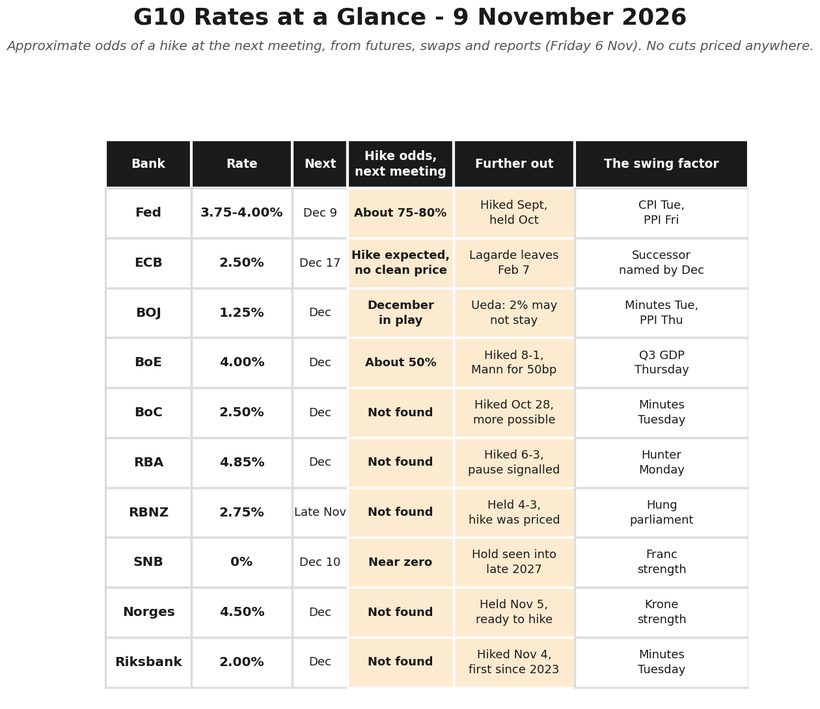
Three G10 banks hiked last week, but the votes are splitting. The RBA hiked 6-3 and signalled a pause, Norges Bank held and only the BoE surprised hawkishly. The odds are snapshots from Friday's close or the latest reports; where we found no market price, the cell says so. Source: CME FedWatch, swaps and central bank statements as reported, Bloomberg Economics.
Regimes
The capital shortage, week thirteen: the strongest pay up. Meta paid 2.2 points over Treasuries for 30-year money, almost 0.9 more than in April, and promised no more unsecured bonds until the second quarter. Oracle paid a 35bp concession, tech spreads widened for the week, and default swaps on CoreWeave, SpaceX and Broadcom hit records on Thursday. Banks are already stuck with $15 billion of bridge loans to a data centre that Texas halted. Treasuries were the haven again. Still no outright duration. changed, week 13
The dollar goes two-way, week twenty-three: dipped on the vote, back on payrolls. The DXY fell on the sweep and regained it all on Friday's jobs, ending at 102.3, still inside its 101.5-103 range. A move above 102.5 opens a test of the year's high near 103. CPI on Tuesday decides which side of the range we test. changed, week 23
Europe's weak links: France, Poland and the referee. Renamed from France, which folds in. France's assembly rejected the revenue half of its budget 458-0, Spain votes on the 29th, Poland had its deadliest shooting since 1989 days after warning of armed provocations from Kaliningrad, and the ECB's next president is chosen in the middle of all of it. The euro does not look like it has bottomed. new, week 1
The funding-currency battle, week eight: no flight even on a 6% day. The Nasdaq 100 lost 6.4% in a session and USDJPY still closed the week at 157.5; the won weakened to 1,356 instead. The funders do not pay on risk-off, the AI exporters do. The regime revives only if a shock hits funding itself, and the BOJ's December decision is the one that could. changed, week 8
The AI fracture, week nineteen: peak capex, now with a political catalyst. The vote put more than 40% of planned data-centre capacity in states whose new governors backed moratoriums. The SOX had its worst day since April 2025, the Nikkei and Taiex entered bear markets, and Anthropic's IPO is now the market's thermometer. The fracture is between the economy, which is fine, and the trade, which is not. changed, week 19
The war is the inflation, week sixteen: escalation before de-escalation. Brent fell 16% on bets that a beaten president ends the war, while the US struck Qeshm, Iran walked out in Qatar and the Houthis hit Aramco's Riyadh tower on Sunday. Congress gets the power of the purse in January. Oil is now pricing the exit before the shooting stops. changed, week 16
Surplus versus deficit, week eleven: China becomes the hedge. China's exports are still seen up more than 30% and factory-gate inflation above 5%, while Washington told Beijing to meet the Busan terms at once. Money fleeing the AI trade went to Hong Kong's China index, up 5.2%, and to India. The LGFV crack has not spread yet. changed, week 11
The hiking chorus, week two: louder, but split. The RBA, Riksbank and BoE all hiked, Norges Bank and Bank Negara held, and the votes split: 6-3 in Sydney, 8-1 in London with the dissenter wanting more. Bailey warned against reading a long sequence. A hiking cycle with split votes is closer to its end than its start. changed, week 2
The lame duck: Washington changes hands in January. Democrats take both chambers with power to block bills, fund or defund the war and investigate the administration. Miller replaces Wiles, Rubio is reported to be distancing himself, Johnson steps aside, and prediction markets price about 60% for impeachment articles by June. A weak president abroad is the risk, from Manila to APEC in Shenzhen. new, week 1
Shifts (if then)
Last week the vote, the refunding and payrolls fired as scripted; the BoE was more hawkish than our script and Doha delivered nothing, though oil fell anyway. This week the scripts are CPI, the exhaustion test and the Gulf.
Core CPI at 0.2% or lower → December odds drop below 60%, the 2-year rallies, the dollar tests 101.5 and tech gets its relief rally; core at 0.4% or more prices December fully, takes the 10-year back toward 5% and the dollar to 103. new
The SOX holds above Thursday's low through Applied Materials and Cisco → the unwind is exhausting: the won and Taiwan dollar bounce first and the Kospi leads Asia back. A new low below Thursday's means a second leg, and the funding currencies finally move. new
The Houthis keep hitting Saudi infrastructure → Brent goes back above $110 and the oil importers sell, the rupee, peso and won first; a ceasefire track after the strikes on Qeshm sends Brent toward $90 and the same currencies rally. new
Anthropic launches its roadshow on schedule → the AI trade has found a price and the bounce extends; a delay is the market saying the window is shut, and every data-centre bond reprices. new
UK GDP at 0.7% or more → February is priced, gilts sell and sterling holds near $1.34; below 0.5% makes it one and done. new
India's CPI above 6% → December's RBI hike is locked, the rupee is supported and the Nifty's rotation is tested; a print near 5.5% gives the rally room to run. new
Tails
Retired this week: the contested election, because the result was clean; and the second wave, because it hit: the Kospi and Taiex tripped circuit breakers. It moves into the shifts as the exhaustion test. retired
Political violence spreads in Europe → Krakow followed school attacks in October and a warning of armed provocations from Kaliningrad. Another attack, or one on the border, would put the zloty and CEE assets in the war-risk bucket overnight. new, week 1
A BOJ surprise → Ueda says underlying inflation has reached 2% but may not stay. A hawkish signal into December would force the yen carry trade to unwind in the middle of an equity rout. new, week 1
The LGFV crack spreads → if Huafa's banks refuse to roll and a second local-government issuer misses, China's onshore credit market reprices and the PBOC is forced into a visible rescue. held, week 2
A cyber theft hits a bank → Binance lost $6.3 billion in minutes. The same attack on a payments system would be a liquidity event, not a crypto story. held, week 2
Deposit flight from France → the budget's revenue half was rejected 458-0. A visible run on French banks would turn a spread problem into a euro problem. held, week 3
A neo-cloud defaults → CoreWeave's default swaps hit a record on Thursday and it reports on Tuesday. A missed payment would reprice every data-centre bond at once. changed, week 4
The kingdom's trillion gets cut → the Houthis have now hit Aramco's tower in Riyadh. If the kingdom redirects money home to defend itself, its pledges to US AI and its Treasury holdings both shrink. changed, week 4
Kyiv's leader pushed out → US-mediated talks open in Abu Dhabi on Tuesday. A settlement over Kyiv's head splits Europe's sanctions front. changed, week 5
A hit on Abqaiq → the Houthis are already striking Riyadh. A hit on Saudi Arabia's main processing plant would take millions of barrels a day offline in an afternoon. changed, week 5
Peak capex: the note that named it
Some blamed Thursday's selloff on a single research note calling the end of the AI trade "as we know it." It was not the first to call peak capex, but it put the argument in numbers just as the vote gave it a catalyst. The point is not that AI is over. Growth in spending can no longer accelerate, and a trade priced on acceleration does not need a bust to fall.
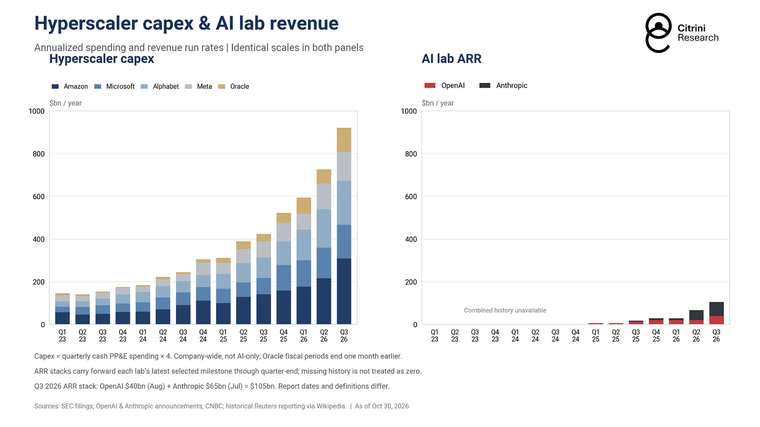
Spending is running years ahead of revenue: annualised hyperscaler capex is heading for about $1 trillion, while revenue across the whole AI ecosystem is at least $200 billion. Doubling capex from here would need revenue measured in trillions. Closing the gap takes either an order-of-magnitude jump in revenue or capex that stops growing, and probably a bit of both. Source: Citrini Research.
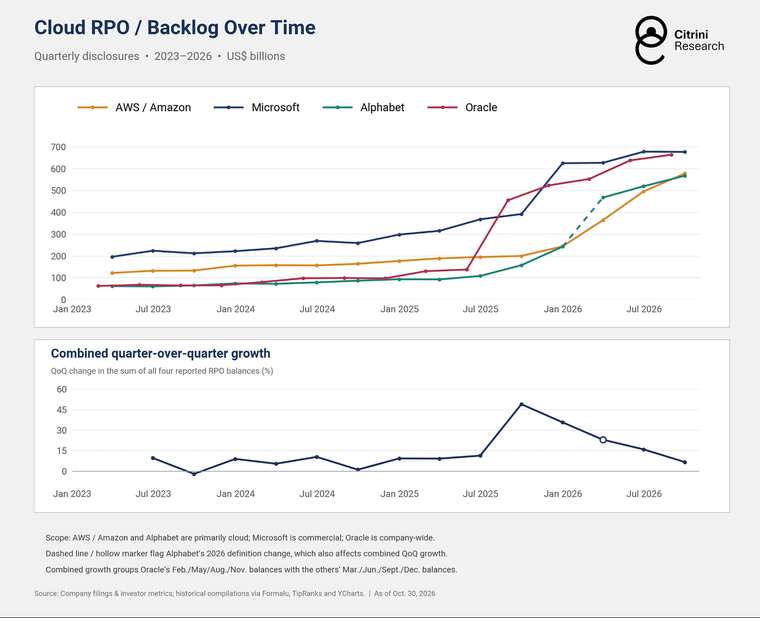
The backlog is still growing, just more slowly: cloud backlogs at Amazon, Microsoft, Alphabet and Oracle sit near records, but their combined quarterly growth has fallen back from the 2025 burst. The labs, who see demand first, have slowed their mega-commitments; a $500 billion announcement no longer moves a stock. Source: Citrini Research.
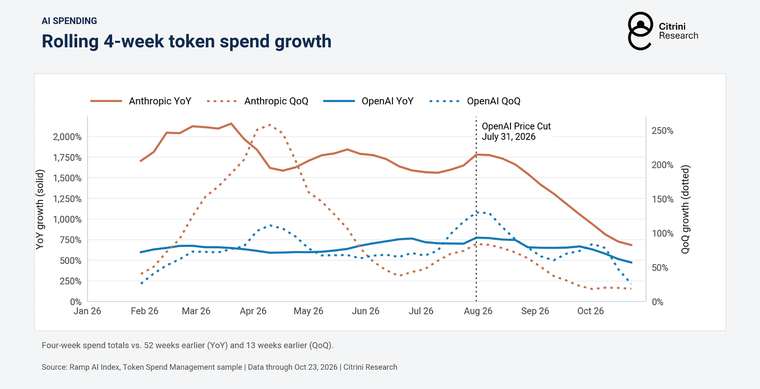
A price war is the oldest warning in a build-out: token spending growth at the leading labs slowed after OpenAI cut prices on July 31, and customers turned out to be price-sensitive in products that look alike. Railways and fibre both ended in price wars. The question is whether AI demand grows faster than its own discounts. Source: Citrini Research.
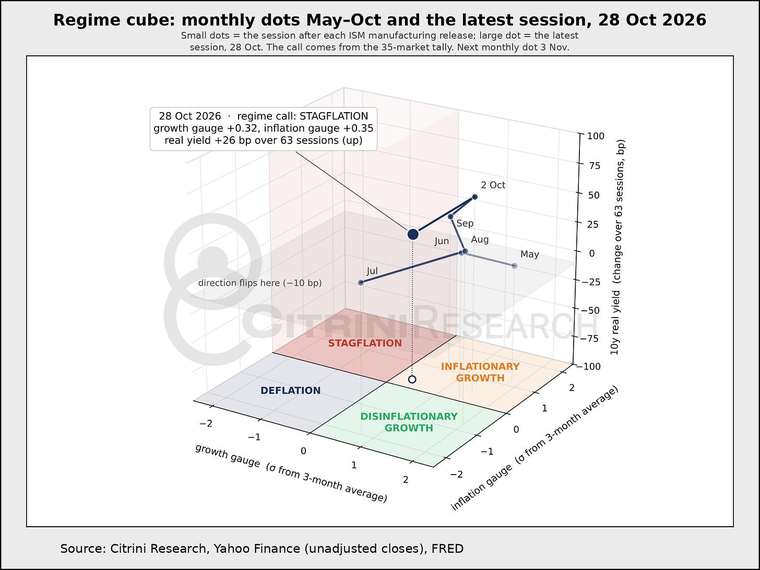
Markets are already trading stagflation: 9 of 14 asset pairs in this regime model lean stagflationary, and cyclicals are down 6.9% against defensives over six months, while the economic data still say expansion. That is what late cycle looks like: you either pray for a second leg in momentum or pay up for slow growers at record valuations. Source: Citrini Research.
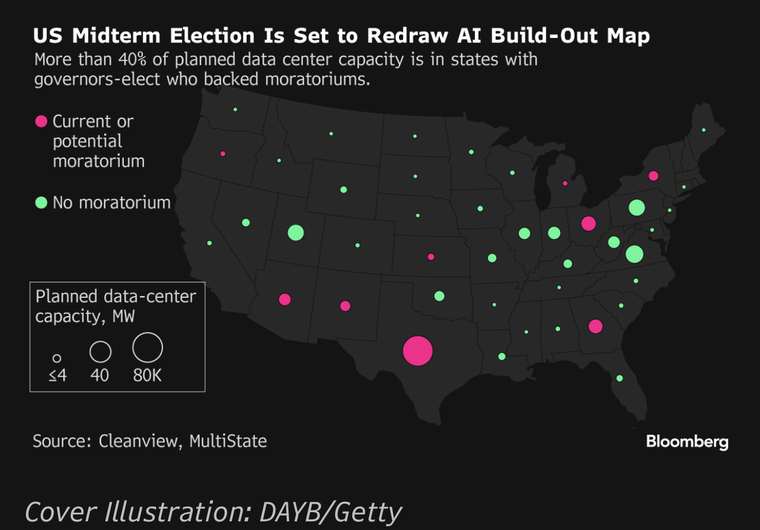
The vote redrew the build-out map: more than 40% of planned data-centre capacity sits in states whose new governors backed moratoriums. None is likely to stop construction outright, but the cost goes up: bigger concessions to towns, protections for ratepayers, clean-energy rules and slower permits. Texas gave a preview before the vote, when banks were left holding $15 billion of bridge loans to a halted project. Source: Bloomberg, Cleanview, MultiState.
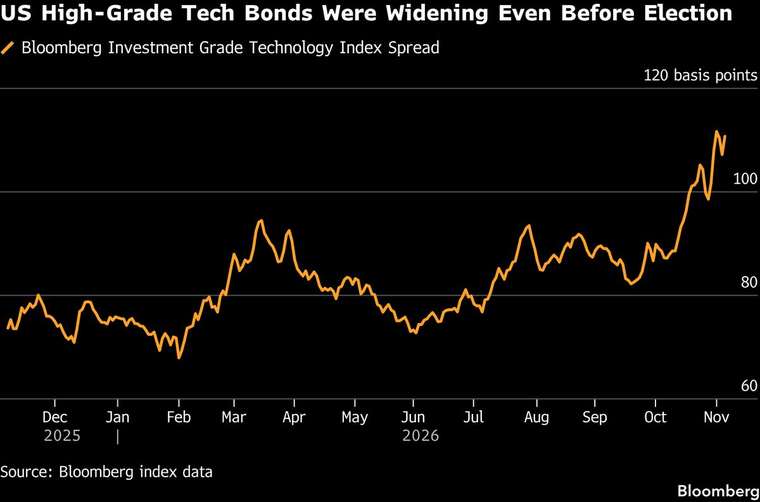
The bond market saw it first: tech spreads were widening well before the election, and Meta still drew a record €53 billion of orders for its first euro bond while paying up in dollars. Borrowers now size and time their deals like junk issuers. When the strongest balance sheets pay more, the weakest cannot borrow at all, and that is where the neo-clouds and private credit sit. Source: Bloomberg.
Asia: from the AI trade to the forgotten trades
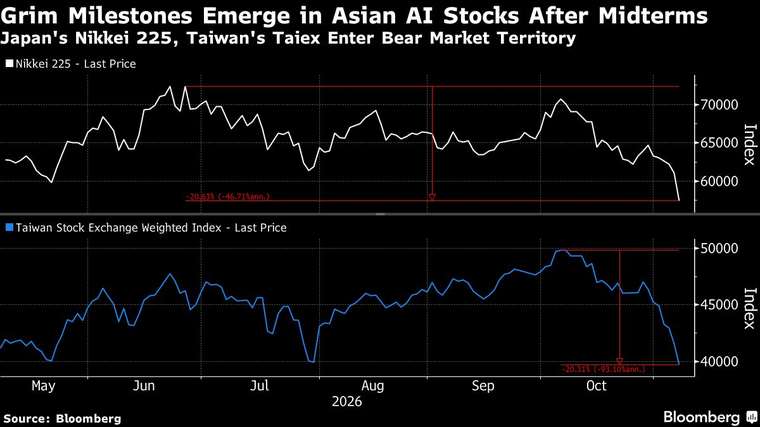
Asia's AI winners are this month's losers: the Nikkei and Taiwan's Taiex both fell into bear markets after the midterms. Samsung, SK hynix and TSMC are the picks and shovels of the build-out, and foreign funds sell first what they own most of. Domestic pension funds in Korea are already moving into consumer names, from beauty to K-pop agencies. Source: Bloomberg.
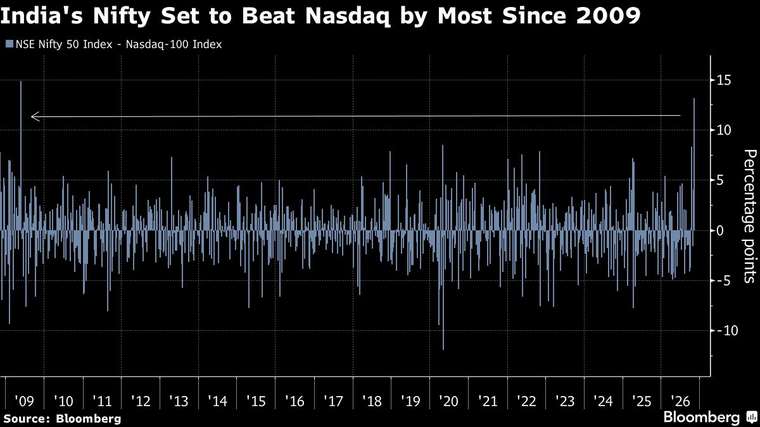
India is the hedge nobody wanted: the Nifty rose 8.6%, its best week since 2021, beating the Nasdaq by the most since 2009, as foreign funds put in about $1.9 billion in three days. Its lack of AI exposure, a handicap all year, became its appeal, and cheaper oil helped an importer. Whether this is a rotation or a squeeze in the year's laggards is the trade of the month. Source: Bloomberg.
China's prices on Singapore's holiday Monday
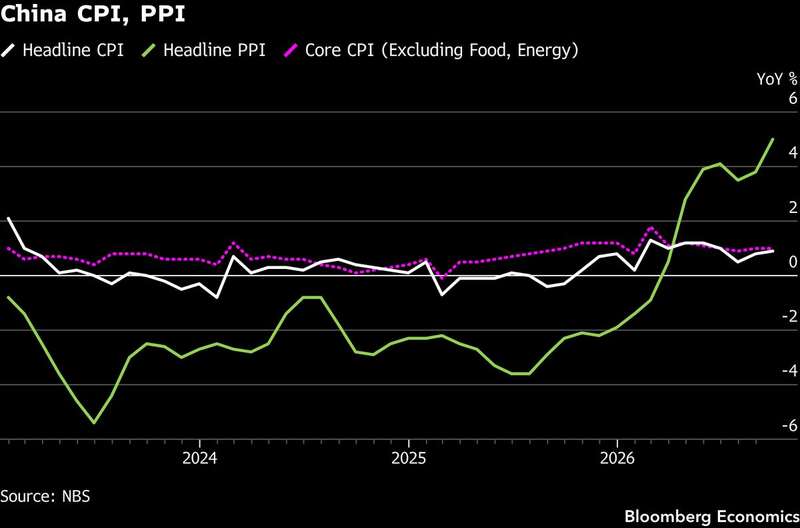
China imports inflation it cannot pass on: factory-gate prices are seen rising 5.4% on the year, a third month of acceleration on energy costs, while consumer prices barely reach 1%. Margins sit in between. Exporters can still sell at those prices abroad; households at home cannot pay them. Source: Bloomberg Economics, NBS.
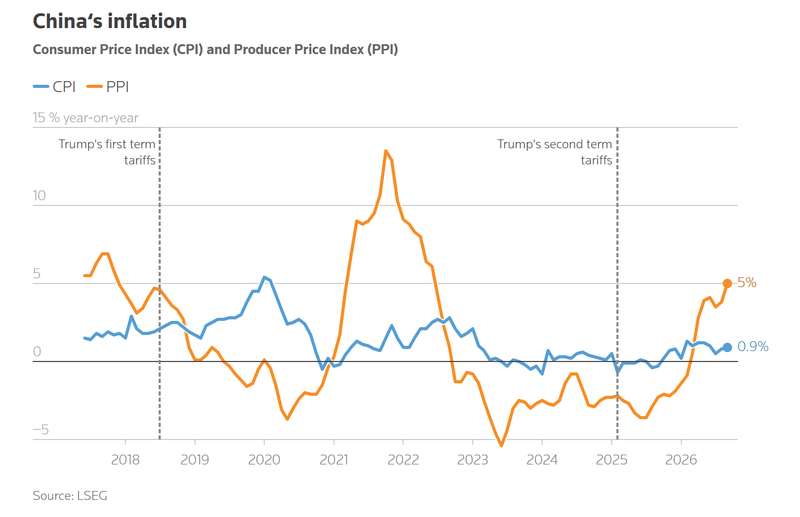
Two tariff cycles, two price stories: the chart marks both of Trump's tariff rounds, but this time it was the oil shock that turned the PPI up. A PPI above 5% with CPI near 1% is the reverse of the deflation story China was exporting a year ago, and it changes what it ships to the rest of Asia. Source: LSEG / Reuters.
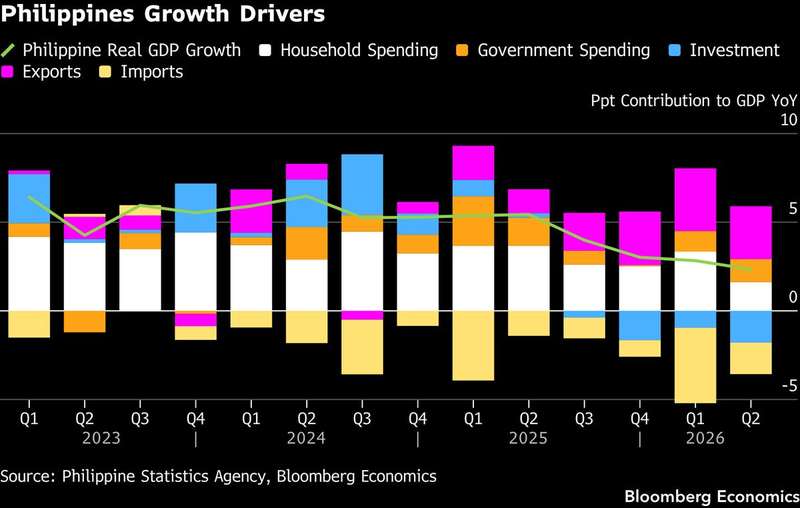
The Philippines is paying for the oil shock twice: growth is seen slowing to about 2% in the third quarter as fuel, food and a weak peso squeeze households, and BSP's hikes cool investment. A graft scandal froze public projects; their restart is the recovery case. The BSP is still expected to hike again in December. Source: Bloomberg Economics, Philippine Statistics Authority.
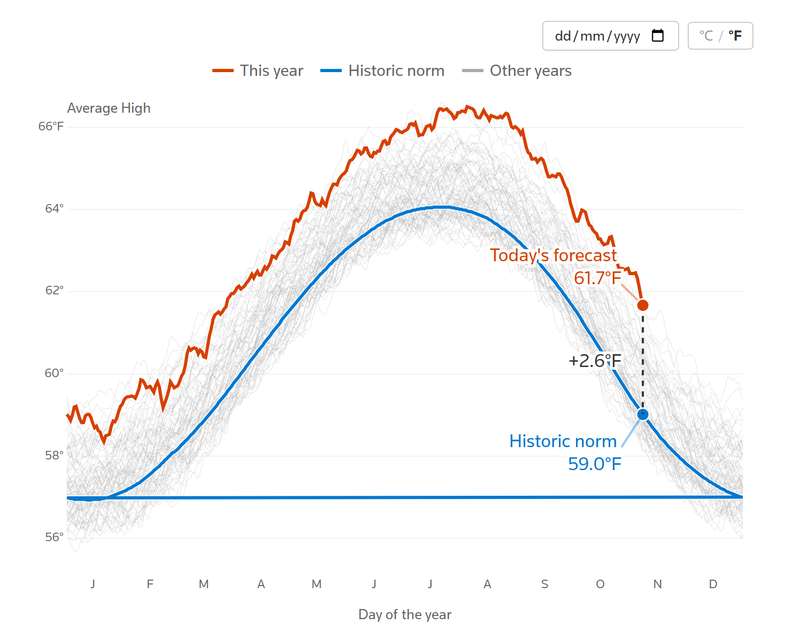
COP31 opens in the hottest stretch on record: the summit in Antalya starts on Monday with more than 80 leaders but no formal US role. Turkey wants 35% of the world's power from electricity by 2035, from about 23% now. The money is the fight: aid budgets are being cut just as the bill for floods and droughts rises. Source: Reuters.
CPI Tuesday
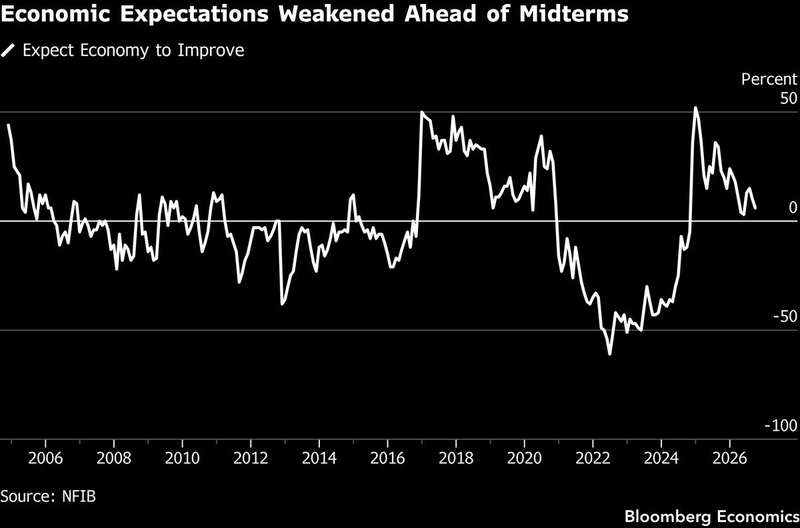
Small firms lost faith before the vote: the share expecting the economy to improve fell back ahead of the midterms, though hiring plans edged up. Main Street is where tariffs and rates bite first, and its mood on Tuesday shows whether the result has eased uncertainty or simply changed it. Source: NFIB, Bloomberg Economics.
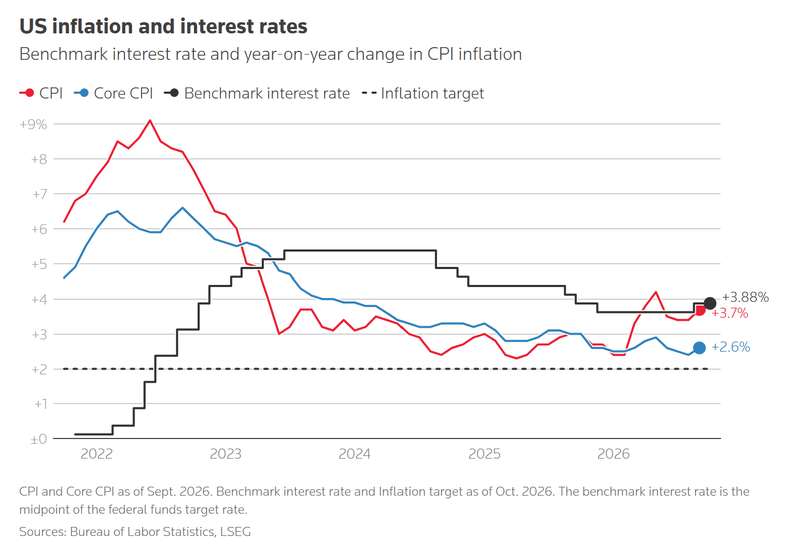
The Fed is hiking into a cooling print: inflation is still well above target with the policy rate at 3.75-4.00%, and traders price a fourth-quarter hike at more than 80%. A soft CPI with oil down 16% in a week is the doves' best argument since September; a hot one ends the debate. Source: LSEG / Reuters.
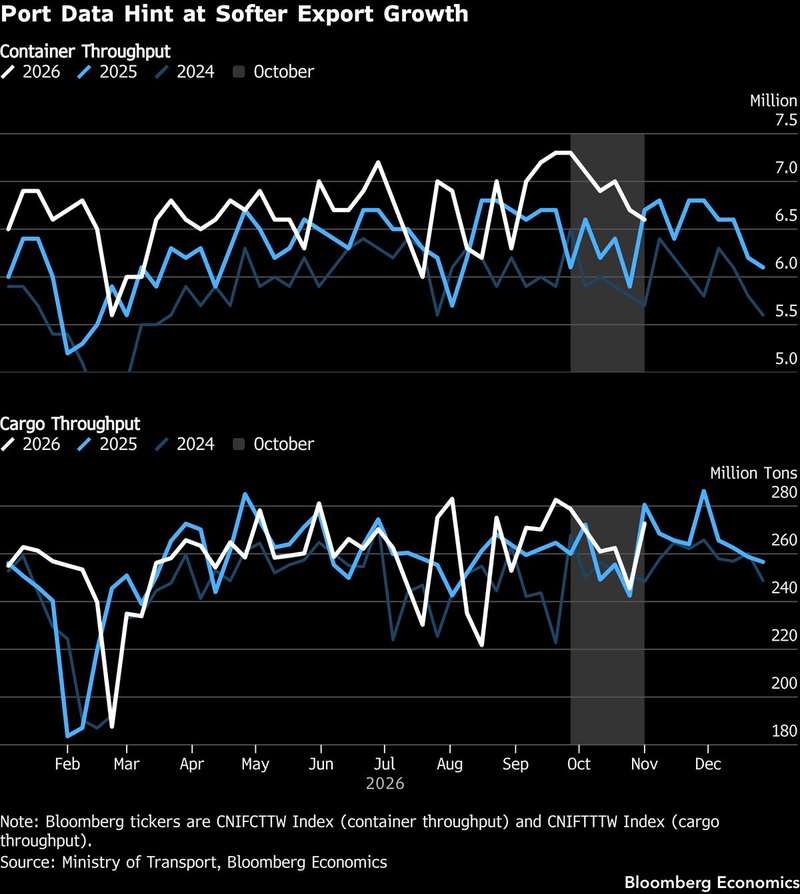
China's ports hint at a softer month: throughput data slowed into October, and exports are seen growing about 32% after 36%, still driven by AI hardware. If the AI trade is cooling in New York, Shenzhen's order books are where it shows up next. Source: Ministry of Transport, Bloomberg Economics.
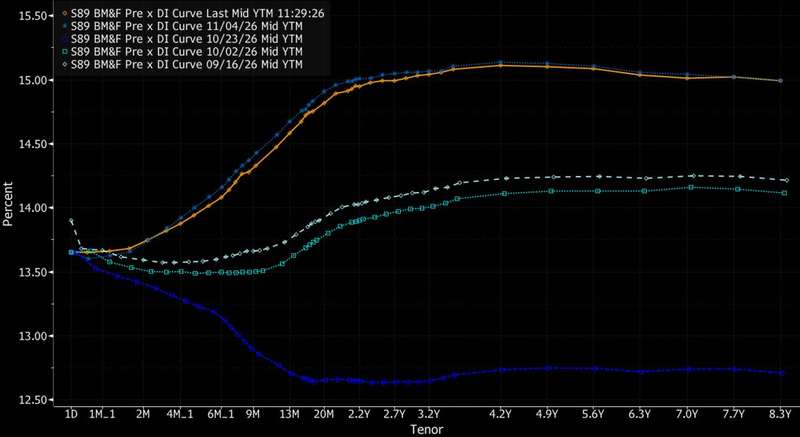
Brazil's curve has already done the hiking: the central bank held at 13.75% with vague guidance, and Tuesday's minutes are expected to stay vague. The curve prices substantial tightening; the real releaser is a credible fiscal plan for Lula's fourth term. Source: Bloomberg.
Bonds shut Wednesday
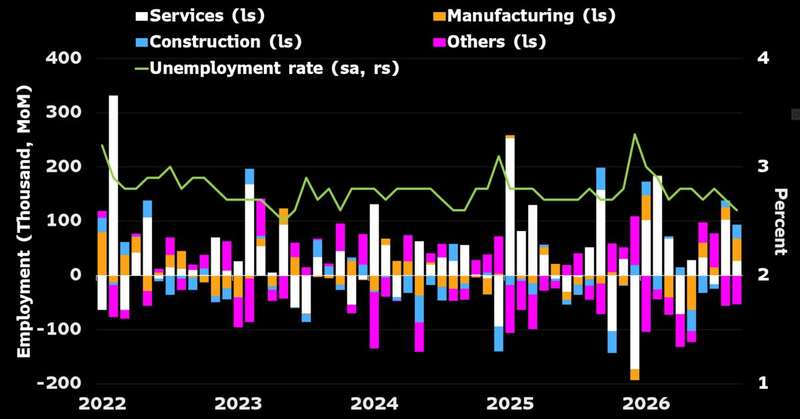
Korea's jobs are built on the chip boom: unemployment is seen at 2.6%, below its post-2020 average, with manufacturing and the construction of fabs and data centres adding workers. That is exactly the part of the economy the AI selloff now questions, which makes Korea's labour market a lagging risk, not a comfort. Source: Ministry of Data and Statistics, Bloomberg Economics.
UK GDP and India's prices Thursday
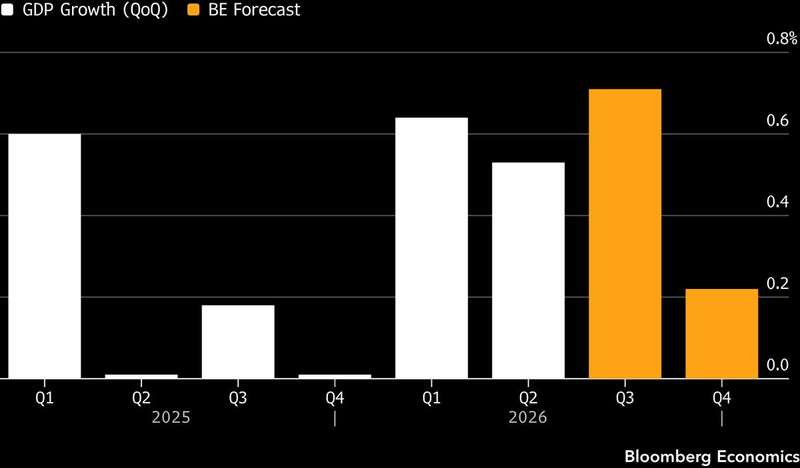
Britain keeps growing through the shock: the economy grew 1.2% in the first half and is seen adding 0.7% in the third quarter, helped by AI spending. Strong growth means policy is not biting much, and with energy bills set to jump about 25% in January, the BoE may find reasons to keep hiking past February. Source: Bloomberg Economics, ONS.
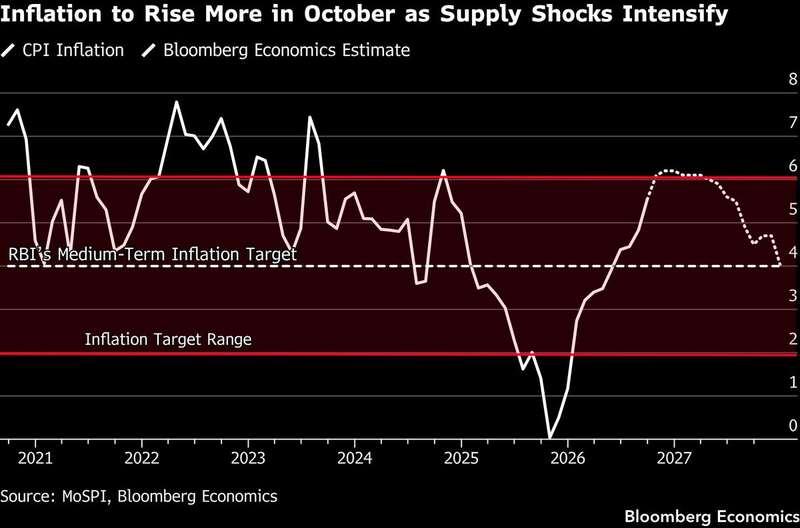
India's inflation breaks the ceiling just as the money arrives: October's CPI is seen at 6.1%, above the RBI's 6% limit, on food and fuel, which keeps hikes in December and February on track. Foreign money flooding into the Nifty is betting the inflation spike is temporary. Source: MoSPI, Bloomberg Economics.
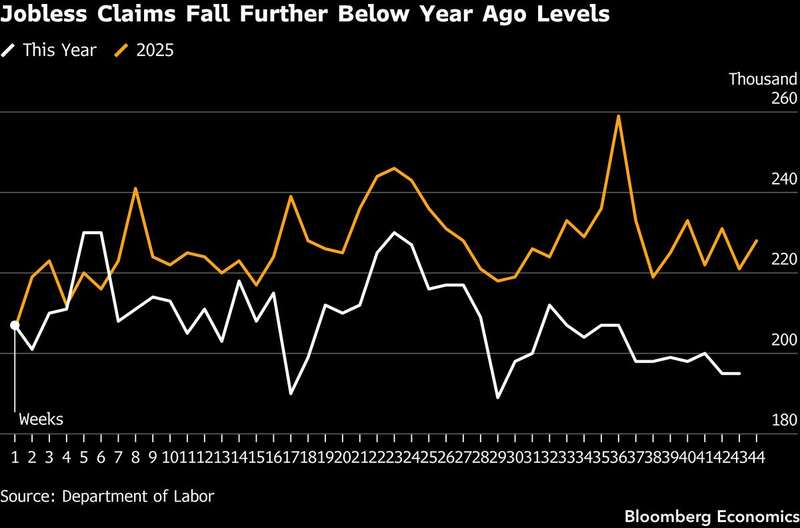
Firms are still not firing: claims keep running below last year's levels, a low-layoff economy where some industries face shortages even while hiring is weak. As long as this line stays flat, the AI rout is a markets story, not a jobs story. Source: Department of Labor, Bloomberg Economics.
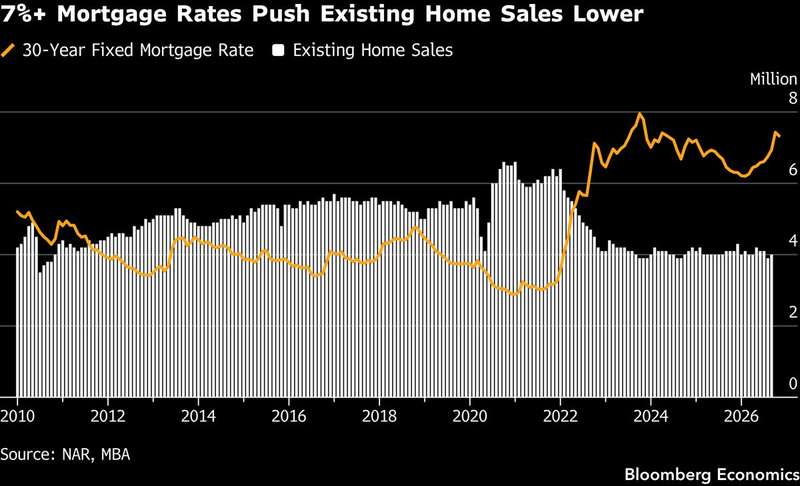
Mortgages above 7% keep the housing market frozen: existing-home sales are seen falling again, the median first-time buyer is now 40, and a record one in ten paid all cash. A hiking Fed is pricing a whole generation out of ownership, which is part of why the cost of living decided the vote. Source: NAR, MBA, Bloomberg Economics.
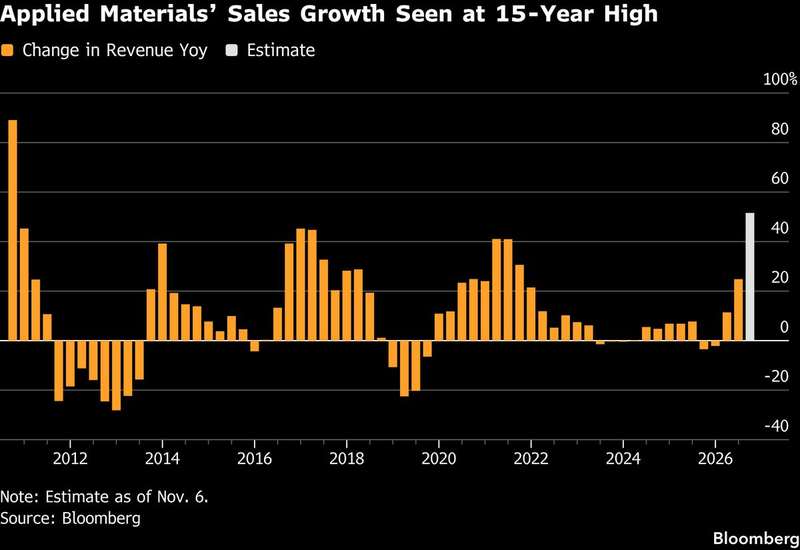
Applied Materials reports its best growth in 15 years into the worst week for chips: wafer-fab equipment demand is accelerating as chipmakers chase data-centre rollouts. Thursday tests the market's mood more than the company: last week AMD guided revenue up more than 80% and still fell by double digits. Source: Bloomberg.
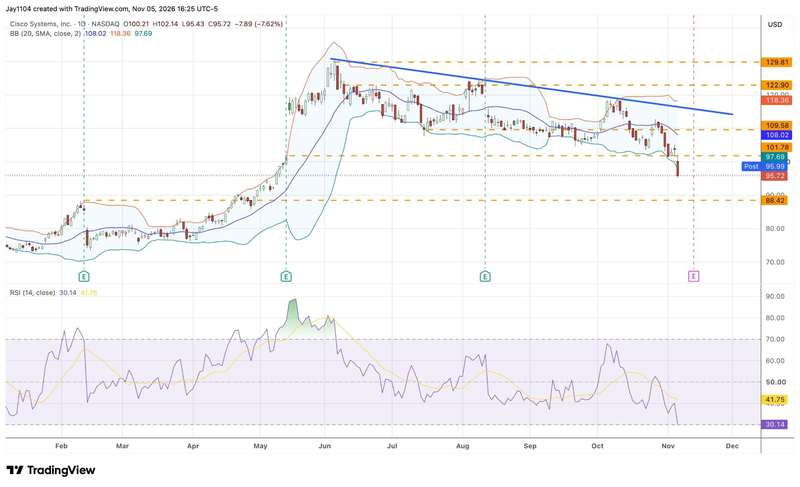
Cisco has already broken down before its results: the stock fell through its rising support as networking became guilty by association with data centres, even with revenue seen growing the most since 2010. A beat that cannot lift it would be the clearest sign that the selling is not about earnings. Source: TradingView.
PPI Friday
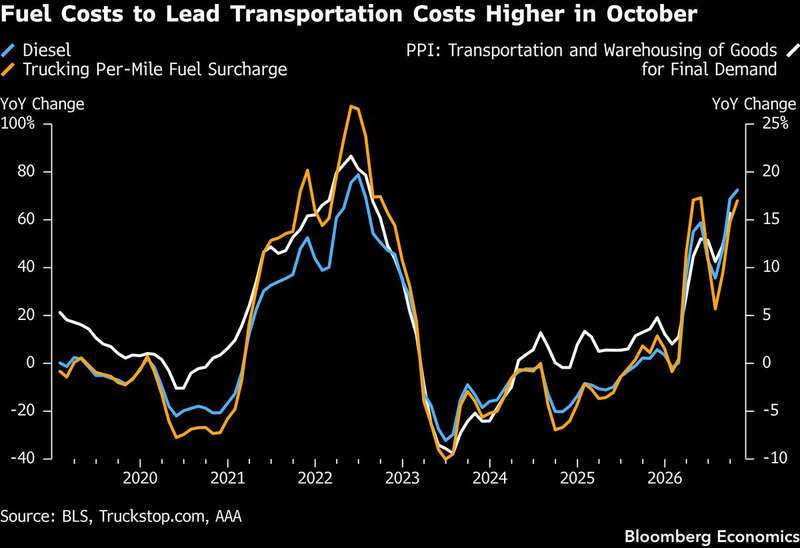
Fuel is still feeding through the pipeline: trucking fuel surcharges and diesel lead transport costs higher, and producer prices are seen up about 6.5% on the year. The PPI parts that feed the Fed's preferred PCE gauge matter more than the headline, and they arrive two weeks before the November PCE. Source: BLS, Truckstop, AAA, Bloomberg Economics.
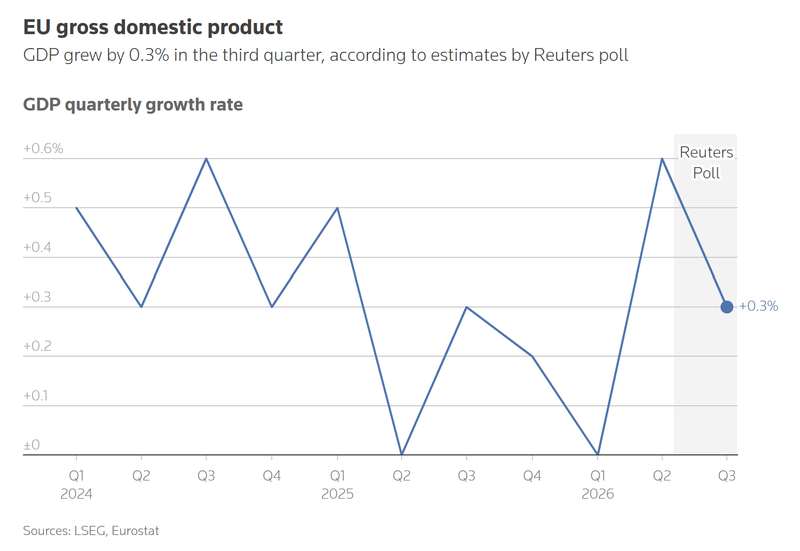
Europe keeps surprising on growth: the euro area grew about 0.3-0.4% in the third quarter despite sky-high energy and rising rates, and Friday's second estimate confirms or revises it. Resilient growth is what lets the ECB hike in December even as its president leaves. Source: LSEG, Eurostat, Reuters.
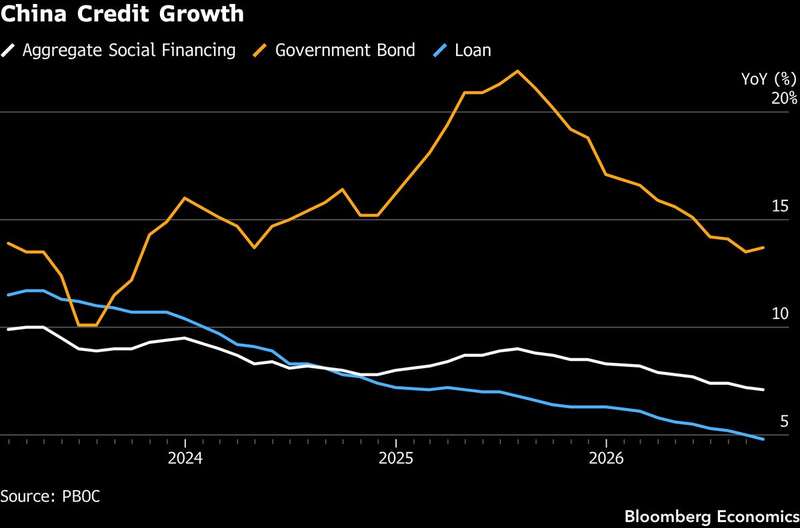
China's slower credit is the new normal: October's credit is seen dipping seasonally to about 850 billion yuan, with outstanding growth near 7.1%. Beijing's tech push relies less on bank loans, so slower credit is no longer the alarm it used to be; the alarm is if local-government borrowers stop being rolled. Source: PBOC, Bloomberg Economics.
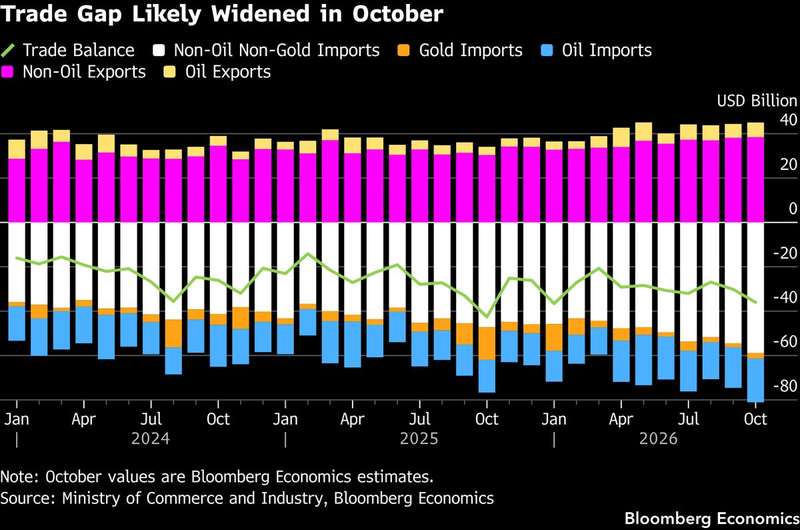
India's oil bill widens the gap: the trade deficit is seen widening to about $36 billion on crude at around $108 and festive gold buying. Last week's oil drop helps from November, which is part of why foreigners just bought India. Source: Ministry of Commerce and Industry, Bloomberg Economics.
New Zealand: a hung parliament
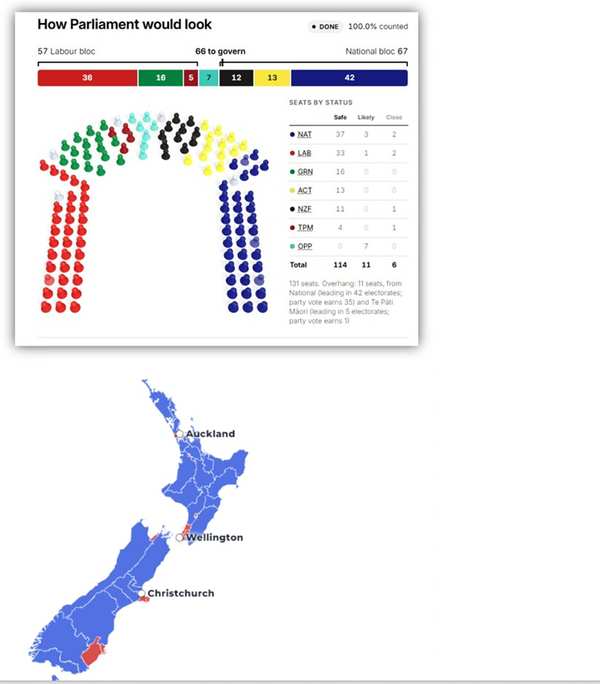
Neither side has a majority yet: National and Labour each took just under 30% of the vote, the preliminary count gives the governing coalition a paper-thin edge, and special votes and an overhang can still change it. Luxon will run a caretaker government through weeks of talks, and told voters to take "a bit of a break." Source: Electoral Commission.
Cyber: the hack and the exposure
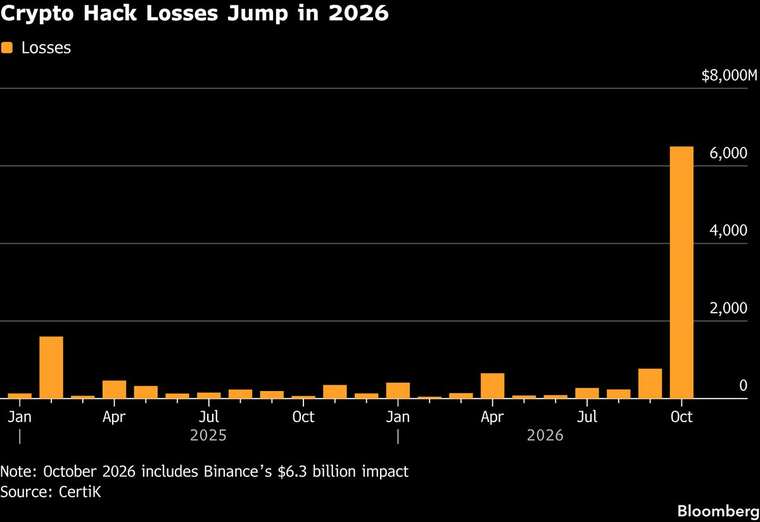
Fifteen dollars to steal $2.5 billion: the Binance hackers paid about $15 in network fees to set up a permission, then moved roughly $2.5 billion in a single transaction, 40% of the $6.3 billion taken. The feature that let them keep control after the breach was a convenience upgrade. Every efficiency in finance is also an attack surface. Source: CertiK, Blockaid, Bloomberg.
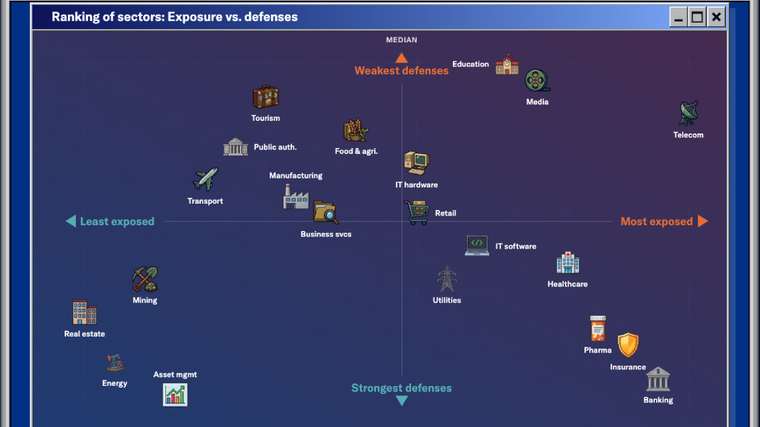
The most exposed sectors are not always the biggest losers: Moody's maps 21 US sectors by exposure and defence, as AI speeds up the search for software flaws. Banking and insurance are among the most exposed but carry the strongest defences, while education and media pair high exposure with the weakest. The losses depend on size as much as on sector. Explore the full rankings. Source: Moody's.
The midterms: the money and the map
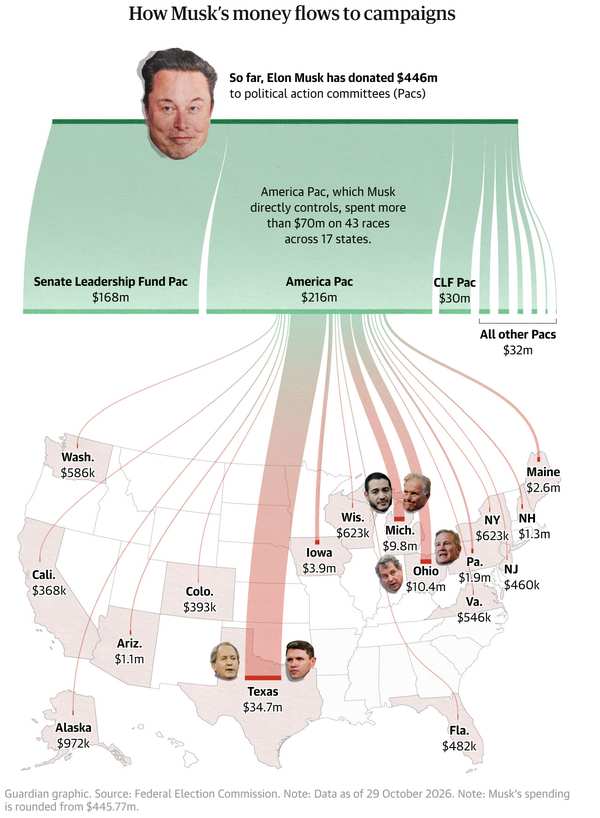
The largest donor in modern US history, and the result: Elon Musk put at least $446 million into Republican-aligned groups this cycle, more than Soros or Bloomberg ever did, enough to buy 31.9 million cheeseburgers at his own diner. Money bought the airtime, not the votes. The Guardian's graphic follows every dollar. Source: The Guardian, FEC.
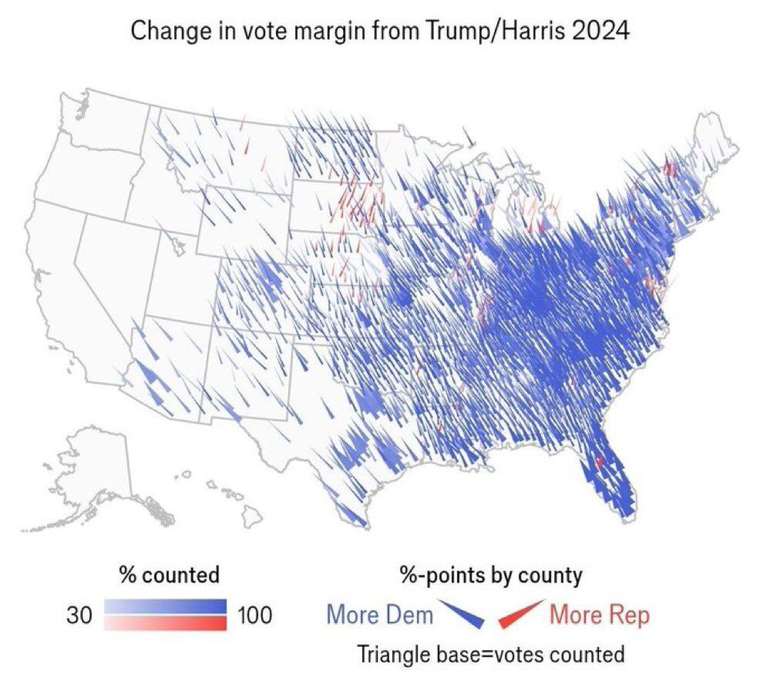
The shift was everywhere at once: county by county, almost every arrow on the map points toward the Democrats compared with 2024, in cities, suburbs and farm country alike. A swing this uniform is a verdict on the incumbent, not a story about turnout in a few places. Democrats now control both chambers from January, with power to block, fund and investigate. Source: Ian Bremmer.
Oil and the climate
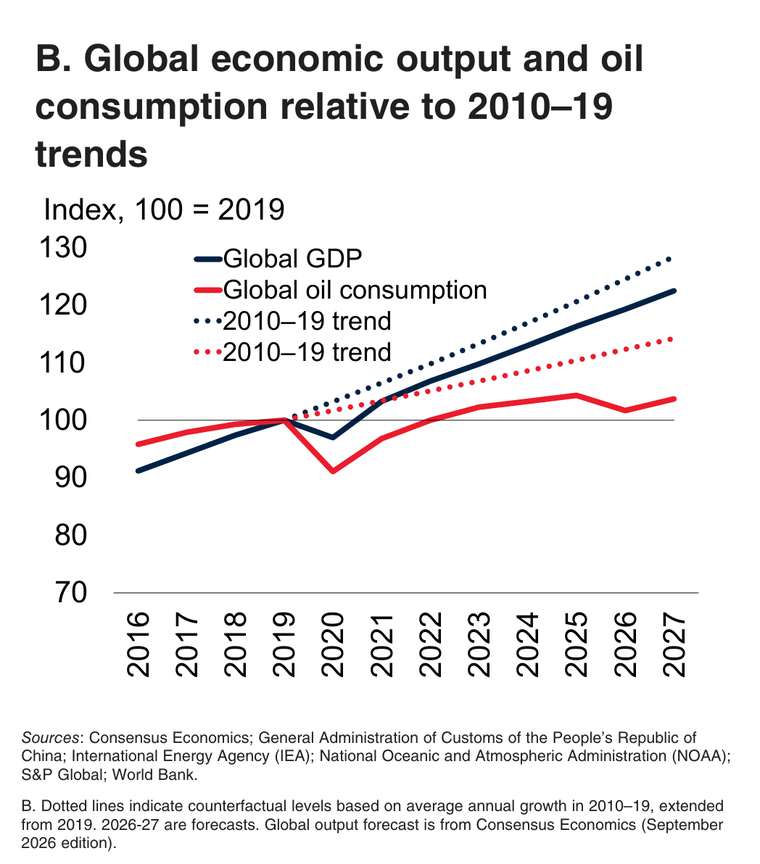
The world is using less oil than its growth says it should: oil demand is projected to fall 2.5% this year and rebound only about 2% next, leaving it more than 9% below its pre-pandemic trend in 2027, about twice the shortfall in output. High prices and electric cars may leave a permanent dent. Brent is forecast to average $79 next year, or $105 in the bad case. Source: World Bank Commodity Markets Outlook.
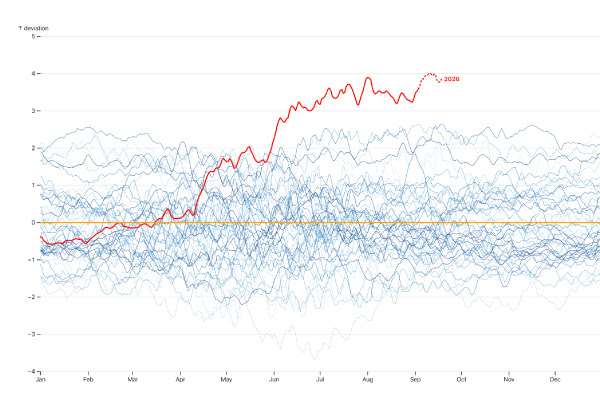
A Godzilla El Niño is forming: tropical Pacific temperatures are running about 3.3°C above the 1991-2020 norm, off the charts of the past 45 years. Food agencies already warn of crop losses, floods and droughts. With food prices seen rising 7% next year, the next inflation shock may come from the weather, not the Gulf. Source: Observable.
Visual Capitalist: How America Has Changed, Part 2
Part 2 of the special dispatch follows the money: from record profits to household wealth and the federal budget, then to the industries and states that grew, and a stock market that is now more than a third AI. It reads differently in a week when voters punished the incumbents and the AI trade cracked.
Infographic 1 - Corporate Profits Outgrow the Economy
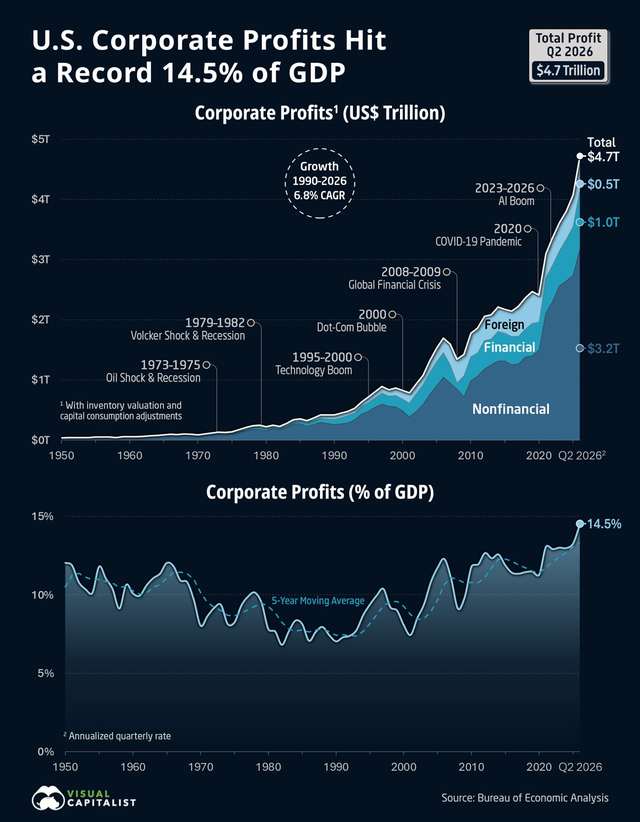
Profits hit 14.5% of GDP, $4.7 trillion a year in the second quarter, the highest share since the series began in 1950 and double the 7% of 1990. Overseas earnings are included. When profits take a record share of the economy, wages took a smaller one, and that gap showed up at the ballot box. Source: Visual Capitalist.
Infographic 2 - Stocks Pull Ahead of Real Estate
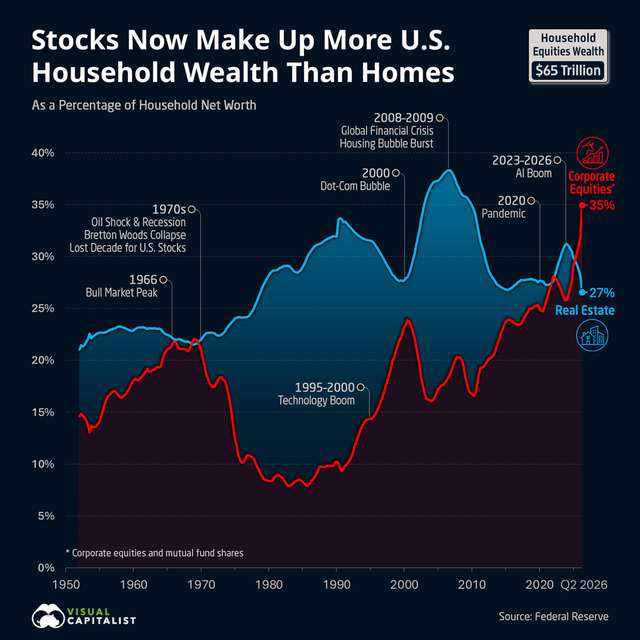
Shares are now 35% of household net worth, against 27% for real estate, the reverse of most of the postwar era. The bigger the weight of equities, the more a week like the last one hits household spending. Source: Visual Capitalist.
Infographic 3 - The Highest Earners Overtake the Middle
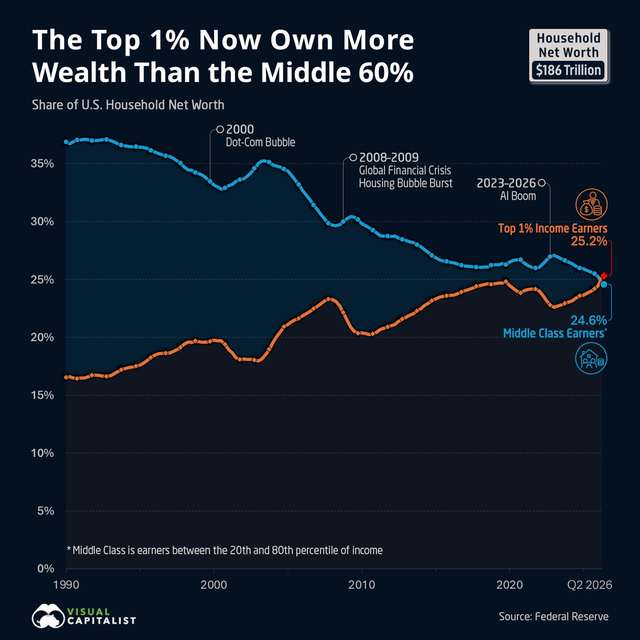
The top 1% now own more than the middle 60%, 25.2% of household net worth against 24.6%, for the first time, in the second quarter of 2026. In 1990 the middle held more than twice as much. Asset prices did most of the work. Source: Visual Capitalist.
Infographic 4 - Debt Service Overtakes Defense
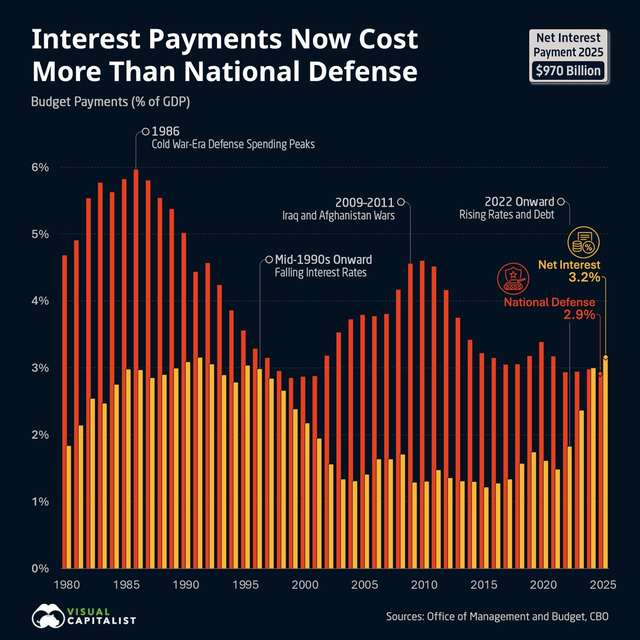
Interest now costs more than the military, $970 billion, or 3.2% of GDP, against 2.9% for defence in fiscal 2025, and it rose again in 2026. Older debt rolls into higher rates year after year; the bill is only starting to arrive. Hence the $800 billion the Treasury needs next quarter. Source: Visual Capitalist.
Infographic 5 - Health Care Leads Net Job Growth
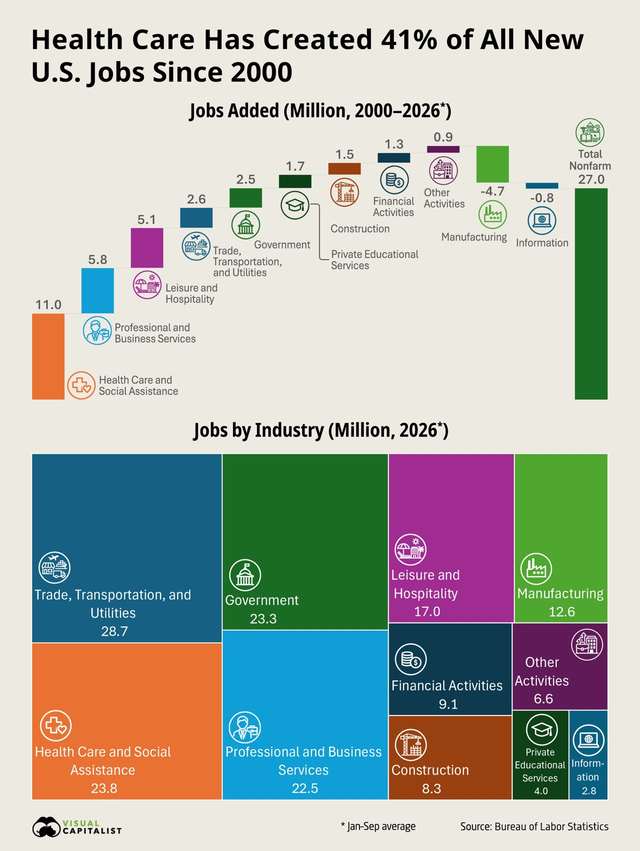
Health care built 41% of America's new jobs, 11 million of the 27 million net jobs added since 2000, while manufacturing lost 4.7 million. An ageing country hires carers, not machinists. Source: Visual Capitalist.
Infographic 6 - Digital Industries Lead Output Growth
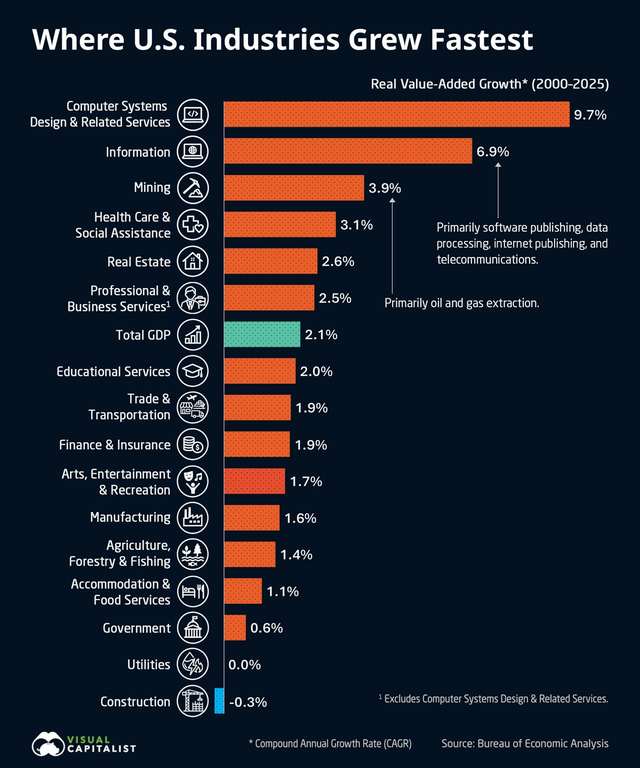
Software grew output fastest, with fewer people: computer systems design grew 9.7% a year in real terms from 2000 to 2025, against 2.1% for the economy, while information lost about 800,000 jobs. The industries that grow output are not the ones that grow jobs. Source: Visual Capitalist.
Infographic 7 - The States Leading Economic Growth
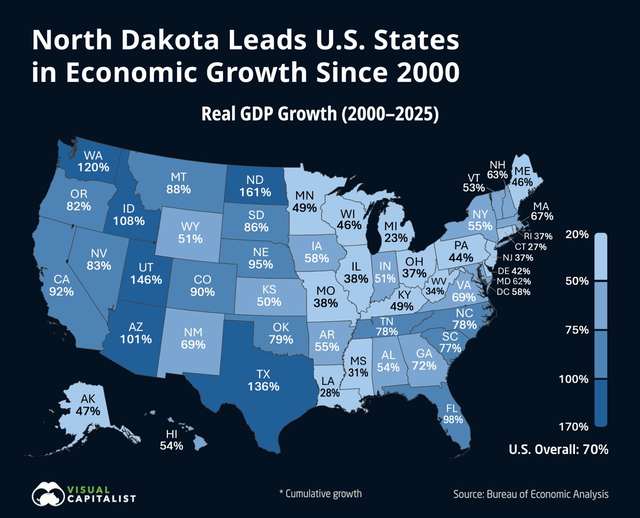
North Dakota's output grew 161%, the most of any state, on the Bakken oil boom, while its jobs grew only 36%. Utah and Texas more than doubled; Michigan managed 23%. Source: Visual Capitalist.
Infographic 8 - Job Growth Favors the Mountain West
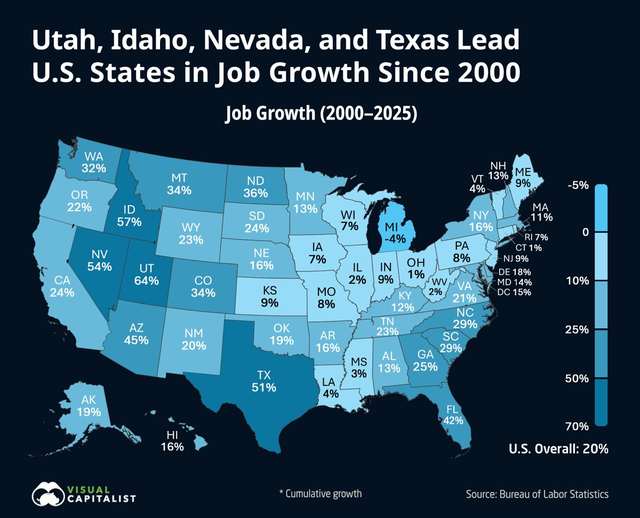
Utah added 64% more jobs since 2000, followed by Idaho at 57%, against about 20% nationally. Michigan is the only state with fewer jobs than in 2000. People and jobs moved west and south, and so did the data centres. Source: Visual Capitalist.
Infographic 9 - AI Stocks Reach 89% of GDP
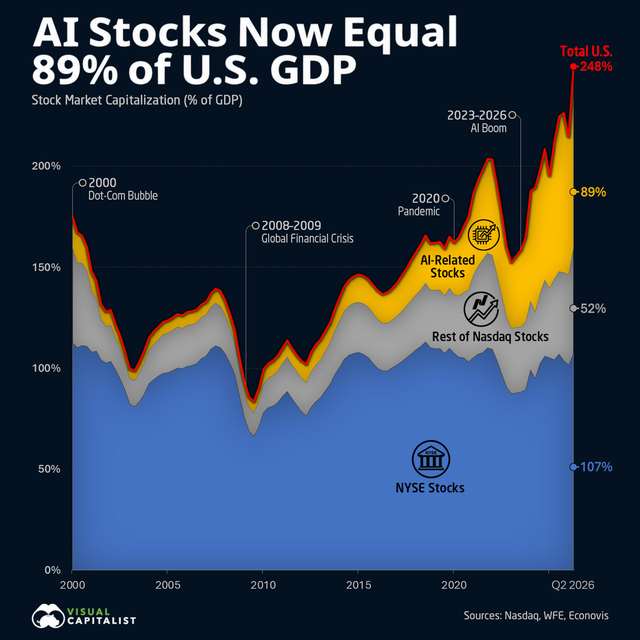
AI stocks alone are worth 89% of US GDP, inside a market worth about 248% of GDP. Almost all of the rise since 2000 comes from the AI group; the rest of the market has grown roughly in line with the economy. That concentration is why one Thursday can take $2.5 trillion off one index. Source: Visual Capitalist.
The Good Wrap
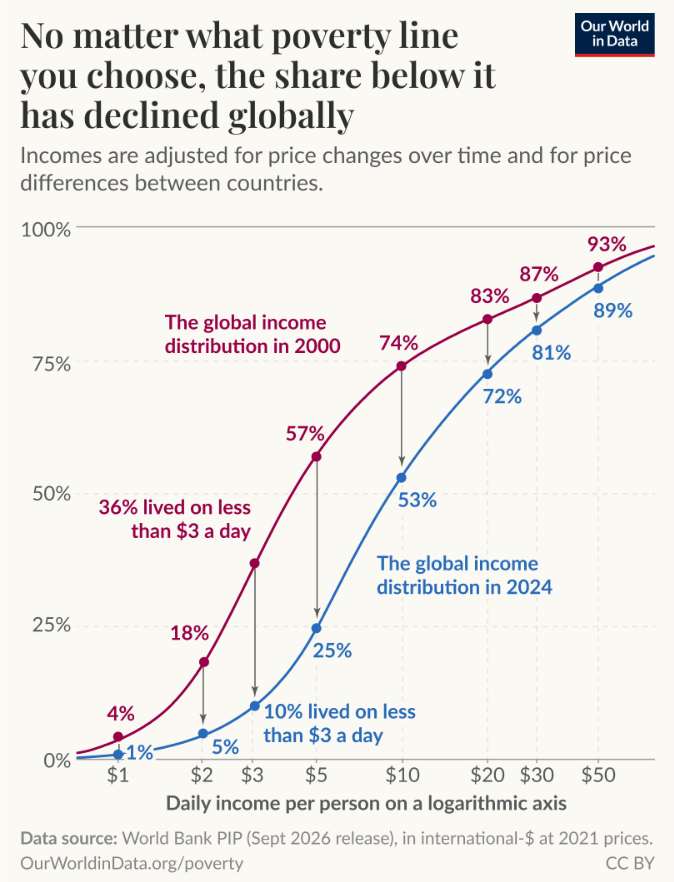
Whatever poverty line you choose, fewer people live below it: in 2000, 36% of the world lived on less than $3 a day; in 2024 it was 10%. The share under $10 a day fell from 74% to 53%. But 81% of people still live on less than $30 a day, about $900 a month. Progress is real, and most of the world is still poor by any rich-country standard. Source: Our World in Data, World Bank.
Best,
Hoelon
WITPTW is a personal publication. Everything here is personal opinion and market commentary, written in a personal capacity. It is not investment advice and not a recommendation to buy or sell any security. It is not associated with, endorsed by, or representative of any employer, fund or company. Charts and images are reproduced from their original publishers, credited to their sources for commentary and discussion; all rights remain with the respective copyright holders.