Anthropic IPO
Personal views and market commentary. Not investment advice. Not associated with any employer or firm.
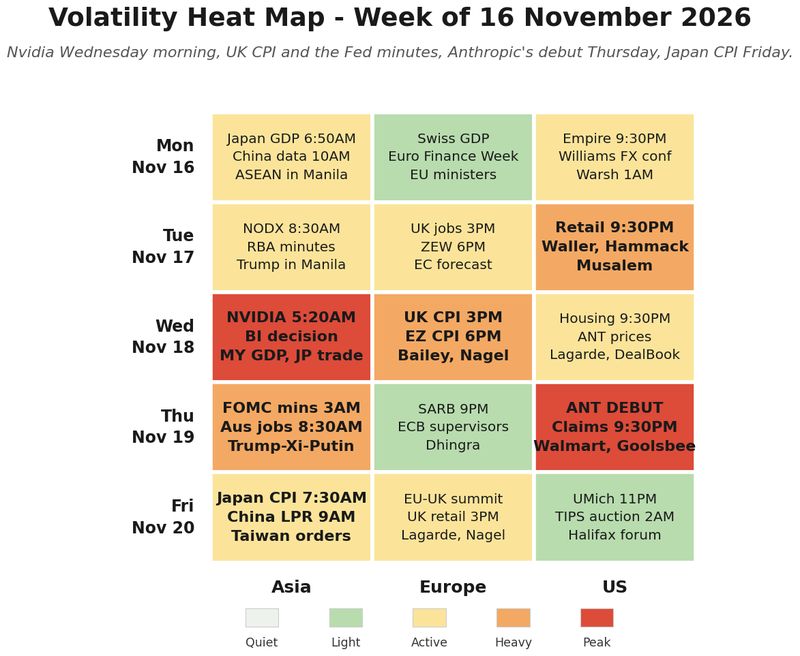
Volatility heat map for the week ahead, in Singapore time. This is the last full-liquidity week of the month: Japan shuts next Monday, India next Tuesday and the US on Thursday the 26th for Thanksgiving. The S&P enters near 7,562, the 10-year near 5.14% and Brent near $96.
"You want to sell the Chinese enough that their developers get addicted to the American technology stack." — Howard Lutnick, US Commerce Secretary, on CNBC, July 2025. The habit was fed from Southeast Asia. It worked, just not by the route Washington drew. Nvidia sold almost no data-centre chips straight into China. Instead the habit ran through Southeast Asia: data centres in Malaysia and Singapore renting top chips to Chinese AI firms remotely, which is still legal. The Wall Street Journal reports Malaysia could become the world's second-largest data-centre hub after Virginia, and Commerce is drafting licence rules for Malaysia, Indonesia and Singapore to end remote access. Whether Megaspeed's Alice Huang was a spy may never matter. As Stacy Rasgon put it on Odd Lots, she "just needs to be able to be credibly painted as a spy." The bill lands on Asia's data-centre boom, not on Nvidia's US customers.
"At some stage therefore we should have to expect the machines to take control." — Alan Turing, Intelligent Machinery, A Heretical Theory, a 1951 lecture published after his death. Seventy-five years later, the machine lists on Nasdaq. Turing said it calmly, as a matter of timing, not of fear. This week the chip and the mind meet the market within 48 hours. Nvidia reports on Wednesday morning, our time, without Jensen Huang for the first time. Anthropic prices that night at $70 to $78 a share and trades as ANT on Thursday. Dario Amodei once said this was heading towards "a country of geniuses in a datacenter". From Thursday that country has a share price, quoted every second. Come what may on the opening print, it is a week to mark: the company that set out to build the machine carefully is now asking the market what that care is worth.
"來留去送,甩手直衝。 Receive what comes, escort what goes, and when the hand is freed, strike straight." — Wing Chun maxim (詠春拳訣). Calling a top is force on force. Wing Chun is learned in the arms, through sticky hands, never from a book. You take the opponent's energy, stay close while it lasts, see it off as it leaves, and strike only when the pressure lets go. The last inning of a special year asks for the same thing. Big listings tend to arrive near tops. Coinbase listed on 14 April 2021, the day bitcoin hit its then record. Rivian raised almost $12 billion in November 2021, days before the Nasdaq peaked. But a famous IPO on its own is not a sell signal. With Thanksgiving next week and Christmas after, escort the move, don't fight it. Strike when the hand is freed, when the buying exhausts.
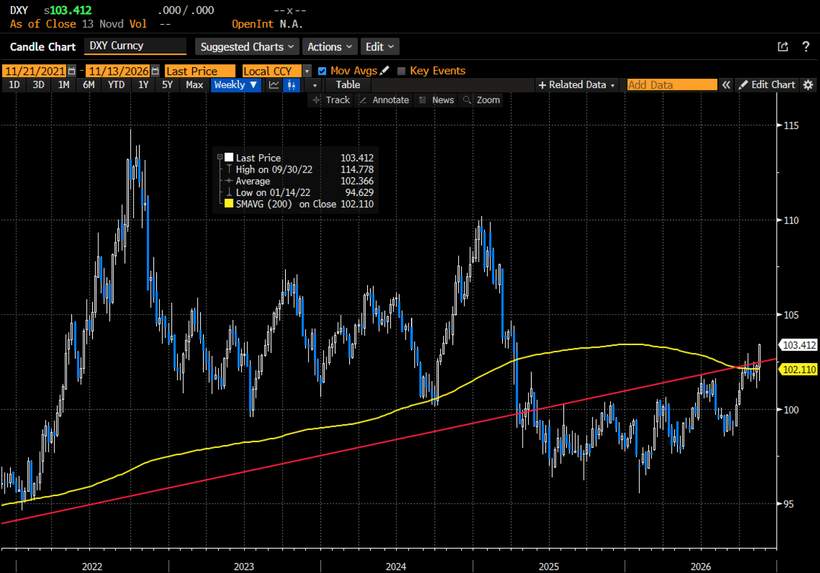
The dollar finally broke out on the weekly chart: the DXY ended at about 103.4, its highest since April 2025, back above the long-term uptrend line it lost in 2025 and above its 200-week average. Momentum points to 104-104.5. It took a hot CPI, a hawkish Fed and the 10-year back above 5% to do it, and it happened while equities were rising, which makes it a rates story, not a fear story. Source: Bloomberg.
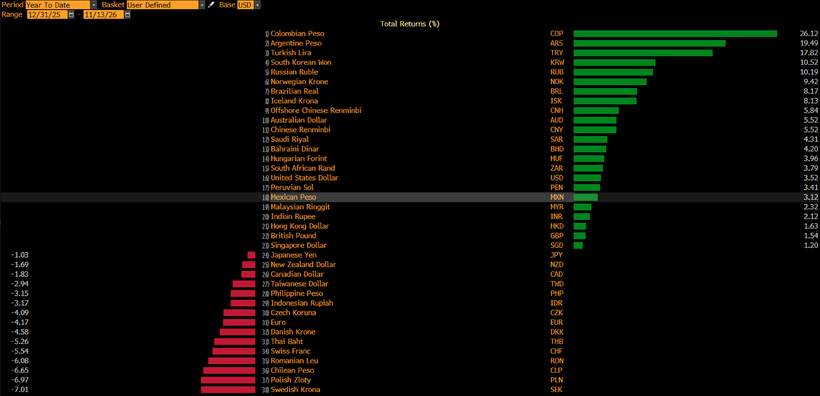
And yet the dollar is not even a top-ten currency this year: on total returns the US dollar is up about 3.5%, 16th in this ranking, behind the Colombian peso at 26%, the won at 10.5% and the Norwegian krone at 9.4%. Asia's deficit currencies sit at the bottom: the Philippine peso and the rupiah down about 3%, the baht 5%. It has been a year of differentiation, not of the dollar. The question for 2027 is whether the breakout turns a catch-up into a trend. Source: Bloomberg.
What is the plan this week?
The world continues to see turmoil in tech. With AI agents multiplying exponentially and each new model better at getting in, it is not hard to feel insecure and perplexed. The Outlook outage went further than anyone expected, two days of email, Teams and Copilot down across the world, and on Friday every flight in America was grounded for four hours by a communications failure. Even more surprisingly, life goes on. We start the week with Japan's GDP and China's October data on Monday morning, and Trump on his way to Manila and then Shenzhen.
Markets are moving on three things: the price of forward AI capex, the Fed's path, and energy, as the chance of the war escalating subsides. There are many sub-factors, and last week the result was a higher dollar and stabilising equities. Bonds sold off as the war premium came out, but also into a debate about US fiscal discipline, the capital shortage and whether Treasuries are still the instrument to hedge with. The ten-year rate ten years forward barely fell even on the days equities did, which says the market is pricing borrowing, not growth.
We have a lot of data across the time zones this week, though the Fed speakers have been the market movers, because the data is generally strong except housing. Retail sales should slow on Tuesday night after a petrol-boosted September, housing starts follow on Wednesday, and the October minutes land at 3am on Thursday, stale before they are printed. The voters to listen to are Paulson early on Tuesday, Waller and Hammack that night, Williams three times, and Barr and Kashkari midweek; Warsh, who has avoided guidance, opens the Fed's productivity and jobs conference at 1am on Tuesday. Nvidia is looking for a new boss, and Huang himself is summoned to Capitol Hill, with a subpoena threatened if he does not sit for three House committees on December 1. After a massive correction there will be bargain hunters, so the result this week is big. Anthropic's pricing, come what may, may remind people that IPOs often mark a temporary top, but we are in the best season of the year for a rally. The holiday season is kicking off: Singles' Day sales rose about 5% in one count, a modest start, and Walmart, Target, Home Depot and TJX tell us this week how the American shopper is holding up.
In Britain, Tuesday's jobs and Wednesday's CPI decide whether the Bank of England hikes again in December, and the market cannot agree: estimates of the odds run from 40% to nearly 80%. The economy grew 0.7% last quarter; energy, not demand, is the problem. Bailey speaks on Wednesday, and on Friday Burnham goes to Brussels for a summit that could take Britain closer to Europe than anyone thought possible two years ago. On the continent, the euro touched its lowest since May 2025 and Nagel calls a December ECB hike almost inevitable. The Commission publishes its autumn forecast on Tuesday and Lagarde is at DealBook in New York on Wednesday. We should also start to think about a less hostile Washington: a Democratic Congress from January is likely to be warmer to Europe, firmer on Ukraine and colder on tariffs against allies, one reason the euro may find a floor before the dollar finds a top.
In Asia, APEC is the stage. Trump lands in Manila on Tuesday for the ASEAN-US summit, after Li Qiang has already left, then meets Xi in Shenzhen, their third meeting this year, and on Thursday joins Xi and Putin for the first-ever three-way meeting of the three biggest nuclear powers, on arms control and Iran but not Ukraine. The Kremlin hopes it will have "a stabilising effect"; Washington expects no agreement. What will Trump come out with? A weaker president at home needs a win abroad, and there is a lot to ponder in this lame-duck period: Taiwan's arms package, AI chips, farm purchases and a war he says he does not need a deal to end. Singapore's role as a haven for data centres will certainly be affected as details come out of the Jensen investigation: the city billed close to a fifth of Nvidia's sales in its last full year while only a sliver of the chips landed here, and the probe into Megaspeed, the Singapore-based firm at its centre, has moved to the Justice Department. October's NODX comes on Tuesday after September's 68% jump, and the FinTech Festival opens on Wednesday. Japan has GDP on Monday and CPI on Friday with the yen at 160 and Tokyo warning, Bank Indonesia decides on Wednesday with the rupiah near its record low, and Malaysia reports its final GDP and CPI.
Machine intelligence is becoming abundant; what stays scarce is human experience. With Thanksgiving next week and Christmas after, it has been a special year, and the last inning is worth playing well. The plan this week is to chase the dollar breakout. I believe long dollar and carry can get through the rest of the year. Plenty can topple the dollar, but until the new Congress sits in January, there is no alternative. Asia's weaker current-account countries, the Philippines and Indonesia, are in a tough zone. Only last week we were talking about cheaper oil giving central banks room to ease; no longer.
What did I learn last week?
Mon Nov 9: China's CPI slowed to 0.7% while factory-gate prices jumped to 5.7% against 5.3% expected. The Philippines grew only 2.1% in the third quarter against about 3%, and Taiwan's exports rose a record 58.9%. The Eurogroup took stock of Knot and Hernández de Cos without choosing, and the G7 met in Paris, not Marseille.
Tue Nov 10: CPI rose 0.4% with core at 0.3%, both a tenth above forecasts, and Waller put a 50bp December hike on the table. China's exports rose 35.2% and imports 41.6%. Jordan beat Scalise 106-73 to lead House Republicans, and Russia and Ukraine talked in Abu Dhabi without a breakthrough, and Anthropic set its range at $70-78.
Wed Nov 11: CoreWeave beat and raised its guidance, steadying the neo-clouds. Korea's unemployment fell to 2.5%, Singles' Day sales rose about 4.8%, and German CPI was confirmed at 2.8%.
Thu Nov 12: Jensen Huang resigned as Nvidia's chief executive and Colette Kress took over; the stock opened down 14%. Japan's wholesale prices rose 7.1% against 6.5%, UK GDP grew 0.7% as expected and India's CPI reached 6.09%, above the RBI's ceiling. Cisco and Applied Materials beat and Peru hiked to 4.50%.
Fri Nov 13: PPI rose 0.3% against 0.4%, 6.5% from a year earlier. Euro-area growth was confirmed at 0.4%. USDJPY touched 160.03 and Katayama warned against "one-sided and rapid" moves. The FAA stopped every US flight for four hours after air traffic communications failed.
Weekend: Barisan Nasional swept Malacca with 21 of 28 seats. The ASEAN summit opened in Manila, Saudi Arabia intercepted Houthi missiles over Riyadh, and Iran's Guards claimed a drone strike on a US radar in Bahrain, which Washington denies.
All week: The S&P rose 2.5% to 7,562 and the Nasdaq 2.3%, while Nvidia lost 12.8%. The 10-year rose about 25-30bp to 5.14%, the DXY to 103.4, Brent fell 2.5% to $95.84, and gold slid toward $3,900, near a one-year low. Grading the board: CPI came in hot, so the hawkish branch fired; the SOX held its lows and Anthropic kept its timetable; UK GDP printed 0.7% and India's CPI broke 6%, both as scripted. The Houthis kept firing at Riyadh without a hit.
What to look out for next week?
Mon Nov 16: Japan's third-quarter GDP at 6:50am, seen near 0.2% annualised with a contraction possible, and China's October activity at 10am. Thailand's GDP mid-morning and Swiss GDP in the afternoon. The ASEAN summit runs in Manila through Tuesday. Canada's CPI and the Empire survey at 9:30pm, Williams opens the New York Fed's FX conference at 10pm, and the 13F filings show who sold tech in the third quarter.
Tue Nov 17: Warsh opens the Fed's productivity and jobs conference at 1am and Paulson speaks at 7:30am. Singapore's NODX and the RBA minutes at 8:30am, and Trump at the ASEAN-US summit. UK jobs at 3pm, unemployment seen at 4.6-4.7%, the ZEW at 6pm, the Commission's autumn forecast and Hungary's decision. US retail sales and import prices at 9:30pm, seen at 0.2% with the control group at 0.4%, and industrial production at 10:15pm. Musalem, Waller and Hammack speak; Home Depot and Disney report.
Wed Nov 18: Nvidia at about 5:20am with the call at 6am: revenue near $109 billion and guidance near $125 billion expected, with options pricing an 8-9% move. Japan's trade at 7:50am, Malaysia's final GDP at noon after a 5.3% advance estimate, and Bank Indonesia in the afternoon, seen holding at 5.75% though some expect a hike. UK CPI at 3pm, seen at 3.6-3.7%, and euro-area final CPI at 6pm. APEC leaders meet in Shenzhen through Thursday. Housing starts at 9:30pm. Lagarde at DealBook with Musk, Altman and Nadella, and Anthropic prices overnight, its book reported six times covered.
Thu Nov 19: The Fed's October minutes at 3am, after the $16 billion 20-year auction at 2am. Australia's jobs at 8:30am, unemployment seen at 4.7%, and Malaysia's CPI at noon. Trump, Xi and Putin meet in Shenzhen, the first three-way summit of its kind. South Africa at 9pm, seen holding at 7.25%. Claims and the Philly Fed at 9:30pm, and Anthropic trades as ANT in our evening. Walmart, Alibaba and Ross report; Goolsbee, Barr and Paulson speak. Grand Theft Auto VI goes on sale.
Fri Nov 20: Japan's CPI at 7:30am, seen at 2.5-2.6%, and China's loan prime rates at 9am, seen unchanged for an 18th month. Malaysia's trade, Taiwan's export orders and Sri Lanka's decision. UK retail sales at 3pm, euro-area negotiated wages and confidence, and the EU-UK summit in Brussels, while Lagarde and Nagel speak at the European Banking Congress. UMich at 11pm and the 10-year TIPS auction at 2am. The UK, Portugal, Hungary and Serbia have rating reviews, and NATO's parliamentary assembly and the Halifax forum open.
Beyond next week
Nov 23-27: Japan shut on the 23rd and India on the 24th; US PCE and revised third-quarter GDP on the 25th; the BOK, seen hiking, on the 26th; the US shut for Thanksgiving on the 26th with a half day on the 27th.
Nov 29: Spain's snap election and the OPEC+ ministerial meeting.
Dec 1-11: Huang's House interview on the 1st, or a subpoena, and Senate Banking on the 3rd; the RBI from the 2nd to the 4th; the Fed, BoC and RBNZ on the 9th; the SNB on the 10th; the US stopgap funding expiry on the 11th.
Dec 16-18: The Riksbank on the 16th; the ECB, BoE, BSP and Norges Bank on the 17th; the BOJ and the EU summit on the 17th and 18th.
G10 rates at a glance
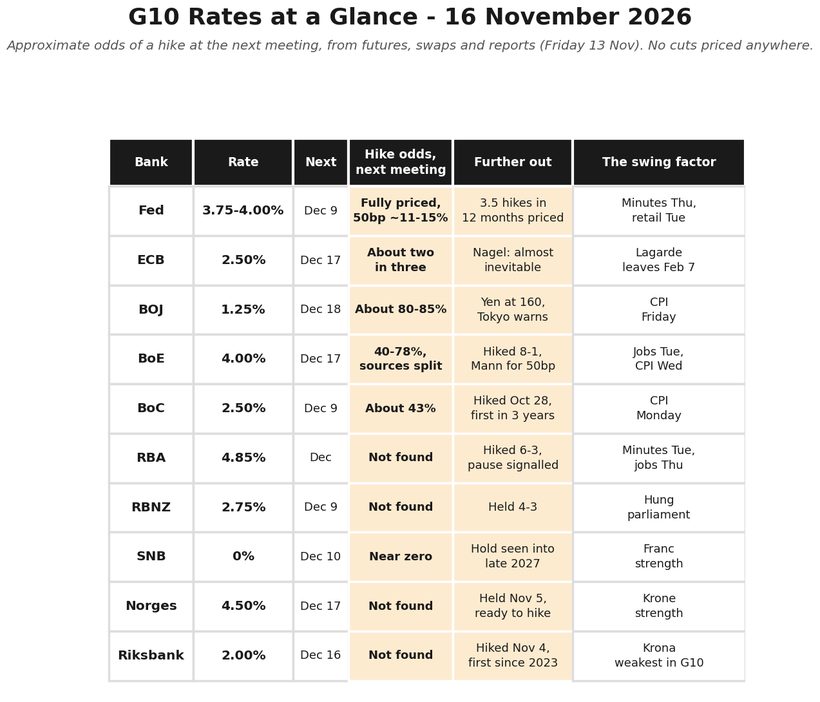
Every G10 bank that moves next is moving up. The Fed is fully priced for December, with 50bp at about one chance in seven, and most now expect the BOJ to hike too. The BoE is the one nobody can agree on: estimates run from 40% to 78%. The odds are snapshots from Friday's close or the latest reports; where we found no market price, the cell says so. Source: CME FedWatch, swaps and central bank statements as reported, Bloomberg Economics.
Regimes
The dollar breaks out: the range is over. Renamed from the dollar goes two-way, which ran 23 weeks inside 101.5-103. A hot CPI, hawkish Fed speakers and Treasury yields back above 5% took the DXY to about 103.4, a 19-month high, and back above the long-term trendline it lost last year. Momentum points to 104-104.5. The dollar is still only mid-table for the year, so this is a catch-up, not a mania, and Asia's deficit currencies, the Philippine peso and the rupiah, feel it first. new, week 1
The capital shortage, week fourteen: the borrowers go abroad. Investment-grade yields reached about 6%, near the highest since the financial crisis, and Alphabet borrowed about $4 billion in Hong Kong and Singapore dollars, 20-30bp inside guidance. CoreWeave is borrowing against Meta's credit at 7-7.5%, banks are discounting the AI debt they are stuck with, and Broadcom's $63 billion package for Anthropic's chips will need bonds next year. Lenders are rationing names, not money. changed, week 14
The AI fracture, week twenty: the founder goes, the trade stays. Huang resigned on Thursday after affairs that included an alleged Chinese spy, and Nvidia lost close to $900 billion at the low. Yet the Nasdaq had its best week since August as the money moved to AMD and Broadcom, and Anthropic kept its timetable. Nvidia on Wednesday morning and Anthropic on Thursday decide whether the fracture closes or widens. changed, week 20
The hiking chorus, week three: the Fed takes the lead. Every Fed speaker was hawkish after October's CPI rose 0.4%; Waller put 50bp on the table and Logan wants at least two more hikes. December is fully priced and about three and a half hikes over twelve months. Elsewhere the chorus is splitting: the RBA has paused and Bank Indonesia, South Africa and Sri Lanka are seen holding as oil falls, while most now expect the BOJ to hike. changed, week 3
The funding-currency battle, week nine: the yen at 160. USDJPY touched 160 as US 2-year yields jumped, the level where Tokyo has stepped in before, while markets put a December BOJ hike at about 80-85%. The PBOC raised banks' foreign-currency reserve requirement and capped the yuan, which makes CNH a candidate funder too. Intervention would be the shock to funding that this regime has waited for. changed, week 9
Europe's weak links, week two: the euro breaks support. The euro fell through $1.115 and is testing $1.105, with little support until about $1.075 if that goes. Nagel says a December ECB hike is "rather obvious" even as services inflation cools. Spain votes on the 29th, Poland is on alert, and Friday's EU-UK summit is the one European story going the other way. changed, week 2
The war is the inflation, week seventeen: the floor holds. Crude fell to two-month lows midweek on OPEC+ supply and recovering Hormuz flows, then rose back to about $96 on Brent after Trump said he does not need a deal with Iran. The Black Sea is now deadlier for shipping than the Gulf. Trump wants Xi's help, and perhaps Putin's, at APEC. Oil still prices the exit before the shooting stops. changed, week 17
Surplus versus deficit, week twelve: Shenzhen is the stage. China's exports are still growing above 30% while its consumer prices rose only 0.7%: a factory for the world with a weak shop floor at home. Trump meets Xi in Shenzhen, then Xi and Putin together, weaker after the midterms, and the Democrats want the Taiwan arms package unfrozen. The PBOC capping the yuan says Beijing will not pay for the surplus with its currency. changed, week 12
The lame duck, week two: defiance. Trump questioned the midterm results, promised vetoes, threatened Mexico with new tariffs, mused about a week-long campaign against Cuba and sent Vance after corruption in Democratic cities. Democrats now hold at least 54 Senate seats after Mississippi. A president with less to lose at home is more unpredictable abroad, starting in Manila and Shenzhen this week. changed, week 2
Shifts (if then)
Last week CPI came in hot and the hawkish branch fired; the SOX held its lows, Anthropic kept its timetable, UK GDP printed 0.7% and India's CPI broke 6%, all as scripted. The Houthis kept firing without a hit on Saudi output. This week the scripts are Nvidia, Anthropic, UK CPI, the yen at 160, Bank Indonesia and Shenzhen.
Nvidia guides above $125 billion and names a credible succession plan → the AI trade has a floor, the SOX rebuilds from last month's lows and the won and Taiwan dollar lead Asia; a cut to guidance or silence on the probes sends the stock through $140 and the second leg starts. new
Anthropic prices above $78 and trades up on Thursday → the window is open, the private AI names line up to list and the AI-debt market reopens; a break below the offer price on day one says the top is in for this cycle. new
UK CPI at 3.7% or higher → December is priced, gilts sell and sterling holds near its post-Brexit high into Friday's summit; 3.4% or lower takes December off the table and sterling gives back the summit premium. new
USDJPY trades through 160 into Friday's CPI → intervention risk is live and the yen can gain three to five figures in an hour; a hot CPI with no intervention locks in the BOJ's December hike. new
Bank Indonesia hikes on Wednesday → the rupiah's floor is official and Asian deficit currencies get a reprieve; a hold with the rupiah at a record low leaves IDR and PHP exposed to the dollar breakout. new
Trump and Xi announce an Iran or AI deal in Shenzhen → Brent heads back toward $85 and the yuan firms despite the cap; a cancelled meeting or a row over Nvidia's China sales sends Brent above $100 and the Asian exporters lower. new
Tails
Nvidia's probe reaches Singapore → Singapore billed about a fifth of Nvidia's sales last year though only a sliver of the chips landed here, and Washington calls the region a permissive jurisdiction. A finding against Singapore-based intermediaries would hit the data-centre pipeline, the Singapore dollar's AI premium and the city's balancing act between Washington and Beijing. new, week 1
Political violence spreads in Europe → Krakow was eight days ago and the Black Sea attacks now reach NATO waters off Romania and Bulgaria. Another attack would put the zloty and CEE assets in the war-risk bucket overnight. changed, week 2
A BOJ surprise → with the yen at 160 and inflation rising back above 2%, an intervention or a hawkish signal into December would force the carry trade to unwind while equities are still fragile. changed, week 2
A neo-cloud defaults → CoreWeave beat and raised, but it now borrows against Meta's contract rather than its own name and says it will not use the unsecured market at these yields. A missed payment anywhere would reprice every data-centre bond at once. changed, week 5
A cyber theft hits a bank → Binance lost $6.3 billion in minutes and Maersk reported an IT security incident last week. The same attack on a payments system would be a liquidity event, not a crypto story. changed, week 3
The LGFV crack spreads → if a second local-government issuer misses after Huafa, China's onshore credit market reprices and the PBOC is forced into a visible rescue just as it caps the yuan. held, week 3
Deposit flight from France → the budget's revenue half was rejected 458-0 and the euro is breaking support. A visible run on French banks would turn a spread problem into a euro problem. held, week 4
The kingdom's trillion gets cut → the Houthis have hit Aramco's tower in Riyadh and keep striking Saudi infrastructure. If the kingdom redirects money home, its pledges to US AI and its Treasury holdings both shrink. held, week 5
Kyiv's leader pushed out → the Kremlin says it is ready for security talks at once, and Trump wants Putin in a room with Xi. A settlement over Kyiv's head splits Europe's sanctions front. changed, week 6
A hit on Abqaiq → the Houthis are already striking Riyadh. A hit on Saudi Arabia's main processing plant would take millions of barrels a day offline in an afternoon. held, week 6
The AI week: the chip without its founder, the mind with a ticker
Two tests in 48 hours. Nvidia reports in our Wednesday morning with an interim chief executive and probes into its China sales, and Anthropic prices that night and trades on Thursday. Between them they decide whether last month's rout was a correction in a build-out or the start of its end.
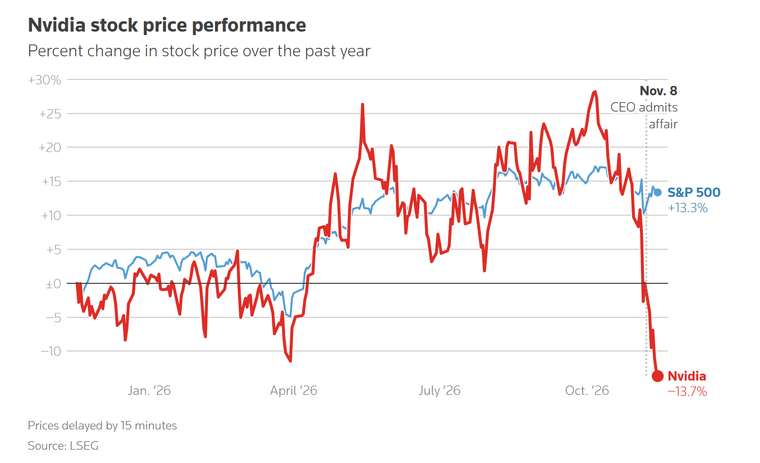
A year of gains gone in a week: Nvidia went from leading the S&P to trailing it by more than 25 points after Huang's affairs became a governance story and then a national security one. At its low it lost close to $900 billion in value, though AMD and Broadcom took much of it back. Support near $150 is about 9 times next year's earnings, cheap for a company still growing near 90%. Source: Reuters, LSEG.
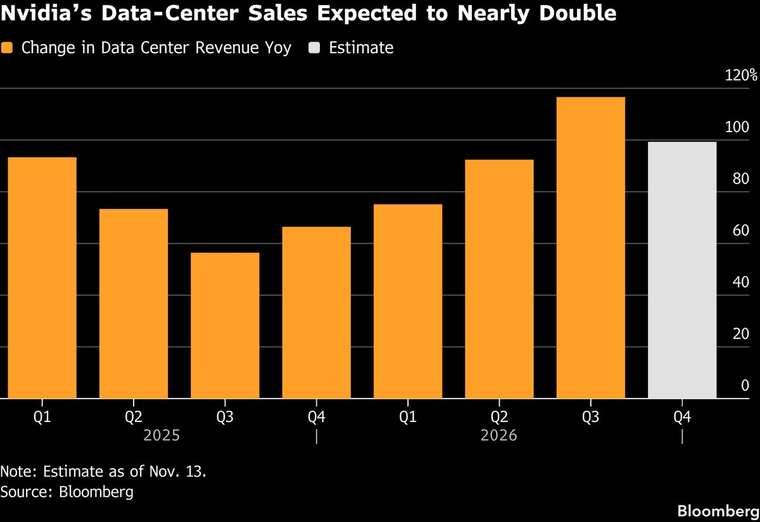
The business is still doubling: data-centre sales are expected to nearly double from a year earlier again, and the street wants about $109 billion of revenue and guidance near $125 billion. The numbers will probably be fine. What the market needs to hear is whether the $500 billion financing partnership with six asset managers survives without the man who was negotiating it. Source: Bloomberg.
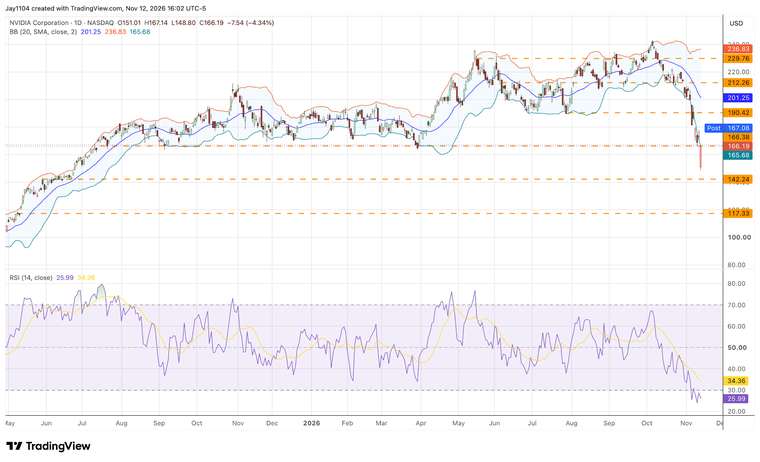
The chart has broken, and that is when bargain hunters arrive: the stock fell through support that had held near $165 since July 2025, with the relative strength index under 30. Put open interest is heaviest at $150 and calls at $200, so a clean report could squeeze the hedges. The next support below is near $140. Source: TradingView, CMC Markets.
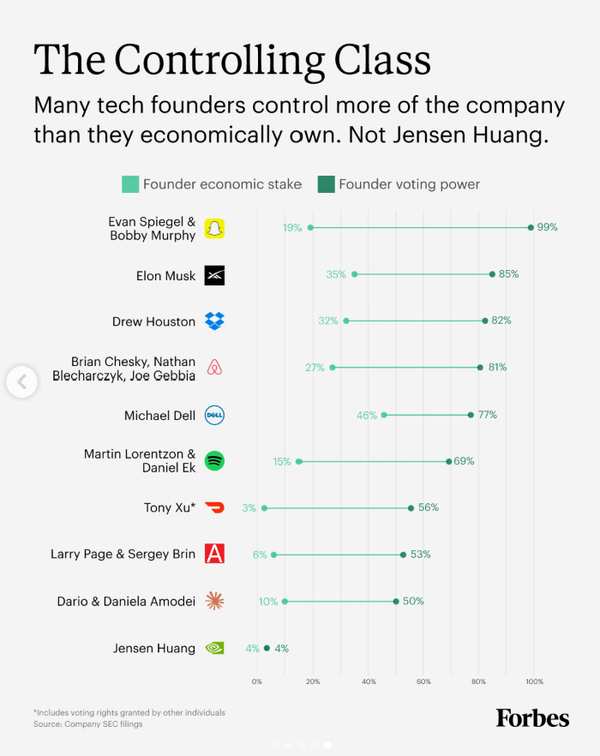
Why Huang could be removed when Zuckerberg could not: most tech founders control far more of their companies than they own, through super-voting shares. Huang owns about 4% of Nvidia and had about 4% of the votes, the least protected founder on this list. The same chart shows the Amodeis hold about 50% of Anthropic's votes on a 10% stake. Governance is now a line in the valuation. Source: Forbes.
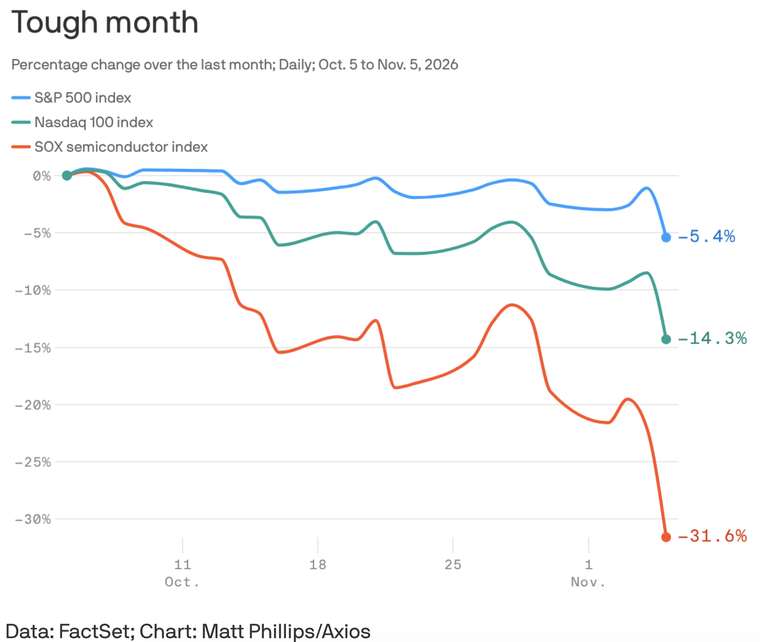
A month that erased a year of AI leadership: from 5 October to 5 November the semiconductor index fell 31.6%, the Nasdaq 100 14.3% and the S&P only 5.4%. The damage was concentrated in the stocks that led, which is what positioning unwinds look like. Nvidia alone was about 8% of the Nasdaq 100 in October. Source: Axios, FactSet.
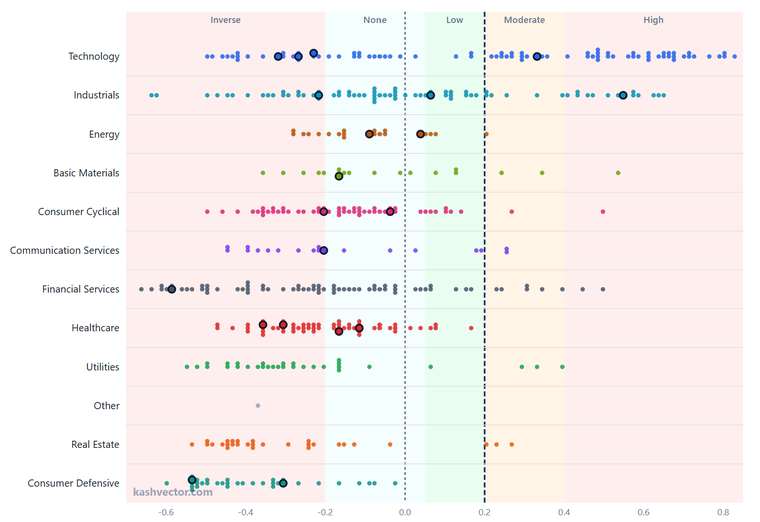
How much of the S&P moves with AI: this map sorts every S&P stock by how closely it trades with the AI basket. Most of technology and a good part of industrials sit to the right; healthcare, staples and utilities sit to the left. In a rotation, the left side is where the money hides, which is why the equal-weighted index held up so much better. Source: Kash Vector, via Visual Capitalist.
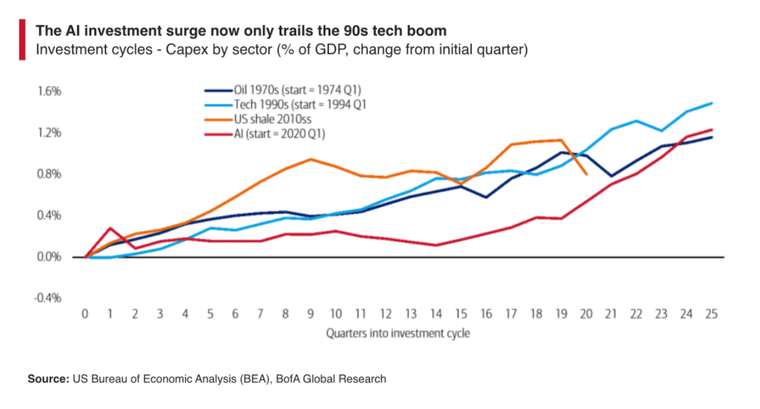
The AI build-out now trails only the 1990s: AI capital spending is about 1.2% of GDP against 1.5% at the peak of the tech boom, and has already passed the 1970s oil and 2010s shale cycles at the same stage. Every one of those cycles ended in overcapacity. The question is not whether this one overbuilds, but how long the revenue takes to catch up. Source: Bank of America Institute, BEA.
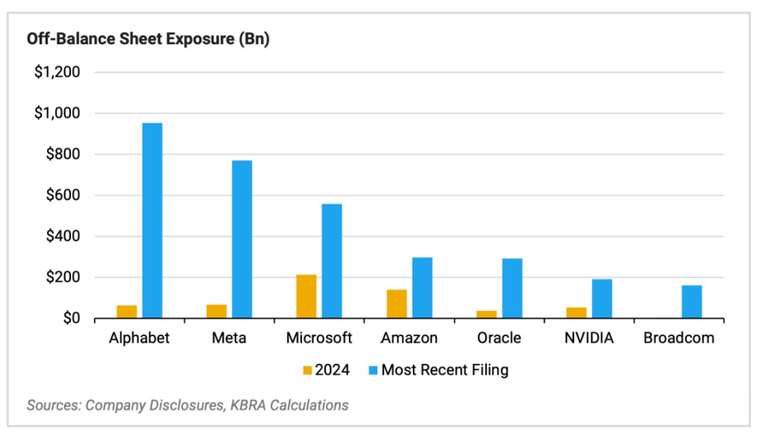
The debt you cannot see: hyperscalers had about $3.2 trillion of commitments for leases and chips that are not yet on their balance sheets at the end of the second quarter, led by Alphabet and Meta. Leverage on that scale rivals the telecom cycle of 2000. Committed spending is also spending that cannot easily be cut when the cycle turns. Source: KBRA, company filings.
The dollar, rates and credit
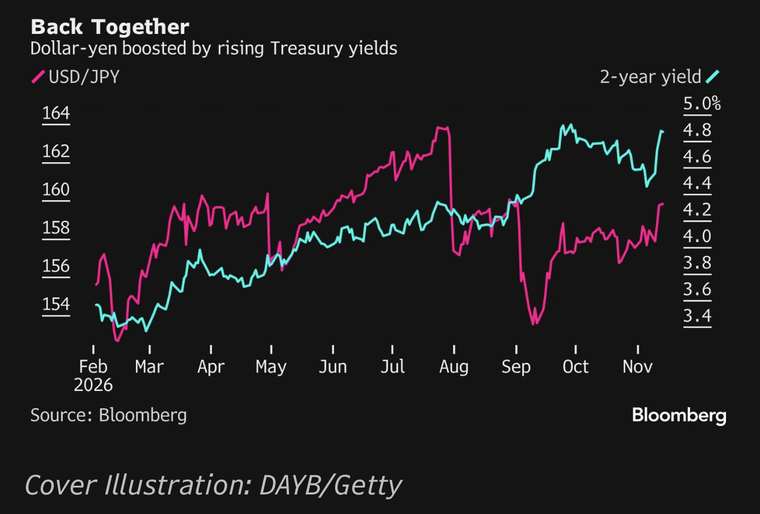
Dollar-yen is back to following the 2-year: the yen touched 160 last week as Treasury yields jumped, the level Tokyo has defended before. Japan's officials can talk, but as long as the Fed is hiking and the BOJ is undecided, intervention buys weeks, not a trend change. Friday's CPI and the BOJ in December are the yen's own catalysts. Source: Bloomberg.
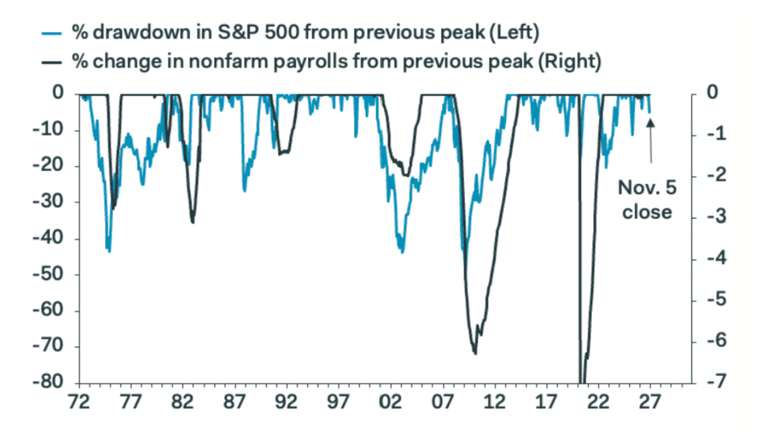
A 5% drawdown is not enough to stop the Fed: big stock market falls have preceded steep job losses in the past, but this one is too small to suggest payrolls will shrink. With 165,000 jobs in October and a hot CPI, the Fed has every reason to hike in December and no reason to rescue equities. The put is struck much lower. Source: Pantheon Macroeconomics.
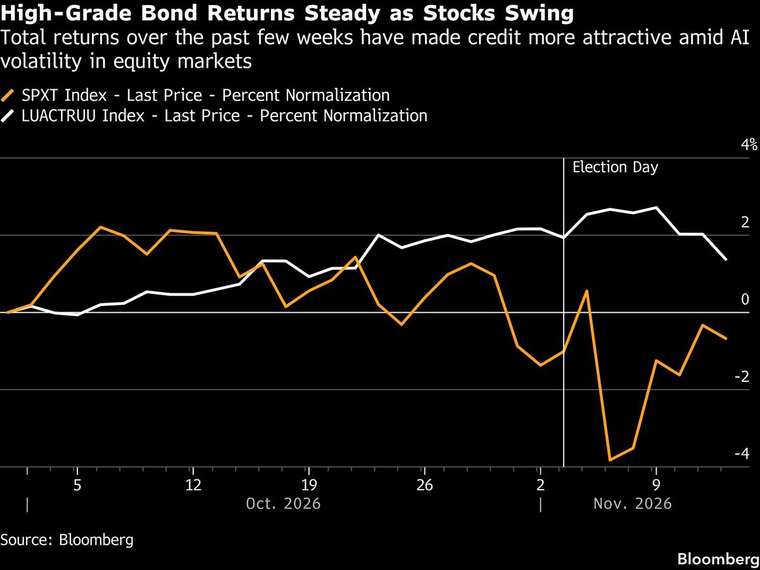
Bonds are winning the argument with stocks: high-grade corporate debt returned 1.2% since the end of September while the S&P lost about 1.1%, and investment-grade yields near 6% are close to their highest since the financial crisis. With tech borrowing less, supply may shrink next year just as allocators ask whether a known 6% beats an uncertain equity market. Source: Bloomberg.
Asia: the rotation into markets with no AI to sell
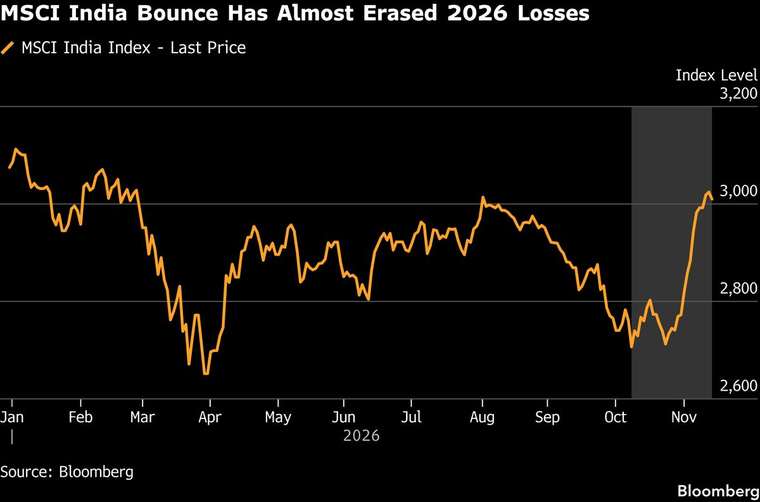
India has almost erased its 2026 losses: MSCI India is up 11% from its October low, adding more than $400 billion, and foreigners bought a net $8.5 billion in November, the most in six years. Active funds are still about $74 billion underweight. Cheaper oil helps an importer, and the absence of AI exposure has become the selling point. Source: Bloomberg.
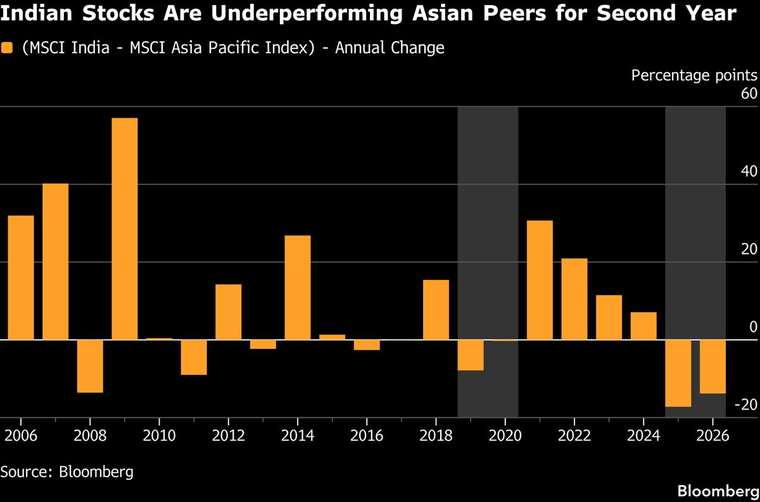
Still a laggard for the year: India is heading for a second year behind Asia Pacific for the first time since 2020, still down about 2% while the region is up about 12%. That gap is the room the rotation has left to run, as long as Brent stays near or below $100. Source: Bloomberg.
Monday: Japan's GDP and China's October
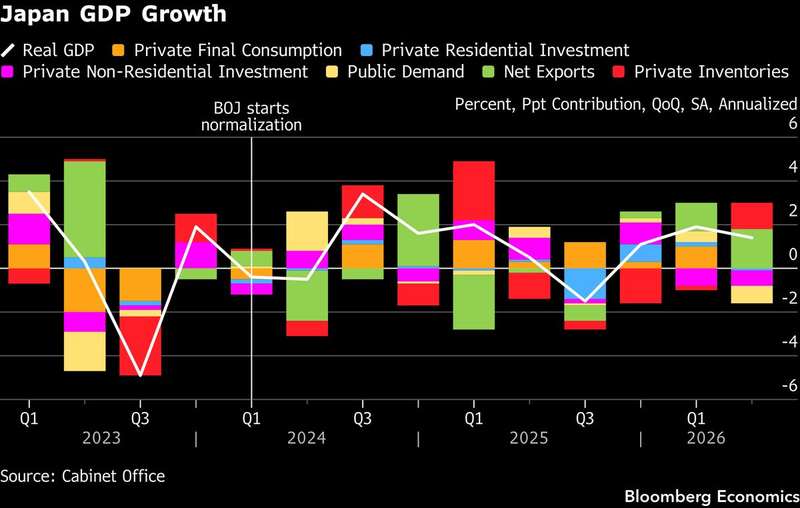
Japan probably shrank in the third quarter, for reasons that will not last: the Kyushu earthquake shut factories and typhoons kept shoppers home, so consensus is only 0.2% annualised and Bloomberg Economics sees -0.2%. A one-off contraction will not stop a December hike, but it gives the BOJ cover to go slowly, with the yen at 160. Source: Cabinet Office, Bloomberg Economics.
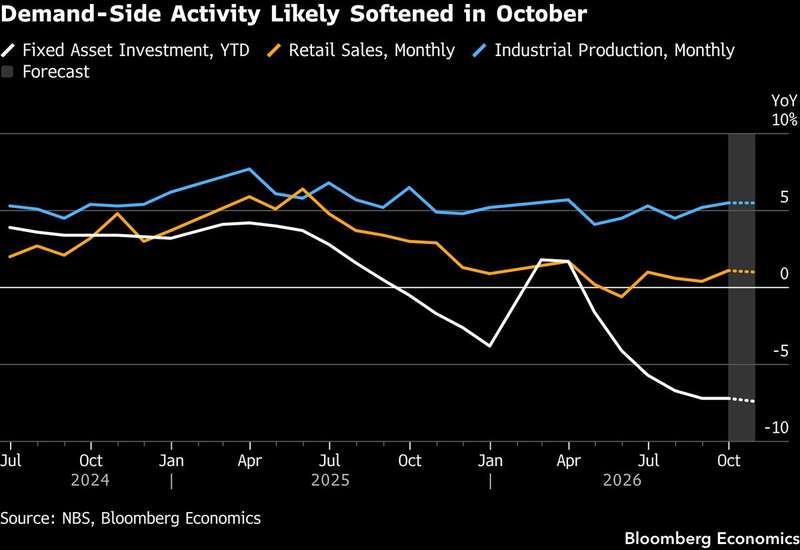
China's September bounce looks like it faded: fixed-asset investment is seen falling 7.0-7.4% for the year to October, retail sales slowing to about 1%, while industrial production holds near 5.5% on demand for AI equipment abroad. Factories for the world, a weak shop floor at home. A big miss is the one thing that could bring a cut in Friday's loan rates. Source: NBS, Bloomberg Economics.
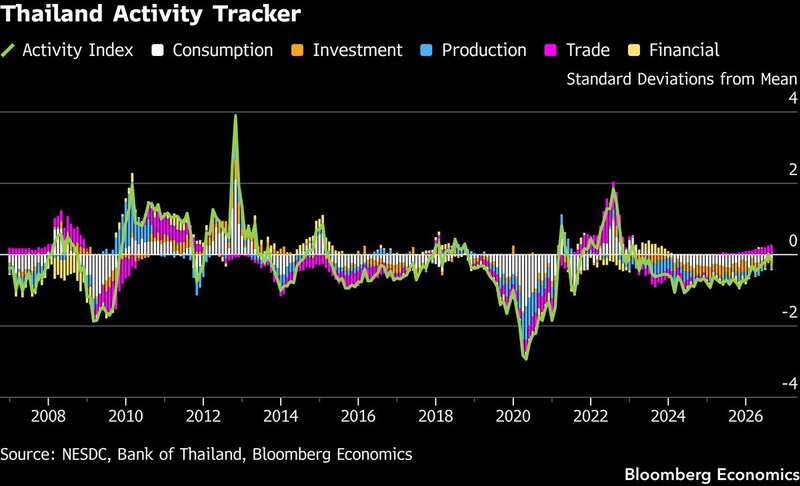
Thailand is picking up from a low base: third-quarter growth is seen at 2.2-3.1% from 1.9%, helped by AI-related exports, government subsidies against the oil shock and firmer confidence. Tourism, the old engine, is still soft on high fuel costs. Source: NESDC, Bank of Thailand, Bloomberg Economics.
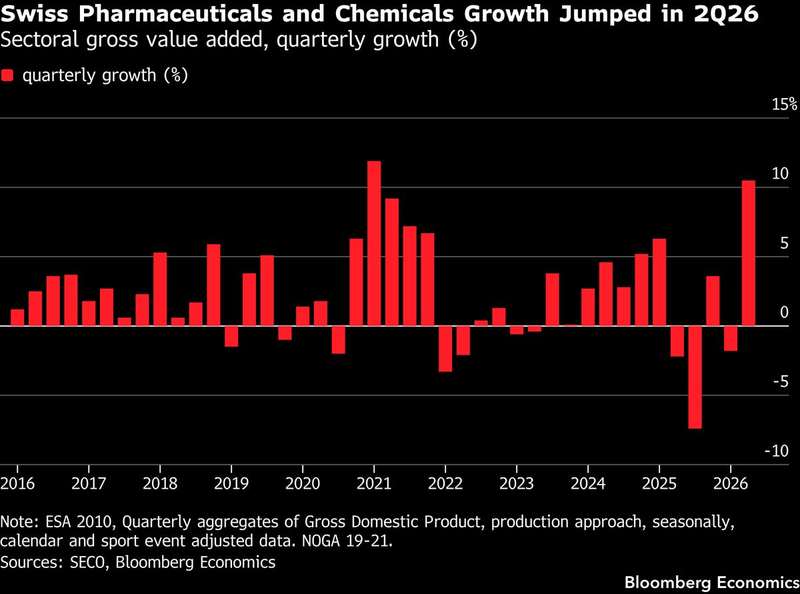
Switzerland gives back its pharma surge: after 1.5% growth in the second quarter on a rush of pharmaceutical exports, the economy is seen shrinking slightly. Core inflation is only 0.5%, so the SNB has no reason to move on the 10th; the franc does the tightening. Source: SECO, Bloomberg Economics.
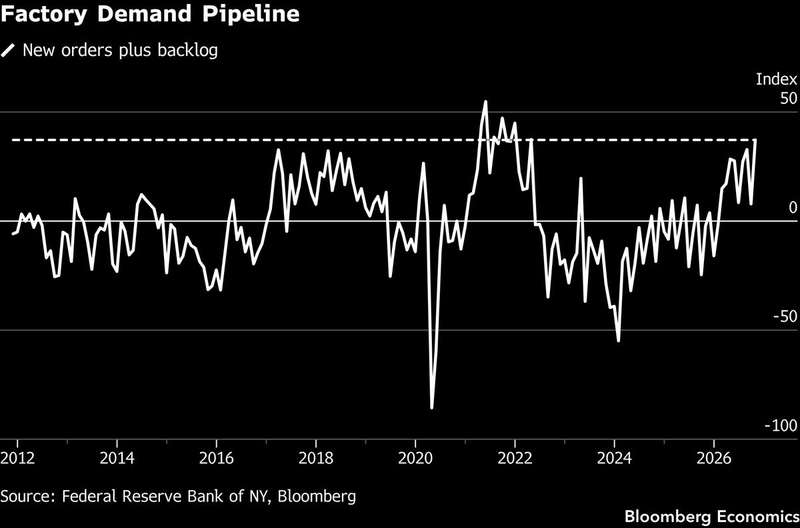
New York's factories have more orders than they can fill: new orders plus backlogs are near the highs of 2021, so even a drop in the headline Empire index toward 18 would still mean expansion. Data centres, AI and defence are leading the order books, which is why manufacturing is not the part of the economy the Fed worries about. Source: New York Fed, Bloomberg Economics.
Tuesday: the American shopper, and Britain's jobs
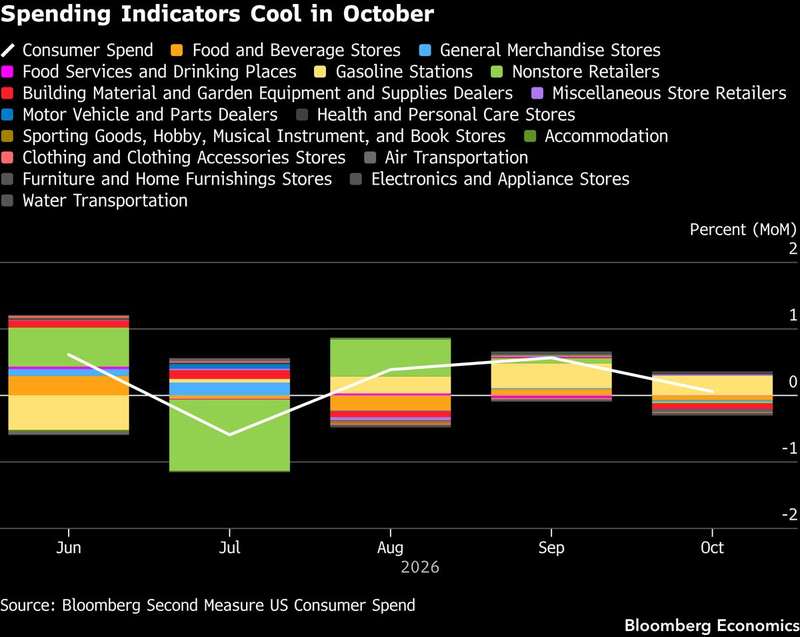
October's spending cooled after a petrol-fuelled September: retail sales are seen up only 0.1-0.2% after 0.8%, with the control group at 0.3-0.4%. Car sales fell almost 3% and card data softened. A slowdown from a high base is not a consumer in trouble, but a soft number in the same week as a hot CPI is the stagflation mix the Fed least wants. Source: Bloomberg Second Measure, Bloomberg Economics.
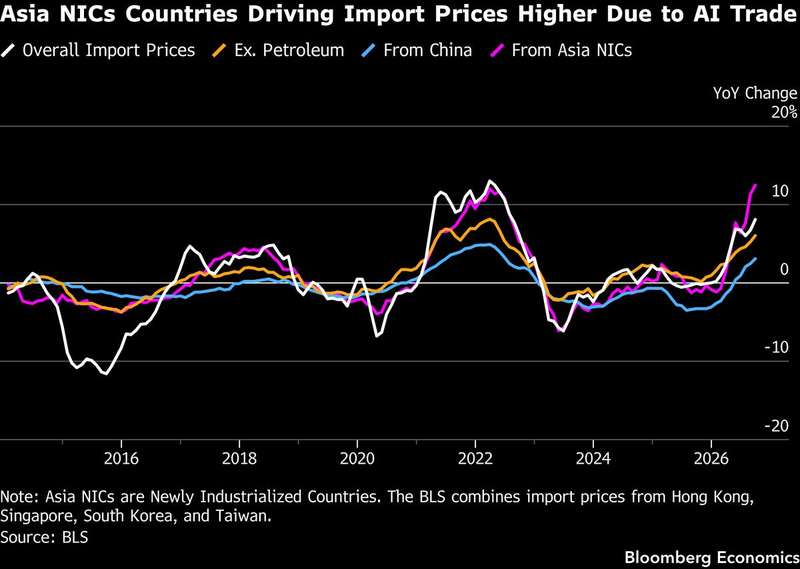
Asia's AI exports are now pushing up American import prices: prices of goods from the newly industrialised economies, Korea, Taiwan, Singapore and Hong Kong, are rising faster than those from China. Import prices are seen up 0.7% for October. Servers and chips are an inflation channel nobody modelled into the tariff debate. Source: BLS, Bloomberg Economics.
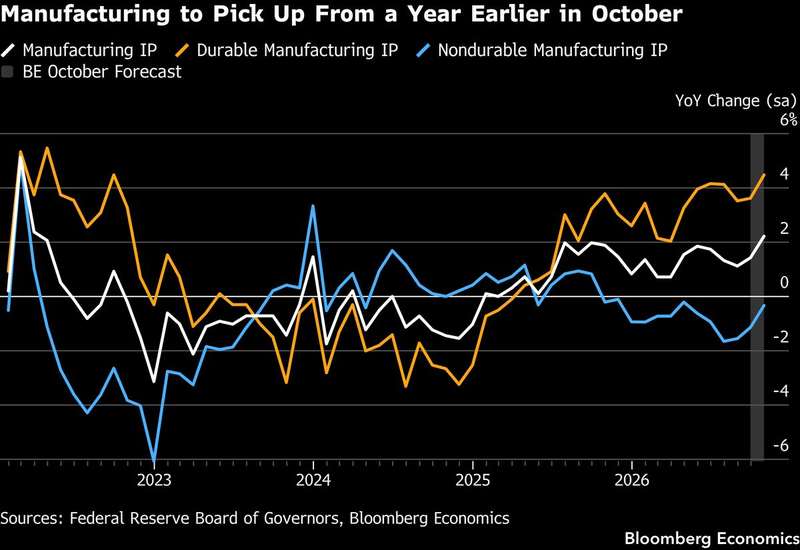
Industrial production may drop on a calendar quirk: Labor Day fell in the reference week, so Bloomberg Economics sees output down 0.4% while consensus has a small gain. Underneath, manufacturing is picking up from a year earlier, led by durable goods. A weak print here is noise, not signal. Source: Federal Reserve, Bloomberg Economics.
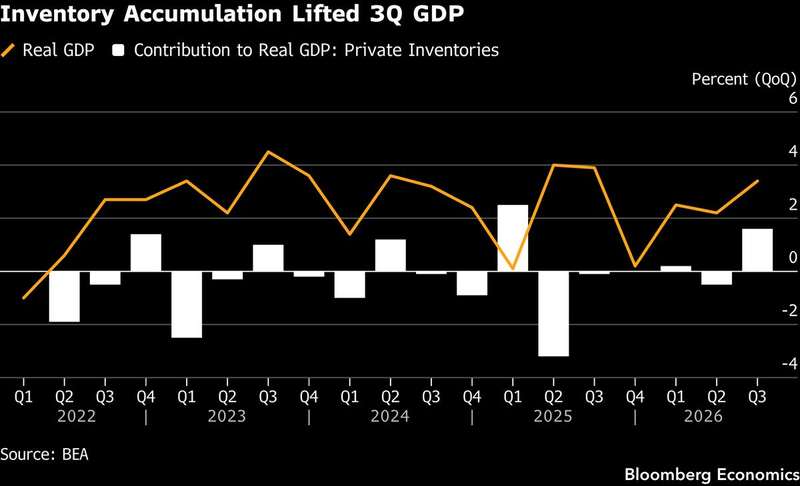
Inventories carried the third quarter: stockbuilding added 1.6 points to third-quarter growth, mostly in wholesale and manufacturing. What was built up has to be sold down, so inventories are a risk to the fourth quarter just as the Fed is set to hike. Source: BEA, Bloomberg Economics.
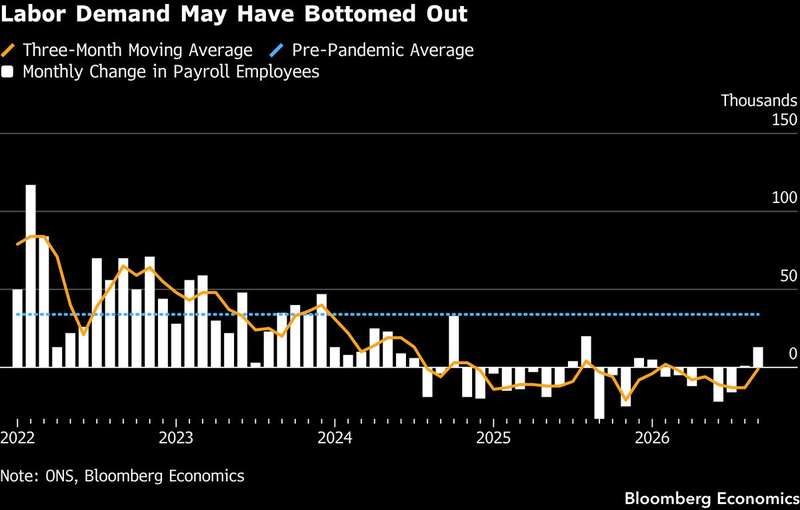
Britain's labour market may have turned: unemployment is seen falling to 4.6-4.7% and private pay ticking up to 3.1%, after the economy grew 0.7% in the third quarter. A recovering job market with sticky pay is what turns one hike into two. The markets give December roughly even odds. Source: ONS, Bloomberg Economics.
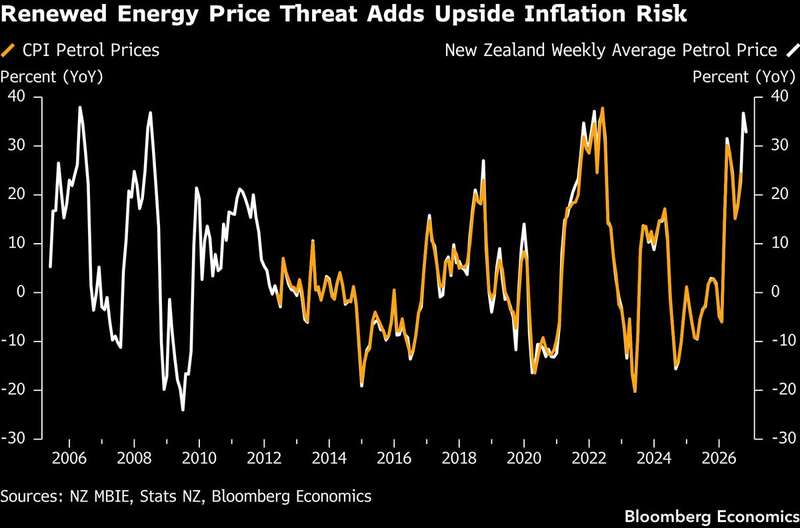
New Zealand's petrol prices are climbing again: fuel costs rebounded through September and October with the Iran war, and October food prices land on Tuesday. With a hung parliament and a caretaker government, the RBNZ is the only institution in Wellington making decisions. Source: NZ MBIE, Stats NZ, Bloomberg Economics.
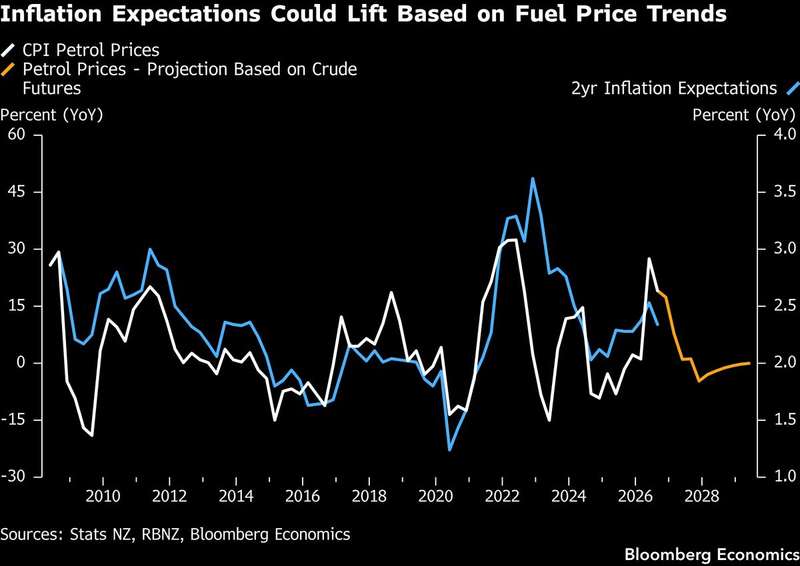
Expectations follow the pump: two-year inflation expectations tend to track petrol prices and are seen edging up from 2.34%. Unemployment and a wide output gap should contain domestic inflation, but expectations are what the RBNZ cannot afford to lose. Source: Stats NZ, RBNZ, Bloomberg Economics.
Wednesday: UK and euro inflation, Bank Indonesia and the Fed's minutes
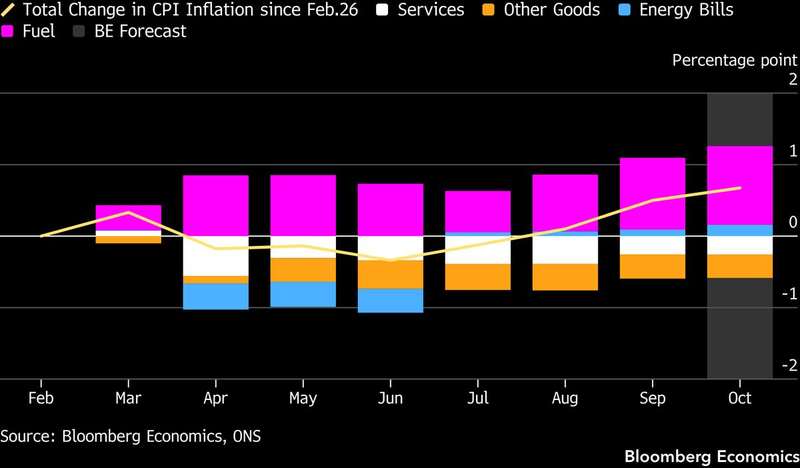
Energy is doing all the work in British inflation: CPI is seen rising to 3.6-3.7% from 3.5%, driven by fuel and a 4% rise in the energy price cap, while core holds near 2.8%. Bloomberg Economics sees a peak of 4.1% in the first quarter as household bills jump about 25% in January. The BoE has to decide whether to look through a shock it can see coming. Source: ONS, Bloomberg Economics.
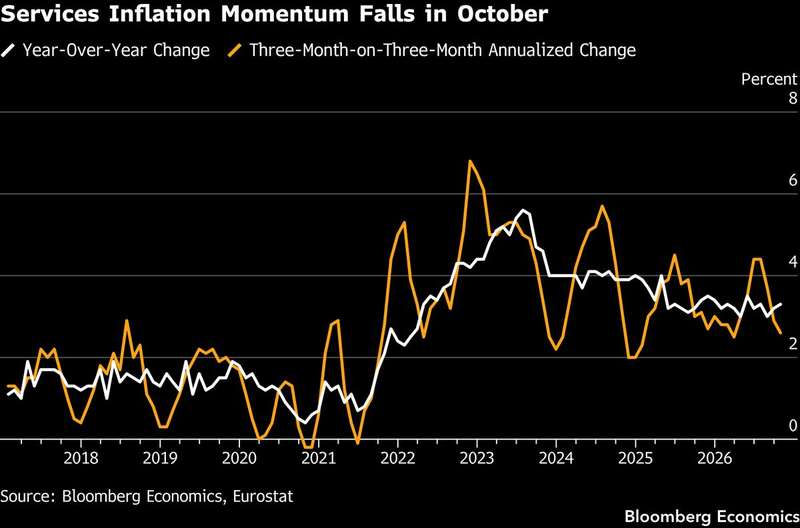
Euro-area services inflation is cooling underneath: the final October print should confirm headline at 4.0% and core at 2.5%, but the three-month pace of services prices fell to 2.6%. Nagel calls a December hike "rather obvious"; the momentum data argue it would be a hike into slowing prices. Source: Eurostat, Bloomberg Economics.
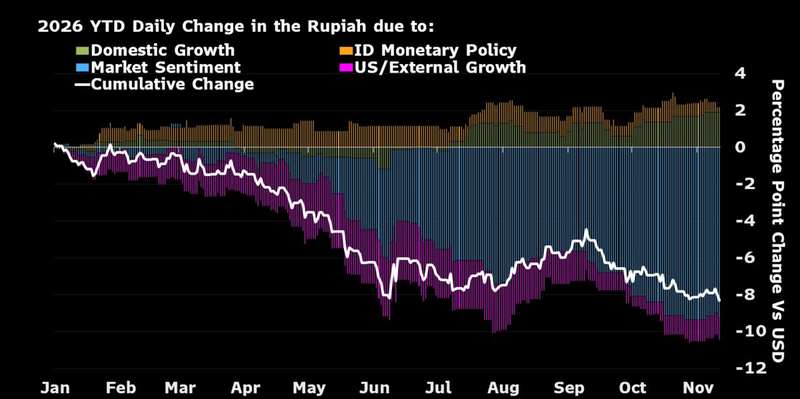
The rupiah's slide is mostly sentiment: Bank Indonesia is seen holding at 5.75% while consensus leans to a hike. Bond yields at their highest since 2020 did part of the work, and MSCI's warning of a possible downgrade to standalone status has not forced a move. BI prefers intervention to rates, and a hike would tell us it has run out of patience. Source: Bloomberg Economics.
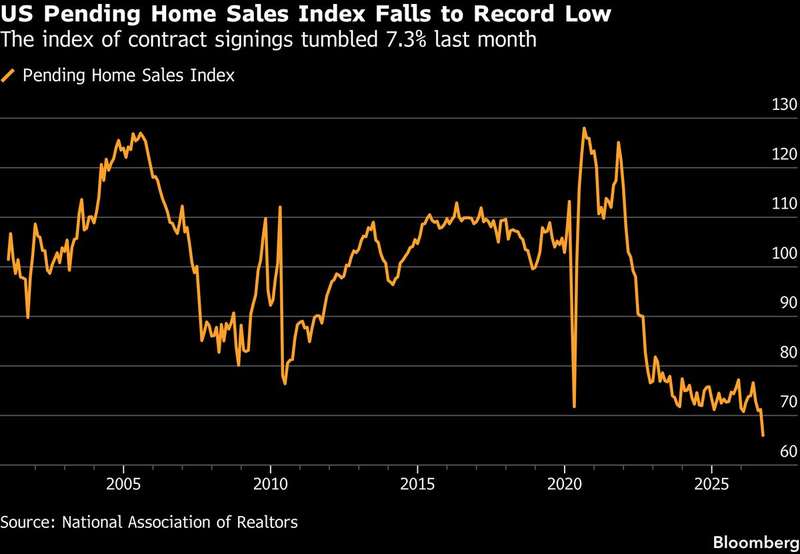
Pending home sales fell to a record low: signings dropped 7.3% in September to the lowest since records began in 2001, and existing sales are at a 16-year low. Applications jumped when mortgage rates eased from 7.61% to 7.21%, so demand is there; affordability is not. Higher yields last week will undo that. Source: National Association of Realtors, Bloomberg.
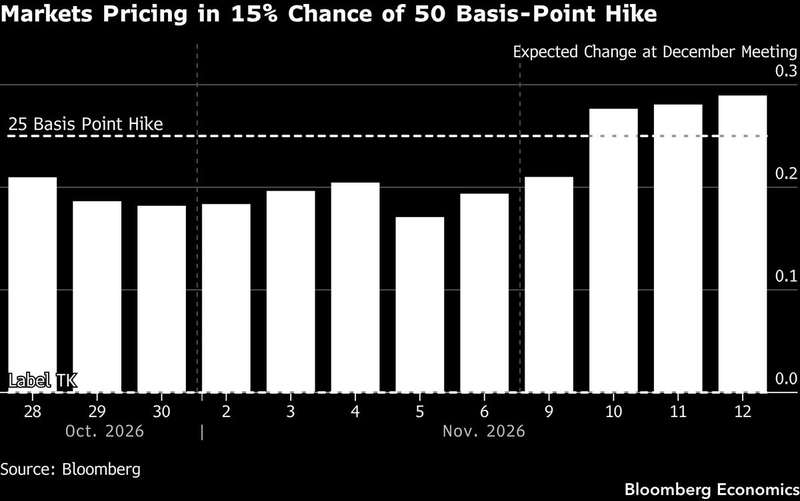
The market now gives a 50bp December hike about one chance in seven: the October minutes should show most officials favoured waiting but still saw another hike this year, with a 10-2 vote that understated the hawks. They are stale: they predate the 165,000 payrolls and the hot CPI. Waller has since put 50bp on the table. Source: Bloomberg, Bloomberg Economics.
Thursday: claims, Philadelphia and Australia's jobs
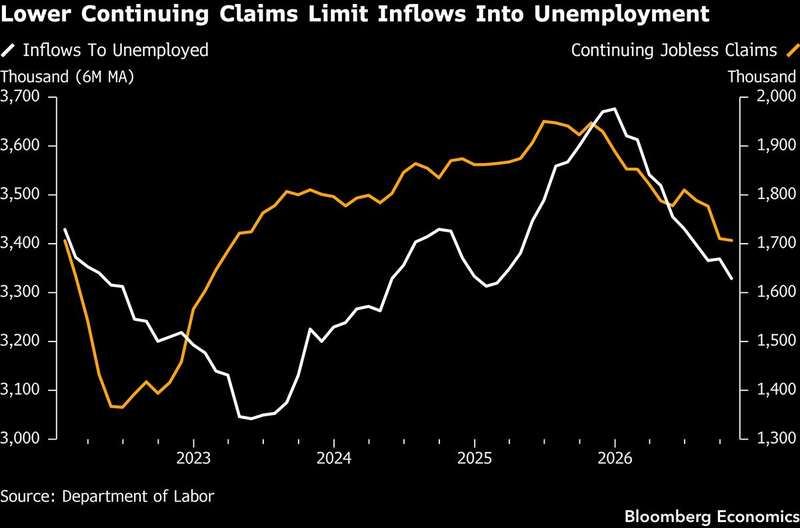
Layoffs are still rare: initial claims are running near 200,000 and continuing claims have fallen back, despite pockets of AI-related job cuts. Without broad layoffs, unemployment rises only slowly even as hiring cools, and the Fed keeps its focus on prices. Source: Department of Labor, Bloomberg Economics.
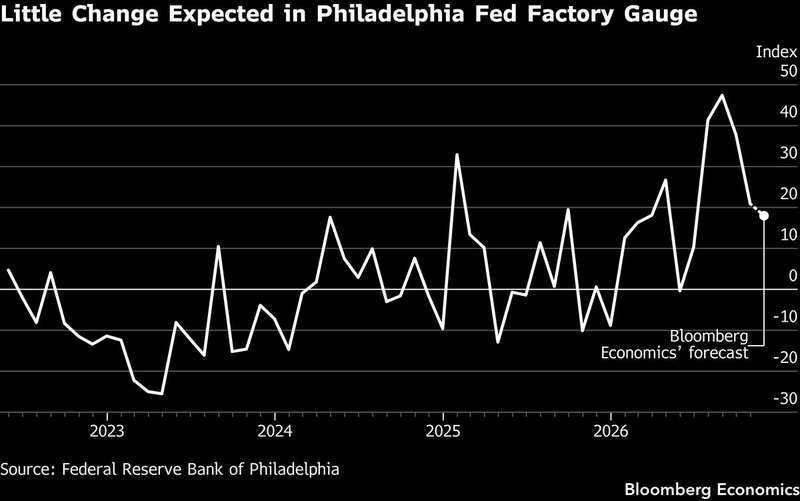
Philadelphia's factories are softer than New York's: the index has dropped about 26 points in two months, with new orders down to 4.3 in October, though consensus still sees about 20. The Beige Book said growth in the district is led by data centres, AI and defence, all long projects that do not stop on a bad month. Source: Philadelphia Fed, Bloomberg Economics.
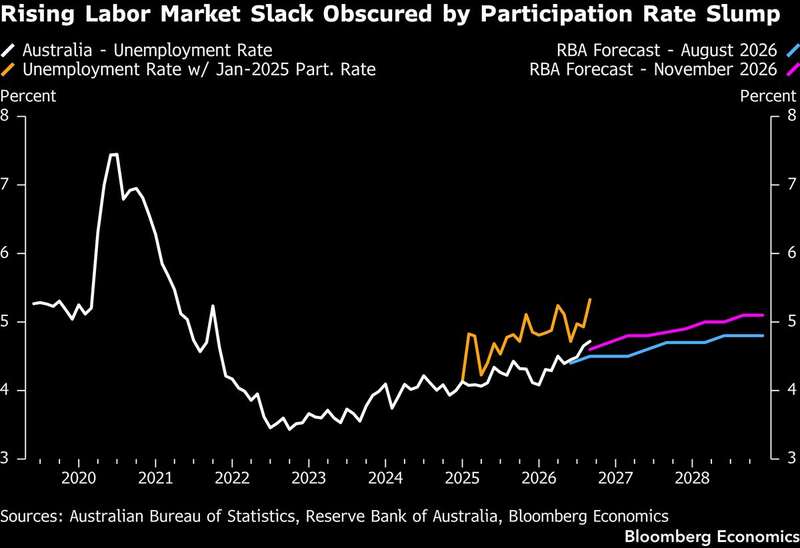
Australia's slack is hiding in participation: unemployment is seen at 4.7% with a modest rebound in hiring after September's 39,000 loss. The RBA signalled a pause after its fifth hike, and a soft report keeps it there. Source: ABS, RBA, Bloomberg Economics.
Friday: Japan's inflation and China's loan rates
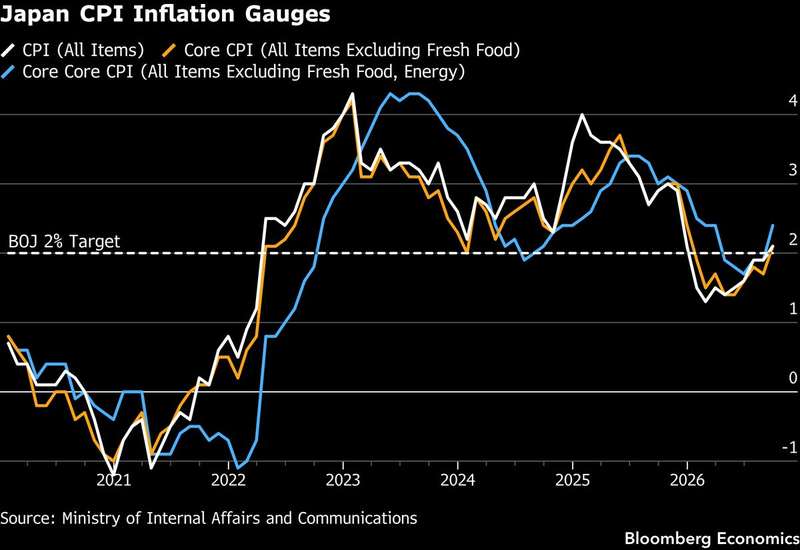
Japan's inflation is turning back up: October CPI is seen at 2.5-2.6% from 2.1%, with core at about 2.4%, as energy and a weak yen lift prices and wet weather pushes up vegetables. That supports a December hike, which markets already price at about 80-85%. Source: Ministry of Internal Affairs, Bloomberg Economics.
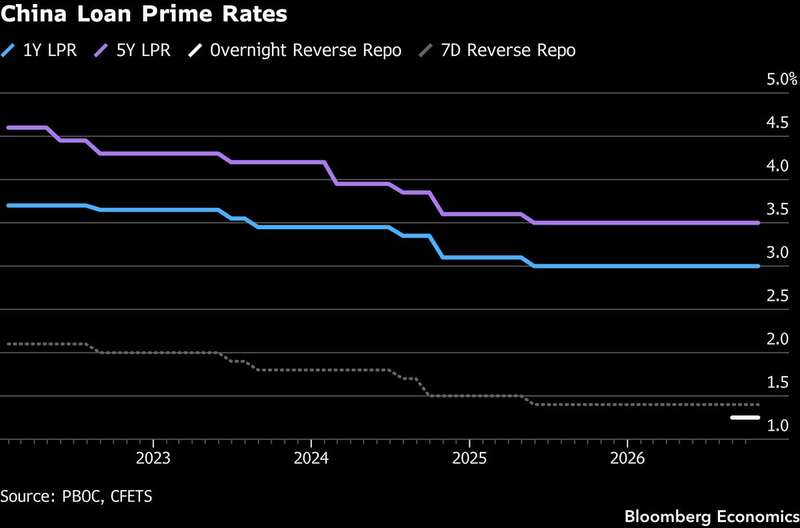
China's loan rates are set to hold for an 18th month: the one-year LPR should stay at 3.00% and the five-year at 3.50%. The PBOC moved its anchor to a lower overnight rate this month, which is not a cut yet. Banks wait for the PBOC to move its new rate, and Monday's data decide whether it has to. Source: PBOC, CFETS, Bloomberg Economics.
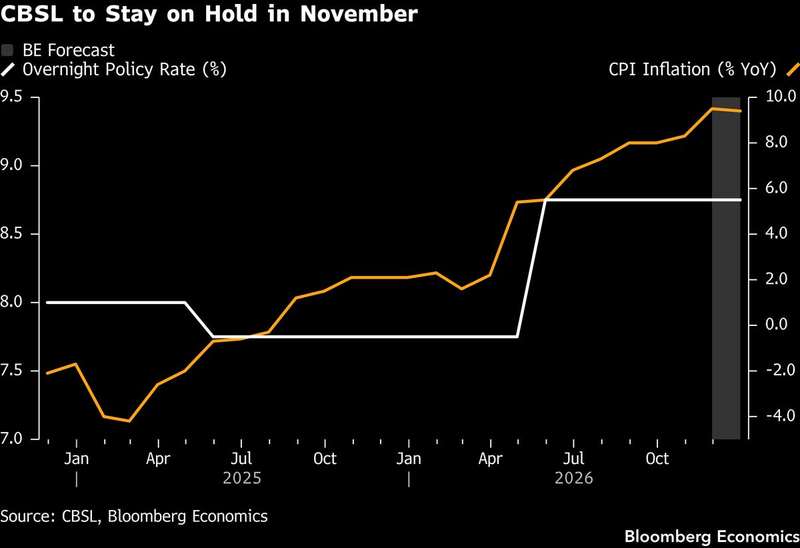
Cheaper oil saves Sri Lanka a hike: the central bank is seen holding at 8.75% after Brent fell about 21% from its late-October peak, with reserves above $7 billion and the rupee stable. The oil importers are the first to feel a ceasefire. Source: CBSL, Bloomberg Economics.
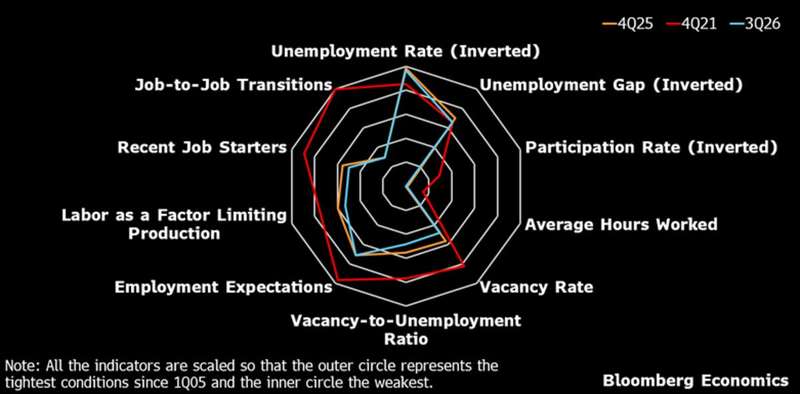
Europe meets the energy shock with weak labour demand: negotiated wages slowed to 2.4% in the second quarter, below the 3% consistent with the target, and vacancies are the lowest in five years. Without wage pressure, second-round effects are unlikely before next year, the argument against the ECB hawks. Source: ECB, Bloomberg Economics.
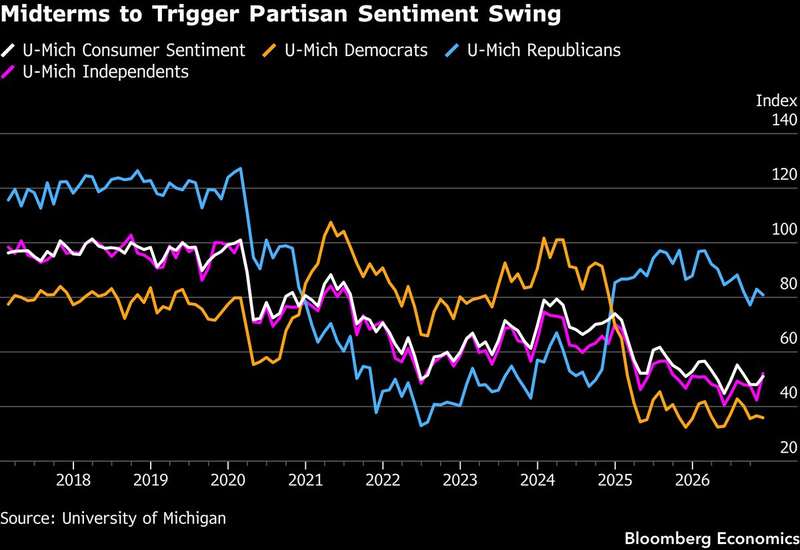
The midterms flipped the mood by party: Democrats' sentiment jumped after their sweep and Republicans' fell, so Friday's final November reading is seen edging up to about 51.5. Sentiment by party now swings with elections, not prices, which makes it a poorer guide to spending. Source: University of Michigan, Bloomberg Economics.
APEC in Shenzhen: Trump and Xi, round three
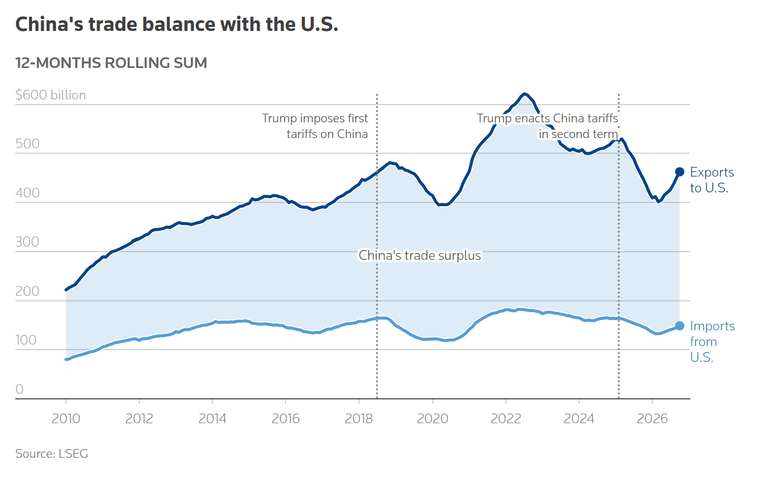
Tariffs dented China's exports to America, not its surplus: China's 12-month exports to the US fell sharply after the second-term tariffs and are rebounding again, while imports from the US barely moved. Trump meets Xi in Shenzhen on the 18th and 19th, the third time this year, weaker at home after the midterms and wanting Beijing's help to end the Iran war. Source: Reuters, LSEG.
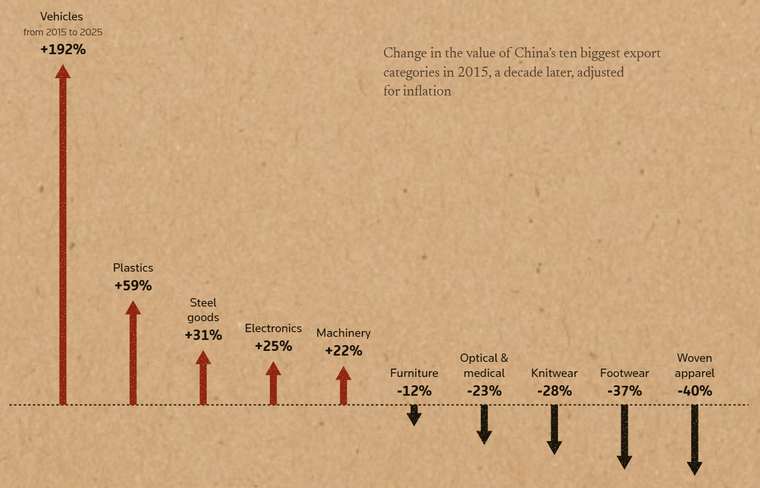
The new Made in China is cars, not clothes: in ten years the value of China's vehicle exports rose 192% while woven apparel fell 40% and footwear 37%. The country that sold the world its shirts now sells it its cars and its plastics. The trade fight is now over industries that the West still has. Source: Reuters, via Visual Capitalist.
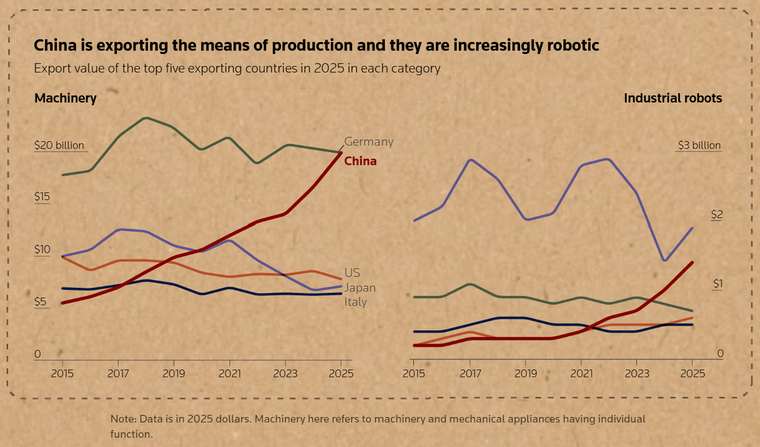
China exports the means of production: China caught Germany as the biggest machinery exporter in 2025, and its robot exports have taken off since 2023. Selling the machines that make things is a deeper moat than selling the things. Every tariff on finished goods makes the machines more valuable to whoever builds locally. Source: Reuters, via Visual Capitalist.
Oil and the wars: reprieve or trend?
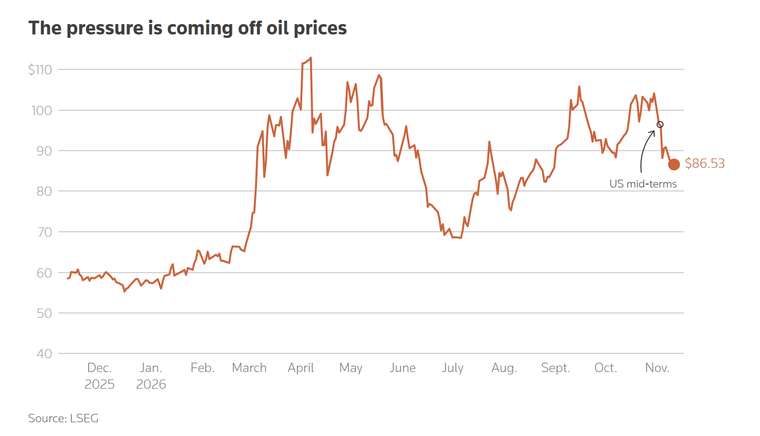
The pressure is coming off oil, for now: crude touched two-month lows midweek on OPEC+ output, Hormuz flows recovering and the IEA's call for a surplus in the fourth quarter. Then Trump said he does not need a deal with Iran and it rose back to about $96. The Houthis' strikes on Saudi infrastructure and attacks on Gulf tankers keep the floor high. Source: Reuters, LSEG.
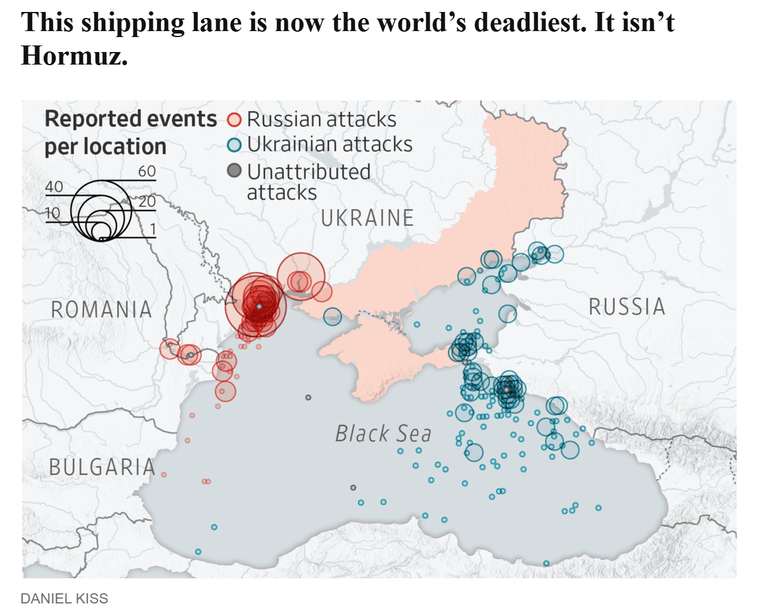
The world's deadliest shipping lane is not Hormuz: Russian and Ukrainian attacks in the Black Sea have now killed more people than strikes on shipping in the Iran war, and they have spread into the waters of Romania and Bulgaria, both NATO members. Grain and oil both pass through. The Kremlin says it is ready for security talks; the ships say otherwise. Source: Wall Street Journal.
Britain and Europe: getting cosy again
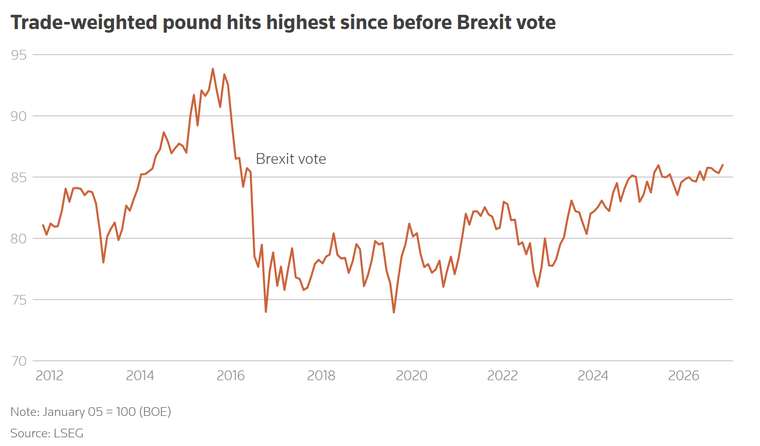
Sterling is back where it was before the Brexit vote: the trade-weighted pound is at its highest since 2016, and Friday's EU-UK summit in Brussels could add to it. Burnham has even raised rejoining, and Spain and France are welcoming. A currency that has already priced the rapprochement needs more than a friendly summit to go higher. Source: Reuters, LSEG.
Washington after the vote
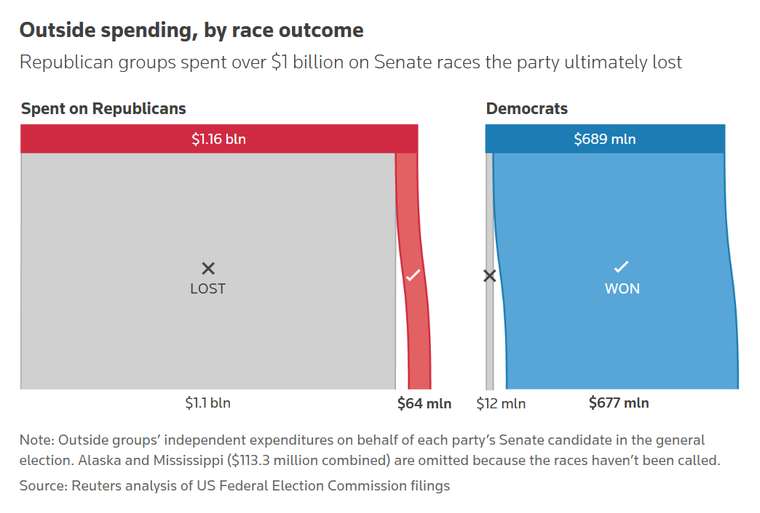
Republican groups spent over $1 billion on Senate races they lost: outside groups put $1.16 billion behind Republican Senate candidates, and only $64 million of it went to winners. Democratic groups spent $689 million and nearly all of it won. Money did not buy the Senate this time; the cost of living and corruption did the voting. Source: Reuters, FEC filings.
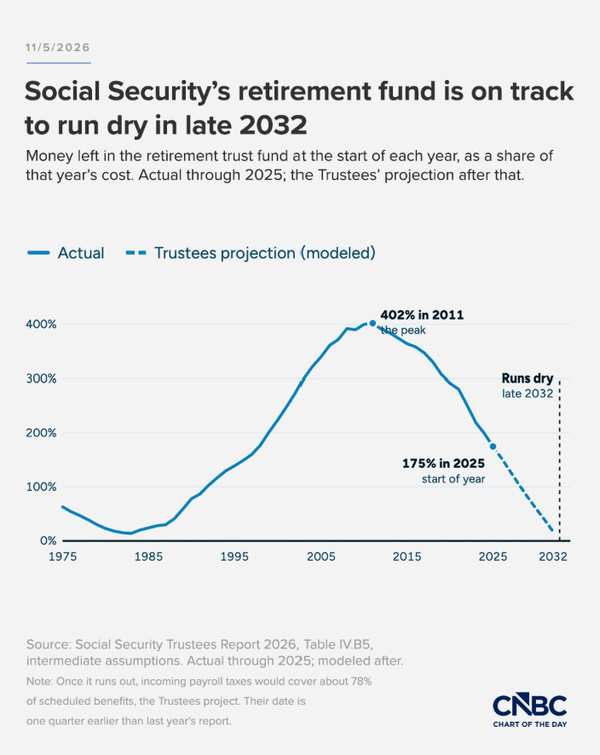
Social Security's retirement fund runs dry in late 2032: without action, benefits face an automatic cut of about a fifth in six years. The trust fund peaked at four times a year's costs in 2011 and was below two times at the start of 2025. The new Congress inherits the deadline, and with a 6% deficit there is no painless fix left. Source: CNBC, Social Security Trustees.
Visual Capitalist: The Chips Powering the AI Arms Race
This week's special dispatch follows the AI supply chain from the silicon and memory to the minerals, then to who earns the profits, who pays the bills, and which countries build and use the models. It lands in the week Nvidia reports without its founder and Anthropic, one of its biggest customers, goes public.
Infographic 1 - AI Chip Sales by Company
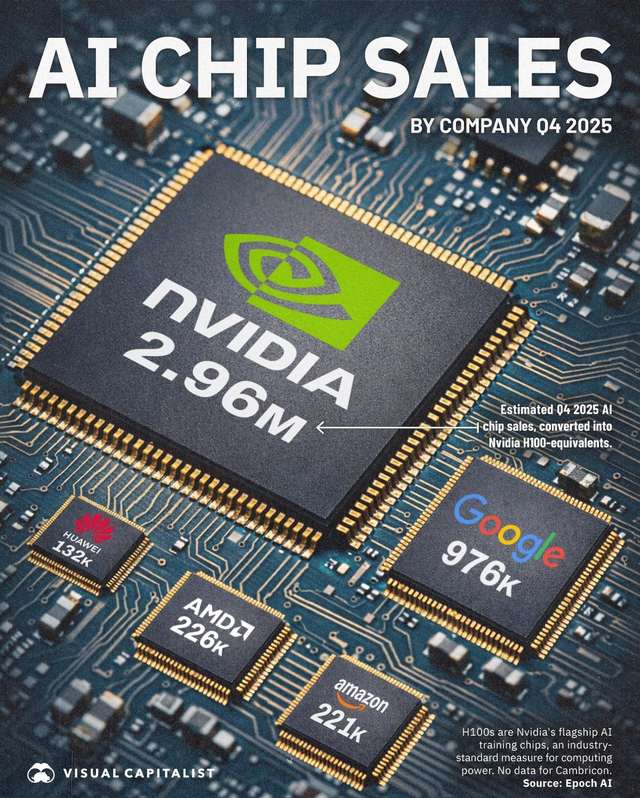
Nvidia shipped more computing power than its four nearest rivals combined: about 2.96 million H100 equivalents in the last quarter of 2025, against 976,000 for Google, the only challenger at scale. Alphabet rolled out two new TPU systems last week. A leadership vacuum at the top is the opening the challengers have waited for. Source: Visual Capitalist.
Infographic 2 - Memory Chip Makers by Market Cap
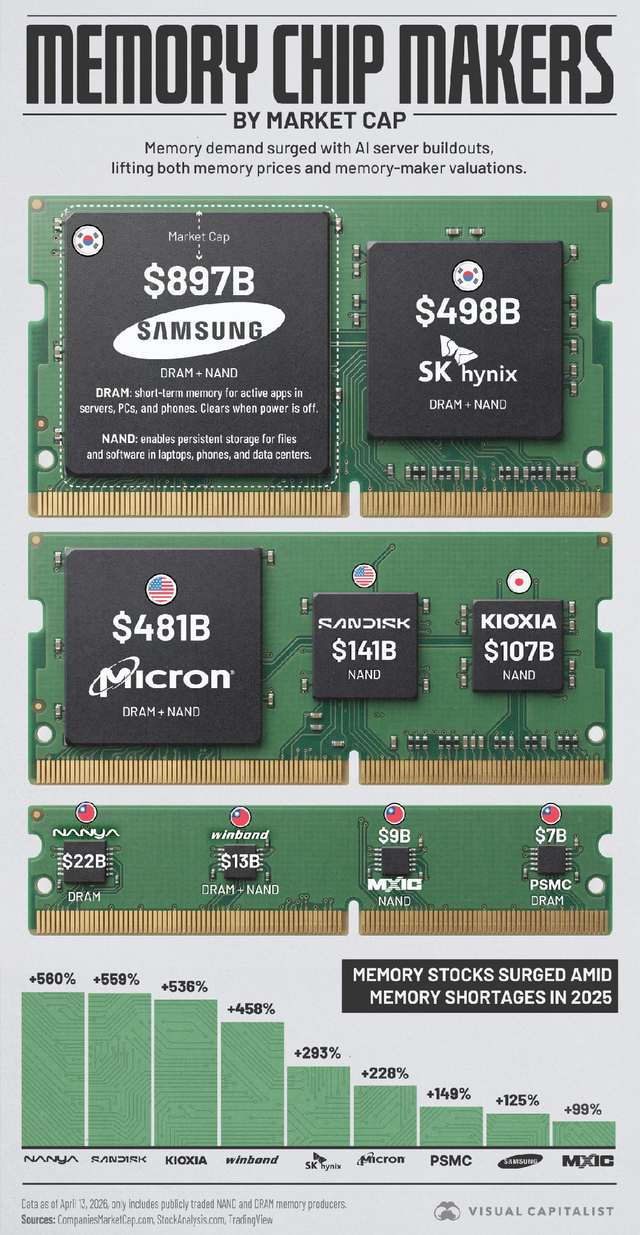
Memory is the bottleneck nobody priced: Samsung, SK hynix and Micron are worth about $1.9 trillion together, and SK hynix expects demand to beat supply through 2030. Asus said last week it can no longer pass on memory costs and is cutting laptops from 16GB to 8GB. The shortage is a tax on every device that is not an AI server. Source: Visual Capitalist.
Infographic 3 - Who Controls the Minerals Powering AI?
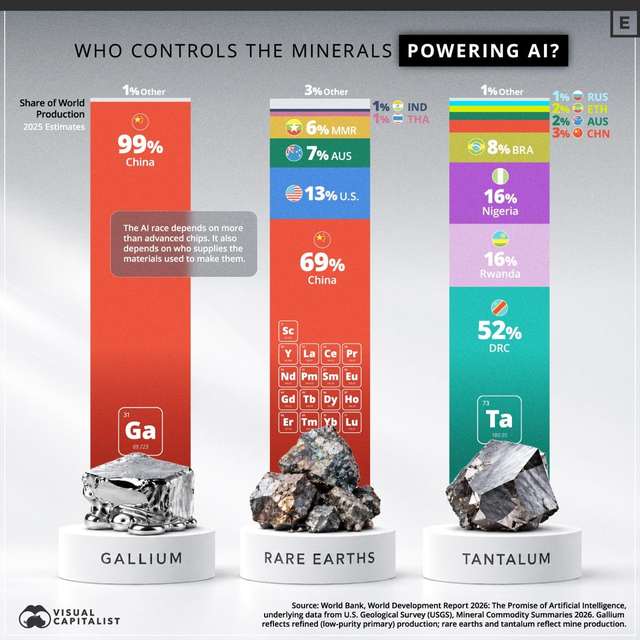
The AI race runs on materials one country controls: China produces 99% of primary gallium and 69% of rare earths, while Congo mines just over half the world's tantalum. Beijing has used that grip as leverage all year, and it arrives at APEC in Shenzhen with the card still in hand. Source: Visual Capitalist.
Infographic 4 - World's 30 Largest Companies, Profit per $100 of Revenue
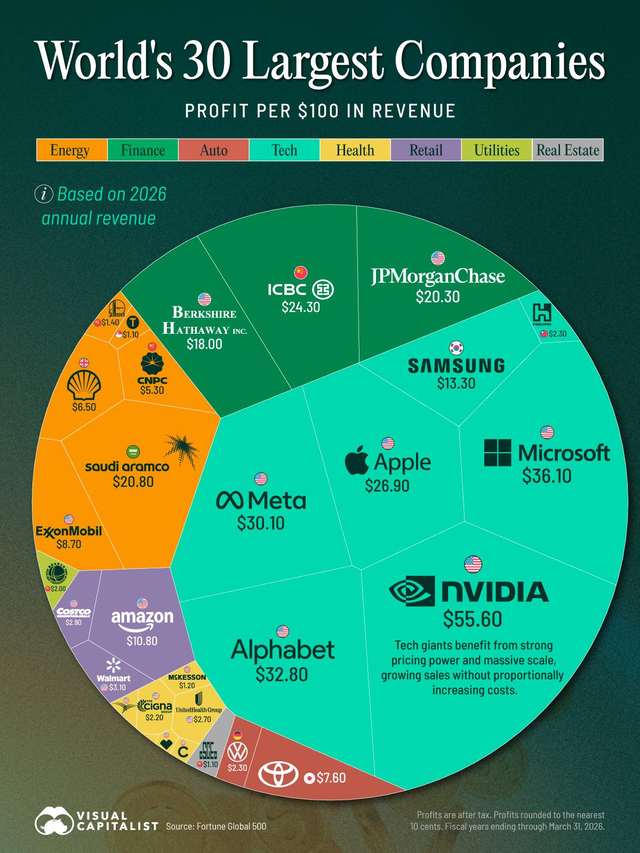
Selling the shovels is the best business in the world: Nvidia kept $55.60 of every $100 it sold, ahead of Microsoft at $36.10 and Alphabet at $32.80. Margins this high invite rivals, regulators and customers who design their own chips. This week's guidance is the first test of whether the margin survives the founder. Source: Visual Capitalist.
Infographic 5 - AI Company Costs
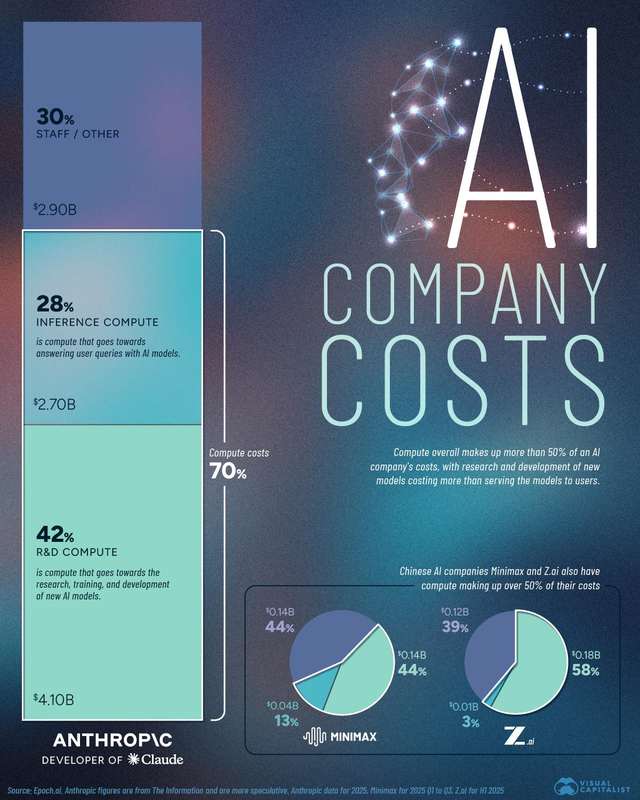
The labs spend most of what they raise on compute: about 70% of Anthropic's costs in early 2025 estimates. Its prospectus puts compute and infrastructure at $18.8 billion in the first nine months of 2026, 55% of operating expenses. The customers of the chipmakers are listing partly to keep paying the chipmakers. Source: Visual Capitalist.
Infographic 6 - The Countries Developing the World's AI Models
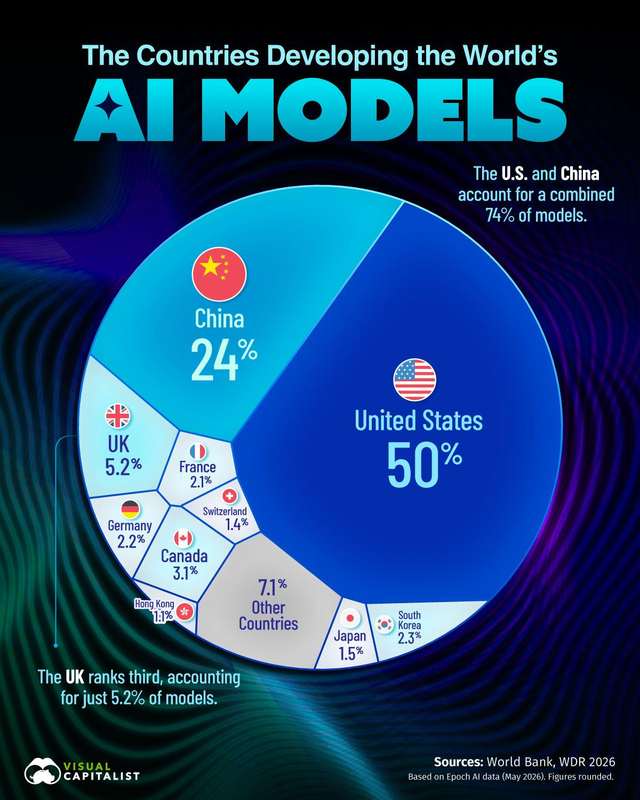
America and China build three of every four models: the US accounts for 50% and China 24%, with Britain a distant third at about 5%. Europe's absence is the story of a continent that regulates first and builds later. Source: Visual Capitalist.
Infographic 7 - AI Adoption by Country
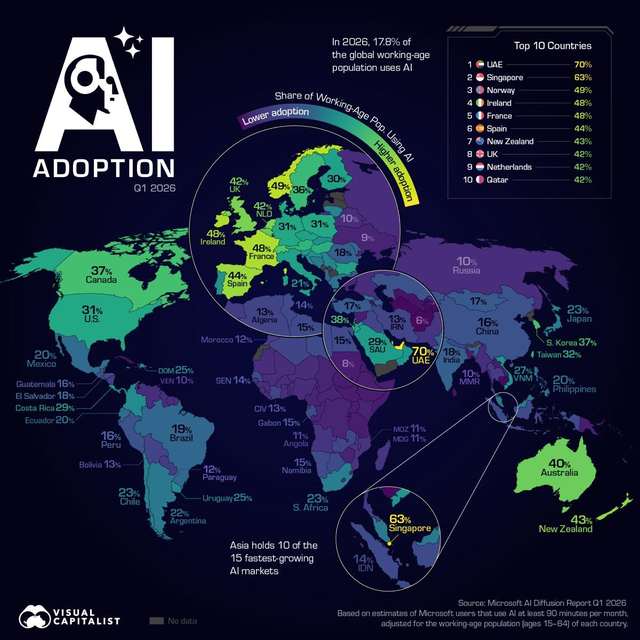
Singapore is the second-heaviest user of AI in the world: about 63% of working-age people use generative AI, behind only the UAE at 70%, while the US ranks 21st. The countries that build the models are not the ones that use them most. Small, wired, English-speaking hubs adopt fastest. Source: Visual Capitalist.
The Good Wrap
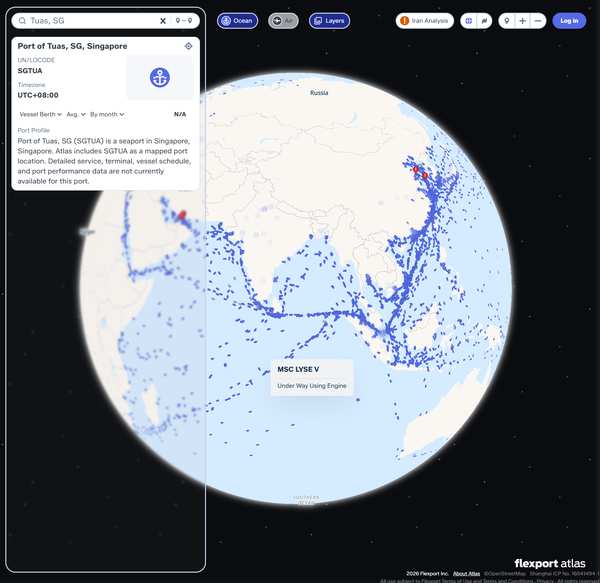
Everything we buy spends weeks at sea, and now you can watch it: Flexport's live atlas maps the ports, the shipping services and the individual vessels behind global trade. Type in Tuas, the world's largest fully automated port being built here, and follow the ships in and out. It is an absorbing hour, and a reminder of how much coordination sits behind a parcel at the door. Source: Flexport Atlas, via Visual Capitalist.
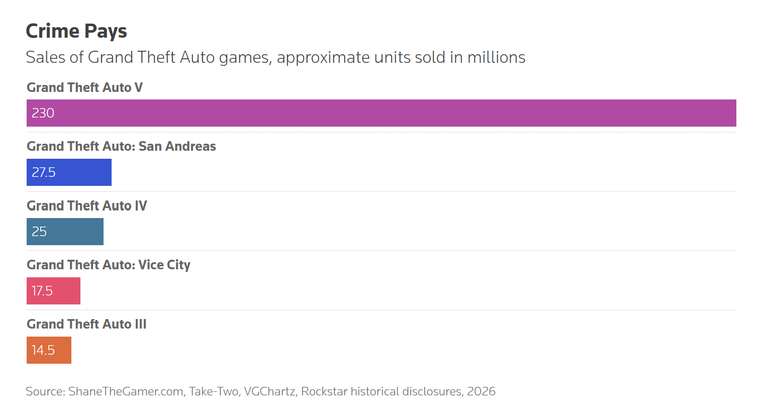
Crime pays, and it took 13 years: Grand Theft Auto VI arrives on Thursday, back in Vice City, on a budget reported near $1.5 billion, close to what the Burj Khalifa cost. GTA V sold about 230 million copies and made $10 billion, and the new one could take more than $5 billion in its first week. It may be the biggest consumer launch of the holiday season, and the cheapest night out for a lot of households. Source: Reuters.
Best,
Hoelon
WITPTW is a personal publication. Everything here is personal opinion and market commentary, written in a personal capacity. It is not investment advice and not a recommendation to buy or sell any security. It is not associated with, endorsed by, or representative of any employer, fund or company. Charts and images are reproduced from their original publishers, credited to their sources for commentary and discussion; all rights remain with the respective copyright holders.