The AI Circuit Breaker
Personal views and market commentary. Not investment advice. Not associated with any employer or firm.
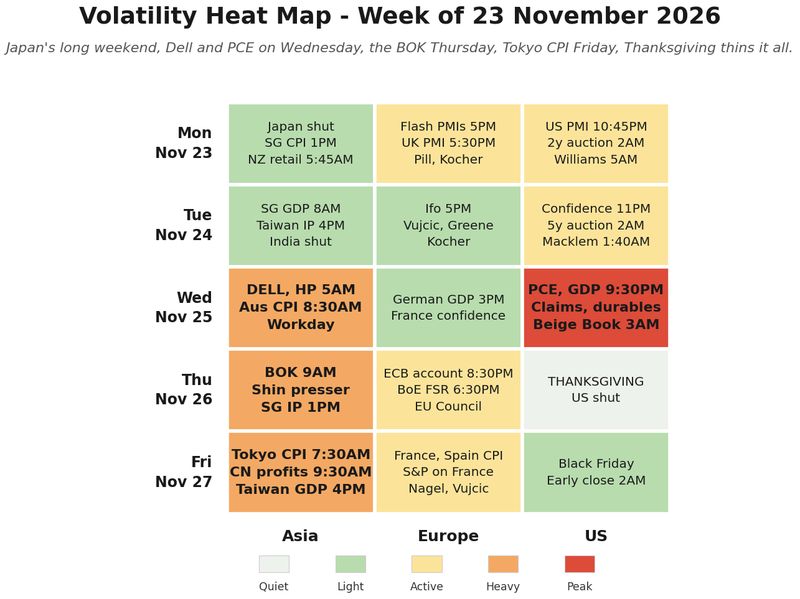
Volatility heat map for the week ahead, in Singapore time. A holiday-thinned week: India shuts on Tuesday, the US on Thursday for Thanksgiving with a half day on Friday, and the Fed's blackout starts on Saturday. The S&P enters near 6,910, the 10-year near 4.95% and Brent near $93.
"What a job President Xi has done. It's clean, it's immaculate." — Donald Trump, on Shenzhen, at a White House press conference, 20 November 2026. The China hawks now sit on the other side of the aisle. Trump came home calling Xi "a great man" and America's cities "rusty and disgusting." From 3 January, Democrats hold at least 258 House seats and 56 in the Senate, promising to be tougher on China and AI. Republican Don Bacon called it "another role reversal." Can Trump stop them? He has promised vetoes, again and again. An override takes two-thirds of both chambers, so about 32 House Republicans and 11 senators. China is the one issue that could find them: in January 2021, Congress overrode his veto of the defence bill. Meanwhile export rules stay his: no Blackwell for China, a tax on data centres abroad, and a wish that Nvidia rehire Huang.
"The demand for debt from rate-insensitive hyperscalers willing to pay whatever it takes has the potential to elevate the interest rates the government must pay." — Howard Marks, "A Layman Thinks About AI," Oaktree memo, 11 November 2026. Crowding out, in reverse. AI borrowing has reached nearly $600bn this year, over a fifth of US investment-grade supply, and AI bonds are now about 12% of the index. The hyperscalers can't slow down, so they take money at any price, and the Treasury pays the difference. Marks even asked Claude to rate how predictable each part of AI is; it gave the frontier labs a 2 out of 10, "practically unknowable." Anthropic listed on Thursday, rose 17%, and was back near its offer price by Friday. If more of the build is paid for in stock rather than bonds, long bonds get relief. How the bubble is funded is now a rates call. Read the memo.
"If you think this is still all about an affair and some politics, you're not thinking hard enough." — Michael Burry, on X, 19 November 2026. The scandal is the trigger, not the cause. The market blames the week on Jensen Huang's affair and the midterms. Burry's case is about money: billions spent on chips and data centres with no clear return, chips that may wear out before the debt against them is repaid, and GPU build-outs funded by private credit that leave lenders and insurers holding the risk if rental rates fall. He says he never told anyone to short, only gave them "the information one would need to sell." The Nasdaq 100 lost 10% last week, its worst since March 2020, and Nvidia, the stock he named first, has nearly halved from its October high.
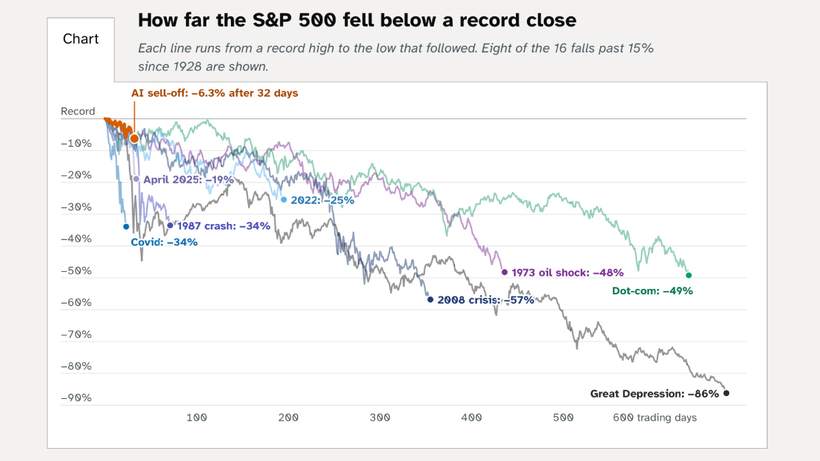
The world is in circuit-breaker mode, and the question is which crash this rhymes with: Kadoa lines up every S&P fall since 1928 from its record. When the chart was drawn the AI selloff was 6% deep; by Friday it was 11.6% below the October record, seven weeks in. Many pundits point to late 2018, when the Fed hiked into a 20% fall and turned within weeks. The dot-com bust went 49% deep over two and a half years, and chip stocks took nearly 18 years to regain their peak. Explore the interactive. Is this a 2018 scare that ends with the Fed, or a 2000 unwind that takes years? Source: Kadoa, via Visual Capitalist.
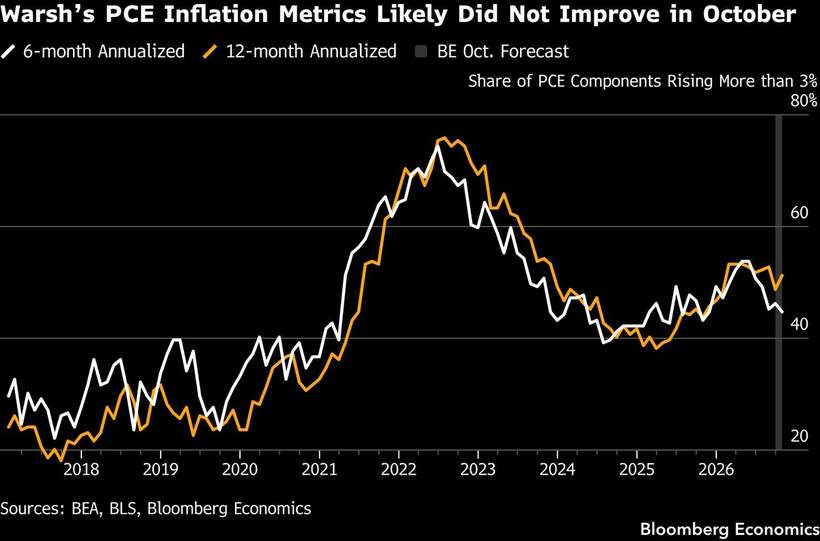
PCE, a Fed at risk of over-hawking, and the holiday season: about half of the PCE basket is rising faster than 3%, and Bloomberg Economics thinks Warsh's breadth gauges did not narrow in October. Core is seen at 0.3% on the month and 3.2% on the year, the last print before the 9 December decision. A hike is all but certain; the argument is 25 or 50, while stocks have fallen 12% and the 10-year has slipped back below 5%. The market is already doing some of the Fed's tightening for it. Source: BEA, BLS, Bloomberg Economics.
What is the plan this week?
Last week was the breaking point. For 21 weeks we have tracked the AI fracture, and here we are. It started with a simple question, whether AI's funding needs for 2027 could be met by its profits, at a time when everyone laughed at hacked supermarket fridges. Have we reached the point where VaR shocks and profit-protection selling carry on to the end of 2026? I still get calls to buy the dip, and the grand reason is that growth is still strong. But how much of that growth is equity wealth, especially AI-driven wealth? China's biggest buyers are starting to say it out loud: Tencent says its cash capex is near its peak, and Alibaba may shrink its data-centre build. The DXY pushed higher, explained by there being no alternative, but ended the week mixed: the yen and the krone gained, and collapsing US indices should in time send foreign money home. In 2000 the dollar kept rising for almost two years after the Nasdaq peaked, until January 2002; this time the lag should be shorter. We are not quite there yet, because markets still see this as a correction rather than a meltdown. We start the week with Japan on a long weekend, shut on Monday for Labour Thanksgiving Day after Friday's 5% fall in the Nikkei, so Tokyo's reaction waits until Tuesday.
The US week is short and crowded into Wednesday. PCE, revised third-quarter GDP, durable goods and claims all land at 9:30pm our time and the Beige Book at 3am; then New York shuts for Thanksgiving and Friday is a half day. A core PCE of 0.4% or more revives Waller's 50bp case and sends the dollar toward 104.6, where it would have retraced 61.8% of its slide since January 2025; 0.2% or less squeezes the crowded Treasury shorts. Williams on Monday is the only Fed speaker before the blackout starts on Saturday. Washington is the other risk. Steve Eisman says the biggest question is how far states slow data-centre building, and that a full moratorium "would put the country into recession overnight." Warsh himself conceded last week that an AI boom could bring "substantial labor market disruption."
Getting Europe right from here matters for trading macro: fiscal policy, politics, the ECB, the wars and the relationship with China, and what changes now that the Democrats have stormed back in Washington. Russia tested NATO again, with two missiles and a drone falling in eastern Poland near drills involving 11 nations. The data first. Monday's flash PMIs follow a run of euro-area numbers that have missed forecasts since October, and Germany's Ifo comes on Tuesday. On Thursday the ECB publishes the minutes of its October meeting. They should confirm a December hike to 2.75%, which the market prices at about 90%. The real question is whether December is the last one: oil and gas have fallen since October, and Lagarde's likely successor in February, Hernández de Cos, has been more dovish than the other contender. A softer path after December would weigh on the euro. On Friday France and Spain publish November inflation, which should ease on cheaper fuel, and that night S&P reviews France's rating, with French bonds already paying about 155bp over Germany. Then Spain votes on Sunday, and polls show the conservative PP and the far-right Vox winning a majority together.
Besides AI and tech, commodities are melting even faster and more painfully. Brent has lost about a fifth this month, and last week copper fell almost 10%, gold 9% to a 14-month low, silver and wheat followed, soybean oil dropped 6%, and arabica coffee sank to its lowest since June. What does that mean? China now faces a hawkish new US Congress while bidding farewell to a friendly Trump. Will it turn protectionist, and will it stop the yuan's appreciation bias? The PBOC is already capping the yuan near 6.70 to the dollar. Trump is definitely much more popular in China than in the US, judging by my reels feed on his visit last week. Friday's industrial profits will show who still earns in China.
In Asia, the Bank of Korea is likely to go ahead with a hike to 3.25% on Thursday, but how is it bracing for the AI valuation questions? And how are ASEAN countries dealing with a possible slowdown in data-centre demand? Since Thursday, US advanced chips bound for data centres in Malaysia, Singapore, Thailand and Indonesia need a licence when the customer is Chinese, and the projects built for Chinese tenants, most of them in Thailand and not yet financed, look most at risk. At home, Singapore has October CPI on Monday, final third-quarter GDP on Tuesday and industrial production on Thursday. Taiwan votes in local elections on Saturday.
The plan this week is to chase the dollar breakout, but by shorting the currencies with no defence rather than buying the dollar against everything. The theme is switching away from the dollar as the only alternative, because the link between a higher dollar and the AI trade could reverse. Asia's weaker current-account countries, the Philippines, Indonesia and Thailand, are in a tough zone, and the ringgit is caught in the AI complex. The Aussie's fall is still small next to the commodity meltdown. Thanksgiving liquidity is thin.
What did I learn last week?
Mon Nov 16: Japan's economy shrank 0.1% annualised against 0.3% growth expected, and China's October was soft everywhere: industrial output 4.8%, retail sales 0.4%, investment down 8.1% for the year. Washington now requires licences for US AI chips in overseas data centres that serve Chinese firms.
Tue Nov 17: Singapore's NODX jumped 79.8% and the RBA minutes confirmed a 6-3 split. UK unemployment fell to 4.6%. US retail sales rose 0.2% with the control group at 0.6%, import prices 1.1%, and industrial production fell 0.4%. After the bell Nvidia beat, guiding to about $130 billion against $125 billion, and rose 4% late before reversing.
Wed Nov 18: Bank Indonesia surprised with a hike to 6.00% after the rupiah hit a record low. UK CPI was 3.6% as expected, Malaysia's GDP was revised up to 5.5% and Japan's exports hit a record. The Fed minutes said "almost all" saw more hikes, and Waller said "you have to go 50" unless January is signalled. Anthropic priced at $83, above its range, and Trump and Xi met in Shenzhen with little agreed.
Thu Nov 19: Anthropic opened at $111.50 and closed at $97.17, raising $81.3 billion, the largest IPO ever. Trump, Xi and Putin agreed that nuclear war "cannot be won and must never be fought," with no arms-control talks. Australia's unemployment jumped to 4.9%, the Philly Fed fell to 6.3 against 20, and South Africa held 4-3.
Fri Nov 20: Japan's core CPI was 2.2% against 2.3% and China's loan rates were unchanged for an 18th month. UK retail sales rose 0.7%. Two Russian missiles and a drone fell in Poland. Reuters reported that the SEC's probe is examining Nvidia's accounting; the stock fell 14%, the S&P 3.7% and the Nasdaq 5.3%, and Cook said hikes are urgently needed.
Weekend: Iran's Guards claimed hits on US radars in Bahrain, two tankers were struck near Oman and the FT reported Trump is weighing new strikes. Trump called on Nvidia to reinstate Huang.
All week: The S&P fell 8.6% to 6,910, the SOX 17% and Nvidia 23%, and the VIX closed at 35.9. The 10-year fell 23bp to 4.95%, the DXY rose to 103.9, Brent fell 3.4% to $92.57, gold 9% to $3,520 and copper 10%; bitcoin broke $60,000.
What to look out for next week?
Mon Nov 23: Japan is shut for Labour Thanksgiving Day. New Zealand's retail sales at 5:45am and Singapore's October CPI at 1pm, headline seen at 1.9% from 2.2%. Flash PMIs from 4:15pm: the euro area after 51.7, the UK near 53, and the US at 10:45pm. Pill, Kocher and Simkus speak in Vienna. The $69 billion 2-year auction at 2am and Williams at 5am; Maybank reports, and HPE and Zoom after the US close.
Tue Nov 24: India is shut. Singapore's final third-quarter GDP at 8am after a 5.4% advance estimate, Japan's flash PMI, and Taiwan's industrial production at 4pm, seen near 22%. The Ifo at 5pm. Conference Board confidence at 11pm, seen at 92.1, with Case-Shiller and the Richmond Fed. Vujcic, Kocher and Greene speak, and Macklem at 1:40am. The $70 billion 5-year at 2am. Xiaomi, Medtronic, Best Buy and Dollar Tree report.
Wed Nov 25: Dell, HP, Autodesk and Workday land in the early morning, with Dell's options pricing a move near 12%. Australia's October CPI at 8:30am after 4.3%, with Bloomberg Economics at 4.8%. German GDP at 3pm. At 9:30pm: PCE seen at 0.3% and 3.8% a year, core at 0.3% and 3.2%; GDP revised to 3.5%; durables 0.5%; claims near 200k. New home sales at 11pm, the $44 billion 7-year at 12:30am and the Beige Book at 3am.
Thu Nov 26: The US is shut for Thanksgiving. The Bank of Korea at about 9am, seen hiking 25bp to 3.25%, followed by Governor Shin's press conference. Singapore's industrial production at 1pm. The Bank of England's Financial Stability Report at 6:30pm and the ECB's account at 8:30pm. EU leaders meet in Brussels through Friday on the budget and Ukraine's financing. Brazil's IPCA-15, Canada's payrolls, and the BOJ's Tamura and the Riksbank's Jansson speak.
Fri Nov 27: Tokyo's CPI at 7:30am, headline seen at 3.1% from 2.8%, China's industrial profits at 9:30am and Philippine trade. Taiwan's GDP at 4pm, seen at 14.4%. France's CPI and GDP at 3:45pm and Spain's CPI at 4pm, euro-area confidence and the ECB's consumer expectations. Nagel, Vujcic and Moulin speak. Black Friday: US stocks close at 2am Saturday. S&P reviews France, South Africa and Hungary, and Meituan reports.
Beyond next week
Nov 28-29: Taiwan's local elections on the 28th, when the Fed's blackout starts; Spain's snap election and the OPEC+ ministerial meeting on the 29th.
Dec 1-4: Huang's closed-door interview with three House committees on the 1st; the RBI from the 2nd to the 4th; US payrolls on the 4th.
Dec 8-11: The RBA on the 8th; the Fed, BoC and RBNZ on the 9th; US CPI and the SNB on the 10th; the US stopgap funding expiry on the 11th, with shutdown talk building.
Dec 16-18: The Riksbank and Bank Indonesia on the 16th; the ECB, BoE, Norges Bank and BSP on the 17th; the BOJ on the 18th.
Jan 3-10: The new Congress sits on the 3rd with Democrats controlling both chambers; the US-China trade truce expires on the 10th, with an extension tied to rare earths.
Feb 2027: The Treasury is expected to hit the $41.1 trillion debt ceiling, the first fight for the new Congress; estimates of the X-date, when extraordinary measures run out, cluster between October and December, with an early risk flagged for August.
G10 rates at a glance
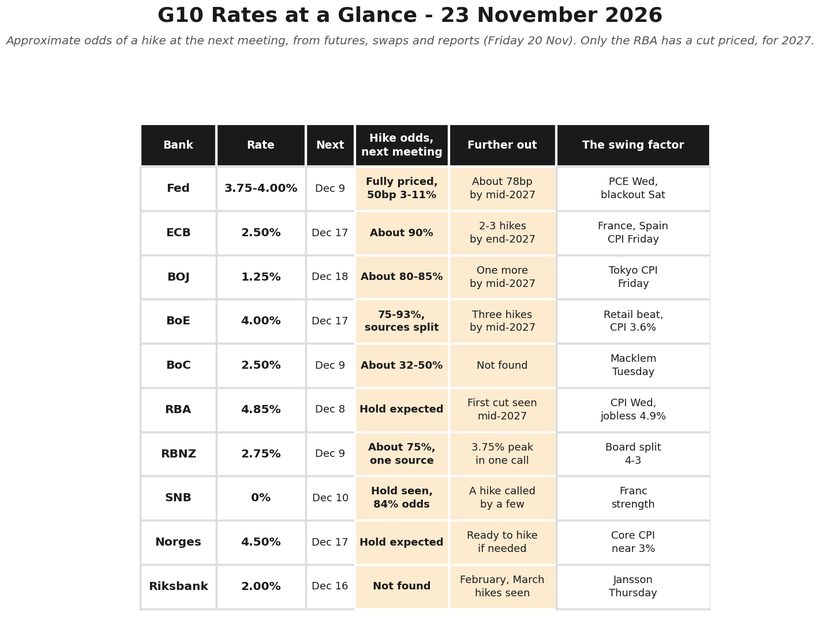
Every G10 bank that moves next is still moving up, even as stocks fall. The Fed is fully priced for December, with 50bp at a small minority since Waller's call. The BoE's odds firmed after the retail beat, though sources still disagree. The RBA is the outlier: after unemployment hit 4.9%, its next move priced is a cut, in 2027. The odds are snapshots from Friday's close or the latest reports; where we found no market price, the cell says so. Source: CME FedWatch, swaps and central bank statements as reported, Bloomberg Economics.
Regimes
The AI fracture, week twenty-one: the fracture becomes a break. Nvidia guided above expectations and still fell 23% in the week, nearly half below its October high, as Reuters reported the SEC is examining its accounting. The SOX is 43% off its June peak and over half the Nasdaq 100 is in a bear market. China's hyperscalers say their capex is near its peak, and Democrats promise to slow data-centre building. The question is no longer the demand, it is who pays for it. changed, week 21
The capital shortage, week fifteen: the lender of last resort steps back. The Bank of Nvidia is becoming more selective after Huang's exit, and SpaceX paid about 100bp over its own curve to sell $32 billion of chip-backed bonds. High-grade spreads widened 9bp in the week, Qualtrics' buyout bonds are bid in the 70s and CoreWeave's co-founder is buying its distressed bonds himself. Barclays sees record US corporate supply of $2.97 trillion next year. changed, week 15
The dollar breaks out, week two: the haven bid. The DXY touched a 19-month high and closed near 103.9 even as yields fell 23bp, a haven bid on top of the rate story. The yen and the krone were the only exceptions in the G10; high-yielding emerging currencies were hit hardest, the Mexican peso by 2.7%. Asia's deficit currencies still feel it first, the rupiah at a record low despite a hike. changed, week 2
The hiking chorus, week four: the chorus sings into a crash. The minutes said "almost all" Fed officials see more hikes, Waller wants 50 and Cook says it is urgent, with about 78bp priced by mid-2027. Bank Indonesia hiked in surprise and the Bank of Korea is expected to follow on Thursday. The first voices are turning: Australia's unemployment jumped to 4.9% and the market now prices an RBA cut in 2027. changed, week 4
The funding-currency battle, week ten: the yen finds a haven bid. USDJPY turned back from 160 to 158.5 as risk soured, without Tokyo having to intervene, and a December BOJ hike is priced at about 80-85%. The PBOC is capping the yuan near 6.70 and buying dollars to do it. The test this week is Tokyo's CPI on Friday, with Japan shut on Monday. changed, week 10
Europe's weak links, week three: Russia at the door. Two Russian missiles and a drone fell in eastern Poland near NATO drills, and the euro sits near $1.096, short of the $1.088 retracement. The French premium over Germany is near 155bp, S&P reviews France on Friday and Spain votes on Sunday. The EU-UK reset is the one European story going the other way. changed, week 3
The war is the inflation, week eighteen: the floor breaks. Brent fell to $92.57, about a fifth lower in November, in a commodity liquidation that took copper down 10% and gold to a 14-month low. The risks have not gone: Iran's Guards claim strikes on US radars in Bahrain, tankers were hit near Oman, the Houthis claim a hit on a Saudi pipeline station and Trump is weighing new strikes. Oil is now pricing a demand problem, not a supply one. changed, week 18
Surplus versus deficit, week thirteen: Shenzhen punts. APEC left the 10 January truce expiry unresolved, China kept its rare-earth licensing and Washington kept its new chip rules, with no new farm purchases. China's exports to the EU hit a record and Brussels is preparing a tool to hit back. The PBOC capping the yuan says Beijing will not pay for the surplus with its currency. changed, week 13
The lame duck, week three: the shutdown clock. Trump is praising Xi, calling on Nvidia to reinstate Huang and threatening a "tremendous tax" on firms that build data centres abroad. The stopgap funding runs out on 11 December, with no deal and fights over Iran and defence. A president with less to lose at home now has a budget fight before the new Congress even sits. changed, week 3
Shifts (if then)
Last week Nvidia guided above $125 billion and still broke $140, so the second leg started; Anthropic priced above range and traded up, then gave it back; UK CPI at 3.6% hit neither branch; the yen stayed under 160 without intervention; Bank Indonesia hiked; Shenzhen brought neither a deal nor a row. This week the scripts are PCE, Dell, the Bank of Korea, Tokyo's CPI, S&P on France and the Nasdaq's 20% line.
Core PCE at 0.4% or more → 50bp in December is back on the table, the 2-year rises and the dollar runs to 104.6, with the rupiah and the peso the first casualties; 0.2% or less squeezes the crowded Treasury shorts, the 10-year heads toward 4.75% and an oversold market gets its bounce. new
Dell raises its AI-server outlook and holds $325 → the hardware floor is in and the SOX can rebuild from 8,400; a cut to guidance or a break of $325 says the second leg has further to run, toward the 2025 lows. new
The Bank of Korea hikes and its dots lean toward 3.75% → the won outperforms Asia even with the KOSPI under pressure; a hold or a soft message joins the won to the deficit currencies' slide. new
Tokyo's core CPI at 2.9% or higher → December is locked in for the BOJ and the yen extends its haven bid toward 157; 2.7% or lower takes USDJPY back to 160 and the intervention risk with it. new
S&P cuts France on Friday → the French premium goes back above 170bp and the euro breaks $1.088 into Spain's vote; an affirmation lets the spread drift toward 140bp. new
The Nasdaq 100 closes 20% below its high → the bear market is official, risk models force another round of selling into thin holiday trade and VIX holds above 35; a hold of the line lets late-November seasonality, which usually favours a rebound, do its work. new
Tails
Nvidia's probe reaches Singapore → the SEC is now examining Nvidia's accounting, California has subpoenaed it, and US chips for data centres in Singapore, Malaysia, Thailand and Indonesia need licences when the customer is Chinese. A finding against Singapore-based intermediaries would hit the data-centre pipeline and the Singapore dollar's AI premium at once. changed, week 2
A cyber outage hits the payment rails → banks, Zelle and an NSA network went down last week, and customer data from card networks and a big bank was reportedly leaked. An outage that froze settlement for a day would leave solvent banks short of cash, a liquidity event rather than a tech story. changed, week 4
Strikes on Iran resume → Iran's Guards claim hits on US radars in Bahrain, two tankers were struck near Oman and the FT reports Trump is weighing new strikes. With oil a fifth lower in November and positioned for peace, a strike would hit the market at its least prepared. new, week 1
A neo-cloud defaults → CoreWeave's bonds have slid to levels that typically signal distress, Optimum has skipped an interest payment and the Bank of Nvidia is pulling back. A missed payment by an AI borrower would reprice every data-centre bond at once. changed, week 6
Russia tests NATO in Poland → two missiles and a drone fell near drills involving 11 nations, and Tusk called it a provocation. Another incident, or a hit on allied troops, would put the zloty and CEE assets in the war-risk bucket overnight. changed, week 3
A BOJ surprise → with Tokyo's CPI seen above 3%, a hawkish signal into December, or an intervention if the yen slips back to 160, would force the carry trade to unwind while equities are still falling. held, week 3
Deposit flight from France → the French premium is near 155bp and S&P reviews the rating on Friday. A visible run on French banks would turn a spread problem into a euro problem. changed, week 5
The LGFV crack spreads → if a second local-government issuer misses after Huafa, China's onshore credit market reprices and the PBOC is forced into a visible rescue while it caps the yuan. held, week 4
The kingdom's trillion gets cut → the Houthis claim a hit on an East-West pipeline pumping station. If the kingdom redirects money home, its pledges to US AI and its Treasury holdings both shrink. changed, week 6
A hit on Abqaiq → the Houthis now aim at the pipelines. A hit on Saudi Arabia's main processing plant would take millions of barrels a day offline in an afternoon, and with oil at two-month lows nobody is hedged for it. changed, week 7
Kyiv's leader pushed out → Shenzhen produced a statement on nuclear war but nothing on Ukraine, while Russia kept striking. A settlement over Kyiv's head would split Europe's sanctions front. held, week 7
AI broken: what can save the trade?
It was a month of back-to-back punches: Huang's ouster, the Democrats' sweep, and an Anthropic listing that was meant to change the mood and did not. Anthropic's own numbers show weakening pricing power for frontier intelligence: demand is enormous, but customers will not yet pay enough to justify the spending. Instead of finding reasons to buy, investors keep finding reasons to sell, from grounded flights to hacked banks.
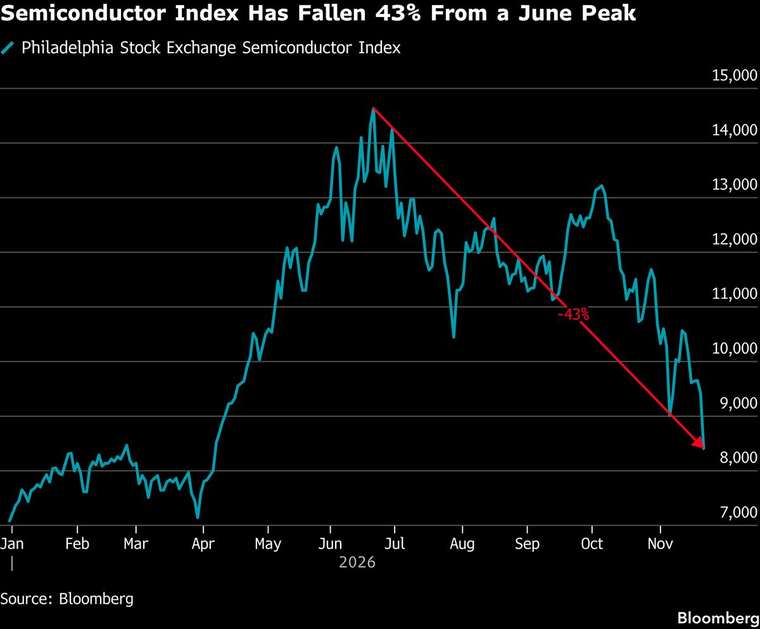
Chips are a cycle after all: the SOX more than doubled in the first half on the belief that AI demand would break the cycle, then lost 43% from its June peak. Memory fell hardest: Sandisk led the S&P in the first half, up 857%, and is its worst stock in the second, down 72%, while Micron is off more than half. Yet DRAM and HBM are still in short supply and prices are stable. The stocks are pricing a glut that has not arrived. Source: Bloomberg.
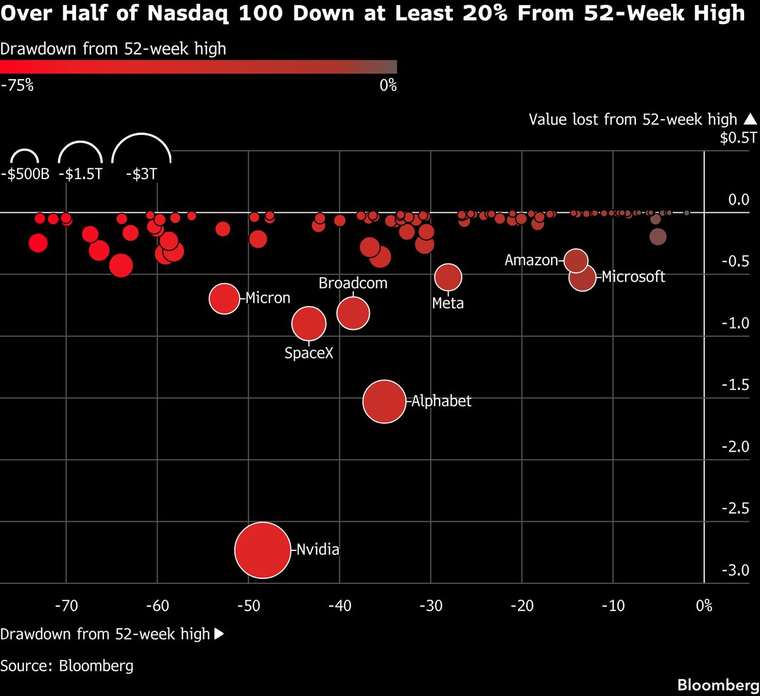
Over half the Nasdaq 100 is in its own bear market: more than half the members are at least 20% below their 52-week highs. Nvidia alone has lost close to $3 trillion of value, with Alphabet, SpaceX, Broadcom, Micron and Meta behind it. The index itself closed just short of the 20% line on Friday, after crossing it during the day. When the generals fall this far, the index rarely holds the line for long. Source: Bloomberg.
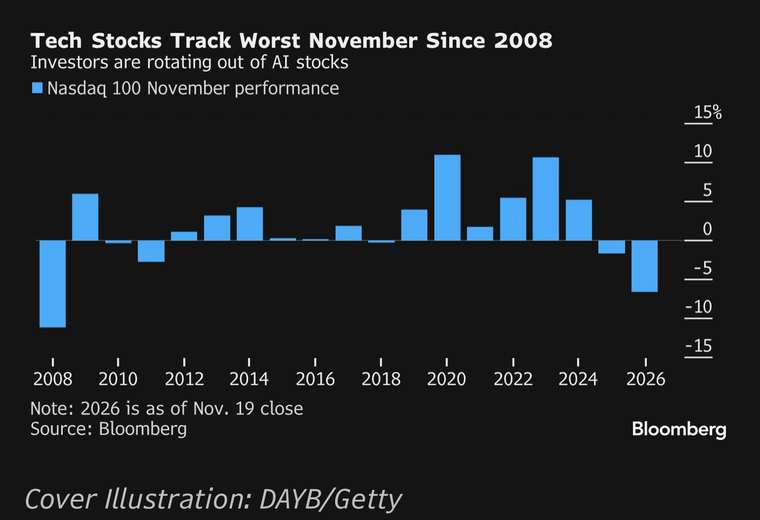
The worst November for tech since 2008: November is usually one of the strongest months, and this one had the Nasdaq 100 down more than 6% by the 19th, before Friday's 5.6% fall. Late November into Thanksgiving has historically favoured a rebound, one study putting the typical climb back to the high at 9%. The bulls are counting on the calendar; the calendar has not met a VIX near 36 very often. Source: Bloomberg.
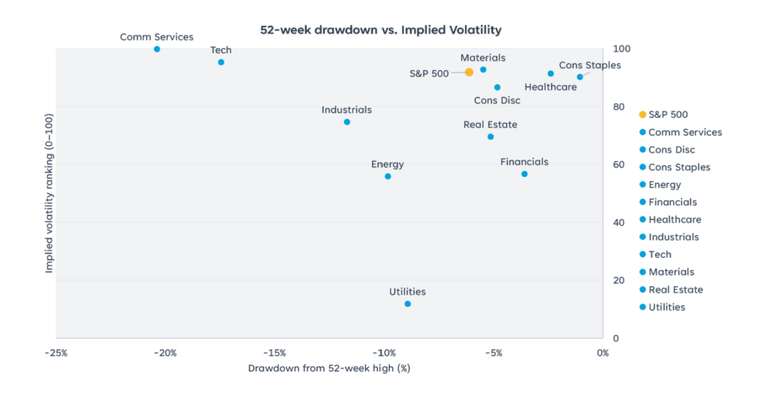
Tech and communications are the most volatile and the furthest from their highs: one strategist argues that with the technical damage done, oversold conditions and extreme implied volatility mean a lot of uncertainty is already priced, and that if momentum steadies, falling volatility could carry a recovery. Utilities and staples sit in the opposite corner. But the rotation into defensives reversed last week, when staples and healthcare rolled over too. When everything is sold, there is nowhere to rotate. Source: Fortune.
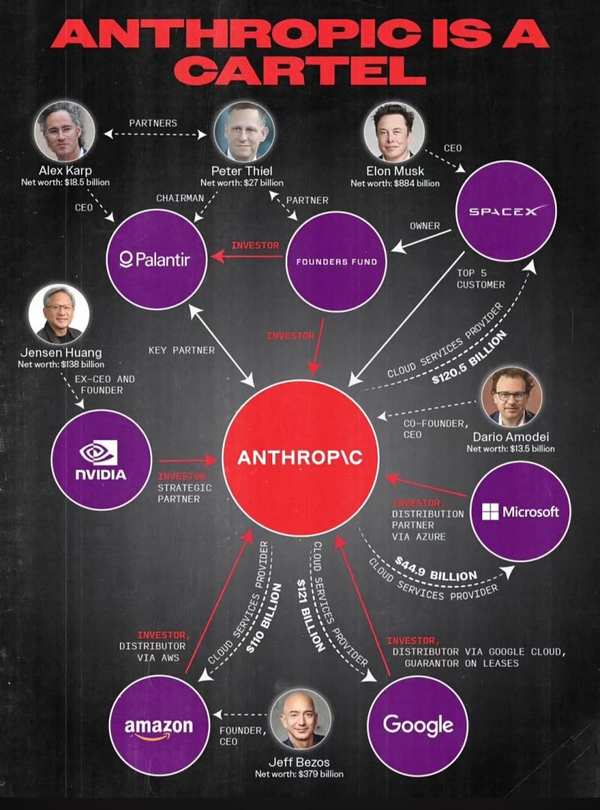
Anthropic's investors are also its suppliers and its shop window: it raised $81.3 billion publicly plus $26 billion privately from its tech partners, then signed roughly $900 billion of long-term compute commitments. Nvidia, Amazon, Google and Microsoft invest in the lab, sell it chips and cloud, and distribute its models, so the hyperscalers lock in demand for their data centres whichever model wins. Is that the flywheel that scales frontier AI, or concentration risk if enterprise returns arrive late? Source: Infographic shared on social media.
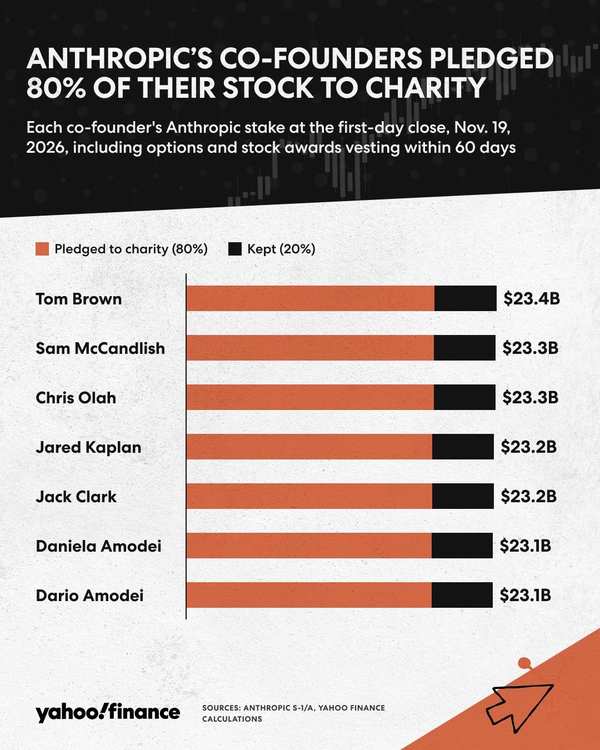
Anthropic's seven co-founders pledged 80% of their stock to charity: each stake was worth about $23 billion at the first-day close, including options vesting within 60 days. Ashton Kutcher's former firm turned $435 million into about $6 billion, while FTX's estate sold a stake now worth more than $40 billion for $1.3 billion in 2024. Yahoo Finance has the story. By Friday the stock was at $88.30, a few dollars above the offer. Source: Yahoo Finance.
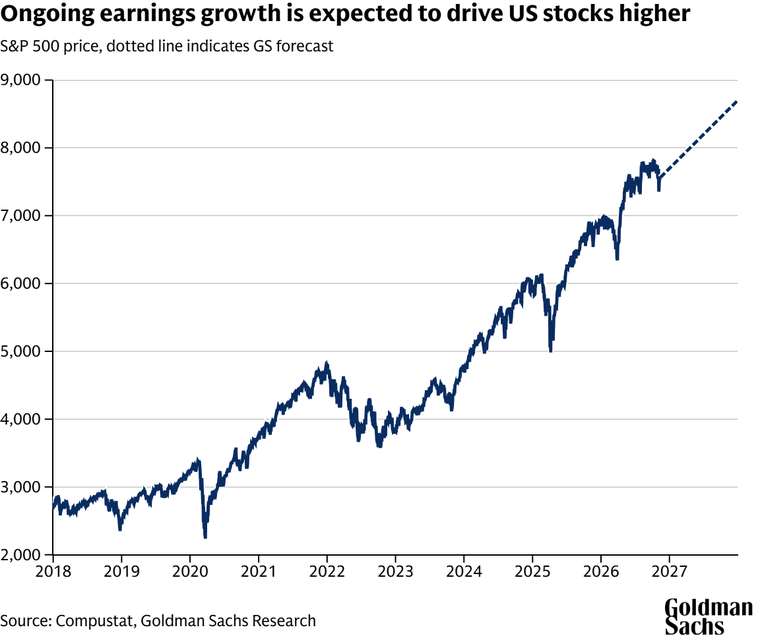
Not everyone has given up on 2027: one of the big houses still sees the S&P delivering an 18% total return through the end of 2027, with earnings growth slowing to 11% from about 30% this year. AI capex produced about half of this year's earnings growth and that impulse shrinks as capex slows, so it expects investors to rotate: to the next AI beneficiaries such as the hyperscalers that monetise, to buyback aristocrats, to quality and momentum, and to defensives. The forecast is dated 17 November, before the worst of the week. Source: Compustat, Goldman Sachs Research.
The chip underworld: Alice Huang's network
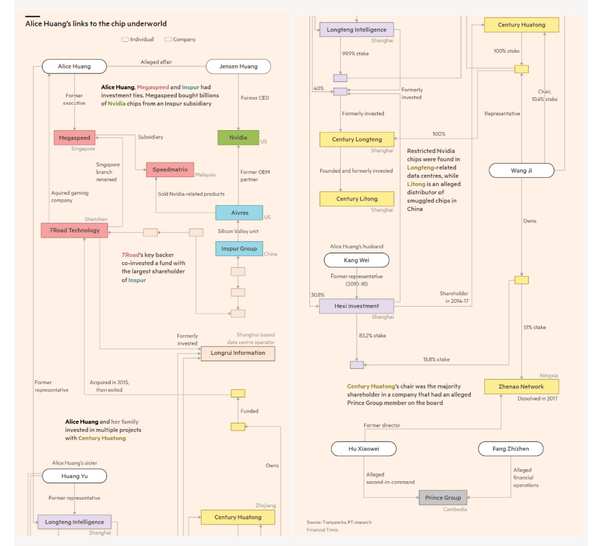
The FT traced how Nvidia's chips reached China: a web of companies linked to Alice Huang, the former Megaspeed executive romantically linked to Jensen Huang, ran from Inspur's renamed US unit Aivres, through Megaspeed in Singapore and its Malaysian subsidiary, which imported about $4.6 billion of goods from Aivres in a year, to a distributor in Shanghai, with links to an alleged Cambodian crime syndicate. Nvidia says it blocked Megaspeed in 2025. Some US officials suspect Alice Huang was a spy, which Beijing calls a smear. If Washington puts a lid on Southeast Asia, where do the chips go next? Source: Financial Times.
Funding the build: SpaceX's chip bonds
How do you finance chips that last about five years without wrecking a balance sheet? SpaceX's answer, Project Saturn, was a special vehicle that buys Nvidia's chips, leases them to SpaceX for five years and sells bonds against the lease, about $44 billion in all.
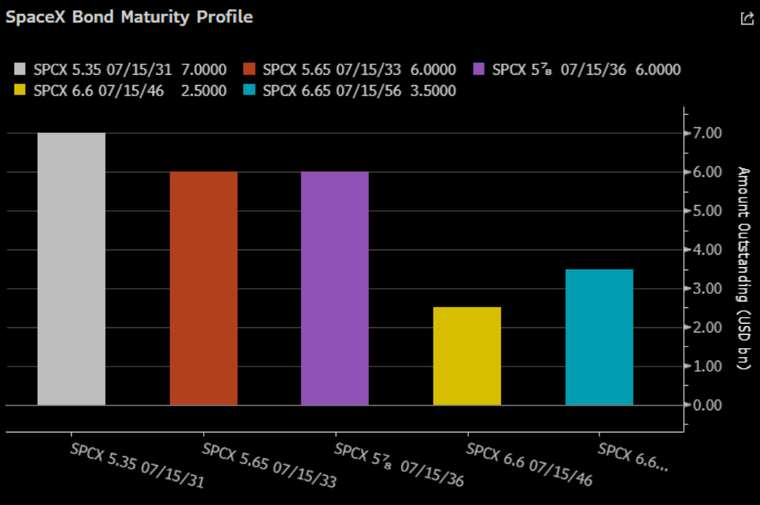
SpaceX's own bonds: about $25 billion across five maturities from 2031 to 2056. The new chip-backed notes priced at 3.45 points over Treasuries, a yield near 8.3%, against about 7.2% on SpaceX's own 2031s: roughly a point more for debt rated a notch higher, A3 at Moody's, thanks to hell-or-high-water lease clauses. Lenders even tried to bar Musk from launching their collateral into orbit for his space data centres. Source: Bloomberg.
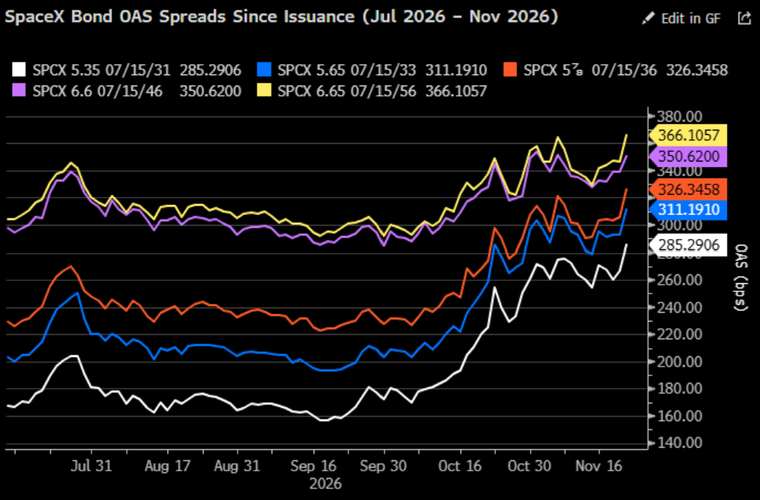
And those bonds have been widening since October: the spread on SpaceX's 2031s has gone from about 160bp to 285bp, and on its longest bonds to 366bp. Pimco took $4 billion of the new deal and BlackRock and KKR anchored it, so the demand is there, at a price. Some $1.5 trillion of chips still need buying, much of it with debt, and only the $8.3 trillion high-grade bond market is deep enough. The price of that money rises every week. Source: Bloomberg.
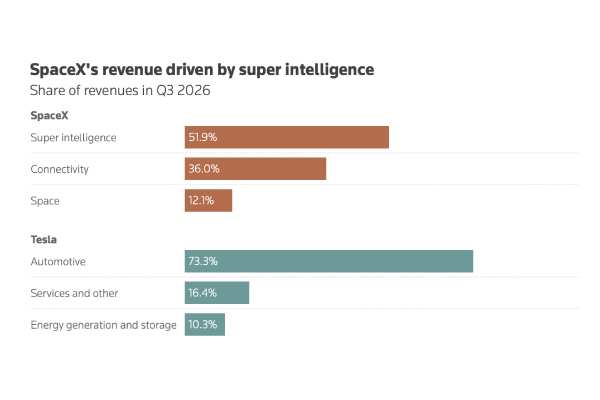
Super-intelligence is already half of SpaceX's revenue: 51.9% in the third quarter, ahead of connectivity at 36% and space at 12%, while Tesla still earns 73% from cars. That is the logic of a merger in Musk's eyes, and the reason lenders care where the chips end up. Reuters explains the merger. Source: Reuters, via Visual Capitalist.
Data centres: the jobs, the politics and the licences
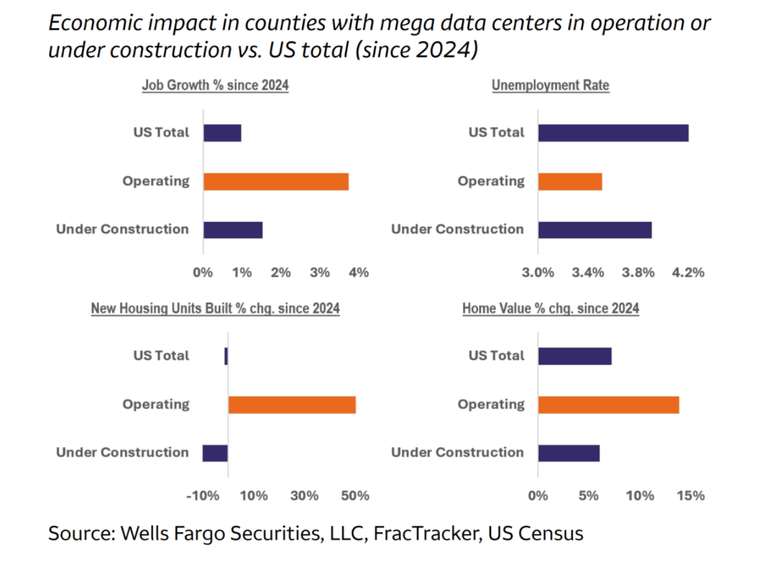
Where data centres go, jobs follow: a study of about 200 US sites of 500 megawatts or more finds that counties with operating mega data centres have had faster job growth, lower unemployment and more homes built since 2024. Its authors expect the political opposition to recede, and say Texas, with 27% of the country's planned capacity, is the state to watch. Many of the Democrats who won this month campaigned on the opposite. Source: Wells Fargo Securities, FracTracker, US Census.
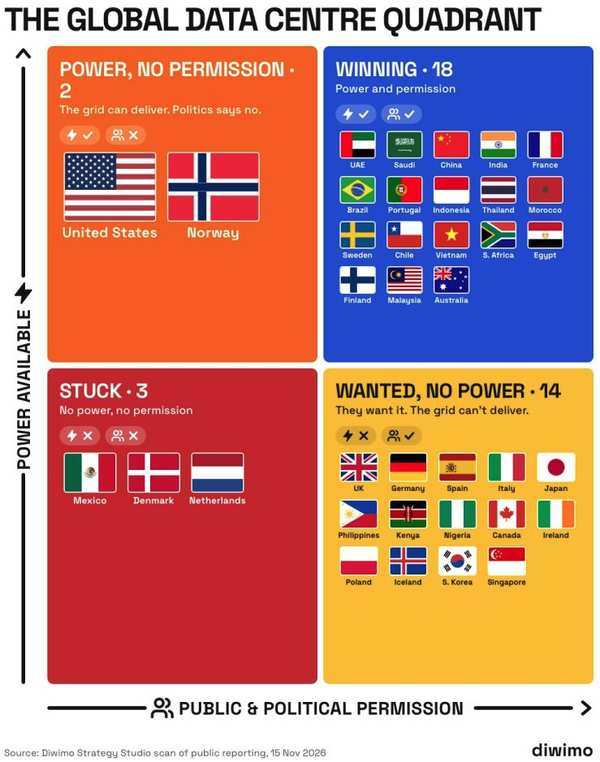
Only 18 of 37 countries have both the power and the permission: the US and Norway have the power but face opposition, while Britain, Germany, Japan, Singapore and ten others have the welcome but not the grid. Malaysia, Thailand and Indonesia sit among the winners. Since Thursday, though, US chips for data centres there, and in Singapore and Brazil, need a licence when the customer is Chinese, and renting them remotely to Chinese firms does too. The winners' corner now depends on who the tenant is, not just on the grid. Source: diwimo, via Visual Capitalist.
Monday: Japan's day off, and the flash PMIs
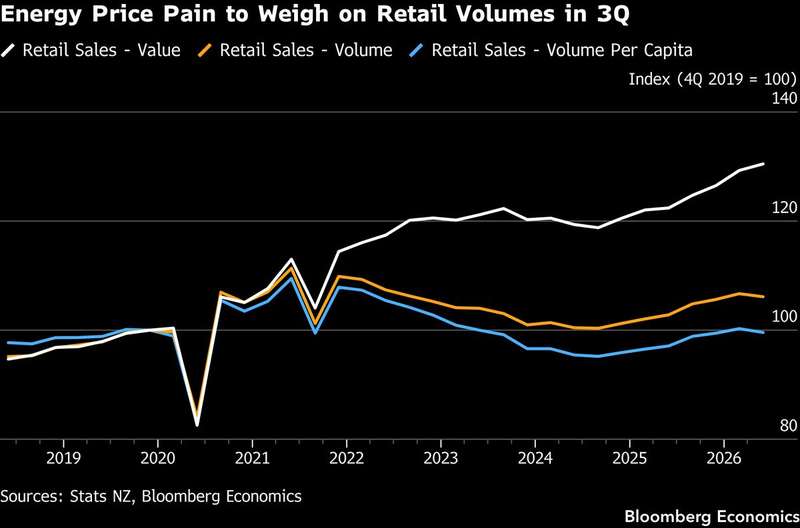
New Zealanders are spending more and buying less: retail values keep climbing while volumes per head sit below 2019, and third-quarter volumes probably fell as fuel prices and weak confidence bit. The Iran war shock derailed a recovery that rapid rate cuts had started. The RBNZ meets on 9 December with its board split 4-3. Source: Stats NZ, Bloomberg Economics.
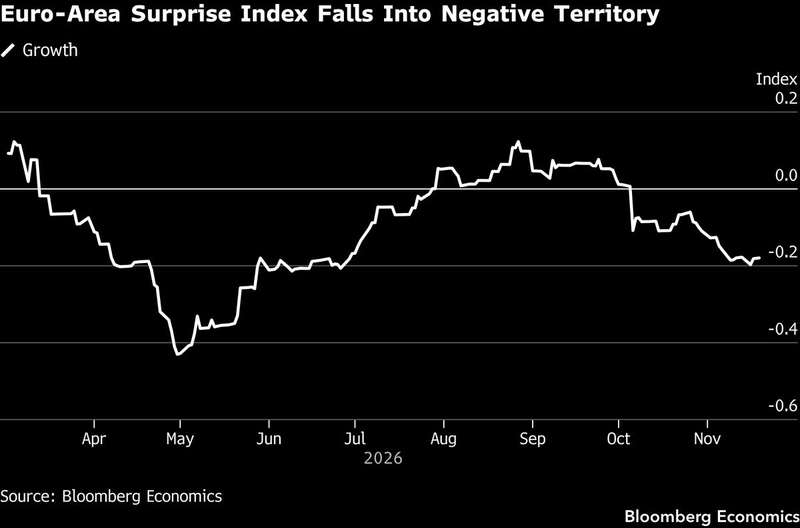
The euro area has stopped surprising on the upside: the growth surprise index fell below zero in October and has stayed there, dragged by industrial production and German trade. The composite PMI slipped to 51.7 in October, and the energy shock plus higher sovereign yields after France's bond turmoil could take it lower. That is the backdrop for an ECB that still plans to hike in December. Source: Bloomberg Economics.
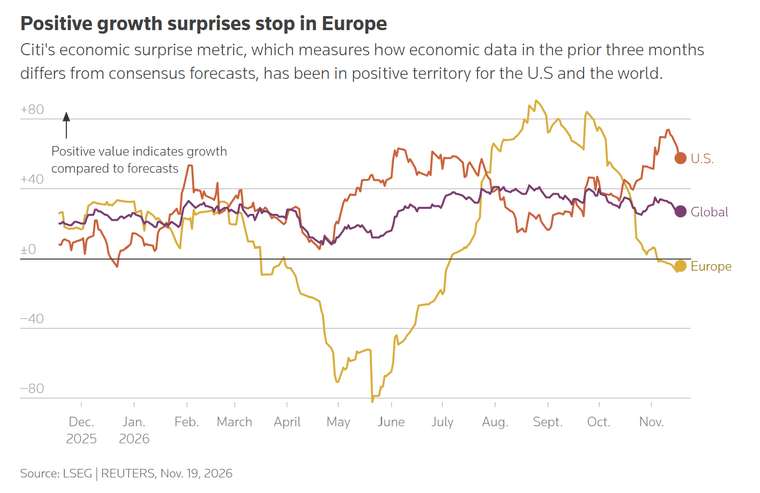
America still surprises, Europe no longer does: economic data have beaten forecasts all year for the world and strongly for the US, where the PMI's price components now matter most after three months of CPI above 0.4%. In September a hot PMI took the 10-year from about 4.95% to 5.3% within weeks. A repeat on Monday night would land on a falling stock market. Source: LSEG, Reuters.
Tuesday: housing, factories and a gloomy consumer
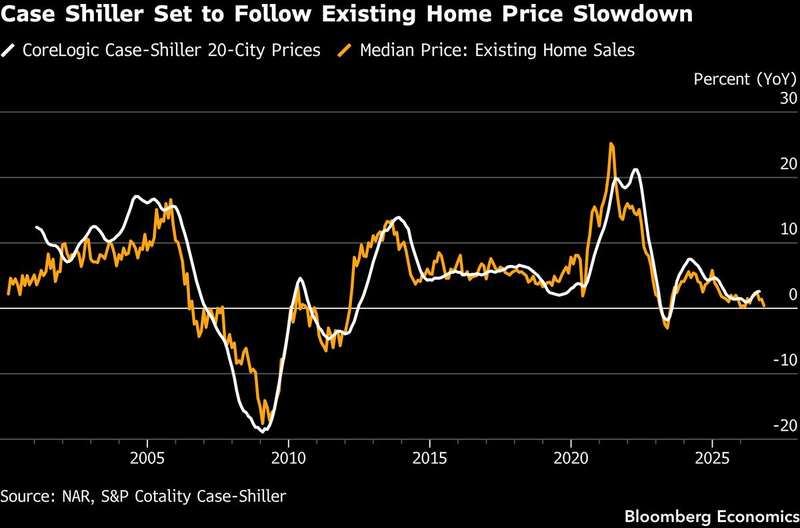
Home prices are flattening: the median existing-home price rose only 0.4% in October from a year earlier, and sales fell 5.5% to 3.75 million, a 16-year low. Case-Shiller, seen near 2.7%, lags by months. With mortgage rates above 7%, housing already behaves as if the Fed had won. Source: NAR, S&P Cotality Case-Shiller, Bloomberg Economics.
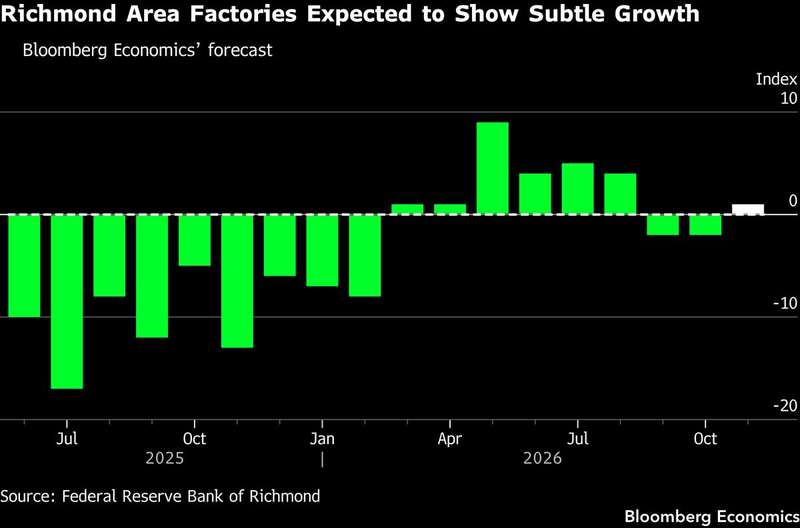
Richmond's factories may be stabilising: a rise to about +1 from -2 would be a marginal expansion after two negative months, though new orders, 40% of the index, probably stay negative. The district has lagged other regional surveys, and last week's Empire and Philly prints both disappointed badly. Source: Richmond Fed, Bloomberg Economics.
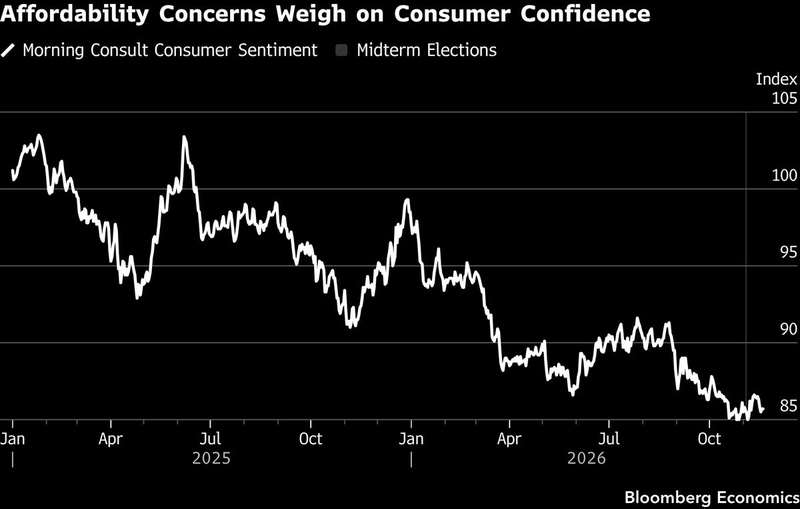
Consumers were gloomy before the market fell: confidence is seen near 92, weighed down by affordability, and weekly surveys showed sentiment barely moved around the midterms, only swapping between the parties. November's survey closes before most of last week's fall in stocks, so December's will show whether the wealth effect has turned. Source: Morning Consult, Bloomberg Economics.
Wednesday: Dell in the morning, PCE at night
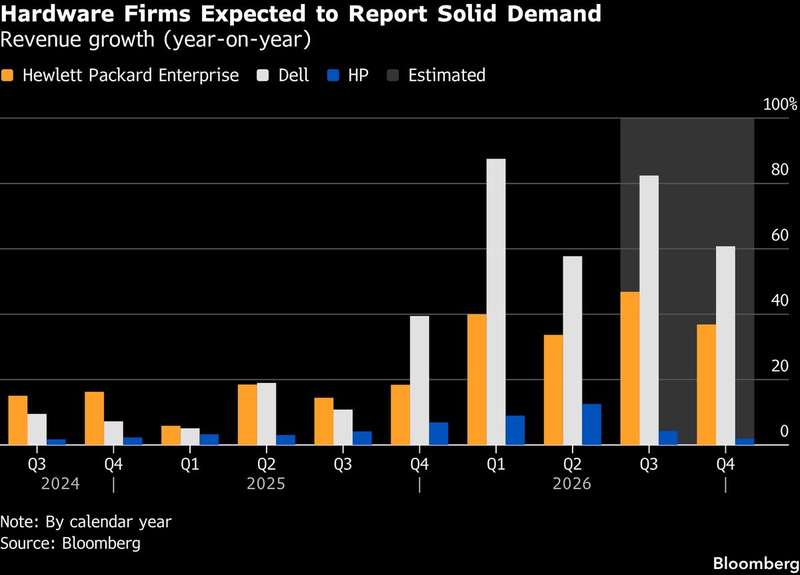
AI hardware has never sold so well: Dell's AI-server revenue is forecast to more than triple to a record $19.3 billion, and HPE's revenue to grow 47%, the most since its 2015 split. Most near-term projects are already permitted or under construction, so this year's orders should hold. The question on the calls is 2027, after Huang's exit, with dearer components and a Congress that wants fewer data centres. Source: Bloomberg.
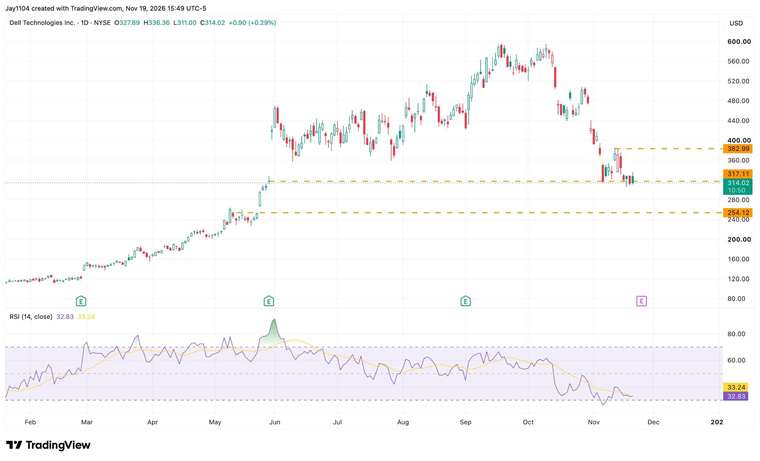
Dell sits on support: the stock is holding around $325 with a possible bullish divergence on the RSI; a break opens $300, while a rally after the results could reach $383, where it peaked on 11 November. Options price a move near 12.5%, with puts clustered at $300-310 and calls capping near $400. Revenue is seen up 82% to $49.2 billion. Source: TradingView.
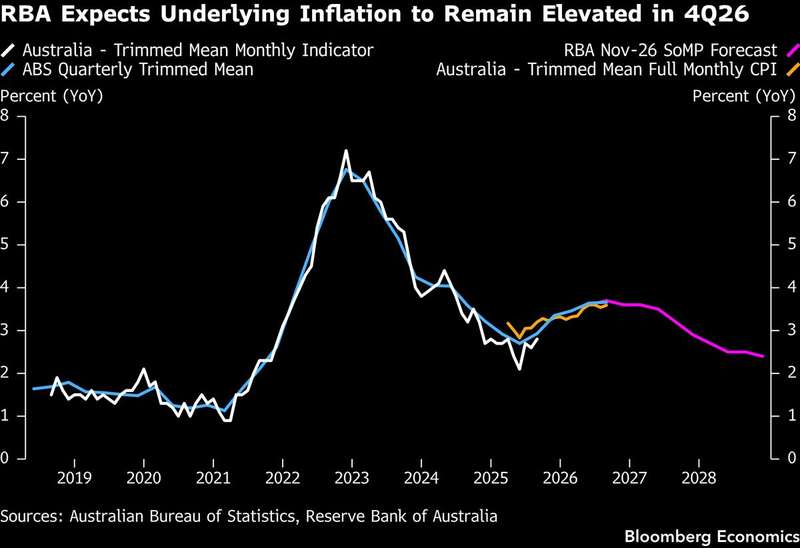
Australia's inflation is still rising while its jobs market cracks: October CPI is seen up to as much as 4.8% from 4.3% on a fuel surge, while the trimmed mean holds near 3.6%. The RBA hiked to 4.85% this month on a 6-3 vote and expects underlying inflation to come down only slowly. With unemployment at 4.9%, the market has moved to a cut in 2027; a hot print makes that harder to hold. Source: ABS, RBA, Bloomberg Economics.
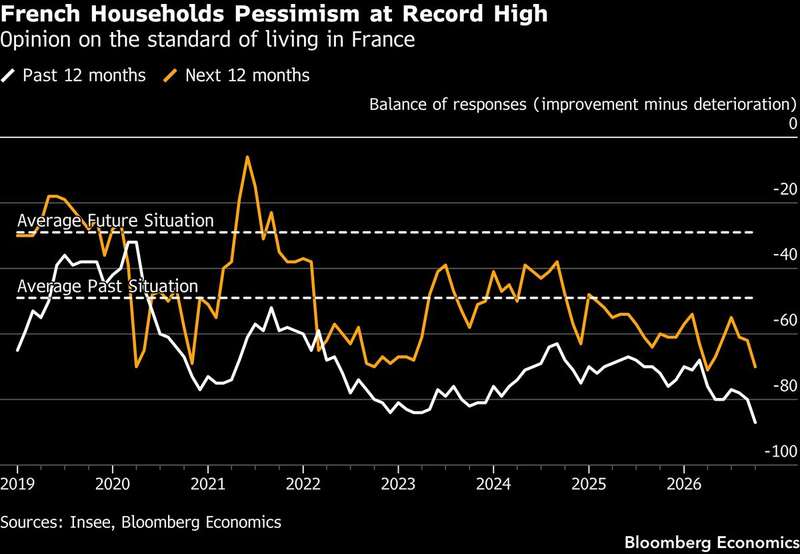
French households have never been gloomier: pessimism about living standards hit a record in October after the social unrest and the riots of 17 October. Consumption has held up by running down savings, rising 0.4% in the third quarter, and November's survey will show whether that cushion is wearing thin. Source: Insee, Bloomberg Economics.
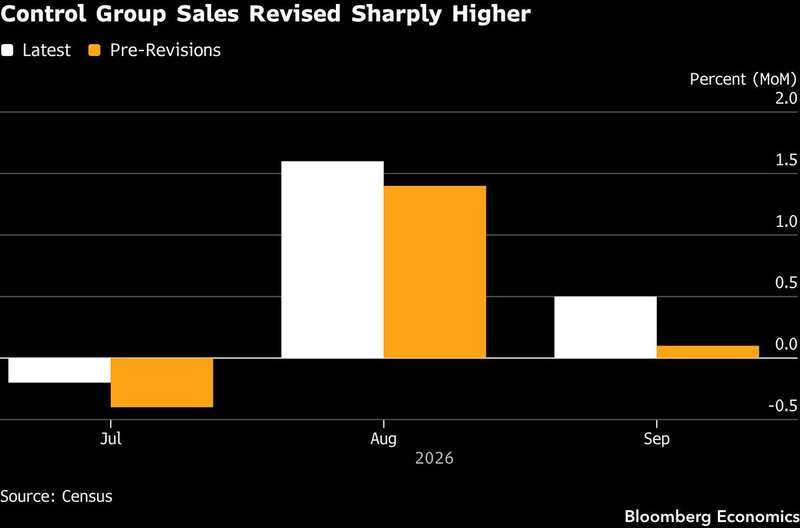
Third-quarter growth may be revised up: control-group sales for August and September were revised sharply higher, and they feed straight into consumption, so GDP is seen at 3.5% from 3.4%. A bigger drag from imported computers is offset by equipment investment. Growth is not the Fed's problem; inflation is. Source: Census, Bloomberg Economics.
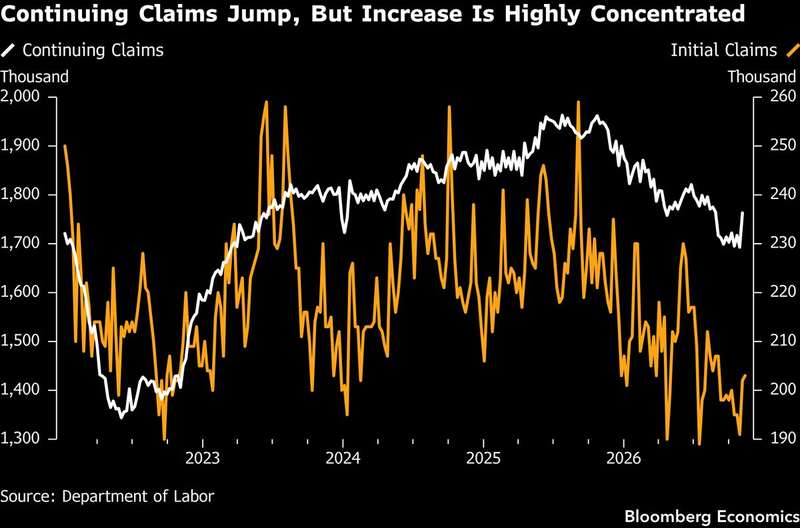
Continuing claims jumped, but mostly in one state: Michigan accounted for 39,000 of the 43,000 unadjusted rise in the week to 7 November. Initial claims, seen near 200,000 and moved to Wednesday by the holiday, still point to very few layoffs, though last week's 203,000 was above forecast. Source: Department of Labor, Bloomberg Economics.
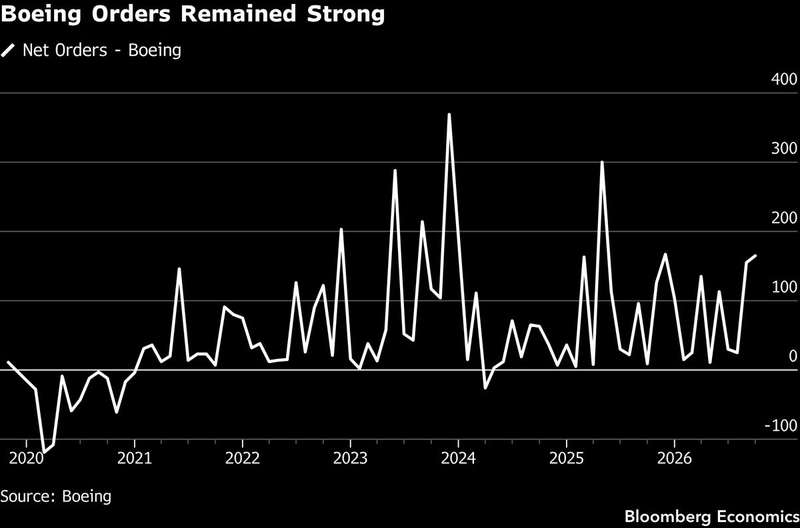
Boeing's orders are strong but concentrated: 165 net orders in October, but 140 of them came from a single lessor, Avolon. Durable goods are seen up about 0.5%; core capital goods are the better read on business investment. October's orders came before the midterms, so they say nothing yet about what the Democrats' win does to investment plans. Source: Boeing, Bloomberg Economics.
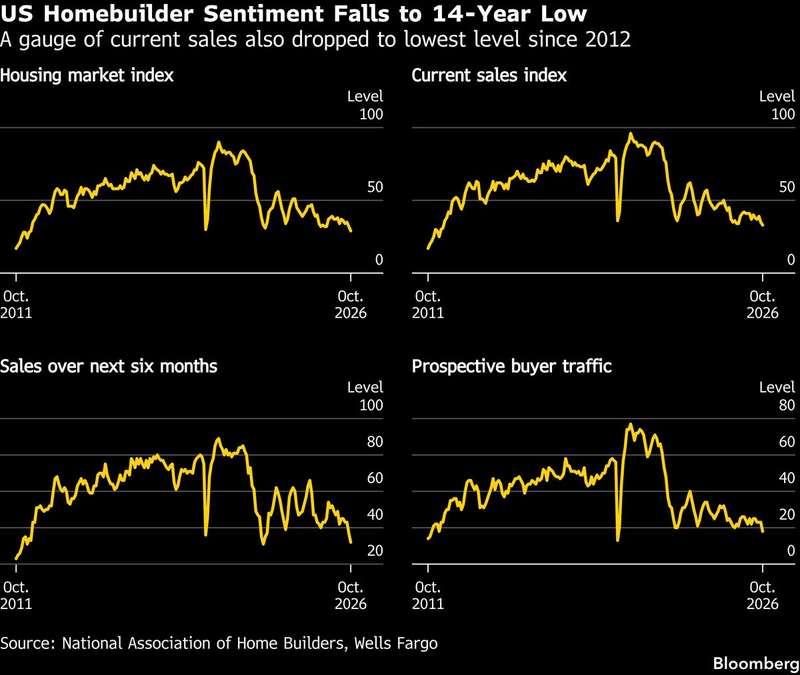
Homebuilders are at their gloomiest in 14 years: 68% of builders are offering incentives and 46% have cut prices, both post-Covid highs, and new home sales are seen falling to about 650,000. Builders can still buy down mortgage rates, which is why new homes have held up better than existing ones, but the margin to do it is shrinking. Source: NAHB, Wells Fargo, Bloomberg.
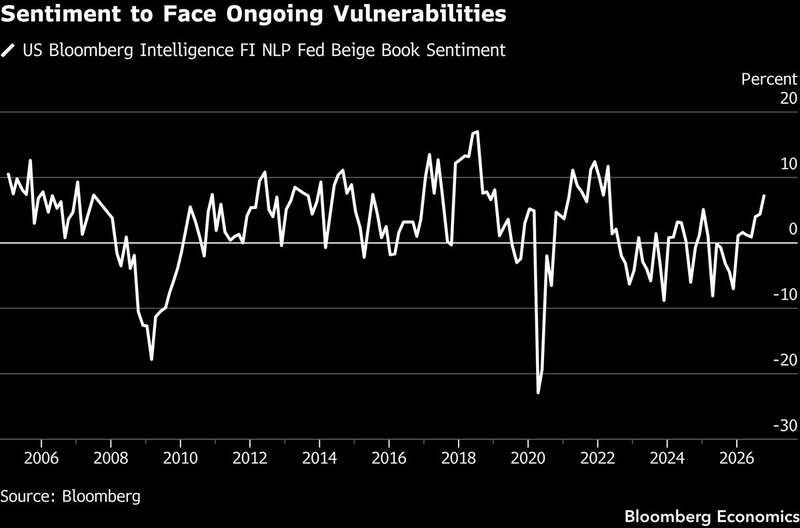
The Beige Book will read better than the market feels: regional sentiment has recovered to slightly positive, with higher-income households carrying spending and lower-income ones more careful with prices. Firms are turning to AI and automation to limit hiring. Released at 3am our time, it is the Fed's last word before Thanksgiving. Source: Bloomberg Intelligence, Bloomberg Economics.
Thursday: Korea hikes, the ECB explains, America gives thanks
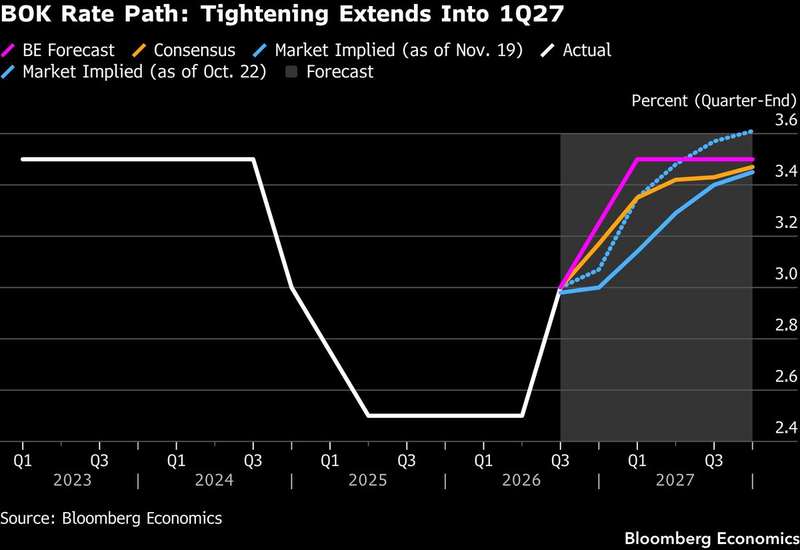
Korea's tightening runs into next year: the Bank of Korea is seen hiking 25bp to 3.25%, the third hike of this cycle, with another in February and its growth forecasts raised to about 4%. Samsung and SK hynix dividends and bonuses are spreading the chip boom into households. Market pricing has run ahead of the economists since October, so the risk on Thursday is a hike with softer guidance while the KOSPI falls. Source: Bloomberg Economics.
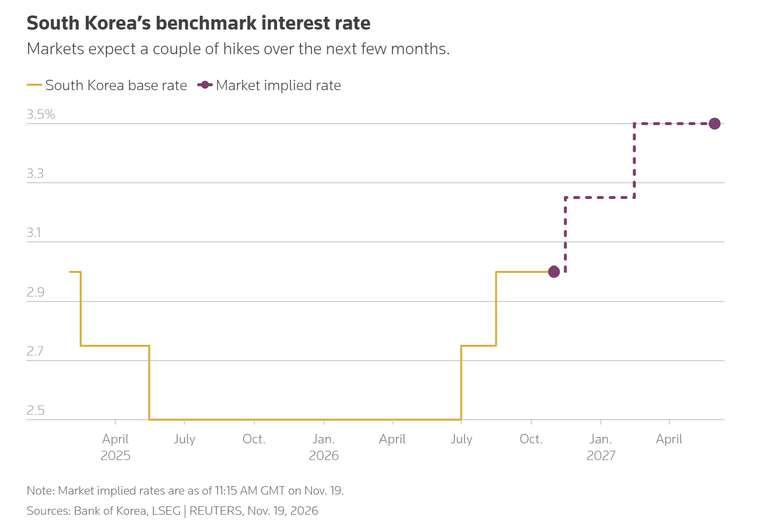
The market wants more than one: implied rates climb toward 3.5% by mid-2027. Korea's exports topped $1 trillion this year, only the fourth country to get there after Germany, the US and China, yet households feel little of it under high borrowing costs and wild stock swings. The KOSPI's 8% fall last week is the first test of how far the bank is willing to go. Source: Bank of Korea, LSEG, Reuters.
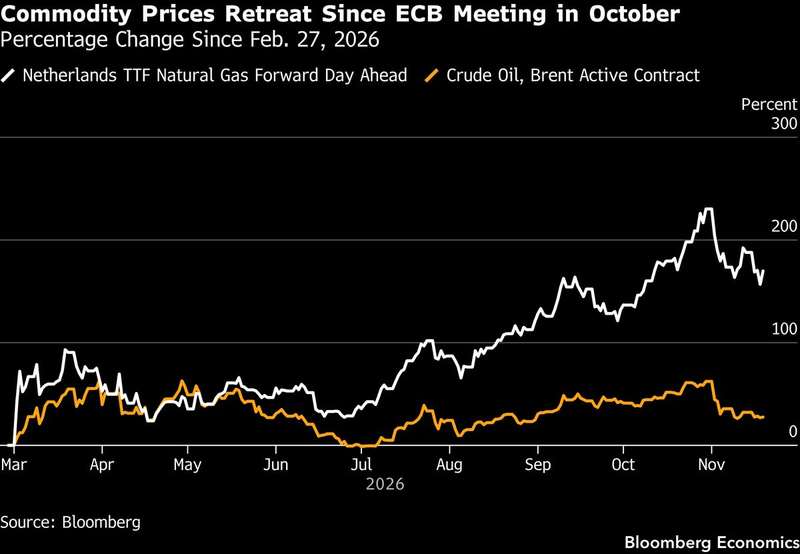
Commodities have given back much of the war premium since the ECB last met: Brent and Dutch gas have both fallen since the October meeting, easing the pressure to keep hiking in 2027. The account should confirm December, taking the deposit rate to 2.75%, which the ECB itself sees as slightly restrictive, and frame it as possibly the last move. Source: Bloomberg Economics.
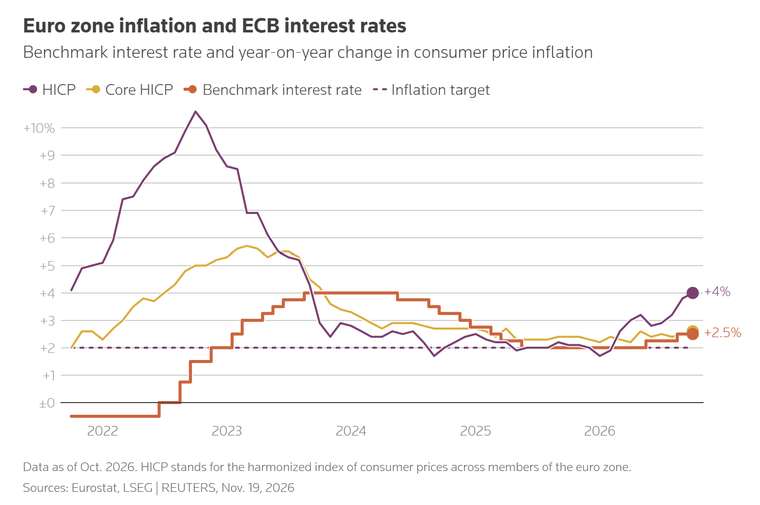
Euro inflation is back at 4%: the headline is about double the target with core at 2.5%, and the deposit rate is still 2.5%. Germany has backed Hernández de Cos to succeed Lagarde and proposed Markus Brunnermeier as chief economist, with France expected to take the other seat; the deadline for candidates moved to Friday. A more dovish president is one reason the market doubts how far the ECB goes after December. Source: Eurostat, LSEG, Reuters.
Friday: Tokyo's prices, China's profits and Black Friday
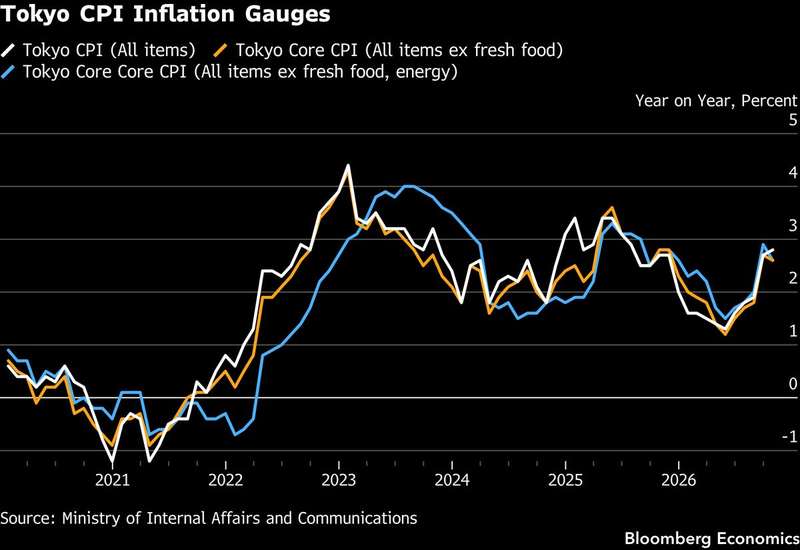
Tokyo's inflation is heading back to 3%: the headline is seen at 3.1% from 2.8% as utility subsidies roll back, with core near 2.8-2.9% and core-core holding near 2.6%, all above the BOJ's 2% target. One survey counted 1,477 food and drink price rises in November, ten times last November's. Tokyo leads the national figures due on 18 December, the day of the BOJ's decision. Source: Ministry of Internal Affairs and Communications, Bloomberg Economics.
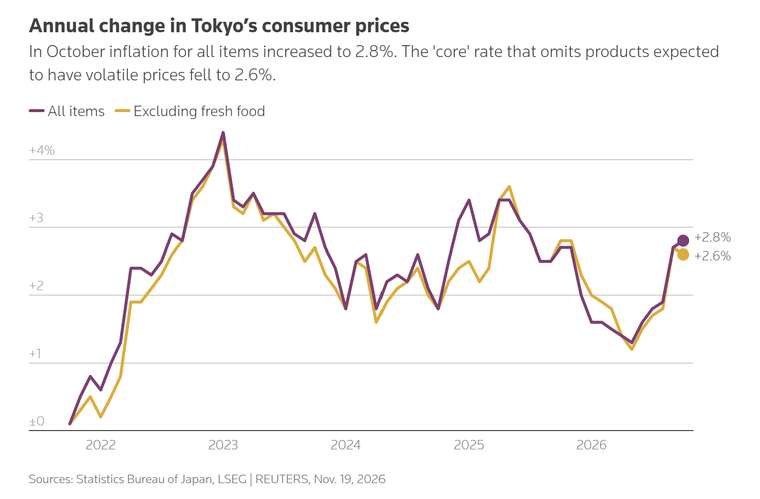
October was the first step back up: Tokyo's all-items inflation rose to 2.8% while core slipped to 2.6%. The BOJ held in October, and most economists now expect a third hike this year in December and another by March. With Japan shut on Monday and the yen near 158.5, Friday is the market's first clean read on the case for December. Source: Statistics Bureau of Japan, LSEG, Reuters.
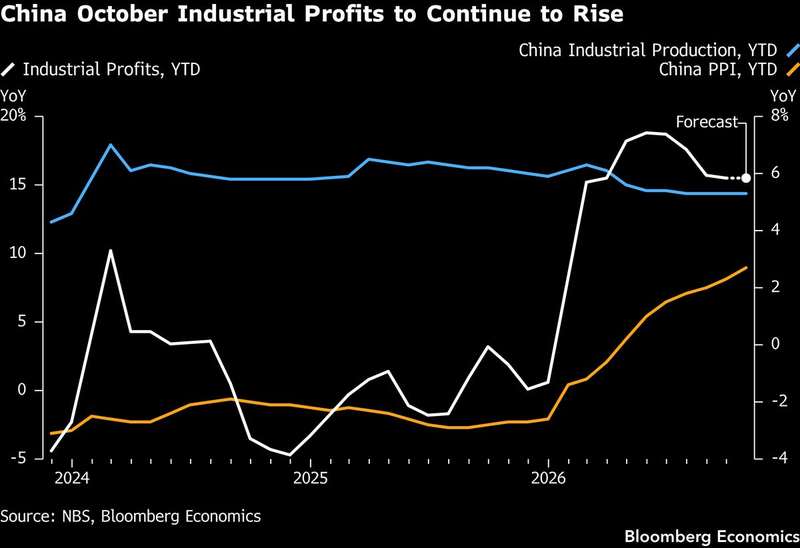
China's profits are up on prices, not volumes: factory-gate prices rose 5.7% in October on energy and AI hardware, while output growth slowed to 4.8%. Profits are seen up about 15.5% for the year so far, concentrated in electronics and upstream commodities, while carmakers, construction and consumer goods struggle. As commodities melt, that price support fades. Source: NBS, Bloomberg Economics.
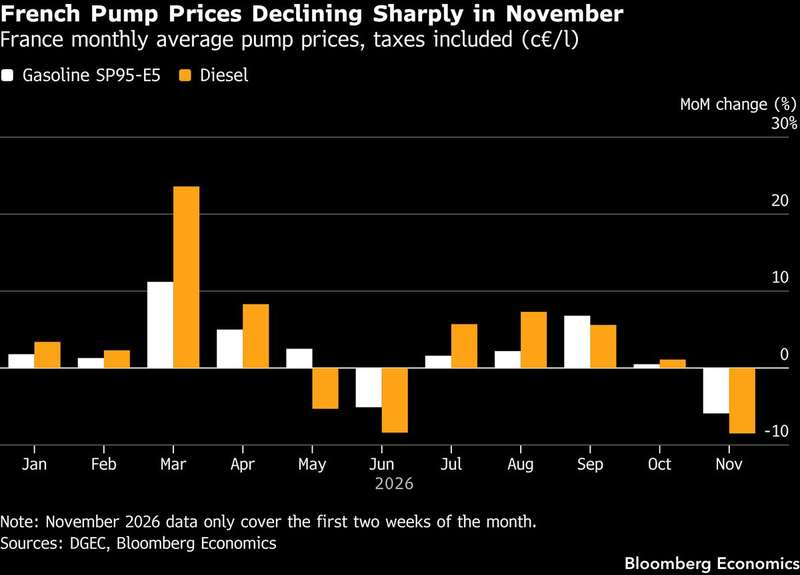
France's pump prices are falling fast: diesel is down sharply in November on cheaper crude and the release of 10 million barrels from strategic stocks, about two-thirds of a month of road diesel. French inflation is seen easing to 3.6% and Spain's to 4.7% from 4.9%, the first relief from the energy shock just as the ECB prepares its last hike. Source: DGEC, Bloomberg Economics.
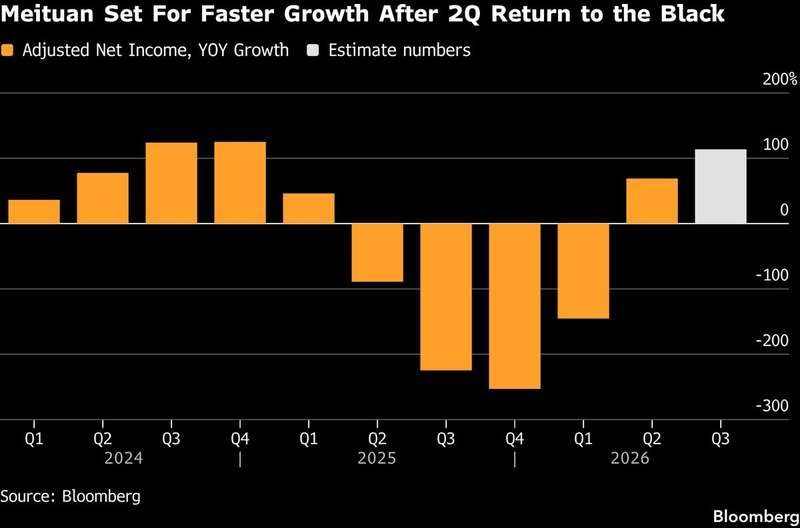
Meituan stays profitable after the price war: profit is expected to stay positive after last year's loss-making subsidy war, though below the prior quarter as it spends into year-end. A sharp slowdown in instant retail during Singles' Day suggests rivals are pulling back on subsidies, which helps Meituan most. China's consumer platforms are where the weakness at home shows first. Source: Bloomberg.
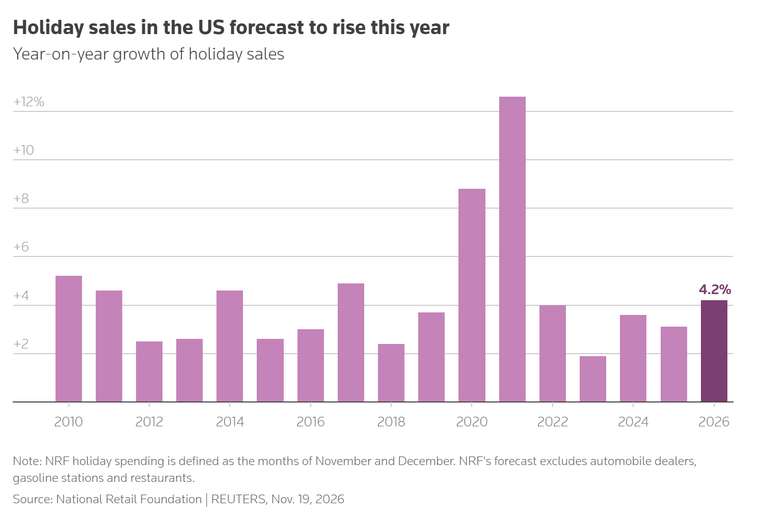
America is still expected to shop: the retail federation forecasts November and December sales up 4.2% to $1.013 trillion, and Target and TJX gave upbeat holiday outlooks last week. Walmart's chief says the consumer remains consistent and resilient, looking for value. Black Friday is the first test of whether a 12% fall in stocks reaches the tills. Source: National Retail Federation, Reuters.
Commodities: melting faster than tech
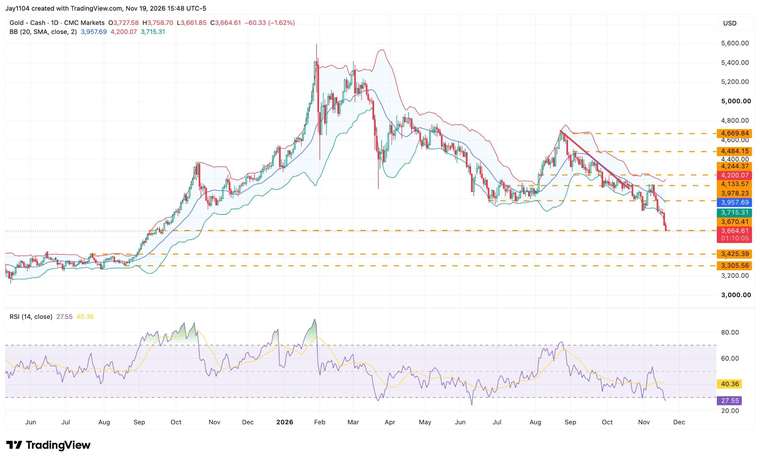
Gold is oversold with little support below $3,600: it trades below its lower Bollinger band with the RSI under 30, and a failure to hold $3,600 may open the way to $3,400. Friday's close near $3,520 says the line is already being tested. In a dash for cash you sell what you can, not what you want, and gold has been the asset people can sell. Source: TradingView.
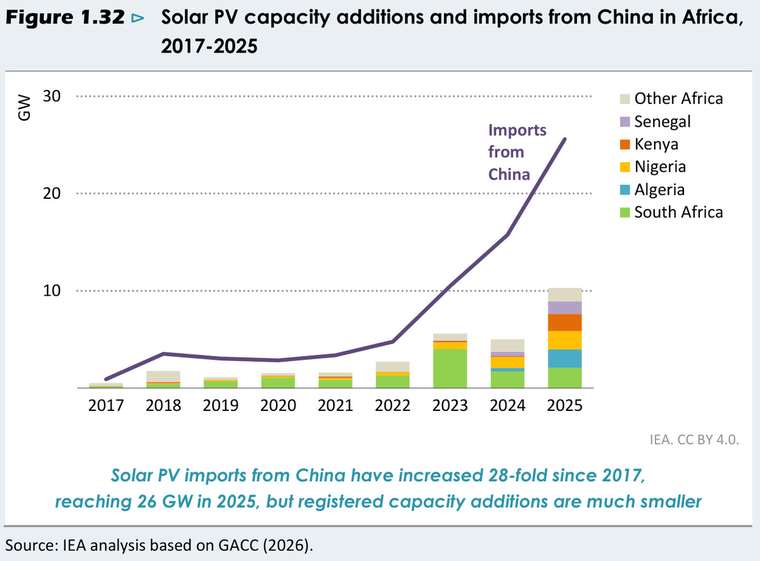
Africa imports far more Chinese solar than it officially installs: imports reached about 26 gigawatts in 2025 against 10 gigawatts recorded, and satellite imagery found more than half as much again at large solar farms as the official records show. Johannesburg's rooftop solar grew fivefold in five years. The world will spend $1.6 trillion on oil and gas imports this year, 25% more than in 2025, according to the IEA's outlook; the cheaper path is being built quietly. Source: IEA, via Visual Capitalist.
Europe: Russia at the door, China at the market
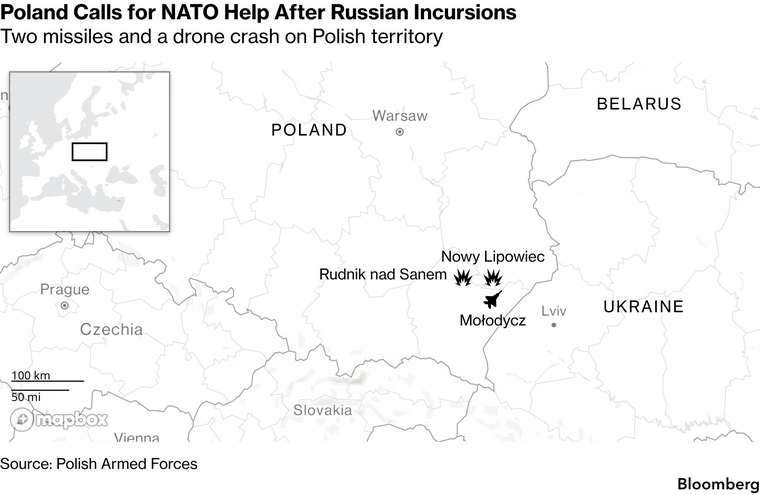
Two missiles and a drone fell in Poland during NATO drills: Tusk said it "doesn't look like an accident", and that it was no coincidence, with thousands of troops from 11 nations, including France and Britain, exercising nearby. Hours earlier Trump had left APEC calling Putin his friend who wants to end the war, as Russia launched one of its largest air attacks, more than 110 missiles and 400 drones. Poland has not invoked Article 4 and wants more help on NATO's eastern flank. Source: Polish Armed Forces, Bloomberg.
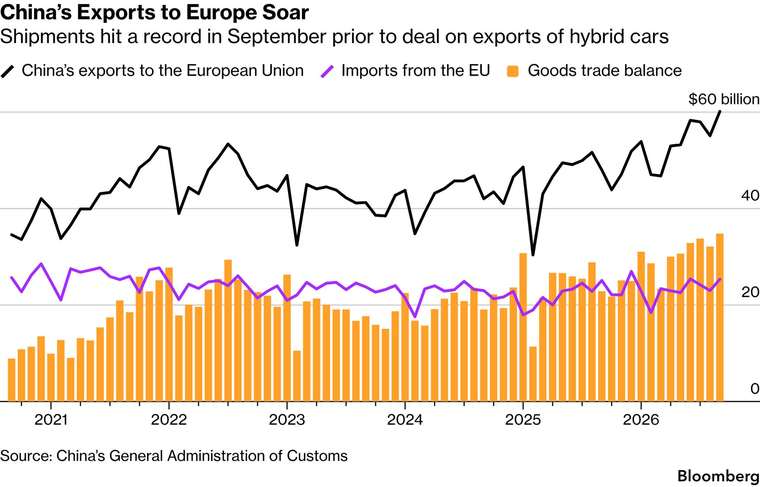
China's exports to the EU are at a record: shipments hit a high in September, ahead of a deal on hybrid cars, and the surplus keeps widening. Brussels is finalising a power to hit back at trade attacks from countries such as China, tentatively called ReadyEU, which would let it block goods and services from its market of 450 million consumers. Will a new US Congress that is warmer to Europe and tougher on China push Brussels to halt the growth of China's exports to Europe? Source: China's General Administration of Customs, Bloomberg.
North Korea: building while nobody calls
Trump tried to reach Kim Jong Un last year and nobody called back; a letter handed to a North Korean diplomat in Manhattan was later tossed, unopened, at a UN meeting. Kim calls denuclearisation "a nuclear fantasy" and has bought protection from Russia and China. The Wall Street Journal has the full story.
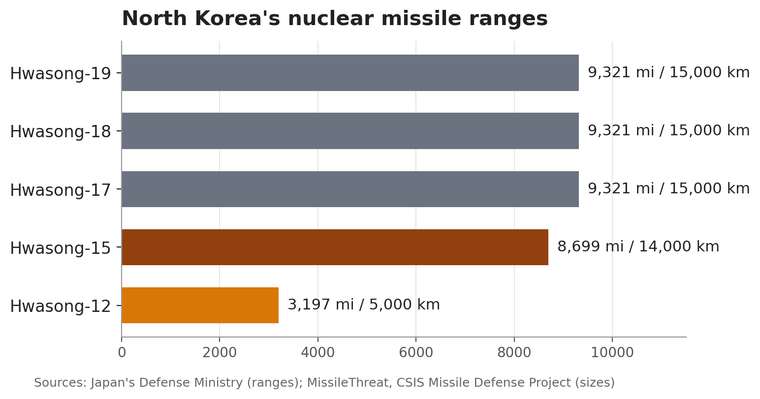
Every long-range missile in the arsenal can reach the US mainland: the Hwasong-15, 17, 18 and 19 reach 14,000-15,000 km, and a new Hwasong-20 may have been shown at the October 2025 parade. Since 2022 Pyongyang has made about 100 launches of more than 50 missile types. Source: Japan's Defense Ministry, MissileThreat, CSIS.
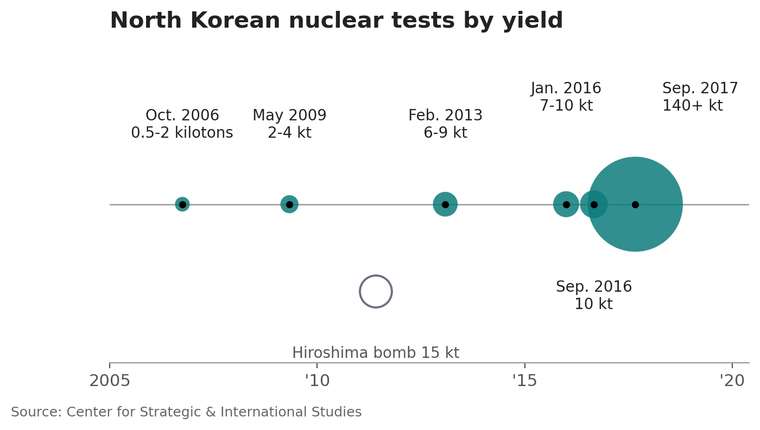
The tests have grown a hundredfold: from under 2 kilotons in 2006 to 140 or more in September 2017, against Hiroshima's 15. Estimates put the arsenal at 60-70 weapons with material for more than 100. A seventh test would land in a lame-duck year with no channel to Washington. Source: CSIS.
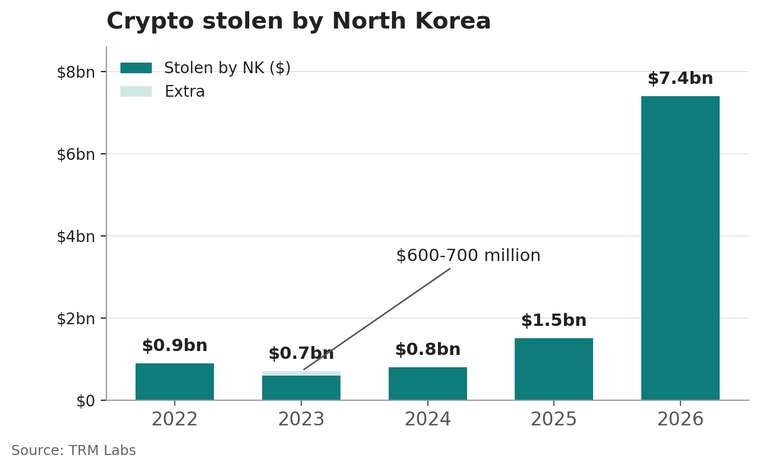
Crypto theft pays for it: North Korea stole a record $7.4 billion this year by one count, after $1.5 billion in 2025, which included the Bybit hack, the largest crypto theft ever. It is the same cyber capability that now worries the banks. Trump has met Kim three times and still wants a fourth meeting. Source: TRM Labs.
America at Thanksgiving: who has something to be thankful for
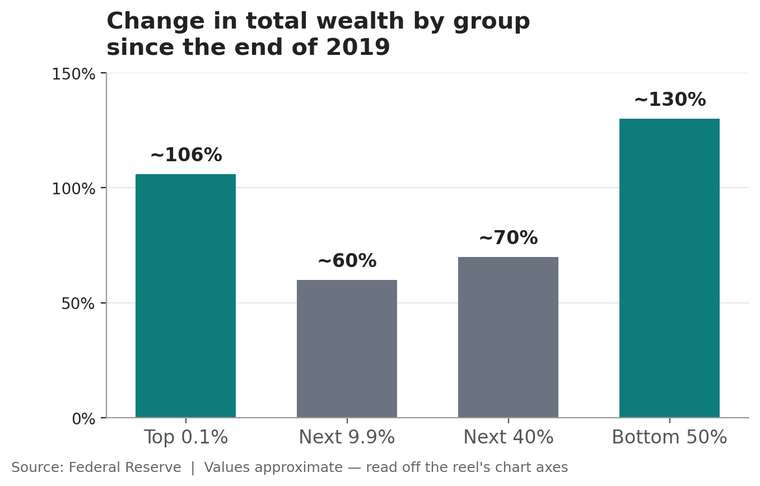
The richest gained the most since 2019, by far, in dollars: the top 0.1% added about $14.5 trillion, more than doubling their wealth, including $4 trillion from the stock market in the year to June. The bottom half grew fastest in percentage terms, but from almost nothing: for every $1 of a bottom-half household, the merely rich hold $118 and the top 0.1% more than $3,000. The values are read off the WSJ's reel and are approximate. Source: Federal Reserve, The Wall Street Journal.
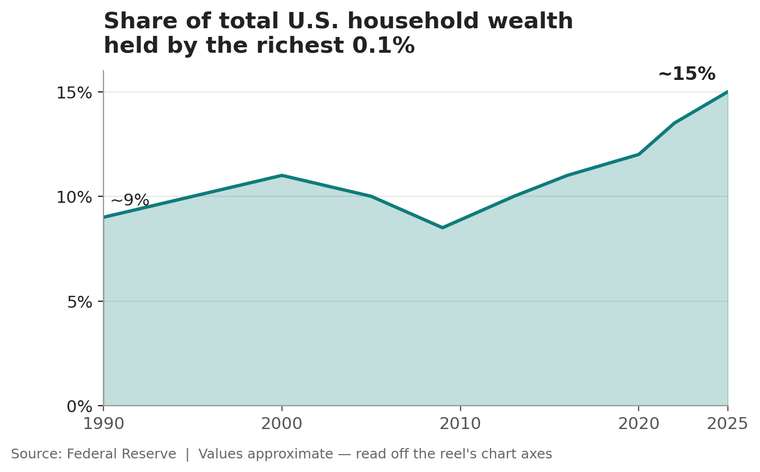
The top 0.1% now holds about 15% of America's wealth: up from about 9% in 1990, with average household wealth above $200 million. This year's gains came from the stock market, so last week's fall is the first dent in the top arm of the K-shaped economy. Who keeps spending when the richest feel poorer? Source: Federal Reserve, The Wall Street Journal.
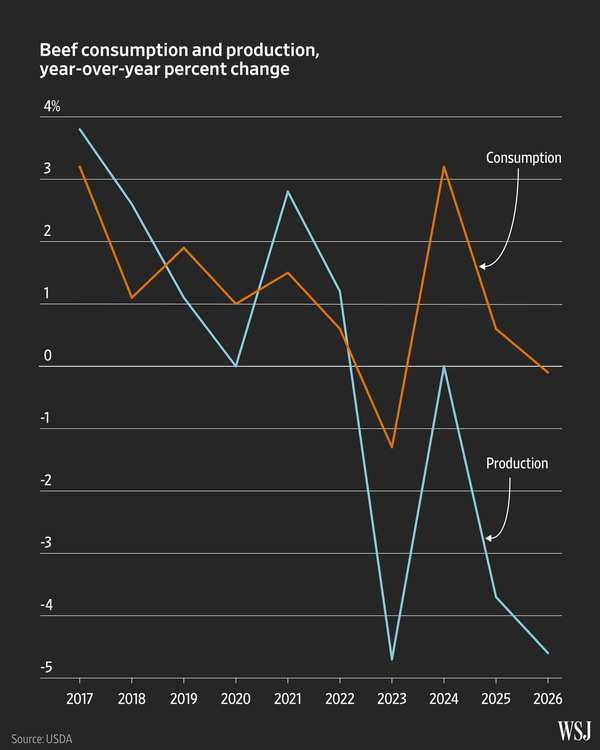
Beef prices are high and staying high: America's $100 billion beef industry is shrinking, with production falling faster than consumption, and one auctioneer says they will "be lucky to start gaining cattle in four years." Packers are losing billions and closing plants, and fear of cheap imports keeps ranchers from rebuilding herds. The Wall Street Journal explains why. The turkey is the cheap part of this year's Thanksgiving table. Source: USDA, The Wall Street Journal.
Visual Capitalist: The Geography of Opportunity
This week's special dispatch asks where peace, the rule of law, skills and pay show up in people's working lives. The average Finnish wage buys about a third more than the Polish one, yet Poland has the stronger job market, with unemployment of 3.2% against Finland's 10.2%. Singapore appears near the top of several lists, for reasons worth knowing.
Infographic 1 - The Most and Least Peaceful Countries
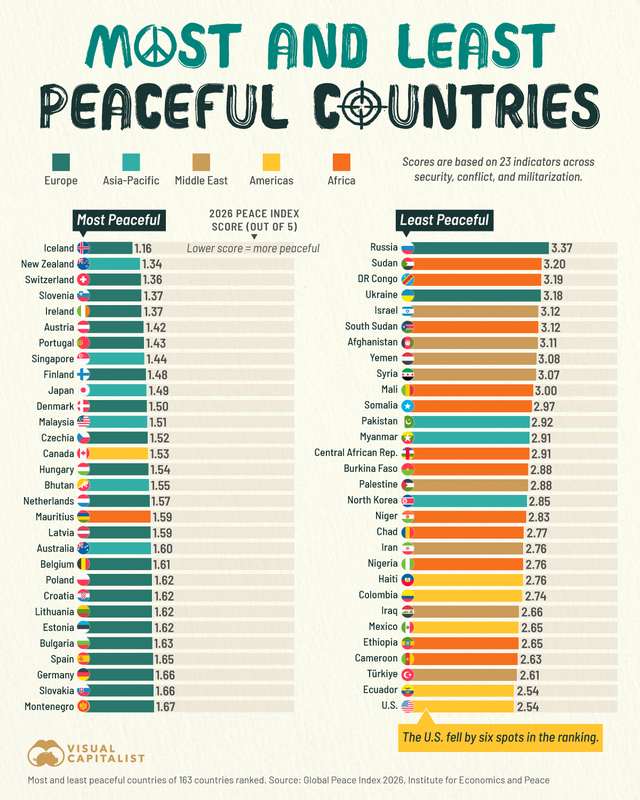
Seven of the ten most peaceful countries are in Europe, and so are two of the five least: Russia and Ukraine. New Zealand, Singapore and Japan take the other top-ten places. Since 2008 the 25 least peaceful countries have worsened by nearly 19% on average, and no country has ever climbed from the bottom quarter to the top. The US fell six places to 134th on political instability. See the ranking. Source: Visual Capitalist.
Infographic 2 - How Countries Rank on Rule of Law
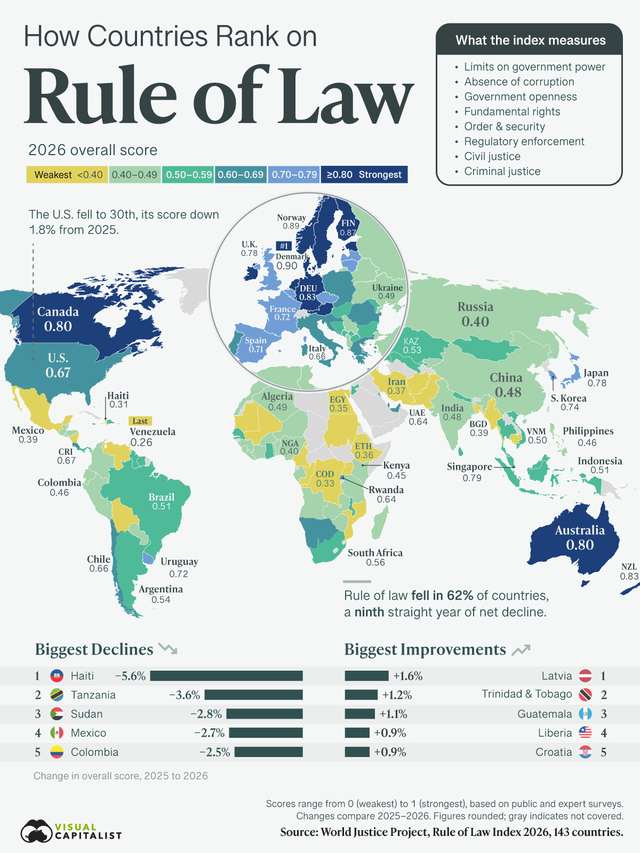
Canada ranks 13th for the rule of law, the US 30th and Mexico 125th: Canada scores well ahead on whether officials face penalties for misconduct and whether courts are free of government influence, though US civil courts are quicker. The Nordics take the top four places, and courts lost ground against government power in nearly two-thirds of the countries surveyed. See the map. Source: Visual Capitalist.
Infographic 3 - Safest Countries for Investors
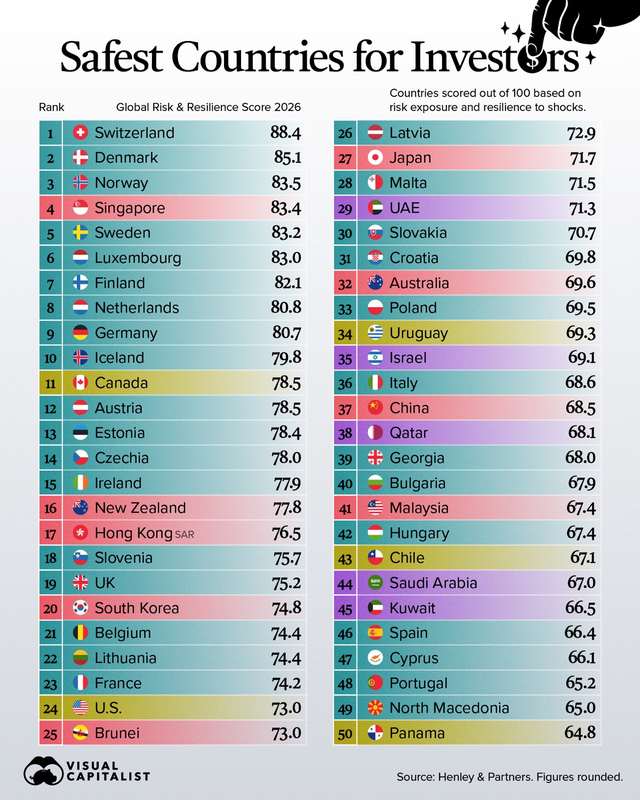
Singapore ranks fourth for investors although its government owes more than the country produces in a year: the debt funds investments through the national savings scheme, and the government's financial assets exceed all its debts, so it scored the maximum for its ability to fund a recovery. Europe takes nine of the top ten, led by Switzerland at 88.4. See the ranking. Source: Visual Capitalist.
Infographic 4 - Global Innovation Index 2026
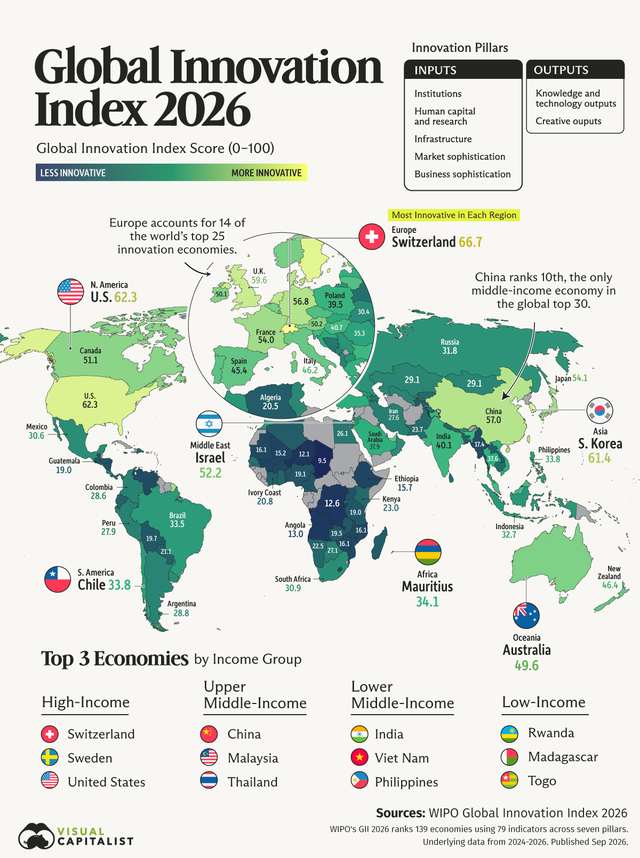
China is the only middle-income economy among the 30 most innovative, in tenth place: 22nd on inputs such as research, but fifth on outputs such as patents and high-tech exports. Vietnam ranks 43rd overall yet first for high-tech exports as a share of trade, though foreign firms make up to 85% of its electronics exports and much of the design work happens elsewhere. See the map. Source: Visual Capitalist.
Infographic 5 - The Countries Best at Computing and Logic
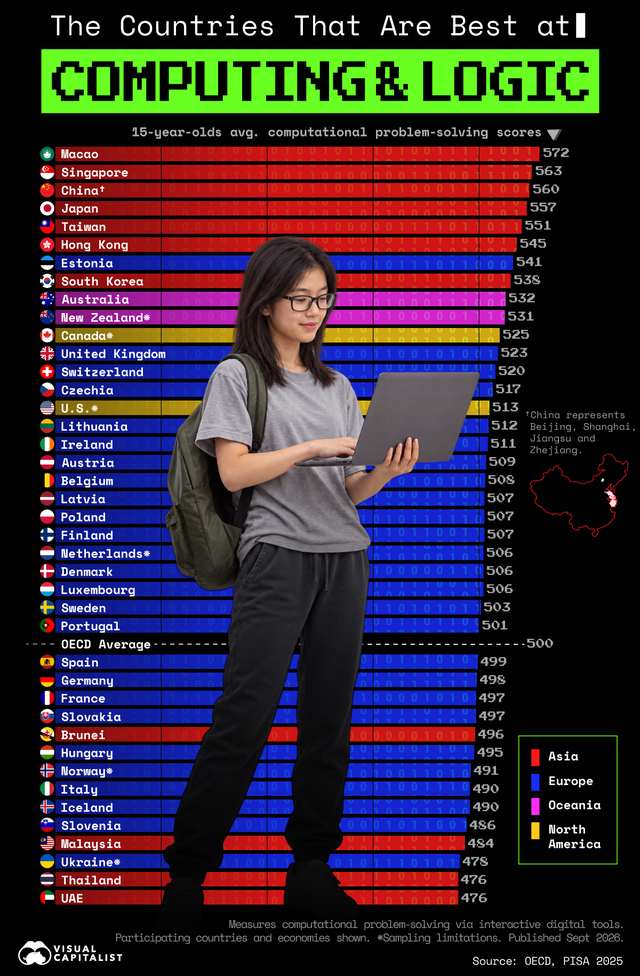
The six best scores on the OECD's computing test for 15-year-olds came from Asia: Macao is clearly ahead, with Singapore second and the mainland, which tested only Beijing, Shanghai, Jiangsu and Zhejiang, third. Estonia, where children start coding in kindergarten with small programmable robots, placed seventh, 15 places ahead of neighbouring Finland. See the ranking. Source: Visual Capitalist.
Infographic 6 - Where AI Talent Is Moving
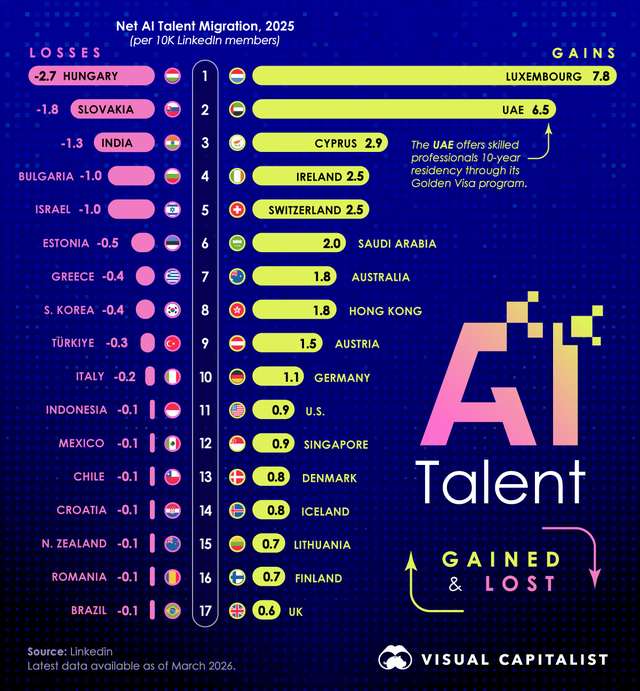
Luxembourg and the UAE are the magnets for AI specialists: the UAE gained about 6.5 per 10,000 LinkedIn members last year, more than double third-placed Cyprus, while the US gained under one. India loses specialists at the third-fastest rate even as its share of members with AI skills more than doubled since 2019. See the ranking. Source: Visual Capitalist.
Infographic 7 - Unemployment Rates Around the World
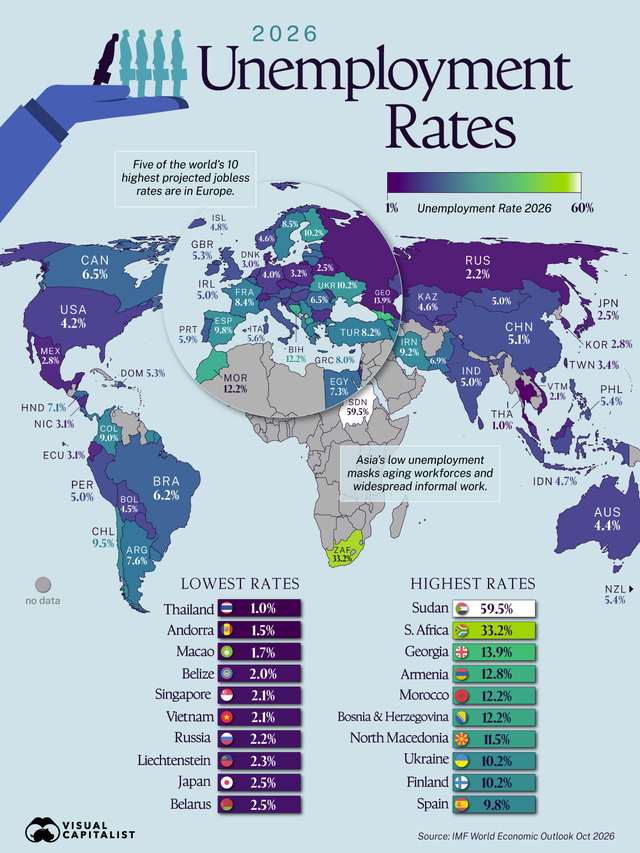
Five of the ten highest unemployment rates on the IMF's map are in Europe: Finland's at 10.2% among them, more than triple Poland's 3.2%, on weak demand and a long construction slump. In South Africa one in three is out of work, and in war-torn Sudan nearly three in five. Asia's low rates mask ageing workforces and large informal economies. See the map. Source: Visual Capitalist.
Infographic 8 - Wage Growth in Major Countries
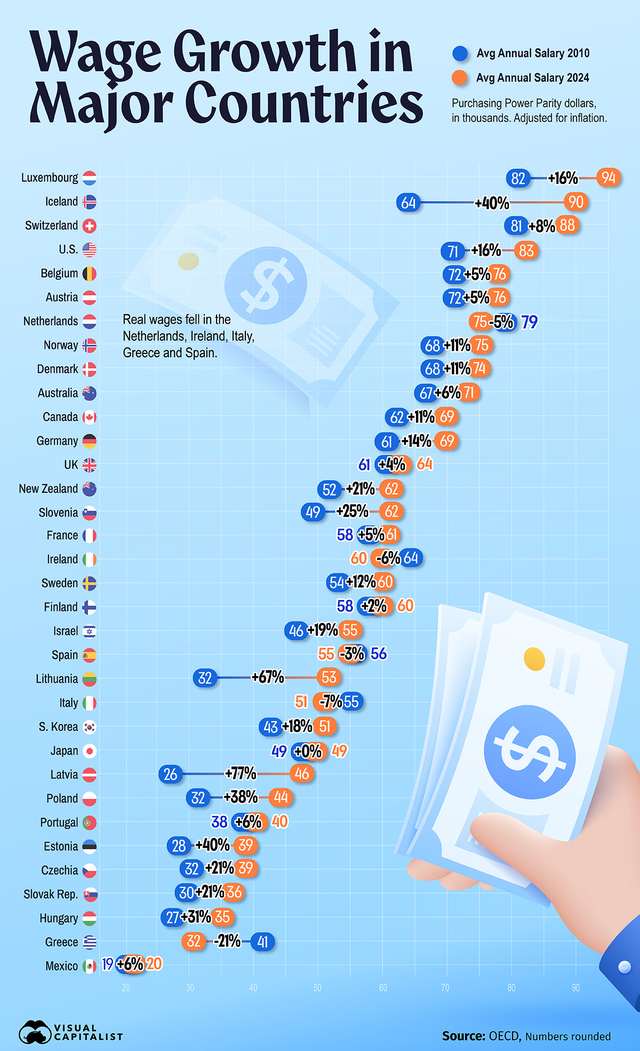
Latvia overtook Greece on pay: in 2010 the average Greek wage bought nearly 60% more than the Latvian one; by 2024 the Latvian wage bought about 40% more, after real pay rose 77%, the most in the comparison, while Greek wages lost a fifth of their buying power. See the chart. Source: Visual Capitalist.
Infographic 9 - 30 Years of Global Income Change
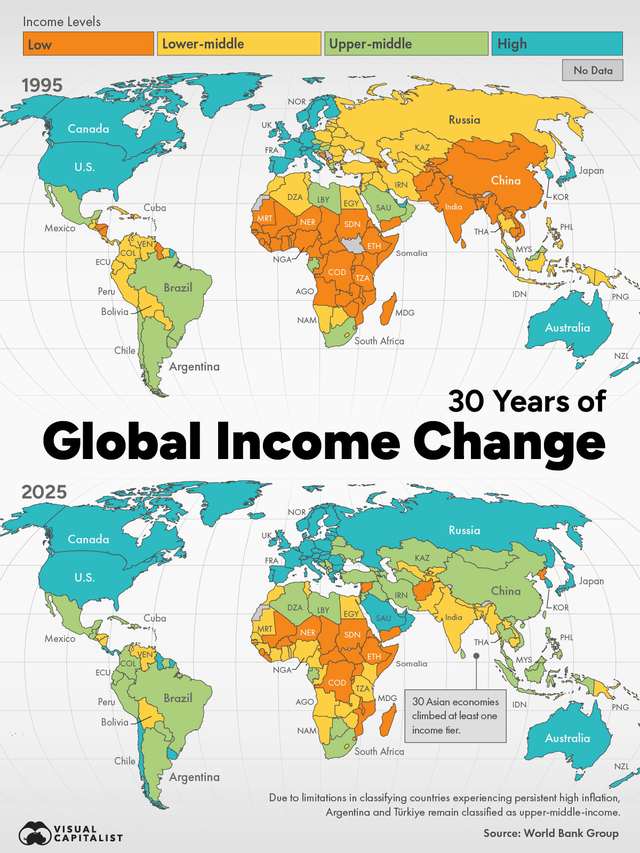
Thirty Asian economies climbed at least one World Bank income tier since 1995: China and Vietnam rose two tiers and India one, while Latvia, Lithuania and Poland went from lower-middle to high income. Guyana crossed all three thresholds, reaching high income less than four years after its offshore oil began to flow in 2019. See the map. Source: Visual Capitalist.
Infographic 10 - The World's Most Prosperous Countries
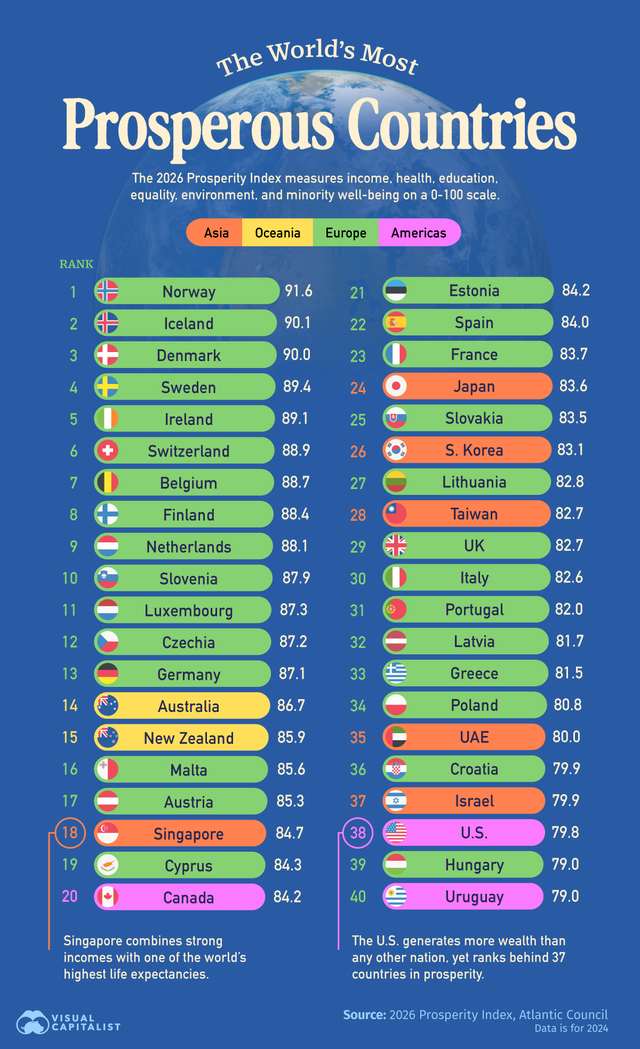
Norway leads the prosperity ranking, Singapore is 18th and the US 38th: Norway invests its oil revenue in a sovereign fund and draws only the expected long-term return, so services survive an oil slump. The index weighs health, education, environment and equality, which is why Slovenia ranks tenth, above Germany, and Canadians live about three years longer than Americans. See the ranking. Source: Visual Capitalist.
The Good Wrap

1,457 rivers on one map: Dominic Royé's interactive traces the shapes of the world's rivers, from the Amazon and the Nile to the Yangtze and the Mississippi. One of the coolest infographics I have seen this year; click around with your children if you can. Source: Dominic Royé, via Visual Capitalist.
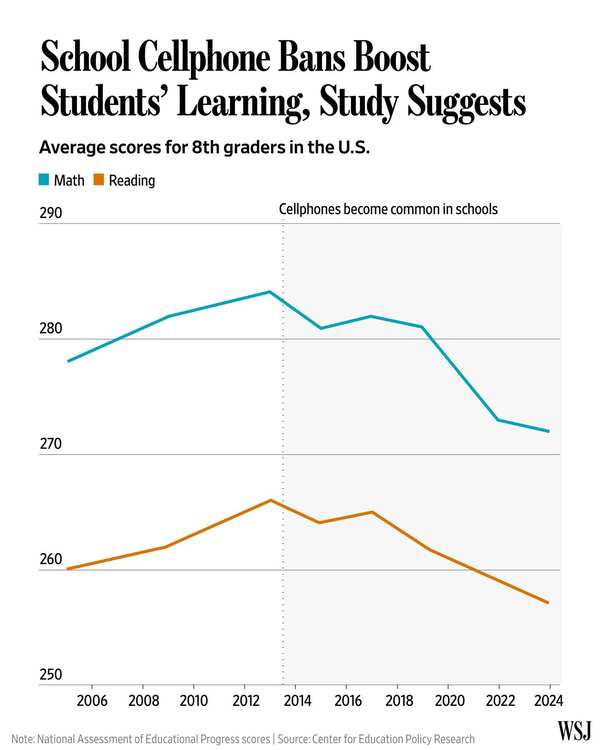
Locking phones away in class works: a Harvard study finds students in schools that put phones in lockable pouches gained the equivalent of one to two weeks of extra learning a year. Eighth-grade maths and reading scores have fallen since phones became common in schools around 2013, and about 77% of US public schools now ban them in class. The Wall Street Journal has the research. Source: Center for Education Policy Research, The Wall Street Journal.
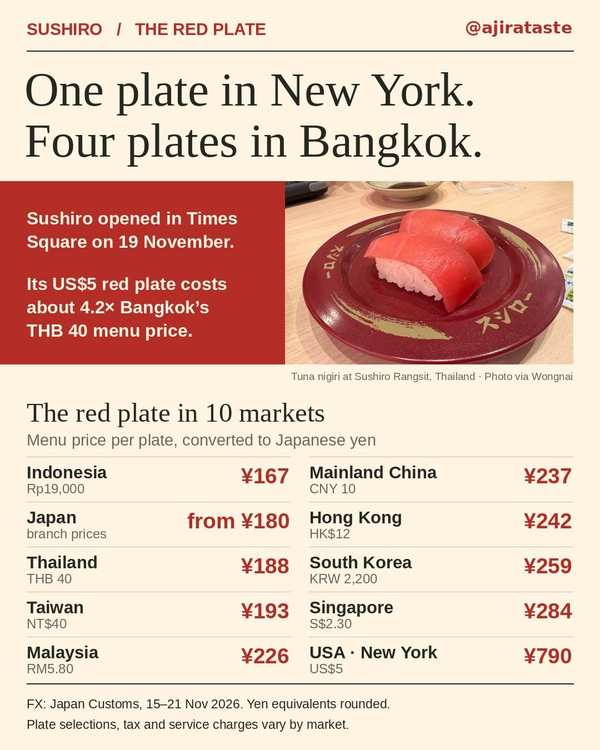
One red plate in New York costs more than four in Bangkok: Sushiro opened in Times Square on 19 November with a US$5 red plate, about ¥790, and no tip to add; four plates in Bangkok cost ¥752, and Indonesia's is the cheapest at about ¥167, below Japan's ¥180. Ajira compared all ten markets. A plate of tuna nigiri makes an honest purchasing-power index, and this one says what the currency market said last week: the dollar is very strong, and the rupiah very cheap. Source: Japan Customs, @ajirataste.
Best,
Hoelon
WITPTW is a personal publication. Everything here is personal opinion and market commentary, written in a personal capacity. It is not investment advice and not a recommendation to buy or sell any security. It is not associated with, endorsed by, or representative of any employer, fund or company. Charts and images are reproduced from their original publishers, credited to their sources for commentary and discussion; all rights remain with the respective copyright holders.